Bayard Rustin Challenged Progressive Orthodoxies

Of interest, a progressive who challenged progressive orthodoxies:

Bayard Rustin, a trusted adviser to Martin Luther King Jr. and chief organizer of the 1963 March on Washington, was a towering figure in the fight for racial equality. Remarkably for a man of his generation and public standing, he was also openly gay. When Mr. Rustin died in 1987, obituaries downplayed or elided this fact. Emblematic of this erasure was this paper, which made only passing mention of his homosexuality and obliquely described Mr. Rustin’s longtime partner as his “administrative assistant and adopted son.”

In the decade since President Barack Obama awarded him a posthumous Presidential Medal of Freedom, the country’s highest civilian honor, there has been a welcome resurgence of popular interest in Mr. Rustin’s extraordinary life. He was frequentlyinvoked in commemorations of the march’s 60th anniversary last month and will be the subject of a feature film produced by Barack and Michelle Obama’s company that will come out later this year.

Whereas remembrances of Mr. Rustin once evaded the issue of his sexual orientation, today, in accordance with our growing acceptance of gay people and awareness of the discrimination they have faced, such tributes are likely to center it. This past June, for instance, the PBS NewsHour aired a segment for Pride Month titled “The story of Bayard Rustin, openly gay leader in the civil rights movement.” Other representative encomiums celebrate the “gay socialist pacifist who planned the 1963 March on Washington”and “the gay black pacifist at the heart of the March on Washington.”

Mr. Rustin is today often extolled as an avatar of “intersectionality,” a theoretical framework popular among progressives that emphasizes the role that identities play in compounding oppression against individuals from marginalized groups. While it’s admirable that Mr. Rustin is being recognized for something he never denied (according to one associate, he “never knew there was a closet to go into”), these tributes studiously ignore another aspect of his life: how, throughout his later career, Mr. Rustin repeatedly challenged progressive orthodoxies.

Mr. Rustin, who was characterized by The Times in 1969 as “A Strategist Without a Movement” and, upon his death, an “Analyst Without Power Base,” would most likely find himself no less politically homeless were he alive today. A universalist who believed that “there is no possibility for black people making progress if we emphasize only race,” he would bristle at the current penchant for identity politics. An integrationist who scoffed at how“Stokely Carmichael can come back to the United States and demand (and receive) $2,500 a lecture for telling white people how they stink,” he would shake his head at an estimated $3.4 billion diversity, equity and inclusion industry that often prioritizes making individual white people feel guilty for the crimes of their ancestors while ignoring the growing class divide. A pragmatist who noted, “There is a strong moralistic strain in the civil rights movement which would remind us that power corrupts, forgetting that the absence of power also corrupts,” he would have no patience for social justice activists unwilling to compromise. And a committed Zionist — supportive of the state but likely critical of its government — he would abhor the Black Lives Matter stance on Israel and the recent spate of antisemitic outbursts by Black celebrities. Mr. Rustin’s resistance to party dogma is a neglected part of his legacy worth celebrating, an intellectual fearlessness liberals need to rediscover.

The origin of Mr. Rustin’s estrangement from the progressive consensus began with his belief that once federal civil rights legislation was achieved, the American left would need to turn its attention from racial discrimination to the much more pervasive problem of economic inequality. Four months after the march, Mr. Rustin was invited to deliver a speech at Howard University to the Student Nonviolent Coordinating Committee. According to the Times account, Mr. Rustin “said that the civil rights movement had gone as far as it could with its original approach and that the time had come to broaden the movement, which, he said, faces the danger of degenerating into a sterile sectarianism.” To avoid this fate, he argued, it must “include all depressed and underprivileged minority groups if their own movement is to make another leap forward.” Deriding direct-action protest tactics as mere “gimmicks,” Mr. Rustin counseled the young activists that “Heroism and ability to go to jail should not be substituted for an overall social reform program … that will not only help the Negroes but one that will help all Americans.”

Mr. Rustin expanded upon this analysis in a seminal 1965 Commentary magazine essay, “From Protest to Politics.” Published after the passage of the Civil Rights Act and several months before the signing into law of the Voting Rights Act, Mr. Rustin argued that the main barrier to Black advancement in the United States would soon no longer be racism but poverty. “At issue, after all, is not civil rights, strictly speaking,” he wrote, “but social and economic conditions” that transcended race. The problems facing Black America, therefore, needed to be seen as the “result of the total society’s failure to meet not only the Negro’s needs, but human needs generally.” A stalwart social democrat, Mr. Rustin argued that meeting these needs required a coalition of “Negroes, trade unionists, liberals, and religious groups” to push the Democratic Party to the left on economic issues.

Sectarian appeals based solely on race — whether from white segregationists or Black nationalists — threatened this aim. In May 1966, the moderate integrationist John Lewis was ousted from the chairmanship of SNCC by the Black Power radical Stokely Carmichael. Mr. Rustin responded with another Commentary essay, “‘Black Power’ and Coalition Politics.” Black Power, he wrote, was “simultaneously utopian and reactionary” as it “would give priority to the issue of race precisely at a time when the fundamental questions facing the Negro and American society alike are economic and social.” At a time when the Democratic Party is losing the support of working-class Americans of all races, this component of Mr. Rustin’s legacy is as important as ever.

Committed to a political program that would improve the lives of the poor and working class regardless of their skin color, Mr. Rustin opposed racial preferences . In 1969, he called a proposal for slavery reparations “preposterous,” elaborating that “if my great-grandfather picked cotton for 50 years, then he may deserve some money, but he’s dead and gone and nobody owes me anything.” Worse than a point of personal pride was the way in which the call for reparations divided the multiracial working class. As a “purely racial demand,” Mr. Rustin contended, “its effect must be to isolate blacks from the white poor with whom they have common economic interests.”

Testifying before Congress in 1974 against affirmative action, Mr. Rustin said: “Everyone knows racial discrimination still exists. But the high rate of black unemployment and the reversal of hard-won economic gains is not the result of discrimination,” but of the same, general economic conditions that affected the white unemployed. Contrary to contemporary “antiracism” advocates who claim that the existence of racial disparities necessarily constitutes evidence of racism, Mr. Rustin asserted, “That blacks are underrepresented in a particular profession does not by itself constitute racial discrimination.”

Another major source of tension between Mr. Rustin and the progressive left concerned American foreign policy. Briefly a member of the Young Communist League in the 1930s, Mr. Rustin followed the path of many a disillusioned ex-Communist by becoming a staunch anti-Communist. Although an early opponent of American military involvement in Vietnam, Mr. Rustin could not, as he wrote in 1967, “go along with those who favor immediate U.S. withdrawal, or who absolve Hanoi and the Vietcong from all guilt. A military takeover by those forces would impose a totalitarian regime on South Vietnam and there is no doubt in my mind that the regime would wipe out independent democratic elements in the country.”

In his role as chairman of Social Democrats, USA, the more hawkish faction to emerge from a split within the Socialist Party of America over the Vietnam War, Mr. Rustin was an outspoken critic of the Soviet Union and international Communism. He declined to endorse Democratic Senator George McGovern’s antiwar presidential candidacy in 1972 and joined other hawks in forming the Coalition for a Democratic Majority, an initiative to oppose the Democratic Party’s leftward lurch, becoming its vice chair. In the 1976 Democratic presidential primary, Mr. Rustin supported Senator Scoop Jackson of Washington, whose decades-long career combined strong support for civil rights and social welfarism at home with robust anti-Communism abroad.

Mr. Rustin’s evolution from absolute pacifist (epitomized by the two years he spent in a federal penitentiary during World War II as a conscientious objector) to Cold War liberal dismayed many of his allies on the left, who accused him of betraying the principles of Gandhian nonviolence he had brought to the civil rights movement. But Mr. Rustin’s transformation was born of long deliberation and genuine conviction; according to one biographer, Mr. Rustin repeatedly said that if he had been aware of the Holocaust during World War II, he most likely would not have become a conscientious objector.

If Mr. Rustin’s erstwhile comrades considered him a sellout, so too was he disillusioned with a political camp that posited a moral equivalence between the United States and its Soviet adversary. “Whereas I used to believe that pacifism had a political value, I no longer believe that,” Mr. Rustin stated flatly in 1983. “It is ridiculous, in my view, to talk only about peace. There is something which is more valuable to people than peace. And that is freedom.”

Yet another source of antagonism between Mr. Rustin and the left was his outspoken opposition to antisemitism within the Black community and fervent support for the state of Israel. “So far as Negroes are concerned,” he wrote in 1967, responding to an eruption of antisemitic statements by radical Black activists, “one of the more unprofitable strategies we could ever adopt is now to join in history’s oldest and most shameful witch hunt, antisemitism.” The following year, in an address to the Anti-Defamation League, Mr. Rustin condemned “young Negroes spouting material directly from ‘Mein Kampf.’” In 1975, as the United Nations General Assembly was preparing its infamous resolution condemning Zionism as a “form of racism,” Mr. Rustin assembled a group of African American luminaries including A. Philip Randolph, Arthur Ashe and Ralph Ellison into the Black Americans to Support Israel Committee (BASIC). “Since Israel is a democratic state surrounded by essentially undemocratic states which have sworn her destruction, those interested in democracy everywhere must support Israel’s existence,” he declared.

A descendant of slaves who was himself a victim of brutally violent racism, Mr. Rustin never let his country’s many sins overshadow his belief in its capacity for positive change. His patriotism was unfashionable among progressives while he was alive and is even more exceptional today. “I have seen much suffering in this country,” he said. “Yet despite all this, I can confidently assert that I would prefer to be a black in America than a Jew in Moscow, a Chinese in Peking, or a black in Uganda, yesterday or today.”

For his heresies against progressive dogma, Mr. Rustin was derided as a “neoconservative.” (Indeed, he was one of the first political figures to be branded with this epithet, coined as a term of abuse for members of the Social Democrats, USA by their more left-wing rivals.) But while Mr. Rustin may have taken part in various neoconservative initiatives and counted individual neoconservatives as friends and allies, he was not himself an adherent of this ideological persuasion. Unlike most of the thinkers and activists associated with neoconservatism, Mr. Rustin never abandoned his social democratic convictions, nor did he endorse Ronald Reagan. On the contrary, he wrote that “insensitivity and lack of compassion increasingly are becoming the hallmarks of the Reagan administration’s domestic program” and stated that the Black poor “have been victimized by years of Reaganism.”

Mr. Rustin’s life offers a sterling example of moral courage and personal integrity. Resisting the temptations of tribalism, standing up for one’s beliefs even when it angers one’s “side,” advocating on behalf of the least among us — Mr. Rustin embodied these virtues to an uncommon degree. And undergirding it all was a bedrock belief in our common humanity. Asked to contribute to an anthology of Black gay men the year before his death, Mr. Rustin respectfully declined. “My activism did not spring from my being gay, or for that matter, from my being black,” he wrote.

Rather it is rooted, fundamentally, in my Quaker upbringing and the values that were instilled in me by my grandparents who reared me. Those values are based on the concept of a single human family and the belief that all members of that family are equal. Adhering to those values has meant making a stand against injustice, to the best of my ability, whenever and wherever it occurs.

I am heartened to see a new generation of Americans belatedly acquaint themselves with Bayard Rustin’s life and work. If we truly wish to honor his remarkable legacy, we should begin by recognizing him as he would have wanted: for his ideas, not his identity.
Source: Bayard Rustin Challenged Progressive Orthodoxies

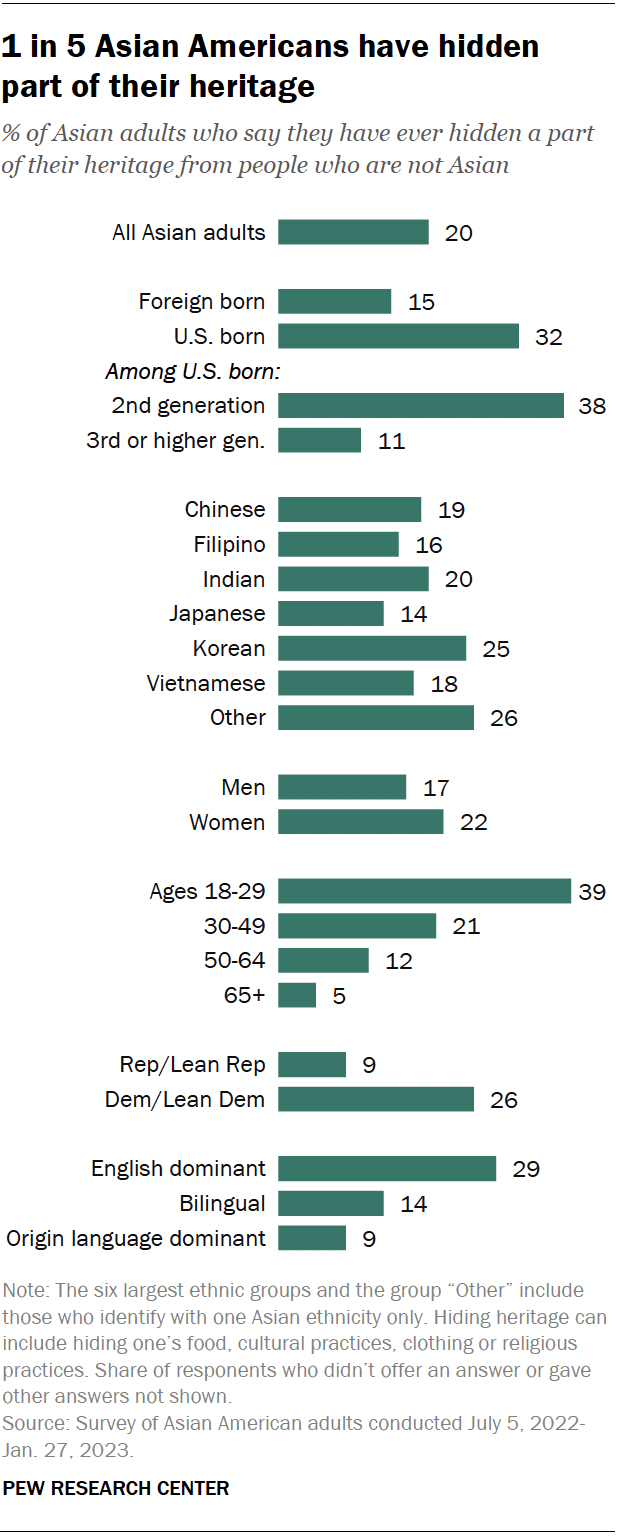
Among Asian Americans, U.S.-born children of immigrants are most likely to have hidden part of their heritage

Noteworthy. Also of interest is that it sharply declines in the third or higher generations, along with being highest in the second generation, where many of the integration and identity struggles are:

One-in-five Asian American adults say they have hidden a part of their heritage – cultural customs, food, clothing or religious practices – from non-Asians at some point in their lives. Fear of ridicule and a desire to fit in are common reasons they give for doing this, according to a Pew Research Center survey of Asian adults in the United States conducted from July 2022 to January 2023.

How we did this

A bar chart showing that 1 in 5 Asian Americans have hidden
part of their heritage.

Birthplace and immigrant roots play a role in who is most likely to hide their heritage: 32% of U.S.-born Asian adults have done this, compared with 15% of immigrants. Among those born in the U.S., second-generation Asian adults (in other words, those with at least one immigrant parent) are more likely than third- or higher-generation Asian Americans (those with U.S.-born parents) to have hidden their culture from non-Asians (38% vs. 11%).

Second-generation Asian Americans make up 34% of the U.S. Asian population, at approximately 7.9 million people, according to a Center analysis of the 2022 Current Population Survey. The majority of this group (66%) is under age 30. And according to our survey, they also primarily speak English.

Aside from generational differences, here are other survey findings about who is most likely to have hidden their heritage from non-Asians:

  • Korean Americans are more likely than some other Asian origin groups to say they have hidden part of their heritage. One-in-four Korean adults (25%) say they have done this, compared with smaller shares of Chinese (19%), Vietnamese (18%), Filipino (16%) and Japanese (14%) adults.
  • Asian Americans ages 18 to 29 are about twice as likely as older Asian adults to have hidden their culture. About 39% of Asian adults under 30 have hidden their culture, food, religion or clothing from non-Asians. About one-in-five Asians ages 30 to 49 (21%) have done this, as have 12% of Asians 50 to 64 and 5% of those 65 and older.
  • Asian adults who are Democrats or lean Democratic are much more likely than those who identify with or lean toward the Republican Party to have hidden their identity. Among Asian adults, 29% of Democrats have hidden their culture from others, compared with 9% of Republicans.
  • Asian Americans who primarily speak English are more likely than those who primarily speak the language of their Asian origin country to have hidden part of their heritage. Some 29% of English-dominant Asian adults have hidden their heritage, versus 14% of those who are bilingual and 9% who primarily speak their Asian origin language.

Why some Asian Americans hide their heritage

Asian Americans who said they have hidden part of their heritage also shared why they did so. Some of the most common reasons were a feeling of embarrassment or a lack of understanding from others.

However, different immigrant generations also cited various other reasons for hiding their culture:

  • Many recent Asian immigrants said they have tried to fit into the U.S. and fear that others may judge them negatively for sharing their heritage.
  • U.S.-born Asian Americans with immigrant parents often said they hid their heritage when they were growing up to fit into a predominantly White society. Some in this generation mentioned wanting to avoid reinforcing stereotypes about Asians.
  • Some multiracial Asian Americans and those with more distant immigrant roots (third generation or higher) said they had at times hidden their heritage to pass as White.

What U.S.-born Asian Americans say about growing up in the U.S.

In 2021, the Center conducted 17 focus groups in which Asian Americans born in the U.S. answered questions about their experiences growing up. Some second-generation Asian Americans shared distinct examples of hiding their heritage and having to balance their family’s cultural practices with the culture of broader American society:

“[It] was kind of that stigma when you were little, a teen, or you were younger that [you] don’t want to speak Chinese … because people would think that you’re a FOB [fresh off the boat] or an immigrant.” – Early 30s man with Chinese immigrant parents

“I remember in elementary school, I don’t even know what my mom brought me, [but] it was some Taiwanese dish. I guess it just had a more pungent smell to it. The kids would just be like, ‘Oh, what is that smell? You guys smell that?’ I would just cover my lid and be like, ‘Okay, I’m not going to eat my lunch.’” – Early 20s woman with Taiwanese immigrant parents

“[I] used to roll as Asian/Hispanic because I was too scared of my identity to say I was Pakistani. I remember 2011 or 2012, when [U.S. special operations forces] killed [al-Qaida leader Osama] bin Laden in Pakistan, after that happened, I was like, ‘Yeah, I’m definitely not saying I’m Pakistani,’ because people were coming up to me and they’re like, ‘Oh my God, they killed your uncle. They found him in your homeland.’” – Early 20s man with Pakistani immigrant parents

Alongside these struggles, many second-generation Asian Americans talked about being proud of their cultural background and wanting to share it with non-Asians:

“[W]hen I go to Cambodia and speak the language, it’s like connecting with an old friend … or meeting somebody from my past because so many of those ideas of what love is, of what it is to be part of a community, and even to live by example comes from having that language still alive within me.” –Early 30s man with Cambodian immigrant parents

“[T]here are going to be ups and downs. Definitely one of the downs is being labeled by other people for our differences. But one of our ups is that we have culture and language that we can always rely on; we have some diversity in customs and cultures that we could go back to. And if people are willing to experience these new differences, we can definitely pass it on and spread awareness of different cultures.” –Early 20s man with Korean immigrant parents

Source: Among Asian Americans, U.S.-born children of immigrants are most likely to have hidden part of their heritage

Sun Editorial: ‘Jihadi Jack’ is not Canada’s problem

Agree. UK “offloaded” him to Canada despite him having born and raised in the UK and never having spent any time, or significant time, in Canada. Feel for the parents but not a reason to provide consular and other support:

Once again, pressure is being brought on the federal government to provide consular assistance to Canadians in Syrian prison camps.

Canadians are being held in camps run by Kurdish forces that reclaimed the area from the terrorist group Islamic State of Iraq and the Levant (ISIL) — a military organization that seeks to establish an Islamic caliphate in Iraq and Syria.
A recent Canadian Press story recounted the visit of a four-person “civil society” delegation, including a senator, to the camp to discuss the repatriation to Canada of some of those held there. The report omitted vital details about one of the men mentioned, Jack Letts.At 18, Letts left his home in the U.K. to join the terror group ISIS. Dubbed “Jihadi Jack” by the British media, Letts gets his Canadian citizenship through his father, John Letts. It’s unclear how much time — if any — his son has actually spent in this country. Jack was born and educated in the U.K. and that country has revoked his citizenship. As a signatory to the Convention on the Reduction of Statelessness, Canada can’t deprive a person of citizenship if it renders them stateless. So the U.K.’s pre-emptive action in revoking Letts’ citizenship has dumped the whole mess into our laps.

In 2019, then Public Safety Minister Ralph Goodale said, “Canada is disappointed that the United Kingdom has taken this unilateral action to off-load their responsibilities.” He told the CBC, “We have no obligation to facilitate his travel from his present circumstances, and we have no intention of facilitating that travel.”

This country should hold fast to that sentiment. It’s true Letts was young when he made the bad decision to join ISIS. His parents are exhausting every avenue in an attempt to return their son to them, as most parents would. Nevertheless, his presence in this country would be an insult to all those who honour the principles of freedom and democracy and those who have come here to escape terror.

Canadian citizenship is not a flag of convenience. It’s a badge of honour, hard won by those who fought and died for our rights and freedoms. Jack Letts does not in any way embody those values.

Source: EDITORIAL: ‘Jihadi Jack’ is not Canada’s problem

John Ivison: Who really killed Canadian moderation?

Thoughtful analysis:

I’ve been immersed in Winston Churchill’s My Early Years, a ripping yarn that sees the future wartime leader take part in a cavalry charge at the battle of Omdurman in Sudan and escape captivity during the Boer War in the late 1890s.

As gripping as the incredible Boy’s Own adventures are his accounts of the fin-de-siecle British Empire — which, when he is writing in 1928, he described as a “vanished age.”

Ages always vanish, of course, usually because of traumatic cataclysms like wars or pandemics.

In our own time, COVID seems to have been the catalyst for a new age of discontent, accelerating anxieties that were already percolating, and taking with it the classical liberal consensus that dominated the postwar world.

It is paradoxical that a prime minister who ventured the thought that Canada is stronger because of its differences, rather than in spite of them, is now presiding over a political landscape dominated as never before by ill-will and alienation.

Politics in this country may never have been exactly civil — it’s been said the best explanation for the good old days is a bad memory. But the respect and a broad policy consensus that undeniably existed has been replaced by loathing and partisan hostility. Illiberalism is the dominant strain on both the left and the right.

There is empirical evidence that Canada is a meaner country than it was a few short years ago.

Police-reported hate crimes have soared 72 per cent from 2019 to 2021. The homicide rate has risen steadily to its highest level in 30 years. Meanwhile, social trust has plummeted. Only a third of adults now agree that most people can be trusted.

The political system is a direct casualty of that disillusionment. A recent study by the Public Policy Forum into the rise of polarization, appropriately called Far and Widening, said only 50 per cent of the respondents it polled believe voting is the best way to enact change. One person in six said that only taking power from “global elites” would effect real change.

It used to be the case that most people could agree on what many consider to be “Canada’s advantage” — an immigration policy that has attracted the best and brightest from around the world.

Yet that too is breaking down, in large part because of careless, incoherent federal government policy.

Last week, a video on social media featured a long lineup of what appeared to be Southeast Asian students queuing to apply for jobs at a Food Basics supermarket in Hamilton, Ont. The comments in response to the video suggested that a nativist backlash to Liberal immigration policy is in full swing.

The government has overseen an explosion in international students coming to Canada — 900,000 this year alone — many of whom are using education as a back door to citizenship.

By paying tuition fees of around $25,000, students can come to Canada, study part-time at a private college, work legally in low-wage jobs and stay in the country for years after graduating. Coupled with a Liberal plan to boost the number of permanent residents to 500,000 by 2025 — double the number from a decade earlier — it is clear that there has been a massive increase in low-skilled immigration that threatens to put pressure on wages at the bottom end of the labour market.

The lobby group Colleges and Institutes Canada, whose members are the main beneficiaries of the huge influx in tuition fees, acknowledged as much when it said in a statement that the cap on international students being contemplated by Ottawa could “exacerbate current labour shortages.” A reminder: this is a program for international students, not temporary foreign workers.

As many economists have noted, such high numbers of newcomers have the happy corollary for the government of boosting GDP — immigration is likely to account for the total output increases of 1.5 per cent in 2023 and 2024.

But those gains will mask a cumulative decrease in output per person and add to the housing crisis. In short, Canadians will be worse off under this policy and resistance to similar levels of immigration will surely follow.

The Liberals have to accept a disproportionate share of the blame for the state we’re in because they have been in government for nearly eight years.

But the conditions for a more bitter politics were already ripe in 2015. After the Second World War, average real wages doubled in roughly 30 years. In the subsequent half-century they have been relatively stagnant. Poll after poll has shown the majority of Canadians think the next generation will have a lower standard of living than their parents did — an economic backdrop against which it is hard to generate optimism.

The advent of social media that prioritizes provocative content has helped erode the common ground most Canadians shared in the postwar world.

Politicians have found that what former Conservative leader Erin O’Toole called “performance politics” works for them: ramping up the rhetoric and demonizing their opponents in order to get noticed. MPs not viewed as being sufficiently combative are considered suspect by their colleagues and partisan constituents.

O’Toole’s successor, Pierre Poilievre, has fine-tuned the cartoonish manipulation of the outrage machine that is X (formerly Twitter), combining bombastic rhetoric and an indifference to truth. Impressively, in one recent tweet, he managed to malign the trifecta of Conservative scourges — the prime minister, the CBC and the World Economic Forum — in under 140 characters.

As Justin Ling, author of the PPF report on polarization, noted, political parties used to be big tents, a microcosm of the country at large, but they now more closely resemble special interest groups.

The pandemic only accelerated that division of Canadians into two tribes, when a material minority emerged who were vocal in their belief that governing elites had lost their connection to the people they are meant to serve. That gave birth to the truckers’ convoy protest that blockaded downtown Ottawa last year. It is a significant indication of widespread disillusionment that one poll suggested a majority of 18- to 34-year-olds sympathized with the protest against vaccine mandates, even if they didn’t agree with the blockade.

Justin Trudeau did little to reconcile alienated voters by calling a snap election and using vaccine status as a wedge issue. He even referred to his opponents as “often anti-science, often misogynistic, often racist” and wondered if they should be tolerated.

For a leader who is quick to blame those who disagree with him of engaging in “the politics of fear and division,” it revealed his own tendency toward intolerance.

His critics contend that Trudeau has been on a quest to transform Canada into something more closely resembling his own progressive leanings — and of portraying those who oppose him as uninformed, irresponsible or motivated by unworthy goals.

Moderation and the modest compromises that characterized much of Canadian political history have been jettisoned in favour of lofty goals that often come with unintended consequences, such as the immigration targets. It is telling that the debate around the cabinet table apparently was not whether 500,000 newcomers was too many, but rather whether that number was ambitious enough.

In the current fervid political environment, it is unrealistic to expect a politician to emerge who will appeal for calmer heads to prevail, like the medieval knight in the middle of melee in the Far Side cartoon: “Hey, c’mon. Hold it! Hold it! Or someone’s gonna get hurt.”

Voters are in a vitriolic mood. Appealing to their better angels is likely to leave any politician feeling like Winston Churchill after his first abortive venture into politics, “deflated as a bottle of champagne when it has been half-emptied and left uncorked for a night.”

Source: John Ivison: Who really killed Canadian moderation?

Australia’s multicultural framework can no longer be separate from … – Pearls and Irritations

While errs on the side of discounting the risks of foreign influence and interference, fundamental point that foreign and multiculturalism policies should be more coherent, to which I would add a caution of not being overly influenced by diaspora politics and issues (all too often the case):

A new multicultural framework needs to recognise that the well-being of Australia’s multicultural communities is closely related to, and inevitably affected by, geopolitics, and by Australia’s foreign policy towards migrants’ countries of origin. It is no longer viable to conceptualise foreign policy and multicultural affairs as two separate entities.

The Australian government is currently conducting a Multicultural Framework Review, and I have made a submission.

My submission is focused on the need for Australia’s multiculturalism to be reconceptualised and redesigned by taking into account the opportunities and challenges posed by current geopolitics, and by the growing complexity of the myriad Chinese-Australian communities.

This focus on the Australian-Chinese communities is in response to a number of unique factors: (a) a higher percentage of arrivals from the PRC than in previous periods; (b) a fast-changing geopolitical dynamics featuring growing tension and hostility between the US and China; and (c) Australia’s foreign-policy positioning vis-à-vis the US and China, and the Australian government’s national security and defence strategy, which increasingly imagines China as the nation’s greatest military threat.

In my submission, I have made a few recommendations

  • At the conceptual level, a new multicultural framework needs to recognise that the well-being of Australia’s multicultural communities is closely related to, and inevitably affected by, geopolitics, and by Australia’s foreign policy towards migrants’ countries of origin. It is no longer viable to conceptualise foreign policy and multicultural affairs as two separate entities. This new reality may have serious implications for the current bureaucratic structure of various departments in the federal government, and the relationships between them.
  • In terms of the well-being of various Chinese-Australian communities, the government should recognise that the ‘China threat’ discourse has caused serious concern among the Chinese-Australian communities, many of whom feel that, caught in the hostility between their motherland and their new country of residence, they have been subject to undue suspicion and distrust. My recent research shows a worryingly low level of acceptance of the Chinese-Australian communities by the Australian public, and a low level of trust between English-language media and Chinese-Australian communities, especially Mandarin-speaking first-generation Australians and permanent residents. These tendencies alert us to serious problems in the nation’s bid for multicultural harmony and social inclusiveness.
  • Future multicultural policy needs to put the principle of human rights back into its framework, especially in the context of countering foreign interference. The Chinese-Australian communities are complex and diverse in terms of political views, social values, and cultural practices. In light of this diversity or sometimes even conflict, the overall principle of respecting individuals’ right to freedom of expression is paramount. For this reason, just as individuals speaking out against the Chinese government should be safe from harassment and abuse, those who wish to speak in support of the Chinese government should not automatically be seen as brainwashed by China’s propaganda, or – even worse – suspected or accused of operating as agents and spies of the Chinese state.
  • Similarly, free access to all social media platforms including WeChat needs to be respected. Naturally, WeChat should comply with all relevant Australian regulations. However, because WeChat is by far the most useful platform for PRC migrants, it is important that the government respect this community’s right to stay connected with their families, friends and networks in China. It is crucial that the issue of WeChat should not be weaponised by politicians who single-mindedly push for a ban or partial ban in the name of security interests.
  • In line with the goal of developing adequate communication platforms to reach out to non-English speaking populations, the government should continue to use Chinese social media such as WeChat and Xiaohongshu to facilitate political engagement, better delivery of social services in aged care, health care and disability care, as well as to promote social inclusion and belonging.
  • More than ever before, there is a serious need to support ongoing research in order to identify feasible strategies, methods and pathways of ensuring inclusion and acceptance of Chinese-Australians, especially first-generation PRC migrants. The government should actively harness the hitherto largely untapped resource of the Chinese-Australian communities as assets in defending Australia’s national security and national interest, rather than regarding them as primarily a liability. Identifying effective strategies to promote their social, cultural and political integration should be considered as an urgent matter of national interest and national security.

Chinese-Australians, social inclusion and the national interest

In recent years, and especially since COVID-19 and during the last period of government by the Coalition, we have witnessed growing anti-Chinese racism, the demonisation of Chinese-Australians, suspicion of Chinese-Australians’ political loyalties, and a lack of civic and citizenship education for new migrants.

Social cohesiveness has been identified as a key element of Australia’s national interest, underpinning Australia’s prosperity and security. Indeed, security commentators make the case that ‘building trusted and apolitical engagement with all parts of the community, and notably Australians of Chinese origin’ is an important component of formulating an overarching national interest strategy. Facilitating the integration of minority groups, particularly those as sizeable as the Chinese-Australian communities, is not only consistent with a liberal perspective of justice and equality, but it is also a matter of pragmatic importance, especially if Australia is intent on growing its own political influence and increasing its national power in strategic competition with foreign coercive influence.

For the same reason, Osmond Chiu cautions that pursuing our foreign policy through a defence and security lens needs to stop fuelling ‘the perception that Chinese-Australians would be acceptable collateral damage in a conflict’.

This view – that Chinese-Australians would be acceptable collateral damage in a conflict – seems to have been implicitly adopted by many commentators in our media, as well as by some think-tanks and politicians. This has been extremely damaging to the legitimacy and validity of the ethos and philosophy of multiculturalism.

A new multicultural framework needs to reflect the fact that the well-being of Chinese-Australians is closely related to, and inevitably affected by, current geopolitics, by Australia’s foreign policy towards China, and by Australia’s national security policy favouring a close alliance with the US. It is increasingly difficult to conceptualise the two as separate entities.

Given this, the challenge to facilitate the social integration of this particular cohort is enormous. Recently, Andrew Jakubowicz commented on what he has called ‘Sinophobia in times of COVID-19’. He writes:

Identity within and attachment to Australia for ethnic immigrants depend on how well the system they enter protects their human rights from the omnipresent threats from racists and xenophobes. They will not release their grip on the old if the new emerges as threatening and potentially dangerous.

Lack of Information and Communication Platforms for Practical Needs
While many people in these communities feel marginalised and excluded in political and social terms, in practical terms there is also a gap in the government’s efforts to deliver a wide range of services, including aged care, health care, legal aid, and myriad other social initiatives, such as GambleAware and information about domestic violence.

Academics who conduct research on various aspects of the Chinese-Australian communities have demonstrated the importance of Chinese social media platforms in the everyday lives of people in these communities. For instance, Bingqin Li (UNSW) has been studying how community organisations such as the Chinese Australian Services Society (CASS) use WeChat to recruit volunteers in aged care and self-help groups. WeChat is particularly useful for community-based service providers to contact hard-to-reach older people. Li reports that some of these older people have been quietly contributing to the shortage of aged care labour in Australia for many years. But now, with the help of WeChat, CASS has recruited many more volunteers, including many new migrants from mainland China.

For older Chinese Australians, WeChat is essentially a lifeline for overcoming social isolation and learning about Australian culture, regulations, social services, events and networks. If it were banned or its use restricted, many of these elders would return to a state of effectively being ‘blind, deaf and mute’.

Similarly, Tina Du, (currently at University of South Australia) has studied the information behaviour of Chinese migrants over the age of 67, and found that WeChat plays a significant and essential role in enabling these senior citizens to live in Australia and remain connected with China. This is especially relevant, given the challenges identified in the Australian Government’s recent 2023 Intergenerational Report.

Some researchers are also urging health professionals to use WeChat to assist their patients. Dr Ling Zhang (Sydney University) is a nurse practitioner and research fellow specialising in the care of patients with cardiovascular disease. Based on her finding of low levels of eHealth literacy among migrant communities, Zhang argues that WeChat should be used as a platform for GPs and cardiologists to disseminate health information by health care providers, given its wide reach.

This growing body of evidence-based research is pointing to the crucial role that WeChat is playing in the lives of many Chinese-Australian migrants, and so far, no concrete evidence has been identified that shows that WeChat is a threat of any kind to Australia’s national security.

Senator James Paterson, who chaired the Senate Select Committee on Foreign Interference through Social Media, believes that ‘We must also harden the resilience of our diaspora communities targeted by transnational repression to protect their right to free speech’.

To echo Senator Paterson’s call to protect our diaspora communities’ right to free speech, it is important to point out that the right to freedom of expression and free access to all social media platforms, including WeChat, indeed needs to be respected. While WeChat should be expected to comply with all relevant Australian regulations, it is also important that the government recognise and accept that WeChat is the most widely used social media platform for PRC migrants, and has become essential for them in staying connected with their families, friends and networks in China. Whatever policies emerge in this space must respect this community’s right to use the platform for such purposes. Moreover, these policies must encourage the government to harness the platform as a way of improving PRC migrants’ capacity to access information about social services and other vital government functions. It is crucial that the issue of WeChat should not be weaponised by politicians who single-mindedly push for a ban or a partial ban in the name of security interests.

The government should not only continue its nascent use of WeChat to facilitate political engagement, to deliver social services in aged care, health care, disability care, and to encourage and promote inclusion and belonging; it should also fund further research to identify ways of doing more with the platform in these spheres, and to do it better.

Summary

The question of how to address the issue of Australian-Chinese communities is an integral component of the multicultural framework review. A number of factors – a large number of recent arrivals from the PRC, a fast-changing geopolitical dynamics featuring growing tension and hostility between the US and China, and Australia’s increasing tendency in its foreign policy to imagine China as our biggest military threat – come to bear on the current review of the multicultural framework. Much work – overall reconceptualisation, governing structure, a rethinking of policy, and the design of practical strategies – remains to be done. The government will benefit enormously by actively seeking the views of scholars, multicultural agencies and community stakeholders in updating its framework.

Wanning Sun is a professor of media and cultural studies at the University of Technology, Sydney. She also serves as the deputy director of the UTS Australia-China Relations Institute.

Source: Australia’s multicultural framework can no longer be separate from … – Pearls and Irritations

Rioux: L’abaya, un vêtement comme les autres?

Le Devoir Paris correspondant on the French abaya ban (consistent in his support for dress restrictions):

Lundi, c’était jour de rentrée scolaire en France. Mais ce n’était pas une rentrée ordinaire. Dans une grande partie des collèges de France, on était littéralement sur les nerfs. Comment cela allait-il se passer ? Comment réagiraient les élèves ? Les parents viendraient-ils protester devant les grilles ? Bref, on craignait le pire.

C’est qu’une semaine plus tôt, le tout nouveau ministre de l’Éducation nationale, Gabriel Attal, avait décrété l’interdiction du port de l’abaya en classe. L’abaya est cette tunique traditionnelle musulmane que portent un nombre croissant de jeunes d’origine maghrébine afin de dissimuler leur corps. Tout juste nommé, à une semaine de la rentrée scolaire, le jeune ministre de 34 ans a décrété que ce vêtement distinctif identifié à la culture arabo-musulmane n’avait « pas sa place à l’école ». Le message était clair. On ne se présente pas devant un professeur en revendiquant sa religion.

Cela faisait des mois que, partout en France, enseignants et directeurs d’établissements réclamaient une intervention du ministre. Laissées à elles-mêmes, les directions étaient aux prises depuis plus d’un an avec des campagnes islamistes sur les réseaux sociaux incitant ouvertement les jeunes musulmanes à contourner la loi qui, depuis 2004, interdit aux élèves le port de tout signe religieux ostensible. Pas surprenant qu’en deux ans, le nombre d’incidents scolaires portant atteinte à la laïcité ait plus que doublé.

Or, quoi de plus ostensible que cet accoutrement patriarcal destiné à dissimuler tout le corps ? Dans sa déclaration, il aura suffi d’une seule phrase à Gabriel Attal pour clarifier le débat. « Lorsque vous entrez dans une classe, vous ne devez pas être capables d’identifier la religion des élèves », a-t-il tranché.

Les associations musulmanes eurent beau prétendre qu’il s’agissait d’une simple tenue traditionnelle sans la moindre connotation religieuse, il est clairement apparu dans le débat que l’abaya était aussi musulmane que la ceinture fléchée est québécoise. D’abord, rien de plus difficile dans la civilisation musulmane que de distinguer clairement ce qui relève de la culture de ce qui est proprement religieux. Comme l’a brillamment expliqué le philosophe Rémi Brague dans son essai magistral Sur l’islam (Gallimard) publié l’an dernier, contrairement à la chrétienté, l’islam est ce qu’il appelle « une religion intégrale » où « tout est culte » puisqu’il intègre un code juridique et définit les moeurs des bons musulmans.

Comme l’expliquait la spécialiste de l’islamisme Florence Bergeaud-Blackler, il n’existe pas de vêtements qui seraient par essence religieux, seulement « un habit qui permet de se conformer à une norme religieuse, celle qui d’après les rigoristes considère que la femme ne doit pas montrer les formes de son corps ». Comme le voile en 2004, ce rôle revient aujourd’hui à l’abaya. Il suffit de consulter les publicités sur Internet pour voir combien les marchands de guenilles le considèrent comme un prolongement du voile permettant de rompre avec la tradition laïque de l’école française.

Une tradition plus que centenaire que les Français ne semblent pas prêts à renier. Soutenue par 81 % des Français, l’interdiction de l’abaya fait l’objet d’un consensus encore plus fort que celui observé en 2004 sur la loi interdisant les signes religieux à l’école. Même les jeunes ayant entre 18 et 24 ans, que l’on dit pourtant multiculturalistes, se rangent à 63 % derrière la décision de Gabriel Attal. Ce consensus s’étend à toutes les familles politiques sans exception, mettant d’ailleurs en porte-à-faux la majorité de la gauche française avec ses électeurs. Ainsi, 58 % des partisans de La France insoumise (LFI) approuvent la décision du ministre alors même que son leader, Jean-Luc Mélenchon, a fait un virage électoraliste à 180 degrés sur le sujet, dénonçant « une mesure dangereuse et cruelle ».

Certaines féministes ont aussi de graves questions à se poser. Alors que l’écologiste radicale Sandrine Rousseau dénonce une « machine de broyage » des adolescentes, le caractère religieux de l’abaya ne fait aucun doute pour 74 % des Françaises qui se disent féministes. Rarement un événement aura illustré de manière aussi évidente le cul-de-sac dans lequel s’est engagée depuis plusieurs années une grande partie de la gauche en se ralliant aux thèses du multiculturalisme et en ne craignant pas de s’allier aux musulmans les plus obscurantistes.

Lundi, comme en 2004, après moult explications de la part des proviseurs, à peine quelques dizaines de jeunes filles ont dû être renvoyées chez elles. Les autres se sont facilement conformées à la règle. Le cours normal de l’école a ainsi pu reprendre. Cela démontre que, pour peu que l’on fasse respecter les lois et la tradition laïque de l’école, l’immense majorité des élèves musulmans se conformeront aux traditions et règles de vie de leur pays d’accueil. Ils n’attendent qu’une chose, qu’on le leur dise !

Pour tous les Québécois que l’on stigmatise en permanence pour avoir simplement osé exiger des enseignants qu’ils se gardent d’exprimer par la parole ou le vêtement leurs convictions religieuses à l’école, le message est on ne peut plus clair : pour être respecté, encore faut-il se tenir debout.

Source: L’abaya, un vêtement comme les autres?

Paul: The Problem With ‘Elites’ May Not Be What You Think It Is

Good column:

Elitism is a frequent target of criticism, especially in politics. Historically, Americans haven’t liked elitists. They don’t appreciate the hoity-toity who look down on everyone else.

These days that disdain emanates most vocally from the populist right. To these self-described down-to-earth folk without airs or fancy talk, “the elite” is shorthand for those who are more educated and have more power, especially cultural power, code for people they don’t agree with and resent.

But the left also has a beef with elitism. To those concerned with social inequity, “the elite” symbolize a flawed meritocracy. In their view, certain demographic groups get elevated over others and bar access to those historically deprived of power, especially political and economic power.

Whatever their respective merits, both critiques are hard not to read as variations on “I want what you have.” The word “elite,” after all, signifies something people aspire to. We admire elite athletes. We rely on elite research institutions to make medical advances. Most people wish they too could sit in first class. Until then, they hotly resent whoever does.

A more sophisticated and productive critique of elites comes from Fredrik deBoer, known to those who read his popular newsletter as Freddie. DeBoer, a Marxist, activist and the author of the book “The Cult of Smart,” is one of the sharpest and funniest writers on the internet. I don’t agree with everything he says, but he’s always thoughtful and he pushes me to think. I hope his new book, “How Elites Ate the Social Justice Movement,” will be read especially by those on the left, because the left is where his heart lies and the failings of the left seem to break his heart most. In this, he and I are fully aligned.

“It’s OK to call nonsense nonsense, even if you feel it’s on your own side,” he writes. “You can defend your values, be a soldier for social justice and be merciless toward conservatives while still admitting when feckless people take liberal ideology to bizarre ends.” As deBoer points out, it’s far better for those of us on the left to clean up our own mess than to hand it over to conservatives as easy fodder for mockery. To that end, he scrutinizes the self-interests of the nonprofit industry, the “elite capture” of the Black Lives Matter movement, the neglect of class as a primary category of political thought and other failures and shortcomings among progressive movers.

What drives deBoer’s argument here is the idea that on the left, elites are undermining progress for the average Joe. Worse, they’re doing it in the name of progress. It’s time, he says, to forcefully question exactly what elites on the left claim is best for everyone else, especially when evidence suggests otherwise.

One of the bravest chapters in his new book examines the elitism of the defund the police movement, which, deBoer argues, hurts the cause of racial justice. Research shows more policing has reduced homicides, which disproportionately affect Black Americans. Black Americans are about 13 percent of the population but make up more than half of homicide victims. As deBoer explains, “police abolition and incremental efforts to reduce policing could easily result in more hardship for the very community that we’re ostensibly fighting for.”

In deBoer’s view, this misplaced enthusiasm for police abolition is largely a result of the economic and cultural gulf between elite activists of all races and the vast majority of Black Americans. What’s easy for radical activists and academics to write on a placard turns out to be hard for many Black Americans to actually live with. Taking police off the streets may minimize the possibility of police violence against Black people, but it will do little to mitigate the far greater problem of all other violence against Black people.

Many Black people, particularly outside of elite circles, are all too aware of this. As deBoer notes, “significant majorities of Black Americans want not less policing but better policing.” In 2022, Black Democrats were twice as likely as white Democrats to say reducing crime should be a top priority. A 2021 survey found that white liberals were more inclined than Black Americans to support defunding the police: “71 percent of white liberals say they would support reducing police budgets and shifting funding to social services,” compared with 53 percent of Black Americans; a significant 44 percent of Black people oppose it altogether.

Yet for many on the left, to point out these facts is considered sacrilege, somehow racist and essentially tantamount to serving the enemy. Many white progressives are so terrified of being labeled “racist” themselves that they prioritize self-protection and fear of their critics over helping out the very people they profess to want to help — people they may not understand well at all.

For deBoer, police violence and other problems of social justice require action from people of all races and ethnicities, rather than heeding the empty diktats of elite discourse. “I feel strongly that there must be a way — there must be a way — to take police violence against Black people immensely seriously and to fight for major police reform,” he writes, “while acknowledging that crimes and violence committed against Black people by those other than police are far more common.”

Last month I met deBoer for lunch near where he lives in Connecticut. He talked a lot about the class disparities of the state, which contains many of the wealthiest pockets in the nation alongside extreme poverty. He sees himself writing in the tradition of leftist thinkers like Eric Hobsbawm, Todd Gitlin, Richard Rorty and Adolph Reed. It seems to pain him that the left so often shoots itself in the foot.

When I asked why he wrote this book, he said, “I really do believe that we live in a country and a culture with deeply entrenched racial inequality, and all decent people have a duty to try to confront that inequality.” However, he emphasized, it’s not only something we have a moral duty to do — we also have a moral duty to do it well. The number of people who genuinely thought there was a chance of police abolition was very small, he told me. “But by making that a centerpiece of their demands, it allowed them to say afterward, ‘Look at how awful things are now, we didn’t go far enough.’”

It’s a way for the left, deBoer explained, to look like “a beautiful failure.”

DeBoer doesn’t consider himself an optimist, but he nonetheless doesn’t want to concede that kind of defeat. The left, he told me, needs to return to the “up from below” approach of the socialist politician Eugene Debs: It needs to invest in real change for those in need rather than heed elite rhetoric. To my ears, all this does sound quite optimistic, considering the polarized discourse and politics of 2023, where shouty or performative extremism often gets in the way of duller and more difficult action. But as deBoer says, a bottom-up approach may be the best, or only, option for meaningful social progress.

Source: The Problem With ‘Elites’ May Not Be What You Think It Is

Antisemitic Comments by Palestinian Leader Cause Uproar

Sigh….

Video has emerged of Mahmoud Abbas, the president of the Palestinian Authority, recently asserting that European Jews were persecuted by Hitler because of what he said were their predatory lending practices, rather than their religion.

Mr. Abbas’s false claim drew swift condemnation from Israeli and European officials. It also fueled accusations that Mr. Abbas — an architect of interim peace agreements between Israelis and Palestinians in the 1990s — is not genuinely committed to resolving the ongoing conflict.

In a speech late last month, Mr. Abbas said: “They say that Hitler killed the Jews because they were Jews, and that Europe hated the Jews because they were Jews.”

“No,” Mr. Abbas added. Jews were persecuted, he continued, because of “their social role, which had to do with usury, money, and so on.”

Mr. Abbas also repeated a widely discredited theory that European, or Ashkenazi, Jews have no ancient roots in the Middle East. Instead, Mr. Abbas claimed that European Jews were the descendants of a nomadic Turkic tribe that converted to Judaism during the medieval period, and therefore were not victims of antisemitism.

“When we hear them talk about Semitism and antisemitism — the Ashkenazi Jews, at least, are not Semites,” Mr. Abbas said.

Mr. Abbas’s comments were broadcast live on Palestinian television two weeks ago, in a speech to members of his secular political party, Fatah,

The remarks were brought to a wider audience on Wednesday, when the Middle East Media Research Institute, a Washington-based monitoring group that mainly translates extremist comments by Arab and Iranian leaders, distributed a subtitled version of Mr. Abbas’s speech.

Mr. Abbas is the president of the Palestinian Authority, the semiautonomous body that has administered parts of the Israeli-occupied West Bank since the 1990s, when the Israeli and Palestinian leaderships signed interim peace accords.

His comments illustrated why he has developed a checkered reputation among Israeli and Western partners. Mr. Abbas was one of the chief negotiators in the peace process, and often is credited with helping to reduce tensions following a wave of violence in the 2000s. At times, he has also described the Holocaust as a crime against humanity.

But Mr. Abbas also has a long history of antisemitic remarks. He made similar comments in 2018 about usury and Ashkenazi Jews, and last year he accused Israel of committing “50 Holocausts” against Palestinians.

In 1984 he published a book in which he condemned the Holocaust but also cited historians who disputed the widely accepted death toll of as many as six million Jews.

“This is the true face of Palestinian ‘leadership,’” Israel’s ambassador to the United Nations, Gilad Erdan, wrote on social media in response to Mr. Abbas’s latest speech.

“It is no wonder that mere hours ago a Palestinian teenage terrorist hacked innocent Israelis with a meat cleaver,” Mr. Erdan added, referring to an attack on Wednesday in the Old City of Jerusalem that wounded at least two people.

The European Union said in a statement that Mr. Abbas’s “historical distortions are inflammatory, deeply offensive, can only serve to exacerbate tensions in the region and serve no-one’s interests.”

The statement added: “They play into the hands of those who do not want a two-state solution, which President Abbas has repeatedly advocated for.”

Source: Antisemitic Comments by Palestinian Leader Cause Uproar

Integration – General Deck 2022 data

This is an updated version of my earlier deck with 2022 numbers across immigration, citizenship, settlement and multiculturalism, OECD integration indicators and polling data. The narrative has also been updated to reflect the ongoing shift to two-step immigration, and arguably a shift from an immigration-based country to a migration-based country.

An Exploration of Methods to Estimate the Number of Immigrant Girls and Women at Risk of Female Genital Mutilation or Cutting in Canada

Of note:

Executive summary: It is estimated that at least 200 million girls and women around the world have experienced female genital mutilation or cutting (FGM/C). The World Health Organization defines FGM/C as “all procedures involving partial or total removal of the external female genitalia or injury to the female genital organs for non-medical reasons” (World Health Organization 2008). The practice of FGM/C is concentrated in Africa, the Middle East, and parts of Asia. However, estimates of FGM/C prevalence vary greatly by country and even by region within countries, and FGM/C has been documented in as many as 92 countries (End FGM European Network, U.S. End FGM/C Network, Equality Now 2020). 

This report explores different approaches used in previous research to estimate the number of girls and women currently living in Canada who may be at riskNote  for FGM/C based on their (and their parents’) country of birth. Information on FGM/C in Canada may help to inform health care providers, community service providers, and policy makers interested in women, health care, and immigration about this issue in Canada. Additionally, this information may inform intervention strategies focusing on women’s human rights, gender equality, and women’s health (Ortensi and Menonna 2017).

In Canada, FGM/C is considered a form of aggravated assault under the Criminal Code (Department of Justice 2017). However, there is a lack of information on the prevalence of FGM/C in Canada. This information gap was highlighted on the International Day for Zero Tolerance for FGM/C in 2021, when Prime Minister Trudeau issued a statement indicating a need for improved data to address FGM/C within Canada (Government of Canada 2021). Monitoring FGM/C in Canada is important for addressing Sustainable Development Goal indicator 5.3.2, which is focused on determining the proportion of girls and women aged 15 to 49 years who have undergone FGM/C, by age (United Nations n.d.). Currently, there are no available data on this issue for Canada. 

While other nations, such as Australia and the United States, have estimated the number of immigrant girls and women at risk for FGM/C in their countries (Australia Institute of Health and Welfare 2019; Population Reference Bureau 2016), previous research examining FGM/C in Canada has largely been qualitative and focused on specific immigrant groups (e.g., Chalmers and Omer Hashi, 2000; 2002; Jacobson et al., 2018; Omorodian, 2020; Perovic et al., 2021). Therefore, an understanding of the number of women and girls in Canada who may be at risk for having experienced FGM/C is lacking. This information would be especially valuable for Canadian health care providers, because a recent study indicated that less than 10 percent of Canadian health care providers felt “very prepared” to care for FGM/C patients, and 90 percent indicated they would benefit from more information and training related to FGM/C (Deane et al., 2022). Additionally, FGM/C patients have reported negative experiences with health care providers in Canada including stigmatization, shame, judgment, inappropriate care, and disregard for health care preferences (e.g., method of delivery), with many indicating that they had delayed seeking health care during pregnancy because of these issues (Chalmers and Omer Hashi, 2000; Jacobson et al., 2022).

Since no national surveys directly collect information on FGM/C, estimates of FGM/C are derived through indirect measures, an approach consistent with other countries (e.g., the United States and Australia). Similar to FGM/C research in other nations, country- and age-specific prevalence rates from international surveys are used (Australian Institute of Health and Welfare 2019; Population Reference Bureau 2016). Data on the country-specific estimated prevalence rates of FGM/C were obtained from the Demographic and Health Surveys (DHS) and the Multiple Indicator Cluster Surveys (MICS) (UNICEF 2017). These estimates were applied to the 2016 Census Canadian population counts of women living in Canada who were born in one of the 29 countries for which nationally representative data on FGM/C prevalence were available at the time of this analysis. 

Four different methods were used to estimate the number of girls and women living in Canada who may be at risk for FGM/C. In approach A, the estimated number of at-risk women in Canada was based on the 2016 Census immigration counts multiplied by 2017 UNICEF estimates for in-country prevalence of FGM/C. Approach B slightly refined this method by using age-specific estimates of FGM/C prevalence. Approach C added first-generation immigrant girls aged 0 to 14 years, as well as women aged 50 and older. Finally, approach D included second-generation immigrants—that is, those who were born in Canada and have at least one parent who was born outside of Canada. Since the rate of FGM/C among second-generation immigrants living in Canada is unclear, approach D estimated a range of risk for FGM/C, varying from no risk among the second generation (i.e., no cases of FGM/C if born in Canada) to the same risk as first-generation immigrants (high-end or upper-bound estimate).  

Among the approximately 125,000 reproductive-aged girls and women (aged 15 to 49) who were currently living in Canada, but had immigrated from one of the 29 countries where the practice of FGM/C was documented (UNICEF 2017), about 58,000 were estimated to be at risk for having experienced FGM/C. When the other first-generation immigrant girls and women (i.e., those aged 0 to 14 years and 50 and older) as well as second-generation girls and women aged 0 to 49 years were included, approximately 95,000 to 161,000 girls and women currently residing in Canada were estimated to be at risk of experiencing or having experienced FGM/C. 

Canada is home to a significant number of first- and second-generation immigrant girls and women who may be at risk for FGM/C, which may have implications for public policy related to health care, immigration, and public safety. However, several limitations warrant consideration. First, selective migration was not considered—that is, women who are more highly educated, who have higher incomes, and who are from urban areas are more likely to immigrate to Canada than their counterparts, and they (and their daughters) may be less at risk of having undergone or undergoing FGM/C (UNICEF 2013; Ortensi, Farina and Menonna 2015; Farina, Ortensi and Menonna 2016). Additionally, there is some evidence that women who migrate may be less likely to have undergone FGM/C, in particular if they are from countries with moderate or low prevalence of FGM/C (UNICEF 2013). Second, acculturation in Canada may mean that second-generation girls and women are less likely to undergo FGM/C. Third, the FGM/C estimates used in this analysis may be limited—rates in many countries are declining over time, and there may be variation in the rate of FGM/C within a country depending on the time of measurement. Moreover, since prevalence rates were only available for 29 countries, there may be women and girls in Canada from other countries of origin where FGM/C is practised that are not included in the calculations. Because of these factors, the estimates could over- or under-estimate the number of girls and women in Canada who are at risk for FGM/C and should not be interpreted as official estimates of FGM/C in Canada. 

Future work may include a qualitative exploration of the experiences of women from countries that practise FGM/C who now live in Canada. A qualitative approach is necessary to understand topics that are difficult to address through surveys, especially when the topics are sensitive and the terms used to describe and understand FGM/C vary. Additionally, qualitative research may better capture differing perspectives and cultural traditions associated with the practice of FGM/C. Future work is needed to inform regional variations within a country, as well as the applicability of country-specific rates of FGM/C to second-generation girls and women. Other research methods could also be explored to better understand the health implications and to address policies, programs, and interventions geared toward this group of women.

Source: An Exploration of Methods to Estimate the Number of Immigrant Girls and Women at Risk of Female Genital Mutilation or Cutting in Canada