Québec bloque la nomination au CA de l’INRS d’une prof étudiant le racisme systémique

This blocking of the nomination of Denise Helly, who I know from my time in government, is creating quite a stir in Quebec from what I understand. Always found her work and opinions reasonable even if I didn’t always agree:

La ministre de l’Enseignement supérieur, Pascale Déry, a semé l’émoi chez les professeurs, dans les partis d’opposition et dans les plus hautes sphères de l’Université du Québec (UQ) en bloquant la nomination d’une professeure qui s’intéresse, dans ses travaux, au multiculturalisme, à l’islamophobie, au racisme systémique et, depuis peu, au mouvement anti-woke. 

Le 20 décembre, la professeure titulaire Denise Helly, de l’Institut national de la recherche scientifique (INRS), a reçu un message du secrétaire général de son établissement qui l’avisait avec « regret » que sa candidature au conseil d’administration (CA) de l’INRS n’avait pas été « retenue » par le ministère de l’Enseignement supérieur. 

La raison ? Dans le courriel que Le Devoir a pu consulter, le secrétaire général, Michel Fortin, écrit à Mme Helly que la décision relève de la « discrétion ministérielle » et que, dans ce type de situation, « le ministère de l’Enseignement supérieur ne fournit aucune explication additionnelle ».

L’INRS fait partie du réseau de l’UQ. En entrevue, le président de l’UQ, Alexandre Cloutier, a dit s’inquiéter de cette intervention de la ministre, qui n’est pas « habituelle ». « Ça soulève deux enjeux. Un qui est lié à l’autonomie des universités et l’autre, celui de la liberté universitaire, mérite une attention d’analyse également », lance-t-il. Ces deux principes sont enchâssés dans la Loi sur la liberté académique dans le milieu universitaire, adoptée par le gouvernement Legault en juin 2022. 

M. Cloutier a dit avoir sollicité — et obtenu — un rendez-vous avec l’équipe de la ministre Déry. « La rencontre est prévue à la fin du mois de janvier prochain, et c’est certain qu’on va faire valoir la validité de nos processus internes pour la nomination des membres de notre CA », a-t-il averti. Sollicité pour cet article, le cabinet de la ministre a refusé de commenter le dossier. À Québec, les partis d’opposition, eux, y ont vu un geste relevant de la censure. 

Dans un courriel envoyé au Devoir, l’INRS a dit avoir avisé le ministère du fait que « ne pas nommer une professeure désignée par son assemblée était inhabituel et contrevenait [à son avis] à l’autonomie universitaire ». En vertu de la Loi sur la liberté académique, « les universités doivent pouvoir accomplir leur mission sans contrainte doctrinale, idéologique ou morale », ont aussi souligné dans un communiqué commun Jean-Charles Grégoire, président du Syndicat des professeurs de l’INRS, et Madeleine Pastinelli, présidente de la Fédération québécoise des professeures et professeurs d’université.

Bloquée pourquoi ?

Les deux syndicats exigent des explications de la ministre Déry au sujet du rejet de la candidature de Mme Helly, qui détient un doctorat de la Sorbonne. « À nos yeux, s’il est justifié, ce refus ne peut que reposer sur des motifs très sérieux, et ces motifs doivent être communiqués clairement et sans délai à toutes les instances impliquées. »

En entrevue, Mme Helly dit s’attendre à la même chose. « Si [la ministre] ne donne pas d’explication en exerçant son pouvoir discrétionnaire, ça devient de l’arbitraire », estime-t-elle. Faute de justification, elle formule des hypothèses pour expliquer le refus ministériel. 

De l’avis de la professeure, la décision pourrait constituer « de la discrimination selon l’âge, parce que j’ai 81 ans ».Ou alors relever de l’« ingérence », une « atteinte à l’autonomie universitaire et une tentative de politiser les débats ».Se disant encore très active dans la vie universitaire, Mme Helly tend à privilégier sa deuxième hypothèse, de concert avec une troisième, cette dernière voulant qu’elle ait été écartée en raison de ses orientations de recherche.

« Je travaille depuis 40 ans sur le multiculturalisme canadien, le racisme systémique, la discrimination, l’islamophobie, les musulmans. Et puis récemment — et ça, la ministre ne le sait pas encore, parce que je n’ai pas encore publié — sur les courants anti-woke, la dernière offensive politique et publique contre les droits des minorités, explique-t-elle. Donc, ce sont des sujets un peu fâcheux pour les gens de la CAQ. » Elle dit ne pas comprendre « l’intérêt » de lui interdire une présence au CA de l’INRS, un rôle qui, à son avis, constitue « un détail » dans la vie universitaire. « Alors, pourquoi prendre un risque pareil ? Je pense que c’est une erreur politique de la part de la ministre », laisse-t-elle tomber. 

La professeure Helly explique avoir été élue par le corps professoral de son établissement conformément à la procédure interne. Sa candidature a ensuite été soumise par l’INRS au ministère de l’Enseignement supérieur. Selon les règles, le ministère doit retenir une candidature avant de la proposer au Conseil des ministres, qui rend la décision finale. Dans le cas de Mme Helly, la candidature n’a pas été retenue, ce qui veut dire qu’elle n’a pas été soumise au conseil exécutif.

Dans un échange avec Le Devoir, l’INRS assure avoir respecté « chacune des étapes du processus de nomination ».

Source: Québec bloque la nomination au CA de l’INRS d’une prof étudiant le racisme systémique

New Electoral Map and Diversity

My analysis of the impact of the new electoral map on racialized and religious minorities and Indigenous, and how it will be further impacted by the ongoing increase in immigrants.

Source: New Electoral Map and Diversity – The Hill Times

Tara Henley: What happened to Canada?

Tara Henley, who left the CBC over concerns over its overly “woke” approach to stories, continues her critique of narrow identity focused analysis rather than more universal class-based approaches:

…During the same decade or so that housing affordability was tanking in Canada, an ideology arrived that took a radical posture on social issues while maintaining the economic status quo. 

This new line of thinking originated at elite American universities and spread to Canada through social media. It presents itself as leftist but eschews key leftist concepts such as class analysis, universalism, and the importance of free speech. Instead, it views politics through the lens of identity, focusing on equalizing outcomes between identity groups, as well as on problematizing language, criticizing social, cultural, and interpersonal norms, and building up a vast administrative class to advance such efforts.

Critically, it presents its ideas as moral imperatives, trading persuasion for campaigns of public shaming.

It is a political project that’s been widely embraced by economic elites in Canada, from individuals to corporate and governmental leaders, including Justin Trudeau. Though clearly well-intentioned in some instances, in practice it serves to assuage the guilt of the haves and to signal their virtue to the have-nots. (See the prevalence of Indigenous land acknowledgments at public events in Canada. This exercise makes participants look and feel good but does nothing to improve the living conditions of Indigenous people.)

Identitarian moralism, as it happens, has also appealed to a vocal and understandably pessimistic segment of the have-nots—chiefly a class of young, educated knowledge workers, whose economic prospects have markedly declined. As other writers have pointed out in the past, this ethos provides a low-effort outlet for feelings of powerlessness. The causes of Canada’s decline are multifold, complex, and difficult to address. Calling someone a bigot online is relatively easy….

Source: Tara Henley: What happened to Canada?

McWhorter: The Hidden Lesson of ‘American Fiction’

On my watch list:

Cord Jefferson’s film “American Fiction” offers a delightful portrayal of the white fetishization of Black pain — and also, in 2024, at least, one that is more satire than documentary. In the movie, an erudite Black author writes a baldly melodramatic “ghetto” novel titled “My Pafology” in protest of the way white audiences seem to go wild for such material — and to his surprise, nobody gets the joke and white audiences do, in fact, go wild for the book.


America had a conversation of this sort long ago — especially amid the debates over hip-hop in the 1990s and afterward — about treating inner-city violence, sexism and multigenerational poverty as “authentic” and entertaining. I think we can give the non-Black public here in the real world at least some credit. Today they would not embrace nakedly cartoonish tripe like the novel cooked up by the film’s protagonist, Thelonious “Monk” Ellison, or the best seller “We’s Lives in Da Ghetto” by the Black author Sintara Golden that inspired his sarcastic stunt in the first place.


However, such exotification of Blackness has hardly disappeared entirely, and the film perfectly captures facets of the contemporary continuation of it. I was especially struck by a scene in which Monk finds that a bookstore has stocked his earlier novel, an adaptation of Aeschylus’ “The Persians,” in the African American section simply because he is Black.


I had the exact same experience.


Twenty years ago, I wrote a book called “Doing Our Own Thing,” a study of the increasing informality in public language in America since the 1800s. It mentioned race only in passing, yet I twice found it stocked in the Black studies (or some equivalent description) section of a bookstore. Apparently someone — at least twice! — blithely assumed that because I’m Black, the book must be an indignant shout-out on behalf of Black English, an appeal that Black people should be able to “do our own thing” (thang?). To the bookstore employees — and perhaps customers — the paramount aspect of a Black author was his Blackness.

But let’s face it: White people don’t get this view of us only from their own subconscious bias or objectification. Black people play a part in fostering this vision, too, in the ways we present our souls to the public. Not in silly novels like “My Pafology,” but more broadly.
Some of us enthusiastically portray microaggressions as grave harms to our well-being, despite the fact that the literature on microaggressions is mostly of questionable scientific rigor and yields only limited evidence that they injure this deeply, or even that most Black people experience them in this way.

Many of us also insist that there remains something insufficient and inadequately “representative” about the degree to which Blackness is depicted in popular culture. The implication is that Blackness is marginalized, held at least at half an arm’s length. Yet a random list of recent Black-oriented films and television shows — “Black Panther,” “Atlanta,” “Black-ish,” “Dear White People,” “Insecure,” “The Book of Clarence” — demonstrates enough richness and variety to make an old-time Southern segregationist retch. “American Fiction” itself has been widely nominated for major awards and features exquisite performances by Jeffrey Wright, Erika Alexander and Myra Lucretia Taylor in particular. An uninformed observer of Black representation in contemporary American popular culture would be mystified that anyone felt there remained any real deficit at all.


Meanwhile, some believe it is antiracist for Black people to portray ourselves as a people for whom standards must be loosened thanks to the legacies of our past. The SAT, for instance, has been presumed such a racist burden that it should be withdrawn — despite evidence that it has been better at identifying gifted Black students from disadvantaged backgrounds than alternatives.


Is it any wonder that white people listen to these kinds of reasoning and feel compelled to think of us as poster children and stereotypes rather than as whole people? There is a straight line from the positions I outlined above, often thought of as forms of enlightenment, and a well-meaning but Kabuki version of pity that becomes a kind of racism in itself.

Source: The Hidden Lesson of ‘American Fiction’

Black public servants locked in three-year legal battle with Ottawa with no end in sight [and related equity issues]

Good overview. One issue I have is the lack of comparison with other minority groups. Citing the numbers for Black public servants without the other groups provides an incomplete picture, as the table below shows, highlighting that other groups have more significant under-representation than Blacks, both at the all public service and EX levels. Disaggregated data for the last six years shows similar differences (https://multiculturalmeanderings.com/wp-content/uploads/2023/05/ee-analysis-of-disaggregated-data-by-group-and-gender-2022-submission-1.pdf):

Jasminka Kalajdzic, director of the Class Action Clinic at the University of Windsor, says the mere pursuit of the lawsuit has already led to more changes than what a public servant could ever achieve with a grievance.

For example, Treasury Board is working on a more accurate self-identification process and centralizing employment equity data collection and reporting. As well, many departments have created anti-racism secretariats.

The government committed to a Black justice strategy and set aside $46 million in funding for a Black mental-health plan, although efforts to get that up and running have been mired in controversy.

The government recently announced a new panel to develop a “restorative engagement” program to address discrimination.

There has also been a flurry of promotions. In August 2022, Caroline Xavier became the first Black deputy minister when she was appointed president of Communications Security Establishment – 33 years after Ontario appointed its first Black deputy minister.

The Black Executives Network, established in July 2020, delivered its first report in June 2023, which noted “tremendous progress” in building a Black executive community over the past three years. The number of Black executives in the federal public service has grown to 168 today from 68 in 2016, with four deputy ministers and 15 assistant deputy ministers and a few dozen directors-general.

That’s still only about 2.3 per cent of the executives in the core public service, while Black people account for about 4.2 per cent of all public-service employees.

“This (issue) is so much bigger than the Black class action,” says Courtney Betty, the plaintiffs’ lead lawyer. “This is reflection of Canadian society. This is who we are. And for many Black individuals, that’s what they feel. It’s not a reality for any other Canadian. But for Black Canadians, it is a reality.”

Source: Black public servants locked in three-year legal battle with Ottawa with no end in sight

Few immigrant applicants to Canadian military get enlisted: Report

Of note:

Efforts by Canada’s military to recruit new immigrants have been futile.

In fact, a December 2023 briefing note for Defence Minister Bill Blair said only 77 applicants out of thousands of permanent residents successfully enlisted, according to Blacklock’s Reporter.

“Between November 1, 2022 and November 24, 2023, the Canadian Armed Forces received 21,472 applications from permanent residents,” said the note Recruitment Of Permanent Residents. “Seventy-seven permanent residents have been enrolled.”

In 2022, the military altered regulations that promised a quicker path to citizenship for landed immigrants if they enlisted as soldiers, sailors and air crew.

Despite the more favourable regulation changes, the note cited lengthy security checks with the abysmal number of successful recruits during that timeframe.

“There are important and necessary measures which need to be completed such as security checks and medical evaluations,” said the note. “As well the validation of security clearances generally takes longer for permanent residents.”

Due to a 35% decline in recruitment numbers in 2022 — from 8,069 to 5,242 volunteers — the military turned to foreigners who had army training to fill the gap.

“The Canadian Forces recruiting group accepts trained applicants from foreign militaries,” said the note. “These applicants include pilots, logistics officers, infantry officers and other skilled professionals who may become enrolled in the Canadian Armed Forces if they have permanent resident status in Canada. This enables other permanent residents who meet the same criteria as Canadian citizens to enroll in the Canadian Armed Forces as new recruits or officer cadets.”

The military says at minimum 60,500 fully trained full-time members are required while also setting a goal of reaching 68,000 military forces.

Source: Few immigrant applicants to Canadian military get enlisted: Report

Chris Selley: Backing the Houthis exposes the raw Jew-hatred of the pro-Palestinian protesters

Such extremism has little place in Canada and those publicly supporting such extremism need to reflect more on the impact of their actions:

Canada is broken in many ways, but the ability of different people from very different backgrounds to get along has not thus far been one of them. That’s very much at risk. Obviously many Jewish Canadians arrived many weeks ago at where I now find myself: Overt public support for Hamas, which is only slightly more subtle about its genocidal aims than the Houthis, has destroyed friendships and professional relationships, and weakened confidence in Canada as a safe place for Jews to live.

I abhor the idea of asking any individual Muslim (or any other Canadian) to explain and justify his position on the Israeli-Palestinian conflict. We’re allowed to think whatever we want about geopolitics inside our own heads, so long as we can be civil to each other out in the real world. But more and more, these protests are becoming an overt rejection of that latter.

Calling for an end to Israel’s war against Hamas is fair enough. The death toll is appalling, the prospects of a lasting victory uncertain. But if they’re as worried about Islamophobia as they claim to be, Muslim organizations and advocates desperately need to repudiate the naked extremism that now seems to have free run within the cause.

Source: Chris Selley: Backing the Houthis exposes the raw Jew-hatred of the pro-Palestinian protesters

Tasha Kheiriddin: Trudeau frittered away a good immigration policy for the sake of Liberal votes – National Post

Discounts the flawed policy rationale of the Barton commission recommendations but of course, political considerations also played a role. And, as we saw during the Kenney years, the liberals cannot take these voters for granted:

Immigrants are also grateful to the party that bring them in. Prime Minister Justin Trudeau learned this from his father. Pierre Elliott Trudeau took credit for the citizenship of millions of Canadians, even though many had come to Canada under previous governments. Why? Because they took their oath under his watch. And when it came to elections, the immigrant communities of the day — Italians, Greeks, Haitians, Vietnamese — tended to vote Liberal.

The implications of Trudeau Jr.’s replication of this policy are dire. Studies show that they are turning Canadians against immigration: even 62 per cent of current immigrants think we’re letting in too many people. They are impoverishing Canadians, both current and newcomer, according to the bank study. And they are also helping fuel Quebec separatism, as francophones look with alarm at rising immigrant populations in the Rest-Of-Canada. By the end of the century, Quebec risks becoming a bit player in Confederation, with only 15 per cent of its population.

This cannot continue. Instead of flooding the country with newcomers, the government needs to boost domestic productivity. That’s a harder fix — and one that won’t give them more votes. But then again, if Canadians can’t afford a decent life, the Liberals may not get their votes either.

Source: Tasha Kheiriddin: Trudeau frittered away a good immigration policy for the sake of Liberal votes – National Post

White Americans who dislike Jews also tend to endorse anti-Muslim attitudes, study suggests – PsyPost

Survey dates from 2014 but likely same trends apply:

The researchers focused on responses that reflected attitudes towards Muslims and Jews. Questions in the survey pertained to the cultural belonging of Muslims and Jews (e.g., whether participants would approve of their child marrying a Jew or Muslim, their agreement with a Muslim or Jewish ‘vision of America’), their loyalty, assimilation, and perceived power (e.g., ‘more loyal to their religion or Israel than to America’, ‘less like other Americans’, ‘have too much power’), and associated problems (e.g., ‘a threat to public order and safety’, ‘do not share my morals or values’, ‘take jobs and resources’, ‘are intolerant of others’, ‘want to take over political institutions’, ‘do not contribute to my community’, ‘are dependent on welfare and government’).”

The results showed that levels of anti-Muslim sentiment were several times higher than anti-Jewish sentiment. A clear majority of participants disapproved of a marriage between their child and a Muslim and roughly two thirds considered Muslims to be more loyal to their religion than to America. About one in four participants associated Muslims with public safety issues, while one in three believed they did not share their moral values and were intolerant.

In contrast, only about 17% of participants objected to their child marrying a Jew. Thirteen percent disagreed with Jews’ ‘vision of America’, 14% perceived them as more loyal to Israel than to America, and other negative views were less frequent.

Further analysis identified four distinct groups among the participants. The largest group, comprising 54% of participants, held few or no negative views towards both Muslims and Jews (low anti-Muslim, low anti-Jew). Another group, encompassing 26% of participants, exhibited moderate anti-Muslim and anti-Jewish views. The third group, making up 17% of participants, held strong anti-Muslim views but low anti-Jewish attitudes. The smallest group, approximately 4% of participants, harbored highly negative views towards both Jews and Muslims.

Membership in these groups was not associated with education. Men were twice as likely as women to hold high anti-Muslim, but low anti-Jew views. Older individuals were also more prone to this configuration of views. People with lower income were more likely to be in the fourth group (strong negative views of both groups). Republicans and evangelical Protestants were much less likely to be in the first group than in any of the other three groups.

“Although anti-Muslim opinion is more extensive, the two track together empirically and share a cultural logic as connected forms of ethno-religious boundary-making. Latent class analysis shows that anti-Semitism is nested within anti-Muslim attitudes, with political and religious identifications as consistent predictors of opinion,” the study authors concluded.

Source: White Americans who dislike Jews also tend to endorse anti-Muslim attitudes, study suggests – PsyPost

Ibbitson: Liberals trying to play both sides in Gaza conflict

Definition of middle of the road: road kill!

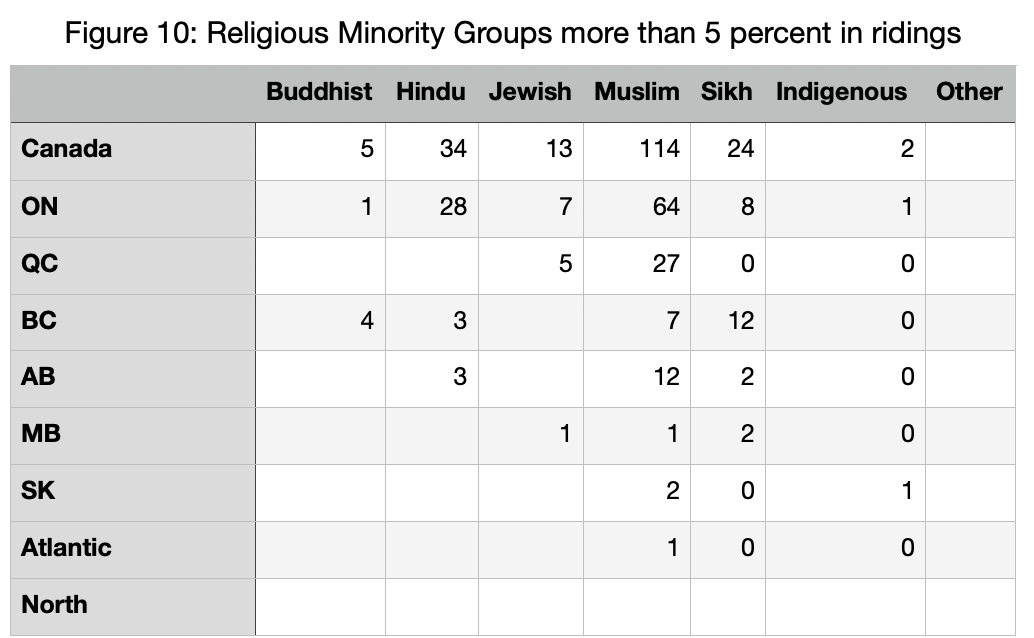
The table below highlights the number of ridings with more than 5 percent religious minorities, highlighting just how many more ridings have significant Muslim populations compared to Jewish populations.

The Liberals find themselves caught between an Israel/Conservative rock and a NDP/Palestinian hard place. And they don’t seem to have a solution, other than to placate both sides, which is no solution at all.

Source: Liberals trying to play both sides in Gaza conflict