In remote Xinjiang province, Uighurs are under siege

Good long piece by the Globe’s Beijing correspondent on Xinjiang and Beijing’s treatment of the Uighurs, China’s Muslim minority:

That the “Xinjiang Uighur Autonomous Region” is religiously and culturally unique, however, is beyond dispute. Islam arrived in the ninth century, largely displacing Buddhism. Today, many Uighurs are intellectually and linguistically oriented west toward Central Asia and the Middle East – watching Iranian music videos and reading Turkish news sites – rather than east toward coastal China.

Their home territory has, however, experienced tremendous change since the Communist Revolution in 1949. Briefly an independent state in the early 20th century, Xinjiang has in the past few decades become home to vast numbers of ethnic Chinese, many of them sent here by government settlement policies.

They now outnumber the Uighurs, and continue to arrive, drawn by untrammelled space and the jobs that flow from a land rich in resources.But the wealth hasn’t necessarily benefited the Uighur population. As the region’s oil and gas flow east, local filling stations routinely run short, with lineups 150 cars long.

In remote Xinjiang province, Uighurs are under siege – The Globe and Mail.
Jonathan Kay: Petty language spats have all but vanished in Quebec since Marois’ ouster

While anecdotal, and drawing from those of similar views, Jon Kay’s lengthy column on how the tone has changed in Quebec following the defeat of the PQ and their Quebec Values Charter is worth a read:

Much has been written about the PQ’s insidious impact on Quebec politics. What has been less remarked upon — in other provinces, at least — is how thoroughly the shrill nastiness of Ms. Marois and her administration seeped into the everyday life of ordinary Quebecers. On the subway, in restaurants, at gas stations, interactions between English and French, Jew and gentile, Muslim and non-Muslim, became more fraught. In one notorious case, at the cafeteria of Montreal’s Jewish General Hospital, a worker became so enraged when a customer refused to speak French that she allegedly assaulted him with a thrown tomato sandwich. English-language social media and radio call-in shows were full of similar stories. Then came the April 7 election, and suddenly the stories stopped.

A reminder of the effect that Government rhetoric can have on how people perceive their relations with others, and their being accepted by wider society.

Jonathan Kay: Petty language spats have all but vanished in Quebec since Marois’ ouster

Filipino-Canadian youth’s English fluency, hard work not enough for upward mobility — study | Inquirer Global Nation

Worrisome trend of downward mobility (see earlier coverage of same study Understanding Intergenerational Social Mobility: Filipino Youth in Canada » Institute for Research on Public Policy):

Canadian-born Filipino men present a somewhat similar picture, graduating from university at rates that exceed Canadian averages,” Kelly said. “However, they are well behind several other groups.”

“It is notable that Filipino men perform considerably worse than Filipino women in terms of university education, and in terms of failure to attain any certification at all including high-school graduation, but this is a gendered pattern of uneven achievements that holds true for all population groups,” Kelly added.

Kelly found that 37 percent of Filipino parents are degree holders, but only 25 percent of their daughters and 13 percent of their sons graduate from university. This contrasts with the fact that while only 23 percent of Chinese parents that are degree holders, 68 percent of their daughters and 58 percent of their sons graduate from university.

Kelly is not the first to present this trend. In 2009, another study using the 2002 Ethnic Diversity Survey “found that intergenerational upward mobility in terms of rates of university education, occurred between the first and second generations in all immigrant communities except for the Filipino and black visible minorities.”

Another study in 2011 using Ontario census data from 1996 and 2006 showed that Filipinos and Americans were the only groups in which second generation youth “did not tend to surpass their fathers in terms of educational attainment although in both cases, the fathers were very well-educated.

….Kelly presented occupational data suggesting this apprehension about English may be a factor in Filipino parents’ low level of involvement in their children’s education. In addition, the shift schedules of nanny mothers and manufacturing worker fathers contribute to the poor educational attainment level, he wrote.

“The downward mobility and de-professionalization experienced by parents upon arrival in Canada has an impact on parenting style and authority,” Kelly wrote. “One respondent poignantly explained that his father had been an executive in the Philippines; security guards saluted as he arrived at his office each morning. On arriving in Canada, he had to take a job cleaning toilets.”

Fil-Canadian youth’s English fluency, hard work not enough for upward mobility — study | Inquirer Global Nation.

Death to the Jews? | Arun with a View

The back story on the small hamlet called Latin American-Mort-aux-Juifs by my friend Arun:

The reason why La-Mort-aux-Juifs went unnoticed all these years was precisely because practically no one had heard of it. The story is presently all over the French media, which is precisely where Frenchmen and women are learning that such a locality exists.

A couple of things. First, La-Mort-aux-Juifs has been called a “village” or even “town” in English-language reports, which is inaccurate. It is a “lieu-dit”—which may be translated as “locality” literally: said place or locality—, in the commune of Courtemaux population 239—itself a place practically no one outside the eastern Loiret has heard of. Communes are the smallest administrative units in France of which there are some 36,681 in the 101 departments of metropolitan and overseas France, the majority with populations of under 500. Most communes have lieux-dits—which are sometimes indicated, sometimes not—, referring to a bit of the commune that had a specific identity in centuries past.

As for La-Mort-aux-Juifs, it consists of two houses and a farm above photo, is on a country road probably taken by no one except the few people who live around there, and is not indicated on any sign. In other words, even if one drove through the place, one would not know of the lieu-dit’s name.

Secondly, it is not even clear what the name of this lieu-dit is supposed to signify. As a piece in Marianne pointed out—and that I had been wondering about—La-Mort-aux-Juifs does not, in fact, translate as “death to the Jews.” Without the definite article “la” and the dashes—which are generally the rule in place names in France—, it would indeed mean this. But the definite article and dashes change the meaning, which is indeterminate but may simply indicate a place where Jews were killed—maybe even massacred—eight or nine centuries ago. For all one knows, the lieu-dit may have even been named this to commemorate such an event, to remember a tragedy…

via Death to the Jews? | Arun with a View.

Religion should be an elective course – Globe Editorial

Ongoing series of issues that emerge with funding of Catholic schools in Ontario:

In case there was any doubt, the Ontario Superior Court recently ruled the exemption not only applies to religious courses, but also to liturgies and retreats. The decision is a logical extension of the Education Act and earlier court rulings, and it makes a lot of sense. The primary purpose of a publicly funded school is to teach academics, not faith. Students attending publicly funded Catholic high schools are currently required to take four religion courses, one at each grade level. Any student, particularly those that are struggling academically, should have the right to forgo those classes to focus more on academics.

The trouble is some Catholic schools across the province won’t let them. Some boards claim, in a strange twist of discrimination, that their non-Catholic students are eligible for an exemption, but Catholic students aren’t. They are wrong. Forcing religious classes on any student amounts to a violation of the Education Act and willful ignorance of the recent Ontario Superior Court ruling. Catholic schools should follow the rules if they continue to rely on public funds to operate.

Religion should be an elective course – The Globe and Mail.

Kuwait and revoking citizenship – Al Arabiya News

The Gulf government view on extremism and revocation (not just for acts of terrorism but for extremist speech):

Extremist groups have realized that the silence of governments has enabled them to act freely, ensuring them protection and free movement especially if they are unarmed. These groups have now lost. Over the past few years, extremists succeeded in building mutually-reinforcing networks across borders, including with in the UAE, Kuwait, Saudi Arabia, Bahrain, Egypt, Britain, France and other countries. Some were bold enough to threaten different factions of society, thus benefiting from the spread of terrorism.

However, this network is collapsing after governments decided to besiege it via different means. Political authorities found that targeting leaders is better than pursuing followers and that revoking citizenship will stop individuals who act as figure heads. This would send a strong message that the government will not be content with security checks and lawsuits but will resort to exerting its maximum power to bring down figures whom it considers dangerous to its national security.

Kuwait and revoking citizenship – Al Arabiya News.

Outstanding ATIP Request Documents Now Available

For those of you interested, finally (after 18 months) received some long overdue ATIP documents. Most of these relate to issues covered in my book Policy Arrogance or Innocent Bias: Resetting Citizenship and Multiculturalism and are old news.

However, the various documents on the Government’s work on birth on soil issues are new, and reveal a somewhat tortured struggle between the evidence (relatively small problem) and the wish of the Government to address what it considers – or at least considered – a significant issue.

Documents available at the ATIP tab ATIP.

For those interested in ATIP process, my journal of dealing with ATIP ATIP Delay Log.

The case of the disappearing Statistics Canada data

Good piece on Statistics Canada and the impact of some of the changes made to reduce long-standing data series:

Last year, Stephen Gordon railed against StatsCan’s attention deficit disorder, and its habit of arbitrarily terminating long-standing series and replacing them with new data that are not easily comparable.

For what appears to be no reason whatsover, StatsCan has taken a data table that went back to 1991 and split it up into two tables that span 1991-2001 and 2001-present. Even worse, the older data have been tossed into the vast and rapidly expanding swamp of terminated data tables that threatens to swallow the entire CANSIM site. A few months ago, someone looking for SEPH wage data would get the whole series. Now, you’ll get data going back to 2001 and have to already know StatsCan won’t tell you that there are older data hidden behind the “Beware of the Leopard” sign.…

Statistics Canada must be the only statistical agency in the world where the average length of a data series gets shorter with the passage of time. Its habit of killing off time series, replacing them with new, “improved” definitions and not revising the old numbers is a continual source of frustration to Canadian macroeconomists.

Others are keeping tabs on the vanishing data. The Canadian Social Research Newsletter for March 2 referred to the cuts as the CANSIM Crash Diet and tallied some of the terminations:

  • For the category “Aboriginal peoples” : 4 tables terminated out of a total of 7
  • For the category “Children and youth” : 89 tables terminated out of a total of 130
  • For the category “Families, households and housing” : 67 tables terminated out of a total of 112
  • For the category “Government” : 62 tables terminated out of a total of 141
  • For the category “Income, pensions, spending and wealth” : 41 tables terminated out of a total of 167
  • For the category “Seniors” : 13 tables terminated out of a total of 30

As far as Statistics Canada’s troubles go, this will never get the same level of attention as the mystery of the 200 jobs. But, as it relates to the long-term reliability of Canadian data, it’s just as serious.

Given my work using NHS data, particularly ethnic origin, visible minority and religions, linked to social and economic outcomes, still in the exploration stage of what data and linkages are available – or not.

The case of the disappearing Statistics Canada data

Quebec Jewish community disturbed by lack of outrage over columnist’s ‘anti-Semitic’ radio rant

Pretty outrageous and crossing the boundary line between criticism and antisemitism:

Gilles Proulx was invited onto Montreal’s Radio X last Friday after writing a column in the Journal de Montréal on the Israel-Hamas conflict. “No need to be an expert to say that Israel could make Washington, Paris or Ottawa bend, knowing in advance that its diaspora, well established, will make any government submit!” he wrote in the Journal.

Speaking to Radio X, he elaborated on his thinking, suggesting Jews historically provoke hate and persecution. “The diaspora is scattered around the world, where they take economic control, provoke the hatred of local nations, whether it is in Spain, for example, with the Inquisition, or again later with Adolf Hitler,” he said.

Later he added: “The diasporas are so powerful in Paris, New York, Toronto or in Ottawa or Montreal, that they can manipulate the government through their opinions, their threats, their pressure, making it a marionette.” The show’s host never challenged Mr. Proulx’s remarks.

Mr. Proulx has a long history of incendiary comments, going back as far as the 1990 Oka crisis when his anti-aboriginal rants were blamed for drawing a mob that hurled rocks at a convoy of Mohawk women, children and elderly leaving the Kahnawake reserve.

….Neither Mr. Proulx nor Radio X responded to a request for comment. CBC  [error should be RDI] spokesman Marc Pichette denied that the July 14 phone-in show identified by the CIJA was intolerant.

“RDI managers do not consider that it could be deemed anti-Semitic, even if some of the numerous comments expressed in the show were highly critical of Israel’s bombing of the Gaza strip, drawing a parallel with Nazi Germany,” he said. “Other callers were in agreement with the Canadian government’s unequivocal support of Israel’s right to defend itself.”

Quebec Jewish community disturbed by lack of outrage over columnist’s ‘anti-Semitic’ radio rant

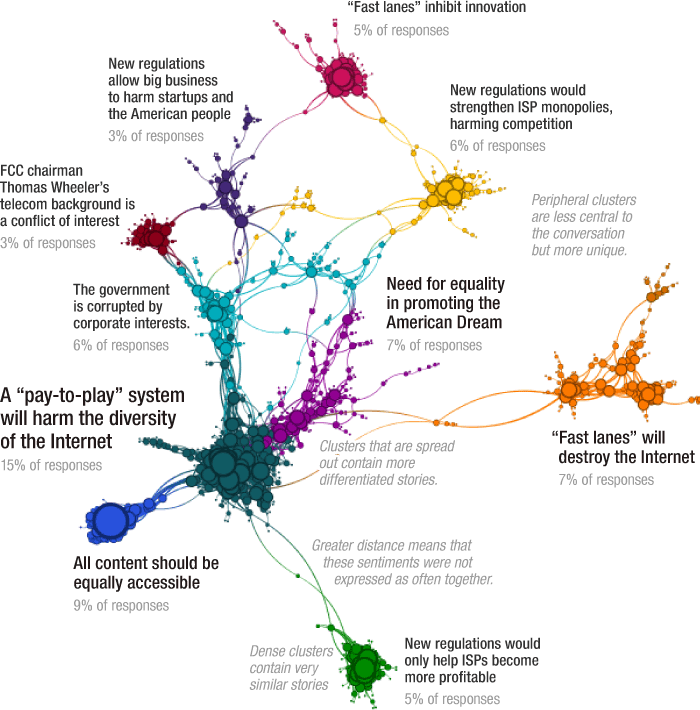
Neat Data Visualization: Net Neutrality

gr-neutrality-comments-624A good visualization that helps one understand relationships and relative weight of comments.

A Fascinating Look Inside Those 1.1 Million Open-Internet Comments