Appreciate the History of Names to Root out Stigma – NYTimes.com

More on implicit bias and names, this time with respect to African-American names:

Besides the barrier to entry to employment that comes with a “black name,” employers also tend to hire “racially palatable” blacks or other minority individuals. If a person is unstereotypically non white — which is to say, for example, that he or she acts white — that person is more likely to be considered for the job.

Nontraditional names are testaments to nonconformity, but they do not signal combativeness or unacceptable personality fits.

The insidious bias against people with black-sounding names pops up long before they hit the job market. And usually, the more unusual the name, the more susceptible to bias. A study published in 2005 found that teachers had lower expectations for children with unusually spelled names like Da’Quan, even when compared to their siblings with “less black-sounding” names like Damarcus.

That’s because preconceived notions about black-sounding names are not only racist but an indication of class bias. Unusually spelled names that have punctuation are associated with low socio-economic status — a factor that consciously or unconsciously biases teachers, employers and everyone in between. The assumption of low socio-economic status is specific to African-American names (or so-called ghetto black names), as opposed to names of African origin like Nia or Jelani.

But the nuance of individualized, African-American names goes deeper. The diversification of baby names in America started in the late 1960s during a larger sociocultural shift that emphasized individuality, and that’s where names for black and white Americans began to diverge. As black Americans began to give unique names to their children (much more so than white Americans), there was a sharp rise in the prevalence of distinctively black-sounding names — influenced at least in part by the championing of black culture by the Black Power movement.

African-American names became symbols of resistance. They resist uniformity and West European influence, and therefore the limiting cultural framework of how one should present his or herself. When minority individuals are prejudged on the basis of their names, it is because those names do not conform. And in order for diverse identities to be reclaimed as such, we must appreciate the ideology behind unique names and root out the stigmas about them.

And while nontraditional names are testaments to nonconformity, they do not signal combativeness or unacceptable personality fits. They signal the multitudes of different experiences that shape people of color, and increased knowledge of these experiences can be wielded to combat bias.

Source: Appreciate the History of Names to Root out Stigma – NYTimes.com

Can Tories repeat past success in wooing the ethnic vote?

Further to my earlier post Visible Minority Candidates in the 2015 Election: Making Progress, good range of comments by Myer Siemiatycki, Thierry Giasson, and Ratna Omidvar on whether or not the Conservatives can maintain their inroads (most recent polls suggest not).

We will see who is right Monday night:

Opinion is divided as to whether the Conservative Party will be able to repeat its success in drumming up support in the ethnic and newcomer communities in next week’s federal election.

In 2011, the strategy was to “broaden the support of the party and reach out to visible minority communities,” says Myer Siemiatycki, a professor of political science at Ryerson University. “We saw a very concerted and aggressive outreach by the Conservatives.”

That effort proved to be successful. According to an Ipsos exit poll, 42 per cent of immigrants to Canada voted Conservative. The party won 43 per cent of the vote of immigrants who had been in the country for more than a decade. In that same poll, only 37 per cent of people born in Canada voted for the Conservatives.

But this time around it may not work as well, Siemiatycki says. Issues like the niqab, terrorism and security and the Conservatives’ stands on what they have described as “barbaric cultural practices” as well as policies on Syrian refugees, family reunification and citizenship have irked many and perhaps driven away some ethnic or multicultural voters.

Because of that, Siemiatycki gives Prime Minister Stephen Harper and the Conservatives a failing grade when it comes to wooing multicultural and ethnic Canadians this campaign. Charm won’t be enough in this election, he says. As for the Liberals and New Democrats, Siemiatycki ranks their performance as neck and neck, giving both parties a resounding A for their efforts.

While neither party does the kind of narrowcasting the Conservatives are famous for, they have gone out of their way to include a diverse slate of candidates as well as make campaign appearances in diverse ridings, he says.

More importantly, both parties have strongly spoken out against Tory policies, including family reunification; citizenship, the niqab and refugees, he adds. Liberal leader Justin Trudeau and NDP leader Tom Mulcair are trying to win over newcomers and minority communities by arguing that Tory policies are not in the best interest of the country, he says. “It took courage, I think, to stand for minority rights; to stand for inclusion based on diversity and pluralism, tolerance and the rule of law.”

However, Thierry Giasson, professor of political science at Laval University, believes the Tories have been very effective — perhaps just as effective — this time around. They know what they’re doing when it comes to wooing specific ethnic and newcomer communities, he says.

…Ratna Omidvar, founder of the Global Diversity Exchange, a think tank at Ryerson University, believes the Conservatives have made substantial inroads in certain ethnic communities by appealing to “mainstream values within (certain) immigrant communities that are in favour of law and order … I do think the Conservatives have the lead on this.”

Source: Can Tories repeat past success in wooing the ethnic vote? | Toronto Star

ICYMI: Divided, Canada stands to lose what makes it great – Naheed Nenshi

Calgary Mayor Naheed Nenshi at the September LaFontaine-Baldwin Symposium:

At our best, we’ve figured out a simple truth: We’re in this together. Our neighbour’s strength is our strength. The success of any one of us is the success of every one of us. More importantly, any one failure is all our failure, too.

When Canada works, it is because of that tolerance and respect for pluralism, that generous sharing of opportunity with everyone. It is because of that innate sense that every one of us, regardless of where we come from, what we look like, how we worship or whom we love, deserves the chance right here, right now, to live a great Canadian life.

That Canada, however, is incredibly fragile, and must be protected from the voices of intolerance, divisiveness and small-mindedness. That Canada must be protected from the voices of hatred.

Let’s talk about Bill C-24, the Strengthening Canadian Citizenship Act, which allows Ottawa to strip Canadian-born citizens of their citizenship if they’ve been convicted of treason, spying or terrorism, if those Canadians have citizenship in another country or are considered able to claim citizenship in another country through a parent. The government can do so even if the conviction takes places in another country – even one that lacks the rule of law.

One of the highlights of being mayor of Calgary is that I get to attend citizenship ceremonies. Every time I do, I cry with joy to be with so many people who have worked so hard to become Canadian and have chosen to take on the great responsibility of citizenship. Sharing in that moment with new citizens, I always talk about how, growing up, I wondered why my father, mother and sister had these fancy citizenship certificates, while all I had was a lousy birth certificate. Only later did I appreciate two things about those pieces of paper: They were the most valuable possessions we had, and they were really the same document.

No longer.

How is it that those individuals I get to watch saying their oath should somehow be less Canadian than others? How is it that we should allow it to be easier for our government to strip them of the privilege and responsibility of citizenship? How is it that I, born at Saint Mike’s in downtown Toronto, could also have my citizenship revoked? One Canadian citizen committing the same crime should be treated the same as any other. They should not be subjected to a different sort of justice.

Most distressingly, the bill allows the minister of citizenship and immigration to exile people from Canada without any Canadian court being involved. That is a degree of power no individual should possess.

How did we allow this to happen?

I am deeply troubled by the language of divisiveness in Ottawa these days. The label of “terrorist” is thrown around with deliberate regularity. It is targeted language that nearly always describes an act of violence done by someone who shares my own faith, that ties violent action to individuals in a religious group here in Canada – many of whom are citizens. It does little to understand the causes of individual acts of violence or the potential solutions. Instead, it encourages fear and division; that’s the opposite of the country we aspire to build and nurture.

Our government likes to warn us of the radicalization of Muslim youth in our communities. But law-enforcement officers and community activists explain that the deeper cause of this radicalization is alienation and isolation – that the kids being radicalized are the same ones who’d often otherwise join gangs. In other words, according to individuals on the ground, the issue is not about religion. It’s about inclusion. Understanding this, we must work hard to make these kids feel part of the community.

But then the government, seeking to appeal to a certain segment of society, picks a fight on a completely irrelevant issue – wearing the niqab to a ceremony. It will appeal two court decisions and spend millions in taxpayer dollars to prevent one woman, Zunera Ishaq, from voting?

And what about those kids – the ones we’re trying to convince that there’s a place for them in our society? Bill C-24 warns them that, no matter what, they can never be truly Canadian. That their faith is incompatible with our values.

All that good work on deradicalization? Undermined.

When we act like this, whether the issue is addressing the extraordinary human suffering of refugees fleeing conflict or the social problems of our own youth, we are failing ourselves, our nation, and the world.

Let it be said: Such failures to become the Canada we hope for aren’t only recent. Far from it. After all, we are the nation that turned back Indian Sikh refugees on the ship Komagata Maru in 1914, the nation of the Chinese head tax, the nation of Japanese internment camps and the “None is too many” policy. We are the nation of provincial eugenics programs and generations of residential schools.

These, sadly, are also our origin stories. Many of us feel a deep, dark discomfort when confronted with them. The truth is not easy. It wasn’t easy for the victims of residential schools to tell their stories to the Truth and Reconciliation Commission, and it wasn’t easy for Canadians to bear witness to those truths. But it is important that we did then, and that we are doing so with the dark truths we see now.

The real answer to crafting the Canada we aspire to build lies in engaging muscularly with both the past and the future. It means undertaking a thousand simple acts of service and a million tiny acts of heroism. It means acting at the community level: on our streets, in our neighbourhoods, and in our schools. It means refusing to accept the politics of fear.

Source: Divided, Canada stands to lose what makes it great – The Globe and Mail

Using culture and religion to combat incitement: David Matas

From David Matas’ talk at the recent CRRF Webinar, ‘The Power of Words’ (see earlier post CRRF Webinar: Multiculturalism and The Power of Words) and the particular need for the voices of insiders:

The effort to combat human rights violating discourse must be the work of both insiders and outsiders.  Leaving the efforts to others, the outsiders, is a recipe for failure.  Leaving the efforts to outsiders creates an artificial impression of foreign cultural or religious imposition which undermines the advocacy of universality of the standards.

For insiders to assume sole responsibility has the same effect. By leaving the struggle to insiders alone, we create the impression that incitement is an issue for the particular religion or culture alone rather than for us all.

Insiders have a special risk and a special role.  Only insiders can be accused of treason or apostasy.  Only insiders can speak with authority to what the culture or religion truly is.

Ideally, leadership in the struggle against human rights violating discourse should come from within, from the leaders of the cultural or religious community. Solidarity should come from without.  Universality must be more than a word.  It must be demonstrated in fact.  We who are outsiders should be supporting those in every religious and cultural community who stand against incitement emanating from that community.

There is a direct linkage between incitement and other human rights violations.  War propaganda leads to war. Incitement to terrorism leads to terrorism.  Incitement to discrimination leads to discrimination.  Both incitement to genocide and hate propaganda lead to genocide.

There is a direct linkage between the abuse of the religious and cultural idioms to propagate terror, war, genocide, hatred and discrimination and the terrorism, war, discrimination and mass killings in which some members of the culture or religion engage. In some situations, and I see this often in my refugee practice, the opponents in-country of this propaganda emanating from their own culture or religion become primary targets of the propagators.  Standing against incitement in a country without respect for the rule of law means you yourself will become a target for the inciters.

In that situation global solidarity is essential, both within and without the culture or religion from which the incitement emanates. We need to cross the cultural, linguistic, geographic and religious divide not just to show the universality of rights and solidarity with the victims but also as a simple practical matter.  Whether inside or outside the culture or religion, only those outside the country where violations are rampant can there be unequivocal public opposition to human rights violating discourse.

To a certain extent, this problem exists even in countries benefiting from the rule of law.  In countries with the rule of law, those opposed to incitement within their culture or religion may not face the risk of physical harm.  But in a situation where the discourse of incitement in the culture or religion is prevalent, opponents to the discourse within the culture or the religion may face ostracism and scorn.  They risk becoming pariahs in their own communities.

How many of us are prepared to confront our parents, our siblings, our neighbours, our community leaders when they engage in discourse which would be objectively labelled incitement to genocide, hatred, discrimination, terrorism or war? How many of us would hesitate to risk personal relationships in order to stand up against incitement uttered by someone close to us?  How many of us would rather leave the confrontation to a stranger?

Yet, the reality is that a challenge from someone from the same community or culture is likely to have more impact on the genocide/ hate/ terrorism/ war/ discrimination promoter than a challenge from someone culturally or religiously remote. It may be easy for an inciter to shrug off outsiders. It is harder to shrug off your own.

I have avoided giving examples partly because it is invidious to give one or two, partly because it would more than exhaust my time and your patience to be comprehensive, but mostly because I am confident that every one participating can think of examples on his or her own.  While each of us should be thinking about how we can help others in other cultural or religious communities to address the problem of incitement, primarily we should be thinking of what we can do each in our own cultural or religious community to combat this scourge.

Using culture and religion to combat incitement

Visible Minority Candidates in the 2015 Election: Making Progress

Is the increased number of visible minorities being reflected in party candidates? Which ridings are these candidates running in? And do these candidates reflect the largest groups in their ridings?

Now that we know the names of all candidates, we can answer these and related questions.

But first, as a basis for comparison, how has women’s representation increased in 2015 candidates? The analysis by Equal Voice shows that overall representation from the 2011 election has slightly increased from 31 to 33 percent (still far away from equality), with the relative ranking of parties below.

Women Candidates 2015 Election

To assess visible minority representation I have used candidate names, photos and biographies to identify visible minority candidates. Although not as exact as identifying women candidates (e.g., subjectivity in analyzing photos), it nevertheless provides a reasonably accurate indication of how well Canadian political party candidates represent the population of visible minorities who are also Canadian citizens (15 percent).

Building on an earlier study by Jerome Black (“Racial Diversity in the 2011 Federal Election: Visible Minority Candidates and MPs”) showing the diversity in earlier elections, I went through the candidate lists using the criteria above, concentrating on the more diverse ridings.

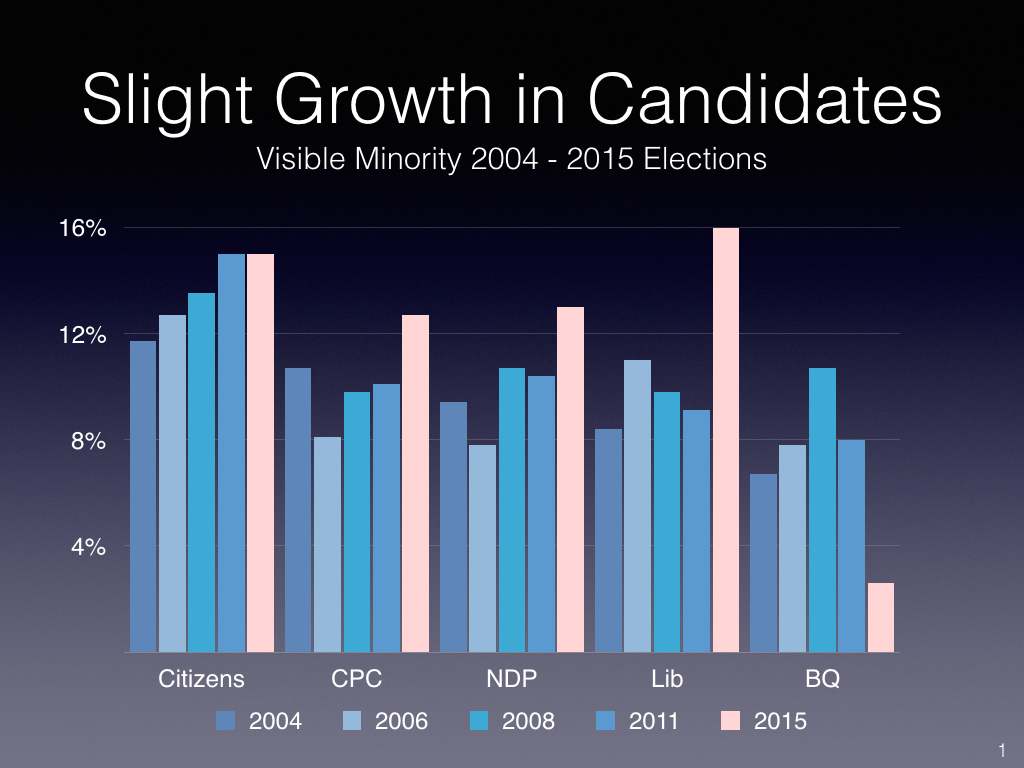
Out of a total of 1014 candidates for the three major parties, 142 or 13.9 percent were visible minorities. The chart below shows a growth in visible minority candidates for the three major parties plus the Bloc.

VisMin Candidates 2004-2015.001

For the 2015 election, the Liberal party has the most visible minority candidates, slightly greater at 16 percent than the number of visible minority voters who are citizens. The Conservative party and the NDP have slight under-representation (13 percent) while the Green party has greater under-representation (11 percent). The Bloc québécois only appears to have a two visible minority candidates (under three percent of Quebec’s 78 seats).

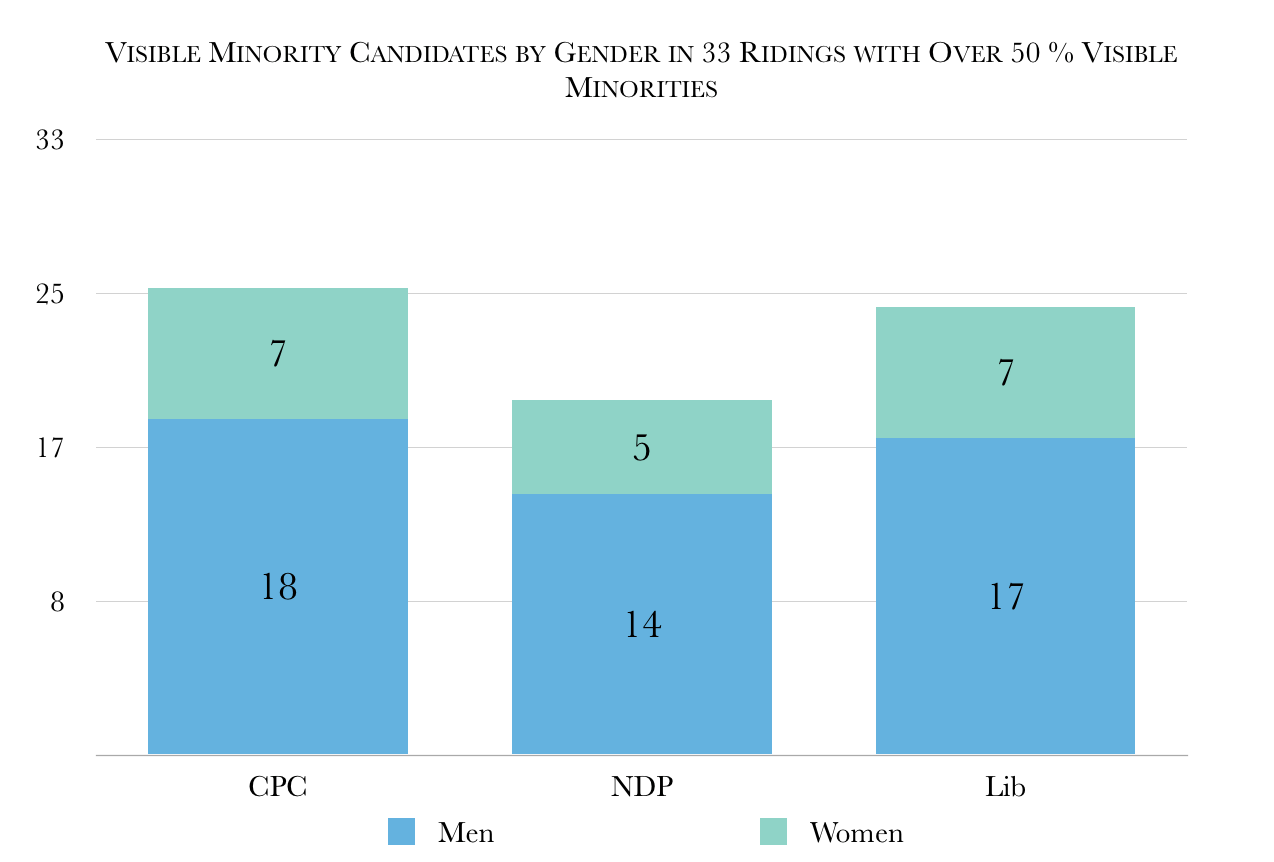
The chart below provides the comparative numbers for each party in the 33 ridings that are more than 50 percent visible minority, broken down by gender.

VisMin Candidates Top 33 RidingsAdditional characteristics of these ridings, in terms of the candidates, include:

  • Out of the 99 candidates from the three major parties, 68 are visible minorities (over two-thirds). These account for just under half of the 142 visible minority candidates in all ridings.
  • 19 candidates are women (19.2 percent)
  • In 15 of these ridings, all major party candidates are visible minorities;
  • Only one riding, Scarborough Guildwood, has no visible minority candidates;
  • The Conservative Party has the most visible minority candidates (25), followed by the Liberal Party (24) and the NDP (19); and,
  • In general but by no means universally, many candidates come from the larger communities in these ridings, particularly South Asian ridings as this table 2015 Ridings with More than 50% Visible Minorities and Their Candidates shows.

Happy election viewing and seeing how these (and other) ridings go.

Election Watch: Attacks on Multiculturalism May Haunt Tories – New Canadian Media

Good overview by Phil Triadafilopoulos, Stephen E. White, Inder S. Marwah on some of the implications and tests of the Conservative electoral strategy with ethnic voters:

Verbal and physical attacks on Muslim women, graffiti on Muslim candidates’ lawn signs and the growing sense of unease among Canadian Muslims speak to the costs of the Conservatives’ strategy.

And yet, the response of Canadians to these assaults on fellow citizens has been muted.

Polls suggest that Canadians across the country are, in fact, supportive of the Conservatives’ positions. What does this tell us about the state of Canadian democracy?

Canadians’ support for multiculturalism is limited.

First, it suggests that Canadians’ support for multiculturalism is limited. Intolerant or merely opportunistic politicians can count on a reservoir of such support in advancing their agendas if they play their cards right.

The Conservatives have done exactly this: the relatively diffuse spread of Muslim voters, along with a broad-ranging antipathy toward the niqab, made this a worthwhile gamble.

By making the niqab an issue the Conservatives have harmed the NDP’s chances in the province Quebec, making it much less likely that the New Democrats – the frontrunner at the start of this campaign – will emerge with the most seats on Oct. 19.

The Conservatives’ ability to hold onto ridings in both the Greater Toronto Area and Greater Vancouver Area will provide the ultimate test of its strategy.

Second, if such bans become legislated, the ongoing battle between elected governments and the courts will continue.

While Stephen Harper has framed the NDP and Liberal parties’ resistance to niqab bans as being “on the wrong side of the electorate”, they’re on the right side of constitutional laws intended to shield minorities from the potentially unconstitutional preferences of democratic majorities.

We need only recall the overwhelming public opposition to Sikh turbans in the Royal Canadian Mounted Police (RCMP) 25 years ago to see how important the courts can be in preserving minority rights in the face of public pressure.

The coveted new Canadian vote

Finally, the election raises questions about the Conservative party’s longstanding efforts to replace the Liberal party as the “natural home” of new Canadian voters.  

The Conservative’s positions on the niqab currently enjoy support from a majority of Canadians, including new Canadian voters. But the extension of the culture wars into the final days of the campaign may be risky.

If the Conservatives’ strategy is successfully framed as an attack on Canadian multiculturalism and the Charter of Rights and Freedoms, it may come back to haunt the party.

The Conservatives’ ability to hold onto ridings in both the Greater Toronto Area and Greater Vancouver Area will provide the ultimate test of its strategy.

Source: Election Watch: Attacks on Multiculturalism May Haunt Tories – New Canadian Media

Islam in Britain: David Cameron goes too far in equating theology and terror | The Economist

Worth reading:

Nobody could deny that Britain’s madrassas are a huge, under-regulated social phenomenon (about 250,000 children attend around 2,000 such institutions) and that at worst, they are dreadful. In Birmingham last month, a 60-year-old imam and his son, a fellow Islam teacher, were both jailed for a year after pleading guilty to beating a ten-year-old child for his supposed failures in religious classes. It is certainly a bit crazy that up to now, “supplementary schools” have not been subject to the sort of inspection regime that has long been applied (albeit rather too leniently, until recently) to all full-time schools, including faith-based ones.

Mr Cameron’s words will reassure citizens whose sympathies teeter between the Conservatives and parties further to the right; but they will be badly received in the hard-core Muslim areas of British cities, like Bradford and Birmingham, even among those who agree that their communities suffer from all sorts of pathologies, from forced marriage to domestic violence to self-segregation to intolerance, that badly need to be tackled.

And the main reason, says Bradford imam Alyas Karmani, is not so much the contents of the prime minister’s statement, but the context; and in the particular the implication that by teaching, sometimes rather badly and brutally, a fairly purist form of Islam, madrassas are incubators for jihadist violence. What Muslim listeners to the speech will have noticed is the fact that Mr Cameron’s reference to madrassas came immediately after a segment deploring the fact that British boys and girls are being lured off to Syria to fight for the terrorists of Islamic State. “People do not become terrorists from a standing start,” said the Tory leader, after pledging to “take on extremism in all its forms, violent and non-violent.”  Both openly and subliminally, he was implying that deeply traditional Islam is a step on the path to terrorism.

And there, precisely, lies the nub of the deep argument between the British political class and many of the country’s Muslim leaders, especially those who are close to the grass roots. In parts—not all—of the former camp, it has become an ideological axiom that ultra-traditional social attitudes (on gender and sexuality, for example) and terrorism are points on the same spectrum, and not very far apart. But there are many Muslims (including those who resolutely oppose terror, and don’t much like ultra-traditionalism either) who insist that this is simply wrong. On the contrary, they say, social and theological conservatism is one thing, and sympathy for terrorism is another; they need to be separated not conflated.

Whatever their (often dire) failings, British madrassas are not an especially significant factor in incubating terrorism, insists Mr Karmani who knows the Muslim scene in London and many northern cities. The sort of youngster who is tempted to quit Bradford for Syria is often the product of a secular, non-madrassa-going family who is led into fanaticism by material on the internet. As evidence against against any link between hard-line theology and terror, he says that hardly any of the British youngsters who have left for Syria have been products of the purist Deobandi school of south Asian Islam, which accounts for a lot of Muslim education in Britain. As another prominent British Muslim adds, madrassas (especially those attached to well-known mosques) are the last place where a rogue teacher would try to find a jihadist warrior; they are watched by too many people and any such recruiting drive would be quickly found out.

Of course, while there appears to be little to no link to violent extremism, from an integration perspective, such ‘hard-line theology’ is hardly helpful.

Source: Islam in Britain: David Cameron goes too far in equating theology and terror | The Economist

Religious Freedom Report Says Anti-Semitism Remains Global Problem – Breaking News – Forward.com

Highlights from the U.S. State Department’s annual International Religious Freedom Report for 2014:

The 17th annual report, which was released Wednesday, noted that anti-Semitic incidents rose significantly in Western Europe during the 2014 Gaza War between Israel and Hamas as well as in eastern Ukrainian regions when Russian rebels forcefully annexed part of the territory. The number of incidents overall in France doubled last year, to 851, over 2013.

The report, which analyzed levels of religious freedoms in regions across the globe, also found in Israel “an increase in interethnic tension and violence involving different religious communities.”

In addition to the 2014 Gaza conflict, the report cited the attack on a synagogue in Jerusalem that left five dead along with the kidnapping and killing of three Jewish teenagers before the war as incidents that heightened tensions between Muslims and Jews in Israel during the year.

However, the report emphasized that “because religion, ethnicity, and nationality are closely linked in the Israel-Palestinian conflict, it was difficult to categorize many societal actions against specific groups as being solely based on religious identity.”

The report was the first presided over by Rabbi David Saperstein, who in January became the first non-Christian to hold the post of U.S. ambassador-at-large for international religious freedom.

“If you look at the Pew reports that I believe are a year behind our reports, over the last several years there’s been a steady increase in the percentage of people who live in countries that … have serious restrictions on religious freedom,” Saperstein said at a news conference Wednesday. “At the same time … we’ve seen enormous expansion of interfaith efforts on almost every continent to try and address the challenges.”

Source: Religious Freedom Report Says Anti-Semitism Remains Global Problem – Breaking News – Forward.com

Mayors of the 905 weigh in on election, and the possible myth of ‘the big shift’

I always thought that Ibbitson and Bricker were premature in their assertion that there was a permanent ‘big shift’ to the Conservatives. The comments by Ajax mayor Steve Parish are particularly interesting, given that this is Citizenship and Immigration Minister Alexander’s riding:

The suburban area around Toronto, known as the 905 for its area code, has been one of the key battlegrounds in this federal election campaign. With 52 ridings, the electoral gold mine of double-income commuters, strip malls and hockey arenas amounts to the third-largest province after Ontario and Quebec in riding count.

While Stephen Harper’s 2011 majority was largely attributed to the Tories’ sweep of the 905, Justin Trudeau’s Liberals have narrowed the spread this time to a horserace.

As of this last week of campaigning, Jeff Smith of EKOS Research Associates says their data shows the parties in the 905 are in a two-way tie as they are both averaging about 40 points each.

Journalist John Ibbitson and political commentator and pollster Darrell Bricker published the The Big Shift: The Seismic Change in Canadian Politics, Business, and Culture and What It Means for Our Future in 2013. The authors surmised that suburban areas in Ontario, like the 905, are making the country more conservative, because the immigrants — largely from Asian countries — who are settling there are conservative. They identified the Conservative surge in 905 in the 2011 campaign represented not a fluke but a permanent, demographically-generated shift.

With the constant scrutiny and nitpicking from pollsters, politicians and strategists on what could happen, iPolitics talked to the people who know 905 communities best: their mayors.

Ajax, according to Statistics Canada in 2011, is a city of almost 110,000 people in the eastern part of the Greater Toronto Area. Since 1995, the mayor of this growing and diverse city has been Steve Parish. A self-identified fiscal conservative who is socially progressive, Parish says the narrative of the “big shift” of the suburban areas around Toronto being a permanent stronghold for the Conservative Party is a bit of a generalization.

“I think generalizations are dangerous in politics,” Parish says.

Ajax — formerly known as Ajax-Pickering — went Conservative in the last election, to now Minister of Citizenship and Immigration, Chris Alexander. Prior to the 2011 election, Ajax was a Liberal stronghold stretching back to the 1980s.

Parish says that his city has seen massive growth in ethnic diversity, which wasn’t there 10 to 15 years ago. With this diversity, many of his constituents he says are small “c” conservative — due to their religious or cultural beliefs — but that there is no broad stroke to define everyone.

“My theory is that even in the recent-Canadian category, there is a broad range of philosophies as to what the proper role of government is.”

One thing Parish says he abhors is wedge politics — like the issue of whether or not women can wear the niqab during the citizenship ceremony. It unnecessarily divides people, he says, and diverts their attention from bigger problems. He says trying to deny women the right to wear the niqab “rings hollow, and very opportunistic to me.”

Despite Parish’s thoughts on the niqab, a poll conducted by Léger Marketing, in March for Conservative Leader Stephen Harper, found of those polled, 82 per cent supported the requirement that women remove their niqabs or burqas during citizenship ceremonies.

With many of his constituents being from Middle Eastern countries, like Lebanon and Iraq, Parish says issues of immigration and refugees are important to them. “It strikes a chord in this community.”

“Residents are plugged into wide range of issues. I don’t know which issues will be ballot box question. It’s a diverse population, with people from a lot of diverse backgrounds who have different priorities.”

Mayors of the 905 weigh in on election, and the possible myth of ‘the big shift’

Mississauga Mayor Crombie refuses to apologize over mosque stance

Crombie called it correctly (Mississauga is about 12 percent Muslim):

Mississauga Mayor Bonnie Crombie stood up in council Wednesday and adamantly declared, “I stand by the remarks I made,” refusing to apologize to a group of residents alleging she had labelled them racists for refusing to support a new mosque.

Crombie told residents — who presented a petition demanding an apology, claiming she had turned a planning issue into a race issue — that she singled out only one resident at a council meeting two weeks ago for his views.

Kevin Johnston admitted distributing literature urging people to support stopping the mosque. He claimed if the mosque is built current residents would leave in droves, creating “another Canadian cultural hole.” He argued the mosque did not fit with the neighbourhood, would drive up crime and vandalism, set back women’s rights and impact housing prices.

The brochure depicted a Canadian flag with a Muslim crescent moon and star in the middle, instead of the maple leaf, offering it as a warning to readers. He urged people to visit his website, stopthemosque.com and sign a petition.

Johnston has since changed the content of the website to focus only on planning issues.

“It was uncalled for, it was unCanadian, it was heinous and it was wrong,” Crombie responded to the group of residents demanding an apology inside the council chamber, as a much larger group that filled one side of the seats erupted in applause.

In a verbal statement at council on Wednesday Johnston said he has paid a price for his position.

“What I would also like to say here is the term hate monger was regrettably brought forth by yourself Madame Mayor. It is something that well, congratulations to you, cost me my job and also, congratulations to you, cost me the ability to work locally so I will have to probably work outside of Mississauga but I won’t be leaving.”

“What I do want to say clearly to the entire Muslim community (is that) I do want to talk to you this is not something where I’m saying I am anti-Muslim, I am not anti-individual but I do know the problems that will come up with this building so if you do want to have conversations please call me,” he said.

Source: Crombie refuses to apologize over mosque stance | Toronto Star