Away from spotlight of national Conservative campaign, Jason Kenney runs another

Interesting list of commitments (not in the party platform), reinforcing the link between domestic (diaspora) politics and foreign policy:

He’s [Kenney] been going non-stop since the campaign began, he said, because despite all the inroads the Conservatives have made, demographics and shifting immigration patterns provide new opportunities for outreach.

“We’re not going to retain every vote we have in the last election but I think we’re doing very well,” he said.

He’s doing more, however, than just showing up.

Kenney has made several campaign promises in recent weeks that appear nowhere in the official Conservative campaign platform.

To the Sri Lankans, Kenney promised a promise to expand Canada’s high commission to the city of Jaffna, a provincial capital in that country whose population is mostly Tamil. The Tamil diaspora in Canada is among the largest in the world.

To Iranians, Kenney promised to make it easier for them to access consular services from Ottawa, as opposed to having to travel to Washington, D.C. Canada expelled Iranian diplomats from Ottawa in 2012, leaving the Iranian diaspora without access to services like passports or other government documents.

To the Armenian community, a pledge to opening trade and consular office in Yerevan, the country’s capital.

Armenian Canadians should “return the favour to the Conservative party and its candidates by voting and helping party candidates,” the head of the Armenian Canadian Conservative Association reportedly said, according to a post about the announcement on the HyeForum, an Armenian community website.

While not speaking specifically about those promises, Kenney said the Conservatives have their eye on getting diaspora communities more involved in foreign policy.

“Think tanks, foreign policy commentators say that Canada’s diversity is in principle a great strength for foreign and economic ties around the world and we have never really done that in a systematic way,” he said.

“So we’ve been trying to develop ways to more formally engage the large diaspora communities who are new Canadians to deepen ties with countries of origin.”

The Conservatives have come under considerable fire, however, for how closely they appear to link foreign policy to diaspora politics.

Since 2006, under the Conservatives, 1.6 million people became Canadian citizens, Kenney pointed out.

“There are new communities that have developed in large part since our government came to office and so that’s an advantage we did not have in the past.”

Those Canadians are looking for change just like everyone else, said Liberal John McCallum, and they are not responding well to what he calls the Conservatives’ divisive — and often entirely misleading — approach.

A recent set of ads appearing in the Chinese and Punjabi press asked readers whether Trudeau’s values — described as being about putting brothels in communities, allowing marijuana to be sold in corner stores and allowing drug injection sites in local neighbourhoods — none of those things are in the Liberal platform, McCallum said.

“It’s wrong, on principle, and it’s a sign of desperation.”

Source: Away from spotlight of national Conservative campaign, Jason Kenney runs another | National Newswatch

UK: Anti-Muslim hate crime to be treated as seriously as antisemitism

Good and needed as part of engagement strategy:
Prime Minister David Cameron will tell police forces in England and Wales to record anti-Muslim hate crimes separately and treat them as seriously as anti-Semitic attacks. The move comes amid rising incidents of Islamophobia.

New funding to boost security at religious buildings, including mosques, will also be announced.

The policy move on Tuesday is designed to reassure Muslim communities that the government’s counter-extremism strategy will be balanced, amid fears that the measures alienate them.

Cameron will make the announcement at the first meeting of his new Community Engagement Forum, which will meet to discuss the government’s counter-extremism strategy, due to be published next month.

Islamophobic crime in London jumped by 70 percent in the year up to July, according to official statistics from the Metropolitan Police, one of the few forces to record anti-Muslim hate crime.

Anti-Muslim hate crimes in other parts of the UK are currently monitored by Tell MAMA, an unofficial recorder of Islamophobia in the UK that relies on victims logging incidents online or over the phone.

Speaking ahead of the announcement, Cameron said he wanted to show Muslim communities support.

“I want to build a national coalition to challenge and speak out against extremists and the poison they peddle.

“I want British Muslims to know we will back them to stand against those who spread hate and to counter the narrative which says Muslims do not feel British.”

“And I want police to take more action against those who persecute others simply because of their religion,” he added.

Source: Anti-Muslim hate crime to be treated as seriously as anti-Semitism – Cameron — RT UK

What Kathleen Wynne can do about anti-black racism

Anthony Morgan, a research lawyer at the African Canadian Legal Clinic, proposes the creation of an anti-racism secretariat to undertake research and public education to reduce racism.

Not really sure the extent to which this will be effective, compared to the Ontario Human Rights Commission as well as other activities, governmental and non-governmental, with the comparable objectives:

Peel recently joined Toronto, Ottawa, Hamilton and London as Ontario jurisdictions where black people are the primary targets of the humiliating, human rights violating police practice of street checks and carding. Peel Police Chief Jennifer Evans has even decided to join the line of other Ontario chiefs who are defiantly committed to continuing this practice despite evidence of its discriminatory impact on black people.

In the realm of child welfare, black children are grossly overrepresented in every Ontario region where there is a sizable black population. After initially being caught flat-footed, the Ontario government has responded by supporting two separate province-wide consultations to address the systemic anti-black racism chronically plaguing Ontario’s policing and child welfare institutions.

It’s likely only a matter of time before similar province-wide government consultations have to be launched to remedy the over representation of blacks in school dropout rates, suspensions and expulsions, Ontario prisons, mental health committals and incidents of police use of deadly force, among others.

Though not as prominent on the public radar as it should be, anti-black hate crime also remains a pressing problem in Ontario. According to annual reports by the Toronto police and Statistics Canada, for the last few years blacks have been the principal target of racist hate-crimes in not only Toronto but across Canada.

Recently in Ottawa, a Black Lives Matter mural was defaced with the following threat: “ALL LIVES MATTER, NO DOUBLE STANDARD, YOU HAVE BEEN WARNED.” This was the third Black Lives Matter mural to be defaced in Ottawa over the last few months. In another jarring incident in April, a black assembly plant worker in Windsor faced repeated incidents of nooses being tied and mysteriously placed in and around his working space.

The above incidents are not small, isolated and unconnected mishaps enacted by a fringe few. They collectively form part of the continually creeping culture of anti-black racism embedded in the public consciousness, conventions and institutions of Ontario. This culture is critically implicated in constructing a context for black life in which chronic crime, violence, unemployment and poverty too commonly compromise the health and well-being of Ontario’s black population.

None of the above is to suggest that the Ontario government and its institutions are not leading and/or supporting some important work to directly or indirectly address anti-black racism. It is to point out that what is being done is simply not enough.

There remains a powerfully promising institutional response to anti-black racism and other forms of race-based discrimination that the Ontario government is yet to deploy: the Anti-Racism Secretariat. Since 2006, Ontario’s Human Rights Code has provided for the creation of this secretariat mandated to undertake research and public education programming designed to prevent and eliminate racism in Ontario.

For reasons that are unclear, the secretariat has never been established. In the chasm of the Ontario government’s silent inaction, it is tempting to speculate that black people being the primary targets of racism in Ontario is the reason for this.

Source: What Kathleen Wynne can do about anti-black racism | Toronto Star

Canadian Science Policy Conference 2015: Diaspora Scientists: Canada’s untapped resource of knowledge networks

Another example of multiculturalism in action: building diaspora scientific links this coming November:

A first of its kind in Canada, this inaugural symposium aims to discuss the topic of diaspora scientists and their potential to strengthen international science and technology collaboration.

The symposium seeks to mobilize the untapped resources of diaspora communities to strengthen Canada’s global connections in science, innovation and trade.

The objectives of this symposium include:

· Mobilizing and connecting existing diaspora scientific communities in Canada

· Providing networking opportunities among diaspora scientists to share experiences,
lessons, and best practices

· Exploring the full potential of diaspora scientists

· Forming a Canadian Network of Diaspora Scientists that includes a database of organizations and individuals who are active in this field

Source: Canadian Science Policy Conference 2015: Diaspora Scientists: Canada’s untapped resource of global knowledge networks

Former CSIS analyst on homegrown terrorism and Islamic doctrine – The Globe and Mail

Good interview with Phil Gurski, former CSIS homegrown terrorism expert, regarding the messages in his new book, The Threat From Within. Last para particularly noteworthy:

You write that extremism is like the aphorism about real estate and location – but “narrative, narrative, narrative.”

What they [al-Qaeda-inspired radicals] are propagating and distributing is this conviction they are responding to our aggression as Westerners, and they are merely defending themselves. And that’s not true, but it doesn’t have to be true to be effective. The whole point of the book is there is no pattern to this. We have to accept that terrorists come from us. They come from Canadian society. They are not off-the-boat immigrants.

You point out, though, the narrative is partly rooted in religious doctrine, or at least concepts like jihad, hijra …

Here’s the dilemma that mainstream Muslims face: The people who commit these acts of terrorism see themselves as actually representative Muslims. In fact, they see themselves as the only true Muslims and start criticizing everyone else as being non-Muslims. So it comes from within Islam, but it is not Islam. How do we accept they have taken pieces of 1,400 years of Islamic history, and use it to their advantage?

You write that fundamentalist imams in Canada should be challenged.

Even if we’re not talking about terrorism, if we’re talking about small pockets of society that will basically advocate intolerance and rejection of other parts of society, do we want a country like that? What the [fundamentalist preachers] do is they are very intolerant and rejectionist of other Muslims, let alone non-Muslims. I think we have an obligation to challenge this, to argue against this.

But our political leaders don’t know the difference between Islamic doctrines.

Politicians are going to do what politicians are going to do. That’s fine. Everyone recognizes if we’re going to talk about this issue, to do something about it at an early level, we need early intervention, before it becomes a security-intelligence issue. The government’s role is to foster and encourage the grassroots that are starting in this country. The government role has to be very much a background role.

But if the problem is narrative, and the narrative has had 1,400 years, how does someone in Ottawa come up with a program to counter it?

The line I like to use – and it really shocks some audiences – is that right now the only solution we have is to start with the four-year-olds. If we can get all the four-year-olds to understand what this narrative is saying and reject it, we’ll be fine.

Like in junior-high assemblies where the police used to say, “Don’t do drugs?”

No, it’s more than that. We as a society have to understand the child you’re raising has to be raised in an environment of tolerance and acceptance. So if you can get that right across the board – not just Muslim communities, not just immigrant communities, but in Wonder Bread white communities – we’re going to be in good shape.

Source: Former CSIS analyst on homegrown terrorism and Islamic doctrine – The Globe and Mail

Grad rates jump for Toronto Somali students thanks to programs geared to help

Despite the earlier controversy by some in the Somali-Canadian community, appears that this kind of targeted program can work:

The plan runs the gamut: Nudging Somali-speaking teens into taking leadership roles at school; ensuring their culture and faith are part of their courses; training their teachers; reaching out to their parents.

And over an eight-year period, those efforts have paid off: 80 per cent of Somali teens now earn high school diplomas, a jump of 27 percentage points between 2005 and 2013.

While the community still struggles in the school system — results on the Grade 10 literacy test and standardized math tests continue to lag, as well as the number of credits teens earn in Grades 9 and 10 — the increase in graduates means the plan has almost closed the gap with the Toronto District School Board’s overall rate of 83 per cent.

“When we have such a high-level of buy-in from students and the community, inevitably we trend toward improvement,” said Jim Spyropoulos, executive superintendent in charge of equity and inclusive schools. He predicts Somali youth will soon surpass the board-wide graduation rate.

He attributes the boost to programs funded by Ontario’s Ministry of Education that help schools in at-risk urban neighbourhoods, as well as board initiatives geared toward providing social, emotional and academic support specifically for Somali students, plus training to help educators create a classroom that reflects the diversity of the city.

Improved grad rates were being achieved even before a task force to help Somali teens — vehemently opposed by a vocal group in the community — was set up.

Spyropoulos said the task force’s 2014 recommendations, which include mentoring and university planning, were built on the previous initiatives.

“The kids were telling us what’s working,” and those initiatives were included in the task force plan, he said.

The community has changed over the years, he added. Twenty years ago, many of the Somali teens in Toronto schools were recent arrivals from a war-torn country. Today, they’re mainly Canadian-born kids who face different stressors — including trail-blazing for the next generation.

“Eighty per cent of them are now born in Canada,” added Spyropoulos. “We need to be effectively plugged into the community as to what are the realities of today, coping with second-generation stresses.”

Part of the focus will be on post-secondary education, which the board is tracking, because “these kids are pioneers… when they go (on to post-secondary), they change the world for generations after” who will then be more likely to go to college or university.

Among Somali teens who graduated in 2005, 24 per cent were accepted into an Ontario university and 13 per cent to college. Among the 2013 group, 41 per cent went to university, and 20 per cent to college. The university enrolment rate is lower than that of the board as a whole, which is 50 per cent.

Source: Grad rates jump for Somali students thanks to programs geared to help | Toronto Star

Multiculturalism in Canada: Evidence and Anecdote Book Launch – Presentation

MiC - Final Cover - Lulu - LargePlease find the link to the deck presentation used at yesterday’s book launch at the Ryerson Centre for Immigration and Settlement (RCIS) and the Global Diversity Exchange. It provides a high level overview of the findings using numerous charts.

Overview Deck

Election 2015: Party Platforms Immigration, Citizenship and Multiculturalism

Now that all the political platforms are out, I prepared this comparative table of the three major parties and their commitments on immigration, citizenship, multiculturalism and related issues.

A number of aspects worthy of note with respect to the Liberals and NDP (Conservatives are largely reinforcing existing policies):

  • Neither party mention repealing C-24 (2014 Citizenship Act) either in whole or in part (e.g., revocation), despite having been clear on the campaign trail and in the debates to do so (save for the Liberals committing to restore pre-Permanent Resident time for international students for residency requirements);
  • The main focus is immigration, with the Liberals emphasizing rolling back some of the changes, the NDP foreign credential recognition;
  • General agreement on refugee policy with some nuances;
  • No real discussion of multiculturalism save for the need for community outreach and engagement as part of a counter extremism strategy, with the NDP also calling for non-discriminatory consular service; and,
  • Both calling for the restoration of the long-form Census.

The link to the pdf version of the table is below (doesn’t translate well into WordPress):

Liberal, NDP and Conservative Platforms

I have tried to summarize accurately the individual commitments. Needless to say, if any readers have any corrections, comments or suggestions, happy to revise this accordingly.

How Tories win immigrant votes using anti-immigrant messages: Doug Saunders

Doug Saunders, always worth reading, flags the longer-term risks of the Conservative approach, drawing on the analysis of Peter Loewen (see earlier post Support for Conservatives’ niqab ban is deep and wide, even among immigrants). We will, of course, see the extent to which the strategy works on election day:

The second is that after accomplishing this, Mr. Harper’s party has run a 2015 campaign built on ethnic and religious distrust, fear and divisiveness. By turning a non-existent issue – involving a miniscule subgroup, women who wear the niqab – into a major campaign issue, and by tying immigration and terrorism policies together rhetorically, the Conservatives have stoked anti-immigrant sentiments and religious intolerance.

That leads to the third surprise: This does not appear to have cost the Conservatives support among immigrants and members of most minorities.

I checked this with Peter Loewen, a specialist in public-opinion analytics at the University of Toronto’s department of political science. He is one of the operators of localparliament.ca, an online portal that tracks the voting intentions of 11,442 eligible and likely voters across Canada. While the survey’s big-picture forecasts are subject to the distortions and biases of online polling (and use algorithms to correct for these), it shines at providing a uniquely large-sample, daily breakdown of intention by immigration status.

It shows that, as of Wednesday, non-immigrant Canadians have a predicted likelihood of voting Conservative of 27 per cent, while foreign-born Canadians have a likelihood of 34 per cent – a statistically significant 7-point difference recorded well after the Tories’ tilt toward ugly ethno-politics.

More significantly, Dr. Loewen told me, “there is no evidence that immigrants are becoming less likely to vote Tory as the campaign goes on. In fact, if anything, the opposite appears true.”

By turning sharply toward anti-immigrant messaging, the Conservatives didn’t lose, and might even have gained, support among immigrants. What gives?

It shows that the politics of intolerance, as well as the more benign social and economic appeals to small-c conservatism, are at least as likely to appeal to minority immigrants as they are to “white” Canadians. On one level, realizing this represents a sort of political maturity – better to have conservative parties fighting for minority votes than the situation in the United States or France, where the right-wing parties still rely on the monolithic intolerance of the white majority.

David Cameron, Britain’s Tory Prime Minister, ran a re-election campaign this year larded with tough messages about detaining and sending back immigrants; he not only won a majority but also doubled his party’s support among ethnic minorities, attracting a million visible-minority Britons.

On a more extreme level, former Toronto mayor Rob Ford’s xenophobic and often outright racist rhetoric made him the preferred candidate for lower-income immigrant voters; his faction still controls the city’s most minority- and immigrant-heavy wards.

Mr. Harper has probably lost the Muslim vote, but that’s only 3 per cent of Canadians. He and his ethnic-outreach agent, Multiculturalism Minister Jason Kenney, are evidently making a calculated bid to make gains among Hindu, Sikh, Buddhist and Christian diasporas by playing on their atavistic fears of their Muslim neighbours.

This is a dangerous game.

Research has shown that Canadians do not bring the ethno-political divisions of their home countries with them: Indo-Canadian Muslims prefer to live among Indo-Canadian Hindus and Sikhs rather than Muslims from other backgrounds, for example. Intermarriage rates are high.

But diversity does not mean that everyone trusts everyone else. My Trinidadian neighbours have sour things to say about Jamaicans, and the Malaysian guy up the street says unprintable things about the local Eritreans. The schisms of the Indian subcontinent – Hindu, Sikh and Muslim; Sinhalese and Tamil; Sunni and Shia; Deobandi and Barelvi – are woven into many family histories. The schisms of the Middle East are woven into others. But in Canada’s system of democratic pluralism, those private divisions are kept in the background, subsumed under a larger values of mutual respect, cooperation and equal treatment. Playing on these histories for electoral gain goes against Canada’s basic values.

Building a diverse and inclusive conservative movement ought to have been a historic accomplishment. But by using intolerance to fuel sectarian mistrust, Mr. Harper is damaging that legacy.

Source: How Tories win immigrant votes using anti-immigrant messages – The Globe and Mail

Loewen: Support for Conservatives’ niqab ban is deep and wide, even among immigrants

Analysis by Peter Loewen

Analysis by Peter Loewen

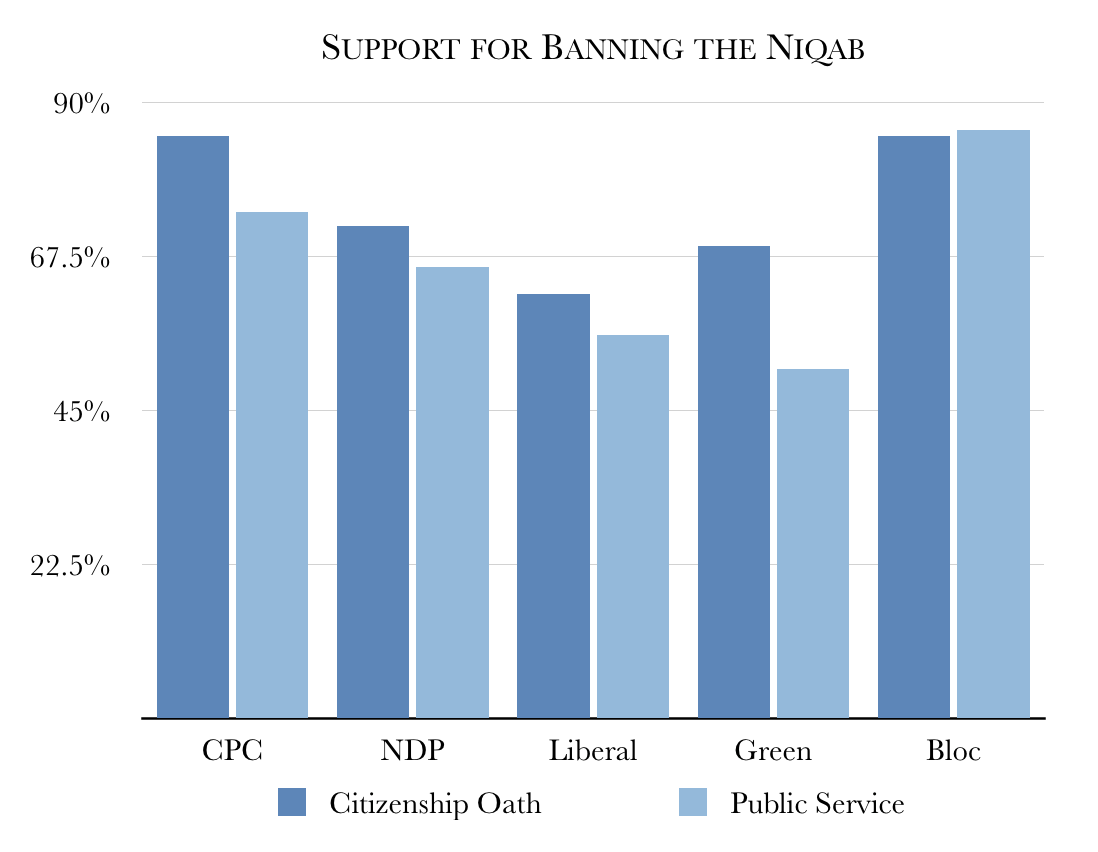
Interesting analysis by Daniel Robinson and Peter Loewen on the changing voting patterns of immigrant voters and the niqab, providing more analysis than in Doug Saunders synopsis (How Tories win immigrant votes using anti-immigrant messages). The chart above compares party supporter views:

On the citizenship oath measure, 72 per cent of Canadians agree. Just 14 per cent disagree. (Another 14 per cent either don’t know or are ambivalent.) This opinion is not isolated to “old stock” Canadians. Among those citizens born outside the country, 70 per cent agree with forcing women to reveal their faces.

… It is a similar story when we ask whether the public service should ban niqabs. Sixty-four per cent of people we surveyed support such a ban. Just 19 per cent oppose it. Support is undiminished among immigrants, where two-thirds (66 per cent) would support a ban and just 16 per cent would not. …

Some have noted that the niqab is an effective issue, not only because it garners wide support but also because it is largely irrelevant to voters. It is, at best, a useful distraction. But this misses something important about voters: they often take their cues from politicians about what is important. By the time we surveyed voters, the niqab had been a point of discussion for more than two weeks. When we asked our respondents how important the issue is to them, 78 per cent indicated that the niqab in citizenship ceremonies is a somewhat or very important issue. We got the same results when we asked about a niqab ban in the public service.

We now have a situation in which opinion-leaders – newspaper columnists, pundits, commentators – almost uniformly insist that a policy is both wrong and unimportant while voters disagree on both accounts.

Our data tell a broader story about multiculturalism and Tory support. Political scientists – especially André Blais and Richard Johnston – have long noted that the 20th century dominance of the Liberal party was attributable to outsized support among Catholics and visible minorities, perhaps especially immigrants (to the extent that those categories overlap). Consequently, the Tories have spent considerable effort courting various groups of immigrants to their party.

Data from both the 2011 Canadian Election Study and Ipsos-Reid’s massive 2011 exit survey suggest that the Tories may have finally closed this “immigrant gap” in the last election. Our data suggest that they have now not only closed the gap, but have created a significant advantage of their own among immigrant Canadians.

To test this, we calculated the odds of Canadians voting Conservative that controls for a respondent’s age, income, education and gender, province of residence and, importantly, religion.

The results, which draw on massive sample sizes, show that a native-born citizen has a 27 per cent likelihood of voting Conservative. The likelihood for an immigrant Canadian voting Conservative is 34 per cent.

Because we controlled for religious affiliation, we can also estimate these effects. Compared to the non-religious, Jews and non-Orthodox Christians have a greater likelihood of voting for the Conservative party. But among Muslim Canadians, there is a clear aversion to the Conservative Party of Canada.

The niqab has become a campaign issue in this election, and perhaps the issue. The are several reasons for this, but public opinion research points to one of the more important ones: given the consistent, widespread support across the political spectrum for the Conservatives’ stated position, the Tories can only stand to gain from the issue playing prominently in the public discourse.

Source: Loewen: Support for Conservatives’ niqab ban is deep and wide, even among immigrants | Ottawa Citizen