Q&A: Master of None’s Aziz Ansari on ‘ethnic’ casting, Netflix & making revolutionary TV

On my ‘to watch’ list:

Launched on Netflix two weeks ago, Master of None has already been become one of the most talked-about shows of the year. It’s been hailed as the show that aging Millennials have been waiting for, the show that put an end to the last acceptable ethnic cliché, a show that subverts masculinity, and a food-stuffed triumph; it’s the new Louie, the new Sex and the City. Aziz Ansari, the co-creator, co-writer and co-director of this mult-headed Hydra of amazingness,spoke to Sarmishta Subramanian about how he and his co-creator, Alan Yang, did it.

Reviews of your show have been ecstatic. People have really responded to it. Why do you think that is?

It’s making a narrative of our comedic viewpoint. Master of None is really me and Alan’s perspective, and I guess it resonated with a lot of people.

For me, as an Indian, it was like watching Indians on television for the first time. It was a revelation. Have you heard that from other people? 

That was a point of the show. Me being Indian and him being Taiwanese, we could finally do an episode like “Parents” [which tells the backstory of the parents of Ansari’s character, and stars the actor’s parents] or “Indians on TV.” We were in a place that was so creatively friendly like Netflix; we also had the experience to tell a story like that, to get it right. What other show would have the impetus to do an “Indians on TV” episode? None, really.

It’s partly the specificity of it that’s ground-breaking. You never really see a Bengali or a Malayali or someone from Tamilnadu; it’s just “Indians.”

Yeah, that’s what I love. There are little things I’ve seen so many people respond to, such as my dad saying poda or ayyo or talking about pappadums, these little cultural things you haven’t really seen. Usually, it’s not an Indian person running the show, so there’s no one with that background to draw from.

Were you frustrated as a viewer by the generic way Indians are usually represented?

Yeah, that montage at the beginning of “Indians on TV” sums it up. But it’s not just Indian people—it’s everybody. The point with Master of None is: Everyone is an interesting, compelling person who goes beyond their ethnic background, their accent. We’re all three-dimensional characters.

A lot of times, characters of certain ethnicities are reduced to these two-dimensional, cardboard, stereotype roles, where their traits are very generic, and specifics of their ethnicities are painted with very broad strokes. It’s very insulting, and people don’t really get it right often. It’s pretty incredible that Ashton Kutcher did that brownface thing and didn’t get more flak for it. It’s pretty insane.

A big thematic point of Master of None is that there aren’t easy answers to these things and there don’t need to be. It’s more about having a conversation about it. A lot of the episodes were written with us in the writers’ room having long discussions about race or sexism or old people.

It’s not just a mix of races. In very subtle ways, the show also crosses age and class and sexual-orientation boundaries, but never in an over-the-top way. 

That’s one of the advantages of structuring the show the way we did, as opposed to a four-piece ensemble every week. The show is really about: What’s [Ansari’s character] Dev going to find himself doing this week? And which characters can we bring in to help that story? Sometimes it’s that this episode is called “Old People,” and let’s just have him hanging out with Rachel’s grandma the whole episode and you don’t see the other friends. You probably couldn’t do that on a normal show, because they’d say you’ve got to have all the friends still there. It gets annoying, because, in real life—and people have responded to this—you don’t have lunch with the same four people every day; you don’t see the same four people every weekend. People weave in and out of your life.

The casting for the show is almost—almost—over-the-top diverse. Two Indians is too many? How about an Indian guy, a Taiwanese guy, a black lesbian—

[Laughs] It wasn’t done in this way of a United Colors of Benetton ad. It was done in a very genuine way. The Brian character is based on Alan, the co-creator of the show, so he’s a proxy for him. Denise—we had an open call for that character. We told our casting person, Alison Jones, “Let’s meet with interesting people.” I read with so many women, and Lena [Waithe] was the funniest, and it just so happened she was an African-American lesbian woman, so we totally adapted the character to her. And Wareheim—Eric Wareheim—who plays Arnold, he is a good friend of mine in real life and he’s really funny.

Source: Q&A: Aziz Ansari on ‘ethnic’ casting, Netflix & making revolutionary TV

How the crazies and the pundits give IS exactly what it wants: Tabatha Southey

Great piece by Southey, and take down of those who should know better (David Frum) and those who don’t (Ezra Levant), although she is being unfair to Premier Wall:

Also working overtime for IS’s PR machine this week was former speechwriter for President George W. Bush and current senior editor at The Atlantic, David Frum. Despite the fact it appears that none of the people involved in the Paris massacre were Syrian refugees (statistically, refugees are among the groups least likely to commit acts of terror), Mr. Frum tweeted: “We must accept these peace-loving refugees from ISIS or else they will get very angry and try to kill us.”

What was the thought process there, Mr. Frum? “Good morning, I helped to provide justification for the Iraq war but I still don’t have quite enough blood on my hands, so I’d like to take a moment to characterize an entire nation of people as terrorists, thereby helping to ensure that the most vulnerable among them will suffer”?

Were you simply constrained by Twitter’s character limit there, Mr. Frum? Basic human decency and professionalism were clearly not issues for you.

Mr. Frum’s tweet may literally be the worst joke ever made, and it would be even if it didn’t spread just the kind of disinformation that actual IS murderers labour to disseminate.

What he should know, or admit to knowing, is that IS is not overly keen on Syrians escaping Syria. The optics are bad.

If you’re trying to position yourself globally as a utopian caliphate, Muslims running away from you as fast as they possibly can at grave risk to their lives is seriously bad press.

Muslims fleeing, not embracing you as an even marginally better alternative to the government that won’t stop bombing them, does not look good, and IS is acutely aware of this; no one wants would-be Syrian refugees kept in Syria more than does IS.

David Frum, among others, appears happy to help them out. David Frum: Unpaid Intern of The Islamic State of Iraq and Syria.

There’s method to IS’s macabre dramaturgy. They want to be depicted as the authentic Muslims, as some evil mystical empire with whom the West is at war, and volunteers queue up to help them.

In reality, IS’s progeny is recruited more at the malls than at the mosques and, in both their youthful demographic and their disaffection distorted into a kind of grotesque idealism, the recruits can seem more like murderous groupies than anything else.

In mentality and, to a certain extent, military capability, IS is more massive Manson family than major martial force.

Their lifeblood is the gratuitous message amplification so many proffer.

Big IS shout-out to Saskatchewan Premier Brad Wall, as well, for helping to stigmatize Syrian refugees and for suggesting that the appropriate response to terrorist intimidation tactics is to drop everything and be intimidated.

That’s exactly what his calls for additional security screening of Syrian refugees on top of the measures already in place do – measures that Michel Coulombe, director of the Canadian Security Intelligence Service, this week called “robust … and appropriate.”

The grassroots efforts on IS’s behalf should not be overlooked this week, either; every vile, racist tweet sent is like a bake sale held on IS’s behalf; and, speaking of sales, Sun TV detritus YouTube channel, Rebel TV, is offering black-and-white, very much IS-on-brand “Fuck ISIS” hats, T-shirts and coffee mugs.

This Christmas, Rebel TV wants you to say it with massacre merch.

Former Sun TV personality Ezra Levant high-tailed it to Paris this week to whine that its citizens continue, in the aftermath of last week’s horror, to be philosophical and resolutely secular, and to drink wine in the cafés. Why must they be so French?

Mr. Levant, disappointed rage-tourist and unofficial ambassador for the IS agenda, did not seem to like the fact that the attacks did not bring Paris to its knees. He is perturbed by your joie de vivre, France, by your determination to not let terrorists change you into a vicious, angry, funhouse mirror of your attackers.

President François Hollande announced the country will accept 30,000 refugees as planned.

Vive la France, and, terrorism dilettantes, go find meaningful employment.

Source: How the crazies and the pundits give IS exactly what it wants – The Globe and Mail

Le problème de cette majorité francophone | Le Devoir

More on Quebec debates and how Premier Couillard is addressing them:

L’accueil par le Québec de réfugiés syriens a inspiré à Philippe Couillard des réflexions sur l’intolérance des peuples, intolérance sur les braises de laquelle il accuse le Parti québécois et la Coalition avenir Québec d’avoir soufflé. Des commentateurs y ont vu un dérapage partisan. Or, il n’a fait que révéler le fond de sa pensée.​

Dans son discours d’ouverture du conseil général du Parti libéral du Québec il y a une semaine, Philippe Couillard a lancé : « Non à la xénophobie et au racisme, non à la fermeture et l’exclusion, oui à l’accueil, oui à la citoyenneté partagée. » Le sujet : l’accueil des réfugiés syriens et une bannière déployée à Québec pour s’y opposer.

Le lendemain, dans son discours de clôture, le chef libéral s’enhardissait en parlant de l’intégration des nouveaux arrivants : il a dénoncé la proposition du PQ — en fait, de Jean-François Lisée — d’imposer un délai d’un an à un nouveau citoyen canadien avant qu’il obtienne le droit de vote au Québec, question d’empêcher Ottawa de tricher. Quant à la CAQ, Philippe Couillard lui reprochait cette idée aussi singulière qu’inapplicable d’imposer aux immigrants un examen de français et de « valeurs » trois ans après leur arrivée : un échec mènerait à l’expulsion.

Le PLQ se présente comme le parti « de l’inclusion », comme l’a dit son chef, « celui d’une citoyenneté ouverte et partagée ». Le corollaire, c’est que le PQ et la CAQ ne le seraient pas. Dimanche dernier, le président de la Commission-Jeunesse du parti, Nicolas Perrino, a bien résumé dans son discours cette nouvelle posture des libéraux. « Les Québécois de tous les horizons savent que notre parti est le seul qui refusera toujours de céder aux fantasmes populistes d’un autre temps. Ils savent que notre parti se méfiera toujours de ceux qui prétendent promouvoir l’affirmation identitaire de la majorité en brimant les droits fondamentaux des minorités. Ils savent que notre parti défendra toujours les libertés individuelles et notre culture sans jamais verser dans l’intolérance et l’exclusion. »

Dans la conférence de presse de clôture du conseil général, Philippe Couillard a développé sa pensée. Tant le PQ que la CAQ « ont un lourd passif » en matière d’accueil des immigrants. « Parfois, et même parfois involontairement, en adoptant certaines politiques qui semblent faciles, qui semblent répondre à ce qu’on croit être le souhait de la population, on pose des gestes qui attisent les braises de ces démons qu’on a chez nous comme partout ailleurs », a-t-il fait observer. Devant l’intolérance, « j’ai toujours eu cette inquiétude », devant ces « démons », présents dans toutes les sociétés démocratiques, « dont la peur de l’Autre, dont la tentation facile du rejet de l’étranger, dont la xénophobie ».

À l’Assemblée nationale mardi, le chef de la CAQ, François Legault, a bien tenté d’obtenir de lui une rétractation. En vain. Jamais, jamais il ne se rétractera parce que c’est précisément ce qu’il pense, confirme-t-on dans son entourage. Ce ne sont pas là des exagérations partisanes servant à chauffer des militants qui se délectent des attaques du chef à l’endroit des adversaires politiques.

Aux yeux de Philippe Couillard, l’hypocrisie du PQ était manifeste durant ce qu’il appelle « cet épisode très regrettable de la charte des valeurs ». En prônant une neutralité religieuse qui s’incarne dans les employés de l’État, le PQ a sciemment exacerbé les sentiments xénophobes du peuple et il a divisé les Québécois.

Deux conceptions

Le débat sur cette charte, appuyée par une nette majorité de francophones à l’époque, ne confrontait pas deux conceptions légitimes du vivre-ensemble — entre les visions d’un Guy Rocher et d’un Charles Taylor, par exemple. Pour les détracteurs de la laïcité de l’État comme Philippe Couillard, le débat opposait les défenseurs des droits et libertés à une majorité pusillanime qui gonfle les muscles en brimant les minorités ; les Lumières de l’interculturalisme, l’ouverture à l’Autre étaient confrontées à l’ignorance nauséabonde d’une plèbe un brin raciste et obtuse.

À l’instar de Bouchard-Taylor, Philippe Couillard a toujours soutenu qu’il n’y avait pas eu de crise des accommodements raisonnables. Il a affirmé que la pratique était aujourd’hui bien balisée et que la charte péquiste ne réglait que des « problèmes imaginaires ». Ce qui ne va pas, c’est la majorité francophone. Il faut définir une « nouvelle identité québécoise », avait-il fait valoir alors qu’il était candidat à la chefferie du PLQ.

Source: Le problème de cette majorité francophone | Le Devoir

Regional differences in the educational outcomes of young immigrants

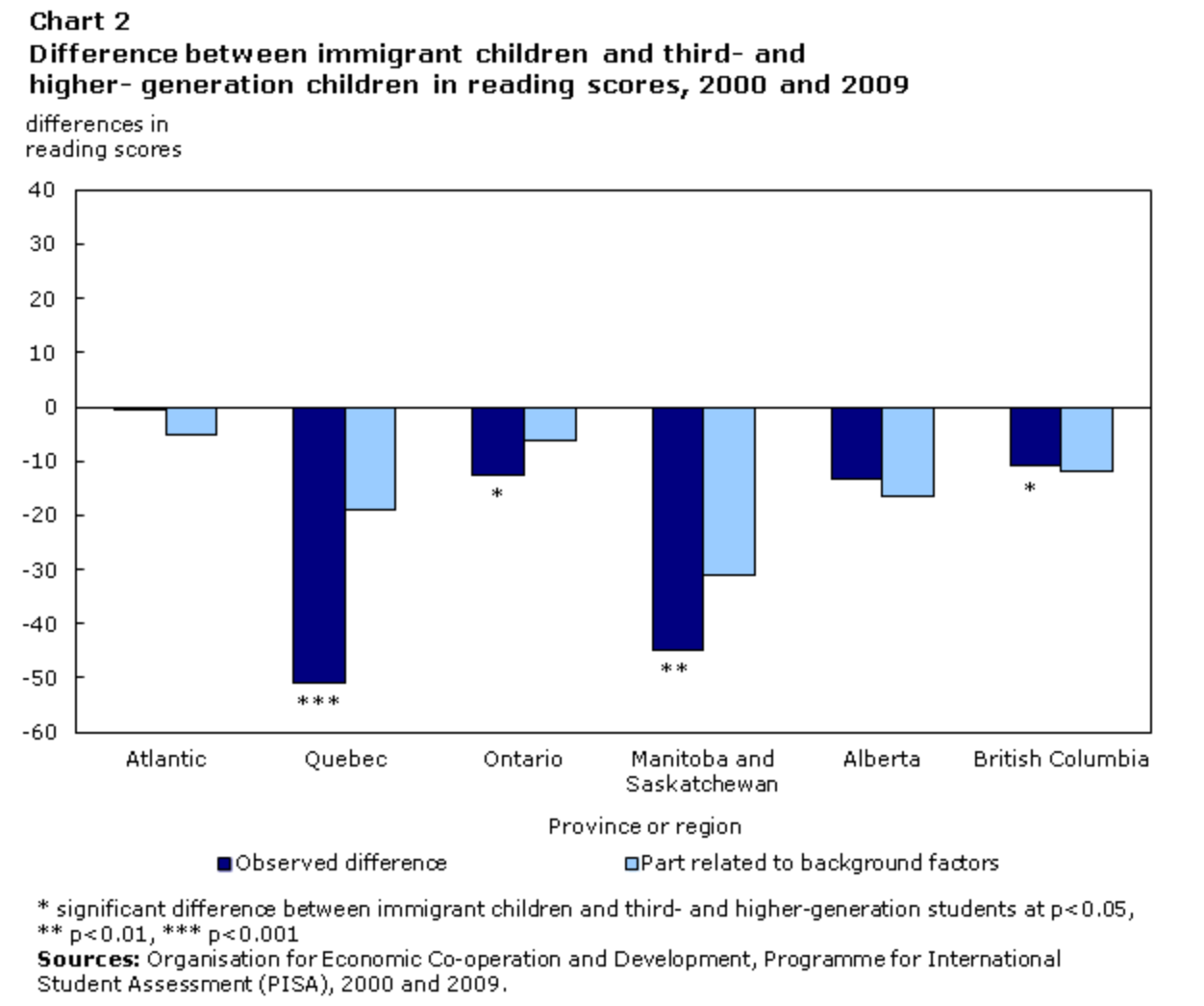
Immigrant Math Scores by RegionInteresting study comparing the educational outcomes of immigrant children and third-generation or more Canadians. The findings regarding Quebec are particularly worrisome, given implications for longer-term integration:


This article examines regional differences in the math and reading skills of immigrant children aged 15 based on data from the Programme for International Student Assessment (PISA). It also examines regional differences in high-school and university completion rates among young immigrants who came to Canada before the age of 15 using National Household Survey (NHS) data. Throughout the article, comparisons are made with the children of the Canadian-born (third- or higher-generation Canadians).

  • In Canada, the average PISA math score of immigrant students aged 15 was similar to the score of third- or higher-generation students. The average PISA reading score of immigrant children was slightly lower than the score of third- or higher-generation children.
  • In almost all regions, immigrant students had lower PISA reading scores than third- or higher-generation students. With respect to PISA math scores, immigrant students performed better than third- or higher-generation students in the Atlantic provinces and British Colombia, but performed less well in Quebec and in Manitoba and Saskatchewan.
  • Young immigrants aged 20 to 24 were more likely to have a high school diploma than their third- or higher-generation counterparts (93% versus 87%). Young immigrants aged 25 to 29 were also more likely to have a university degree (40%, compared with 26% of third- or higher-generation individuals in this age group).
  • Manitoba and Saskatchewan (29%) and Quebec (32%) had the lowest proportions of immigrants aged 25 to 29 with a university degree. In contrast, British Columbia (44%) and Ontario (41%) had the highest proportions.
  • Regional differences in the source countries of immigrants explained, in part, why some regions had higher university completion rates than others.

Immigrant Reading Scores by RegionSource: Regional differences in the educational outcomes of young immigrants

Québec s’attaque à la radicalisation: Loi 59

The evolution of Loi 59 – refreshing to see a government open to amendments for proposed legislation:

La ministre de la Justice, Stéphanie Vallée, a dévoilé des dizaines d’amendements — tenant sur plus de 40 pages — à son projet de loi anti-discours de haine afin de l’inscrire formellement dans la « lutte contre la radicalisation ».

« Le discours haineux, c’est un discours qui peut s’inscrire dans un processus de radicalisation, malheureusement », a-t-elle souligné dans un bref entretien avec Le Devoir près d’une semaine après les attentats de Paris.

D’ailleurs, le libellé de la version amendée du projet de loi, soumise aux élus de la Commission des institutions jeudi, a été inchangé depuis les attaques dans la Ville Lumière, a-t-on assuré au Devoir.

Le projet de loi 59 prohibera les discours haineux et les discours incitant à la violence tenus ou diffusés publiquement, mais également les « enseignements » du même registre, visant un groupe de personnes identifié à l’article 10 de la Charte des droits et libertés de la personne — femmes, homosexuels, minorités visibles, groupes religieux, etc. —, a annoncé Mme Vallée jeudi.

Suivant les recommandations des juristes de l’État, l’élue libérale s’était abstenue de définir le concept de « discours haineux » dans la version originale du projet de loi, ce qui lui avait valu de nombreuses critiques. Elle a remédié à cette lacune. « Aux yeux d’une personne raisonnable, [le discours haineux] est d’une virulence ou d’un extrême tel qu’il est susceptible d’exposer ce groupe à la marginalisation ou au rejet, à la détestation, au dénigrement ou à l’aversion, notamment pour que ce groupe soit perçu comme étant illégitime, dangereux ou ignoble », peut-on lire dans la nouvelle mouture du document.

D’autre part, Mme Vallée a ajouté une disposition au projet de loi permettant aux cégeps de résilier un contrat d’utilisation d’un local si le locataire a un « comportement qui peut raisonnablement faire craindre pour la sécurité physique ou psychologique des étudiants ainsi que celle des personnes qui sont présentes dans le collège ». « C’est une mesure [dictée par le] gros bons sens », a-t-elle fait valoir, près d’un an après le départ de jeunes fréquentant les classes du prédicateur Adil Charkaoui au Collège Maisonneuve pour aller grossir les rangs de groupes djihadistes.

Par ailleurs, Mme Vallée a retiré l’obligation faite à la Commission des droits de la personne et des droits de la jeunesse (CDPDJ) de tenir à jour une « liste noire » ou « liste de la honte » recensant les personnes épinglées pour discours haineux ou incitant à la violence dans le projet de loi.

Elle a également enlevé la peine minimale de 1000 dollars à laquelle celles-ci s’exposaient. La ministre laissera le loisir au Tribunal d’« imposer une ou plusieurs mesures de redressement » comme une « lettre d’excuses ». « Il peut arriver qu’un discours haineux soit tenu par une personne dans une situation de vulnérabilité extrême [ou] un jeune, un mineur », a précisé Mme Vallée au Devoir.

Source: Québec s’attaque à la radicalisation | Le Devoir

Seeing the Same Canada? Visible Minorities’ Views of the Federation

IRPP - Visible Minorities and the Federation.001A useful report by IRPP researchers Antoine Bilodeau, Luc Turgeon, Stephen E. White and Ailsa Henderson on the views regarding the federation of visible minorities, divided into both immigrants and second or more generations.

These regional differences, while not terribly surprising, nevertheless are revealing in that they reflect the overall regional perspectives (similarity between visible minority and majority population in Ontario, weaker regional grievances in the West among visible minorities, and greater support for national institutions in Quebec among visible minorities).

While the authors note that the federal model of multiculturalism is attractive to visible minorities is not new, it highlights the failure of Quebec’s efforts to create an alternative interculturalism narrative, along with the all too often exaggeration of the nuanced differences between the Quebec and federal approaches).

As to their recommendation that the Quebec government should adopt a formal interculturalism policy, while sensible in some respects, this would likely reopen some of the less productive debates of the past (e.g., the PQs Quebec Values Charter). Ironically, it also might undermine the rhetoric of the Quebec model of interculturalism, given its subtle differences with multiculturalism.

One of the weaknesses of CIC/IRC citizenship program was precisely its lack of stronger citizenship promotion in Quebec, which reflected more processing and efficiency concerns rather than reinforcing Canadian identity. This will likely continue, even if it is one of the few IRC programs in Quebec, one that can play an important role in reinforcing the federal presence in Quebec.

The transfer of multiculturalism back to Canadian Heritage will provide scope for more multiculturalism programming in Quebec and thus reinforcement of Canadian identity.  (Within CIC, there was a feeling that under the Cullen-Couture agreement, which transferred immigrant selection and settlement services to Quebec, that multiculturalism program funding for Quebec was not needed – missing an opportunity to assert federal presence.):

The authors show that, compared with the majority population, members of visible minority groups as a whole have a stronger sense of loyalty to the federal government than to provincial governments, express greater support for Canada’s national policies, and are less inclined to endorse historical grievances about the Canadian federation. As for competing national and provincial visions of Canada, members of visible minority groups embrace a national vision more strongly than the majority population.

However, the extent to which members of visible minority groups hold distinctive views about the Canadian federation depends on the province they live in and whether or not they were born in Canada. In Ontario, visible minorities’ views are almost indistinguishable from those of the majority population. In Alberta and in British Columbia, visible minorities born abroad hold somewhat weaker regional grievances than the majority population. However, those born in Canada see the federation in similar terms as the majority population.

The greatest difference between visible minorities and the majority population is in Quebec, where visible minorities born abroad and those born in Canada express considerably stronger support for a national vision. The differences in outlook on the federation between non-French speaking members of visible minority groups and the rest of the Quebec population are particularly striking.

The findings suggest that the federal government’s multiculturalism policy offers a model that appeals to members of visible minority groups. Its highest level of support is among visible minorities in Quebec, whose government has never supported multiculturalism policy and has yet to offer a formal and official alternative.

[conclusion] … If the attractiveness of the federal model appears to exert an influence over visible minorities in Alberta and British Columbia, it might be enhanced in Quebec because of the alternative narrative proposed by the Quebec government. The Quebec government has never officially supported the federal multicultural model and has instead proposed a model of interculturalism that has yet to be stated formally in an official policy and remains unfamiliar to most Quebecers (Gagnon and Iacovino 2007). Our findings thus lend support for those arguing for the Quebec government to adopt an official policy of interculturalism (Rocher and White 2014). A formal policy positioning of the Quebec government on matters of ethnocultural diversity would stand as a symbolic gesture recognizing the contribution of diversity within Quebec society and would promote increased interaction between minorities and the broader population. By so doing, the government could favour a rapprochement between the narrative adopted by visible minorities in Quebec and the dominant one found in Quebec and hence appease some of the tensions that have marked Quebec society over the last few years.

Our final observation concerns an exception to the patterns for all four provinces just discussed. Visible minorities in all four provinces are substantially more prone to see a positive impact of the policy of multiculturalism on Canadian identity than the majority population. This finding is not necessarily surprising considering that, more than any other issue examined in this study, the policy of multiculturalism speaks to the contribution of ethnocultural minorities to the construction of Canadian identity. Moreover, as we argued, the federal government’s multiculturalism policy might be the pivot around which the more federally oriented narrative of visible minorities is structured. Should the growing presence of visible minorities have one significant and consistent impact, it may well be to further strengthen acceptance of the country’s multicultural heritage — in the process further strengthening this pillar of Canadian identity.

http://irpp.org/wp-content/uploads/2015/11/study-no56.pdf?mc_cid=7023dd89ad&mc_eid=86cabdc518

How France’s diversity problem became a security problem

Konrad Yakabuski on the failure of France to integrate Muslim youth:

But eradicating the Islamic State, were it possible, would not end the alienation that has turned so many young French Muslims into violent jihadis. While the immediate imperative remains combating one particular brand of terrorism, Mr. Hollande’s efforts cannot end there. Unless Muslim youth can envision a future of semi-equal opportunity in France, one violent cause will simply replace another.

“A more nuanced response than total war is needed to deal with the underlying rage that fuels this confrontation. And that is almost impossible to imagine in the current atmosphere,” American University professor Gordon Adams wrote this week on the Foreign Policy website. “Islam has not been welcome in France, and the hostility of non-Islamic France is only growing.”

Source: Hollande faces the enemy from within – The Globe and Mail

Dana Wagner digs deeper:

Tidjane Thiam couldn’t get a job in France. Mr. Thiam is an Ivory Coast native who studied in France at the elite INSEAD business school. After failing to advance his career in France, he left for an offer in Britain, and in March became chief executive officer of Credit Suisse. The problem was not Mr. Thiam.

It’s unknown how many other visible minorities are unemployed or underemployed in France. The country doesn’t count. It’s against the law to collect data on race or ethnicity – liberté, egalité, fraternité.

But gender gets counted, as does disability. And in business, what gets counted gets done. Some French employers have found creative ways to count and improve work force diversity, using proxies such as names or home neighbourhoods. But in general, there is no counting, no target, no change.

The reluctance to count has made important subjects taboo. Ask a group of employers to a talk about immigrant and visible minority employment and few will show up. The very subject of race is an offensive topic of conversation. Affinity groups (Vietnamese professionals, Indian women, Algerian engineers) are considered insulting.

This summer, I met with staff of organizations that help disadvantaged young people get jobs. Most clients are poor and non-white. One manager I spoke with knows that the qualified young people he works with have worked twice as hard to get where they are. And still, hiring managers often express surprise at how well dressed they are, without the slightest awareness of how patronizing their comments are.

If this is what France’s educated, skilled visible minorities can expect, imagine what it’s like to be someone less privileged than that. Imagine knowing that you don’t stand a chance.

This is the undercurrent we will hear about in coming weeks: French people who don’t see themselves in France’s face or future. The integration problem has become a security problem that better intelligence will never solve.

Calgary Mayor Nenshi ‘shaken’ by racism in debate over refugee crisis

One of the best argued pieces on refugee and immigration fears:

“I don’t mind telling you that I have been shaken over the last four months by a tiny minority of the discourse,” the mayor said in an interview in his office.

“I haven’t heard stuff like that in a long time, and I think the really divisive rhetoric [around accommodating Syrian refugees] during the election gave people permission to say stuff that wasn’t polite to say in modern society. And that is absolutely different than it was six or seven months ago.”

Since becoming the country’s first Muslim mayor in 2010, Mr. Nenshi has been reluctant to wade into the often sensitive and difficult discussions that have taken place about followers of his religion. He says he is the mayor of a multicultural community of 1.2 million and not a religious authority who can speak on behalf of Muslims everywhere.

However, the current conversation in Canada and around the world seems to have stirred some genuine feelings of angst from within. He said he is “very concerned” when Muslims “are asked to apologize for Muslims everywhere.”

“Every one of the terrorists so far has been a man,” he said. “We don’t ask all men to apologize on behalf of all men when stuff like this happens. We certainly don’t ask Christians to apologize when there is a mass shooting involving someone who happens to be Christian.

“But, of course, it’s different, because these people [the terrorists] purport to be doing this work in the name of their faith. But the guy in Norway [mass murderer Anders Breivik] was also that way. But we didn’t ask every Lutheran to apologize for what he did.”

The mayor said Canada has a “tiny minority” of people who assume anyone who is a Muslim or an Arab “must be in cahoots with the terrorists that they are, in fact, actually fleeing from.” He also questioned some of the terrorists-will-come logic being used in an attempt to thwart the Syrian refugee plan in this country.

He said if he was organizing a plot to infiltrate Canada, he would consider the fact that terrorists were able to get people in France and Belgium to do horrible things inside their own countries. “If someone pulls out a French passport, they can be in Calgary in seven hours,” the mayor said, “without checks of any kind.

“So why would I want to embed bad guys, put them on leaky boats where they could die, have them sit in a refugee camp possibly for 18 months, in the hopes they might end up in a country where they might want to do bad stuff? It’s way easier to do bad stuff in other ways.”

The mayor said that when he hears about the racist behaviour that has taken place in recent days in this country, it hurts him as a Canadian.

Source: Calgary Mayor Nenshi ‘shaken’ by racism in debate over refugee crisis – The Globe and Mail

After Paris, we must tune out the hatred: Farber

Bernie Farber on the need for respectful and sensitive dialogue:

When it comes to these tragic and sensitive issues, there is a dire need for careful and meaningful “dialogue.” We need to create safe spaces for people from different communities and with perspectives to come together, mourn together, learn together, and act together. This cannot be superficial; it needs to be more than holding hands and playing nice. This is complex and long-term work. It does not require that we abandon our beliefs and values, but we do need to move outside of our respective comfort zones.

There will always be people who have no interest in peaceful dialogue, preferring instead to cower behind their computers waiting for the next opportunity to spew their caws of hatred. Dealing with these people can feel like playing a game of “whack-a-mole,” as they duck down and re-emerge from time to time.

The best use of our energies is to drown out these voices by creating platforms for people, communities and organizations who are interested in constructive rather than destructive dialogue. As we have seen, these positive voices are already out there. We just need more opportunities to hear them, and the discipline to tune out everyone else.

Source: After Paris, we must tune out the hatred | Toronto Star

RCMP had no idea about barbaric cultural practices snitch line pitched by Conservatives

No excuse for former Ministers Leitch and Alexander for going along with this. It would be nice to hear some sober second thought reflections from each of them:

CBC News has learned the RCMP had no idea a Conservative government would have tasked it with establishing a controversial “barbaric cultural practices” tipline.

Two former Conservative cabinet ministers held a news conference mid-campaign to tell reporters that if their party formed the next government, it would order Mounties to set up the snitch line.

Chris Alexander and Kellie Leitch said it would allow citizens to “report incidents of barbaric cultural practices here in Canada or to notify authorities that a child or woman is at risk of being victimized.”

The idea was criticized by some who pointed out such a tip line already exists — 911. Others jokingly predicted the Mounties could have found themselves investigating tips from the public that baby boys were being circumcised or that parents were getting their kids’ ears pierced.

CBC News asked the RCMP for all correspondence or other documentation related to such a proposal in an access to information request. The police force responded Wednesday.

The Mounties say they searched records in federal policing, specialized policing services, contract and aboriginal policing and the strategic policy and planning directory.

“Unfortunately, we were unable to locate records which respond to your request,” Supt. David Vautour, an officer with the access to information and privacy branch of the RCMP, wrote in a letter to CBC News.

This backs up what sources have recently told CBC News — that the idea for such a tip line was cooked up at the last minute by a small circle of people close to former prime minister and Conservative Party leader Stephen Harper with no consultation with anyone else.

Today, the Conservative Party’s Interim Leader Rona Ambrose told reporters, “I was not part of that decision, nor do I support it.”

Source: RCMP had no idea about barbaric cultural practices snitch line pitched by Conservatives – Politics – CBC News