Peterborough synagogue welcomes Muslims displaced by mosque arson

Canada at its best:

A Muslim group in Peterborough, Ont., will kneel and pray today at a local synagogue, where they will be welcomed after their own mosque was damaged in an arson attack earlier this month that police are investigating as a hate crime.

“As Canadians we have to stick together,” said Larry Gillman, president of the  Beth Israel Synagogue, in an interview on  CBC’s Metro Morning today. “It’s not about religion, it’s not about race. Canadians do this.”

The Masjid al-Salaam mosque was damaged in a fire set deliberately on Nov. 14, part of a wave of anti-Muslim crimes after the attack in Paris a day earlier. A firebomb was placed in one of the windows of the mosque. The resulting fire caused $80,000 in damage.

The Beth Israel Synagogue will host two prayer sessions for local Muslims and a potluck dinner today.

It’s a partnership between Kenzu Abdella, the president of the Kawartha Muslim Religious Association, and Gillman.

As soon as Gillman heard about the fire at the mosque, he reached out to his synagogue’s board of directors to find out about sharing space with the Muslim congregation. They voted unanimously in favour.

“I hope this can be some kind of small example to others,” said Gillman.

Abdella wasn’t sure what to think at first. “Can we be here?” he remembered thinking.

Larry Gillman, president of the Beth Israel Synagogue, invited Muslims into his synagogue in Peterborough, Ont., for prayer. (Beth Israel Synagogue)

“In the beginning, it was a shock,” he said. “Within 24 hours, that changed. They walked to the mosque and told us that whatever we need, they will support us.

“Even though it came out of a tragedy, we are working together.”

Source: Peterborough synagogue welcomes Muslims displaced by mosque arson – CBC.ca | Metro Morning

Rick Mercer’s Rant on Refugee Worries

Short and to the point:

Why talk about cultural appropriation goes against multiculturalism | CanIndia NEWS

More commentary on cultural appropriation:

In a globalized world cultural appropriation is to be expected

In a global and multicultural world, we are urged to appreciate and sample cultures and cuisines from around the world. It is a matter of national pride in India that butter chicken, tandoori and Indian cuisine has become the go-to mainstream cuisine across Britain. There are more Indian restaurants in London, England than there are in Mumbai and Delhi. Thanks to the popularity of Indian cuisine, there is a shortage of Indian chefs and so more English chefs are learning the finer points of Indian cuisine. Is that cultural appropriation? Will an English chef be condemned for daring to cook butter chicken? Is he or she colonizing Indian cuisine? Is it okay for a chef from another ‘marginalized’ culture to cook ‘our’ butter chicken since his was a one-time oppressed culture?

The bindi was once a religious symbol

There was a time when the bindi was a highly religious symbol in India and if a non-Hindu chose to wear the bindi as a fashion statement, it would have deeply offended Hindus. Not anymore, it has more or less lost its religious significance and today it has become a fashion accessory for Indian and Western fashionistas. So would it be inappropriate for a Canadian of Caucasian descent to slap it on her forehead?

Needless controversy at a time when so much else is happening

This whole thing about cultural appropriation is utterly ridiculous and a waste of time, unfortunately it can have some serious consequences. Where does it end? If this continues, any minority could shut down or protest about any program or practice that has been adopted by a White westerner. Instead of being flattered that other races find parts or most of a culture originating in the third or fourth world country appealing enough to be adopted, we have people fretting over this and claiming to be offended.
Imagine if the Palestinians take offense because Israelis who have been deeply influenced by Arab culture, claim Hummus and Falafel as part of their food territory. I am quite convinced that some radicals in the West will see it as another form of cultural oppression of the Palestinians by the powerful Israelis.
There are countless Whites especially in America’s southern states that cook and enjoy African Soul food. Now soul food was introduced to the Americas around the time of the slave trade. It has its roots in west Africa and quickly became a dietary staple for slaves. Many soul food restaurants are black owned and operated but what if a White or Desi chef decided to open one, would he or she be guilty of cultural oppression sometime in the near future?
Or what about Whites who sport dreadlocks or start dressing in Indian cultural attire? Once we start taking offence to stuff like this, we are going down a very slippery slope. Westerners who are loathe to be perceived as racist or culturally insensitive will steer clear of anything ‘foreign’ and what we will all soon be living in socio-cultural silos. So many immigrant groups are doing just that much to their detriment. The message we will be giving Caucasians is this- appreciate our culture, visit our countries but just don’t adopt anything as your own. Doing so would be treated as an act of cultural thievery. On the other hand it is quite okay for Bollywood movies to adapt and be inspired by Hollywood. It is reasonable to lift scripts, re-make songs, beats, western fashion and lifestyle in India. Why? Because Indians were once colonized and ‘oppressed’. So its justifiable to flagrantly violate copyrights and patents and rip off western artistes, inventors et al because they were once racist colonizers and oppressors. Ꮠ

Source: Why talk about cultural appropriation goes against multiculturalism | CanIndia NEWS

Liberal changes [moving #multiculturalism back to Canadian Heritage] will strengthen multiculturalism: expert

Further to my earlier post on the machinery and related changes (Ministerial Mandate Letters: Mainstreaming diversity and inclusion, and point of interest from a citizenship and multiculturalism perspective):

The moves suggest the Liberals want to make Heritage “more of a Canadian unity and identity department,” said David Elder, a former senior official at the Privy Council Office, which manages the machinery of government.

Multiculturalism is at the heart of Trudeau’s goal to defuse security concerns about bringing in 25,000 Syrians in the aftermath of the Paris attacks. In London, he said Canada has a history of taking those fleeing conflict who go on to help build stronger communities and more opportunities.

“I know when those 25,000 new Canadians begin to integrate into families and homes over the course of the winter, and as people get to know the extraordinary individuals who are working hard to contribute to Canada and our future, then many of the fears that come from not having personal connections and contacts with people will simply evaporate,” Trudeau said.

Changes to the structures, processes and accountability of departments can be highly disruptive in the public service, taking huge amounts of time and energy. This can mean moving people, carving up budgets and bringing together different work cultures.

Many say Trudeau wisely made few machinery changes that affected the structure of departments. Most of the changes amounted to tinkering, moving around responsibilities and changing some names to signal his priorities and the realigned portfolios of his cabinet.

“My take is that they did it brilliantly,” said Andrew Griffith, a former director-general of multiculturalism at Citizenship and Immigration. “They signalled change, put in strong ministers and strategically it means bureaucrats don’t have an excuse to fight over resources, and have to deliver on the government agenda.”

Kenney was the Conservatives’ multiculturalism minister for eight of the nine years the party was in power. He took it on as a junior minister – secretary of state for multiculturalism and Canadian identity in 2007 – and brought the file with him when he became minister of Citizenship and Immigration in 2008. He retained the responsibility later at Employment and Social Development Canada and at National Defence.

His political job was to court ethnic minorities across the country to back the Tories in the 2015 election. He promoted a brand of integration that promoted “social cohesion” rather than the “social inclusion” encouraged by the Liberals, said Griffith.

But Griffith said moving multiculturalism back to Heritage, rather than attaching it to a minister who bounces from post to post, should revitalize the issue. Most programs dealing with inclusion and diversity will now be in one department, meaning a broader national approach.

The Liberals also created the first cabinet committee for diversity and inclusion, Griffith noted. And mandate letters to ministers drove home that Canada’s values include “diversity” and “bringing Canadians together.” Ministers were told all appointments must reflect gender parity and “that Indigenous Canadians and minority groups are better reflected in positions of leadership.”

“They have mainstreamed the diversity and inclusion agenda so now all ministers have responsibility for it,” said Griffith.

“They have to include it in their policies, consider diversity in appointments, and having a cabinet committee to provide focus says these aren’t little boutique issues but should be government-wide issues.”

Griffith, who moved multiculturalism to CIC in 2008, long argued it had withered and gotten lost at Citizenship, a highly operational department that focused on the process side of immigration, refugees and citizenship.

Griffith said it will be difficult to tease out the jobs and funding at CIC that should be returned to Canadian Heritage because they were dispersed throughout Citizenship and Immigration. The two departments will have to duke it out over which resources will move.

Multiculturalism also faced a significant cut under the Conservatives. When Griffith moved it to CIC, the program had a $13-million budget: $12 million for grants and contributions and 73 full-time positions. The last departmental performance report showed 29 full-time positions with a $9.8-million budget. Money for grants and contributions fell to $7.9 million.

Source: Liberal changes will strengthen multiculturalism: expert | Ottawa Citizen

Prime Minister Trudeau uses world stage to promote the value of diversity

Significant contrast with previous international and domestic messaging:

Prime Minister Justin Trudeau is using the international stage and a London audience to pitch his Syrian refugee plan as an example of Canada’s unique diversity to the world.

“We have a responsibility — to ourselves and to the world — to show that inclusive diversity is a strength and a force that can vanquish intolerance, radicalism and hate,” Trudeau told a well-heeled crowd at Canada House in central London.

A day after his government revealed its hotly debated plans for bringing 25,000 refugees to Canada from the devastating, years-long civil war in Syria, Trudeau made an impassioned and highly political appeal that plumbed many of the themes of the October election that vaulted his Liberals to power.

The message provided a sobering counterpoint to his morning audience with the Queen, where Trudeau presented his two youngest children Ella-Grace and Hadrien just as his own prime minister father, Pierre, had once introduced a young Trudeau to the monarch.

….Trudeau’s sweeping speech to a crowd that included Mark Carney, the Canadian governor of the Bank of England, a number of captains of industry and members of the House of Lords, attempted to wrap all his government’s themes under a single banner: Diversity.

He argued that a thriving middle class is the key to making Canada’s diversity work.

“Economic disaster manifests itself in many ways,” said Trudeau. “Fear and mistrust of others who are different is one of the most common, dangerous expressions.”

He said Canada faces a constant debate between those “who would have us retrench, close ranks, build walls” and those who recognize that the country’s strength lies in its multicultural, polyglot nature.

Source: Prime Minister uses world stage to promote the value of diversity – Macleans.ca

Ontario premier says it’s time the province started analyzing policies through a ‘race lens’

Whether one labels this as a ‘race’, visible minority, or ethnic group lens, there is a need for government policies and programs to consider the needs of an increasingly diverse population:

Ontario Premier Kathleen Wynne says it’s past time the province has a mechanism through which to consider its policies through a “race lens.”

The premier made the comments Wednesday at a breakfast hosted by Equal Voice — an organization that seeks to get more women of all backgrounds involved in politics — and she pointed to recent events to highlight the fact equity issues in government and policy-making go beyond gender.

The recent focus on policing and black youth — especially men — in Toronto and across the province first got Wynne thinking about this issue. Then the recent attacks on Muslim women wearing the hijab — one of which occurred outside a school in her riding when a mother was picking her kids up from school — put a renewed focus on it.

 “I understand we haven’t used that lens, we haven’t used that race lens, we haven’t talked about explicitly, and I think we need to start,” Wynne said at Queen’s Park. “I believe that what we need to do is figure out what is a structure… that is going to allow us to filter the policies we put in place, to create new policies, to put protections in place.”

There is an established equity framework for education, but not across government, and that should change, she said.

Wynne has yet to discuss the idea formally with cabinet, but her office said an equity-based initiatives could take a number of forms: it could be a standalone mini-ministry like the women’s secretariat or a cabinet committee, similar to the one on “diversity and inclusion” Prime Minister Justin Trudeau just created. And there is precedent in Ontario — the NDP government set up an equity taskforce — though it was focused specifically on employment.

“I think the moment may be right once again to introduce a more formal structure to say that, you know, this hasn’t gone away and we need to signal, not just internally in government, but externally that there is more work to be done on equity,” Wynne said.

Source: Ontario premier says it’s time the province started analyzing policies through a ‘race lens’

Pope Francis says interfaith dialogue needed to battle extremism

Part of the puzzle but requires an openness for dialogue. And many of those susceptible to radicalization may not be open to such dialogue:

Pope Francis said on Thursday dialogue between religions in Africa was essential to teach young people that violence and hate in God’s name was unjustified, speaking in Kenya which has been the victim of a spate of Islamist militant massacres.

Bridging divisions between Muslims and Christians is a main theme of his first tour of the continent that also takes him to Uganda, which like Kenya has been victim of Islamist attacks, and the Central African Republic, riven by sectarian conflict.

“All too often, young people are being radicalized in the name of religion to sow discord and fear, and to tear at the very fabric of our societies,” the pope told Muslim and other religious leaders gathered in the Kenyan capital Nairobi.

“Ecumenical and inter-religious dialogue is not a luxury. It is not something extra or optional, but essential,” he said at a morning meeting with about 25 religious leaders in the Vatican embassy here.

He stressed that God’s name “must never be used to justify hatred and violence.”

He referred to Somalia’s al Shabaab Islamists’ 2013 attack on Nairobi’s Westgate shopping mall and this year’s assault on Garissa university. Hundreds of people have been killed in the past two years or so, with Christians sometimes singled out by the gunmen behind the raids.

The chairman of the Supreme Council of Kenya Muslims (Supreme), Abdulghafur El-Busaidy, also called for cooperation and tolerance.

“As people of one God and of this world we must stand up and in unison, clasp hands together in all the things that are essential for our collective progress,” he said at the meeting, adding doctrinal differences should be put aside.

Source: Pope Francis says interfaith dialogue needed to battle extremism – World – CBC News

Black Friday: 30 percent off print books

Lulu 27 NovFor those interested in the print version of Multiculturalism in Canada: Evidence and Anecdote or Policy Arrogance or Innocent Bias: Resetting Citizenship and Multiculturalism, one of Lulu.com’s better sales, 30 percent off.

The direct link to my book page is: My Author Spotlight.

Environics Institute: Do students with immigrant backgrounds in Canada do as well in educational achievement as non-immigrants students?

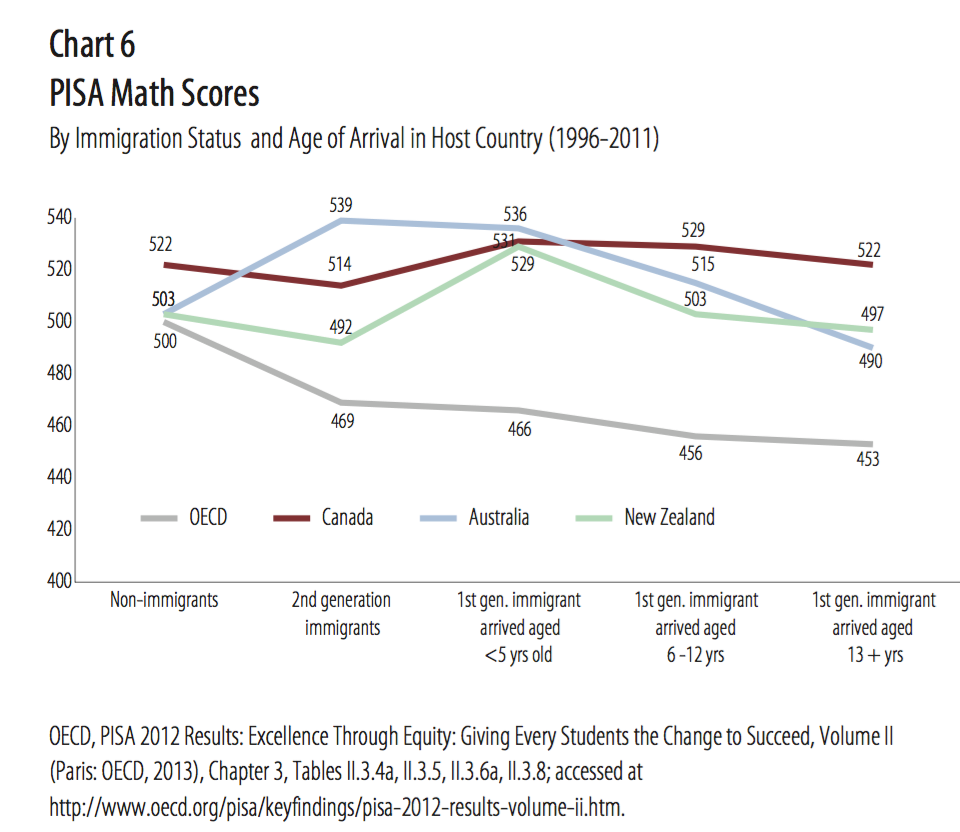
PISA Math ScoresGood study from the Environics Institute on education outcomes. Excerpt from Chapter 8, immigrant backgrounds:

Yes; Canada is one of only a very few countries that combines overall high achievement, a larger than average immigrant population, and no significant achievement gap between immigrants and non-immigrants.

One of the main reasons that explains Canada’s good overall performance in education is that it is successful in ensuring the educational achievement of children with immigrant backgrounds. Given the comparatively large proportion of students in Canadian schools, colleges and universities that are first and second generation immigrants, the country simply could not post high overall achievements scores if there was a significant gap between these students and non-immigrants.

The PIRLS study of Grade Four students does not report data regarding immigrant students, but does examine results for those who did not speak the language of the test prior to starting school (in Canada, this would be those whose spoke a language other than English or French). While internationally the average gap between students who did and did not speak the language of the test prior to starting school was 37 points, Hong Kong, Australia and Canada all had gaps of 5 points or less (and in each case, the gap was not statistically significant). This demonstrates the ability of schools in high immigration countries such as Australia and Canada to quickly integrate students from immigrant families in the early years of schooling.

PISA - Literacy ScoresThere is extensive data from PISA regarding students with immigrant backgrounds. The proportion of students with immigrant backgrounds in Canada is much higher than average, and indeed higher than in almost all other OECD countries.

  • 29 percent of Canadian 15-year old students have an immigrant background (meaning they are either first or second generation immigrants), compared to the OECD average of 11 percent. Among OECD countries, only Luxembourg (46 percent) has a higher proportion. New Zealand (26 percent), Switzerland (24 percent), Australia (23 percent), and the US (22 percent) are the other OECD countries where the proportion of students with immigrant backgrounds is greater that one in five.
  • 13 percent of Canadians students are first-generation immigrants, compared with the OECD average of 5 percent. Among OECD countries, only Luxembourg and New Zealand (17 percent each) have a higher proportion.
  • Among OECD countries, Canada (14 percent) has the second highest proportion of students who have an immigrant background (first or second generation) and who speak a language at home that is different from the language of the PISA assessment, after Luxembourg (32 percent). The average for the OECD is 6 percent.There is no significant gap between the academic achievement of immigrant (first and second generation) and non-immigrant students in Canada, as measured by PISA 2012 (mean math scores).
  • The two point gap in favour of non-immigrant students in Canada is not statistically significant, and compares with an average gap for all OECD countries of 34 points. New Zealand and Ireland resemble Canada in having no gap between immigrant and non-immigrant students, while in Australia there is a significant gap in favour of immigrant students.
  • There is also no noticeable gap between students in Canada who are first-generation immigrants and non-immigrant students (in fact, the former group has a slight 6 point edge).
  • Similarly, students in Canada who have both an immigrant background (first or second generation) and who speak a language at home that is different from the language of the PISA assessment perform about as well as non-immigrants with the same language as the assessment (again, the former group has a slight 7 point edge).In fact, Canada is one of only a few OECD countries that combine a number of important attributes: high overall performance, a high proportion of students from immigrant families, and a low or non-existent performance gap between immigrants and non-immigrants. This is illustrated in Table 6.37

Canada’s success in this area is also evident by the fact that even those first generation immigrant students who arrived in Canada after age 12 perform relatively well: in fact, the PISA math scores for this group are no different than those of non-immigrant students. As Chart 6 illustrates, there is no significant drop-off in scores for immigrants students based on how long they have been in the country, in marked contrast to the international average.

Immigrants in Canada have also been successful in postsecondary education.

  • Of course, data on educational attainment for first- generation immigrants generally reflects the educational backgrounds that immigrants had before arriving in Canada rather than their education experience in this country (immigrants to Canada on the whole are more likely to have a university degree than domestically born Canadians).
  • The experience of second generation immigrants is more revealing. 84 percent of second generation immigrants in Canada enroll in a postsecondary education course by the age of 21, including 54 percent who pursue a university degree, compared with 72 percent for non-immigrants (38 percent for university).
  • Not all immigrant groups are equally successful, however. While over 80 percent of second generation immigrants whose parents came from Africa or China pursue university studies by the age of 21, only 36 percent of those from central and southern America and the Caribbean do.

Experts: Yes, Anti-Refugee Rhetoric Helps ISIS – The Daily Beast

Unfortunately, not understood by so many:

President Obama said Sunday that by rejecting and vilifying Syrian refugees, Republicans (and Democrats who are going along with them) are doing the terrorists’ work for them.

“Prejudice and discrimination helps ISIL and undermines our national security,” Obama said. This sounds like a political talking point, but if you speak with the independent academics who actually study the mentality and motivations behind terrorism, it turns out Obama is correct.  Broad anti-Muslim suspicion and rhetoric is not only anti-American, it helps the terrorists!

I spoke with a number of our nation’s top academics who study the pathology and psychology of terrorism in general and ISIS in particular. Every single one agreed that the anti-Syrian refugee policies and rhetoric help ISIS.

“There is no place for bigotry in effective counterterrorism,” Professor James Forest, the director of the graduate program in security studies and interim director of the Center for Terrorism and Security Studies at UMass Lowell, told me. “Terrorist groups like al Qaeda and Islamic State thrive when they can exploit the vulnerable seams within a society, when they can exacerbate prejudices.”

Arie W. Kruglanski, professor of psychology at the University of Maryland, has written about how ISIS recruitment strategy is based on psychology, not theology.  And within that context, Kruglanski told me: “The refugee debate could fuel the bitterness and sense of grievance of young Muslims anywhere and could be used by ISIS propaganda machine to enhance anti-US sentiment and boost recruitment.”

“Counterterrorism tries to do two things,” explained Professor Max Abrahms, a political scientist at Northeastern University who studies terrorism. “You try to neutralize existing terrorists and you try to not breed new ones. The surest way to breed new ones is if you’re indiscriminate—for instance, punishing non-violent, moderate Muslims.”

In fact, Abrahms noted he thinks an attack like the one in Paris, from so-called homegrown terrorists, is less likely “because the American Muslim population is much happier, better integrated and does better financially.”

A more moderate Muslim population yields a smaller share of extremists and better relations with law enforcement—which explains why Muslims helped law enforcement prevent one out of every two al-Qaeda related plots against the U.S. since 2009.

“We need to cherish the support and moderation of the American Muslim community,” says Abrahms.

Source: Experts: Yes, Anti-Refugee Rhetoric Helps ISIS – The Daily Beast