Douglas Todd: Richmond toughens stance on Chinese-language signs

Finding the balance:

After years of dismissing residents’ worries about the expansion of Chinese-language signs in Richmond, the city is hiring a new staff person to press for more signs to include English.

Richmond last week quietly posted a full-time job for a sign inspector. The inspector’s duties will include educating business owners about the city’s policy, which says signs should contain 50-per-cent English lettering.

“I think the issue is being taken more seriously than it once was,” Councillor Alexa Loo said this week.

Loo, who was elected to council in the fall of 2014, had previously said it was “ridiculous” that Chinese-only signs were on the rise in Richmond, despite ethnic Chinese now making up one out of two residents.

Richmond’s current council, Loo said, is slowly becoming convinced that community “harmony” is threatened by a proliferation of signs that cannot be read by those who do not read Chinese.

The city’s decision to hire someone to educate businesses about English on signs is a significant change.

Only a few years ago former Richmond city bylaw manager Wayne Mercer said every month he would tell yet another “anxious and insecure” Richmond resident that the city correctly intended to do “nothing” about Chinese-only and Chinese-dominant signs.

Joe Greenholtz, a member of Richmond’s intercultural advisory committee, also brushed aside the concerns of people who felt alienated by Chinese-only signs.

Longtime Richmond residents who complain about signs, Greenholtz wrote in 2012, are simply “feeling the pain of being irrelevant in their own backyards for the first time.” At the time, Greenholtz, an immigration consultant, argued the sign issue was solely a matter of commerce, but more recently he acknowledged community cohesiveness is also at stake.

The city’s records show Richmond residents were going to council to express concerns about Chinese-only signs as far back as 1997.

In was only in recent years that some residents became more vocal, launched petitions and eventually brought international attention to Richmond, whose population is 62-per-cent foreign born.

The tide began turning late last year when retiring Richmond councillor Evelina Halsey-Brandt admitted she had been mistaken in believing the sign controversy would “solve itself.”

Halsey-Brandt urged the new council to find a way to ensure that a large portion of the 200,000 residents of Richmond don’t end up “feeling that they don’t belong in their own city.”

Between 1981 and 2011, Statistics Canada figures show the ethnic Chinese population of Richmond expanded by 80,000. In the same period, the white population had a net loss of 28,000 people.

In response to increasing debate, a group of prominent Metro Vancouver Chinese business leaders gathered in Richmond in May and urged all immigrants to “follow Canadian customs” and include English in their signs.

For his part, Richmond Councillor Chak Au says he has been waiting for years for other council members to come around to his viewpoint.

“I was the only one four years ago who was saying we should go to bilingual signs,” Au said.

“In the beginning, the others didn’t want to do anything.”

Many Richmond residents remain disappointed the city’s new inspector is being asked only to “encourage” business owners to make signs 50-per-cent English.

Richmond activist Kerry Starchuk, who has been interviewed by media outlets across Europe and Asia, said this week the city and province aren’t being nearly proactive enough.

“This is just as minimal as what can be done,” she said. Without enforceable municipal and provincial legislation, Starchuk believes, almost nothing will change in regards to the proliferation of Chinese-only or Chinese-dominant signs.

For their part, Au and Loo want to avoid formal sign bylaws. They believe it’s more “harmonious” to have a staff member try to persuade businesses to include English, to improve cross-cultural communication.

Au and Loo also worry Richmond could open itself up to a charter challenge if it requires English. Even though the province of Quebec has laws preserving the French language in signs, Loo said Quebec has more constitutional authority than B.C.

The executive director of the B.C. Civil Liberties Association, which has threatened to take Richmond to court over the sign issue, told The Vancouver Sun in July that individual rights trump community concerns. Some BCCLA board members, however, have since questioned Josh Paterson’s position.

Read more: http://www.vancouversun.com/news/douglas+todd+richmond+toughens+stance+chinese+language+signs/11597065/story.html#ixzz3uff8Oi1uSource: Douglas Todd: Richmond toughens stance on Chinese-language signs
ICYMI: Abigail Fisher deserves an ‘F’ for her race-baiting Supreme Court case aimed at boosting subpar white students – Salon.com

The latest court case around affirmative action:

Wednesday, the Supreme Court heard arguments in what is easily the most baffling case it’s going to hear this session, yet another attack on affirmative action policies at state universities, in this case the University of Texas at Austin. If ever there was a case that has no business in front of the high court, it is this one. The suit is a nuisance suit, it’s poorly argued, it’s disingenuous, it’s been heard before and, to make everything even more bizarre, the plaintiff’s claim to injury is demonstrably untrue. This is a case that should have been laughed out of court years ago, but instead, this is the second time — second time! — it’s being presented in front of the Supreme Court.

 At stake is the claim made by Abigail Fisher, now 25, who hails from a wealthy suburb of Houston called Sugar Land, that she was deprived of her rightful admission at UT Austin because, in her view, some person of color who didn’t deserve it stole it from her.
Throughout her now seven-year campaign to make the school pay for not letting her in, Fisher has never been able to produce any evidence that the school tossed her application to make room for a less qualified minority applicant. That’s because, as UT Austin has maintained throughout this ordeal, Fisher was never getting in to their school. Fisher’s GPA and SAT scores weren’t high enough, and she didn’t have enough external accomplishments to convince the school to give her a shot otherwise. As Pro Publica explained at the time:

It’s true that the university, for whatever reason, offered provisional admission to some students with lower test scores and grades than Fisher. Five of those students were black or Latino. Forty-two were white.

Neither Fisher nor Blum mentioned those 42 applicants in interviews. Nor did they acknowledge the 168 black and Latino students with grades as good as or better than Fisher’s who were also denied entry into the university that year.

Fisher’s case only makes sense if you assume that people of color are inherently less worthy than white people. How else do you justify an argument that assumes that every white person should have been given a shot before minority students do?

This assumption of the inherent superiority of white people, even above those people of color who have more appealing applications, was reflected in Antonin Scalia’s remarks during today’s case.

Instead of telling her where to shove it, the Supreme Court sent Fisher’s case back to the appeals court. Now she and her lawyers are back again. This time, they’ve tweaked their argument a bit, trying to argue that diversity itself is an illegitimate goal for schools and, to add a bit of extra nastiness sauce to it, they’re claiming that diversity is bad for students of color.

In other words, Fisher and her lawyers are concern-trolling the Supreme Court.

Most of UT Austin’s admissions are on the basis of high school class standing — about 80 percent of its class in the year that Fisher applied. But the other 20 percent are determined in a holistic fashion, by looking at grades, extracurricular activities, test scores, writing samples, the usual stuff. Because of the school’s commitment to diversity, race and class background is also taken into consideration. Someone who shows potential but faced some obstacles gets a closer look than someone who hasn’t had similar obstacles.

When you read about this case, it quickly becomes self-evident why the admissions committee didn’t think Fisher had some hidden potential that wasn’t reflected in her grades. Fisher, however, has decided her unparalleled genius is going unnoticed because of the notorious racism against white people. But since that argument hasn’t gotten her very far, her lawyer, Edward Blum, is now trying a different tactic to argue that schools should admit mediocre white people over talented students of color: His claim is that  giving students of color an opportunity somehow hurts them.

Source: Abigail Fisher deserves an ‘F’ for her race-baiting Supreme Court case aimed at boosting subpar white students – Salon.com

Sri Lanka: Moving from nationalism to multiculturalism | Daily News

Not sure how realistic this vision is, and multiculturalism only came about in Canada when immigration ‘diluted’ the basic anglophone/francophone duality:

Who would doubt that we, as a nation, would be better off if we could engage with one another in a less polarized manner? We cannot get “beyond” these oppositions to achieve national unity, however, despite our desire to do so. Indeed, this desire is a large part of the problem – or, depending on how one views it, the solution – because attempts to transcend the oppositional character of these debates tend to reinforce them. The national unity question that drives our conversation makes it futile, lost in the very terms of the quest. But to the extent that our dialogue continues, those that participate are at least united in their oppositions. This is the bind that ties.

Multicultural society

If the majority of us can agree on a path to achieve national unity, it will eventually lead our country into a solid multi-cultural society. In such a society the different cultures are made inclusive, tolerated and accommodated, and these trends are institutionalized in legislation. Canada, Australia and other western countries, where multiculturalism is the national policy, respect religions, ethnicity and cultures of different communities and their cultural rights, while a secular law common to all protect their human rights. They are not allowed to have a legal system (e.g. Sharia law) or practices (e.g. animal sacrifices) that are contrary to the laws of the country.

Canada, for instance, has, a Multiculturalism Policy from which the plethora of new immigrant communities has benefited in more ways than one. For instance, I know of many Sri Lankans who own their own properties in salubrious neighbourhoods in Canadian Capitals. The key to that effort lay in the fact that all three levels of government – Federal, Provincial and Municipal – provided that immigrant community with the means of generating the revenues not only to purchase a substantial building but to continue to maintain their cultural identity in that city.

Source: Moving from nationalism to multiculturalism | Daily News

Canada’s Growing Jihadi Cancer: Unbalanced but captures one perspective – The Daily Beast

Dana Kennedy, former correspondent at ABC, Fox News and MSNBC, presents a one-sided account of perceived ‘jihadi cancer,’ citing the usual suspects (Farzana Hassan, David Harris, Tarek Fatah, Raheel Raza), with no attempt to balance that with other views, apart from Mubin Sheikh.

It appears her views reflect more her experience at Fox than the other networks:

The usual Canada’s new telegenic Prime Minister Trudeau, 43, the ultimate anti- Donald Trump, was pictured last week warmly greeting the first of an estimated 25,000 Syrian refugees arriving between now and March 2016. (Canada’s population is about one-tenth of the United States, so that’s as if 250,000 Syrian refugees were arriving in the U.S. in the space of just four months.)

But some worry that the feel-good photo op for Trudeau and his Liberal Party could portend trouble for Canada.

“In a technical briefing for journalists this week, Canadian immigration officials said not a single applicant has been rejected yet,” right-wing activist and lawyer Ezra Levant told The Daily Beast.

“This is a national security threat to Canada, and to the United States, which shares the world’s longest undefended border with us,” said Levant. “The Islamic State has repeatedly named Canada as a target; dozens of Canadian Muslims have gone to Syria to become terrorists. And yet Canada is rushing refugees through, far in excess of our capacity to properly vet them. We simply don’t have sufficient intelligence personnel, let alone those who function in Arabic.”

Toronto attorney and human rights activist David Harris said the new influx of Syrian refugees is part of a “gigantic and overly generous immigration policy,” coupled with a lax vetting process and a philosophy of encouraging newcomers to retain their cultural traditions, that has negative connotations for Canada.

“It’s very interesting to see how the deteriorating situation in Canada and the implications for northern America border security has not been recognized,” said Harris.

“Massive immigration here has created an immigration-industrial complex with all sorts of publicly funded language schools, settlement organizations and lobbying groups that have sprung up like the Sorcerer’s Apprentice,” said Harris. “Because Canada is so much smaller in population, there are areas of the country starting to resemble tribal homelands and the loyalty is not to Canada. Canada is extremely vulnerable to extremism and terrorism.”

“This is all a Saudi-funded cancer spreading across the world.”

Brian Levin, a former NYPD officer turned counter-terrorism and extremism specialist at San Bernardino State, concurred.

“People talk about Mexico,” said Levin. “They totally overlook Canada. Nobody has any idea what’s going on up there. In my opinion it’s a bigger threat than Mexico.”

Given Prime Minister Trudeau’s good looks, his political pedigree, a one-time TV-anchor wife who the New York Post called “the hottest First Lady in the world,” and his headline-making cabinet featuring many women and minorities, he recently scored a spread in Vogue.

But he’s come under fire at home for what some see as pandering to the Muslim vote and an extreme political correctness. He has said he will revamp aspects of C-51, the controversial anti-terrorism bill that the Conservative Party enacted this year.

Trudeau visited mosques all over Canada as part of his political campaigns leading up to his recent win. He visited a notorious Montreal mosque in 2011, a month before the U.S. classified it as an al-Qaeda recruitment center. He addressed a mosque with ties to Hamas and, unlike his Conservative Party predecessor, former Prime Minister Stephen Harper, he defends the right for Muslim Canadian women to wear the niqab, a veil covering the face, when they take their citizenship oaths.

In 2011 Trudeau objected to the word “barbaric” in a Canadian citizenship guide for new immigrants that included the passage: “Canada’s openness and generosity do not extend to barbaric cultural practices that tolerate spousal abuse, honor killings, female genital mutilation, forced marriage or other gender-based violence.”

“There’s nothing the word ‘barbaric’ achieves that the words ‘absolutely unacceptable’ would not have achieved,” said Trudeau, who later retracted his statements after a Twitter firestorm.

…But, at least so far, homegrown attacks in Canada are fairly rare.

Mubin Shaikh, a former Muslim extremist turned counter-terrorism operative who went undercover for Canadian intelligence to infiltrate the Toronto 18, says the low incidence of terror attacks is precisely because of Canada’s policy of multiculturalism.

“Our multiculturalism is a protective factor and one of the reasons why Canada has seen lower numbers [of terrorist incidents]is largely due to the fact that Muslims are treated very well,” Shaikh told The Daily Beast.

“This is the whole point, that when you actively prevent isolation and marginalization, so too do you see a low level of extremism,” said Shaikh. “The problem in the UK is that although there is multiculturalism, there is a colonial history that grievances-centered people can take advantage of.”

Others disagree and say multiculturalism has spawned a more subtle type of fundamentalism taking over some communities to the point where they look like areas of the Middle East with a corresponding mind-set—and dangers.

“If you’ve been out of Ottawa for just two months, you’ll come back and be astonished at how many more hijabs and niqabs you see on the street in just that short amount of time,” said attorney Harris. “There’s a significance and symbolism to that whether you believe it or not.”

Source: Canada’s Growing Jihadi Cancer – The Daily Beast

US Sikhs feeling vulnerable amid anti-Islam rhetoric, but joining Muslims to fight backlash | Fox News

Have not heard of recent similar attacks here on Sikhs but likely that there are some:

Pradeep Kaleka spent several days after 9/11 at his father’s South Milwaukee gas station, fearing that his family would be targeted by people who assumed they were Muslim. No, Kaleka explained on behalf of his father, who wore a turban and beard and spoke only in broken English, the family was Sikh, a southeast Asian religion based on equality and unrelated to Islam.

But amid a new wave of anti-Islamic sentiment since the terror attacks in Paris and San Bernardino, Kaleka is vowing to take an entirely different approach.

“For us it does not matter who they’re targeting,” said Kaleka, a former Milwaukee police officer and teacher whose father was one of six people killed in 2012 when a white supremacist opened fire at a Sikh temple in Oak Creek, Wisconsin. “This time we cannot differentiate ourselves; when hate rhetoric is being spewed we cannot be on the sidelines.”

Across the U.S., Sikhs and Muslims are banding together to defend their respective religions. Someone bent on harming Muslims wouldn’t understand — or care — about the distinction between the two faiths, they say, and both also deserve to live in peace.

So they plan educational sessions and rallies. They successfully pushed the FBI to track hate crimes against Sikhs. They speak to lawmakers and support each other’s legal action, including a lawsuit filed over a New York City police surveillance program targeting New Jersey Muslims.

“We are in this fight together,” said Gurjot Kaur, a senior staff attorney at The Sikh Coalition, founded the night of Sept. 11.

Sikhism, a monotheistic faith, was founded more than 500 years ago in Southeast Asia and has roughly 27 million followers worldwide, most of them in India.

There are more than 500,000 Sikhs in the U.S. Male followers often cover their heads with turbans — which are considered sacred — and refrain from shaving their beards.

Reports of bullying, harassment and vandalism against Sikhs have risen in recent weeks.

Last week, a Sikh temple in Orange County, California, was vandalized, as was a truck in the parking lot by someone who misspelled the word “Islam” and made an obscene reference to ISIS.

Source: Sikhs feeling vulnerable amid anti-Islam rhetoric, but joining Muslims to fight backlash | Fox News

Quebec needs to confront its Islamophobia problem

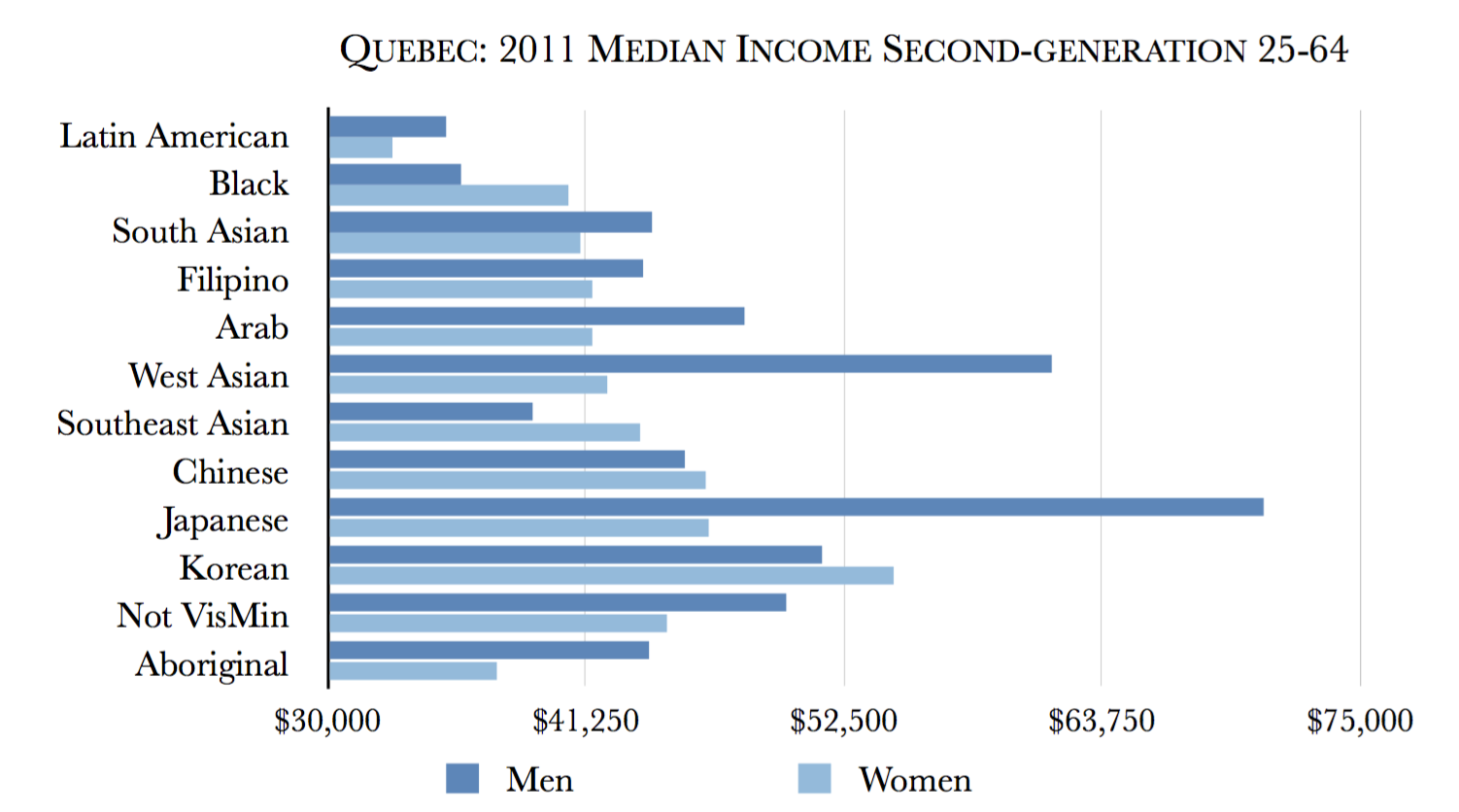
Quebec Second Gen Economic

More on the challenges faced by Muslims in Quebec by Amarnath Amarasingam and Higham Tiflati. Overall, economic outcomes for immigrants and their children are lower than elsewhere in Canada:

While Islamophobia and anti-Muslim animus exists throughout Canada, the nature of it in Quebec seems to be unique, and quite worrisome. Law-enforcement officials and social workers receive calls from concerned citizens wanting to report “suspicious persons” like a man with a long beard in their neighbourhood, and calls from concerned families asking whether their relative, a new convert to Islam, could become a terrorist.

Muslim students also report that Francophone CEGEPs do not allow their students to create Muslim Students’ Associations (MSAs), a policy not even practiced by Anglophone CEGEPs in Quebec.

Polling data backs up much of what these young people are expressing. A 2015 Quebec Human Rights Commission survey found that 43 per cent of Quebecers believe we should be suspicious of anyone who openly expresses their religion, with 49 per cent expressing some uneasiness around the sight of Muslim veils.

For many Muslim youth, this kind of public scrutiny is deeply alienating. Young Canadians from other ethnic and religious backgrounds have the privilege and the freedom to wrestle with adolescent identity issues in private. These struggles, ones we have all experienced, play out quite differently for Muslim youth.

Aspects of Muslim youth identity, such as whether to wear the hijab, are quite often national debates, discussed on the nightly news, and even find their way into speeches given by the prime minister. The young girl wearing a hijab is not someone who has made a fairly harmless and rudimentary religious choice, but is seen as someone making a political statement about Western values or ways of life.

It is no surprise then that these youth express an emotional exhaustion arising from being constantly watched, scrutinized, and pitied. Fairly mundane activities such as walking down the street or riding the bus become “events,” requiring mental and psychological fortitude. It takes a deep toll on their confidence, self-esteem and sense of inclusion. As Safiya remarked, “Shayma didn’t want to feel like a stranger here any more.”

Safiya, though, is committed to changing her life in Quebec, and changing the way Quebecers see her and her community. She has dreams and goals. “My parents brought me here for a reason,” she says. “Sure, things are not perfect, but I see potential in our Muslim community here in Quebec and if everyone just left it won’t help.”

Source: Quebec needs to confront its Islamophobia problem | Toronto Star

Nova Scotia premier to discuss statue Mi’kmaq community says is racist

Another example of significant historical figures and their mixed legacy viewed through contemporary eyes (e.g., the Princeton Woodrow Wilson controversy).

In general, rather than moving the statue ‘out of sight,’ it might be better to have an interpretative plaque that provides a more complete picture of his role and actions.

A learning opportunity for all that recognizes the Mi’kmaq’s valid concerns:

Nova Scotia’s premier says he will discuss options for a statue of Halifax city founder Edward Cornwallis that the Mi’kmaq community has long argued is racist.

A spokeswoman for Stephen McNeil says the premier plans to meet with Halifax Mayor Mike Savage to discuss the statue, which has stood in a downtown park for more than 80 years.

Mi’kmaq elder Daniel Paul says although Cornwallis is the city’s founder, he also issued a scalping proclamation in 1749 that offered a cash bounty for anyone who killed Mi’kmaq men, women and children.

Paul says his goal is not to erase Cornwallis from history books, but to strike a compromise that recognizes the atrocities he committed.

He says he would like to see the statue removed from the park and placed in the depths of the Citadel Hill fortress.

About four years ago, a local junior high school stripped Cornwallis from their name amid concerns from the Mi’kmaq community.

Source: Nova Scotia premier to discuss statue Mi’kmaq community says is racist – Macleans.ca

Bill Murray Befriends the Muslim World: ‘Not Every Flower Is the Same’

Some funny but pointed Bill Murray quotes, that aim to counter the current hysteria:

“There is a phobia about what Muslims are like,” he continues. “I have known about two-dozen. I went to school in Paris with Muslims. Most were from Iran. I found them much to be like friends back home. I was raised as a Catholic. It was always Catholics against Jews. I’m in Hollywood. There are lots of nutty Jews and lots of nutty Catholics. Muslims are just as goofy, too. It is what makes the garden beautiful: Not every flower is the same.”

…And the film [the new Ghostbusters], he says, carries an even deeper message.

“In Ghostbusters, what comes to destroy New York is a giant marshmallow,” explains Murray. “If you face your fears, they are all giant marshmallows. There were people that were afraid to come here to come along for the ride. That thought came into my mind. A friend said we just made a film about a girl that couldn’t sing. Are we going to be afraid to go back? Fear is negative imagination. Do I think these events have been terrible? Are they horrible? Are they dreadful? Yes. But I can’t live a life of fear like that. If I’m going to go, I’m going to go living. Here we all are and we are okay, aren’t we? As soon as I saw the cars and walls, I was like, ‘I’m so glad I’m here. I’m glad I came.’”

Source: Bill Murray Befriends the Muslim World: ‘Not Every Flower Is the Same’ – The Daily Beast

Parable on Bigotry and Citizenship Plays Out in a Supermarket – The New York Times

A good parable:

At the end of the aisle, Ms. Macksoud noticed a couple of middle-age white men talking. One in particular caught her eye with his beer belly, tattooed forearms and large golden cross. As she neared him, she heard the word “Bible.” When she passed him, he said in a raised voice: “not like the Quran those Muslims read.” He included an obscenity to describe Ms. Macksoud and 1.6 billion coreligionists.

Ms. Macksoud grew up on Staten Island, competing in soccer and track, and liked to think that she had that outer-boroughs bravado. Instead of firing back, though, she answered with forced calm: “You didn’t have to say that.”

Surface composure aside, she was shaken. Her flesh felt as if it were quivering. Her mind went so blank she made a wrong turn, and instead of heading into frozen foods, she was adrift and searching for Ms. Yu. “She was shocked and angry,” Ms. Yu recalled the other day. “More in a kind of disbelief that something like this could happen to her.”

Indeed, nothing before ever had. Even after the Sept. 11, 2001, attacks, when Ms. Macksoud began wearing the hijab as her personal way of reclaiming Islam from jihadists, nobody had ever said a word to her. No one objected even when she was working for MTV in Times Square and her building was evacuated during a failed car bombing by a militant Muslim in May 2010.

But in the United States of 2015 — weeks before the terrorist attacks in Paris and San Bernardino, Calif. — someone had insulted and implicitly threatened her in her favorite ShopRite. It felt to her as if all the toxic language of the Republican presidential campaign, with its various forms of Islamophobia, had infiltrated even a store she cherished for its commitment to diversity.

With Ms. Yu at her side, she went to the Customer Service counter to report what had happened. The agent there called for the store’s assistant manager, Mark Egan. “I’m not done shopping,” Ms. Macksoud recently recalled telling him, “but I don’t feel safe here.”

Mr. Egan was about as much of a Jersey guy as a Jersey guy can get. He grew up in Freehold, Bruce Springsteen’s hometown, and married in the young Springsteen’s parish church, Saint Rose of Lima. Mr. Egan, his hair starting to thin at 43, has worked at ShopRite for 13 years.

He told Ms. Macksoud he would protect her. And for the next half-hour, he walked alongside her on the pretense of checking inventory as she did the rest of her shopping. They never did find the man who had insulted her. Before leaving, Ms. Macksoud asked for Mr. Egan’s name so she could send a thank-you letter to the store.

The next day she wrote about the incident on Facebook. She had nearly 300 replies, some from other American Muslims on their experiences with bias — being called a “raghead” or a “Christian killer,” being almost run over, being told to go home, as if home were not here. Many offered solidarity and solace.

One of those correspondents, Sheryl Olitzky, is the wife of a rabbi and the mother of two others. Five years earlier, she and a friend, Atiya Aftab, had formed a group called the Sisterhood of Salaam Shalom, to bring Jewish and Muslim women together. Since then, it has grown to 20 local chapters across the country with another 15 in formation.

With Ms. Macksoud’s permission, Ms. Olitzky called Mr. Egan and told him, “I heard what happened, and you’re my hero.” He replied, “I was just doing my job.”

Modesty aside, Mr. Egan did agree to attend the Sisterhood’s annual convention last weekend to receive an award. His wife and father-in-law came with him, and the Saker family, which owns the North Brunswick ShopRite, made a donation to the group.

Source: Parable on Bigotry and Citizenship Plays Out in a Supermarket – The New York Times

US Conservatives Call For ‘Religious Freedom,’ But For Whom? : NPR

Good article on the ongoing hypocrisy of the religious right and Republican contenders:

Such prejudice bothers some advocates of religious freedom, including Russell Moore, president of the Ethics and Religious Liberty Commission of the Southern Baptist Convention.

“If we really believe in religious liberty, then religious liberty applies to everyone, and that means I’m not threatened by non-Christians having religious liberty,” he says. “I think the only way the Gospel can advance is with free consciences, and I think evangelical Christians particularly ought to be the most vocal about religious liberty for our non-Christian neighbors and friends.”

Robert George, the McCormick Professor of Jurisprudence at Princeton University and a leading lay Catholic intellectual, is also outspoken on the need to defend religious liberty for people of all non-Christian faiths, including Islam.

“It’s scandalous to me when members of a community say, ‘We don’t want a mosque in our town, because the Muslims are terrorists,'” George says. “The vast majority of Muslims are not terrorists or sympathizers of terrorists. They want the same things for themselves and for their children that Christians want, that Jews want, that Hindus want, that all of our fellow citizens want.”

In the aftermath of the Paris and San Bernardino shootings, the fear of more attacks has inflamed anti-Muslim sentiment, fueled in part by Donald Trump and others who are highlighting the threat of “Islamic terrorism.” Those candidates who have emphasized the struggle for religious liberty as a mobilizing cause, from Cruz to Jeb Bush, have either ignored Trump’s repeated anti-Muslim comments or condemned them.

For some conservatives, however, recent events may bring a decision point. They may need to choose between opposing Islam and advocating for religious freedom. To wage both fights at the same time is likely to become increasingly awkward.

Source: Conservatives Call For ‘Religious Freedom,’ But For Whom? : NPR