Voile intégral: Couillard confiant de pouvoir légiférer malgré l’approche d’Ottawa

Federal citizenship case reflected fact that Minister did not have the authority under the Citizenship Act to prohibit the niqab, not the fundamental question of whether banning the niqab would be in conformity with the Charter.

Quebec law may result in that more fundamental challenge:

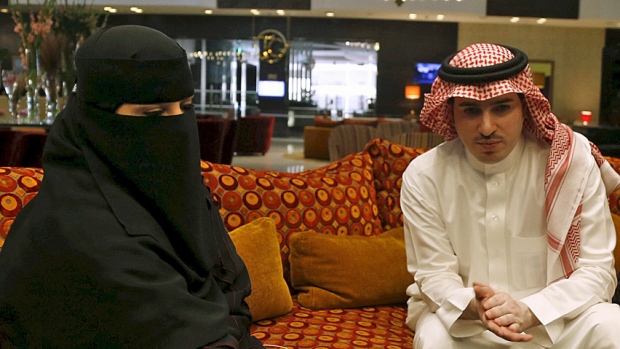
Le premier ministre Philippe Couillard a maintenu que les assises juridiques du Québec sont solides pour interdire le port du voile intégral au moment de voter et dans les services publics, malgré la décision d’Ottawa de l’autoriser pendant les cérémonies de citoyenneté et lors de scrutins.

Lors d’une conférence de presse en compagnie du premier ministre Justin Trudeau, vendredi, M. Couillard a reconnu que son gouvernement approche la question du port du voile sous un angle différent de son homologue.

M. Couillard a déclaré que cette différence ne remet pas en question les fondements juridiques sur lesquels Québec s’appuie.

« On est persuadés que l’approche qu’on choisit est tout à fait conforme avec les lois du pays, en incluant les chartes, on est très attentifs à cette question-là », a-t-il dit.

Selon le premier ministre québécois, il n’est pas nécessaire de faire l’unanimité à ce sujet, qui a occupé une place importante dans la dernière campagne fédérale.

« On aborde la question d’angles différents mais avec la même préoccupation, a-t-il dit. Moi-même j’ai fait une campagne complète sur les droits et libertés des gens et c’est un enjeu important pour moi. »

Après avoir été élu il y a près de deux mois, M. Trudeau a retiré l’appel déposé par le gouvernement conservateur devant la Cour suprême du Canada, dans la cause entourant le port du niqab aux cérémonies de citoyenneté.

Par ailleurs, en 2007, les conservateurs s’étaient engagés à interdire le vote à visage couvert, mais ils avaient fait marche arrière en février 2014, au moment de réformer la loi électorale.

Plusieurs citoyens ont choisi de protester contre l’absence de balises en se présentant le visage masqué de diverses façons au moment du scrutin fédéral d’octobre dernier.

Alors que le vote à visage couvert est interdit au Québec depuis huit ans, le gouvernement de M. Couillard a déposé un projet de loi qui fixerait la même obligation lors de la prestation de services publics.

« Le cas du visage voilé va au-delà de cette question, au-delà de la question religieuse, a-t-il dit vendredi. C’est une question d’image de la femme dans une société, du message qu’on envoie aux gens. (…) Pour le Québec et dans l’histoire du Québec dans l’état actuel de nos valeurs communes, je pense que c’est un geste qu’il faut faire et qu’on va poursuivre. »

M. Couillard a affirmé que M. Trudeau et lui sont malgré tout d’accord « sur les grands enjeux, sur les grands principes ».

« Il n’est pas interdit qu’il y ait des éléments où on a des approches différentes, a-t-il dit. Il ne faut pas rechercher l’unanimité et la constance à tout prix. »

M. Trudeau a insisté sur la place du débat sur les symboles religieux dans les dernières campagnes électorales québécoise et fédérale.

« Nous nous situons dans cette lignée de refuser la politique qui divise ou qui vise à faire peur aux gens, a-t-il dit. On a tous deux gagné des élections dans les dernières années en étant raisonnables et ouverts dans le respect des droits. »
Source: Voile intégral: Couillard confiant de pouvoir légiférer malgré l’approche d’Ottawa | Alexandre Robillard | Politique québécoise

Unmuzzle the ambassador of religious freedom, Conservatives tell Dion

My sense is that Andrew Bennett’s time is up.

Open question whether they fold back the function into the Human Rights Division or keep it as a stand-alone division (6 FTEs). Arguments can be made for both approaches:

With Donald Trump calling earlier this week for a ban on all Muslims entering the United States until the country’s representatives can “figure out what’s going on”, it seemed like a great opportunity for Canada’s ambassador of religious freedom to say…something.

It is his mandate, after all, to “promote Canadian values of pluralism and tolerance abroad.”

But since the Liberals were elected in October, Andrew Bennett has been suspiciously quiet, leading many to speculate Canada’s first ambassador of religious freedom could also be its last.

Though Bennett, who was appointed to the Harper government-created position in February 2013, released a statement on the International Day for Tolerance in mid November, Global Affairs Canada has turned down requests from multiple media outlets for interviews.

“I will have to politely decline your interview request with Ambassador Bennett at this time,” Global Affairs spokesperson John Babcock told iPolitics in an emailed statement right around that time.

“I will say that the promotion and protection of human rights is an integral part of Canada’s constructive leadership in the world. Freedom of religion or belief, including the ability to worship in peace and security, is a universal human right in accordance with the United Nations Universal Declaration of Human Rights.”

The Toronto Star was told during the campaign that he’d be available after the election, and CTV‘s Don Martin lashed out on Twitter this week after being declined yet another interview request with Bennett.

In Question Period on Wednesday, Conservative MP Garnett Genuis sought clarification from the government, echoing the familiar Liberal jab at the Conservatives’ muzzling of federal government scientists.

“Mr. Speaker, members of the media are telling us that they have been unable to get hold of the ambassador for religious freedom since the new government was sworn in. The ambassador has previously been a highly effective advocate internationally, earning widespread acclaim and achieving substantial results. At a time when religious minorities are more vulnerable than ever before, why is the ambassador being muzzled?”

Global Affairs Minister Stéphane Dion responded, “Mr. Speaker, that is quite rich coming from this party. We do not muzzle officials at all. They did. They did it all over the place. We will fight to protect the right of freedom of religion, and all freedoms will be protected as much as possible by this government.”

Unmuzzle the ambassador of religious freedom, Conservatives tell Dion

Egan: Algonquin’s money-losing Saudi campus raises ethical questions

Valid questions:

Why does the world go nuts when the University of Ottawa student federation cancels a yoga class – for lack of cultural sensitivity – but no one bats an eye when Algonquin College opens a men-only campus in Saudi Arabia, only to lose $1 million in public money in one year?

Algonquin, the city’s leading college with 20,000 students, has a mission statement that details its core values. One of them is “integrity,” described thusly: “We believe in trust, honestly and fairness in all relationships and transactions.”

Another is “respect,” put this way: “We value the dignity and uniqueness of the individual. We value the equity and diversity in our community.”

How you square those values in a country with a human rights record like Saudi Arabia is a mystery. It has been said — and written — that Ontario Premier Kathleen Wynne would not only be barred from attending Algonquin’s campus in Jazan, she could well be arrested for being open about her sexuality. If she tried driving a car to class, Lord knows what would happen.

(This is not histrionics: public floggings and beheadings are common in a country with so-called religious police. It hardly helps when you visit the Human Rights Watch website and the first story on Saudi Arabia is: “Poet Sentenced to Death for Apostasy.”)

Nonetheless, a couple of the Wynne ministries were only too eager to announce this great adventure in international education in 2013.

The optics are terrible, frankly, gender inequality being one of many sore points.

The college said this planned “revenue generator” was important at a time of reduced funding, presumably from the Ontario treasury. At capacity, annual revenue in Jazan was to peak at more than $25 million.

Well, does this not have a “sell-your-soul” feel to it? It’s OK if it makes money? Setting aside that whopper, the bottom-line predictions turned out to be wrong.

The campus lost $983,000 in 2014/15 and the estimate for the current year is a modest profit of $232,000, followed by projected profits of $2 million and $3.6 million. Well, we shall see. It might be the moment to point out Algonquin’s operating deficit for 2016/17 is projected to be near the $5-million mark.

This can probably be parsed eight ways to Sunday, but the bottom line is easy to find. This is a public institution. It is not a for-profit corporation. It needs to think pretty hard about gambling with the public’s money, with an eye on profit, to provide a service to citizens in one of the world’s wealthiest countries.

The people of Ontario — is it not so — are subsidizing oil sheiks?

The arguments are not lost on the school. It produced a strategic plan in 2014 that discussed the human rights records in countries where Algonquin does or might collaborate.

“Algonquin believes that education is a powerful, effective force for positive change in any country,” it reads.

“For these reasons, while some feel Algonquin should not partner with countries that do not offer the same human rights protections as Canada, the College is convinced that working with those genuinely invested in change can yield beneficial outcomes. Saudi Arabia and China, for example, are investing heavily in education and have explicit policies encouraging their educational institutions to partner with those in the west.”

It is also worth asking whether the Saudi deal could have been structured so that Ontario taxpayers were protected. Instead, the college is paid on a performance-based model that takes into account things like attendance and graduation rates.

Wonderful if students stay in school. Not so good if they drop out, or flunk, which they did in alarming numbers in 2013-14: of the 600 students in the English foundation program, only 20 per cent completed the year.

Things are improving, however. This year, the school has 800 students, including 200 in actual diploma programs. So, perhaps, financially, the corner has been turned.

This hardly solves the conflict in values. Institutions of higher learning should be places where ideas — even crazy ones about yoga — can be expressed without fear of reprisal. Hard to imagine this is the case at Algonquin’s Saudi campus, where students are learning how to be accountants and “truck and coach technicians.”

Source: Egan: Algonquin’s money-losing Saudi campus raises ethical questions | Ottawa Citizen

Charlie Hebdo Editor: Europe’s Problem Is Racism, Not Islamophobia | TIME

Deceased Charlie Hebdo editor Stéphane Charbonnier on the need to focus on racism, and the risks of focusing on Islamophobia. Valid arguments, that will likely provoke some debate.

In Canadian context, the previous government’s almost exclusive focus on antisemitism meant broader anti-racism initiatives and programming were neglected. Expect some of this to change with the Liberal government as part of its diversity and inclusion agenda, although likely with a mix of broader messaging and programming and specific community focus (i.e., antisemitism, anti-Muslim):

Minority pressure group activists who seek to impose the concept of “Islamophobia” on judicial and political authorities have only one goal: to persuade the victims of racism to proclaim themselves Muslim. Forgive me, but the fact that racists may also be Islamophobic is essentially incidental. They are racists first, and merely use Islam to target their intended victim: the foreigner or person of foreign extraction. By taking only the racist’s Islamophobia into account, we minimize the danger of his racism. Yesterday’s anti-racism activist is turning into the salesman of a highly specialized commodity: a niche form of discrimination.

The fight against racism is a fight against all forms of racism; but what is the fight against Islamophobia against? Is it against criticizing a religion or against abhorring its practitioners because they are of foreign descent? Racists have a field day when we debate whether it is racist to say the Koran is a useless rag. If tomorrow the Muslims of France were to convert to Catholicism or renounce all religion, it wouldn’t make the least bit of difference to the racists—they would continue to hold these foreigners or French citizens of foreign descent responsible for every affliction.

Okay, so Mouloud and Gérard are Muslims. Mouloud is of North African extraction and comes from a Muslim family; Gérard is of European origin and comes from a Catholic family. Gérard has converted to Islam. Both are trying to rent the same apartment. Assuming they have similar incomes, which of the two Muslims is more likely to get the apartment? The Arab-looking fellow or the white guy? It’s not the Muslim who will be turned away; it’s the Arab. The fact that the Arab bears no outward sign of belonging to the Muslim faith changes nothing. Yet what does the anti-Islamophobia activist do? He charges religious discrimination instead of decrying racism….

Social discrimination, while the subject of much less debate than religious discrimination because it is manifested more insidiously and discreetly, is nevertheless far more predominant in France. Managers choose their future employees less on the basis of their religious membership, true or supposed, than, for instance, on their place of residence. Between the Mouloud who lives in upscale Neuilly-sur-Seine and the Mouloud who lives in the down-at-heel banlieue of Argenteuil, which of the two, assuming they are of equal competence, is more likely to get the job? Yet who ever talks about this kind of discrimination? People are massively discriminated against based on their social class, but since a large proportion of the poor—whom no one wants hanging around their place of work, their neighborhood, or their building—is made up of people of foreign descent and, among these, a great many of Muslim origin, the Islamic activist will claim that the problem is Islamophobia.

Source: Charlie Hebdo Editor: Europe’s Problem Is Racism, Not Islamophobia | TIME

If Donald Trump were campaigning in Canada, could he be charged for hate speech?

Good comparative analysis:

On Monday Donald Trump called for a complete ban on Muslims entering the United States “until our country’s representatives can figure out what’s going on.” Despite universal outrage, the billionaire presidential candidate has only doubled down on his vow, the latest in a string of anti-minority comments ranging from the offensive to the downright absurd. Even respectable commentators have started calling him a fascist.

These comments are in bad taste at best and hateful at worst, why are there no legal repercussions for Trump making them? 

The short answer is because it’s the United States. The U.S. has extremely strong protections for free speech, which is only considered hateful if it will incite direct and immediate violence. Trump pontificating at a podium or in an interview doesn’t qualify. Until he starts an angry mob, he’s free to say whatever he likes.

So for argument’s sake, what if this were happening in Canada? Would anything be different?

Trump’s most recent comments might offend you, but they likely still couldn’t be prosecuted under Canadian law. Though hate speech laws in Canada are broader than they are south of the border, speech needs to meet some very specific requirements to be considered hateful here, too.

Section 319 (1) of the Criminal Code states that hate speech “incites hatred against any identifiable group where such incitement is likely to lead to a breach of the peace” and where the comments are made in a public place.

This would pose two problems for charges under hate speech law.

“[T]he immediacy of the breach of the peace would make it extremely difficult to convict someone for saying what Trump said,” said Faisal Kutty, a Toronto lawyer and human rights activist.

Trump also isn’t making any outright claims despite the subtext of his statements, said Richard Moon, a law professor at the University of Windsor.

“That’s the main problem with trying to fit his current statement under the hate speech law: it doesn’t have any real hateful content in the sense of making a claim about the nature of character of Muslims,” said Moon. “Of course, why should they be excluded other than, presumably, on the belief that they are somehow dangerous? But he leaves that slightly open.”

But I’ve seen and heard people call his comments hate speech. What does that mean?

That’s due to the technicality of law. While his comments might be considered hateful, the burden of proof under the law is higher. The comments must meet specific criteria to be prosecuted, and his comments likely don’t meet these standards.

What about some of his other comments? He’s said a lot more extreme things in the past.

Some of his previous remarks could more easily be prosecuted, like his remarks about Mexican immigrants during his announcement speech on June 16: “They’re bringing drugs. They’re bringing crime. They’re rapists.”

“That is the very stuff of hate speech, and a claim like that made in Canada might well constitute hate speech contrary to the Criminal Code,” Moon said.

So why are Canadian and American hate speech laws so different?

It’s probably due to a lot of factors, but part of it traces back to the founding of the country. America is old, and so are some of the laws, said David Matas, a Winnipeg-based lawyer and author of Bloody Words: Hate and Free Speech.

“In the United States you’ve got a bill of rights which is very old.  It comes from the 18thcentury. Everywhere else, the concept of rights is post-Holocaust, post-Declaration of Human Rights. Being ahead of the gun at the time has left them far behind when it comes to the 21st century.”

Source: If Donald Trump were campaigning in Canada, could he be charged for hate speech?

Diversity Makes You Brighter – The New York Times

Other studies have also shown, I believe, the advantages of diversity in reducing automatic thinking and group think:

Upholding affirmative action in 2003, in Grutter v. Bollinger, Justice Sandra Day O’Connor argued that it served the intellectual purpose of a university. Writing for the majority, she described how the University of Michigan aspired to enhance diversity not only to improve the prospects of certain groups of students, but also to enrich everyone’s education.

Ms. Fisher [the applicant of the case before the US Supreme Court] argues that diversity may be achieved in other ways, without considering race. Before resorting to the use of race or ethnicity in admissions, the University of Texas must offer “actual evidence, rather than over broad generalizations about the value of favored or disfavored groups” to show that “the alleged interest was substantial enough to justify the use of race.”

Our research provides such evidence. Diversity improves the way people think. By disrupting conformity, racial and ethnic diversity prompts people to scrutinize facts, think more deeply and develop their own opinions. Our findings show that such diversity actually benefits everyone, minorities and majority alike.

To study the effects of ethnic and racial diversity, we conducted a series of experiments in which participants competed in groups to find accurate answers to problems. In a situation much like a classroom, we started by presenting each participant individually with information and a task: to calculate accurate prices for simulated stocks. First, we collected individual answers, and then (to see how committed participants were to their answers), we let them buy and sell those stocks to the others, using real money. Participants got to keep any profit they made.

When trading, participants could observe the behavior of their counterparts and decide what to make of it. Think of yourself in similar situations: Interacting with others can bring new ideas into view, but it can also cause you to adopt popular but wrong ones.

It depends how deeply you contemplate what you observe. So if you think that something is worth $100, but others are bidding $120 for it, you may defer to their judgment and up the ante (perhaps contributing to a price bubble) or you might dismiss them and stand your ground.

We assigned each participant to a group that was either homogeneous or diverse (meaning that it included at least one participant of another ethnicity or race). To ascertain that we were measuring the effects of diversity, not culture or history, we examined a variety of ethnic and racial groups. In Texas, we included the expected mix of whites, Latinos and African-Americans. In Singapore, we studied people who were Chinese, Indian and Malay. (The results were published with our co-authors, Evan P. Apfelbaum, Mark Bernard, Valerie L. Bartelt and Edward J. Zajac.)

The findings were striking. When participants were in diverse company, their answers were 58 percent more accurate. The prices they chose were much closer to the true values of the stocks. As they spent time interacting in diverse groups, their performance improved.

In homogeneous groups, whether in the United States or in Asia, the opposite happened. When surrounded by others of the same ethnicity or race, participants were more likely to copy others, in the wrong direction. Mistakes spread as participants seemingly put undue trust in others’ answers, mindlessly imitating them. In the diverse groups, across ethnicities and locales, participants were more likely to distinguish between wrong and accurate answers. Diversity brought cognitive friction that enhanced deliberation.

For our study, we intentionally chose a situation that required analytical thinking, seemingly unaffected by ethnicity or race. We wanted to understand whether the benefits of diversity stem, as the common thinking has it, from some special perspectives or skills of minorities.

What we actually found is that these benefits can arise merely from the very presence of minorities. In the initial responses, which were made before participants interacted, there were no statistically significant differences between participants in the homogeneous or diverse groups. Minority members did not bring some special knowledge.

The differences emerged only when participants began interacting with one another. When surrounded by people “like ourselves,” we are easily influenced, more likely to fall for wrong ideas. Diversity prompts better, critical thinking. It contributes to error detection. It keeps us from drifting toward miscalculation.

Our findings suggest that racial and ethnic diversity matter for learning, the core purpose of a university. Increasing diversity is not only a way to let the historically disadvantaged into college, but also to promote sharper thinking for everyone.

Source: Diversity Makes You Brighter – The New York Times

Distinct societies: Why Canada, U.S., diverge on Syrian refugees: Adams

Michael Adams on the contrast between Canada and the USA:

Americans certainly enjoy unique latitude in the individual pursuit of happiness, but the pursuit of happiness doesn’t always look like much fun. In an environment where there is a lot to fear (financial ruin in an unforgiving system, illness leading to bankruptcy, gun violence inflicted by a stranger, a family member, or an unsupervised toddler), it is perhaps not surprising that some are eager to control the one variable that seems like a no-brainer: don’t give jihadists a green card. But one of the San Bernardino jihadis seems to have been born in Chicago. The “big and beautiful wall” Donald Trump proposed to build to keep dangerous people out of America would require complex architecture indeed. No society is or can be perfectly safe. But societies that have traditionally put a little more stock in collective well-being seem to have better odds. To be fair, those safer, quieter places have also not been the birthplaces of Apple, Google, Tesla, Amazon, Wikipedia and the first man on the moon.

As I have written elsewhere, despite the current apparent spasm of xenophobic sentiment and the din of gun violence, our values research suggests that in fact Americans’ values are tilting in a slightly more Canadian direction – toward greater openness to social difference, a more nuanced sense of personal autonomy, and even a less suspicious attitude toward government. The shift is by no means a sea change, but the election of Mr. Obama (twice) was indeed the product of deep and meaningful changes in the electorate, no matter how lonely he may sometimes appear in White House press briefings these days. As younger voters, women (especially single women), and America’s diverse, city-dwelling voters become more influential politically, America is changing. But those who are on average less keen on this direction of social change (older, more conservative, whiter, more religious and patriarchal voters) have some innings left, as the tremendous polarization of U.S. political discourse attests.

What will become of America in the next election cycle and beyond? And how will the noisy debates and decisions of our neighbour to the south influence our own public conversations and political aspirations? As we wait to welcome 25,000 Syrian refugees, Canada feels like a fairly peaceable corner of a turbulent world. Recent reports suggest, however, that of the more than 25,000 refugees interviewed by the UN, fewer than 2,000 were interested in coming to Canada. Many are likely hoping for reunification with family members in Europe. It would be interesting to know how many are holding out for their shot at the American Dream.

Source: Distinct societies: Why Canada, U.S., diverge on Syrian refugees – The Globe and Mail

Pranksters read verses from a Bible disguised as the Qur’an to prove a point

A good experiment, one that reminds us that all religious texts have passages that we find abhorrent:

A YouTube “prank” video is being used once again this week to teach the world an important lesson about never judging a book by its cover.

Quite literally, in fact.

The Holy Quran Experiment was released by Dutch comedians Alexander Spoor and Sacha Harland over the weekend to express the duo’s concerns about reports of Islamophobia motivated by last month’s Paris attacks.

“Since the recent events in Paris, and the association between ISIS and Islam, the Islamic belief has been under constant scrutiny,” reads English subtitles on the Dutch-language video‘s introduction.

“Muslims have been accused of following a religion that has no place in our Western culture,” the piece continues. “This made us wonder: What about Christianity? A religion that has influenced our culture greatly?”

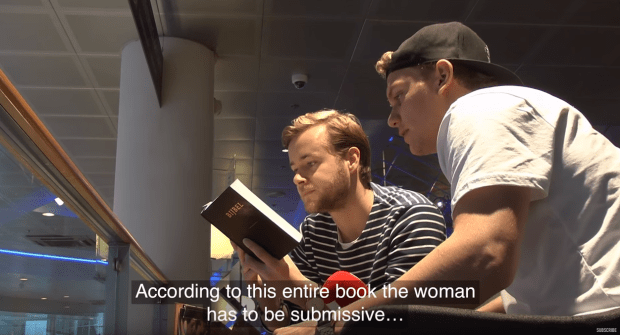
To further explore the question, Spoor and Harland picked up a copy of the Bible and started reading.

Bible Quar'an experiment Dit Is Normaal

Then, after selecting what they called “some of it’s most gruesome verses,” they removed the Bible’s cover, replaced it with the cover of a Qur’an – the central religious text of Islam – and took to the streets.

“Let’s see what happens when we read these passages from the Bible to some people out there, all while leading them to believe these are passages from the Qur’an,” says one member of the team, which goes by Dit Is Normaal on YouTube, before sharing the following quote with several passers-by:

“If you do not obey Me, but act with hostility against Me… you will eat the flesh of your sons and the flesh of your daughters.” (Leviticus)

As it turns out, people in The Netherlands aren’t very keen on the idea of eating their own children. Or putting gay men to death. Or cutting off the hands of women who dare to teach.

“How could anyone believe in this?” one woman says. “That’s unbelievable to me.”

“Cutting off peoples’ hands … I mean, apparently that’s just the way they are,” says another. “If you’ve been raised with this book and these kinds of thoughts it’s going to influence the way you think.”

When asked to compare what they’ve just heard from the (fake) Qur’an to what’s in the Bible, different people the comedians encounter describe the Islamic holy book as “more aggressive” and less “positive” than the Christian holy book.

Then comes the big reveal, which leaves every participant visibly shocked (and most, rather amused).

Bible Quar'an experiment Dit Is Normaal

Harland and Spoor let the faces speak for themselves, choosing to reserve comment and show a reel of the reactions instead.

Source: Pranksters read verses from a Bible disguised as the Qur’an to prove a point – Trending – CBC News

Why aren’t we looking into the Saudi role in San Bernardino attack?

Neil MacDonald, on Saudi Arabia and the uncomfortable parallel with ISIS:

Usually, executions — more than 150 so far this year — are performed with a “godly” sword. In public, of course, for the entertainment of a self-righteous crowd. But there are also crucifixions and mutilations.

SAUDI-ELECTION/

Saudi woman Fawzia al-Harbi, a candidate for local municipal council elections, sits next to one of her chaperones at a shopping mall in Riyadh last month. Saudi Arabian women are running for election and voting for the first time on Dec. 12, but their enfranchisement marks only a pigeon step towards democracy and gender equality in the Islamic kingdom. (Reuters)

Saudi women are treated better than immigrants, but are still severely oppressed, and treated like chattels of the male population.

If that all sounds like the modus operandi of ISIS, which the Saudis have been accused of having funded and armed before becoming a stout ally in the U.S. bombing campaign, well, the shoe does fit.

The Saudis have actually threatened to sue anyone who makes the ISIS comparison, but objectively, it’s not unreasonable.

The main difference is that the Saudis are extremists who managed to create a nation and have it recognized. And of course their king doesn’t claim to lead a new caliphate.

It’s almost a cliché to say this is all about oil, and the Saudi willingness to sell it, and sell it cheaply in unlimited quantities, to the West.

Because it is about oil. It’s also about the Saudis’ willingness to spend billions of that petro-revenue back in the West, signing contracts for military materiel that our governments are ecstatic to arrange.

If you’re inclined to think otherwise, try this mental exercise: imagine if Cuba, or Russia, or Venezuela (or even Canada) had produced 15 of the 19 9/11 hijackers, and had remained a consistent leader in exporting murderous ideology, and radicals like Tashfeen Malik.

Source: Why aren’t we looking into the Saudi role in San Bernardino attack? – World – CBC News

San Bernardino shooting highlights tensions within Islam

More on the Saudi influence on radicalization by Nadeem F. Paracha:

Faisal Shahzad, the American-Pakistani who tried to blow up New York’s Times Square in 2010, had also spent some time in Saudi Arabia. Like Tashfeen, he, too, belonged to a middle-class family.

The authorities in Pakistan still have no clue how to address the phenomenon of educated and relatively well-to-do young people becoming overtly radicalized to the point of committing grave violence.

The country’s military establishment, along with the government headed by the moderate center-right party, the PML-N, has unleashed a widespread operation against hardened and organized militants.

Part of the operation also includes an elaborate plan to neutralize the harder and more puritan stands of the faith that have seeped into various sections of Pakistani society ever since the 1980s.

This aspect of the operation has been tougher to implement because one major section of PMLN’s vote-bank in the Punjab is made up of men and women whose economic status has been enhanced by the money they made in the Gulf states.

But, again, till now, though such Pakistanis have often been known to denounce the faith followed by most of their compatriots and to fund a number of apolitical Islamic evangelical outfits that preach their kind of Islam, they are never expected to cross the line that separates them from militancy.

Ready-made narratives

However, as one Pakistani psychologist suggested two years ago at a seminar, young people in Pakistan with serious emotional problems and unresolved psychological issues are now being handed ready-made religious and political narratives by populist electronic and social media outlets. These narratives, he said, encourage them to give violent expression to their angst, confusion and failures while believing that they are doing so for a grander, more divine cause.

This seems to have been the case with Tashfeen. Hailing from a small town family steeped in indigenous forms of the faith; allegedly flown away to Saudi Arabia by a stubborn father who believed his country’s people were “flawed Muslims” and that “true Islam” was practiced only in Saudi Arabia; returning to Pakistan as a young woman and perhaps coming to the conclusion that her father was correct; linking up with an equally disgruntled soul from the US; marrying him; and then finally discovering her true calling: mass murder.

Hers was a psychotic break emerging from unresolved emotional issues, but combined with a warped politico-religious narrative that simply promised her a catharsis. But it was a catharsis that left 14 innocent people dead; a six-month-old child scarred for life; and a Muslim community in the US scratching their heads and wondering where they went wrong in simply trying to lead “pious lives.”

Source: San Bernardino shooting highlights tensions within Islam | World | DW.COM | 07.12.2015