Trudeau urged to create gender-balanced Senate

Holding the Government to the spirit of the common wording in the mandate letters (“You are expected to do your part to fulfill our government’s commitment to transparent, merit-based appointments, to help ensure gender parity and that Indigenous Canadians and minority groups are better reflected in positions of leadership.”).

The previous Conservative government appointed 18 women out of 57 appointments (32 percent) and 9 visible minorities (16 percent – in line with the percentage of visible minorities who are Canadian citizens) by my rough count.

Good that this group has appropriately broadened their focus beyond gender parity:

The federal government is facing pressure to create gender parity in Canada’s upper chamber, two months after Prime Minister Justin Trudeau attracted global attention by forming a cabinet whose membership is half female.

A group of prominent women from across the country has seized on Mr. Trudeau’s move to achieve gender equality in the cabinet and his promise of Senate reform, and is now calling on him to fill the 22 current vacancies in the Senate with women – which would create gender balance for the first time in the chamber’s history.

In addition, the group – led by Donna Dasko, co-founder and former national chair of Equal Voice, a non-partisan organization advocating for women in politics – is asking that the female appointees be from diverse backgrounds, such as indigenous women and those from minority linguistic, racial and ethnic communities. This, they point out in a letter sent late last month to the Prime Minister, is in keeping with the Senate’s mandate to represent minorities.

“This is an historic opportunity,” Ms. Dasko wrote in the letter that is signed by more than 80 women, including former Progressive Conservative prime minister Kim Campbell, former Liberal deputy prime minister Sheila Copps, actress Sonja Smits and Vancouver’s deputy mayor, Andrea Reimer.

Currently there are 83 senators, 30 of which are women – representing 36 per cent of the Senate. Appointing 22 women immediately would make the chamber 50-per-cent female. The group says in the letter that “future appointees could include both men and women in equal numbers.”

Paul Duchesne, a spokesman for Democratic Institutions Minister Maryam Monsef, told The Globe and Mail in an e-mail on Sunday that “we share the desire of the signatories to achieve gender balance in the Senate.”

Source: Trudeau urged to create gender-balanced Senate – The Globe and Mail
A testing year for Australia’s social cohesion as multiculturalism debate grows louder

A good overview of multiculturalism in Australia:

[Racial discrimination commissioner] Soutphommasane warns against taking an overly positive “Pollyanna” view of social cohesion.

“It would be foolish to be too optimistic or too defeatist,” he says, adding that predictions of multiculturalism’s “terminal decline” are baseless.

“There’s no doubt that there are challenges at the moment, but the strength of our multiculturalism shouldn’t be undermined,” Soutphommasane says. “We are dealing with profound challenges, but from a position of strength.”

Fierravanti-Wells agrees, noting that Australian society has faced bumps in the road before, but has always been able to draw on its reserves to get through.

Rowland has faith in the people, and in the country’s laws on inclusion and diversity, which have not changed despite the often heavy-handed rhetoric espoused by individual politicians.

“Our legislative structure has remained fairly consistent,” she says.

“For every negative reaction, there was a positive reaction from the whole of community,” he says.

But he thinks debate on multiculturalism and what it means to be Australian should not be gagged.

“Let’s talk about the challenges and what’s uncomfortable to talk about. We are ready for that.”

Source: A testing year for Australia’s social cohesion as multiculturalism debate grows louder | World news | The Guardian

Order of Canada Appointments 2015 – Diversity lens

Media commentary largely focused on gender and regional diversity as can be expected. The lengthy process involved (about a year) means that this largely took place under the previous government (although the process and decisions are under the GG).

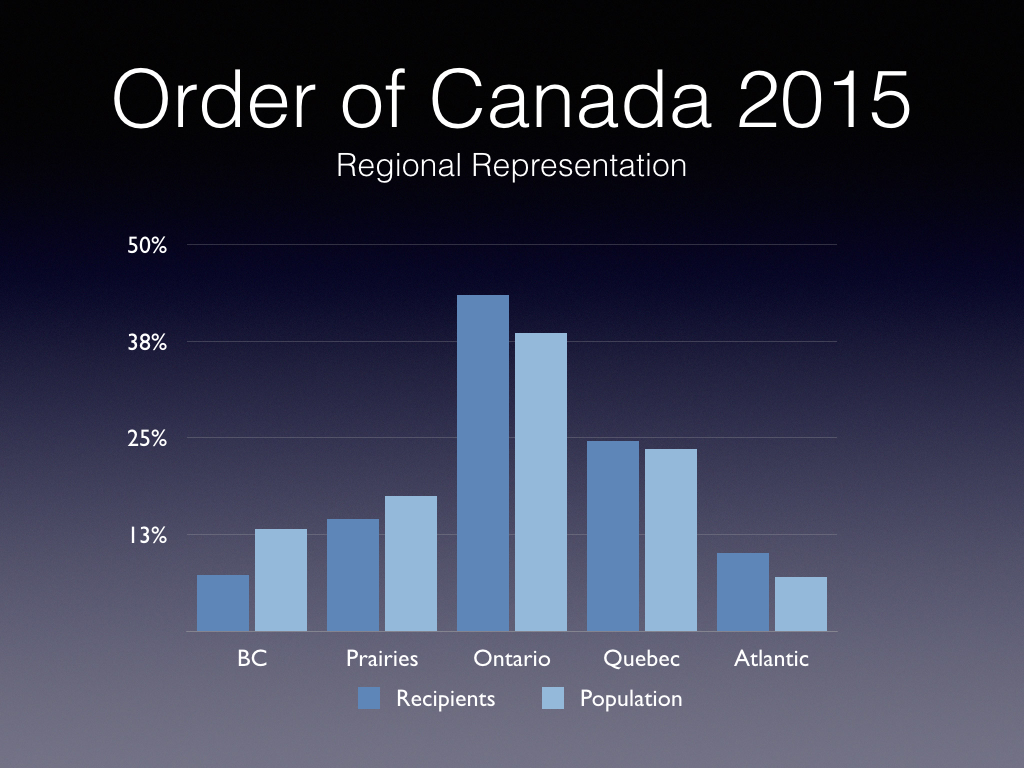
Looking at regional diversity, as some have noted, Ontario and Atlantic Canada are over-represented in relation to their share of the population:

Order of Canada 2015.001

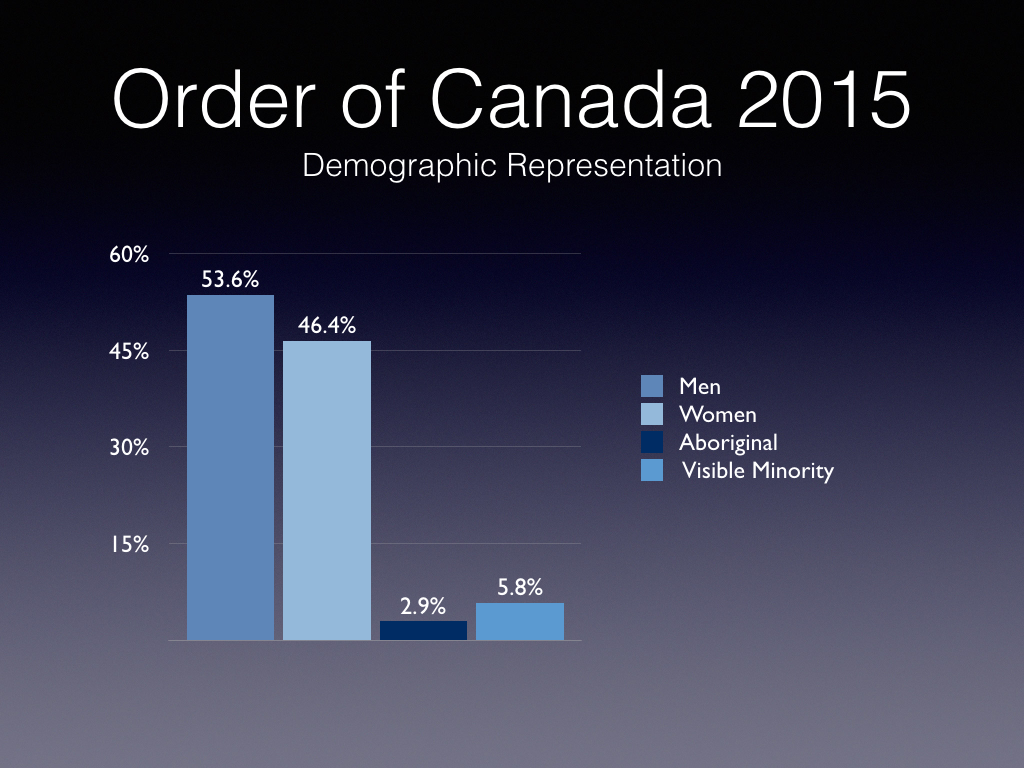
Looking at gender, indigenous and visible minority representation, both women and indigenous representation are relatively close to their share of the population.

However, visible minorities, whether measured against the overall number (19.1 percent) or the number who are Canadian citizens (15 percent), are under-represented at 5.8 percent. (Note: this analysis was based on names and descriptions and not correlated against photos and thus may understate representation).

Order of Canada 2015.002

This is not surprising, given that visible minorities have a shorter history in Canada than other ethnic groups and thus less time to make the kind of contributions that the Order recognizes. But, like other open nomination processes, it may also reflect fewer nominations, in turn reflecting less awareness among visible minorities regarding the Order.

Hard to say without more data but suggests that more outreach to get more nominations may be warranted.

Order of Canada Appointments

Will Japan’s apology to ‘comfort women’ bring closure?

While leave to others the foreign policy and geopolitical dimensions, long overdue apology:

Now, in a landmark agreement this week, Japan has apologized anew for the practice and pledged $8.3-million (U.S.) to a fund set up for survivors in what both sides said was a “final and irreversible resolution.” Does this new agreement have the power to change the course of Asian geopolitics at a time when the U.S. needs a united front against China, or will it join all the other war-time apologies that are issued, criticized, forgotten and buried beneath the remarkably long-lasting, ever-lingering hatreds of East Asia?

The surprise deal was immediately hailed in Japan as a coup for Japanese Prime Minister Shinzo Abe, who seemed to have finally settled Japan’s grim historical record in Korea, after previously attempting to downplay Japan’s past abuses. This apology was as unambiguous as Mr. Abe was likely to give, offered remorse and considered the immeasurable suffering of the women – rather than trying to justify or fudge the history, as many on Japan’s right still do. The money being pledged also came straight from the Japanese government, which was meant to add an air of formality and officialdom.

But the agreement received a more muted response in Korea, where President Park Geun-hye, who is broadly unpopular, has squeezed anti-Japanese feelings for all they are worth. Former sex slaves and opposition politicians immediately criticized the deal for coming about without the participation of the “comfort women” themselves, for failing to acknowledge legal culpability and for not offering formal financial reparations. Former sex slaves said they were also angry Seoul agreed to discuss with them the possible removal of a statue – placed directly outside the Japanese embassy in Seoul – of a former sex slave sitting next to an empty chair, a symbol of the “comfort women” who died waiting for a full apology from Japan. One group of survivors called the deal “shocking” and said it was an act of “humiliating diplomacy” from Seoul.

Unlike in Europe, which has largely moved on from the scars of the Second World War, memories of Japan’s vicious imperial sweep across much of East and Southeast Asia are still vivid – and influence regional geopolitics to this day. South Korea and Japan still do not share sensitive military information, preferring to rout it through the United States, despite the obviously shared security concerns over China’s growing assertiveness in the region and the perennial problem of North Korea.

The U.S. has constantly urged Tokyo and Seoul over the years to reconcile historical disagreements and move forward in a more united fashion on matters of regional importance such as the Six-Party Talks involving North Korea. In a media briefing, a senior State Department official said the deal could be as transformative to regional relations as the monumental Trans-Pacific Partnership free-trade deal between the U.S., Canada, Japan and other Pacific nations.

Some, of course, argue that apologies in international politics are too often counterproductive. The academic Jennifer Lind has noted that reconciliation between nations does not necessarily require a formal apology – let alone many formal apologies, as in Japan’s case – because the apology provides a platform for nationalist elements in both countries to again debate and disagree over the facts.

But laying aside the criticisms of civil-society groups and opposition politicians in both countries, who have an obvious stake in milking the issue forever, the deal marks an enormously positive step in Japanese-Korean relations. Better military co-operation between Japan and South Korea might dampen China’s appetite for territorial disputes over islands in the East and South China seas, and will certainly help the U.S. execute its ongoing pivot to Asia. It will also prevent North Korea from using historical grievances as a convenient wedge to distract and divide the coalition of countries concerned about Pyongyang, and might dissuade the dictatorship from its destabilizing antics.

Japan has already indicated that it is ready to discuss the “comfort women” with Taiwan, though conversations on the issue with Beijing are likely far off. Still, Mr. Abe and Ms. Park – both arch-conservatives who thrive on the support of nationalist elements in their respective countries – will not be in power forever, and leadership transitions might generate additional warmth to thawing relations.

Though imperfect, the deal does represent an attempt to move forward peacefully, without forever nursing the sting of historic abuses. That sort of closure is something northeast Asia desperately needs.

Source: Will Japan’s apology to ‘comfort women’ bring closure? – The Globe and Mail

2015 in review – My WordPress blog stats

For those interested, and in the spirit of openness and transparency, please find the WordPress 2015 annual report for my Multicultural Meanderings blog.

Here’s an excerpt:

The concert hall at the Sydney Opera House holds 2,700 people. This blog was viewed about 27,000 times in 2015. If it were a concert at Sydney Opera House, it would take about 10 sold-out performances for that many people to see it.

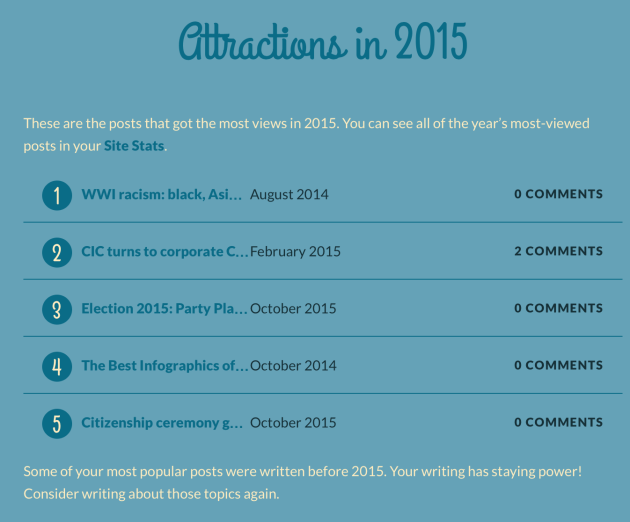
The top posts:

Your_2015_year_in_blogging

Click here to see the complete report.

Multiculturalism in Canada: Evidence and Anecdote eBook – 5 Percent off

Lulu ebook sale 30 Dec

A small saving, one of the rare ones Lulu offers for eBooks. Direct link for eBook: Multiculturalism In Canada: Evidence and Anecdote

Implementing diversity and inclusion in Parliament: A more complete picture | My piece in the hilltimes.com

With the appointment of parliamentary secretaries and opposition critics, we now have a more comprehensive picture of gender and visible minority diversity in Parliament’s leadership positions. How well has the Liberal government implemented its overall diversity and inclusion commitments, and how have the other parties responded to the “because it’s 2015” challenge?

Although Prime Minister Justin Trudeau appointed a Cabinet with gender parity (15 each of men and women) and almost 17 per cent visible minority ministers (four Sikh and one Afghan Canadian), gender parity was not attained for parliamentary secretaries (12 positions out of 35 or 34 per cent). Visible minority parliamentary secretaries are over-represented (nine positions or 24 per cent) in relation to their share of the voting population (15 per cent).

Moreover, the government addressed some of the criticism regarding Cabinet over-representation of Sikhs by appointing three African Canadians, one Chinese, one Arab, one Latin American and three South Asians (two Sikhs, one Ismaili Muslim). Three of the nine visible minority parliamentary secretaries are women, including Celina Caesar-Chavannes, a parliamentary secretary to the Prime Minister.

In total, of the 68 leadership positions (ministers, parliamentary secretaries, whips, and House leaders), 59 per cent are men, and 21 per cent are visible minority men or women. The detailed breakdown is shown in the chart below:

In terms of percentage of caucus, there are 27 women in leadership positions out of 50 elected, or 54 per cent. For visible minorities, there are 14 out of 39 elected, or 36 per cent. In contrast, 30 non-visible minority men are in leadership positions out of 134 elected, or 20 per cent.

No matter how one looks at the data, this marks a major shift in government parliamentary leadership appointments, towards more women and visible minorities.

The Conservative official opposition compensated for their relatively low number of women MPs (17 per cent of caucus), making 35 per cent of critics women (the Harper government’s last Cabinet similarly appointed more women to Cabinet—31 per cent—compared to the 17 per cent in caucus).

However, with a small number of visible minority MPs (six or six per cent of caucus), critic visible minority representation is only slightly compensated at nine per cent, although visible minority MPs form 13 per cent of the smaller number of deputy critics. But in relation to caucus membership, 50 per cent of visible minority Conservative MPs are critics, reflecting again the same drive to present a more inclusive face to Canadians.

The NDP opposition has the largest proportionate female caucus representation: 41 per cent. It is no surprise that women MPs form 45 per cent of critics. With only two visible minority MPs to choose from, only one (three per cent) is a critic (but again, this is 50 per cent of those elected).

So what does all this mean in terms of diversity and inclusion?

The Liberal government, given the large number of women (50) and visible minority (39) MPs elected had little difficulty in meeting its stated goals of Cabinet gender parity (but slipped in other leadership positions). It also was able to significantly exceed visible minority representation in relation to the number of visible minority voters.

This ‘over-representation’ reflects a conscious decision to demonstrate diversity and inclusion, one that started with having the highest percentage of visible minority candidates (17 per cent) compared to the other major parties (13 per cent).

For both opposition parties, the weakness in visible minority representation reflects the small number of visible minority MPs elected. With respect to women, the Conservatives responded to the ‘because its 2015’ challenge, compensating for their small number of women MPs, and applying the same approach to visible minorities. The NDP made the most effort in recruiting female candidates, many of whom were successful, and thus close to gender parity was not a challenge.

All in all, taken together, the Liberal leadership positions reflect a significant implementation of the diversity, inclusion and multiculturalism agenda, one that, given the horizontal ministerial comment for parity and diversity in all government appointments, holds significant promise in ensuring greater representation in government.

Moreover, to the extent that the opposition parties could, their choices recognize the need to respond to this agenda and ensure that their leadership reflects Canadian diversity.

Source: Implementing diversity and inclusion in Parliament: A more complete picture | hilltimes.com

A ‘race lens’ for the labour market? Welcome to 2015, Ms. Wynne

While I am not sure that I agree with all of these recommendations as I am not familiar enough with existing structures to know whether these are needed, or more adjustment of existing mandates and roles would be more appropriate, this helps continue the conversation of the overall need for a diversity lens.

In Multiculturalism in Canada: Evidence and Anecdote, the Ontario data confirms some of the gaps and challenges (particularly economic), as do any number of issues (e.g., police carding, Toronto school outcomes, children aid society statistics).

My preference is for a lens that integrates all the different aspects of diversity (gender, ethnic origin, sexual orientation etc) into policy, program and service delivery (see my earlier post, Jim Maclean: In Ontario, a new race-based government | The Limits of Anecdote and Assertion):

Having a racial-equity policy framework is just the beginning, however. If the Premier is sincere about bringing racial justice to Ontario, the following foundational steps are critical:

  • Establish an equity and anti-racism directorate to provide for the collection and analysis of ethno-racially and otherwise appropriately disaggregated data across all provincial ministries and public institutions. The directorate – with a pan-provincial government-wide mandate – would complement this data analysis by providing an ongoing monitoring and program development role for the integrated implementation of comprehensive and inclusive equity and anti-racism policies and practices.
  • Establish an employment-equity secretariat, fully mandated and adequately resourced in order to implement a mandatory and comprehensive employment-equity program in Ontario.
  • Amend the provincial funding formula for publicly funded elementary-secondary schools by introducing an equity in education grant – a more robust redistributive mechanism rooted in a range of relevant equity and diversity measures and considerations – to ameliorate Ontario’s growing ethno-racially defined learning outcome inequities and disparities.
  • Apply equity principles to all current and future government infrastructure investments, particularly “green collar” job-creating initiatives, to best ensure stable and sustainable futures for all.
  • Establish the anti-racism secretariat as mandated under the Ontario Human Rights Code.

With these and other similar measures, first peoples and peoples of colour will have a fighting chance of finally becoming equal members of our society. By 2017, these diverse communities will make up close to one-third of Ontario’s population. The time for action is now.

ICYMI: The False Promise of Meritocracy – The Atlantic

A note of caution of those who believe that hiring and other systems are based on objective meritocracy, without any influence of bias and prejudice, and a reminder of the need to be more mindful and aware of these biases:

Americans are, compared with populations of other countries, particularly enthusiastic about the idea of meritocracy, a system that rewards merit (ability + effort) with success. Americans are more likely to believe that people are rewarded for their intelligence and skills and are less likely to believe that family wealth plays a key role in getting ahead. And Americans’ support for meritocratic principles has remained stable over the last two decades despite growing economic inequality, recessions, and the fact that there is less mobility in the United States than in most other industrialized countries.

This strong commitment to meritocratic ideals can lead to suspicion of efforts that aim to support particular demographic groups. For example, initiativesdesigned to recruit or provide development opportunities to under-represented groups often come under attack as “reverse discrimination.” Some companies even justify not having diversity policies by highlighting their commitment to meritocracy. If a company evaluates people on their skills, abilities, and merit, without consideration of their gender, race, sexuality etc., and managers are objective in their assessments then there is no need for diversity policies, the thinking goes.

But is this true? Do commitments to meritocracy and objectivity lead to more fair workplaces?Emilio J. Castilla, a professor at MIT’s Sloan School of Management, has explored how meritocratic ideals and HR practices like pay-for-performance play out in organizations, and he’s come to some unexpected conclusions.In one company study, Castilla examined almost 9,000 employees who worked as support-staff at a large service-sector company. The company was committed to diversity and had implemented a merit-driven compensation system intended to reward high-level performance and to reward all employees equitably.

But Castilla’s analysis revealed some very non-meritocratic outcomes. Women, ethnic minorities, and non-U.S.-born employees received a smaller increase in compensation compared with white men, despite holding the same jobs, working in the same units, having the same supervisors, the same human capital, and importantly, receiving the same performance score. Despite stating that “performance is the primary bases for all salary increases,” the reality was that women, minorities, and those born outside the U.S. needed “to work harder and obtain higher performance scores in order to receive similar salary increases to white men.”

These findings led Castilla to wonder if organizational cultures and practices designed to promote meritocracy actually accomplished the opposite. Could it be that the pursuit of meritocracy somehow triggered bias? Along with his colleague, the Indiana University sociology professor Stephen Bernard, they designed a series of lab experiments to find out. Each experiment had the same outcome. When a company’s core values emphasized meritocratic values, those in managerial positions awarded a larger monetary reward to the male employee than to an equally performing female employee. Castilla and Bernard termed their counter intuitive result “the paradox of meritocracy.”

The paradox of meritocracy builds on other research showing that those who think they are the most objective can actually exhibit the most bias in their evaluations. When people think they are objective and unbiased then they don’t monitor and scrutinize their own behavior. They just assume that they are right and that their assessments are accurate. Yet, studies repeatedly show that stereotypes of all kinds (gender, ethnicity, age, disability etc.) are filters through which we evaluate others, often in ways that advantage dominant groups and disadvantage lower-status groups. For example, studies repeatedly find that the resumes of whites and men are evaluated more positively than are the identical resumes of minorities and women.

This dynamic is precisely why meritocracy can exacerbate inequality—because being committed to meritocratic principles makes people think that they actually are making correct evaluations and behaving fairly. Organizations that emphasize meritocratic ideals serve to reinforce an employee’s belief that they are impartial, which creates the exact conditions under which implicit and explicit biases are unleashed.

“The pursuit of meritocracy is more difficult than it appears,” Castilla said at a recent conference hosted by the Clayman Institute for Gender Research at Stanford, “but that doesn’t mean the pursuit is futile. My research provides a cautionary lesson that practices implemented to increase fairness and equity need to be carefully thought through so that potential opportunities for bias are addressed.” While companies may want to hire and promote the best and brightest, it’s easier said than done.

Source: The False Promise of Meritocracy – The Atlantic

ICYMI – The U.S. Senate: Still One of the World’s Whitest Workplaces – The Atlantic

Not that surprising. Have not seen a comparative Canadian study on staffers (anyone know one?) but I would suspect that visible minority percentages would be higher:

The U.S. Senate is famously known as the world’s most deliberative body, but it has never been its most representative. And that remains true not only of the 100 people elected to serve, but of the hundreds more hired as their top advisers.

Just over 7 percent of congressional aides who hold senior staff positions in the Senate are people of color, according to a new study set to be released Tuesday by the Joint Center for Political and Economic Studies. That amounts to just about 24 of the 336 people who hold top job titles, and it is a far lower percentage than the country as a whole, where people of color—defined as African Americans, Hispanic Americans, Asian Americans, and Native Americans—comprise about one-third of the population. The lack of diversity is particularly glaring among African Americans (0.9 percent of top staff positions) and in the offices of senators hailing from states with large black and Hispanic populations. And it suggests that little has changed in the decade since the online magazine Diversity Inc. called the Senate the nation’s worst employer for diversity.

In one way, the finding is not surprising. While the 114th Congress as a whole is the most diverse in history (admittedly a low bar), the Senate itself is notoriously unrepresentative as an elected body. There are just two African American senators and three Hispanics to go along with 20 women out of 100 senators. Yet the report’s author, James Jones of Columbia University, said he was still shocked to find the staff numbers to be so low, particularly in the offices of Democratic senators. “I didn’t expect it to be this bad,” he told me. The social demographics of senators naturally influences the social demographics of the people they hire as their senior advisers, Jones said. But, he added, “I don’t think diversity in the Senate—especially racial diversity—should be dependent on the racial backgrounds of senators. All senators come from states with racially diverse demographics, and so I think they have a responsibility to have staffs that look like the states that they represent.”

The Senate’s static diversity also bucks a trend in the federal government under President Obama, who has appointed a record percentage of minorities and women to posts requiring confirmation. The Senate, therefore, is approving a lot of minorities; it just isn’t hiring them. Jones told me that his research indicated that staff diversity in the top rungs of the Senate hadn’t changed much since the 1980s, despite periodic efforts to highlight and remedy the problem. In the mid-2000s, then-Senate Majority Leader Harry Reid created a diversity initiative to encourage minority hiring by Democratic offices. But Jones said the impact of that effort had been mixed: It helped staffers of color get their foot in the door with entry-level positions, but it didn’t make much difference in senior-level jobs. “Senior positions are more competitive, they’re more political, and the opportunities to fill these vacancies are more rare,” Jones said.

Source: The U.S. Senate: Still One of the World’s Whitest Workplaces – The Atlantic