US election 2016: What does ‘Islam’ think of America? – BBC News

Useful summary of what some of the polling data indicates:

The Pew Research Centre, which surveys global attitudes, said anti-Americanism was strong around the word around the time of the US invasion of Iraq.

However, currently there is little evidence of profound anti-American sentiment except for in a handful of countries, it says.

Bruce Stokes, director of global economic attitudes at Pew, says sentiment towards the US varies widely between Muslim-majority countries.

“We tend to see more negative sentiment among Muslims in the Middle East, such as those from Egypt and Jordan,” he says.

Barack Obama meeting American MuslimsImage copyrightGetty Image
“But Muslims outside the Middle East generally have a more positive outlook,” he adds.

In Indonesia, the world’s most populous Muslim country, 62% of people hold a favourable opinion of the US, Pew’s latest data suggests.

That figure rises to 80% in Senegal, a country which is over 90% Muslim. Mr Stokes points out that this is a stronger approval rate than Germany.

“Attitudes have also been changing over time. We’ve seen a gradual rise in positive sentiment since President Barack Obama came to power,” Mr Stokes says.

“Even in the Palestinian Territories, where sentiment is 70% unfavourable, that’s an improvement on 82% in Barack Obama’s first year.”

The BBC World Service commissioned its own poll of global attitudes in 24 countries in 2014.

Among other things, it asked respondents if they thought the US “had a mainly positive or mainly negative influence in the world”.

Pakistanis generally held the worst view of the US, with 61% saying the US had a negative influence.

But both China and Germany were not far behind, scoring 59% and 57% respectively.

Turkey, almost 98% Muslim, was split between 36% positive, 36% negative and 28% neutral.

Source: US election 2016: What does ‘Islam’ think of America? – BBC News

Religious institutions [temple and mosque] form unlikely partnership to aid Syrian refugees

Good to see initiatives like this:

For years, the Temple Har Zion and the Imam Mahdi Islamic Centre (IMIC) have been neighbours, even sharing a parking lot, in Thornhill, Ont. Now, the unlikely partners are about to share a major responsibility – sponsoring a group of Syrian refugees.

The religious institutions have united to privately sponsor Syrian refugees to resettle in Canada. Together, they are pooling their resources to raise a target of $60,000 in the next couple of months.

Temple Har Zion Rabbi Cory Weiss says the co-operation is “groundbreaking” for both organizations.

“It brought us together in a way that nothing else has,” Mr. Weiss told The Globe. “The more we learn about each other’s religion, the more we realize we have in common.”

Alireza Torabian, who is leading the sponsorship efforts at the mosque, says the partnership sets a good example for other Canadians.

“We are very proud that we can start a project and show Canadians that different cultural groups and religions can work together in Canada on the same common cause,” he said.

Given their proximity to one another, there has always been a relationship between the synagogue and the mosque, but last fall, Mr. Weiss and the imam of the IMIC, Seyed Reza Hosseini-Nasab, met to get to know one another better.

In December, the synagogue decided it wanted to sponsor Syrian refugees and reached out to the mosque, which happened to be considering refugee sponsorship too.

The organizations teamed up and are now working with their refugee sponsorship agreement holder, Jewish Immigrant Aid Services (JIAS) in Toronto, which will help with the process once enough money is raised.

JIAS language and settlement director Lia Kisel said this is the first time she has worked with two religious institutions on refugee sponsorship.

“It makes you feel very proud because bridges are being built,” Ms. Kisel said.

Source: Religious institutions form unlikely partnership to aid Syrian refugees – The Globe and Mail

Refugees and anti-Semitism: is it a problem? | Germany

More about antisemitism and refugees in Germany:

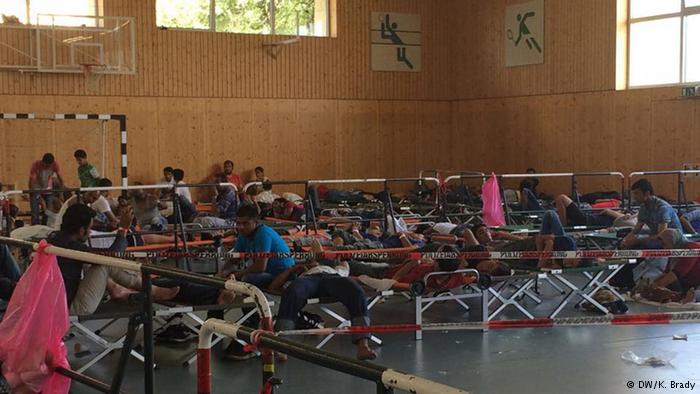
First, there were the images on TV of desperate, scared people climbing out of tiny boats and marching slowly along motorways and through woods. Then, not long after, the refugee crisis arrived on Shaked Spier’s doorstep in Berlin: overcrowded gyms, people waiting for weeks to be registered, overwhelmed officials.

“I knew immediately: If refugees are now in the country that my grandparents had to flee, and if they need help and protection, then I have to do my part,” Spier said. For him, there was absolutely no doubt. Since then, Spier, a Jew whose grandparents once fled the Nazis, has been volunteering at a refugee shelter in Friedrichshain, a hip district of Berlin filled with bars and cafes. Spier, 30, is a well-spoken man who works as a project manager at an IT company, and gives long, reflective answers when asked questions. At the refugee shelter, he helps to serve meals, plays with the kids and talks to the parents about the trauma they’ve experienced.

He is one of many Jews who’ve been helping refugees by donating clothes, working in shelters, or taking refugees into their homes. Spier says he hasn’t had any negative experiences. He says his identity, background and sexual orientation – Spier is openly gay – have never played a big role in his encounters with refugees. If someone notices the Hebrew tattoo on his arm or his accent, the reaction is typically one of, “Oh, you’re from Israel? Cool, I’m from Afghanistan.” He laughs.

Deutschland Rosenheim Grenze Österreich Turnhalle Lager Asylbewerber More than 1 million refugees came to Germany in 2015

No research to support the claims

But then he grows serious. It makes him angry, he says, when other people accuse refugees of being anti-Semites or harboring hate towards Israel simply because they come from countries whose governments espouse such sentiments. The head of Germany’s Central Council of Jews, Josef Schuster, has frequently spoken about the danger of importing anti-Semitism along with refugees. In a recent newspaper interview, he said that “a considerable proportion of Arabs have grown up with anti-Jewish, anti-Israeli stereotypes. These people cannot simply leave their prejudice behind at the border.”

Spier says he has experienced no hostility while working with refugees

Dervis Hizarci, a history and political science teacher in Berlin, also finds such generalizations problematic. There is no research on the extent to which refugees may be bringing anti-Semitism with them to Germany, he said. Hizarci is the head of KIGA, an initiative against anti-Semitism based in the Berlin neighborhood of Kreuzberg. The initiative has launched a project about anti-Semitism among refugees; he expects to have the initial results by the end of the year. Until then, Hizarci says people shouldn’t make generalizations about the issue, as that would only stir up anti-Islam and anti-foreigner sentiment. However, he points to research showing that between 15 and 20 percent of the German population harbor latently anti-Semitic views. “Of course there are Muslims among these people, even in the second and third generation, but they’re by far not all Muslims!”

Hizarci doesn’t deny that young German Muslims are susceptible to anti-Semitic views, fueled by the horrors of the Middle East conflict they see on their smartphones and televisions. Hizarci and his colleagues give workshops and lead debates about anti-Semitism, but also about hatred of Islam. He says his work requires a lot of time and resources. “Just like when it comes to fighting homophobia or right-wing extremism, you can’t change such views with a single workshop; it doesn’t happen overnight.” After the Easter holidays, the initiative wants to start a model project that, among other things, will offer welcome workshops on the topic.

Mosques are overwhelmed

But often, it’s individual people engaged in such efforts to promote tolerance: German mosques are often overwhelmed with the problem, in part because they are led by volunteers who also have to commit their time and energy to other problems facing members of their community, such as exclusion, anti-Islam sentiment and joblessness. There are barely any resources left for confronting the problem of anti-Semitism, said an insider who asked to remain anonymous due to the contentious nature of the topic. The source added that many young Muslims are not an integrative part of the mosque community: “When that’s the case, there’s no way to reach them.”

Source: Refugees and anti-Semitism: is it a problem? | Germany | DW.COM | 12.03.2016

Donald Trump’s success a ‘wake-up call’ for Michigan’s Muslims

Does not bode well:

On Thursday, Muslim leaders in this Detroit suburb were saying that members of their community still felt safer here than they would in just about any other place in their country.

….The source of considerable angst and reflection was this past Tuesday’s Michigan presidential primary. In one of the most Muslim-heavy states in the country, Republican front-runner Donald Trump – a candidate so overtly playing to Islamophobia that he pronounced during a CNN interview this week that “Islam hates us” – cruised to victory with about 37 per cent of the Republican vote. And in Dearborn itself, where nearly half the city’s roughly 100,000 residents are Arab-American and many country- or state-wide Muslim or Arabic organizations are based, Mr. Trump’s percentage was a couple of points higher than that.

Unsurprisingly, most of his votes came from the half of Dearborn that’s not really a Muslim capital at all. While the vast majority of residents on the east side of town are of Arabic descent – with roots primarily in Lebanon, Syria, Yemen and the Palestinian territories – the west side is primarily white. Of the 3,153 Dearbornians who voted for Mr. Trump, only about 500 live on the east side. (Christian Arabs, a small population here, may account for a few of those.)

But until recently, Dearborn seemed to be a success story of Muslims integrating into a city with a history of segregation, and a state that has seen more than its share of racial strife. Many have opened businesses on the west side, some have even moved there, and they are increasingly engaged civically, including on the city’s council. The town has attracted its share of attention from cranks: Right-wing bloggers have long propagated various bogus conspiracy theories, including that the city is under Sharia law, and the likes of Koran-burning Florida pastor Terry Jones occasionally show up seeing attention. But even following the attacks of Sept. 11, 2011, there wasn’t the degree of backlash for which many of its immigrant families braced themselves.

Now, with thousands of people with whom they co-exist either embracing Mr. Trump’s Muslim-bashing or proving willing to overlook it, Muslim residents have been given a reality check about how they’re perceived – and how much Mr. Trump has helped bring to the fore something ugly that was lurking below the surface.

“I think what is most troubling about this election cycle is that in Michigan, you would assume there is a certain familiarity with Muslims,” says Rana Elmir, who grew up in Dearborn and is now deputy director of the American Civil Liberties Union of Michigan. “And I don’t think what you’re seeing in those results reflects that familiarity and trust.”

Source: Donald Trump’s success a ‘wake-up call’ for Michigan’s Muslims – The Globe and Mail

Engaging Newcomers: ‘We Haven’t Done Enough’

One of the strongest speakers at the recent Metropolis conference and certainly the strongest one on the ‘identities’ workshop (which most of the other panelists didn’t address):

Governments and bureaucrats need to focus less on numbers and more on starting real conversations that tackle critical problems, like race, in ways that engage immigrants rather than shaming them.

“A lot of time when it’s about race, we are afraid to talk about it,” said Yolande James, one of four speakers from the government and legal system who presented at the “Identities, Rights and Migration: A Session on the Intersection of Gender, Race, Class and Sexuality” session at the 18th National Metropolis Conferenceheld in Toronto last week.

“There is a way to have a conversation involving everybody, to be respectful and constructive. Everybody has something to give and we should have an equal life.”

James, a former provincial politician, was the first Black female cabinet minister in Quebec history, serving as Minister of Immigration and Cultural Communities & Minister of Family between 2007 and 2014.

As a former provincial government minister, and child of immigrant parents herself, James knows about how inefficient all levels of government are in engaging newcomers into their host country.

“Do we engage immigrant populations? Do we have engaged dialogue?” she asked. “We haven’t done enough.”

She said the lack of society-wide conversations that engage with immigrants sends the message that they do not matter.

“I feel the whole nation, in terms of why the issues touching immigration and diversity [are] important, is not engaged,” she said. “It’s all about being able to engage people to connect with other people’s experience.”

“There is so much emphasis on the numbers, but it’s not important. It’s about their journey.”

As an example, James pointed to the current challenge of accepting Syrian refugees to Canada. She said that the government needs to pay attention to more than just the number of refugees being accepted.

“Should it be 55,000 or 50,000?” she asked. “There is so much emphasis on the numbers, but it’s not important. It’s about their journey,” she said.

Source: Engaging Newcomers: ‘We Haven’t Done Enough’ – New Canadian Media

Where is the postracial society? Mark Kingwell

On identity politics and post-racialism:

Is the solution a “postracial” society, blind to colour and bogus judgments of difference? Would that it were so. Unfortunately, too many comfortable postracialists are self-appointed allies of struggle, who should remember that they don’t get to be not-white just because they have achieved personal tolerance. Demographics alone are an uncertain vehicle of change, and rainbow populations no guarantee of harmony and justice – sometimes quite the opposite.

The presumed liberal goal for diverse societies is universal equality, but identity politics seems compelled to tout essential differences. The best response to this long-standing philosophical double-bind isn’t what Mr. Rock suggested: more opportunity, especially in Hollywood’s tiny self-regarding gene pool. Opportunity is too often a rigged game, another frat mixer where you get stuck in the corner with the other squares.

Instead, we need to challenge the very idea that random differential traits – skin colour, physical beauty, penises – should generate outcomes unrelated to them, such as wealth, power and status. Racism is stupid as well as dangerous, a conceptual error frozen into intellectual sludge. The solution is not more identity but more imagination, including for differences we haven’t yet encountered.

Without that, the postracial society will remain a sci-fi dream, like crew rosters on Star Trek or the bar scenes in Star Wars. And even there – well, we like you, C-3PO, but you’re … not an organic.

Source: Where is the postracial society? – The Globe and Mail

Statistics Canada: The contribution of immigration to the size and ethnocultural diversity of future cohorts of seniors

Projected_distribution_of_various_cohorts_at_age_65__by_place_of_birthNot surprising but interesting:

The aging of Canada’s population is currently related to the baby-boom cohort reaching their senior years. Subsequent cohorts will continue to sustain high populations of seniors because of declining mortality rates and higher immigration levels.

According to population projections, future cohorts of older Canadians could also be more ethnoculturally diverse, as a larger portion of them could be born outside of Canada.

Source: The Daily — Study: The contribution of immigration to the size and ethnocultural diversity of future cohorts of seniors

Liberals vow to review Canada’s poor record jailing Islamist fighters returning to country

Reasonable approach as part of the overall review under-way:

Canada’s poor record at jailing Islamist fighters returning from Syria and Iraq will be scrutinized as part of the government’s overhaul of the nation’s security apparatus.

The commitment Tuesday by Public Safety Minister Ralph Goodale, responsible for Canada’s chief spy agency and the RCMP, follows news that about 60 individuals in Canada are suspected to have returned from foreign battlefields and the ranks of the Islamic State, al-Qaida and other terrorist groups.

None have been charged, though Parliament in 2013 created four new criminal laws against leaving the country or attempting to leave to engage in terrorist activities. The Canadian Security Intelligence Service (CSIS) believes about 180 others from Canada are currently fighting with, or aiding, extremist movements overseas.

The numbers were revealed Monday by CSIS Director Michel Coulombe, testifying before the Senate’s committee on national security. The principal concern is that some of those who survive and return to Canada could use their combat skills to launch attacks here or become terrorist recruiters, fund-raisers and domestic organizers.

Goodale and RCMP Commissioner Bob Paulson, appearing before the Commons public safety committee Tuesday, said the paucity of foreign fighter prosecutions — there has been just one — reflects the high evidentiary standards in Canada’s criminal courts. (Five other men have been charged in absentia, but two have reportedly been killed fighting in Syria.)

Gathering incriminating intelligence in a far-flung combat zone, then turning it into evidence to satisfy guilt beyond a reasonable doubt is tough. What’s more, CSIS has no law enforcement powers and terrorism-related criminal charges are up to the RCMP.

“It’s a challenge to be able to get the evidence that’s required to prove our cases to our standards here in Canada,” Paulson told reporters. “We have been improving collecting that evidence, but it is fundamentally an evidence-collection issue.”

Increasingly, police and other authorities are using heavy surveillance, immigration law, detentions, peace bonds and disruption tactics to watch, remove, control and thwart the activities of those who have returned.

Both Goodale and Paulson flatly rejected the notion of lowering criminal law thresholds.

Instead, Goodale said the issue will be included in the government’s promised review of Canada’s national security framework.

“How do you make that important transition from intelligence information to prosecutorial evidence? All of that is part of what we will be examining,” he said.

Source: Liberals vow to review Canada’s poor record jailing Islamist fighters returning to country | National Post

Today’s feminist problem? Black women are still invisible: Anderson

More than an element of truth in this critique by Septembre Anderson:

A few weeks ago, I got a press release about the 100th anniversary of women getting the vote in Canada. The e-mail goes on about women’s suffrage and the commemoration of that fight for a few hundred words and then begins to catalogue when women got the right to vote throughout the country – women in Manitoba in 1916, those in Newfoundland in 1925 and so on and so on – and then, in brackets, near the end, “Unfortunately, the right to vote was withheld from indigenous women, as well as those of Asian and African descent, for years longer.”

Nowhere in the press release was there any mention of how anti-black many suffragettes were; how much of these women’s activism was about gaining the vote for white women only; and how championing eugenics for racialized women was also part of their politics. Heck, there wasn’t even a mention of when indigenous, Asian and African women got the vote in Canada.

And this is the problem with feminism as it exists today. Black women and other women of colour are continuously rendered invisible beneath the “women” banner. The default definition for women is white women – those with the most systemic power – and the issues of the most privileged of us take precedence over the trials and tribulations of the least privileged of us.

We saw this clearly during the Academy Awards. While white women used the hashtag #AskHerMore to bring awareness to and combat sexist reporting on the red carpet, women of colour were bringing attention to #OscarsSoWhite, created by movie critic April Reign, to protest the lack of racial diversity in Oscar nominees.

We saw this with the celebration of Justin Trudeau’s recent cabinet – that boasted gender parity “because it’s 2015” but not racial parity. We see this with continuing discussions about the gender pay gap – but there’s a greater disparity between race than gender.

While white women experience the repercussions of sexism, racism isn’t one of the barriers that they have to come up against. It’s actually one that benefits them. The unique issues that black women have to deal with are far too often overshadowed by the issues that white women deal with, leaving those of us with less institutional power to wait and hope for a trickle-down equity that history has shown us will never come.

Black women exist at the intersection of blackness and womanhood and, therefore, our feminism isn’t a single issue struggle. Our battle for equity and inclusion is with both misogyny and systemic anti-blackness, from within and without feminist circles. Feminism, as it is popularly practised, whitewashes the experience of racialized women and does not acknowledge the intersectionalities within womanhood. It does not acknowledge the distinctive ways different women experience sexism.

Through this myopic definition of womanhood, mainstream feminism is embroiled in elevating the women closest to the top rather than those struggling and suffering on the margins.

In Canada, black women and other women of colour find themselves missing not only from movements for gender diversity, but also from seats of power. Bank boards, newsrooms, hospital boards and executive positions are all spaces where white women see themselves better represented.

Source: Today’s feminist problem? Black women are still invisible – The Globe and Mail

Canada has more women in cabinet, but fewer sit on Commons committees

The Globe picks up on the same issues I raised earlier in Diversity on parliamentary committees: Does it matter? | My piece in The Hill Times with interesting commentary from a variety of parliamentarians, but only focuses on gender:

Diversity on committees is important; women believe they bring a different view to issues.

“It’s not that it’s a right or a wrong perspective. It’s just different,” said Pam Damoff, the newly elected Liberal MP for Oakville North-Burlington and the only woman on the public safety and national security committee. “It’s early going so far, but I do think it [female membership] gives a slightly different lens to look at things.”

There are 10 members on each committee – six Liberals, three Conservatives and one New Democrat. The numbers for each party are based on their representation in the House.

Mr. Trudeau’s promise to make committees more independent has also added to the dearth of female representation. There was criticism among opposition during the past government about having parliamentary secretaries, who are considered junior cabinet ministers, on their respective committees. The view was that the Harper government was using parliamentary secretaries to do the bidding of their minister, hijacking the committee’s independence.

Mr. Leslie said his government was “determined not to repeat that.”

And so, parliamentary secretaries are not on committees, giving Mr. Leslie even fewer female MPs to work with (the Prime Minister, cabinet ministers, opposition leaders, and the Speaker are also not appointed to committees).

“Do we need more women in caucus? Absolutely,” Mr. Leslie said.

And not just in the Liberal caucus, but in the entire Commons, where there are a total of 88 female MPs and 250 male MPs; women account for 26 per cent of the 338 seats.

The Conservatives elected 99 MPs – 17 are women. They are allowed to appoint three MPs to each committee. The third-party NDP has 44 MPs, 18 of whom are women. They are allowed one MP on each committee.

“We made a decision to put women on key committees,” Ms. Mathyssen said. Her party purposely put women on the foreign affairs committee and also on international trade, given that the massive trade deal, the Trans-Pacific Partnership, is one of the most important issues facing the Commons for the NDP.

Ms. Mathyssen suggested that women are more pragmatic and work harder than their male counterparts. “We go in prepared … We’ve always had to be very efficient in terms of time management because of all the things women do.”

For Ms. Damoff, being the only woman on the public safety committee was a surprise. She had asked to be on the infrastructure committee. “When I first got appointed, I thought, ‘Wow, I’m the only woman on here.’” she said. But she quickly realized she could play an important role.

“I do bring a different perspective,” she said. Recently, RCMP Commissioner Bob Paulson appeared before her committee on issues around sexual harassment in the police force. She asked him what he was doing to promote women into leadership roles.

“The only way you change the culture in any organization, whether it is business or politics … is to have women in leadership roles,” she said about why she asked that question. “Not that men may not have thought of it. But it was just a different perspective I was bringing to the issue.”

Government House Leader Dominic LeBlanc recognizes that there are too few women on committees, but says the Prime Minister made the commitment to put women in leadership roles in government. “One objective is to encourage more women to run for nominations and get elected to Parliament,” he said. “This would be a direct way to increase the number of women serving on committees of the House.”

Nancy Peckford of Equal Voice, the non-partisan organization advocating for more elected women, says it’s important to have gender parity in cabinet, but the trick now is not to be complacent and think that women have somehow won.

“What this points to is that you have a House that is only 26-per-cent women … so, really, it comes down to electing more women,” she said.

The print edition also has a neat graphical representation.

Source: Canada has more women in cabinet, but fewer sit on Commons committees – The Globe and Mail