Kellie Leitch tears up over role in barbaric cultural practices tip line – Politics – CBC News

Clear reflection and acknowledgement of a major mistake. Waiting to hear from former CIC Minister Chris Alexander whether he also has regrets:

Tory leadership candidate Kellie Leitch became visibly emotional while trying to explain her decision to front the launch of the Conservatives tip line for reporting barbaric cultural practices during the recent federal election.

The former minister in Stephen Harper’s government told CBC News Network’s Power & Politics host Rosemary Barton that she wishes she never took part in the election announcement.

“I’ve had a lot of time to think about this since the campaign took place and if could go back in time, which I can’t, I would change things,” Leitch said. “I would not have made that announcement that day.

“As minister of status of women I was focused on making sure that we eliminated violence against women and girls especially making sure we advocated for women’s rights,” she explained.

Leitch, who is also a pediatric orthopedic surgeon, said her intention was to ensure that if women and children needed to “pick up the phone” to call for help that someone would answer, but admits that “the message was lost.”

“We weren’t talking about race, we were talking about kids … but that message was completely overtaken and I regret that, and I regret that it occurred, and it shouldn’t have been done,” she said.

The Simcoe-Grey MP refused to reveal who in the Conservative Party came up with the idea for the tip line saying “this is not a time for pointing fingers at people or looking at what happened.”

When the Tories lost the election they also lost the chance to implement the promised tip line.

Source: Kellie Leitch tears up over role in barbaric cultural practices tip line – Politics – CBC News
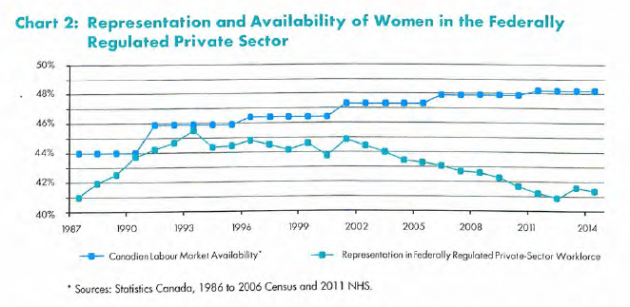
Women in federally regulated workforce declining: study – iPolitics

While the focus of the article is with respect to women, the other results are just as interesting (the largest federally regulated industries are telecoms, banking and transport, and the large retail presence in the first two – think of those cell phone pop-up stands or bank branches – mean strong representation of visible minorities):

The Employment Equity Act Annual Report tracks employment in federal federally regulated industries such as banking, communications and transportation.

The study found that transportation companies had the worst track record when it came to employment equity. Women made up only 27.2 per cent of the employees in private sector transportation sector companies, 14.2 per cent of the workforce were members of visible minorities and 2 per cent had a disability. The only area in which the transportation industry fared better than others was with aboriginal peoples who made up 2.8 per cent of the employees.

Screen Shot 2016-04-19 at 5.30.13 PM

The banking sector had the best track record with three of the four employment equity groups. Women made up 61.5 per cent of the workforce in banking, 30.2 per cent were members of visible minorities and 4 per cent had a disability. However, banking had the lowest proportion of aboriginal Canadians of any sector at 1.3 per cent.

Communications came up the middle with women at 37.4 per cent, visible minorities at 18.6 per cent, people with disabilities at 2.3 per cent and aboriginal peoples making up 1.8 per cent of the employees.

In a fourth category that mixed several different federally regulated industries from metal ore mining and wood to public administration or professional, scientific and technical services, 30.9 per cent of employees were women, 12.2 per cent came from visible minorities, 4.5 per cent were aboriginal and 2.6 per cent had disabilities.

…There was a gap between men and women who come from visible minorities. While 52.1 per cent of visible minority men working in federally regulated industries earned over $60,000, that dropped to 39.8 per cent of women.

Overall, employment equity in federally regulated sectors is improving, the study found.

“Employers are showing greater interest and awareness in employment equity through their commitment to implementing short-term and long-term measures in the workplace, including improvements to hiring and retention processes, accessible training and networking opportunities for advancement and overall evidence of employment equity integration into day-to-day activities.”

Source: Women in federally regulated workforce declining: study – iPolitics

A Close Look at Brussels Offers a More Nuanced View of Radicalization – The New York Times

Interesting contrast between Turk and Moroccan-origin communities, and the impact of failing to deliver on integration expectations:

At a Turkish mosque in Molenbeek run by Diyanet, Turkey’s state-controlled religious affairs agency, the imam, who speaks only Turkish, expressed revulsion at the March attacks in Brussels and said that he and his worshipers never tolerate extremist views. He stressed that his congregants respect and follow the law.

Worshipers at a nearby Moroccan mosque angrily shooed away reporters, accusing them of fanning “Islamophobia” and stigmatizing their neighborhood as a haven of jihadists.

In contrast to Belgium’s Turks, the Moroccan community is far more divided and resistant to authority, in part because many of the early immigrants came from the Rif, a rebellious Berber-speaking region often at odds with the ruling monarchy in Morocco. “When emigration to Europe started, the king was happy to get rid of these people,” said Bachir M’Rabet, a youth worker of Moroccan descent in Molenbeek.

Another source of anger in his community, he added, is that many Turks often speak poor French and no Dutch, Belgium’s two main languages, and cling to their Turkish identity, while most Moroccans speak fluent French and aspire to be accepted fully as Belgians. This, he said, means that many Moroccans feel discrimination more acutely and, at least in the case of young men on the margins, tend to view even minor slights as proof that the entire system is against them.

Philippe Moureaux, who served for two decades as Molenbeek’s mayor, described this as “the paradox of integration.” A less-integrated Turkish community has resisted the promise of redemption through jihad offered by radical zealots. Yet, a Moroccan community that is more at home in French-speaking Brussels has seen some of its young fall prey to recruiters like Khalid Zerkani, a Moroccan-born petty criminal who became the Islamic State’s point man in Molenbeek.

“The Turks suffer much less from an identity crisis,” Mr. Moureaux said. “They are proud to be Turks and are much less tempted by extremism.”

Suspicion of and hostility toward authority, particularly the police force, run so deep among some North African immigrants in Molenbeek that when the police mobilized in the area this month to prevent a group of anti-immigrant right-wing hooligans from staging a rally, local youths, mostly young men of Moroccan descent, began hurling abuse and objects at the police.

Molenbeek immigrants of Turkish or other backgrounds generally have a less hostile view of the police. A Turkish shopkeeper who runs a general store near the police station said he feared not the police but aggressive North African youths who accuse him of being a bad Muslim because he sells alcohol. He noted that the youths steal, which is also forbidden.

Emir Kir, the Belgian-Turkish mayor of Saint-Josse-ten-Noode, a heavily immigrant Brussels borough that is worse off economically than Molenbeek, said the only Turk he knew about who had tried to go to Syria was a young man who had fallen in love with a girl of Moroccan descent. He got as far as Istanbul before being sent back. “This was a love affair, not an act of extremism,” he said.

Source: A Close Look at Brussels Offers a More Nuanced View of Radicalization – The New York Times

Why the anti-abortion movement is embracing gender equality

Martin Patriquin nails it:

No pro-choice type himself, former Prime Minister Stephen Harper was at least pragmatic enough to stamp out any anti-abortion rumblings emanating from the socially conservative recesses of his party.

But gender equality is another story entirely. While we may be a cautious bunch on the issue of abortion, we Canadians are wildly, flamingly liberal on equality of sexes—94 per cent in favour of it, according to but one recent poll.

Pro-life types have cannily glommed onto sex-selective abortion as a means to demonstrate the evils of the pro-choice narrative run amok. They’ve rebranded the practice “gendercide,” and one politician amongst the ranks has attempted (unsuccessfully) to introduce a motion condemning it. They’ve appointed more female spokespeople. Twenty years ago, women who received abortions were murderers. Today, they are more likely to be victims.

It’s part of what University of Ottawa researchers Kelly Gordon and James Saurette call the “pro-woman” rhetoric of the anti-abortion movement. “Anti-abortionists have been losing since 1969 [when the Canadian government liberalized abortion laws],” Gordon told me recently. “They’ve been viewed as being very anti-woman. This is a strategic shift. Concentrating on sex-selective abortions is a far more sympathetic discourse.”

Enacting a law against sex-selective abortion would be folly. In India, a country of 1.2 billion, there were all of 20 convictions between 1994 and 2010, according to the government report. But then, preventing sex-selective abortions isn’t the goal of pro-lifers in this country; prohibiting abortion outright is. Gender equality is just a useful vehicle to this end.

A useful vehicle, and a Trojan horse. Restricting reproductive rights would be far easier with an existing law banning what amounts to an aberration of the practice. By draping itself in the flag of gender equality, the anti-abortion movement is rehashing a debate it lost long ago. It’s a savvy and cynical move, and should be recognized as such.

Ultimately, of course, the way to curb sex-selective abortions is roughly the same as curbing the frequency of abortions in general—not through legislation, but education. This country’s long-diminishing abortion rate is the best testament to this fact.

Source: Why the anti-abortion movement is embracing gender equality

Survivors project to save Holocaust stories

Worthy initiative:

But what happens when they’re no longer able to tell their stories?

That was a question asked by Mina Cohn, director of the Centre for Holocaust Education and Scholarship, within Carleton University’s Centre for Jewish Studies. Five or six years ago, she considered the possibility that “second-generation” survivors — the children of survivors — could share their parents’ experiences.

“These experiences are an integral part to teaching the Holocaust,” she says. “They bring details that you can never read in a history book. But so often the details and immediate emotion are absent when a second-generation survivor tells them. So we decided to record the survivors, so students and scholars could hear their voices and see their faces.”

So was born the Ottawa Holocaust Survivors Testimony Project, which aims to record and preserve these stories on video, and make them accessible to teachers, students and researchers.

They’ve so far identified about 30 living survivors in the Ottawa area, and plan on recording 10 of them in their first round. They figure they need about $7,500 to cover the production and editing costs, as well as a public launch. The university has agreed to let them pitch for funds through its Future Funder crowd-sourcing website (futurefunder.carleton.ca/project/ottawa-holocaust-survivors-testimony/). If they raise sufficient funds, they also plan on editing the 30-minute interviews into thematic groups — camp survivors, for example, or child survivors.

“These oral history testimonies fill in the gaps of the traditional historical narrative,” says Carleton masters student and project organizer Elise Bigley. “They give that feeling and emotion that will be lost when survivors stop going to schools. These testimonials are vital for that.”

Each testimonial is also unique, she adds, making it imperative to gather as many as possible. “It challenges this grand historical narrative of just one story. Tova’s story, for example, will challenge the idea that Japan was this Axis power that could have never helped the Jewish people. So it’s so important that each testimony gets documented.”

“It’s of personal importance to me,” adds Young-Drache, “because it forces you to examine your life, and what happened and why. It’s so important for my children and grandchildren, for everybody, to know what happened.

“Many people say you can’t learn from such terrible things as the Holocaust, but on the other hand, it’s obvious that a lot of things happened not just because there were mad men and others who hated a certain group of people just because of who they were, but also because there were lots of people — and there still are in many parts of the world — where ordinary people accept what is going on without questioning and don’t like to intervene or get involved.

“It’s important to know with accuracy the truth, to know what actually happened.”

Source: Survivors project to save Holocaust stories | Ottawa Citizen

This [US EB-5] visa program is a path to citizenship for the rich

The US equivalent to the debate in Canada over investor immigration, essentially bad programs that distort local economies with little long-term benefit to the economy:

Big, high-profile real estate developments in America are scooping up funding from an unusual and controversial source: foreign investors angling to become Americans. The EB-5 visa program offers a path to citizenship to those rich enough to invest at least half a million dollars here. But there’s a growing debate about the program, with fierce defenders and critics who cut across traditional partisan lines.

Hudson Yards, a massive complex of office, retail, residential and park space coming together on Manhattan’s far west side, is one current project that benefits from these investments. The $25 billion project—the largest private development in American history—has brought in $600 million from EB-5 visa investors. That number could double by the time the whole project finishes in the middle of the next decade. Related Companies, which is developing Hudson Yards, said the EB-5 money was a “critical component.”

“Think back to when we started this,” said Jeff Blau, Related’s CEO. “In 2009-2010 the economy wasn’t so strong and so that EB-5 capital filled that gap for us.”

Supporters of the program, like Blau, point to the jobs and economic impact their developments create. The buildings at Hudson Yards will house private equity firms and luxury shops, but their bones are steel, manufactured in Virginia and welded into place by workers earning middle-class pay.

The program began in the early 1990s with the goal of bringing in job-creating investments from abroad. For many years it was tiny, well below its annual cap of 10,000 visas. But after the financial collapse, the program exploded, with a wave of Chinese applications.

As the program has grown, critics say too much money is going to real estate projects that benefit the wealthy, such as Manhattan skyscrapers and Vegas hotels.

“It is a program with a lot of flaws,” said Audrey Singer, a senior fellow at the Brookings Institution who has studied EB-5 financing. “It is easy to exploit.”

Foreigners who invest in high-unemployment areas get a break on how much money they have to put in: $500,000 versus $1 million. But developers have found ways to use that money for projects in wealthy areas, through creative drawing of districts called targeted employment areas (TEAs). By creating TEAs that include ritzy neighborhoods along with struggling ones, developers make it easier for foreign investors, but can still build in rich areas. Though legal, critics see this kind of gerrymandering as against the spirit of the law.

Singer says the EB-5 program can be a positive force, but it needs to tighten rules so more benefits go to neighborhoods that need them most. A bipartisan attempt to make changes recently failed, beaten down by the real estate lobby and Congressional supporters in both parties.

So for now, a pricey express lane to American citizenship remains open and the argument will rage on over whether it’s the right way to go.

Source: This visa program is a path to citizenship for the rich

Canada’s news media are contributing to mistrust of Muslims: Siddiqui

Haroon Siddiqui’s guide for the media (I would add test these by substituting ‘Christian,’ ‘Sikh,’ ‘Jewish’ or other religions to check for consistency) :

The credibility of media with Muslims is very low. Muslims generally don’t trust us. In fact, they’re outright afraid of us. They don’t think they would get a fair shake from us. They are petrified that their words would be twisted and distorted.

Let me offer some suggestions.

  • It would be helpful for newsrooms, or the media industry as a whole, to articulate some ethical guidelines on coverage of and commentary on Muslims.
  • Develop a manual to clarify what do the following words mean and whom do they apply to – “moderate Muslims,” ‘anti-modern Muslims,” “fundamentalist Muslims,” “militant Muslims,” and “Islamist Muslims.” Who, exactly, are “radical Muslims” – those who believe in violence, or something else? Who are anti-modern Muslims – the Muslims who don’t drive cars, don’t use iPhones, don’t Tweet, don’t build or visit museums, or refuse blood transfusions?
  • Subject opinion pieces and commentaries to the simple test of truth. Give us a range of views, not just those that might just confirm your own prejudices. The CBC commentator Rex Murphy has advanced questionable propositions about Muslims. He is free to express his views, of course. But where’s the counter-opinion on the taxpayer-supported CBC?
  • Don’t find excuses to attribute crimes by Muslims to their religion. Use the same standard for them as for other people.
  • Avoid double standards on free speech. It seems that we must have free speech to malign Muslims but Muslims must not claim the right to be free from hate speech, which is also a very Canadian value.
  • Resist generic photos of niqab-wearing women when the story has little or nothing to do with niqab. You create the impression that most Muslim women wear it, whereas the number who do is a tiny, tiny minority – in Canada, no more than a few dozen. Don’t distort that reality.

I describe myself as an “incurably optimistic Canadian.” So I think if any nation can debate this issue, within the framework of free speech and fair play, it is Canada. If we get this right, we might even export it to the United States and Europe.

We owe it to Canada to at least try.

Source: Canada’s news media are contributing to mistrust of Muslims | Toronto Star

Citizenship put on hold for ‘no-handshake’ Muslim boys – SWI swissinfo.ch

Another example of an accommodation issue (in this case, I would side with the authorities):

The family of the two teenagers, who refused to shake their female teachers’ hands for religious reasons, have had their application for citizenship suspended. Shaking hands with the teacher before and after class is often standard practice in Switzerland.

A spokesperson for the local security authorities said that the office for migration in canton Basel Country would be speaking to family members individually, and that it was not unusual for an application to be suspended while additional information was gathered.

The spokesperson said that the interview would be open-ended, and that the family’s immigration status would only be decided based upon their answers to the questions posed during the interview process. After this it would be decided how the application process should proceed. Precise appointment dates are not known.

The 14- and 16-year old brothers are Muslim, and do not want to touch women in general, for religious reasons. The younger of the two said in a newspaper interview that he had discovered this rule in an internet sermon.

The head teacher of the school attended by the two boys arranged that they would not shake hands with any of the teachers. However, this led to a public outcry as news spread in the Swiss press, and justice minister Simonetta Sommaruga publicly criticised the decision, arguing that the handshakes are part of Swiss culture.

Clarification

The decision to suspend the application process for citizenship and summon all family members for individual interviews was said to have been taken last week. It is not known how many of the children are applying to become Swiss, along with their parents.

The cantonal education authorities have meanwhile ordered a legal opinion on how and if etiquette can be enforced. Several motions have been filed in the local parliament that focus on banning special arrangements made for religious reasons.

Source: Citizenship put on hold for ‘no-handshake’ Muslim boys – SWI swissinfo.ch

The changing face of multiculturalism in Europe: David Miller

David Miller of Oxford University on multiculturalism:

The death of multiculturalism [in Europe] might then seem to resemble Murder on the Orient Express, in which the victim was stabbed by 12 assailants. But in European societies there is an additional factor that distinguishes our situation from the Canadian one. These are societies with national identities that stretch back for hundreds, if not for thousands, of years, in the course of which they have needed to be defended by armed struggle against rivals and neighbours. That some of these identities include a generous dollop of historical myth does nothing to reduce their emotive force. And now these identities face new threats: global culture, the spread of English as a lingua franca, the flattening effect of the European Union. Under these circumstances Europeans are not likely to be found echoing the Canadian claim that cultural pluralism is the essence of their national identity. Instead, they see it as part of the state’s job to protect the national culture; this means giving it some precedence, and encouraging immigrants to adopt it, even they have to jettison parts of the culture they bring with them. In this respect, Europe looks much more like Quebec than it does the rest of Canada.

European leaders, then, think in terms of citizenship and integration rather than of multiculturalism. More commonly now, access to citizenship depends upon passing a test that requires knowledge of the history and political culture of the country, for example. The effect of recent mass immigration to countries such as Germany and Sweden can only be to reinforce this trend. But does this really mean that multiculturalism has disappeared altogether? Many policies associated with that word are still in place, such as affirmative employment policies for ethnic minorities, or accommodations for religiously mandated dress, and these are not going to change. What has gone is a certain idea of how a modern liberal society should look: a variegated landscape in which many cultures live happily alongside each other, with a neutral state presiding benignly over them all.

Valid points regarding the very different European experience and history, but fails to acknowledge the differences in immigration policies (‘guest’ or temporary workers versus immigrants as future citizens) that also made a difference.

Moreover, multiculturalism in Canada was always based on easing the integration and citizenship pathway, rather than encouraging or facilitating separate identities and institutions as happened in many countries in Europe.

Source: The changing face of multiculturalism in Europe – The Globe and Mail

High-school students need to learn more about Holocaust to dissuade teens from joining ISIL, group says

One effort to improve awareness:

“It’s very topical: we’re talking about 17-year-olds and 16-year-olds being lured into ISIS,” said Berger. “The question is, if these students were educated about genocide, that would certainly help to a large degree.”

Kyle Matthews of the Montreal Institute for Genocide and Human Rights Studies is supporting Berger’s initiative.

“It struck me that we’re not teaching our youth enough about genocide when we have Canadian and Quebec youth leaving to commit genocide overseas,” said Matthews.

“Something is missing in our core education when not just a couple of a bad apples but a significant number are embracing an ideology that encourages slaughter (and) extinction.”

Matthews says it is important to preserve the memory of such massacres: there are no survivors left of the Armenian genocide and Holocaust survivors are elderly and dying.

Genocide education is sporadically available around the country. The Toronto District School Board has offered a course since 2007 that investigates examples of genocide in the 20th and 21st centuries, including Armenia, the Holocaust and Rwanda.

Berger, a filmmaker and university lecturer, carries on her mother’s message in her own school presentations on the Holocaust — one in which Kazimirski still figures prominently through a posthumous video testimonial about the harrowing experiences she endured.

In her school visits, Berger learned that teachers are afraid to teach it and don’t have the tools.

“An ethics teacher came up and told me that kids are graduating from Grade 11 without knowing what the word genocide means,” Berger recounted.

About 18 months ago, she founded The Foundation for the Compulsory Study of Genocide in Schools. In Quebec, Berger is lobbying for changes to a textbook for a course called “Contemporary World” to include a full chapter on genocide instead of the current few paragraphs. She also wants help for teachers.

Berger says a meeting with Education Minister Sebastien Proulx is scheduled for early May and that a previous petition as well as meetings with provincial legislators and teachers’ unions have been positive.

David Birnbaum, the legislative assistant to Proulx, has helped Berger navigate Quebec bureaucracy and bring the matter to the attention of the national assembly.

Birnbaum said academic studies suggest a relatively high level of ignorance about the Holocaust and genocide in general, but adds the matter is tackled in the current Quebec curriculum.

“There are a range of places … where the Holocaust and the concept of genocide are mentioned and it’s always a challenge to make changes to the program,” Birnbaum said.

“But my own priority is to make sure that Heidi Berger gets to make her case as clearly and directly as she can.”

Quebec title: Une Québécoise réclame une formation sur le génocide dans les écoles

Source: High-school students need to learn more about Holocaust to dissuade teens from joining ISIL, group says | National Post