Shakespeare and religion: Shakespeare’s complex views of the Islamic world | The Economist

Another part of the richness and insight of Shakespeare:

Shakespeare, as proven time and again in other fields, was ahead of his time in his sensitivity to the Islamic world and its inhabitants. Of course, his plays reveal his own set of prejudices, fascinations and contradictions, but over the course of his career the myth of the bloodthirsty Muslim is eclipsed by a more sensitive depiction in Othello—a change possibly influenced by the visit of Morocco’s ambassador to London in 1600. In our present day, where skewed misconceptions about Islam in Europe is the norm, there is much Shakespeare can teach us about who and what we identify with.

Source: Shakespeare and religion: Shakespeare’s complex views of the Islamic world | The Economist

The Cost of Multiculturalism: Canadians Turn Blind Eye to Race Despite a Staggering Black Incarceration Rate – Atlanta Black Star

A reminder:

Black Canadians are jailed more than their white counterparts and part of the issue is that Canadians don’t believe they have a race problem. They stay silent on the issue.

Howard Sapers, a Canadian correctional investigator, presented an annual report to the parliament that showed Blacks in the country continue to be disproportionately imprisoned. Since Sapers started his position in 2005, he said has seen the Black prison population increase steadily. In total, the number of Black inmates has grown 69 percent.

Torontoist reports African-Canadians account for 10 percent of the federal prison population even though they only make up 3 percent of the general population. A similar statistic rings true for American prisons. Blacks make up 37 percent of the prison population and 13 percent of the general U.S. population.

Despite Canada’s Black imprisonment rates not being that far off from American rates, African-Canadian rights advocate Anthony Morgan says Canadians don’t think they face racial issues. Instead, the silence about the alarming rates of Black incarceration stems from the idea that it only affects Americans.

“It has a lot to do with what I’ve called Canadian racial exceptionalism,” he tells Torontoist. “If America is having a conversation about the hyper-incarceration of Black males, in order to maintain our sense of moral superiority, we can’t look into those issues as we experience them here in Canada.”

Though Morgan admits that rates of Black imprisonment are a little higher in America than in Canada, he says myths about Canada’s embrace of multiculturalism also plays a part.

“The truth of the matter is,” Morgan tells the publication, “when you look in our prison systems, if you go to our courthouses, if you go at children’s aid offices, to school detention halls, it is overwhelmingly Black kids who are being criminalized and punished. I think the generalized silence has to do with what we want to believe about ourselves as Canadians.”

Source: The Cost of Multiculturalism: Canadians Turn Blind Eye to Race Despite a Staggering Black Incarceration Rate – Atlanta Black Star

Jonathan Kay: Don’t blame the media for Islamophobia | National Post

Jon Kay’s balanced assessment in response to Haroon Siddiqui’s column (Canada’s news media are contributing to mistrust of Muslims | Toronto Star), including his dismissal of B’nai Brith’s annual antisemitism report (I always find the police reported hate crimes to be more objective, although imperfect and likely understated).

However, Elke Winter has done some interesting parliamentary and media analysis related to citizenship revocation in cases of terror or treason, presented at Metropolis 2016, that showed that despite balanced coverage, the net effect of the examples used, understandably largely Muslim, did contribute to distrust of Canadian Muslims:

Jews and Muslims have more in common than most people think. And not just on the superficial level of pork avoidance, a love of shawarma and (male) circumcision. In Canada, both the Jewish and Muslim communities are periodically riled up with claims that they are being victimized by epidemics of acute anti-Semitism and Islamophobia. These claims are baseless in both cases.

I flipped a coin. Let’s start with the Jews.

Every year, B’nai Brith Canada releases its Audit of Anti-Semitic Incidents. And every year, B’nai Brith assures us that its numbers prove that Jews are besieged by a “rising tide of anti-Semitism.”

“All one needs to do is look to the comment section of any major news site on a story examining the Israel-Hamas conflict,” declared B’Nai Brith CEO Michael Mostyn when the most recent report was published. “Almost without exception, legitimate debate and dialogue devolves to accusations of the murder of children, Zionist plots and the use of anti-Semitic language blaming the ‘Jews.’ ”

But when you examine B’nai Brith’s catalogue of supposedly horrifying anti-Semitic episodes, what you find is a menagerie of demented Internet crackpots and teenage graffiti artists spray-painting backward swastikas on fences. There is no “rising tide of anti-Semitism” in Canada. It only feels that way because whenever some loon in a strip-mall mosque does express a hate-on for Jews, the incident becomes a sensation on social media.

In other cases, the examples of anti-Semitism are padded out with hateful statements that aren’t really about Jews at all — but quite specifically about the Israeli government. The idea that criticizing Israel automatically qualifies as a form of disguised anti-Semitism has become a lazy debating trick.

Based on the scattered anecdotal reports I hear, I’d say that Islamophobia is somewhat more common in Canadian society than anti-Semitism. You rarely hear of some kid named Avi or Mordechai getting mistakenly put on a no-fly list, for instance. And this month, well-heeled spectators came out to a debate in downtown Toronto where the star performer promoted the thesis that Muslim refugees just can’t be trusted not to rape our Judeo-Christian babies. That’s bad. As was last week’s debunked and retracted Halifax newspaper story about little Muslim children plotting global Islamic conquest from the merry-go-round.

Nevertheless, hate-speech watchdogs take things too far when they suggest that the mainstream media are somehow cheerleading Canada’s fringe Muslim-haters.

This month, former Toronto Star columnist and editorial-page editor Haroon Siddiqui told an audience at the city’s Aga Khan Museum that — according to the Star’s summary — “the media have contributed to widespread Islamophobia by conflating Muslim terrorists with all Muslims.”

In his speech, excerpted in the Star, Siddiqui declared: “The biggest culprits have been the National Post and the Postmedia group of newspapers across the country, which now include the Sun chain. Hardly a week goes by without these publications finding something or other wrong with Muslims and Islam. These publications are forever looking for terrorists under every Canadian minaret. They are hunting for any imam or any Muslim who might make some outrageous statement that can be splashed as proof of rampant Muslim militancy or malevolence.”

Siddiqui and I have appeared on media panels together. I like the guy, and have found him to be quite moderate on most issues. But what he’s written here is unfair.

Yes, the media are fascinated with terrorism — because our readers are fascinated by terrorism. Just as they are fascinated with all forms of horrifying violence — including the kind caused by street gangs, natural disasters and Karla Homolka. It’s human nature. We pay attention when things go bang and boom and all bloody-like.

We also pay attention to questions of motive. And since Islamist terrorists from Islamic state of Iraq and the Levant, Boko Haram, al-Shabab and al-Qaida insistently, repeatedly and explicitly tell us that they are committing their slaughter in the name of Islam, we report that, too. When terrorists in the Middle East, Africa and South Asia stop praising Allah as they self-detonate — or, better yet, stop self-detonating altogether — we media types will be the first to report on that phenomenon, as well.

Moreover, it would be nice if Siddiqui might acknowledge that in the last two years, not one but two Canadian governments — Stephen Harper’s Tories and Pauline Marois’ Parti Québécois — have been booted out of office in large part because media commentators were disgusted by their Islamophobic fearmongering on the niqab issue. I myself was working at the National Post during the 2014 Quebec election campaign, and personally authored several articles denouncing the xenophobic messaging from PQ hardliners. In both cases, it wasn’t media Islamophobia that held sway at the polls, it was media anti-Islamophobia.

Canadians should be proud that they live in a tolerant country where both anti-Semitism and Islamophobia are marginalized and discredited sentiments. Haroon Siddiqui is correct to advocate vigilance against these forms of hatred, but he greatly exaggerates the scope of the problem.
Source: Jonathan Kay: Don’t blame the media for Islamophobia | National Post

Kellie Leitch tears up over role in barbaric cultural practices tip line – Politics – CBC News

Clear reflection and acknowledgement of a major mistake. Waiting to hear from former CIC Minister Chris Alexander whether he also has regrets:

Tory leadership candidate Kellie Leitch became visibly emotional while trying to explain her decision to front the launch of the Conservatives tip line for reporting barbaric cultural practices during the recent federal election.

The former minister in Stephen Harper’s government told CBC News Network’s Power & Politics host Rosemary Barton that she wishes she never took part in the election announcement.

“I’ve had a lot of time to think about this since the campaign took place and if could go back in time, which I can’t, I would change things,” Leitch said. “I would not have made that announcement that day.

“As minister of status of women I was focused on making sure that we eliminated violence against women and girls especially making sure we advocated for women’s rights,” she explained.

Leitch, who is also a pediatric orthopedic surgeon, said her intention was to ensure that if women and children needed to “pick up the phone” to call for help that someone would answer, but admits that “the message was lost.”

“We weren’t talking about race, we were talking about kids … but that message was completely overtaken and I regret that, and I regret that it occurred, and it shouldn’t have been done,” she said.

The Simcoe-Grey MP refused to reveal who in the Conservative Party came up with the idea for the tip line saying “this is not a time for pointing fingers at people or looking at what happened.”

When the Tories lost the election they also lost the chance to implement the promised tip line.

Source: Kellie Leitch tears up over role in barbaric cultural practices tip line – Politics – CBC News

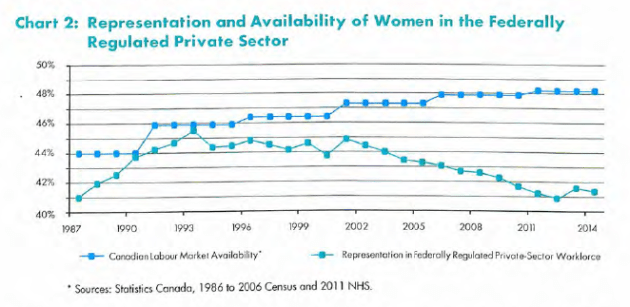
Women in federally regulated workforce declining: study – iPolitics

While the focus of the article is with respect to women, the other results are just as interesting (the largest federally regulated industries are telecoms, banking and transport, and the large retail presence in the first two – think of those cell phone pop-up stands or bank branches – mean strong representation of visible minorities):

The Employment Equity Act Annual Report tracks employment in federal federally regulated industries such as banking, communications and transportation.

The study found that transportation companies had the worst track record when it came to employment equity. Women made up only 27.2 per cent of the employees in private sector transportation sector companies, 14.2 per cent of the workforce were members of visible minorities and 2 per cent had a disability. The only area in which the transportation industry fared better than others was with aboriginal peoples who made up 2.8 per cent of the employees.

Screen Shot 2016-04-19 at 5.30.13 PM

The banking sector had the best track record with three of the four employment equity groups. Women made up 61.5 per cent of the workforce in banking, 30.2 per cent were members of visible minorities and 4 per cent had a disability. However, banking had the lowest proportion of aboriginal Canadians of any sector at 1.3 per cent.

Communications came up the middle with women at 37.4 per cent, visible minorities at 18.6 per cent, people with disabilities at 2.3 per cent and aboriginal peoples making up 1.8 per cent of the employees.

In a fourth category that mixed several different federally regulated industries from metal ore mining and wood to public administration or professional, scientific and technical services, 30.9 per cent of employees were women, 12.2 per cent came from visible minorities, 4.5 per cent were aboriginal and 2.6 per cent had disabilities.

…There was a gap between men and women who come from visible minorities. While 52.1 per cent of visible minority men working in federally regulated industries earned over $60,000, that dropped to 39.8 per cent of women.

Overall, employment equity in federally regulated sectors is improving, the study found.

“Employers are showing greater interest and awareness in employment equity through their commitment to implementing short-term and long-term measures in the workplace, including improvements to hiring and retention processes, accessible training and networking opportunities for advancement and overall evidence of employment equity integration into day-to-day activities.”

Source: Women in federally regulated workforce declining: study – iPolitics

A Close Look at Brussels Offers a More Nuanced View of Radicalization – The New York Times

Interesting contrast between Turk and Moroccan-origin communities, and the impact of failing to deliver on integration expectations:

At a Turkish mosque in Molenbeek run by Diyanet, Turkey’s state-controlled religious affairs agency, the imam, who speaks only Turkish, expressed revulsion at the March attacks in Brussels and said that he and his worshipers never tolerate extremist views. He stressed that his congregants respect and follow the law.

Worshipers at a nearby Moroccan mosque angrily shooed away reporters, accusing them of fanning “Islamophobia” and stigmatizing their neighborhood as a haven of jihadists.

In contrast to Belgium’s Turks, the Moroccan community is far more divided and resistant to authority, in part because many of the early immigrants came from the Rif, a rebellious Berber-speaking region often at odds with the ruling monarchy in Morocco. “When emigration to Europe started, the king was happy to get rid of these people,” said Bachir M’Rabet, a youth worker of Moroccan descent in Molenbeek.

Another source of anger in his community, he added, is that many Turks often speak poor French and no Dutch, Belgium’s two main languages, and cling to their Turkish identity, while most Moroccans speak fluent French and aspire to be accepted fully as Belgians. This, he said, means that many Moroccans feel discrimination more acutely and, at least in the case of young men on the margins, tend to view even minor slights as proof that the entire system is against them.

Philippe Moureaux, who served for two decades as Molenbeek’s mayor, described this as “the paradox of integration.” A less-integrated Turkish community has resisted the promise of redemption through jihad offered by radical zealots. Yet, a Moroccan community that is more at home in French-speaking Brussels has seen some of its young fall prey to recruiters like Khalid Zerkani, a Moroccan-born petty criminal who became the Islamic State’s point man in Molenbeek.

“The Turks suffer much less from an identity crisis,” Mr. Moureaux said. “They are proud to be Turks and are much less tempted by extremism.”

Suspicion of and hostility toward authority, particularly the police force, run so deep among some North African immigrants in Molenbeek that when the police mobilized in the area this month to prevent a group of anti-immigrant right-wing hooligans from staging a rally, local youths, mostly young men of Moroccan descent, began hurling abuse and objects at the police.

Molenbeek immigrants of Turkish or other backgrounds generally have a less hostile view of the police. A Turkish shopkeeper who runs a general store near the police station said he feared not the police but aggressive North African youths who accuse him of being a bad Muslim because he sells alcohol. He noted that the youths steal, which is also forbidden.

Emir Kir, the Belgian-Turkish mayor of Saint-Josse-ten-Noode, a heavily immigrant Brussels borough that is worse off economically than Molenbeek, said the only Turk he knew about who had tried to go to Syria was a young man who had fallen in love with a girl of Moroccan descent. He got as far as Istanbul before being sent back. “This was a love affair, not an act of extremism,” he said.

Source: A Close Look at Brussels Offers a More Nuanced View of Radicalization – The New York Times

Why the anti-abortion movement is embracing gender equality

Martin Patriquin nails it:

No pro-choice type himself, former Prime Minister Stephen Harper was at least pragmatic enough to stamp out any anti-abortion rumblings emanating from the socially conservative recesses of his party.

But gender equality is another story entirely. While we may be a cautious bunch on the issue of abortion, we Canadians are wildly, flamingly liberal on equality of sexes—94 per cent in favour of it, according to but one recent poll.

Pro-life types have cannily glommed onto sex-selective abortion as a means to demonstrate the evils of the pro-choice narrative run amok. They’ve rebranded the practice “gendercide,” and one politician amongst the ranks has attempted (unsuccessfully) to introduce a motion condemning it. They’ve appointed more female spokespeople. Twenty years ago, women who received abortions were murderers. Today, they are more likely to be victims.

It’s part of what University of Ottawa researchers Kelly Gordon and James Saurette call the “pro-woman” rhetoric of the anti-abortion movement. “Anti-abortionists have been losing since 1969 [when the Canadian government liberalized abortion laws],” Gordon told me recently. “They’ve been viewed as being very anti-woman. This is a strategic shift. Concentrating on sex-selective abortions is a far more sympathetic discourse.”

Enacting a law against sex-selective abortion would be folly. In India, a country of 1.2 billion, there were all of 20 convictions between 1994 and 2010, according to the government report. But then, preventing sex-selective abortions isn’t the goal of pro-lifers in this country; prohibiting abortion outright is. Gender equality is just a useful vehicle to this end.

A useful vehicle, and a Trojan horse. Restricting reproductive rights would be far easier with an existing law banning what amounts to an aberration of the practice. By draping itself in the flag of gender equality, the anti-abortion movement is rehashing a debate it lost long ago. It’s a savvy and cynical move, and should be recognized as such.

Ultimately, of course, the way to curb sex-selective abortions is roughly the same as curbing the frequency of abortions in general—not through legislation, but education. This country’s long-diminishing abortion rate is the best testament to this fact.

Source: Why the anti-abortion movement is embracing gender equality

Survivors project to save Holocaust stories

Worthy initiative:

But what happens when they’re no longer able to tell their stories?

That was a question asked by Mina Cohn, director of the Centre for Holocaust Education and Scholarship, within Carleton University’s Centre for Jewish Studies. Five or six years ago, she considered the possibility that “second-generation” survivors — the children of survivors — could share their parents’ experiences.

“These experiences are an integral part to teaching the Holocaust,” she says. “They bring details that you can never read in a history book. But so often the details and immediate emotion are absent when a second-generation survivor tells them. So we decided to record the survivors, so students and scholars could hear their voices and see their faces.”

So was born the Ottawa Holocaust Survivors Testimony Project, which aims to record and preserve these stories on video, and make them accessible to teachers, students and researchers.

They’ve so far identified about 30 living survivors in the Ottawa area, and plan on recording 10 of them in their first round. They figure they need about $7,500 to cover the production and editing costs, as well as a public launch. The university has agreed to let them pitch for funds through its Future Funder crowd-sourcing website (futurefunder.carleton.ca/project/ottawa-holocaust-survivors-testimony/). If they raise sufficient funds, they also plan on editing the 30-minute interviews into thematic groups — camp survivors, for example, or child survivors.

“These oral history testimonies fill in the gaps of the traditional historical narrative,” says Carleton masters student and project organizer Elise Bigley. “They give that feeling and emotion that will be lost when survivors stop going to schools. These testimonials are vital for that.”

Each testimonial is also unique, she adds, making it imperative to gather as many as possible. “It challenges this grand historical narrative of just one story. Tova’s story, for example, will challenge the idea that Japan was this Axis power that could have never helped the Jewish people. So it’s so important that each testimony gets documented.”

“It’s of personal importance to me,” adds Young-Drache, “because it forces you to examine your life, and what happened and why. It’s so important for my children and grandchildren, for everybody, to know what happened.

“Many people say you can’t learn from such terrible things as the Holocaust, but on the other hand, it’s obvious that a lot of things happened not just because there were mad men and others who hated a certain group of people just because of who they were, but also because there were lots of people — and there still are in many parts of the world — where ordinary people accept what is going on without questioning and don’t like to intervene or get involved.

“It’s important to know with accuracy the truth, to know what actually happened.”

Source: Survivors project to save Holocaust stories | Ottawa Citizen

This [US EB-5] visa program is a path to citizenship for the rich

The US equivalent to the debate in Canada over investor immigration, essentially bad programs that distort local economies with little long-term benefit to the economy:

Big, high-profile real estate developments in America are scooping up funding from an unusual and controversial source: foreign investors angling to become Americans. The EB-5 visa program offers a path to citizenship to those rich enough to invest at least half a million dollars here. But there’s a growing debate about the program, with fierce defenders and critics who cut across traditional partisan lines.

Hudson Yards, a massive complex of office, retail, residential and park space coming together on Manhattan’s far west side, is one current project that benefits from these investments. The $25 billion project—the largest private development in American history—has brought in $600 million from EB-5 visa investors. That number could double by the time the whole project finishes in the middle of the next decade. Related Companies, which is developing Hudson Yards, said the EB-5 money was a “critical component.”

“Think back to when we started this,” said Jeff Blau, Related’s CEO. “In 2009-2010 the economy wasn’t so strong and so that EB-5 capital filled that gap for us.”

Supporters of the program, like Blau, point to the jobs and economic impact their developments create. The buildings at Hudson Yards will house private equity firms and luxury shops, but their bones are steel, manufactured in Virginia and welded into place by workers earning middle-class pay.

The program began in the early 1990s with the goal of bringing in job-creating investments from abroad. For many years it was tiny, well below its annual cap of 10,000 visas. But after the financial collapse, the program exploded, with a wave of Chinese applications.

As the program has grown, critics say too much money is going to real estate projects that benefit the wealthy, such as Manhattan skyscrapers and Vegas hotels.

“It is a program with a lot of flaws,” said Audrey Singer, a senior fellow at the Brookings Institution who has studied EB-5 financing. “It is easy to exploit.”

Foreigners who invest in high-unemployment areas get a break on how much money they have to put in: $500,000 versus $1 million. But developers have found ways to use that money for projects in wealthy areas, through creative drawing of districts called targeted employment areas (TEAs). By creating TEAs that include ritzy neighborhoods along with struggling ones, developers make it easier for foreign investors, but can still build in rich areas. Though legal, critics see this kind of gerrymandering as against the spirit of the law.

Singer says the EB-5 program can be a positive force, but it needs to tighten rules so more benefits go to neighborhoods that need them most. A bipartisan attempt to make changes recently failed, beaten down by the real estate lobby and Congressional supporters in both parties.

So for now, a pricey express lane to American citizenship remains open and the argument will rage on over whether it’s the right way to go.

Source: This visa program is a path to citizenship for the rich

Canada’s news media are contributing to mistrust of Muslims: Siddiqui

Haroon Siddiqui’s guide for the media (I would add test these by substituting ‘Christian,’ ‘Sikh,’ ‘Jewish’ or other religions to check for consistency) :

The credibility of media with Muslims is very low. Muslims generally don’t trust us. In fact, they’re outright afraid of us. They don’t think they would get a fair shake from us. They are petrified that their words would be twisted and distorted.

Let me offer some suggestions.

  • It would be helpful for newsrooms, or the media industry as a whole, to articulate some ethical guidelines on coverage of and commentary on Muslims.
  • Develop a manual to clarify what do the following words mean and whom do they apply to – “moderate Muslims,” ‘anti-modern Muslims,” “fundamentalist Muslims,” “militant Muslims,” and “Islamist Muslims.” Who, exactly, are “radical Muslims” – those who believe in violence, or something else? Who are anti-modern Muslims – the Muslims who don’t drive cars, don’t use iPhones, don’t Tweet, don’t build or visit museums, or refuse blood transfusions?
  • Subject opinion pieces and commentaries to the simple test of truth. Give us a range of views, not just those that might just confirm your own prejudices. The CBC commentator Rex Murphy has advanced questionable propositions about Muslims. He is free to express his views, of course. But where’s the counter-opinion on the taxpayer-supported CBC?
  • Don’t find excuses to attribute crimes by Muslims to their religion. Use the same standard for them as for other people.
  • Avoid double standards on free speech. It seems that we must have free speech to malign Muslims but Muslims must not claim the right to be free from hate speech, which is also a very Canadian value.
  • Resist generic photos of niqab-wearing women when the story has little or nothing to do with niqab. You create the impression that most Muslim women wear it, whereas the number who do is a tiny, tiny minority – in Canada, no more than a few dozen. Don’t distort that reality.

I describe myself as an “incurably optimistic Canadian.” So I think if any nation can debate this issue, within the framework of free speech and fair play, it is Canada. If we get this right, we might even export it to the United States and Europe.

We owe it to Canada to at least try.

Source: Canada’s news media are contributing to mistrust of Muslims | Toronto Star