Diversity lags in provincial and territorial legislatures but is improving

My latest analysis:

How does diversity in the provincial and territorial legislatures compare with diversity in the federal Parliament? Federal Parliament diversity has been tracked systematically since 1993 by Jerome Black, but little comparative analysis has taken place at the level of the legislatures. This analysis aims to fill that gap by contrasting the most recent elections with the previous ones for all provinces and territories, looking at the percentage of women, visible minorities and Indigenous Peoples elected among the total of 772 provincial and territorial legislature members.

Just as diversity in the federal Parliament has increased over time, the last two provincial/territorial election cycles have shown an increase in diversity in most legislatures.

For a benchmark, the percentage of visible-minority citizens from the 2021 census is used rather than the percentage of visible-minority residents. This narrow approach reflects the fact that only citizens can become members of legislatures, whereas the population approach recognizes that non-residents also participate in supporting candidates and political parties. For Canada, visible minority citizens make up 21.4 per cent of the total population, compared to 26.5 per cent for all visible minorities, but there is considerable variation among provinces.

Table 1 compares overall representation to citizens. Underrepresentation of women ranges from almost 30 per cent in Newfoundland and Labrador to only four per cent in Quebec. Underrepresentation of visible minorities ranges from nine per cent in British Columbia to around five per cent or less for other provinces. Nova Scotia is the only province with greater representation of visible minorities (seven per cent) than their share of the population, in part because of a significant African Nova Scotian population. Underrepresentation of Indigenous Peoples ranges from a high of 14 per cent in Saskatchewan to two per cent in Ontario, Quebec and Prince Edward Island, with only Nunavut, not surprisingly, having representation reflecting the population.

https://e.infogram.com/2023-01-griffith-figure-1-1hmr6g7r3vmpo6n?live?parent_url=https%3A%2F%2Fpolicyoptions.irpp.org%2Fmagazines%2Fjanuary-2023%2Fdiversity-lags-in-provincial-and-territorial-legislatures-but-is-improving%2F&src=embed#async_embed

Table 2 contrasts representation at both the member and cabinet levels, highlighting overall representation of women, visible minorities and Indigenous members. Given that governments often factor diversity into cabinet formation, the third set of columns assesses the degree that provincial and territorial governments have compensated for underrepresentation of their caucus. It is clearly the case with Alberta for both visible minorities and Indigenous members, and for Ontario in the case of visible minorities. It is striking that Saskatchewan and Manitoba cabinets have not done so for both visible minorities and Indigenous Peoples, whereas it is less surprising that Quebec has not done so for visible minorities.

https://e.infogram.com/2023-01-griffith-figure-2-1hnq410ejrv0k23?live?parent_url=https%3A%2F%2Fpolicyoptions.irpp.org%2Fmagazines%2Fjanuary-2023%2Fdiversity-lags-in-provincial-and-territorial-legislatures-but-is-improving%2F&src=embed#async_embed

Table 3 contrasts the most recent provincial and territorial elections with the previous election. Representation of women increased in all provinces save Alberta, Ontario, and Newfoundland and Labrador. Similarly, representation of visible minorities remained stable or increased in all provinces save Newfoundland and Labrador. However, Indigenous Peoples’ representation decreased or remained stable in all provinces save Manitoba, Newfoundland and Labrador, and The Northwest Territories.

https://e.infogram.com/2023-01-griffith-figure-3-1h984wor7jl9z6p?live?parent_url=https%3A%2F%2Fpolicyoptions.irpp.org%2Fmagazines%2Fjanuary-2023%2Fdiversity-lags-in-provincial-and-territorial-legislatures-but-is-improving%2F&src=embed#async_embed

Table 4 examines the intersectionality between gender and visible minorities. Visible minority women members made up a larger share of the total number of visible minority members than their respective non-visible minority counterparts, and by 9.5 per cent overall. Notable exceptions are Alberta, Saskatchewan and Yukon. (Provinces with no visible minority members are excluded.) In short, visible minority women were more likely to contribute to greater gender diversity in most provinces.

https://e.infogram.com/2023-01-griffith-figure-4-1h984wor7jeyd6p?live?parent_url=https%3A%2F%2Fpolicyoptions.irpp.org%2Fmagazines%2Fjanuary-2023%2Fdiversity-lags-in-provincial-and-territorial-legislatures-but-is-improving%2F&src=embed#async_embed

While there is no clear political alignment between parties at the provincial/territorial levels, table 5 attempts an approximate ideological lens between left-leaning, centrist and right-leaning parties. Left-leaning parties have the strongest representation of women, visible minorities and Indigenous Peoples followed by centrist parties for women and visible minorities. Right-leaning parties have lower representation for all groups save men.

https://e.infogram.com/2023-01-griffith-figure-5-1h9j6qgery0n54g?live?parent_url=https%3A%2F%2Fpolicyoptions.irpp.org%2Fmagazines%2Fjanuary-2023%2Fdiversity-lags-in-provincial-and-territorial-legislatures-but-is-improving%2F&src=embed#async_embed

Provincial and territorial legislatures, like the federal Parliament, have considerable underrepresentation of women, visible minorities and Indigenous Peoples with the exceptions noted above. In general, greater diversity can be found in parties leaning left compared to parties leaning right. However, compared with the previous election, representation is improving for women and visible minorities in most provinces and territories, with a more mixed record for Indigenous Peoples.

For the four largest provinces, Quebec has the least underrepresentation of visible minorities and Indigenous Peoples while British Columbia has greatest underrepresentation of visible minorities and Alberta has the greatest underrepresentation of Indigenous Peoples.

The 2021 census has highlighted an ongoing increase in immigrants and visible minorities. Parties at the provincial level, like their federal counterparts, are clearly taking this into account in their candidate selection and campaign strategies. The increase in representation, while uneven and partially dependent on which party wins an election, indicates the degree to which this is so.

Methodology

Women, visible minorities and Indigenous Peoples are identified through name, photo and biographical analysis. MLA lists come from provincial and territorial election organizations and legislatures. 

For the ideological lens, we classified parties as follows, recognizing that there is considerable variation among the provinces:

Left-leaning: NDP, Québec solidaire, Parti québécois, Green

Centrist: Liberal, Independent Liberal, Independent

Right-leaning: Conservative, CAQ, UCP, Saskatchewan Party, B.C. Liberal (now B.C. United), People’s Alliance

Source: Diversity lags in provincial and territorial legislatures but is improving
Singal: Diversity Trainings Try to Change Hearts and Minds. That’s a Mistake.

Yet another analysis questioning the value of some diversity training and a reminder to focus on actions and behaviours, not “hearts and minds”:

Diversity trainings have been around for decades, long before the country’s latest round of racial reckoning. But after George Floyd’s murder — as companies faced pressure to demonstrate a commitment to racial justice — interest in the diversity, equity and inclusion (D.E.I.) industry exploded. The American market reached an estimated $3.4 billion in 2020.

D.E.I. trainings are designed to help organizations become more welcoming to members of traditionally marginalized groups. Advocates make bold promises: Diversity workshops can foster better intergroup relations, improve the retention of minority employees, close recruitment gaps and so on. The only problem? There’s little evidence that many of these initiatives work. And the specific type of diversity training that is currently in vogue — mandatory trainings that blame dominant groups for D.E.I. problems — may well have a net-negative effect on the outcomes managers claim to care about.

Over the years, social scientists who have conducted careful reviews of the evidence base for diversity trainings have frequently come to discouraging conclusions. Though diversity trainings have been around in one form or another since at least the 1960s, few of them are ever subjected to rigorous evaluation, and those that are mostly appear to have little or no positive long-term effects. The lack of evidence is “disappointing,” wrote Elizabeth Levy Paluck of Princeton and her co-authors in a 2021 Annual Review of Psychology article, “considering the frequency with which calls for diversity training emerge in the wake of widely publicized instances of discriminatory conduct.”

Dr. Paluck’s team found just two large experimental studies in the previous decade that attempted to evaluate the effects of diversity trainings and met basic quality benchmarks. Other researchers have been similarly unimpressed. “We have been speaking to employers about this research for more than a decade,” wrote the sociologists Frank Dobbin and Alexandra Kalev in 2018, “with the message that diversity training is likely the most expensive, and least effective, diversity program around.” (To be fair, not all of these critiques apply as sharply to voluntary diversity trainings.)

If diversity trainings have no impact whatsoever, that would mean that perhaps billions of dollars are being wasted annually in the United States on these efforts. But there’s a darker possibility: Some diversity initiatives might actually worsen the D.E.I. climates of the organizations that pay for them.

That’s partly because any psychological intervention may turn out to do more harm than good. The late psychologist Scott Lilienfeld made this point in an influential 2007 article where he argued that certain interventions — including ones geared at fighting youth substance use, youth delinquency and PTSD — likely fell into that category. In the case of D.E.I., Dr. Dobbin and Dr. Kalev warn that diversity trainings that are mandatory, or that threaten dominant groups’ sense of belonging or make them feel blamed, may elicit negative backlash or exacerbate pre-existing biases.

Many popular contemporary D.E.I. approaches meet these criteria. They often seem geared more toward sparking a revolutionary re-understanding of race relations than solving organizations’ specific problems. And they often blame white people — or their culture — for harming people of color. For example, the activist Tema Okun’s work cites concepts like “objectivity” and “worship of the written word” as characteristics of “white supremacy culture.” Robin DiAngelo’s “white fragility” trainings are intentionally designed to make white participants uncomfortable. And microaggression trainings are based on an area of academic literature that claims, without quality evidence, that common utterances like “America is a melting pot” harm the mental health of people of color. Many of these trainings run counter to the views of most Americans — of any color — on race and equality. And they’re generating exactly the sort of backlash that research predicts.

Just ask employees at the Smithsonian’s National Museum of African American History and Culture, which had to issue an apology after it posted an Okunesque graphic that presented rational thought, hard work and “emphasis on scientific method” as attributes of “white culture.”

Then there are the lawsuits. As The New York Times Magazine noted in 2020, at least half a dozen people who had been employed by the New York City Department of Education filed lawsuits or won settlements in cases relating to mandatory D.E.I. trainings. Racial affinity groups, a popular intervention in which participants are temporarily separated by race so they can talk about, well, race, have perhaps proved even more problematic. They’ve sparked complaints in places like Jacksonville, Fla. (where a principal was temporarily reassigned after she attempted to separate white students from students of color to discuss “cultural issues”), and Wellesley, Mass. (where the creation of racial affinity groups for students provoked a now-settled lawsuit from a conservative group).

Not every complaint is valid, not every lawsuit has merit and backlash to conversations about racial justice is nothing new. Martin Luther King Jr. had an unfavorable rating of 63 percent before his assassination. If common diversity trainings definitively made institutions fairer or more inclusive in measurable ways, then one could argue they are worth it, backlash and mounting legal fees notwithstanding. But there’s little evidence that they do.

So what does work? Robert Livingston, a lecturer at the Harvard Kennedy School who works as both a bias researcher and a diversity consultant, has a simple proposal: “Focus on actions and behaviors rather than hearts and minds.”

Dr. Livingston suggests that it’s more important to accurately diagnose an organization’s specific problems with D.E.I. and to come up with concrete strategies for solving them than it is to attempt to change the attitudes of individual employees. And D.E.I. challenges vary widely from organization to organization: Sometimes the problem has to do with the relationship between white and nonwhite employees, sometimes it has to do with the recruitment or retention of new employees and sometimes it has to do with disparate treatment of customers (think of Black patients prescribed less pain medication than white ones).

The legwork it takes to actually understand and solve these problems isn’t necessarily glamorous. If you want more Black and Latino people in management roles at your large company, that might require gathering data on what percentage of applicants come from these groups, interviewing current Black and Latino managers on whether there are climate issues that could be contributing to the problem and possibly beefing up recruitment efforts at, say, business schools with high percentages of Black and Latino graduates. Even solving this one problem — and it’s a fairly common one — could take hundreds of hours of labor.

The truth, as Dr. Livingston pointed out, is that not every organization is up to this sort of task. Ticking a box and moving on can be the more attractive option. “Some organizations want to do window dressing,” he said. “And if so, then, OK, bring in a white fragility workshop and know you’ve accomplished your goal.”

The history of diversity trainings is, in a sense, a history of fads. Maybe the current crop will wither over time, new ones will sprout that are stunted by the same lack of evidence, and a decade from now someone else will write a version of this article. But it’s also possible that organizations will grow tired of throwing time and money at trainings where the upside is mostly theoretical and the potential downsides include unhappy employees, public embarrassment and even lawsuits. It’s possible they will realize that a true commitment to D.E.I. does not lend itself to easy solutions.

Source: Diversity Trainings Try to Change Hearts and Minds. That’s a Mistake.

CAIR Announces Official Position on Hamline University Controversy, Islamophobia Debate

Somewhat tortured language trying to appease everyone but ends up IMO largely in the right place.

Bu the qualification that “encouraged schools to consider the perspective of students who argue that displaying depictions of Prophet in the classroom is harmful and also unnecessary, given they represent a small and late-stage part of the vast Muslim art history” rather than encourage students to have a broader perspective:

The Council on American-Islamic Relations (CAIR), the nation’s largest Muslim civil rights and advocacy organization, today released an official, nationwide position statement in response to a controversy at Minnesota’s Hamline University involving visual representations of Prophet Muhammad (may peace be upon him) in the classroom.

“Although CAIR’s national headquarters normally does not comment on local issues that arise in states with one of our state chapters, we must sometimes speak up to clarify where our entire organization stands on issues of national concern,” said CAIR National Executive Director Nihad Awad. “This is one of those times.”

In its statement, CAIR reaffirmed its longstanding policy of discouraging the display of images of the Prophet while also noting that the academic study of ancient paintings depicting him does not, by itself, constitute Islamophobia. CAIR also said that it has seen “no evidence” that former Hamline University professor Erika Lopez Prater had bigoted intent or engaged in Islamophobic conduct in the classroom.

READ FULL STATEMENT HEREOfficial CAIR Statement on Islamophobia and Hamline University Controversy

In the statement, CAIR said in part:

“For almost thirty years, CAIR has been…exposing, countering, and preventing incidents of Islamophobia. This pervasive form of bigotry harms countless people here in America and around the world. We never hesitate to call out Islamophobia, but we never use the word Islamophobia lightly. It is not a catch-all term for anything that we find insensitive, offensive or immoral. To determine what constitutes an act of anti-Muslim bigotry or discrimination, we always consider intent, actions and circumstances…”

“Although we strongly discourage showing visual depictions of the Prophet, we recognize that professors who analyze ancient paintings for an academic purpose are not the same as Islamophobes who show such images to cause offense. Based on what we know up to this point, we see no evidence that Professor Erika López Prater acted with Islamophobic intent or engaged in conduct that meets our definition of Islamophobia… 

“Academics should not be condemned as bigots without evidence or lose their positions without justification.”

CAIR also expressed support for Muslim students at Hamline University and encouraged schools to consider the perspective of students who argue that displaying depictions of Prophet in the classroom is harmful and also unnecessary, given they represent a small and late-stage part of the vast Muslim art history.

CAIR encouraged school officials, academics, students and others involved in the situation at the local and national level to re-examine the controversy with open minds, and pledged to do what it can to help resolve the conflict.

[NOTE: CAIR noted that its statement today represents the sole official and authorized position of the organization. Any past comments which contradict the statement do not represent CAIR’s position.]

BACKGROUND

Islamic artwork and iconography dating back to early Muslim history center largely around calligraphy and geometric designs because of ancient teachings that limited, discouraged or outright forbade the drawing of living beings, especially Prophets and other figures whose images might be subjected to idolatry. No images of the Prophet were drawn during or anywhere near his lifetime.

Many Muslims therefore consider visual depictions of Prophet Muhammad (may peace be upon him) sacrilegious and offensive. However, Muslim artists in some regions of the world did draw paintings depicting the Prophet hundreds of years after his passing, and some Muslims use certain images as part of their religious practices.

Like many other American Muslim institutions, CAIR has condemned anti-Muslim extremists who create or display images of the Prophet to cause offense. CAIR and others have also respectfully discouraged mainstream institutions from showing images of him meant to be positive.

In 1997, sixteen major American Muslim groups, including CAIR, asked the U.S. Supreme Court to respect Islamic teachings and the sentiments of most Muslims by altering or removing a frieze that depicted the Prophet in an attempt to honor him as a “great lawgiver.”

However, Muslim groups did not describe the Court as Islamophobic because its intent was not bigoted.

Source: CAIR Announces Official Position on Hamline University Controversy, Islamophobia Debate

The Political Impact of Increased Diversity: What the Census Shows

The 2021 census highlights the growth in immigrants, visible and religious minorities. The political impact will continue to play out at the riding level, further reinforcing political party efforts to attract voters from these groups. This article provides a detailed analysis of diversity at the riding level, with the percentage of visible minorities and key demographic and socio-economic characteristics of these ridings.

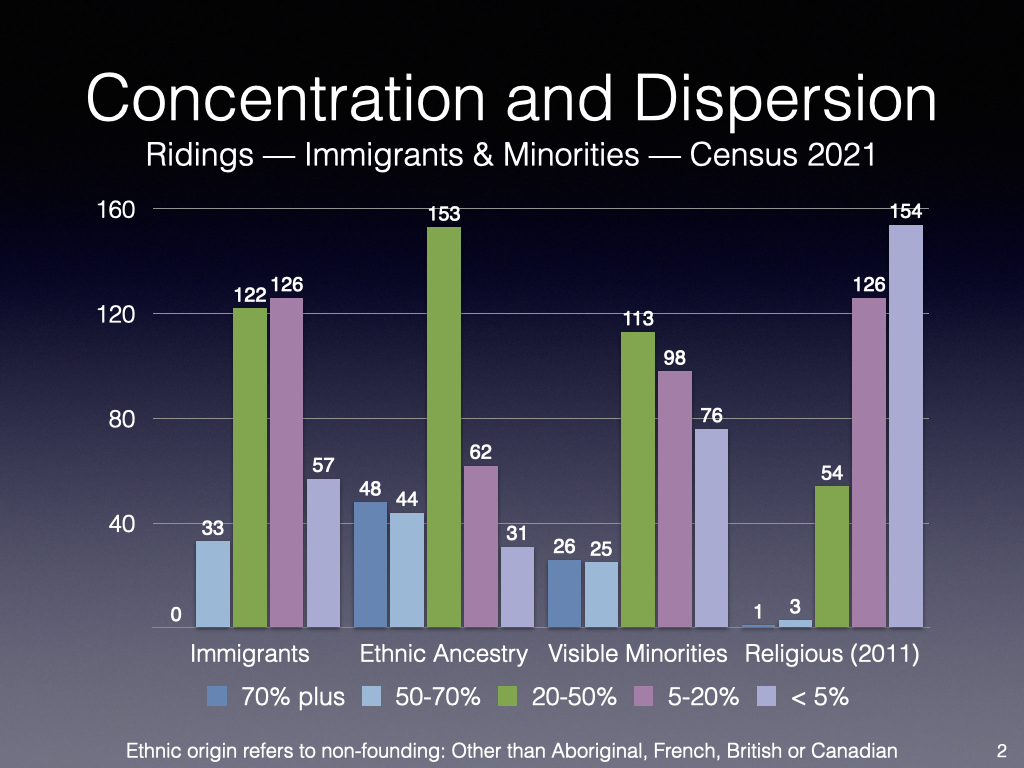
Figure 1 contrasts immigrants, non-founding ethnic ancestry or origin, visible and religious minorities by their percentage in ridings, highlighting the large number of ridings with significant population shares of each group.

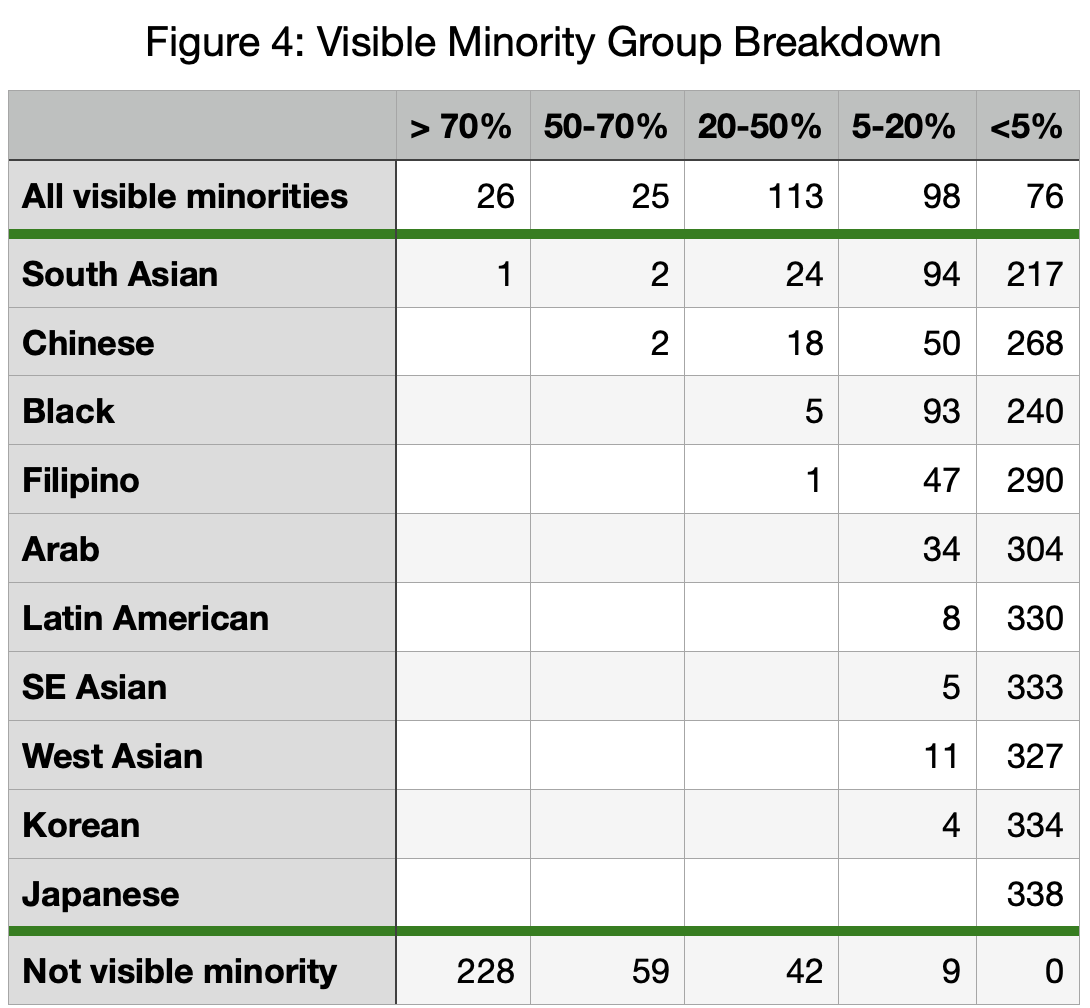
Figure 2 highlights the growth of ridings where visible minorities form a significant share of the population. The number of ridings in which visible minorities form a majority of the population has increased from one in ten (33) in 2011 to close to one in six (51), reflecting high and increasing levels of immigration. Moreover, the number of ridings with significant numbers of visible minorities (20 to 50 percent) has also increased significantly, reflecting ongoing immigration to smaller urban and suburban centres.

While the number of ridings with between five and 20 percent visible minorities has stayed relatively constant, the percentage of visible minorities has increased by five percent or more in about half of these ridings.

In contrast, there are only four ridings in which religious minorities form the majority, an increase of two compared to 2011, with 54 ridings in which religious minorities are between 20 and 50 percent, an increase of 12 compared to 2011.

Figure 3 shows ridings with a majority of visible minorities by province, with Ontario, British Columbia and Alberta having the greatest share and increase compared to the 2016 census. These are all ridings where one can expect all parties to run visible minority candidates, most likely from the largest visible minority group in the riding.

However, virtually all provinces have an increased number of ridings with between 20 and 50 percent visible minorities, and thus ridings where visible minorities are a significant constituency.

Figure 4 provides the breakdown by visible minority group, with only South Asians and Chinese being a majority of the population (five ridings out of 51 – Brampton East and West, Surrey-Newton for South Asians, Markham-Unionville and Richmond Centre for Chinese), highlighting that most visible minority majority ridings have a mix of visible minority groups. All visible minority groups are present in ridings with between 5 and 20 percent, save Japanese.

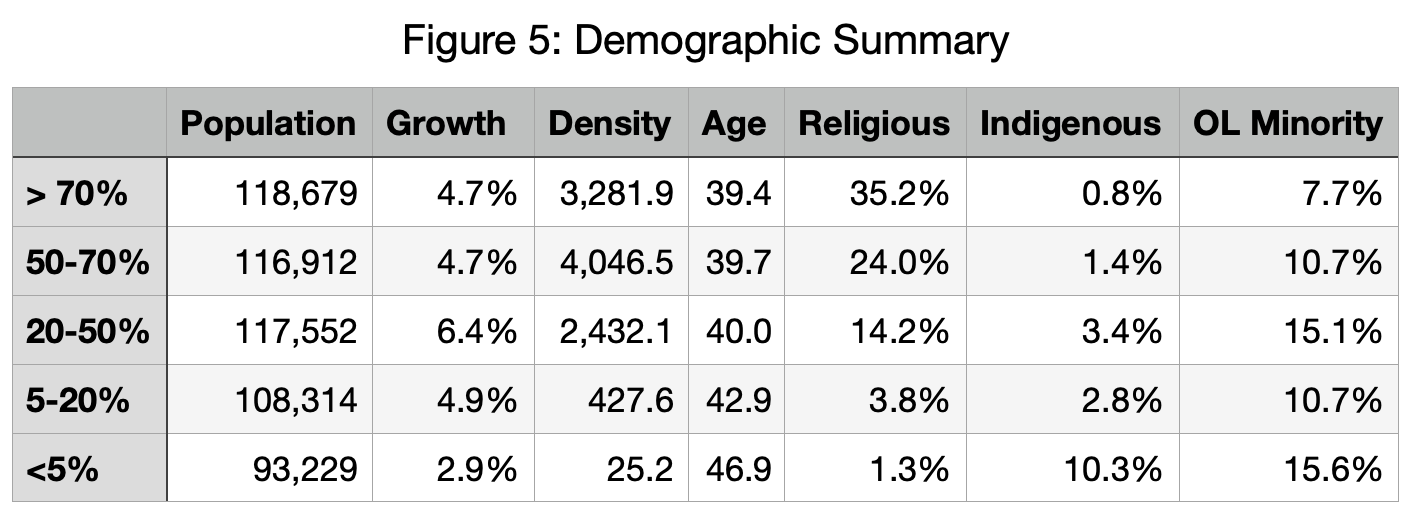
Demographic and socioeconomic characteristics vary by percentage of visible minorities as shown in Figure 5.

Visible minority majority ridings are characterized by larger populations, moderate growth, high densities, a younger population, a higher percentage of religious minorities and a low percentage of Indigenous peoples, with the reverse generally being the case for ridings with less than 20 percent visible minorities, highlighting the differences between rural and urban Canada. The highest growth occurs in ridings with 20 to 50 percent visible minorities, ridings that are increasingly diverse. The percentage of religious minorities correlates with the percentage of visible minorities. There is no overall pattern with respect to official language (OL) minorities.

As one would expect, the higher the percentage of visible minorities, the higher the percentage of immigrants and conversely, the lower the percentage of citizens given residency and other requirements as shown in Figure 6. The period of immigration highlights the contrast between earlier waves of immigration, largely European in origin and in low visible minority ridings, and later waves, largely visible minority, with an impact across all ridings, particularly in the last five years and in ridings with lower overall percentage of visible minorities.

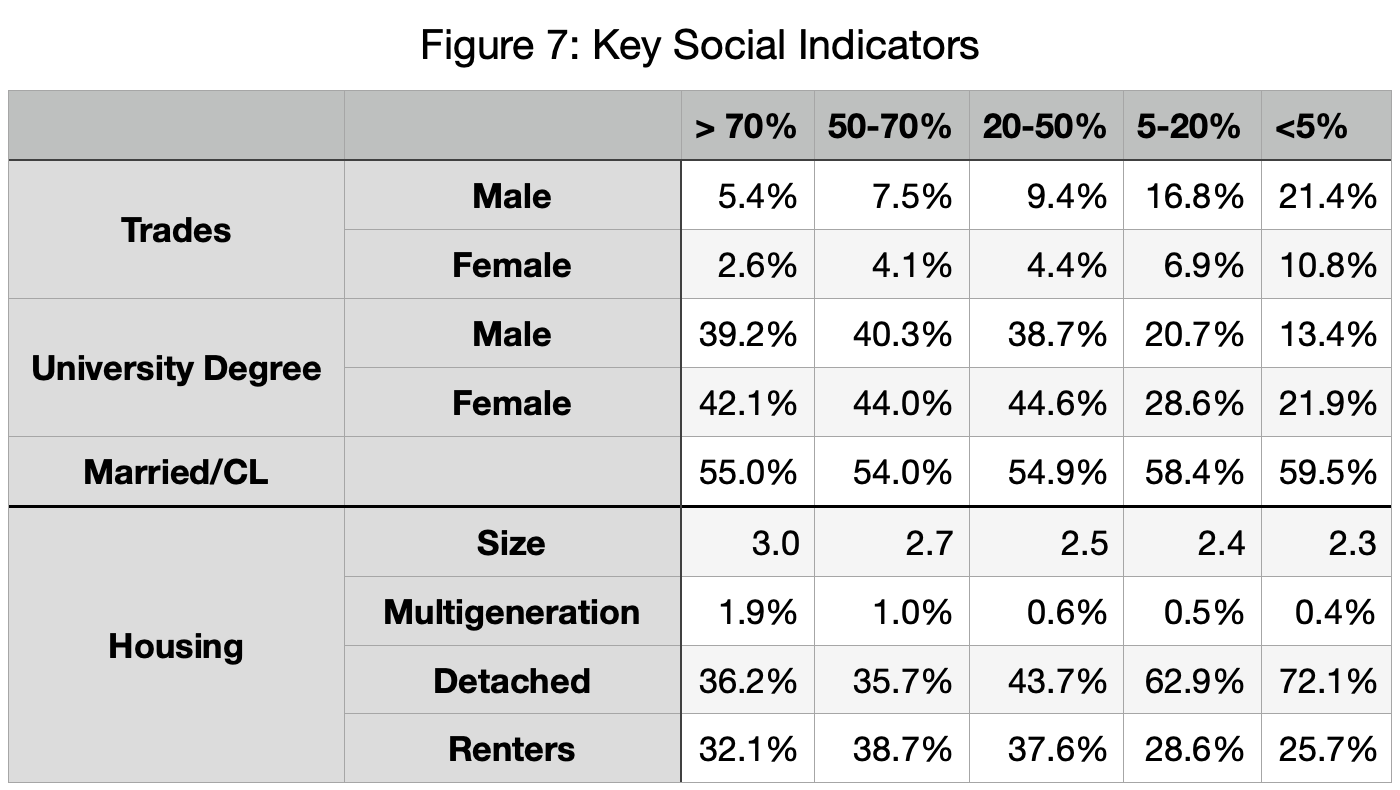
Figure 7 highlights educational attainment (trades and university degree, the percentage of married or common-law couples, household size, and whether residents form part of  multigenerational households, are in single-detached housing and the percentage of renters. Trades are more prevalent in ridings with fewer visible minorities and university diplomas more prevalent in ridings with more visible minorities. Women have higher rates of university degrees across all ridings.

Variations on marriage or common law between ridings are small. Household size directly relates to the percentage of visible minorities whereas the prevalence of single detached homes is inversely proportional. Renting is more prevalent in ridings with between 20 and 70 percent visible minorities.

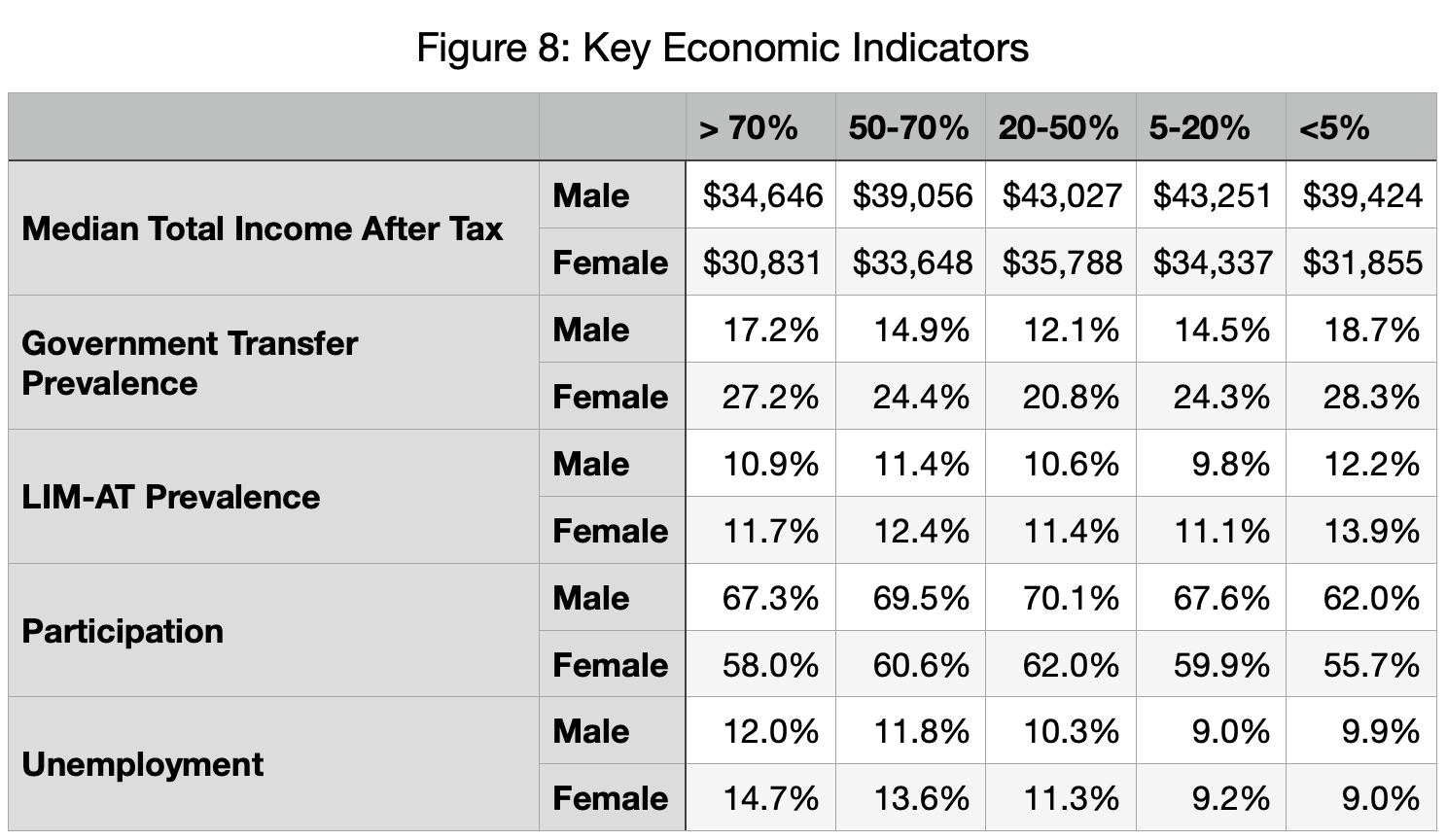
Figure 8 highlights median total after tax income, the percentage of government transfers and income along with participation and unemployment rates. In general, ridings with between 20 and 50 percent have the strongest economic outcomes save for unemployment rates which are lowest in ridings with fewer visible minorities. Outcomes for women are worse overall except with respect to unemployment in ridings with less than 20 percent visible minorities.

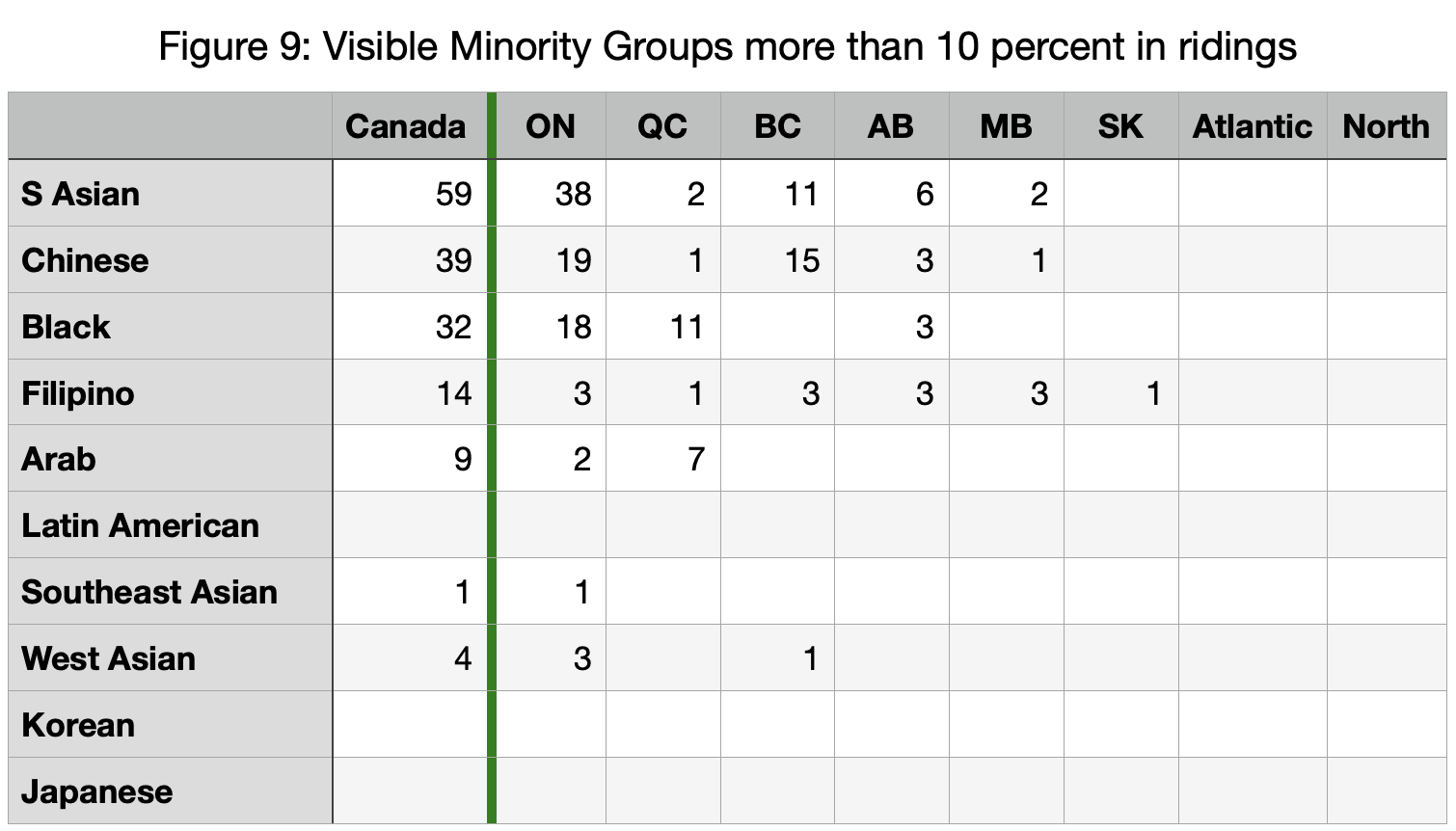
Turning to the political aspect and voter targeting, Figure 9 highlights the number of ridings where a visible minority group forms more than 10 percent of the population, broken down by province, again demonstrating the extent to which political parties need to address specific group concerns. Only Latin American, Korean and Japanese have no ridings with ten percent or more of the population; however, with a threshold of five percent, only Japanese have no ridings of significant concentration. Regionally, there are no ridings in Atlantic Canada and the North with one visible minority group forming 10 percent of the population but six ridings where one group forms more than five percent: three South Asian, two Black and one Chinese.

Figure 10 highlights the 190 ridings where a religious minority forms more than five percent of the population as a threshold of ten percent would exclude Buddhist and Indigenous spirituality. Most groups are concentrated in a number of ridings, with Muslims dispersed across the greatest number of ridings.

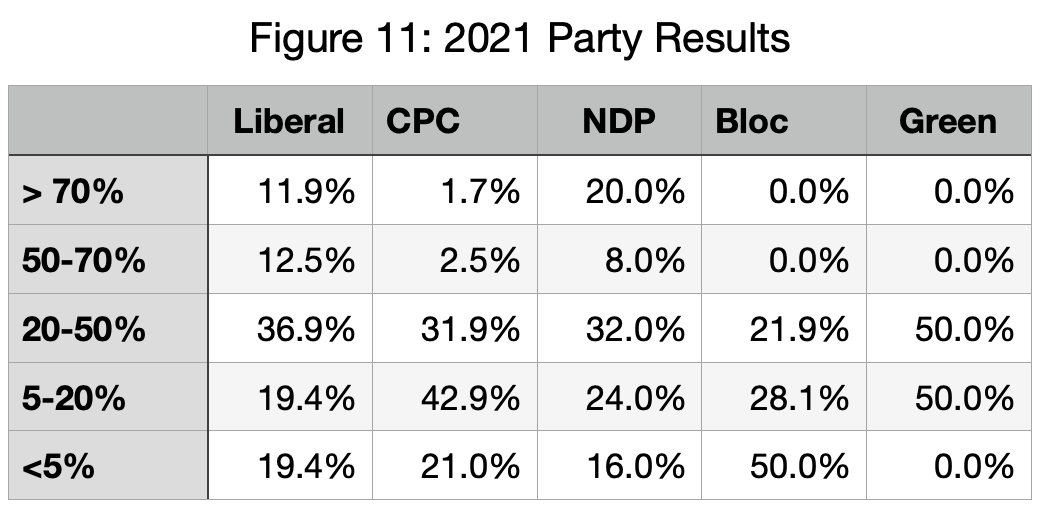
Figure 11 breaks down the 2021 election results, highlighting the relative strength of the Liberals and NDP in visible minority majority urban ridings and the relative strength of the Conservatives in ridings with between five and twenty percent visible minorities. Compared to the 2015 election, the biggest change was the increase in the relative share of NDP MPs in visible minority majority ridings and the Conservative and Bloc relative share increase in ridings with between 20 to 50 percent visible minorities. These ridings can flip; in 2011, the Conservatives won a majority of ridings with more than 50 percent visible minorities.

Concluding observations

All parties have candidate selection, policy and other electoral strategies to engage these communities and the ongoing increase in the number of visible minority candidates and MPs reflects these strategies. Substantively, there are no major differences in attitudes between immigrants and non-immigrants across a range of immigration-related issues.

While some visible minority groups have a tendency to vote for a particular political party, there is political diversity in all groups resulting in no party ignoring any group. Earlier waves of immigrants, mainly European origin, tend to lean Conservative compared to more recent waves, mainly visible minority, tend to lean Liberal.

Visible minority and immigrant groups are affected by perceived singling out or dog whistles, as the Conservatives learned to their cost in 2015, with the “barbaric cultural practices” tip line and the strength of the Liberal language “a Canadian is a Canadian is a Canadian” in response to the Conservative government’s citizenship revocation provision of C-24. Immigration-specific issues such as the ease of family reunification also play a role.

But in general, visible minority voters are more affected by overall campaign themes and issues, whether these be with respect to campaign tone, general concerns regarding the economy, housing, and healthcare, and largely follow the overall electoral trend at national and regional levels.

Riding characteristics impact upon voting patterns. Visible minority majority ridings have lower incomes and higher unemployment which generally play to left and left-of-centre parties. Similarly, larger family size and more multigenerational households in these ridings suggest that political parties target their messaging accordingly.

No major party is arguing against increased immigration, nor is any province except for Quebec. Public support is strong. Apart from administrative issues like backlogs and poor Immigration, Refugees and Citizenship Canada service, debates and discussion focus more on the practicalities and impact of immigration on housing affordability, healthcare stresses and infrastructure gaps. More recent commentaries are focussing on these negative impacts but in a non-xenophobic manner. After all, these issues affect immigrants and non-immigrants alike, helping to reduce polarization.

Methodology:

All data is from the Census profile given that it provides riding-level data. Indicators were chosen based on their pertinence. Non-founding ethnic ancestry includes all groups save for English, Scottish, Irish, Welsh, Canadian, French and Indigenous (Census allows for multiple responses). Electoral results data is from Elections Canada.

Andrew Griffith is the author of “Because it’s 2015…” Implementing Diversity and InclusionMulticulturalism in Canada: Evidence and Anecdote and Policy Arrogance or Innocent Bias: Resetting Citizenship and Multiculturalism and is a regular media commentator and blogger (Multiculturalism Meanderings). He is the former Director General for Citizenship and Multiculturalism and has worked for a variety of government departments in Canada and abroad and is a fellow of the Canadian Global Affairs Institute and Environics Institute. 

Source: The Political Impact of Increased Diversity: What the Census Shows

Labelle: L’immigration, McKinsey et le diktat de la mobilité internationale

Of interest although I think she overstates the reduction of state powers due to increased mobility:

Romain Schué et Thomas Gerbet viennent de dévoiler, le 4 janvier dernier, l’influence de la firme américaine McKinsey sur la politique d’immigration du gouvernement Trudeau et les coûts faramineux payés à cette entreprise. Cette firme aurait conseillé l’accueil de 465 000 immigrants en 2023 pour atteindre 500 000 en 2025, dont 60 % seraient de la catégorie économique. A-t-elle aussi conseillé l’augmentation fulgurante des travailleurs temporaires ? Le contrôle des frontières et des demandeurs d’asile ? Une transformation démographique du Canada postnational dont se vante Justin Trudeau ? Une réorganisation du système informatique, une meilleure gestion des passeports (ce serait alors une faillite) ? L’information est bloquée pour le moment. Mais de quel droit tout cela ?

Faut-il s’étonner de ce recours à une multinationale pour influer sur les affaires internes canadiennes ? Non, si on le met en relation avec le développement hégémonique d’une théorie sociologique de la mobilité qui domine aujourd’hui au point de rendre les gouvernements dépendants des multinationales comme McKinsey.

Pour comprendre ce changement de paradigme, un retour en arrière s’impose.

Le paradigme de la mobilité adopté par le fédéral depuis des décennies

Le paradigme de la mobilité (mobility studies) n’a fait que se renforcer depuis la fin des années 1990. En 2005, le sociologue John Urry publiait un texte édifiant et quelque peu délirant dans Les Cahiers internationaux de sociologie pour décrire le monde en mouvement : demandeurs d’asile, terroristes, touristes, diasporas, étudiants internationaux, entrepreneurs, sportifs, randonneurs, prostituées sont en mouvement, écrivait-il. Le sociologue reprochait à ses pairs d’avoir négligé le phénomène de la mobilité et d’avoir jusqu’ici insisté plutôt sur le rôle de structures sociales figées au sein de la société ou de l’État-nation obsolète.

John Urry en appelait à une « reformulation de la sociologie dans sa phase post-sociétale », dont l’objet majeur ne serait plus les sociétés dans leur spécificité, mais « les diverses mobilités des peuples, des objets, des images, des informations et des déchets [sic] ». Depuis, ce paradigme concurrence diverses perspectives « post » , y compris la thèse de la superdiversité, très en vogue dans les universités anglophones, où l’on parle avec une délicatesse douteuse « d’itinérants transculturels ». Le multiculturalisme est pour ainsi dire dépassé, on nage désormais dans l’univers trans. Toutes remettent en cause les frontières politiques et symboliques des États-nations, ainsi que les significations de la citoyenneté et de l’appartenance.

Cette mouvance est à mettre en relation avec la création du réseau international Metropolis fondé en 1996 à l’initiative du ministre Sergio Marchi, et dont Meyer Burstein a été codirecteur exécutif, ainsi qu’avec le discours du fédéral sur la rentabilisation du multiculturalisme et la stratégie d’innovation du Canada. En 2004, le document « Élaboration de l’analyse de rentabilisation du multiculturalisme » précisait que les transilient immigrants font partie d’une nouvelle « classe créative », apte à mobiliser leurs réseaux internationaux en vue d’investissements et de bonnes pratiques commerciales.

Les immigrants et les « minorités visibles » y sont vus comme « un réservoir de compétences culturelles et linguistiques auquel les industries canadiennes peuvent faire appel pour leurs opérations à l’étranger ou pour prendre de l’expansion sur les marchés internationaux », écrivait déjà en 2004 l’ex et puissant directeur d’Immigration et Citoyenneté Canada, Meyer Burstein.

Les liens que les diverses « communautés culturelles et raciales entretiennent avec presque tous les pays du monde sont synonymes de prospérité économique et ont contribué à susciter l’intérêt du gouvernement du Canada à l’égard du multiculturalisme », statuait à son tour Patrimoine canadien (2005). On ne peut donc s’étonner du recours aux tentacules internationaux de la firme McKinsey. Et Justin Trudeau ne peut être que d’accord avec ce niveau d’interférence dans un pays qu’il conçoit et présente comme postnational.

Les effets pervers de la mobilité sur les personnes et le pouvoir des États

L’immigration internationale concerne plusieurs catégories de personnes aux statuts social et politico-juridique différents. Or, les pays doivent choisir entre deux catégories principales de transfrontaliers sur le plan économique : les travailleurs étrangers qualifiés, hautement mobiles, et les travailleurs non qualifiés.

La mobilité des premiers est vue comme un signe d’ouverture envers le pays d’accueil. Désirable sur le plan économique, elle ne pose pas de défis d’intégration, soutient-on à tort. Dans cette perspective, la chasse aux cerveaux (ou plutôt l’exode des cerveaux, vu sous un autre angle) apparaît souhaitable pour les États demandeurs et les institutions qui ont besoin de professionnels ou d’étudiants internationaux afin de favoriser l’investissement, la recherche et l’innovation.

Au contraire, les mouvements de la main-d’oeuvre à bon marché et souvent déclassée sont à contrôler afin de ne pas provoquer un sentiment d’envahissement dans la société d’accueil. C’est la raison pour laquelle cette force de travail fait l’objet d’un sempiternel débat public sur la naturalisation, l’intégration civique et les exigences linguistiques. Sans compter qu’en Amérique du Nord, pour un immigrant indépendant jouissant du statut de résidence, on compterait une cinquantaine d’immigrants parrainés, compte tenu des réseaux et des liens transnationaux des migrants.

Enfin, ce paradigme de la mobilité provoque également l’obligation de repenser les notions de citoyenneté et de souveraineté de l’État, jugées obsolètes dans un monde globalisé. Les chercheurs ont beau spéculer sur la beauté du transnationalisme, on peut pourtant constater que tous les États aspirent à contrôler l’immigration selon leurs intérêts propres en matière de sécurité et d’ordre public, de légalité, de réunification des familles, de dépenses publiques et de problèmes urbains, d’intégration sociale et politique, voire d’identité nationale. En ce sens, le paradigme de la mobilité véhiculé par des instances supraétatiques ne peut qu’entamer le pouvoir de l’État.

Enfin, il serait intéressant de savoir ce que pensent les conseillers de McKinsey sur les dysfonctionnements et l’éventuelle crise sociale qu’entraîne la mobilité incarnée par la traversée du chemin Roxham. Les demandeurs d’asile qui arrivent par milliers aux frontières comptent-ils dans l’objectif des 465 000 à 500 000 migrants souhaités sur cinq ans ? En dépit du fait que ce système donne lieu à de l’exploitation, à un trafic reconnu et à des réseaux internationaux de passeurs bien organisés et sans doute sans pitié ? Une situation que le gouvernement Trudeau ne semble pas avoir le courage de regarder en face et devant laquelle le Québec semble impuissant.

Source: L’immigration, McKinsey et le diktat de la mobilité internationale

Wheeler et al: The role of Blackness in the Hamline Islamic art controversy

Interesting angle on context, that nevertheless, as author notes, doesn’t justify Hamline’s decision:

In early October, Erika López Prater, a professor at Hamline University in Minnesota, showed her online Islamic art history class an image of the Prophet Muhammad. A Muslim student in the class complained, citing Islamic tradition barring representations of the prophet. Other students joined in to express their view that this incident was part of a larger problem of Islamophobia on campus. The administration agreed, and eventually López Prater’s contract to teach during the spring semester was rescinded.

Since her firing, other professors, including Islamic studies scholars, have rightly rallied around her, drafting petitions and op-eds calling her dismissal a case of censorship trammeling academic freedom. 

We’ve heard little in the media coverage of this fiasco, however, about the students who initiated the complaint — why they objected, who they are and what their lives are like at Hamline and in the Twin Cities. Most of all, we need to understand why a perceived attack on the body and dignity of the Prophet Muhammad may have felt like an attack on them.

What has been written about the students has at times been unfortunate. The Chronicle of Higher Education, for instance, described Muslims who believe it is wrong to display images of Muhammad as ascribing to the “most extreme and conservative Muslim point of view.” Never mind that using the term “extreme” insinuates that these students are violent; the point is not to discuss the history of iconoclasm in Islam, but why these particular Muslims objected to the image when and where they did.

Our many decades of learning and experience as scholars of Black American Islam tell us that the missing context is race. The Muslim students were hurt by what they saw as an attack on the dignity of the prophet, whether they are doctrinally correct or not. This hurt paralleled the attacks on their dignity they experience daily as Black Muslims. Violence toward Black Muslims, rooted in slavery and Jim Crow and perpetuated in post-civil rights America, is an embodied phenomenon.

Attacks on the Prophet Muhammad’s body for someone living in this reality may be felt as an assault from the whole surrounding community. In an interview with The Oracle, the school’s student paper, Aram Wedatalla, who was in López Prater’s class, said, “as a Muslim, and a Black person, I don’t feel like I belong, and I don’t think I’ll ever belong in a community where they don’t value me as a member, and they don’t show the same respect that I show them.”

Black students account for 11% of Hamline’s student body, according to U.S. News & World Report — a smaller percentage than Black residents’ in Minneapolis (but about the same as African-descended people in the city’s metro area). In a forum at the university in early December, according to The New York Timesa student panel of Black Muslim women “spoke tearfully about struggling to fit in at Hamline.”

Beyond Hamline’s campus, Islamophobia in Minnesota is often colored Black: Muslims in Minnesota, especially Somalis, have faced discrimination and violence as well as state-sanctioned Islamophobia, often in the form of police harassment.

The Countering Violent Extremism program, launched by the Obama administration in 2011, aimed at partnering with the American Muslim community to reduce violence; it ended up marginalizing Musllms further. Minnesota Somalis were disproportionately affected by CVE, as the program was known. The Trump administration’s iteration of CVE “rebranded and refunded the programs, exacerbating ongoing racial discrimination, surveillance, and police brutality in the Twin Cities,” according to one study.

Minnesota’s Black Muslims have also watched as their elected representatives, Keith Ellison and Ilhan Omar, have received death threats and been called terrorists.

Anti-Muslim anti-Black violence is not just a problem in Minnesota. It’s an historic national issue. Black Muslims have been depicted in the media as irrational, violent and incompatible with American values for nearly 100 years. Look no further than how Malcolm X, Muhammad Ali (depending on the decade) or the Nation of Islam under Elijah Muhammad were described by journalists, academics and law enforcement. Consider how images of the Black Muslim boogeyman (and in later cases, boogeywoman) were used to justify harassment and discrimination against Black Muslims and by 9/11, all Muslims.

This is the context missing from the current conversation about López Prater’s firing.

The solution, however, is not be to ban images of the Prophet Muhammad in the classroom or to fire professors for doing their jobs. (No report has shown that the students even asked for López Prater to be fired.) There is immense theological diversity and varying views among Muslims on the permissibility of depicting Muhammad, as López Prater is aware; she made efforts to soften the blow to Muslim students who might be offended.

In the eyes of these Muslim students, she and the university did not go far enough, but rather than address students’ concerns as a community, the university administration chose to deal with its institutional Islamophobia as a problem between an overworked and underpaid contingent faculty member and marginalized students.

We live in a deeply Islamophobic society where Muslims face both interpersonal and institutional oppression that affects how young Muslims experience everyday life. This incident is simply the latest example. López Prater has unjustly lost her job, and Hamline University Muslim students have been vilified in the media, while the underlying problem — Islamophobia — still persists on Hamline’s campus and beyond.

(Kayla Renée Wheeler is an assistant professor of critical ethnic studies and theology at Xavier University. Edward E. Curtis IV holds the William M. and Gail M. Plater Chair of the Liberal Arts at Indiana University. The views expressed in this commentary do not necessarily reflect those of Religion News Service.)

Source: The role of Blackness in the Hamline Islamic art controversy

Paradkar: Professor’s firing over Prophet Muhammad art offensive — but not because of ‘wokeism’ or ‘cancel culture’

Good column:

The news that a private liberal arts university in the United States fired a professor for showing a painting of the Prophet Muhammad, calling it Islamophobic, should worry us all.

Not because “wokeism” has gone too far or because “cancel culture” has run amok, but because it overrides diversity among Muslims as well as threatens academic freedom and, therefore, democratic ideals. And because the chill is also happening in Canada.

There was nothing woke about Hamline University in Minnesota terminating the contract of Erika López Prater, an adjunct professor — meaning not tenured and working for low or no pay — who in October showed two medieval Islamic artworks in her global art history class. In one, the Prophet’s face is veiled. The other openly depicts Muhammad receiving the revelation of the Quran from the angel Gabriel. To be woke is to be awakened to societal injustices, not to further entrench them.

Nor was cancel culture at play at the university but rather the politics of appeasement, in this case by an institution that, like many, cloaks its reputational risk-management strategy in the language of inclusiveness.

“We have learned, over many years, that knowledge can be shared in a multitude of responsible, thoughtful and respectful ways,” wrote Fayneese Miller, the university’s president, and David Everett, associate vice-president for inclusive excellence, in a letter to the campus on Dec. 9. 

“Respect for the observant Muslim students in that classroom should have superseded academic freedom.”

A month prior, Everett is reported to have called the lesson “disrespectful and Islamophobic.”

If Islamophobia is hate and discrimination springing from prejudice against Islam or Muslims, how does showing an item that is a treasured part of Islamic history perpetuate that hate?

Many but not all Muslims believe visual representations of the prophet are forbidden, even though the Quran does not explicitly forbid it.

“If Islamophobia is characterized by anything that violates Islamic theology, then we have a problem, because that doesn’t respect academic freedom,” says Anver Emon, a professor at the University of Toronto and Canada Research Chair on Islamic Law and History.

“What is now being conveyed as Islamophobia is deference to certain forms of orthodoxy over others.”

By all accounts, the Hamline lecturer had informed the class beforehand what she was going to show and why, and invited them to bring any concerns to her. The class itself went smoothly.

Still, a student who was also president of the Muslim Student Association complained after the class.

“I’m like, ‘This can’t be real’,” she is quoted saying in the student newspaper. “As a Muslim and a Black person, I don’t feel like I belong, and I don’t think I’ll ever belong in a community where they don’t value me as a member, and they don’t show the same respect that I show them.”

I don’t know if the student didn’t hear the teacher prior to class, or saw it as an opportunity to make a point. But it’s clear that, to her, the lesson tied in with the larger issue of not belonging.

I can see that the university had to do something, or be seen to be doing something, and calculated that losing a staff member on contract was far easier than the hard work of changing its culture.

Wrong move. Students complain, as is their right. But universities that are increasingly treating students as customers need to remember they are not always right. Students’ feelings can and should be taken seriously and issues resolved through dialogue and building trust. Not dealt with through human resources. Not used willy-nilly to dictate the curriculum.

A similar class created a furor at the University of Alberta last year. The professor involved is on leave.

Jairan Gahan, an assistant professor, ran afoul of the Muslim Students Association last February, ironically during a class about Islamophobia, after she shared images of a few medieval miniatures commissioned by a Muslim ruler that depicted the Prophet.

Gahan told the Star she was helping students understand why Muslims are so outraged by the Charlie Hebdo cartoons of 2012 but may not react as strongly to other Islamophobic instances. “The point was to show this backlash (to Charlie Hebdo) is not just a theological debate. It’s more than that. It’s about moral injury.”

Given that the cartoon depicted the Prophet, she wanted to show historical diversity. To explain “how we have come to believe that there have been no images of the Prophet. Where is this coming from? What was the historical movement behind it? Is it absolute?”

Gahan says she never got to speak to the student or students who complained despite attempts to do so, found her online ratings as a professor affected and ultimately had a fruitless discussion with a Muslim organization that got involved. 

By contrast Emon, like many scholars, has shown images of Muhammad in class without offering prior warnings. He has a PowerPoint presentation that only looks at Islamic art and depictions of the Prophet. He has discussed and displayed the Danish newspaper Jyllands-Posten’s cartoons from 2005 depicting Muhammad.

The art depicts the Prophet as veneration, as honour and also for courtly purposes, he says. The cartoons, on the other hand, do so for denigration and to exemplify “the unbelonging of Islam and Muslims in Europe.”

“That’s the fundamental difference. And if we don’t account for that, then we ignore how embedded in every single depiction of the Prophet is a politics.”

To Emon, the situation at Hamline is not all that different from the hiring fiasco at U of T law school in 2020, when a major donor expressed objections to its plans to hire the academic Valentina Azarova, who had previously criticized Israel.

Demanding professors not discuss history or politics or religion because it is uncomfortable to some is an unreasonable restriction. 

This should not be confused with seeking an overhaul of language, curricula and practices that continue to harm the historically marginalized.

The former quashes intellectual inquiry. The latter seeks to refine critical thinking and ultimately uphold democratic principles of freedom, equality and justice. 

“We, the academy, are being accused of violating something sacred, not respecting something sacred, but we are not the keepers of theology, nor are we the protectors of theology,” says Emon. 

“We are here as academics to question everything. And if society can’t sustain that, then there goes democracy.”

Source: Professor’s firing over Prophet Muhammad art offensive — but not because of ‘wokeism’ or ‘cancel culture’

Cornellier: Besoin de Montréal

Of note, Montreal vs the regions and the multiculturalism/interculturalism debates:

Si le Québec veut réussir dans le dossier de l’intégration des immigrants, il aura besoin de la contribution de la Ville de Montréal. C’est là, en effet, que la majorité des immigrants décident de vivre. En 2016, ces personnes représentaient 34,3 % de la population de Montréal, 28,5 % de celle de Laval et 20,3 % de celle de Longueuil. Dans le reste du Québec, les personnes immigrantes ne représentent qu’environ 4 % de la population. On voit donc toute l’importance qu’a la région montréalaise dans cette mission.

La Ville de Montréal est-elle à la hauteur des attentes québécoises dans ce dossier ? C’est la question que pose le politologue David Carpentier dans La métropole contre la nation ? (PUQ, 2022, 232 pages), un éclairant essai issu d’un mémoire de maîtrise. « Que fait concrètement la Ville de Montréal pour favoriser l’intégration de ces populations sur son territoire ? » demande Carpentier. Va-t-elle dans le sens préconisé par l’État québécois ou contredit-elle l’action de ce dernier ?

Carpentier est un chercheur. Son essai n’a rien de polémique. Il reste que sa conclusion selon laquelle « il se déploie ainsi dans la métropole une forme dissimulée de multiculturalisme donnant libre cours à une vie civique affranchie du cadre national » fera réagir à juste titre. Selon Carpentier, en effet, « les principes sur lesquels repose une certaine conception de l’intégration, établie par les processus démocratiques québécois, se voient court-circuités par la Ville de Montréal », sans véritable légitimité politique.

Selon la Constitution canadienne, l’immigration est une compétence partagée entre les provinces et l’État central. Les municipalités, quant à elles, jouissent des responsabilités que veulent bien leur déléguer les gouvernements provinciaux.

Au Québec, de plus, l’affaire se complique du fait que nous sommes une nation minoritaire dans un État dont la politique d’intégration, le multiculturalisme, entre en concurrence avec la nôtre, l’interculturalisme. À titre de « créatures de la province » sur le plan juridique, les municipalités devraient donc être soumises à l’application de la politique québécoise, mais un certain flou, dans cette dernière, vient gripper la machine.

Le multiculturalisme canadien est une politique officielle depuis 1971. Il « valorise la manifestation des particularismes d’ordre ethnoculturel, religieux et linguistique dans l’espace public », résume Carpentier, et affirme qu’il « n’existerait pas au pays une culture ou un groupe ayant préséance ». Comme le note le politologue, le Canada a beau jeu de ne pas insister sur la nécessité de l’intégration à une société d’accueil puisque la présence de cette dernière s’impose de fait, « étant donné le statut hégémonique de la tradition anglo-saxonne et sa réalité démographique majoritaire ».

Nation minoritaire, le Québec ne peut se permettre ce luxe, d’où son adhésion à l’interculturalisme, une « voie mitoyenne », précise Carpentier, entre l’assimilationnisme et le multiculturalisme. L’interculturalisme valorise le pluralisme, mais accorde une place prioritaire à la culture majoritaire d’accueil, à laquelle doivent s’intégrer les nouveaux arrivants et qui se fonde sur l’« égalité des genres, la démocratie, la laïcité, le français comme langue publique commune, l’État de droit [et] le respect des droits et libertés de la personne », résume le politologue. Or, ce modèle d’intégration n’a jamais été officialisé par le gouvernement du Québec, ce qui rend son application incertaine.

Dans certains documents publics, la Ville de Montréal affirme adhérer à un interculturalisme minimaliste. Dans les faits, toutefois, son action révèle souvent l’« adhésion tacite de la municipalité au modèle canadien et son contournement du discours que promeut l’État québécois », constate Carpentier.

Dans des interventions publiques, par exemple, le maire Coderre et la mairesse Plante ont tous deux plaidé pour une laïcité dite ouverte et pour plus de flexibilité dans l’usage de l’anglais. Ainsi, au nom de la différence montréalaise, ils ont contesté deux des principaux socles de l’interculturalisme québécois.

Selon Carpentier, les acteurs de la politique montréalaise d’intégration se diviseraient en deux camps : les partisans de l’interculturalisme, principalement des fonctionnaires et des chercheurs, et ceux du multiculturalisme, qu’on retrouve surtout chez les élus et les acteurs associatifs. Pour le moment, à cause du flou juridique et politique entourant le statut de l’interculturalisme, ce sont les seconds qui s’imposent, entraînant ainsi une dramatique « déconnexion » entre la métropole et le reste du Québec.

Qu’attend donc le gouvernement du Québec pour faire de l’interculturalisme sa politique d’intégration officielle sur tout le territoire national ? Ça devrait faire partie d’un programme sérieux de réveil national.

Source: Besoin de Montréal

Order of Canada appointees far less diverse than the population, analysis shows

Based on my analysis posted earlier. Comments from Sarah Kaplan and Erin Tolley decrying the lack of diversity without fully recognizing as legitimate the focus of the Order on longer term contributions rather than new and emerging talent for many arts and culture awards (the Governor General Performing Arts Awards are for lifetime contributions).

Personally, I don’t find it “completely unacceptable” that the Order doesn’t provide “full representation” given its longer term focus, nor do I find its “elite” focus unacceptable. By definition, the Order is the elite Canadian award, just as the Nobel is the world elite award, whereas others are not.

That being said, there are opportunities to encourage more nominations for women and visible minorities, learning from the efforts to increase business and Prairie representation through additional funding for promotion in 2015 under the Conservative government which had, however, limited success.

The 2022 list of appointees to the Order of Canada is far less diverse than the Canadian population and even less diverse than it was in 2021, a new analysis shows.

The Governor General made 184 appointments to the order in 2022. It’s considered one of the country’s highest civilian honours, one which recognizes “people who make extraordinary contributions to the nation,” according to Rideau Hall. Over 7,600 Canadians have joined the order’s ranks since its creation in 1967.

But analysis by retired public servant Andrew Griffith, who served as Canada’s director general of citizenship and multiculturalism, found that last year’s appointees were not representative of the Canadian population.

Order of Canada must change, professor says

Source: Order of Canada appointees far less diverse than the population, analysis shows

Lisée: Quebec’s plan to eradicate English

Clever piece but unlikely to convince many:

It’s much worse than everything you’ve heard. The assault on the Anglo minority in Quebec has been best summed-up by Marlene Jennings: it is, she said, a “perfect formula” for “eradication.” She should know. The former Liberal MP headed until recently the Quebec Community Groups Network, spearheading the fight against François Legault’s many-pronged and still evolving eradication plan.

The numbers don’t lie. Quebecers who have English as a mother tongue account for 8 per cent of the population. But what of the ability to attract newcomers into the Anglo fold, given the enormous power of attraction of French on the continent? The proportion of Quebecers that uses English more than French in their daily lives is only 14 per cent. That doesn’t even double the count. Granted, 44 per cent of all Quebecers do speak English as do close to 80 per cent of young francophone Montrealers, but that is poor consolation.

Case in point: Quebec’s intolerant immigration policies has only let into the Montreal area about 90,000 unilingual English-speaking newcomers in the last three years — since the election of the governing CAQ — which barely adds 14 per cent to the Anglo population, so you can see where this is headed.

Everybody knows that the CAQ language bill, now in effect, will crack down on any doctor or nurse who would dare speak English to anyone not member of the “historic Anglo community,” meaning those who attended school in English. The actual text of the law tries to hide this fact by stating that French is required “except in health,” and then a specific section gaslights jurists by saying it specifically does not apply to the general statute on health and social services. 

Don’t be fooled by the fact that other law compels hospitals in all regions to set up English speaking access plans and to render services in English for anyone who asks for them. In reality, Anglo Quebecers have little other resource than to rely on the 37 institutions of the English public health network, which barely employs 45 per cent of the Island of Montreal’s health workers. 

Outside that small cocoon, English speakers needing medical care will be lucky if they fall in the hands of the puny proportion of French doctors that actually speak their language: 88 per cent. It is clear to anyone who follows these issues that French Canadians outside Quebec would revolt if their access to health in their language was that dire.

It’s even shoddier, of course, in the labour market. Toronto readers know, thanks to Globe and Mail columnist Andrew Coyne, that “the law prohibits the use of any language but French in the province’s workplaces, large or small, public or private.” Specifically, the new law extends to mid-sized shops, the regulation having existed for 35 years in larger ones. 

The damage is already done: in the last census, the proportion of workers in the Montreal area who used mostly English at work was down to 20 per cent, those who use it regularly down to 49 per cent. Why aren’t all these people fined by the language police? 

Corruption, laziness and incompetence, endemic in Quebec as famously reported in Maclean’s magazine, are surely the only explanation for this lack of enforcement, hidden perhaps behind a slew of exceptions enabling anyone to speak any language to clients, suppliers, the head office, or colleagues, provided French is the “usual and habitual language of work.” Usual and habitual, which are, of course, code words for intransigence. Now if someone would be foolish enough to impose, say, English as the “usual and habitual language of work” in Toronto or Mississauga, all hell would break loose.

In Quebec, only 14 per cent of management positions are held by the 8 per cent of Anglos, which gives them a ridiculously small systemic advantage. Thank God for the rebel CEOs of Air Canada, SNC-Lavalin, the Laurentian Bank, the Canadian National and Couche Tard, proud unilingual Anglos, who enable all their senior staff and secretaries to revel in English, whatever their linguistic background. That’s inclusion.

Language oppression is Quebec is particularly offensive in education. René Lévesque’s Bill 101 famously took away the linguistic choice for K-12 to all, except Anglos and immigrants going to English schools prior to 1977, who retain the right to choose and pass it to their descendants for all eternity, and any English-Canadian of any background schooled in English moving to Quebec anytime and their descendants, for all eternity. Appalling.

Granted, the 8 per cent of Anglos have access to 17 per cent of spots in colleges and 25 per cent of universities, with 30 per cent of research grants. The new law would actually cap the Anglo Cegeps at merely double the presence of Anglos in the population. Not only that. These institutions of higher learning used to properly shun Anglo high schoolers that had lesser grades and give their spots to French students bright enough and bilingual enough to enrol there. The anti-Anglo nationalist government now forces these colleges to give precedence to Anglo students in enrolment, thus forcing Anglo institutions into debasing themselves by catering to lesser Anglos. Shameful, really.

Now for the coup de grâce. The inward-looking Quebec government seems to have it in it’s head that Anglo kids should be proficient enough in French to succeed in a work environment where French is still, alas, unavoidable. By law, all Anglo high schoolers with diplomas in hand are deemed bilingual. So why bother asking them, in college, to hone this skill? This idea is so bonkers that when the Quebec Liberal party proposed that Anglo students attend three classes IN French, (alongside their French colleagues who follow ALL classes in English), the scandal was enormous. 

The federation of colleges announced that a full third of Anglo students would fail. Not fare badly, but fail. Pretending that a bilingual person could actually read texts, attend lectures and render a paper in another language is of course nonsensical. One Anglo CEGEP director, Christian Corno, hit it on the nail by writing, in French, that this abomination was motivated by a willingness “to make Anglo students atone for the sins of their ancestors” (who may or may not have oppressed the French in the past, a debatable assertion). 

The fallback position has been to increase the number of French classes that these poor students should take, from two to five. This, also, puts their grades in jeopardy. Forcing students to learn the language of the majority of the population where they live and will work is an unacceptable imposition, surely unheard of anywhere else in the world.

The relentlessness of Quebec’s assaults on minority and religious rights extracts a heavy toll on its international reputation and attractiveness. Last year, only 177,000 foreign temporary workers and students were in the province. Yes, it is triple the usual amount and an all-time high. But just think of those who didn’t come. 

Foreign investment is repelled by the current intolerant climate. FDI in the Montreal area only jumped 69 per cent to a record high of $3.7 billionlast year but this is only attributable to Quebec boasting a recent growth rate greater than that of any G7 countries, Canada included. The fact that these newcomers and investors came to Quebec after the controversy and adoption of the secularism bill and during the language bill controversy simply points to the paucity of information available to them.

Thankfully, for the first time in history, the number of Ontarians moving to Quebec outpaced the number or Quebecers moving to Ontario. It used to be that, each year, 3,000 to 9,000 more Quebecers would leave for Ontario than the other way around. But given the new toxic environment, the flow has flipped and, last year, almost a net 800 brave Ontarianscrossed the Ottawa River to settle in Quebec. (In total, an astonishing 29,000 citizens moved from the Rest of Canada to Quebec in 2021.) Not for lower housing prices or better services or job outlook, but simply, surely, to contribute in defeating the eradication plan afoot. More will be needed. 

Please, come in droves! Hurry, before the last English word is ever spoken in Quebec.

Jean-François Lisée is an author, a columnist for Le Devoir and a former head of the Parti Québécois. This text may contain traces of irony. One may find his rants at jflisee.org

Source: Quebec’s plan to eradicate English