Understand the political pressures to apologize. Still doesn’t justify walking back from her and Farber’s legitimate take on Bill 21 and the Quebec analysis by Leger (virtually all surveys by various companies highlight Quebec’s lower acceptance and tolerance of Canadian Muslims. Other comments, yes:
Take a look at these two quotes.
“Anti-Muslim sentiment appears to be the main motivation for those who support a ban on religious symbols, a new poll has found.” — a Montreal Gazette report in 2019.
“Unfortunately, the majority of Quebecers appear to be swayed not by the rule of law, but by anti-Muslim sentiment.” — an Ottawa Citizen opinion piece a couple of months later.
Can you find the difference between this news report and this commentary? There isn’t much, in substance at least, if you analyze the Leger Marketing poll the quotes reference. But only one of them is at the centre of newly manufactured national outrage.
That second quote appeared in an opinion piece that Amira Elghawaby, then a journalist, co-wrote with Bernie Farber, then CEO of the Canadian Jewish Congress.
The first quote is received as information. The second, we’re given to understand, is prejudice.
Elghawaby, whom the Trudeau government appointed only last week as its special representative on combating Islamophobia, is the target of a bizarre witchhunt for the apparent sin of offending an entire province for having repeated the outcome of a poll — three years ago. She apologized for it this week.
She never should have.
Gather around, folks, to hear the story of the most inane politicization of an innocuous political posting, to understand what the cowardice of power looks like and to learn why one must never apologize for speaking truth to that power.
See, it begins in June 2019, when Bill 21, which bans public servants from wearing religious symbols such as hijabs, passed into law.
No, make that 2017, with Bill 62, which decreed nobody was allowed to cover their face while providing a public service. Or maybe 2013, with Bill 60, a supposed “Charter of Values,” calling for a ban on all “ostentatious” religious symbols. Or better still 2010, when the more blatant Bill 94 tried to ban women wearing the niqab and burqa while receiving or delivering public services.
Whatever the bill, whichever the party, whatever the stated purpose — “it affects all religions,” “it respects our secularism” — it is an example of majoritarian excess. That’s true even taking into account that the separation of church and state has been hard-earned in Quebec. And while various religious minorities felt the impact of Bill 21, it has been most devastating for Muslim women.
A survey last August found two-thirds of Muslim women interviewed said they’d either been a victim of or witnessed a hate crime.
In general, I don’t put much stock in the oppression-fighting powers of government appointees. But if the mandate of this representative is to provide expert advice to ministers on combating Islamophobia, you’d think, at the very least, those who appointed her understood that this expert’s views were legitimate.
However, because Quebec is an important battleground for votes, federal politicians are loath to stand against it. Which means majoritarian sentiments, not fairness or principle, dictate political calculus.
It explains why the Liberals appear reluctant to stand by even the mildest of rebukes of Quebec; there was nothing provocative about what Elghawaby and Farber wrote.
Islamophobia literally kills Canadians, and fuels various other forms of violence. But go on, make it about the hurt feelings of the majority instead.
Which is exactly what La Presse began when it reported that the prime minister’s new appointee had once painted Quebec as “anti-Muslim.”
This is why you have Quebec’s nationalist ruling party, Coalition Avenir Québec, scooping a handful of nothing, swirling it in the air, and releasing it with the triumphant flourish of a magician’s revelation. You have opportunistic federal Conservative Leader Pierre Poilievre gleefully swooping in to grab the invisible magic dust and professing great affront by it, and you have the Liberals dithering, contemplating: is the scandal nothing or is it worth something, trapped in the eternal question: what is the value of zero?
At various times, the prime minister has distanced himself from her comments; appeared to stand by her; and apparently facilitated a meeting with the Bloc leader without consulting her.
No doubt other sections of the media are trying to get a bite out of the nothingburger, investigating penetrating handwringers such as “how was she appointed in the first place?”
Photographs published in the past few days could well be a metaphor for her isolation. On the day of the announcement of her appointment, Jan. 26, a photo tweeted by Diversity and Inclusion Minister Ahmed Hussen features himself along with Elghawaby and Transport Minister Omar Alghabra among others. On Wednesday, Elghawaby is seen going to meet Bloc Québécois Leader Yves-François Blanchet and facing a swarm of journalists, by herself.
She hasn’t even begun the job. As my colleague Raisa Patel reported, Elghawaby’s start date is Feb. 20. “That also means she currently does not have her own staff, nor is she being paid to take part in such meetings.”
And we wonder why women, especially those marked for identity-based hostility, stay away from public positions?
Those who challenge power are often chided for being belligerent, unreasonable, uncivil. It’s as if all it requires for the powers that be, and those who influence them, to ensure equality is to be asked politely.
Want civility? Elghawaby apologized Thursday. Said she was sorry for having “hurt the people of Quebec.”
“I’m glad that she apologized but she still has to resign,” said Jean-François Roberge, Quebec’s minister responsible for the French language.
Another relevant commentary on the politics of the appointment. As noted earlier, there appointment has drawn criticism from the more secular Muslims, and Iranian Canadians protesting the mandatory hijab in Iran and the Iranian regime:
The noxious effects of identity politics have been on full display in Canada since Prime Minister Justin Trudeau’s Jan. 26 nomination of Amira Elghawaby as his government’s Special Representative on Combatting Islamophobia.
In Quebec, the reaction to Ms. Elghawaby’s appointment has gone far beyond the boilerplate outrage that usually awaits external critics of the province’s efforts to preserve its language, identity and values. This time, the indignation is real and proportional to the offence Mr. Trudeau committed in promoting someone who has perpetuated stereotypes about Quebeckers as hostile toward “others.”
At its core, the controversy over Ms. Elghawaby’s nomination represents a clash of two forms of identity politics practised in Canada that are equally corrosive. One seeks to validate claims of Canada as a country founded on oppression and racism, with both continuing to permeate our institutions and society to the point of inflicting relentless pain on Indigenous, racial, religious and sexual minorities. Practitioners of this kind of identity politics question whether Canada Day is even worthy of celebration, as Ms. Elghawaby herself has done.
Mr. Trudeau rarely misses an opportunity to give succour to those who hold such views. His very appointment of Ms. Elghawaby is an affirmation of this clenched-fist approach to fighting discrimination, which leaves little room for compromise or dialogue. It takes its cues from the radical American left that infiltrates university campuses and silences free speech. And it is embraced by progressive politicians to mobilize their bases.
Ms. Elghawaby’s brand of identity politics has now entered into direct collision with Quebec nationalism, arguably Canada’s oldest form of identity politics and one based on Quebeckers’ perception of themselves as an endangered (and historically oppressed) cultural minority in North America. They take offence, often far too easily, whenever their survivalist reflexes are criticized by others as inward-looking or worse.
It was this kind of identity politics we witnessed on Tuesday when the National Assembly adopted a unanimous resolution calling for the repeal of Ms. Elghawaby’s nomination. MNAs from the far-left Québec Solidaire, which practises American-style identity politics with a Québécois twist, abstained on the vote.
Exhibit A in the case against Ms. Elghawaby’s appointment is a 2019 Ottawa Citizen op-ed on Quebec’s religious symbols ban, co-authored with her Canadian Anti-Hate Network colleague Bernie Farber, in which the duo wrote: “Unfortunately, the majority of Quebeckers appear to be swayed not by the rule of law, but by anti-Muslim sentiment.” They went on to refer to a Leger Marketing poll that found that the vast majority of Quebeckers with negative views of Islam supported Bill 21, which prohibits public employees in a position of authority, including teachers, from wearing religious symbols on the job.
It is dangerous to rely on a single poll on a subject as emotionally charged and personal as religion to make a sweeping statement about the motivations of Quebeckers for supporting Bill 21. Besides, one can hold negative views of Islam without being anti-Muslim or Islamophobic. Just as one can criticize Papal doctrine on homosexuality, women and contraception without being anti-Catholic.
The op-ed in question was hardly an isolated incident. In her role as a contributing columnist for the Toronto Star and on social media, Ms. Elghawaby has regularly made uncharitable comments about Quebeckers. In a 2013 column, she saidphilosopher John Ralston Saul “might as well be writing about today’s Quebec” when he referred, in a 2008 book, to the “fear of loss of purity – pure blood, pure race, pure national traits and values and ties” in the Western world.
The cherry on the sundae, if you like, was the tweet (now deleted) that Ms. Elghawaby posted in response to a 2021 Globe and Mail op-ed by University of Toronto philosophy professor Joseph Heath, who had argued that “the largest group of people in this country who were victimized by British colonialism, subjugated and incorporated into Confederation by force, are French Canadians.” Ms. Elghawaby’s tweet did not mince words. “I’m going to puke.”
Ms. Elghawaby is, as the saying goes, entitled to her opinions. But one wonders how she can promote understanding of and tolerance toward Muslims among Canadians if she starts out from the defensive crouch she has taken in her writings. Tolerance is a two-way street.
Then again, Ms. Elghawaby’s appointment has little to do with any attempt by Mr. Trudeau to foster meaningful dialogue. Her nomination is meant to delight outspoken interest groups whose support is critical to Liberal political fortunes.
On Wednesday, Ms. Elghawaby, who will be paid between $162,700 and $191,300 a year in her new post, apologized to Quebeckers for “the hurt [she] caused with her words.” And Mr. Trudeau said he understood Quebeckers’ “distrust” toward organized religion, given the Roman Catholic’s Church’s dominance before the Quiet Revolution. But it was mostly all damage control.
By all accounts, Ms. Elghawaby’s job mainly involves preaching to the converted. She has already shown herself to be very good at that.
Of note, Glavin’s assessment of the political targeting considerations:
It’s profoundly unfair to Amira Elghawaby that she was engulfed in a whirlwind of opprobrium and hurt feelings and disgust pretty well from the moment the Trudeau government announced last week that she’d been chosen to serve as Canada’s first Special Representative on Combatting Islamophobia.
No matter what you might think about Elghawaby or about her harshest detractors — among whom you can count members of Prime Minister Justin Trudeau’s own cabinet — the appointment was doomed to turn out badly, no matter who’d been picked for the post. The whole point of Elghawaby’s job — who she’s supposed to represent, exactly, and what she’s expected to be combatting — has been obscured in a shambles of pious boasts, half-truths and cynical disinformation.
According to Trudeau’s announcement last week, Elghawaby is intended to be Canada’s representative in the matter of this thing that has come to be called Islamophobia. But after certain of his Quebec lieutenants and the Quebec government erupted in umbrage owing to indelicate insinuations she’d appeared to have made about Quebeckers, Elghawaby went from being a representative of the Government of Canada to what Trudeau called “a representative to the Government of Canada.” On Monday, Trudeau put it this way: “She is there to speak for the community with the community and build bridges.”
This is not quite throwing Elghawaby under the bus. Neither is it a case of Trudeau having unfairly set up a Muslim woman in the first place to challenge Quebec’s entrenchment of laïcité secularism, which clearly disfavours devout Muslim women in the public service.
At the same time, it’s not hard to make the argument that Trudeau hasn’t shown much mettle in forcefully challenging Quebec on this front himself. Today, Elghawaby told Quebeckers she was sorry that her words “have hurt the people of Quebec … I have heard you and I know what you’re feeling.”
The trouble isn’t just Elghawaby’s views about Quebec’s Bill 21, which the Canadian Civil Liberties Association reasonably describes as a “horrendous law that violates human rights and harms people who are already marginalized” because it prevents teachers, police officers and other public servants from wearing hijabs and turbans and yarmulkes and crosses.
Part of the problem is this: If a job description in a federal posting called for the composite stereotype of a faintly obnoxious and earnest upper-class social justice enthusiast from one of the leafier Liberal strongholds of the Greater Toronto Area, Elghawaby would be the ideal candidate — except she’s an Ottawa resident.
As an activist and frequent opinion-pages contributor, Elghawaby has adopted all the respectable standpoints with just the right degree of transgressive élan, rarely too strident or too squishy. She’s called for removing the Queen as Canada’s head of state and dismissed Canada Day as a festival of “Judeo-Christian storytelling.” She’s been gushing in her praise for Trudeau and backs the Trudeau government’s extremely contentious moves to regulate commentary on the internet. She has argued in favour of Muslim prayer rooms in schools, and once blasted the former Conservative government of Stephen Harper as having done more harm to the image of Canadian Muslims than al-Qaida’s atrocities in New York and Washington on Sept. 11, 2001.
That last claim was clearly over the top, but fair enough. In certain high-fashion “progressive” circles, that’s the sort of thing one is expected to say.
More worrisome is Elghawaby’s apparent contentment with the conflation of anti-Muslim bigotry with genuine and justifiable alarm among liberal Muslims and national security agencies arising from the presence of reactionary, grossly antisemitic and foreign-influenced Islamist elements within Canada’s Muslim leadership itself. For years, the Trudeau government has used the spectre of “Islamophobia” to dismiss these concerns.
It’s a pattern that began in the traumatic days of January 2017, after six Muslims were massacred at a mosque in the Quebec City suburb of Sainte-Foy. Back then, the Trudeau government sacrificed all-party consensus around a definition of the term Islamophobia, leaving it sufficiently open-ended to include a mere disdain for the Islamic religion itself or even high-pitched opposition to the theocratic-fascist ideologies of Islamism — which is not the religion, Islam.
According to the definition set out in the contentious federal anti-racism strategy, Islamophobia is defined this way: “Includes racism, stereotypes, prejudice, fear or acts of hostility directed towards individual Muslims or followers of Islam in general. In addition to individual acts of intolerance and racial profiling, Islamophobia can lead to viewing and treating Muslims as a greater security threat on an institutional, systemic and societal level.”
So whatever Islamophobia is, it includes these things.
Two years ago, at the national Summit on Islamophobia where the establishment of the post Elghawaby has taken up was first proposed, the main matter at hand was the Canada Revenue Agency’s audits of certain Muslim-centred charities. At that summit, Trudeau said the CRA was targeting Muslims, and it should stop. “Institutions should support people, not target them,” Trudeau said.
This puts the prime minister squarely at odds with Canada’s national security agencies and the Research and Analysis Division of the CRA’s Charities Directorate. Based on the Finance Ministry’s 2015 Assessment of Inherent Risks of Money Laundering and Terrorist Financing in Canada, the “most likely” destinations for Canadian funds supporting terrorism were Afghanistan, Egypt, Lebanon, Pakistan, the Palestinian Territories and several other mostly Muslim-majority countries. Terrorist groups with “a Canadian nexus” in the assessment included several Islamist fronts associated with al-Qaida, the Islamic State (ISIL), Hamas, Hezbollah and so on — terrorist groups that rely on an Islamic cover story for their savagery.
Trudeau ordered the CRA Office of the Taxpayer’s Ombudsperson to inquire into the claim that the CRA’s audits of certain Muslim charities constituted “systemic Islamophobia,” but the review has been stymied by the Ombudsperson’s inability to ferret out specific national-security information from the relevant agencies.
The Muslim Association of Canada and the National Council of Canadian Muslims — Elghawaby’s employer during the Islamophobia summit — are now demanding that the CRA audits be called off altogether. They also want the Ombudsman’s review to scrapped because it’s apparently useless. They certainly have a point there.
The whole thing is a mess, and it’s just as jumbled and fractious as Elghawaby’s appointment, which is as Trudeau described it — to “build bridges.” But it’s to build the Liberal Party’s bridges to Muslim voters.
In a 2017 opinion piece for the Ottawa Citizen, Elghawaby quite reasonably described the Quebec government as a bully that was “out to gain votes off the backs of vulnerable minorities.” That’s at least arguably exactly what the Trudeau government is doing here, too.
As Trudeau himself said of Elhawaby: “Her job now is to make sure she’s helping the government.”
The poll referred to in the Elghawaby/Farber op-ed was in 2019, not 2007, and discomfort with Muslims in Quebec has polled somewhat higher than elsewhere in Canada over various polls and time periods.
Quebec periodically has these debates, as Labelle is right to remind us, and of course polling reflects the issues and controversies of the day, and the specific formulation of questions:
Les déclarations de l’ancienne journaliste Amira Elghawaby, nommée au poste de représentante spéciale du Canada chargée de la lutte contre l’islamophobie, suscitent un tollé, avec raison. Elle a, entre autres fausses nouvelles, fait référence aux résultats d’un sondage réalisé en 2007 par la firme Léger selon lesquels 59 % des Québécois se considéraient comme racistes. En tant que journaliste, elle aurait pu examiner de plus près ce sondage pour en constater les failles. Mais un quelconque objectif plus ou moins caché l’aura sans doute emporté sur son éthique de travail.
Le fatidique sondage de 2007
Le 15 janvier 2007, en plein contexte de débats intenses sur les accommodements raisonnables, après que le conseil municipal d’Hérouxville eut adopté un code de conduite ciblant les accommodements religieux, LeJournal de Montréal publiait un sondage réalisé par la firme Léger Marketing par le biais de deux sondages Internet, entre décembre 2006 et janvier 2007, avec un titre choc : « 59 % des Québécois se disent racistes ».
Or, à l’instar de mes collègues Rachad Antonius et Jean-Claude Icart, chercheurs spécialisés comme moi en sociologie du racisme, ces résultats m’apparaissaient immédiatement suspects. Dans la foulée, nous avons publié deux articles à ce sujet, l’un dans La Presse, l’autre dans la revue Éthique publique. Selon notre analyse, plusieurs raisons expliquaient ces résultats aberrants : une définition douteuse du racisme, l’agrégation de catégories non agrégeables, ce que l’on apprenait des attitudes concernant les accommodements raisonnables en comparaison, et l’absence des Premières Nations.
Une définition douteuse et des résultats contradictoires
La définition scientifique du racisme consiste en ceci : « Une idéologie qui se traduit par des préjugés, des pratiques de discrimination, de ségrégation et de violence, impliquant des rapports de pouvoir entre des groupes sociaux, qui a une fonction de stigmatisation, de légitimation et de domination, et dont les logiques d’infériorisation et de différenciation peuvent varier dans le temps et l’espace ».
Or, les sondés devaient réagir à une définition lacunaire : « … au niveau populaire, tous comportements, paroles, gestes ou attitudes désagréables, si mineurs soient-ils à l’égard d’une autre culture… ». Il est peu probable que tous aient saisi la signification profonde du terme « racisme » pour ensuite se juger « racistes ». En fait, ils devaient répondre à des questions (12 à 22) concernant davantage les relations interculturelles, voire l’ethnocentrisme, plutôt que le racisme. Il y avait donc d’entrée de jeu une utilisation déficiente du mot racisme pour exprimer toute une gamme d’attitudes délicates interprétables de façon variable.
Un deuxième problème était le regroupement des sous-catégories (fortement raciste, moyennement raciste, faiblement raciste, pas du tout raciste). Ceux et celles qui se disaient fortement racistes étaient fusionnés avec ceux et celles qui se disaient moyennement ou faiblement racistes, d’où le fameux total de 59 %. Or, que signifiaient exactement le « moyennement raciste » ou le « légèrement raciste » ?
Autre donnée contradictoire : la grande majorité des Québécois (77 %), tout comme la majorité des membres des « communautés culturelles » (80 %) estimaient qu’il n’y a pas de « races » humaines plus douées que d’autres (question 3). Et 78 % des membres des dites « communautés culturelles » déclaraient se sentir bien accueillis.
Comment expliquer ces résultats si 59 % des Québécois étaient racistes ?
D’autres contradictions sur les accommodements raisonnables
Il faut souligner que le sondage Léger Marketing de janvier 2007 s’est tenu dans un contexte chargé. L’opinion publique était chauffée à blanc par les politiciens et les médias sur la question des accommodements raisonnables à caractère religieux.
Dans le même sondage, Léger a donc cru bon d’introduire deux questions sur cet enjeu de société : « Quel énoncé correspond le mieux à votre opinion ? 1. Tous les immigrants devraient respecter les lois et règlements du Québec même si cela va à l’encontre de certaines croyances religieuses ou pratiques culturelles ; 2 « Il est nécessaire d’adopter des accommodements à nos lois et règlements pour ne pas obliger les immigrants à aller à l’encontre de leurs croyances religieuses ou pratiques culturelles ». Le résultat obtenu fut le suivant : « La très grande majorité des Québécois (83 %) croient que les immigrants devraient respecter les lois et les règlements du Québec, même si cela va à l’encontre de certaines croyances religieuses ou pratiques culturelles. Chez les membres des communautés culturelles, 74 % sont du même avis ».
En conclusion, on peut aussi se demander pourquoi le sondeur distinguait « communautés culturelles » et « Québécois », une question de fond dont l’importance politique et citoyenne est immense. Et pourquoi la dimension autochtone a été alors complètement évacuée de l’enquête Le Journal de Montréal publiait en janvier 2007 un tableau intitulé « L’immigration en 5 minutes », dans lequel les 130 165 membres des « Premières Nations » figuraient parmi les « importantes communautés culturelles du Québec » issues de l’immigration ! Une gaffe désespérante…
On peut aussi se demander s’il ne serait pas pertinent de mener des sondages sur les types de préjugés relevant du Québec bashing systémique qui sévit au sein des minorités (un prototype étant celui pratiqué par Mme Elghawaby), à l’égard des Québécois dits « de souche », un incontestable tabou à affronter.
Representative of the favourable commentary to her appointment. I agree, if she hadn’t been public on her opposition to Bill 21 and the public attitudes behind it and previous Quebec debates, she would have no credibility. It is more with respect with her other positions that questions can be asked:
It took 18 months for the Trudeau government to carry through on its promise to name a “special representative” to combat Islamophobia. It took just 24 hours for that appointment to blow up in its face.
Last Thursday the government announced it had named Amira Elghawaby to the position. Elghawaby is well known to us at the Star; she’s been contributing thoughtful, insightful articles to our opinion pages for several years on all sorts of subjects, with a focus on social justice issues.
It was an excellent and well-deserved appointment. The government patted itself on the back for making it a few days before the anniversary of the Quebec City mosque massacre. Prime Minister Justin Trudeau called it an “important step” in the fight against “hatred in all its forms.”
Cue the outrage in Quebec. A federal Liberal minister (Pablo Rodriguez) professed to be “profoundly insulted” as a Quebecer by Elghawaby’s comments. Trudeau called on her to “explain” them. By Monday, the Quebec government was demanding her resignation. And Pierre Poilievre found the time to craft a video attacking Trudeau for appointing someone he smeared as “anti-Quebec, anti-Jewish and anti-police.”
Poilievre’s attack is particularly sleazy. His real target isn’t Elghawaby. She’s just road kill in his assault on the Trudeau government and all its works.
It’s also BS. The idea that Elghawaby thinks Quebecers are Muslim haters is based on an article she co-wrote in 2019 for the Ottawa Citizen with Bernie Farber, who is a human-rights activist as well as being Jewish. They cited a poll showing 88 per cent of Quebecers who hold anti-Muslim views supported Bill 21, and wrote that “unfortunately” most Quebecers seemed at that moment to be swayed “by anti-Muslim sentiment.”
Frankly, viewed in the context of the time, when Quebec had just passed the most discriminatory law in modern Canadian history, the article is remarkably moderate. It decries the “tyranny of the majority” and ends with an appeal to uphold “basic human rights and dignity” for all.
Elghawaby’s other supposedly offensive comments have also been twisted out of shape. As for being “anti-Jewish,” her appointment was welcomed by the Centre for Israel and Jewish Affairs, the country’s leading Jewish organization, as well as by Irwin Cotler, Canada’s special representative on antisemitism. If she’d taken anti-Jewish positions, you’d think they’d have noticed.
I don’t agree with quite a bit of what Elghawaby has written, such as her view that Canada should abolish the monarchy. But so what? I haven’t seen a thing she’s written that goes beyond the bounds of reasonable debate (and no, I don’t include the occasional badly worded tweet).
As a human-rights activist she challenges Canadian complacency, but that hardly disqualifies her from serving (in the words of the government’s announcement) as a “champion, adviser, expert and representative” on fighting anti-Muslim hatred. On the contrary.
Some will argue that, regardless of all this, her appointment is “divisive” — the evidence being the reaction to it in Quebec. But the truth is that while hatred of all sorts knows no political boundaries, there is a particular problem with the way Quebec handles issues of religious tolerance and minorities.
The evidence for that is plain for all to see in Bill 21 itself, which is blatantly discriminatory and racist in effect if not in intent. Sure, there’s a complicated history behind all this. But if Islamophobia can’t be frankly confronted in Quebec, of all places, there’s no point in having a national representative on the issue.
On Monday, the prime minister said he’s satisfied with Elghawaby’s explanation of her past remarks and she will remain in place. That’s absolutely the right decision. In fact, the uproar around her appointment is the best possible demonstration of the need for putting someone like her in the job.
Valid contrast. One does have to question the Liberal’s vetting process and their political understanding of Quebec as this reaction among the Quebec commentariat and politicians was likely:
One of the more astonishing scenes in Canada’s recent political history occurred over the weekend as Prime Minister Justin Trudeau, his Quebec lieutenant and Canadian Heritage Minister Pablo Rodriguez, and Industry Minister François-Philippe Champagne took turns wagging their fingers at Amira Elghawaby. She had been installed only the day before as Canada’s first official representative to combat Islamophobia, on the eve of the anniversary of the 2017 massacre at the Islamic Cultural Centre in Quebec City.
Champagne said he was “worried.” He suggested Elghawaby should take time to reflect upon what she had done. From his fainting couch, Rodriguez declared himself “wounded and shocked as a Quebecer.”
“I certainly don’t agree with her words and I expect her to clarify them,” Trudeau tutted.
Elghawaby’s crime? Elghawaby’s campaigning against Islamophobia actually extends to Quebec.
The controversy began Friday when La Presse unearthed a 2019 op-ed in the Ottawa Citizen, co-written by Elghawaby and fellow Canadian Anti-Hate Network board member Bernie Farber, lamenting the recent passing of Bill 21 — the Quebec legislation, now in force, banning civil servants in certain positions of state authority (notably teachers) from wearing religious garb on the job.
“Unfortunately, the majority of Quebecers appear to be swayed not by the rule of law, but by anti-Muslim sentiment,” Elghawaby and Farber argued. “A poll conducted by Léger Marketing earlier this year found that 88 per cent of Quebecers who held negative views of Islam supported the ban.”
This is not a controversial statement — certainly not by the standards of those who campaigned against Bill 21, as any reasonable appointee to Elghawaby’s new position would have done, Bill 21 being the most Islamophobic thing going in this country.
The pointless 15-year “reasonable accommodations” psychodrama that produced the Bouchard-Taylor Commission, the Parti Québécois’ failed “values charter” and eventually Bill 21 had some Jewish content, particularly around the issue of kosher food at Montreal’s Jewish General Hospital. The Supreme Court’s 2006 decision allowing Sikh students to wear kirpans at school is somewhere in the primordial ooze of this debate.
But no one can honestly deny that the vast majority of the angst was over Islam, and what some of its adherents choose to wear. The notion that the hijab (as opposed to the niqab or burqa) represents a radical, political and evangelical form of Islam is commonly heard in Quebec, and almost never anywhere else in Canada.
The aforementioned 2019 Léger poll found Quebecers’ “net positive” view of Catholics — i.e., positive minus negative – was 66 per cent; of Jews, 55 per cent; of Muslims, 37 per cent. Moving on to personal religious symbols, the net positive view of crucifixes was 59 per cent. The net positive view of kippas was 37 per cent. Of hijabs, 28 per cent. (Keep that in mind the next time someone tells you Bill 21 was a principled extension of the Quiet Revolution. It’s a neat trick, casting off the shackles of the Catholic Church while remaining resolutely pro-crucifix.)
When put on the defensive, Bill 21 supporters will often point out that the idea has support in the Rest of Canada. It’s true to a point: An Abacus Data poll last year found 30 per cent of Canadians outside Quebec liked the idea. But the figure in Quebec was 53 per cent. And rather crucially, Quebec is the only province where any politician in any party has even proposed such a law, never mind followed through on it to popular acclaim.
Elghawaby, an activist and journalist, has committed other rhetorical crimes, especially from the Quebec-nationalist point of view. In 2021, she declared herself nauseated by University of Toronto historian Joseph Heath’s contention that “the largest group of people in this country who were victimized by British colonialism, subjugated and incorporated into confederation by force, are French Canadians.” She has advocated for prayer rooms in public schools, and for including non-Christian holidays on official Canadian calendars. You could hardly pick two better positions to empurple a nationalist with a newspaper column or a seat in a legislature.
“One wonders how this person, with so many prejudices against Quebecers and clearly incapable of understanding the importance of secularism in the historical and social development of Quebec, could help improve the ambient climate and mutual understanding,” professors Nadia El-Mabrouk and François Dugré argued this weekend in La Presse.
She can’t. Almost certainly, no one can. Discussions in this country about Islamophobia, racism, minority rights and everything in that neck of the woods exist in two hermetically sealed chambers: One for Quebec, and one for everyone else. It’s basically impossible to speak to both worlds at once. But if anyone were capable of it, the minimum they would need is to be appointed by a government willing to support her when one world or the other got a bit offended.
As it stands, both the Quebec government and the opposition Conservatives in Ottawa are demanding Elghawaby’s resignation. The Liberals, having denounced her for no good reason, are making it easier, not harder, for them to do so. And they look as ridiculous doing it in Quebec as in the Rest of Canada. Asked Monday by reporters how he responded to the calls for Elghawaby to resign, Trudeau offered up some typically tawdry bafflegab: “She is there to speak for the community, with the community, and build bridges across. Obviously she has thought carefully over many years about the impacts that various pieces of legislation, various political positions, have had on the community. Her job now is to make sure that she’s helping the government and helping everyone.”
Not for the first time with the Trudeau gang, we are left with two simple but baffling questions: What the hell do they think they’re doing? And why haven’t they heard of the internet?
Le Devoir had three commentaries on the appointment, highlighting how this appointment and her comments on Bill 21 and anti-Muslim sentiment have resulted in a “cue the outrage” response, even if her comments were in line with what other commentators and public figures have and continue to state.
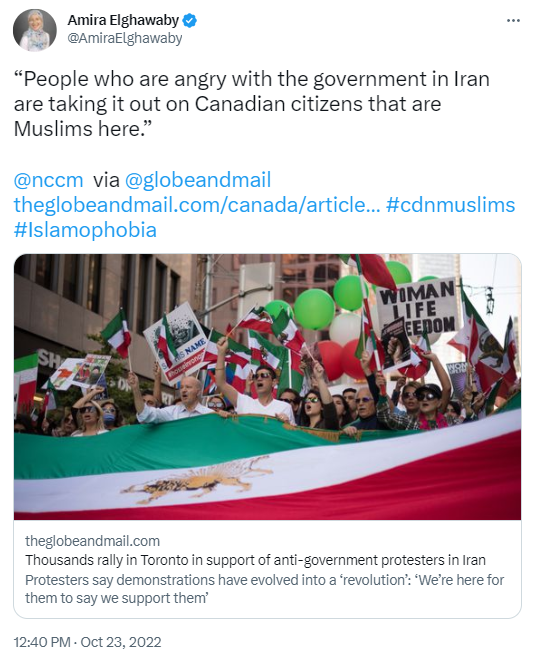
Interestingly, there has also been some pushback by members of the Iranian Canadian community, partly driven by their visceral reaction to the hijab, given that the Iranian regime forced it on women and the recent protests against the mandatory hijab and regime. Kaveh Shirooz has been active on twitter pointing out that Elghawaby has argued that “People who are angry with the government in Iran are taking it out on Canadian citizens that are Muslims here,” rather than criticizing the Iranian regime for its repression (Google search does not show any other commentary on the Iran protests unless I missed it).
I suspect that her appointment may be more divisive within the Canadian Muslim community than might first meet the eye, between the more secular and more religious.
Will be interesting to see whether these reactions continue or fade out:
.@HonAhmedHussen: in 2021, I told the CBC that we need to distinguish between anti-Muslim hatred [obviously bad] and opposition to Islam as an ideology [which is everyone’s right]. This was Ms. @AmiraElghawaby‘s reply. Will she make that distinction in her new role? twitter.com/HonAhmedHussen…
.@HonAhmedHussen I note that as people were (and continue to be) slaughtered in Iran for the right to live free of religion, this was Ms. @AmiraElghawaby ‘s contribution. I’ve been close the protests in the diaspora: to suggest that targetting Muslims represents anything but the absolute most minor fringe in these protests is absolutely dishonest. And yet that’s what Ms. Elghawaby chose to focus on. This was a poor choice, Minister.
Lisée: “I want to puke”
Elle m’a eu au mot « vomir ». En anglais, puke. Je parle d’Amira Elghawaby, la nouvelle conseillère spéciale de Justin Trudeau en matière d’islamophobie et d’antiracisme. C’était il y a huit mois. Le Globe and Mail avait mis sur son fil Twitter le texte d’opinion d’un professeur de philosophie de l’Université de Toronto, Joseph Heath, affirmant que les concepts utilisés par les militants antiracistes canadiens, importés des États-Unis, ne pouvaient s’appliquer correctement à l’histoire canadienne du racisme.
Mme Elghawaby a commenté le tweet, choisissant et retranscrivant spécifiquement le passage qui suit : « Enfin, il convient de noter que le plus grand groupe de personnes dans ce pays qui ont été victimes du colonialisme britannique, subjugué et incorporé à la confédération par la force, sont les Canadiens français. » Au-dessus de cette citation, la militante a écrit : « I’m going to puke » (« Je vais vomir »).
Croyez-moi, j’ai tenté de trouver une autre explication. Mais la seule qui s’impose est la suivante. Mme Elghawaby était à ce point outrée que quelqu’un rappelle qu’en nombre, sinon en intensité, les francophones ont été les plus grandes victimes du colonialisme que sa réaction ne fut ni de contre-argumenter, ni d’affirmer Lison désaccord, ni d’ignorer simplement ce point de vue. Non. Elle a souhaité que tous ses abonnés sachent que la seule évocation de l’importance de l’oppression vécue par les Canadiens français lui causait une violente réaction, physique — au sens propre, « viscérale » — de rejet.
Justin Trudeau, qui était fier de présenter sa nouvelle recrue dimanche à la commémoration de l’horrible tuerie de la mosquée de Québec il y a six ans, a déclaré qu’elle était la personne choisie pour « bâtir des ponts avec les Québécois et les autres Canadiens ». Si c’est vrai, on aimerait avoir la liste de ceux qui n’ont pas été retenus. Don Cherry ? Amir Attaran ?
Pablo Rodriguez qui est, comme l’a dit récemment M. Trudeau au sujet d’un autre de ses ministres, un « bon Québécois », s’est déclaré « profondément insulté et profondément blessé » par un autre propos formulé par écrit par Mme Elghawaby. En effet, dans un texte, toujours en ligne, dans l’Ottawa Citizen, cosigné par l’ex-président de la section ontarienne du Congrès juif canadien Bernie Farber et s’opposant à la loi 21, on lit : « Malheureusement, la majorité des Québécois semblent influencés non pas par la primauté du droit, mais par des opinions négatives envers l’islam. Un sondage réalisé par Léger Marketing plus tôt cette année a révélé que 88 % des Québécois qui avaient des opinions négatives sur l’islam appuyaient l’interdiction. » (Je dois avouer que j’ai moi-même des opinions négatives envers le christianisme, l’islam et toutes les autres religions.)
Cela voulait-il dire que Mme Elghawaby estimait que les Québécois sont islamophobes, selon le mot désormais accepté à Ottawa et qui signifie à la fois sentiment anti-musulman et toute critique de l’islam, quelle qu’elle soit ? Mais non ! Qu’allez-vous chercher là ? Sur son fil Twitter, la dame nous a rassurés vendredi dernier : « Je ne crois pas que les Québécois sont islamophobes ; mes commentaires passés faisaient référence à un sondage au sujet de la loi 21. » Affirme-t-elle maintenant que ce sondage était fautif ? A-t-elle de nouvelles données ?
Si elle s’est trompée dans ce texte, elle a récidivé dans un autre, de 2020, du Toronto Star. Après avoir cité un membre de la communauté musulmane de Québec, Rachid Rafah, affirmant qu’« au Québec, les gens ne peuvent pas admettre qu’il y a des problèmes dans cette société. Je ne sais pas pourquoi ». Elle ajoute : « Il n’y a pas que la plupart des Québécois qui sont dans le déni », trop de Canadiens le sont aussi.
Si on prend le temps de lire ses écrits un peu plus vieux, on ne peut que déceler une constante dans son appréciation des Québécois, superbement étalée dans ce texte de 2013 du Star sur la charte des valeurs. Elle cite d’abord le livre A Fair Country, de John Ralston Saul : « Dans tout le monde occidental dans la seconde moitié du XIXe siècle, les civilisations de la classe moyenne, enchaînées et obsédées par l’empire ont progressivement glissé vers les peurs paranoïaques du XXe siècle. Peur de quoi ? Peur de la perte de pureté — sang pur, pure race, purs traits nationaux et valeurs et liens. »
Son commentaire : « Il aurait pu écrire cela au sujet du Québec d’aujourd’hui. Les sondages favorables à la charte indiquent que [Pauline] Marois a puisé dans une paranoïa viscérale de l’autre qui hante parfois les communautés avec un effet tragique. » Elle se désole ensuite que certains se résignent à ce que « la province ne changera jamais, restant un bastion forcé et statique de la culture et de l’identité françaises ; un rêve partagé qui nie le rôle et la présence des Premières Nations au départ, et celles des minorités qui sont venues plus tard ? ».
Plus près de nous, son texte de l’Ottawa Citizen recèle une autre pépite. Elle y donne un avis bien senti, spécifiquement sur François Legault : « Le premier ministre de la province continue de nier l’existence de l’islamophobie, y compris les expériences des Québécoises qui disent avoir ressenti un racisme croissant au cours des derniers mois. Les politiciens qui flattent les tendances xénophobes doivent être appelés sur le tapis. » Bang !
Avis à ceux qui assisteront à leur première rencontre : apportez vos sacs à vomir.
Interprétant de façon abusive un sondage sur l’attitude des Québécois à l’égard de l’islam, Amira Elghawaby a écrit en 2019 que « la majorité des Québécois semblaient influencés non pas par la primauté du droit, mais par un sentiment antimusulman ». Il est difficile de savoir ce qui est pire : que les Québécois s’opposent à la règle de droit ou qu’ils soient antimusulmans. On peut constater que la représentante spéciale, pur produit de l’idéologie multiculturaliste canadienne, a pris quelques libertés avec les faits. Le communiqué du premier ministre la décrit d’ailleurs comme une journaliste primée et une militante, comme s’il n’y avait pas là contradiction dans les termes.
Un passage d’une chronique publiée dans The Globe and Mail par le professeur de philosophie Joseph Heath, de l’Université de Toronto, lui a donné envie « de vomir », avait-elle écrit spontanément sur Twitter en 2021. Un passage où l’universitaire faisait observer que le plus grand groupe de personnes qui furent victimes du colonialisme britannique au Canada, c’étaient les Canadiens français.
La thèse de Joseph Heath est pourtant intéressante. Il relève qu’au Canada anglais, on utilise l’acronyme américain BIPOC (Black, Indigenous and people of color), qui ne correspond à la réalité canadienne des relations raciales. Aux États-Unis, les Noirs représentent la minorité raciale la plus importante, et de loin, que ce soit en nombre ou en raison de son poids historique. Dans l’énumération, les Autochtones, qui représentent 5 % de la population canadienne, devraient venir avant les Noirs, qui sont trois fois moins nombreux, et les francophones avant les Autochtones en raison de leur nombre. Donc, au lieu de l’acronyme américain BIPOC, le professeur Heath propose l’acronyme FIVM (pour Francophone, Indigenous and visible minority) pour désigner les plus importants groupes minoritaires au Canada. Il souligne que contrairement aux États-Unis, où on analyse les conflits sociaux à travers « une lentille raciale », le Canada n’a pas cherché à « racialiser » les différences ethniques entre ses citoyens. L’idée qu’un immigrant débarquant au Canada en provenance d’Éthiopie a vraiment quelque chose en commun avec un descendant d’esclaves africains présents sur le continent depuis 300 ans est « non seulement une fiction : c’est une fausse représentation pernicieuse ».
Il faut croire que l’influence américaine est forte puisque, dans le communiqué du premier ministre, la description de tâches de cette nouvelle représentante spéciale amalgame la religion — la lutte contre l’islamophobie — au racisme systémique et à la discrimination raciale.
Certains voudraient qu’Amira Elghawaby s’excuse — c’est le cas du chef parlementaire du Parti libéral du Québec, Marc Tanguay — ou retire ses propos. Mais ce ne serait là que parfaite hypocrisie. La représentante spéciale du Canada incarne un courant de pensée fort répandu au Canada anglais, où l’on est viscéralement contre la conception québécoise de la laïcité et de l’équilibre recherché entre différents droits qui, dans une société, peuvent entrer en conflit.
Au débat des chefs en anglais, lors de la dernière campagne électorale fédérale, la question posée au chef du Bloc québécois, Yves-François Blanchet, dont la prémisse était que « le Québec a un problème de racisme » parce que le gouvernement caquiste a fait adopter la loi 21 sur la laïcité et la loi 96 sur la langue témoignait de ce consensus au Canada.
On peut être en désaccord avec des aspects de la Loi sur la laïcité de l’État — c’est la position du Devoir, d’ailleurs —, mais ce n’est pas une loi xénophobe ni antidémocratique. Comme le soulignait le juge Robert M. Mainville dans une décision partagée de la Cour d’appel du Québec sur une requête interlocutoire demandant la suspension de la loi 21 (présentée par l’ancien employeur d’Amira Elghawaby, le National Council of Canadian Muslims), « la conception de la symbolique religieuse et sa place dans l’espace public ne sont d’ailleurs pas perçues de façon identique par chaque société, la Loi sur la laïcité de l’État en est un exemple frappant au sein du Canada ». Et encore : « On peut constater que la question de l’égalité des sexes en regard du foulard islamique ne se prête pas à des réponses simples ou évidentes. »
Justin Trudeau a dit que la nouvelle représentante resterait en poste. Soit. Mais puisqu’elle crache (ou vomit) sur la société québécoise, que, manifestement, elle méconnaît, qu’elle reste chez elle. Le phénomène de l’islamophobie au Canada anglais devrait amplement l’occuper.
Il serait absurde de nier que l’islamophobie, tout comme le racisme, existe au Québec, au même titre qu’ailleurs au Canada et un peu partout sur la planète. Le premier ministre Legault convient lui-même que nous ne sommes pas à l’abri de ces maux, même s’il réfute leur caractère systémique.
Cela dit, non seulement le raccourci pris par Amira Elghawaby pour affirmer que « la majorité des Québécois » est animée par un sentiment anti-musulman était insultant, mais il témoignait au surplus d’une malhonnêteté intellectuelle qui ne plaide pas en faveur de la nouvelle représentante spéciale du gouvernement Trudeau dans la lutte contre l’islamophobie.
S’il était vrai, comme l’indiquait un sondage Léger, que 88 % des islamophobes appuyaient la Loi sur la laïcité de l’État (loi 21), on ne pouvait pas inverser la proposition et affirmer que la majorité des partisans de la loi étaient islamophobes. Mme Elghawaby a parfaitement le droit de ne pas aimer la loi 21 et de la combattre, mais cela ne l’autorise pas à faire un procès d’intention aussi gratuit qu’injuste à ceux qui la soutiennent.
Même si on voulait lui donner le bénéfice du doute en invoquant un manque de disposition pour les mathématiques, elle a tenu dans le passé d’autres propos qui laissent peu de doute sur les sentiments qu’elle éprouve envers le Québec.
Le député péquiste des Îles-de-la-Madeleine, Joël Arseneau, s’est montré passablement indulgent en parlant d’une « incompréhension » de la société québécoise. Cela ressemble davantage à une détestation. Même le ministre fédéral du Patrimoine, Pablo Rodriguez, s’est dit « blessé et choqué comme Québécois ». C’est dire. • • • • • On ne peut pas s’opposer à la vertu. Toute mesure visant à lutter contre l’islamophobie et à faciliter l’intégration des musulmans à la société canadienne est assurément la bienvenue.
La question est de savoir pourquoi Justin Trudeau a choisi une militante « pure et dure » comme Mme Elghawaby pour occuper un emploi qui va exiger beaucoup de doigté pour favoriser les rapprochements, au Québec comme dans le reste du pays. Lancer des anathèmes n’est assurément pas la meilleure façon d’y parvenir.
Les « clarifications » qu’elle a apportées n’ont pas satisfait le gouvernement Legault, qui exige son départ, mais M. Trudeau est tout disposé à s’en contenter. D’ailleurs, il l’aurait nommée de toute façon, a-t-il reconnu. S’il a pu être agacé par la maladresse de sa recrue, le fond de ses déclarations ne l’a manifestement pas troublé.
Le premier ministre et Mme Elghawaby partagent la même aversion pour la loi 21. Dans l’exercice de ses nouvelles fonctions, elle persistera sans doute à dire tout le mal qu’elle en pense, avec la bénédiction de son patron. M. Trudeau aurait voulu jeter de l’huile sur le feu qu’il n’aurait pas pu faire un meilleur choix.
Toute attaque contre la loi 21 provoque maintenant une réaction épidermique chez M. Legault, comme on l’a vu encore dernièrement quand son homologue canadien a réitéré son intention de la contester et de limiter l’utilisation préventive de la disposition de dérogation.
Dimanche, il brillait par son absence lors de la commémoration du massacre de la grande mosquée de Québec. Il n’avait sans doute pas très envie d’entendre les porte-parole du Centre culturel islamique lui reprocher une loi qui « vient chambarder tout ce qu’on fait comme travail pour le vivre-ensemble ». • • • • • L’indignation provoquée par la nomination de Mme Elghawaby rappelle celle qui avait accueilli, en janvier 2021, la nomination de la géographe Bochra Manaï au poste de commissaire à la lutte et à la discrimination systémiques à la Ville de Montréal, Mme Manaï ayant été précédemment porte-parole du Conseil national des musulmans canadiens.
M. Legault avait aussi qualifié cette nomination d’« erreur » en raison de la « croisade personnelle » de Mme Manaï contre la loi 21 qui, selon elle, avait fait du Québec « une référence pour les suprémacistes extrémistes ».
Le chef du Parti québécois, Paul St-Pierre Plamondon, avait déploré que la mairesse Plante utilise des fonds publics pour « imposer son idéologie » et prédit que la nouvelle commissaire allait semer la division. Manifestement, ses propos étaient insultants. Depuis deux ans, on n’a cependant entendu personne se plaindre de son travail.
Il est sans doute de bon ton de réclamer le départ de Mme Elghawaby, mais il est clair que M. Trudeau ne reviendra pas sur sa décision. Dès lors, la meilleure attitude à adopter est peut-être celle du chef du Bloc québécois, Yves-François Blanchet, qui a réclamé une rencontre avec la représentante spéciale.
Sans se faire trop d’illusion sur son acte de contrition, le chef du Bloc se dit prêt à entendre de plus amples explications. Qui sait, lui-même pourra peut-être lui expliquer certaines choses qu’elle ignore sur le Québec. Il sera toujours temps de déchirer sa chemise si elle ne veut toujours pas comprendre.
Of interest and relevance given the demographics. Will be interesting to see the performance measures that assess the effectiveness of the strategy:
Six years ago, a school board west of Toronto was making headlines for all the wrong reasons.
Security had to be stepped up after racist outbursts at board meetings, a man was filmed tearing pages out of a Qur’an during discussions about religious accommodations, and Muslim students were told they would have to choose from sermons approved by the board for their Friday prayers.
Today, the Peel District School Board (PDSB) is the first in Canada to adopt a strategy aimed at dismantling Islamophobia and affirming the identity of Muslims students, who comprise the largest reported faith-based identity at the board — about a quarter of its student population.
And the timing isn’t without significance, said the National Council of Canadian Muslims.
“The PDSB has set a tremendous example with this anti-Islamophobia strategy that other school boards across the country would be wise to study, examine and follow,” the council’s education director, Aasiyah Khan, said in a news release.
‘Historic step forward’
“It’s really fitting that this announcement is being made in the lead-up to the sixth anniversary of the Quebec City shooting, which really changed this country,” she added. “This is a historic step forward.”
The announcement comes after a 2020 review by Ontario’s Ministry of Education found anti-Black racism to be a significant challenge at the board. The board also noted “blatantly Islamophobic resources and teaching materials” had been used in classrooms, affecting the well-being of Muslim students and staff, in a report dated Wednesday.
The anti-Islamophobia strategy sprang from a motion put forth by former PDSB trustee Nokha Dakroub in September 2021 that proposed, in part, anti-Islamophobia training for all board staff members.
The strategy relies largely on the definition of Islamophobia created by the Ontario Human Rights Commission, namely: “stereotypes, bias or acts of hostility towards individual Muslims or followers of Islam in general. In addition to individual acts of intolerance and racial profiling, Islamophobia leads to viewing Muslims as a greater security threat on an institutional, systemic and societal level.”
“These systemic attitudes foster an unwarranted culture of suspicion and surveillance of Muslims and the Muslim community,” the board says, pointing to the example of a cash reward being offered to surveil Muslim students at Friday prayers in schools.
Strategy outlines 6 key pillars
The board’s plan also notes Islamophobia often intersects with other forms of oppression including racism, such as anti-Black and anti-Palestinian racism, sexism, anti-LGBTQ hate and systemic oppression.
The strategy, developed with input from the NCCM, the Council of Agencies Serving South Asians and the Urban Alliance on Race Relations, lists six key pillars for the board to work on:
Building capacity to implement the strategy.
Affirming and celebrating Muslim identities, including using resources that acknowledge Muslim contributions across subjects like math, science, history and the arts to “counter the erasure of Muslim identity in the historically Eurocentric curriculum.”
Creating learning and working environments to intentionally disrupt Islamophobia, including annual mandatory anti-Islamophobia training for staff and establishing prayer or contemplation spaces for staff or student use.
Foster meaningful engagement with Muslim communities, including partnerships with community agencies and ensuring culturally appropriate referrals to services.
Supporting the mental health and well-being of Muslim students and staff, such as by recognizing Muslim beliefs and practices can differ between individuals and groups and creating “safe spaces” for groups such as Muslim Students Associations.
Implementing responsive hiring and supportive measures, including supporting the advancement of racialized employees into leadership roles.
‘Calls almost every day’ over Islamophobia in schools
In a news release, Khan added anti-Muslim hate is an issue that endures in schools even today.
“We’ve gotten calls almost every day for the last few weeks about horrific issues relating to Islamophobia in our schools, some violent, and some systemic.”
Samya Hasan, executive director of the Council of Agencies Serving South Asians, experienced that kind of anti-Muslim discrimination firsthand as a student and said it can lead to Muslim youth questioning their identity having low self-esteem.
“We’ve heard from hundreds of youth, and their parents, about stories of things like being called a terrorist, or girls, having their hijabs pulled off from their heads, or being dismissed by teachers in the school system … And not to speak of tons of microaggressions that happen on an everyday basis.”
That, in part, is why the strategy also commits to collecting data to measure its success.
Those metrics will measure the percentage of Muslim students who feel their school is a safe and inclusive environment, for example, as well as the number of human rights complaints made to the board’s human rights office, hate incidents and Muslim staff members’ well-being.
“The development of a strategy to affirm Muslim identities and dismantle Islamophobia is only the first step in an ongoing journey,” the board said in its strategy document.
“Fostering an environment that is free from Islamophobia will require the efforts of all members of the PDSB community to meaningfully engage in this important work”
News of the strategy comes as Canada marked another first.
On Thursday, Prime Minister Justin Trudeau announced the appointment of Amira Elghawaby as Canada’s first special representative on combating Islamophobia. Elghawaby will advise the federal government on how to better fight discrimination against the Muslim community.
Of note, she has recently been a regular commentator at the Star:
Prime Minister Justin Trudeau has announced the appointment of Canada’s first special representative to combat Islamophobia.Amira Elghawaby, a journalist and human rights advocate, will serve as an advisor and expert as the federal government works to fight religious intolerance and systemic racism.
In a news release today, Trudeau says he is looking forward to working with Elghawaby, and calls her appointment an “important step” to combat Islamophobia and build a country where everyone is respected.
Speaking at an event to mark her appointment, Elghawaby says she is deeply honoured and humbled to serve the Muslim community in the new role.
She says the position was created to address a “painful, even deadly reality of Islamophobia in this country” and that despite the ideal of multiculturalism, Islamophobia, antisemitism, anti-Black and anti-Indigenous racism continue to be present in Canadian society.
Ahmed Hussen, the federal Diversity and Inclusion minister, says the special representative will be supported by staff.
Legitimate lawsuit and university admin having to scramble:
A former art instructor who showed images of the Prophet Muhammad in class has sued Hamline University, saying administrators defamed her and reneged on an offer to teach in the spring semester.
Attorneys for Erika López Prater announced Tuesday that she had sued the university for defamation, religious discrimination and breach of contract, among other things. Less than two hours later, the university’s president and board chair said in a joint statement that they had “learned much” about Islam and that the previous decision to describe the incident as Islamophobic was “flawed.”
The St. Paul private college found itself at the center of a painful debate over academic freedom and religious tolerance this month as news of the university’s decision not to renew López Prater’s contract spread across the globe. Instructors rallied around López Prater, saying the university’s decisions could have a chilling effect on professors who teach controversial material. A prominent local Muslim organization supported administrators, saying they had to act to protect students with diverse religious beliefs while a national Muslim group said it didn’t consider the teacher’s conduct wrong.
Scholars and religious leaders have sometimes disagreed about whether Islam permits images of the Prophet Muhammad. Some Muslims argue that the images are strictly prohibited to avoid idolization. Others have images of the prophet in their homes.
During a class in October, López Prater showed two centuries-old artworksthat depict the prophet receiving revelations from the angel Gabriel that would later form the basis for the Qur’an. López Prater said she provided a disclaimer in the syllabus for the course and spent “at least a couple minutes” preparing students for the images. One of her students, Aram Wedatalla, president of the Muslim Student Association, said she heard the professor give a “trigger warning,” wondered what it was for “and then I looked and it was the prophet.”
In the lawsuit, attorneys for López Prater said she shared her syllabus with a department chair and others at Hamline University and no one raised concerns about her decision to show the images.
“Students viewing the online class had ample warning about the paintings,” wrote attorney David Redden. “Students viewing the online class also had ample opportunity to turn away from their computer screens, turn their screens away from them, turn off their screens, or even leave their rooms before the paintings were displayed.”
Redden wrote that a department leader initially told López Prater “it sounded like you did everything right.”
A few weeks later, she received an email informing her that the university would no longer offer the spring semester online art history class she’d been in discussions about teaching. In early November, the university’s Office of Inclusive Excellence sent a campus email saying actions taken in her class were “undeniably inconsiderate, disrespectful and Islamophobic” — a statement disputed by some Muslim scholars and advocacy groups.
Redden wrote that Hamline University had made López Prater a “pariah,” quashed dissent from others seeking to support her, and allowed people to defame her in the student newspaper and during a “Community Conversation” event discussing Islamophobia in December. He accused the university of violating its own policy on academic freedom and of discriminating against López Prater “because she is not Muslim, because she did not conform her conduct to the specific beliefs of a Muslim sect, and because she did not conform her conduct to the religion-based preferences of Hamline that images of Muhammad not be shown to any Hamline student.”
Throughout it all, Redden wrote, López Prater “suffered immediate, severe, and lasting emotional distress, including various physical manifestations of that distress.”
The university declined to comment on the lawsuit Tuesday night. In a joint statement, university President Fayneese Miller and board Chair Ellen Watters didn’t discuss the lawsuit but said the flurry of news coverage had prompted them to “review and re-examine” the university’s response.
“Hamline is a multi-cultural, multi-religious community that has been a leader in creating space for civil conversations. Like all organizations, sometimes we misstep,” the pair wrote.
“In the interest of hearing from and supporting our Muslim students, language was used that does not reflect our sentiments on academic freedom. Based on all that we have learned, we have determined that our usage of the term ‘Islamophobic’ was therefore flawed,” they wrote. “We strongly support academic freedom for all members of the Hamline community. We also believe that academic freedom and support for students can and should co-exist.”
The university said it will host two events in the coming months: One will focus on academic freedom and student care, and the other on academic freedom and religion.

 Multicultural Meanderings