Political typology: Race and discrimination, opinions about immigrants and Islam | Pew Research Center

As always, Pew’s findings, broken down by political leaning, are of interest and highlight just how divided the United States is on these issues:

Views of immigrants and nation’s ‘openness’

When it comes to attitudes about immigration, Democratic-leaning groups hold almost universally positive attitudes toward immigrants and support the idea of America being open to people from all over the world. Virtually all Solid Liberals say that immigrants strengthen the society and that openness is “essential” to America’s identity as a nation (99% each).

The only group on the political left that holds ambivalent views of immigrants is Devout and Diverse, a group that is racially and ethnically diverse and also has the lowest family incomes and levels of educational attainment of any typology group.

The Republican-leaning groups are sharply divided in views of immigrants and the nation’s openness to people from around the world. About three-quarters of Country First Conservatives (76%) say immigrants are a burden on the country – the largest share of any typology group. Country First Conservatives also are most likely to say that the U.S. risks losing its identity as a nation if it is too open to people from around the world (64% say this).

Compared with Country First Conservatives, Core Conservatives and Market Skeptic Republicans have more divided views of immigrants and whether too much openness risks the nation’s identity. New Era Enterprisers have the most positive views among Republican-leaning groups: 70% view immigrants as a strength and 65% say America’s openness is “essential to who we are as a nation.”

Islam and violence

A large majority of Core Conservatives (79%) say Islam is more likely than other religions to encourage violence among its followers.

And roughly the same percentage of Solid Liberals (83%) say Islam does not encourage violence more than other religions.

The views of other typology groups divide along partisan lines, with one exception. As with views of immigration, Devout and Diverse differ from other Democratic-leaning groups in their views of Islam and violence.

Devout and Diverse are divided – 47% say Islam is more likely to encourage violence, 44% say it is not – while sizable majorities in other Democratic groups say Islam does not encourage violence more than other religions.

New to Canada, struggling to find work: Integration programs

Role of the community colleges in integration:

It is no coincidence that Canadian colleges go to great lengths to welcome and prepare immigrant students for school and work.

Immigration is key in helping soften the effects on the labour force of the aging population, an important element of long-term economic growth, according to the Conference Board of Canada’s report, A long-term view of Canada’s demographics, released in October, 2016.

Bridging, pre-arrival, and other programs and services are particularly important for immigrant students, who, compared with international students (those in the country on study permits but who also may apply to immigrate to Canada), tend to be older, have more extensive education and work backgrounds, and are also permanent residents, notes Alex Irwin, director of George Brown’s School of Immigrant and Transitional Education (SITE).

Along with the one-year college teachers training program that Ms. Shokry and Mr. Kabir have completed, SITE offers bridging programs in nursing and construction management.

Among other Canadian colleges with prominent immigrant programs and services is Red River College, which has campuses in Winnipeg and other areas of Manitoba, and this year has nearly 1,360 immigrant students who are permanent residents.

“Our goal is to support immigrants to Manitoba with a holistic approach throughout their entire student life cycle, and we have a large suite of programs and services across different departments and areas to work toward this goal,” Nora Sobel, manager of diversity and intercultural services at Red River, said in an e-mail interview.

Red River recruits students from other countries to aid in boosting Manitoba’s skilled labour shortages, the school’s website says. In the spring, for instance, the college launched a pathway program to construction skills, starting with 20 students from countries such as Syria, Sudan and the Democratic Republic of Congo. Also on campus, Red River’s Diversity and Intercultural Services department helps organize the annual welcome party for immigrant and international students, and offers services, including financial aid information sessions.

Many programs don’t just delve into the fine points of the jobs themselves; they also give immigrant students insight into the “cultural norms and social cues in the workplace,” notes Mr. Irwin.

He gives this example: “The Canadian workplace can be seen as more casual, but there are a lot of social clues we take for granted that have to be learned if you’re new to the country, like what to call your boss. Calling someone ‘sir’ may not be appropriate in Canada.”

Prominent among pre-arrival programs is a one-day orientation and information session called Planning for Canada, which is offered free, both online and in person, in countries including India, China and the Philippines.

The federally funded program was launched in October, 2015, and is jointly run by the Canadian Immigrant Integration Program (CIIP, a program of Colleges and Institutes Canada) and Canadian Orientation Abroad (a program of the International Organization for Migration).

Planning for Canada has teamed with dozens of organizations (including the YMCA, the Immigrant Access Fund, and employment, tourism and nursing interests) as well as colleges that help students to plan their journeys to Canada.

Partner colleges include Red River, George Brown, Bow Valley College in Calgary, Vancouver Community College, and Parkland College, with campuses in Saskatchewan.

One goal of Planning for Canada is to “dispel any misunderstanding or misconceptions earlier in the [immigration] process,” says CIIP director Holly Skelton.

She says a bulk of immigrants are chosen to come to Canada based on their high levels of academic achievement, yet one common misunderstanding is that credentials earned in another country will be recognized fully in Canada.

“We’re there to provide a reality check and provide information they need to take action right away, before they come, so they can hit the ground running and don’t waste time,” says Ms. Skelton.

Source: New to Canada, struggling to find work – The Globe and Mail

Migrants: Ottawa doit payer pour les «invités de Trudeau», selon Lisée

A bit rich given that Quebec currently receives a block grant of $345 million for its role in immigrant selection and settlement, over double the budget of their Ministère de l’immigration, diversité et inclusion of $150 million:

Le Québec n’a pas à payer pour les «invités de Justin Trudeau», les milliers de demandeurs d’asile en provenance des États-Unis, a déclaré le chef péquiste Jean-François Lisée lundi.

Il a réclamé qu’Ottawa assume tous les coûts de cet afflux de migrants d’origine haïtienne aux frontières. Actuellement, le Québec paie pour les héberger, les nourrir, en plus de distribuer des chèques d’aide sociale.

En conférence de presse en matinée à Saint-Augustin, en banlieue de Québec, M. Lisée a rappelé que le premier ministre fédéral avait souhaité «welcome to Canada» (bienvenue au Canada) aux personnes persécutées de par le monde.

Donc, selon le chef péquiste, la situation actuelle est «le résultat des déclarations irresponsables» de Justin Trudeau.

«Il faut qu’ils (ces demandeurs d’asile) soient bien traités, ça c’est certain. Mais la question, c’est: combien ça va coûter et qui va payer? a demandé M. Lisée. Depuis quelques jours on essaie de savoir quelle sera la compensation fédérale pour ces invités de Justin Trudeau.»

Le chef de l’opposition officielle a également rappelé que le Québec accueille bon an mal an 3000 à 4000 demandeurs d’asile, mais qu’au-delà de ce seuil normal, Ottawa devrait payer la facture, les coûts d’hébergement temporaire, d’aide sociale, d’éducation, etc.

«Si j’étais premier ministre (du Québec), je commencerais à faire mes comptes (…), c’est au fédéral de payer ce que ça va coûter en plus et je n’entends pas M. Couillard dire ça.»

M. Lisée estime qu’il brise «un tabou» en soulevant cette question que beaucoup de gens se posent, selon lui: «L’argent qu’on va mettre là, on va le prendre où? Ça ne pousse pas dans les arbres, on vient de vivre trois ans d’austérité libérale très sévère.»

Réaction de Philippe Couillard

Le premier ministre Philippe Couillard a réagi depuis Charlottetown à l’Île-du-Prince-Édouard, où il assistait à la Conférence annuelle des gouverneurs de la Nouvelle-Angleterre et des premiers ministres de l’Est du Canada.

Il a jugé que les termes «invités de Justin Trudeau» étaient «assez malheureux», en ajoutant que «tout le monde travaille ensemble, avec ses responsabilités et ses outils».

Appelée à préciser la répartition actuelle des responsabilités financières, la porte-parole de la ministre de l’Immigration Kathleen Weil, Émilie Tremblay-Potvin, a évoqué dans une entrevue les ententes qui existent déjà entre Québec et Ottawa sur les services sociaux et la santé, sans pouvoir donner de chiffres précis.

Elle a toutefois indiqué qu’une «comptabilisation est faite pour l’instant», qui pourrait servir à faire des «représentations» ultérieurement à Ottawa.

Source: Migrants: Ottawa doit payer pour les «invités de Trudeau», selon Lisée | Patrice Bergeron | Politique québécoise

Douglas Todd: Canada struggling to ‘absorb’ immigrants, report says

Good account by Douglas Todd on one of the more thoughtful CIC policy decks  (possibly part of pre-2015 election transition planning given the date of June 2014). Lexbase was kind enough to provide me with a copy.

While some of the issues identified – housing, healthcare, public transit – affect both immigrants and non-immigrants, the deck provides a good overview of the main issues, identifies data gaps particularly at the local and municipal level and proposes an absorptive capacity index to help inform future levels planning (unclear whether this is being pursued):

Immigration, Refugees and Citizenship Canada officials are digesting a significant report that defines absorptive capacity as “a two-way process that encourages adjustment on the part of both the newcomer and the receiving society.”

Indeed, the internal report, obtained under an access to information request, shows that immigration analysts are worried that the “absorptive capacity” of Canada is going down.

“Declining outcomes of recent immigrants have shown that integration is not automatic,” says the report, which surveys emerging problems with immigration flows and the pressure it’s putting on Canadian sectors.

While some Canadians behave as if it’s xenophobic to question immigration policy, immigration rates and their results, the sweeping in-house government report, titled Evidence-Based Levels and Mix: Absorptive Capacity, does exactly that.

The report, obtained by Vancouver lawyer Richard Kurland, shows integration of immigrants into Canada, despite relative success here compared to most countries, is faltering ­– in regards to housing, jobs, health care, education, religious tensions, ethnic enclaves and transit.

With Canada now accepting 300,000 immigrants a year, in addition to accommodating 700,000 international students and temporary foreign workers, the 2014 report, which has no listed author, recognizes real problems. It wants policy makers to adapt.

Assimilation has been largely superseded by the word “integration” [always has been integration].And now Canadian government immigration officials are talking about a new concept: “absorptive capacity.”

Some pivotal points:

Immigrants are struggling with housing
Like millions of Canadian-born residents, immigrants are battling to afford adequate housing, especially in major cities. They face particular barriers because of their larger household sizes.

Many immigrants, however, do well in housing after a decade, though with risk.

Immigrant “home ownership rates rise significantly with time spent in Canada and surpass that of the native-born after 10 years in Canada, (but) newcomers tend to risk more capital and spend more of their income on housing costs, making them more vulnerable to market fluctuations.”

Language gaps are expanding

Despite language requirements for immigrants and the availability of free language classes in Canada, many may not be learning English or French nor passing it onto their young children.

The study found that in one large school district in Metro Toronto [Peel], three out of 10 children needing ESL training were born in Canada.

Language limitations also create obstacles in Canadian workplaces. “Skilled immigrants face labor market integration challenges such as limited language proficiency.”

Immigrants have difficulties getting health care

“Waiting for care is the number one barrier to access, although this problem is not specific to the immigrant community, as Canadians also mention long wait times as a critical problem,” says the report.

Immigrants are not dispersing across the country

Two out of three immigrants move to Toronto, Montreal or Vancouver.

That means immigrants are almost 2.5 times more concentrated in Canada’s three largest cities than is the total population (only 27 per cent of whom live in these cities).

Despite a phrase often heard in discussion of immigration — “Canada is a large country” — the study makes clear “absorptive capacity” is being tested almost entirely in our large cities. And virtually no city-by-city data exists on how that’s working out.

Ethnic enclaves are expanding

There is a strong tendency for newcomers to settle with members of their own ethnicity in the core of cities and, more recently, their suburbs.

“Residential concentrations of newcomers is a growing concern,” the report says, suggesting self-chosen ethnic isolation can create further barriers to full integration. [Todd somewhat overstates the deck’s observations as the analysis is more nuanced.]

Tensions exist over religious differences

Religious and cultural accommodation continues to be an issue regarding practices that are deemed in conflict with Canada’s institutions,” the report says, naming “forced marriages” and “family violence issues.” [may reflect the then Conservative government focus as these are not accommodation but criminal issues – more common ones being related to religious accommodation such as worship space, food requirements etc].

Transit hassles abound for immigrants

With Metro Vancouver residents debating whether to build a bridge or tunnel on the south arm of the Fraser River, the report shows public transit is a much bigger worry for Canada’s urban and suburban immigrants.

Although transit hassles are significant for all residents of cities such as Metro Vancouver, they’re worse in the suburbs, where many immigrants are moving.

“Recent immigrants are twice as likely to use public transit as their Canadian-born counterparts.”

What’s the way forward?

Despite trying to be frank about Canada’s immigration difficulties, the report notes the country is recognized as “a world leader in creating an environment than enables newcomers to settle and become active, productive and connected citizens.”

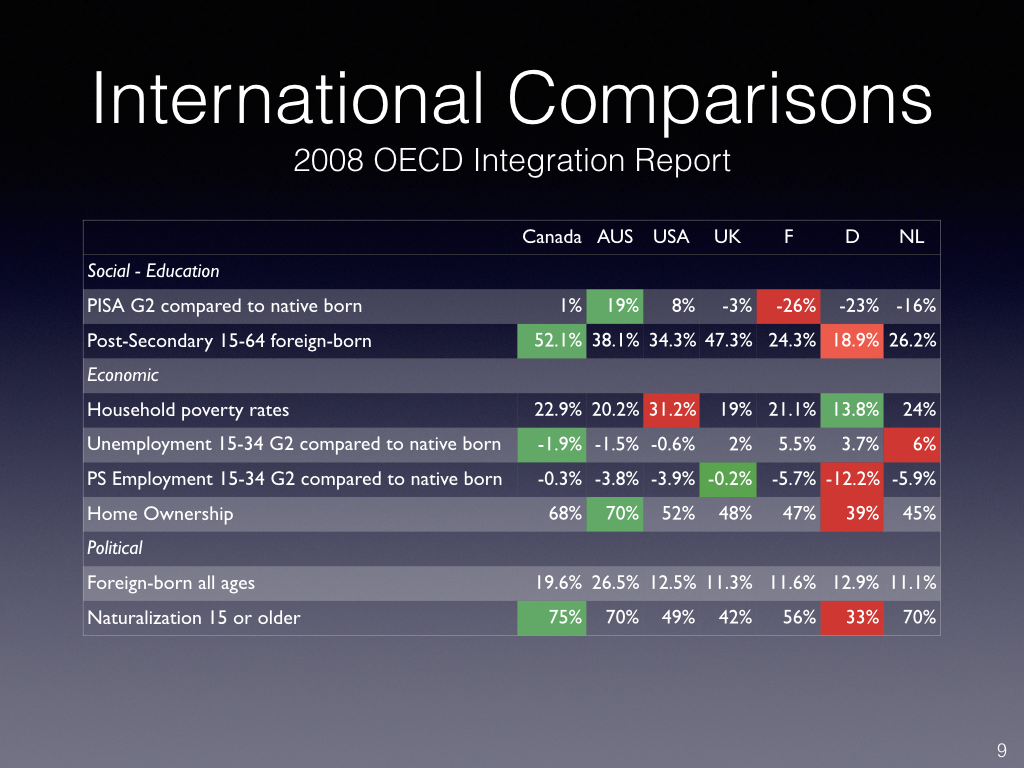
Canada is ranked third out of the 31 countries that welcome immigrants. The Migration Integration Policy Index rates only Sweden and Portugal as doing better at absorbing newcomers.

For obvious reasons, the index doesn’t bother comparing Canada to the majority of the world’s countries, like most of those in Africa and Asia, which either deny entry to any immigrants or allow in a trivial number.

Despite Canada’s strong ranking, the Immigration department’s report notes another disturbing finding, which could have long-term repercussions.

Second-generation visible minority immigrants, compared to first-generation immigrants, are more likely to “perceive” they’ve been subject to discrimination.

Poll results suggesting 43 per cent of Canada’s second-generation visible minority citizens are convinced they’re being treated unfairly may point to an expanding crack in the dream of cultural integration.

As for coming up with better policies, the report makes it clear Immigration officials are often in a fog about the overall effects of large-scale immigration on Canada, not to mention the impact of international students and temporary foreign workers.

There is “no comprehensive stock-taking on how Canadian institutions and cities are adapting” to immigrants and other foreign nationals, says the report. The knowledge vacuum exists across housing, health care, the regional job market, transit and more.

Source: Douglas Todd: Canada struggling to ‘absorb’ immigrants, report says | Vancouver Sun

Canadian exceptionalism: Joseph Heath | In Due Course

Joseph Heath, of UofT’s department of philosophy, in a recent post paints an overly simplistic picture of “Canadian exceptionalism.”

While many of his points are valid, there is a surprising lack of a historical perspective in his treatment of integration and limitations to his analysis of the numbers and politics.

Historical perspective: Heath seems to anchor his post on the shift towards greater support for immigration in the mid-1990s – the inflection point when more people supported immigration than opposed.

But this ignores the longer term factors that are central to Canada’s relative success. First among them is a “culture of accommodation” that, however imperfect, reflects an early accommodation between settlers and First Nations (e.g., Royal Proclamation of 1763) and between French and English settlers (e.g., Quebec Act of 1774). While more observed in the breach than the observance for most of our early history, it nevertheless provided a way of thinking that underlies Canadian discourse.

The emphasis on integration, as distinct from assimilation, emerged in 1959 as Canadian citizenship articulated that integration was a voluntary process, respect for cultural traditions was compatible with loyalty to Canada, and that the host society was ultimately responsible for newcomer acceptance. The “Other groups” chapter of the Bi and Bi Commission provided further elaboration of the integration process.

The “other groups,” such as Ukrainian Canadians, pressed for multiculturalism in order to recognize their distinct identity and contribution to the building of Canada. The end result was the multiculturalism policy of 1971 and Act of 1988.

It was not merely “inadvertently” that Canada ended up being more successful in newcomer integration, but a series of earlier actions and policy choices – immigration, settlement, citizenship and multiculturalism – that enabled us to do so.

Numbers: While Canada does have more diverse newcomers than most other countries at the national level, the same cannot be said at the regional or municipal levels. The various controversies that emerge from time-to-time in places such as Brampton, Surrey or Richmond illustrate that.

Political system:

Similarly, his treatment of how Canada’s political system lacks understanding of the numbers of new Canadian voters and their relative concentration in ridings.

The more fundamental reality is that no political party can win a majority (and would be hard placed to win a strong minority) without the support of new Canadian voters, particularly those in the suburban areas of Toronto (the 905) and Vancouver.

Moreover, he overstates the impact of the first-past-the-post system on the far right given that UKIP, at least in the 2015 election, was able to attract almost 13 percent (but less than two percent in 2017).

Personally, I find Keith Banting’s recent analysis of “Canadian exceptionalism” at a “Big Thinking” Parliament Hill event more convincing (see Big Thinking video).

The five factors of Heath:

1. Very little illegal immigration

2. Bringing people in from all over

3. A political system that encourages moderation

4. Immigrants are part of larger nation-building project

5. Protection of majority culture clear from the start

Source: Canadian exceptionalism | In Due Course

Précarité des jeunes migrants: Ottawa et Québec se font rassurants

Interesting discussion regarding young refugees and the degree to which settlement and related services are adequately meeting their needs:

Tandis que l’organisme Dans la rue constate un nombre grandissant de jeunes nouveaux arrivants en situation précaire, les autorités se font rassurantes quant à l’intégration des immigrants, réfugiés et sans-papiers au

Tandis que l’organisme Dans la rue constate un nombre grandissant de jeunes nouveaux arrivants en situation précaire, les autorités se font rassurantes quant à l’intégration des immigrants, réfugiés et sans-papiers au Canada.

Réunies vendredi à l’occasion d’une soirée-bénéfice pour l’organisme et son nouveau partenariat avec le Haut-commissariat des Nations unies pour les réfugiés (HCR), la ministre fédérale du Développement international, Marie-Claude Bibeau, et la ministre provinciale de l’Immigration, Kathleen Weil, ont surtout imputé ces cas «qui tombent entre les mailles du filet» à des traumatismes vécus par certains demandeurs d’asile dans leur pays d’origine.

La ministre Weil dresse un portrait élogieux de la prise en charge des nouveaux arrivants par le gouvernement, puis par le milieu communautaire et la société civile.

En entrevue avec La Presse canadienne, Marie-Claude Bibeau a pour sa part tenu à souligner qu’avec quelque 46 700 réfugiés réinstallés l’an dernier, le Canada n’en accueille qu’un nombre «relativement modeste».

«J’ai été au Liban et en Jordanie où, dans certaines villes, la population a doublé, a-t-elle illustré. Vous imaginez la pression que ça vient mettre sur les services publics?»

Au-delà de la compassion, l’aide humanitaire relève d’un «enjeu de paix et de sécurité mondiale», a avancé la ministre, dont les propres parents avaient accueilli une famille de Vietnamiens à l’époque de la vague de «boat people».

Mme Bibeau rétorque en outre à ceux qui remettent en question l’utilité de l’aide humanitaire que celle-ci permet d’éviter que des conflits prennent de l’ampleur et exacerbent la crise des migrants.

La ministre Weil renchérit qu’il s’agit d’un enjeu qu’il faut approcher «en amont comme en aval».

Quant aux sans-papiers – qu’elle aborde comme un dossier totalement distinct -, Mme Weil assure qu’on ne leur bloque pas totalement l’accès aux réseaux de la santé et de l’éducation.

«Mais c’est un peu normal qu’il y ait des gens qui tombent entre deux chaises», croit-elle.

«Arriver en tant que réfugié dans un nouveau pays est toujours une gageure», fait valoir Jean-Nicolas Beuze, de HCR Canada.

Si certains parviennent à tirer profit des services sociaux ou bénéficient déjà d’un réseau de proches, d’autres se heurtent à la barrière de la langue et parfois à un puissant choc culturel, a-t-il poursuivi.

M. Beuze souligne également la précarité économique de bon nombre de réfugiés, tandis que, globalement, la moitié d’entre eux sont en fait des mineurs.

«Les gens arrivent sans un sou en poche, surtout quand ils se sont déplacés à travers le monde. Ils ont souvent dépensé toutes leurs économies», a ajouté M. Beuze.

Le représentant de HCR au Canada félicite lui aussi le gouvernement québécois pour son système qu’il juge «très solidaire vis-à-vis les nouveaux arrivants».

Dans le cadre du partenariat avec Dans la rue, l’agence onusienne combinera son expertise au soutien psychosocial apporté par l’organisme qui vient en aide aux jeunes en situation d’itinérance ou de précarité. Cette association entre «un organisme qui oeuvre au coin de la rue et un autre, à l’autre bout du monde», dans les mots de Julien Nepveu-Villeneuve, de l’Association du jeune Montréal, vise à améliorer les interventions auprès des nouveaux arrivants, comme les cinquante jeunes qui ont fait appel à Dans la rue l’an dernier seulement.

La directrice générale de Dans la rue, Cécile Arbaud, fait état de la grande complexité des cas de certains jeunes qui ne parlent parfois ni français ni anglais, et qui ne sont pas dotés des papiers d’identité nécessaires pour avoir droit à l’aide sociale ou trouver un logement.

Impressions from Copenhagen and Malmö Integration Seminars

Last week’s integration seminars in Copenhagen and Malmö gave me a better appreciation of European debates on integration and multiculturalism (an updated version of my deck with 2016 citizenship numbers is Integration, Diversity and Inclusion – Copenhagen April 2017).

While the two seminars had different participants – Copenhagen included members of the diplomatic corps, officials involved in integration issues and academics from the Centre for Migration Studies, University of Copenhagen, Malmö had only academics, mainly Masters and PhD students – common themes and discussion points emerged. Both events were well attended: between 50-60 in Copenhagen and 25-30 in Malmö.

My pre-reading highlighted just how different Denmark and Sweden’s national policies on integration and multiculturalism are, one reflected in both the Migrant Integration Policy Index (MIPEX) and the Multiculturalism Policy Index (MPI), with the two countries largely at opposite ends of the spectrum. At the municipal level, however, the differences are less clear-cut.

None of the participants in both locations could explain how and why this difference emerged, given that on most other issues both countries have broadly comparable policies and outlooks. Some possible factors mentioned Sweden’s self-perception as a large country compared to Denmark’s being small compared to its earlier history, and thus possible greater societal insecurity. Moreover, Sweden has more urban centres, where diversity is more a fact, whereas Denmark is largely rural save for Copenhagen. But these were cast more in the nature of possible hypotheses, and there appears to be sensitivity, at least among academics, to probe more deeply into the differences.

The Copenhagen event, hosted by the Embassy and the Centre for Migration Studies, was part of the government’s agenda of promoting the Canadian approach to diversity and inclusion (Malmo was in part a follow-on activity to the Governor General’s earlier visit but was self-funded).

As Global Affairs Canada looks at different approaches to meet this commitment, ranging from the symbolic (e.g., this resolution tabled at the UN’s Human Rights Council, The Power of Inclusion and the Benefits of Diversity), high level dialogue (e.g., more senior level engagement like the GG’s messaging in Sweden) or working level (which I would characterize this event as being), I think it is important to emphasize sharing experiences, not promoting models, with some humility in how we approach such discussions.

After all, as I emphasized in both seminars, each country’s geography, history, demographic mix is unique. While we can and should learn from each other,  models and approaches cannot be easily transplanted or applied.

Some of the more interesting comments and observations, at least to me, were:

Copenhagen

Immigration and related debates (integration, citizenship and multiculturalism) are largely only viewed through a refugee lens, with little public debate or discussion on what appears a need for skilled immigrants to meet labour shortages. Ironically, there is some recognition in rural areas regarding the contribution immigrants make to the sustainability of rural centres (examples of immigrants from Eastern Europe were cited). This recognition, however, did not translate into any nuance in Danish political debates, where neither rural or business community needs were generally raised, and where all nine political parties hold the same position and focus on refugee issues.

There was considerable discussion of values, which are the important ones and what are the friction points (gender equality being the one most signalled). Some participants were perplexed by Canadian use of the term visible minorities and how it is defined (Denmark does not systematically collect comparable data.)

Malmo

Some of the questions and comments of particular interest included:

How does private sponsorship of refugees work? What is the comparative evidence on how well private vs government sponsored refugees integrate, and over what period of time. Some noted that Sweden’s focus on equality made it difficult to discuss and implement what would be perceived as a “two-tier” system.

Participants noted that like Denmark, immigrants were welcomed in rural areas given their contribution to the local community’s sustainability.

There was an interesting exchange on possible tipping points on reasonable accommodation issues and how these are resolved – or not – through public discussion or, as more likely, through practical accommodations in the various public and private institutions.

An equally interesting question and exchange was with respect to definitions of social cohesion and social inclusion, where I noted that it was largely a question of emphasis: social cohesion stressed expections, social inclusion put more weight on accommodation, but both occurred within the same legal and general framework.

Also raised was the question of “disadvantages” of multiculturalism which led to some discussion about diaspora politics and how foreign policy becomes influenced by homeland concerns.

My observation that in many ways, the citizenship program was “broken” prompted a question (provoked but not planted!) asking for an explanation of how so (i.e., under-resourcing and under-management leading to periodic processing backlogs, recent changes that have resulted in a decline in applications, leading to a decline in the recent naturalization rate).


Integration Presentations in Denmark and Sweden

No blogging this week as speaking on the Canadian approach to integration at a seminar organized by the Canadian Embassy and the Centre for Migration Studies, University of Copenhagen Wednesday and the Malmö Institute for Studies of Migration, Diversity and Welfare Friday.

It has been fun to put together this deck, updated with 2016 citizenship data, which tries to show how the various elements – immigration, settlement, citizenship and multiculturalism – work together to facilitate integration.

Given some difficulties I had reconciling data sets, Temporary Foreign Worker Program and International Mobility Program data is only up to 2015.

The pdf version can be found here: Integration – Copenhagen April 2017.

ICYMI: Les allophones fréquentent les écoles francophones au Québec: From 15 percent in 1971 to 89 percent

A dramatic shift:

La très grande majorité des élèves dont la langue maternelle est autre que le français ou l’anglais fréquentent les écoles francophones au Québec: au primaire et au secondaire, ils sont passés de 15 à 89 % entre 1971 et 2015, rapporte l’Office québécois de la langue française (OQLF).

«Une progression très marquée», soit six fois plus d’élèves, note l’Office, qui a publié deux rapports vendredi, soit un sur l’enseignement collégial et un autre sur les établissements préscolaires, primaires et secondaires.

L’OQLF relève aussi une hausse importante de près de 20 points de pourcentage depuis 1976 du nombre d’anglophones qui fréquentent l’école en français, cette proportion atteignant même 28 % en 2015.

D’ailleurs, cette année-là, la très grande majorité des élèves du Québec – toutes langues maternelles confondues – apprenaient leur alphabet à l’école en français, soit 90 % de ceux du préscolaire, primaire et secondaire.

Mais cette fréquentation accrue de l’école française n’est pas toujours un choix: ces chiffres s’expliquent en partie par l’adoption par le gouvernement du Québec en 1977 de la Charte de la langue française qui oblige certaines catégories d’enfants à fréquenter l’école en français au primaire et au secondaire. Au niveau collégial toutefois, ils ont la liberté de choisir.

«C’est sûr que le fait que la Charte a été adoptée, et les nouvelles normes pour l’inscription à l’école de la langue française, cela peut être un des facteurs qui a joué», a souligné en entrevue le porte-parole de l’OQLF, Jean-Pierre Le Blanc.

Il est ainsi à noter qu’entre 1986 et 2015, la proportion d’élèves admissibles à l’école anglaise a chuté chez les anglophones et les allophones, respectivement de 12 et de 26 %.

Chez ceux ayant une langue maternelle tierce, la plus grande portion de la hausse de fréquentation de l’école en français est survenue dans les années suivant l’adoption de la Charte, entre 1976 et 1991, est-il noté dans le rapport.

Source: Les allophones fréquentent les écoles francophones au Québec | Stéphanie Marin | Éducation

Horace M. Kallen: Democracy Versus the Melting Pot

Mort Weinfeld, during our Metropolis workshop on integration metaphors, drew my attention to this 1915 essay by Kallen and his use of the orchestra metaphor (highlighted in the extract below). While the examples he cites and the descriptions he uses are dated, the overall metaphor and analysis generally holds up well (as does his question, particularly relevant today):

The reason lies, I think, in the fact that in Switzerland the conception of “natural rights” operates, consciously or unconsciously, as a generalization from the unalterable data of human nature. What is inalienable in the life of mankind is its intrinsic positive quality, its psychophysical inheritance. Men may change their clothes, their politics, their wives, their religions, their philosophies, to a greater or lesser extent: they cannot change their grandfathers. Jews or Poles or Anglo-Saxons, would have to cease to be. The selfhood which is inalienable in them, and for the realization of which they require “inalienable” liberty, is ancestrally determined, and the happiness which they pursue has its form implied in ancestral endowment. This is what, actually, democracy in operation assumes. There are human capacities which it is the function of the state to liberate and to protect; and the failure of the state as a government means its abolition. Government, the state, under the democratic conception, is merely an instrument, not an end. That it is often an abused instrument, that it is often seized by the powers that prey, that it makes frequent mistakes and considers only secondary ends, surface needs, which vary from moment to moment, is, of course, obvious; hence our social and political chaos. But that it is an instrument, flexibly adjustable to changing life, changing opinion, and needs, our whole electoral organization and party system declare. And as intelligence and wisdom prevail over “politics” and special interests, as the steady and continuous pressure of the inalienable qualities and purposes of human groups more and more dominate the confusion of our common life, the outlines of a possible great and truly democratic commonwealth become discernible.

Its form is that of the Federal republic; its substance a democracy of nationalities, cooperating voluntarily and autonomously in the enterprise of self-realization through the perfection of men according to their kind. The common language of the commonwealth, the language of it great political tradition, is English, but each nationality expresses its emotional and voluntary life in its own language, in its own inevitable aesthetic and intellectual forms. The common life of the commonwealth is politico-economic, and serves as the foundation and background for the realization of the distinctive individuality of each nation that composes it. Thus “American civilization” may come to mean the perfection of the cooperative harmonies of “European civilization,” the waste, the squalor, and the distress of Europe being eliminated, a multiplicity in a unity, an orchestration of mankind. As in an orchestra, every type of instrument has its specific timbre and tonality, founded in its substance and form; as every type has its appropriate theme and melody in the whole symphony, so in society each ethnic group is the natural instrument, its spirit and culture are its theme and melody, and the harmony and dissonances and discords of them all make the symphony of civilization, with this difference: a musical symphony is written before it is played; in the symphony of civilization the playing is the writing, so that there is nothing so fixed and inevitable about its progressions as in music, so that within the limits set by nature they may vary at will, and the range and variety of the harmonies may become wider and richer and more beautiful.

But the question is, do the dominant classes in America want such a society?