Why the Canadian government must review its immigration policy

My latest:

Immigration can be a politically charged topic but the beauty of economics is that there is no arguing with the numbers. Canada’s birth rate has not kept up with an ageing population and so its future prosperity depends significantly on attracting migrants to fill jobs and pay pension contributions.

Immigration is less emotionally charged in Canada compared to most countries, with public debate and discussion focussed more on the specifics of selection criteria and priorities than on fundamental questioning of immigration.

The Canadian government continues to prioritise skills that don’t fully reflect the reality of the country’s needs – which has been laid bare by COVID-19.

Last October, when hopes were high of a flattened curve, the government published an immigration plan for the coming years. The target was to admit 401,000 migrants in 2021 to catch up on the 50% drop in immigration in 2020, with an overall emphasis on skilled economic immigrants.

Yet, this pandemic – which has proven to be far more of a long-term crisis than anticipated – has shown which workers Canadian society actually depends on. Low-paid grocery staff, truck drivers and healthcare support workers were deemed essential, even though they are not prioritised in immigration plans or rewarded monetarily.

The pandemic bottleneck

Between April and December last year, permanent residencyapplications and admissions were down by about 60% compared with the previous year (from 275,000 to 115,000 admissions).

During the same period, the total number of temporary workers residing in Canada fell by 6.3% (from 272,000 to 254,000), except in the agriculture sector where it dropped by 1.5 % (from 45,000 to 44,000). In this period, only 149,000 foreign students applied for study permits – a 59% decrease compared with 364,000 the previous year.

Newcomers are still subject to travel restrictions that are likely to remain in place until this summer, given the ongoing waves of infections and the fact that most people won’t be vaccinated until early autumn. So all of this will create a bottleneck for welcoming in workers that the country urgently needs.

COVID has shown which workers Canada depends on. Low-paid grocery staff, truck drivers and healthcare support workers were deemed essential, even though they are not prioritised in immigration plans or rewarded monetarily.

The reality is that the government’s immigration target levels set last year are no longer realistic for this year and possibly won’t be for next year either.

In fact, maintaining these target levels is questionable as to do so may undermine the credibility of the government’s whole immigration plan.

“Immigrants with higher education levels benefit most from services designed to support economic integration – putting the lower educated at further disadvantage.”

While selection criteria and settlement programming can be adjusted to improve economic outcomes, or at least attenuate the impact of the pandemic-induced downturn, this will be harder to achieve given that the downturn is likely to continue well into the year.

In 2018, the government department Immigration, Refugees and Citizenship Canada evaluated the settlement programme and highlighted several areas for improvement. These included the labour market and the services that support immigrants’ economic integration. The evaluation showed that immigrants with higher education levels or more work experience were benefitting most from these services – further deepening the disadvantage that the lower educated face.

Shouldn’t such programmes serve the essential workers who need this support more? And shouldn’t settlement agencies better support those who are, as John Shield explained, “less digitally adept, lacking in technology and with more limited official language abilities?”

Immigration policies are selective by design: who can obtain permanent residency; who can only stay on a temporary basis; and what are the criteria they have to meet (e.g. language knowledge, education, age, professional qualifications).

Policy steeped in inequality

These criteria invariably raise equality issues between permanent and temporary residents. This can be seen most clearly in the realisation that lower-skilled workers are deemed ‘essential’. These frontline workers are more exposed to COVID-19 than those able to work remotely yet are poorer.

Personal support and healthcare workers – mostly women and visible minorities – are vital to an increasingly ageing population yet remain under-appreciated. Many of these workers come from migrant backgrounds but aren’t supported in immigration policies.

Other inequalities exist in the ability to obtain permanent residency – it’s an easier process for those considered to be higher skilled and less so for those considered lower skilled.

Agricultural workers, given their crowded living conditions, should be prioritised for permanent residency. Some of this work is clearly seasonal, but many jobs, such as meat-packing, are not. This is where a more direct path to permanent residency would be appropriate.

One approach to improve equality in this area would be to draw from the live-in caregivers experience, whereby two years’ full-time work as a temporary resident provided a pathway to permanent residency in Canada. Why not apply this approach to any immigrant who has worked two years full-time?

Recession hits migrants hardest

The Canadian government has essentially adopted a Keynesian approach: more immigration means more demand and thus economic growth.

This approach considers growth only in terms of a country’s GDP, ignoring the more important GDP per capita that shows the total value of all the goods and services produced in a year, divided by the number of people living there. In this way it ignores the importance of equality among all, immigrants and citizens alike.

Yet it’s been proven from prior recessions that recent immigrants suffer the most in a downturn and some remain impacted in the long term.

This is why an increase in migration at this time could likely contribute to an increase in inequality over time, given poorer economic integration for those arriving during this downturn. The Canadian government has yet to adjust its policy though to address these important issues.

Source: https://www.opendemocracy.net/en/pandemic-border/why-canadian-government-must-review-its-immigration-policy/

Dependent on foreign students, Canada universities risk revenues as vaccines lag

More on the impact on university revenues from COVID-19 travel restrictions and a reference to how Canada’s currently lower vaccination rate may affect Canada’s relative competitiveness in attracting international students:

Public universities have become increasingly dependent on foreign students, who pay far higher tuition than domestic students, to boost their profits. International enrollment jumped 45% over the last five years, advocacy group Universities Canada said, but it fell 2.1% this year amid coronavirus restrictions.

Reuters Graphic

That decline, coupled with a sharp fall in revenues from campus services like conferences, dorms, food halls and parking, has hit the schools hard. Canada’s slow vaccine campaign – it currently lags well behind global peers on inoculations – and the emergence of new variants, could extend the slump in enrollment and campus revenues into the next year school, experts warn.

“Overall, we are expecting universities to post consolidated deficits this year,” said Michael Yake, a senior analyst with rating agency Moody’s.

It is still too soon to know the final impact of COVID-19 on the current year. The University of British Columbia, for example, is projecting a deficit of C$225 million ($177.2 million) this year compared with a C$60 million surplus budgeted pre-COVID-19. And the uncertainty will continue.

“We’re not assuming the vaccine is going to be in place for the fall,” Yake added. “Even if in Canada the vaccines are available, that doesn’t means it’s going to be available for the international students.”

BIDEN EFFECT

While most of Canada’s universities are well positioned to weather the COVID-19 storm, an unexpected move by Laurentian University in Ontario to file for creditor protection this month has sparked concerns. Experts says that while Laurentian’s situation is unique, other schools also face cost pressures and some may be too reliant on foreign tuition.

International students brought in almost C$4 billion in annual revenue for Canadian universities in 2017/18, the most recent data from Statistics Canada showed. On average, they pay five times the tuition of domestic students and account for nearly 40% of all tuition fees.

Reuters Graphic

At Canada’s top three ranked universities, foreign students make up at least a quarter of the student body. Many stay in Canada after graduation and contribute to economic growth.

Canada did stave off a feared enrollment plunge this year, in part because the federal government made it easier for international students to get work permits after graduation, but the huge gains in foreign students of the previous five years are likely over.

Indeed a trend that saw many international students choose Canada over the United States in recent years could reverse as U.S. President Joe Biden’s administration overhauls the U.S. immigration.

“Something that’s benefited Canada for some time is the political environment in the U.S., as it drove more international students to Canada,” said Travis Shaw, a senior analyst at rating agency DBRS Morningstar.

The change of administration “probably means we’ve got more competition for those international students in the years ahead,” he said.

An increase in domestic students could offset some of the need for new foreign students, but their lower tuition fees will create a significant financial gap. Other cost-saving alternatives might include reducing course offerings and consolidating smaller schools.

And while international enrollment is expected to stabilize as COVID-19 restrictions are lifted, the longer the pandemic drags on, the greater the risk that more international students will go elsewhere to study, particularly if competitor campuses are able to safely reopen before those in Canada.

“Most students want to come to Canada for the student experience. If a student experience does not seem viable over the term of the course, it is sure to be a deterrent,” said Aditi Joshi, an analyst at DBRS Morningstar.

Source: https://www.reuters.com/article/us-canada-education/dependent-on-foreign-students-canada-universities-risk-revenues-as-vaccines-lag-idUSKBN2AF189?rpc=401&

Canada’s record-setting invitation to immigrants after COVID shortfall an ‘absolute shock’

More reaction to the minimal Express Entry score of 75 and essentially opening to all with work experience in Canada. Money quote: “The draw transforms a well-structured and predictable system into a lottery ticket,” said [immigration lawyer Sergio] Karas. “It makes the system look worthless and game-able.”:

If you’re an immigrant living in Canada and looking for permanent residency, this might be your lucky year.

Canada has set a record for the number of skilled migrants invited to apply for permanent residence on a single day, as the government scrambles to make up for an immigration shortage caused by COVID-19 and the resulting travel restrictions.

On Saturday, Feb. 13, the immigration department held its latest draw from a pool of candidates and issued 27,332 invitations — five times more than its previous high of 5,000 people — to hopeful candidates already living in the country.

The news caught immigration experts and applicants by surprise and created a buzz on social media, with pundits tagging it #SaturdaySurprise from Canada.

“It was an absolute shock to everyone. We all thought there was a glitch on our screens and the numbers were incorrect,” said Kareem El-Assal, managing editor of immigration news site CIC News and policy director at CanadaVisa.com.

The plan is not without its critics, however, who say the strategy could open up the program to people with limited qualifications who would have been out of luck had it not been for Ottawa’s attempt to meet its immigration targets in the middle of a pandemic.

Applying for permanent residency is usually a long and competitive process.

Skilled immigrants who are interested must create a profile in a government management system called Express Entry, where they score points for things such as age, language skills, educational attainments and work experience.

The highest rankings are then invited via routine draws to apply for immigration. While an individual typically needs a minimum score of 400 points or above to make the cutoff, the lowest-ranked person invited in the latest round only had a score of 75. (The immigration department posts the results of each draw on its website.)

This latest draw applies to people in what’s called Canadian Experience Class, meaning they’ve worked in the country.

The instance of requirement loosening means some applicants, with scores too low to normally be considered, are now being encouraged to create a profile and try their luck, experts say.

“Between now and the next draw, you are going to have more Canadian Experience Class candidates entering the pool,” said El-Assal.

“If I’m in Canada right now and I meet the minimum requirements, I will be rushing to submit my profile ASAP because there’s a very good chance that I will be invited.”

Given the challenges presented by the travel restrictions and reduced processing capacity, El-Assal expects the immigration department will continue to prioritize immigration candidates from within Canada before it looks further abroad.

Canada had set to bring in 340,000 new permanent residents in 2020, but ultimately only 180,000 landed here, the lowest annual immigration intake since 1998, according to El-Assal.

This year, Immigration Minister Marco Mendicino planned to bump up immigration levels to 401,000 in order to make immigration part of Canada’s economic recovery post-COVID-19.

But as the pandemic continues, international travel remains slow, and immigration with it.

“They’ve got these massive (immigration) levels that they have to hit and they took a real beating last year. They thought the border would be more open now but they are not. They’re scrambling to find a way to meet those targets,” said Alberta-based immigration lawyer Mark Holthe, chair of the Canadian Bar Association’s immigration section.

“This was a really wonderful development. So many people have invested so much time and effort in getting here in the first place, whether it’s the hundreds of thousands of dollars that (foreign) students have paid and worked here. They’re paying taxes. They’re contributing. It’s not like they’re on handouts.”

In a news release, the immigration department said 90 per cent of the 27,332 people invited in this round are already living in Canada, with at least one year of Canadian work experience.

“This means they’re unaffected by current travel restrictions and won’t face the same barriers as overseas applicants when gathering the required documentation and undergoing criminality and medical screening,” it said.

“Those invited to apply who are not currently living in Canada will be able to travel once restrictions are lifted.”

However, Toronto immigration lawyer Sergio Karas said trying to meet the immigration target by lowering the bar is a “terrible” way to make policies.

The latest draw unfairly rewards the low scorers, who “took a flyer” and entered the pool, he said, even if they have poor qualifications, poor language skills and poor job prospects while qualified applicants who are still collecting documentation and not yet in the system lose out.

“The draw transforms a well-structured and predictable system into a lottery ticket,” said Karas. “It makes the system look worthless and game-able.”

Since immigration employees are still working from home, he questioned whether the department has the processing capacity for the flood of applications coming from this draw without compromising the processing time or quality of decisions.

Independent immigration policy analyst Richard Kurland said the system is nimble and flexible as it’s supposed to in adapting to the challenging environment under the pandemic.

“Due to COVID, fewer people registered in the system, resulting in a lower pass mark,” he said. “Now, the publicity (of this news) will flood the system with new candidates. You’ll likely see a lot more people registering just in case immigration lightning strikes twice, increasing the pass mark again.”

Source: Canada’s record-setting invitation to immigrants after COVID shortfall an ‘absolute shock’

Ibbitson: Ottawa needs an aggressive immigration plan

Will be interesting to see how this largely opening the gates to anyone already in Canada will affect overall economic integration and outcomes.

This fixation of meeting the target level in the middle of a downturn and at a time of ongoing travel restrictions has an element of unreality, given the recent RBC report predicting only 275,000 new Permanent Residents compared to the target of 401,000 (less than 70 percent) and what I am seeing in observing monthly data.

Many of his points are, of course, valid, particularly greater recognition of lower skilled/paid essential workers, increased competition to attract immigrants by the USA and European countries, and a possible decline in potential interest in emigration from current source countries given their declining birthrates.

His commentary is, like so many, silent on the anticipated impact of automation and AI on the economy and labour force:

If you are studying or working in Canada on a visa, if you are here as an asylum claimant, even if your visa has expired and you are an undocumented resident, the odds have never been better that you could soon be on the path to citizenship.

In order to maintain immigration targets, the federal government is aggressively courting non-Canadians who are living here to apply to become permanent residents.

This may stoke resentment among some old-stock Canadians who don’t like the change, literally, in the complexion of the population. But there is no alternative, if Canada is to grow and prosper.

Because borders were closed by the pandemic, we accepted only 184,000 new permanent residents last year, rather than the target of 341,000. Most of those granted status were already in the country when the pandemic hit.

To make up the loss, the Liberal government has set goals of 401,000 new permanent residents this year. But with borders still closed, a recent Royal Bank report predicted we’ll be lucky to get to 275,000 in 2021.

“With the effects of the pandemic looking more likely to remain into the spring and summer, the headwinds … will keep immigration into Canada low throughout most of 2021,” wrote senior economist Andrew Agopsowicz.

There are between a million and a million and a half people in Canada who are here on work or student visas, who are seeking asylum, or who are undocumented because their visa expired or for some other reason.

To show it’s serious about converting as many as possible to permanent residents, the federal government greatly lowered the entrance requirement in its most recent call for applications under the Express Entry system, which fast-tracks economic-class applicants.

“It’s a catch-all draw, meant to transition many of those who are eligible to be permanent residents and who are currently residing in Canada,” explained Kareem El-Assal, director of policy at Canadavisa.com, the website of an immigration law firm.

Mr. El-Assal believes that Canada can meet the target of 401,000 new permanent residents this year by drawing on the pool of people already here and by bringing in family-class immigrants, who are permitted to enter Canada under pandemic rules.

I would argue that Ottawa and the provinces should also look for qualified workers from the pool of asylum claimants and undocumented workers as well, subject to the appropriate background checks. Right now we need workers more than we need to enforce bureaucratic rules.

The government’s determination to meet its immigration targets coincides with a lesson many have learned about the value of so-called low-skilled work in areas such as agrifood and health care.

“The pandemic revealed that many people who were described as low-skilled were really essential workers,” said Usha George, director of the Centre for Immigration and Settlement at Ryerson University. When many Canadians were forced out of work or had to work from home because of lockdowns, “they contributed to keeping us all going,” she said.

Our immigration system is geared to attracting high-skilled workers in the professions and trades. But our economy also depends on people whose work we undervalue, and they too should be welcomed to Canada as permanent residents.

Surveys show a significant minority of Canadians believe that immigration levels are too high. There is plenty of evidence on social media that some Canadians of European background resent high levels of non-European immigration.

But Canada’s fertility rate has been declining since the 1970s, and is now more than half a baby shy of replacement rate. Without immigrants, our population would soon start to decline.

Meanwhile, India and the Philippines, two major source countries of immigrants to Canada, have brought their fertility rates down to replacement rate, or very close to it. And factoring in the robust economic growth they were enjoying before the pandemic, there could soon be fewer people available – or interested – in coming.

Aging societies across the developed world need immigrants to fill vacant jobs and to pay taxes to support the elderly, whatever nativist know-nothings may think.

In the not-too-distant future, rather than the federal and provincial governments choosing which applicants get to come to Canada, we will be begging potential newcomers to pick us over the American and European competition. The sooner we get used to that idea, the better.

Source: https://www.theglobeandmail.com/politics/article-ottawa-needs-an-aggressive-immigration-plan/

Immigration Newspeak II — USCIS Edition

Predictable criticism by CIS on the more inclusive language of the Biden Administration. Similar to Canadian debates over “illegal” border crossers and “irregular arrivals”:

As I previously wrote, open borders advocates vehemently oppose the use of precise legal terms found in U.S. immigration law. The recent “dehumanizing” strawman term is “alien”, which is defined in statute at section 101(a)(3) of the Immigration and Nationality Act (INA) as: “The term ‘alien’ means any person not a citizen or national of the United States.” The Biden administration particularly despises the term and devotes an entire section of its mass amnesty bill to replace “alien” with “noncitizen” throughout the INA. While this legislative change is silly and unnecessary, if it becomes law then so be it, that is the proper way of making change.

However, Biden’s deputies at the Department of Homeland Security (DHS) have taken it upon themselves to preemptively trash statutory language in favor of the activists’ preferred lingo. Unexpectedly, the first change occurred at U.S. Immigration and Customs Enforcement (ICE) where agents were ordered to discontinue using “alien” and “illegal alien” and instead use “undocumented noncitizen” or “undocumented individual”. Further exposing the absurdity of this linguistic gymnastics, ICE agents were ordered to replace “aslyee” with “asylum-seeker”. When I worked at U.S. Citizenship and Immigration Services (USCIS), the term “asylee” was largely understood to mean an alien who had established eligibility for asylum. Under the Biden “newspeak”, legitimate asylees have now been demoted in reference to speculative asylum seekers. DHS justified this change as “an effort to align with current guidance and to ensure consistency in reporting”. But, as my colleague Art Arthur pointed out, the term “noncitizen” inherently defines someone by what he or she is not — a citizen.

Alas, this illogical scrubbing of technical language has reached my former agency. As first reported by Axios (and confirmed by my sources), USCIS staff received a memo February 16 — dated February 12 — with the subject “Terminology Changes”. (See the two pages of the memo here and here.) Citing the Biden-backed mass amnesty bill that has still not formally been introduced in either chamber of Congress, the memo says “the Biden Administration provides direction on the preferred use of immigration-related terminology within the federal government” and includes a table of previously used terms and the Biden-approved replacements. On the outs are “alien”, “illegal alien”, and “assimilation”, which are replaced with “noncitizen”, “undocumented noncitizen or undocumented individual”, and “integration, civic integration”. Curiously, the table also lists “undocumented alien” as a previously used term (to be replaced by the same terms acceptable in place of “illegal alien”) yet this term was never used in my four years at the agency because it is an inaccurate term made up by amnesty advocates.

Un-ironically, the memo contradicts itself by saying the guidance “does not affect legal, policy or other operational documents, including forms, where using terms (i.e., applicant, petitioner, etc.) as defined by the INA would be the most appropriate.” In the table replacing “alien” with “noncitizen” there is an associated footnote that reads, “Use noncitizen except when citing statute or regulation, or in a Form I-862, Notice to Appear, or Form I-863, Notice of Referral to Immigration Judge.” Translation: This cringe-worthy effort is a messaging gimmick.

At a time when USCIS is continuing to struggle financially and has record-level backlogs, posturing by the political appointees at the agency demonstrates a clear disconnect from the serious issues the agency needs to address. At the risk of embarrassing the Biden political appointees at USCIS, I do wonder if they are aware that the “A” in “A-Number” (the unique personal identifier assigned for immigration benefits) and “A-File” (individual files identified by the A-Number) stands for “alien”. Has the USCIS Office of the Chief Financial Officer calculated the time and money it will take to replace “A-Files” with (presumably) “NC-Numbers” and “NC-Files”? How about a complete overhaul of the USCIS website? Even if the answer is yes, which I doubt, what a waste of resources.

If you believe the memo, the terminology changes are essential for “the interest of effective communication” and “designed to encourage the use of more inclusive language.” I can think of nothing more ineffective than requiring USCIS staff, the media, and the public to maintain a cheat sheet of terms in order to communicate and understand what is being discussed. And, again, who exactly is “excluded” by statutory term “alien”? The memo, unsurprisingly, is silent on that point.

Source: Immigration Newspeak II — USCIS Edition

Canada lowers threshold for immigrants to get permanent residency

Money quote by Mikal Skuterud: “What the government did on Saturday is signal very clearly, our only objective here is to hit the target,” rather than a substantive policy rationale:

Ottawa has made it easier for thousands of immigrants living in Canada to become permanent residents, a sign that policy makers are focused on hitting an aggressive target for 2021 after last year’s intake fell way short because of the COVID-19 pandemic.

Immigration Canada invited 27,332 people to apply for permanent residency through Express Entry, a system designed to approve applications in six months or less. The candidates were part of the Canadian Experience Class category, which requires immigrants to have at least one year of recent work experience in the country.

The weekend invitation was more than five times larger than the typical draw under the program. Draws tend to happen every couple weeks and usually result in just 3,000 to 5,000 invitations. This time, to send out significantly more invitations, Immigration Canada slashed the number of points required to get an invite.

Nearly all of those people – 90 per cent – are already living in Canada, the federal government said. The move reflects efforts by Ottawa to prioritize those already in the country to add 401,000 new permanent residents in 2021, a target that has been complicated by border restrictions because of COVID-19.

Canada is coming off an exceptionally weak year for immigration. Roughly 184,000 new permanent residents were added in 2020, the lowest since 1998, and well short of the 341,000 target. To make up for that setback, Ottawa has ramped up its intake goals for the next three years.

Express Entry is one avenue for becoming a permanent resident. In gaining entry to that pool of candidates, people are assigned a score that’s based on a number of factors, including English or French language skills, age, education and work history.

For each draw, a cut-off score is set. Typically, the minimum score for those in the Canadian Experience category is above 400. Successful candidates were often younger than 30, had strong language skills, advanced degrees and extensive Canadian work experience.

This time, however, the points threshold for the weekend draw was just 75, essentially allowing all available candidates to qualify.

For many observers, the lowered cut-off was a seismic event for the Express Entry system. Mikal Skuterud, a University of Waterloo economics professor, likened Saturday’s move to a university dramatically lowering its grade requirements to boost enrolment.

“What the government did on Saturday is signal very clearly, our only objective here is to hit the target,” he said.

The abrupt shift sent immigration lawyers scrambling to contact clients on the weekend who had been advised to hold off on applying because their scores were considered to be too low.

The changes open a path for many immigrants to become permanent residents who may have otherwise struggled, such as people in their 40s and older and who may have a bachelor’s degree or less education, said Mark Holthe, an immigration lawyer in Lethbridge, Alta., who specializes in Express Entry applications.

“These people are here. They’ve been working, they’ve been paying taxes, they speak the language, they’re adjusted,” he said. “They’re quality candidates every bit as much as those with super-high human capital.”

But the weekend draw also cast uncertainty over the Express Entry system, raising questions about whether Ottawa intends to keep its criteria lowered for future draws, or boost targets for other immigration streams.

“What the government has done is basically throw away the playbook,” said Toronto immigration lawyer Sergio Karas. “They have really transformed the Express Entry system into a lottery ticket. The message that has been sent overseas is that this is a government that is desperate to meet their quotas.”

Mr. Karas said the aggressive targets in this recent draw have exhausted the pool of domestic candidates in the Canadian Experience Class program, meaning future draws will likely have to target people living overseas.

Prof. Skuterud questioned the timing of Ottawa’s immigration push, given tough labour conditions during the pandemic. As of January, there were nearly two million people who fit Statistics Canada’s definition of unemployed – largely, that one must be available and searching for work – while another 700,000 wanted work but weren’t looking.

“The evidence is overwhelming, that immigrants who enter labour markets during recessions … struggle more than immigrants who don’t,” he said. By lowering the points cut-off, “that means having immigrants who are going to struggle more.”

The sheer size of the weekend draw is also likely to upend immigration targets set by various provinces under the Provincial Nominee Program, which frequently draws from the same pool of domestic candidates. The Alberta government, for instance, had planned to restrict its provincial nominees to only those immigrants already working in Alberta.

“Instantly their whole pool of candidates is going to be gutted,” Mr. Holthe said. “They’re going to have to look at people that are outside of Canada now, I believe, in order to meet those targets.”

Source: https://www.theglobeandmail.com/business/article-ottawa-goes-on-blitz-to-boost-immigration-make-up-for-pandemic-induced/?utm_medium=email&utm_source=Morning%20Update&utm_content=2021-2-17_6&utm_term=Morning%20Update:%20Canada%20lowers%20threshold%20for%20immigrants%20to%20get%20permanent%20residency&utm_campaign=newsletter&cu_id=%2BTx9qGuxCF9REU6kNldjGJtpVUGIVB3Y

Immigration likely to miss targets again in 2021: RBC

Not a great surprise. RBC also called relatively early the decline in 2020, estimating a decrease of 170,000 compared to 2019 https://bit.ly/covid-immigration-rbc :

Immigration, a key driver of the Canadian population and economic growth, is likely to remain stalled in 2021, says RBC Economics in a new report.

In 2020, Canada only managed to meet just over half of its pre-pandemic immigration target of 341,000 new residents, RBC said, as 184,000 people settled in the country amid an array of border restrictions caused by Covid-19.

The government is aiming to add 1.2 million new residents over the next three years to help make up for the shortfall in 2020, the report noted.

However, RBC projected that the ongoing effects of the pandemic will see immigration totals fall short again in 2021, with 275,000 new permanent residents predicted for the year ahead.

Continued border restrictions, significant quarantine requirements and substantial processing delays are all weighing against strong immigration totals for the current year, the report noted.

Additionally, the number of new applicants for permanent residency has dropped notably, and there isn’t much of a backlog of immigrants who have been approved but haven’t yet moved to Canada. This suggests that “even if borders open up soon, it will still take time to increase the flow of new immigrants back to pre-pandemic levels,” the report said.

“In the long-run, Canada does have the capacity to hit the ambitious targets set out last fall and population growth from new immigration will again return as the main driver. However, with the effects of the pandemic looking more likely to remain into the spring and summer, the headwinds listed above will keep immigration into Canada low throughout most of 2021.”

Source: https://www.investmentexecutive.com/news/research-and-markets/immigration-likely-to-miss-targets-again-in-2021-rbc/

RBC report: https://thoughtleadership.rbc.com/canadian-immigration-interrupted-a-look-ahead-into-2021?_ga=2.80358033.760756181.1613593885-1292850278.1613593885

#COVID-19: Comparing provinces with other countries 17 February Update

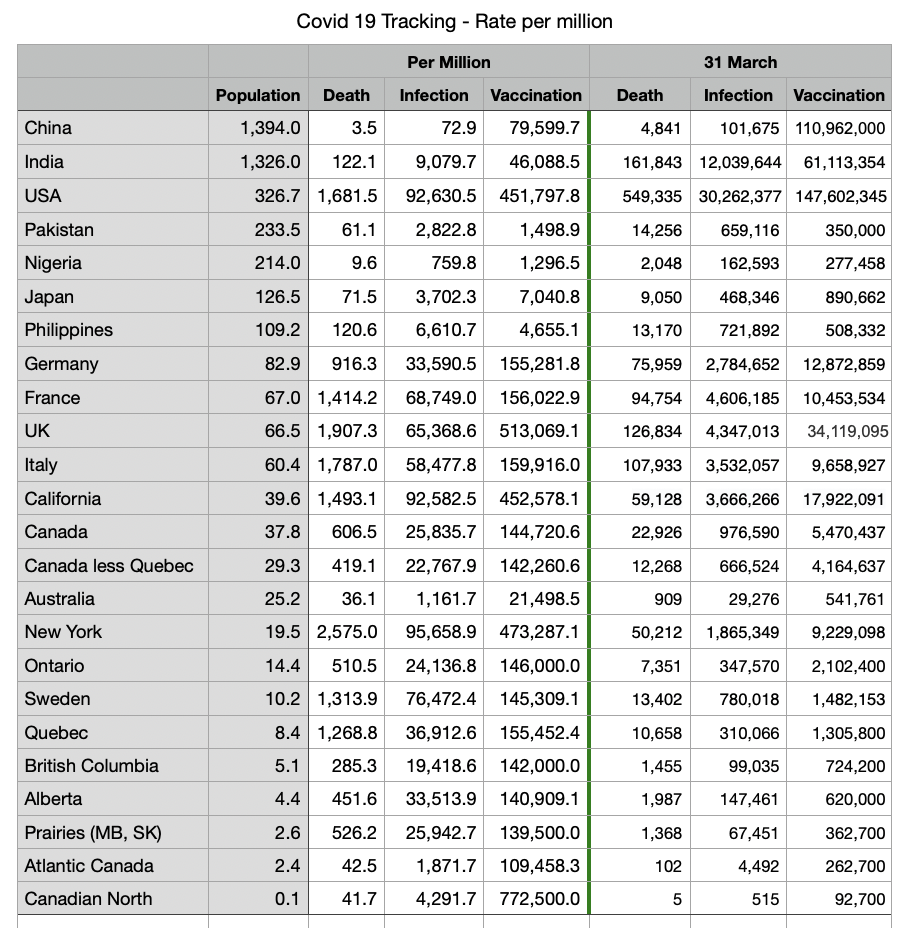
The latest charts, compiled 17 February.

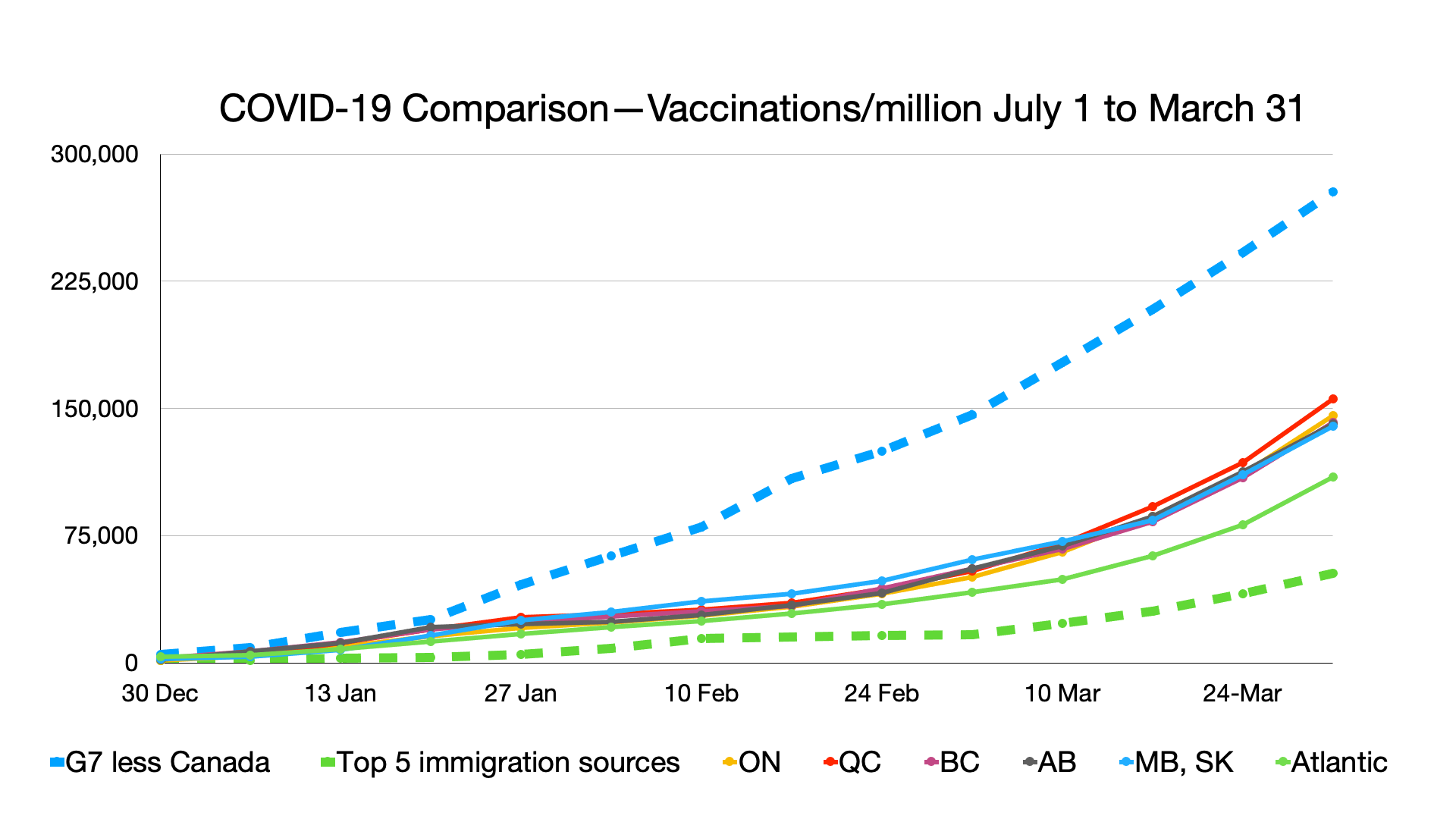
Vaccinations: The gap between all G7 countries save Japan continues to grow given the pause in deliveries to Canada, with the notable exception of the Canadian North.

Trendline charts

Infections per million: Alberta continues to be controlling the virus better than Quebec with an overall flattening of growth.

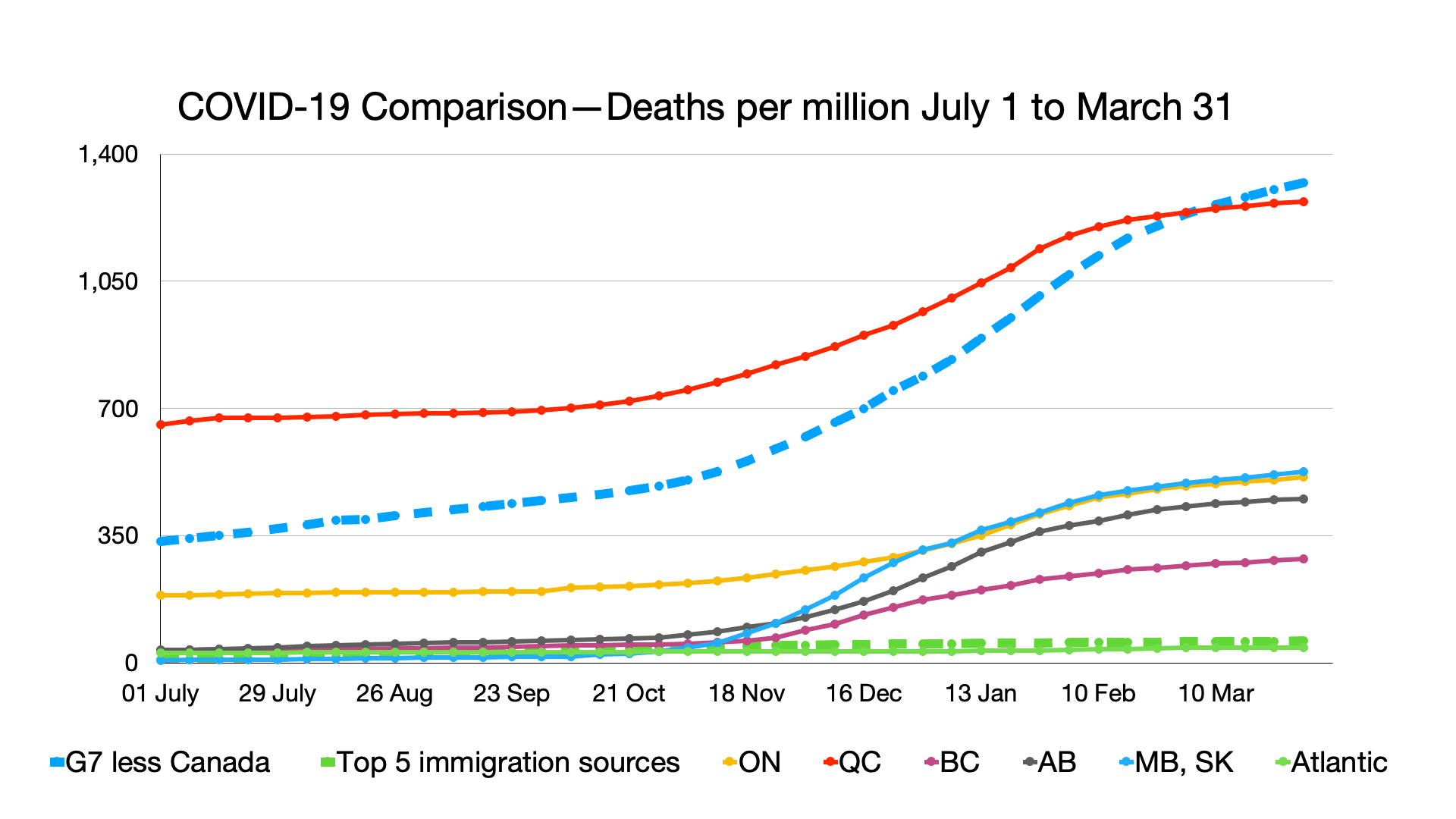
Deaths per million: While Canadian provinces are starting to flatten the curve, G7 has yet to see a flattening.

Vaccinations per million: Gap between G7 and Canada, driven not only by the UK and USA, continues to widen.

Weekly

Infections per million: No relative change.

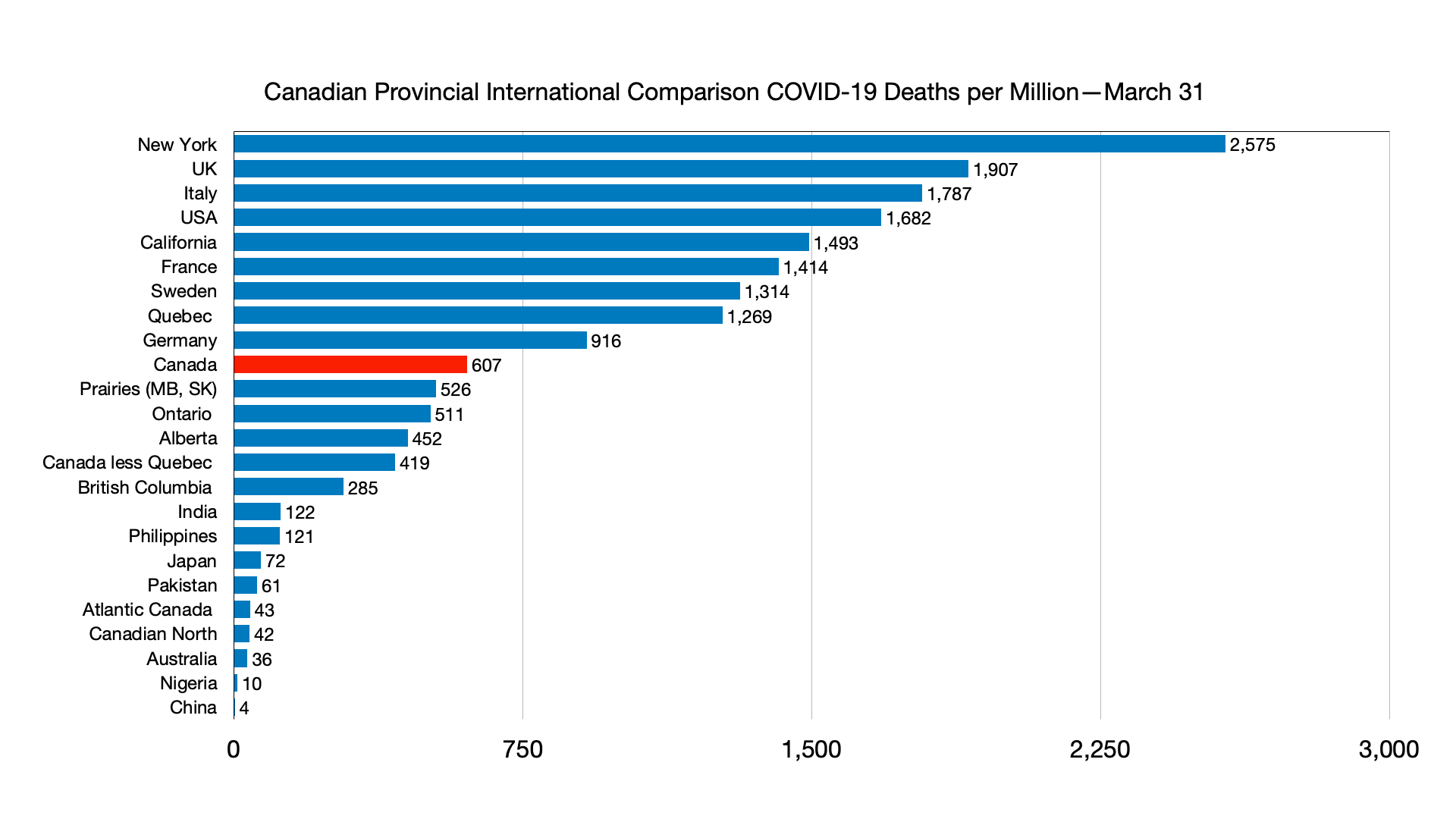
Deaths per million: Quebec ahead of France, Japan ahead of Pakistan.

Border agency reports spike of nearly 6,000 immigrant children crossing into US alone

Less than 10 percent of 2019 numbers:

Thousands of unaccompanied immigrant children are attempting to flee to the United States amid the coronavirus pandemic, propelled by devastating natural disasters, chronic violence, and severe economic hardship at home.

US Customs and Border Protection encountered 5,871 kids at the south-west border without a parent or legal guardian last month, the largest influx yet since the start of the public health crisis in early 2020.

That sudden spike is still relatively modest compared to huge figures from fiscal year 2019, when Border Patrol apprehended more than 76,000 unaccompanied children, a trend that reached its zenith that spring.

But unlike in past years, the Office of Refugee Resettlement – which cares for those kids – has had to slash its housing capacity nearly in half in light of Covid-19. And, with nearly 5,700 of 7,100 total beds already accounted for, ORR is preparing to resurrect a controversial influx facility to create space.

“Even though the numbers of children in custody are still relatively low by historical standards,” the lack of available shelter beds is cause for concern, warned Mark Greenberg, director of the Human Services Initiative at the Migration Policy Institute.

Greenberg added: “If we return to the levels that had been experienced in all recent years except 2020, it will pose a significant challenge because of Covid.”

As more migrants attempt the arduous journey across the US-Mexico border, CBP officials are citing push factors such as “underlying crime and instability” in their countries of origin and “inaccurate perceptions of shifts in immigration and border security policies”.

Before taking office, Joe Biden’s administrationwarned that its comparatively pro-immigrant agenda would not translate to an immediate shift at the border. On Wednesday, White House press secretary Jen Psaki reiterated that, despite rare exceptions, the vast majority of migrants are still being turned away.

“Now is not the time to come,” she said.

Since 2014, a flood of immigrant children and families largely from Central America’s Northern Triangle have made their way to the US, many in search of refuge from a crush of gang-related violence, poverty and persecution. Between fiscal year 2013 and 2014, CBP apprehensions of unaccompanied children at the south-west border surged by 77%, while apprehensions for families more than quadrupled.

That significant change heralded a new era in US border migration, defined by asylum seekers and other vulnerable populations. In response to the humanitarian crisis, former president Donald Trump devised hard-line tactics to try to deter Central Americans and others from seeking protection in the US, then used Covid-19 as a rationale to effectively shutter the border altogether to defenseless migrants.

Under the guise of public health, the Trump administration subjected hundreds of thousands of people – and at least 13,000 unaccompanied children, according to the ACLU – to rapid expulsion from the US without due process during the pandemic.

A federal judge eventually blocked the US government from applying that policy to unaccompanied minors, and Biden has said he will not resume expulsions for kids who show up without a parent or guardian, according to CBS News.

But amid the border closure, children unable to safely enter US custody have turned to perilous border crossings, said Erika Pinheiro, policy and litigation director at Al Otro Lado.

“They suffer so much,” she said. “And the fact that the US government forces them to suffer more is really hurtful to think about.”

In an elaborate game of telephone, news articles about immigration enforcement in the US and Mexico have gotten distorted in the foreign press, then exploited by smugglers, who have every incentive to spread rumors encouraging people to cross the border.

“There’s sort of like one message that comes out of the news. It gets repeated down here, maybe not completely accurately, and then the smugglers really capitalize on that, too. So it sort of builds on itself,” Pinheiro said.

As the number of unaccompanied children encountered by border enforcement increases to levels not seen since the summer of 2019, ORR is preparing to reactivate a temporary influx care facility in Carrizo Springs, Texas, that will initially be able to house about 700 kids.

The remote Carrizo Springs facility was opened in July, 2019, but closed in a few short weeks.

ORR said officials anticipate “the need to start placing children at Carrizo Springs in 15 days or soon after”, a move that has alarmed some advocates.

“There’s no reason to warehouse these children in these potentially dangerous facilities,” Linda Brandmiller, an immigration attorney in San Antonio, told USA Today.

Unaccompanied kids have been arriving primarily from Guatemala, El Salvador and Honduras in recent years. The vast majority are teenagers.

“In a substantial number of cases, they are fleeing for their lives,” Greenberg said. “But whether that will allow them to qualify for asylum will depend upon how asylum policies are now changed.”

Source: Border agency reports spike of nearly 6,000 immigrant children crossing into US alone

Express Entry: 4346 CEC candidates invited

Meeting the levels target at any cost: score of 75 compared to normal average in the high 400s.

To put this into context, essentially any one 18 and 35 or anyone with a one-year degree, diploma or certificate from  a university, college, trade or technical school, or other institute, will obtain a score of 75, irrespective of any other factors.

Hard to see that this represents a merit-based appoach to selecting immigrants but does have the political advantage of helping meeting target immigration levels:

Canada invited 27,332 candidates to apply for permanent residence in its latest Express Entry draw— you read that right.

Immigration, Refugee and Citizenship Canada (IRCC) invited candidates from the Canadian Experience Class (CEC) on February 13. This unprecedented Express Entry invitation round only required candidates to have a Comprehensive Ranking System (CRS) score of at least 75— the lowest CRS requirement ever.

Today’s draw was almost six times larger than the largest Express Entry draws ever (5,000 ITAs were issued in four straight draws between November 18 and December 23 last year). Prior to today, the lowest CRS cut-off requirement ever was 199 points in the May 16, 2017 draw which only invited Federal Skilled Trades Program candidates. Express Entry was launched in January 2015.

On Wednesday, Canada also held an Express Entry draw inviting 654 Provincial Nominee Program (PNP) candidates to apply for permanent residence, that makes a total of 27,986 Invitations to Apply (ITAs) issued this week.

IRCC implemented the tie-break rule, meaning candidates who had the minimum score of 75 were only included if they submitted their Express Entry profile before September 12, 2020 at 15:31 UTC.

Today’s draw goes to show IRCC’s commitment to achieving its target of 401,000 new immigrants in 2021. Of those, IRCC is aiming to welcome 108,500 newcomersthrough Express Entry-managed programs, according to its 2021-2023 Immigration Levels Plan. Next year that target increases to 110,500, and then to 113,750 in 2023. Canada has given Federal High Skilled programs— which are managed by the Express Entry system— the largest share of new immigrant allocations for the next three years. This means the Express Entry system will continue to be Canada’s main source of new immigrants for the foreseeable future.

Canada’s immigration minister, Marco Mendicino, recently said that IRCC will make efforts to achieve the ambitious immigration targets by transitioning more temporary residents to permanent residents during the pandemic.

The unprecedented draw today seems to indicate that IRCC is aiming to issue as many invitations as it can at the beginning of this year so that it can complete the permanent residence landings of successful Express Entry candidates later in 2021. This would provide IRCC with a greater opportunity to achieve its immigration levels target amid ongoing coronavirus disruptions across the world. At the same time IRCC and Mendicino continue to stress that they will also look to global talent including those currently outside of Canada to support the country’s post-pandemic recovery.

Source: Express Entry: 4346 CEC candidates invited