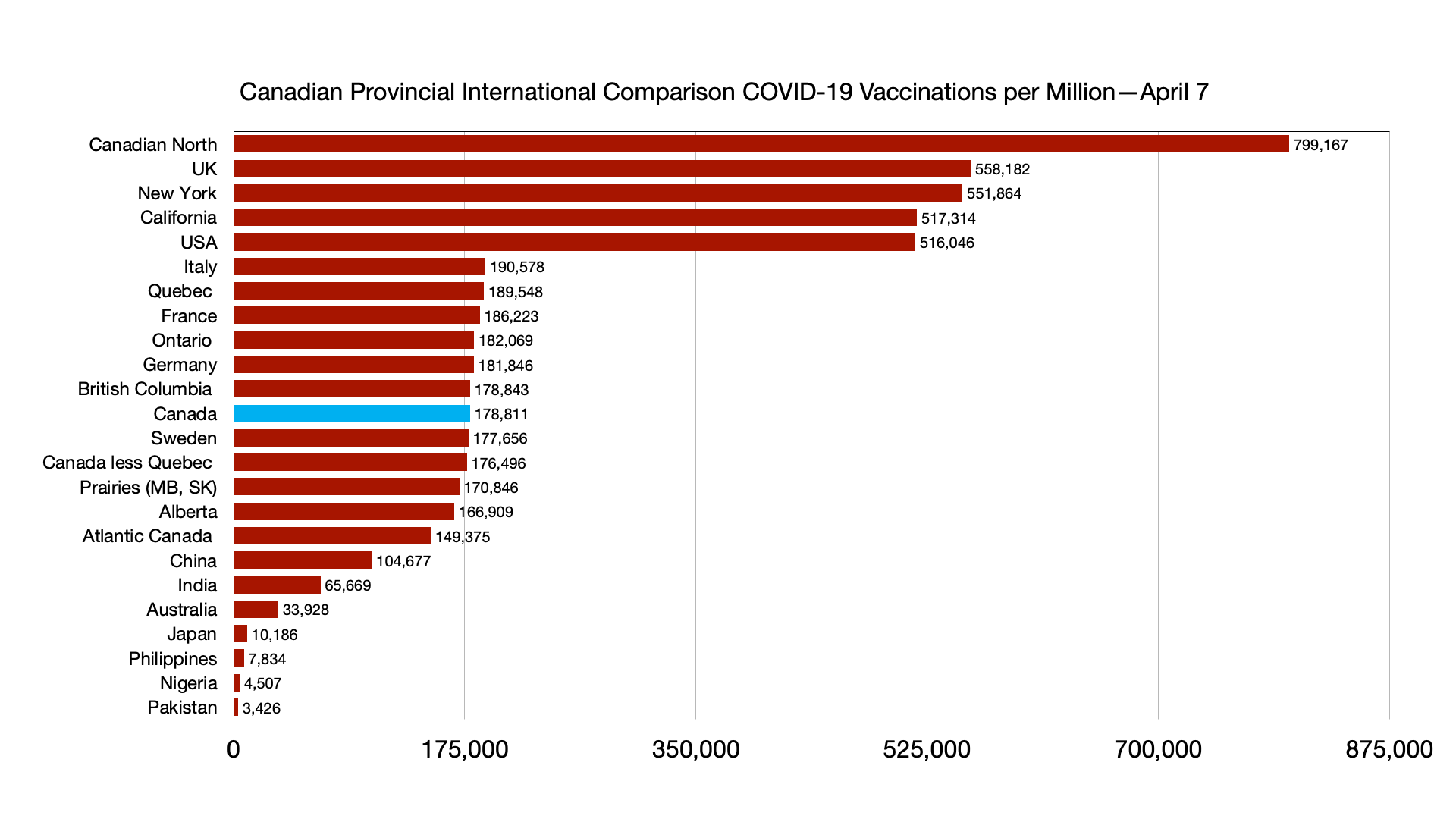
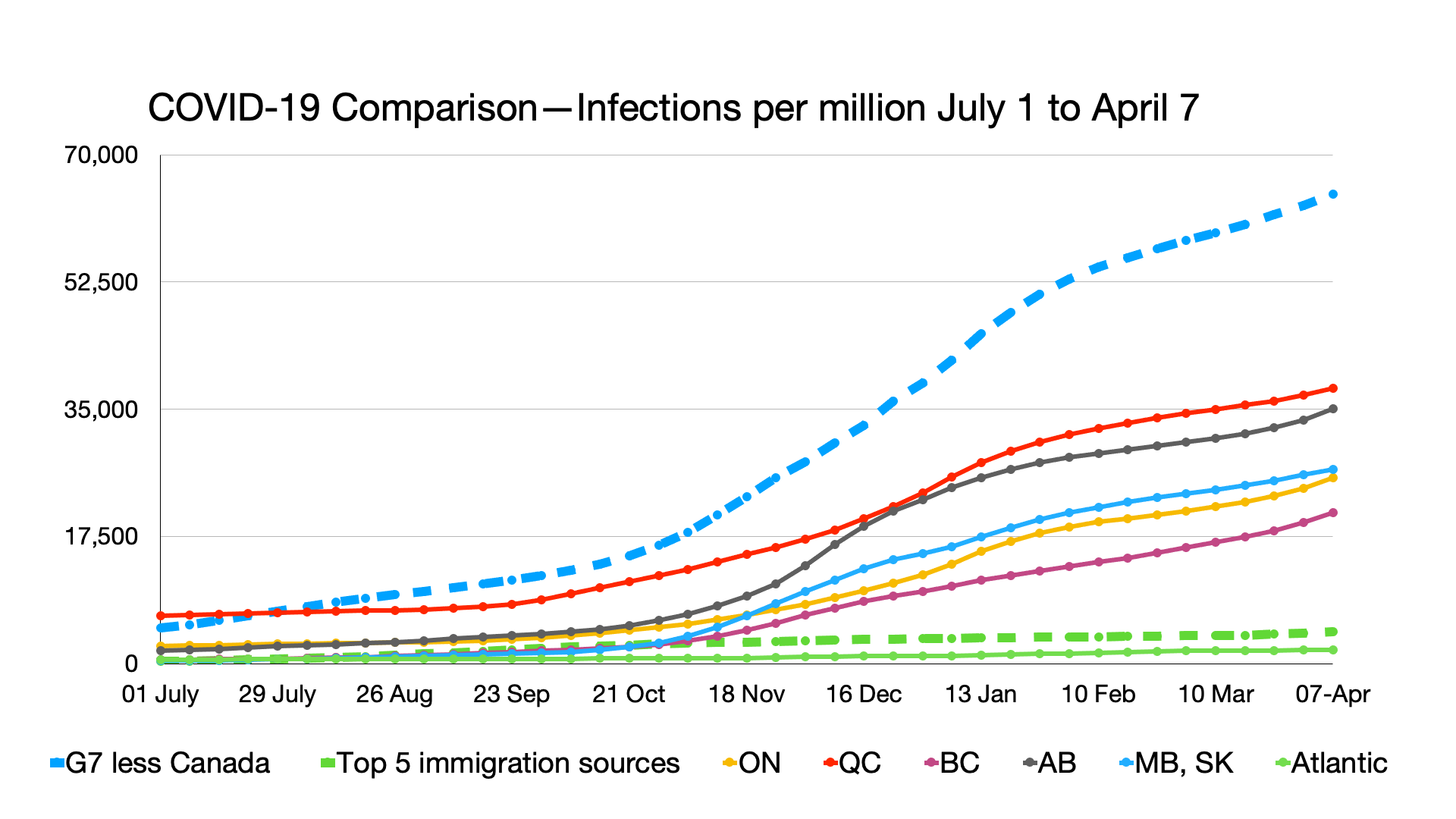
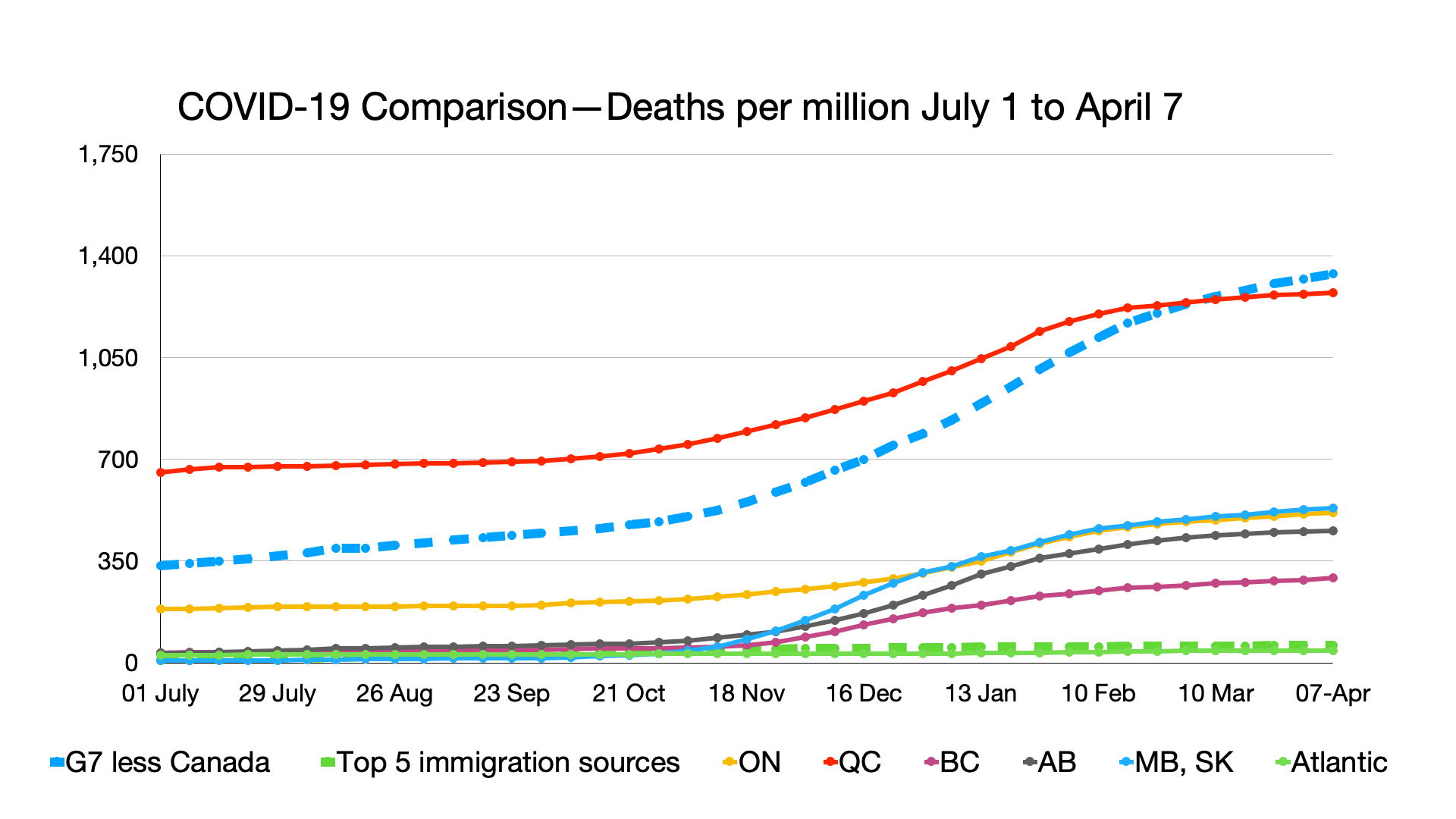
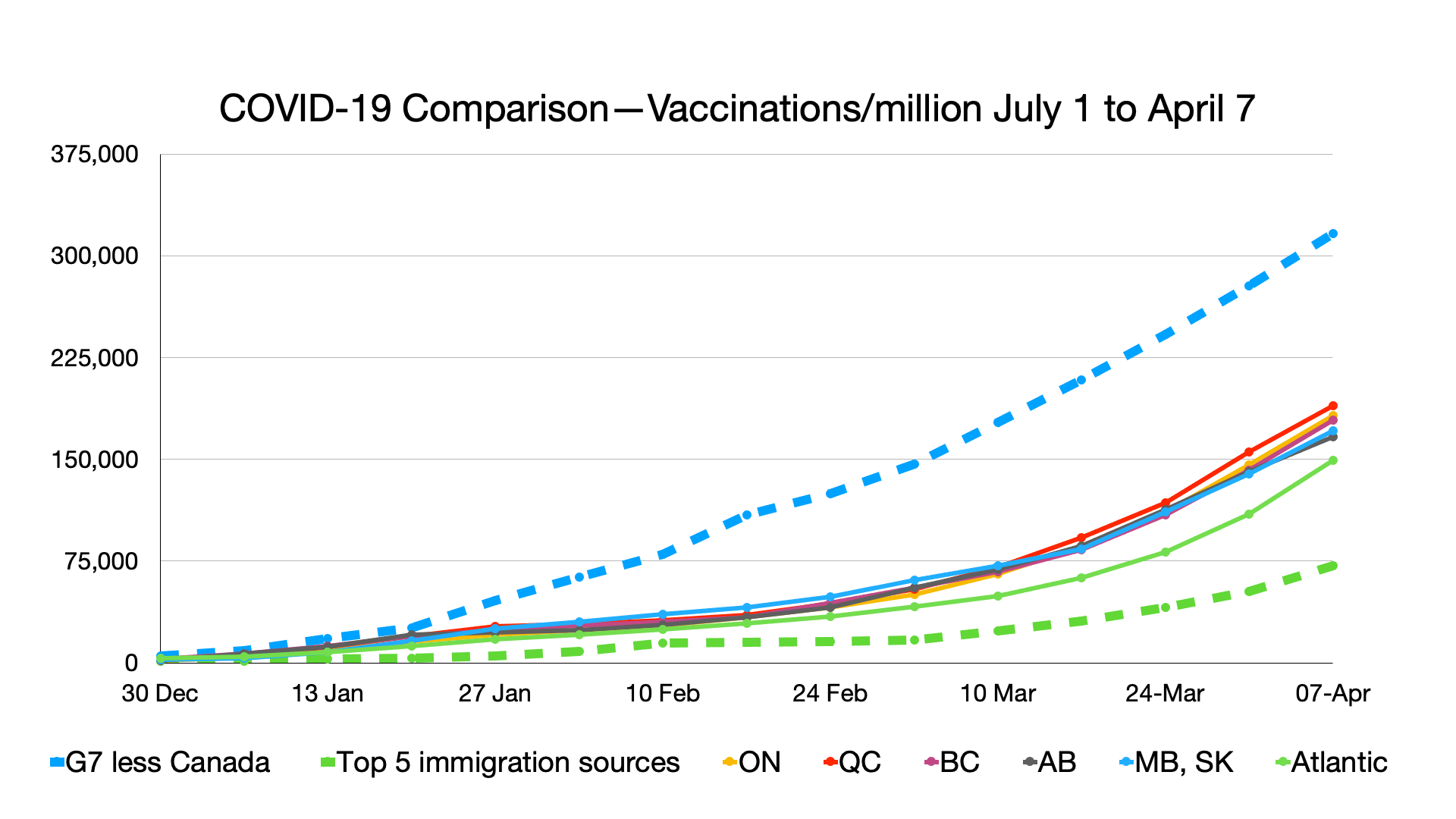
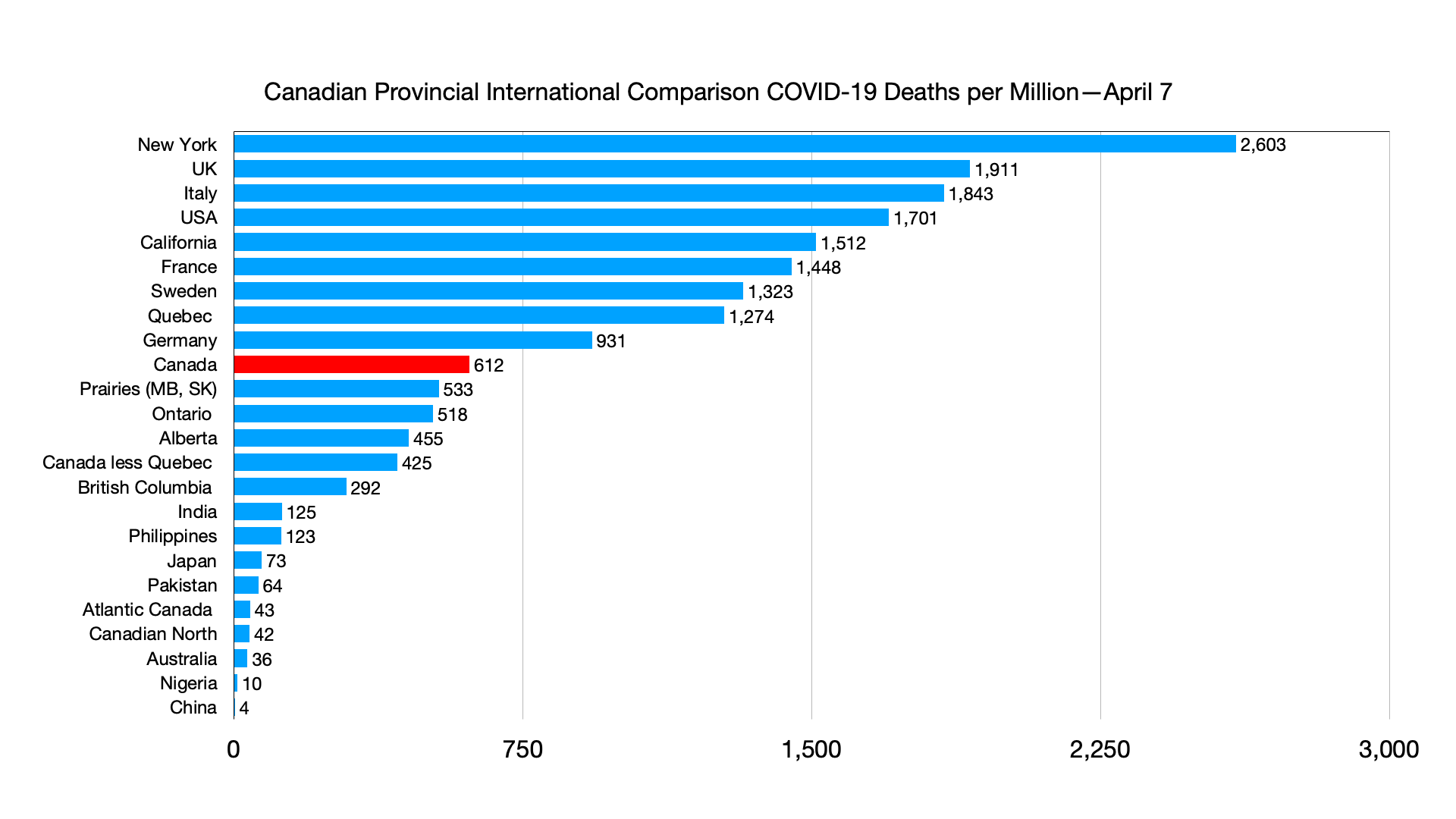
#COVID-19: Comparing provinces with other countries 3 March Update

The latest charts, compiled 3 March (not international vaccination data is latest available).

Vaccinations: The gap between all G7 countries save Japan continues to grow, all European countries slightly ahead of Canada.

Trendline charts

Infections per million: The overall trend of a flattening curve is seen in G7 countries and most provinces save for the Prairies and British Columbia.

Deaths per million: Most Canadian provinces continue to flatten the curve, Quebec most dramatically. Overall G7 death rate at point of surpassing Quebec.

Vaccinations per million: Gap between G7 and Canada, driven not only by the UK and USA, remains largely unchanged.

Weekly

Infections per million: No relative change.

Deaths per million: California ahead of Sweden and Quebec, Sweden ahead of Quebec 

Saunders: How Canada learned what’s wrong with its immigration system – by slamming its borders shut

Usual thought provoking column by Doug Saunders, even if I am more sceptical regarding the government’s approach:

How do you find 401,000 immigrants to become new Canadians when nobody’s even allowed to enter the country? That was the puzzle Ottawa faced at the beginning of the year, after the federal government set admirably high annual immigration targets in 2020 that will bring in 1.2 million people over the next three years in a bold effort to build economic growth through population expansion.

Air and land borders have been shut tight because of the coronavirus pandemic, and neither immigrants nor refugees have been arriving – 2020′s immigration intake was the lowest since the 1990s. The new targets, representing more than 1 per cent of Canada’s population per year, would produce immigration rates Canada hasn’t seen since the 1960s – but begin during a border-closing pandemic. Opposition and business critics said our immigration bureaucrats could never meet that target.

Two weeks ago, those bureaucrats announced a solution that was surprising and potentially ingenious. But it also revealed some of the deep flaws in an outdated and overcomplicated immigration system that was designed for restriction rather than growth, and that leaves hundreds of thousands of families in Canada unable to participate fully in its economy.

In essence, Immigration Minister Marco Mendicino recognized that most of those 401,000 immigrants are already living and working in Canada, and often have been for years – they just don’t have the right kind of visa, or haven’t accumulated right number of points along our Byzantine immigration pathway, to qualify for permanent-residency status and eventual citizenship.

On Valentine’s Day weekend, as it does every few weeks, the Immigration Department sent out invitations for selected temporary immigrants, all of whom have worked in Canada for at least a year, to apply for permanent-resident status. Instead of the usual 3,000 to 5,000 invitations, though, it sent out more than 27,000, and hinted that this high rate would continue for some time. In order to find enough current residents to invite, the number of points needed was lowered dramatically. (Canada’s long-established points system, properly known as the Comprehensive Ranking System, awards points toward permanent status for such things as work experience, education and language skills.)

Immigrants who expected to have to wait months or years longer, and to jump through dozens more bureaucratic hoops, suddenly learned they were on a pathway to become Canadians. Immigration lawyers, who found themselves deluged with clients last week, said the supply of qualified high-quality people was always here; it just took a crisis for the government to see it.

“Yes, they can hit the 400,000 target because there are half a million temporary foreign workers and international students in Canada right now,” says Raj Sharma, a Calgary-based immigration lawyer. “I think they’re going to meet the target, and it’s going to have repercussions on the way they do things – they always should have prioritized people already living in Canada.”

Drawing on immigrants with lower point scores is not a case of “scraping the bottom of the barrel,” as Mr. Sharma notes, because the great majority of those in Canada on a temporary basis (with only a few possible exceptions, such as seasonal agricultural workers) are able to be here, for study or work, precisely because they have skills and are fluent in a Canadian language. What has denied most of these people and their families access to citizenship is not a lack of actual skills or experience, but a complex and often self-contradictory set of rules and classifications.

For example, a temporary worker employed for a year as an accounts-receivable clerk does not earn enough points to qualify under normal rules; the same worker employed as a bookkeeper does. In some provinces, an immigrant employed caring for elderly and disabled people in their own homes is ineligible to apply for permanent residency, while an immigrant doing the same work in a long-term care facility is.

At root are two decades-old assumptions behind our immigration system, both of which have been challenged by the pandemic. The first is that highly skilled, educated and fluent immigrants are a comparative rarity and a lengthy weeding-out process is needed to find them. The second is that immigrants divide neatly into two groups of very different people: temporary and low-skilled, and permanent and high-skilled.

That hasn’t been true for decades. Not only are most “temporary” immigrants to Canada people who are educated and considered middle-class in their countries of origin, but temporary low-wage work is most often used as a stepping-stone to permanent work in professions or skilled trades, or to small-business ownership. A high proportion of temporary-immigrant women employed as live-in caregivers and nannies, for example, have postsecondary diplomas and degrees from their home countries.

These assumptions have exacted a high cost on Canada’s economic prospects, by leaving large numbers of newcomers in a limbo state, unable to invest in their communities, start legal businesses or set down family roots because they’re not eligible to become Canadians – even though they’re here because the economy needs them. In the early 2000s, under prime minister Stephen Harper’s earlier policies, a majority of immigrants in Canada were temporary foreign workers without access to permanent residency.

The later Harper years and early Trudeau years saw pathways to permanent residency created for most classes of temporary workers and students. In the prepandemic years, several thousand people per month were making this transition, though few of them were lower-wage immigrants from the Temporary Foreign Worker Program, who face difficult bureaucratic hurdles regardless of their skill or education level.

The pandemic shone a light on this problem. The jobs deemed “essential” – and thus the jobs that expose employees to the greatest coronavirus risk – are very often the ones held by immigrants who have the least possibility of becoming Canadians.

“I do think that COVID-19 provides an opportunity to rethink our immigration policy, given what we have seen in terms of essential workers, traditionally undervalued and underpaid,” says Andrew Griffith, a former director-general of Canada’s immigration department. He doesn’t believe it will be necessary for the government to permanently lower its points-score requirements for permanent residency, especially during a pandemic recession. Even though there are many labour shortages in low-skill fields, much of that demand is filled not by primary immigrants but by their relatives – the family members who accompany them, and who they later sponsor.

This crisis may have come along at just the right time. If Canada wants to reach a level of population density that provides the most ecological, economic and cultural benefits – especially in a world whose borders and markets are becoming less open – it doesn’t have much time. As recent academic analyses have pointed out, Canada’s projected peak population this century (double its current level) may be difficult to reach because many of our chief countries of immigration are watching their own population growth levels collapse and are trying to hold onto their own populations.

What the pandemic has shown us is that newcomers are not guaranteed to be available when we need them, and might not always be willing to jump through all our hoops – not when other wealthy countries, including warmer ones, may be willing to make better offers.

An immigration policy designed for a growing, educated population needs to do three things.

First, it needs to keep families intact – an immigration system built on unaccompanied individuals is bad for immigrants and bad for Canada, as it leaves out the long-term population benefits of immigration.

Second, it needs to avoid leaving people stuck in Canada for a long time without a clear pathway to citizenship. This is true for both refugee applicants and immigrants – it is a huge wasted opportunity to have hundreds of thousands of ambiguous-status individuals knocking around the country, unsure if they should invest in this country or some other one, or when they’ll know for sure.

We wrongly think of our “points system” as assessing the intrinsic worth of an individual, but in fact most immigrants build up points during the time they spend in Canada. Might it make more sense to allow them to accumulate those points not before but after they earn permanent-resident status? That way, the earnings and savings they build up during that time will be used to build a stake in Canada’s society and economy.

But the flip side of a generous and large-scale controlled-immigration system is that removal of non-qualified people should be quick and decisive – ideally through economic incentives rather than far more expensive deportation. Immigration and citizenship should be valued and treated as precious accomplishments, and that means making decisions quickly and fairly.

And finally, the system should allow rapid movement between categories and classes of immigration – ideally without changing anything. Someone in Canada as a temporary medical-industry worker should be able to become a university student, or a permanent-residency applicant, without having to pay lawyers and questionable immigration agents to navigate a labyrinth of applications, waiting lists, lotteries and restrictions. The number of immigration categories, and steps, could easily be cut in half without any detriment to the system.

Canada will never be an open-borders country, and it will never need to return to the era of mass immigration, as we experienced a bit more than a century ago. We can double or triple our population this century within current immigration rates, and without lowering our standards – but we need to start taking advantage of the immigration assets we already have. If nothing else, the pandemic’s border closings have taught us that we need to do things differently.

Source: https://www.theglobeandmail.com/opinion/article-how-canada-learned-whats-wrong-with-its-immigration-system-by-slamming/

Federal government must allow for immigrants and refugees to receive Canada Child Benefits

Would be helpful to their case if they would provide some estimates of the number of “refugee claimants and other individuals with precarious immigrant status” affected. The total number of refugee claimants as of December 2020 is about 80,000 (IRB data) with no reliable numbers for others, a relatively small number. However, there is merit to their arguments for those who are working and paying income tax:

Given that As COVID-19 rages on, the federal government has rightly extended several emergency benefits, including the Canada Recovery Benefits (CRB) — though not to all in need.

This is welcome news for many Canadians, particularly women and racialized community members, who are among the hardest hit by the pandemic triggered economic downturn. The January 2021 Statistics Canada Labour Force Survey showed unemployment rate has increased to the highest level since August 2020, with core-age women posting the largest employment declines in the month and many racialized groups continuing to experience disproportionately higher job loss rates.

The CRB and its predecessor CERB have kept many struggling families afloat, including many migrant workers and people with precarious status, who could access these benefits with a valid work permit.

During the pandemic, the government has also made an additional one-time payment of $300 per child for families who are receiving the Canada Child Benefits (CCB) and a promise of an additional $1,200 for eligible families with children under six in 2021.

However, not every child in Canada, and not every family in need, is able to enjoy this quasi-universal benefit.

To qualify for the CCB, an applicant parent must be a Canadian citizen, permanent resident, protected person, or a visitor who has lived in Canada for at least 18 months. 

Excluded from accessing CCB are refugee claimants and other individuals with precarious immigrant status, even though many are working legally and filing personal income tax return. In some cases, these families have Canadian-born children, but are still denied CCB because of the parents’ immigration status.

The denial of CCB has a disproportionate impact on women who are still the primary caregivers for children in most Canadian families. Given that the vast majority of people with precarious immigration status are people from the Global South, the denial of CCB adversely affects individuals from racialized communities, who have long been overrepresented among the low income population in Canada.

The federal government has been promising since 1989 to end child poverty. Most recently, the government reprioritized this issue with the release of its national poverty reduction strategy in 2018, followed by poverty reduction legislation that received royal assent in 2019. This strategy calls for a “human rights-based approach to poverty reduction, [one that] reflect[s] principles that include universality, non-discrimination and equality, participation of those living in poverty, accountability and working together.”

Despite this, 1.3 million children, or 18.2 per cent of children, live in poverty in Canada today. Before the pandemic, in many parts of the country, that rate was on the rise.

Child poverty is more prevalent for communities marginalized by race, gender, and their immigration status. 

The exclusions of CCB based on immigration status have been in our law books for many years. Former bureaucrats involved in the design of the child benefits scheme could not explain why these exclusions were introduced in the first place, other than noting that the government of the day did not anticipate that refugee claimants and others in similar situations would be working legally and filing income tax. 

The CCB is a proven tool to reducing child poverty. Access to this benefit for families with precarious status is a matter of equity and justice.

As the federal government prepares for its 2021 budget, there is no better time than right now for the federal government to move swiftly. Deputy Prime Minister Chrystia Freeland has set forth an economic vision of an intersectional feminist and green recovery in the last fall fiscal update. Prime Minister Justin Trudeau has said that no one will be left behind in pandemic response and recovery efforts to build back better. 

But without investments to support families who are falling through the cracks, these words are empty.

People with precarious immigration status are important members of our communities. They are doing the essential work to keep us safe and the economy going.

The federal government should honour its human right obligations and stop discriminating against low-income children and families with precarious status by providing them with immediate access to the Canada Child Benefit.

Source: https://www.thestar.com/opinion/contributors/2021/02/25/federal-government-must-allow-for-immigrants-and-refugees-to-receive-canada-child-benefits.html

Biden Rescinds Immigrant Visa Ban, Keeps Worker Ban: Who Benefits?

Useful data and analysis, along with practical recommendations to streamline processes:

President Joe Biden rescinded Donald Trump’s presidential proclamation banning new immigrant visas for most new legal permanent residents coming from abroad. Trump justified the ban based on old, disproven economic protectionist arguments. He claimed immigrants would take jobs. During his campaign and in this proclamation, President Biden rejected this idea. Yet incongruously, he’s keeping an identical ban on temporary work visa holders.

The State Department issued nearly 290,000 fewer immigrant visas in the categories that the ban targeted during the year that it was in effect. If they are not from a country on which Biden has imposed a countrywide entry ban—mostly Europe, South Africa, Brazil, China, and Iran—these immigrants will now be able to immigrate to the United States. This is great news for them and for the Americans with whom they plan to associate.

Altogether, the banned categories saw a 90 percent decline in visa issuances over the last year. The family‐​sponsored categories saw an average decline of 94 percent, while employees of U.S. businesses were least affected (partly due to a favorable court decision that exempted employees of members of the National Association of Manufacturers and the Chamber of Commerce). 83 percent of the banned immigrants were family members of U.S. citizens and legal permanent residents.

Spouses and minor children of U.S. citizens were exempt from the ban, but they also saw a decline in the number of visas issued due to the travel restrictions. According to a government filing this month, the State Department had nearly 473,000 documentarily qualified family‐​based immigrant visa applicants—presumably some of these cases will ultimately turn into denials, but this will be a huge undertaking for the consulates to process.

Four ideas to help with this backlog (mostly borrowed from our one‐​time Cato author David Kubat):

  1. The government should use “parole‐​in‐​place” authority to waive the requirement to travel to consulate abroad for certain applicants who would otherwise be eligible to adjust in the United States if not for the fact that they initially entered without inspection (illegally).
  2. It should adjudicate applications for waivers on grounds of inadmissibility before conducting the interview to save time and streamline the process. Under the current process, the State Department waits until after they’ve taken your fingerprints, medical evaluation, and other documents and then get denied. Only then do you restart the many months‐​long process of trying again.
  3. It should allow for remote or virtual interviews to speed the interview process. Remote immigration court hearings are already happening.
  4. It should waive as many interviews as possible for applicants with no red flags and a history of travel to the United States.

As Figure 1 shows, the number of immigrant visas had already declined by more than a quarter before the pandemic. This means that even without the visa bans, the new administration will have to go further to rescind the numerous restrictions on legal immigration that led to that decline.

Of course, the other major visa ban—on the most common nonimmigrant work visa categories for skilled and seasonal nonagricultural workers—is still in effect. President Biden states in his order revoking the immigrant visa ban, “The suspension of entry…. does not advance the interests of the United States. To the contrary, it harms the United States including…. industries in the United States that utilize talent from around the world.” These lines apply just as much to the nonimmigrant visa ban, yet Biden has chosen to keep it.

The nonimmigrant visa ban and immigrant visa backlog are just two of the numerous issues that Biden will have to address to get the legal immigration system back to what it was pre‐​Trump. There are also country‐​specific entry bans on Europe, South Africa, Brazil, China, and Iran that lack any health basis. The public charge rule to keep out low‐​income immigrants is also still in force. USCIS has not reinstated its prior deference memo and so is still relitigating past approved petitions and applications in order to increase denials. The immigration forms still contain the bogus, vague, time‐​consuming, and expensive “extreme vetting” questions based on a faulty reading of the data on vetting failures. At the border, Border Patrol is still “expelling” asylum seekers under a political CDC order. The immigration courts and asylum process generally is still in chaos.

With this action, the president makes his first real attempt to reinstate the system to how it once was, but he’s not even 10 percent of the way there. Still, it’s a great first step.

Source: Biden Rescinds Immigrant Visa Ban, Keeps Worker Ban: Who Benefits?

Douglas Todd: Economists question decision to boost immigration during pandemic

Good and needed questioning:

Canadian economists are questioning why Ottawa is setting record immigration targets in the middle of unprecedented unemployment caused by the pandemic.

More than 1.7 million Canadians are looking for work, and the economists are warning that the Liberals’ aggressive new target of more than 400,000 new immigrants in 2021 will likely hurt the country’s low-skilled workers, particularly those who have recently become permanent residents.

Source: Douglas Todd: Economists question decision to boost immigration during pandemic

International students aren’t making as much money as their Canadian classmates in the first years after graduation, report suggests

Significant study on the importance of work experience:

Despite equal Canadian education credentials, international students earn less than their Canadian peers after graduation, Statistics Canada says.

That’s because they fail to secure enough local work experience before they graduate, data from the agency indicates.

International students earned “considerably” less than domestic students during their first five years after graduation, said a report released Wednesday in collaboration with Immigration, Refugees and Citizenship Canada.

“Fewer years of pre-graduation work experience and lower levels of pre-graduation earnings among international students accounted for most of their observed disadvantage in post-graduation earnings.”

This revelation will be crucial for Canada to address as the federal government has increasingly drawn on its pool of international students as future immigrants. In 2019 alone, more than 58,000 international graduates successfully applied to immigrate permanently.

They are favoured over immigrants who are traditionally selected directly from abroad because they’re generally younger and have more years to contribute to the labour market after immigration. There is also less uncertainty about their quality of education and language ability, and little barrier related to credential recognition when joining the labour force.

Based on Canada’s Post-secondary Student Information System and tax data, researchers compared early labour-market outcomes and sociodemographic information of international students and domestic students who graduated from post-secondary institutions between 2010 and 2012.

International students comprised six per cent or 66,800 of the sample, with Canadian citizen and permanent resident students accounting for 87 per cent and seven per cent of the population (about 927,700 and 71,900), respectively. The classification was based on the students’ immigration status at their time of graduation.

Overall, 43.6 per cent of international students had no Canadian work experience prior to graduation, compared with 2.2 per cent of Canadian citizens and 9.7 per cent of permanent resident students.

The average number of years of pre-graduation work experience was 6.2 for Canadian citizen students, 3.9 for permanent resident students and just 1.2 for international students.

Four in 10 domestic students earned more than $20,000 in a year before graduation, whereas only one in 10 international students did so.

One year after graduation, the income gaps between international graduates and Canadian citizens were larger for graduates with an advanced degree than for their international peers with a lower education. The difference was about 10 per cent for bachelor’s degree holders and 40 per cent for the ones with master’s degrees.

However, by the fifth year, the gap narrowed for international students with graduate degrees, while it increased over time for their peers with a bachelor’s degree or college diploma only.

International students had lower earnings on average than domestic students in many fields of study, with a few exceptions where they had similar earnings: visual and performing arts, and communications technologies; humanities; health and related fields.

For the four most popular fields of study among international students, graduates from the STEM fields (architecture, engineering and related technologies; and mathematics, computer and information sciences) suffered a smaller earnings gap than their non-STEM peers in business, management and public administration; and social and behavioural sciences and law.

The disadvantage faced by international students in securing pre-graduation work experience can be explained by language proficiency, cultural differences, concentration in fields of study, course grades, employers’ reluctance to recruit and train job applicants with temporary residency status, and possible employer discrimination, the study suggested.

“International students may face these barriers when looking for a job while studying, before they formally enter the labour market, and after they graduate,” it said. “Another possible answer is the difference in participation rates between domestic and international students in work-integrated learning (which) provides participating students the benefits of workplace-related skill accumulation and connections to potential employers.”

International students lack knowledge about the local labour market, have limited local networks, and face financial barriers, such as relocation costs and the additional tuition fees required for delayed graduation — all contributing to their lower participation in internship and co-op, said the report.

Although the federal government has relaxed the off-campus employment rules for international students during school year since 2014 by allowing them to work up to 20 hours a week without requiring a work permit, they still have limited access to government-sponsored student hiring programs where priorities are given to Canadians.

“The disadvantage for international students in pre-graduation work experience hampers their ability to compete for a high-paying, high-quality job after graduation,” said the report.

“The results of this study imply that policies to reduce the pre-graduation work-experience gap are crucial to reducing the post-graduation earnings gap between international and domestic students.”

Source: International students aren’t making as much money as their Canadian classmates in the first years after graduation, report suggests

New tool could point immigrants to spot in Canada where they’re most likely to succeed

A neat example of algorithms to assist immigrants assess their prospects although human factors such as presence of family members and community-specific food shopping and the like may be more determinate. But good that IRCC is exploring this approach. More sophisticated that the work I was involved in to develop the Canadian Index for Measuring Integration. Some good comments by Harald Bauder and Dan Hiebert:

Where should a newcomer with a background in banking settle in Canada?

What about an immigrant who’s an oil-production engineer?

Or a filmmaker?

Most newcomers flock to major Canadian cities. In doing so, some could be missing out better opportunities elsewhere.

A two-year-old research project between the federal government and Stanford University’s Immigration Policy Lab is offering hope for a tool that might someday point skilled immigrants toward the community in which they’d most likely flourish and enjoy the greatest economic success.

Immigration, Refugees and Citizenship Canada is eyeing a pilot program to test a matching algorithm that would make recommendations as to where a new immigrant might settle, department spokesperson Remi Lariviere told the Star.

“This type of pilot would allow researchers to see if use of these tools results in real-world benefits for economic immigrants. Testing these expected gains would also allow us to better understand the factors that help immigrants succeed,” he said in an email.

“This research furthers our commitment to evidence-based decision making and enhanced client service — an opportunity to leverage technology and data to benefit newcomers, communities and the country as a whole.”

Dubbed the GeoMatch project, researchers used Canada’s comprehensive historical datasets on immigrants’ background characteristics, economic outcomes and geographic locations to project where an individual skilled immigrant might start a new life.

Machine learning methods were employed to figure out how immigrants’ backgrounds, qualifications and skillsets were related to taxable earnings in different cities, while accounting for local trends, such as population and unemployment over time.

The models were then used to predict how newcomers with similar profiles would fare across possible destinations and what their expected earnings would be. The locations would be ranked based on the person’s unique profile.

“An immigrant’s initial arrival location plays a key role in shaping their economic success. Yet immigrants currently lack access to personalized information that would help them identify optimal destinations,” says a report about the pilot that was recently obtained by the Star.

“Instead, they often rely on availability heuristics, which can lead to the selection of suboptimal landing locations, lower earnings, elevated out-migration rates and concentration in the most well-known locations,” added the study completed last summer after two years of number crunching and sophisticated modelling.

About a quarter of economic immigrants settle in one of Canada’s four largest cities, with 31 per cent of all newcomers alone destined for Toronto.

“If initial settlement patterns concentrate immigrants in a few prominent landing regions, many areas of the country may not experience the economic growth associated with immigration,” the report pointed out. “Undue concentration may impose costs in the form of congestion in local services, housing, and labour markets.”

Researchers sifted through Canada’s longitudinal immigration database and income tax records to identify 203,290 principal applicants who arrived in the country between 2012 and 2017 under the federal skilled worker program, federal skilled trades program and the Canadian Experience Class.

They tracked the individuals’ annual incomes at the end of their first full year in Canada and predicated the modelling of their economic outcomes at a particular location on a long list of predictors: age at arrival, continent of birth, education, family status, gender, intended occupation, skill level, language ability, having studied or worked in Canada, arrival year and immigration category.

Researchers found that many economic immigrants were in what might be considered the wrong place.

For instance, the report says, among economic immigrants who chose to settle in Toronto, the city only ranked around 20th on average out of the 52 selected regions across Canada in terms of maximizing expected income in the year after arrival.

“In other words, the data suggest that for the average economic immigrant who settled in Toronto, there were 19 other (places) where that immigrant had a higher expected income than in Toronto,” it explains, adding that the same trend appeared from coast to coast.

Assuming only 10 per cent of immigrants would follow a recommendation, the models suggested an average gain of $1,100 in expected annual employment income for the 2015 and 2016 skilled immigrant cohort just by settling in a better suited place. That amounted to a gain of $55 million in total income, the report says.

However, researchers also warned against the “compositional effects” such as the concentration of immigrants with a similar profile in one location, which could lower the expected incomes due to saturation. Other issues, such as an individual’s personal abilities or motivation, were also not taken into account.

The use of artificial intelligence to assist immigrant settlement is an interesting idea as it puts expected income and geography as key considerations for settlement, said Ryerson University professor Harald Bauder

“It’s not revolutionizing the immigration system. It’s another tool in our tool box to better match local market conditions with what immigrants can bring to Canada,” says Bauder, director of Ryerson’s graduate program in immigration and settlement studies.

“This mechanism is probably too complex for immigrants themselves to see how a particular location is identified. It just spits out the ranking of locations, then the person wonders how I got this ranking. Is it because of my particular education? My particular country of origin? The information doesn’t seem to be clear or accessible to the end-users.”

New immigrants often gravitate toward a destination where they have family or friends or based on the perceived availability of jobs and personal preferences regarding climate, city size and cultural diversity.

“This tool will help those who are sufficiently detached, do not have family here and are willing to go anywhere,” says Daniel Hiebert, a University of British Columbia professor who specializes in immigration policy.

“People who exercise that kind of rational detachment will simply take that advice and lead to beneficial outcomes.”

But Hiebert has reservations as to how well the modelling can predict the future success of new immigrants when they are basing the advice and recommendations on the data of the past.

“This kind of future thinking is really difficult for these models to predict. There’s too much unknown to have a good sense about the future,” he says. “These models can predict yesterday and maybe sort of today, but they cannot predict tomorrow.”

Source: New tool could point immigrants to spot in Canada where they’re most likely to succeed

Law firms scramble to help clients capitalize on shift in Canada’s immigration policy

Money quote: “it doesn’t speak favourably of the integrity and predictability of our immigration system:”

Law firms are urging their clients to get in Canada’s express pool of immigration candidates as soon as possible after the federal government invited a record number of people in that system to apply for permanent residency to help hit ambitious targets.

On Feb. 13, Immigration Canada issued the invitations to more than 27,000 people in the Express Entry system, which is aimed at expediting the intake of skilled workers. That round of invitations – known as a draw – focused on those who had at least one year of recent work experience in Canada.

The number was more than five times larger than the previous record. To hit that mark, the federal government had to drastically reduce the immigration scores needed for an invitation to apply.

The decision sent a jolt through the legal community, with initial confusion giving way to a flurry of phone calls. Many lawyers had steered clients away from Express Entry because it was unlikely they could get a high enough score.

The situation has prompted a rethink. Several law firms contacted by The Globe and Mail are now telling clients that anyone who can get into the Express Entry pool should do so, given the potential for the federal government to surprise again.

“At this point, it seems like all bets are off, and we have no predictability in terms of who’s going to be selected and who’s not,” said Meika Lalonde, partner at McCrea Immigration Law in Vancouver. “We do know that the government has some ambitious immigration targets that it wants to fill this year. So there is a possibility that they’ll draw again at a remarkably low score.”

Owing to the pandemic, Canada has just had an exceptionally weak year for immigration. About 184,000 new permanent residents were added in 2020, well short of the 341,000 target. To make up for that, Immigration Canada raised its targets for the next three years, starting with an intake of 401,000 in 2021.

With border restrictions still in place, Ottawa is focused on foreign workers and students already here. Most of the invitations issued on Feb. 13 were to people in Canada, the federal government said.

Launched in 2015, Express Entry is one of several pathways for immigration. When people go into that pool, they’re assigned a score in points based on age, education, work experience and other factors. Draws are usually held every two weeks and have a cut-off score for who gets invited.

The cut-off is usually at much more than 400 points. Successful candidates in the category of people with Canadian work experience have often been under 30 years old and had advanced degrees and strong English or French skills.

This time, the cut-off score was slashed to 75. That meant nearly everyone in the Canadian-experience stream of Express Entry got an invitation, all but depleting that source of candidates.

“I actually thought it was a mistake,” said Adrienne Smith, partner at Battista Smith Migration Law Group in Toronto. “I was completely shocked.”

Once she learned it was real, Ms. Smith advised clients to try to get into the express pool. “I just don’t want to have another client that misses out on this potential draw,” she said.

The message was the same from Sonia Matkowsky, an immigration lawyer in Toronto: “I do advise individuals [who would get] lower scores to enter the pool,” she said. “Especially this year. Anything can happen.”

It’s unclear how the coming months will play out. While the Canadian-experience stream was nearly emptied, it’s undoubtedly starting to grow again. The question is whether the cut-off score will be low in future draws.

Several lawyers say they think the federal government will eventually shift its focus outside the country. Thousands of Express Entry candidates are abroad and lack Canadian work experience, but otherwise have desirable credentials. Their entry is complicated by border restrictions.

“A lot of our clients overseas were also contacting us,” Ms. Smith said. “I think the hope and the anticipation is that in order to meet the 400,000-person target, that [the government is] going to have to move to overseas applicants next.”

Even then, the 2021 target should be tough to hit. In a recent report, RBC Economics estimated that Canada would add only 275,000 new permanent residents this year.

Some lawyers said the recent draw undermined the purpose of the Express Entry system, which is intended as a way to fast-track the top candidates rather than send a blanket invitation to virtually everyone.

“It’s a very good news story for a lot of individuals,” Ms. Lalonde said. “But I would say it doesn’t speak favourably of the integrity and predictability of our immigration system.”

Source: https://www.theglobeandmail.com/business/article-immigration-strategies-take-u-turn-after-surprise-government-decision/

#COVID-19: Comparing provinces with other countries 24 February Update

The latest charts, compiled 24 February.

Vaccinations: The gap between all G7 countries save Japan continues to grow with the effect of increased deliveries to Canada not yet apparent.

Trendline charts

Infections per million: The overall trend of a flattening curve is seen in G7 countries and most provinces save for the Prairies and British Columbia.

Deaths per million: Most Canadian provinces continue to flatten the curve, Quebec most dramatically. Overall G7 death rate will likely surpass Quebec.

Vaccinations per million: Gap between G7 and Canada, driven not only by the UK and USA, remains largely unchanged.

Weekly

Infections per million: No relative change.

Deaths per million: California ahead of Sweden and Quebec, Sweden ahead of Quebec 

Thousands of asylum seekers stuck at home as work permit approvals slow during pandemic

IRCC operational difficulties:

Marius Tapé is bored, restless and frustrated.

The engineer arrived in Canada from the Ivory Coast in July with his teenage daughter, joining his wife and three other children who had already settled in Granby, Que.

Tapé says his family fled the Ivory Coast after he and his wife were attacked for his political affiliation. They are trying to start a new life here, but it’s been tough.

Source: Thousands of asylum seekers stuck at home as work permit approvals slow during pandemic