#COVID-19: Comparing provinces with other countries 15 September Update

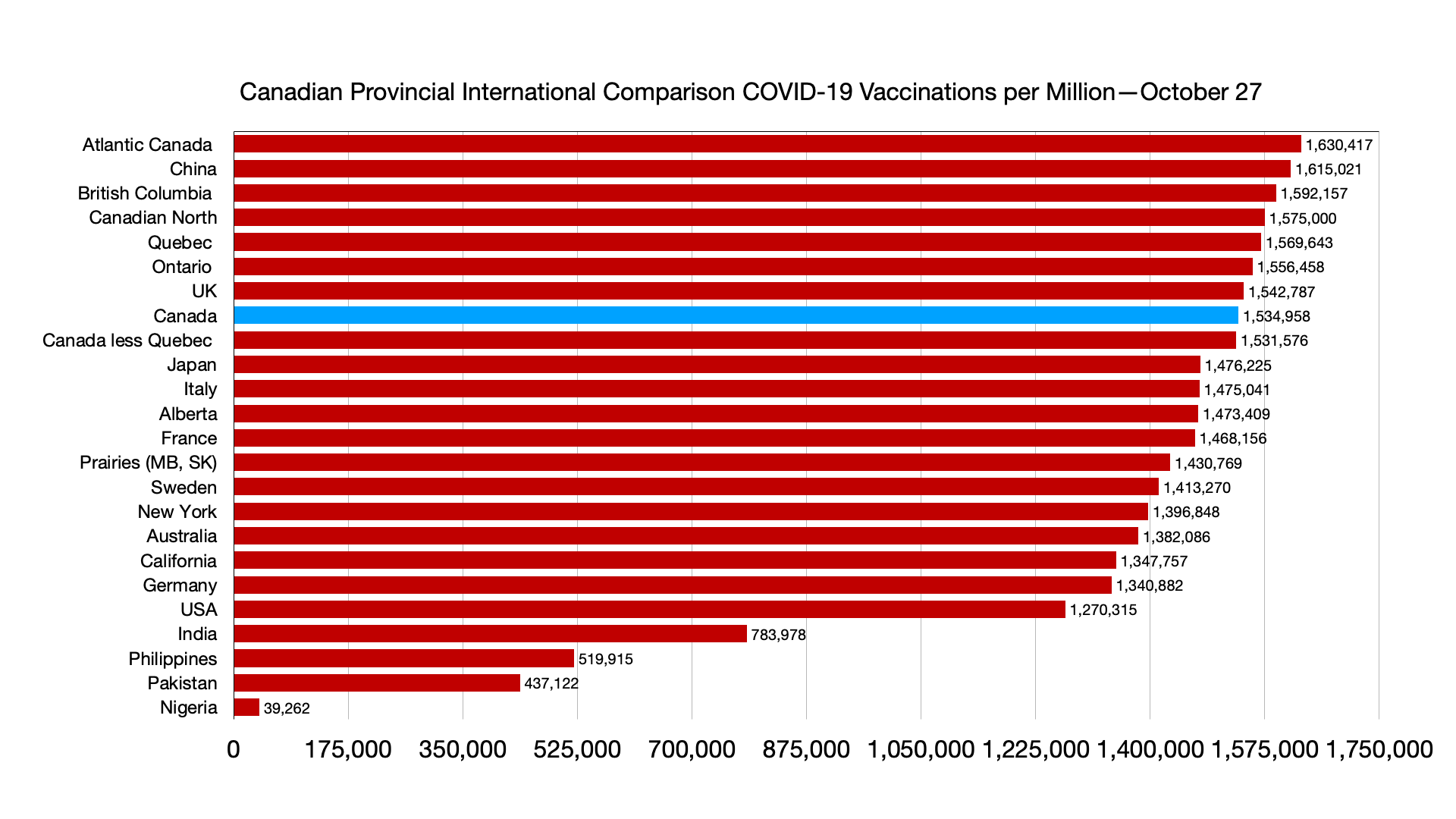
The latest charts, compiled 15 September as overall rates in Canada increase slightly due to the variant. Canadians fully vaccinated 69.3 percent, higher than USA 54.6 percent and the UK 66 percent) but all three countries are hitting a wall, with only minimal increases in the past week.

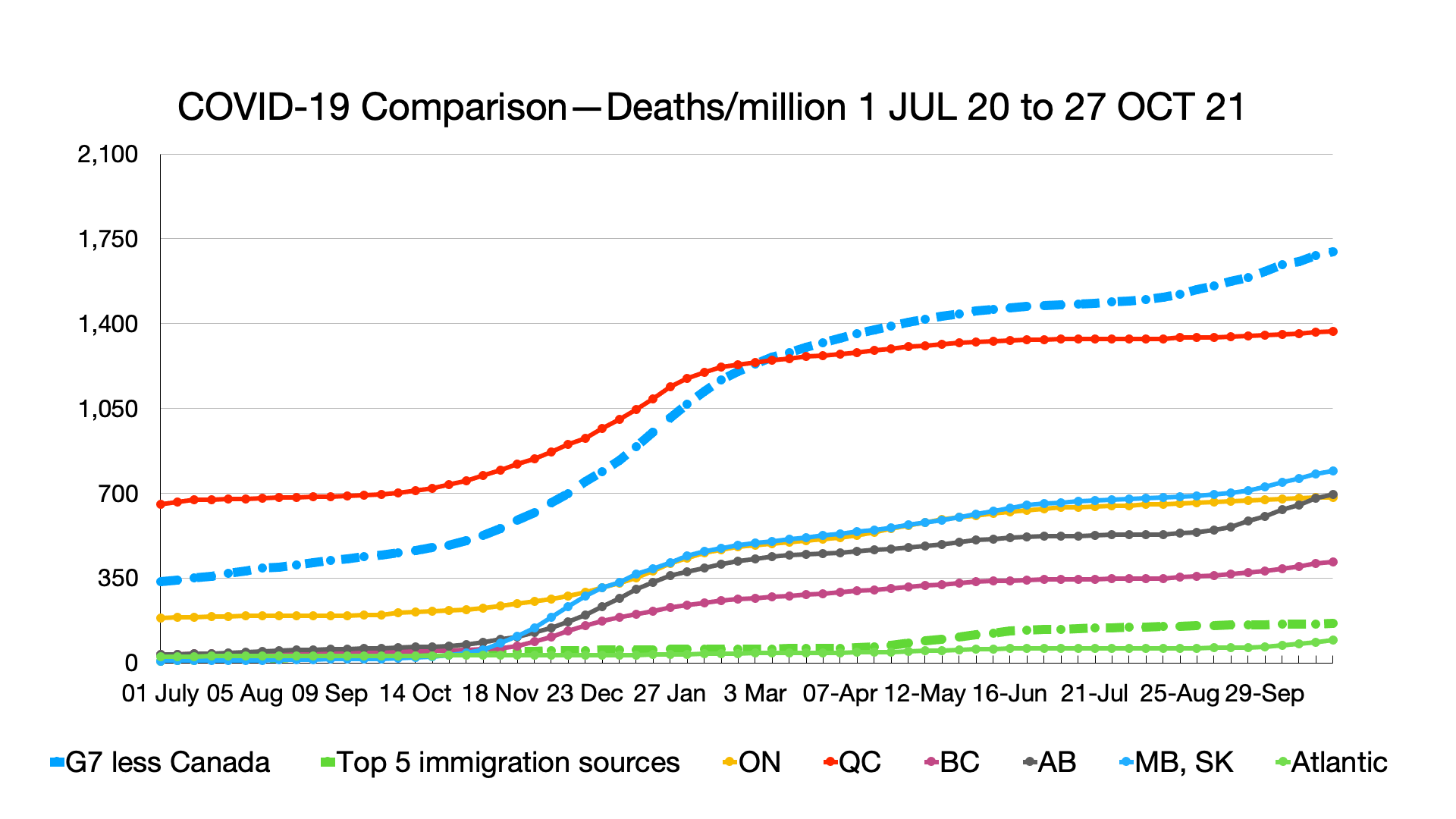
Trendline charts

Vaccinations: Philippines ahead of India. China fully vaccinated 69.4 percent, India 13.3 percent.

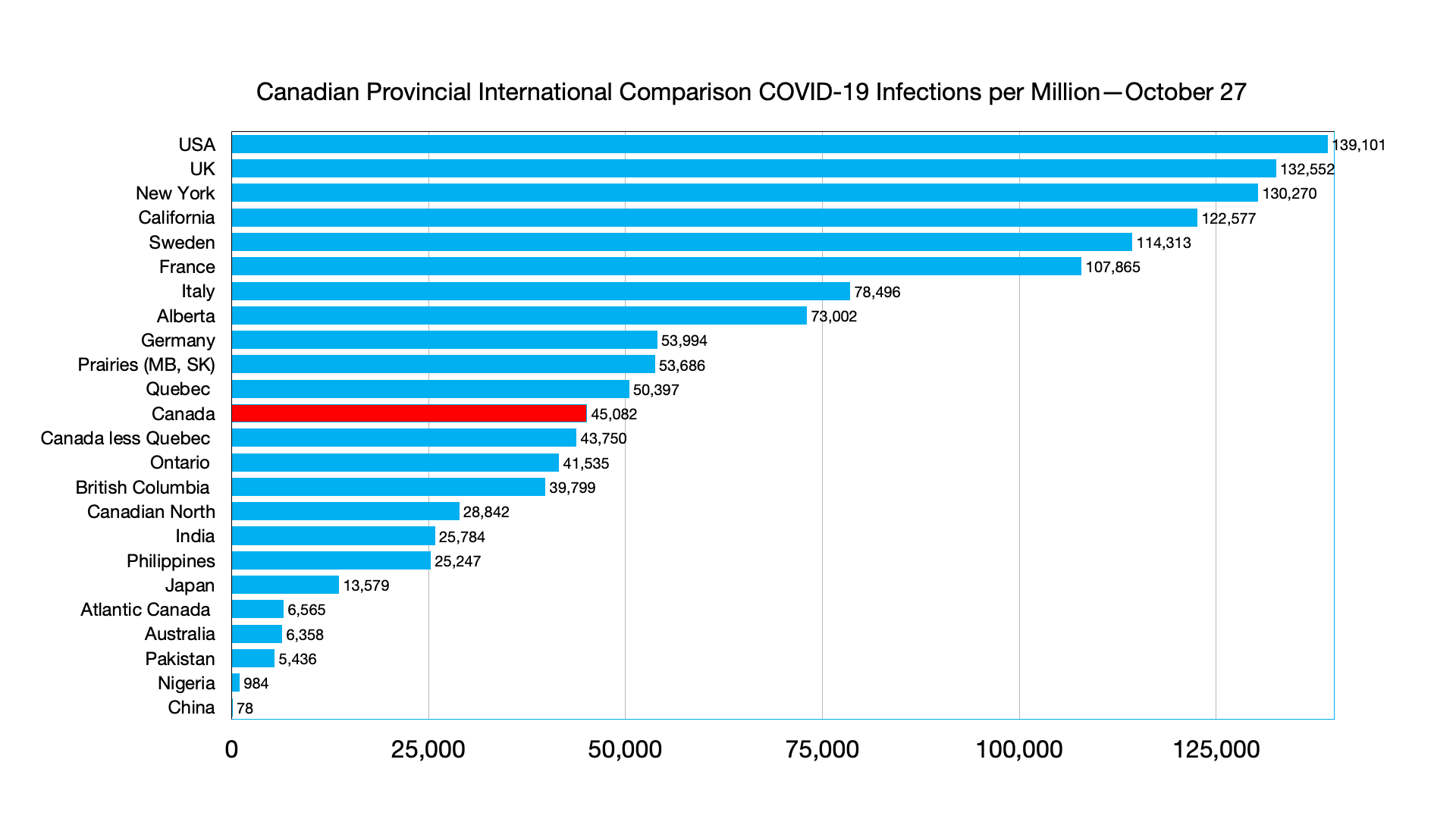
Infections: Continued trend of pronounced uptick in G7 less Canada (driven largely by USA). While all provinces showing increased infections, Alberta and Prairies showing the highest, followed by British Columbia.

Deaths: No major change but uptick G7 less Canada and in Alberta.

Vaccinations: Ongoing steady gap between Alberta and Prairies with lower vaccination rates than elsewhere in Canada. More rapid increase of immigration sources countries continues to be driven by China and to a lesser extent, India.

Weekly

Infections: No relative change.

Deaths per million: Canadian North ahead of Pakistan.

Misattributed blame? Attitudes toward globalization in the age of automation

Interesting study and findings:

Many, especially low-skilled workers, blame globalization for their economic woes. Robots and machines, which have led to job market polarization, rising income inequality, and labor displacement, are often viewed much more forgivingly. This paper argues that citizens have a tendency to misattribute blame for economic dislocations toward immigrants and workers abroad, while discounting the effects of technology. Using the 2016 American National Elections Studies, a nationally representative survey, I show that workers facing higher risks of automation are more likely to oppose free trade agreements and favor immigration restrictions, even controlling for standard explanations for these attitudes. Although pocket-book concerns do influence attitudes toward globalization, this study calls into question the standard assumption that individuals understand and can correctly identify the sources of their economic anxieties. Accelerated automation may have intensified attempts to resist globalization.

Source: https://www.cambridge.org/core/journals/political-science-research-and-methods/article/misattributed-blame-attitudes-toward-globalization-in-the-age-of-automation/29B08295CEAC4A4A89991E064D0284FF

UK: How have Priti Patel’s previous pledges on immigration fared?

Of note (somewhat comparable issues with respect to calls to close the Canada-USA Safe Third Country Agreement “loophole” for asylum seekers between official points of entry):

The viability of Thursday’s announcement by Priti Patel that small boats carrying migrants across the Channel will be turned back to France by Border Force officials has been questioned by politicians on all sides, and by the immigration services union, lawyers and human rights organisations.

So it may be that its chances of actually being put into practice are slim. Here is a quick guide to what happened after previous high-profile announcements by the home secretary.

Small boat arrivals

In October 2019 Patel pledged to halve migrant crossings by the end of that month – at that time there had been more than 1,400 people crossing in small boats since the beginning of 2019. So far in 2021, 13,500 migrants have crossed the Channel, including 1,000 in the past two days.

The statement from the home secretary about turning small boats back mid-Channel crossing was not an official Home Office announcement. It is not clear whether or not a published policy will emerge.

Toufique Hossain, director of public law at Duncan Lewis solicitors, said: “It is difficult to see a legal basis for what is effectively collective expulsion. The desperate need to look tough on immigration may lead to unlawful and dangerous consequences.”

Offshoring asylum seekers

Reports emerged in June this year that the new immigration bill would include plans to hold asylum seekers in processing centres outside the UK. It is understood that officials working for the Foreign, Commonwealth and Development Office were tasked with exploring whether any other country would be receptive to accommodating asylum seekers who had sought sanctuary in the UK while their claims were processed. Australia adopted this controversial system in 2001 and Denmark has passed legislation enabling it to do the same. Countries such as Rwanda, along with Ascension Island and disused oil rigs, were mooted. Installing giant wave machines in the Channel was also mentioned in media briefings last October. Since then no more has been heard about these plans.

Sending small boat arrivals who passed through safe European countries back there

This was promised after the conclusion of the Brexit transition period at the end of 2020. But nobody has yet been sent back. The Home Office said that this category of asylum claims would be ruled inadmissible. According to Migration Observatory evidence this week to the joint committee on human rights, 4,500 notices of intent have been served since the start of 2021 relating to cases that may be considered inadmissible. But so far only seven cases have been declared as such and nobody has so far been returned to a European country post-Brexit.

Increased number of deportations

Deportations and enforced removals have declined year on year since 2012, with 3,300 enforced returns in 2020, 54% fewer than in 2019. While the sharp drop last year can be partly attributed to Covid, the steady year-on-year reduction cannot. The Home Office says the reduction is partly due to some of those in detention prior to deportation raising “issues”.

Tougher provisions in new immigration bill

The nationality & borders bill itself is subject to a legal challenge questioning the lawfulness of the consultation process. Even some of the Home Office’s key contractors such as the charity Migrant Help, which operates a helpline on behalf of the Home Office for asylum seekers, have been critical of the new bill, saying they believe it will damage the UK’s reputation as a world leader in its approach to human rights and social responsibility.

Source: How have Priti Patel’s previous pledges on immigration fared?

Immigration-related party platform commitments: Updated with Green Platform

I have updated the immigration party platform table to include the Green Party. Please note that this analysis is based on the published platforms only, not other public commitments.

Some general observations that supplement my earlier summary:

  • All platforms have a mix of specific commitments (e.g., LPC reduce family class processing times to under 12 months) versus non-specific commitments (e.g., NDP address backlog for refugees);
  • All platforms resort to process commitments (e.g., Foreign Credential Recognition);
  • Focus on Quebec particularly apparent in Conservative and NDP platforms. All parties save the Bloc silent on Quebec’s Bill 21;
  • All platforms contain “virtue signalling” or party base language (e.g., LPC reference to previous CPC cuts to immigration levels — not true, CPC “prepared to work hard, contribute to growth and productivity of Canada, and strengthen our democracy” for transition to permanent residency);
  • All platforms save PPC are silent on immigration levels. Surprising that Liberals didn’t mention the levels plan given all the messaging around achieving 400,000 this year;
  • Limited immigration policy innovation, save for CPC family class “point system,” expedited processing fee and replacing GARS with PSRs and Blended refugees, along with operational innovation;
  • Clear divisions on the STCA: Liberals silent, CPC and PPC would apply across the border (closing Roxham Road “loophole”), Bloc and Greens would end the agreement, with NDP surprisingly silent;
  • Relatively little attention paid to operational and administrative issues save for general reference to processing times;
  • All parties are silent on issues where either their record is mixed (Liberals on processing) or party positions may be controversial (e.g., CPC on multiculturalism and anti-racism) or unclear (e.g., NDP on economic immigration);
  • Some catering to specific groups (e.g., Liberals with respect to Blacks, Conservatives with respect to visa-free travel for Ukrainians, Bloc of course with Québécois);
  • Liberal (82 pages), Conservative (160 pages), NDP (114 pages) and Green (103 pages) platforms are lengthy, allowing them to micro-target. The Bloc (30 pages) is more concise given its focus on Quebec. PPC has not provided one complete pdf to compare length but covers most areas. Unlikely that any party could deliver on the majority of commitments.

Updated by issues

  • Levels: No reference to specific levels by CPC, NDP, Bloc and Greens.
  • Liberals are silent (save for a false claim of previous Conservative cuts) but levels are known through the immigration plan.
  • PPC platform commitment to reduce levels to between 100 and 150,000.

Economic:

  • Liberal commitments to welcome talented workers through existing Global Skills Strategy and reduce processing times to under 12 months.
  • Conservatives emphasize the priority to be given to healthcare workers and expansion of the Provincial Nominee Program in regions which retain immigrants.
  • PPC commits to increase percentage of economic and require in-person interviews with questions regarding alignment with Canadian values along with additional resources for background checks.

Family:

  • Liberals commit to electronic applications and a program to issue visas to spouses and children abroad pending full application processing.
  • Conservatives, more innovatively, propose replacing the lottery system with a point system based upon childcare and family support along with language competency, along with additional resources.
  • NDP proposes to end the caps on Parents and Grandparents, the Greens propose an increase while the PPC proposes to abolish P&Gs and limit others.
  • Greens also propose to revise adoptions procedures, including adoption bans from Muslim countries.

Refugees:

  • Liberals propose to increase the number of Afghan refugees from 20,000 to 40,000 as well as 2,000 skilled refugees through the Economic Mobility Pathways program with a healthcare focus.
  • Conservatives propose replacing Government Assisted Refugees (GARS) with Privately Sponsored (PSR) and Blended programs with no change in numbers. Priorities will be the most vulnerable, SPOs with strong track record and the introduction of a “human rights defender stream” for situations like Hong Kong as well as making the LGBTQ Rainbow Refugee program permanent. Additional capacity for the IRB along with closing the Safe Third Country Agreement (STCA) loophole (between official points of entry) and joint border patrols with the US are part of the platform.
  • NDP commits to addressing the backlog and working with Canadians to resettle refugees in communities.
  • Bloc would end the STCA and welcome French speaking refugees.
  • Greens also propose to end the STCA, and revise all CBSA practices (e.g., detention centres, family separation), address long processing times, and lower family reunification barriers for convention refugees.
  • PPC commits to fewer refugees, declaring the entire border an official port of entry (thus covered by the STCA), reliance on private sponsorship and no longer relying on UN selection of GARS with priority given to religious minorities in Muslim countries and those who reject “political Islam.”

Foreign Credential Recognition: All three major parties with continue to work with provinces and territories, with the Conservatives committed to a task force for “new strategies.” The Greens promise greater funding and collaboration with accreditation issues.

Cultural Sensitivity: In addition to the Conservative proposal on “cultural sensitivity,” the Greens propose to “address xenophobia in all aspects of settlement, including temporary visa liberalization, issuing of temporary permits …and family reunification.”

Immigration fees: The Conservatives would introduce an expedited service fee for quicker application and the Greens would provide a fee exemption for low-income immigrants.

Temporary Residents: Both Liberals and Conservatives commit to a trusted employer system to reduce the administrative burden on employers.

  • Liberals mention the Global Talent Stream focus on highly skilled workers and commit to an employer hotline to resolve issues.
  • Conservatives would introduce standards and timelines for Labour Market Information Assessments (LMIA).
  • Bloc proposes the transfer of the Temporary Foreign Workers Program to Quebec.
  • Green platform has general reference to liberalization for temporary workers and strategies for workers to report abusive employers without losing status.
  • PPC would limit the number of temporary workers and ensure that they are only filling temporary positions and not competing with Canadians.

Temporary to Permanent Transition:

  • Liberals would reform economic immigration programs to expand pathways to Permanent Residence.
  • Conservatives commit to pathways for both the “best and brightest” as well as low-skilled workers, latter based on labour market data, and those that are “prepared to work hard, contribute to growth and productivity of Canada, and strengthen our democracy”. Employers would be allowed to sponsor those wishing to transition.
  • NDP would provide a pathway to all Temporary Residents, highlighting caregivers in particular.
  • Greens would lower barriers to transition, particularly for healthcare workers.

Consultants: Only the NDP mentions consultants and commits to government regulation.

International cooperation: PPC commits to withdraw from the Global Compact on Migration.

Settlement/Integration:

  • Conservatives state they will support settlement services but with no specifics.
  • NDP states that it will work with the provinces.
  • Greens would provide greater funding for language training and employment skills.

Administration (Processing):

  • Conservatives emphasize simplification and streamlining of application and administrative processing, with technology being used to speed up application vetting. The IT infrastructure (the one currently being developed) would record all transactions and applicants would be allowed to correct “simple and honest” mistakes rather than the application being rejected. The Conservatives also commit to harmonizing FPT systems.
  • The Bloc would accelerate Permanent Resident application processing.

Citizenship:

  • Liberals recycle their 2019 commitment to eliminate citizenship fees.
  • Bloc plans to table a bill requiring knowledge of French to obtain citizenship (currently, knowledge of either official language). Ironic, given the Bloc’s persistent in respecting jurisdictional competencies as citizenship is exclusively under federal jurisdiction.
  • Greens would update the citizenship guide (already been revised, awaiting political decision to release) and exemption from citizenship fees for low income applicants
  • PPC promises to make birth tourism illegal.

Visitor visas

  • Strangely, the Conservatives commit to a five-year super-visa when they had introduced a 10-year super-visa when in government that was maintained by the Liberal government. They also commit to explore more “generous and fairer visas” by more enforceable commitments on length of stay.
  • Greens would remove visa requirements for most parents visiting children, including TRs

Multiculturalism:

  • CPC: No mention or commitments
  • Liberals commitments include: improve gender & racial equity among faculty (Canada Research Chairs $250m), reference to existing initiatives (Black Entrepreneurship, Black-led non-profits, youth), implement the Black-led Philanthropic Endowment Fund, strengthen equity targets for fed-funded scientific research, specific target for Black Canadians and Funding for promising Black graduate students $6m), support production led by equity seeking groups, creation of a Changing Narratives Fund for diverse communities, BIPOC journalists and creatives $20m), and Increase funding to multiculturalism community programs.
  • NDP commitment include preventing violent extremism through support for community-led initiatives, confronting systemic racism (few details), a national action plan to dismantle far-right extremist organizations, a national task force and roadmap to address over-representation of Blacks and Indigenous peoples in Canadian prisons and, working with the provinces, the collection of race-based data health, employment, policing.
  • Familiar Bloc commitments include placing the federally-regulated sectors (banking, communications, transport) under Quebec’s language charter, opposing Court Challenges Program funding for challenges to Quebec laws (e.g, Bill 21), a commission on prevention of “honour crimes,” and excluding Quebec from the Multiculturalism Act.
  • Greens would implement recommendations from the UN Working Group of Experts on People of African Descent, limit RCMP role and funding in municapt and reserve policy, develop a national oversight approach working with provinces, end RCMP carding and shift police resource to social and community services. 
  • PPC would repeal the Multiculturalism Act.

Anti-Racism/Hate:

  • CPC: No mention or commitments
  • Liberal commitments include: a National Action Plan on Combatting Hate, possible amendments the Criminal Code hate provisions, boosting funding to the Anti-Racism Strategy and Anti-racism Secretariat, introducing legislation to combat serious forms of hurtful online content including making social media platforms responsible for such content, strengthening the Human Rights Act and Criminal Code to more effectively combat online hate, and the creation of a National Support Fund for Survivors of Hate-Motivated Crimes.
  • NDP commitments include: ensuring all major cities too have dedicated hate crime units, establishment of national standards for recording hate crimes (beyond police-reported which already exist?) and work with non-profits to increase reporting, ban carding by the RCMP and establishing a national working group to counter online hate and protect public safety, and making sure that social media platforms are legally responsible for distributing online hate.
  • Bloc condemns hate speech but no proposed changes to the Criminal Code and denounces “Quebec bashing” assertions regarding racism in Quebec.
  • Greens commit to developing better guidelines to address weaponization of free expression, funding data collection online hate and real-world violence, improve AI solutions to detect online hate & violence and require social media to detect and prevent online hate.

Employment Equity:

  • Liberal commitments include: the creation of Diversity Fellowship for mentoring and sponsoring of under-represented groups, French language training for 3rd and 4th year university students to bridge language barriers to entry, expand recruitment to international students and Permanent Residents, and the creation of a mental health fund for Black public servants & support career advancement for Black workers.
  • NDP commitments include: a review to help close the visible minority and Indigenous peoples wage gap and ensuring diverse and equitable hiring in the public service and FRS (recent public service data indicates considerable progress).
  • Bloc proposes the use of blind cvs in public service hiring (pilot carried out in 2017 suggested little difference between existing and blind cv processes).
  • Greens welcome the review of the Employment Equity Act and call for greater working input, an extended timeline and increased resources, and broadening it application to outsourced workers.

#COVID-19: Comparing provinces with other countries 8 September Update

The latest charts, compiled 8 September as overall rates in Canada increase slightly due to the variant. Canadians fully vaccinated 68.6 percent, higher than USA 53.8 percent and the UK 65.1 percent) but all three countries are hitting a wall, with only minimal increases in the past week.

Vaccinations: China now has highest vaccination rate, British Columbia ahead of Canadian North, Italy ahead of Prairies, Sweden ahead of Alberta.  Chinese fully vaccinated, 63.3 percent (unchanged from last week).

Trendline charts

Infections: Same ongoing trend of pronounced uptick in G7 less Canada (driven largely by USA). While all provinces showing increased infections, Alberta and Prairies showing the highest.

Deaths: No major change but uptick G7 less Canada.

Vaccinations: Ongoing steady gap between Alberta and Prairies with lower vaccination rates than elsewhere in Canada. More rapid increase of immigration sources countries continues to be driven by China and to a lesser extent, India.

Weekly

Infections: No relative change except California slightly ahead of Sweden.

Deaths per million: No significant change.

25-year-old internal memo to Canada Revenue Agency predicted foreign money distorting housing market

Pretty outrageous, both the initial non-release and the five-year ATIP battle. Kudos to Ian Young of the SCMP for persisting. David Anderson and Jane Stewart were ministers at the time:

An internal Canada Revenue Agency audit concluded 25 years ago that wealthy new immigrants were buying up most of the priciest houses taken from a sample in and around Vancouver while declaring poverty on their tax returns. But the report was not made public until a five-year access-to-information battle concluded recently.

Housing and immigration academics say the study could have warned the public about the scale of foreign money being parked in Metro Vancouver’s residential real estate – decades before the provincial government began taking meaningful action to slow this trend.

During the federal election campaign, all three major parties have proposed various policies to curb international demand for real estate, which has contributed to rising unaffordability in a number of urban centres.

The Liberals and Conservatives are promising to ban foreign home buyers for at least two years. The New Democrats have pledged to tax those who aren’t Canadian citizens or permanent residents with a 20-per-cent levy – the same penalty imposed in British Columbia’s biggest cities for the past three years.

But critics say the parties need to follow B.C.’s lead to capture even more information about property owners so that they can be taxed more equitably and governments can tamp down international real estate speculation.

The CRA’s analysis from October, 1996, was shared with The Globe and Mail this week after its release to Ian Young, the South China Morning Post’s Vancouver correspondent who first requested the information in 2016 after being leaked portions of the internal memo explaining its findings.

The audit focused on 328 higher-end sales in the suburbs Burnaby and Coquitlam, but the study also analyzed a random sample of 6,060 sales from Vancouver and neighbouring Richmond and discovered “similar demographic results.”

Of the 46 houses bought in Burnaby, staff found 72 per cent were purchased by new arrivals to Vancouver who reported an average total family income of just $16,000. In contrast, the CRA’s chart from the audit showed four buyers who were long-term residents reported average family incomes that were tens of thousands of dollars higher.

This income gap between new immigrants and neighbours who had lived there longer was also observed in Coquitlam, according to the CRA’s chart released in the package of documents.

“It should be noted that an obvious large discrepancy exists between the average total family incomes for long-term Canadian residents and newer Canadian residents,” the author of the memo wrote to his CRA boss. “Furthermore, based on lifestyle and average age of these taxpayers, it is likely that many of these new Canadians still have active business activities, but are not reporting all their sources of income.”

Vancouver lawyer Richard Kurland, who has been helping international clients immigrate to B.C. for 25 years, said the analysis proves the CRA failed to catch those hiding their global income while competing for homes on Canada’s West Coast.

“They knew it was happening and did nothing, so the bleeding continued, taxes were not paid, property was subject to speculation and the end result [is] people in Vancouver are paying many more times than they have to for residential property because the CRA did nothing when it was warned by its own employees about what was going on,” he said.

David Ley, a geography professor at the University of B.C. who studies housing bubbles, said the 1996 report could have spurred politicians to address the anomaly of “apparently poor people buying very rich properties” decades earlier. He said the CRA had long maintained that they it would take too many resources to crack down on home buyers hiding wealth abroad, in large part because other countries they lived in were unlikely to release the pertinent tax information.

“It’s very difficult to pursue foreign sources of income – so they didn’t,” Dr. Ley said.

The CRA told The Globe this week that the study intentionally focused on cases where the buyer may have been underreporting their income and, thus, “was not intended to, and should not be, extrapolated to the whole population.”

But large parts of the internal communications around the release of this document were redacted because the agency said federal access-to-information law allows consultations or deliberations between government employees, a minister of the Crown or their staff to remain confidential.

The federal agency said it takes cheating its system seriously and has stepped up audits in the hot housing markets of Toronto and Vancouver in recent years. Still, the CRA said its five-year battle with Mr. Young over the release of this document is “clearly not normal, nor is it acceptable; we are continuing to take steps to improve [our] performance.”

Andy Yan, a housing analyst and director of Simon Fraser University’s city program, said the federal government has a lot of tools – such as home loan data and analysis of social demographic changes in neighbourhoods – through which it can confirm or refute how widespread these investment patterns have been. But, ultimately, he said, the CRA has not effectively enforced the country’s tax rules, helping create an unfair system where foreign capital is stored in residential real estate.

“There shouldn’t be any free parking,” said Mr. Yan.

In 2015, a Globe and Mail investigation into public data – including land titles, tax reporting and court records – revealed a similar pattern to the 1996 CRA study that suggested the typical wealthy foreign family buying Vancouver real estate pays little or no income or capital gains tax. These family homes were priced out of reach for many locals whose taxes pay for public services.

The Globe discovered that one in three multimillion-dollar homes bought in Vancouver areas popular with foreign buyers was registered to a homemaker, student or corporation – one indicator of how the identity of the person who actually paid can be hidden.

When a spouse or child sells a property that is registered in their name, the real investor can avoid capital-gains taxes – because the relative in Canada can claim it was their primary residence, therefore not an investment.

This and other Globe investigations helped increase public pressure on the provincial Liberal government to enact Canada’s first tax on foreign homebuyers. After the New Democrats were elected in 2017, in part on their pledge to further crack down on expanding real estate speculation, B.C. implemented a host of new taxes and demand-side tools.

Mr. Kurland said more provinces need to follow B.C.’s lead in requiring that homebuyers declare their country of residence for tax purposes as well as create a registry for beneficial owners – which will come into full force at the end of this year to make it tougher for people to hide real estate investments behind corporations, trusts or partnerships.

He said the CRA’s current “whack-a-mole” approach to catching scofflaws in the housing market relies on auditors digging for specific information in individual cases, but it will soon be able to use algorithms to scour all its tax information and these twin data sets to better catch those hiding wealth in B.C.

“It’s equivalent of an abacus versus a spreadsheet,” said Mr. Kurland, who added that he saw a “massive selling spree” among foreign owners in B.C. before each of those two policies became law.

Rohana Rezel, a software engineer who advocates for more affordable housing by using software and data to uncover speculators in Metro Vancouver’s market, said the most effective federal policy on this issue would be to blanket the whole country with a speculation tax on all homes.

Then, owners could offset this two-per-cent penalty against what they pay to the CRA each year, said Mr. Rezel.

“If you’re paying income taxes of a certain amount it doesn’t apply to you,” said Mr. Rezel, who immigrated to Canada from Sri Lanka in 2008.

Source: https://www.theglobeandmail.com/canada/british-columbia/article-25-year-old-internal-memo-to-canada-revenue-agency-predicted-foreign/

Immigration-related party platform commitments: Working draft

Having reviewed all the official party platforms (save the unreleased Green platform), I have prepared this working summary of immigration and diversity related programs.

Party platforms are largely communication instruments that signal overall direction as well as targeting specific groups and interests. The longer the platform, the greater the micro-targeting, and both Liberal and Conservative platforms are long.

In general, the general consensus around immigration-related issues and thus immigration is not a major or polarizing election issue (save for PPC), as noted by John Ibbitson. And Andrew Coyne notes the same overall, without mentioning immigration”

I have tried to keep editorial comment to a minimum except where a factual or historic reference is appropriate.

Let me know if any omissions or any corrections needed.

Summary:

Levels: No reference to specific levels by CPC, NDP and Bloc.

  • Liberals are silent (save for a false claim of previous Conservative cuts) but levels are known through the immigration plan.
  • PPC platform commitment to reduce levels to between 100 and 150,000.

Economic:

  • Liberal commitments to welcome talented workers through existing Global Skills Strategy and reduce processing times to under 12 months.
  • Conservatives emphasize the priority to be given to healthcare workers and expansion of the Provincial Nominee Program in regions which retain immigrants.
  • PPC commits to increase percentage of economic and require in-person interviews with questions regarding alignment with Canadian values along with additional resources for background checks.

Family:

  • Liberals commit to electronic applications and a program to issue visas to spouses and children abroad pending full application processing.
  • Conservatives, more innovatively, propose replacing the lottery system with a point system based upon childcare and family support along with language competency, along with additional resources.
  • NDP proposes to end the caps on Parents and Grandparents while the PPC proposes to abolish P&Gs and limit others.

Refugees:

  • Liberals propose to increase the number of Afghan refugees from 20,000 to 40,000 as well as 2,000 skilled refugees through the Economic Mobility Pathways program with a healthcare focus.
  • Conservatives propose replacing Government Assisted Refugees (GARS) with Privately Sponsored (PSR) and Blended programs with no change in numbers. Priorities will be the most vulnerable, SPOs with strong track record and the introduction of a “human rights defender stream” for situations like Hong Kong as well as making the LGBTQ Rainbow Refugee program permanent. Additional capacity for the IRB along with closing the Safe Third Country Agreement (STCA) loophole (between official points of entry) and joint border patrols with the US are part of the platform.
  • NDP commits to addressing the backlog and working with Canadians to resettle refugees in communities.
  • Bloc would end the STCA and welcome French speaking refugees.
  • PPC commits to fewer refugees, declaring the entire border an official port of entry (thus covered by the STCA), reliance on private sponsorship and no longer relying on UN selection of GARS with priority given to religious minorities in Muslim countries and those who reject “political Islam.”

Foreign Credential Recognition: All three major parties with continue to work with provinces and territories, with the Conservatives committed to a task force for “new strategies.”

Cultural Sensitivity: The Conservatives propose “cultural sensitivity” training and matching applicants with officers who understand the cultural context of immigrants, most likely in the context of spousal sponsorship given some public awareness of previous IRCC practices and guides.

Immigration fees: The Conservatives would introduce an expedited service fee for quicker application review and processing

Temporary Residents: Both Liberals and Conservatives commit to a trusted employer system to reduce the administrative burden on employers.

  • Liberals mention the Global Talent Stream focus on highly skilled workers and commit to an employer hotline to resolve issues.
  • Conservatives would introduce standards and timelines for Labour Market Information Assessments (LMIA).
  • Bloc proposes the transfer of the Temporary Foreign Workers Program to Quebec.
  • PPC would limit the number of temporary workers and ensure that they are only filling temporary positions and not competing with Canadians.

Temporary to Permanent Transition:

  • Liberals would reform economic immigration programs to expand pathways to Permanent Residence.
  • Conservatives commit to pathways for both the “best and brightest” as well as low-skilled workers, latter based on labour market data, and those that are “prepared to work hard, contribute to growth and productivity of Canada, and strengthen our democracy”. Employers would be allowed to sponsor those wishing to transition.
  • NDP would provide a pathway to all Temporary Residents, highlighting caregivers in particular.

Consultants: Only the NDP mentions consultants and commits to government regulation.

International cooperation: PPC commits to withdraw from the Global Compact on Migration.

Settlement/Integration:

  • Conservatives state they will support settlement services but with no specifics.
  • NDP states that it will work with the provinces.

Administration (Processing):

  • Conservatives emphasize simplification and streamlining of application and administrative processing, with technology being used to speed up application vetting. The IT infrastructure (the one currently being developed) would record all transactions and applicants would be allowed to correct “simple and honest” mistakes rather than the application being rejected. The Conservatives also commit to harmonizing FPT systems.
  • The Bloc would accelerate Permanent Resident application processing.

Citizenship:

  • Liberals recycle their 2019 commitment to eliminate citizenship fees.
  • Bloc plans to table a bill requiring knowledge of French to obtain citizenship (currently, knowledge of either official language). Ironic, given the Bloc’s persistent in respecting jurisdictional competencies as citizenship is exclusively under federal jurisdiction.
  • PPC promises to make birth tourism illegal.

Visitor visas: Strangely, the Conservatives commit to a five-year super-visa when they had introduced a 10-year super-visa when in government that was maintained by the Liberal government. They also commit to explore more “generous and fairer visas” by more enforceable commitments on length of stay.

Multiculturalism:

  • CPC: No mention or commitments
  • Liberals commitments include: improve gender & racial equity among faculty (Canada Research Chairs $250m), reference to existing initiatives (Black Entrepreneurship, Black-led non-profits, youth), implement the Black-led Philanthropic Endowment Fund, strengthen equity targets for fed-funded scientific research, specific target for Black Canadians and Funding for promising Black graduate students $6m), support production led by equity seeking groups, creation of a Changing Narratives Fund for diverse communities, BIPOC journalists and creatives $20m), and Increase funding to multiculturalism community programs.
  • NDP commitment include preventing violent extremism through support for community-led initiatives, confronting systemic racism (few details), a national action plan to dismantle far-right extremist organizations, a national task force and roadmap to address over-representation of Blacks and Indigenous peoples in Canadian prisons and, working with the provinces, the collection of race-based data health, employment, policing.
  • Familiar Bloc commitments include placing the federally-regulated sectors (banking, communications, transport) under Quebec’s language charter, opposing Court Challenges Program funding for challenges to Quebec laws (e.g, Bill 21), a commission on prevention of “honour crimes,” and excluding Quebec from the Multiculturalism Act.
  • PPC would repeal the Multiculturalism Act.

Anti-Racism/Hate:

  • CPC: No mention or commitments
  • Liberal commitments include: a National Action Plan on Combatting Hate, possible amendments the Criminal Code hate provisions, boosting funding to the Anti-Racism Strategy and Anti-racism Secretariat, introducing legislation to combat serious forms of hurtful online content including making social media platforms responsible for such content, strengthening the Human Rights Act and Criminal Code to more effectively combat online hate, and the creation of a National Support Fund for Survivors of Hate-Motivated Crimes.
  • NDP commitments include: ensuring all major cities too have dedicated hate crime units, establishment of national standards for recording hate crimes (beyond police-reported which already exist?) and work with non-profits to increase reporting, ban carding by the RCMP and establishing a national working group to counter online hate and protect public safety, and making sure that social media platforms are legally responsible for distributing online hate.
  • Bloc condemns hate speech but no proposed changes to the Criminal Code and denounces “Quebec bashing” assertions regarding racism in Quebec.

Employment Equity:

  • Liberal commitments include: the creation of Diversity Fellowship for mentoring and sponsoring of under-represented groups, French language training for 3rd and 4th year university students to bridge language barriers to entry, expand recruitment to international students and Permanent Residents, and the creation of a mental health fund for Black public servants & support career advancement for Black workers.
  • NDP commitments include: a review to help close the visible minority and Indigenous peoples wage gap and ensuring diverse and equitable hiring in the public service and FRS (recent public service data indicates considerable progress).
  • Bloc proposes the use of blind cvs in public service hiring (pilot carried out in 2017 suggested little difference between existing and blind cv processes).

Working table below:

Douglas Todd: ‘Get real’ estate! Five reasons to doubt Trudeau’s housing promises

Of note. Leave it to the housing experts for a comparative assessment of party housing promises and their electoral positioning:

Justin Trudeau has abruptly switched into the role of housing-affordability radical.

But it remains to be seen how many Canadians will buy the Liberals’ brazen new wave of promises — including a ban on foreign purchases, a tax on property flipping and restrictions on exploitive real-estate agents — since there is much cause for skepticism.

Weighing the party’s credibility is crucial since polls are suddenly showing housing affordability (not COVID) is one of the electorates’ top concerns. That’s like the B.C. election in 2017, which saw provincial Liberal leader Christy Clark, who relied heavily on developer donations, turfed in favour of the NDP.

All federal parties’ housing platforms require scrutiny, but here are five reasons voters are justified in feeling suspicious about the prime minister’s sudden conversion to housing activist, a persona he adopted last week to profess: “You shouldn’t lose a bidding war on your home to speculators. It’s time for things to change.”

1. Trudeau has done remarkably little to address an expanding housing crisis

Housing prices across the country have jumped more than 50 per cent cent on average under Trudeau’s watch.

This glaring reality was captured in a recent devastating sound bite, when a heckler at a Trudeau rally in Ontario bellowed: “You had six years to do something. You’ve done nothing. These houses are worth $1.5 million. Are you going to help us pay $1.5 million? Are you, buddy?”

While in power, Liberal promises to address soaring prices have added up to zero. Take, for instance, the commitment Trudeau made in B.C. during the 2019 campaign, to bring in a one-per-cent tax on purchases by “non-resident, non-Canadians.” Nothing happened.

Similar vacuous pledges came to mind last week when the Trudeau stole the Conservatives’ idea to place a two-year ban on all foreign property purchases. Only two months earlier, the Liberals had voted against a Conservative opposition-day motion to do just that.

Many Liberals, federal and provincial, have long claimed it’s xenophobic to restrict foreign buyers in Canada. They’re only now toning down their race-baiting.

The Liberals have long failed to address foreign capital flooding into real estate — as revealed, yet again, this week. A South China Morning Post article by Ian Young showed Ottawa spent five years covering up an old Canada Revenue report detailing how “rich migrants made more than 90 per cent of luxury purchases” in Burnaby and Coquitlam “while declaring refugee-level incomes.”

It also became even harder in the past few days to accept Trudeau’s authenticity on taxing house flipping when it was uncovered the Liberals’ star candidate in Vancouver-Granville had flipped 21 properties. Liberals’ coziness with real-estate insiders runs deep (as it does for many politicians).

2. The Liberals have purposely increased ‘demand’ for housing

It was more than odd when Trudeau came to Vancouver in August and said “you’ll forgive me if I don’t think about monetary policy … You’ll understand that I think about families.”

It’s impossible to believe the prime minister doesn’t comprehend that monetary policy — in the form of extremely low interest rates and his government’s rapid printing of money in response to the pandemic — have helped jack up prices.

While the Liberals are joining the Conservatives and NDP in making big pledges to increase the construction of housing, many analysts are shocked that some promises Trudeau is making will further inflate prices.

Trudeau’s talk about tax-free housing accounts for first-time buyers, along with other credits, will super-charge demand even more, particularly among young people who can’t afford to stretch further. The size of new mortgages in Canada are soaring far into the danger zone.

It looks, however, like many millennials aren’t buying the new Liberal rhetoric; Leger polling has found the party has been losing support among young adults.

3. Ottawa has done little to combat money laundering via real estate

Prominent housing analyst Stephen Punwasi says former Vancouver Sun reporter Sam Cooper’s book, Wilful Blindness: How A Network of Narcos, Tycoons and CCP Agents Infiltrated The West, is “the most important book on Canadian real estate you’ll read this year.”

Wilful Blindness describes how transnational multi-millionaires and criminals, rooted in China, Mexico and elsewhere, have exploited the country’s real estate, which is “Canada’s soft spot for economic infiltration.” Cooper’s book describes many egregious examples of how “dirty” offshore money has been transformed into “clean” money through Canadian housing, especially via property flipping.

What have the Liberals done to crack down on money laundering in urban real estate? Though the Liberals said they would gradually direct $69 million into strengthening RCMP investigation of money laundering, B.C. Attorney General David Eby and others have urged Ottawa to go much further — and institute U.S.-style racketeering laws, which are credited with dismantling Mafia families.

4. The Liberals keep hiking immigration levels

Economists — from banks, universities and developers’ organizations — have in recent years acknowledged one of the biggest factors affecting Canadian housing and prices is population growth through immigration.

Despite, or because of, this, Trudeau has steadily increased Canada’s immigration target since being elected in 2015, hiking it from 250,000 to 400,000 a year, with B.C. an especially popular destination.

UBC geographer Dan Hiebert has found the typical value of a detached Metro Vancouver home owned by a new immigrant in 2017 was $2.3 million, $800,000 higher than a dwelling owned by a Canadian-born person.

An SFU study found “hidden foreign ownership,” particularly through satellite families in which breadwinners make their money offshore, is a significant reason prices have no connection to local wages. It all adds up to help cut into the hopes of both domestic Canadians and newcomers with modest resources.

Source: Steve Saretsky, Vancouver housing analyst

5. It’s worse than ironic Trudeau now says, ‘The deck is stacked against you’

In light of the prime minister showing almost no interest in protecting the young from soaring prices, it was more than perplexing to last week see him act like a white knight taking on an out-of-control real-estate system.

Who knows if the identity switch will get votes? But Trudeau’s latest self-image echoes that of the Liberals’ talkative housing secretary, Adam Vaughan, who in April let slip that Canada is “a very safe market for foreign investment, but not a great market for Canadians looking for choices around housing.”

While Vaughan revealed the Liberals’ strategy has been to support “a very good system of foreign investment creating a lot of new housing in Canada as we add immigrants and grow the population,” he cautioned it would be terrible to bring in any policy that could cause  homeowners to see “10 per cent of the equity in their home suddenly disappear overnight.”

There it is. Two months ago the Liberals were firmly on the side of homeowners wanting to profit. Last week Trudeau suddenly became a champion of those frozen out of ownership.

You’re forgiven for thinking you are witnessing pure electoral posturing.

Source: Douglas Todd: ‘Get real’ estate! Five reasons to doubt Trudeau’s housing promises

Inger Stoejberg: Danish ex-immigration minister faces impeachment trial

Of note:

A historic impeachment trial gets underway in Denmark on Thursday against a former minister who spearheaded dozens of tough immigration measures.

Inger Stoejberg is accused of unlawfully ordering the separation of young asylum-seeking couples in 2016.

She is facing a landmark lawsuit, which accuses her of bearing responsibility for breaking the law.

It is Denmark’s first impeachment case in almost three decades, and only the second held in a century.

Between 2015 to 2019, Ms Stoejberg served as Denmark’s immigration minister in a centre-right government propped up by the right-wing populist Danish People’s Party.

Under her watch more than 100 new restrictions were introduced.

Advertisements were taken out in Lebanese newspapers to deter refugees and rules around family reunification were tightened up, drawing criticism from the United Nations refugee agency.

After imposing 50 new immigration curbs, she stirred controversy by celebrating with a cake.

Among other headline-grabbing measures were the confiscation of valuables from asylum-seekers and a now-scrapped plan to send foreign criminals to an uninhabited island in the Baltic Sea.

Separation of couples

The impeachment case stems from an order Inger Stoejberg gave in February 2016, that married refugees under 18 years old must not be accommodated with their spouse.

Twenty-three married couples, some with children, were separated before the policy was dropped a few months later.

Among them were a young Syrian couple, Rimaz Alkayal, then 17 and her spouse Alnour Alwan, 26, who were reunited following a complaint. They had been forced to live apart for four months, even though she was pregnant.

It has been a long journey to Denmark’s Supreme Court.

Inquiries by both the country’s ombudsman and a special commission concluded that the separations were illegal. Requirements to individually assess or consult those affected had been ignored and breached human rights.

The “Instrukskommission” or Directive Commission also said that the former minister had been warned by staff that the practice was unlawful.

Two independent attorneys then determined there were grounds for impeachment, and earlier this year, a large majority of MPs voted in favour, including Inger Stoejberg’s own party, the Liberals.

She resigned as deputy leader and quit the party.

‘No basis for impeachment’

Ms Stoejberg maintains she was trying to protect girls and combat child marriage.

“Mistakes have happened in the case and those I have apologised for, but to me there is of course no basis for an impeachment,” she wrote earlier on Facebook.

“My political wish was, is and will be that no child brides should live with their older husband at a Danish asylum centre. But of course I haven’t given any orders to break the law.”

The trial takes place at a special impeachment court and is likely to last until December. Thirteen Supreme Court judges and 13 appointees will decide if the former minister has violated the Ministerial Accountability Act.

“It’s about her responsibility. Whether she actually instructed the administration to perform an illegal action, and whether she knew that’s what she was doing,” explains Jens Elo Rytter, a constitutional law professor at Copenhagen University.

Career in the balance

“Very rarely do we have impeachment trials in this country,” says Prof Rytter. “It’s the only trial you can have for a minister who has allegedly performed an illegal action in office.”

This is only the sixth impeachment in Danish history.

Most have ended in acquittal. However, in 1995 ex-Justice Minister Erik Ninn-Hansen was handed a four-month suspended sentence for blocking refugees from Sri Lanka bringing their families to Denmark.

There’s no chance to appeal. If convicted, she could face a fine or possible imprisonment.

Her political career also hangs in the balance and Prof Rytter believes Ms Stoejberg has a fight on her hands.

“If you read the conclusions of the investigative committee that have looked very, very carefully to this case, their conclusions are rather clear.” he says. “On that basis, I would say I would be more surprised to see an acquittal than a guilty verdict.”

Inge Stoejberg is currently an independent MP. But if she is convicted she could lose her seat and parliament will vote on whether to allow her to stand for election again.

“This is a once-in-a-generation thing that’s happening. This is going to be very impactful,” says political analyst Kristian Madsen, who is editor-in-chief of A4 Medier.In Denmark Ms Stoejberg is a divisive figure, but she’s also a political heavyweight with a faithful following.

“There’s the traditional, nationalistic right wing that she obviously appeals to, but there’s also almost a Trump-esque element to this,” says Mr Madsen, who points to her strong social media influence. “She’s become an anti-elite, anti-establishment figure.”

Ahead of the trial she has this week launched a new website, offering paid subscribers exclusive videos and weekly newsletters with her views on her “political struggle for Danish values”. She had sought to have the trial televised, which in Denmark does not happen.

“This is unheard of in Denmark,” says Mr Madsen. “The message that sends to me is that she’s going to be a voice in the political arena after this trial, no matter how it ends.”

Source: Inger Stoejberg: Danish ex-immigration minister faces impeachment trial

Congress Can’t Solve Immigration. Maybe the States Can.

Seeing more arguments in US media regarding providing a role for states in selecting immigrants, citing Canada’s Provincial Nominee Program as a model. Given the political dynamics, hard to see this getting much traction as presume there would need to be legislative authority for such a change:

“A moral failing and a national shame.” During his 2020 campaign, that was how Joe Biden characterized America’s immigration policies in the Trump era. On his first day in office, the new president announced an ambitious reform. The U.S. Citizenship Act of 2021 would include a pathway to citizenship for undocumented immigrants. It would raise caps on legal immigration. It would increase aid for Central America. It touched all the progressive erogenous zones.

And it was dead on arrival. “It’s such a progressive wish list that it’s almost counterproductive,” a pro-immigration lobbyist told me. By summer, the reform effort had stalled, migrants were flooding the border, the Democrats were divided, and the Republicans were demagoguing. Just like always.

For the country, as well as for immigrants and their families and employers, the cost of our never-ending immigration crisis has been very high. Among its consequences was the presidency of Donald Trump, who could not have reached the White House without the disruptive energy that immigration unleashed. In fact, if you had to pick a date when America launched itself toward Trumpism, June 28, 2007, would be a good choice.

Immigration was on the floor of the Senate. A bipartisan coalition had revived what was then—and still is—the logical compromise: stricter controls at the borders and at job sites, more legal immigration (especially of skilled workers), and a path to citizenship. Had the compromise passed, “it would have changed the politics,” Jim Kolbe, who was then a House Republican representing an Arizona border district, recently told me. “It would have been seen as putting the immigration issue behind us.”

Instead, the bill failed, badly. A disappointed Mitch McConnell, then the Senate minority leader, said, “I had hoped for a bipartisan accomplishment, and what we got was a bipartisan defeat.”

Before 2007, immigration had been a controversial issue but also a normal one—susceptible to bargaining and compromise. Congress had passed major reform under President Ronald Reagan in 1986, and then a series of tune-ups in the ’90s. After 2007, paralysis set in. For conservatives, the stalemate became emblematic of the country’s inability to secure its borders and enforce its laws. For liberals, it was emblematic of the country’s inability to deal humanely with millions of immigrants. And for moderates, it was a symbol of congressional incompetence. According to the Pew Research Center, two-thirds of the public wants a pathway to citizenship and better border control. “Everyone knows what has to be done,” Kolbe told me, “but no one has the will to do it.”

This dispute has now inflamed our whole body politic. “I think the immigration debate is a bigger problem for the country than any of the failures of the immigration system,” Yuval Levin of the American Enterprise Institute told me. In other words, the country needs a resolution to the political crisis around immigration at least as much as it needs a solution to the policy mess. As long as voters believe Washington is too incompetent and venal to handle immigration, they will not trust it to do anything else, and the door will stay open to demagogues and nihilists.

So now what? Plan A, comprehensive progressive reform, will not work. Plan B, comprehensive conservative reform, will not work. Plan C, compromise, should work but has failed time and again. That leaves Plans D, E, and F: piecemeal reforms for groups such as “Dreamers” and farmworkers, and the kinds of patchwork changes that congressional Democrats were seeking to include in their budget-reconciliation package this fall. They may be the best we can do.

But there is one piecemeal proposal that deserves special attention. I think of it as Plan Z, because it reframes the whole problem.

In 2019, representative John Curtis, a Republican from Utah, introduced what he called the State-Sponsored Visa Pilot Program Act. It would have allowed a new avenue for immigration by authorizing states to sponsor people for three-year, renewable work visas. The bill found no co-sponsors and never came up for debate, but Curtis told me he intends to reintroduce it in the current Congress.

Delegating immigration authority to the states is not a new concept; Senator Ron Johnson, a Republican from Wisconsin, introduced a similar plan in 2017. According to Alex Nowrasteh of the Cato Institute, a libertarian think tank, bills seeking authority to issue work visas have been introduced in 11 state legislatures since 2008, and three such bills have been voted into law. But the federal government has ignored them.

One problem is that people just can’t get their mind around letting someone other than the federal government decide who comes and stays. You can’t have individual states picking immigrants for the whole country! What about security? What about fairness? Could a conservative state discriminate on the grounds of, say, race or religion?

But the idea is not really that dramatic. This proposal wouldn’t encroach on the existing federal systems for visas, refugees, or family reunification. Any state-sponsored work permits would be in addition to the current number. The federal government would still vet the applications and control permanent residency and citizenship. Federal law and the Constitution would still forbid discrimination.

When I asked Mitch Daniels, the president of Purdue University, in Indiana, and a former Republican governor of the state, whether policy makers there would participate in such a program, he replied with a prompt yes. “The one thing” keeping Indiana from economic competitiveness, he said, “is that we don’t have enough people with the right skills.” Besides, he added, universities and businesses can already sponsor immigrants for visas; why shouldn’t states have the same authority?

how would state-sponsored visas work? In Curtis’s 2019 version, every state would have the option of sponsoring 5,000 work visas a year, plus an additional allotment based on its population, up to a nationwide total of 500,000. No state would be obligated to sponsor anyone, so states could shut their doors if they chose to. They could favor tech workers, farmworkers, family members; they could even use their visas to temporarily legalize undocumented workers already living there. The only requirements would be that the visas couldn’t be employer-specific (so bosses couldn’t use them to blackmail workers with deportation threats) and that the immigrants holding them live and work in the state that sponsored them.

How would the plan prevent immigrants from moving out of state? Each state would be required to report where its visa holders live and work, and if it couldn’t account for them, it would lose visas the next year. States that administered their programs well would be rewarded with more visas.

In any case, immigrants who settle into jobs and communities are not all that inclined to move. In Canada, which has allowed its provinces to sponsor immigrants since 1996 and which does not restrict where visa holders reside, more than 80 percent of them stay put for more than 10 years. “The vast majority,” a government report on the program said in 2017, “have become established economically, with high employment rates and earnings that increase over time.”

Even if this system isn’t perfect, the politics would be healthier than at present, when the federal government is making decisions, or nondecisions, and the states have no voice. “We’ve been so wrapped around the axle on immigration law and policy for so long that it might be very constructive to look at it through a different lens,” Janet Napolitano, a former governor of Arizona and secretary of homeland security in the Obama administration, told me. “Maybe it avoids some of the hard lines that both sides have drawn.”

State-sponsored immigration is not a cure-all. It would not remedy Congress’s deficiencies or resolve difficult questions about border control, asylum, or citizenship. What it would do is make American communities feel that they have some influence. It might dispel the rancid air that has suffocated reform. And it might begin to free our national politics from the curse of immigration gridlock.

Jonathan Rauch is a contributing writer at The Atlantic and a senior fellow at the Brookings Institution. He is the author of The Constitution of Knowledge: A Defense of Truth.

Source: Congress Can’t Solve Immigration. Maybe the States Can.