Campos: Canadian Immigration: Will the Improvements Be Enough?

Seem like a reasonable assessment, one that will become clearer over the course of the year:

In this feature, Canadian immigration lawyer Maria Campos offers her thoughts on the issue.

Do you think the proposed measure will go far enough to tackle Canada’s 1.8 million+ immigration backlog?

It is uncertain whether the current $85 million budget will have any meaningful positive impact in the short term, on the 1.8+ million immigration backlog. Most of the money was meant to be spent on developing online and electronic processing systems, which in themselves take time to create and meanwhile the backlog only increases. Also, there is a transition period once these new systems come into effect, which requires re-training of officers while many will still be processing applications in the traditional way. The express entry system is a perfect example of the time that it takes for an electronic processing system to become effective.

The express entry system was created in 2015, and in my opinion only started to show positive results within the last 2-3 years. This is because most people who are applying under express entry are finally familiarised with the system itself and the officers are now well aware of how the system works, both technically and legally. The pause in the express entry draws have nothing to do with the ineffectiveness of the electronic system itself, but with the significant number of invitations that IRCC issued in February 2021.

Most technical difficulties under express entry have been dealt with, but even with an already proven-to-work system it was insufficient to handle the backlog after the invitations last February. It does not matter how much technology IRCC uses if they continue to expand on the number of applications taken into processing. Another problem with technology in the immigration field is that there are currently several different portals to work with and multiple areas to submit applications, which may make it more difficult for applicants who qualify under different streams to navigate an ever more complicated electronic bureaucracy.

I do believe that the funds allocated now to improve the current system will have results at some point, but definitely not in the short term. The government of Canada has increased the number of targeted immigrants year after year without being ready to process all the applications.

It is uncertain whether the current $85 million budget will have any meaningful positive impact in the short term

Recently, what are some of the most common concerns you see from clients wishing to enter the country?

It is obvious that younger immigrants are usually the best candidates. Clients in their late thirties or early forties often feel discouraged by the fact that they will most likely have fewer opportunities to qualify under the various programs available. That being said, with the current backlogs and potential applicants getting older, they are concerned about not getting invitations on time or before they continue to lose points because of their age.

In your experience, which groups are most heavily impacted by the backlog?

Citizenship applicants are the most heavily impacted group. However, they are not necessarily in a rush, as most are already established permanent residents in Canada. The delays of the processing in the citizenship applications indeed help to prove intent to reside in Canada because applicants are “patiently” waiting for their citizenship applications to be processed.

How have IRCC operations attempted to address the increased demands of the pandemic?

There are some candidates across the world who would have not thought to come to Canada in the past, and the response by the Canadian government during the pandemic made people more aware of how incredible it is to be here. Those people who never thought of immigrating now look to Canada as an option. As a result, IRCC has more and better candidates to choose from.

However, the government has been missing out on this opportunity by not issuing invitations under the FSW program because they also have a responsibility to the applicants who are already in Canada, which might be the reason why they decided to issue thousands of invitations early last year under the Canadian Experience Class instead. It could be said that Canada has attempted to respond to this increased demand by facilitating more permanent residency options to immigrants who are already here.

Those people who never thought of immigrating now look to Canada as an option.

How has the IRCC started to reduce processing times?

The first move shown by IRCC to reduce processing times happened in the middle of the pandemic when the minister committed to processing family class applications within the regular processing times despite the initial backlog created at the beginning of the pandemic. Right after his statement, IRCC started issuing temporary file numbers to most applicants in the backlog. It was noticeable how within a few days, I started receiving dozens of emails from IRCC, all regarding family class applications providing their temporary file numbers.

Another obvious move was seen in the spring of 2021 when IRCC processed entire express entry applications within 3-4 months. Something that is definitely helping to reduce the backlog is the electronic landing system, which means applicants do not have to book appointments to perform their landing. They also do not risk missing their landing date deadline and are able to complete their process electronically.

It has been suggested that express entry draws would not invite FSWP candidates or CEC candidates for the first half of 2022. In your opinion, what are the major pros and cons of this?

A pro is that better candidates will submit their profiles for the next several draws once express entry resumes. Also, not issuing as many invitations helps reduce the backlog.

But the major cons are that in-Canada applicants are now turning to provincial nominee programs which are starting to show a backlog as well, and some applicants are relying on invitations to continue remaining in Canada, which makes their futures uncertain.

What is your opinion about the public policy permanent residency programs for international graduates and essential workers? Did these programs contribute to the backlog?

The essential workers program was great, because not many of those people had options to become permanent residents. The areas also cover industries in high demand and the program provided certainty for those immigrants.

The program for international students was good in substance as well, although badly planned. There are hundreds of thousands of international students in Canada and it was obvious that the program was going to fill up within hours, meaning that over 40,000 applications contributed to the backlog in one single day. Not to mention that many self-represented applicants rushed into submitting their applications without even understanding the basics, and while those applications have the right to be processed, their relatively poor quality puts an added burden on the system.

How do you foresee these changes to immigration processing times impacting your firm?

We have had to accommodate our cases remaining active for a longer period of time. Invicta Law is taking on new clients and addressing their immigration needs, but at the same time focusing on active files and addressing the statutory stages of the processing, replying to procedural fairness letters and ensuring clients keep their legal status at all times until they become permanent residents.

Source: Canadian Immigration: Will the Improvements Be Enough?

Tech group wants new visa for skilled workers to enter country without a job offer

Of note. Not clear why Canadian companies also cannot hire people to work remotely:

A group representing 150 of Canada’s fastest growing and most promising technology companies wants the federal government to pilot a new visa stream allowing high-skilled tech workers to enter the country without a job offer.

The visa proposed Thursday by the Council of Canadian Innovators would target in-demand professions like software developers and data scientists, allow recipients to work, switch jobs or employers and help them extend their stay and attain permanent residency without needing to switch into another visa category.

The idea is one of 13 the council included in a new report aimed at addressing the country’s critical shortage of skilled tech talent and helping startups compete against Silicon Valley giants and multinationals.

“There’s over 200,000 positions in the tech space that are not being filled in Canada,” said Benjamin Bergen, the council’s president.

“At the onset of COVID, borders basically collapsed and the problem that we were seeing in terms of lack of skilled workers in the country was only exacerbated by the fact that foreign firms can now come into Canada and hire people to work remotely, increasing the pressures … on the general labour market.”

On Tuesday, Facebook owner Meta announced it would hire 2,500 Canadians over the next five years with many working remotely.

They’re joined by Microsoft, DoorDash, Amazon, Google, Wayfair, Twitter, Pinterest, Reddit and Netflix, which revealed Canadian hiring plans during the pandemic, causing homegrown startups to fret about how they’ll compete with these companies’ big names and salaries.

“If you’re an Amazon or you’re Facebook or you’re Google, you’ve already set up in Canada…you’re able to bring in technology talent through some of the immigration streams that already exist…because they’re doing it at such a massive scale,” said Arif Khimani, the president and chief operating officer at MobSquad, a Calgary company helping businesses with recruitment and visas.

Many companies he works with are looking to hire a small number of people to work from Canada, and trying to figure out immigration rules, tax policies, payroll, benefits, office space, and remittances can be difficult for them.

Khimani feels they would be helped by more policies targeting immigration and giving workers better pathways to permanent residency, which the council’s report advocates for.

The council also wants to see programs better reflect emerging talent needs. Khimani notices the most in-demand job roles right now are full-stack and software engineers and developers, and jobs related to artificial intelligence and machine learning.

“Given how quick tech innovation changes, looking for a salesperson who has experience on X, Y or Z product, that happens to only reside in a specific jurisdiction often doesn’t apply for some of those programs, so we’re really pushing for an expanding (of current policies),” Bergen said.

Immigration changes could be accompanied by a “digital nomad strategy,” which the council envisions including clarity around taxes and length of stay for Canadians working remotely and internationally and foreigners who locate to Canada for part of the year.

The council also recommended the country target talent retention with a 12-month student loan repayment grace period for new graduates who work for Canadian firms and tax-advantaged loan repayment benefits for employers who make contributions towards their employees’ outstanding student debt.

Finally, the council wants to see talent generation prioritized. It asked the government to consider funding for Canadian businesses developing up-skilling or retraining programs and incentives to encourage post-secondary institutions to offer more experiential learning opportunities like longer co-op placements.

Source: Tech group wants new visa for skilled workers to enter country without a job offer

Sciubba: Immigration Is a Political Choice—Not a Certainty

A needed reminder:

The Mistaken Assumption That Immigration Is Inevitable

The notion that mass movement is foreordained distorts our politics, galvanizing anti-immigrant forces and lulling progressives into complacency.

“They keep coming. The numbers are climbing with no end in sight,” claims an ominous voice over images of migrants crowded at the southwestern U.S. border. The implication of the 30-second spot sponsored by the Federation for American Immigration Reform, which lobbies for lower immigration, is that the mass migration of people across borders is inevitable. On that point, even many immigration advocates agree. Only their interpretation is different: If large-scale population movement is inevitable, they argue, the receiving countries—and especially wealthy liberal democracies such as the United States—need fairer, more humane systems for processing people as they arrive.

The widespread assumption that immigration is inevitable shapes public discourse in other ways. To light a fire under Western governments only sluggishly moving to reduce greenhouse-gas emissions, climate activists have cited a looming migration of people from countries prone to floods, fires, extreme storms, and desertification. Supporters of an internationalist foreign policy paint the many Ukrainians streaming across Europe’s borders so close on the heels of the 2015 influx of Syrian refugees as evidence of a foreordained future, in which those displaced by a surge in conflict will force open Europe’s doors.

But as I explain in my new book, 8 Billion and Counting: How Sex, Death, and Migration Shape Our World, this rhetoric does not match reality. It has, however, distorted the politics of the U.S. and other wealthy nations by galvanizing anti-immigrant forces while lulling progressives into complacency. In practice, national governments can and do exercise considerable control over how many people cross their borders. People fleeing conflict, displaced by environmental changes, or just hoping for a better life may try to come to liberal democracies. But those states don’t have to take them—and probably won’t, unless immigration advocates convince the general public that an influx of newcomers is desirable rather than inevitable.

Even after Donald Trump, who pursued a “zero tolerance” immigration policy, left office, the U.S. has continued his restrictive approach using a policy known as Title 42, which, since March 2020, has allowed the U.S. to remove people who were recently in a country where a communicable disease was present. Critics see this as a border-enforcement mechanism masquerading as a COVID-19 measure; under first a Republican administration and then a Democratic one, U.S. Customs and Border Protection has used it to expel more than 1.7 million would-be immigrants and asylum seekers along the southwestern U.S. border. (Yesterday, the Biden administration floated the idea of lifting Title 42 in late May.)

Contrast recent American gatekeeping at the Mexican border with Colombia’s more welcoming response to the mass displacement of people from Venezuela, its economically and politically troubled neighbor. Colombian President Iván Duque recently offered 10-year residency permits to nearly 1 million Venezuelans living in Colombia.

In Europe as in the Americas, individual nations differ significantly in their willingness to admit migrants. More than 1.1 million people applied for asylum in European Union countries in 2016. Although 61 percent of cases received a positive decision overall—largely driven by Germany, which issued approvals in 69 percent of its 631,000 cases—France approved only 33 percent, the United Kingdom (then an EU member) 32 percent of cases, and Greece just 24 percent. But the welcome mat can just as easily be rolled up as rolled out. As citizens in many European democracies soured on immigration in the second half of the 2010s, even Germany denied more than 50 percent of first-time applicants in 2020.

The initial European response to Ukrainians fleeing the Russian invasion has been generous. But just a month into the brutal conflict, officials in Moldova, Ukraine’s smallest neighbor, are already saying that refugees are putting their country under strain. Past experience elsewhere in the world suggests that host nations’ resolve to support a huge exodus may not last as long as the crisis will.

Predictions of future human mobility—voluntary and forced—frequently focus on the dozens of “push” factors, such as crime and poor job prospects, that could drive people from their home country. The pressures that create emigration will continue in the future. Changing climates will make earning a living difficult for many people, and natural disasters will render some currently populated areas dangerous or even uninhabitable. The global retreat of democracy could yield more civil conflict and an increase in forced-displacement trends. But even if emigration from a troubled country is inevitable, immigration to a wealthy, peaceful one is far from it. Liberal democracies will not open their borders enough to accept all those seeking refuge.

Similarly, the “pull” factors that make a country attractive to migrants do not guarantee their legal entry. As America’s population ages, unless it can boost its fertility rate (which isn’t looking likely), the country will have to either accept more immigrants to supplement native-born workers or else face the consequences of a shrinking labor force. Experts have made the same argument in Japan, where low fertility would seem to have made immigration an economic necessity. But Japanese voters and public officials continue to resist proposals to invite migrants from elsewhere in Asia. Although Japan has the world’s oldest population, immigrants make up only about 2 percent of its residents, and the country imposes significant institutional barriers to discourage immigrants from settling permanently.

Sovereign nations, for reasons of their own, can and do enact restrictive immigration policies even when doing so is not in their best economic interest. Domestic political concerns—including those in response to fears of ethnic change—can prop up anti-immigration laws indefinitely. I have previously argued that, far from trying to keep immigrants out, the United States should build a wall to keep them in.

Perpetuating the narrative of inevitable immigration has consequences for a country’s politics. Demographic analysis frequently suffers from what psychologists call desirability bias—the data appear to show exactly what the observer wishes to be true. For those who wish to welcome migrants—or who stand to benefit politically from demographic change—the presumption that the flow will always continue may breed inaction and complacency.

In the U.S., that presumption made the Democratic Party overly confident about its long-term electoral prospects. “Many Democrats came to believe that long-term demographic trends would inexorably produce a Democratic majority,” Elaine Kamarck and William Galston—both policy experts who served in the Clinton administration—argued in The Wall Street Journal in February. “The expectation was that decades of robust immigration from Latin America and the Asia-Pacific region would steadily increase the diversity of the U.S. population. As these Americans entered the electorate, they would join forces with other people of color—especially African-Americans and Native Americans—to strengthen support for the Democratic Party.”

But voters’ political affiliations are not fixed. Although people of color make up a growing share of younger voters, many Hispanic voters of all ages are shifting to the Republican Party, seemingly out of frustration with the Democratic platform or party norms that seem divorced from their values on a variety of issues, including immigration.

Of course, the narrative of inevitable immigration can also increase some voters’ resolve to keep would-be newcomers out. Governments respond to those pressures. Many democratic countries have used extreme measures to deter would-be asylum seekers from crossing into their borders. Australia has created offshore processing centers that prevent migrants from ever setting foot on the country’s soil; the U.S. has followed a “Remain in Mexico” policy to keep Central American migrants at bay; and the EU criminalized rescues at sea in 2017. In lieu of permanently settling refugees, Denmark chose to issue temporary residency permits in many cases, a move supported by politicians on both the right and the left. And now that many Danes are ready for those Syrians to leave, Denmark has instituted a plethora of policies designed to force them to return home, including a “jewelry bill” entitling the Danish government to seize asylum-seekers’ assets to build the country’s funds. 

Immigration advocates, including those in the private sector who are hoping that immigrants will fill skills gaps, need to push for legal changes to increase immigration, rather than simply assuming that immigration will happen no matter what. 

This piece is adapted from Sciubba’s recent book, 8 Billion and Counting: How Sex, Death, and Migration Shape Our World. 

​​Source: Immigration Is a Political Choice—Not a Certainty

Canada expands settlement support for Ukrainians coming to Canada

Press release confirming these precedents, again drawing contrasts with other groups of refugees:

The Honourable Sean Fraser, Minister of Immigration, Refugees and Citizenship, announced that Canada is offering temporary federal support to help Ukrainians settle in their new communities. Settlement Program services, which are typically only available to permanent residents, will soon be extended until March 31, 2023, for temporary residents in Canada eligible under the Canada-Ukraine authorization for emergency travel (CUAET). This is an extraordinary temporary measure aimed at supporting Ukrainians arriving under this special, accelerated temporary residence pathway. Key services that will be available to Ukrainians as they settle into their new communities include

  • language training
  • information about and orientation to life in Canada, such as help with enrolling children in school
  • information and services to help access the labour market, including mentoring, networking, counselling, skills development and training
  • activities that promote connections with communities
  • assessments of other needs Ukrainians may have and referrals to appropriate agencies
  • services targeted to the needs of women, seniors, youth and LGBTQ2+ persons
  • other settlement supports available through the Settlement Program

Settlement services are delivered through more than 550 agencies across Canada. The Government of Canada will continue working closely with provinces and territories, which are mobilizing to support Ukrainians arriving in Canada. They play a key role in helping temporary residents through settlement and social services.

Starting early April 2022, the Canadian Red Cross, in support of the Government of Canada, will provide arrival services at the Toronto, Edmonton and Vancouver international airports. This support includes providing translation services, as well as information in their language of choice to help connect Ukrainians with government and community services.

We have also created a Ukraine Cross-Sectoral Collaboration Governance Table, which will bring together settlement sector leadership, provincial and territorial representatives, the Ukrainian Canadian Congress, the Canadian Red Cross, federal partners and other stakeholders. This table will facilitate communication and collaboration on the Ukraine response and will help to triage logistics for cash donations and volunteers.

IRCC is exempting certain individuals who are low-risk from providing biometrics on a case-by-case basis at the decision maker’s discretion. Biometrics are currently a requirement before arrival in Canada for the majority of Ukrainian nationals. IRCC relies on biometrics for identity management and to ensure the integrity of Canada’s visa programs. The collection of biometrics is an essential component of the security screening process to protect the safety and security of Canadians and Ukrainian nationals when they arrive on Canadian soil. The easing of biometrics requirements will ensure Ukrainian nationals arrive in Canada as quickly and as safely as possible.

Service Canada is working with service delivery partners to provide Ukrainian newcomers with information about Government of Canada programs and services, in particular the social insurance number (SIN), including through SIN clinics delivered at convenient locations. To help connect Ukrainian newcomers with available jobs, the government also launched Job Bank’s Jobs for Ukraine webpage, including a fact sheet in Ukrainian, on March 17, 2022. Since its launch, the site has been viewed close to 96,000 times.

Canadians have been stepping up to help Ukrainians. Together, and with our partners, we will welcome Ukrainians into our communities and provide the supports they need to thrive, until they can safely return home.

Source: Canada expands settlement support for Ukrainians coming to Canada

@DouglasTodd ‘People are dying’ — Canada must expose dirty money now

Longstanding issue:

In authoritarian countries, Canada has a reputation for having the weakest anti-money-laundering laws in the democratic West.

So, with the recent crackdown on Russian oligarchs who prop up Vladimir Putin, experts say it is urgent that Canada finally and rapidly make it possible to track the trans-nationals who secretly ship ill-gotten money into this country through a process dubbed “snow-washing.”

Corporate lawyer Kevin Comeau, an expert on money laundering, says “it’s terrific“ that Prime Minister Justin Trudeau has announced an agreement with NDP leader Jagmeet Singh to speed up the deadline for a publicly accessible registry to identity the real owners of companies, particularly those invested in real estate.

It was three years ago that Trudeau first promised a national corporate ownership registry, which would be searchable by name. The Liberals slated it to be up and running by 2025. Now, in the light of Russia’s invasion of Ukraine, the pledge is that the registry will be active by next year.

Even though Comeau thinks a national ownership registry, loosely modelled on one recently started in B.C., could actually be pressed into place by the end of this year, he is hopeful the federal government will meet its 2023 deadline — because “people are dying. There’s a lot of political pressure on them.”

Such registries, which reveal the true owners of corporations, trusts and property, are the only way that Western governments can follow through on their high-profile promises to sanction corrupt billionaires and others who benefit from being cronies of ruthless strongmen.

A working ownership registry that can identify and lead to the seizure of illicitly held assets in Canada — which should have been put in place years ago to stop dirty money pouring into the nation’s real estate — “will put pressure on the oligarchs and in turn pressure on Putin to stop this war,” Comeau said.

“There is a huge incentive for persons from authoritarian regimes to get their money out and send it into a western liberal democracy that has the rule of law, which protects against arbitrary confiscation” by volatile leaders, said Comeau, who has produced reports on money laundering for the C.D. Howe Institute, Transparency International and other organizations.

“Why do they pick Canada? Of the large western liberal democracies, we have the weakest anti-money-laundering rules.” Britain, the U.S. and European Union nations are far ahead in monitoring and sometimes targeting the real owners of laundered assets.

The Economist magazine has found that Russia, which last month invaded Ukraine, has the most billionaire oligarchs who are cronies of autocratic leaders. Russia is followed by China, which has a stronger presence in Canada through trade, international education and immigration. Saudi Arabia, Iran and many other regimes also have rich citizens seeking offshore havens to hide their tainted money.

Ownership registries should have been up and running much earlier in Canada, said Comeau. But somehow, many Canadians bought the idea that global money-laundering and tax evasion is a “victimless crime”, and that it’s useful to have foreign money, even the proceeds of corruption, flow into an economy.

Slowly, however, more Canadians have been realizing it is “a horrible thing,” especially for housing affordability.

“In the past few years, people have become aware there is a real problem of laundered money coming in from around the world and entering our real estate market. That has been driving up prices for Canadians, such that many persons couldn’t afford to buy a home in the cities and towns which they grew up in,” Comeau said. “It’s the first time in Canadian history that middle-class persons, as a group, cannot purchase homes in their own cities and towns.”

And taxpayers don’t have to worry about the cost of setting up federal and provincial registries that will make it possible to expose shady owners of corporations and properties. On the contrary.

A public ownership registry creates a “massive weapon” against oligarchs, kleptocrats, human traffickers and tax evaders because it is the key to seizing their assets, including properties they might have held for decades.

“It’s a huge source of revenue for the Canadian government and the provinces. It can bring in many, many billions of dollars. You’re talking millions of dollars to set up a registry. You will probably bring in a hundred-fold more by having a registry in place. Just by (seizing) 20 houses, you’ve paid for a registry many times over.”

Since Comeau is among those who are calling for a “pan-Canadian” registry system that includes the provinces, which have jurisdiction over real estate, he praises the B.C. NDP for helping lead the way by last year creating a beneficial housing ownership registry.

Even though B.C.’s registry has a few weaknesses, Comeau said they are fixable.

With a bit more spending, he said, B.C. could remove the $5 paywall for each search, provide a line for tipsters, require third-party identify verification, and make sure foreign passports written in non-Latin scripts, such as Russian, Chinese and Arabic alphabets, are translated into English.

In addition, Comeau said, people found to make fraudulent entries on any Canadian registry should be subjected not only to fines — “which are often just the cost of doing business” — but to potential prison sentences.

With such reforms, Canada and the provinces would no longer be known around the world as a “snow-washing” capital.

Source: Douglas Todd: ‘People are dying’ — Canada must expose dirty money now

She’s trilingual, has a PhD and loads of work experience. So why was getting a job in Canada an ordeal?

Ongoing barriers of note:

With a PhD and eight years of project management experience, Hala El Ouarrak didn’t expect finding a job would be that hard in Canada.

Before the Moroccan woman arrived in Toronto in 2019, she took part in all the pre-arrival settlement services and employment counselling that were available to soon-to-be newcomers. She was assured her skills and experience were sought after in the Canadian job market.

“I did everything to the letter to make sure that I’m not missing anything when I get here. The feedback was I wouldn’t have any problem finding a job, and all I would need would be a Canadian phone number for employers to reach me,” said El Ouarrak, whose doctoral degree is in applied math and automatic control engineering.

Instead, the 31-year-old worked as a sales account manager at a shoe store and teaching statistics on a side as a private tutor, while “upgrading” her CV by acquiring four additional Canadian project-management credentials. (Some of El Ouarrak’s struggle came during the pandemic’s disruptions, but she says the number of job postings wasn’t affected.)

“It actually took me two years to get back to my field,” said El Ouarrak, now an IT consultant and part-time lecturer in project management and data analysis at Northeastern University’s Toronto campus.

A new study suggests this sort of problem has been an issue for years — that many highly skilled and educated female immigrants in Canada are facing immense disparities in employment outcomes due to employer biases, gender-based barriers and other factors.

“Immigrant women face distinct challenges in entering and advancing in the Canadian labour market. They encounter downward career mobility and underemployment relative to their education and professional backgrounds,” says the study by Toronto Region Immigrant Employment Council (TRIEC).

“Data also shows that the earnings of immigrant women, especially those who are racialized, lag behind those of immigrant men and Canadian-born women, and their unemployment rate is higher.”

Based on an online survey of 365 immigrant women in Greater Toronto — two-thirds with at least a master’s degree — and subsequent interviews, researchers found that 83.8 per cent of respondents had taken at least one of the following measures to “fit” the culture or expectations of Canadian employers:

  • 57.5 per cent had downgraded their stated educational achievements and/or experience to not appear overqualified for a position;
  • 43 per cent had accepted unpaid work or internships in a role related to their field of expertise to gain “Canadian experience”;
  • 21.9 per cent said they had changed or shortened their name to sound “more Canadian”;
  • 15.3 per cent sought training to help change their accents;
  • 13.7 per cent of respondents changed their appearances to make their looks more acceptable to “Canadian culture.”

“The compromises some immigrant women have to make to start their careers in Canada is in contrast to the high value Canada’s points-based immigration system places on their skills,” said report author Sugi Vasavithasan, TRIEC’s research and evaluation manager.

“Having to downplay their qualifications or change aspects of themselves to enter the Canadian labour market can be demoralizing for immigrant women. It hurts their dignity and self-esteem.”

Immigrant women’s jobless rate, at 12.2 per cent, is much higher than their Canadian-born peers (4.9 per cent) and immigrant men (6.4 per cent), said the report. Among principal applicants admitted in 2009 under various skilled immigration programs, women made $17,400 less than their male counterparts after 10 years.

Maysam Fadel settled in Toronto in 2019 after working for the United Nations Refugee Agency as a community service co-ordinator and for UNICEF as emergency officer in Syria for a decade.

The 36-year-old applied to more than 500 jobs posted in the not-for-profit sector but didn’t receive one single reply. She finally found a survival job working as a sales associate in retail while volunteering at different organizations, including the Canadian Red Cross.

“Employers all ask for Canadian experience and don’t consider any of the experience you had back home,” said Fadel, who has an undergraduate degree in English literature from Damascus University.

“I was very depressed and I lost my hope of ever finding an appropriate job in alignment with my experience.”

The husband of a friend’s friend helped her polish her resumé and she dropped her last name, Allah, on her CV, to avoid any potential biases she might face from prospective employers. Then response started trickling in and she finally was hired as a volunteer co-ordinator at a community service agency.

While she needed to learn about the operations and work culture at the organization, she said she’s simply applying the same skills she acquired from back home to her new job in Canada. 

“I didn’t get a new skill I didn’t have before. It’s just transferring my skills from one context to another. You need to learn and adapt whenever you change jobs even in Canada. That’s normal,” said Fadel, who last year got a promotion to be a manager at the same agency. 

El Ouarrak, who speaks fluent Arabic, English and French, said immigrant women shouldn’t have to downplay their credentials just to get their foot into the door.

Rather, she said, Canadian employers should adopt blind hiring practices to focus on seeking out candidates with the right skills and block out personal information that could bias a hiring decision. 

“Hiring managers are looking for unique profiles of candidates who qualify but to get to the hiring managers, you have to go through recruiters, the gatekeepers who are checking the boxes. If you don’t check 80 per cent of the boxes, they don’t even look at your profile,” said El Ouarrak. “I think that’s where the disconnect is.”

The study calls for improvement to generic employment support programs to reflect the unique needs of highly skilled immigrant women, as well as further education of hiring managers and recruiters in looking past stereotypes and recognizing the value of foreign credentials brought by female immigrants.

Source: She’s trilingual, has a PhD and loads of work experience. So why was getting a job in Canada an ordeal?

U.S. immigration agency moves to cut 9.5 million-case backlog and processing delays

Not only Canada that has backlog problems:

The Biden administration on Tuesday is announcing three measures to reduce a growing multimillion-case backlog of immigration applications that has crippled the U.S. government’s ability to process them in a timely fashion, a senior U.S. Citizenship and Immigration Services (USCIS) official told CBS News.

The agency plans to expand the number of applicants who can pay extra fees to have their immigration petitions adjudicated more quickly, propose a rule that would provide relief to immigrants waiting for work permit renewals and set processing time goals, the official said, requesting anonymity to detail the measures before a formal announcement.

USCIS adjudicates requests for work permits, asylum, green cards, U.S. citizenship and other immigration benefits, including the temporary H-1B program for highly skilled foreign workers and the Deferred Action for Childhood Arrivals (DACA) policy for undocumented immigrants brought to the country as children.

The agency, which is largely funded by fees, has struggled with application bottlenecks and processing delays for years. But the COVID-19 pandemic, which initially led to a shutdown of most global travel, a drop in applications and a suspension of in-person interviews and other services, greatly exacerbated those issues.

As of February, USCIS was reviewing more than 9.5 million pending applications, a 66% increase from the end of fiscal year 2019, according to agency data.

The growing case backlog has dramatically extended application processing delays, trapping many immigrants — from asylum-seekers and green card applicants to would-be U.S. citizens — in a months- or years-long legal limbo that can force them to lose their jobs, driver’s licenses and sources of income.

“USCIS remains committed to delivering timely and fair decisions to all we serve,” USCIS Director Ur Jaddou said Tuesday. “Every application we adjudicate represents the hopes and dreams of immigrants and their families, as well as their critical immediate needs such as financial stability and humanitarian protection.”

The new measures

Among USCIS’s new measures is a rule to expand “premium processing,” which allows certain applicants to pay $2,500 in extra fees to have their cases reviewed on an expedited basis. Currently, the service is limited to certain applications, including H-1B petitions and some employment-based green card requests.

The rule, set to take effect in 60 days, will expand premium processing to additional employment-based green card applications, all work permit petitions and temporary immigration status extension requests, allowing applicants to pay $2,500 to have their cases adjudicated within 45 days.

Premium processing will expand gradually, starting with work-based green card petitions for multinational executives or managers and professionals with advanced degrees or “exceptional ability” who are requesting a waiver that allows them to immigrate to the U.S. without having a job offer, which is typically required.

The senior USCIS official said the phased implementation will ensure other applications are not delayed by the premium processing expansion, which was authorized by Congress in 2020, when the agency faced a fiscal crisis that threatened to furlough 13,000 employees.

“We can’t just shift all our resources to premium filers, while everybody else suffers,” the official said.

USCIS is also unveiling another rule to provide temporary relief to immigrants affected by the work authorization delays by extending the period of automatic work permit extensions for those who apply for a renewal, the senior agency official said. The rule was recently submitted to the White House for review.

Currently, most work permit holders who apply for renewals are eligible for an automatic 180-day extension if their authorization to work lapses. However, many immigrants are waiting for their work permit renewals longer than that, often beyond 10 months, USCIS figures show.

“We’re regularly unable to adjudicate these renewals, not just by the expiration date, but by those 180 days past the expiration date,” the USCIS official said.

USCIS’ third measure includes hiring more caseworkers and improving processing technology to meet new timelines for adjudicating applications, which it believes it can achieve by September 2023. USCIS currently has several thousand job vacancies, according to agency data.

The agency will instruct caseworkers to try to adjudicate requests for temporary work programs, such as H-1B and H-2A visas for agricultural workers, within two months. Requests for work permits, travel documents and temporary status extensions or changes should be reviewed within three months.

According to the new processing guidelines, USCIS officers should adjudicate other applications, including those for U.S. citizenship, DACA renewals and green card requests for immigrants sponsored by U.S. family members or employers, within six months.

“It’s pretty unprecedented for the director of USCIS to say to the entire agency, to the entire workforce, ‘Our processing times are too long, it’s inhibiting us from delivering on our mission and so here are the goals that the entire agency is going to pursue and is going to achieve,'” the USCIS official said.

“You’re always worried”

Jairo Umana, a political dissident from Nicaragua seeking U.S. asylum, has been waiting for his work permit to be renewed for nearly a year. Because his permit expired, he’s working as a roofer in the Miami area using the 180-day automatic work authorization extension. But that is also set to expire on April 14.

As the sole provider for his two children, Umana said he’s worried about losing his work authorization and driver’s license, which is tied to his work permit.

“It is stressful. You’re always worried,” Umana told CBS News in Spanish. “Being out of work triggers a chain reaction: there’s no income, there’s no money for rent, there’s no food.”

The backlog of applications before USCIS is part of a broader logjam plaguing the immigration system. The Justice Department is currently overseeing 1.7 million unresolved court cases of immigrants facing deportation, while the State Department is handling a backlog of over 400,000 immigrant visa applicants waiting for interviews at U.S. consulates, which limited operations during the pandemic.

The Biden administration has vowed to reduce these backlogs, which it partially attributes to Trump-era policies that cut legal immigration and placed more immigrants in deportation proceedings. USCIS has made bureaucratic changes aimed at speeding up processing, but it still relies on paper records and forms.

As part of a massive spending bill passed by Congress earlier this month, USCIS received more than $400 million to address processing delays and application backlogs. On Monday, President Biden asked Congress to give USCIS another $765 million in fiscal year 2023 to finance the backlog reduction effort.

Conchita Cruz, co-founder of the Asylum Seeker Advocacy Project (ASAP), an organization that works with more than 280,000 immigrants who requested U.S. asylum, called USCIS’ proposal to prolong automatic work permit extensions a “huge victory.”

“This extension will not only help ASAP members, but will benefit asylum seekers, other immigrant workers, as well as their employers and the communities that rely on their work as doctors, construction workers, truck drivers, software engineers and more,” Cruz said.

Lynden Melmed, the top lawyer at USCIS during the George W. Bush administration, said Tuesday’s announcement shows the agency recognizes the urgency of its case backlog and processing crisis — and its humanitarian impact on applicants and economic consequences on U.S. employers.

“At a time where every company is struggling to find workers, it is rubbing salt to a wound to have to terminate a worker because the government can’t process a four-page application in over a year,” Melmed told CBS News.

Source: U.S. immigration agency moves to cut 9.5 million-case backlog and processing delays

Why US Population Growth Is in the Danger Zone

Always struck by the lack of thinking and analysis regarding options and approaches on living with a declining population. A larger population is not good for the planet from any number of perspectives, and even advantages at the country level are mixed at best.

Just as we have to do with climate change, we need to consider what a mix of curbing growth and mitigating the impacts would look like, how to manage transitions and address externalities:

The U.S. population grew at the slowest pace in history in 2021, according to census data released last week. That news sounds extreme, but it’s on trend. First came 2020, which saw one of the lowest U.S. population-growth rates ever. And now we have 2021 officially setting the all-time record.

U.S. growth didn’t slowly fade away: It slipped, and slipped, and then fell off a cliff. The 2010s were already demographically stagnant; every year from 2011 to 2017, the U.S. grew by only 2 million people. In 2020, the U.S. grew by just 1.1 million. Last year, we added only 393,000 people.

What’s going on?

A country grows or shrinks in three ways: immigration, deaths, and births. America’s declining fertility rate often gets the headline treatment. Journalists are obsessed with the question of why Americans aren’t having more babies. And because I’m a journalist, be assured that we’ll do the baby thing in a moment. But it’s the other two factors—death and immigration—that are overwhelmingly responsible for the collapse in U.S. population growth.

First, we have to talk about COVID. The pandemic has killed nearly 1 million Americans in the past two years, according to the CDC. Tragically and remarkably, a majority of those deaths happened after we announced the authorization of COVID vaccines, which means that they were particularly concentrated in 2021. Last year, deaths exceeded births in a record-high number of U.S. counties. Never before in American history have so many different parts of the country shrunk because of “natural decrease,” which is the difference between deaths and births.

Excess deaths accounted for 50 percent of the difference in population growth from 2019 to 2021. That’s a clear sign of the devastating effect of the pandemic. But this statistic also tells us that even if we could had brought excess COVID deaths down to zero, U.S. population growth would still have crashed to something near an all-time low. To understand why, we have to talk about the second variable in the population equation: immigration.

As recently as 2016, net immigration to the United States exceeded 1 million people. But immigration has since collapsed by about 75 percent, falling below 250,000 last year. Immigration fell by more than half in almost all of the hot spots for foreign-born migrants, including New York, Miami, Los Angeles, and San Francisco

Some of this reduction is a result of economic factors; immigration from Latin America has slowed as those economies have grown. Some of it is epidemiological; immigration declined around the world because of COVID lockdowns. But much of this is an American policy choice. The Trump administration worked to constrain not only illegal immigration but also legal immigration. And the Biden administration has not prioritized the revitalization of pro-immigration policy, perhaps due to fears of a xenophobic backlash from the center and right.

America’s bias against immigration is self-defeating in almost every dimension. “Immigration is a geopolitical cheat code for the U.S.,” says Caleb Watney, a co-founder of the Institute for Progress, a new think tank in Washington, D.C. “Want to supercharge science? Immigrants bring breakthroughs, patents, and Nobel Prizes in droves. Want to stay ahead of China? Immigrants drive progress in semiconductors, AI, and quantum computing. Want to make America more dynamic? Immigrants launch nearly 50 percent of U.S. billion-dollar start-ups. The rest of the world is begging international talent to come to their shores while we are slamming the door in their face.”

Finally, yes, Americans are having fewer babies—like basically every other rich country in the world. Since 2011, annual births have declined by 400,000. Two years ago, I wrote that “the future of the city is childless,” and the pandemic seems to have accelerated that future. Just look at Los Angeles: L.A. County recorded 153,000 live births in 2001 but fewer than 100,000 in 2021. At this rate, sometime around 2030, L.A. births will have declined by 50 percent in the 21st century.

Declining births get a lot of media coverage, with mandatory references to Children of Men, followed by mandatory references to Matrix-style birthing pods, followed by inevitable fights over whether it’s creepy for dudes like me to talk academically about raising a nation’s collective fertility. My personal opinion is that wanting and having children is a personal matter for families, even as the spillover effects of declining fertility make it a very public issue for the overall economy.

The fact that declining fertility is a global trend suggests that it’s not something we can easily reversed by mimicking another country’s politics or culture. Around the world, rising women’s education and employment seem to correlate with swiftly declining birth rates. In just about every possible way you could imagine, this is a good thing: It strongly suggests that economic and social progress give women more power over their bodies and their lives.

But I should stress that declining fertility isn’t always a sign of female empowerment, as indicated by the large and growing gap between the number of children Americans say they want and the number of children they have. There are many potential explanations for this gap, but one is that the U.S. has made caring for multiple children too expensive and cumbersome for even wealthy parents, due to a shortage of housing, the rising cost of child care, and the paucity of long-term federal support for children.

The implications of permanently slumped population growth are wide-ranging. Shrinking populations produce stagnant economies. Stagnant economies create wonky cultural knock-on effects, like a zero-sum mentality that ironically makes it harder to pursue pro-growth policies. (For example, people in slow-growth regions might be fearful of immigrants because they seem to represent a threat to scarce business opportunities, even though immigration represents these places’ best chance to grow their population and economy.) The sector-by-sector implications of declining population would also get very wonky very fast. Higher education is already fighting for its life in the age of remote school and rising tuition costs. Imagine what happens if, following the historically large Millennial cohort, every subsequent U.S. generation gets smaller and smaller until the end of time, slowly starving many colleges of the revenue they’ve come to expect.

Even if you’re of the dubious opinion that the U.S. would be better off with a smaller population, American demographic policy is bad for Americans who are alive right now. We are a nation where families have fewer kids than they want; where Americans die of violence, drugs, accidents, and illness at higher rates than similarly rich countries; and where geniuses who want to found new job-creating companies are forced to do so in other countries, which get all the benefits of higher productivity, higher tax revenue, and better jobs.

Simply put, the U.S. has too few births, too many deaths, and not enough immigrants. Whether by accident, design, or a total misunderstanding of basic economics, America has steered itself into the demographic danger zone

Derek Thompson is a staff writer at The Atlantic and the author of the Work in Progress newsletter. He is also the author of Hit Makers and the host of the podcast Plain English.

Source: Why US Population Growth Is in the Danger Zone

#COVID-19: Comparing provinces with other countries 30 March Update

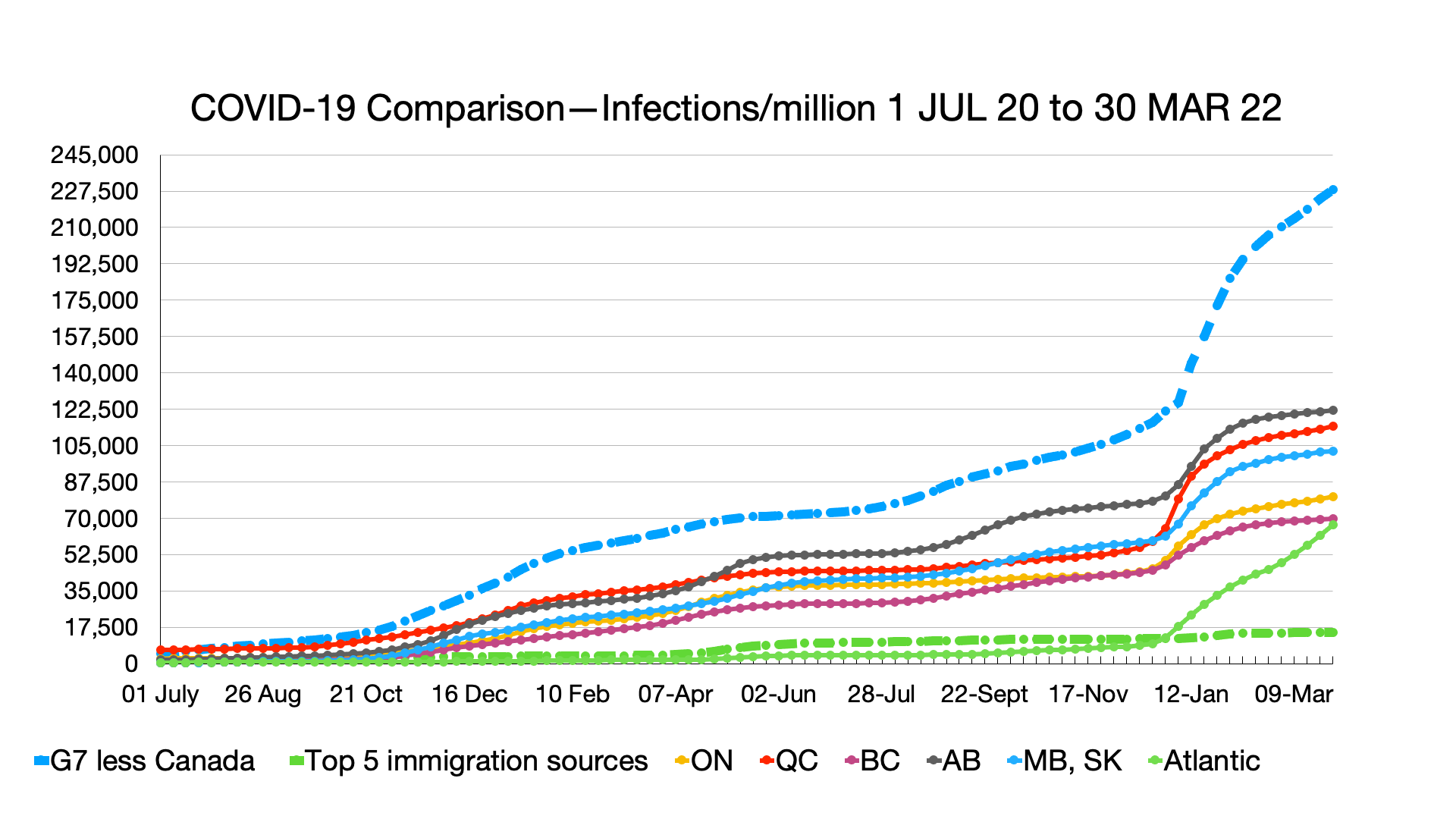
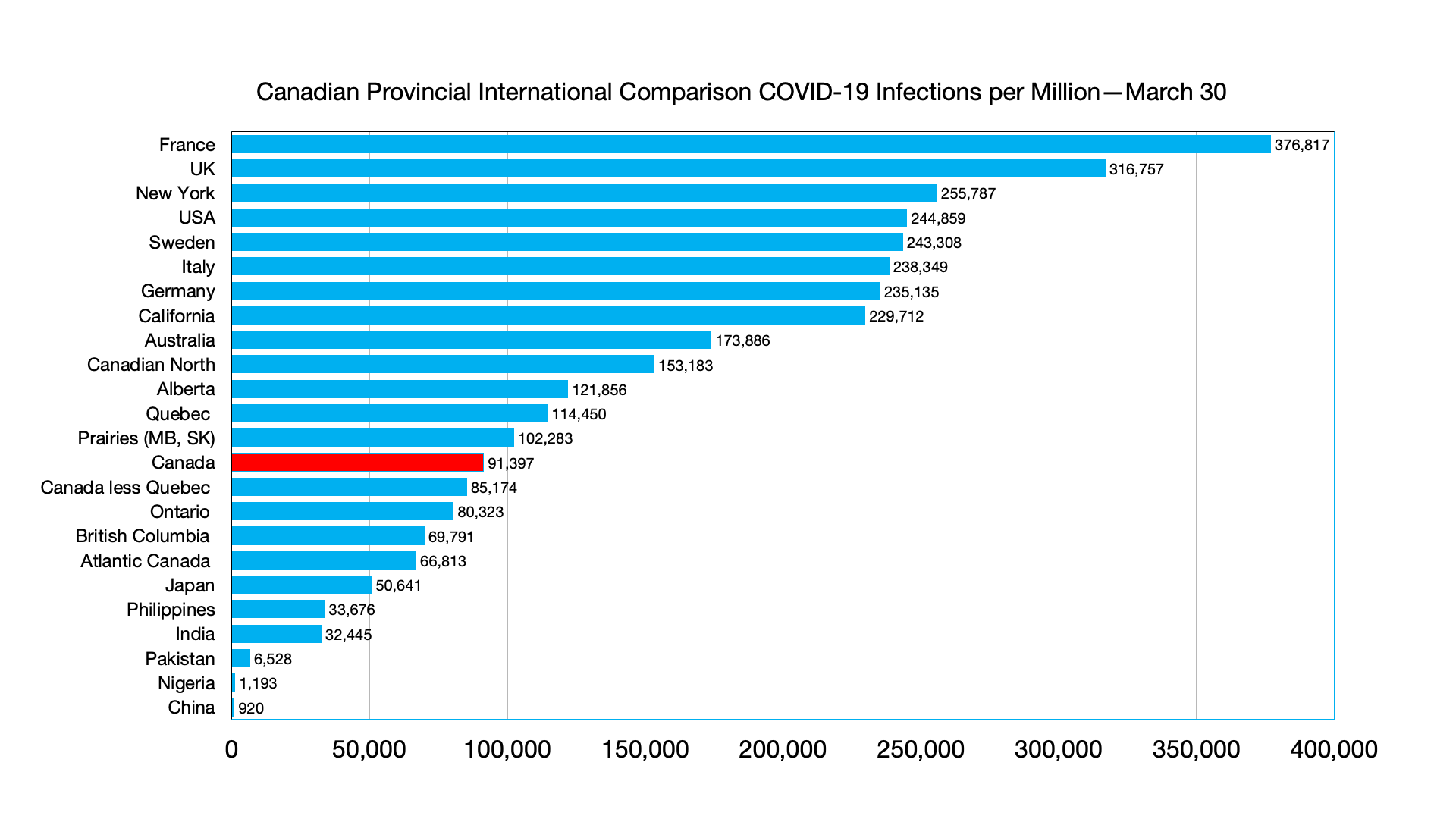
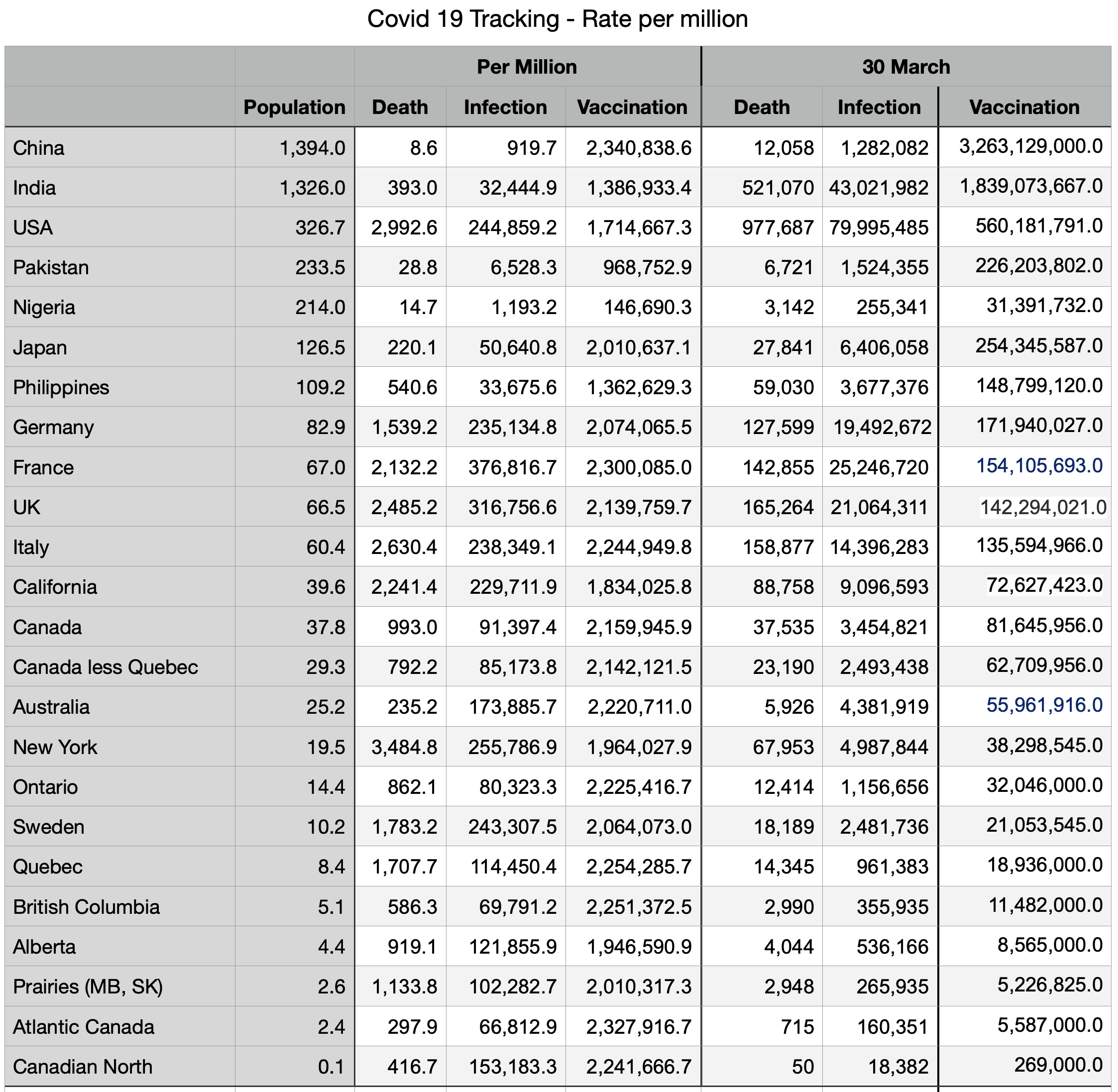
Numbers from China continue to climb. New omicron variant showing up in increased infections in G7 countries and in some provinces (uneven testing hides some of the change).

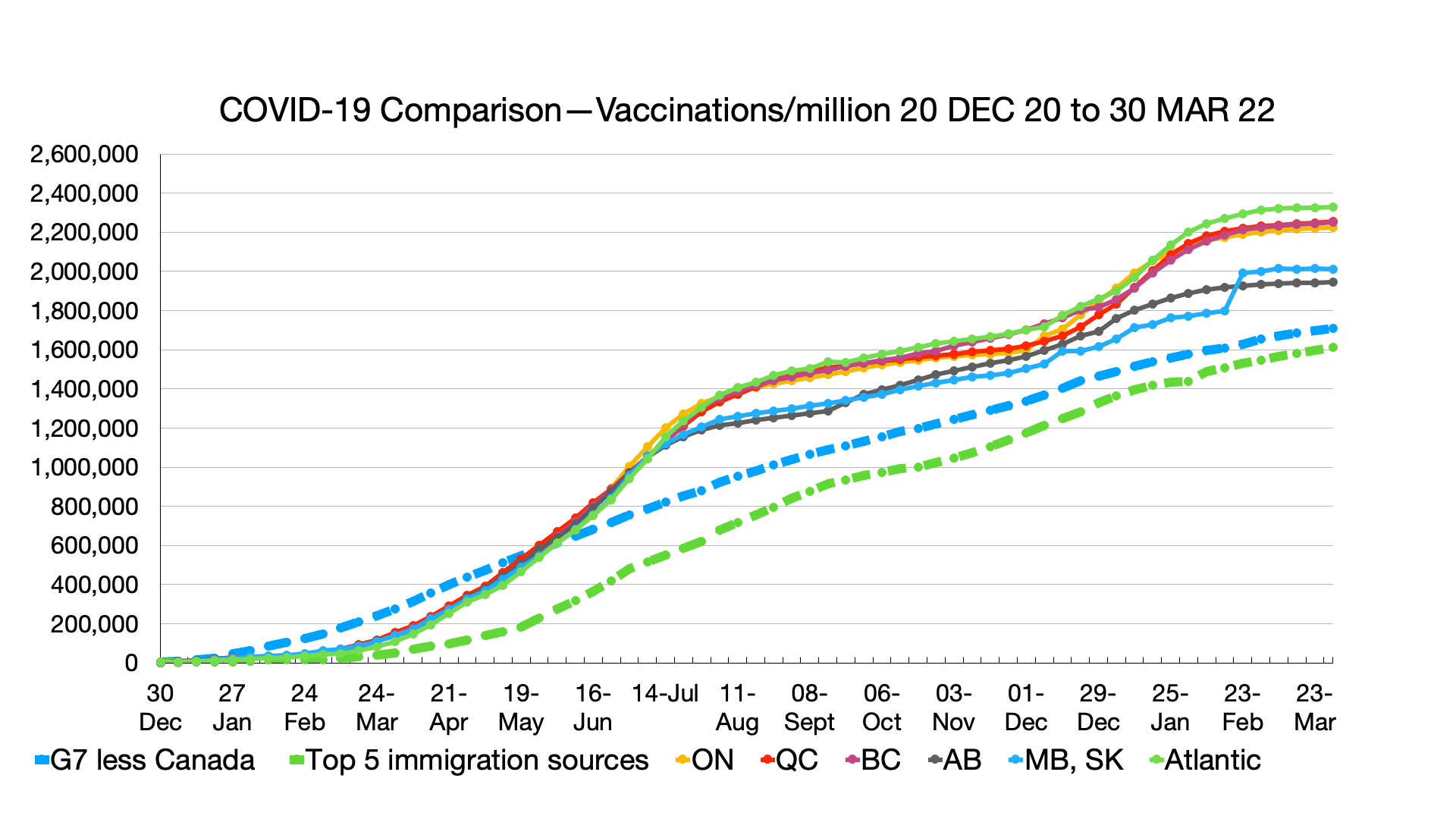
Vaccinations: Some minor shifts but convergence among provinces and countries but minimal increases to overall vaccination rates. Canadians fully vaccinated 82.9 percent, compared to Japan 79.7 percent, UK 73.9 percent and USA 66.3 percent.

Immigration source countries: China fully vaccinated 88.8 percent, India 60.6 percent, Nigeria 4.8 percent, Pakistan 47 percent, Philippines 609 percent.

Trendline Charts:

Infections: Increased number of infections due to omicron variant in G7 countries with most Canadian provinces having lower rates of increase save for Atlantic Canada.

Deaths: No relative changes.

Vaccinations: China ahead (again) of Atlantic Canada, Japan ahead of Prairies.

Weekly

Infections: Germany ahead of California.

Deaths: No relative change.

Canadian Real Estate Fuelled or Cooled by Immigration Policy? 

From the recent report by Re/Max Canada, the Conference Board and CIBC, largely cheerleading the government’s increased immigration levels but emphasizing the need for more trades in the mix of immigrants to help address labour shortages in construction:

…

SCENARIO: Canada fulfils its commitment to welcome more than 400,000 immigrants per year to the country with a continued emphasis on integrating Economic Immigrants who generally have higher education, English and French skills, and prior Canadian work or study experience.

“Immigration produces significant benefits for the Canadian economy as a whole and helps meet the labour market needs of particular communities and sectors. Canada’s system excels at selecting immigrants who have a high likelihood of long-term economic success. However, the system could improve by selecting more immigrants to fit specific, chronic labour market needs. In particular, a focus on immigrants with skills in the trades and construction could help address severe labour shortages that limit housing supply,” says Iain Reeve, Associate Director, Immigration Research, Conference Board of Canada.

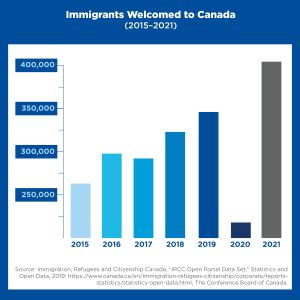
Canadian real estate and immigration_Immigrants welcomed to CanadaResearch by the Conference Board of Canada has shown that higher immigration levels can benefit the Canadian economy with greater GDP and public revenues [Note: Overall GDP not per capita GDP]. CIBC Capital Markets and The Conference Board of Canada agree that the Canadian economy needs a minimum of 400,000-plus new immigrants annually to sustain our economic vibrancy.

In fact, despite the pandemic, Canada accepted approximately 405,000 new Canadians in 2021. According to Benjamin Tal, Deputy Chief Economist at CIBC Capital Markets, what is not often reported is that 70 per cent of the 2021 cohort were already established in Canada and approximately 50 per cent of the 2022 immigrants will be in-country. The key insight here is that we are not looking at 400,000-plus net new individuals settling anew in Canada with housing needs, but approximately half that number. They have been students and non-permanent residents with employment, promising prospects for employment and all with housing. 

New immigrants are not the only factor to consider in determining housing demand. The formula is complicated and often does not look at things such as immigrants already living in Canada and Canadian students in temporary housing. To get an accurate measure of housing demand, further refinement is needed to housing data collection methods, according to both CIBC Capital Markets and The Conference Board of Canada.  

As Tal explains, the profile of new Canadians is quite distinct from historical immigrant cohorts. Many have higher educational credentials and Canadian work experience. For example, just 10,000 new immigrants in 2015 held a post-graduate work permit, versus more than 88,000 in 2021, according to data compiled by the Conference Board.

Canadian real estate and immigration_Immigrants who are homeownersIt takes 10 years for immigrants to have earnings that are commensurate with their skills, education, and experience when compared to similar Canadian-born workers. According to Tal, that time has decreased by approximately half. In part, this is a result of Ottawa’s emphasis on economic immigrants and better immigrant support systems. This means that new immigrants can land on their feet faster and participate in the Canadian economy in various ways, such as entering into Canadian real estate ownership. In 2021, 38 per cent of homeowners in Canada were immigrants.

However, as both CIBC Capital Markets and The Conference Board of Canada state, Canada’s immigration levels alone are not an issue. There is a missed opportunity by not selecting more immigrants who are trained in the trades, where all regions across Canada are experiencing a deep labour shortage. 

In reference to the construction sector alone, BuildForce Canada reported that 90,000 workers will be leaving the workforce in the next five to 10 years due to retirement. Yet, Canada has not accepted enough skilled trade immigrants in 2021 to fill these labour market gaps, according to the Conference Board of Canada. This will impact Canada’s ability to fulfill the new housing and affordable housing starts as predicted by the federal government.

“Currently, Canada’s federal immigration policy does not link with the country’s labour market needs and that will be a mounting problem in our capacity to build enough homes to meet the high demand over the next five years,” says Tal. “It’s all fine to table policy to improve our national housing affordability crisis by promising to build more homes and affordable housing — it’s critical — but it’s superfluous when you don’t have the skilled workers
to build it.”

“For several years now, RE/MAX Canada has been advocating for a coherent and achievable national housing strategy to calm red-hot price increases and more importantly, to improve affordability for a greater diversity of buyers and renters,” says Elton Ash, Executive Vice President, RE/MAX Canada. “Yet, as the experts at CIBC and The Conference Board show, our current immigration policy is lacking sufficient linkages with labour demands and as such is not set-up as successfully as it could be. Immigration policy should help support our labour demands.” 

Source: Canadian Real Estate Fuelled or Cooled by Immigration Policy?