Lacroix: Niveaux d’immigration, la noyade

While some of his analysis overstates or incorrectly assesses (e.g., looking at declining French maternal language use while not recognizing that the vast majority of allophones have a working knowledge of French, thanks in no small part to Law 101), the overall points regarding the declining importance of Quebec in the federation is valid, as are some of his critiques of the federal government’s ongoing increase in immigration levels (need some more critical perspectives in English Canada):

Le ministre fédéral unilingue anglophone de l’Immigration, Sean Fraser, publiait, juste à temps pour la Saint-Valentin, le plan d’immigration du gouvernement de Justin Trudeau pour 2022-2024. Ce plan est de hausser, encore une fois, les volumes d’immigration, qui passeront de 184 606 personnes en 2020 à 431 000 nouveaux résidents permanents en 2022 et à 451 000 en 2024.

Ottawa souhaite admettre 1,33 million de nouveaux immigrants permanents en seulement trois ans. Il s’agit d’une hausse de 80 % par rapport aux seuils d’immigration qui avaient cours avant la prise du pouvoir par le Parti libéral du Canada en 2015. Au prorata de la population, le Canada est déjà l’un des pays occidentaux qui accueillent le plus d’immigrants.

Immigration temporaire

Et ces chiffres ne valent que pour les immigrants permanents, soit ceux qui obtiennent la résidence permanente. Parallèlement à cette hausse constante et soutenue de l’immigration permanente, nous assistons à une hausse vertigineuse de l’immigration temporaire, c’est-à-dire du nombre de personnes accueillies au Canada avec un permis d’études ou de travail temporaire. Le nombre de travailleurs étrangers détenteurs d’un permis de travail temporaire est passé de 66 600 en 2000 à 429 000 en 2018, soit une augmentation de 544 % en 18 ans. Ces travailleurs temporaires obtiennent de plus en plus, à terme, leur résidence permanente (à hauteur de 50 %). L’immigration « temporaire » est donc souvent de l’immigration permanente déguisée. À ces travailleurs temporaires il faut ajouter les étudiants étrangers, dont le nombre augmente exponentiellement ; en 2020, nous en étions à 530 540 étudiants étrangers au Canada. Si on combine ces deux catégories temporaires, il y avait, au 1er janvier 2020, 1,3 million d’immigrants temporaires au Canada.

Pour estimer le volume global et l’incidence de la migration, il faut additionner les permanents aux temporaires. Aux 431 000 immigrants permanents en 2022 il faut donc ajouter environ 1,3 million d’immigrants temporaires, ce qui donne le chiffre de 1,73 million d’immigrants pour 2022, soit environ 4,7 % de la population totale du Canada.

Conséquences pour le Québec

L’arrivée d’un aussi grand nombre d’immigrants en si peu de temps a plusieurs conséquences néfastes pour le Québec. L’immigration est d’abord la cause directe du recul accéléré du français auquel on assiste depuis 15 ans. Mais elle a aussi pour effet d’exacerber la crise du logement, la hausse du volume d’immigration étant directement responsable de la hausse débridée du prix de l’immobilier au Canada. La crise du logement, bien sûr, frappe d’abord les plus pauvres, ce qui inclut souvent les nouveaux arrivants.

Mais cela ne semble pas émouvoir outre mesure le Parti libéral.

En faisant de l’immigration temporaire la voie d’accès royale vers la résidence permanente depuis 2014, Ottawa a modifié unilatéralement le système d’immigration et a dépouillé le Québec d’une bonne partie de ses pouvoirs en immigration. Pourquoi ? Parce que le Québec n’a aucun pouvoir de sélection sur l’immigration temporaire, de plus en plus importante numériquement parlant, et qui relève strictement d’Ottawa. Le pouvoir de sélection des immigrants a ainsi glissé, indirectement, de Québec vers Ottawa.

À cela, il faut ajouter la discrimination exercée par Ottawa contre les immigrants francophones qui souhaitent s’installer au Québec ou y étudier en français. Le ministère fédéral de l’Immigration sabote activement, de façon volontaire ou non, les efforts du Québec pour attirer des francophones.

Un piège parfait

Les premiers chiffres publiés du recensement 2021 indiquent que le poids relatif du Québec au Canada a baissé pour un 11e recensement d’affilée, passant de 28,9 % en 1966 en 23 % en 2021. Avec la hausse des seuils, la baisse de ce poids va s’accélérer. Pour le contrecarrer, Québec devrait accepter environ 103 730 immigrants permanents par année à partir de 2024, soit plus du double des seuils actuels, seuils qui sont déjà en train de conduire à l’effondrement du français dans toute la grande région de Montréal.

Pour le Québec français, la question de l’immigration est donc un piège parfait ; pile, il perd ; face, le Canada gagne. L’avenir réservé au Québec dans le Canada, c’est la noyade démographique.

En 2017, Statistique Canada a publié une étude de projections démolinguistiques, qui annonçait un effondrement du poids démographique des francophones au Québec à l’horizon de 2036. La proportion de francophones au Québec passerait, selon ces projections, de 78,9 % en 2011 à 69 % en 2036, une chute de 9,9 points. Il s’agit d’un effondrement sans précédent dans toute l’histoire du Québec.

Cette projection de 69 % était calculée avec un scénario « immigration forte » qui correspondait, grosso modo, à 350 000 immigrants permanents par année au Canada. Or, la hausse des niveaux d’immigration à 451 000 signifie que le chiffre de 69 %, loin d’être un « plancher », est maintenant un « plafond » ; la proportion réelle des francophones au Québec en 2036 sera très certainement en dessous de ce chiffre.

Cela sera vrai même si le Québec ne hausse pas son seuil d’immigrants permanents actuel de 50 000 par année (note : le Québec n’a pas ce pouvoir et doit suivre les seuils fédéraux selon l’Entente Canada-Québec). Pourquoi ? Parce que le Québec n’a aucun contrôle sur la migration interprovinciale. Le solde de cette migration est devenu positif en 2020 pour la première fois depuis 1961. Il est probable que l’anglicisation accélérée de la grande région de Montréal fait que de nombreux Canadiens peuvent maintenant y vivre en anglais comme s’ils étaient à Toronto, et ce, à moindre coût. À Montréal, le fait français ressemble de plus en plus à un résidu historique appelé à se dissoudre dans le grand tout canadien. Le projet de loi 96, qui évite soigneusement toute mesure structurante, ne changera rien à cet état de fait.

Le portrait global qui se dégage est celui-ci : si Ottawa avait un plan méthodique, systématique, afin de liquider une fois pour toutes le Québec français, ce plan ressemblerait probablement à ce que l’on voit se dérouler sous nos yeux.

Il va falloir que le gouvernement du Québec se réveille. Et vite.

Source: Niveaux d’immigration, la noyade

USA: Investor immigrants say their applications are viable despite program lapse

Of note:

A group of immigrant investors have filed a lawsuit claiming the Biden administration is unlawfully refusing to process their applications for visas and green cards after Congress allowed a major visa program they participated in to lapse.

More than a dozen plaintiffs in a complaint filed in Seattle federal court on Thursday said that while a program earmarking EB-5 visas for investors who pool money has expired, federal law still requires U.S. Citizenship and Immigration Service and the Department of State to process their applications, which were filed before the expiration.

The EB-5 program allows foreign citizens who invest $1 million in a U.S. business – or $500,000 in economically depressed areas – and create at least 10 jobs to qualify for visas and green cards.

The plaintiffs, who are citizens of Canada, Russia, India and other countries, applied to participate in the EB-5 Regional Center program, which reserves thousands of visas each year for investors who pool their money into large economic development projects.

Authorization for the program, which was first created in 1992, expired in June without action from Congress and its future is still in limbo. USCIS in December said it would not process visa and green card applications tied to the program until it is renewed.

But in Thursday’s complaint, the plaintiffs said the expiration of the program only meant that the government no longer had to grant a preference to applicants involved in the Regional Center program. The federal Immigration and Nationality Act still requires USCIS to process their EB-5 applications and set aside visas for them if they qualify, the plaintiffs said.

Jon Wasden of Wasden Banias, a lawyer for the plaintiffs, said that a decision in the plaintiffs’ favor could ultimately spur USCIS to process thousands of other pending applications.

USCIS and the Department of State did not immediately respond to requests for comment.

The case is Bajaj v. Blinken, U.S. District Court for the Western District of Washington, No. 2:22-cv-00189.

Source: Investor immigrants say their applications are viable despite program lapse

Dutrisac: Le Québec largué [on immigration processing, levels and demography]

Of note, along with the ongoing trend of a relative decline compared to other Canadian provinces. Not clear that having more powers for Quebec would change that unless a Quebec government decides to match Canadian immigration targets:

Si on fait exception de 2020, année marquée par les sévères restrictions liées à la pandémie, le gouvernement Trudeau vole de record en record en matière d’immigration. Cette semaine, le ministre de l’Immigration, des Réfugiés et de la Citoyenneté, Sean Fraser, a dévoilé de nouvelles cibles qui placent le Canada au sommet des pays — et de loin — quant au nombre d’immigrants qu’ils accueillent.

Au cours de son premier mandat, le gouvernement Trudeau a fait passer le seuil de 280 000 immigrants du gouvernement Harper à quelque 350 000. L’an dernier, Ottawa a voulu effectuer un rattrapage en raison des contraintes touchant les déplacements internationaux et des ratés administratifs qui ont contribué à réduire à 186 606 le nombre d’immigrants admis en 2020 au lieu des 341 000 prévu ; il a donc porté ce nombre à 400 000 en 2021.

Cet objectif de 400 000 et plus, c’est maintenant le nouveau plancher canadien en matière d’immigration. Dans son rapport annuel de 2021 présenté cette semaine au Parlement, le ministre Fraser a établi les seuils à 431 000 pour 2022, 447 000 pour 2023 et 451 000 pour 2024. C’est grosso modo 20 000 à 30 000 de plus que les niveaux avancés dans le rapport annuel précédent.

Si on se réfère à la cible élevée plutôt que moyenne, telle qu’inscrite dans le rapport pour 2024, soit 475 000 immigrants, nous sommes tout près de la recommandation de l’organisme canadien-anglais Century Initiative, qui entend convaincre le gouvernement Trudeau de hausser à 500 000 le seuil d’immigration pour 2026. L’objectif, c’est de faire passer la population canadienne de 37 millions à 100 millions en 2100.

Tandis que le ministre pousse à la hausse le nombre de dossiers à traiter, sa machine administrative ne suit pas. On ne sait d’ailleurs pas sur quelle planète Sean Fraser vit quand il écrit dans son rapport : « Heureusement, le Ministère a su s’adapter aux immenses pressions exercées par la pandémie. » La réalité, c’est qu’au Québec, son ministère est dysfonctionnel.

Les délais pour obtenir le statut de résident permanent, c’est-à-dire devenir un immigrant reçu en bonne et due forme après avoir été sélectionné par Québec, ont encore augmenté, pour atteindre en moyenne 28 mois.

En raison de problèmes administratifs, Ottawa n’arrive même pas à remplir les objectifs d’immigration que lui transmet le gouvernement du Québec. Le ministère de l’Immigration, de la Francisation et de l’Intégration a demandé qu’un rattrapage soit effectué en 2021 pour combler les retards engendrés par la pandémie, soit un total de 18 000 nouveaux résidents permanents de plus. Manquent à l’appel 15 000 d’entre eux.

Qui plus est, sur les 48 600 détenteurs d’un certificat de sélection du Québec toujours en attente de leur résidence permanente, 25 000 résident au Québec et occupent un emploi. Le ministre Jean Boulet a demandé à son homologue fédéral d’accorder la priorité à ces demandeurs. Mais Ottawa se montre réticent. Si on tient compte de toutes les catégories de nouveaux arrivants, ce sont 90 000 personnes qui sont en attente, selon les données obtenues par Radio-Canada auprès d’Immigration, Réfugiés et Citoyenneté Canada.

C’est deux poids, deux mesures, car les délais imposés au Québec sont beaucoup plus importants que dans le reste du Canada. Par ailleurs, les autorités fédérales exercent une discrimination à l’endroit des étudiants étrangers en provenance de l’Afrique francophone qui souhaitent étudier au Québec : le taux de refus de ces étudiants pourtant admis dans nos cégeps et nos universités est beaucoup plus élevé que celui des étudiants étrangers anglophones.

Mais plus grave encore, c’est que le Canada, avec sa politique d’immigration extrêmement vigoureuse, est en train de larguer le Québec. On voudrait diminuer rapidement son poids démographique — et celui du Québec français — au sein du Canada qu’on n’agirait pas autrement. En clair, le reste du Canada, toutes proportions gardées, accueille deux fois plus d’immigrants que le Québec. Si l’on voulait résister à cette érosion démographique, ce ne sont pas 53 000 immigrants qu’il faudrait admettre, mais près de 120 000 l’an prochain et davantage les années suivantes.

Dans ce contexte, il est clair que l’entente Canada-Québec sur l’immigration, signée en 1991 par les ministres Gagnon-Tremblay et McDougall, ne tient plus, du moins dans son esprit. Cette entente prévoyait que le Canada consulte le Québec pour établir ses seuils d’immigration, ce qu’il ne fait plus. En outre, les seuils canadiens devaient permettre au Québec de recevoir un pourcentage d’immigrants égal à celui de sa population. Ce n’est plus possible.

Cette évolution du Canada postnational constitue une menace pour la nation québécoise. Il est temps — et c’est un minimum — que le Québec obtienne tous les pouvoirs en matière d’immigration.

Source: Le Québec largué

Refugees in Quebec will have to learn French within 6 months

Not realistic and discriminatory (but not surprising), unfortunately):

The Quebec government is moving ahead with a controversial part of its proposed language bill, which will require all government officials to communicate with new immigrants exclusively in French, six months after their arrival — with no exceptions for refugees and asylum seekers.

The article of Bill 96, which was introduced at the National Assembly last May, was recently approved by the legislative committee studying the bill, amid criticism from opposition Liberal and Québec Solidaire MNAs. The bill is expected to become law this spring but still faces detailed study in committee.

Some organizations, opposition members and even the union representing public servants tried to persuade the government to soften the rule, to no avail.

“For newly arriving immigrants, the basic principle of the law is clear: as of Day 1, it’s exclusively in French,” said Simon Jolin-Barrette, justice minister and minister responsible for the French language.

There are exemptions in the law, which allow communication in a language other than French, “where health, public safety or the principles of natural justice so require” such as getting health care.

As well, the bill allows for a six-month grace period for “particular situations that require the use of a language other than French with new immigrants” according to Élisabeth Gosselin, spokesperson for Jolin-Barrette.

The bill says after that six-month period has lapsed, communication must be in French.

“Currently, the government communicates with immigrants who have requested it, sometimes for years, or for their whole lifetime, in a language other than French, which does not foster integration,” Gosselin said.

Learning French in 6 months

Community organizations working with newly arrived immigrants have been calling on the government to extend the six-month grace period.

“We all agree that the government cannot respond to immigrants in every language. But we have to give them time to learn French,” said Élodie Combes, member of the Table de concertation des organismes au service des personnes réfugiées et immigrantes (TCRI), a working group that represents community organizations working with immigrants.

Combes believes that the bill may actually hinder the integration of immigrants, by making it more difficult for them to get government services.

“It’s as if we’re telling them to retreat into their lingustic minority, that the government is not there for them, because they aren’t francophone enough,” she said.

Garine Papazian-Zohrabian, an associate professor in educational psychology at the Université de Montréal who researches French-language training for immigrants, says the six-month hard cap will be most harmful for refugees and asylum seekers, who are arriving in a vulnerable state.

“Members of this population are already disoriented, arriving in Quebec. They can been burdened by a difficult past and face cultural challenges. They’re not ready to learn a new language, like French, right after their arrival,” said Papazian-Zohrabian.

“You might as well say that we don’t accept refugees or immigrants, rather than place so many obstacles in front of them,” she added.

Opposition slams ‘excessive’ measures in bill

The union representing 40,000 Quebec civil servants, the Syndicat de la fonction publique et parapublique du Québec (SFPQ), is also in favour of extending the six-month grace period.

In its submission to the committee examining the bill, the union suggested the delay could be extended to two years, to allow new immigrants more time to adapt.

Ruba Ghazal, Québec Solidaire MNA for the Mercier riding in Montreal, proposed a grace period of three years, saying that Jolin-Barrette is “totally disconnected from the reality of newly arrived immigrants.”

“The minister makes no distinction between a refugee and an economic class immigrant,” she said. “These people need more kindness and understanding.”

Jolin-Barrette dismissed the idea of extending the grace period, saying six months was a “reasonable” period.

Ghazal said while the bill takes a harsh stand with newly arrived immigrants, it contains a clause that allows the government to continue to communicate in languages other than French with people who immigrated to Quebec in the past.

Source: Refugees in Quebec will have to learn French within 6 months

Know the Risks: A Guide for Journalists on Quoting Immigrant Sources

Useful:

WHAT HAPPENED TO ROSA still haunts Maria Hinojosa. Rosa, an undocumented immigrant from Mexico, agreed to appear on camera for “Immigrant Nation, Divided Country,” a 2004 CNN documentary helmed by Hinojosa, a veteran journalist. Soon after the program aired, immigration agents arrested Rosa, her boyfriend, and her children.

Hinojosa had taken care not to show where Rosa lived or worked. She later discovered, however, that despite her efforts to protect Rosa’s anonymity, she had missed one small detail: the license plate of a car belonging to Rosa’s boyfriend had appeared, unblurred, in the background of a shot. Hinojosa reasoned that agents must have used the license plate to track Rosa down.

“​I realized,” Hinojosa said in a recent interview, “that the worst could absolutely happen.”

The risks facing undocumented immigrants have only intensified in the years since—particularly during the presidency of Donald Trump, whose anti-immigrant rhetoric and policies vilified Mexicans, Africans, and Muslims, among others. How journalists work with their immigrant sources is critical to reducing those risks, even in a hyper-competitive climate where ambitious stories drive public attention.

Miriam Jordan, a lead immigration reporter for the New York Times, revealed in 2018 that President Trump employed undocumented workers at his private properties. Jordan’s story focused on Victorina Morales, an undocumented immigrant who worked at Trump’s golf club in Bedminster, New Jersey. She also quoted Sandra Diaz, who had been undocumented when she worked there, but was a legal resident at the time of the story. Both Morales and Diaz agreed to be identified by their full name—a step Jordan, in an email, said was “essential to the credibility of the piece”—and also to be photographed. Morales told Jordan that Trump’s hateful comments, along with verbal abuse from a supervisor, compelled her to speak out. Jordan later noted the rarity of Morales’s decision:

“In all my years reporting on immigration, I had rarely encountered undocumented workers willing to risk their livelihood — and deportation — to speak out against their employers.”

After the story came out, Morales made numerous media appearances; she also applied for asylum and received a work permit. Eighteen months later, she learned that her asylum case had been referred by US Citizenship and Immigration Services to a court for removal proceedings, where a judge would review her status. (In a follow-up, Jordan reported that Morales would be able to remain in the country while her case was mired in a years’ long backlog.)

In 2020, a selection of immigration reporters told CJR and Migratory Notes that, under the Trump administration, they felt more inclined to grant anonymity to undocumented sources, and to take greater care to explore the consequences of a story with them. Though the administration has changed, the stakes haven’t: polarizing politics have stalled efforts at immigration reform, and some of Trump’s most harmful policies remain in effect under President Biden. Against this backdrop, migrants coming to the border, asylum seekers awaiting court hearings, and those with temporary protections, such as Deferred Action for Childhood Arrivals, have little incentive to identify themselves on the record.

Anonymity is routinely provided to government officials who are “not authorized to speak publicly”—a practice intended to facilitate reporting without costing an official their job or livelihood. Yet, as an industry, journalism has not widely embraced anonymous sourcing in its coverage of undocumented immigrants.

Journalists who cover undocumented people must be aware that their approaches to stories—including the decisions to name sources and subjects and show images of them —can carry a range of unintended, adverse consequences. With this in mind, Define American created a toolkit on anonymous sourcing, to advise journalists on their responsibilities when working with immigrant sources and, we hope, to help them mitigate risk.

The “Quoting Immigrants” toolkit provides numerous recommendations for ensuring credible coverage across a range of media while also granting partial or even full anonymity; they include a hierarchy of attribution, recommendations for independently verifying a source’s identity, and examples of personal details to consider avoiding. The toolkit honors longstanding journalistic principles of credibility and authenticity, but also spells out the potential consequences for undocumented immigrants who are identified in news reports. Crucially, the toolkit reminds reporters that it’s OK to back off, move on, and not jeopardize or traumatize a source at risk or perpetuate trauma—a subject that Define American explored in a recent research report on the mental health toll on sources in the Dreamer movement.

Throughout the toolkit, several reporters who’ve covered immigration draw on their own experience to offer guidance. “Just understand that these are human beings and you might need to make accommodations,” Camilo Montoya-Galvez, an immigration reporter for CBS News, told us. “They are doing us a favor by talking to us.”

Armando Tonatiuh Torres-García, an immigration reporter for ABC News, cautioned reporters to consider the safety of minors: “If they were in a detention center, just because they are separated from their parents, that does not give you the right to film them as if they were adults.”

Hinojosa now hosts LatinoUSA, a radio program produced by Futuro Media Group, a multimedia organization she founded. When she interviews immigrants now, Hinojosa says she often uses only first names. When migrants readily agree to be identified by their full names, she thinks of her experience with Rosa, and fully considers her options. She wants to expose injustice for asylum seekers, but not if she endangers them.

“My role as a journalist is to get the story in their voice,” Hinojosa said. “And to do no harm.”

Source: Know the Risks: A Guide for Journalists on Quoting Immigrant Sources

Germans less skeptical of immigration

Significant shift with respect to skilled immigrants, concerns re refugees (similar pattern in Canada):

Christian Osterhaus knows only too well what the term Willkommenskultur (“welcome culture”) means: When hundreds of thousands of people seeking protection arrived in Germany in 2015, he was one of the first to co-found a local refugee aid organization.

“We didn’t want to repeat the mistakes of the past,” he tells DW. By welcoming the refugees, he and his team wanted to show “that we don’t exclude people again.” With around 30 fellow campaigners, Osterhaus got involved in Bonn in the fall of 2015. The group cared for 40 to 50 refugees, most of whom came from Syria.

Osterhaus was one of hundreds of thousands of people in Germany who set out to help those fleeing civil war in Syria and other countries, and to help integrate them into German society. “We wanted to give these people a new home,” Osterhaus says looking back.

The special effort at integration became known as Germany’s welcome culture. But in 2015 and 2016, many people also had little understanding for this attitude. They did not want to take in refugees and migrants. The xenophobic protest movement gave rise to the far-right populist Alternative for Germany party (AfD).

More people see benefits of migration

In its representative study “Willkommenskultur zwischen Stabilität und Aufbruch,” (Welcome Culture Between Stability and Departure) the nonprofit Bertelsmann Foundation has now taken a closer look at changes in Germans’ attitudes and identified a trend: Germans are more optimistic about migration and immigration than they were a few years ago.

“In essence, our survey shows that skepticism toward immigration is still widespread in Germany, but it has continually declined in recent years,” says Ulrike Wieland, co-author of the study: “More people now see the potential benefits of migration; especially for the economy. When it comes to perceptions of integration, we find that more respondents than in previous years see inequality of opportunity and discrimination as significant obstacles hampering integration of individuals.”

The Bertelsmann Foundation has been conducting representative surveys since 2012. In the beginning, the researchers set out to determine how Germans felt about the immigration of skilled workers. But in response to the influx of large numbers of refugees in 2015-2016, researchers wanted to gauge attitudes towards these people.

As to long-term effects of immigration, positive and negative assessments roughly balance each other out. But the debate on refugees has somewhat tipped the scales.

Today, many see immigration as a way to help solve Germany’s demographic and economic problems. For example, two out of three respondents see immigration as helping to balance out an aging society, more than half of those polled said it could also compensate for the ongoing shortage of skilled workers, and half of all respondents expect immigrants to generate additional revenue for Germany’s pension fund.

But many respondents remain skeptical: 67% say that immigrants place an additional burden on the welfare state, 66% say they worry about conflicts erupting between people born and raised in Germany and immigrants, and many respondents fear that schools are facing major problems integrating immigrant students.

But there is an important differentiation to make: skilled immigrants seeking employment or academic opportunities are more accepted (71%) than refugees who are primarily seeking protection (59 %).

More than a third don’t want more refugees

The Bertelsmann Foundation study also clearly shows that there is still a lot of skepticism in Germany when it comes to refugees.

Christian Osterhaus notes that many helpers have turned away because of the decrease in acceptance for their work for refugees. “In the beginning we were part of a social movement and felt supported, but for several years we have been working against the social mainstream,” is how Osterhaus describes it to DW.

Germans have overall become more accepting of refugees. But over one-third of respondents (36%) believe that Germany cannot take in any more of them. In 2017, that number stood at 54%. Currently, 20% consider the refugees to be “temporary guests” who do not need to be integrated into society.

“We see that one-fifth of the population is skeptical of refugees or outright rejects them. These people seem to have a worldview that supports the idea of a (far-reaching) social closure against migration,” explains co-author Ulrike Wieland.

Germany should see itself as an immigration society,’ says the study’s co-author, Ulrike Wieland

People with an immigrant background are underrepresented in politics, corporate management and the media in Germany. Respondents see German language skills as a pivotal prerequisite to integration. But many of them also believe that legislation needs to be changed to combat existing inequality when it comes to finding housing, dealing with authorities or schools.

The new coalition government of center-left Social Democrats (SPD), environmentalist Greens and neoliberal Free Democrats (FDP) has already made clear it wants to focus more on integration. For example, they are planning to ensure that even rejected asylum seekers are given the opportunity to stay in Germany permanently if they have learned German and have found work to earn a sufficient income. Family reunification is to be extended to all refugees and it is to become easier to obtain German nationality.

That is basically the right way to go, says researcher Ulrike Wieland: “But it is also important for Germany to develop a positive self-image as an immigration society. To achieve this, politicians and civil society must work together. They must actively shape a diverse society.”

Aid worker Christian Osterhaus looks back at when he started working with refugees: “At the time, I really had the impression that German society had opened up and changed and had actually learned a lot.” He believes that interpersonal connections and friendships are the foundation for the path to building a real welcome culture in Germany.

Source: Germans less skeptical of immigration

Alberta launching new programs to boost rural immigration

Always an uphill challenge, and latest Census data indicates ever increasing percentage flocking to urban areas. That being said, even small increases in rural areas can make a difference there even if one of the motivators is political:

Alberta’s United Conservative government is hoping two new programs will bring more immigrants to rural Alberta communities.

Speaking at the Fairness for Newcomers Summit in downtown Calgary on Wednesday, Premier Jason Kenney said the programs will encourage skilled workers from abroad to settle outside the province’s big cities to help fill anticipated labour shortages.

“We’re determined to get more than our share of newcomers,” Kenney said. “Newcomers don’t take jobs away from Albertans but help to create jobs. They create additional demand, they create additional wealth and, very typically, they create additional businesses that hire people.”

The Rural Renewal Stream will allow municipalities outside the Calgary and Edmonton metropolitan areas with fewer than 100,000 people to apply to become a designated community for immigrants.

The other program, the Rural Entrepreneur Stream, will let immigrants who want to start or buy a business in rural Alberta visit communities to assess their plans. The UCP had first pitched the programs as campaign promises before the 2019 provincial election.

The Wednesday announcement comes in the wake of the 2021 census, which revealed Alberta has seven of the 10 fastest-shrinking municipalities across Canada, all in far-flung rural areas, as rural communities face aging populations and a dwindling workforce.

One difficulty for immigrants to rural communities is having their foreign credentials recognized, said UCP Associate Minister of Immigration and Multiculturalism Muhammad Yaseen. He said the government is aiming to make it easier for trained professionals to put their skills to use, which he said could help alleviate the province’s ongoing rural doctor shortage.

“A larger issue is, how do we get international medical graduates who are here, in Calgary or Edmonton, who are also willing to go to rural Alberta?” Yaseen told Postmedia.“We’re doing whatever we can to help them, to facilitate them, and not only doctors but engineers and pharmacists and others. We don’t want anybody left behind just because their credentials are not recognized.”

Yaseen immigrated to Canada from Pakistan with his family when he was 17, and in 1979 took his first job in Rimbey, about 65 kilometres northwest of Red Deer. At the time, he was the only person of colour in the rural community, something he said has shifted in the intervening decades.

Yaseen did face some discrimination, but said many people welcomed him into the community.

“Rural Alberta culture is a culture of hospitality, a culture of generosity, a culture of sharing and caring, and I learned a lot when I moved there,” he said.

Immigrant Services Calgary applauded the new initiatives, saying they expect plans to boost rural immigration to have broader economic benefits for the province.

“The rural immigration streams announced today will not only contribute to the local economies of small towns and centres across Alberta, but they’ll also support and grow the provincial economy,” said Hyder Hassan, CEO of the local non-profit.

The Opposition NDP criticized the announcement, saying additional community supports need to be established in communities that will be welcoming immigrants.

“These new streams will not be enough to help communities set newcomers up for success,” NDP labour critic Christina Gray said in a statement.

Source: Alberta launching new programs to boost rural immigration

Immigration Minister Fraser takes heat for ‘short-sighted’ approach to processing backlogs

Informative account and opposition right to hold government to account on processing times and the choices and trade-offs they made in order to meet the higher levels in 2021:

Opposition MPs accused Immigration Minister Sean Fraser of being “misleading” about processing times for Canada’s considerable immigration backlog, with the department’s timeline to address the 1.8 million applications still “opaque.”

Fraser (Central Nova, N.S.) fielded questions and took heat from some MPs on the House Immigration and Citizenship Committee during his Feb. 15 briefing on immigration timelines and acceptance rates.

The government’s fall economic statement promised to inject $85-million into Immigration, Refugees, and Citizenship Canada (IRCC) to reduce the backlog of 1.8 million applications that continues to grow. The funding is being specifically directed towards reducing processing times for work and study permits, permanent residency applications, and visitor visas. Much of the money is being used to automate aspects of the application review process, as well as introducing electronic systems for immigration applicants to review the status of their applications.

In response to a question from NDP MP Jenny Kwan (Vancouver East, B.C.) about the processing times for family reunification applications, Fraser enthusiastically shared that immigration processing times were back to the service standard of 12 months.

Fraser acknowledged there were some “real frustrations” for some whose family reunification applications got stuck in limbo while Canada’s borders were closed due to the pandemic.

But, through federal investments in the system, including hiring 500 staff, Fraser said IRCC now has “the capacity to process new applications and family reunification streams in 12 months in accordance with the service standard that has existed since before the pandemic.”

However, later in the meeting, officials from IRCC confirmed this standard processing time is only back in place for new applications—not for those applicants who are still pending in the backlog. After hearing this, Kwan said the minister’s comments were “misleading.”

The 12-month processing time only applies to people who are submitting applications starting this year, Daniel Mills, senior assistant deputy minister at IRCC, told MPs at committee.

“However we do have to work on the backlog or the inventory that we have, and that’s what we are doing,” he said.

In the Immigration Levels Plan 2022-2024 tabled in Parliament on Feb. 14, Fraser set new goals for immigration levels, raising this year’s goal of 411,000 new immigrants to 432,000, with the hope to reach immigration levels of 451,000 newcomers to Canada by 2024. One way the department plans to do this, he said, is by boosting departmental productivity due to a new digital platform in the works. For MPs at committee, however, questions still remained as to how the department will clear the existing backlog, rather than more quickly process new and future applications.

In an interview with The Hill Times, Kwan said she hears from constituents who have family who have applied through the family reunification stream that have been stuck in the system for two or three years “all of the time.”

“Those people have already missed the boat with respect to that processing standard,” Kwan concluded. “And they’re going to probably get another problem because soon people will come back and say, ‘how come the newer applicants got processed before me?’”

Kwan called it a “short-sighted way of dealing with the situation.”

“They’re trying to create this perception that they are somehow on top of things, when in fact, frankly, they’re not. And the system remains opaque. There’s a lack of transparency, and lack of accountability,” she said.

At committee, Conservative MP Rosemarie Falk (Battlefords-Lloydminster, Sask.) followed up on Kwan’s point.

“I’m actually very concerned with what MP Kwan had just brought up. What I had heard you as the official say is that applicants as of this month, February 2022, will have the service standard of 12 months. So what is happening to all of the backlogs previous to this? What is the timeframe to clean these backlogs up?”

The department’s answer: “it depends.” Family class applications, for instance, has 35,000 pending applications, Mills said, and the department processed 8,000 applications in January—above the average processing rate of about 6,000 applications per month the department saw in 2021.

Falk pressed officials during the same exchange to offer details on Fraser’s instructions to the department.

“What direction has the minister given the department to clean up these backlogs, that I’m hearing the excuse of the delayed processing times is because of COVID?”

Mills told Folk the department is trying to reduce the inventory and process them “as quickly as we can.” That is being sped up through digitization of files, which allows the department to process applications virtually, he said.

Off the bat, Fraser laid blame for the backlog at the feet of the COVID-19 pandemic.

“As the members of the committee know, the pandemic has caused applicants processing delays and backlogs,” he said in French. In English, “folks, it’s not lost on me that there are challenges when it comes to processing in the immigration system,” he stated.

Several members of the committee across parties did not accept that premise, and said the COVID-19 pandemic was being used as an “excuse.”

Kwan said “that excuse is running tired.”

“Let’s face it, there were backlogs pre-pandemic. There’s no question that COVID has exacerbated it. But you know, we’re more than two years into the pandemic,” said Kwan, who is her party’s immigration critic.

Fraser said the primary cause of the backlog was the fact that during the first year of the pandemic when borders were closed, Immigration, Refugees, and Citizenship Canada stopped bringing in new immigrants, and instead processed the applications of newcomers and permanent residents who were already in Canada.

COVID-19 public health orders also resulted in the shut-down of a number of in-person immigration offices and services within an application process that requires some elements to be conducted in-person. Prior to the pandemic, for instance, citizenship ceremonies were only ever done in-person, and initially, the pandemic put these ceremonies on hold. Now, the minister said they are able to conduct them online, which should help expedite the clearing of that backlog.

“At the same time, when we were welcoming people who were located in Canada already, we continued to see a significant number of applications that were coming in from people who were overseas,” Fraser said.

He said he believed it was the right decision to make, and as a result of focusing on applications of people who were already here, Canada welcomed the most new permanent residents in any year.

“But we knew that that would come with certain consequences that we now need to deal with.”

At the meeting, Conservative MP Kyle Seeback (Dufferin-Caledon, Ont.) cited backlog figures including 548,000 Permanent Resident applications, 112,392 refugee applications, 775,000 temporary resident applications, including study permits and work permits, and; 468,000 Canadian citizenship applications.

Conservative MP Jasraj Singh Hallan (Calgary Forest Lawn, Alta.) also took issue with the suggestion that COVID-19 was responsible for the delays and lack of communication he is hearing about from Afghan refugees and their families who are trying to come to Canada.

“You know, it’s easy for now to say, you know, it’s COVID, and we didn’t have time or IRCC wasn’t prepared, but I mean, [the government was] more prepared for an election plan than they were for an evacuation plan. And the same thing goes with IRCC… I don’t think we can use COVID as an excuse anymore for what’s going on,” he said in an interview after the meeting.

MP Hallan’s exchange with the minister became heated early in the meeting, with Hallan concluding his line of questioning with accusations of the election taking priority over Afghan refugees. Tensions were high at the meeting as Conservative MP Brad Redekopp (Saskatoon West, Sask.) accused immigration officials of “remarkable callousness” in their lack of response to applicants, citing an instance in which one of his constituents’ permanent residence card was 66 days overdue, meaning she could not travel home to visit her dying mother.

“Is this a systematic failure based upon incompetence or are you maliciously blocking PR cards for people who want to see their dying parents?” Redekopp asked. The minister said he would “pass on commenting” on malicious intent.

“I can reassure all members of this House that any challenges that we are facing are due to the circumstances tied to the pressures that COVID-19 has put on Canada’s immigration system, including on PR cards, which typically require somebody to show up for an in-person appointment when many of the offices have been closed down and there hasn’t been that opportunity for face to face engagement,” Fraser said.

Source: Immigration Minister Fraser takes heat for ‘short-sighted’ approach to processing backlogs

#COVID-19: Comparing provinces with other countries 16 February Update

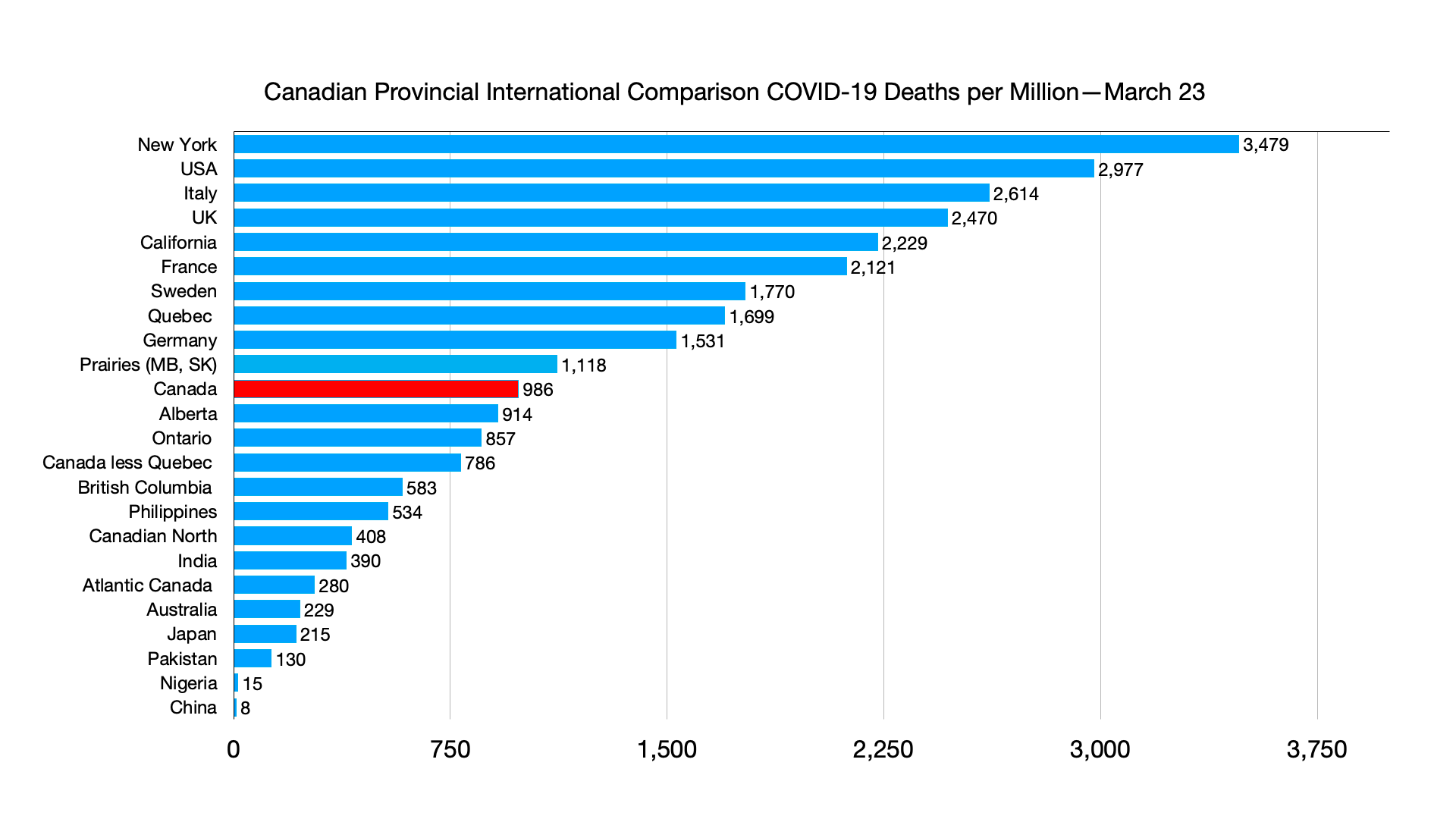
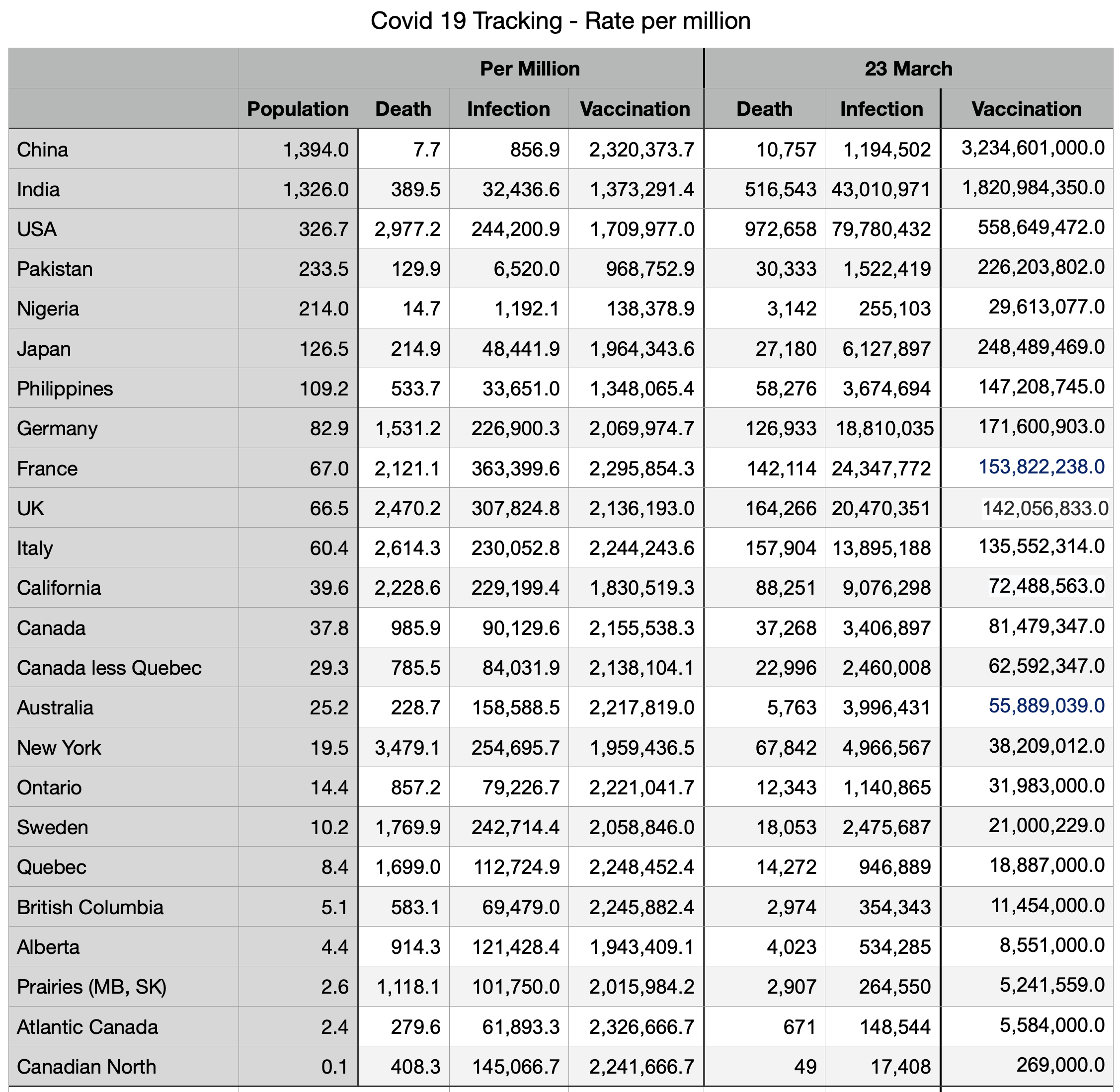
Overall decline in infections and deaths as omicron wave passes. Note Saskatchewan data is from previous Thursday given the government’s “see no evil” strategy of no longer publishing daily statistics.

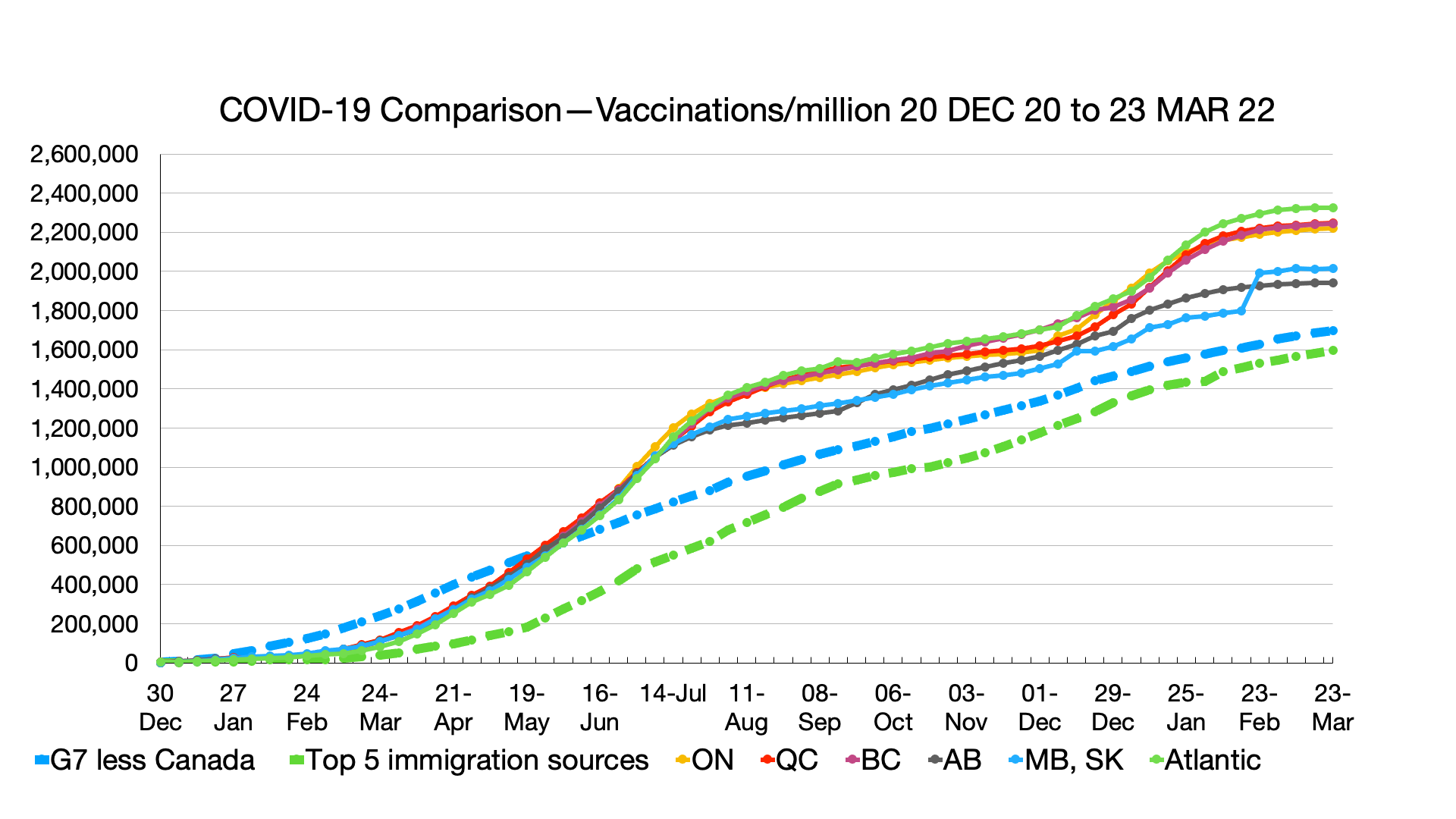
Vaccinations: Some minor shifts but general convergence among provinces and countries. Canadians fully vaccinated 81.6 percent, compared to Japan 79.2 percent, UK 72.7 percent and USA 64.9 percent.

Immigration source countries are also converging: China fully vaccinated 87.9 percent (numbers have not budged over past three weeks), India 55.6 percent, Nigeria 2.7 percent (the outlier, unchanged), Pakistan 43.2 percent, Philippines 56.7 percent.

Trendline Charts:

Infections: Further signs of omicron and other variants plateauing.

Deaths: Quebec plateauing.

Vaccinations: No major change but Alberta and Prairies continue to be laggards compared to other provinces given resistance among residents and political considerations.

Weekly

Infections: No significant relative changes.

Deaths: No relative change.

Immigration Plan 2022-24: Reports and Reactions

Expect to see more detailed analysis and commentary over coming days to round out the initial reporting.

Overall, the plan continues the government strategy of growing the economy through growing the numbers of immigrants.

This reflects the various interests of the “immigration industry” and business: more bodies means more consumers, more work for immigration lawyers and consultants, more funding for settlement organizations, more research opportunities for academics etc.

Not surprisingly, no questioning of these perspectives in articles and commentary to date (see my earlier Increasing immigration to boost population? Not so fast.). The government strategy continues to be based on overall GDP growth, not per capita GDP growth and productivity, a long standing issue that governments have tried to address with limited to no success.

The articles below capture some of the aspects which groups and individuals quoted have raised as concerns, but these are all in the context of general suppoort.

In terms of the politics of the plan, unlikely that this will create many issues for the government. The NDP generally supports higher numbers and the Conservatives will likely continue to focus on implementation and administrative issues, given the backlogs and that this is much safer than engaging in a debate over numbers, given their vulnerability to charges of being anti-immigration (unfair IMO but too tempting a target for the Liberals given the Conservatives still wear the legacy of the “barbaric practices tip line” and other ill-thought political messaging).

Given the overall shorter-term perspective of most immigration analysis and commentary, I continue to advocate for a royal commission or equivalent for a more independent and thorough look at immigration policy and programs with a longer-term perspective.

Media articles and commentary to date (nothing negative so far but expect some in more right leaning media and will continue to monitor):

The Star:

Canada plans to welcome more than 1.3 million new immigrants to the country over the next three years to help its economy recover from COVID-19 and to drive future growth.

Immigration Minister Sean Fraser’s multi-year immigration-levels plan was announced Monday.

“If we’re not ready to significantly increase our ambition when it comes to immigration, we are going to be in a position where our economy will suffer, and it could put into jeopardy so many of the public services and social supports that make me very proud to be Canadian,” Fraser said.

But the plan comes amid calls from critics for the federal government to first reduce the ballooning backlog of 1.8 million applications piling up in the system as a result of slowed processing capacity during the COVID-19 pandemic.

The new plan calls for an annual intake that will reach 431,645 in 2022; 447,055 in 2023; and 451,000 in 2024 — equivalent to 1.14 per cent of the population by 2024.

This year, the number of new permanent residents will include 241,850 from the economic class; 105,000 through family reunification; and 76,545 as refugees and protected persons.

Canada reached its 2021 goal — bringing in a record 405,000 newcomers — largely by granting permanent residence to migrants such as international students and foreign workers who were already in Canada and therefore not hampered by pandemic travel restrictions and border closures.

However, the disruptions caused by COVID-19 here and abroad — and the unexpected Afghan refugee crisis — have created an unprecedented backlog in the immigration system that experts believe will take at least three years to clear.

As of December, there were 548,195 pending permanent residence applications; 775,741 temporary residence applications, including study and work permits; and 468,000 citizenship applications in the queue for processing.

Fraser said he hopes to rein in the backlog through additional hiring and by modernizing processing through new digital platforms.

The new plan will change the composition of the intake slightly this year, with the share of economic and skilled immigrants down from 60 per cent to 56 per cent. The portion of newcomers under the family class will also fall from 26 per cent to 24 per cent, while the ratio of refugees will go from 14 to 20 per cent.

Immigration policy analyst Kareem El-Assal said he’s unsure how reducing the share of economic migrants to Canada is going to benefit the country’s economy, which faces a labour shortage equivalent to nearly one million jobs.

“That’s what they’re trying to tell us. And then you look at the numbers and you see that’s not what’s happened,” said El-Assal, managing editor of immigration news site CIC News and policy director at CanadaVisa.com.

“You don’t have to spin anything for us. Just tell us, ‘This is what we’re doing temporarily. We’re going to be reducing the economic class share and the family class share temporarily for two years so that we can accommodate more refugees.’”

Calling the government plan “ambitious,” Ravi Jain of the Canadian Immigration Lawyers Association said he was concerned about reducing the permanent residence quota for federal high skilled workers by half, from 111,000 to 55,900.

During the pandemic, many international students have been unable to earn the job experience they need to qualify for permanent residence despite the high tuition fees they have paid. Jain said Ottawa needs an immediate plan to extend their work permits in Canada.

“They’re going to be waiting potentially a few years and they’re going to need the status to be able to buy that time,” said the Toronto lawyer. “There are some major concerns around what to do about the people who are here and who won’t necessarily have a pathway for permanent residence.”

The federal government has devoted $827.3 million over five years to enable the department to develop and deliver an enterprise-wide digital platform, with an additional $85 million to hire staff to reduce backlogs.

But the system hasn’t transformed fast enough to meet the insatiable demand for immigration to Canada.

Shamira Madhany, managing director of World Education Services, said Canada can’t rest on its laurels, as other countries are also competing for skilled talents for their post-COVID economic recovery.

“What Canada has done here is basically saying, ‘Our borders are open for immigration,’” said Madhany. “In terms of our capacity (to absorb immigrants), it’s a different question. We need to make sure we have mechanisms and tools in place to leverage their prior skills and experience. We don’t want highly skilled people to come here to do low-skilled jobs.”

MP Jenny Kwan, the NDP immigration critic, said Fraser’s plan shows a continuation of the Liberals’ Band-Aid approach to systemic immigration problems.

“The government simply cannot continue to shift resources and immigration levels from one stream to another. This pattern of behaviour has and will continue to create further problems and chaos in the system,” said Kwan.

Source: Canada wants to welcome 1.3 million newcomers over three years — but can its immigration system keep up?

Globe and Mail:

The federal government aims to welcome nearly 432,000 immigrants to Canada this year, as a part of a three-year plan to fill critical labour-market gaps and support a post-pandemic economic recovery.

The annual immigration levels plan, tabled in Parliament Monday, projects Canada will admit 431,645 permanent residents in 2022, followed approximately by 447,000 in 2023 and 451,000 in 2024. The majority of the permanent resident spots – 56 per cent – will be designated for immigrants coming to Canada to fill job vacancies this year.

Speaking to The Globe and Mail, Immigration Minister Sean Fraser said the COVID-19 pandemic has highlighted how key immigrants are to Canada’s success, as newcomers fill many front-line jobs.

“When I talk to restaurants, machine shops, health care providers or virtually any other business, I see help-wanted signs in windows,” Mr. Fraser said.

“By launching what is the most ambitious immigration plan in the history of Canada, we are going to equip the Canadian economy with the workers it needs.”

Ottawa says immigration accounts for 100 per cent of labour-force growth and, with five million Canadians set to retire by the end of this decade, the worker-to-retiree ratio will drop – demonstrating the need for increased immigration.

Goldy Hyder, president and chief executive officer of the Business Council of Canada, said the number of job vacancies in the country is near an all-time high and immigration will be a key driver of pandemic recovery. He welcomed the government’s immigration targets Monday, but he said the plan must be supported by increased processing capability and supports for newcomers.

“To help meet these new targets, we urge the government to expand the immigration system’s processing capacity by adding new processing centres, updating outdated IT systems, and increasing recruitment and training of border agents and settlement services personnel. A growing workforce should also be accompanied by increased investments in public services, housing, and infrastructure,” Mr. Hyder said in a statement.

Mr. Fraser said the government recently hired 500 new processing staff and set aside $85-million in new funding to reduce application backlogs.

NDP immigration critic Jenny Kwan urged the government to introduce special immigration levels to give the 500,000 migrant workers already in Canada a path to settlement and help address the labour-skill shortage.

While the government plans to increase the number of economic immigrants it welcomes to Canada over the next three years, from nearly 242,000 this year to more than 267,000 in 2024, it will simultaneously reduce the number of refugees to whom it offers safe haven. Canada will resettle approximately 77,000 refugees this year, 74,000 in 2023 and 62,500 in 2024. Mr. Fraser said resettlement numbers will gradually decrease as Canada follows through with its commitment to resettle 40,000 Afghan refugees over the next two years. More than 7,550 Afghan refugees have been resettled in Canada since last August.

The reduction in refugee-resettlement targets – particularly the government’s plan to accept more privately sponsored refugees than government-assisted refugees – has sparked concern for advocates.

“The responsibility to resettle refugees lies with the government – to reflect that responsibility, the government should resettle more refugees than private citizens. Yet the levels show private sponsors are being asked to do one and a half times as much resettlement as the government,” the Canadian Council for Refugees said in a statement.

Overall immigration levels have grown substantially since the Liberals took power in 2015. Numbers continued to grow until 2020, when Canada only admitted 184,500 newcomers because of the challenges posed by the pandemic. Shuttered overseas visa offices, closed borders, quarantine restrictions and challenges booking flights heavily affected the immigration system.

Immigration numbers rebounded in 2021, when Canada welcomed 405,000 new permanent residents – breaking the all-time record set in 1913. The majority of the newcomers were already in Canada on temporary status, including temporary foreign workers in the skilled trades, health care and technology, and international students.

The government has not tabled an immigration levels plans since October, 2020. It normally announces it immigration targets by Nov. 1, but last year’s plan was delayed because of the federal election.

Source: Canada aims to welcome 432,000 immigrants in 2022 as part of three-year plan to fill labour gaps

Le Devoir

Ottawa espère également atteindre enfin sa cible d’immigration francophone hors Québec en 2023, soit 4,4 % de toutes les admissions, une cible ratée depuis des années selon le commissaire aux langues officielles.


En 2020, 184 606 résidents permanents ont été enregistrés au Canada, c’est-à-dire beaucoup moins que la cible annoncée de 341 000, confirme également ce rapport annuel. Ce nombre, selon le ministre Fraser, est néanmoins un « succès impressionnant compte tenu des fermetures et des restrictions frontalières » dues à la pandémie, y écrit-il.


Pour cette même année, on a compté 326 116 titulaires de permis de travail temporaire au pays, ce qui illustre une autre tendance lourde, soit l’augmentation des catégories temporaires. Ce qui s’appelle le « solde de résidents non permanents » représentait 1,3 million de personnes au 1er janvier 2020, selon des informations communiquées précédemment par le ministère fédéral de l’Immigration au Devoir. Les détenteurs de titre de séjour temporaire, toutes catégories de permis confondues, représentaient ainsi près de 3,5 % de la population totale la même année.


Il s’agissait lundi de la première annonce officielle de cibles depuis octobre 2020. En décembre dernier, le ministre Fraser avait affirmé dans une entrevue au Devoir vouloir être le gouvernement le plus ambitieux de tous les temps en matière d’immigration.


Pour 2021, il estime avoir atteint « cette réalisation historique » en accueillant plus de 401 000 nouveaux résidents permanents, avait-il annoncé par communiqué. La majorité de ces personnes était déjà à l’intérieur des frontières sous un statut temporaire et a accédé à la permanence par divers programmes.


Le record précédent datait de 1913, quand 400 900 nouveaux immigrants permanents avaient foulé le sol canadien. Le pays comptait alors seulement 7,6 millions d’habitants ; cet afflux représentait donc une proportion plus importante de sa population totale, soit plus de 5 %. En comparaison, la cible d’immigration pour 2022 équivaut à 1 % de tous les Canadiens.

Source: Ottawa dévoile des cibles d’immigration encore plus ambitieuses

New Canadian Media

Canada aims to attract about 1.3 million new immigrants over the next three years to help fill critical labour shortages and fuel post-pandemic growth.

Minister of Immigration, Refugees and Citizenship (IRCC) Sean Fraser announced the new targets on Monday as the government struggles to clear a backlog of about 1.8 million visa/citizenship and other applications in the queue exacerbated by pandemic-induced delays.

At the same time, the latest numbers from Statistics Canada show that job vacancies in the country remain high, with 874,700 unfilled positions.

In a statement, IRCC said there are still hundreds of thousands of positions in all sectors waiting to be filled. 

Immigrants  needed

“Immigration already accounts for almost 100% of labour force growth, and with 5 million Canadians set to retire by the end of this decade, the worker to retiree ratio will drop down to only 3:1,”  it said. “This is a clear sign that we have a strong economic need for increased immigration.”

The 2022–2024 Immigration Levels Plan aims to continue welcoming immigrants at a rate of about 1 per cent of Canada’s population, including 431,645 permanent residents in 2022 (an increase of about 21,000 people from its original plan), 447,055 in 2023, and 451,000 in 2024. 

“From farming and fishing to manufacturing, healthcare and the transportation sector, Canada relies on immigrants. Setting bold new immigration targets, as outlined in the 2022-2024 Levels Plan, will further help bring the immeasurable contribution of immigrants to our communities and across all sectors of the economy,” Fraser said during the announcement.

To support the new ambitious targets, which follows a record year of 405,000 new permanent residents in 2021, IRCC had earlier announced a plantomodernize Canada’s immigration system to fuel economic recovery and improve client experience.

Veteran Vancouver-based immigration lawyer, Richard Kurland, told  NCM  that “IRCC is banking on new information technology to deliver an aggressive program that will be faster for applicants and cheaper for government.”

“The objective is to have more people here, in less time, at less cost,” he said.

Goldy Hyder, president and CEO of the Business Council of Canada, said “even with full employment, the country will need newcomers to help fill all the jobs available.”

“To help meet these new targets, we urge the government to expand the immigration system’s processing capacity by adding new processing centres, updating outdated IT systems, and increasing recruitment and training of border agents and settlement services personnel,” Hyder said in a statement.

Perpetuating problems’

Jenny Kwan, the Vancouver East MP, who also acts as the NDP Immigration Critic, said the government is actually scaling back the Federal Skilled Workers Program by almost 50 per cent by shifting resources and immigration levels from one stream to another. 

“The immigration levels released today shows that the government is perpetuating the problems they created when they failed to adjust the levels to accommodate the new (temporary to permanent resident pathway) immigration measure,” she said.

The measure, also known as TR2PR, is a limited-time pathway to permanent residence applicable only to temporary residents currently working in Canada and to their families.

According to a government memo cited by the National Post, the federal skilled workers program was being scaled back because IRCC simply can’t process the applications quickly enough. 

It also said the “reductions are due to admissions space required to accommodate the TR2PR stream and the resettlement of Afghan nationals to Canada.”

“This pattern of behaviour has and will continue to create further problems and chaos in the system,” Kwan told New Canadian Media in an email.

The Canadian Immigration Lawyers Association (CILA) said it is pleased with the modest newcomer increase announced today, adding it will give IRCC time to improve its client experience, tackle its backlogs, and make the technological modernizations necessary to better manage the system moving forward.

However, it is calling for IRCC, in conjunction with Employment and Social Development Canada (ESDC), to immediately expand the list of occupations eligible for premium processing under the Global Talent Stream.  

According to CILA, an added support for Canadian employers would be for IRCC and ESDC to waive national recruitment requirements for all occupations processed under the Temporary Foreign Worker Program where labour shortages are well documented by industry.

“By immediately helping employers address their labour needs over the next two years or more, IRCC and ESDC can reduce government red tape that only serves to delay and frustrate international recruitment,” the association said.

A visa as Valentine’s

Meanwhile, IRCC’s Valentine’s Day message on its Facebook site has been met with derision from those in limbo waiting for their visa, PR cards and citizenship documents.

Mahmoud AR wrote “ How about you guys give me a Valentine’s day gift by finishing my 30 month application for citizenship?”

“Please give my wife (a) visa as Valentine’s gift,” said Pargat Gill

Mary Joy Lee responded “Roses are red, Violets are blue, Finish Applications that are delayed & overdue.”

Source: Canada eyes 1.3 million immigrants to overcome labour pains

And among the advocates, starting with CILA:

The Canadian Immigration Lawyers Association (CILA) is pleased with the modest newcomer increase announced today under the new Immigration Levels Plan 2022-2024. 

The gradual increase will give Immigration, Refugees and Citizenship Canada (IRCC) time to improve its client experience, tackle its backlogs, and make the technological modernizations necessary to better manage the immigration system moving forward.

The new levels plan is beneficial to families and will provide safety to more refugees. On the other hand, CILA regrets that economic class immigrants will be negatively impacted by this plan as IRCC looks to reduce its backlogs. CILA once again calls on IRCC to share its backlog reduction plan so that applicants know where they stand in the queue.

Economic Class 

Express Entry: CILA is disappointed with the halving of Express Entry admissions in 2022 and calls on IRCC to reverse course by immediately resuming invitations to Federal Skilled Worker Program (FSWP) and Canadian Experience Class (CEC) candidates.

FSWP candidates have unfairly paid the price throughout the pandemic. This has included expired holders of Confirmation of Permanent Residence (COPR) being neglected at the start of the pandemic, FSWP processing being significantly reduced in 2021, and IRCC pausing invitations to FSWP candidates since December 2020.

Welcoming more immigrants under the FSWP is key to supporting Canada’s labour force and economic growth. Temporarily cutting Express Entry admissions will undermine IRCC’s stated goal of strengthening the labour force via immigration. 

Ongoing disruptions to the FSWP will also hurt Canada’s international competitiveness as global talent will be forced to look elsewhere due to dimmer prospects for them in Canada over the next two years.

While it is good news that IRCC plans to bring Express Entry levels back to normal by 2024, this will be of little comfort to the many Canadian employers in desperate need of talent to address their immediate labour shortages.

The halving of Express Entry admissions this year will also be of grave consequence to Canadian Experience Class (CEC) candidates. The pause in CEC invitations since September 2021 is creating significant hardship for thousands of international students and temporary foreign workers who have spent years contributing to Canada’s economy and society, and who now have fewer permanent residence spots available to them. Many such individuals risk losing their legal status in Canada which may cause them to leave the country. This will also hurt Canadian employers and the economy. CILA calls on IRCC to quickly offer bridging permits to those with Express Entry profiles who have jobs, regardless of whether they have received an Express Entry Invitation to Apply. Alternatively, IRCC could re-introduce a one-time extension to Post-Graduation Work Permit (PGWP) holders like it did in early 2021.

Provincial Nominee Program (PNP): CILA is pleased to see that IRCC will be increasing its PNP admissions targets from 80,000 to 93,000 immigrants by 2024. Since its launch in 1998, the PNP has been successful in promoting a broader distribution of immigration across Canada and addressing local labour market needs. The PNP is crucial to regions across the country amid labour shortages caused by Canada’s aging population and shifts to the economy amid the pandemic.

Start-up Visa Program: CILA believes processing times for Canada’s Start-up Visa Program (SUVP) are not globally competitive and is disappointed to see that admission targets remain unchanged under the new levels plan. IRCC has noted that processing times for the SUVP are now up to six years which is far too slow to support an innovation-driven economy.

Temporary Foreign Worker Program (TFWP): The new immigration levels plan is ambitious and is premised on acute labour shortages across Canada. Employers experiencing labour shortages need continued access to international talent to meet the demand for their products and services in Canada and international markets. To complement the new levels plans, IRCC in conjunction with Employment and Social Development Canada (ESDC) should immediately expand the list of occupations eligible for premium processing under the Global Talent Stream. IRCC should immediately devote resources to applications eligible for two week processing under the Global Skills Strategy (GSS). Pending applications under the GSS remain backlogged by several months thereby negating the purpose of introducing the GSS.

An added support for Canadian employers would be for IRCC and ESDC to waive national recruitment requirements for all occupations processed under the Temporary Foreign Worker Program (TFWP) where labour shortages are well documented by industry and government data. A good practice that can be replicated across Canada is the Quebec List of Occupations Eligible for Facilitated Labour Market Impact Assessments (LMIAs). By immediately helping employers address their labour needs over the next two years or more, IRCC and ESDC can reduce government red tape that only serves to delay and frustrate international recruitment.

Family Class 

Spouses and Partners: CILA reiterates its call for IRCC to extend its Spousal Open Work Permit Pilot Program to spouses and partners living outside of Canada. It is unfair to offer work permits to inland sponsorship applicants as well as the partners of study and work permit holders, but force outland sponsorship applicants to remain separated or unemployed while inside Canada. Allowing spouses and common-law partners to work would allow these applicants to contribute to the labour market immediately. In addition, CILA hopes IRCC will achieve its goal of returning to a 12-month service standard for spousal sponsorship applications by the end of this year.

Parents and Grandparents Program (PGP): The increase in Canada’s PGP intake over the coming years is welcome and will help to support families across the country. At the same time, CILA encourages IRCC to consult widely on how to effectively manage the PGP moving forward.

Refugee and Humanitarian Class

Afghan refugees: CILA welcomes the Canadian government’s desire to fulfill its international humanitarian obligations by welcoming more refugees. CILA hopes Canada will be able to resettle Afghan refugees as quickly as possible to achieve its goal of providing safety to 40,000 Afghans.

Source: CILA’s Statement on Canada’s Immigration Levels Plan 2022-2024