Diversity of UK senior civil service falls, rises at lower grades

Of note. Canadian figures by way of comparison, all visible minorities 18.9 percent, executives 12.4 percent, EX-4 10.1 percent, EX-5 9.2 percent (EX-4 and 5 likely equivalent to senior UK public servants):

The percentage of UK civil servants from an ethnic minority background is at a record high, according to the latest figures, but the proportion in top jobs has fallen for the first time since 2015.

Official figures for 2022 revealed that, of those with a known ethnicity, the percentage of government officials who are from an ethnic minority background is at a record high of 15.0% – up from 14.3% in 2021, and 9.3% a decade ago.

There was a year-on-year increase at all grades, with the exception of the senior civil service – the group of officials who run government departments or hold other top posts. In this group, there was a year-on-year decline from 10.6% in 2021 to 10.3% in 2022.

Percentage of civil servants from an ethnic minority background by grade 2012 to 2022

Civil Service Statistics 2022

The government had previously pledged to increase the percentage of senior civil servants who are from an ethnic minority year-on-year to reach 13.2% in the three year period from 2022 to 2025. However, in its Diversity and Inclusion Strategy: 2022 to 2025, published earlier this year, the government said it had stopped using targets to measure progress. “We will mainstream our success measures with our broader organisational priorities, such as Places for Growth [the plan to move officials out of London and into the regions of the UK], senior civil service workforce planning, talent schemes and recruitment priorities. Rather than relying on standalone targets, our ambitions will be embedded in these key deliverables designed to improve our delivery for citizens. Where our data indicates progress is not being made, action will be taken,” the strategy said.

The strategy made only one mention of people from ethnic minority backgrounds, stating: “We will make sure that people from minority ethnic backgrounds, those living with disabilities and those who have experienced disadvantage in their early lives can flourish in public service.”

Source: Diversity of UK senior civil service falls, rises at lower grades

Speer: I was wrong about Canada’s state capacity

Good reflections. The other point I would make is that the political and bureaucratic levels need more policy “modesty” and need to consider, and value, input from the operational side (where “truth to power” may need to be strengthened). More focus, not necessarily more or less resources. Money quote:

“The key takeaway then is that our politics ought to dedicate more energy and attention to the question of state capacity. Our political debates need to go beyond bigger versus smaller government and address good versus bad government. Everyone should be able to ultimately agree that the former is better than the latter.” 

The idea of “state capacity” has attracted considerable intellectual and political attention in recent years. It started with a blog post in early 2020 by leading public intellectual Tyler Cowen about what he called “state-capacity libertarianism” to describe a policy framework for a limited yet effective government to provide basic public goods and solve for market failures. His influential essay has since spawned dozens of articlescommentaries, and papers on the topic. 

State capacity broadly refers to a government’s functional ability to carry out its market-supporting activities in an efficient and effective manner. The key insight here is that while debates about the proper size and scope of government are highly important, we ought to dedicate similar energy and attention to questions of state capacity and competency. 

Cowen’s chief contribution was to catalyse a renewed intellectual movement focused on “better or worse government” rather than merely “bigger or smaller government.” The timing couldn’t have been more apposite. His essay was published mere months before the COVID-19 pandemic. 

The pandemic experience brought the ensuing conceptual debate about state capacity into practical focus. It necessarily put governments in Canada and elsewhere around the world to the test. The results were mixed, to say the least. 

Prior to the pandemic, it was something of an axiom that Canada is home to strong public institutions, a professional public service, and high-quality public administration. It has, in other words, high levels of state capacity. 

I subscribed to this view. I’ve even authored and co-authored articlespapers, and newspaper columns in favour of a larger role for government in supporting science and technology and industrial development. It may be a reach to say that I was fully wrong. But in hindsight, I now concede that my analysis probably overstated Canada’s state capacity. 

The pandemic exposed that our governments are slower and more sclerotic than many of us fully understood. It turns out that Canada has a state capacity problem. 

Start with the federal government. The pandemic revealed that Ottawa’s state capacity has been hollowed out in recent decades. It still proved capable of creating new cash transfer programs like the Canada Emergency Relief Benefit and distributing cheques to households with minimal scrutiny or oversight, but otherwise the federal capacity for procurement, logistics, and service delivery was shockingly weak. The federal government has effectively been reduced to a revenue collection entity that exists to transfer dollars to seniors, families with children, First Nations, and other levels of government. 

This state capacity weakness manifested itself in a series of federal pandemic failures that’s quite long, including its confusing and often contradictory public health diktats, its initial vaccine procurement (including a bizarre contract with a Chinese state-owned enterprise), and the $25 million spent on the ArriveCan app. 

The post-pandemic period has similarly been marked by high-profile cases of government failure. The most obvious example is the country’s passport backlog which has led to lengthy delays, long line-ups at Service Canada offices, and canceled summer vacations. 

This case is particularly salient because it is so basic. How can a government that cannot issue passports on a timely basis reasonably expect to reduce poverty by 50 percent in 2030 or engineer an energy transition by 2050 or fulfill any other major policy ambition over the coming years? 

The provinces aren’t much better. Their collective failure to reform their health-care systems prior to the pandemic in spite of mounting evidence of limited capacity and poor outcomes was a major factor behind the country’s lengthy and stringent lockdowns. The risk of hospitals collapsing essentially held us held hostage for more than two years. 

This point cannot be overstated: we now know that children suffered long-term learning loss and others forewent diagnostic tests, surgeries, and treatments in large part because a generation of provincial bureaucrats, politicians, and special interests chose to protect the failed health-care status quo. 

These recent examples raise legitimate questions about our governments’ ability to deliver on their core functions and responsibilities. Lines of people in front of their local Passport Canada offices with lawn chairs like they’re waiting for a concert or playoff tickets is a powerful rebuttal to the pre-pandemic narrative about Canada’s world-class state capacity. 

It’s important to emphasize that these observations are neither partisan nor necessarily arguments in favour of a smaller government. Governmental failings have been broadly distributed on the Left and Right and, in any case, research tells us that the correlation between state capacity and size of government is imprecise. Denmark, Finland, and Israel have governments that are similarly sized or even bigger and yet seem able to deliver more effective and expeditious public services than we can. 

The factors behind our state capacity weaknesses are complex and would doubtless be the subject of ideological and political debate. The Left would ostensibly argue that it’s a consequence of so-called “austerity” including previous rounds of privatization and spending cuts. The Right would instead point to Public Choice explanations including institutionalized risk aversion, perverse incentives, and union-protected mediocrity that undermine effective and efficient collective action. 

The key point here though is that the pandemic exposed that Canadians shouldn’t be self-congratulatory about our country’s state capacity to deliver on whatever we collectively ask of it through our politics. 

Which brings me to my mea culpa. My research in recent years on innovation policy has highlighted the rise of the intangible economy (which has been described as the shift from an “economy of things” to an “economy of thoughts”) and its unique characteristics and properties including its geopolitical and strategic consequences. This has led me to rethink the role of the state to support science and technology and cultivate sectors, sub-sectors, and technologies that may have high-value, strategic upside for the Canadian economy. 

As part of this work, we’ve considered the creation of new public sector organizations to better support breakthrough technologies and even grappled with the potential for a modern industrial policy. I have tried to root my analysis in a clear-eyed understanding of the limits of state action and other political economy risks. In a late 2021 paper, for instance, we argued for a new science and technology agency with a specialized staff and a high degree of autonomy so as to minimize the risks of bureaucratic inertia and political capture.  

But even with these political economy caveats (which were unfairly ignored by some critics), there’s probably an argument that my work has overestimated Canada’s state capacity. That is to say, I spent so much time worrying about the twin risks of bureaucratization and politicization that I failed to ask more basic questions like “can the government reasonably do this?”. The passport mess has provided a useful corrective. 

I stand behind most or all of my work on these topics. We do need to recommit ourselves to a more ambitious science and technology strategy and the market uncertainty of breakthrough technologies will invariably involve a role for government. But I now better appreciate how improving (or at least accounting for) the country’s state capacity is a crucial first step to greater progress on these issues. I admit that I was wrong—or at least a bit incomplete in my analysis. One consequence is I’m now probably more of an economic libertarian than I was prior to the pandemic. 

The key takeaway then is that our politics ought to dedicate more energy and attention to the question of state capacity. Our political debates need to go beyond bigger versus smaller government and address good versus bad government. Everyone should be able to ultimately agree that the former is better than the latter. 

Source: I was wrong about Canada’s state capacity

Noël: Quand les gouvernements trébuchent [call for policy and program modestly]

Echoes the calls by others but nevertheless important.

Money quote: “le gouvernement fédéral devrait probablement modérer ses ambitions dans ses propres sphères de compétence, en adoptant des objectifs plus réalistes en immigration par exemple, afin d’éviter les échecs récurrents de gestion.”

Je n’étais pas en avance, c’est vrai, mais au début juillet, tard en soirée, je faisais des réservations pour un séjour de camping à Terre-Neuve et en Nouvelle-Écosse. Les réservations pour le traversier entre les deux provinces, opéré par Marine Atlantique, une société d’État fédérale, se sont avérées plutôt simples, tout comme celles pour des parcs provinciaux dans chaque province. Mais pour réserver des sites au parc national du Gros-Morne et à celui des Hautes-Terres-du-Cap-Breton, c’était un peu plus stressant. Avant de pouvoir réserver, il fallait créer une « CléGC (Service de gestion des justificatifs du gouvernement du Canada) », avec un nom d’utilisateur (toutes les variantes de mon nom ont été refusées), un mot de passe, et des réponses à une panoplie de questions. Pas un obstacle majeur, mais un processus un peu lourd pour une si petite tâche. À Ottawa, les missions les plus simples semblent souvent devenir complexes.

Tout ne va pas mal au Canada. Une étude parue à la fin juin dans le Canadian Medical Association Journal montre que, pour les deux premières années de la pandémie, le pays s’est classé parmi les meilleurs pour le nombre de cas, le taux de vaccination et la mortalité excédentaire, avec un bilan économique somme toute satisfaisant. Au Canada, ce sont les provinces atlantiques et le Québec qui ont connu les plus faibles taux de mortalité excédentaire.

Mais quelque part sur l’interminable voie de sortie de la pandémie, le bilan du gouvernement fédéral s’est détérioré. Cafouillage dans l’émission des visas et des passeports, congestion dans les aéroports, délais inacceptables à l’assurance-emploi, accueil difficile des réfugiés, traitement déficient des dossiers d’immigration, les échecs semblent s’accumuler.

Tout ne va pas nécessairement mieux dans les provinces. Il y a même des domaines où les ratés sont habituels, voire pérennes. La gestion des soins de santé constitue un cas patent. Mais dans ce cas, c’est largement une question de ressources. En 2019-2020, les soins de santé représentaient 41,4 % des dépenses de portefeuilles des provinces, comparativement à 31 % en 1981-1982. La même année, la contribution fédérale, par le biais du Transfert canadien en matière de santé, était tombée à 22,4 %. Si les provinces ne font pas mieux en santé, c’est largement parce que d’une année à l’autre elles doivent faire plus avec moins.

Dans d’autres domaines, comme en environnement, il s’agit plus clairement d’un manque de volonté politique. Si le ministre de l’Environnement du Québec « avait les convictions, la volonté, le courage et l’autorité morale nécessaires pour relever le défi de l’urgence climatique », écrivait récemment le chroniqueur Michel David, François Legault ne l’aurait pas choisi pour ce poste.

Mais émettre des visas et des passeports, acheminer des prestations d’assurance-emploi, traiter des demandes à l’immigration ? Le gouvernement fédéral a sûrement les ressources pour accomplir ces tâches et il devrait même être capable de marquer des points dans des secteurs qu’il contrôle depuis toujours, qui sont visibles et significatifs pour les citoyens et ne demandent pas des ressources faramineuses. « Il ne fallait pas être un génie », déplorait récemment l’ancien greffier du Bureau du Conseil privé Paul Tellier, « pour prédire qu’il y aurait une hausse des demandes de passeport » au sortir de la pandémie.

M. Tellier attribue les difficultés du gouvernement Trudeau à la centralisation excessive de la gestion autour du premier ministre et à la méfiance qui en découle entre élus et fonctionnaires. D’autres auteurs blâment le jeu politique, qui amène les élus à négliger les conseils et les actions des fonctionnaires.

Plus plausible, à mon avis, est le constat de l’ancien haut fonctionnaire Ralph Heintzman selon lequel le gouvernement fédéral se désintéresse des services aux citoyens depuis au moins trente ans. Dans la fonction publique fédérale, le prestige est associé aux conseils et à la stratégie, pas à la gestion compétente des programmes en place. Une carrière ascendante se caractérise par des sauts rapides d’un ministère à l’autre, pour appliquer à des niveaux supérieurs des méthodes de gestion largement indifférenciées. Consacrer trop d’années à maîtriser un domaine d’intervention gouvernementale semble manifester un manque d’ambition. Les hauts fonctionnaires voient ainsi les choses de haut. Quant aux élus, ils préfèrent annoncer des programmes plutôt que de veiller à leur bon cheminement.

Mais pourquoi ces travers semblent-ils plus prononcés à Ottawa ? Pour le comprendre, il faut considérer le fonctionnement de la fédération canadienne. Un rapport récent de l’Institut sur la gouvernance rapporte les propos d’un haut fonctionnaire qui note que « nous ne sommes pas un pays cohésif. Nous sommes une grande fédération ». On pourrait interpréter ce constat comme un appel de plus à davantage de collaboration entre les ordres de gouvernement. Mais il semble plus juste d’y voir une caractéristique structurelle, une condition d’existence du Canada.

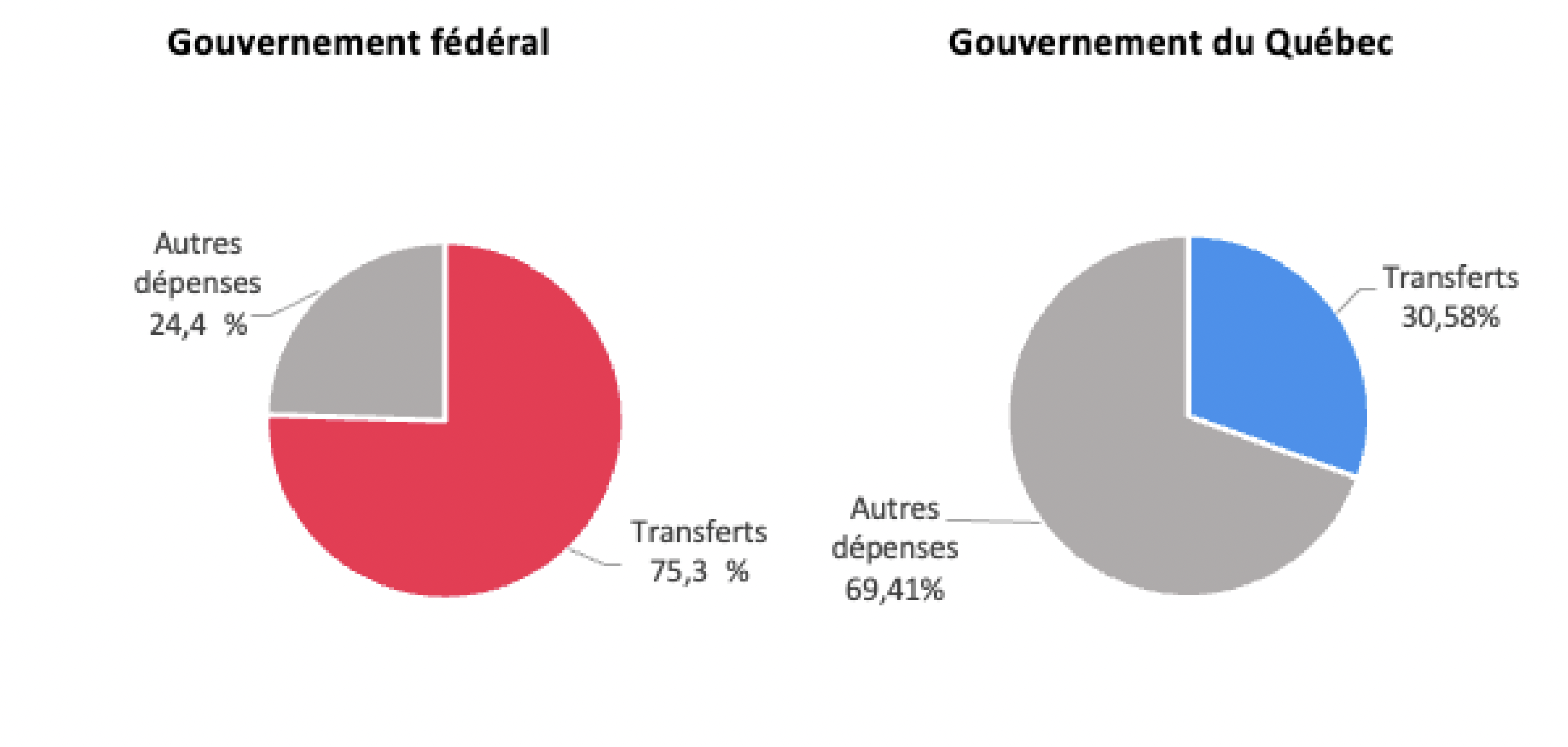
La figure 1 ci-dessous montre bien pourquoi la gestion quotidienne de services aux citoyens n’est pas le fort du gouvernement fédéral.

Figure 1 : Dépenses du gouvernement fédéral et du gouvernement du Québec, 2021Sources : Comptes publics du Canada ; Comptes publics du Québec

Le gouvernement fédéral est un animal particulier, plus habitué à émettre des transferts aux individus, aux entreprises et aux gouvernements, et à énoncer des normes associées à ces transferts, qu’à livrer des services à la population. L’année 2021 exagère un peu le trait, puisque la pandémie a engendré son lot de transferts exceptionnels. Mais la logique générale ne change pas. Il y a plus de vingt ans, le rapport de la Commission sur le déséquilibre fiscal faisait état de proportions assez semblables.

Les difficultés actuelles du gouvernement Trudeau ne sont donc pas si exceptionnelles. Le gouvernement fédéral demeure principalement une machine à récolter et à distribuer des ressources fiscales et il a tendance à se perdre quand il s’agit de gérer des programmes concrets.

La solution réside donc moins dans une réforme additionnelle de la fonction publique fédérale que dans une meilleure compréhension du fonctionnement de la fédération. En premier lieu, il faudrait améliorer l’équilibre fiscal en laissant davantage de ressources propres aux gouvernements provinciaux, dont la tâche principale consiste justement à livrer des services à la population.

Ensuite, pour des raisons évidentes, il conviendrait de prendre avec un grain de sel les volontés de leadership fédérales sur des questions de compétence provinciale. Notant dans une formulation bien à lui qu’en santé « ce n’est pas juste pitcher de l’argent vers le problème qui va le résoudre », M. Trudeau invitait récemment les provinces à des « conversations » afin de réduire les délais d’attente. Compte tenu de l’état de ses services, il devrait se garder une petite gêne.

En fait, le gouvernement fédéral devrait probablement modérer ses ambitions dans ses propres sphères de compétence, en adoptant des objectifs plus réalistes en immigration par exemple, afin d’éviter les échecs récurrents de gestion.

Mais les difficultés actuelles ne sont pas nouvelles, et elles ne se résorberont pas facilement.

Source: Quand les gouvernements trébuchent

May: Top bureaucrat urges summer test drive of hybrid public service workforce

Will be interesting to see how this works out and how departments develop and implement guidelines and requirements:

Canada’s top bureaucrat wants public servants back in the office part-time this summer to test drive running federal departments with a hybrid workforce.

Privy Council Clerk Janice Charette recently wrote to deputy ministers calling on them to use the summer to experiment with hybrid work so their departments are ready for a full implementation by the fall.

“My expectation is that departments are actively testing hybrid work models,” Charette wrote.

“Encouraging broad employee participation in experimentation, particularly with onsite presence, is key to working through the challenges and making the most of the opportunities to shift toward a new way of working.”

The clerk is the top boss, but can’t issue directives to the public service. That authority rests with Treasury Board as the employer. However, the clerk’s power over deputy ministers, who serve at the pleasure of the prime minister, comes from her recommendations on the hiring, firing and performance pay of deputy ministers.

Treasury Board approved the move to a hybrid workforce, but took a hands-off approach and left it up to departments to decide how to make the shift and how to bring workers back to the office. This sparked complaints about inconsistency and indecision that fed the notion among public servants that they can work anywhere.

Many office workers – about half of the public service – don’t want to  come back to the office as they did before COVID. Surveys show 85 per cent want a hybrid approach, working at home and at the office. The rest – from border and prison guards to nurses, scientists and spies – are not able to work from home.

After more than two years working from home, many public servants feel successfully delivered the government’s pandemic response.

They’ve adapted their lives but now a new more contagious Omicron subvariant is making public servants even more resistant to spending time in the office or riding transit. High gasoline prices make it even more difficult to convince people to commute.

Several senior bureaucrats who are not authorized to speak publicly said hybrid work is a new ballgame that departments haven’t figured out yet – partly because they can’t get enough people in the office to test it. They hope Charette’s letter will help bring more structure or guidelines on how to do it.

“What was happening is that everybody thought ‘yippee’ we can do whatever,” said one senior bureaucrat. “People’s idea of flexibility is that every single day they can work from home; not show up at the office or work from anywhere in the country or the world.”

“We can’t be driven by people’s emotions, preferences and opinions. Let’s be driven by experimentation and get the facts and data on what works and what doesn’t.”

Another said something had to give “because we seemed to be the only employer in the country that thinks it’s outrageous to ask people back to work.”

The move to hybrid is a massive shift for the public service. It will change everything about work and how it’s done. The need for security, technology, bandwidth, office space and design will change, as will labour agreements and the way services are delivered and policies are executed.

Meredith Thatcher, co-founder and workplace strategist at Agile Work Evolutions,  said the current version of hybrid is not the same as it was working in an emergency during the pandemic when rules and processes were streamlined, bent or even discarded.

“It’s going to be new. Sometimes you just have to live it in order to figure out how to make it work, and they haven’t had the opportunity to live it. So that’s what the clerk is saying is, ‘Please let’s start living this because we can learn only if we start living it.’”

In her letter, Charette said the “one-size fits all approach” has limits for an organization as large and complex as government, but employees deserve “coherence in how hybrid approaches are applied across the enterprise.”

She reminded deputy ministers they have two responsibilities – the management of their departments and being stewards of the public service as an institution.

“You are collectively responsible for the development of the federal public service of today and tomorrow. I urge you to keep in mind this dual responsibility as you test new ways of working,” she told deputies.

Many say departments dragged their feet because they didn’t have central direction; or were scared of setting guidelines that might not work or backfire; or waited to see what others did. A big worry now, for example, is that workers will pick up and move to the departments that offer the most flexibility to work remotely.

Thatcher said another problem is understanding what people do, when and how they perform the tasks of the job. That’s more than figuring out what tasks need to be done in the office.

A public servant could do all the tasks of their jobs at home, but what about the benefits of working in the presence of others? Departments have to figure out how, when and where to do that. In-person meetings – whether for camaraderie or collaboration – leads to brainstorming that generates new ideas or innovations.

That’s all part of what Charette wants deputy ministers to figure out.

“Now is the time for us to test new models with a view to full implementation in the fall, subject to public health conditions,” she wrote.

But Charette noted this call back to the office is not signalling a return of the old ways of working pre-pandemic. Working from home offers employees flexibility and a way for managers to recruit a more diverse workforce outside of Ottawa and across the country.

She said bringing people together in the office means opportunities for “enhanced idea generation and knowledge transfer, and building a strong public service culture.”  She said the hybrid workplace should “blend” the best of the traditional and new ways of working.

For unions, the ideal is finding the balance between where employees prefer to work and the operational requirements of the jobs.

Dany Richard, co-chair of the joint union and management National Joint Council, said the clerk’s letter is a “gamechanger” which is reverberating across departments. He said the big takeaway is no one can “predominantly work remotely.”

Richard, who is also head of the Association of Canadian Financial Officers, said members who previously had the go-ahead to mostly work remotely are now being told they may have to come into the office for a day or two every week.

“Before that letter, no one was in a rush. Everyone was saying, ‘Okay, let’s work out our plans, our office designs, let’s get ready, and then slowly start bringing people back.’”

Jennifer Carr, president of the Professional Institute of the Public Service of Canada, said Treasury Boards guidelines were too wishy-washy and never really defined hybrid work.

This left departments all over the map, she said.  Some allowed remote work while others arbitrarily demanded workers return to the office – one, two or three days a week.

She said employees are already shopping for jobs, looking to move to departments that offer the most flexibility. Public servants have created Facebook pages to advertise remote jobs and some unions are ranking which departments are the most open to remote work.

Source: Top bureaucrat urges summer test drive of hybrid public service workforce

Lynch: Federal government must better deliver core services [more interesting would be his reflections on how Service Canada didn’t live up to its promise]

Hard to disagree with Kevin’s arguments about what is ailing the federal government nor his prescriptions to address these issues, which reflect a reasonable and, more debatable given the need for political buy-in, approach to addressing these.

However, what he leaves out is any reflection on the creation of Service Canada and how the government and the bureaucracy pulled back on Service Canada’s potential to develop and implement citizen-centred service and reverse, or at least rebalance, towards service delivery compared to policy and program development.

He was the Clerk at the time and his insights on the reasons for the pullback would be more insightful than the more general points he makes.

When Clerk, the aggressive and innovative (but certainly not risk free) Deputy was replaced by a much more cautious Deputy, likely chosen deliberately to engineer the pull-back.

More generally, he is silent on the bias within the public service culture for policy and program development, rather than service delivery. He, of course, as one of the most brilliant policy minds of that period, exemplifies that bias:

What is going on with the delivery of government services?

What do the provision of passports, airport security screening, immigration processing, dealing with refugee claims, military procurement, public service payroll systems, keeping border crossings open, preserving public order in the nation’s capital, handling harassment in the military, responding to the mass casualties in Nova Scotia and enforcing anti-money laundering have in common?

All are core government services and they are not being delivered well at all.

Canadians certainly differ in what they think of the government’s proposed policy initiatives. But the unasked question is, can the government actually deliver on them while maintaining the core public services Canadians expect? Indeed, critics accuse this government of being more about announcements than implementation, that it is not focussed on, or good at, delivery.

Delivering requires complex, exhausting, and time-consuming work by a highly capable and empowered workforce of public servants. That it’s not being done well suggests that the delivery issue is not solely the fault of the politicians, that it also lies in the hands of the public service.

If you believe what government does and how it does it matter, then less-than-quality delivery of public services neither serves the public interest nor bolsters the public’s trust in our institutions of government.

The questions are why is this happening, and what can be done? As with any complex problem, there are multiple reasons, but four stand out.

The first is that the sheer volume of new policy initiatives of the Trudeau government is a major impediment to implementation. In either the private or public sector, there is only a limited number of priorities you can manage well, and it’s often said that a government with too many priorities is a government with none. Efficient and timely implementation of policy promises and effective oversight of core government services is the unintended casualty of over-crowded policy agendas.

The second is excessive centralization of power and control in the Prime Minister’s Office. As more and more decision making, on more and more aspects of both policy and operations, as well as communications, is centralized in the PMO, the consequences for effective cabinet governance, ministerial accountability and the role of a professional public service are profound.

The third reason is a compliance regime run amok. In government today there are too many layers of checking, too much reporting and too many different central agencies involved in oversight, all in the name of compliance. This consumes a ridiculous amount of a department’s time and resources, and encourages excessive process, paper work and caution. The end result is risk aversion, not effective risk management.

And fourth is a bureaucracy that spends too much time in reactive mode, too little time on professional advice and getting things done, and is burdened by a proliferation of self-inflicted red tape. The public service has under-invested in hiring the new skills it needs, such as digital operations, data analytics, and project management. Its advice to ministers is too often vetted in advance by political staff rather than discussed when received by ministers. These practices influence public service culture, where today there is reduced emphasis on “speaking truth to power” and taking initiative to “get things done.”

What can be done?

The start would be for the government, and Parliament, to recognize that there is a real and present problem with policy and program delivery. Time will tell whether the Prime Minister’s recent creation of a special ministers’ task force on service delivery will actually move beyond the announcement phase.

The fixing of the problem will take pragmatism, determination, common sense and non-partisanship. Here are some ingredients of a solution.

First, back to basics for ministerial mandate letters. No more lists of 40 to 50 priorities. Instead, focus on the key priorities for ministers and their departments and the expected outcomes and delivery milestones, and abolish the endless reporting back to the PMO. This would re-establish clear accountability for policy and program execution by ministers and departmental officials.

Second, let ministers be Ministers again. Implement the Prime Minister’s promise when he took office in 2015 to move away from excessive centralization of control in the PMO. This is necessary for better governance as well as improved policy and program execution. Ministerial accountability and collective cabinet decision making, not the PMO, are central to our Westminster system of government. Ministers should select their own staff, be responsible for their communications and stand accountable for departmental activities and outcomes.

Third, tackle the compliance morass. This will require eliminating overlap in oversight mechanisms, reducing controls, cutting red tape, stopping needless reporting, and chopping the number of people on the compliance side of government. To do this well, and enhance public trust, an independent external group composed of experts in compliance should provide a clear, focussed and expedited roadmap for reform. In so doing, they could also advise on whether changes to the 15-year-old Accountability Act are needed as well. A further step would be to reform procurement, which has grown complex, risk-averse, and so prone to administrative challenge that it serves no one well.

Fourth, stop the slide toward a reactive “administrative service.” This requires a clear undertaking by the Clerk of the Privy Council to reinforce the core tenets and key capabilities of a proactive, independent public service. Restore the non-partisan voice of the public service to provide frank, unvetted, professional advice to ministers.

And fifth, do something now. What is essential for the credibility of the government is to show it is serious about improving the delivery of core government services and programs. Canadians would prefer better government to bigger government. Fixing the unacceptable problems with passport renewals, airport screening and immigration processing would be good places to start.

Good government is about more than lofty rhetoric. It’s about turning worthy intentions into reality for Canadians through effective and efficient delivery of government programs and services. Canadians invest great responsibility and power in their elected governments; in return, they rightly expect peace, order, and good government.

Source: Lynch: Federal government must better deliver core services

This Pioneering Economist Says Our Obsession With Growth Must End

Hard to see how countries will wean themselves off this obsession, even as we see the negative effects on the environment and society. Definitely asking the right ethnical and value questions:

Growth is the be-all and end-all of mainstream economic and political thinking. Without a continually rising G.D.P., we’re told, we risk social instability, declining standards of living and pretty much any hope of progress. But what about the counterintuitive possibility that our current pursuit of growth, rabid as it is and causing such great ecological harm, might be incurring more costs than gains? That possibility — that prioritizing growth is ultimately a losing game — is one that the lauded economist Herman Daly has been exploring for more than 50 years. In so doing, he has developed arguments in favor of a steady-state economy, one that forgoes the insatiable and environmentally destructive hunger for growth, recognizes the physical limitations of our planet and instead seeks a sustainable economic and ecological equilibrium. “Growth is an idol of our present system,” says Daly, emeritus professor at the University of Maryland School of Public Policy, a former senior economist for the World Bank and, along with the likes of Greta Thunberg and Edward Snowden, a recipient of the prestigious Right Livelihood Award (often called the “alternative Nobel”). “Every politician is in favor of growth,” Daly, who is 84, continues, “and no one speaks against growth or in favor of steady state or leveling off. But I think it’s an elementary question to ask: Does growth ever become uneconomic?”

There’s an obvious logic to your fundamental argument in favor of a steady-state economy, which is that the economy, like everything else on the planet, is subject to physical limitations and the laws of thermodynamics and as such can’t be expected to  grow forever. What’s less obvious is how our society would function in a world where the economic pie stops growing. I’ve seen people like Peter Thiel, for example, say that without growth we would ultimately descend into violence.

To me that suggests a fairly limited and grim view of human possibility. Is your view of human nature and our willingness to peacefully share the pie just more hopeful than his? 

First, I’m not against growth of wealth. I think it’s better to be richer than to be poorer. The question is, Does growth, as currently practiced and measured, really increase wealth? Is it making us richer in any aggregate sense, or might it be increasing costs faster than benefits and making us poorer? Mainstream economists don’t have any answer to that. The reason they don’t have any answer to that is that they don’t measure costs. They only measure benefits. That’s what G.D.P. is.

There’s nothing subtracted from G.D.P. But the libertarian notion is logical. If you’re going to be a libertarian, then you can’t accept limits to growth. But limits to growth are there. I recall that Kenneth Boulding said there are two kinds of ethics. There’s a heroic ethic and then there’s an economic ethic. The economic ethic says: Wait a minute, there’s benefits and costs. Let’s weigh the two. We don’t want to charge right over the cliff. Let’s look at the margin. Are we getting better off or worse? The heroic ethic says: Hang the cost! Full speed ahead! Death or victory right now! Forward into growth! I guess that shows a faith that if we create too many problems in the present, the future will learn how to deal with it.

Do you have that faith? [Laughs.] No, I don’t.

Historically we think that economic growth leads to higher standards of living, lower death rates and so on. So don’t we have a moral obligation to pursue it? 

In ecological economics, we’ve tried to make a distinction between development and growth. When something grows, it gets bigger physically by accretion or assimilation of material. When something develops, it gets better in a qualitative sense. It doesn’t have to get bigger. An example of that is computers. You can do fantastic computations now with a small material base in the computer. That’s real development. And the art of living is not synonymous with “more stuff.” People occasionally glimpse this, and then we fall back into more, more, more.

But how would a country continue to raise its standard of living without growing its G.D.P.? 

It’s a false assumption to say that growth is increasing the standard of living in the present world because we measure growth as growth in G.D.P.

If it goes up, does that mean we’re increasing standard of living? We’ve said that it does, but we’ve left out all the costs of increasing G.D.P. We really don’t know that the standard is going up. If you subtract for the deaths and injuries caused by automobile accidents, chemical pollution, wildfires and many other costs induced by excessive growth, it’s not clear at all. Now what I just said is most true for richer countries. Certainly for some other country that’s struggling for subsistence then, by all means, G.D.P. growth increases welfare. They need economic growth. That means that the wealthy part of the world has to make ecological room for the poor to catch up to an acceptable standard of living. That means cutting back on per capita consumption, that we don’t hog all the resources for trivial consumption.

You said “make ecological room,” which brings to mind the arguments you’ve made about how we’ve moved from an empty world to a full one. But how do we know that our world is full and that we’re operating near the limits of the planet’s ecological capacity?

What I call the empty world was full of natural resources that had not been exploited. What I call the full world is now full of people that exploit those resources, and it is empty of the resources that have been depleted and the spaces that have been polluted. So it’s a question of empty of what and full of what. Is it empty of benefits and full of cost? Or full of benefits and empty of cost? That gets to that point of paying attention to the costs of growth.

Aren’t the serious difficulties that we’ve seen during past recessions or periods of stagnant growth indicative of what would happen in a steady-state economy? 

The failure of a growth economy to grow is a disaster. The success of a steady-state economy not to grow is not a disaster. It’s like the difference between an airplane and a helicopter. An airplane is designed for forward motion. If an airplane has to stand still, it’ll crash. A helicopter is designed to stand still, like a hummingbird. So it’s a comparison between two different designs, and the failure of one does not imply the failure or success of the other. But in order to move from our present growth economy to a steady-state economy, that’s going to imply some important design principles — some changes in the fundamental design.

Let’s say that tomorrow the United States government says it recognizes the need for ecological balance and is going to de-emphasize growth. Wouldn’t every other country have to make the same decision for it to have the desired ecological effect? 

That’s a very difficult question. If you try to enact laws for counting the ecological costs of your production in the United States and then you enter into trading relations with another country that does not count the costs, they have a competitive advantage. They may ruin themselves in the long run, but in the short run they’re going to undersell you. This creates huge problems for the free traders because the answer to the problem is to have a tariff to protect the U.S. industry. At one time I would have tended to favor moving toward a global government. I don’t know what changed my mind. Perhaps spending six years at the World Bank made me think that global governance looks like a chimera. I think you’re stuck with nation-states. But this is globalism versus internationalism. Globalism says to erase national boundaries. Let’s have one global system that we manage globally. Internationalism says national boundaries are important, but they’re not the ultimate thing. This was the philosophy behind the Bretton Woods agreements.

We said we have a world of interdependent nations, which are fundamentally separate but try to be cooperative. That’s the model that we’re stuck with. So the best road forward is for nations to try to move toward a steady state and accept the fact that you’re going to need to have some tariffs and hope that the resulting benefits are sufficient to convince other nations to follow suit.

A lot of what you’re talking about has to do with getting humanity — from individuals to corporations to governments — to accept the idea of having “enough” and that constraining the ability to pursue “more” is a good thing. Those ideas are basically anathema to modern Western society and, especially, certain notions of liberty. So what would the inflection point or mechanism be that might move people away from that mind-set of “more”? 

So, how do you envision a successful steady-state economy? First, back up and say, How do you envision a successful steady-state Earth? That question is easier because we live in one. Earth is not expanding. We don’t get new materials, and we don’t export stuff to space. So you have a steady-state Earth, and if you don’t recognize that, well, there’s an education problem. But again, there’s this heroic ethic and economic ethic. Maybe the heroic ethic is the right one, but religion’s counsel is to pay attention to the cost. Don’t make people worse off.

Do your religious beliefs influence your economic ideas? 

I’ll start with the second part of that question. When you study economics, you’re looking at the relationship between ends and means. You want to allocate your means so as to maximally satisfy your ends. But traditionally economics has begun with what I would call intermediate means and intermediate ends. Our intermediate ends might be a good diet, education, a certain amount of leisure, health — the benefits of wealth. We dedicate our means toward these intermediate ends. Our intermediate means are commodities that we’re able to produce: food and industrial goods, education. Economics is going from intermediate means, which are limited, to intermediate ends, which economics says are unlimited. I say, let’s not just talk about intermediate means. Let’s ask what our ultimate means are. What is necessary to satisfy our ends and which we ourselves cannot make but must take as given? Is there an answer to such a big question? I think there is. I learned from my old professor Georgescu-Roegen

that it’s matter and low-entropy energy. You need matter and energy to accomplish your physical ends. But the first law of thermodynamics says that matter and energy can never be destroyed or created. You can change its form, and all processes change that form from low-entropy, useful energy to high-entropy, useless energy. Our ultimate means are constrained by the entropy law. But is there an ultimate end? That’s harder to answer.

Can you give it a shot for me? 

I think we’re all in the position where we have to try to answer it for ourselves. But I can rule out the current answer, which is that growth is the ultimate end. Now, instead of that you could say spiritual improvement is the ultimate end. That gets you into fundamental religious questions: What is the meaning of life? Where did I come from? What’s going to happen when I die? These are questions people used to think of as fundamental. Now they’re marginal, unscientific. My critique of economics as it exists today would be that it is too materialistic because it does not consider the relationship between the ultimate ends and the intermediate ends. At the same time, economics is not materialistic enough because it also refuses to deal with the ultimate means. It doesn’t ask questions about the fundamental limits of the entropic nature of the world, of matter and energy and adapting to these physical limits.

Let me stick with ultimate ends for a second. What do you think the meaning of life is? Everyone has an answer to that, even if it’s just to punt, but I’m a Christian. I do think there’s a creator. I don’t think that you can say life is an accident, which is really what scientific materialism says. Neo-Darwinism has gotten a free ride philosophically for a long time. When you calculate the compound probability of all these infinitesimally probable events happening at once to generate life, it becomes quite absurd. The Neo-Darwinist types say, “Yes, we accept that, that’s mathematics.” It’s totally improbable that life should have originated by chance in our universe. “But we have infinitely many unobserved universes!” Infinitely many universes, unobserved? “Mathematically it could have happened!” And our universe is the lucky one? They look down their noses at religious people who say there’s a creator: That’s unscientific. What’s the scientific view? We won the cosmic lottery. Come on.

You’ve spent a lifetime arguing rationally and diligently for your ideas, and there is real discussion happening about alternatives to an economy predicated solely on growth.But growth is still king. Is that at all disappointing? 

My duty is to do the best I can and put out some ideas. Whether the seed that I plant is going to grow is not up to me. It’s just up to me to plant it and water it. Of course, I don’t think burning the world is ethically mandated by the ultimate end, so I like to see the ideas of ecological and steady-state economics move forward. But you’re asking about disappointment. I get a lot of criticism in the sense of “I don’t like that; that’s unrealistic.” I don’t get criticism in the more rational sense of “Your presuppositions are wrong” or “The logic which you reason from is wrong.” That is a disappointment. Georgescu-Roegen made many of the same arguments, and he was also completely ignored. In his case he had made other contributions to mathematical economics, which should have given credibility to his more radical ideas but didn’t. I lacked that independent thing, so it’s even more unlikely I would be taken seriously. But unlikely things do happen.

Source: This Pioneering Economist Says Our Obsession With Growth Must End

My latest: Disconnect between political priorities and service delivery [focus on passports and immigration]

Article below as behind a paywall:

The disconnect between government commitments and its ability to deliver on targets and service levels has never been clearer as the immigration and passport backlogs attest.

Immigration Minister Sean Fraser indicated that the 2023-25 plan will likely include a target of 500,000 new permanent residents by the end of the plan. The number of temporary foreign workers will also increase significantly following relaxation of eligibility requirements (length of permits; increase in the cap allowed from 10 to 30 per cent; no longer refusing applications in low-wage occupations in regions with unemployment higher than six per cent), and the large number of Ukrainians arriving in Canada due to the war.

These current and planned increases are happening against the backdrop of large backlogs in permanent and temporary resident, citizenship and passport applications.

The resulting public and political outrage has prompted a mix of short-term measures, both symbolic such as the formation of a task force to improve government services as well as substantive, to alleviate applicant frustration (e.g., triage of passport applications, more online application tracking tools for immigration-related programs).

Why the disconnect?

Public service expert Ralph Heintzman focuses on the comparative neglect of service in relation to policy and program development (“poor cousin”) and how Service Canada never lived up to its promise to overturn that hierarchy in favour of citizen-centred service. As someone who has worked at Service Canada to implement that vision during the early days, we developed tools like score cards to maintain focus on service. Heintzman notes that departments do not focus on citizen and applicant satisfaction as current service failures illustrate.

Donald Savoie, a Canadian public administration expert, looks at the more fundamental issue of the relationship between the political and bureaucratic levels, and the need for the latter to have clear goals in order to implement effectively. The political level generally has conflicting goals, reflecting different stakeholder interests, and has a bias for the shiny and new, rather than program management, as any party platform will illustrate. Senior public servants are more akin to “courtiers,” rising through policy rather than service-delivery ranks, and have a “limited understanding of how best to help frontline managers deliver programs and public services.”

While his argument that government cannot be managed by using private-sector practices is valid at the policy level, I would argue that private-sector measurement and service practices are needed for the reasons outlined by Heintzman.

When service delivery is essential, as in the case of pandemic-related financial supports, the political and bureaucratic levels focus accordingly, and address the trade-off between speed of delivery and program integrity.

It is unclear the extent to which the public service advised the government that its focus on meeting its political objective of increased immigration would mean a surge in backlogs across programs, given reduced capacity during the pandemic.

The need for digitalization, modernization, and renewal of IT infrastructure was driven home during the pandemic. In the short-term, the IRCC has delivered online applications and updates for some programs. For the longer term, the challenges are greater, given the complexities of programs and government structures, the time involved and the need for effective management, as the Phoenix pay system debacle illustrates.

While the government is ultimately accountable, stakeholders, with some rare exceptions, bear some of the responsibility. Businesses complain about backlogs, but press for higher levels that exacerbate pressures, as do other levels of government, immigration lawyers, and consultants, settlement agencies, academics, and activists. While the general support for immigration across all these groups is laudable and exceptional compared to other countries, it also reveals an unhealthy group think that is unwilling to consider seriously trade-offs between addressing backlogs and increased levels.

Air Canada’s announcement that it is trimming capacity in order to ensure meeting their on-time performance service standards contrasts with the inability of the government to manage immigration and passport demand and related expectations. While I disagree with the government’s overall approach to increased immigration, a more responsible government would engage with stakeholders to explain the constraints and institute a partial and temporary reduction in immigration levels to reduce the backlog.

Politically, it is harder for governments to be open about service delivery issues than the private sector. However, being up front avoids the inevitable drip-drip of revelations of problems that result in greater public and media attention and prolonged controversies.

The challenge for the public service is to “provide stronger advice to the political level on the constraints and trade-offs inherent in public administration” on service delivery issues, always tricky to carry out in practice.

Canadians may not appreciate the abstraction of large numbers, but they do understand the many personal stories of those who are waiting for decisions, whether in passport lineups or applications in the system. As Heintzman, Savoie, and others have noted, government failure to deliver on services or communicate in advance of service delivery issues undermines overall trust in government.

Source: Disconnect between political priorities and service delivery

Quebec tells federally regulated firms to guarantee use of French among employees

Federal response has been weak to date. Will be interesting to see the results of expected court cases:

The Quebec government is giving companies in federally regulated sectors one month to begin complying with new requirements to guarantee the use of French in their workplaces.

The move comes as Ottawa’s plans to modernize the country’s Official Languages Act, which will include new rules for federally regulated companies, are still being debated in Parliament.

Federally regulated sectors include banking, telecommunications and transportation, which were not under the legal purview of the Quebec government until the recent adoption of a new language law known as Bill 96.

Source: Quebec tells federally regulated firms to guarantee use of French among employees

Smart tech is key to solving Canada’s service failures and ending passport seekers’ woes

All true and necessary, but government has mixed record on such large and complex IT projects.

Even harder is the necessary simplification and streamlining of programs and processes that would facilitate IT and related modernization:

Canadians are missing flights, cancelling trips and even camping out overnight at government offices as the passport application process has utterly failed to keep up with post-pandemic demand.

With anger and frustration over the delays flaring into a national issue, Prime Minister Justin Trudeau named a task force of ten cabinet members to try to address the problem and figure out how to end the backlogs on passports and immigration processing.

This comes not long after Auditor General Karen Hogan found veterans seeking disability benefits also face unacceptable delays in the processing of their applications by Veteran Affairs Canada.

Hogan found veterans applying for disability benefits waiting almost 40 weeks for a decision on their first application compared to the 16-week average processing time for other benefits packages. And she reported that the department’s inability to meet timely delivery standards has been going on for seven years.

As governments struggle to fix these problems, it has to be pointed out that a simple automated solution is readily at hand. It’s just a question of the government’s ability to take advantage of it.

Better data management

In fact, the current backlogs on passports, immigration paperwork and veterans’ applications are nothing less than case studies in the need for digital innovation to enable government departments to quickly and efficiently upgrade service delivery and deliver a better experience for Canadians.

Organizations around the world are increasingly leveraging intelligent automation, particularly Robotic Process Automation (RPA), to tackle business challenges, including the need for greater efficiency, reduced processing time and better data.

Addressing shortcomings in data operations is one of the hallmarks of RPA, a software technology that uses digital workers for repetitive tasks like data entry and validation. RPA reliably captures and handles data faster and more accurately, while streamlining the client experience. As importantly, RPA frees employees from repetitive, mundane work, allowing them to be more productive and focus on better solutions.

Solutions seen globally

For example, the United States Department of Veterans Affairs (VA) has adopted RPA solutions to address persistent service problems similar to those faced by Veterans Affairs Canada. Among other improvements, the U.S. VA has saved over 500,000 hours by leveraging RPA in its mailroom. It has successfully automated the review and classification of more than 8,000 physical mail packets on a daily basis, representing 277 unique document types.

Such examples of positive RPA implementation are myriad. For instance, ATB Financial, Alberta’s Crown-owned bank, has used RPA to achieve a 99 per cent improvement in turnaround time for end-to-end processes, as well as other upgrades. Other sectors worldwide have successfully implemented RPA technology, including in accounting, retail trade, government, professional services and manufacturing.

The Canadian government is, of course, well aware of the game-changing potential for service delivery through intelligent automation, and is committed to digital transformation in its 46 departments and agencies. But it started this process from a weak position, with officials informing Prime Minister Trudeau that critical federal computer systems and applications were “rusting out and at risk of failure.”

The federal government has committed billions of dollars to new digital operations, and Shared Services Canada has been mandated to modernize these systems, but accomplishing overall change in such a massive, traditionally-siloed organization has proven challenging. Despite its efforts, the government acknowledges that some of its services are still hard to access and use.

Changing expectations

The demand for processing improvements is on the rise. The pandemic has produced a transformation in services and online access across the socio-economic landscape, and Canadians increasingly expect governments to meet this standard.

“We’re at a point where digital matters so much … we saw that amplified in the last two years,” Catherine Luelo, who was appointed the federal chief information officer last year, recently told CIO.com. In Budget 2022, the government promised legislation allowing it to expand availability of its digital platform services, including in other jurisdictions in Canada, and Luelo is working on ways to accelerate the institution-wide transformation away from legacy technology at the federal level.

Indeed, as thousands of frustrated would-be travellers can attest, the opportunities for RPA-based improvements have never been greater as the government tries to reopen services in the face of post-COVID demand. RPA is able to be procured by individual government departments and could quickly assist in speeding up passport and immigration processing. Intelligent automation could also provide solutions to the service problems now causing long wait times at airports in Toronto, Montreal and Calgary.

When service providers modernize their administration processes using RPA, they are not only able to realize solutions to specific needs but also make their operations scalable. This scalability through intelligent automation is the key tool needed to respond effectively to the surge in demand that has been so badly tying up the country’s passport offices and airports, with no end in sight.

Michael McGeehan is the North American Intelligent Automation Leader at SS&C Blue Prism.

Source: Smart tech is key to solving Canada’s service failures and ending passport seekers’ woes

Pratte: Federal gridlock is a threat to national unity

Agree:
Like most Canadians, Quebecers have relatively few interactions with the federal government. When constituents face difficulties, they usually call their provincial representative, rather than their MP.
Most “close-to-people” government services — health care, schools, day cares, etc. — are delivered by the provincial government, while Ottawa deals with things like passports, customs, immigration and employment insurance. Unfortunately, virtually all the services administered by the Government of Canada are currently broken, despite the fact that the federal government has significantly increased its expenses and its workforce since the pandemic hit.

When Quebecers are thinking about the federal government these days, they are not impressed. How come a G7 country is not able to issue passports in less than three months? Why can’t it deal with an immigration file in months rather than years? How is it that the government can’t ensure there are enough security and customs agents at major airports to process travellers within an acceptable time frame?

Le Journal de Montréal reported this week that a newly unemployed man has been waiting for close to three months for his first employment insurance cheque. It appears that his file needs to be treated by a “public servant level 2,” which would explain the delay …

Remember the sponsorship scandal, the massive (and corrupt) advertising program developed by the Chrétien government to increase the federal government’s visibility in Quebec? What we are seeing these days is the reverse.

Sovereignist columnist Joseph Facal was quick to highlight the federal government’s “gross incompetence,” and compare it to the Quebec government’s more responsive attitude: “While there is certainly incompetence at the Government of Quebec level, one does not see that lazy indifference, that feeling of distance, of flying way over ordinary people, of living on another planet that coats the federal public service.”

How can the Government of Canada argue that being part of the federation is advantageous if it cannot deliver the basic programs it is responsible for? Even before this latest mess, the proportion of Quebecers who said they think that Canadian federalism has more advantages than disadvantages for Quebec slipped to 43 per cent in 2022, from 51 per cent in 1998, according to Environics’ annual Confederation of Tomorrow survey.

This trend is not unique to Quebec; Canadians from other regions have also become skeptical about the advantages of federalism. Fortunately, other data points from that survey are more encouraging. For example, over the last two years, the percentage of francophone Quebecers who feel “Quebecers only” has dropped to 12 per cent from 22 per cent, while the proportion who feel equally Canadian and Quebecer has increased to 25 per cent from 18 per cent.

The same survey shows that 80 per cent of French-speaking Quebecers feel they are both Quebecers and Canadians to some degree. Quebecers know, for example, the very high value of a Canadian passport in foreign lands — if you can manage to get your hands on one, that is.

The breakdown of the services delivered by the Government of Canada cannot be allowed to continue. It is intolerable for Canadians, who carry a heavy load of taxes to receive those services in an efficient and timely manner. It is bad for the country, because it weakens the trust that Canadians have in their national government.

Because of this, and because repairing the large machine of government is obviously a complex undertaking, that should be priority number 1 for Prime Minister Justin Trudeau and his cabinet. It’s fine to issue statements and tweets about Ukraine and abortion in the United States, but when your government cannot deliver passports or unemployment cheques, it is your responsibility and your duty to come back from your worldly travels and get to work.

As long as the bureaucracy does not feel the pressure coming from the prime minister himself, this frustrating situation will continue. Members of cabinet like to show up at airports when refugees arrive; why don’t they show up at airports and passport offices now?

Relatively few Quebecers celebrated Canada Day yesterday. For most of us, the true national holiday is June 24, the Fête nationale. This does not mean Quebecers don’t feel some connection with Canada. But nowadays, the prevalent feeling is indifference — which could easily turn to anger if the Trudeau government does not tackle the current bureaucratic disarray head-on.

Source: Federal gridlock is a threat to national unity