Globe full-court press on immigration levels obfuscation: Editorial, Keller and Urback
2026/11/11 Leave a comment
Valid critiques in the Globe. Fail to see the policy and political advantages of not being as clear and transparent as possible. Just have a separate line for TR2PR under one-time measures along with a total. In any case, the distinction between Permanent Residents and TRs is increasingly irrelevant as the number of PRs that are formerly TRs was close to 50 percent in 2025.
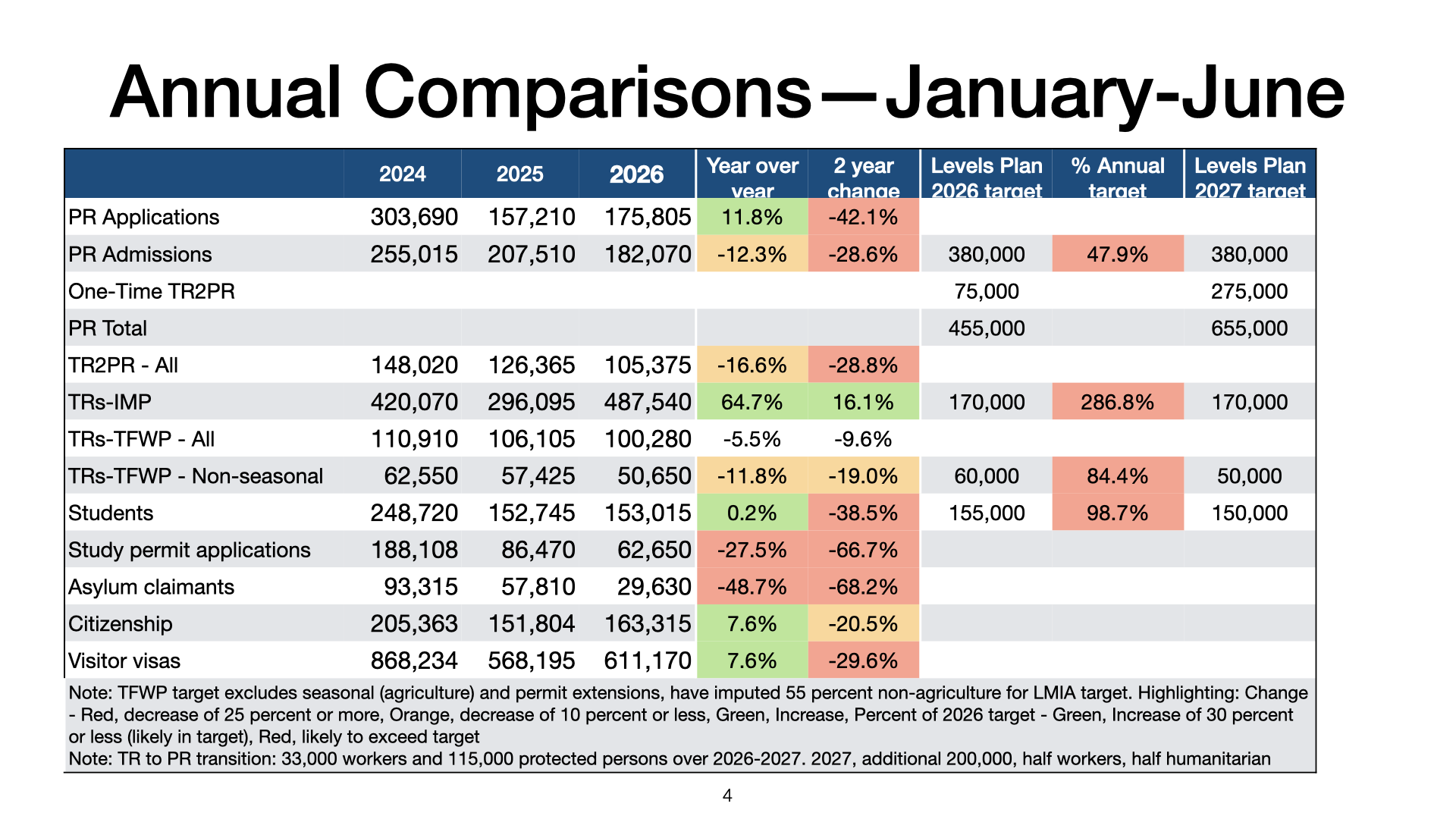
….There is no valid reason to separate out these permanent residents from the broader number often cited by the media. It’s true that these aren’t new arrivals, so they won’t put additional pressure on the housing market and social services, but that has become the norm. In recent years, around half of new permanent residents were already living in Canada.
By separating out the numbers, the government makes it harder to do year-over-year comparisons, and it bolsters the impression that the immigration system has been stabilized. In reality, the government has been struggling to meet its goal of reducing temporary residents to 5 per cent of the population by the end of 2027, despite the fact it already extended its deadline. As of July, 2.8 million people had temporary status in Canada, which is 6.7 per cent of the population.
When the Trudeau government announced its plan to get to the 5 per cent target in October 2024, it said that in 2025, Canada’s temporary population would decline by 445,901 people. That’s not what happened. Last year, the temporary population declined by just 89,445, one-fifth of the goal….
The Trudeau government created a massive mess out of Canada’s immigration system. However, if the Carney government wants to fix it by boosting permanent resident intakes far past the record high, it should make that case, not come up with creative accounting to obscure that fact.
The key problem is not the numbers, it’s the shaken confidence of the public in the immigration system. On that front, the Carney government is making things worse.
An immigration numbers game is not the way to restore public trust. Ottawa should level with Canadians about the system’s problems, and what is being done to address them.
Tony Keller: The Carney government’s immigration targets are a fib and a dodge
…The Carney government is trying to reduce the huge temporary resident population – as it has promised to do – by making it ever easier for non-permanent residents to become Canadians.
There’s a logic to this. But lowering the bar will create new incentives for those on temporary visas or with expired status. That will foster yet more unintended consequences.
And to meet its promise of lowering and stabilizing permanent immigration – a government pledge that polls suggest is popular – Team Carney is resorting to fudging its immigration books. Fibbing.
I’m sorry to have to use this word: Lying.
Our immigration system has become extremely complex and opaque. The Carney government just made it more non-transparent.
For a government committed to restoring confidence in the integrity of the immigration system – and confidence in the integrity of government itself – it’s a move in the wrong direction. They will regret it. We all will.
Robyn Urback: Mark Carney cranks up immigration again, while pretending not to
….Immigration is an economic issue, to be sure, but it is also a social one. The previous government demonstrated how just a few short-sighted decisions could destroy a decades-long national consensus on immigration. That consensus can be rebuilt, slowly, but that won’t happen if the public feels as though it is being gaslit on the government’s plans – whether it’s through the apparent exclusion of “one-time measures” from the overall accounting, or through insistences that Canada’s labour supply is “resilient,” even as Ottawa simultaneously makes it easier for employers to hire low-wage workers from abroad.
And while it is true that the Carney government has scaled back immigration significantly compared to the peak Trudeau years, the reality is that Canada’s non-permanent resident population as a proportion of the total population is still higher than it was in 2023, which poses enduring challenges in terms of housing, health care and other social infrastructure. That’s a topic worth addressing, say, on a Wednesday morning.
 About Andrew


