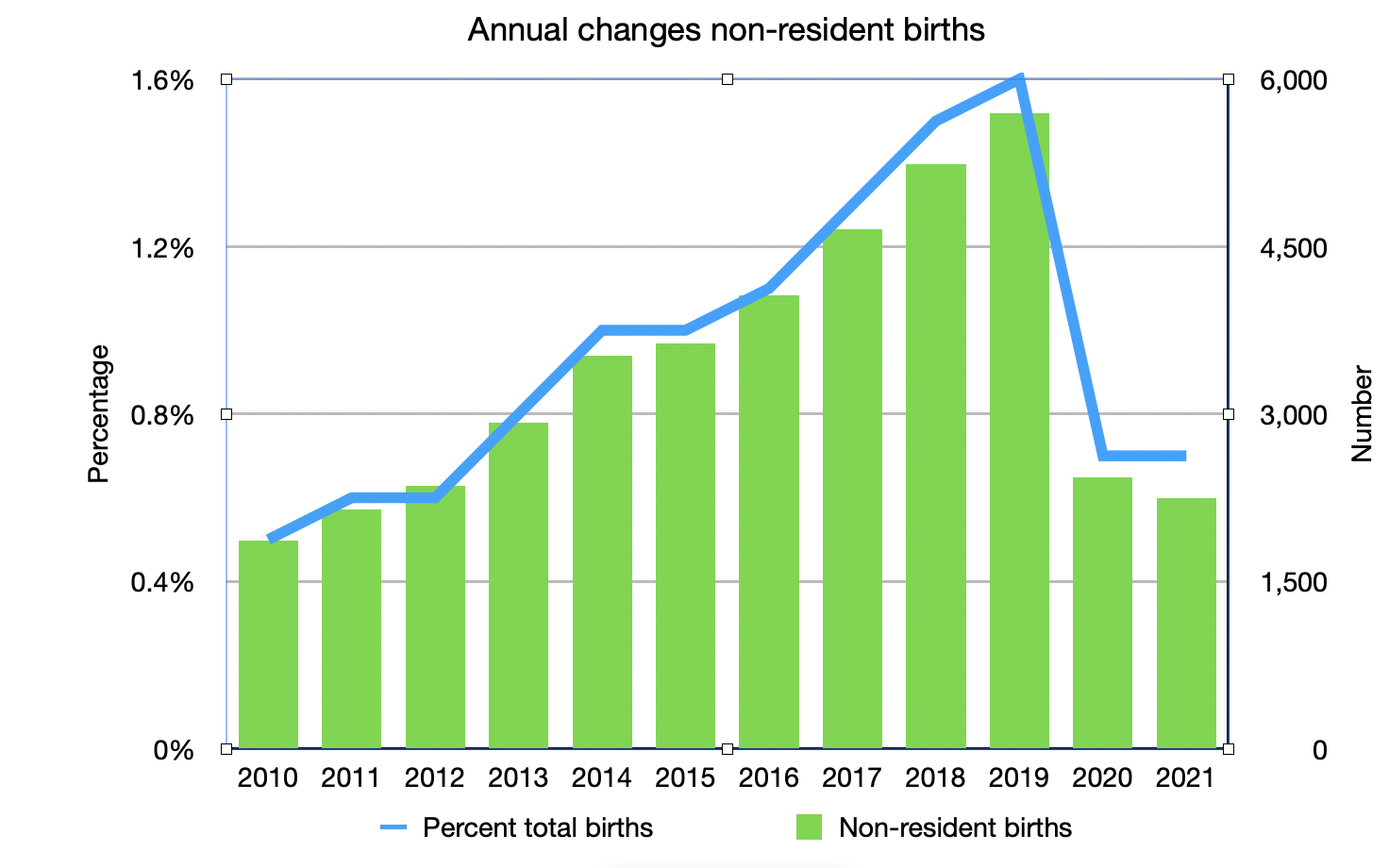
Canadian doctors say birth tourism is on the rise. It could hurt the health care system. [Alberta study]

Interesting Alberta study that broadens awareness of the issue with some qualitative analysis (Alberta has some of the most active medical academics working on birth tourism and I haven’t seen much from the other large provinces). Medical professionals are much more realistic than some social scientists and lawyers on the issues and implications:

Every few years, the phrase “birth tourism” seems to re-emerge in the news cycle. It refers to non-residents giving birth outside of their home country to gain citizenship and, occasionally, health care for their newborns. Birth tourism isn’t illegal in Canada, but it’s a fraught issue that tends to kick up discussions about who deserves access to the country’s health care system, especially in times of low bandwidth. Like now.

Simrit Brar, an OB-GYN at Calgary’s Foothills Medical Centre, is one of many Canadian doctors who claim to have noticed a recent spike in the number of birth tourists arriving out west. But because that data isn’t routinely collected by hospitals, it’s been impossible to understand the real scope of the issue. Last year, Brar was part of a research team that conducted the country’s first in-depth study on birth tourism in Alberta, and this year—for the first time—the Society of Obstetricians and Gynecologists of Canada is forming a working group to study its impact country-wide. Here, Brar reveals what we know so far.

What prompted you to study birth tourism?

Anecdotally, my colleagues and I noticed an increase in the number of cases we were seeing in Calgary hospitals over the past decade or so, but it’s been difficult to draw any real conclusions about the motivations, health outcomes or financial situations of birth tourists. We know they don’t have Canadian health coverage, but sometimes they have their own private insurance plans that reimburse their care costs. Canadian doctors were struggling to provide timely care for our baseline population even before the pandemic. Birth tourism is far from the only factor straining the health care system, but we knew it was an additional cost, and that we didn’t have the data to understand it. We saw an opportunity.

So how do birth tourists differ from other uninsured pre-natal patients in Canada?

Based on our research, birth tourists are typically middle to upper-middle class, with the means to support themselves while in Canada. The people we looked at weren’t necessarily disadvantaged. I want to be clear: refugees, asylum seekers, undocumented migrants and those in similarly precarious situations—like patients whose provincial health insurance has lapsed, for whatever reason—are not birth tourists. A birth tourist makes the conscious decision to travel and give birth here, and generally they have no intention to stay. Piling everyone under the same umbrella misses those crucial nuances and prevents us from making informed decisions, both at the policy level and in day-to-day care.

If you’re right that there’s been an uptick in birth tourism, what do you think is causing it?

It’s hard to say. We saw it slow a bit during the pandemic, given travel restrictions, and now it seems to be picking up again. I think the availability of information via social media is one factor; that spreads awareness that this is even an option. There are also companies that specialize in facilitating the birth-tourism process. They seem to market themselves online and through word-of-mouth.

What did your study reveal about why birth tourists are coming to Alberta? And where are they typically coming from?

About a quarter came from Nigeria, probably because there’s an established Nigerian community in the Calgary region. Birth tourists tend to go where they have friends or family. Smaller portions came from the Middle East, China, India and Mexico. The vast majority arrived with tourist visas, and based on our interviews, they weren’t facing particularly precarious situations back home. Again, I can only speak to the population we studied, but in general, these are women with resources.

What were they seeking?

That majority said their goal was to get Canadian citizenship for their newborns. Many saw it as an easier route to citizenship for their kids than applying through the typical process. Others either wouldn’t tell us their motivations or said they wanted to somehow benefit from quality Canadian health care.

When birth tourists get off their flights, what is the extent of their health needs?

Many travel here late in their pregnancies and arrive close to 38 weeks, which can lead to complications. I’ve seen patients with pre-existing high blood pressure get off a plane with numbers that are through the roof. Often, they’ll show up at a family doctor’s office, who sends an urgent hospital referral. I’ve also seen patients with pre-term twins literally get off a plane and go straight to an emergency room to deliver. Even somebody who might be otherwise low risk but shows up with no medical imaging or other records of pre-natal testing can have adverse birth outcomes, like unchecked pre-eclampsia and gestational diabetes. These aren’t isolated incidents, either.

When you crunched the numbers, what was the total cost incurred by the province to take care of these people?

For the 102 people we studied, the total amount owed to Alberta’s health care system was $649,000. That may not sound like a lot, but this is just one small study. If you were to add up the costs across Canada, you would end up with a significant amount. I also want to emphasize that this is not just about money. Canada’s health care system isn’t like the States’, which is not only fee-for-service but has a much larger population—and accordingly a larger number of health care providers. Our public system has a finite number of doctors, nurses, and anesthetists. Every province has a lengthy surgical waitlist, and we’re struggling to care for insured patients. So even if a birth tourist does pay their bill, if we allow people who have the opportunity to pay to preferentially access beds (and finite human resources), that displaces people here.

Have any solutions been proposed? If birth tourism isn’t illegal, but it is draining resources, how do we move forward?

We’ve discussed developing a standard charge and different systems for collecting it. In Calgary, we’ve established a central triage system, where patients identified as birth tourists are charged an upfront deposit of $15,000 to cover physicians’ fees. They’re refunded whatever part of that doesn’t end up being used. It’s the only measure of its kind in Canada. Transparently, that number is meant to be a deterrent.

Conversations on this topic occasionally lean toward a xenophobic—and even racist—lens, particularly in the States. Media coverage can sometimes paint pregnant women of colour as a national security threat. What are the biggest misconceptions about this issue?

I say this as a woman of colour: in my opinion, this is not a race issue. It’s a social-structure issue. It’s about access to care. When you have money and you have the ability to get on a plane and choose where to go, your options are different. The issue here is the use of a limited public health care resource. It’s about what it means for patients in disadvantaged communities here. Birth tourists have the ability to choose where they want to go, whereas somebody in a marginalized community may not have that ability. If we open the floodgates, we are further limiting people with very limited options.

Birth tourism highlights some really interesting philosophical tension around the Canadian health care system, the spirit of which is to make sure everyone is taken care of. Here, we see the limits of that thinking. Has studying birth tourism changed your perspective?

You hit the nail on the head. I would love nothing more than to have unlimited resources and help anyone and everyone. That would be dreamland. I would love to not have to fight to get things done. And to be clear, I would never deny care to a patient. But the reality is that we operate within a finite system, and even though the conversations around the allocation of those resources are difficult and complex, we have to have them. I would identify wanting to help as many people as possible, and in the best way possible, as a fundamentally Canadian value. But the system is too strained for us to ignore these questions.

Source: Canadian doctors say birth tourism is on the rise. It could hurt the health care system.
Canadians celebrate Citizenship Week [while IRCC undermines value through oath changes and dated citizenship guide]

The irony. The government tables a Gazette Notice proposing to all for self-affirmation of the oath rather than with fellow Canadians. The government promised to revise Discover Canada in 2016 (three or four ministers ago). And then it spouts this verbiage. Sad:

Becoming a Canadian citizen is a momentous occasion that marks the final step in the immigration journey. Every year, we celebrate Citizenship Week, a chance to celebrate new citizens and all that it means to be Canadian—our diversity, our history and our culture.

Today, the Honourable Sean Fraser, Minister of Immigration, Refugees and Citizenship, launched Citizenship Week, which runs from May 22 to 28, 2023. He will mark the occasion by attending citizenship ceremonies from coast to coast in Halifax, Nova Scotia, and Vancouver, British Columbia. Across the country, Canada will welcome thousands of new Canadians.

Citizenship ceremonies are an emotional and meaningful experience for all those who have a chance to participate. They provide an opportunity to witness new Canadians reach this proud milestone and reflect on the significance of citizenship, the rights it affords, and the responsibilities it bears. Citizenship is a commitment to Canada and all Canadians.

Everyone in Canada is invited to celebrate Citizenship Week by attending citizenship ceremoniestaking place this week across the country. Canadians can join the livestream from Halifax on May 24 or attend a ceremony that is open to the public in person.

As part of our efforts to modernize our services, Immigration, Refugees and Citizenship Canada (IRCC) has made great strides when it comes to citizenship through online testing, virtual citizenship ceremonies, and an online application tracker that helps clients stay up to date on their files.

Canada is proud to have exceeded its citizenship goals this past year, with nearly 364,000 new Canadian citizens. We have already welcomed 85,000 new Canadians in the first three months of this year, and look forward to welcoming thousands more in the months ahead.

Source: Canadians celebrate Citizenship Week

5 takeaways from AP’s series on health disparities impacting Black Americans

Of note:

The Associated Press spent a year examining how racial health disparities have harmed generations of Black Americans. 

From birth to death, Black Americans fare worse in measures of health compared to their white counterparts. They have higher rates of infant and maternal mortality, higher incidence of asthma during childhood, more difficulty treating mental illness as teens, and higher rates of high blood pressure, Alzheimer’s disease and other illness as adults. 

Here are the key takeaways from each story:

WHY ARE BLACK BABIES AND MOTHERS MORE LIKELY TO DIE?

Black women have the highest maternal mortality rate in the United States — 69.9 per 100,000 live births for 2021, almost three times the rate for white women, according to the Centers for Disease Control and Prevention. The 2021 rate was a significant increase from the prior year.

Black babies are also more likely to die, and also far more likely to be born prematurely, setting the stage for health issues that could follow them through their lives. In 2020, there were 364,487 preterm births in the nation, about 1 in 10. Preterm birth rates were highest for Black infants, 14.2%, between 2018 and 2020. 

Multiple factors contribute to these disparities, according to the CDC and advocacy organizations, such as underlying health conditions. But more doctors and experts have pointed to the role of structural racism that has created inequitable access to health care, implicit bias and discriminatory care. Poor health care or outcomes for Black mothers in turn can create issues for their babies, putting them at risk for future health problems down the road.

WHY DO MORE BLACK KIDS HAVE ASTHMA?

Black children are more likely to have asthma and to be exposed to certain triggers, like mold and air pollution. Their asthma often is more severe and less likely to be controlled. About 4 million kids in the U.S. have asthma. The percentage of Black children with asthma is far higher than white kids; more than 12% of Black kids nationwide suffer from the disease, compared with 5% of white children. 

Some of the high rates of asthma among Black children are tied to genetics — family histories of allergies, and frequent respiratory infections. But much of the disparity lies in the same racist factors that afflict Black peoples’ health from birth to death.

With asthma, especially for kids, where you live makes all the difference. And where you live often depends on your race. Black Americans are more at risk of living in homes with asthma triggers, like cockroaches, dust mites, mold and rodents. Research also shows that air pollution can worsen asthma.

Across America, nearly 4 in 10 Black children live in areas with poor environmental and health conditions compared to 1 in 10 white children. Factories spew nitrogen oxide and particulate matter. Idling trucks and freeway traffic kick up noxious fumes and dust.

The disparities are built into a housing system shaped by the longstanding effects of slavery and Jim Crow-era laws. Many of the communities that have substandard housing today or are located near toxic sites are the same as those that were segregated and redlined decades ago.

HOW DOES RACISM AFFECT BLACK TEENS’ MENTAL HEALTH?

About 50% of Black youth experience moderate to severe symptoms of depression, and about 18% said they were exposed to racial trauma often or very often in their life.

The drivers of the mental health crisis for Black children begin early and persist through a lifetime. Black children’s first encounters with racism can start before they are even in school, and Black teenagers report experiencing an average of five instances of racial discrimination per day. Young Black students are often perceived as less innocent and older than their age, leading to disproportionately harsher discipline in schools.

Black adolescents are far less likely than their white peers to seek and find mental health care. In part, that’s because Black families often distrust the medical system after generations of mistreatment — from lack of access to care to being subjected to racist practices and experimentation. 

The country also has a shortage of providers who understand the roles that racial identity and racism play in shaping young Black people’s mental health. Research and health surveillance data point to a growing mental health crisis among Black youth over decades. Between 1991 and 2019, Black adolescents had the highest increase among any other group in prevalence of suicide attempts — a rise of nearly 80%.

WHAT ROLE HAS HIGH BLOOD PRESSURE PLAYED IN COVID DEATHS OF BLACK AMERICANS?

High blood pressure has played a major role in COVID deaths, and especially in the COVID deaths of Black people. Together, they have created a deadly combination: While it is listed as a contributing factor in 15.5% of the deaths of white COVID sufferers, the figure for Black victims is 21.4% — the highest of any racial group.

About 56% of Black adults have high blood pressure, compared to 48% of white people. Three in four African Americans are likely to develop the disorder by age 55.

While only 32% of white adults with high blood pressure have their condition under control with medication, the figure for Black Americans is even lower — 25%.

And it’s likely to get worse: By 2060, the number of Americans battling cardiovascular disease is expected to drastically increase. High blood pressure rates alone are projected to rise 27.2%, or from roughly 127.8 million to 162.5 million Americans.

Among white people, the prevalence of cardiovascular risk factors and disease is projected to decrease over time. Yet significant increases are projected among people of color, especially Black and Latino Americans.

Like many conditions, genetics do play a part. Experts also blame poor diets, high cholesterol, obesity and smoking — risk factors that often exist at higher rates in Black communities. Also, in recent years, more academics and doctors have called attention to structural inequities that have an outsized impact. Black neighborhoods are more likely to experience a lack of access to healthy foods or be inundated with fast food options.

WHY DO SO MANY BLACK PEOPLE DEVELOP ALZHEIMER’S DISEASE?

Black Americans are more likely than white people to develop Alzheimer’s. About 14% of Black Americans over the age of 65 have Alzheimer’s, compared with 10% of white Americans, according to the Centers for Disease Control and Prevention. Experts believe the rates could be even higher.

Health conditions like cardiovascular disease and diabetes experienced in earlier stages of life are known risk factors — both of which are more common among Black and Latino populations. Depression, high blood pressure, obesity and chronic stress are also risk factors. The CDC also acknowledges the impact of “higher rates of poverty, and greater exposure to adversity and discrimination” as risk factors.

Across the board, Black people are also unlikely to receive the health care that white people do — including necessary medication to treat Alzheimer’s and dementia-related disorders. A preliminary study released this year by Mount Sinai researchers found that Black people are less likely to receive dementia-related medications than white people.

Black and Latino populations are expected to rise in coming years, and so are the number of their cases of Alzheimer’s and related disorders. Cases among Black Americans are projected to increase four times over today’s estimates and Latino Americans could increase seven times, according to the CDC.

Some advocates estimate that by 2030, nearly 40% of all Americans living with Alzheimer’s could be Black or Latino. But the projected rise in cases isn’t just tied to population growth.

While evidence exists that certain genetic risk factors could differ by race and be a driver, the large disparities among racial groups can’t be explained just by genetics, experts say.

And the sheer trauma of experiencing racism is also believed to be a contributing factor.

Source: 5 takeaways from AP’s series on health disparities impacting Black Americans

“The Times They Are A-Changin’?” – Immigration debates and discussions

A few years ago, it was rare to find critiques of the government’s expanding levels of immigration, and the overall consensus among the provinces, business organizations and lobby groups, media and academics organizations in favour of this approach.

However, over the past year or so, there has been significant commentary questioning the approach given the impact on housing availability and affordability, healthcare and infrastructure. In addition to my 2021 Increasing immigration to boost population? Not so fast, former head of the British Columbia public service, Don Wright, wrote one of the stronger critiques, Will Trudeau make it impossible for Eby to succeed?

National unity and the demographic weight of Quebec in Canada has become a second major critique. A series of articles in Quebecor papers (LE QUÉBÉC PRIS AU PIÈGE PAR OTTAWA) highlighting an accelerating decline of Quebec’s population relative to the rest of Canada, reflecting different immigration rates has provoked considerable political debate and commentary in Quebec and English Canadian media.

While the Quebecor were written in an incendiary manner, the substance was correct. The approaches continue to diverge, there is, IMO, an unhealthy consensus in favour ot the current and projected levels of permanent and temporary migration among federal and provincial politicians, business organizations, academics among others.

Some of the commentary recognized that. Stuart Thompson the The Hub, A new era of immigration politics has started in Canada was one of the first to recognize the potential importance to immigration debates and discussions. Chris Selley chimed in, noting that Ottawa has no answer to Quebec’s anti-immigrant narrative. Campbell Clark stressed that Two solitudes emerging on immigration in Quebec, and noted the lame arguments on both sides of the debate. Formally, the Quebec government reject[ed] Trudeau’s immigration plan, fears decline of French.

The role of the Century Initiative received increased prominence given that these debates were happening around the time of one of its Globe and Mail sponsored conferences. Immigration Minister Fraser’s denial that the government had not adopted the 100 million population goal of the Century Initiative was met with understandable cynicism by Robert Dutrisac, Blanc bonnet, bonnet blanc, Konrad Yakabuski, L’«initiative du siècle» n’est pas l’idée du siècle among others, along with more reporting and analysis, Serons-nous vraiment 100 millions de Canadiens en 2100?.

English media commentary focussed more on the politics, with Chantal Hébert asking whether Hébert: Quebec’s separatists were searching for a way to revive their cause. Is this it? and Konrad Yakabuski, another rare journalist who writes in both English and French media, noting that François Legault’s anti-immigration crusade is coming back to bite him. Andrew Phillips in the Star dismissed Quebec concerns, framing it as a Panic attack in Quebec over immigration threat. Althia Raj, also in the Star, argued that: Pierre Poilievre is courting voters by capitalizing on immigration fears in Quebec, both discounting the substance of Quebec concerns and not questioning the federal government approach.

And of course most English language was focused on the less important issue of the passport redesign (not a fan, but my worry is that the controversy will make the government even more skittish about releasing the revised citizenship guide, Discover Canada, first promised in 2016).

Surprisingly, Andrew Coyne focussed more on Quebec, politics and demography, rather than contributing his usual economic take on issues. Almost a childish approach in 100 million Canadians by 2100 may not be federal policy, but it should be – even if it makes Quebec howl, largely ignoring the negative impacts on housing, healthcare and infrastructure and, more bizarrely, falling into the trap of overall GDP rather than productivity and per capita GDP (which most of his economic-related columns focus on).

All this being said, the Quebec government took advantage of the controversy to announce changes to its immigration program Six éléments à retenir des annonces de Québec en immigration, including increased levels to 60,000 new permanent residents while allowing ongoing temporary resident growth. This slight-of-hand was of course noted by Michel David, Et la lumière fut and Plus d’immigrants pour éviter une « louisianisation » ici ? 

This modest increase will not, of course, make any significant change to the ongoing divergence in population growth between Quebec and the Rest of Canada and Quebec’s relative weight in the country.

A recent Statistics Canada study, Unemployment and job vacancies by education, 2016 to 2022, highlighting the disconnect between immigration policy, which favours university-educated immigrants, and immigrant employment, which favours lower-skilled immigrants, provides another example of how our immigration policies appear more to be “policy-driven evidence” rather than “evidence-based policy.”

Questions on immigration levels have broadened from housing, healthcare and infrastructure impacts to the impact on the Canadian federation given the imbalance between Quebec and the Rest of Canada. A potential sleeper issue, parallel to Quebec’s relative share of the population is with respect to Indigenous peoples, given that high immigration levels dwarf Indigenous growth (visible minorities increased by 26.5 percent, Indigenous peoples by 9.4 percent, 2021 compared to 2016).

As I have argued previously, we need to find a way to have more productive discussions on immigration rather than the various solitudes between the “more the merrier” and “great replacement” camps (where most Canadians are). The disconnect between Quebec and the Rest-of-Canada is a long-term threat to the federation.

A focus on the practicalities – housing, healthcare and infrastructure impacts – is likely the best way forward and may provide a means to reduce the divergence between the “two solitudes.”

Ideally, of course, some form of commission examining demographics, immigration, and these impacts would provide deeper analysis and recommendations than current IRCC consultations or any other internal review.

To end with a quote from another favourite musician of mine:

Ring the bells that still can ring
Forget your perfect offering
There is a crack, a crack in everything
That’s how the light gets in

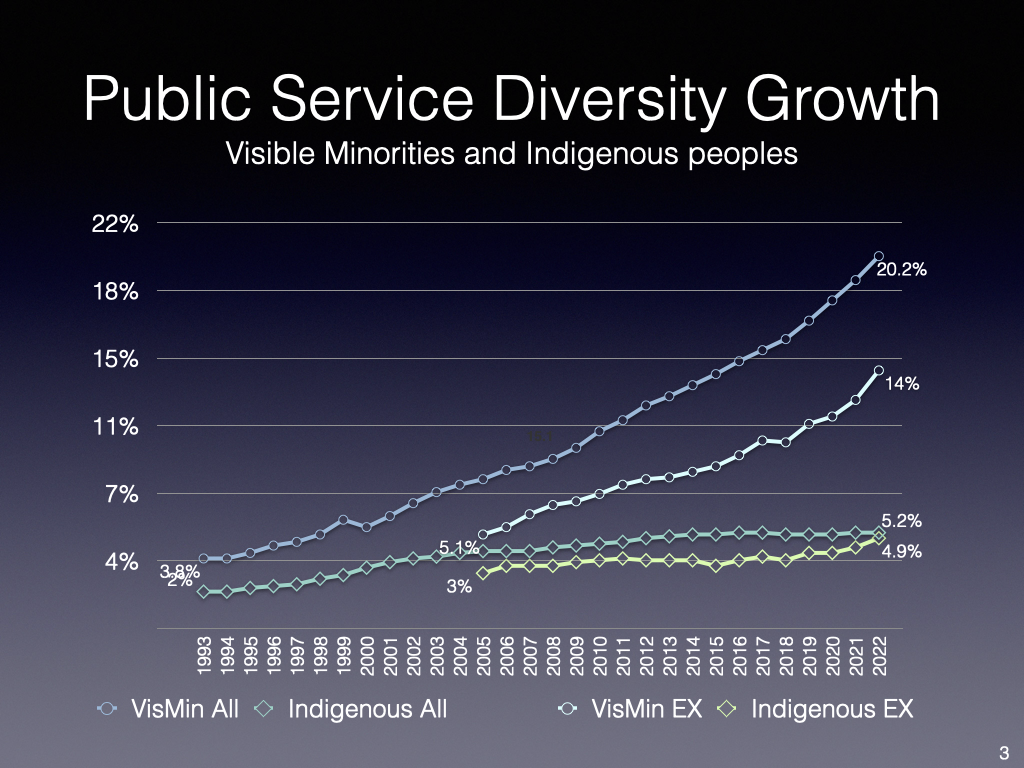
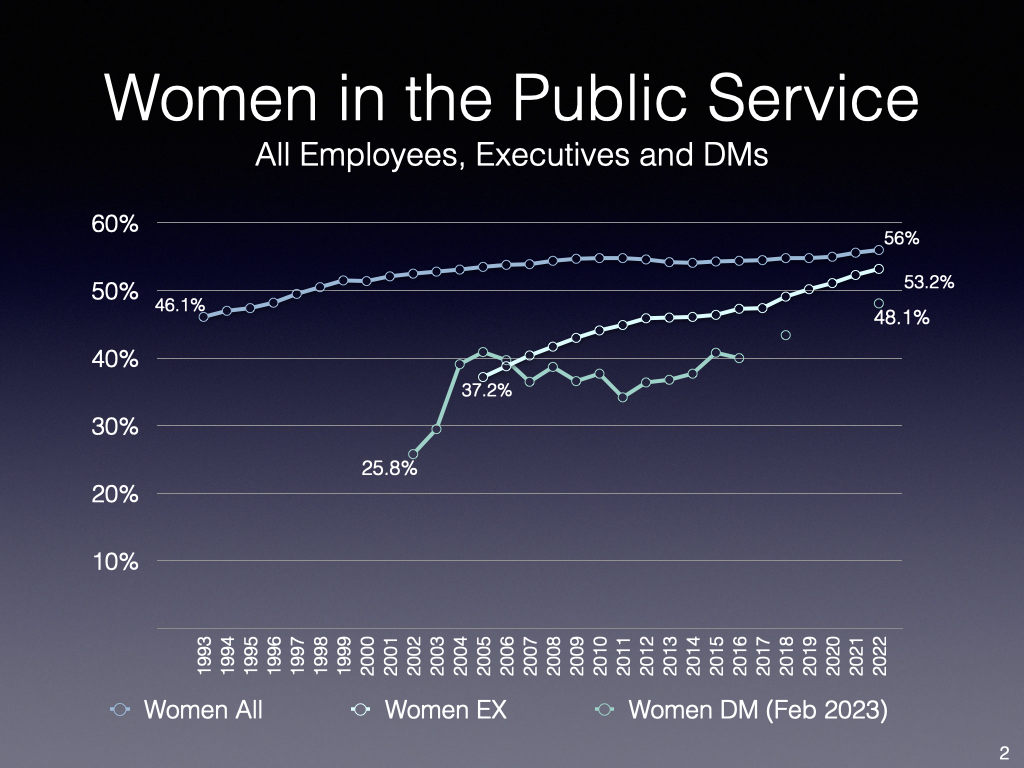
ICYMI: How well is the government meeting its diversity targets? An intersectionality analysis

As you know, I have been looking for some time at how the diversity within the public service continues to evolve. The overall trend over the years demonstrates that the original policy objectives of improved diversity are being met but arguably too slowly for some.

For the past six years, TBS has provided disaggregated data for the various equity groups. In 2022, TBS also provided gender breakdowns within the disaggregated data. Following up on a suggestion from a member of Black Lives Matter, I looked at hiring, separation and promotion rates for visible minority and Indigenous groups, showing that visible minority representation is growing faster than non-visible minority, not indigenous, with a more mixed picture for Indigenous public servants.

When originally published by National Newswatch and subsequently posted on LinkedIn, the analysis received a range of commentary, ranging from this who appreciated the data and analyis to those who contested it. The latter ranged from those genuinely interested in discussing the approach I took while raising valid points (I learned more about disproportionately analysis), to those, “activists on a pension,” as we sometimes called them while working in the multiculturalism branch at Canadian Heritage.

The latter appeared to have not read the article or understood that I had used the same disproportionality approach to assess the differences between hiring, separation and promotion rates, highlighting the improvements over the past six years, particularly but not exclusively, for Black public servants. Media needs to be more careful in citing individual examples without this broader context (e.g., Sandra Griffith-Bonaparte has worked 22 years for the government. She’s never gotten a promotion):

COVID-19 Immigration Effects – March 2023 update

Latest monthly update. Of particular interest, percentage of TR2PR of permanent resident admissions continues to remain around 60 percent for the first quarter. Two-step immigration as the norm.

Blogging break for a few weeks

Scofield: Believe it or not, Canada’s population will hit 40 million in June. It’s time we learned how to retain newcomers [IMO, also question levels and impacts]

Disappointing in that Scofield doesn’t question some of the assumptions behind the immigration levels and their support by the business community, education institutions and others. So much easier to turn up the immigration dial, so much harder to address housing, healthcare and infrastructure needs:

Canada’s population is about to break the 40 million mark this June.

Chief Statistician Anil Arora took to the stage last week to illustrate Canada’s surging society, and that number was his starting point for a very good reason.

Canada’s population is growing quite quickly by historical standards and compared to the rest of the world, and almost all of that growth is thanks to immigration. At the same time, it’s important to note that in any given year, there are thousands of Canadians who leave the country — either permanently or temporarily. You can actually see it happening in real time, thanks to a “population clock” built by Statistics Canada, which shows a couple thousand people per day coming into Canada mainly as immigrants or non-permanent residents.

And what’s true for the country is even more so for the GTA, the centre of the country’s vibrant and dynamic diversity.

The implications are far-reaching and profound, as Arora pointed out in the prestigious, annual Manion lecture to public servants — especially for the economy.

To make the obvious point, it’s essential that policymakers and employers alike anticipate the change coming at us, and make the most of it. That’s not lost on any employer desperately trying to fill job postings these days, nor is it lost on our political leaders.

Immigration Minister Sean Fraser and his entourage are travelling the country, looking for bold ideas for the long term, practical ideas for the short term, and tight timelines to deliver a new vision to his colleagues in cabinet.

At stake is our standard of living, our ability to compete with other countries, our regional development and, importantly, our ability to get along with one another.

Here are a few more numbers to add to Arora’s headline.

Last year, permanent residents coming into Canada reached a historic high, and the same goes for temporary workers. In other words, Canada has a healthy flow of people moving here for the long term, along with a more haphazard intake of stopgap workers whose future is uncertain.

Employers are scrambling to fill more than 731,000 positions right now, but this is down from the one million job vacancies that dominated the news last fall. The vacancies reflect an underlying labour shortage in Canada as the population ages and retirements pile up. But layered on top of that is an expected shorter-term slowdown in hiring as the country’s employers grapple with rising interest rates and stagflation.

House prices in the GTA were up four per cent in April but down 7.8 per cent from a year ago. Similarly, the volume of sales was up nine per cent on the month, but down 5.2 per cent compared to a year ago. In other words, Toronto homes are really expensive and the market is very much in flux. It’s a confusing array of short-term mismatches and long-term demographic trends that require a nuanced approach, if the country’s economy is to set itself on a growth trajectory.

There’s no doubt that we need a growing labour force over the long term, and that immigration is the source of that growth. There’s also no doubt that business leaders routinely list labour supply as their top challenge, and they’re constantly reassessing the mix of skills that they need. There’s no doubt that the challenge of expensive housing repeatedly throws a wrench in the best-laid plans. And there’s also no doubt that Canada’s reputation as a magnet for the world’s best and brightest is under pressure because other countries are mirroring our approach and taking us on.

Canada has fallen behind on key issues that impact our reputation, including administrative backlogs, inadequate housing, and poor recognition of foreign credentials. In the 2022 Global Talent Competitiveness Index, Canada fell to 15th place — down from 9th place in 2015, with its lowest scores for immigrant retention. 

Helpfully, the federal government separates out the “acute” short-term dynamics from the “chronic” longer-term pressures and is actively talking to business about how to collaborate and make sure the mix of newcomers adds to our ability to build homes, fill job vacancies and set the stage for longer-term productivity.

There’s talk of fast-tracking the flow of newcomers attached to trusted employers and trusted institutions such as universities. There’s creative thinking around how large-scale employers can work together to recruit pools of workers overseas. The discussion with professional organizations to streamline credential recognition is vigorous. And there’s some promising use of technology to speed up approvals in a way that also helps with matching people with jobs and smooths out integration.

And of course, on top of the push for speed and the right mix of workers, Canada’s immigration policy is also about a humanitarian approach to refugees and family reunification, as always.

We’re in the midst of a promising collective brainstorming around how — a brainstorming that will become more complicated in the next months as government drives towards decisions and as the economy slows down.

Luckily, most of the public, the government and business are on the same wavelength in making immigration work well for the economy, and the country as a whole.

Let’s keep that consensus in mind as policymakers and employers figure out how.

Source: Believe it or not, Canada’s population will hit 40 million in June. It’s time we learned how to retain newcomers

Black Class Action Secretariat expressing sharp disapproval of new Canadian Heritage hire for multiculturalism, anti-racism

Suspect this is driven as much by the need to keep the organization and its issues in the public spotlight as substantive concerns. Not a political appointee unlike Amira Elghawaby, the special representative on combatting Islamophobia:

An organization working to eliminate systemic discrimination in Canada’s public service is concerned about a new hire for the Department of Canadian Heritage’s acting director general of multiculturalism and anti-racism.

Melanie Mohammed, a former leadership member at the Canadian Human Rights Commission (CHRC), took on the job at Canadian Heritage in April.

The Black Class Action Secretariat (BCAS) is expressing sharp disapproval of the decision to appoint Mohammed to the role, as the CHRC was recently found to have discriminated against its Black and racialized employees.

Mohammed’s hiring came less than a month after Treasury Board made a ruling that the CHRC, the mandate of which is to deal with complaints of discrimination, had itself breached the “no discrimination” clause of a collective agreement between the Treasury Board and the Association of Justice Counsel, the bargaining agent for approximately 2,600 lawyers employed by the government.

BCAS executive director Nicholas Marcus Thompson said last month that the appointment of Mohammed, who was the CHRC’s chief of staff, is “disturbing” and “reckless” as it sends a message to Canadians that there is no accountability or consequence for discrimination.

“If the government has moved an employee from an organization that was deemed to be discriminatory to now an even bigger organization to address anti-racism, it’s not only hypocritical, but it’s a farce,” Thompson said. “There’s zero credibility in this type of leadership.”

The role of the director general of multiculturalism and anti-racism is not only to provide funding to organizations led by Black and racialized people but to address racism and hate through federal multiculturalism and anti-racism strategies, including Canada’s Anti-Racism Strategy and the Federal Anti-Racism Secretariat.

“Employees report being harassed and facing retaliation from Ms. Mohammed after speaking up,” a statement from BCAS stated. “Therefore, it is completely unacceptable for the Government of Canada to appoint this individual as Director General of anti-racism for the entire government.”

This newspaper reached out to Mohammed, who declined to comment on the matter via her lawyer.

Dominique Collin, a spokesperson for Canadian Heritage, said in an email statement last month that the department was taking BCAS’ statement “very seriously” and was looking into the organization’s concerns.

“We remain committed to improving the experiences of Black public servants, but while progress is being made, we know there is still more to do to make our workplaces inclusive and equitable for all equity-seeking employees,” Collin said.

Canadian Heritage confirmed Monday that Mohammed remains in the position.

Thompson added last month that he’d like to see the prime minister take ownership of the issue, and re-affirmed his concern about the lack of accountability within the government in an address to the Senate last week regarding anti-Black racism, sexism and systemic discrimination in the CHRC.

“We have this vicious cycle within the federal public service where there’s no accountability, wrongdoers are often either transferred when it comes to discrimination or promoted,” Thompson told the Senate.

In its statement, BCAS called on the government to rescind Mohammed’s appointment and issue an apology. The group also urged the feds to appoint someone with no connection to CHRC’s leadership and who has demonstrated “an understanding of systemic anti-Black racism.”

BCAS said the appointment also speaks to the “urgent need” to transfer the Federal Anti-Racism Secretariat to the Privy Council Office in order for it to have independence and power to implement its mandate.

The organization also called for Mohammed’s appointment to the Federal Executive Leadership Development Program to be revoked and said it would like to see the government mandate that senior Canadian Heritage executives undergo anti-Black racism training and meet with Black employees and address their concerns within the department.

“This appointment is completely counter to the government’s promise and commitment to create a diverse and inclusive workspace that is free from discrimination and harassment,” Thompson said.

Source: Black Class Action Secretariat expressing sharp disapproval of new Canadian Heritage hire for multiculturalism, anti-racism

Roberge juge intolérable que des immigrants temporaires ne parlent pas français

Well, they’re temporary unlike permanent who have a much greater incentive. And legitimate concerns regarding the impact of high immigration levels in the rest of Canada compared to more modest levels in Quebec (set by the Quebec government):

Le ministre de la Langue française, Jean-François Roberge, juge intolérable que des milliers d’immigrants temporaires vivent au Québec en n’ayant aucune notion de français. Certains de ces travailleurs venus d’ailleurs veulent pourtant apprendre le français, mais Québec doit leur offrir des cours, si possible en milieu de travail, estime le président de la Chambre de commerce du Montréal métropolitain (CCMM), Michel Leblanc.

Plus de 290 000 immigrants temporaires se trouvaient en sol québécois au 31 décembre 2022, selon le ministère de l’Immigration, de la Francisation et de l’Intégration (MIFI). Il s’agit notamment de travailleurs et d’étudiants. Ces gens ne sont pas obligés d’apprendre le français, parce qu’ils viennent au Québec pour de courts séjours — qui peuvent tout de même s’échelonner sur plusieurs années. Certains souhaitent aussi devenir résidents permanents.

Ces gens travaillent entre autres dans les commerces, dans les cafés ou dans les restaurants de Montréal. Ils changent le visage de la métropole en ne maîtrisant pas la langue nationale du Québec. « On ne peut pas tolérer qu’ils anglicisent le Québec », a déclaré le ministre Roberge lors d’une conférence organisée par la Chambre de commerce du Montréal métropolitain, lundi midi.

Le président et chef de la direction de la CCMM, Michel Leblanc, a salué la volonté du gouvernement d’aider les immigrants temporaires à se franciser. Il affirme que plusieurs entreprises (en technologies de l’information ou en aéronautique, par exemple) souhaitent garder leurs travailleurs temporaires.

« Il y a des gens qui travaillent fort, qui viennent d’arriver, parfois avec des enfants, des femmes ou des maris, qui veulent s’intégrer. Il faut leur faciliter la vie. Si on blâme l’immigrant, on perd de vue que notre système n’est pas assez accommodant pour son horaire, pour sa réalité », dit M. Leblanc.

Comme le faucon pèlerin

L’organisme Francisation Québec, qui entrera en fonction le 1er juin, est susceptible de faciliter l’apprentissage de la langue nationale de tous les nouveaux arrivants, y compris ceux issus des programmes temporaires, a fait valoir le ministre Roberge.

Le ministre québécois de la Langue française était invité par la CCMM avec son homologue fédérale, Ginette Petitpas Taylor, après leur entente historique visant à améliorer la protection du français au Québec. La ministre fédérale des Langues officielles a déjà reconnu, avec le projet de loi C-13, « qu’une seule des deux langues officielles est en déclin au Canada, y compris au Québec ». Et cette langue est le français.

Mme Petitpas Taylor a remis à son « ami » Roberge un faucon pèlerin en peluche, pour témoigner qu’il est possible de freiner le déclin d’une espèce vulnérable. Les deux ministres s’étaient entendus en mars dernier pour que le gouvernement Trudeau renforce le français au Québec. Il s’agit d’un geste impensable jusqu’à récemment, car Ottawa a généralement pour mission de protéger les minorités linguistiques, dont celle de langue anglaise au Québec.

Le projet de loi C-13 obligera notamment les entreprises sous réglementation fédérale au Québec à se conformer à la Charte québécoise de la langue française. La langue de travail devra être le français ; il sera aussi obligatoire de pouvoir servir les clients en français. Tout indique que ce projet de loi sera adopté cette semaine par la Chambre des communes.

Immigration francophone

Le ministre Jean-François Roberge a appelé les sénateurs canadiens à sanctionner par la suite le projet de loi « sans le passer à la lessive », en maintenant la référence à la Charte québécoise de la langue française.

Le ministre Roberge a pressé Ottawa d’établir des cibles ambitieuses d’immigration en français. Il dénonce l’« initiative du siècle » visant à faire grimper la population canadienne à 100 millions de personnes en 2100. « J’ose nommer la question de l’immigration massive. Certains appellent ça l’initiative du siècle. Pour moi, c’est la lubie du siècle de penser qu’on peut, de manière démesurée, perdre le contrôle de nos seuils d’immigration. Ce n’est pas bon pour le Québec et ce n’est pas bon pour la francophonie canadienne », a-t-il dit.

La ministre Ginette Petitpas Taylor, une francophone du Nouveau-Brunswick, a reconnu l’importance d’augmenter l’immigration francophone au pays, y compris au Québec.

Source: Roberge juge intolérable que des immigrants temporaires ne parlent pas français