Audit of Employment Equity Representation in Recruitment

PDF Version

Significant and useful, in that it breaks down the various steps in staffing and how different groups are affected at the organizational screening and assessment stages.

Like all research, this begs further work to assess the particular factors that resulted in visible minority and Indigenous candidates being rejected at those stages.

Notable that Black candidate respresentation declined more than other visible minority groups, again suggesting the need for some qualitative analysis of the reasons and rationales for them being selected out:

This audit was undertaken as part of the Public Service Commission (PSC)’s oversight mandate to assess the integrity of the public service staffing system. It is part of a series of initiatives that looks at the performance of the staffing system with respect to the representation of employment equity groups.

Achieving priorities related to diversity and inclusion in the federal public service will ensure that Canadians benefit from a public service workforce that is representative of Canada’s diversity. To date, progress towards a representative federal public service is being made. Of the 4 employment equity groups, 3 are represented at or above workforce availability; persons with disabilities are currently underrepresented in the federal government. These results show that more work and a sustained focus on diversity are required.

This audit focused on advertised recruitment processes as one of the key drivers to improving the representation of employment equity groups in the federal public service. The audit had 2 objectives:

  1. to determine whether the 4 employment equity groups remain proportionately represented throughout recruitment processes
  2. to identify factors that may influence employment equity group representation

This audit looked at 15 285 applications to 181 externally advertised appointment processes from 30 departments and agencies.

We examined employment equity group representation at 5 key stages of the external advertised appointment process (Figure 2 in this report provides more detail on each of these stages):

5 key stages of the external advertised appointment process: job application, automated screening, Organizational screening, Assessment, Appointment

Our focus was to explore whether employment equity groups experienced changes in representation at each stage of the appointment process, and to examine these stages for factors that may have influenced their representation.

Main findings

We found that employment equity groups did not remain proportionately represented throughout the recruitment process.

Our audit results showed that:

  • women were the only group to experience an overall increase in representation from job application to the appointment stage
  • Indigenous candidates experienced a reduction in representation at the assessment stage
  • persons with disabilities experienced the largest drop in representation of any of the employment equity groups, with decreases in representation at the assessment and appointment stages
  • visible minority groups experienced reductions in representation at the organizational screening and assessment stages
  • of the visible minority sub-groups examined in our audit, Black candidates experienced a larger drop in representation than other members of visible minorities, both at the organizational screening and assessment stages

Our ability to identify factors that may influence employment equity representation in recruitment was limited to the information available in the staffing files. Some factors were identified to partially explain the drop in representation of members of visible minorities at the organizational screening stage. However, limited information in staffing files did not provide conclusive evidence of other factors that may be associated with lower success rates of employment equity groups at later stages of the recruitment process. More research will be required to determine potential barriers in externally advertised appointment processes and to develop concrete solutions.

This audit report makes 3 recommendations intended to address the lower success experienced by some employment equity groups in external advertised recruitment processes. The development and implementation of concrete corrective measures will require collaboration between multiple stakeholders including deputy heads, the PSC, other central agencies and employment equity groups.

The audit makes clear that despite efforts across departments and agencies to advance diversity, work remains to achieve inclusive hiring processes in the public service. The PSC will need to further support organizations by providing systems, tools and guidance for implementing a barrier-free appointment process. Most importantly, deputy heads are responsible for reviewing their staffing framework and practices to ensure barrier-free appointment processes for all employment equity groups, including visible minority sub-groups.

Source: https://www.canada.ca/en/public-service-commission/services/publications/audit-of-employment-equity-representation-in-recruitment.html#2_0

COVID-19 scrutiny has stopped some women headed to Canada to give birth, documents allege

While the article is unbalanced, only citing Jamie Liew who dismisses the importance of the issue and the data (Jamie and I continue our debate at Policy Options and elsewhere), good to know that officials are identifying women suspected of misrepresenting their purpose of travel.

While the ATIP under question pertains only to Abu Dhabi, would be interesting to have comparable reports from other main source countries of birth tourists particularly China.

As to the question of the numbers, have written extensively on the strengths and weaknesses of the CIHI numbers (far from perfect but more realistic than the StatsCan/vital stats dramatic understating).

2020 numbers, likely available mid-summer, will provide a good indication of the practice given that visitor visas have declined 96 percent post-COVID, in contrast to other temporary residents where the decline has been much less (international students: 32 percent, IMP and TFWP down by 14 percent, April to November 2020 compared to the same period in 2019).

IRCC work on linking health and immigration data does not appear to have advanced much given COVID-19:

Greater scrutiny of travellers, prompted by COVID-19, has yielded new instances of women from other countries coming to Canada with what officials say is an unspoken plan to deliver their baby here, documents obtained by the Star show.

Some observers have repeatedly cautioned that the practice controversially dubbed “birth tourism” — which is legal — is being overblown and that focus on it has been driven as much by racism as real concern.

The federal government, meanwhile, has said it is studying the issue in an effort to understand the scope of what is happening.

An August 2020 report, obtained through an access-to-information request, offers a look at some of the information the government is getting. 

It was prepared by Canadian government staff in Abu Dhabi in the United Arab Emirates. It says that over a two-week period in June, airline staff, with support from Canada Border Services Agency liaison officers, “intercepted” prior-to-boarding 19 foreign nationals from the Middle East, who were all carrying temporary resident visas, because they were suspected of misrepresenting the purpose of travel.

The report suggests new restrictive citizenship measures in the United States, falling oil prices and economic vulnerability due to the pandemic could be driving more pregnant women from the region to seek to give birth in Canada.

All babies born in Canada receive automatic Canadian citizenship.

Language in the government document states: “While birth tourism is not illegal in Canada, it can undermine Canadians’ confidence in (the government’s) management of migration and citizenship programs.”

Observers, however, say the trend has been exaggerated and that critics are unfairly demonizing non-resident mothers. They note that, generally speaking, many of the foreign women giving birth in Canada are, in fact, not “birth tourists” but international students, migrant workers, foreign government personnel, those seeking to become permanent residents, as well as Canadians living abroad who have chosen to return to Canada to give birth.

“There isn’t enough contextualized data out there to know why people are giving birth in Canada as foreign residents,” said Jamie Liew, a law professor at the University of Ottawa.

“It’s not clear to me that it’s people just floating in and floating out.”

Under the Immigration and Refugee Protection Act, foreign nationals cannot be prevented from travelling to Canada to give birth. They can be, however, if they lie about the purpose of travel on their temporary resident visa application.

For its part, the Trudeau government says it is trying to understand the extent of the practice and is in the middle of collecting better data, including how many non-resident mothers are short-term visitors who come to Canada to give birth then leave. A spokesperson for Immigration, Refugees and Citizenship Canada says the government’s analysis is expected sometime this year.

In some Canadian cities, unregulated for-profit businesses, including so-called “maternity hotels,” have emerged catering to non-resident expectant mothers.

In the Vancouver suburb of Richmond, B.C. — whose main hospital has seen the highest number of non-resident births in Canada outside Quebec, according to the federal government — the city council last year passed a motion urging Ottawa to end birthright citizenship altogether. Most non-resident mothers at that hospital list a permanent address in China, provincial records say.

There is wide discrepancy in the existing national data. The Canadian Institute for Health Information says the number of non-resident births in Canada (outside Quebec) has steadily climbed from 3,600 in 2017-18 to 4,400 in 2019-20, representing about one per cent of the 380,000 births in Canada each year. Data from Statistics Canada has previously shown that the number is only in the hundreds.

The report obtained by the Star says “COVID-19 travel restrictions have brought to light a number of birth-tourism related temporary resident visa applicants within IRCC Abu Dhabi’s caseload, as the restrictions have led to closer scrutiny of the purpose of travel at the time of boarding.”

According to the report, the purpose of travel most commonly cited at the time the 19 applied for their visas was “tourism” or “family visit.”

Five of the 19 travellers were women who had previously given birth in Canada and were travelling to give birth in Canada a second time. They were travelling with family members or other companions.

“Some foreign nationals are using their relationship to their children previously born in Canada to attempt to justify entry to Canada to give birth a second time,” the report states. Others cited medical needs of their Canadian-born child.

Ultimately, 18 of the 19 were not allowed to board and their visas were referred back to immigration offices in Abu Dhabi or Riyadh for review. The one traveller who was permitted to board was refused entry in Canada but eventually allowed in due, in part, to possible risk to her pregnancy.

The 18 who were denied boarding were allowed to make their case in writing in response to “procedural fairness letters.” Some acknowledged they had given birth in Canada on a previous trip but noted they had also visited family or done tourism.

“If a traveller visited family and also gave birth, it is harder to reach a finding of misrepresentation as the declared purpose of travel is not false, but incomplete,” the report says.

It is unclear how many of the 18, if any, were eventually allowed to travel to Canada.

The report noted that since the start of the pandemic travel restrictions, the Canadian immigration office in Abu Dhabi had received 30 online requests from individuals seeking an exemption to travel to Canada to allow them to give birth as a “medical procedure or treatment.” The requests for travel were all denied.

“Few, if any, of the above cases would have come to IRCC’s attention in the absence of the COVID-19 travel restrictions,” the report contends. “The considerable number of cases over a short period raises questions regarding the frequency with which residents of the Gulf region are travelling to Canada for birth tourism under normal circumstances, and remaining under the radar. Indeed, the present numbers might be even higher were it not for limited flight availability and hesitation among expecting parents to board a 14-hour flight during a pandemic.”

The report notes that the decision by the U.S. in early 2020 to stop issuing temporary visitor visas to foreign nationals believed to be travelling to the U.S. to give birth, along with increasing economic uncertainty in the region and falling oil prices “will increase push factors for birth tourism to Canada.”

Asked if the pattern cited in the summer report was continuing, a CBSA spokesperson said the agency does not comment on trends or fluctuations.

An IRCC spokesperson said in an email a person is not inadmissible nor can they be denied a visa solely on the grounds that they are pregnant or that they may give birth in Canada.

However, providing false information is considered misrepresentation and has “immigration consequences.”

“While these statistics indicate that birth tourism is not widespread, the Government of Canada recognizes the need to better understand the extent of this practice,” the email said.

Liew, the law professor, said she worries the government could be prematurely concluding that cases represent birth tourism or that birth tourism is on the rise.

“There is very little data out there that indicates this is a growing problem,” she said. “I would say it seems like a very benign problem in my estimation.”

Source: https://www.thestar.com/news/canada/2021/01/27/covid-19-scrutiny-has-stopped-more-women-headed-to-canada-to-give-birth-documents-allege.html

Class-action lawsuit claims French police discriminate often

Indeed:

In a first for France, six nongovernmental organizations launched a class-action lawsuit Wednesday against the French government for alleged systemic discrimination by police officers carrying out identity checks.

The organizations, including Human Rights Watch and Amnesty International, contend that French police use racial profiling in ID checks, targeting Black people and people of Arab descent.

They were serving Prime Minister Jean Castex and France’s interior and justice ministers with formal legal notice of demands for concrete steps and deep law enforcement reforms to ensure that racial profiling does not determine who gets stopped by police.

The organizations, which also include the Open Society Justice Initiative and three French grassroots groups, plan to spell out the legal initiative at a news conference in Paris.

The issue of racial profiling by French police has been debated for years, including but not only the practice of officers performing identity checks on young people who are often Black or of Arab descent and live in impoverished housing projects.

Serving notice is the obligatory first step in a two-stage lawsuit process. The law gives French authorities four months to talk with the NGOs about meeting their demands. If the parties behind the lawsuit are left unsatisfied after that time, the case will go to court, according to one of the lawyers, Slim Ben Achour.

It’s the first class-action discrimination lawsuit based on or supposed ethnic origins in France. The NGO’s are employing a little-used 2016 French law that allows associations to take such a legal move.

“It’s revolutionary, because we’re going to speak for hundreds of thousands, even a million people.” Ben Achour told The Associated Press in a phone interview. The NGOs are pursuing the class action on behalf of racial minorities who are mostly second- or third-generation French citizens.

“The group is brown and Black,” Ben Achour said.

The four-month period for reaching a settlement could be prolonged if the talks are making progress, but if not, the NGOs will go to court, he said.

The abuse of identity checks has served for many in France as emblematic of broader alleged racism within police ranks, with critics claiming that misconduct has been left unchecked or whitewashed by authorities.

Video of a recent incident posted online drew a response from President Emmanuel Macron, who called racial profiling “unbearable.” Police representatives say officers themselves feel under attack when they show up in suburban housing projects. During a spate of confrontational incidents, officers became trapped and had fireworks and other objects thrown at them.

The NGOs are seeking reforms rather than monetary damages, especially changes in the law governing identity checks. The organizations argue the law is too broad and allows for no police accountability because the actions of officers involved cannot be traced, while the stopped individuals are left humiliated and sometimes angry.

Among other demands, the organizations want an end to the longstanding practice of gauging police performance by numbers of tickets issued or arrests made, arguing that the benchmarks can encourage baseless identity checks.

The lawsuit features some 50 witnesses, both police officers and people subjected to abusive checks, whose accounts are excerpted in the letters of notice. The NGO’s cite one unnamed person who spoke of undergoing multiple police checks every day for years.

A police officer posted in a tough Paris suburb who is not connected with the case told the AP that he is often subjected to ID checks when he is wearing civilian clothes.

“When I’m not in uniform, I’m a person of ,” said the officer, who asked to remain anonymous in keeping with police rules and due to the sensitive nature of the topic. Police need a legal basis for their actions, “but 80% of the time they do checks (based on) heads” — meaning how a person looks.

Omer Mas Capitolin, the head of Community House for Supportive Development, a grassroots NGO taking part in the legal action, called it a “mechanical reflex” for French police to stop non-whites, a practice he said is damaging to the person being checked and ultimately to relations between officers and the members of the public they are expected to protect.

“When you’re always checked, it lowers your self-esteem,” and you become a “second-class citizen,” Mas Capitolin said. The “victims are afraid to file complaints in this country even if they know what happened isn’t normal,” he said, because they fear fallout from police.

He credited the case of George Floyd, the Black American whose died last year in Minneapolis after a white police officer pressed his knee into Floyd’s neck, with raising consciences and becoming a catalyst for change in France.

However, the NGOs make clear that they are not accusing individual police of being racist because “they act within a system that allowed these practices to spread and become installed,” the groups said in a joint document.

“It’s so much in the culture. They don’t ever think there’s a problem,” said Ben Achour, the lawyer.

Source: Class-action lawsuit claims French police discriminate often

Why Australia lags rest of world in political diversity

Australia also compares poorly to Canada. Of course, the USA under Trump was completely different, being overwhelmingly male and white:

Since the days of Franklin D. Roosevelt, the first 100 days of a US presidency carry a certain mystique. The period is meant to provide a window into a new president’s political soul.

In nearly every respect, as we’ve seen already, Joe Biden’s presidency will seek to be the opposite of Donald Trump’s. Last week’s inauguration tried to soothe and restore confidence in American democracy. His first executive orders reversed Trump’s trademark policies, including the immigration ban on Muslim countries, the US withdrawal from the Paris Agreement and the World Health Organisation, and the building of a wall along the Mexican border.

Then there’s his cabinet. Having promised to govern with a team that “looks like America”, Biden is proposing a cabinet with more people of colour and women than any other before it.

Assuming confirmations by the Senate, the majority of Biden’s 25-strong cabinet will be non-white and just under half will be female. It’ll be the most diverse US cabinet. Given the resurgence of white supremacy implicated with the Trump presidency, the make-up of the Biden cabinet feels like an institutional rebuke of the past four years.

There are several firsts. Kamala Harris is not only the first female vice-president but also the first African-American and south-Asian woman elected to the position. Lloyd Austin is the first African-American man to be secretary of defence, Deb Haaland could be the first Native American to be secretary of the interior and Pete Buttigieg (nominated to be secretary of transportation) the first gay member of cabinet.

It’s hard not to think about how Australia shapes up in comparison, and what it may say about our two political cultures.

We barely see any diversity within the highest levels of politics and government. In a 2018 study conducted during my term at the Australian Human Rights Commission, we found only about 3 per cent of the federal ministry and 5 per cent of members of Federal Parliament had a non-European or Indigenous background. Far below the estimated 24 per cent within the general Australian population who have such backgrounds.

Within the 22-strong Morrison cabinet, there is one Aboriginal man (Indigenous Affairs Minister Ken Wyatt), but no other minister who has a non-European background. Six women feature in the cabinet.

We don’t just lag the US. In Britain, for example, politicians from south Asian backgrounds fill two of the four “great offices of state”. In New Zealand, Jacinda Ardern’s 20-strong cabinet includes five ministers who are Maori and eight female ministers.

So why are we such laggards? Aren’t we meant to be one of the most successful multicultural societies in the world?

Some of our lack of diversity reflects the stubborn cultural default of Anglo-Celtic leadership within our institutions. Calls for more multicultural diversity are often either casually dismissed or ignored.

At another level, it may also reflect the history of Australia’s multiculturalism. When multiculturalism was introduced as policy in the 1970s, it followed the dismantling of the last remnants of the White Australia Policy.

Even with migrant ethnic politics, the change didn’t emerge from a groundswell of popular sentiment. It was largely done top-down, helping governments to move on from the international embarrassment caused by Australia’s stance on race.

This history had a political effect. For migrants, multiculturalism came almost as a gift from government, rather than something that had been decisively fought over and won. As a result, our multiculturalism can lack some edginess. Advocates don’t agitate the way they otherwise might.

Some Australian cultural reflexes reinforce the tendency. Many of us like diversity, but only as a therapeutic source of national pride. We don’t always like it when it challenges us. A certain disapproval seems reserved for minorities who don’t express perpetual gratitude for the opportunities presented by this great land. If you’re from a migrant background and offer criticism of Australian society, you risk being lashed as an unpatriotic ingrate.

There is, you might say, a certain pressure for our multiculturalism to be nice and polite, maybe even compliant. Many minorities feel a social expectation to be happy “quiet Australians” who won’t disrupt the peace.

Compounding the problem, many multicultural true believers too often think that being smart and working hard will be enough to see them rise in our society. They wrongly believe that meritocratic diversity’s time will inevitably come.

That isn’t the moral of the story if we return to the Biden diversity cabinet. We’d be naive to believe that enlightenment secures representation. That only happens when minorities reveal their collective power and use it.

Let’s not forget that Black Lives Matter has defined the cultural currents opposing Trumpism. Or that African American voters delivered Biden the South Carolina primary, without which he’d have lost the Democratic nomination race. Biden couldn’t have won the presidency were it not for the very solid black and minority vote behind him.

So if there are signs in the US that a critical mass of diversity has arrived in Washington, it’s not because Biden and his team are moved purely by progressive idealism. It’s because the balance of political power there has shifted, and because diversity can’t be ignored. We’re a long way away from that here.

Tim Soutphommasane is a political theorist and professor at the University of Sydney, and a former race discrimination commissioner.

Source: Why Australia lags rest of world in political diversity

Biden White House Aims To Advance Racial Equity With Executive Actions

Of note and interest given the broad yet specific focus, not just limited to employment equity within government:

Saying it’s time to act “because that’s what faith and morality require us to do,” President Biden on Tuesday signed four executive actions aimed at advancing racial equity for Americans the White House says have been underserved and left behind.

Biden said Tuesday that the measures follow one of his core campaign promises: to restore “the soul of the nation,” as he often said during the presidential race.

“Our soul will be troubled,” he said, “as long as systemic racism is allowed to exist.”

In announcing the actions, Biden cited the killing of George Floyd, a Black man, by a Minneapolis police officer last May, which touched off demonstrations in cities across the United States. Biden called the killing “the knee on the neck of justice,” and said that because of it, “the ground has shifted. It changed minds and mindsets.”

The four executive actions Biden signed:

  • direct the Department of Housing and Urban Development “to take steps necessary to redress racially discriminatory federal housing policies”;
  • direct the Department of Justice to end its use of private prisons;
  • reaffirm the federal government’s “commitment to tribal sovereignty and consultation”:
  • and combat xenophobia against Asian American and Pacific Islanders.

Before the signing ceremony, Biden also called for restoring and extending the Voting Rights Act, but announced no new initiatives regarding ballot access. Some state legislatures are seeking to restrict access in the aftermath of November’s elections.

Earlier, domestic policy adviser Susan Rice told reporters that “advancing equity is a critical part of healing and of restoring unity in our nation.”

Rice cited a 2016 Department of Justice inspector general’s report that she said found private prisons are “less safe, less secure and arguably less humane.” She said Biden is committed to reducing incarceration levels “while making communities safer,” which she said starts with not issuing any new federal contracts for private prisons. But Rice said the order does not apply to private prisons used by Immigration and Customs Enforcement.

The ACLU called Biden’s action on private prisons “an important first step,” but that he “has an obligation to do more, especially given his history and promises.”

According to the federal Bureau of Prisons, a little over 14,000 federal inmates are currently in privately managed facilities. That’s 9% of total federal inmates.

In a statement, the Day 1 Alliance, a trade association representing private detention facilities, said Biden’s action “is a misguided attempt to blame longtime government contractors for a ‘mass incarceration’ problem they actually play zero role in driving.”

The White House said the presidential memorandum on housing directs HUD to “examine the effects of the Trump administration’s regulatory actions that undermined fair housing policies and laws,” and the measure also “recognizes the central role the federal government has played implementing housing policies across the United States, from redlining to mortgage discrimination to destructive federal highway construction, that have had racially discriminatory impacts.”

The Biden administration says the executive action on tribal sovereignty shows its commitment “to re-establishing federal respect for Tribal sovereignty, strengthening the Nation-to-Nation relationship between the federal government and American Indian and Alaska Native Tribes, empowering self-determination, and advancing racial justice for Native communities.” The order, the White House says, “reinvigorates the commitment of all federal agencies to engage in regular, robust, and meaningful consultation with Tribal governments.”

Biden’s presidential memorandum on Asian American and Pacific Islanders establishes that the policy of the administration “is to condemn and denounce anti-Asian bias and discrimination,” which Biden called “unacceptable and un-American.”

Hate crimes against Asian Americans rose along with the spread of the coronavirus, which emerged from China. Former President Donald Trump routinely referred to it as “the China virus.”

The memorandum directs the Department of Health and Human Services “to consider issuing guidance describing best practices to advance cultural competency, language access, and sensitivity towards AAPIs in the federal government’s COVID-19 response.” It also directs the Department of Justice to work with Asian American and Pacific Islander communities “to prevent hate crimes and harassment against AAPIs.”

Tuesday’s measures continue Biden’s rollout of more than 20 executive actions in his administration’s first days.

One executive action signed last week requires all federal departments and agencies to look for ways to address racial equity.

And a senior government official, who spoke to reporters Tuesday on the condition of not being identified, said, “This is not the end of our work on racial equity,” adding that “we’ll have a lot more work to do in the coming weeks and months.”

Source: Biden White House Aims To Advance Racial Equity With Executive Actions

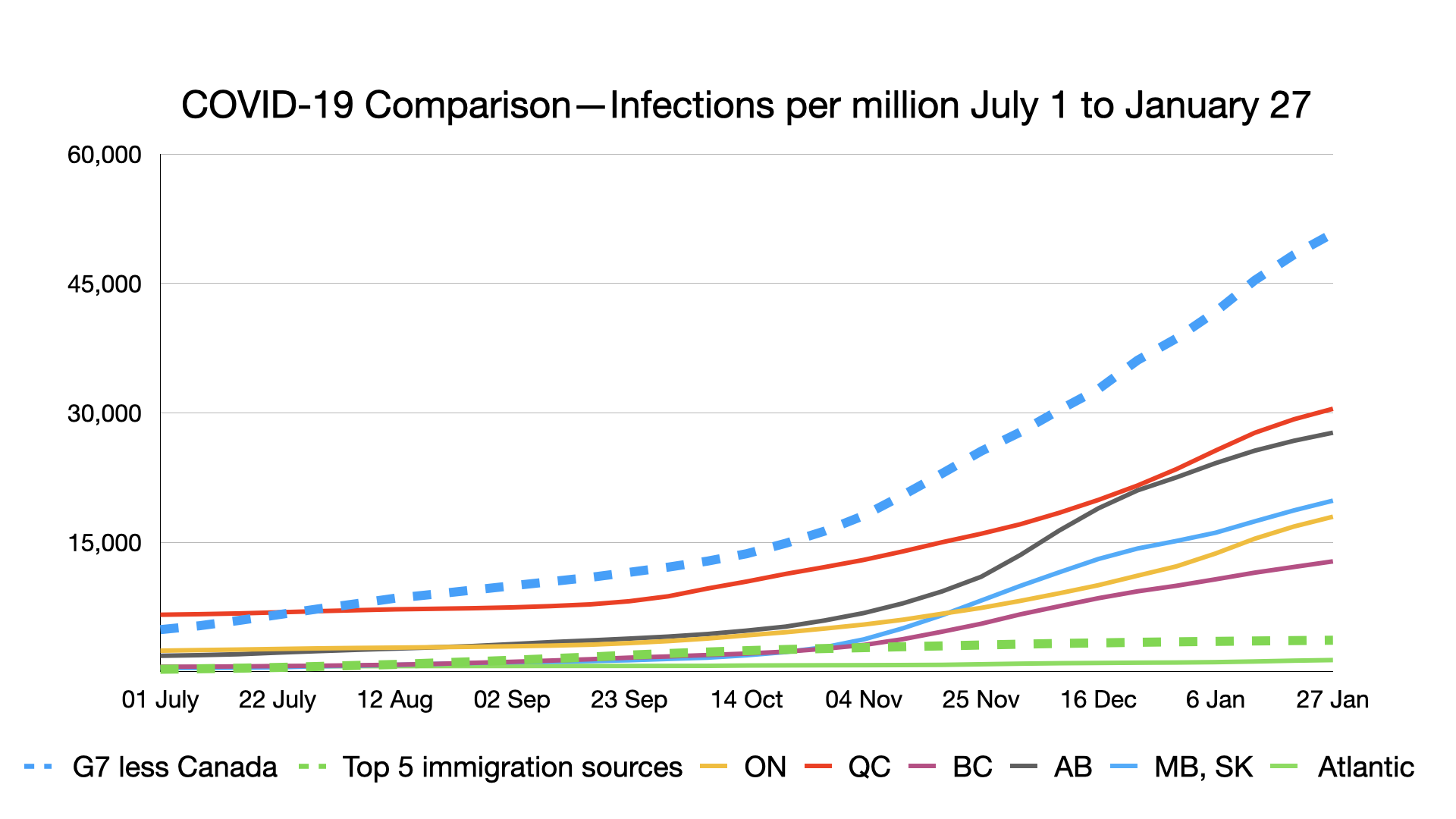
#COVID-19: Comparing provinces with other countries 27 January Update

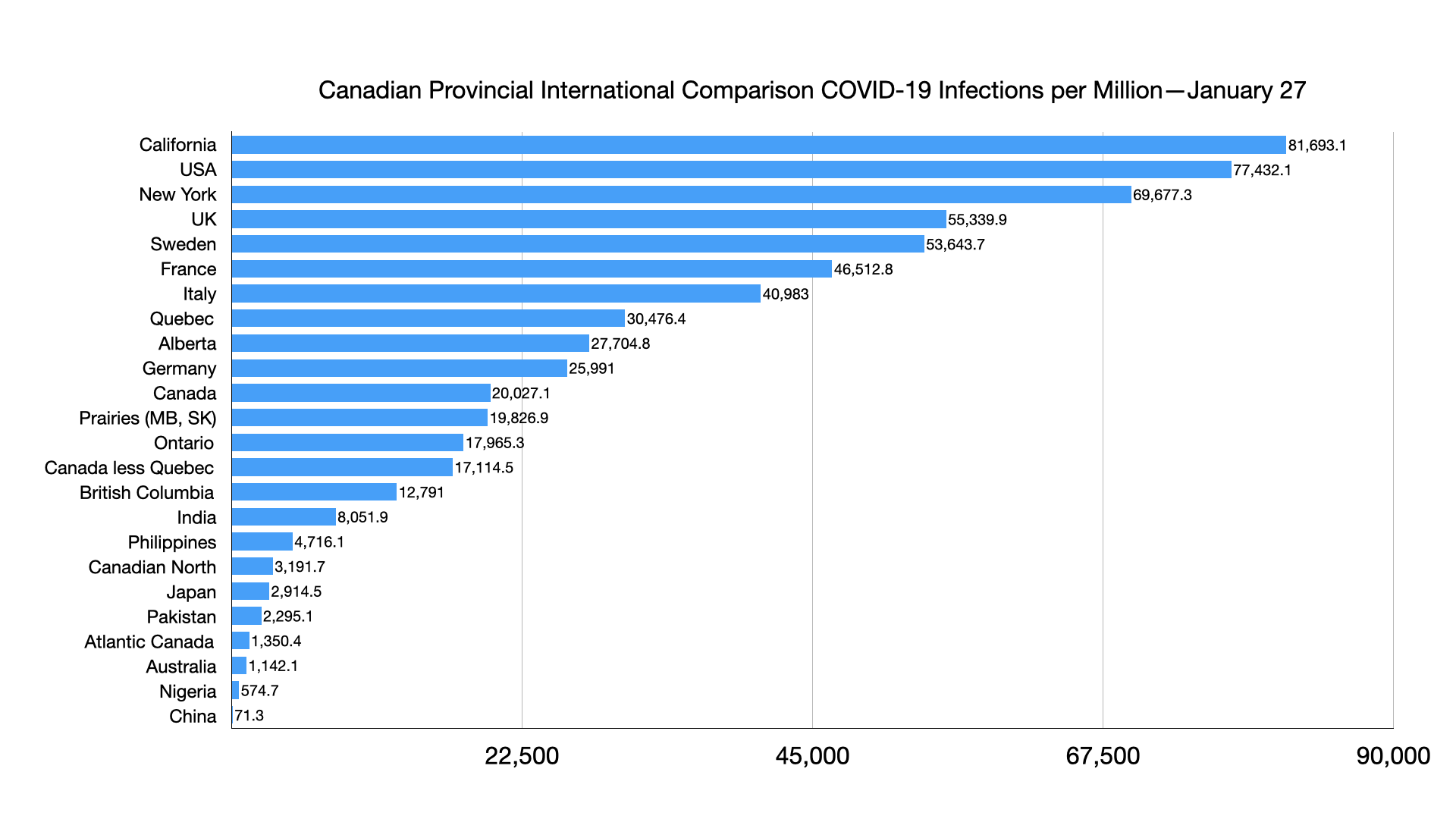
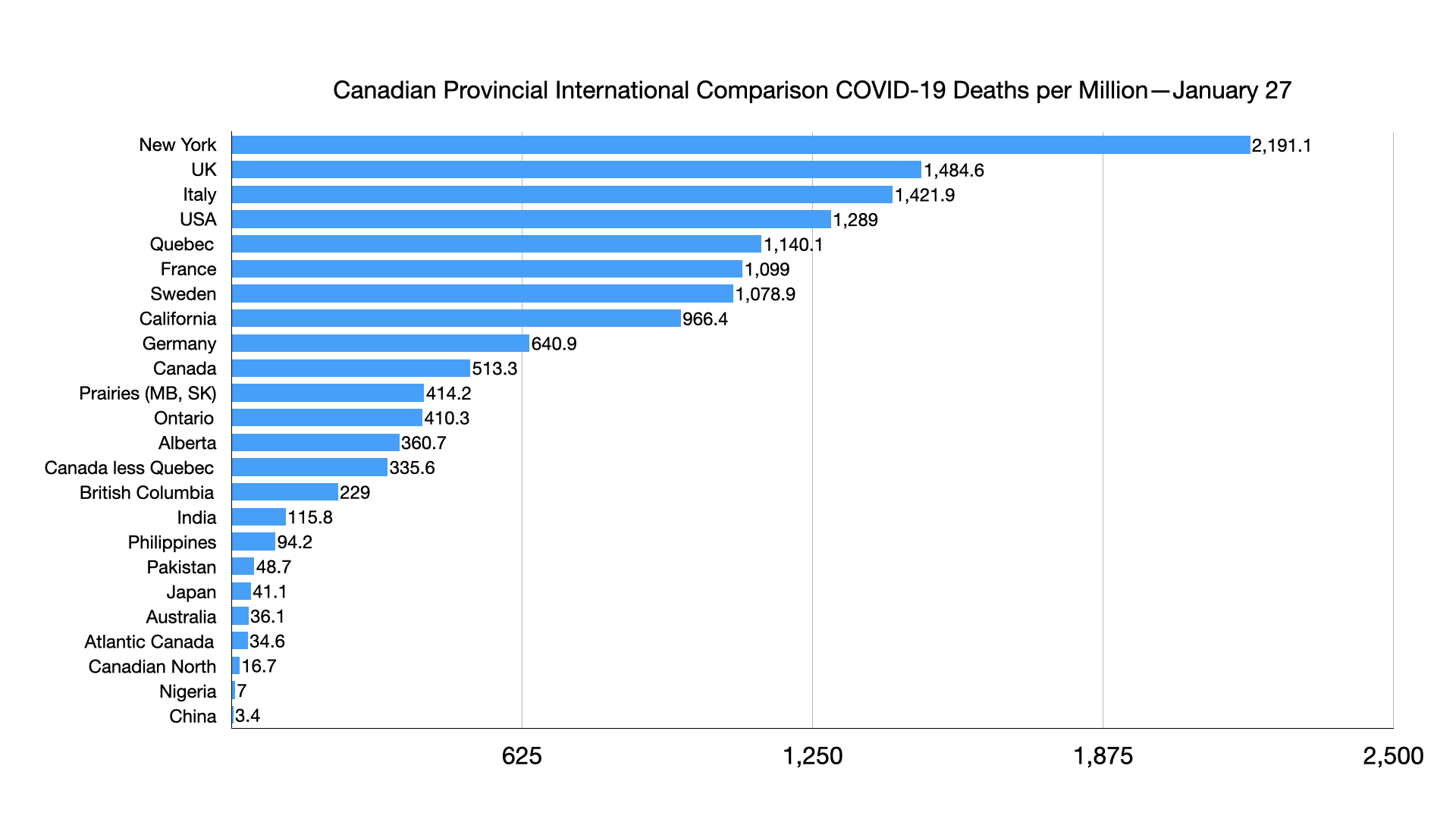
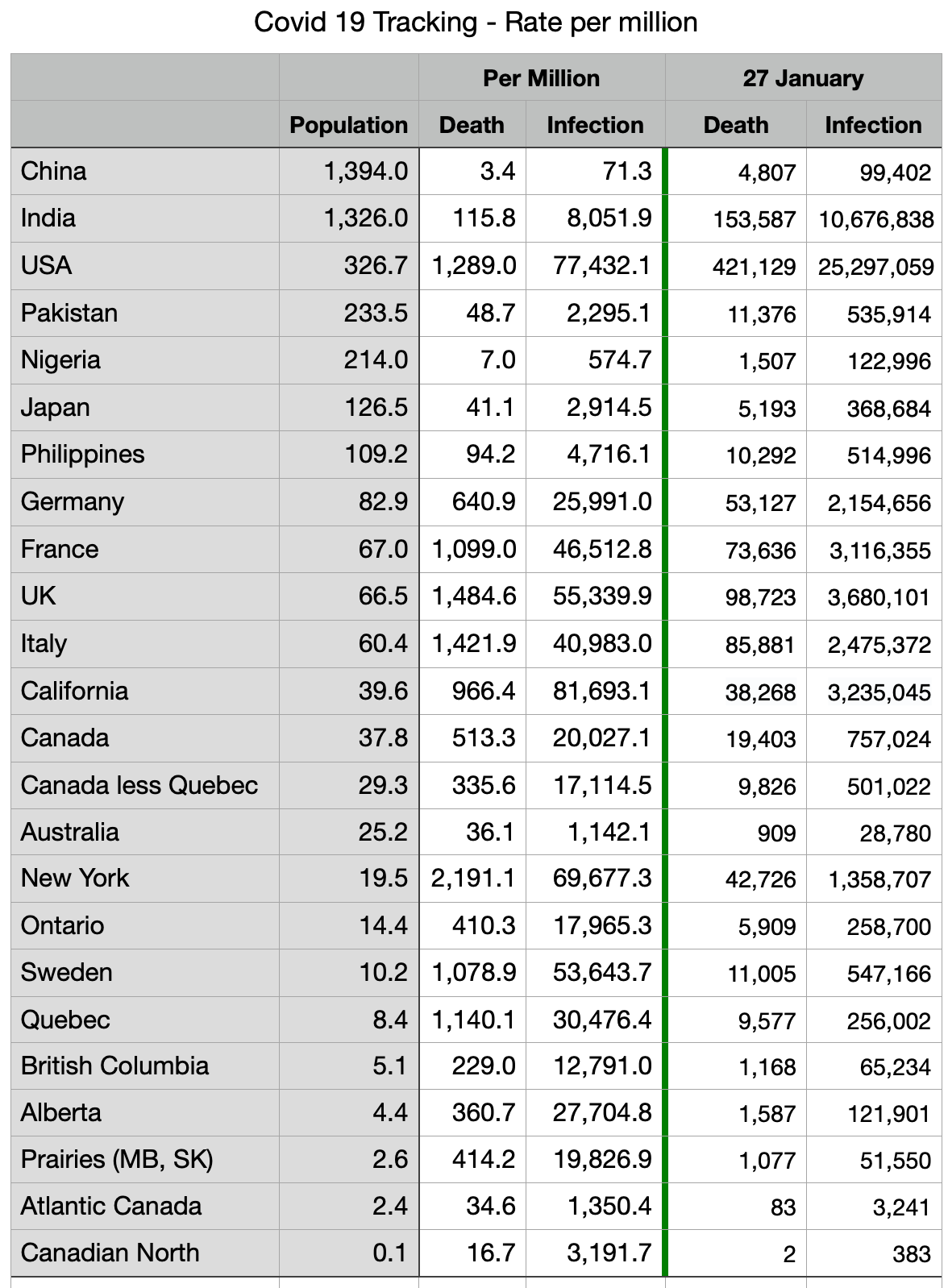
The latest charts, compiled 27 January.

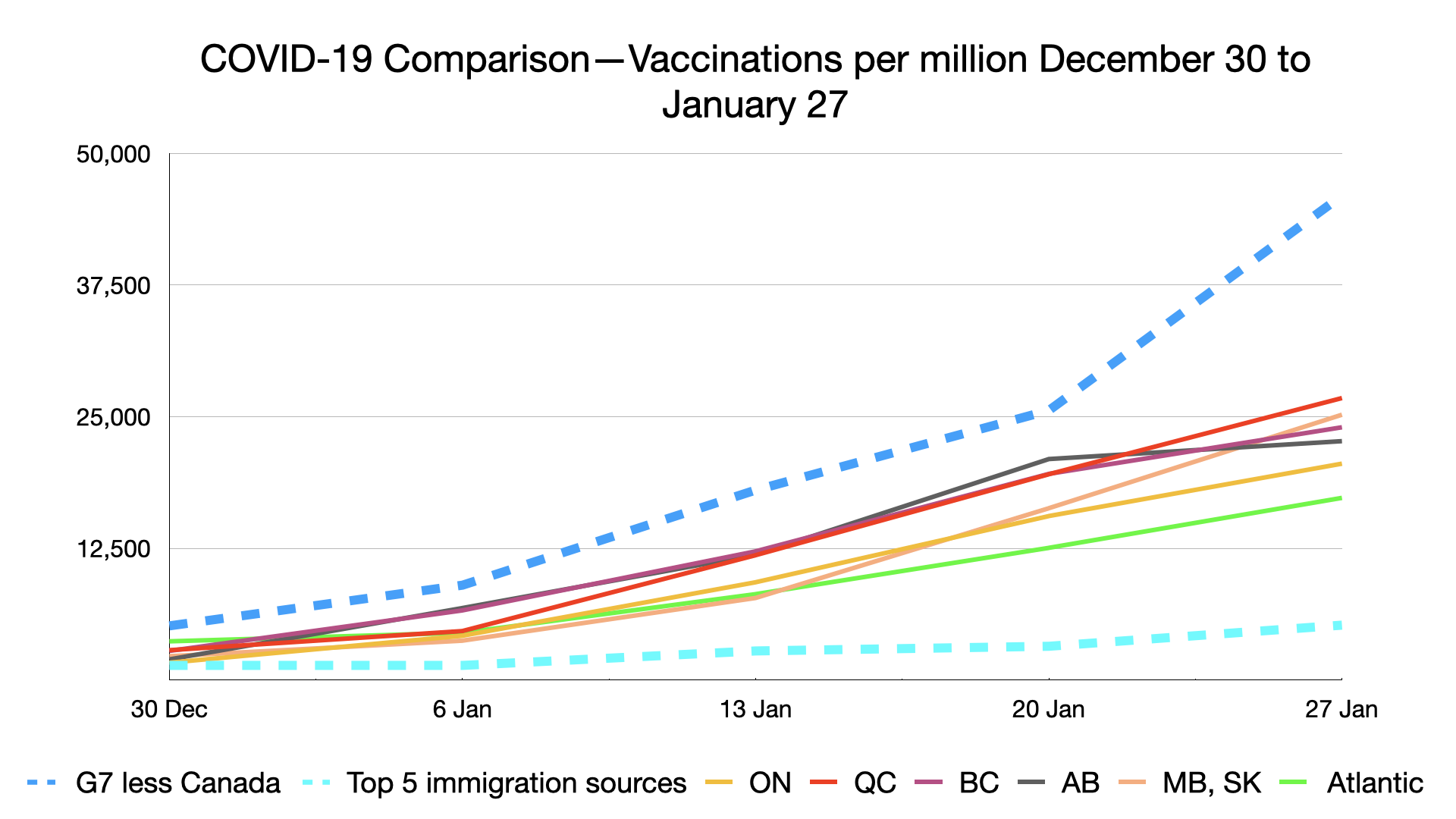
Vaccinations: The gap between the leading G7 countries (UK, USA) and Canada is growing but Canadian provinces still appear to be in the middle of the pack compared to other G7 countries (Japan has not started vaccination). Vaccination rates are the highest, reflecting the small population. We should start to see the impact of the pause in Pfizer deliveries in next week’s update.

Trendline charts

Infections: Alberta no longer closing in on Quebec

Deaths per million: G7 closing in on Quebec

Vaccinations

Weekly

Infections per million: No change in relative ranking from last week.

Deaths per million: UK ahead of Italy, Japan ahead of Australia and Atlantic Canada.

Trudeau government considers legislative changes to make public service more diverse

Of note. The most significant aspects IMO are:

  • ongoing improvements in data (the disaggregated data for visible minorities, Indigenous peoples and persons with disabilities is incredibly useful);
  • the push for increased diversity among executives is buttressed by the DM performance commitment on diversity and inclusion;
  • review of the Employment Equity Act and representation benchmarks (review of the Act will likely generate some debate from all quarters although it’s approach of self-identification and annual reporting has resulted in increased in ongoing increased representation of the EE groups);
  • Review of the Public Service Employment Act and possible amendments to reduce systemic barriers (unclear what that will entail): and,
  • It remains to see how effective the various consultation and related initiatives such as the Centre for Diversity and Inclusion will be in affecting change.

For my analysis of disaggregated data see my What new disaggregated data tells us about federal public service … and What the Public Service Employee Survey breakdowns of visible minority and other groups tell us about diversity and inclusion:

The Trudeau Liberals are eyeing changes to the law governing public service hiring to help make federal departments and agencies more diverse.

They also plan to do further research on the makeup of the federal public service and will try to hire more senior leaders with varied backgrounds.

Treasury Board President Jean-Yves Duclos and his parliamentary secretary, Greg Fergus, are spelling out the priorities today to foster greater diversity, inclusion and accessibility in the public service.

The government says while there has been some progress for Black Canadians, Indigenous Peoples and others who face racial discrimination in the workplace, too many public servants continue to face obstacles.

The Treasury Board Secretariat has begun discussions about the framework for recruitment in the public service and is specifically looking at “possible amendments” to the Public Service Employment Act.

The act is intended to ensure federal hiring is fair, transparent and representative.

The move would complement a review of the Employment Equity Act planned by Labour Minister Filomena Tassi.

The government recently released data that provides more detail about the composition of the public service.

Duclos and Fergus say the annual public service employee survey will help the government identify more precisely where gaps remain and what is needed to improve representation.

The government plans to increase diversity through promotion and recruitment, including introduction of the Mentorship Plus Program to allow departments to offer mentoring and sponsorship opportunities to high-potential employees who might currently face barriers.

The government says although progress will take time, the public service can be a model of inclusion for employers across the country and around the world.

“In time, we will build a public service that is the true reflection of our pluralism and diversity,” Duclos said in a statement.

Just last week, Privy Council Clerk Ian Shugart issued a call to action on anti-racism, equity and inclusion in the public service, setting out federal expectations for current leaders.

The government has also launched the Centre for Diversity and Inclusion, supported by a budget of $12 million, to create an ongoing discussion about change.

“There is much to do before all public servants can feel they truly belong in a public service that values inclusiveness and differences,” Fergus said.

“Outlining these key areas of focus is a key step in taking concrete action.”

Source: Trudeau government considers legislative changes to make public service more diverse

And the TBS announcement of the government’s strategy of January 26:

The public service has long made diversity and inclusion a core value and continuously reflects on the treatment of Black Canadians, Indigenous Peoples, and other individuals who face racial discrimination and other barriers in the workplace, and who are often underrepresented at the most senior levels of the public service. While there has been progress, too many public servants continue to face obstacles. It is time to close the gaps and eliminate the barriers that remain, ensuring the public service is truly representative of the people it serves.

The President of the Treasury Board, the Honourable Jean-Yves Duclos, along with Greg Fergus, Parliamentary Secretary to the President of the Treasury Board, has announced the government’s priorities to foster greater diversity, inclusion and accessibility in the public service. Among these efforts, there are several key initiatives:

Generating and publishing data for a more accurate picture of representation gaps

Already, the government has released disaggregated datasets, providing first‑ever views into the composition of public service employees who self‑identify in Employment Equity sub-groups, such as Black or Métis for example.

The annual Public Service Employee Survey, now underway, will generate data and insights to better understand the workforce at even more detailed levels. The results will help us identify more precisely, in particular demographic or occupational groups for instance, where gaps remain and what actions are required to improve representation. 

Increasing the diversity of the senior leaders of the public service

Departments, supported by the Treasury Board Secretariat, will work to increase diversity among senior leaders of the public service and establish a culture of inclusiveness that will combat racism and address systemic barriers. This includes increasing representation through promotion and recruitment and the introduction of the Mentorship Plus Program to allow departments to offer mentoring and sponsorship opportunities to high-potential employees who may currently face barriers. 

Ensuring appropriate benchmarks

The Treasury Board Secretariat will continue to work closely with partners, which includes supporting Employment and Social Development Canada on the review of the Employment Equity Act, to ensure that the public service applies appropriate benchmarks for diversity. 

Addressing systemic barriers

The Treasury Board Secretariat has initiated discussions with key stakeholders about the framework for recruitment in the public service and is specifically looking at possible amendments to the Public Service Employment Act and to support the review the Employment Equity Act, planned by the Minister of Labour.  

In addition to these initiatives, on January 22, 2021, the Clerk of the Privy Council and Head of the Public Service, issued a Call to Action on anti-racism, equity and inclusion in the federal public service. The Call to Action sets out common expectations for leaders to take practical actions that will form the basis for meaningful change.

Engagement, and education will underpin all this work. To that end, the President of the Treasury Board and his Parliamentary Secretary held a roundtable last week with employee communities and stakeholder groups that continue to face barriers to representation and inclusion. And the Government of Canada recently launched the Centre for Diversity and Inclusion. The Centre, supported by a budget of $12M outlined in the 2020 Fall Economic Statement, will co-develop initiatives with these communities, leveraging the lived experiences of public servants to foster an ongoing dialogue for positive change. At the same time, the Canada School of Public Service is refreshing its diversity and inclusion curriculum and has launched an Anti-Racism Event Series.

Progress will take time. But concrete steps in these areas will bring the public service closer to its goal: to be more reflective of Canada and a model of inclusion for employers across the country and around the world. 

Source: https://www.canada.ca/en/treasury-board-secretariat/news/2021/01/government-announces-priorities-for-action-to-increase-diversity-and-inclusion-in-the-public-service.html

Paikin: Multiculturalism at 50

Zach Paikin argues for a more externally focussed multiculturalism. Apart from his caricature of multiculturalism “celebration of diversity for diversity’s sake,” various governments have tried to use Canada’s diverse communities to advance Canadian interests with mixed success. And such engagement with all communities is needed and useful, it also runs the risk of becoming engaged in diaspora politics, as we see with respect, for example, Canadian Sikhs or Canadian Jews:

This year marks a half-century since Pierre Trudeau announced Canada’s policy of multiculturalism in the House of Commons in 1971. Much has changed in Canada and the world since then. So, too, should multiculturalism’s place and purpose in our national make-up.

Stephen Marche, writing for Open Canada in 2018, explains what makes Canadian multiculturalism unique: In contrast with societies throughout history that have encouraged cultural openness “to find unity, a common humanity, or even a larger truth,” the purpose of multiculturalism in Canada is “diversity for its own sake. Differences are to be respected, not overcome.” Yet the adoption of multiculturalism was not merely about the ideal of ethnic tolerance. Given the political context in which Canada found itself 50 years ago, it was also a policy with pragmatic and strategic aims.

Increasingly, the strategic rationale that initially underpinned Canadian multiculturalism appears outdated, challenged by the arrival of a post-American world and the shift of global power toward Asia. If it is to retain its purpose as a vehicle for advancing the country’s national interests, multiculturalism in Canada must become more than just a celebration of diversity for diversity’s sake. Rather, Canada’s political leadership should reconceive multiculturalism as a core instrument of national strategy aimed at growing our population, increasing our international clout and rebalancing Canadian foreign policy to reduce our current overdependence on the United States.

*  * *

When first enacted, multiculturalism allowed Canada to advance two core aims: secure national unity and develop a distinct identity from the United States. These goals have been mutually reinforcing throughout Canadian history. Canada was founded as a political project bringing togetherconservative British Loyalists and French Catholics in opposition to the liberal universalism expressed by its southern neighbour. Multiculturalism built on both objectives. By promoting the notion that cultural minorities should be accommodated, it fostered a pan-Canadian framework for addressing Quebec’s grievances. It also articulated an image of Canadian society as a “mosaic” — a clear contrast to the American “melting pot.” Yet if these remain the two metrics by which to judge multiculturalism’s effectiveness, then its continued usefulness could be in doubt.

The demographic and economic rise of Western Canada has gradually shifted the structure of Canadian federalism away from its 19th-century, Laurentian-centric compromise of “two founding peoples.” Taking its place is a heavily decentralized federation featuring a system of competing regionalisms. While multiculturalism may still hold a privileged place in the social fabric of the country’s English-speaking provinces, its role in advancing national unity has waned given the nature of Canada’s new political cleavages.

Perhaps more importantly, Canada has become more Americanized in recent decades, not less. The 1990s saw the advent of continental free trade, along with a U.S.-led effort to expand the liberal international order beyond the western Cold War bloc. In both economic and ideological terms, Canada’s dependence on its southern neighbour deepened. The 9/11 attacks reinforced this trend, forcing Ottawa to focus even more vigorously on how to maintain access to the U.S. market at a time when Washington’s pursuit of global hegemony was sharpening through the George W. Bush administration’s “war on terror” and “freedom agenda.” Today, the growth of protectionist impulses within both major U.S. political parties will continue to pull our focus southward, even as the increasingly multipolar character of world politics suggests that our attention should be directed elsewhere.

This process of Americanization has coincided with a period of decline in Canadian foreign policy. Perceived as too close to the United States and not invested enough in key components of multilateralism, Canada has lost not one but two consecutive bids for a UN Security Council seat, even as fellow G7 countries Germany, Japan and Italy continue to serve as non-permanent members with regularity. Relations with major players in some of the world’s most strategically relevant regions — China, Russia, India, Iran, Saudi Arabia and even the U.S. itself — have reached new lows under governments of both stripes. This almost exclusive foreign policy focus on the U.S. border was epitomized in a 2018 episode when Chrystia Freeland — then serving as foreign affairs minister, not minister of international trade — postponed her speech before the UN General Assembly to pursue NAFTA renegotiation talks with Washington.

It is perhaps not coincidental that the past two decades have also been accompanied by the abandonment of Canada’s traditional national unity debates, or by a six-election-long stretch dating back to 2000 in which no federal political party has managed to rally more than 40 percent of the voting electorate behind it. Rather than pursue the lofty but crucial mission of reimagining the future of Canada’s national community, governments have focused on the managerial and mundane task of tending to the continental trading relationship.

As Canada’s interests on the world stage have come to rest disproportionately on the preservation of a stable trading relationship with its southern neighbour, Ottawa’s pronouncements concerning the rest of the world increasingly centre on partisan discourses directed at a domestic audience. This trend began in earnest under Stephen Harper, whose Conservative Party had the targeting of ethnocultural groups for electoral purposes down to a science. It has continued during Justin Trudeau’s tenure, exemplified by Canada’s ill-timed bid for a UN Security Council seat that was aimed more at strengthening the Liberal narrative that Canada was “back” as a multilateral powerhouse than advancing a long-term, non-partisan national aspiration. (Disclosure: I served on that bid in a minor capacity as a speechwriting consultant.) The recent appointment of Marc Garneau as Trudeau’s fourth minister of foreign affairs in just over five years (and Canada’s 14th since 2000) reflects the fact that the position has become more about domestic politics than actually crafting foreign policy. Co-opting foreign policy into a partisan struggle over national identity makes it difficult to assess Canada’s interests consistently, objectively and as ends worthy of being pursued in themselves.

Over the past half-century, Canada has succeeded in fostering internaldiversity: welcoming the world within our borders to create a cultural mosaic, yet with the aim of building a society converging around a single set of principles and values. This goal reflected the aspirations of Canada’s population at the time of multiculturalism’s adoption. Canada’s initial settlers from France and the British Isles, as well as subsequent immigrant communities such as Jews, Italians, Germans and Ukrainians, had all left the Old World behind in search of a new beginning. By contrast, today’s immigrant communities — hailing largely but not exclusively from East, South and West Asia — are more cosmopolitan. They are, to a far greater extent than previous generations of newcomers, “at home in the world,” often retaining strong personal and cultural connections to their countries of origin.

Canada’s pursuit of multiculturalism must adapt to new strategic imperatives and the country’s changing ethnic composition. In an increasingly Asia-centric world, this requires Canada to embrace externaldiversity: marshalling the focus of its diverse population outwards, with the goal of securing a more substantive place in a politically and intellectually diverse Asian region.

For the bulk of the Cold War following the development of intercontinental ballistic missiles, as well as in the immediate post-Cold War years that featured unrivalled American hegemony, a special relationship with Washington and geographic isolation from the rest of the world served as the guarantors of Canadian security. By contrast, in a post-American world framed increasingly by great power conflict, Canadian and American interests are likely to diverge in important ways. In particular, the deterioration of Sino-American relations, now verging on a cold war, threatens the rules-based order and open global trading system on which Canada relies to assert itself as a sovereign international decision-maker. In this context, the struggle for an independent Canadian identity and role in the world will increasingly take place on the world stage rather than at home.

Given the threat posed by the U.S.-China rivalry to Canadian interests, the challenge for Ottawa will be to craft a role for itself as an autonomous, respected and engaged player in Asian affairs. This will require deep, consistent and sustained partnerships with all regional players and a long-term national strategy that transcends partisan politics. It will also necessitate a more active and independent Canadian role in shaping regional trade and security architecture. This does not imply neutrality between the United States and its rivals, merely greater equilibrium in Canadian foreign policy that prioritizes Canada’s unique interests.

In particular, the absence of the United States and India from the region’s two leading trade blocs — the Comprehensive and Progressive Agreement for Trans-Pacific Partnership (CPTPP) and the Regional Comprehensive Economic Partnership — presents an opening for Canada to assert its presence in Asia. Canada’s position as the second-largest economy in the CPTPP leaves it well placed to spearhead efforts to explore ways of harmonizing the two groupings, perhaps along with the Russian-backed Eurasian Economic Union (EAEU). This could reduce the potential for friction to emerge between rival regional orders — a dynamic that came with dire consequences last decade when Ukraine was forced to choose between moving toward the European Union’s regulatory orbit or aligning itself with the EAEU.

Multiculturalism will continue to provide Canada with the right framework for integrating a diverse range of newcomers in a peaceful fashion, growing its population to a point where it can play a more substantive role in securing its national interests and international peace. But a shifting international order requires that Canada adjust its understanding of multiculturalism from an inward-focused value to celebrate to an outward-focused cause to rally around. Much as the 19th-century risorgimentocreated Italy but not Italians, multiculturalism created Canada out of the ashes of British North America. But what it means to be Canadian beyond being a “kinder, gentler version of the United States” — in other words, not American, but like America — remains unresolved.

Marche’s essay laments that multiculturalism has thus far proven too “polite” and orf“hesitant” to produce an “art of respectful difference,” contrasting with beautiful artistic forms such as jazz that emerged from the “insistence of personhood” in more unjust societies. Increasing Canada’s international clout in the world’s central strategic theatre will indeed require Ottawa to navigate a region rife with moral ambiguity. Yet if Canada emerges from the coming decades as a leading international player in its own right, unrivalled in the uniqueness of its multicultural social fabric, then it will possess the heft, respect and visibility necessary to contribute to the debate over the nature of justice and tolerance in a diverse world. Perhaps, at that point, Canada itself would embody the art of respectful difference.

Source: Multiculturalism at 50

Thirty-nine words about antisemitism are splitting the Jewish community

Of note:

There’s a storm brewing in the American Jewish community over a definition of antisemitism that appears, upon first glance, quite banal.

“Antisemitism,” it reads in part, “is a certain perception of Jews, which may be expressed as hatred toward Jews.”

But the language, adopted by the International Holocaust Remembrance Alliance in 2016, comes packaged with a host of examples that describe various criticism of Israel as antisemitic. As much of the Jewish establishment makes federal adoption of the IHRA definition a top priority for the Biden administration, it has become a proxy for a wider rift in the Jewish community over the politicization of antisemitism.“These are not people I trust to go after antisemitism.”

“The Jewish community is pushing this because they see it as a tool that they want to use to stop certain speech they don’t like,” said Ken Stern, director of the Bard Center for the Study of Hate, who helped draft the language on which the IHRA definition is based.

“I can’t totally speak to their intent,” Morriah Kaplan, strategic director at IfNotNow, which is focused on opposing the Israeli occupation, said of the organizations backing the definition, “but these are not people I trust to go after antisemitism.”

The Conference of Presidents, established in the 1950s to give American Jews a unified voice to communicate with the White House and world leaders, sent a letter on Jan. 12 to now-President Joe Biden urging him to use the IHRA definition to combat antisemitism on campuses.

But that letter was only signed by five member-groups and it is unclear how many of the 51 organizations that joined the Tuesday conference statement also support the call for Biden to use it.

In fact, several conference members had joined a competing Jan. 12 statement by the Progressive Israel Network, which cited “strong potential for misuse” of the definition. The Reform movement, the largest Jewish denomination in North America, announced Monday that it had adopted the IHRA definition but simultaneously opposed codifying the language in federal law. Bend the Arc, a major liberal Jewish group, also came out against government use of the definition late Monday.

The White House did not respond to a request for comment about whether Biden supports use of the IHRA definition.

Identifying the threat

As the establishment groups ramp up their lobbying for federal adoption of the definition, IfNotNow and Jewish Voice for Peace, another left-wing activist group, plan to launch lobbying and educational campaigns to oppose the definition in the coming months.

Kaplan, with IfNotNow, and others on the left argue that after four years of the Trump administration, during which the antisemitic far-right gained new power, the most urgent threat to the Jewish community clearly comes from violent white nationalists.

Public opinion polls suggest that most American Jews agree: 75% said in an American Jewish Committee survey last year that the political right posed a serious antisemitic threat, compared to 32% who said the same about the political left.

Yet many mainstream groups continue to emphasize a need to fight antisemitism across the political spectrum. And the antisemitism that Jewish leaders call out on the left almost always refers to attacks on Israel that they believe cross a line. The IHRA definition, they say, helps clarify that line.“Nobody has a problem of defining antisemitism if it’s waving Nazi flags.”

“Nobody has a problem of defining antisemitism if it’s waving Nazi flags,” said Abe Foxman, the former director of the Anti-Defamation League. “The definition deals with a lot subtler issues of what antisemitism is, which today unfortunately includes attacking Israel’s existence.”

Foxman said the IHRA language can be used to deal with all forms of antisemitism, but critics say those promoting the definition are doing so at the expense of focusing on right-wing extremists.

They point to a November memo to Biden’s transition team from the Jewish Federations of North America outlining the organization’s priorities for fighting antisemitism. The document listed ISIS and Al Qaeda as threats to American Jews, but did not name right-wing antisemitism. Sandwiched between increased security grants and Holocaust education was promotion of the IHRA definition.

More outrage came following the Conference of Presidents letter, sent six days after a right-wing mob ginned up on antisemitic conspiracy theories stormed the U.S. Capitol.

“To go forward with a letter to Biden saying that college students advocating for Palestinian freedom are the greatest threat to American Jews was truly unconscionable to me,” said Rabbi Alissa Wise, deputy director of Jewish Voice for Peace, which is anti-Zionist and supports the BDS Movement.

Source: http://click1.e.forward.com/xsrkkdjvvqrtqqmktpblmtslydtpbbdbrlpqdjcpcjvdp_tzwbplvvklcllccbzww.html?a=Daily+Newsletter+USE+THIS+ONE&b=01%2F26%2F2021

John Baird, Nigel Wright head up new group to organize right-leaning Canadians abroad

Of note. Canadian political parties to date have been inactive compared to the parties of other countries where expatriate voting rights have been longstanding such as the US and UK:

A new group headed by some prominent Conservatives aims to mobilize right-leaning Canadians living overseas — and marks a changed attitude toward longtime expat voters after the Supreme Court of Canada significantly expanded their voting rights.

“It’s one of the last truly untapped areas of the electorate,” John Baird, former Conservative cabinet minister, told the National Post. Baird is the honorary president for the new group, called Canadian Conservatives Abroad (CCA).

Baird said expats “overwhelmingly” don’t vote in elections, and noted the estimated three million Canadians living abroad is equivalent to about 30 electoral ridings. About 20,000 expat voters were registered ahead of the 2019 election.

The push to form the group is in part motivated by a 2019 Supreme Court decision that ruled it was unconstitutional to bar Canadian citizens from voting if they’ve lived outside Canada longer than five years. That prohibition had been in place since 1993 (though sometimes enforced loosely), but the Liberal government lifted it with Bill C-76 in 2018.

Under Prime Minister Stephen Harper, the Conservatives fought against allowing longtime expats to vote and cracked down on the practice, alleging people were using loopholes to get around the five-year rule. Embracing the expat vote is somewhat of an about-face, but it’s also a recognition that the prohibition isn’t coming back and the Conservatives are missing an opportunity by not organizing among this population.

The CCA will be modelled after similar organizations for Americans (Republicans Overseas), Britons (Conservatives Abroad) and Australians (Australian Liberals Abroad). Democrats Abroad, which organizes overseas for the U.S. Democratic Party, is another well-known example.

Nigel Wright, a former chief of staff to Harper, will chair the CCA’s executive committee. The group is based in London and the leadership team includes Conservatives spread around the world, according to a news release.

The CCA will operate independently of political parties, but look for supporters of both federal and provincial conservative parties. “We’re starting with a solid base in the U.S., U.K., the Middle East and Asia,” Wright said in a statement.

Baird said he expects the CCA will be primarily focused on voter education, mobilization and assistance with administrative hurdles, but it will also organize virtual events and other forms of networking for overseas Conservatives. Another goal is to help drive Canadian policy discussions on global affairs from a right-wing perspective.

“We’re a group of volunteers that are just getting started, so we’ll see what form it takes,” Baird said. “It’s an exciting opportunity.”

The CCA’s first event will be a discussion on the establishment of a “CANZUK” alliance between Canada, Australia, New Zealand and the United Kingdom that would aim to coordinate matters of migration, education, free trade and foreign policy between the countries. The event will be held to coincide with the upcoming Conservative policy convention in March.

Source: https://nationalpost.com/news/politics/john-baird-nigel-wright-head-up-new-group-to-organize-right-leaning-canadians-abroad