Striking that the government and Minister continue to maintain the current plan to accept some 400,000 immigrants this year, despite the ongoing pandemic and travel restrictions, unlikely to ease up quickly until most Canadians are vaccinated late summer or early fall.
Even if the government could meet this target level, highly questionable given that immigrants who arrive during downturns and recessions don’t do as well in the short-term, with some also not doing well in the longer term.
Citizenship, as always, remains a lessor priority for IRCC. While the government has tabled a bill to revise the citizenship oath, the new citizenship guide remains in limbo despite having been announced five years ago (and largely complete according to earlier press reports), and the 2019 commitment to eliminate the fees should have been relatively straightforward to implement quickly:
Canada’s Immigration Minister Marco Mendicino recently shared fresh insights on the state of the country’s immigration system on the Canadian television show, The Agenda.
In a 20-minute interview, Mendicino spoke on a broad range of immigration topics as he explained to viewers how the federal government aims to cope with the ongoing impacts of COVID-19.
Topics he discussed included:
Immigration Levels Plan 2021-2023
Canadian citizenship
Municipal Nominee Program
Immigration Levels Plan 2021-2023
Mendicino stated that the Canadian government had a choice to make following the outbreak of the pandemic. It could pause or reduce immigration. Instead, the country has chosen to welcome immigrants during and after the pandemic to support its prosperity. As such, Canada is aiming to welcome over 400,000 immigrants over the coming years which are the highest targets in its history. Mendicino said this is necessary since immigrants are key to job creation in Canada and also help fill vital labour market needs including in essential services.
Mendicino’s vision for the immigration system is for all processes to be virtual and contactless beyond the pandemic.
One of the priorities listed in Mendicino’s December 2019 mandate letter is to waive Canadian citizenship fees. Asked about the status of that pledge, Mendicino acknowledged he had hoped to make progress on this front by now. While he did not state this, the delay in fulfilling this promise is very likely a function of the pandemic. Mendicino said that he is enthusiastic about reducing barriers for newcomers and will have more to say on this issue in the future.
Municipal Nominee Program
Another one of the December 2019 mandate priorities is to launch a Municipal Nominee Program to further help encourage immigrants to settle in Canada’s smaller cities. Pointing to initiatives such as the Atlantic Immigration Pilot and Rural and Northern Immigration Pilot, the minister said he believes the MNP will be another federal program that will allow newcomers to pursue fulfilling lives in smaller regions of Canada. IRCC is in the process of consulting with provincial, municipal, business, and other stakeholders on the design of the MNP.
One of the key takeaways of Mendicino’s interview is his assuredness that Canada’s current immigration targets are realistic. This strongly suggests IRCC has a plan in place to achieve the targets, which will likely be through a combination of tapping into the existing pool of immigration candidates with Canadian experience, continuing to select immigrants from abroad and processing their applications so they can arrive after the pandemic, as well as gradually reducing travel restrictions so that those with approvals will eventually be able to move to Canada.
President Trump entered the White House with the goal of reducing legal immigration by 63 percent. Trump was wildly successful in reducing legal immigration. By November 2020, the Trump administration reduced the number of green cards issued to people abroad by at least 418,453 and the number of non‐immigrant visas by at least 11,178,668 during his first term through November 2020. President Trump also entered the White House with the goal of eliminating illegal immigration but Trump oversaw a virtual collapse in interior immigration enforcement and the stabilization of the illegal immigrant population. Thus, Trump succeeded in reduce legal immigration and failed to eliminate illegal immigration.
Figure 1 shows the monthly number of green cards issued to immigrants outside of the United States. In most years, about half of all green cards are issued to immigrants who already reside in the United States on another visa. Thus, the number of green cards issued to immigrants abroad is a better metric of the annual inflow of lawful permanent residents than the total number issued. Trump cut the average number of monthly green cards issued by 18.2 percent relative to Obama’s second term, but that average monthly decline hides the virtual end of legal immigration from April 2020 onward.
In response to the recession and the COVID-19 outbreak, President Trump virtually ended the issuance of green cards to people abroad. In the last 6 months of the 2020 fiscal year (April‐September 2020) the U.S. government only issued about 29,000 green cards. In the same period in 2016, the U.S. government issued approximately 309,000 green cards. Compared to the last half of FY2016, the number of green cards issued in the last half of FY2020 fell by 90.5 percent (please see note at the end of this blog post for how I estimated these figures).
Before the COVID-19 pandemic during the period from January 2017‐February 2020, the average number of green cards issued per month was only down about 0.5 percent under Trump compared to from January 2013‐February 2016 under the Obama administration with cumulative numbers down just over 3.2 percent. Beginning in mid‐to‐late March, the Trump administration virtually halted the issuance of green cards to people abroad. Without the COVID-19 immigration restrictions unilaterally imposed by the President, the issuance of green cards to foreigners abroad would have barely declined relative to the second term of the Obama administration.
Figure 2 shows the monthly number of non‐immigrant visas (NIVs) issued abroad. NIVs include tourist visas, work visas, student visas, and others that do not allow the migrant to naturalize. Trump cut the monthly average number of NIVs by about 27 percent relative to Obama’s second term, but that decline obscures the virtual end of NIVs from April 2020 onward.
As with immigrant visas, President Trump virtually ended NIV issuance in response to the recession and the COVID-19 outbreak. In the last 6 months of the 2020 fiscal year (April‐September 2020) the U.S. government only issued 397,596 NIVs. In the same period in 2016, the U.S. government issued more than 5.6 million NIVs. Compared to the last half of FY2016, the number NIVs issued in the last half of FY2020 fell by almost 93 percent (please see note at the end of this blog post for how I estimated these figures).
Before the COVID-19 pandemic, during the period from January 2017‐February 2020, the average number of monthly NIVs issued was down about 12 percent under Trump compared to the January 2013‐February 2016 period under the Obama administration and the cumulative numbers were down by just over 14 percent. Beginning in mid‐to‐late March, the Trump administration virtually halted the issuance of NIVs to people abroad. The COVID‐19‐related restrictions were the most severe and impactful part of Trump’s immigration policy.
Looking at the decline in the number of visas issued abroad under Trump through November 2020 compared to the second term of the Obama administration, Trump reduced the number of green cards issued by approximately 418,453 green cards and the number of NIVs issued by about 11,178,668. That’s a roughly 18 percent decline in the number of green cards issued abroad and approximately a 28 percent decline in the number of NIVs issued during Trump’s only term relative to Obama’s second term.
From the more activist Chinese Canadians. Will be interesting to see the information that the forum collects on the backlash and related analysis:
Brad Lee is a fourth generation Chinese-Canadian man who was born in Calgary.
Yet, despite those strong ties to Canada, he still sometimes gets treated like an outsider because of his race — especially since COVID-19 came to Canada.
One instance Lee, a historian and consultant, talks about and that makes this point clear happened just before the first lockdowns in Ontario hit.
It was March of last year, while the coronavirus was spreading. Lee was sitting in a medical office waiting to do a routine test unrelated to COVID-19.
A white woman walked in with her son, Lee recounts, stared at Lee and said loudly while glaring at him: “You guys, you front-line workers are so brave. You never know who will walk in here.”
It was part of the backlash that people of Chinese and Asian descent in Canada and around the world have faced since the pandemic spread.
That’s why Lee, who is also a former Toronto Star editor, decided to launch the #FaceRace Campaign, a new online resource tool that explores the lived experiences of what it’s like to be Chinese during the pandemic.
#FaceRace includes links to stories about Chinese and Asian Canadians and the micro-aggressions, racist comments and outright attacks they regularly face, as well as racism they’ve experienced since COVID-19 hit.
The online resource also provides tips on what to do when faced with racism — “stay calm” is the first step recommended — and how to reply when someone makes a racist comment such as saying “Like you, I’m also stressed and hurting from this virus — but your racism is making it worse, for all of us” and “most Canadians aren’t racist. What’s your excuse?”
Members of the Chinese community are also encouraged on the website to continue building allies in the Black and Indigenous communities, whose members are fighting back against racial inequities as part of a worldwide movement sparked by the killing of George Floyd, a Black, man slain by a white police officer in the U.S. last year
The online forum is a joint project between the Chinese Canadian National Council for Social Justice (CCNC-SJ) and the Chinese and Southeast Asian Legal Clinic (CSALC), in partnership with other Canadian organizations. The project is funded by the Government of Canada.
Avvy Go, director of the Chinese and Southeast Asian Legal Clinic, says the most important point of the resource is that Canadians don’t understand the long history of Chinese and other Asian Canadians in this country.
“There’s a lot of hidden anti-Asian racism that has existed for a long time and not talked about and addressed in mainstream society. During times like this (COVID) it pops up in the open. COVID made this visible,” Go said.
She said the goal of the project is for Asian Canadians to confront racism.
“Very often Asian Canadians don’t want to talk about race or racism. They want to pretend it doesn’t happen to them,” she said.
Go also wants the issue out there so the federal government and other levels are moved to address anti-Asian racism.
Lee, the content developer of the online resource, says a major motivation for developing the tool kit is the fact that the coronavirus was “deeply racialized from the beginning in a way that is detrimental to my community.”
Reading all the reports about the backlash and the racism against Chinese people sparked by the coronavirus, Lee says he has felt “super disappointed, saddened and ashamed as a Canadian” — to see the attacks in Canada.
“I felt ashamed because we have these vaunted values of multiculturalism, diversity and appreciation for each other and yet the first reaction in Canada — likely out of fear — was racist blaming of Chinese (people).”
The history of Chinese Canadians is one of resilience, he goes on to say. In that vein, Lee says he wants #FaceRace to encourage Chinese people to speak up when faced with discrimination — whether or not it relates to COVID-19.
“Victims become more knowledgeable about racism than perpetrators ever will because the victims have to process what happened, think about it and figure out what to do about it.
“They have to speak out about it. Even if that means talking to a friend, they’re on the pathway to putting their victimhood behind them,” Lee says.
Noteworthy analysis although may be correlation as much as causation:
On June 22, 2020, President Trump issued an executive order(EO) significantly reducing the number of people eligible for non-immigrant work visas, arguing that due to high domestic unemployment during the pandemic, “the entry…of certain aliens as immigrants and nonimmigrants would be detrimental to the interests of the United States.” This new restriction barred nearly 200,000 highly-skilled international workers — many of whomhold advanced degrees in STEM fields, and on whom U.S. companies rely to fill key talent gaps — from entering the U.S.
As researchers who study immigration and geographic mobility, were interested in examining the immediate impact of this EO on business. To that end, we conducted a study in which we tracked changes in stock price for all publicly traded Fortune 500 companies in the U.S. (a total of 471 firms) in the aftermath of the EO. We found that immediately after the new policy was announced, these companies’ market valuations dropped by about 0.45% — representing a total loss of around $100 billion. Moreover, these companies’ stock prices remained below their pre-EO levels for at least 10 days after the announcement, suggesting that the losses we’d identified represented a significant impact, not a temporary blip.
In addition, our research also found that this negative impact was much more pronounced forthe295firms that had maintained or increased their reliance on foreign workers during the years prior to the EO (as measured by growth in each firm’s Labor Condition Application requests, a proxy for companies’ reliance on H-1B visa employees). Specifically, these companies experienced a drop in market valuation of 0.5-0.6%, while the companies whose reliance on foreign workers had decreased in recent years experienced a valuation drop of only 0.3% — meaning firms that relied more on foreign employees took almost twice as great a hit in the wake of the announcement. This suggests that the reductions in valuation we measured were in fact caused by the EO, rather than by other, unrelated economic disruptions (since other disruptions, such as the impact of the pandemic or political uncertainty, would presumably have affected all firms equally regardless of their reliance on foreign workers).
Our study was limited to the immediate aftermath of the EO, but our finding fits into a larger body of research suggesting that immigration restrictions can harm the U.S. economy in myriad ways. For example, one study reported that when firms hire fewer highly skilled immigrant workers, it actually leads them to hire fewer skilled workers overall, including both international and domestic employees. In addition, a comprehensive report from the National Academies of Sciences, Engineering, and Medicine found in 2016 that “there is little evidence that immigration significantly affects the overall employment levels of native-born workers.” The report went on to describe the value of immigrant labor in no uncertain terms, stating:
“The infusion by high-skilled immigration of human capital … has boosted the nation’s capacity for innovation and technological change. The contribution of immigrants to human and physical capital formation, entrepreneurship, and innovation are essential to long-run sustained economic growth. Innovation carried out by immigrants also has the potential to increase the productivity of natives, very likely raising economic growth per capita. In short, the prospects for long-run economic growth in the United States would be considerably dimmed without the contributions of high-skilled immigrants.”
The list of research-backed downsides to restricting immigration goes on and on. Studies have shown that policies restricting U.S. firms’ ability to hire global talent for highly skilled positions can have a long-term, negative impact on those companies’ profits, productivity, innovation, and growth. There is also robust evidence suggesting that when multinational firms are unable to hire immigrant talent for their U.S. offices, they often resort to offshoring their activities to other nations, ultimately reducing their domestic hiring rates. Another study, conducted by one of us (Prithwiraj Choudhury) and Do Yoon Kim, documented the role of skilled immigrant workers in transferring novel ideas from their home countries to the U.S. The study found that teams with both immigrant and domestic employees benefited from combining their diverse ideas, exhibiting greater levels of innovation than teams without immigrant members.
Yet another study, conducted by two of us (Prithwiraj Choudhury and Dany Bahar) as well as Hillel Rapoport, examined the impact of immigration on a country’s technological innovation, finding that countries with more immigrants who filed patents in a given specialization were significantly more likely to become globally competitive in that specialization. This suggests that the Trump administration’s restriction on the immigration of highly skilled workers could have a lasting negative impact on America’s global competitiveness, significantly reducing productivity and innovation and impeding the country’s post-pandemic economic recovery.
Especially in the midst of an economic crisis, the research clearly suggests that policymakers looking to support the American people should focus on easing — not increasing — human capital restrictions on businesses. Our study has shown that limiting firms’ ability to hire top global talent has an immediate negative impact on their valuations, adding yet another data point to the growing body of evidence demonstrating that restricting immigration to the U.S. harms the country’s economy and its citizens. We hope that these findings can inform the ongoing policy debate, and that they can inspire the incoming Biden administration to take a more productive approach to immigration policy in the months and years to come.
Of note (perhaps the USA could consider a similar initiative for those that disputed the election results in Congress and the Senate):
Germany’s Bundesamt für Verfassungsschutz, the Federal Office for the Protection of the Constitution, is constantly on the lookout for potential threats to Germany’s democratic constitutional system, and it has wide-ranging powers when it finds them.
“This agency has the power — and not only to do surveillance on fringe groups, domestic terrorist threats, but also to keep an eye on any political institution, like a political party,” said Melanie Amann of the German newsmagazine Der Spiegel and the author of a book about the Alternative for Germany, or AfD.
“Like if their program becomes more radical or if they notice that a political party, maybe that’s even sitting in the parliament, goes into a direction that might be harmful to our political system.”
The agency has wrapped up a two-year investigation into the Alternative for Germany, the country’s largest right-wing opposition party, and is expected to announce soon that it will place the entire party under surveillance for posing a threat to Germany’s political system and violating the constitution. The unprecedented move would mean that all AfD lawmakers, including several dozen in Germany’s parliament, would be put under state surveillance.
The driving force behind the creation of the Verfassungsschutz agency and its surveillance powers was the American-led Allied forces, who, after World War II, helped write a new German Constitution with an eye toward preventing the return of Nazi ideology. That’s why the first article of the constitution guarantees the right to human dignity — an article that the agency determined a far-right branch of the AfD violated. It placed that group, known as der Flügel (“The Wing”), under surveillance nearly a year ago.
Amann said the agency has identified instances of AfD politicians denigrating Muslim migrants to Germany. “They were all treated as potential terrorists,” she said. “They were dehumanized in the speeches. They were compared to animals. The [agency] report made it quite clear that these people had crossed a line.”
Some AfD politicians have also trivialized Germany’s Nazi past. Speaking at an AfD event in 2017, the leader of the Flügel wing, Bjorn Höcke, called the Holocaust Memorial in Berlin a “monument of shame.” A year later, AfD parliamentary leader Alexander Gauland likened Germany’s Nazi era to “a speck of bird s*** in more than 1,000 years of successful German history.”
“If you look at how the AfD has been behaving for some time now, it’s clear it’s acting against our democracy and our constitution,” said Social Democrat parliamentarian Thomas Hitschler, a member of the parliamentary committee that reviews Germany’s intelligence agencies. He said the Verfassungsschutz agency has spent two years gathering evidence to inform the decision that is expected to put the entire AfD under watch.
But AfD politician Georg Pazderski claims the process is political. The agency is run by Chancellor Angela Merkel’s government, staffed with members of her own conservative Christian Democratic Union party. Pazderski said the CDU is worried about how fast the AfD has become a presence in Germany’s parliament; the party now has 88 members of 709 in the Bundestag, more than 12% representation.
“If you have an opposition party which is very successful within a very short time, we become a danger for the ruling parties,” Pazderski said, “especially for the conservative CDU. And this is a reason why they are trying to stigmatize us and to really put us in the Nazi corner and also to spread strong rumors.”
Hitschler insists the process is not political and the agency’s findings must withstand tough legal scrutiny.
“Its decision must be so watertight legally that it will stand up in the courts,” he said. “The AfD has legal recourse to contest the decision, and the agency isn’t about to lose face in court with a poor case.”
The AfD is already preparing for the decision. This week, the party published a position paper that represents a U-turn in how it sees immigrants, insisting that it is a party for all Germans, even naturalized citizens.
AfD politician Jens Maier, already under surveillance for being part of the Flügel, told NPR by email that last year’s decision to put his section of the party under surveillance has had real consequences.
“A lot of members fear for their civil reputation or even their jobs, especially if they are employed in public service,” he wrote. “This is clearly an unfair method to lower the election results of the AfD.” Germany’s federal elections are scheduled for September.
Der Spiegel’s Amann says tightened surveillance on the AfD will affect civil servants such as police officers and military personnel, who may cancel their membership out of fear of losing their jobs.
While the Verfassungsschutz agency is able to tap phones and use informants to gather information on whomever it monitors, Maier said he hasn’t noticed the surveillance. But he said it has changed the way he and his associates communicate.
“We don’t talk about confidential topics on the phone or online anymore and people from the outside contacting us do so with care now, knowing that somebody is possibly listening,” he wrote.
When Germany announces the AfD is under surveillance, Pazderski said it can expect an immediate lawsuit challenging the decision. And that, he said, may take years to resolve.
Important and significant debate (moving towards the Canadian definition of integration):
For 15 years now, the term used by German statisticians and politicians alike to denote foreigners and their descendants has been “people with a migration background.”
That was the label given to people who weren’t born into German citizenship. And to people whose mothers or fathers were not born German citizens. Today, that applies to a quarter of the population.
After two years of discussing how Germany could better acknowledge its status as a society of immigration, a specialist commission of 24 politicians and academics appointed by the government has submitted its report to Chancellor Angela Merkel. One of its recommendations is to stop using the terms “migration background” or “immigrant background.”
‘Simply be Germans’
People should use the term “immigrants and their descendants,” commission chair Derya Caglar said. “In my case, this would mean that I am no longer the migrant, but rather the daughter or descendant of migrants.”
Caglar, a member of Berlin’s city-state legislature for the Social Democrats (SPD), said her parents had immigrated from Turkey but she was born here. “And my children, who are currently defined as having a migration background, would simply be Germans,” she said.
The German government’s commissioner for integration, Annette Widmann-Mauz, of the Christian Democrats (CDU), is in favor of the change. The term “migration background” encompasses so many groups now that it has lost much of its meaning, Widmann-Mauz said.
“Many of the 21 million people to which the term is applied do not feel appropriately described by it,” she said. Widmann-Mauz said nearly one-third of people to whom the term “migration background” is applied were born in Germany. The term, she said, gives the impression “that they would never belong here 100%, that immigration was their defining characteristic.”
Merkel: ‘Opulent opus’
Over 240 pages, the report articulates 14 core messages. Topics include social housing, greater efforts to combat racism and hate crimes, and equal education and health opportunities. In Germany, according to the report, integration is a “permanent task affecting everybody.”
Caglar said some of the recommendations would “require patience and a long-term strategy.” Others, she said, “don’t require much adjustment at all.”
Chancellor Angela Merkel expressed her gratitude for the “opulent opus”, saying it provided politicians with “much expertise.”
“As a result of the wave of immigration between 2013 and 2015-16, we have a mountain of tasks in front of us, requiring a great deal of integration work,” Merkel said. “This challenge, it must be said, will not get easier in the near future, because we are experiencing great economic tensions as a result of the pandemic.”
Merkel said recent immigrants were often among the first to feel the effects of a country’s economic difficulties. “Therefore,” she said, “we will have to pay great attention to the issue of integration and immigration in the coming years so that our efforts were not in vain.”
Coronavirus as amplifier
Labor Minister Hubertus Heil, of the SPD, said the pandemic had shown how dependent Germany is on immigration. “The coronavirus crisis acted as a magnifying glass,” he said. “In many areas, we have a shortage of specialist workers.” To fix this, he said, Germany would have to harness its domestic potential for training specialists. “But, at the same time, we also need specialists from elsewhere in Europe and so-called third countries,” he said. “We see this not just in hospitals and care professions, but also on building sites and in the trades.”
That German is a country of immigration has become the consensus among politicians, business leaders and across society.
The only party to question this in the Bundestag is the Alternative for Germany (AfD), which is also the biggest opposition grouping. It wants to apply strict limits to immigration. Within the commission, not everyone could agree on issues of migration and integration. And the final report also reflects opposing views in the section “dissenting opinion.” This also applies to the new term “immigrants and their descendants.” Like the ethnic minorities it is designed to describe, the expression “migration background,” is likely to stick around.
While the call to action is the high level message, the implementation approach is covered by the 2020-21 DM commitments on diversity and inclusion, included below the call.
These are significant given that DM commitments cascade down to all executives, with the strongest one, from a measurement and accountability perspective, being:
Deputies will be required to present a staffing plan demonstrating the rate of hiring and promotions of individuals at the executive and non-executive levels, who self-identify in at least one of the EE groups, that will aim close the gap within the next 4 years, with demonstrable and steady progress made annually starting in 2021.
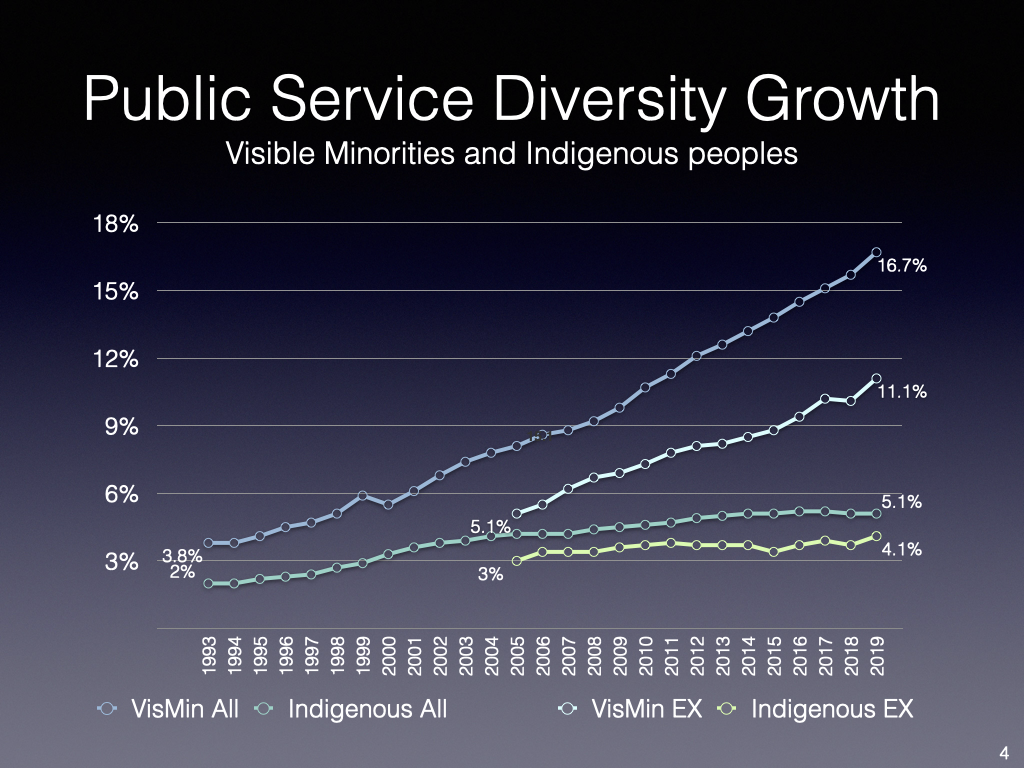
As the above chart shows, there has been a steady increase in visible minorities and Indigenous peoples representation at both the all employee and EX levels.
I have obtained from TBS disaggregated date for visible minorities and Indigenous peoples covering hirings, promotions and separations for the years 2017-19 and will publish my analysis when complete in a few weeks which will refine the baseline by which to measure the impact of the performance commitment and call to action:
The past several months have precipitated deep reflection on the unjust treatment of Black people, other racialized groups, and Indigenous peoples in our society. As public servants come forward and courageously share their lived experiences, the urgency of removing systemic racism from our institutions and from our culture becomes more evident.
Our leadership across the Public Service must be more diverse. Unless swift action is taken, we will fall short of effectively supporting the Government and serving Canadians. We have an obligation to our employees, and to all Canadians, to do better by ensuring that we are putting the full capacity of our entire pool of talent at the service of Canadians.
Grassroots networks and communities have opened conversations, often reliving their own personal traumas, in an effort to increase our collective awareness and to build paths forward. More data is being disaggregated, helping us to further understand where gaps exist and to inform direction and decisions. Training and new recruitment models are being developed. We are by no means where we want to be and much work still remains, but these efforts across the Public Service are creating a foundation for change.
As we focus on combatting racism, it is not sufficient to simply equip ourselves with knowledge and tools. We must take action in ways we know will be meaningful in addressing all barriers and disadvantages. Being a leader means taking an active role in ending all forms of discrimination and oppression, consciously and constantly challenging our own biases, and creating an environment in which our employees feel empowered and safe to speak up when they witness barriers to equity and inclusion. Inaction is not an option.
With the Accessibility Strategy for the Public Service of Canada, we have seen how concerted, system-wide efforts, together with strong commitment and leadership, can generate necessary momentum. Although much work remains, setting out a plan with concrete actions, bringing the voices of those most impacted to the forefront, and holding ourselves accountable for success is a model worth following.
We must encourage and support the voices that have long been marginalized in our organizations. We must create opportunities where they have long been absent. We must take direct, practical actions to invoke change. This is a true test of leadership, and one we must meet head on. Now.
I am therefore calling on all Public Service leaders to:
Appoint Indigenous employees and Black and other racialized employees to and within the Executive Group through career development and talent management
Sponsor high-potential Indigenous employees and Black and other racialized employees to prepare them for leadership roles
Support the participation of Indigenous employees and Black and other racialized employees in leadership development programs (for example, the Executive Leadership Development Program) and career development services (for example, official language training)
Recruit highly qualifiedcandidates from Indigenous communities and Black and other racialized communities from across all regions of Canada
I am further calling on all Public Service leaders to invest in developing inclusive leadership skills and in establishing a sense of belonging and trust for all public servants, as well as those joining us now and in the future, regardless of race, ethnicity, sex, age, disability, sexual orientation or gender expression by:
Committing to personally learning about racism, reconciliation, accessibility, equity and inclusion, and fostering a safe, positive environment where these conversations are encouraged throughout our workplaces
Combatting all forms of racism, discrimination and other barriers to inclusion in the workplace by taking action on what we have learned, empowering employees to speak up about bias and oppression, and better equipping managers to address these issues
Enabling and advancing the work of grassroots networks and communities within the Public Service by providing necessary resources and bringing them into discussions at senior executive tables
Including voices from diverse backgrounds in the identification of systemic racism, discrimination and barriers to inclusion, and the design and implementation of actions to address them
Measuring progress and driving improvements in the employee workplace experienceby monitoring disaggregated survey results and related operational data (for example, promotion and mobility rates, tenure) and acting on what the results are telling us
This call to action represents specific and meaningful actions. My expectation is that progress will be measured and lessons shared. While senior leaders are accountable, this set of actions demands our collective responsibility – at all levels – and a recognition that the existing equity work underway must continue. We have already seen the value of this work in early implementation of recommendations from reports such as Many Voices One Mind: A Pathway to Reconciliation.
As we are bringing these actions to life, we must also recognize that experiences vary across different regions of Canada, and that interconnected dimensions of identity, such as race, ethnicity, religion, age, sexual orientation, gender identification and expression, physical or mental ability, and other individual characteristics, often create varying and complex experiences of bias. As persons with visible and invisible disabilities continue to face physical and technological barriers, the approaches we develop must be truly inclusive by also being truly accessible.
Building a diverse, equitable and inclusive Public Service is both an obligation and an opportunity we all share. We must advance this objective together, acting both individually and collectively, and recognizing that our progress will rely on amplifying the voices of those within our organizations to help lead the way. In my role as the Head of the Public Service, I will keep close to the voices of public servants. I am calling on you to do the same. Ian Shugart Clerk of the Privy Council and Secretary to the Cabinet
2020/2021 Deputy Minister Commitments on Diversity and Inclusion
The Federal Public Service is stronger and most effective when we reflect the diversity of Canada’s populations we serve. While progress has been made in recent years to achieve gender parity in the Deputy Minister community, there is more progress to be made in increasing representation of Black people and other racialized groups, Indigenous People, and persons with disabilities. At the enterprise level, strong partnerships are in place between departments, the Office of the Chief Human Resources Officer, the Public Service Commission and the Canada School of Public Service on horizontal initiatives, such as data analysis, training and development programs as well as recruitment.
To further expand on actions meant to tackle racism and improve representation at all levels, the April 1, 2020 Treasury Board Directive on Employment Equity, Diversity and Inclusion requires Deputies to designate a senior official responsible for developing a comprehensive action plan, in collaboration with equity-deserving groups that will explain how barriers to inclusion will be identified, removed and prevented, and that:
Establishes a baseline of where the Department is at today;
Sets out objectives, to increase representation through recruitment and promotion within the organization and to respond to Public Service Employee Survey (PSES) results related to the perception of harassment and discrimination;
Explains how equity-deserving groups are engaged in the plan’s development and will continue to be; and
Is updated annually, and results reported publicly.
Targets play an important role in driving organizations to achieve measurable change in advancing diversity and inclusion objectives. As a goal for 2021, departments will consider their Workforce Availability statistics as the floor and not the ceiling with regards to diversity targets.
Deputies will be required to present a staffing plan demonstrating the rate of hiring and promotions of individuals at the executive and non-executive levels, who self-identify in at least one of the EE groups, that will aim close the gap within the next 4 years, with demonstrable and steady progress made annually starting in 2021.
In keeping with the Treasury Board Directive and the Performance Management Program’s Corporate Priorities, Deputies must also add focus on efforts and results to build a more inclusive and diverse workforce. Therefore, they are to select three measures from the list below that will enable their leadership teams to advance measureable change in their organizations. As such, they are encouraged to select these measures from one or more themes that go beyond what is currently being done in their organizations, and recognize the different scope of authority at various executive levels within the organization. In reporting on these commitments, Departmental management teams will need to provide clear and measureable results on what the measures have accomplished in achieving progress to address under-representation.
Changing the Public Service Culture
Establish a culture of inclusiveness that values diversity and will combat racism and address systemic barriers
Fostering inclusive leadership by:
Ensuring all executives complete anti-racism and unconscious bias training by March 2021; and
Engaging senior management tables on anti-racism via facilitated group discussions on unconscious bias and systemic racism to start the de-stigmatization of discussions on racism and particularly anti-Black racism.
Providing adequate support by:
Ensuring that employee mental health and wellbeing supports are culturally sensitive and adequately tailored to address issues of racism, discrimination and hate in the workplace; and
Ensuring departmental Ombudsman Offices are trained and equipped to create safe spaces for employees facing racism or experiencing discrimination. Also, providing concrete tools for employees to respond to micro-aggressions in the workplace.
Engaging in dialogue that will de-stigmatize discussions on racism and systemic barriers by:
Hosting monthly organizational fireside chats where subject matter experts deliver relevant presentations on racism, ableism or other discrimination-related topics;
Developing a value statement on anti-racism and ableism and proactively seeking opportunities to talk about the value of diversity and inclusion;
Promoting and supporting the planning of organizational initiatives, celebrations and respectful incorporation of diverse histories and cultures into the workplace; and
Frequently meeting departmental employee equity committees and/or networks and inviting representatives of these committees and/or networks to attend meetings of the senior executive on a regular basis in order for a diversity of perspectives to be considered.
Reflecting Diversity and Promoting Inclusion
Increase the representation of Black, other racialized and Indigenous People as well as persons with disabilities within all levels of the organization
Actively supporting the recruitment and retention of Black people and other racialized groups, Indigenous People, and persons with disabilities by:
Establishing clear targets to increase the representation of Black people and other racialized groups, Indigenous People, and persons with disabilities within all levels of the organization through recruitment, with particular attention to and especially key organizational communities such as human resources and communications;
Partnering with equity-deserving communities to attract and retain new talent that reflects Canada’s diversity;
Reviewing and ensuring that hiring processes are culturally sensitive and driven to remove barriers to appointment for Black people and other racialized groups, Indigenous People, and persons with disabilities;
Supporting non-imperative staffing and language training for managerial positions where Black people and other racialized groups, Indigenous People, and persons with disabilities are being considered for appointment.
Actively supporting the promotion, sponsorship and career development of Black people and other racialized groups, Indigenous People, and persons with disabilities by:
Establishing clear targets to increase the representation of Black employees and other racialized employees, Indigenous employees, and employees with disabilities within all levels of the organization through promotions, with particular attention to and especially key business lines, including human resources and communications;
ADM or DM-level sponsoring of Black employees and other racialized employees, Indigenous employees, and employees with disabilities who are identified by their managers as high-potential for executive roles or to advance to the ADM level;
Reviewing and ensuring that talent and performance management processes are culturally sensitive and driven to remove systemic barriers to Black employees and other racialized employees, Indigenous employees, and employees with disabilities;
Supporting language training for career development of Black employees and other racialized employees, Indigenous employees, and employees with disabilities;
Adopting the Aboriginal Leadership Development Initiative (ALDI) operating at Crown-Indigenous Relations and Northern Affairs Canada / Indigenous Services Canada to identify and cultivate Indigenous talent;
Implementing a mentoring program for Black employees and other racialized employees, Indigenous employees, and employees with disabilities within the organization and requiring that all DMs and ADMs shadow mentees that belong to one of the aforementioned equity-deserving groups.
Updating Policy and Programs: Our Future Workplace
Ensure that internal and external policies and programs are inclusive and free of systemic racism and barriers
Reviewing and adapting all external public oriented policies and programs to ensure they meet the government requirements for accessibility, equity and transparency by:
Identifying and addressing systemic racism and barriers to accessibility and disability inclusion within those policies;
Ensuring transparency and accessibility of departmental Grants and Contributions’ programs with specific initiatives targeted at equity-deserving groups and individuals;
Reporting on the year over year incremental departmental measures in place to support the intent of s. 10.1, 10.2 and 11 of the Indigenous Languages Act if applicable.
Establishing and overseeing a review of all internal systems, policies, programs and initiatives by:
Setting up panels to hear how existing programs and policies are being experienced by equity-deserving groups and what they think needs to be addressed;
Reviewing HR, Procurement, Communications policies, programs and initiatives using Gender-based Analysis Plus (GBA+) and considering various identity factors including race, ethnicity, religion, age, sexual orientation, gender identification and expression as well as and mental or physical disability to identify systemic racism and barriers to accessibility and disability inclusion;
Ensuring Black employees, other racialized employees, Indigenous employees and employees with disabilities have membership and their view represented at executive tables, advisory councils, occupational health committees and other horizontal committees to foster diverse perspectives on internal policies, programs and operations.
Increasing accessibility internally by:
Ensuring new systems, including internally developed or procured hardware and software, meet modern accessibility standards;
Requiring that any documentation distributed across the organization (e.g. presentations, videos, briefing notes and papers, publications) be accessible and ensuring staff have the necessary training to achieve this goal;
Addressing systemic discrimination and barriers to accessibility and disability inclusion within all internal operational policies, programs and initiatives;
Developing and communicating proactive, streamlined workplace accommodation processes and practices in the organization, including for those working from home, as well as putting in place the necessary supports for employees and their managers.
The term “illegal alien,” long decried as a dehumanizing slur by immigrant rights advocates, became even more of a lightning rod during the Trump era — with some top federal officials encouraging its use and several states and local governments taking up measures to ban it.
“The language change on the first day of this administration, with Kamala Harris the daughter of immigrants, to me it’s not just symbolic…it’s foundational,” says Jose Antonio Vargas, an undocumented immigrant whose organization, Define American, pushes for more accurate portrayals of immigrants.
“How we describe people really sticks. It affects how we treat them,” he says. “How we talk about immigrants shapes the policies. It frames what are the issues really at stake here. It acknowledges that we’re talking about human beings and families.”
What the laws say now
US code currently defines “alien” as “any person not a citizen or national of the United States.”
Officials in the past have pointed to the term’s prevalence in US laws to defend their word choices.
In 2018, former Attorney General Jeff Sessions instructed prosecutors to refer to someone who’s illegally in the United States as “an illegal alien,” citing the US code in an agency-wide email.
The term “alien” was often invoked by President Trump in speeches as he warned of what he saw as the dangers of unchecked illegal immigration.
“We were in the Trump administration the perennial boogeyman,” Vargas said.
“Whenever Trump was in trouble, he started talking about the ‘illegals’ and talking about the border.”
But not everyone in the Trump administration was a fan of the language.
In an interview with the Washington Post published shortly before he resigned as acting secretary of Homeland Security in 2019, Kevin McAleenan told the newspaper he avoided using the term “illegal aliens” and instead described people as “migrants.”
“I think the words matter a lot,” McAleenan said, according to the Post. “If you alienate half of your audience by your use of terminology, it’s going to hamper your ability to ever win an argument.”
This isn’t the first effort to change such wording
California struck “alien” from the state’s labor code in 2015.
New York City removed the term from its charter and administrative code last year.
Throughout President Trump’s time in office, immigrant advocates criticized dehumanizing rhetoric.
In guidelines issued in 2019, New York City banned the term “illegal alien” when used “with intent to demean, humiliate or harass a person.” Violations, the city warned, could result in fines up to $250,000.
Prank callers targeted the term early in the Trump administration
One of the first times the use of the term “alien” drew widespread attention during the Trump administration was in 2017 after officials publicized a hotline for victims of “crimes committed by removable aliens.”
Prank callers swiftly flooded the line with reports about space aliens, sharing examples on social media of their comments about Martians and UFOs.
But Vargas says the term and others used to demonize immigrants are no laughing matter.
“Language has power. And I think we saw that in the Trump administration, how it used dehumanizing terms and how it debased language and in turn debased people,” Vargas says. “If you call them ‘alien,’ of course you’re going to put them in jail, of course you’re going to lock them up, of course you’re not going to care that you’re separating little kids from their parents.”
Vargas says the new administration’s effort to use more respectful language gives him hope that some Americans’ views on undocumented immigrants could also shift. Changing just one word, he says, could have a far-reaching impact for millions of people.
Rioux on what he perceives to the the extreme left in the USA and his attack against programs targeted towards minority communities. A caricature of these programs and an ignorance of the reality lived by those communities, not to mention the ample evidence of worse economic and social outcomes.
Of course, it is a political risk, but one that has historical and current justifications, particularly after the Trump presidency.
And should the general policy changes work (economic recovery, COVID measures, immigration reform etc) unlikely that there will be major negative political consequences despite some of the political rhetoric:
Lorsqu’il a juré sur la Bible, perché sur les hauteurs du Capitole devant des rangées de drapeaux plantés dans le sol, Joe Biden avait l’air bien seul. Le nouveau président américain a évidemment juré de rassembler l’Amérique et les Américains. Les accents paraissaient souvent sincères. Mais le pourra-t-il ?
Pour ce faire, ce vieux membre de l’establishment démocrate peut miser sur sa longue expérience de négociateur. Mais il lui faudra pour cela prendre en compte le fossé grandissant qui sépare le peuple américain de ses élites et qui a servi de marchepied à Donald Trump pour se hisser au pouvoir.
Lorsqu’on veut se réconcilier avec quelqu’un, il faut commencer par le traiter poliment et éviter de l’insulter. En jouant l’hyperbole sur les événements du Capitole, les démocrates et les médias n’ont fait pour l’instant que jeter de l’huile sur le feu. Si cette profanation d’un lieu sacré de la démocratie est un geste gravissime, il faut une imagination débridée pour comparer ces personnages de carnaval venus faire des égoportraits dans le bureau de Nancy Pelosi aux marins de Kronstadt, aux milices de la Nuit de cristal ou aux incendiaires du Reichstag.
La génération des « safe spaces » biberonnée aux jeux vidéo a peut-être eu des sueurs froides. Mais ce qui s’est passé le 6 janvier a plus à voir avec la jacquerie des gilets jaunes français qu’avec une insurrection ou une tentative de coup d’État. En novembre 2018, les gilets jaunes avaient bien tenté d’envahir l’Élysée. La garde républicaine eût-elle été aussi empotée que la police américaine, les manifestants auraient paradé en Robespierre dans le bureau d’Emmanuel Macron. Mais ce n’aurait été qu’une parodie de révolution.
Nous avons assisté en direct au suicide politique du Dr Folamour qui a dirigé les États-Unis pendant quatre ans. Dans cette société éminemment violente qu’ont toujours été les États-Unis, le geste répond, comme en miroir, aux longues semaines d’émeutes qui ont suivi l’assassinat de George Floyd et qui ont fait, elles, une trentaine de morts. Avec la bénédiction de nombreux élus démocrates !
Il faut néanmoins reconnaître les efforts que Joe Biden a déployés pour reconquérir les États de la Rust Belt que Trump avait ravis aux démocrates en 2016. Mais ces gains ne seront que de courte durée si le président persiste à obéir à son extrême gauche en introduisant, notamment, des critères raciaux dans le programme de relance du pays. Un programme conçu, dit-il, « spécifiquement pour aider les entreprises possédées par des Noirs et des Bruns » (Black and Brown people). Des mots dignes d’un nouvel apartheid !
Peu importent les appels du président à la réconciliation, cette pensée racialiste est la recette parfaite de la guerre civile. En Oregon, le fonds de 62 millions destiné à aider spécifiquement « les citoyens et propriétaires d’entreprises noirs » est d’ailleurs l’objet de poursuites devant les tribunaux. Car cette épidémie « n’est pas une affaire de Blancs ou de Noirs. C’est l’affaire de tout le monde », a déclaré l’entrepreneur d’origine hispanique Walter Leja, qui fait partie des plaignants.
Joe Biden ne peut pas ignorer que, selon l’Institut Gallup, 74 % des Américains sont contre l’utilisation de critères raciaux dans l’embauche. Un consensus confirmé en novembre par le rejet, pour une seconde fois en 25 ans, de la proposition 16 en Californie. Soutenue par les lobbies ethniques et les grandes entreprises, elle visait à réintroduire ce qu’on nomme là-bas la « discrimination positive » dans l’emploi, l’éducation et l’octroi des contrats publics.
Or, cette réaffirmation des principes d’égalité républicaine ne vient pas cette fois des perdants de la mondialisation, ceux-là mêmes qu’Hillary Clinton avait qualifiés de « déplorables ». Elle vient de l’un des États les plus modernes, les plus multiethniques et qui est de plus un fief démocrate. Aux États-Unis, l’attachement au principe de l’égalité républicaine dépasse de loin les 74 millions d’électeurs de Donald Trump. Il est même un des fondements du pays. Biden ne pourra pas le renier sans en subir les conséquences.
« Réconcilier l’Amérique », cela ne se fera pas non plus en légitimant la censure pratiquée par ces milliardaires du numérique alliés aux démocrates qui, du haut de leur supériorité morale, ont supprimé les comptes d’un président démocratiquement élu. Cette nouvelle alliance de la « cancel culture » avec les magnats des GAFA a de quoi faire se retourner dans leurs tombes tous les « progressistes » d’hier et d’avant-hier.
Joe Biden ne doit pas se tromper sur les raisons qui lui ont permis de l’emporter de justesse au Sénat et au Congrès. Si les Américains ont voulu se débarrasser d’un président égocentrique, incohérent et narcissique, ils n’ont pas plébiscité la politique racialiste et la culture de l’Index que caresse la gauche du Parti démocrate.
Réconcilier l’Amérique suppose que l’on croie dans la nation et une citoyenneté qui ne soit pas fondée sur des critères raciaux. Faute de tenir compte de ces avertissements, l’épisode Biden pourrait bien prendre fin dans deux ans, à l’occasion des élections de mi-mandat. Et la guerre civile larvée symbolisée par l’émeute du Capitole se poursuivra de plus belle.
Another example of those who use a caricature of multiculturalism against a similar simplified view of pluralism. The reality is that both terms, like interculturalism, are relatively plastic terms, ranging from versions that are more integrative to those that are less so.
And like most of these commentaries, they fail to note that Canadian and Australian multiculturalism policies and practices are on the integrative side that reinforces Canadian values and practices, while allowing for recognition and accommodation where possible in conformity with the Canadian constitution and related laws:
On the last day of his tenure, Secretary of State Mike Pompeo took to Twitter to declare, “Woke-ism, multiculturalism, all the -isms — they’re not who America is. They distort our glorious founding and what this country is all about. Our enemies stoke these divisions because they know they make us weaker.”
Pompeo’s claim, unsurprisingly, set off a torrent of moral indignation regarding the beauty of American diversity from people who couldn’t take the time to learn the difference between pluralism and multi-culturalism.
The Jew, Muslim, Christian, atheist — all die on the same battlefield for American ideals, not for some parallel cause or any residual grievance from the Old World. By doing so, they reject a certain kind of multiculturalism, one that emphasizes cultural insularity.
We celebrate our ethnic heritages and customs, but we don’t subordinate American ideals to them. There has been a largely tacit expectation that newcomers leave their ideological baggage outside and integrate. The multiculturalism celebrated by progressives makes no such demand.
Pompeo may have “celebrated his own Italian-American heritage,” but his argument is steeped in the Founding, not in the writings of Garibaldi. My surname is Hungarian, and though I may have some innocuous attachment to goulash, I don’t let Hungary’s legal systems or historical problems with the Romanians forge my outlook. I’m here — and so are you — because America’s liberal traditions and capitalist institutions are far superior to Hungary’s. This probably sounds jingoistic to some, but pretending that all groups have equally beneficial ideas to offer is perilous. And if we can’t acknowledge that the tenets undergirding our society are exceptional, why would immigrants?
On this front, there is a giant controlled experiment called Europe for us to study. One of the continent’s biggest mistakes in recent decades has been embracing a multicultural approach to immigration rather than an American pluralistic approach. Christopher Caldwell, one of the sharpest social observers of contemporary Europe, speaks of the “ethnic islands” that dot major European cities, where the worst habits of newcomers aren’t abandoned but reinforced. They are areas that “look like a seizure of territory rather than a multicultural enrichment.” British writer Kenan Malik argues that multiculturalism, once considered “an answer to Europe’s social problems,” has become a fraught reality of “fragmented societies, alienated minorities, and resentful citizenries.”
Former British prime minister David Cameron admitted as much back in 2011, arguing that state multiculturalism had “failed” his country: “We need a lot less of the passive tolerance of recent years and much more active, muscular liberalism.” German chancellor Angela Merkel, even as she was allowing the continent to be flooded with refugees, noted that multiculturalism “leads to parallel societies, and therefore multiculturalism remains a grand delusion.” French president Emmanuel Macron wishfully claimed that his nation’s “model is universalist, not multiculturalist.”

 Multicultural Meanderings