In Israel, debate over whether French Jews should come — or stay home

Interesting debate in Israel – key question highlighted:

“To all the Jews of France, all the Jews of Europe, I would like to say that Israel is not just the place in whose direction you pray; the state of Israel is your home,” Prime Minister Benjamin Netanyahu said in a televised address.

If a new wave of French Jews move to Israel, they will join what was a record 7,000 compatriots who made the journey last year. But that movement is already rekindling debate among Jews, who ask: Is it better for French Jews to come to Israel or stay home and insist that French society, including the country’s swelling Muslim population, accommodate them?

The debate comes with a contemporary twist: If Jews abandon France in large numbers, are they not doing just what Islamist extremists want — ridding France of its Jews?

“I think what we are seeing now is the old Zionism, the idea that the only place to be is Israel,” said Smadar Bar-Akiva, executive director of JCC Global, an umbrella group of more than 1,000 Jewish community centers worldwide.

Immigrants from France make up a sizable portion of all Europeans migrating to Israel. In 2013, about 12,000 Europeans migrated to Israel, at least 3,000 of them French. In the first nine months of 2014, 5,000 French people migrated to Israel.

“Aliyah is wonderful. We would love to have more Jews in Israel,” Bar-Akiva said, using the Hebrew term for immigration, or “ascending,” to Israel. “But I’d also like to have strong Jews all around the world. I think that it is self-defeating for us to tell them to pack their bags and leave France.”

In Israel, debate over whether French Jews should come — or stay home – The Washington Post.

And a good history of French antisemitism by Andreas Whittam Smith along with a sobering conclusion:

If the Jews cannot live in France any longer, it would be an incredible disaster. The French Republic would have spectacularly fallen short of its ideals. Fortunately Francois Hollande, and Manuel Valls, well understand this and are taking significant actions to buttress the self-confidence of Jewish citizens. Valls also said: “If 100,000 Jews leave, France will no longer be France. The French Republic will be judged a failure.” Exactly right.
Anti-Semitism in France: A prejudice that hardened in 1789 and which has come in waves ever since – Comment – Voices – The Independent.

Australia: Victoria still embracing multiculturalism but numbers sliding

Not surprising to see a certain hardening of attitudes in the Australian state of Victoria given concerns over radicalization:

Deakin University researcher Professor Yin Paradies told Neos Kosmos whilst the figures were overall positive, comparatively research conducted in 2006 showed acceptance levels were in decline.

“We’re finding a worsening across a number of outcomes in terms of people’s attitude towards certain ethnic and racial groups in society and a slight reduction in acceptance of cultural diversity in Australia as a beneficial thing to the nation,” he said.

It is believed deteriorating global security issues, asylum seekers and financial conservatism following the global financial crisis have led to increased prejudices against ethnic groups.

“We’re seeing an intensification of nationalism around the world, which does relate to the fears of terrorism security around the world, and also financial problems. People hunker down in a way when you have these difficulties on a global scale and we get this sense of ‘us and them’ that develops more strongly and a sense of ‘we don’t want our way of life to be eroded’, and some of the findings in our survey find that people are concerned about migrants impacting on Australia’s way of life and taking jobs.”

“About 50 per cent say migrants need to be more like Australians no matter who they are and they need to leave some of their baggage, so to speak.”

Professor Paradies said Muslims were most susceptible to criticisms that they don’t complement Australian society.

“You get the sense that these things can get better over time but there is the potential for them to get worse.

“It’s difficult for individuals to say ‘I’m not racist’ – all of us have a racist thought or inclination at some point in our life. For colonial histories like Australia’s it’s unavoidable there’s historical weight and baggage to our nation and the way it was created that leaves those racist undertones and it’s a lot of work to overcome. It’s a matter of tracking that over time and to try to make it better, and in recent years we haven’t seen a lot of that.”

Media-led campaigns pushing greater integration may serve as the key to combating stereotypes and prejudices, he said.

Victoria still embracing multiculturalism but numbers sliding | Neos Kosmos.

Tolérance ou laïcité | Rioux

Christian Rioux of Le Devoir continues his critique of the more open attitudes of Gérard Bouchard and Charles Taylor, and Rioux reiterates his support for a strict form of laïcité:

Au lieu d’instaurer un espace public qui ignore les croyances et proclame non seulement la liberté religieuse, mais de conscience, dans ce type de régime — que l’on pourrait appeler « de tolérance » —, les religions ont progressivement appris à cohabiter. Cette tradition a toujours été dominante au Canada depuis l’Acte de Québec (1774) qui a supprimé l’obligation faite aux catholiques d’abjurer pour obtenir un emploi de l’État. Ici, ce n’est pas le peuple souverain qui instaure un espace laïque où les citoyens sont égaux, mais les religions qui négocient la paix sociale avec le prince. C’est dans cette tradition que s’inscrivent les organisations musulmanes et antiracistes qui réclament aujourd’hui l’interdiction de blasphémer.

Implicitement, c’est aussi dans cette tradition, et non dans celle de la laïcité, que se placent des intellectuels comme Gérard Bouchard et Charles Taylor, pour qui la laïcité se négocie en partie à la pièce. En érigeant en dogme le régime des « accommodements », ils prolongeaient la vieille tradition des « moyenneurs », comme on disait au XVIe siècle, qui pour rétablir la concorde acceptaient de négocier la place des religions minoritaires dans l’espace public. Outre le fait que ce régime exclut évidemment les athées, il accorde aux religions un statut particulier, d’ailleurs reflété par la Constitution canadienne. Contrairement aux autres formes d’idéologies, les religions sont en effet les seules autorisées à négocier de tels aménagements. On n’imagine pas les marxistes réclamer le droit de ne pas insulter Marx.

Tolérance ou laïcité | Le Devoir.

ICYMI: Turning up the war rhetoric isn’t the same as confronting the threats – The Globe and Mail

Sensible commentary by Campbell Clark in the Globe:

But the big issue is clearly trying to prevent young Canadians, many of them apparently ordinary-joe young suburbanite men, from becoming radicals. And because that’s hard, governments talk less about it.

Talk of war on a massive scale won’t dissuade radicalization. Quite the opposite. One of the motivators for violent radicalization, according to experts, is that it makes marginalized, alienated young men feel important, even feared. ISIS even uses videos with themes from video games like Call of Duty to recruit foreign fighters. A potential recruit would probably be drawn, not deterred, by the idea that this is war on a massive scale. It might be better to employ ridicule.

It is true, as Mr. Harper said last week, that there are threats. But the unpleasant fact is that turning up the war rhetoric isn’t the same as confronting them.

Turning up the war rhetoric isn’t the same as confronting the threats – The Globe and Mail.

Turns out the French government can’t take a joke either

Leonid Bershidsky on the French government’s overkill in arresting Dieudonne and others for hate speech:

Like the other 53 people arrested for hate speech in France since the Paris terror attack, Dieudonne did not wield a gun — he just typed words on a keyboard. If all those cartoons of pencils versus Kalashnikovs that proliferated after the Charlie Hebdo killings are worth anything at all, these people must be freed.

Words do not kill, and it’s always the reader’s or listener’s choice whom to listen to. Charlie Hebdo is not a publication for radical Islamists, Christian fundamentalists or the far right. I bought Charlie Hebdo when I lived in France, but I am not a Dieudonne fan, for obvious reasons. Freedom, however, is about recognizing that, while some wouldn’t touch Charlie Hebdo with a barge pole, they might flock to Dieudonne’s sold-out shows.

Today, Charlie Hebdo sold out its extraordinary 3 million print run in a matter of hours. (Two million additional copies will be printed.) As we stock up on the magazine with a cartoon of the prophet Mohammed on the cover, it would be a good idea to listen to Luz, the artist who drew that cartoon. Here’s what he said in a recent interview:

“The symbolic actions of today are what Charlie has always worked against, to destroy symbols, remove taboos, flatten fantasies. It’s great that people support us but that’s contrary to what Charlie cartoons are about. The unanimity is useful to Hollande when he wants to unite the nation. It is useful to Marine Le Pen when she calls for the death penalty. Everybody can do whatever they want with symbolism in a broad sense.”

Instead of using the Charlie Hebdo attack as a pretext for a crackdown on the freedom of expression, the French government should set an example to others by repealing hate speech laws and concentrating on preventing the truly deadly attacks — those that use bullets. There are far more dangerous people around than anti-Semitic comedians.

Turns out the French government can’t take a joke either

And Andrew Sullivan makes similar points:

…. particularly religion, which should be open to the most merciless attacks and denunciations and mockery precisely because of the grandeur of its claims and the power of its social authority. A true believer is relieved to see the all-too human institutions of church or mosque or synagogue ridiculed, precisely because those institutions are prone to corruption on a vast scale. And faith should easily survive mockery. Jesus himself encouraged his followers not to be dismayed when they are maligned or disparaged because of their faith. It is not something Christians should avenge; it is something that at times Christians should even seek. But even a spiritual figure like Jesus was ignored for millennia once Christianity got worldly power. When Muhammed himself authorizes a hit on someone who insulted him and Allah, the journey is going to be considerably longer.

France Cracks Down On Free Speech

NDP MP to challenge Chris Alexander over visa data requests

Further to the earlier post (Minister Alexander helped bureaucrats avoid giving full details on visa wait times), more detail on the amount of work required.

Tend to believe the points made by the parliamentary briefings coordinator: if the data base can’t spit out the information and the data needs to be manipulated (technical use of the term) in Excel, this time required would increase exponentially.

Not necessarily a reason to refuse what is a valid request (an extension could have been requested):

She also warned the massive quantity of data involved would lead to server crashes, thus further delaying the process.

“We estimate that the [temporary resident] population being requested corresponds to upwards of 16,000,000 records,” she wrote.

“The tools currently at our disposal do now yet fully integrate all the TR data and would therefore require substantial amount of manipulation in Excel of a very large amount of data, which regularly results in system crashes and slower processing of requests of this magnitude.”

The next day, Gagnon’s colleague, Amanda Morelli, called off the search.

“You can hold this work — [the minister’s office] has come back to advise ADMO that we will use the same response we provided to Q-359,” Morelli wrote in an internal email — a reference to an earlier reply to a similar written question filed by Liberal MP John McCallum.

NDP MP to challenge Chris Alexander over visa data requests – Politics – CBC News.

France Has A History Of Anti-Semitism And Islamophobia | FiveThirtyEight

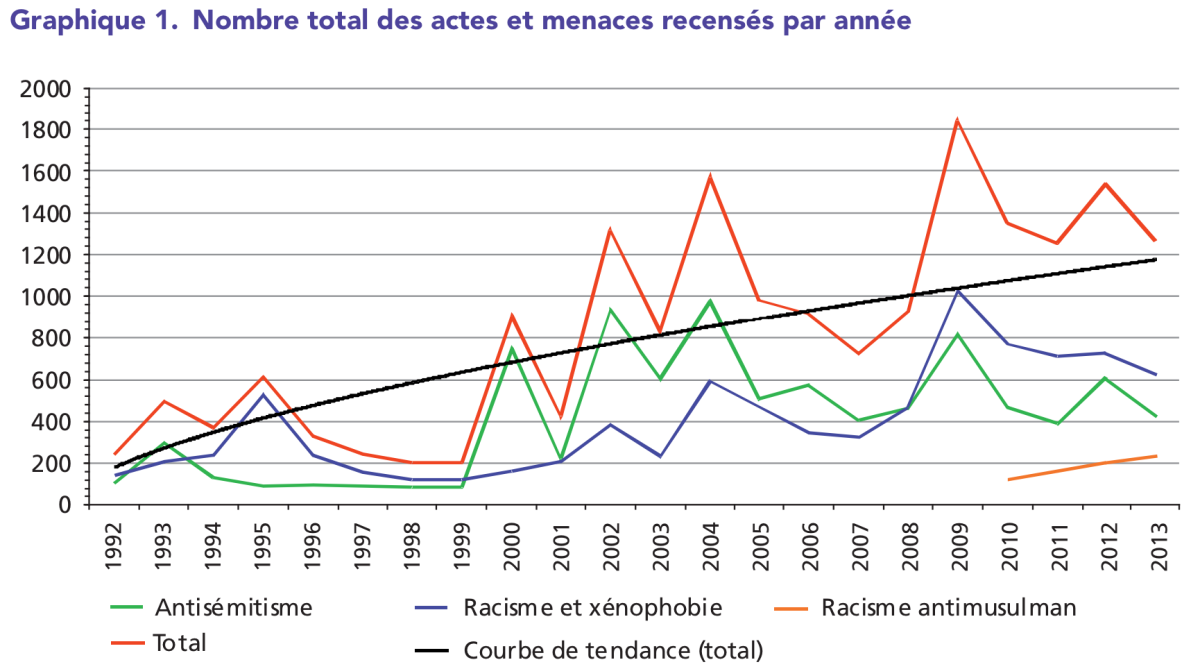
Hate crimes FranceBeyond the anecdotes, hate crime data (chart above) and public polling:

Public opinion surveys might offer some further insight into how Islamophobia is changing in France. In the spring of 2008, Pew surveyed 754 adults in the country about their views on various religious groups. Thirty-eight percent of respondents said they had a “somewhat” or “very” unfavorable opinion of Muslims. That figure was slightly higher than in previous years — in 2006, 35 percent said they had an unfavorable opinion of Muslims in 2005, and in 2004 it was 34 percent.

In 2014, Pew commissioned a new survey, this time posing a question to 1,003 French adults with a slightly different wording. Rather than asking about attitudes toward religious groups in general, the survey asked specifically about attitudes towards religious groups living in France. This time, 27 percent of respondents expressed a somewhat or very unfavorable opinion of French Muslims.

Three-quarters of French respondents believe Islam is an “intolerant” religion, incompatible with the values of French society, according to a January 2013 poll by the French newspaper Le Monde and the market research company Ipsos.

Anti-semitism in France

Rabbis in France have described the country’s Jewish population as “tormented with worry” after Friday’s attack on a French supermarket. On Monday, 5,000 police officers had been sent to Jewish schools and religious sites amid security concerns in addition to 10,000 troops deployed across the country.

The nonprofit Service de Protection de la Communauté Juive (the Jewish Community Security Service, SPCJ) publishes an annual summary of anti-semitic attacks reported to the organization and to police precincts in France. Its latest figures show that in 2013 there were 105 anti-semitics acts and 318 anti-semitic threats. Taken together, the number of threats and acts in 2013 was lower than in 2012 (when there were 614 total incidents) but higher than in 2011 (389).

Pew’s 2014 survey also asked about respondents’ attitudes toward French Jews, with 10 percent of respondents expressing an unfavorable opinion.

In September 2014, Fondapol, a French think tank, posed a range of questions that might reveal anti-semitic attitudes to 1,005 French people age 16 and over. The choice of wording in the survey is interesting. One question asked “when you learn that someone you know is Jewish, what reaction do you have,” to which 91 percent of respondents said “nothing in particular,” 3 percent said “I like them” and 3 percent said “I don’t like them” (the rest refused to answer). However, 21 percent of respondents said they would prefer to avoid having a Jewish president, 14 percent a Jewish mayor, 8 percent a Jewish doctor and 6 percent a Jewish neighbor.

France Has A History Of Anti-Semitism And Islamophobia | FiveThirtyEight.

Islamophobia Is Not a Myth – The Atlantic

The US debate on Islamophobia with Connor Friedersdorf of the Atlantic countering Brendan O’Neil’s piece in the National Review, “Islamophobia is a Myth” with evidence:

Says O’Neill, “According to federal crime stats, in 2009 there were 107 anti-Muslim hate crimes; in 2010, there were 160. In a country of 330 million people, this is exceptionally low.” But in 2000, there were 28 such incidents. What’s wrong with inveighing against anti-Muslim bigotry that’s responsible for 100 or so “extra” hate-crimes, or noting that the numbers were much worse immediately after 9/11… and worrying a spike could happen again? Calling for tolerance of a minority group at a moment of plausible peril is costless, prudent and humane, not objectionable. And if relative tolerance then prevails, that’s a success, not an occasion to complain that elites weren’t trusting enough in the masses.

There’s a non-trivial chance that efforts to stigmatize an anti-Muslim backlash are partly responsible for the fact that there haven’t been more hate crimes in the United States and that the post-9/11 spike has decreased, albeit not back to pre-9/11 levels.

That’s certainly the intention of liberals, as well as many conservatives who followed President Bush’s lead. The chance of success strikes me as a good reason to continue the campaign of stigma, even if the sensibilities of some conservatives are offended, as if suffering is a zero-sum game, or zealously guarding against Islamophobia somehow undermines the fight against terrorism. Insofar as mainstream Muslims are instrumental in informing on radicalized co-religionists who turn to violence, efforts to reach out in support of them are investments in counterterrorism in addition to being consistent with basic justice.

“Islamophobia is a code word for mainstream European elites’ fear of their own populations,” O’Neil writes, “of their native hordes, whom they imagine to be unenlightened, prejudiced, easily led by the tabloid media, and given to outbursts of spite and violence.” As it happens, human beings, in Europe and everywhere else, are often prejudiced, easily led by the media, and given to spite and violence. It is lovely to think that a violent faction on the European right will never again succeed in perpetrating horrific abuses against immigrants or ethnic minorities. To stigmatize those working to prevent such a future is a waste of stigma.

Islamophobia Is Not a Myth – The Atlantic.

La Loi sur la laïcité encore au programme de Couillard | Le Devoir

Couillard maintaining the focus on fundamentalism, not the headgear of public servants:

« On va légiférer. Mais, encore une fois, c’est faire un amalgame qui m’apparaît non seulement risqué, mais inapproprié. Clairement, la relation entre le code vestimentaire et les événements terroristes a été montrée en France comme étant inexistante. On confond deux enjeux », a-t-il d’abord lancé.

« C’est ce genre d’amalgame qu’il faut absolument éviter. Comme on l’avait dit à l’époque, on se trompe de cible. La cible, c’est le fanatisme, c’est le terrorisme, c’est la radicalisation », a-t-il ajouté.

Il a tout de même insisté sur l’importance d’exprimer clairement la neutralité de l’État au Québec. « Ce qui est important, c’est d’assurer la neutralité des institutions de l’État. On a dit qu’on le ferait et on le fera. Également, d’adopter des mesures, par exemple, qui vont, sur le plan du Code civil entre autres, lutter contre l’intégrisme ou les manifestations de l’intégrisme au Québec », a dit M. Couillard.

La Loi sur la laïcité encore au programme de Couillard | Le Devoir.

Jason Kenney rejects crackdown on religious satire

Good strong defence of freedom of speech (see earlier post Satirical religious cartoons should be illegal, says Ottawa imam and reactions):

In the past week, however, some Islamic communities have asked that depictions and satirizations of Mohammed, considered a prophet by Muslims, and whose image is sacred and not to be shown, be pursued by legal means.

Kenney showed no interest in those pleas.

“Freedom of expression means anything,” he said. “It means the right to publish controversial or even sometimes offensive speech.

“It doesn’t mean we have to like it, and it doesn’t mean we have to endorse it, but we have to tolerate it,” Kenney went on. “That’s the price of freedom.”

Jason Kenney rejects crackdown on religious satire | Canada | News | Toronto Sun.