Holocaust Organizations, Scholars Slam Possible Defunding of Anti-Semitism Office

Will be surprising if the Trump administration pursues defunding as they should have learned from previous mistakes (i.e., not mentioning Jewish victims of the Holocaust, delayed condemnation of antisemitic acts and hate crimes). But who knows:

As President Donald Trump prepared to enter the White House, reports began to circulate about what his first budget proposal would look like. The day before his inauguration, The Hill reported on plans of the incoming administration to make drastic cuts in government spending, including the elimination of the National Endowment for the Arts and the National Endowment for the Humanities and reductions in funding and program eliminations within the Departments of Commerce, Energy, Transportation, Justice and State.

Within this last department, Bloomberg reported late last month, the administration was considering whether to eliminate several special envoys, including one on anti-Semitism. On Monday, more than 100 Holocaust organizations, educators and scholars released a statement in response, following similar efforts by the American Jewish Committee, the Simon Wiesenthal Center and U.S. Representative Chris Smith (R-N.J.). William L. Shulman, president of the Association of Holocaust Organizations, tells Newsweek it took the intervening time to put together the statement, edit it and circulate it for signatures.

“We are alarmed by reports that the President plans to defund the US State Department’s Office to Monitor and Combat Anti-Semitism, an office that tracks and counteracts anti-Semitism abroad,” the Association of Holocaust Organizations wrote. “We urge the U.S. government to maintain and strengthen the State Department’s Office to Monitor and Combat Anti-Semitism and to create a new office to address this urgent issue domestically.

The office in question was created via the Global Anti-Semitism Review Act of 2004, which expressed “the sense of Congress [that] the United States should continue to support efforts to combat anti-Semitism worldwide through bilateral relationships and interaction with international organizations such as the Organization for Security and Cooperation in Europe (OSCE)” and that “the Department of State should thoroughly document acts of anti-Semitism that occur around the world.” The act directed the Secretary of State to establish an Office to Monitor and Combat anti-Semitism, which would be headed by a special envoy, to take on the role of tracking, reporting on and combating anti-Semitism.

“Anti-Semitism is not only a Jewish problem,” Ira Forman, who served as the most recent Special Envoy to Monitor and Combat Anti-Semitism under former President Barack Obama, is quoted as saying in the release. “Jew-hatred—like other forms of religious and ethnic prejudice—is a threat to the very foundations of liberal democracies.” Speaking to Jewish Insider about the possible defunding, Forman said, “I can’t believe someone at the White House won’t have better sense than to realize that this is a disaster…. This is as bipartisan an issue as you can get, and I just hope folks at the White House come to their senses.”

Source: Holocaust Organizations, Scholars Slam Possible Defunding of Anti-Semitism Office

Starbucks faces backlash over CEO’s vow to hire thousands of refugees

Not necessarily surprising but not clear whether those more opposed to the hiring of refugees were regular Starbucks customers (the “latte sipping elites” as some would portray them) or the broader population:

Starbucks Corp.’s vow to hire thousands of refugees after President Donald Trump’s first executive order that temporarily banned travel from seven mostly-Muslim nations appears to be hurting customer sentiment of the coffee chain.

Trump supporters have used Twitter, Facebook and other social media sites to call for a boycott since Jan. 29, when Starbucks chief executive Howard Schultz vowed to hire 10,000 refugees over five years in the countries where it does business.

Schultz in a letter to employees said the promise of the American Dream was “being called into question” and that “the civility and human rights we have all taken for granted for so long are under attack.”

YouGov BrandIndex, which tracks consumers’ sentiment toward companies and their willingness to purchase from those brands, noted that the data around this boycott is different because both measures are declining.

Starbucks’ consumer perception levels took an immediate hit as measured by YouGov BrandIndex’s Buzz score, falling by two-thirds between Jan. 29 and Feb. 13, and have not recovered.

Starbucks Buzz score fell to four from 12 during that time. Such scores can range from 100 to -100 and are compiled by subtracting negative feedback from positive. A zero score means equal positive and negative feedback.

Immediate drop

Prior to Schultz’s refugee comments, 30 per cent of consumers said they would consider buying from Starbucks the next time they made a coffee purchase, that fell to a low of 24 per cent and now stands at 26 per cent, according to a YouGov spokesman.

“Consumer perception dropped almost immediately,” said YouGov BrandIndex CEO Ted Marzilli, who added that the statistically significant drop in purchase consideration data showed that consumers became less keen to buy from Starbucks.

“That would indicate the announcement has had a negative impact on Starbucks, and might indicate a negative impact on sales in the near term,” he said.

Marzilli noted that the Starbucks holiday “red cup” controversy from November 2015 corresponded with an even larger drop in perception, but no real impact on purchase consideration scores.

Support for rival urged

Among other things, boycott supporters are urging like-minded friends to support Starbucks rival Dunkin’ Donuts . Representatives from Starbucks and Dunkin’ Donuts declined to comment on the surveys and the boycott’s impact on sales.

Source: Starbucks faces backlash over CEO’s vow to hire thousands of refugees – Business – CBC News

More men moving into women-dominated fields of work: U.S. study

Important study that helps explain some of the political currents. Not sure if there has been equivalent research in Canada:

Even as women moved into men’s jobs, in fields like medicine, law and business, men did not flock to the lower-status jobs that women mostly did.

That’s changing. Over the past 15 years, according to a new study in the United States, men have been as likely to move into predominantly female jobs as the other way around – but not all men. It’s those who are already disadvantaged in the labor market: black, Hispanic, less educated, poor and immigrant men. While work done by women continues to be valued less, the study demonstrates, job opportunities divide not just along gender lines but also by race and class.

At the same time, the women who have continued to make inroads into more prestigious male-dominated professions in that period are likely to be white, educated, native-born and married, according to the research, which is not yet published.

“More privileged men can resist entry into predominantly female occupations more readily than their less privileged counterparts,” said Patricia A. Roos, a sociologist at Rutgers, who did the study with Lindsay M. Stevens, a sociology doctoral student there.

The gender composition of jobs matters for reasons of equality – fields with a majority of men pay 21 per cent more than those with mostly women. Also, the fastest-growing jobs are dominated by women, while the fastest-shrinking ones are predominantly male.

The jobs that have become more female are generally professional or managerial ones, the study found. Some examples of high-paying, high-status jobs done mostly by men in 2000 that had an increased share of women by 2014: supervisors of scientists, which had 19 per cent more women, podiatrists with 8 per cent more and chief executives with 5 per cent more.

Jobs that were mostly female in 2000 and have become more masculine are lower-status jobs. The share of women who work in stores selling products and answering customer questions fell 10 per cent; the share for crossing guards and counter clerks each fell 7 per cent, and for textile workers it fell 5 per cent.

Men are much less likely to have moved into the higher-status professions that are majority women, like nursing and high school teaching (they became more male by about 2 per cent between 2000 and 2014.) The share of women grew slightly in two female-dominated professions, social worker and librarian.

Race, ethnicity and gender have always contributed to who does what work. Women have typically entered occupations when men find better ones, and immigrants have filled the ones women left behind. In the 1800s, according to previous research by Roos and Barbara Reskin of the University of Washington, Irish men replaced native-born white women in textile mills. The women moved to middle-class jobs like teaching – which native-born white men were leaving.

The current patterns reflect widening inequality as a whole, said Leslie McCall, associate director of the Stone Center on Socioeconomic Inequality at CUNY, who was not involved in the new research but said it was consistent with past findings. She said it shows that policymakers who want to improve jobs should focus not on gender or race, but on general working conditions at the bottom of the income ladder.

“People are focusing too much on the white, male working class,” she said, “but if you look at the working class more broadly, the issues are quite similar across all groups: wages, economic security, employment support, training.”

The Rutgers researchers used census data to track 448 occupations. Occupations were considered male or female if they had more than 60 per cent of one sex in 2000, and they were considered to have masculinized or feminized if the percentage of men or women changed by at least 4 per cent by 2014. This happened in 27 per cent of occupations.

Health care showed some of the most striking changes: Every health care job except one is more female than in 2000. (The exception is radiation therapists: from 72 per cent female to 65 per cent.) The share of female dentists, optometrists and veterinarians each increased by more than 10 per cent. The majority of doctors are still men, but women have become the majority in some health care specialties, including pharmacists and veterinarians.

Men’s movement into low-skilled women’s jobs since 2000 is partly a result of the hollowing out of middle-skill jobs in fields like clerical and manufacturing work, which was described by economist David Autor. Women were hit harder – female employment in those jobs fell 16 per cent from 1979 to 2007, compared with 7 per cent for men. But women almost uniformly moved into high-skill jobs, while men were more likely to move into low-skill, low-paying jobs.

Other research has found that men resist so-called pink-collar work, and those who end up in the lowest-status of those jobs, like nurses’ aides who bathe patients and change bedding, are already disadvantaged in the labor market because of race and class.

Sociologists have described the phenomenon as a trap door; these men drop into less desirable jobs. At all levels of work, it seems, white Americans have more choices.

Source: More men moving into women-dominated fields of work: U.S. study – The Globe and Mail

How a Crazy Idea About Islam Went From the Fringe to the White House | Mother Jones

The Islamophobia ‘industry’ and its influence:

In 2011, shortly after the controversy over the so-called Ground Zero mosque and the spread of a conspiracy theory that Shariah was taking over America, the Center for American Progress published a lengthy report titled “Fear Inc.,” which documented what amounted to a cottage industry of Islamophobic misinformation. Prominent players include Act for America, a “national security” group that currently boasts Flynn as a board member. Another is Frank Gaffney, the founder of the Center for Security Policy, which has pushed the unlikely notion that Islamists are secretly trying to infiltrate the American government and prominent organizations—including the National Rifle Association—through a process he calls “civilization jihad.”

“These were people who were always on Fox News, being cited on Pamela Geller’s blog, who were always on Sean Hannity, the Christian Broadcast Network, the National Review, and others,” says Faiz Shakir, the national political director of the American Civil Liberties Union and one of the authors of the report. (Pamela Geller writes a prominent anti-Muslim blog.) “You had major political groups who were then taking this and getting it into the mouths of lawmakers. At that time it was Allen West, Herman Cain, and Michele Bachmann. We went through a period where we had really fought back and marginalized some of these voices,” says Shakir. “They lost some credibility and respect in Republican circles—until Donald Trump came around. He gave them the biggest platform they ever could have imagined.”

This network also had links with what would become Trump’s inner circle. Gaffney appeared on Bannon’s radio show 34 times. Gorka, a former Breitbart editor, has regularly appeared at Center for Security Policy events and on Gaffney’s own radio program. Gaffney once defended the disgraced former FBI agent turned anti-Muslim crusader John Guandolo—who has said that mosques in the United States “do not have a First Amendment right to anything” and has helped draft anti-Muslim legislation.

Trump himself has expressed some of the key tenets of the Islamophobic right. In late 2015, Trump proposed a total ban on Muslims entering the country, justifying the idea by citing a debunked survey commissioned by Gaffney’s Center for Security Policy and conducted by Kellyanne Conway, who would become Trump’s campaign manager. The survey claimed that 51 percent of those polled believe that Muslims in America should have the choice to be governed by Shariah, and a quarter agreed that violence against Americans in the United States “can be justified as part of the global jihad.” A few weeks earlier, he stated that the United States will have “absolutely no choice” but to shut down mosques because “some bad things are happening.”

There have already been previous efforts to prevent mosques from being built using the “Islam is not a religion” argument. “Those are all real efforts,” says Shakir. “They have been on the back burner and bubbling up for a long time, and now they have people in positions of power who can effectuate these radical ideologies that they’ve long held on to.” Until Trump provides some clarity on his true views, people on both sides of the issue may assume that he is unwilling to publicly state that Islam deserves the same legal status and protections as other religions.

Source: How a Crazy Idea About Islam Went From the Fringe to the White House | Mother Jones

Helping Immigrant Students Catch Up, Fast — It Takes A Whole School : NPR

US example of how schools facilitate the integration process:

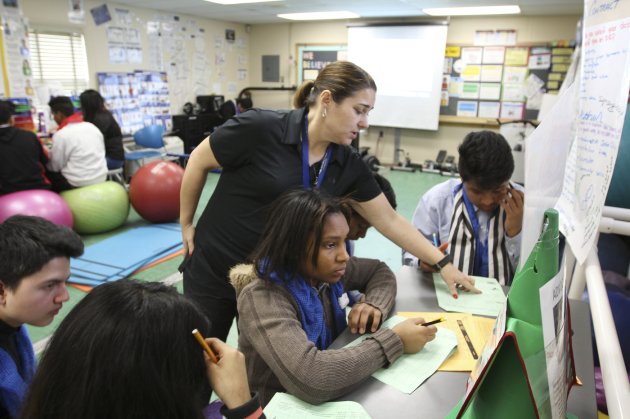
For many immigrant students, the trauma of crossing the border follows them into the classroom — affecting their performance and ability to learn. And that’s where Michelle’s school comes in.

At Langley Park, in Prince George’s County, Md., 87 percent of students are Spanish-speaking. Out of 176 students, 24 countries are represented and 15 languages are spoken at home, not including English.

The school started last fall. So far, the school sits in temporary buildings, but the kids don’t mind it too much — unless it’s raining.
Her school is part of a larger network across the country called Internationals Network For Public Schools. It serves English language learners, or ELLs, and recent immigrants.

For students like Michelle, the problem is two-fold: Not only are they dealing with trauma, but they also belong to one of the most marginalized student populations.

According to a recent Stanford study, the achievement gap between ELL-Hispanic and white students is the largest in the context of race and ethnicity. And, the average high school graduation rate of ELLs is 19 percentage points lower than the national rate, 63 percent compared to 82.

In 1985, the network opened its first school to address that long-standing disparity. Since then, it has grown to 27 schools in seven states, including Washington, D.C.

And, it seems to be working. Last year, ELLs who attended the network’s high schools in New York City graduated at a rate 16 percentage points higher than ELL students in the city’s public schools, the nation’s largest school district.

As for Langley Park, it hasn’t had a graduating class, yet — it opened last fall — but results so far look promising. In the first class of students, 98 percent showed improvement in their English language skills.

Two talented young artists — Stefany Novoa (left), 16, and Frishta Wassl, 14 — work on self-portraits in Christine Wilkin’s art class.

LA Johnson/NPR

How does the network do it when so many other schools struggle to educate ELLs? It seems to boil down to three simple things:

Every teacher is a language teacher. Tammy Tatro, who teaches technology, says implementing English-language instruction into her class curriculum is “really hard.” But she does it by repeating herself and using visual aids to get concepts across to students.

Second, one of the network’s vital principles is collaboration. That’s why the classes are a mix of students with varying English language skills.

“They all want to lift each other up,” Tatro says. “When one fails, especially if they’re working on a team project, then they all kind of fail. So, they have to help each other.”

A third key principle, Principal Carlos Beato says: the school’s partnerships.

Christine Gilliard, a phys ed teacher, used to teach at a large high school where she had “a two-story gym and two storage closets.” Now she teaches out of a trailer-sized temporary building. “We may not have the best of everything, but we have each other,” she says.

LA Johnson/NPR

CASA de Maryland, a Latino advocacy organization, is one of Langley Park’s partners. The organization offers legal advice for students and their families. Students can also take a social justice class from CASA to learn about advocacy and their rights, depending on their immigration status.

Partnerships like this are crucial, given the extra challenges many of these students face — homelessness, separation from their parents and, of course, the language barrier. Without tending to all of their social and emotional needs, Beato explains, “we wouldn’t be getting any of the academics done.”

Most of the network’s schools employ a full-time social worker. At Langley Park, that’s Lesly Lemus. Her job is to support students any way she can as they cope with life outside school, whether it’s connecting them to community resources or just listening.

Source: Helping Immigrant Students Catch Up, Fast — It Takes A Whole School : NPR Ed : NPR

How America’s Idea Of Illegal Immigration Doesn’t Always Match Reality : NPR

A very good analysis with sound data that provide context to US immigration debates and policies:

When you think of illegal immigration in the U.S., do you picture a border crosser or a visa overstayer? A family or a single person? A farmworker or a waiter?

People living in the U.S. without legal status are frequently invoked in American politics — especially in recent months. But the conversation is often short on facts about the millions of people who fall into this category.

There are, however, outdated beliefs: A Pew Research Center survey in 2015 found that very few Americans are aware of recent changes in immigration patterns.

Here’s a look at the actual statistics about people living in the U.S. illegally.

We should note that there are a few caveats about this data. Different research groups use different methodologies, and in some cases, they rely on estimates. We’ve included links to all our data sources so you can read about their methods in more detail.

About 11 million people live in the U.S. without authorization

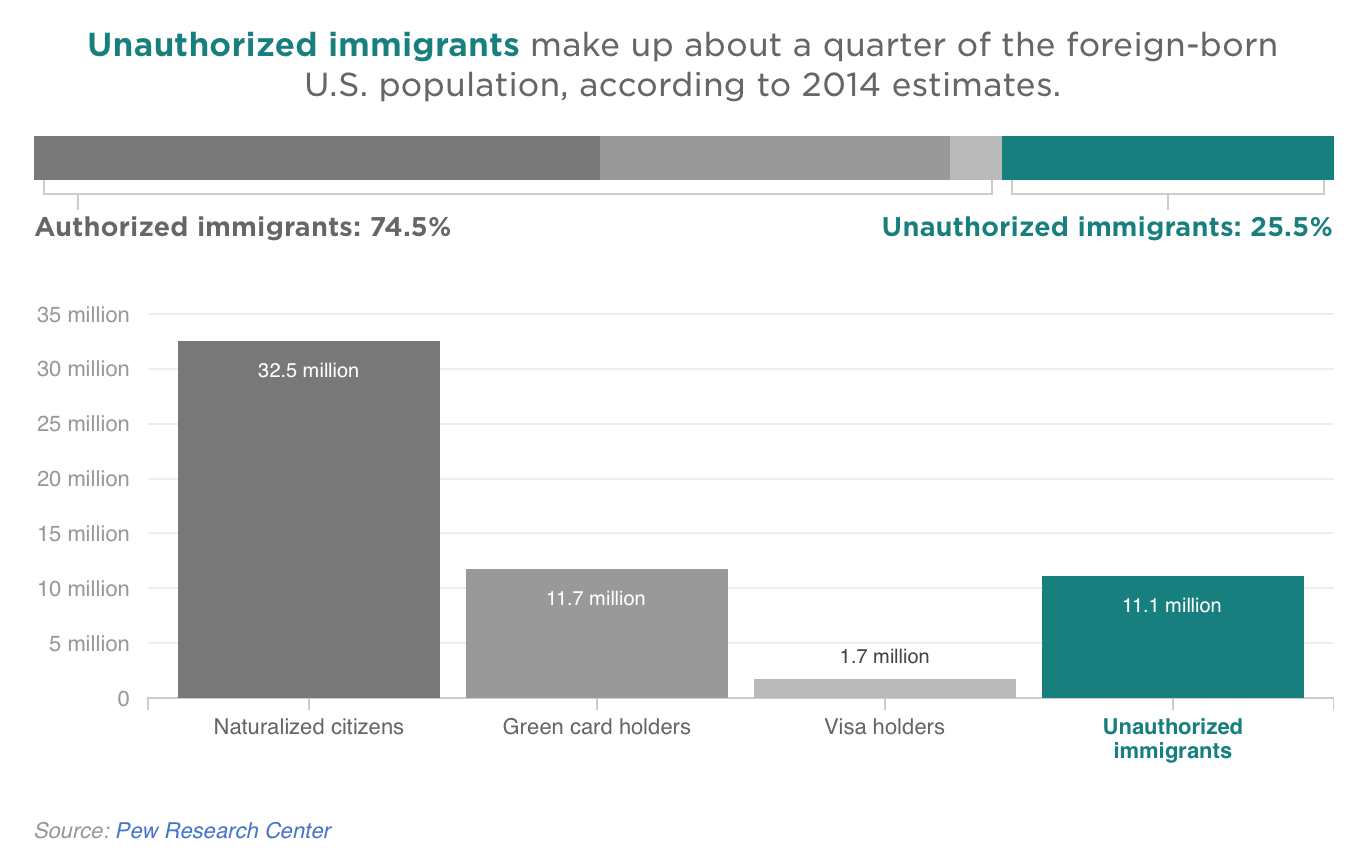
There are far more naturalized citizens than unauthorized immigrants in the U.S., and slightly more green card holders, according to the Pew Research Center.

The total number of people living in the country illegally — about 11 million — has made headlines recently, because immigration advocates suggest that under the Trump administration’s immigration enforcement policies, almost all of them could be targeted for deportation. (More than 700,000 “DREAMers” — immigrants who were brought into the U.S. illegally or overstayed their visas as children — are still temporarily protected from deportation through the Deferred Action for Childhood Arrivals, or DACA, program.)

Longtime residents outnumber new arrivals

A large majority of those people currently living in the U.S. illegally have been here for a decade or longer, which is a major shift from the situation at the turn of the millennium.

About two-thirds of unauthorized immigrants have lived in the U.S. for 10 years or more, Pew says. Only 14 percent arrived within the past five years.

In the late 1990s, the number of new arrivals was far higher, and the share of longtime residents far lower.

Mexicans make up a dominant — but declining — share of this population

Mexico is “the leading nation of origin for U.S. unauthorized immigrants,” Pew writes, but the share of immigrants from Mexico is also declining.

That is to say, Mexican immigrants are a shrinking majority of the population living in the country through illegal immigration.

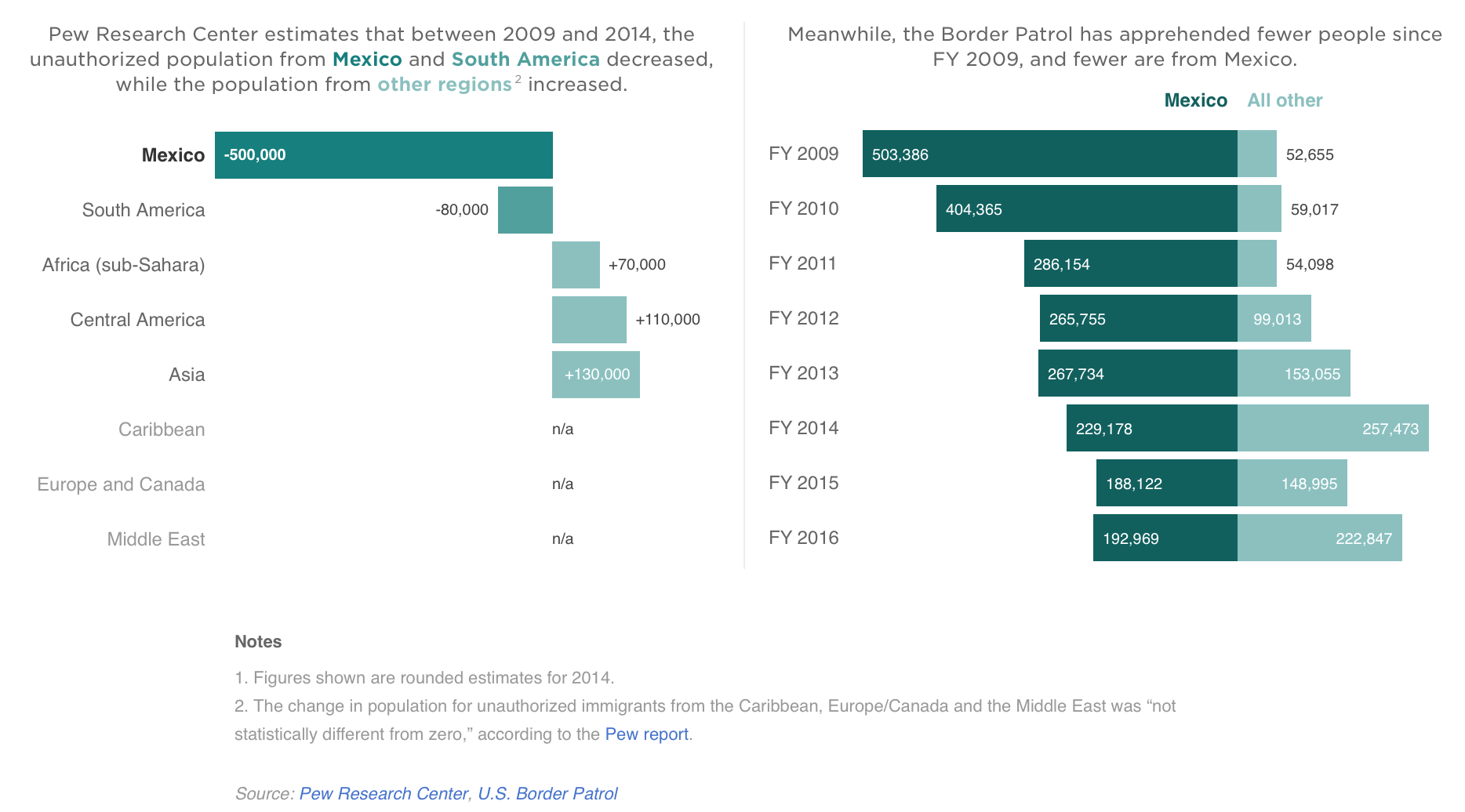
Of people living in the U.S. illegally, more than half are from Mexico. The population from that one country far outnumbers the population from entire continents. But there are fewer people of Mexican origin living in the U.S. now than there were a decade ago.

You can see the trend lines clearly if you look just at people arriving in the U.S. illegally, instead of the millions who live here. The percentage arriving from Mexico has dropped markedly, while more immigrants are coming from Africa, Central America and Asia.

The reasons for the shifting immigration patterns are complex. For Central American immigrants, conflicts in their home countries certainly play a role. The Migration Policy Institute suggests that there might be similar reasons for increased migration from Asia and Africa.

Source: How America’s Idea Of Illegal Immigration Doesn’t Always Match Reality : The Two-Way : NPR

Black People Are Wrongly Convicted Of Murder More Often, Data Show : NPR

Speaks for itself:

A record number of people, at least 166, were exonerated last year after being wrongly convicted of crimes, according to the most recent annual report from the National Registry of Exonerations.

It’s the third year in a row that data collected by a group of law schools showed a record number of exonerations in the U.S. — with 149 in 2015 and 125 the year before that.

Using information on exonerations going back to 1989, the latest report also shows that black people continue to be more likely to be wrongly convicted in America than people of other races. There is no standardized reporting system for exonerations, but the registry is the most complete national data collected on the subject.

Take the crime of murder. Last year, the report collected data on 52 people who were exonerated of murder. More than half of them, 28, were black.

companion report on race and wrongful conviction, also released Tuesday, states:

“African Americans are only 13% of the American population but a majority of innocent defendants wrongfully convicted of crimes and later exonerated. They constitute 47% of the 1,900 [total] exonerations listed in the National Registry of Exonerations (as of October 2016).”

As NPR’s Joe Shapiro reported last year, “after almost nine years in prison, his conviction was overturned when a state investigation found that the real killer had later confessed to Wayne County police and prosecutors.”

Joe also reported that court fees, including a $1,500 bill for a public defender, nearly kept the now-23-year-old man from being released — even after he had been exonerated.

Last year, The Texas Tribune reported that the state had paid 101 people who were wrongly convicted nearly $100 million over the previous 25 years.

Why Mixed-Race Americans Will Not Save The Country : NPR

Interesting and useful discussion on whether an increased percentage of mixed race reduces bias and discrimination, with some compelling examples and notes of caution:

What Biracial People Know,” a recent op-ed in The New York Times, argues that the growing multiracial population may act as a “vaccine” to the bigotry that buoyed Trump’s campaign, granting America “immunity” to the longstanding politics of exclusion shaped by racism.

But this hope that a mixed-race future will result in a paradise of interracial and ethnically-ambiguous babies is misleading. It presents racism as passive — a vestigial reflex that will fade with the presence of interracial offspring, rather than as an active system that can change with time. A 2015 study by Pew Research Center concluded that mixed-race Americans describe experiences of discrimination in the form of slurs, poor customer service, and police encounters. These figures were highest among people of black-white and black-Native American descent.

In their personal lives, mixed-race people may feel pressure to identify with one group or the other. They may have their sense of identity or belonging dismissed by the groups to which they belong, or by the dominant society.

Diana Sanchez, an associate professor in psychology at Rutgers University and a scholar of multiracial identity and experiences, says mixed-race individuals may face subtle forms of aggression in their daily interactions. “People have trouble putting multiracial people in a box … and have opinions about how they should be racially categorized,” she explained. In such instances, mixed-race people may not seamlessly blend in with others’ perceptions, but rather be told that they do not belong to a group, or that they must choose only one, contrary to their personal identity. For some, this disconnect between their sense of self and how the world identifies them can be difficult to navigate.

But when it comes to systemic barriers, experts point out that instances of racial discrimination for mixed-race people may not be very different from the experiences of people who identify as belonging to a single race. Tanya Hernandez, professor of law at Fordham University and the author of the forthcoming book Multiracials and Civil Rights, points out that in legal cases covering a wide-range of contexts, including education, employment, public accommodations, and criminal justice, “people who identify as mixed-race … describe … strikingly binary, black/white or White/non-white forms of discrimination.” Hernandez adds that many mixed-race people find themselves discriminated against, not explicitly because of their mixed-ness, but because of their belonging to a non-white group. She explained that in most of these cases, “the individual…is lumped together in stark contrast to whites, so it’s a white/non-white racial hierarchy.”

The fact that mixed-race people who present as non-white face discrimination because of their proximity to a non-white group reinforces the idea of racial discrimination emphasizing categorization with one group, rather than hybridity. As Sanchez notes, regardless of personal identity, “a lot of research points [out that] mixed-race people tend to be perceived along the lines of their minority identity.”

But what happens to those who aren’t easily categorized?

While not all mixed-race people are considered racially ambiguous, and not everyone perceived as racially ambiguous is of mixed parentage, there is evidence that the inability to categorize people as one race or the other may itself present new forms of bias. Sanchez’s research suggests that white people from less-diverse neighborhoods have more difficulty processing the faces of mixed-race individuals, and that this may result in bias. White people with less exposure to non-whites “have more discomfort trying to make decisions about mixed-race people…and that has consequences for their beliefs around those groups,” she notes.

The upshot, according to Sanchez, is that “the more [people] are exposed to racially-ambiguous individuals, the more likely they are to see race as a social construct, not a biological one.” That realization, that race is a social fiction, “would be a step in the right direction … in terms of trying to reduce racial prejudice and social inequalities,” she says. If people are willing to accept that race is a human fabrication, they may also be more willing to shift their attitudes and perceptions about other groups.

Acknowledging that mixed-race people may experience discrimination and that institutional racism, along with individual prejudice can take forms that target mixed-race people is central to developing policies that address the dynamic face of racism and the effects it has on our communities. But realizing that a mixed-race society can also uphold racism is crucial to a nuanced understanding of the challenge of recognizing and overcoming racism and bias.

Ultimately, the narrative that imagines mixed-race people as a panacea for racism is a flawed one that reinforces ideas around the very existence of race. Instead, we might want to refocus our conversation around how the collective fiction of race is weaponized to limit access to equality and justice for some groups and not others, then maybe we’re onto something.

Source: Why Mixed-Race Americans Will Not Save The Country : Code Switch : NPR

Trump’s administration will be making it harder to get H-1B visas starting in April – Recode

Great opportunity for Canada:

United States Immigration and Customs Services has announced that, starting in April, it will no longer offer its 15-day “premium processing” program for applicants of H-1B visas.

H-1B visas allow employers to temporarily hire non-U.S. born workers to take highly skilled positions at U.S. companies. These visas are frequently used at large technology companies to bring top engineering talent to their U.S. offices. The U.S. only allows 85,000 people per year to enter the country on H-1B visas.

The announcement means that new H-1B visa applications could take months to process. With premium processing, U.S. immigration services offered a 15-day expedited service for a $1,225 filing fee, but come April that will no longer be an option.

“I’ve seen these applications take anywhere from 8-12 months,” said Tahmina Watson, a Seattle-based immigration lawyer, in an interview. “Even though the advertised processing time is four months, I’ve never seen anything take four months.”

This will not only affect new workers coming to the country on the H-1B program, but those who already hold an H-1B visa and are changing jobs within the country too, says Watson, like if an engineer who had an H-1B visa with Microsoft is taking a new position at Google, for example.

The suspension of the premium processing may last up to six months, according to the USICS website.

USICS says that it’s suspending premium processing in order to catch up on “long-pending petitions” — which the agency says has been difficult because of the large number of H-1B applications and requests for premium processing it receives.

Google, Apple, Amazon, Facebook and many other tech companies condemned Trump’s immigration and refugee ban that was issued by executive order in January, which blocked people from seven primarily Muslim countries from entering the U.S.

Dozens of companies, mostly in technology, signed onto a brief that claimed the ban inflicted “substantial harm on U.S. companies.”

Although that executive order was suspended after review from a panel of federal judges, Trump says his administration is working on a new version of the immigration ban.

Trump may praise Canada’s immigration model, but he would never adopt it: Ibbitson

Good analysis by John Ibbitson:

Although Donald Trump praised Canada’s immigration system in his speech to Congress on Tuesday night, he does not understand that system. To emulate the Canadian model, Mr. Trump would have to transform not only U.S. immigration, but his own thinking.

“Nations around the world – like Canada, Australia and many others – have a merit-based immigration system,” Mr. Trump observed in his address. “It is a basic principle that those seeking to enter a country ought to be able to support themselves financially.”

This is correct, as far as it goes, which is not very far. Yes, this country employs a points system that recruits immigrants based on their ability to integrate into the Canadian economy.

But if Mr. Trump truly wished to adapt the Canadian immigration ethos, he would have to embrace concepts he currently rejects. First and foremost, he would have to fling open the doors.

The United States brings in about one million legal permanent residents each year, about a third of one per cent of its population. Canada will bring in 300,000 immigrants this year, just under nine-tenths of one per cent of this country’s population. So to make the U.S. immigration system more Canadian, Congress and the Trump administration would need to almost triple the current annual intake, to around 2.8 million new arrivals a year.

That increased intake, if the Canadian way became the American way, would include 280,000 refugees. While most immigrants to Canada are either economic class or family class, about 10 per cent are refugees, brought in on humanitarian grounds. The United States typically brings in about 70,000 refugees a year, a quarter of the Canadian equivalent, and Mr. Trump wants to ban refugees entirely. That’s really not very Canadian of him.

The President believes immigrants should be self-supporting, and indeed they should. But the most successful immigrants to Canada often do not have the professional degrees or fat bank accounts Mr. Trump no doubt has in mind. As my colleague David Parkinson reported, Canada seeks immigrants not only for the professions and knowledge industries, but in the skilled trades and other blue-collar sectors.

Those sorts of jobs in the United States are often filled by illegal Latino workers. To emulate the Canadian system, the United States would have to convert the stream of illegal immigrants from Mexico into a legal stream. Mr. Trump is trying, instead, to choke off the flow altogether.

The President would have to welcome Muslim immigrants. The Canadian system is blind to ethnicity or religion. Muslims are as welcome as any others, provided they meet the criteria. Mr. Trump, in contrast, wants to ban the citizens of seven majority-Muslim countries from entering the United States in any circumstances.

Most important of all, Mr. Trump would have to embrace multiculturalism: the celebration of diversity within a united society. Such a concept would be alien to the President and his supporters.

Immigration is the key to prosperity and growth for any advanced country. Both the United States and Canada have a fertility rate below the replacement rate of 2.1 children per mother. (The United States is at 1.9 and Canada is at 1.6.) Efforts to increase fertility rates in Europe and in Quebec have mostly failed. (You cannot bribe a couple to have a child; it is insulting even to try.) Immigrants are the best – indeed, the only – way to keep an economy filled with young workers paying the taxes needed to sustain the growing ranks of the retired.

But Mr. Trump, however much he might praise the Canadian model, will never adopt it. That sort of openness to the world just is not in his nature.

Source: Trump may praise Canada’s immigration model, but he would never adopt it – The Globe and Mail