Walking In Their Footsteps At A Former Japanese Internment Camp : NPR

Good long read about one family’s visit to a former internment camp:

The military-style camps were intentionally located in remote areas. Manzanar is about four hours north of Los Angeles by car and 3,800 to 4,200 feet above sea level. It is on U.S. Route 395, east of the Sierra Nevada and west of Death Valley. The nearest populated area is a tiny village six miles north named Independence. Before the trip, I debated whether I should go. The drive from Northern California is long, and my car is old. But I decided that I wanted to see Manzanar with my own eyes, so that my understanding of history might feel deeper through the experience of place.

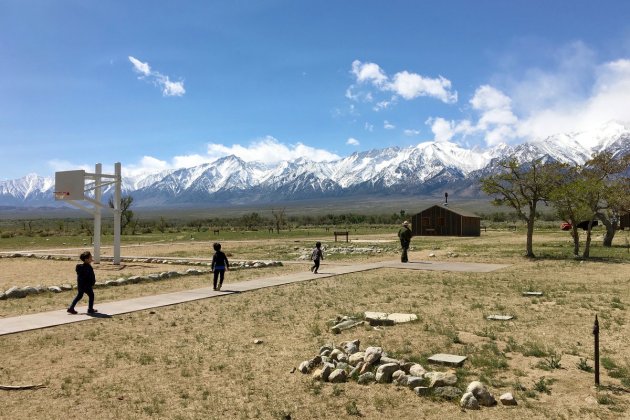
Two reconstructed buildings stand in the former Manzanar War Relocation Center. Once, 10,046 people were imprisoned here.

Melissa Hung for NPR

What we saw was a flat desert with vegetation scrappy and close to the ground, stubborn trees here and there, tumbleweed bounding across the landscape, propelled by the wind. In the distance, Mount Williamson, majestic and snow-covered, looked like a painting.

“I hadn’t pictured it this beautiful,” I said.

“I imagine it must have felt ironic for the people living here,” Erin replied.

Manzanar opened on March 21, 1942, so the weather would have been similar to what we were experiencing on this sunny April day. I was wearing a sweatshirt and a vest. But here spring gives way to summers of up to 110 degrees and winters below freezing. In all seasons, the wind covers surfaces with sand and dust. Like the force of history, it is a constant that cannot be ignored.

Our guide for the day was park ranger Mark Hachtmann. He dressed the way I imagined a park ranger would: a uniform of green pants, a matching green jacket with a U.S. National Park Service patch on the arm, and a brimmed hat. He led us through the few buildings in Block 14, which now serve as exhibits. After the war, most of the buildings at Manzanar were dismantled. After Manzanar became a historic site in 1992, buildings were recreated according to historical photographs. The two barracks in Block 14 were built in 2010.

From what had been rebuilt, we were to imagine the entirety of the camp. There were 36 blocks in all for Japanese Americans. Each block contained 20 buildings: 14 barracks, a mess hall, a recreation hall, a laundry facility, an ironing room, a women’s latrine, and a men’s latrine. Between 250 and 400 people lived in each block, the blocks separated by open areas to prevent fires from spreading, a real threat in this land of wind. The whole camp was just under one square mile.

The residents were resigned to being in the camp ¾ Shikata ga nai(nothing can be done) ¾ and tried to make life a little more normal and comfortable. They created sports teams, published a newspaper, and started a co-op store. I was impressed by their self-organizing and resilience, but also felt a lingering sadness, especially for the older adults who had built their businesses and professions in the face of discrimination, only to have almost everything taken away. Did they ever recover? As we walked from building to building, the boys picked up sticks and dug at the dirt. I wondered how much they understood and if they would remember any of this. They played, I imagined, as kids their ages had done when the camp was full of families.

While in use, the camp included a 250-bed hospital, a fire station, an orphanage for 101 children, and baseball fields. More than 10,000 people ¾ 6,000 adults and 4,000 children ¾ had lived here in a hastily built, temporary city of concrete blocks, wood, and tarpaper. The War Relocation Authority staff ¾ the camp director, police chief, fire chief, social workers, and others who were mostly white and often referred to as the “Caucasian staff” ¾ lived in other blocks with their families, in buildings with their own bathrooms, kitchens, and lawns.

Why American Sikhs Think They Need A Publicity Campaign : NPR

Given Canada’s large Canadian Sikh population, likely more awareness, but polling shows fewer Canadians view Sikhism positively compared to other religions, save Muslims and Mormons:

Nearly 60 percent of Americans admit knowing nothing at all about Sikhs. That lack of knowledge comes at a deadly cost. In the wake of recent incidents from the 2012 Oak Creek Massacre to a shooting of a Sikh man in Washington this March, the Sikh community is taking a more vocal stand against hate.

This month, the National Sikh Campaign, an advocacy group led by former political strategists, launched a $1.3 million awareness campaign, “We are Sikhs.” Funded entirely by grass-roots donations, the campaign’s ads will air nationally on CNN and Fox News as well as on TV channels in central California — home to nearly 50 percent of the Sikh American population — and online.

Some young Sikhs like Sabrina Rangi, a medical student at Michigan State, are optimistic about the potential impact of the campaign. “I think after years of struggling to find the right words, this campaign is getting it right,” says Rangi. “This initiative embodies everything that Sikhism represents, especially its emphasis on shared values and equality. I see this practiced in the gurdwara, where all of the participants sit together on the floor, beneath our holy book, to symbolize that regardless of gender, race or social standing, we are all one.”

Founded over 500 years ago, Sikhism is a monotheistic religion centered on the teachings of 10 spiritual gurus. Guru Nanak, the founder of the faith, rejected India’s caste system and declared all human beings equal. During Guru Nanak’s time, Indian women were considered property with little social standing. Nanak denounced the sexism of the day by proclaiming women equal and encouraging them to participate in all aspects of the gurdwara, or Sikh temple.

The 10th Sikh Guru, Guru Gobind Singh, also promoted the principle of equality. During his time, family names signified social status and caste. To break this tradition, Guru Gobind Singh gave all men the last name “Singh,” meaning lion, and women the name “Kaur,” meaning princess. Sikh turbans, the most visible symbol of the faith, are also a rejection of hierarchy of the caste system. Worn historically by South Asian royalty, the Sikh Gurus adopted the practice of wearing the turban to demonstrate a public commitment to maintaining the values and ethics of the tradition, including service, compassion and honesty.

But the turban’s symbolism is lost on most Americans. According to Ahuja, “Our turbans, which are often perceived as symbols of extremism, are actually representations of equality.” Following Sept. 11, images of Osama bin Laden and al-Qaida associates wearing turbans circulated frequently in the media. Heightened national fear in combination with poor awareness of America’s Sikh community has often made Sikhs the victims of anti-Muslim hate crimes.

Valarie Kaur, a Sikh civil rights activist and lawyer, warns that violence against Sikhs is not only cases of mistaken identity. Attacks against Sikhs in the United States pre-date the Sept. 11 attacks. In 1907, a group of Sikh immigrants were driven out of town by xenophobic mobs during the height of the American nativist moment. Whether 1907 or today, according to Kaur, “it appears to matter little to perpetrators of hate crimes whether the person they are attacking is Sikh and not Muslim. They see turbans, beards and brown skin and it is enough for them to see us as foreign, suspect and potentially terrorist. It’s time to retire the term ‘mistaken identity.’ It’s a dangerous term, because it implies that there is a correct target for hate.”

Source: Why American Sikhs Think They Need A Publicity Campaign : Code Switch : NPR

Religion Could Be More Durable Than We Thought : NPR

Part of the uniqueness of America:

Here is a proposition that may seem self-evident to many people: As societies become more modern, religion loses its grip. Superstition inevitably gives way to rationality. A belief in magic is replaced by a belief in science.

Sociologists call it the “secularization thesis.” In 1822, Thomas Jefferson suggested an early version of it, predicting that Unitarianism “will, ere long, be the religion of the majority from north to south.”

Some data from modern countries support the thesis. Fifty years ago, about four of ten children in England attended Sunday school. Today, it’s only about ten percent. In the United States, just five percent of the population in 1972 reported no religious affiliation. By 2016, one out of four said they were unaffiliated.

Recent research, however, has suggested that religion is more durable than was previously thought. While church attendance has declined sharply in western Europe, secularization has been less evident in the United States. The number of Americans who list their church affiliation as “none” has certainly increased, but more than 70 percent still identify generally as Christian.

A study released this week by the Pew Research Center on the relation in the United States between religiosity and educational attainment (one component of modernization, along with technological change and others) at first glance appears to support the secularization thesis: The more education people have, the less religious they are.

“College graduates are less likely to say they believe in God with absolute certainty,” noted the lead Pew researcher, Gregory Smith. “They are less likely to say that religion is very important in their lives. They are less likely to say they pray regularly, and college graduates are more likely than others to identify themselves as atheists and agnostics.”

A closer look at the data, however, offers a more nuanced picture. While highly educated Jews tend to be less observant than less educated Jews, the relation between education and religiosity is weaker among those Americans with a strong Christian identity.

“Highly educated [Christian] adherents are just as religious, in some cases more religious, than their fellow members who have might have less education,” Smith said. Among mainline Protestants, for example, college graduates were actually found to be more likely than non-college graduates to report weekly church attendance. Regardless of their educational attainment, these Christians find meaning in their church experience.

The sharp rise in the number of Americans who report no religious affiliation may also have an explanation that is unrelated to secularization. Research by Philip Schwadel at the University of Nebraska suggests it may simply be that it was less acceptable 50 years ago to identify as religiously unaffiliated than it is today.

Schwadel and others also argue there are significant differences between the United States and Europe when it comes to the process of secularization. In Europe, organized religion has generally been associated with governments to a far greater degree than in the United States. As a result, anti-government sentiment may have been more likely in Europe to produce antagonism toward the church. Government support for religion in many western European countries may also have weakened the vitality of those church communities.

“When a state creates a relationship with a religion, religious leaders no longer have the same impetus to go out and get people excited,” said Schwadel. “They get money from the state through taxes, so they don’t have to collect money from their congregants.”

In the United States, by contrast, religious leaders have to “hustle” more, Schwadel said. “They need to get more congregants if their church is going to survive.” Perhaps as a result, Americans are more committed than Europeans to their church congregations.

The notion that religious belief and practice have evolved with modernization does remain broadly accepted. As literacy has increased and scientific knowledge has advanced, supernatural explanations for developments in the natural world have become less important. Religion has nevertheless survived, Schwadel argues, because it plays a variety of roles.

“Religion provides people with a lot more than just explanations for the natural world,” Schwadel said. “It provides community. It provides them with friends. It provides them with psychological support and economic support. It provides a lot more than simply an understanding of where they are in the world in relation to the afterlife.”

A 2016 Pew study found that more Americans reported growing feelings of “spirituality” even while saying they were less attached to organized religion. To the extent that churches respond to that need, they will presumably have better prospects for survival.

The question facing religious leaders and sociologists of religion is whether modernization will eventually lead to secularization in the United States and other countries, just as it has in western Europe. Some argue that a diminished emphasis on traditional doctrine about the meaning of salvation, for example, or the existence of heaven and hell, is merely an early sign of growing secularism.

Source: Religion Could Be More Durable Than We Thought : NPR

In New Orleans, Monument to White Terrorism Finally Falls – The Daily Beast

Interesting account of a part of American history:

Since 1891 a monument celebrating white terrorism has proudly stood in the heart of New Orleans, yet this week the city of New Orleans finally removed the Battle of Liberty Place monument. The monument celebrates an attempt by the white supremacist terrorist group the White League to overthrow the government during Reconstruction, and return the city to being ruled by white oppression. Some residents of the city decried its removal and parroted the ludicrous “History Not Hate” rhetoric, and this only serves as a continuation of the pro-Confederacy propaganda movement the South has waged since the end of Reconstruction. As a society, we can no longer tolerate succumbing to this toxicity.

On Sept. 14, 1874, the White League stormed the New Orleans police station in an attempted coup d’état to remove the governor of New Orleans, Republican William Kellogg, and replace him with John McEnery, who had been his unsuccessful Democratic challenger in the 1872 election. The White League defeated the city’s integrated police department, and took control of the city for a couple of days before President Ulysses S. Grant sent down federal troops to reclaim the city. The White League quickly surrendered the city upon the arrival of federal troops, and the Battle of Liberty Place monument exists to remember the 100 White League members who died in the battle. That is to say, it exists to celebrate those who died in a failed coup with the explicit purpose of returning Louisiana to a white dominated society.

The White League, formed in 1874, was one of the last white terrorist groups that sprang up during Reconstruction. The Ku Klux Klan started in 1865 upon the completion of the war. The White League was founded by Christopher Columbus Nash, a former Confederate soldier who was a prisoner of war during the Civil War. On April 13, 1873, Nash led a white militia in the Colfax Massacre that killed approximately 150 freed blacks. The massacre erupted following white fury at the election of Kellogg to the governorship in 1872. This battle is one of the single biggest massacres of Reconstruction. Soon thereafter Nash formed the White League.

“Having solely in view the maintenance of our hereditary civilization and Christianity menaced by a stupid Africanization, we appeal to men of our race, of whatever language or nationality, to unite with us against that supreme danger,” read the platform of the White League.

Despite their clear racist and terroristic foundations, they represented a more palatable form of terror than the KKK. The White League was more mainstream than the KKK. This brand of terror had become normalized over the previous decade. The White League openly collaborated with the KKK, Southern Democratic politicians, and white business owners who facilitated the Redeemers movement to terrorize freed blacks and Union sympathizers to swing elections in favor of the Democratic Party.

President Grant was so alarmed by the threat to democracy that the White League posed that he wrote about them in his 1874 State of the Union Address: “White Leagues and other societies were formed; large quantities of arms and ammunition were imported and distributed to these organizations; military drills, with menacing demonstrations, were held, and with all these murders enough were committed to spread terror among those whose political action was to be suppressed, if possible, by these intolerant and criminal proceedings.”

In New Orleans, a monument to Robert E. Lee was completed in 1884, and the Battle of Liberty Place monument arrived in 1891. In the early 1900s, Confederate President Jefferson Davis received a monument in 1911, and soon thereafter the “Little Napoleon” P.G.T. Beauregard’s monument was completed in 1915. For over a century New Orleans celebrated and normalized “intolerant and criminal” white supremacy and the erosion of our democratic fabric, yet now all four of these monuments are slated for removal.

In 1932, a plaque was added at the foot of the statue describing that the purpose of the battle was for the “overthrow of carpetbag government, ousting the usurpers” and that “the national election of November 1876 [that ended Reconstruction] recognized white supremacy in the South and gave us our state.”

Since the fall of Reconstruction as before, American society has largely chosen to turn a blind eye toward the reimagining of American history along a skewed, and seemingly polite, white oppressive narrative. We hear people utter absurd statements like, “Slaves and slave-owners got along peacefully before the Civil War.” A defender of the Battle of Liberty Place monument even claimed that his ancestor who died in the battle wasn’t a racist because he did not own slaves.

And all this isn’t as ancient as you might think. The Southern Mount Rushmore in Stone Mountain, Georgia, that depicts Robert E. Lee, Jefferson Davis, and Stonewall Jackson was completed not in 1912 or 1922, but in 1972—at the location of the founding of the second iteration of the Ku Klux Klan in 1915. The Daughters of the Confederacy had been dreaming about this monument since roughly 1912, and construction on the stone carving had been started in 1923, but largely remained unfinished for decades. Then, the Civil Rights movement of the 1960s facilitated a renewed interest in repainting Georgia’s skyline in the image of Confederate heroes. And now all of America can visit this Southern Mount Rushmore, conveniently located at 1000 Robert E. Lee Blvd.

Throughout the late 1800s and 1900s buildings, roads, schools, parks, and more have been named after treasonous Confederates to palatably normalize their terror. Children have been named after Confederate leaders, and even today I’ve had people ask me if Attorney General Jefferson Beauregard Sessions III might have been named after Jefferson Davis. Considering that Jeff Sessions Sr. was born in 1860 at the cusp of the Civil War, and the reverence the South still holds for the Confederacy, this question may not be farfetched. And we may need to ask if he was also named after the “Little Napoleon” Beauregard too.

The pervasiveness of Southern oppression can creep into any aspect of American life, and historically, any form of tolerance for white racial oppression has facilitated the further spreading of white terror and a distorted, whitewashed retelling of American history. New Orleans’ decision to remove these monuments and celebrate the rich diversity that has always existed in the city is a step in the right direction. Hopefully, more municipalities will follow suit and free our society from the shackles of America’s pro-Confederate propaganda.

Source: In New Orleans, Monument to White Terrorism Finally Falls – The Daily Beast

A political scientist explains how multiculturalism’s “success” gave us Trump – Vox

Interesting and thoughtful interview with Pippa Norris, a Harvard comparative political scientist:

Last November, I interviewed moral psychologist Jonathan Haidt about the tensions endemic to multicultural societies, and he concluded that “diversity, immigration, and multiculturalism are right at the heart of the sociological problem in Western democracies.” Haidt wasn’t opposed to multiculturalism as such, but he worried that it leads to reduced social capital and the amplification of “tribal tendencies.”

Pippa Norris, a Harvard comparative political scientist, sees it much differently. In a conversation with me last month, she said:

“No, we’re actually witnessing the success of multiculturalism: It’s taking over in the broader sense in the population and in society. I can give you lots and lots of trends on that. You can look at various polls and surveys measuring things like tolerance of minorities, cosmopolitanism, the attitudes toward the United Nations, toward NATO, toward the European Union, and you find that young people are incredibly cosmopolitan, incredibly multicultural. They see their lives as being one where you work in one country, you live in another, you end up in a third.

But, predictably, there is a reaction against multiculturalism, which is a sign that it has succeeded. Social changes have accelerated multiculturalism, and that is perceived as threatening to those opposed to it. There are immense pressures to adapt and adopt.

We have to think about how best to adapt to multiculturalism, but in terms of broad social attitudes, there’s no evidence that, for example, attitudes toward homosexuality or gender or religion are in any way going in a more traditional direction.”

According to Norris, the ultranationalist drift we’re seeing is predictable: Societies are changing, becoming more inclusive, and that has occasioned a reaction from older, more traditionalist citizens.

The crucial question is whether individual states can absorb these reactionary movements. If, for the foreseeable future, we’re going to see more populist pushback, does that mean we can expect more societal disruptions and constitutional crises in Western countries?

Norris is cautiously optimistic:

“A lot depends on the type of system a country has. Different systems will respond in different ways to populist pressures. In most European systems, the party system is flexible. In the United Kingdom, for example, you have 13 parties sitting in Parliament. In Netherlands, Germany, and other countries, you’ve got a multi-party system. In a few countries, like the United States, you’ve only got two parties. Now, those parties themselves are umbrellas, so they’re ideologically indistinct in certain regards, but it’s also very difficult for other parties to break through.

Are there going to be populist parties in the future? Absolutely. They’re not going to go away. How successful they are depends on the institutional rules and depends on how other parties respond to them in terms of either taking over their issues, ignoring them, or trying to isolate them in certain regards. But the American system is resistant to major shocks because of the strength of the two-party structure.”

Ultimately, Norris sees more reasons to be hopeful than not. In America, at least, our institutions are doing precisely what they should do. But, she warns, the real test has yet to occur:

“The courts have done what the courts should do. The media has done what it’s supposed to do. Civil society is still vibrant. The protests are amazing. Young people are energized. Opposition groups like the ACLU are seeing a tremendous spike in contributions. But we haven’t yet been properly tested. The tests are not in the good times or safe times. The tests are when the major crises occur. There will be another crisis in the next four or eight years, another terror attack or some other emergency.

This will be the real test.”

Source: A political scientist explains how multiculturalism’s “success” gave us Trump – Vox

The Trump administration is weighing what to do about the spouses of high-skilled immigrants [H-1B] – Recode

Recruitment opportunities and advantages for tech companies operating in Canada:

The Trump administration’s next immigration target could be a program that allows the spouses of some high-skilled engineers to work in the United States.

Under former President Barack Obama, the government tried to help tech companies and other firms who employed H-1B visa holders by allowing their spouses to seek jobs here. The policy specifically focused on the families of H-1B workers who pursue green cards to become permanent U.S. residents.

Under Trump, however, the government has sought to rethink federal immigration programs. And in court documents quietly filed this week, the Trump administration indicated that it is reconsidering spouses’ rights, too.

Without much fanfare, the Justice Department’s lawyers asked a federal appeals court on Monday to pause consideration of a case challenging the Obama-era policy’s legality. The DOJ sought 180 days so the administration can decide “whether to revise” its rules.

The move drew sharp criticism from immigration reform advocacy groups, including the Mark Zuckerberg-backed FWD.us, which feared that the Trump administration had essentially paved the way to abandon the aid Obama extended to spouses.

“We strongly feel they should keep this regulation in place, and they should not deny a quarter million people” the ability to work, said Todd Schulte, the president of FWD.us, in an interview Tuesday.

The DOJ’s court move, however, raised additional alarm in light of previous comments made by Jeff Sessions, now the country’s attorney general. While serving in the U.S. Senate, the Republican lawmaker had been especially critical of the H-1B program. And Sessions sharply rebuked the Obama administration in 2015 after it issued its rules to permit the spouses of some H-1B holders to seek employment.

Fearing that the DOJ might ultimately choose not to defend the case, an immigration rights organization called Immigration Action sought to intervene“on behalf of thousands of its members who currently possess employment authorization as spouses of H-1B visa holders,” it said in a statement in March.

Earlier this week, the Trump administration promised greater scrutiny of the H-1B program. It pledged more targeted “site checks” to ensure that the program has been administered properly, along with greater scrutiny for computer programmers who apply for those visas. Both measures are viewed as early attempts to crack down on outsourcing firms like Infosys — and not on tech giants like Google, which told employees late Monday that they likely would not be affected.

Source: The Trump administration is weighing what to do about the spouses of high-skilled immigrants – Recode

Trump is cracking down on the H-1B visa program that Silicon Valley loves – Recode

More opportunity for Canada:

On the campaign trail, Donald Trump pledged to crack down on companies that hire foreigners over Americans.

Now that he’s in the Oval Office, his administration is taking aim at some of the high-skilled visas that Silicon Valley seeks so it can hire foreign engineers.

Beginning Monday, the Department of Homeland Security promised greater scrutiny of the H-1B program, which began accepting applications for a lottery that will award visas in 2018. The government’s immigration enforcers plan to heighten their “site visits,” they said, to “determine whether H-1B dependent employers are evading their obligation to make a good faith effort to recruit U.S. workers.”

The Justice Department, meanwhile, issued its own stern warning Monday. “The Justice Department will not tolerate employers misusing the H-1B visa process to discriminate against U.S. workers,” said Tom Wheeler, the acting assistant attorney general at the DOJ’s civil rights division.

Both swipes at the program come days after U.S. Citizenship and Immigration Services issued a policy that rethinks the way the government awards H-1B visas to computer programmers. Now, companies must prove that the programmers they’re hoping to hire are doing special, complex jobs requiring unique technical expertise.

Taken together, the steps seem to point most directly and immediately at outsourcing companies like Infosys and Tata Consultancy Services. But it’s still sure to send a major chill down Silicon Valley’s spine, after an election season in which Trump and his allies took aim at the industry’s hiring practices.

In March 2016, Trump specifically promised to “end forever the use of the H-1B as a cheap labor program, and institute an absolute requirement to hire American workers first for every visa and immigration program.” Others, like then-Senator Jeff Sessions — since tapped as the country’s attorney general — criticized the likes of Facebook CEO Mark Zuckerberg for seeking to expand the program.

Many in the tech industry later expected Trump to issue an executive order clamping down on the H-1B program, a draft of which began circulating earlier this year. He never issued the directive, but DHS did suspend expedited processing for those visas, it announced in March.

“The Trump administration will be enforcing laws protecting American workers from discriminating hiring factors,” said press secretary Sean Spicer at his briefing Monday.

Source: Trump is cracking down on the H-1B visa program that Silicon Valley loves – Recode

Fewer Canadians being refused entry at U.S. land border

Always important to have the numbers and data to inform discussion and debate, both the numbers of refusals as well as overall numbers of people crossing the border:

Fewer Canadians are being turned away at the U.S. land border in recent months despite mounting concerns that Donald Trump’s immigration policies are making it much harder to cross, The Canadian Press has learned.

Refusals of Canadians at American land crossings dropped 8.5 per cent between October and the end of February compared with the same five-month period a year earlier, according to U.S. government statistics

The total number of Canadian travellers denied entry also dropped: 6,875 out of 12,991,027 were refused entry, a refusal rate of 0.05 per cent.

Between October 2015 and February 2016, 7,619 out of 13,173,100 Canadian travellers were denied entry to the U.S., a refusal rate of 0.06 per cent.

About 180,000 fewer people attempted to cross the border in the most recent figures.

The figures, confirmed by U.S. Customs and Border Protection, contrast with recent anecdotal reports of Canadians denied entry into the U.S., with many placing the blame on the policies of the Trump administration, including its controversial attempts to ban arrivals from several predominantly Muslim countries.

A further breakdown of the border data shows a sharp drop in Canadian refusals at the U.S. border in the first two months of this year as 2,600 Canadian travellers were denied entry, compared with 3,500 for the same two-month period of 2016.

‘Much more cautious about crossing the border’

But Canadian immigration and civil liberties advocates caution the numbers don’t tell the whole story.

Immigration lawyer Lorne Waldman said he is fielding more calls than ever from people planning a trip to the U.S. and wanting to make sure they have the paperwork they need. The decreased rate of refusal could be just that people are now better prepared than they used to be, and so fewer are being turned away as a result, he said.

“People in Canada used to take it for granted that they could just go to the border . . . but that’s no longer the case,” he said.

USA: Bid to Strip Terrorist’s Citizenship May Mark New Trump Way – Bloomberg

While the motivation is revocation for terrorism convictions, the rationale is fraud or misrepresentation in Faris’ citizenship application:

The Department of Justice has taken the rare step of seeking to strip a convicted terrorist of his U.S. citizenship as he serves the last several years of a 20-year prison sentence for plotting to destroy New York’s Brooklyn Bridge.

Some national security experts suggested Tuesday the move might signal a new, tougher line under President Donald Trump.

The case involves Iyman Faris, 47 and born in Pakistan, who was sentenced in 2003 for aiding and abetting the al-Qaida terrorist group with his plan to cut through cables that support the iconic bridge. At the time, it was among the highest profile terrorism cases in the aftermath of the Sept. 11, 2001, attacks that killed nearly 3,000 people.

A 17-page filing Monday in U.S. District Court in southern Illinois where Faris is imprisoned launched a revocation process that is likely to take years. The court filing argues that Faris lied on immigration papers before becoming a naturalized U.S. citizen in 1999 and that his terrorist affiliations demonstrated a lack of commitment to the U.S. Constitution.

Faris, known as Mohammad Rauf before becoming a U.S. citizen and who once worked as a truck driver in Ohio, is scheduled for release from the U.S. Penitentiary at Marion, Illinois, on Dec. 23, 2020, according to the U.S. Bureau of Prisons.

Karen Greenberg, director of the Fordham Law School’s Center on National Security in New York, said the federal government has been aggressive in previous decades about revoking the citizenship of accused Nazis living in the United States. But she says it’s largely unheard of for revocation proceedings to be launched against naturalized U.S. citizens imprisoned for terrorism.

Most Americans would almost certainly back steps to strip citizenship from someone like Faris. Prosecutors have also accused him of meeting with Osama bin Laden in 2000 and alleged that the planned attack on the bridge could have been designed to be part of a second wave of attacks to follow those on 9/11.

But Greenberg said making the revocation of a terrorist’s U.S. citizenship established policy would only add to a trend since 9/11 of treating accused terrorists differently than other suspects. Stripping someone’s citizenship, she said, also appeared to be a way of adding on extra punishment not in the criminal statute itself.

“Why isn’t it enough that we put him in prison and give him the sentence he was given?” she said. She added that the effort against Faris could be seen as another example of how the Trump administration “tinkers with the established way we do things.”

Source: Bid to Strip Terrorist’s Citizenship May Mark New Trump Way – Bloomberg

Trump Making ‘Nativist’ Group’s Wish List a Reality – The Daily Beast

Disturbing and part of a pattern:

On April 11, 2016, a tiny think tank with a bland name published a 79-point wish list. The list garnered virtually no media coverage, and in the 11 months since its publication has been largely ignored—except, apparently, by the White House.

Today, Donald Trump seems to be working through it as he rolls out his immigration policy. A number of the 79 items on the list composed by the Center for Immigration Studies (CIS), have either been implemented or shown up in leaked draft proposals from the administration. It’s a course of events that has that think tank cautiously exultant and has immigrants’ rights activists anxious and disturbed.

CIS is one of the most vocal groups supporting increased detention and deportation of undocumented immigrants. It played a key role in torpedoing the 2013 Gang of 8 comprehensive immigration reform bill, and is a long-time favorite of Jeff Sessions and Stephen Miller.

Its newfound influence isn’t just on paper and in policy.

Mark Krikorian, CIS’s executive director, told The Daily Beast that last month, for the first time, his group scored an invite to the Immigration and Customs Enforcement stakeholder meeting, a gathering that happens a few times a year where ICE leaders talk policy and procedure with immigration lawyers and activists. And he said that since Trump’s inauguration, he’s been in touch with new appointees at the Department of Homeland Security. It’s a new level of access and influence that helps explain the quick, dramatic changes Trump has made in immigration policy—changes that will impact millions of people.

“We’re a think tank,” Krikorian said. “Our job is to put stuff out there. Our job is to put a message in a bottle and hope somebody finds it.”

It’s been found.

Just 50 days into his presidency, and Trump’s team has already discussed, proposed, or implemented upwards of a dozen of CIS’s ideas.

For instance, the 29th item on CIS’s list calls for detention of people coming to the U.S. seeking asylum.

“Doing so will restore integrity to an out-of-control system that encourages both border surges and asylum fraud,” the memo reads.

Feb. 21 memo from the Department of Homeland Security laid out how the department is working to quickly expand detention of undocumented immigrants, including asylum seekers….

In some cases, the president’s executive orders all but lift language from CIS’s list. For instance, this is the 65th item on the CIS list:

“Rescind all outstanding ‘prosecutorial discretion’ policies; eliminate the ‘Priority Enforcement Program’, and reinstitute Secure Communities.”

And this appeared in Trump’s Jan. 25 executive order:

“The Secretary shall immediately take all appropriate action to terminate the Priority Enforcement Program (PEP) described in the memorandum issued by the Secretary on November 20, 2014, and to reinstitute the immigration program known as ‘Secure Communities’ referenced in that memorandum.”

The Priority Enforcement Program directed ICE agents to focus their enforcement on undocumented immigrants who had convicted crimes. Now that PEP is toast, most undocumented immigrants in the U.S. are targets for deportation….

And the controversial VOICE office Trump announced at his speech to Congress—which would provide special advocacy and support to Americans hurt by crimes committed by undocumented immigrants—may have had its genesis with CIS. Item number 72 on their list calls for the creation of a “victims advocacy unit” responsible for “providing services to those who have been victimized by illegal alien criminals.”

Krikorian predicted an imminent step from the Trump administration could be worksite raids targeting places of employment for undocumented immigrants. That hasn’t happened yet on a widespread level, he added, but the president could direct it.

“It’s still early, so I expect stuff like that’s going to happen,” he said. “In a sense, that’s the next thing that I’d be looking for.”

And Krikorian’s group has more access than ever to the people who make immigration policy decisions. He said that in February, a representative from the group attended one of the stakeholder meetings that ICE has with immigration advocates several times per year. For CIS, it was a big first: Obama’s DHS had shown zero appetite to have CIS at the table for those meetings, which address wonky procedural issues like how immigrants are transported between detention facilities, how much access attorneys have to them, and how bond gets handled. Meeting participants include the American Immigration Lawyers Association (AILA), the American Bar Association’s immigration project, and immigrants’ rights advocates. And, now, CIS—a leading proponent of increased detention and deportation.

CIS isn’t the only restrictionist group to find newly open ears at DHS. Dan Stein, of the Federation for American Immigration Reform, told The Daily Beast his group was also invited to the meeting as well (though he added it received meeting invites from the Obama administration too). Stein said his group has found the Trump administration to be very open to their ideas.

“As you might imagine, the communication is much better now, and people are asking us to attend all kinds of different meetings,” he said. “FAIR is a very important organization for explaining to people the purposes and strategies behind various administration strategies, and quite naturally the administration would have an interest in making sure we understood the information and properly explain it to people if we’re asked. When I go on CNN to explain the trump travel ban, I expect to have somebody explain it to me in a way I understand.”

And Roy Beck, who heads NumbersUSA—a restrictionist group that boasts a 1.5 million-member email list—said his organization was invited to the ICE stakeholder meeting as well, and has found open ears in the Trump administration, particularly DHS.

“What they’re trying to do meshes with what our organization has always tried to do,” he told The Daily Beast.

These three groups share a co-founder: John Tanton, a population control activist who flirted with racist pseudo-science, supported Planned Parenthood, and argued that immigration and population growth were bad for the environment. Immigrants’ rights advocates argue that the groups are covertly white supremacist and motivated by animus towards people of color. These groups, meanwhile, argue that activists who support immigrants’ rights are secretly in the pocket of corporate interests looking to drive down wages by bringing in immigrants willing to work for less than native-born Americans.

David Leopold, who formerly headed AILA, told The Daily Beast he found CIS’s invitation unsettling.

“I don’t know what the Center for Immigration Studies would be doing there honestly,” he said. “I don’t know why they would be there. What business do they have there? Do they represent people in proceedings? What business does Mark Krikorian have at the ICE liaison committee meeting?”

And Frank Sharry, who heads the activist group America’s Voice, said he shared those concerns and found CIS’s invitation “very disturbing.”

“You have this nativist cabal that has been on the outside looking in for 25 years and now they’re on the inside looking out, and they’re going to have outsized influence,” he said. “In fact, you could say that these groups—CIS and their fellow travelers—are going to own what the Trump administration does on immigration and refugee policy. I’m sure that makes them very happy. I think it should make the country alarmed.”

Source: Trump Making ‘Nativist’ Group’s Wish List a Reality – The Daily Beast