L’État rate Latin American cible: La campagne publicitaire du ministère de l’Immigration fait rager des membres du comité consultatif sur la radicalisation

When advertising campaigns get it wrong:

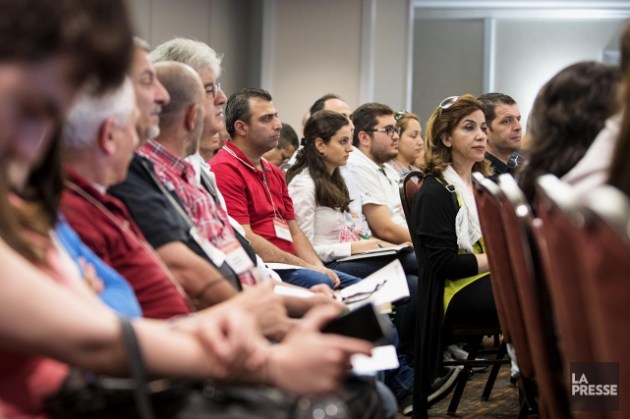
« Assimilationniste »« négationniste », pleine de « clichés ». La campagne sur la diversité lancée lundi par le ministère de l’Immigration du Québec choque des leaders de la communauté musulmane. Au moins l’un d’eux, invités à siéger à une table de travail sur la prévention de la radicalisation, a annoncé son départ et d’autres songent à le faire, jugeant leur rôle inutile au sein de ce comité consultatif, a appris Le Devoir.

« La campagne me semble tout à fait grossière compte tenu de la responsabilité du ministère », a déclaré Haroun Bouazzi, président de l’Association des musulmans et des Arabes pour la laïcité au Québec (AMAL-Québec). « D’un côté, on a la négation du racisme et de l’autre, la discrimination est abordée du bout des lèvres. » Furieux, ce Canado-Tunisien a quitté la Table de travail intersectorielle sur la prévention de la radicalisation menant à la violence, à laquelle il siégeait bénévolement à la demande du ministère de l’Immigration (MIDI), aux côtés d’une dizaine d’autres leaders de la communauté musulmane.

Au coût de 1,2 million, la première phase de la campagne « Ensemble, nous sommes le Québec » qui se déploiera sur cinq ans consiste pour l’instant en deux capsules vidéo, tournées par le réalisateur Ricardo Trogi et diffusées à la télé et sur Internet. Misant sur des modèles d’intégration réussis, on y voit le joueur de soccer de l’Impact Patrice Bernier, un Haïtien d’origine né à Longueuil, et la productrice et animatrice Alexandra Diaz, une Chilienne qui a grandi au Québec, parler de leur expérience d’immigrant de façon positive, faisant allusion aux jokes de Rock et Belles oreilles, au hockey et à la tarte au sucre.

« Le bon immigrant, dépeint par les deux publicités, ne doit pas seulement apprendre le français, il doit aussi connaître toutes les répliques de RBO par coeur. Le bon racisé ne doit pas se contenter d’être un bon joueur de soccer (le sport le plus pratiqué au Québec), il doit aussi savoir jouer au hockey », a déploré M. Bouazzi dans une lettre coup de gueule envoyée au MIDI.

Vernis interculturel

Siégeant également à cette table intersectorielle, Bochra Manaï, professeure et spécialiste d’études urbaines à l’Université d’Ottawa, croit que la campagne du ministère rappelle celles des années 1980-1990, où le Québec faisait encore du « vernis interculturel »« Ça me fait penser à [la vidéo] pour le 375e de Montréal, c’est complètement à côté de la plaque, dit-elle. Si, politiquement, on continue à faire dans le très superficiel, c’est qu’on ne comprend rien à l’époque dans laquelle on vit ». Elle appelle à plus de « courage » de la part du gouvernement. « Je ne vois pas qui on peut vraiment choquer aujourd’hui en faisait une pub d’un immigrant qui dit qu’il a du mal à se trouver une job parce qu’il s’appelle Mohamed », soutient Mme Manaï.

Ève Torrès, coordonnatrice de La Voie des femmes, s’étonne aussi que le gouvernement soit à ce point « frileux » en lançant une campagne aussi consensuelle. « On se moque de nous, s’indigne-t-elle. Nous, on pensait que le message était passé et qu’il y avait vraiment un éveil, une compréhension des enjeux et une envie de collaborer. Mais même après toutes ces années de collaboration des communautés, il n’y a rien qui sort. »

La professeure à l’UQAM, Maryse Potvin est d’avis que le gouvernement donne l’impression qu’il n’est pas à l’écoute. « Il semble ne pas entendre les voix qui lui demandent de prendre en charge certains problèmes de discrimination. Il fait simplement montrer des gens bien intégrés qui sont heureux d’être ici […] les gagnants, constate-t-elle. Le vivre-ensemble, c’est aussi être conscient qu’il y a des gens qui sont rejetés dans la société et dire un peu plus comment on va faire et ce qu’on a mis en oeuvre pour les aider. »

Exclus de la discussion

Certains membres de cette table de travail sur la radicalisation, fondée il y a deux ans à la demande du gouvernement Couillard, sont d’autant plus choqués qu’ils disent n’avoir jamais été consultés à propos de la campagne audiovisuelle. Ils n’ont été mis au courant que deux jours avant son lancement lundi dernier. « On est un peu le comité “ bonne conscience ”, qui légitime et valide ce que [le gouvernement] choisit de faire », indique Bochra Manaï. Elle se dit « choquée » que la table de travail, qui avait été lancée pour discuter des questions d’islamophobie et de radicalisation, n’ait rien produit de probant à cet effet. « Je suis la seule chercheuse qui siège. Il faut beaucoup plus de monde et de chercheurs. »

Il n’y a pratiquement que des Maghrébins qui siègent à cette table, et aucun musulman converti ou non francophone. Tous de bonne foi, ils ont même accepté de participer à une rencontre convoquée par le ministère le 12 septembre dernier… jour même de l’Aïd, qui est aux musulmans ce que Noël est aux chrétiens.

« On est là bénévolement pour s’assurer qu’on a un vrai vivre-ensemble, qui évite la xénophobie et l’exclusion, mais on n’a pas été écoutés », déplore une personne membre de cette table qui désire garder l’anonymat. Elle reconnaît toutefois que la ministre Kathleen Weil semble avoir « une volonté d’écouter nos propositions, mais ça ne se reflète pas dans les actions du ministère ».
Source: L’État rate la cible | Le Devoir

A short history of scapegoating Muslims in Quebec: Martin Patriquin

caq-adGood piece by Patriquin:

We are midway through Quebec’s election cycle, and predicable things are happening. Opposition parties begin to stake out positions on key issues, the importance of which are no doubt polled, focused grouped and otherwise scientifically developed. The most recent efforts of the Coalition Avenir Québec, the province’s second opposition party, can be seen in the charming advertisement above.

“Couillard and Lisée,” it reads, referring to Liberal Premier Philippe Couillard and Parti Québécois leader Jean-François Lisée, “[are] in favour of the chador for teachers in our schools.”

The ad has a stunned and/or befuddled-looking Couillard and Lisée staring at a woman wearing the Muslim garb. The message, in case it hasn’t yet hit you over the head, is that should you vote for either the Liberals or the PQ, your children will be put under the spell of a cadre of evil-looking Muslim women. Vote CAQ, and teachers will remain uncovered (and probably lily white, for that matter.)

It’s gross stuff, of course. It’s also crafty as hell. Both the PQ and the governing Liberals have said that anyone working for the state must do so with their faces uncovered “for security or identification reasons”, as a proposed Liberal law states. Because the chador wearer’s face remains uncovered, it wouldn’t fall under this stipulation. Ergo, so the intentionally blinkered CAQ reasoning goes, the Liberals (and the PQ, which will likely support the proposed law) much be in favour of the chador.

As gross as it is, the most recent CAQ gambit is hardly the first time a party has attempted to make political hay on the backs of Muslim women and other religious minorities. Who can forget this gem, from 2013?

20130910-140922-g

This was the so-called charter of Quebec values, the Parti Québécois’s electoral gambit leading up to the 2014 election. In many ways it is more offensive than the CAQ advertisement. The above image was part of a $2-million ad campaign for a bill introduced by an actual minister that would have been made law had the PQ won the 2014 election. The PQ didn’t win, but it wasn’t for lack of scraping the bottom of the barrel.

During the campaign, the party trotted out Janette Bertrand, a favoured vedette of the very Baby Boomers the PQ wished to recruit, to press flesh and insult minorities. Muslim doctors, she opined, allowed women to “die faster.” Swarthy men had taken over her swimming pool for religious reasons and kicked her out, depriving her of her ability to do aqua-gym exercises. “That’s why we need the charter,” she said. (I’m not making this up.)

Politics, not a sense of shame, caused the PQ to back away from the charter. It has just announced its “resolute, balanced and responsible approach” to Quebec identity that will see the party “build a better dialogue between its parliamentary wing and cultural communities.”

Yet PQ leader Lisée himself has hardly gone all Kumbaya—he’s just changed opinions once again. In 2013, taking great umbrage in something I wrote, Lisée wrote that the PQ’s charter could have flowed from the pen of Thomas Jefferson. Less than a year and one bruising electoral loss later, Lisée said he wouldn’t have supported the charter after all. About two months ago, he said that burqas must be banned “before a jihadist uses one to hide his movements.” Today, he reneged on the comment, saying it was wasn’t his best line. Translation: Lisée was all for scapegoating religious minorities before he was against it—and he may well be for it again, depending on how things go.

I’d be remiss if I didn’t include this pungent example of immigrant-baiting in Quebec.

20080425-081100-g

This is an election sign from the 2008 campaign of the ADQ, the precursor to the CAQ. “Decrease of the French language in Montreal,” it reads. “The track record of the PQ and Liberals: a 22 per cent increase in immigration. The ADQ’s solution: a natalist political plan and a freeze of immigration levels.”

By equating the supposed loss of French in Montreal with the increase in immigration, we have a major political party, the province’s official opposition at the time, scapegoating immigrants not for how they may dress but for what tumbles out of their mouths.

At the time, the PQ denounced the campaign, calling it worthy of France’s hard right Front National. Five years later, the PQ itself introduced the charter—supported by none other than Front National leader Marine Le Pen.

Chutzpah is a great word.

Lisée fait un pas de plus [expanding Bouchard Taylor approach to reasonable accommodation

Identify politics continues – Bouchard-Taylor plus education sector:

Le chef du Parti québécois, Jean-François Lisée, a annoncé, jeudi, un virage identitaire qui va plus loin que ce qu’il proposait comme candidat à la chefferie en matière d’interdiction des signes religieux.

Au cours d’une conférence de presse, le chef péquiste a présenté le « consensus »auquel est parvenue son aile parlementaire au terme d’un débat de quelques heures mercredi, « une approche résolue, équilibrée et responsable », selon le document qui la décrit. En matière de port de signes religieux, la position reprend la recommandation de la commission Bouchard-Taylor, comme le prônait le candidat Lisée, c’est-à-dire une interdiction faite aux agents de l’État qui ont un pouvoir de contrainte — juges, policiers, gardiens de prison. Mais s’ajoutent à cette liste les enseignants du primaire et du secondaire, ainsi que les éducatrices dans les centres de la petite enfance et les garderies subventionnées. Comme candidat, Jean-François Lisée ne proposait qu’une « discussion » à ce sujet.

Cette interdiction ne concernerait que les nouveaux employés ; Jean-François Lisée défend depuis longtemps leurs droits acquis. En outre, la proposition reprend le minimum du projet de loi 62 du gouvernement Couillard — les services de l’État donnés et reçus à visage découvert — et préconise l’interdiction du port du tchador pour tous les employés de l’État, ce qui fait partie des amendements qu’a réclamés le PQ au projet de loi.

La position consensuelle reprend des propositions qui avaient suscité la réprobation du candidat Alexandre Cloutier et de ses partisans Agnès Maltais et Maka Kotto. Ces derniers étaient au côté du chef, Agnès Maltais à titre de porte-parole en matière de laïcité et Maka Kotto comme président du caucus. La porte-parole pour l’immigration, Carole Poirier, complétait le tableau. « La course, déjà, est loin derrière nous », a dit Maka Kotto, qui avait accusé le candidat Lisée de chatouiller « la part sombre de nos âmes ».

Ainsi, un gouvernement du PQ fera la promotion d’un devoir de réserve pour les employés de l’État, « affirmant sa nette préférence pour la plus grande réserve dans l’affichage des convictions politiques, sociales, religieuses ou autres ». La position recycle aussi l’idée d’examiner l’opportunité d’interdire la burqa et le niqab dans l’espace public. Un comité formé de parlementaires et d’experts se pencherait sur les expériences étrangères à cet égard pour ensuite faire des recommandations au gouvernement. Le chef péquiste ne parle plus des mitraillettes qu’on peut cacher sous une burqa. Ce n’est pas sa meilleure citation, a-t-il reconnu.

À plusieurs reprises, Jean-François Lisée a laissé entendre qu’il se rapprocherait de la position défendue par Alexandre Cloutier, qui croit que la charte des valeurs péquiste a considérablement nui au PQ et qu’il fallait s’en tenir à Bouchard-Taylor. « Il y a une différence entre être candidat et être chef. Il va falloir trouver un point d’équilibre », avait dit le nouveau chef dans un point de presse le soir de sa victoire. « Je n’ai pas la réponse, mais probablement qu’Alexandre et moi, on va la trouver. »

Source: Lisée fait un pas de plus | Le Devoir

Quebec woman told to remove hijab in court appeals for legal clarification on right to wear religious attire

Hard to imagine her not winning this appeal. The hijab is not the niqab where the Supreme Court, in a convoluted ruling, stated should be case-by-case (Supreme Court niqab ruling: Veil can be worn to testify in some cases):

A Montreal woman who was told to remove her hijab by a judge is appealing a ruling that declined to clarify whether Quebecers have a right to wear religious attire in court, her lawyer said Wednesday.

Rania El-Alloul had sought a legal clarification from Quebec Superior Court after she was denied an appearance in a lower court because she was wearing a hijab.

Superior Court Justice Wilbrod Décarie ruled last month that the Quebec court judge’s decision went against the principles of Canadian law protecting freedom of religion.

But he also said that although El-Alloul’s treatment was regrettable, he could not guarantee she would be allowed to wear her hijab during future court appearances.

“Each case must be evaluated in light of the context that exists during the witness’s appearance,” he wrote in his decision.

On Wednesday, one of El-Alloul’s lawyers said this case-by-case approach creates insecurity for his client and anyone else who may need to access the justice system while wearing religious attire.

“She would have to be worried every time whether she’d be heard or not, which might induce her to settle cases she shouldn’t settle or not to go to court,” Julius Grey said in a phone interview.

Grey also believes Décarie erred when he ruled it was out of his jurisdiction to make a declaration on whether all litigants have the right to wear religious attire in court.

“When you have a Charter issue, the procedure should not have the effect of depriving someone of their rights,” he said.

A judge refused to hear El-Alloul’s case against the province’s auto insurance board in February 2015 because of her attire.

El-Alloul refused to remove her hijab and the case was put off. It was ultimately settled when the car was returned.

In a statement, El-Alloul said she wanted more than just confirmation the judge had been wrong.

“It isn’t enough that I have been vindicated,” she said. “It’s so important that the successful resolution of my case ensures that no one is ever humiliated the way I was and deprived of their rights.”

Grey said the appeal likely won’t be heard until late 2017.

Québec met fin à une discrimination | Les étudiants autochtones devaient acquitter une note de 17 500$ pour une formation offerte gratuitement aux minorités culturelles

Seems like reducing the costs to encourage and facilitate more indigenous and visible minority police makes sense, and ensuring comparable incentives to address representation gaps (SVPM has only 6.7 percent visible minority police officers, compared to the 20 percent of its population):

Tout étudiant québécois, autochtone ou non, peut emprunter la voie normale et obtenir un diplôme d’études collégiales (DEC) en techniques policières en trois ans sans avoir à assumer des droits de scolarité. Mais le programme, très couru, est fortement contingenté. En pratique, seul le programme d’AEC réservé aux autochtones, une voie rapide pour des étudiants qui, bien souvent, n’ont pas fréquenté le cégep, peut leur permettre d’accéder à l’ENPQ afin de devenir policiers et poursuivre une carrière dans une force autochtone ou une autre.

Les autochtones ne sont pas les seuls à avoir accès à cette voie rapide. Il existe un autre programme d’AEC en techniques policières, au cégep de Maisonneuve, pour les étudiants issus des communautés culturelles. La Sûreté du Québec et le Service de police de la Ville de Montréal (SPVM) embauchent ces diplômés afin que la composition de leurs effectifs soit plus représentative. Or, tandis que les autochtones paient le gros prix, l’AEC en techniques policières réservée aux étudiants des communautés culturelles est gratuit.

À l’ENPQ, les autochtones continuent toutefois de payer le gros prix par rapport aux autres étudiants. Au lieu de 27 000 $, les étudiants non autochtones assument des droits de scolarité d’environ 8000 $.

Au cégep d’Alma, 14 étudiants autochtones suivent les cours de l’AEC en techniques policières. Pour trois d’entre eux, leur conseil de bande a payé la totalité des droits de scolarité. Deux autres ont reçu de 2000 $ à 3000 $, tandis que neuf étudiants ont dû se débrouiller autrement, s’adressant à leur famille et contractant un prêt auprès d’une institution financière, a indiqué Patrick Girard.

Selon lui, les étudiants autochtones font les frais d’une partie de bras de fer entre Ottawa, qui a créé le programme des services de police des Premières Nations en 1991, Québec et les Premières Nations. Le gouvernement fédéral assume 52 % de la note et Québec, le reste. Or en 2012, le gouvernement Harper a décidé de geler sa contribution, ce qui a depuis exercé d’importantes pressions sur les budgets des corps de police autochtones aux prises avec un alourdissement de leur charge de travail.

La situation est différente pour les étudiants autochtones qui parlent anglais. C’est au collège Ellis, une institution privée sise à Drummondville, que l’AEC leur est offerte à un coût variant entre 18 000 $ et 20 000 $. Selon le coordonnateur du programme, Daniel Guillemette, ce sont essentiellement des Cris et des Inuits qui suivent la formation. Or leurs gouvernements assument tous les frais, a-t-il précisé. Cris et Inuits ne dépendent pas du programme fédéral : ils peuvent compter sur la Convention de la Baie-James.

Depuis qu’Ottawa a décidé de geler son financement, l’Assemblée des Premières Nations du Québec et du Labrador (APNQL) se plaint du sous-financement des corps policiers autochtones au Québec. Certaines communautés ont menacé de fermer leur service de police pour forcer la Sûreté du Québec (SQ) à prendre la relève.

En 2015, il existait au Québec 20 corps policiers autochtones qui desservaient 44 communautés et comptaient 401 policiers, selon les données citées par Patrick Girard. De son côté, la SQ emploie un petit nombre de policiers autochtones : ils étaient 27 en 2015, un de plus que deux ans auparavant.

Source: Québec met fin à une discrimination | Le Devoir

Developer behind ‘Muslim housing project’ in Montreal says anyone with shared values welcome

The latest political debate over integration in Quebec, where PM Couillard has appropriately rejected such separate housing developments:

At a time when restricting religious attire is a recurring theme in Quebec political debate and when some municipalities have blocked proposals for new mosques, the proposed housing project could be seen as a defensive gesture.

But Warda said that is not the case.

“I didn’t hear people say, ‘OK, we have to go and defend ourselves against these nasty Québécois by going and living alone.’ That is not at all my motivation,” he said in an interview.

What he has heard are people who have been renting for 30 years and wish they had something to show for all the money. Although views differ about what Shariah law dictates for Muslims living in a society where mortgages are the norm, many refuse to take out loans that charge interest.

“A lot of Muslims have problems with the idea of interest, which in Arabic is called riba,” Warda said. “That means if you pay more than you were loaned, you are doing something that is very, very, very, very bad from the Muslim point of view.”

He said interest can be circumvented thorough an arrangement in which a house is bought by the bank and then the resident buys it back over time, paying a premium that is considered the bank’s profit, and not interest.

“Let us call it a technicality, for me as an accountant, but for the believers it is not a technicality,” Warda said. Similar arrangements have been used at Muslim housing developments in Ontario and Alberta.

We are here in Canada. We came of our own will. Our intention was not to come to isolate ourselves from society

He said non-Muslims would be welcome to move into his project of prefabricated homes, but they would have to share the values of their Muslim neighbours.

“You don’t drive drunk on the street. If you want to drink alcohol, you drink it in your house,” he said. Women could choose whether to wear the headscarf but they could not walk around in a halter-top and shorts.

“There must be some modesty in the way you dress. We don’t want women living there going half-naked down the streets. We don’t like that,” he said. “If they want to do that, let them go and live in downtown Montreal.”

He has scheduled a meeting Friday evening at the Brossard mosque, the Islamic Community Centre of South Shore, to see if there are enough takers. He said he needs a critical mass of 50 potential buyers before the land can be purchased.

But he has heard opposition closer to home, including from the imam of the Brossard mosque, Foudil Selmoune.

“We are here in Canada. We came of our own will,” Selmoune said in an interview. “Our intention was not to come to isolate ourselves from society or from the community.” He said it would be more constructive for Warda to use his financing proposal to help Muslims buy existing homes rather than creating a Muslim neighbourhood.

The social climate in Quebec can be difficult for Muslims, Selmoune acknowledged.

“It doesn’t mean we have to hide ourselves and get away from the challenges we are going through,” he said. “We have to face them.”

Quebec: Des points de vue divergents sur la laïcité de l’État

Some initial commentary before the start of Quebec’s hearings on Bill 62, which bans face covering (i.e., niqab, burka)in the delivery and reception of public services:

Des points de vue opposés se feront entendre lors des consultations qui s’amorcent mardi en commission parlementaire sur le projet de loi 62 favorisant le respect de la neutralité religieuse de l’État et visant notamment à encadrer les demandes d’encadrements religieux dans certains organismes, réponse du gouvernement Couillard au projet péquiste de charte de la laïcité.

« C’est un débat qui divise mais qui fait avancer, comme les débats sur l’avortement, sur la peine de mort ou sur l’aide médicale à mourir », a souligné la juriste Julie Latour, qui comparaîtra en commission parlementaire au nom du regroupement Juristes pour la laïcité et la neutralité religieuse de l’État.

La Commission des institutions a prévu neuf jours d’audiences cet automne au cours desquelles 42 groupes et individus seront entendus, un nombre qui est appelé à augmenter puisque l’horaire prévoit des ajouts.

C’est la quatrième fois que le gouvernement québécois tente de faire adopter un projet de loi pour préciser la neutralité religieuse de l’État et définir des balises pour l’octroi d’accommodements raisonnables dans le secteur public et parapublic. Les deux projets de loi précédents, 63 et 94, présentés par le gouvernement Charest ont été abandonnés tandis que la défaite du Parti québécois en 2014 a clos l’épisode du projet de loi 60 sur la charte « affirmant les valeurs de laïcité » défendu par le gouvernement Marois.

À l’entrée du Conseil des ministres mercredi dernier, la ministre de la Justice, Stéphanie Vallée, qui pilote le projet de loi 62 a indiqué que le gouvernement avait en main « des avis juridiques solides » à l’appui de cette nouvelle tentative législative. Elle a dit souhaiter que le nouveau chef de l’opposition officielle, Jean-François Lisée, reste fidèle aux propos qu’il a tenus lors de la course à la chefferie : le candidat jugeait que le projet de loi était un pas en avant et qu’il fallait l’adopter.

Pour Louis-Philippe Lampron, professeur de droit à l’Université Laval, le projet de loi 62 consiste pour l’essentiel en « une redite » du projet de loi 94 présenté en 2010. « C’est essentiellement une codification du droit canadien actuel sur la neutralité religieuse de l’État », estime-t-il. À cela s’ajoute la même disposition que dans le projet de loi 94 sur l’obligation d’avoir le visage découvert pour fournir ou recevoir des services de l’État, que ce soit dans les écoles, dans les centres de la petite enfance (CPE) et les garderies subventionnées, dans le réseau de la santé et pour les autres services publics. Un accommodement à ce sujet devra être refusé pour « des motifs portant sur la sécurité, l’identification ou le niveau de communication requis ». Mentionnons qu’il n’est aucunement question de signes religieux.
Au moment des consultations sur le projet de loi 94, la Commission des droits de la personne et des droits de la jeunesse (CDPDJ) avait exprimé un « malaise » relativement à cette interdiction qui portait, sans le dire, sur des signes religieux. « On peut même dire que ça vise explicitement un symbole religieux d’une religion [l’islam] », a fait observer Louis-Philippe Lampron. « Il y a des raisons de croire que ça pourrait être contesté. » Ou que l’interdiction ne s’applique pas en raison de l’octroi d’accommodements.
Pour sa part, Me Julius Grey, bien qu’il s’oppose au multiculturalisme et qu’il soit en faveur de la laïcité, est contre l’interdiction des signes religieux, sauf pour les agents de l’État qui détiennent un pouvoir de coercition (juges, policiers, agents correctionnels, etc.), comme le recommandait la commission Bouchard-Taylor. Il trouve inconcevable qu’on puisse priver quelqu’un de soins médicaux, quelles que soient les circonstances.
Pour Julie Latour, le projet de loi 62 est « un jalon ». À ses yeux, il manque à la neutralité religieuse de l’État et à la laïcité un socle juridique qui passe par l’enchâssement de leur principe dans la Charte des droits et libertés de la personne.

Source: Des points de vue divergents sur la laïcité de l’État | Le Devoir

Some of the notable absences from the hearings:

Faux départ pour la commission parlementaire sur le projet de loi 62 concernant la neutralité religieuse de l’État. Une vingtaine de groupes et d’experts que les députés voulaient entendre ont décliné l’invitation. Et pas les moindres : notamment Gérard Bouchard et Charles Taylor, qui ont présidé la commission sur les accommodements religieux.

La ministre de la Justice, Stéphanie Vallée, y voit malgré tout une bonne nouvelle. Le refus de tous ces groupes «envoie un signal qu’ils sont confortables avec la version présentée par le gouvernement, ce qui n’était pas le cas» pour le projet de charte des valeurs du Parti québécois, a soutenu sa porte-parole, Isabelle Marier St-Onge.

Or, en entrevue à La Presse, Gérard Bouchard a assuré qu’il n’a pas changé d’avis sur le port de signes religieux, une position qui va plus loin que ce que propose Mme Vallée. Comme on peut le lire dans le rapport de la commission qu’il a coprésidée, il recommande d’interdire ces signes chez les agents de l’État dotés d’un pouvoir de coercition (policiers, gardiens de prison, procureurs de la Couronne et juges). Le projet de loi 62 précise seulement que les services publics doivent être donnés et reçus à «visage découver», une mesure qui cible le voile intégral.

«Mes idées sur la laïcité sont bien connues, et je m’en tiens toujours aux propositions que nous avons émises il y a huit ans. Je n’aurais que répété ce qui est écrit dans le rapport pour l’opposer à ce qui peut être écrit dans le projet de loi. Je ne voyais pas mon utilité, parce que je n’ai rien à ajouter», affirme M. Bouchard.

 Horaire modifié

L’horaire des auditions, qui débutent mardi à Québec, a été revu à la toute dernière minute en raison des multiples refus de témoigner. Ce cafouillage est d’autant plus étonnant que le projet de loi 62 a été déposé par Mme Vallée il y a longtemps, en juin 2015.

Une vingtaine de groupes refusent de discuter de neutralité religieuse

And English language coverage in the Globe:

The new legislation, “An Act to foster adherence to State religious neutrality and, in particular, to provide a framework for religious accommodation requests in certain bodies,” tabled by the Liberals last year, would make it illegal to give or receive government services if a person’s face is covered. Since no Quebec public employees mask their faces, according to the government, the bill would effectively target Muslim women who wear the niqab or burka.

 Justice Minister Stéphanie Vallée said when introducing the legislation that it was required “for security, identification and communication purposes.”

She has been unable to say how many women wear face veils in the province.

Bill 62 is the latest iteration of Quebec’s efforts to impose official secularism in the public domain (though the new legislation would allow the crucifix over the speaker’s chair in the National Assembly to remain in place).

The bill is seen as a more moderate version of the former Parti Québécois government’s derided “charter of values,” which had set out to ban turbans, kippas, head scarves and other religious displays among Quebec’s civil servants. The bill is believed to have contributed to the PQ’s defeat at the polls in 2014.

The Liberals’ bill would allow for religious accommodations as long as they fit certain sets of guidelines, such as being “consistent” with the equality of men and women.

Still, some groups question the need for the law and say it unfairly targets minority women, who could be excluded from accessing public services.

“How necessary is all of this?” Amira Elghawaby of the National Council of Canadian Muslims said. “How many women might actually be wearing the face veil in Quebec? I doubt that it’s a huge critical mass.” She said that re-opening the issue creates a “malaise.”

“There should really be no suspension of people’s human rights based on popular sentiment toward a religious practice,” Ms. Elghawaby said.

 Hearings to begin on proposed Quebec law targeting veiled women 

Denying Quebec woman day in court because she was wearing of hijab went against Canadian law principles: judge

Surprised that the judge, while making the correct ruling in the particular case, refused to make a general ruling that wearing a hijab (or kippa, or turban) is permissible in court. Hard to understand what hypothetical situation he was thinking of:

Seventeen months after a Quebec Court judge told her to remove her hijab in court, Rania El-Alloul has received partial vindication from the justice system, but no guarantee it will not happen again.

In a ruling released this week, Superior Court Justice Wilbrod Décarie writes, “The court has a lot of sympathy for (El-Alloul) and deeply regrets how she was treated.”

Judge Eliana Marengo’s February 2015 refusal to hear El-Alloul in the “secular space” of a courtroom unless she removed her Muslim head scarf flew in the face of a 2012 Supreme Court of Canada decision that a witness was entitled to testify in a face-covering niqab, Décarie found.

But he did not issue the judgment sought by El-Alloul — declaring that her rights under the Charter of Rights and Freedoms had been breached and affirming her right to appear in court wearing her hijab.

“Each case is a specific case that has to be evaluated in the context of the witness’s court appearance,” Décarie wrote. “It cannot be declared in advance, absolutely and out of context, that El-Alloul will have the right to wear the hijab during her future appearances before the Court of Quebec. Nobody can predict the future.”

What happens next, I don’t know. I hope no one ever feels what I felt in the past

Julius Grey, one of El-Alloul’s lawyers, called Décarie’s finding “wrong in law and very dangerous.” It opens the door to litigants trying to destabilize a witness by filing motions asking she remove her hijab.

“A person will feel insecure before the courts,” Grey said, adding he favours an appeal.

The lawyer said the issue is important as restrictions on religious dress become more common.

“It’s not a particularly Quebec matter. All over the West there is an unhealthy irritation, I would say, with religious garb, with religious practice, with other customs,” Grey said.

Source: Denying Quebec woman day in court because she was wearing of hijab went against Canadian law principles: judge | National Post

Kathleen Weil slams Jean-François Lisée’s immigration comments

More on Quebec immigration and identity debates:

Immigration Minister Kathleen Weil has slammed PQ leadership candidate Jean-François Lisée for listing three European cities as he called on Quebec to have the “best immigration possible.”

The Parti Québécois leadership hopeful said Monday the province should select rapidly employable, educated francophone immigrants from top job fairs in Paris, Brussels and Barcelona because they can integrate quickly into Quebec society. Lisée also talked about recruiting francophones from around the world.

“That is perfect immigration,” he said.

Weil attacked the comments as discriminatory.

“Every human being has the potential to integrate and to live a full life and to contribute to the society that they live in, and that is the history of Quebec,” she said.

Weil argued Quebec boasts the most diversified immigration in Canada.

 “Quebec is an open society; we have greeted, welcomed and settled people from all over the world and we’re going to continue to do that.”

Weil said she was surprised by Lisée’s comments because “people usually don’t discriminate in their comments, certainly not here (in the National Assembly) over the origins of somebody, about who’s a better immigrant.”

She told reporters it is “certainly” discriminatory to “differentiate people based on their cultural background, their origin.”

Lisée’s positions have earned him criticism from inside his own party, too.

PQ MNA Maka Kotto — who supports Lisée’s contender, Alexandre Cloutier, for the party leadership — told La Presse that Lisée was “agitating vectors that tickle the dark part of our souls.”

Kotto later told reporters in Quebec City it had been “imprudent” of Lisée to raise the issue of immigration levels and composition during the leadership race.

“You know this is a topic that stirs up passions and sometimes skids out of control,” Kotto said.

Lisée argued his critics are twisting his words.

“Saying that I want to favour European immigration is nothing but a willful distortion of what I said. My point is that perfect immigration is when we can provide a job, education and integration to every newcomer wherever he or she comes from.”

A new study by the Institut de recherche et d’informations socio-économiques (IRIS) suggests immigrants in Quebec are victims of “systemic racism.”

Source: Kathleen Weil slams Jean-François Lisée’s immigration comments | Montreal Gazette

Quebec woman ordered by judge to remove hijab in court seeks clearer rules

Given the ongoing Quebec debates, a declaratory ruling might be helpful:

Rania El-Alloul, the Montreal woman who was asked by a Quebec Court judge to remove her hijab during a hearing in 2015, was back in court Thursday asking a Superior Court justice to clarify the rules governing religious attire in Quebec courtrooms.

Judge Eliana Marengo told El-Alloul during a hearing in February 2015 that she would only hear El-Alloul’s case if she removed her hijab.

At the time, El-Alloul was in court trying to get her car back after it had been seized by Quebec’s automobile insurance board.

Marengo told El-Alloul that a courtroom was a secular space, and she was not suitably dressed.

The judge also compared the hijab to a hat and sunglasses, which would not normally be allowed in court.

The specific rule about attire in Quebec courtrooms simply states that people appearing before judges must be “suitably dressed,” with no further explanation.

The case sparked outrage across the country, with many lawyers offering to represent El-Alloul and people offering money to help cover her legal bills, suggesting that her charter rights had been violated.

Superior Court asked to weigh in on attire

El-Alloul’s lawyers asked Quebec Superior Court Justice Wilbrod Décarie on Thursday for a declaratory judgment — essentially a ruling that would clarify that hijabs and other religious attire are permitted in Quebec courtrooms and that a judge can’t refuse to hear witnesses on that basis.

Julius Grey and Catherine McKenzie argued that such a ruling is necessary so people who wear religious attire know if they can be heard in Quebec courts.

Without a declaration of rights, McKenzie said, “this opens the door to ask people about religious belief because of what they wear on their head.”

She called that a slippery slope.

Mario Nomandin, the lawyer for Quebec’s attorney general, said such a declaration was not needed.

Normandin noted the Supreme Court of Canada has already ruled that the question of religious clothing in court should be treated on a case-by-case basis.

Justice Wilbrod Décarie said he will take the arguments under advisement.

It could be weeks or months before he renders his decision.

Source: Quebec woman ordered by judge to remove hijab in court seeks clearer rules – Montreal – CBC News