Quebec’s Bill 21 should also stir anti-racist outrage among party leaders

Good column by Jack Jedwab:

Somewhat unexpectedly, the issues of discrimination and racism have moved to the forefront in the federal election. At the start of the campaign, answering a journalist’s question about Quebec’s secularism Bill 21, Liberal Leader Justin Trudeau left open the possibility of some eventual legal intervention on the legislation. Predictably, there was an almost immediate response from Quebec Premier François Legault, asking all federal leaders to make a pledge to stay out of the matter. With the exception of Trudeau, the other federal party leaders quickly complied. Bill 21 prohibits the wearing of religious symbols by Quebec public school teachers, judges, police officers, prison guards, Crown prosecutors and other public servants in positions of authority, as a way of enshrining the concept of state secularism.

And then, just as the campaign’s attention on Bill 21 waned, some very distasteful photos of a younger Trudeau in brownface and in blackface hit the national and international media. Trudeau apologized many times for his past behaviour and correctly acknowledged that it was highly offensive.

Conservative Leader Andrew Scheer insisted that the blackface pointed to Trudeau’s lack of judgment and as such raised questions about his ability to govern. During a September 20 campaign stop in PEI, Scheer said all levels of government need to address the types of issues raised by such conduct. He said that “Conservatives will always support measures that tackle discrimination…We’ll always promote policies that promote inclusiveness and equality throughout our society.” Ironically, that’s precisely what needs to be said in addressing Bill 21.

For his part, NDP Leader Jagmeet Singh made an impassioned plea to all Canadians who were offended by the images of Trudeau in blackface. He chose to speak to those people who have felt the pain of racism and urged them not to give up on themselves, adding that they have value and worth and that they are loved. But that message does not appear to apply to those persons affected by Bill 21. Singh seems unwilling to defend those Quebecers who wear a turban, hijab or kippah and want to teach at a public school in their home province. Paradoxically, while Singh can become prime minister of Canada, he would be unable to teach at a public school in Quebec under Bill 21. By insisting on the need to respect provincial jurisdiction, Singh implies that members of religious minorities need to give up their hope of seeking a career in public service.

Both Scheer’s and Singh’s criticisms of Trudeau and the related concerns about the spread of racism would be more credible if they denounced the discriminatory aspects of Bill 21 rather than bowing to the Quebec Premier’s demands and looking the other way on what Legault insists is a strictly provincial matter.

Perhaps, like many observers, the federal party leaders don’t see any connection between blackface and a state prohibition against educators wearing hijabs, turbans and kippahs in public institutions. Yet the case can surely be made that both arise from subconscious or overt feelings and/or expressions of prejudice that are, regrettably, deemed acceptable by far too many people. The difference is that Trudeau’s use of blackface occurred two decades ago, while the legislation banning religious symbols is the object of current debate.

In the aftermath of the Trudeau blackface incidents, there have been calls for a national conversation about racism. But the tone of this election campaign does not allow for a thoughtful discussion about the ongoing challenge of eliminating racism and discrimination. Ideally, all federal party leaders should work together to combat racism and discrimination, whether it appears in Quebec or anywhere else in the country.

Source: Quebec’s Bill 21 should also stir anti-racist outrage among party leaders
Opinion: True interculturalism starts with multiculturalism

Not quite that simple. While multiculturalism does recognize, acknowledge and accommodate different cultures and religions, this is all within a common legal and constitutional framework.

While interculturalism makes a more specific reference to integration into Quebec francophone culture and society, multiculturalism is about integration into one of the two official language groups, and thus has a similar hierarchy, but one that is more open and flexible in its implementation and evolution:

Those who say they support interculturalism but reject multiculturalism appear to misunderstand both. Interculturalism is not possible without the state’s recognition of diversity of cultures and multiculturalism.

Canada is officially multicultural within a bilingual framework, which demonstrates it is an all-inclusive country. Multiculturalism was institutionalized to recognize diversity and equalize various cultural strands so as to arrive at a more congenial and less hierarchical society, one that does not relegate any to second-class citizenship. It nurtured different cultures, while simultaneously protecting the rights and welfare of all. It provided a context in which disempowered and marginalized communities could demand equality. Multiculturalism stands a step above biculturalism because it means pluralism. While nurturing individual cultures, it ensures preservation of the common good when it comes to rights, liberties, health care, education, shared culture and artistic expression.

In increasingly distancing itself from multiculturalism, the Quebec Liberal Party allies itself with the nationalists’ view that culture, values and the very identity of the francophone majority are threatened when citizens of minority backgrounds, who are visibly and culturally different, don’t conform to the tenets of the majority. The Quebec Liberals, or at least the youth wing, seem to imagine that proposing an interculturalism law will attract the francophone vote, facilitate cultural intermingling and actualize integration without conceding the centrality of the majority culture.

The Quebec brand of interculturalism seeks to integrate minorities, through the mixing of cultures and use of a common language. However, evidence shows that such a model relies heavily on the centrality of a dominant culture, and thus is hierarchical. Equality is not inevitable. It should also be noted that integration also requires an equitable delivery of social, political and economic rights. People of colour remain overworked and underpaid, lack employment equity and professional recognition, are racially profiled and attacked, denied common services, non-represented in public offices and denied jobs due to language, culture, religion and attire.

An interculturalist model, one that is practised in Quebec, is rooted in the idea that the state protects no particular culture but ensures the welfare, rights and common good of its citizens. However, a multiculturalist model, one that recognizes specific cultures, will lead to intercultural relations without compromising the rights, welfare and common good of all, even if the achievement of a discrimination-free society remains elusive.

Quebec’s antagonism to multiculturalism is historical. Multiculturalism is seen as a ploy to defuse the separatist movement. Premier René Lévesque described multiculturalism as “folklore” — saying “the notion was devised to obscure ‘the Quebec business,’ to give an impression that we are all ethnics and do not have to worry about special status for Quebec.”

That view reduced cultures of the Other to mere exoticism, which reveals a lack of understanding of the multiculturalism Lévesque claimed was a ploy against his struggle. For his part, Premier Jacques Parizeau unmasked the hidden divisiveness with his comment about “money and ethnic votes” after the 1995 referendum.

A dozen years later, Hérouxville xenophobe André Drouin advanced a code of conduct that warned against covering faces, stoning adulterous women, committing genital mutilation and dousing women with acid. That and other controversies of the day were enough to prompt Premier Jean Charest to create the Bouchard-Taylor Commission on reasonable accommodation in 2007. That was followed by Premier Pauline Marois’s Charter of Values, and now the Coalition Avenir Québec’s passage of Bill 21.

Majoritarianism is a hierarchical concept asserting that the natural owner of the state is the dominant majority. A majoritarian democracy conveys a message to minorities that they live on tolerance, and it empowers majority to feel superior.

Interculturalism can work only if it relies on multiculturalism. If not, it will be homogenization condemning minorities as inferior.

Source: Opinion: True interculturalism starts with multiculturalism

Demandes de Legault: Scheer répond un oui partiel à Québec

For Temporary Foreign Workers only it appears:

Mardi, le premier ministre François Legault a soumis quatre demandes prioritaires aux chefs fédéraux en campagne. Parmi celles-ci, une demande sur l’immigration.

En campagne à Hamilton mercredi matin, Andrew Scheer a été invité à répondre au désir de Québec qui réclame un plus grand contrôle sur le système d’immigration.

M. Scheer s’est contenté d’exprimer son ouverture pour l’élimination de la duplication des démarches administratives pour les travailleurs étrangers temporaires. Il n’a rien dit du fait que Québec veut décider du nombre de réfugiés et du nombre d’immigrants acceptés pour réunification familiale dans la province. Pas un mot non plus sur l’imposition de tests de français et de connaissance des valeurs québécoises.

« Nous avons toujours dit que nous sommes ouverts à travailler avec le gouvernement du Québec pour donner plus d’autonomie du système d’immigration, s’assurer que le système puisse répondre aux besoins de la province du Québec », a-t-il dit.

Par le passé, le parti, après débat, s’est prononcé contre l’idée du test des valeurs, a fait remarquer un porte-parole de la campagne conservatrice par courriel, à la suite du point de presse du chef.

« À la lecture de la lettre du premier ministre Legault, il semble que le gouvernement du Québec souhaite mettre en place une “évaluation des connaissances des valeurs québécoises”, comme ce qui existe présentement au niveau fédéral. Quand nous aurons vu l’évaluation en question, nous pourrons commenter davantage à ce moment », a ajouté Rudy Husny.

Source: Demandes de Legault: Scheer répond un oui partiel à Québec

Andrew Coyne: Federal leaders have capitulated on Quebec’s Bill 21, and to our shame we let them

Hard to disagree:

Elections are defining moments for a nation: in deciding what it stands for, it also decides who and what it is. In the present election the issue on which we are being asked, most directly, to decide where we stand is Quebec’s Bill 21: the provincial law banning public servants “in positions of authority” from wearing religious symbols on the job.

For many observant persons, particularly Muslims, Sikhs and orthodox Jews, this amounts to a religious hiring bar: the wearing of the hijab, the turban and the kippa are key requirements of their faith, and as such core elements of their identity. To demand that they work uncovered is, in effect, to post a sign saying Muslims, Sikhs and Jews need not apply.

We should be clear on this. It’s not just a dress code, or an infringement of religious freedom, or religious discrimination, or those other abstract phrases you hear tossed about. We are talking about a law barring employment in much of the public sector — not just police and judges, but government lawyers and teachers — to certain religious minorities.

Existing workers may have been grandfathered, but only so long as they remain in their current jobs. Should they ever move, or seek a promotion, they will face the same restrictions. The signal to the province’s religious and, let’s say it, racial minorities, vulnerable as they will be feeling already after the mounting public vitriol to which they have been exposed in the name of the endless “reasonable accommodation” debate, is unmistakable: you are not wanted here. Not surprisingly, many are getting out — out of the public service, out of Quebec.

That this is actually happening, in 2019, in a province of Canada — members of religious minorities being driven from their jobs, and for no reason other than their religion — is sickening, and shameful. That shame is not reserved to Premier Francois Legault or his CAQ government, the people responsible for designing and implementing this disgraceful exercise in segregation, this manifestly cruel attempt to cleanse the province’s schools and courts of religious minorities. It is no less shaming to the rest of us, everywhere across Canada, so long as we permit it to continue.

That is, so far as we are capable of feeling it. But experience has taught us to look the other way when it comes to Quebec, to tell ourselves that it is none of our affair, that we must not raise a fuss when the province explicitly elevates the interests of its ethnic and linguistic majority over those of its minorities, or threatens the country’s life for long years at a time — the beloved “knife at the throat” strategy — to back its escalating fiscal and constitutional demands. We dare not. We cannot. For then Quebec would leave.

So shame does not come easily to us as a nation. We have so hollowed out our national conscience over the years that we think nothing now of selling out a persecuted minority, rather than take a stand in their defence. And the proof of that can be seen in the positions of our national party leaders.

It is a sign of how abjectly they have all capitulated to majority opinion in Quebec that Justin Trudeau’s craven wobbling about — “I won’t do anything about it now, but I don’t entirely rule out doing something sometime” is only a slight paraphrase — looks positively Churchillian among them.

All they have been asked to do, after all, is join in support of legal challenges of the legislation’s constitutionality already filed in Quebec’s courts by private groups — actions that, owing to the Legault government’s invocation of the notwithstanding clause, must be considered long shots at best, based on novel interpretations of those sections of the Charter not covered by the clause, or the division of powers, or the clause itself.

But even that, apparently is too much. Asked at the Maclean’s debate whether he would support such a challenge as prime minister, Andrew Scheer babbled his usual babble as to how his party would “always stand up for individual liberties” as if he were not already on the record that, in the matter of Bill 21, they would never do so. Jagmeet Singh, who would be among the first victims of the bill were he to attempt to find work in the Quebec judicial system, denounced the bill as “legislated discrimination,” without committing himself to do anything about it.

And Elizabeth May? Ah, Elizabeth May. Convinced that the bill was “an infringement on individual human rights” but concerned not to “fuel” separatism, the Green Party leader proposed a “solution” where “we leave Quebec alone, but we find jobs for anyone that Quebec has taken off of their payroll for working in a government job.” Moderator Paul Wells sought to clarify: she’d find jobs “for people who have to leave”? Yes, she replied.

But our political leaders are what we make of them. If the leader of the Green Party can declare on national television that she will stand up for Quebec’s religious minorities by giving them bus tickets, and face no political consequences for it whatever, it is because our own moral and intellectual defences against such nonsense have atrophied.

Even today it is possible to read, on the CBC’s website, an explanation of Quebec’s “new” nationalism, with its familiar appeals to fears of immigration and multiculturalism, as being based not on crude prejudice or majoritarian intolerance, but “on a holistic conception of Quebec society that prioritizes the historical experience of francophones.”

It is only in this context that Legault could issue his extraordinary demand that all of the federal party leaders pledge “never” to intervene in any court case regarding Bill 21. There’s no point to this; he knows they won’t dare. He just wants to watch them grovel. But it’s not just their shame he’s rubbing their faces in. It’s ours.

Source: Andrew Coyne: Federal leaders have capitulated on Quebec’s Bill 21, and to our shame we let them

An introduction to the new Quebec nationalism and the tricks it plays on federal leaders

To watch:

Quebec’s Bill 21 was a dominant theme in the first week of the campaign. Here’s why

The opening days of the 2019 election campaign have been marked, above all, by the attempts of federal leaders to navigate the new Quebec nationalism and its most potent expression, a law on secularism.

The main proponent of this resurgent nationalism is the provincial government led by Premier François Legault and his centre-right party, the Coalition Avenir Québec.

And Legault didn’t wait long before giving the federal leaders a taste.

The campaign was barely a few hours old when he demanded they renounce support for legal challenges to the secularism law his government passed in June — not just “for the moment,” as Liberal Leader Justin Trudeau said he would, but forever.

It was a warning to steer well clear of a matter he considers to be solely within his jurisdiction, even though the law has raised constitutional concerns across the country, not to mention within Quebec itself.

“It’s up to Quebecers to choose and Quebecers have chosen,” Legault said Wednesday of a law that bans religious symbols in parts of the civil service.

But the roots of the new Quebec nationalism go well beyond Legault’s sweeping election victory last year.

It’s a political mindset that has displaced sovereignty as the main alternative to federalism and, as the first week of the campaign has already made clear, will define how the leaders court votes in the province this fall.

Civic vs ethnic nationalism

The nationalism that currently holds sway is conservative. It is based on a holistic conception of Quebec society that prioritizes the historical experience of francophones.

It’s mainly worried that the combination of immigration and official multiculturalism will make francophone Quebec culture more vulnerable in an increasingly interconnected world where English is the lingua franca.

No surprise then that cutting immigration levels and protecting Quebec’s secular identity were the chief highlights of Legault’s first year in office.

He has sworn off sovereignty since his days in the Parti Québécois, but the origins of the conservative nationalism that his government espouses can nevertheless be traced to the movement’s most decisive moment: the night of the second referendum.

That night, Jacques Parizeau, the PQ premier, opted to improvise his concession speech. “We are beaten, it is true,” he said. “But by what, basically? By money and ethnic votes.”

Already in crisis following the narrow defeat, the sovereignty movement was split in its reaction to Parizeau’s comments.

There were those who were horrified and spent the ensuing years trying to expunge the movement of any hint of ethnic nationalism; trying to promote a more inclusive, civic-style nationalism instead.

And there were those who believed Parizeau was right, and sought to emphasize the history of French-Canadians in their version of Quebec nationalism.

At the outset, the civic nationalists had the upper-hand.

“After 1995, because of Mr. Parizeau’s comments, there was a tendency within the sovereigntist milieu to adhere to a Trudeauist conception of society,” said Éric Bédard, a prominent Quebec historian whose writings helped spark the revival of conservative nationalism.

“Why claim a special status, maybe even Quebec sovereignty, if fundamentally we adhere to the spirit of Canadian multiculturalism?”

But the reasonable accommodation crisis, which lasted roughly between 2006 and 2008, tipped the scales in the other direction.

The rise of the conservative nationalists

As debate raged in the province about whether minority cultural practices represented a threat to Quebec’s secular society, conservative nationalists mounted a fierce attack on multiculturalism.

Bédard and others argued the Canadian Charter of Rights and Freedoms and its application by federally appointed judges, was too accommodating of minorities, at the expense of a historically rooted Québécois culture.

According to a conservative nationalist reading of the past, this culture is defined by the solidarity forged among francophones fighting for their survival. And the legacy of this solidarity is a willingness to value collective rights over individual ones.

That, they said, is what a secularism law could do: protect the collective rights of Quebecers to live in a secular society against individuals who use the charter to carve out space for their religious practices.

This argument eventually found a sympathetic ear in PQ leader Pauline Marois, who was desperate to restore her party’s fortunes after a disastrous performance in the 2007 election.

Marois brought several conservative nationalists, including Bédard, into her inner circle.

It was a collaboration that ultimately produced the Charter of Values, a proposed secularism law that would have banned religious symbols from large parts of the civil service.

The charter died on the order paper when the PQ lost the 2014 election. But conservative nationalists didn’t blame the charter for the loss. They blamed Marois’s focus on sovereignty.

The CAQ’s successful 2018 election campaign was based on a similar reading of the political climate in the province.

“The CAQ is in the process of fostering a nationalism without sovereignty. And that’s the winning formula at the moment,” said Jacques Beauchemin, a sociologist and former adviser to Marois whose writings also played a big role in the nationalist revival.

“They are proposing a nationalism that suits Quebec of today; a nationalism that is not afraid of affirming things, like with Bill 21 (the secularism law).”

Of obstacles and opportunities

The federal election campaign thus opens in Quebec at a moment of deep suspicion about federal institutions.

Legault, and other defenders of Bill 21, have actively sought to delegitimize the charter and the court system charged with upholding it, fearing their power to strike down the law.

His government, moreover, seeks not simply to defend provincial jurisdiction, but expand it in key areas, like immigration.

In the meantime, multiculturalism, as both a policy and a value, is cast in ever darker terms by government officials and popular columnists.

The grid laid down by the new Quebec nationalism offers different opportunities and obstacles to the three main contenders in the province.

It helps explain why, when launching his campaign, Bloc Québécois Leader Yves-François Blanchet began with a paean to the nationalism of the CAQ government. Sovereignty received only a second-order mention.

It also provides an explanation for why Conservative Leader Andrew Scheer has been more timid than Justin Trudeau in his criticism of Bill 21.

Now that conservative nationalism has been shorn of its sovereigntist trappings, the Tories are trying to win over voters who once backed the Bloc.

There is, however, only so much Scheer can offer without departing from his federalist bedrock and alienating supporters in the West.

Of the three then, the Liberals would seem to have the most to lose from the present configuration.

Trudeau is seeking a delicate balance with his position on Bill 21, trying to present his pro-charter federalism as no immediate threat to the law without forsaking a document that’s at the core of his party’s identity.

But the Liberals, it bears recalling, have maintained a healthy lead in Quebec polls since the last election. Conservative nationalism may be ascendant in the province; it’s not yet hegemonic.

Source: An introduction to the new Quebec nationalism and the tricks it plays on federal leaders

And PM Trudeau’s carefully worded not closing the door on challenging the Bill 21 in court:

Pour sa première journée de campagne en sol québécois, le chef du Parti libéral, Justin Trudeau, est allé un peu plus loin au sujet d’une possible contestation judiciaire de la Loi 21 sur la laïcité de l’État en affirmant qu’il serait « irresponsable » pour un gouvernement fédéral de « fermer à tout jamais la porte » sur la question.

« Nous ne fermons pas la porte à une intervention éventuelle parce que ce serait irresponsable qu’un gouvernement ferme la porte à tout jamais sur une question de droits fondamentaux », a admis le premier ministre sortant, talonné par les journalistes après avoir annoncé une série d’incitatifs pour les entrepreneurs, à Trois-Rivières.

Justin Trudeau, quelques minutes après le coup d’envoi de la 43e élection générale fédérale mercredi, avait affirmé qu’il jugeait qu’il serait « contre-productif » de s’engager « pour l’instant » dans une démarche judiciaire pour contester la Loi 21.

Sa position a rapidement été entendue à l’Assemblée nationale alors que le premier ministre, François Legault, a bien averti les chefs politiques fédéraux de ne pas s’aventurer dans cette voie. Le chef du Parti conservateur, Andrew Scheer, a déjà fait savoir qu’il n’a pas l’intention d’intervenir dans le débat et qu’il ne contesterait pas la loi.

Loi 21 : Justin Trudeau persiste et signe


Quebec’s religious symbols ban a major issue in federal election campaign

Good range of people interviewed. Odd conclusion given overall demographic changes and that most immigrants integrate:

The new Quebec law that bans many public servants from wearing visible religious symbols has become a major issue in the federal election campaign.

This isn’t a Quebec-versus-the-rest-of-Canada conflict. This is the shires against the cities, old stock versus those who welcome newcomers, the Canada that was against what Canada is becoming.

This is a conflict on the rise, not the wane.

Mario Levesque, a political scientist at Mount Allison University, agrees that Bill 21, as the Quebec legislation was known before it came law, divides Quebec from the rest of Canada. But even more, he says, it divides rural Canada from urban Canada.

When it comes to accepting high levels of immigration and the racial and cultural diversity that follows, “I would almost limit that to some of the bigger cities,” he said in an interview. “In other parts of Canada, I think there is some support for Bill 21.”

Erin Tolley, a political scientist at University of Toronto, points to research she and co-author Randy Besco conducted that shows about a third of Canadians oppose multiculturalism, a third support it, and a third are “conditional multiculturalists” who, as they wrote, “approve of immigration and ethnic diversity, but only under certain conditions” – the most important being that immigrants integrate fully into Canadian society.

“There is some difference between Quebec and the rest of Canada” on the question of embracing multiculturalism, Prof. Tolley said in an interview, “but it’s not as big a difference as you might think.”

Daniel Weinstock, a professor of political philosophy at McGill University, said that an important difference between Quebec and the rest of Canada “is that, in Quebec, politicians and pundits have been able to couch the law, fallaciously in my view, as being in continuity with Bill 101 [Quebec’s language law], as a defence of Quebec identity.”​​

But even without the veil of protecting French language and culture as an excuse, many Canadians object to minority religious and cultural practices. Prof. Tolley says that when Stephen Harper’s Conservatives vowed to ban the niqab – the full face and body covering worn by some Muslim women – at citizenship ceremonies, “many Canadians sided with the Conservatives.”

Prof. Levesque believes that more time may be needed for people in rural areas of Ontario, where he used to live, or the Maritimes, where he teaches now, “to learn about and welcome new arrivals, since they typically get so few of them.”

Although Maxime Bernier’s efforts to leverage voter discontent over multiculturalism with his new People’s Party have thus far gone nowhere, most political leaders are treating the Quebec law as though it were a new third rail.

Andrew Scheer says a Conservative government would not join the court challenge against the law. At this stage, neither would a Liberal government, Justin Trudeau said on Friday, although “we’re not going to close the door on intervening at a later date. “Intervention if necessary, but not necessarily intervention.

At Thursday night’s debate, Green Party Leader Elizabeth May hoped “that we can find a solution where we leave Quebec alone but we find jobs for anyone that Quebec has taken off their payroll.”

Only NDP Leader Jagmeet Singh stands firm against the law, which would prohibit him from being a teacher or judge in Quebec because he wears a turban. “It’s legislated discrimination, and it’s sad and it’s hurtful,” he said at the debate.

Prof. Weinstock profoundly objects to Quebec’s new law because it “asks vulnerable minorities to do something that they can only do at the cost of enormous symbolic harm to themselves,” by publicly abandoning religious symbols “that they see as central to their identities.”

Yet, despite the openly discriminatory nature of the legislation, Quebec Premier François Legault has warned federal politicians not to support the court challenge.

“I want them to stay out of it – forever,” he told reporters earlier this week. “Not for the moment, but forever.”

No political fight is more useless than a culture war. Not a job is created, not a single child lifted out of poverty, not a jot of environmental progress made. It’s just Us and Them, with both sides the loser.

But there may be no escaping this fight, if enough voters in the future reject what Canada is becoming and demand the old one back.

Source: Quebec’s religious symbols ban a major issue in federal election campaign

Jean-François Lisée: The inconvenient truth about Quebec’s secularism law Trudeau doesn’t want to face: it’s popular

Two main points regarding other inconvenient truths:

  • Popular opinion was against the death penalty, LGBTQ rights, same sex marriage and earlier on, gender equality. So would Lisée support rolling back some of these changes on the basis of “popularity?”
  • Europe as a model? Europe has one of the weakest record on integration of its immigrants compared to Canada, Australia, New Zealand and even the USA as the OECD reports on integration with their extensive analysis of economic and social outcomes.
  • Substantively, there is little difference between multiculturalism and interculturalism as both are policies that aim at civic integration. The major difference is that interculturalism makes a reference to Quebec francophone society versus multiculturalism speaks of integration in terms on linguistic integration into English or French.

It is valid to ask all federal leaders their plans re Bill 21 but none of them is likely to state their plans during an election campaign.

“Unthinkable.” That’s how Prime Minister Justin Trudeau reacted when Quebec tabled a law that would ban religious symbols and clothing for its teachers, judges, police officers and other public sector workers.

He pledged to “defend the rights of Canadians” against the proposed ban. His minister of justice repeatedly called the bill “unacceptable” and alluded to “next steps” once it became law.

One should not doubt Trudeau’s inherent repulsion for the Quebec law and everything it embodies. This is the man who heralded a woman’s right to wear a niqab — the starkest symbol of oppression of women — to a citizenship ceremony at which she would pledge to adhere to a Constitution that specifically defends gender equality.

Trudeau the father only paid lip service to multiculturalism and the veneration of differences. Trudeau the son embodies it in his bones. It is certain that, if re-elected, he will act. How? More on this later.

But the bill became law in late June, and no action has been taken since. On the contrary, the Liberal government has evaded and procrastinated on the issue. Why?

There is an inconvenient bump on the road to squashing the Quebec law: public opinion. Quebec public opinion, certainly, but Canadian public opinion also. It can — and will — no doubt be disregarded the morning after the election, but not the mornings before.

Ban has support outside Quebec

In April, Léger Marketing carried out a country-wide online poll asking if voters would support the ban of religious symbols for teachers, police officers and judges in their province. The poll also asked respondents who they would vote for in the federal election.

Outside Quebec, fully 40 per cent of Canadians approved of such a ban in their own province. Except in Alberta, 50 per cent or more of Conservative voters were in favour.

Case closed.

Problem is, a sizable chunk of Liberal voters also embraced the ban. Here are the numbers: Atlantic Canada, 28 per cent; Alberta, 31 per cent; Ontario, 32 per cent; B.C., 34 per cent; Prairies (Manitoba and Saskatchewan), 62 per cent. (Would you believe that the numbers are even higher for NDP voters!)

Liberal pollsters have seen these or similar numbers. And they know that 50 per cent of their Quebec voters support the ban, according to the Léger poll. Were they to make this one of the pivotal issues of the campaign, they would have to turn their backs on a third of their base — and give up any chance of forming a majority.

Tough luck.

An election is precisely the moment when truths must be told.

If Trudeau really thinks the ban is “unthinkable,” and I’m sure he does, he must tell voters exactly what he plans to do about it if re-elected.

Trudeau should reveal what he plans to do about the ban

Three options are available to him. The most extreme, let’s call it the nuclear option, is to use the old disallowance clause of the Constitution to simply squash the legislation. This option, promoted by pundits such as columnist Andrew Coyne, was last used in 1943 against an Alberta law that restricted the property rights of Hutterite colonies.

There is a deadline on that option: it can only be used within 12 months of the law being sanctioned by the governor general, thus, no later than late June 2020.

The mid-range option is to refer the question of whether or not the law is constitutional directly to the Supreme Court. Constitutional scholars meeting in Toronto last April concluded that recent jurisprudence would lead the court to declare the law invalid — on its merits and despite the use of the notwithstanding clause. They said the court could also severely curtail the use of the notwithstanding clause itself and declare that Quebec really had no right to use it pre-emptively.

The milder option would be for Ottawa to join the ongoing legal challenge of the ban by the Canadian Civil Liberties Association and National Council of Canadian Muslims and help bring it before the Supreme Court.

Are any of these options off the table for Trudeau? The election campaign should not end without a clear answer to that question.

Look to Europe, not Ottawa

Those who think Canadian multiculturalism is the only possible answer to the challenges of diverse societies will keep pushing hard against the ban. As did CBC’s Robyn Urback, who wrote recently that the Quebec law was a “national disgrace,” nothing short of “state-sponsored, systemic oppression” and called on Trudeau to denounce it as he had other “policy wrongs of the past,” such as the hanging of First Nations chiefs in the 19th century.

Proponents of this point of view are also present in the NDP — and to a lesser extent in the Conservative Party — and will want to know why their leaders seem indifferent in the face of Quebec’s perceived assault on equality rights.

Quebecers, on the other hand, know that the cradle of rights and freedoms is not in Ottawa but Europe. And that European courts have ruled that states have legitimate grounds to demand a clear separation of Church and state — including when it comes to the attire of civil servants — and to promote the rights of women by prohibiting misogynist religious garb.

So the question is, really, about tolerance. Will the Liberals and other federal parties tolerate the existence within Canada of a nation that disagrees with their brand of multiculturalism?

Trudeau claims he accepts the existence of Quebec as a nation within Canada. Will he say that doesn’t mean a thing when that nation veers from the Canadian norm?

He knows that no Quebec government to date has signed the current Constitution, and each one has rejected multiculturalism as a policy. Will he nonetheless use this unsigned Constitution as a hammer against a very popular Quebec law?

The Quebec government of François Legault played by the rules when it passed the law in June by invoking the notwithstanding clause to forestall any potential charter challenge. Will Ottawa now ask the Supreme Court to change the rules once the game is already underway?

Quebecers want to know; Canadians, too.

Source: The inconvenient truth about Quebec’s secularism law Trudeau doesn’t want to face: it’s popular

Singh promises bump to Quebec’s immigration funds to address labour shortage

Sigh. Quebec already receives about 40 percent of settlement funding and only received about 16 percent of immigrants in 2018:

NDP Leader Jagmeet Singh says his government would give a boost to Quebec’s immigration funding to help prepare immigrants to fill the province’s labour shortage.

At an announcement in Drummondville, Que., on Saturday, Singh promised to increase the federal immigration transfer payment to Quebec by $73 million per year to improve settlement services for newcomers, if he is elected prime minister.

The province has been dealing with a labour shortage, with more than four per cent of all jobs in Quebec left vacant for four months or longer, according to a Canadian Federation of Independent Business report. That’s roughly 120,000 jobs.

“Quebec is dealing with a serious labour shortage, and needs immigration to help meet the challenge,” said Singh.

“It’s a critical issue.”

The NDP’s platform also commits to bolstering immigration settlement in rural areas of Quebec. Many immigrants arrive in Quebec with no French language skills, which affects their ability to work in the province. Singh said that a funding increase from an NDP government would help to target those language barriers.

Quebec will already receive $25.5 billion from Ottawa this fiscal year in the form equalization payments and health and social transfers. In the 2017-2018 fiscal year, $490 million was allocated for immigration supports.

But the provincial government isn’t completely sold on the idea of increasing immigration.

Leaning on temporary foreign workers

The CAQ government intends to accept around 20 per cent fewer immigrants this year, or 40,000 instead of the nearly 52,000 accepted last year.

However, Premier François Legault said temporary foreign workers can counter the shortage.

His government recently launched a $21-million plan to make it simpler for smaller businesses to recruit foreigners. It includes subsidizing recruitment missions by Quebec companies overseas and offering to cover $1,000 in moving expenses for the workers.

The province also announced $34 million for measures aimed at better integrating immigrants into the workforce.

Source: Singh promises bump to Quebec’s immigration funds to address labour shortage

Laïcité: une campagne contre la loi 21 est lancée

Of note:

Le lancement a eu lieu à Montréal dans un lieu de culte protestant, soit l’église unie Saint-James.

Ehab Lotayef, l’un des coordonnateurs de la campagne, qui est de confession musulmane, avait une kippa sur la tête, une calotte portée traditionnellement par les juifs.

« Je vais la porter tout le mois de septembre », a-t-il affirmé.

Cette loi a peut-être été adoptée, mais c’est une loi injuste, a-t-il lancé près de l’autel de l’église. Pour les opposants, elle viole la Charte des droits et libertés et limite les possibilités d’emploi de personnes sur la base de leur religion. « On ne va pas juste l’accepter. »

La Loi sur la laïcité de l’État — connue avant son adoption comme le projet de loi 21 — interdit le port de signes religieux à certains employés de l’État lorsqu’ils sont dans l’exercice de leurs fonctions, dont les policiers, procureurs de la Couronne et gardiens de prison, ainsi qu’aux enseignants des écoles publiques du primaire et du secondaire.

Une enseignante d’origine tunisienne portant le voile, qui n’a révélé que son prénom, Ola, a témoigné qu’après une année extraordinaire dans une école primaire publique de Montréal, elle a frappé un mur pour l’année scolaire en cours. Comme elle n’est pas une employée permanente, si elle accepte un contrat pour cette année, elle devra signer une clause selon laquelle elle s’engage à ne pas porter de signe religieux dans la salle de classe, a-t-elle déclaré. Pour elle, cela signifie enlever son voile.

« Cette loi vient me priver de mes droits, d’être une femme libre, capable de décider où travailler, que porter. Personnellement, je ne vois pas ce que cette loi va apporter de plus ou de mieux à la société québécoise », a-t-elle dit.

« Sauf la tension sociale que je sens et que je vois. Et que je vis. »

Elle a souligné qu’il lui a été difficile de témoigner, se disant déstabilisée par les commentaires « inacceptables » qu’elle voit sur les réseaux sociaux.

Selon le rabbin Michael Whitman, « les effets négatifs de cette loi iront bien au-delà des personnes qui sont directement touchées […]. Elle a donné la permission à l’incivilité. »

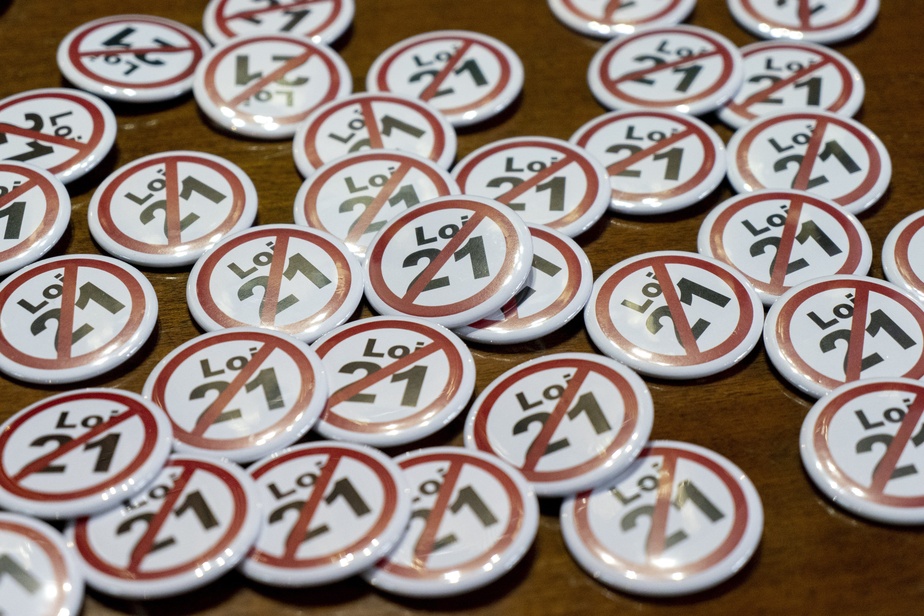
Les membres du groupe de citoyens invitent les Québécois à porter les macarons qu’ils ont fait produire en grande quantité et qu’ils distribuent librement. Sur ceux-ci, on peut voir les mots « Loi 21 », barrés d’une ligne rouge. Porter le macaron montre publiquement son opposition à la mesure législative du gouvernement caquiste et le soutien à ceux « dont les droits sont niés par cette loi discriminatoire », font-ils valoir.

Leur but est de rassembler d’ici le 6 octobre quelque 50 000 personnes portant le macaron et le signe religieux de leur choix, qui participeront ce jour-là à une journée d’action publique. Ils veulent aussi générer une discussion sur la loi et changer l’avis de ceux qui la soutiennent.

Lors du lancement jeudi, des représentants de différentes communautés religieuses étaient présents.

La Loi sur la laïcité de l’État a été adoptée en juin dernier par l’Assemblée nationale.

Ce fut un jour très triste, selon Manjit Singh, de confession sikhe, qui a été dans le passé l’aumônier de l’Université McGill à Montréal.

« Nous sommes venus ici légalement, et soudainement, parce que nous avons quelque chose sur la tête, ce n’est plus acceptable désormais », a-t-il déploré.

Et cela ruine la vie des gens, a ajouté l’homme.

Leur opposition civile à la loi se fait de façon parallèle à la contestation judiciaire qui est en cours, ont-ils affirmé.

À la mi-juillet, un juge de la Cour supérieure a rejeté la demande de groupes de défense des libertés civiles et religieuses qui réclamaient la suspension de la Loi sur la laïcité de l’État. Le juge Michel Yergeau avait alors tranché que la loi continuerait de s’appliquer jusqu’à ce qu’un tribunal se prononce sur le fond de l’affaire. Car le but ultime de ces groupes est de faire invalider cette mesure législative. En août, la Cour d’appel du Québec a accepté de se pencher sur la demande d’injonction.

Source: Laïcité: une campagne contre la loi 21 est lancée

Migrants irréguliers: Ottawa verse 250 millions à Québec

Hard to disagree with the principle.

However, important not to forget that Quebec has a sweetheart deal with respect to the amount transferred annually for economic immigrant selection and settlement services (all categories) that is based on the percentage of of Quebec’s population, not the percentage of immigrants.

Given the current cuts in Quebec levels, and the increase in Canadian ones, the imbalance continues to increase:

À l’approche des élections fédérales, le gouvernement Trudeau sort le chéquier pour régler un différend avec Québec: il versera à la province 250 millions de dollars en guise de compensation pour les coûts liés au soutien des milliers de migrants qui ont franchi la frontière de manière irrégulière en 2017 et en 2018.

Le ministre des Finances, Bill Morneau, a confirmé cette décision par voie de communiqué jeudi après-midi, permettant ainsi au gouvernement Trudeau de tourner la page sur un dossier qui avait provoqué des frictions entre les deux capitales.

Depuis 2017, quelque 43 000 personnes sont entrées au pays de manière irrégulière. Plus de 90% d’entre elles ont franchi la frontière canado-américaine en passant par le chemin Roxham, près du poste frontalier de Lacolle.

«L’augmentation au cours des deux dernières années du nombre de migrants irréguliers qui entrent au Canada par le Québec a imposé au gouvernement du Québec des pressions particulières et sans précédent. Nous apprécions sa collaboration pour la gestion de cet enjeu», a affirmé le ministre Morneau.

Selon lui, le financement accordé au gouvernement du Québec devrait permettre de défrayer l’ensemble des couts extraordinaires liés à l’afflux de demandeurs d’asile en 2017 et 2018.

À Québec, le gouvernement Legault a fait savoir que l’entente conclue avec Ottawa ouvre la porte à d’autres compensations pour les dépenses liées au passage de demandeurs d’asile pour l’année en cours, une fois que leur nombre total sera connu.

En outre, les fonctionnaires de Québec et d’Ottawa poursuivent les négociations afin d’établir un mécanisme de répartition qui doit permettre de rediriger plus rapidement les demandeurs d’asile vers leur province de destination après leur arrivée à la frontière canadienne.

«Pour le Québec, il était primordial de compenser toutes les dépenses extraordinaires encourues pour les demandeurs d’asile au cours des années 2017 et 2018. Après plusieurs mois de négociations, nous avons obtenu le remboursement complet de nos dépenses pour les années 2017 et 2018 ainsi que l’engagement du Canada de rembourser les sommes encourues pour 2019. Il s’agit d’une avancée majeure et cela confirme le rôle du Québec en matière d’immigration», a affirmé le ministre de l’Immigration, de la Diversité et de l’Inclusion, Simon Jolin-Barrette,

Dans le passé, les partis de l’opposition ont accusé à plusieurs reprises le gouvernement Trudeau d’avoir perdu le contrôle de la gestion de la frontière avec les Etats-Unis.

«Le gouvernement du Canada vise d’abord et avant tout à assurer la bonne gestion du système canadien d’immigration et d’asile et à faire en sorte que les flux de migration soient gérés de façon sécuritaire et ordonnée. Le gouvernement du Québec a été et continue d’être un partenaire extraordinaire. Nous sommes impatients de poursuivre notre étroite collaboration avec lui», a pour sa part déclaré le ministre de la Sécurité frontalière et de la Réduction du crime organisé, Bill Blair.

Dans le passé, les partis de l’opposition ont accusé à plusieurs reprises le gouvernement Trudeau d’avoir perdu le contrôle de la gestion de la frontière avec les États-Unis.

Dans un rapport publié en novembre dernier, le directeur parlementaire du budget Yves Giroux estimait que cet afflux de migrants qui traversent la frontière de façon irrégulière a coûté pas moins de 340 millions de dollars au gouvernement fédéral seulement en 2017-2018.

Source: Migrants irréguliers: Ottawa verse 250 millions à Québec