#COVID-19: Comparing provinces with other countries 14 October Update
2020/10/15 Leave a comment


Working site on citizenship and multiculturalism issues.
2020/10/08 Leave a comment
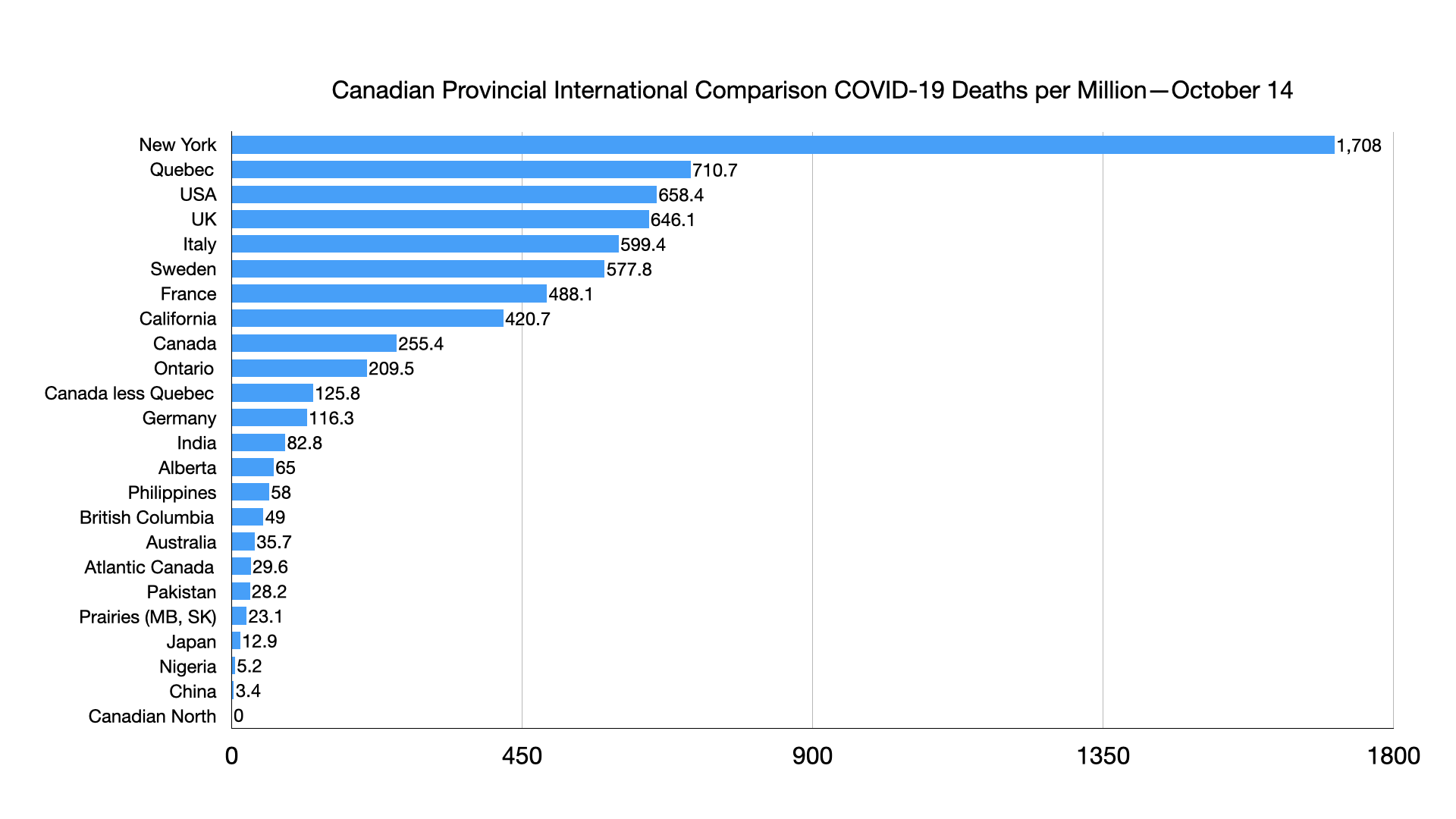
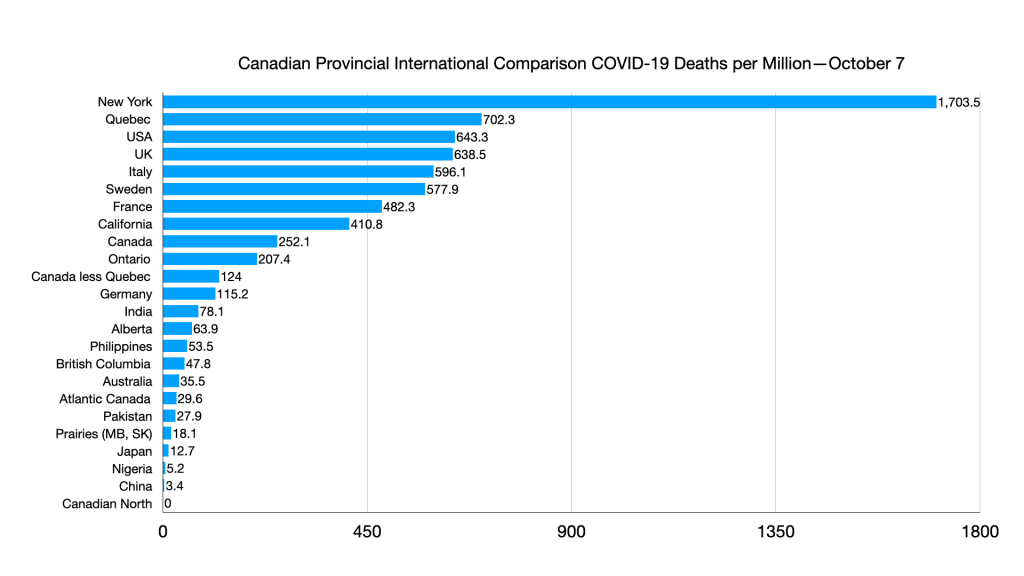
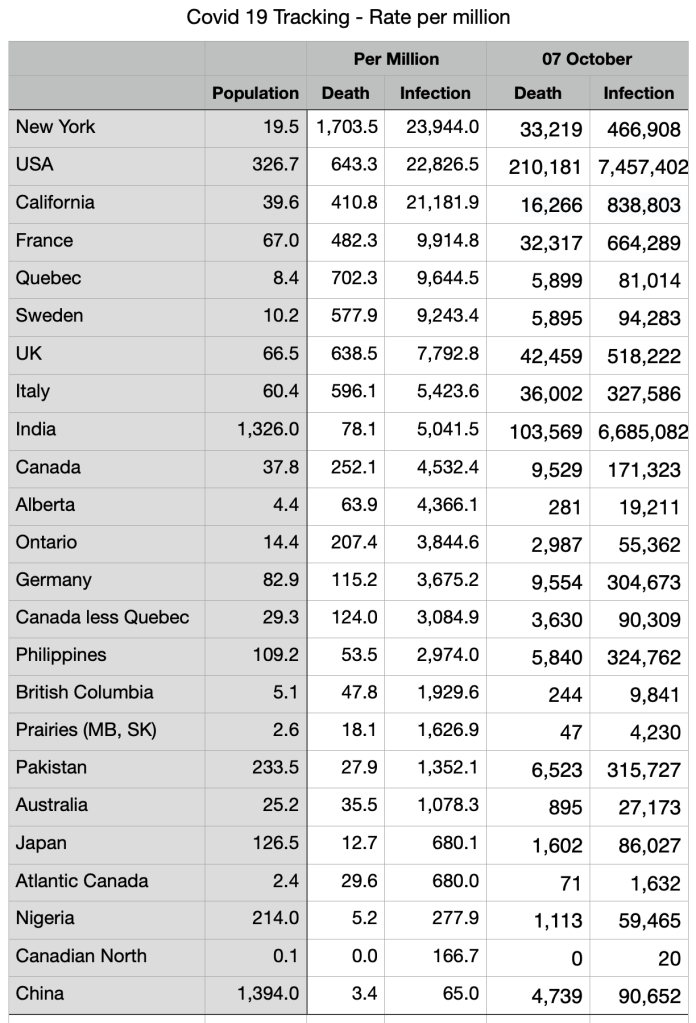
Highlights:
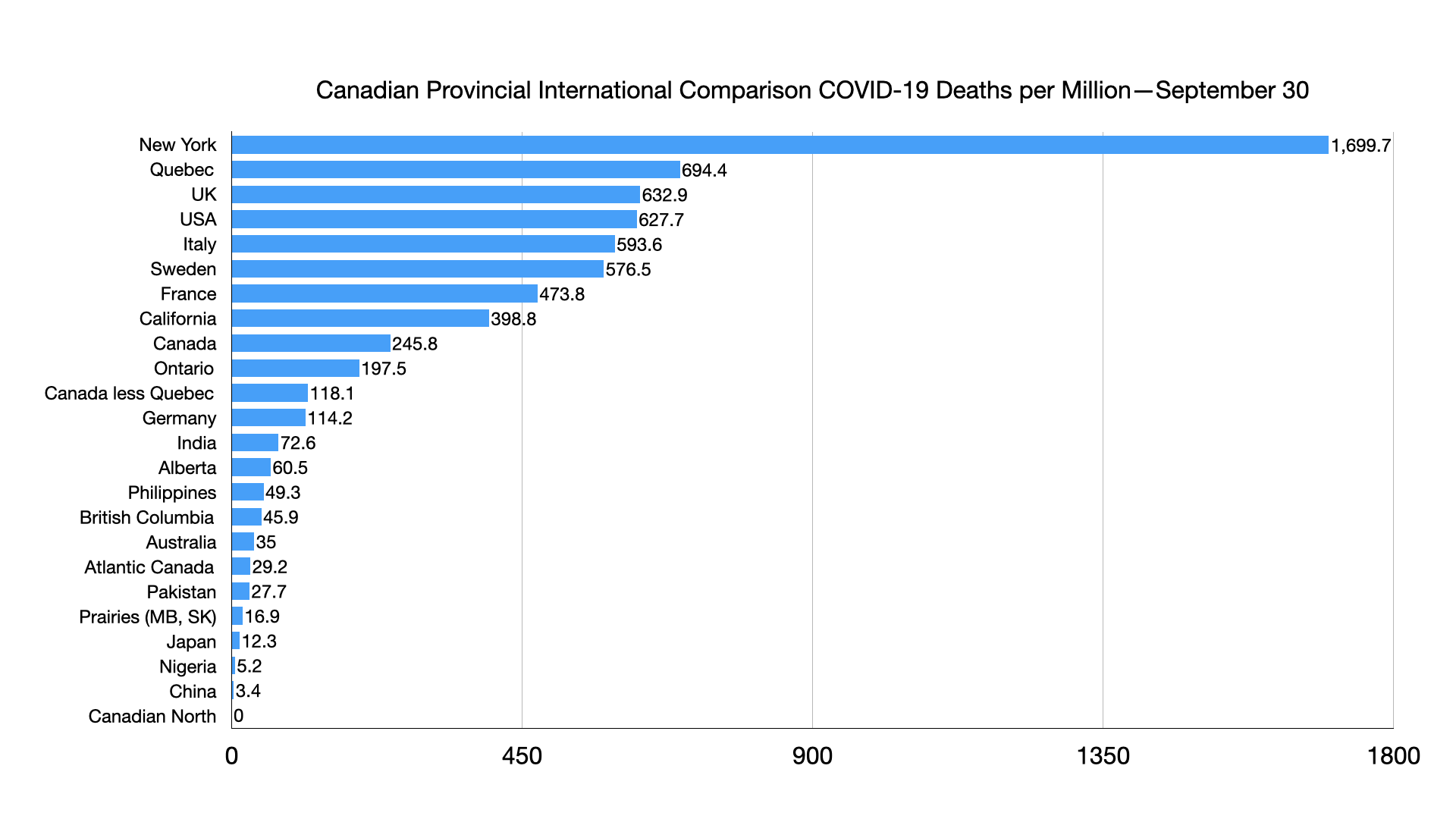
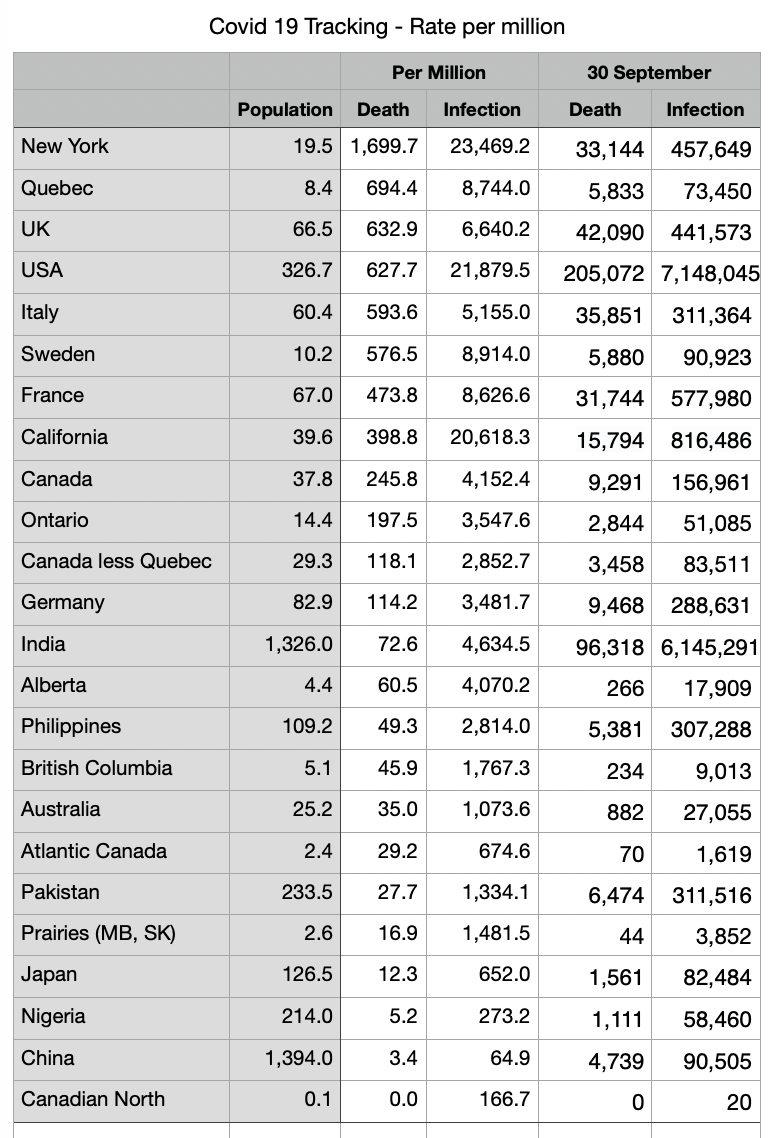
Deaths per million: USA now ahead of UK
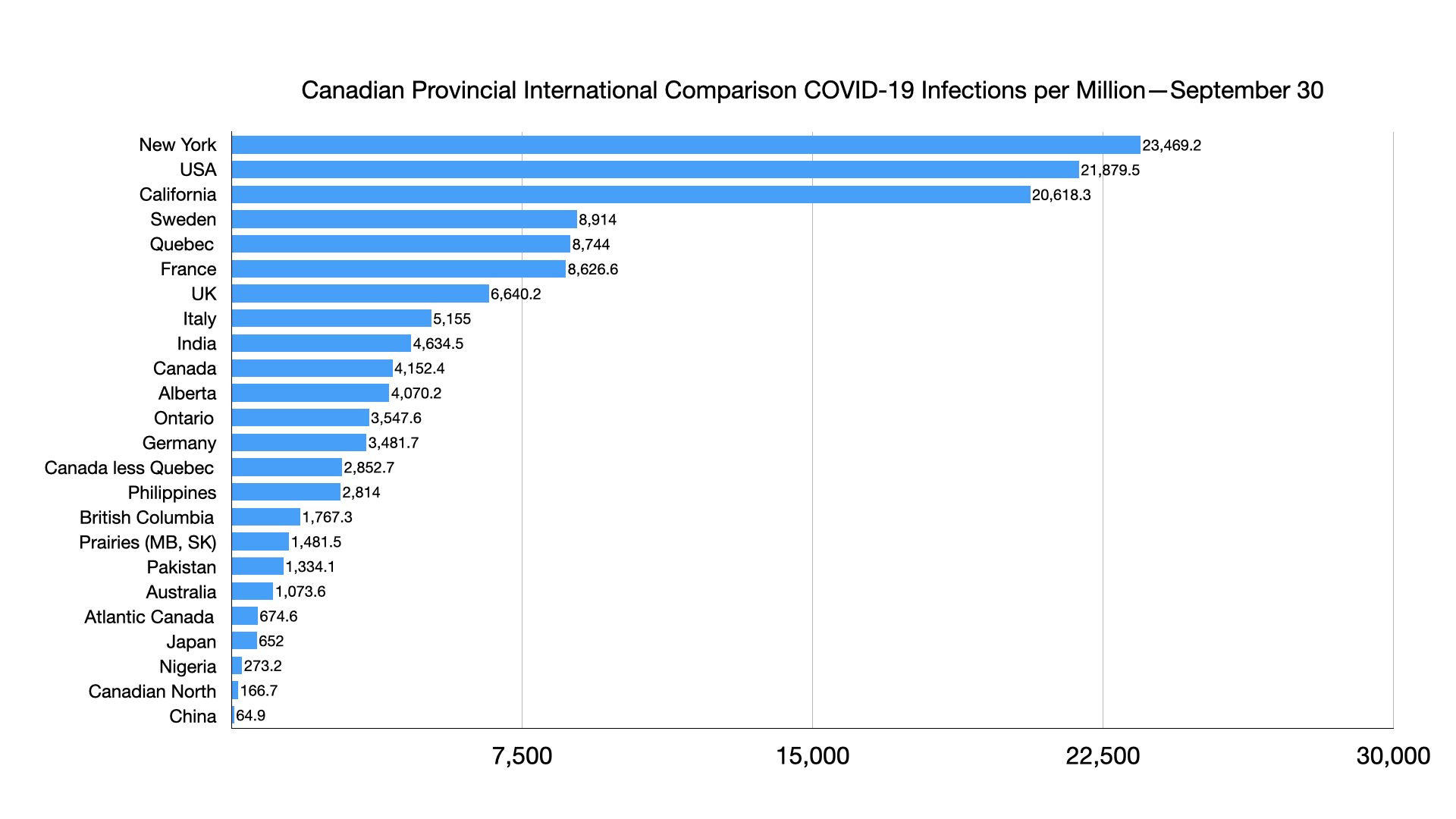
Infections per million: France and Quebec ahead of Sweden, Japan ahead of Atlantic Canada

2020/10/02 Leave a comment
Of note:
From the moment she was admitted to the hospital in Joliette, Que., Joyce Echaquan started filming her interactions with staff.
It was an impulse, friends and family say, driven by long-held concerns about the way Indigenous people are treated at the hospital 70 kilometres north of Montreal.
Ultimately, two days after she walked in with stomach pains, she would broadcast her final pleas for help, capturing insulting and foul language directed at her by attending staff.
Sebastien Moar, Echaquan’s cousin, said she had several health problems, and felt she didn’t receive adequate care at the hospital.
“She always said, at the hospital, they never did anything. They just made sure she wasn’t hurting. She always had appointments and she said the nurses seemed fed up with her,” Moar said.
Echaquan used her phone, Moar said, to make sure her experience was documented.
“She was able to communicate what was happening and what had already happened.”
Her mistrust in the health services provided at the Joliette hospital, the Centre hospitalier de Lanaudière, is widespread in Echaquan’s Atikamekw community of Manawan, 180 kilometres further north.
It was flagged as a problem in the Viens commission, a provincial inquiry into the discrimination faced by Indigenous people.
One year after the Sept. 30, 2019 release of the report, Paul-Émile Ottawa, chief of Conseil des Atikamekw de Manawan, said he has started advising people to seek services elsewhere, for example Trois-Rivières or La Tuque, where signs in the hospitals are translated in Atikamekw.”The racism problems at [the Joliette] hospital did not start yesterday,” he said Wednesday. “Even during the commission we came to devote a whole week to listen to the testimonies of the people of Manawan who suffered discrimination in this hospital.”
According to the Grand Chief of the Atikamekw First Nation, Constant Awashish, people are hesitant to file complaints because they distrust the system.
With no clear directives coming from the Quebec government following numerous recommendations and reports that have identified systemic racism, including the Viens commision, Awashish wants change.
“We’re in 2020. I think we need the government to step up on this and we need them to work on mitigation,” he said.
Mistrust in Manawan
For Alexia Nequado, who is also from Manawan, the death of her friend Joyce Echaquan was all too familiar.
Like Joyce, Nequado said she was admitted to the Joliette hospital two years ago with stomach pain.
Lying on a hospital gurney, Nequado said a nurse came to check on her. When she explained she was still in pain despite the dilaudid injection she had received, the nurse went to fetch a syringe of morphine.
Nequado, who was wearing a bracelet that indicated she was allergic to the drug, passed out.
“When I came to, the nurse told me I was an idiot for not telling her I was allergic,” Nequado said Wednesday.
“I didn’t feel safe and I felt awful for being treated that way.”Nequado said she filed a complaint to the hospital, but when she followed up later she was told it had not been reported to management. Alland Flamand, a witness at the Viens commission who is also from Manawan, said he’s avoided going back to the hospital after trying and failing to get treated for an undiagnosed back problem.
Over six months, he said he went five times and each time was told nothing was wrong then given pain medication and told to rest. He was often asked, he recalled, if he was on drugs.
At one point, Flamand said, he saw a white man at the hospital for his own back problem being treated with a degree of respect he had not been given.
“It showed me clearly that there was racism there,” he said Wednesday.
After half a year of hardly being able to stand up, let alone walk, Flamand finally went to the hospital in Trois-Rivieres where he was taken in for emergency surgery for a herniated disc.”I could have been in her place,” Flammand said of Echaquan. The local health authority, the Centre intégré de santé et de services sociaux de Lanaudière, did not return a request for comment Wednesday about those incidents.
Health authority promises to work with Manawan
Earlier, Daniel Castonguay, the executive director of the health authority, said he was “shocked and disappointed” to hear the language captured on video coming from one of his staff members.
But he denied there is systemic discrimination at the Joliette Hospital against Atikamekw patients.
“We receive complaints from people from all backgrounds, and those complaints are taken very seriously,” Castonguay said.
“But to say that residents from Manawan are systematically treated this way? No, that’s not true.”Castonguay said staff have to follow a cultural awareness training program. He wants to replace that with a working committee in collaboration with Atikamekw communities. “The goal of that partnership is to ensure people feel safe, no matter where they are from.”
With pressure mounting on provincial authorities, Echaquan’s death is now the subject of three investigations: a coroner’s inquest, an investigation by the local health authority into her treatment and broader investigation by the same organization into practices at the hospital.
One of the nurses involved has been fired.
Sylvie D’Amours, Quebec’s minister responsible for Indigenous Affairs, said that whatever the outcome of the investigation, what was captured on video was “totally unacceptable and must be denounced loud and clear.”
“This shows that, unfortunately, there is still racism in Quebec, in particular against Indigenous communities,” she said Wednesday. She also said that 51 of the 142 recommendations from the Viens report have an action plan.
But she too, like Premier François Legault, has continued to deny systemic racism is a problem in the province.
Source: Racism at Quebec hospital reported long before troubling death of Atikamekw woman
2020/10/01 Leave a comment
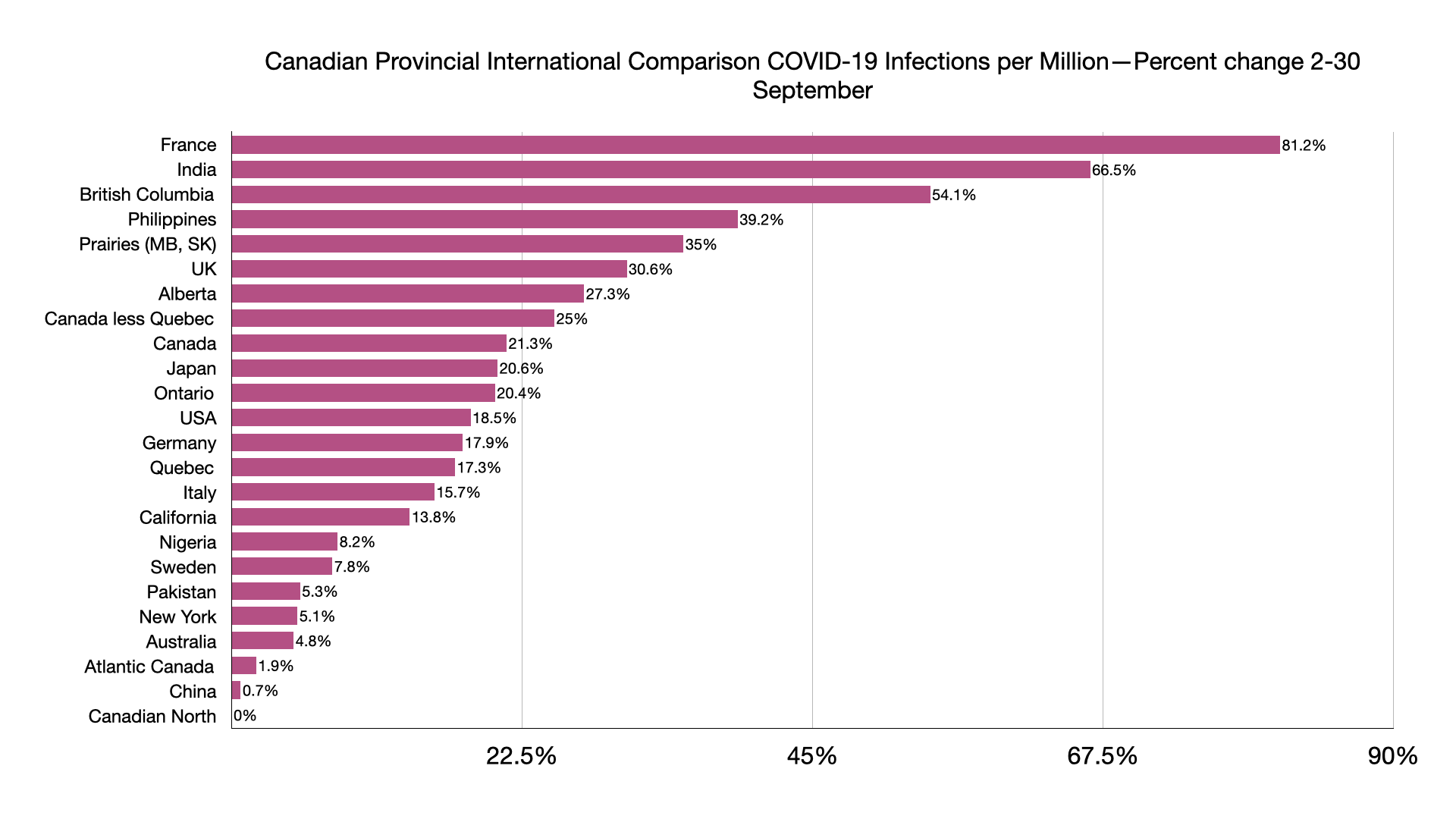
Highlights:
Deaths per million:Canada less Quebec now ahead of Germany
Infections per million: Ontario now ahead of Germany, Canada less Quebec ahead of Philippines
 The Globe has an editorial highly critical of the Ford government:
The German language probably has a word for the state of being surprised by the unsurprising, unprepared for the expected, and caught off guard by the danger you were on guard against. English does not have such a word. But when this pandemic is over, we are going to have to come up with one.
We’ll need it to describe what appears to be happening right now, in Canada.
Governments from coast to coast knew a second wave was coming. It was as predictable as fall. It was as expected as the rising of the sun. It was as surprising as the first snowfall – timing and severity uncertain; occurrence inevitable.
And yet, somehow, many governments have reacted like someone who forgot to set the alarm clock. Leading the parade of those surprised by the unsurprising is Premier Doug Ford’s Ontario government.
On Monday, Ontario reported 700 new cases of COVID-19, a new single-day record. Also on Monday, Ontario casinos reopened their doors to gamblers.
They say timing is everything in comedy and politics. In pandemics, too.
Also on Monday, the Ford government announced that, in response to the second wave, it would be hiring 3,700 more frontline health care workers. It’s a move that should have been made in May or June, not late September.
Still on Monday: Ontario reported processing more than 41,000 tests, but had a backlog of 49,586 waiting to be analyzed. By Tuesday, the backlog was nearly 55,000. The province, like many parts of the country, has recently seen enormous lineups at testing centres; lineups that are – how is this surprising? – driven by the predictable and predicted combination of rising infection rates and people needing to get tested to allow a safe return to school.
Yet again on Monday: The Ottawa Citizen obtained a memo showing that provincial health bureaucrats ordered a reduction in testing in some areas, owing to labs being overwhelmed. It’s another unsurprising result of too little test-processing capacity meeting growing demand for tests.
As of Tuesday afternoon, the pinned tweet at the top of Health Minister Christine Elliott’s Twitter feed still said: “It’s never been more important to get tested for #COVID19.” She’s right. The more people who get tested, the more often, the better. That should include lots of people who have no symptoms. But if everyone takes that advice to heart in the current system, where there are not enough tests or facilities to process them, Grade 3 math points to the inevitability of a surprisingly unsurprising outcome.
For anyone who remembers what Ontario went through last spring, that outcome looks all too familiar. We have lived this movie before.
Yes, Ontario is conducting several times more daily tests than it did back in April. Yes, Ontario has the second-highest provincial testing rate (Alberta is tops). There has been progress. There just hasn’t been enough.
With case numbers rising, as in the spring, and testing not keeping pace, as in the spring, this looks a lot like a sequel. The script has a disturbing amount of consistency. If it were run through plagiarism-detection software, someone would be getting an “F.”
More unsurprisingly surprising findings:
The most recent data from Toronto Public Health, as reported by the CBC, show that most people testing for COVID-19 don’t get results for at least two days. And nearly half of those who test positive are not followed up by contact tracers within 24 hours. Both of those numbers are well below the targets that need to be met for a program of heavy testing and contact tracing – which the province is supposed to have, but doesn’t – to be able to quickly find infected people before they infect others, and even more quickly track down anyone they may have infected.
In an effort to speed things up, the Ford government last week gave the green light for some pharmacies to begin administering tests to some asymptomatic individuals. The province also intends to hire more contact tracers. The mystery is why it didn’t do that months ago.
And last week, the province began rolling out plans for its response to the pandemic’s second wave. But this is like announcing in January that, in response to recent snowfalls, you plan to put out a tender for snowplows. It’s a bit late in the game.
2020/09/23 Leave a comment
Reminder how some Quebec intellectuals remain mired in Québecois de souche as the benchmark rather than language, in this critique by Charles Castonguay:
Dans sa chronique intitulée « Blues souverainistes » du 8 août dernier, Louis Cornellier souligne que « le poids des Québécois d’ascendance canadienne-française diminue sans cesse. Le chercheur Charles Gaudreault a montré qu’il était passé de 79 %, en 1971, à 64,5 %, en 2014 ». Selon Cornellier, il conviendrait « de constater une réalité qui rend l’indépendance de plus en plus improbable ».
Dans la revue L’Inconvénient (no 81, été 2020), Ugo Gilbert Tremblay enfonce le clou. « Or qu’en est-il exactement ? Quelle est la réalité sur laquelle plusieurs parmi les souverainistes préfèrent fermer les yeux ? [Le] chercheur Charles Gaudreault a voulu jeter un regard froidement objectif sur la question. La conclusion de son étude est que, de 1971 à 2014, [le poids] des Canadiens français est passé de 79 % à 64,5 % […] En projetant sur les prochaines décennies un flux migratoire comparable à celui des années précédentes, Gaudreault prédit que les Canadiens français deviendront minoritaires en sol québécois dès 2042 et que leur poids ne sera plus que de 45 % en 2050 […] Il me semble qu’un souverainiste mature devrait être capable de réfléchir — sans hargne ni rancune — aux implications de ces changements démographiques. »
Tout cela repose, cependant, sur de l’ethnie-fiction. Les projections en question ne tiennent pas la route.
Par exemple, Gaudreault définit le « groupe ethnique canadien-français » comme étant formé des descendants des colons français arrivés entre 1608 et 1760. Pour estimer son effectif en 1971, il utilise toutefois la population qui, au recensement, s’est déclarée d’origine française. Or, cette population découle aussi de deux bons siècles d’assimilation par voie de métissage ou d’adoption de personnes d’origine allemande, amérindienne, irlandaise, etc. ainsi que d’un siècle de nouvelle immigration française depuis 1870.
Gaudreault soutient également qu’en 1971, les répondants au recensement ne pouvaient indiquer qu’une seule origine. C’est faux. Ils pouvaient parfaitement en déclarer deux, trois ou plus. Statistique Canada a tout simplement éliminé les déclarations multiples avant la publication des données, en assignant à chaque répondant en cause une seule de ses origines déclarées.
Gaudreault affirme en outre que les données de 1971 sont les dernières observations fiables sur l’origine ethnique depuis 50 ans du fait qu’elles se fondent sur des « choix fermes », alors que tous les recensements suivants ont procédé par autoénumération. Faux encore. L’autorecensement a débuté en 1971 même, et Statistique Canada a recueilli des données fiables sur l’origine française jusqu’en 1991 inclusivement.
Les projections de Gaudreault excluent ensuite tout nouvel apport — même celui de nouveaux immigrants français — à sa population de départ, soit la population d’origine française énumérée en 1971. Pas surprenant, alors, qu’à force de faire mourir une population fermée et foncièrement sous-féconde, Gaudreault aboutisse, sous l’hypothèse d’une immigration non française abondante et soutenue, à un moignon de « Canadiens français ». Semblable appareil de projection réduirait en peu de temps n’importe quelle majorité à un statut minoritaire.
Dérapage
Notons qu’après une répartition égale des déclarations d’origines multiples entre les origines déclarées, le poids de la population d’origine française recensée en 1991 s’élevait à 77,5 %, en baisse de seulement 1,5 point de pourcentage depuis 1971. Par comparaison, les « descendants de Canadiens français » de Gaudreault en perdent 5, plongeant en 1991 à 74 %. Les projections de Gaudreault dérapent sérieusement, donc, dès 1991, soit 20 ans seulement après leur point de départ.
L’étude de Gaudreault a été mise en ligne en 2019 par la revue Nations and Nationalism. L’Action nationale en a repris l’essentiel en mars dernier, bonifié de quelques pages additionnelles dans lesquelles Gaudreault accuse Statistique Canada de ne pas avoir recueilli de données valables sur la langue depuis 1971. Faux toujours. Il y gratifie même Navdeep Bains, ministre responsable de Statistique Canada, et Anil Arora, son statisticien en chef, tous deux d’ascendance indienne, de remarques gentiment racistes.
Bel exemple de « regard froidement objectif ».
C’est d’ailleurs en fonction de la langue, et non de l’origine ethnique, qu’on juge du caractère français du Québec ou de l’appui éventuel à l’indépendance. Le poids de la population québécoise parlant le français comme langue principale à la maison est d’abord passé de 80,8 % en 1971 à près de 83 % en 1991, puis est revenu à 80,6 % en 2016. Dans cette optique, tout ne serait pas encore perdu.
Source: Ethnie-fiction et indépendance
2020/09/22 Leave a comment
Of note. Perhaps not surprising, after laying out the options, Kinsinger essentially adopts the Liberal government’s position of reserving the right to intervene in an exiting legal process:
Among the more discouraging aspects of the 2019 federal election was the failure of all major parties to take any meaningful stand against Quebec’s Bill 21. The legislation, which was passed by the National Assembly of Quebec last year, prohibits many public servants from wearing religious attire while they’re on duty. According to the Quebec government, one of the key purposes of the law is to promote the religious neutrality of the state. Civil libertarians and religious equality advocates, however, have widely denounced Bill 21 as an unjustified state intrusion into matters that fall outside of the its proper constitutional role.
To date, four separate legal challenges have been brought against Bill 21. The Quebec Superior Court will hear these cases together in the near future. In anticipation of this litigation, the Quebec government invoked section 33 of the Canadian Charter of Rights and Freedoms, often referred to as the notwithstanding clause. This provision constitutionally insulates laws that would otherwise violate certain rights and freedoms guaranteed by the Charter, subject to a renewal by the enacting legislature every five years.
Even with the invocation of the notwithstanding clause, Bill 21 flies directly in the face of constitutional protections that limit the state’s ability to dictate matters of conscience or religious belief. All political parties ought to be opposed to this legislation and should develop policies based on the very real grounds they would have to challenge Bill 21 if they form government. However, it is especially disappointing that Erin O’Toole, the recently elected leader of the Conservative Party, has not taken advantage of this opportunity to differentiate himself from other federal party leaders by openly opposing Bill 21.
The Tories have numerous reasons to be particularly offended by Bill 21: conservatives have long affirmed the positive and important role that religion plays in the lives of individuals and in the public square, and they often bill themselves as the strongest defenders of religious freedom, even when it seemingly clashes with other shared values.
In this sense, it is unsurprising that O’Toole has vowed to protect the rights of religious minorities both in Canada and abroad if he becomes prime minister. Yet following a meeting with Quebec Premier François Legault on Sept. 14, O’Toole told reporters he backed provincial autonomy and would not interfere on the issue of Bill 21. While O’Toole has sought to frame this as an issue of national unity, he no doubt also fears alienating Bill 21’s numerous supporters in Quebec, a province in which, many observers insist, the Conservatives must make significant inroads if they hope to regain power. Indeed, O’Toole’s decisive leadership victory over frontrunner Peter MacKay is being attributed in large part to the high support he received from Conservative members in La Belle Province.
It would nonetheless be a mistake for O’Toole to assume that the endorsement he received from Quebec Tories will translate into support from Quebec voters more generally. If past electoral performance is any indicator, the Conservatives will still face an uphill battle in Quebec when the next election is called. On this point, O’Toole would do well to remember that the road to Conservative success also goes through racially and religiously diverse ridings, especially those found in the Greater Toronto Area: it is here that a conservative defence of religious freedom can make a strong appeal to both religious and immigrant voters.
Consider the 2019 election, in which former Conservative leader Andrew Scheer’s personal religious views became a hotly debated election issue. Scheer never found a satisfying answer to an endless barrage of questions about whether he supported same-sex marriage. Had he defended himself on the grounds of religious freedom and conscience rights, and then made clear he wanted to protect these rights for all religious minorities, he might have been able to find a powerful message that resonated with voters in the ridings the Conservatives needed — and ultimately failed — to pick up.
To be sure, the Conservatives should denounce Bill 21 first and foremost as a matter of principle. But this doesn’t mean that O’Toole needs to ignore the compelling political reasons that favour taking a stand against this odious law. By promoting the rights of religious minorities, the Tories can show that religious freedom is truly about protecting the practices of all believers, and not just coded language used by social conservatives and Christians to defend their own beliefs. To this end, Garnett Genuis, a rising voice in the Conservative caucus and an early supporter of O’Toole’s leadership bid, has already shown how opposition to Bill 21 can be expanded into a broader platform for combating systemic discrimination in all its forms.
There are a range of policies that the federal government could adopt toward Bill 21, regardless of who occupies the Prime Minister’s Office. Admittedly, some of these are more advisable than others. The most radical would be to invoke the rarely used disallowance power, under which the federal government is permitted to constitutionally invalidate provincial legislation. Of all the available options, this is by far the least desirable. Although it was once employed regularly, the federal power to disallow provincial legislation has not been invoked for the better part of a century, and its use now would likely ignite a constitutional crisis concerning its legitimacy.
The next option would be for the federal cabinet to refer Bill 21 directly to the Supreme Court of Canada for an opinion on its constitutionality. The current challenges that have been brought against Bill 21 could take years to make their way through the normal appeals process. By referring the matter directly to the court of final appeal, the federal government could save these parties the considerable time and cost of litigating the constitutionality of Bill 21. Although advisory opinions don’t constitute precedents as weighty as do rulings on cases that were contested by litigants, in practice they’re usually treated as binding.
One of the key questions that will likely be addressed in the Bill 21 litigation concerns the Quebec government’s invocation of the section 33 override, even though the courts may ultimately decide to strike down the legislation on other grounds. Although invoking the notwithstanding clause was once considered taboo, provincial governments have increasingly relied on it in recent years to safeguard controversial legislation against unwanted Charter challenges. While a reference to the Supreme Court on Bill 21 would likely provide much-needed clarity on the constitutional limits of section 33, it could also result in undesirable tension with the Quebec government.
Thankfully, a less contentious alternative remains open to the federal government: the attorney general of Canada may, as of right, intervene as an added party in any litigation involving a constitutional question. Of the various responses to Bill 21 potentially available to O’Toole if he becomes prime minister, this would be the most prudent. Unlike a direct constitutional reference, an intervention by the attorney general would not force the Quebec government’s hand by initiating fresh litigation. Such an intervention could be further tailored to demonstrate the significant ways in which this law misapplies important constitutional principles, but without adopting a hard position on section 33 that risks open confrontation with the provinces.
The insistence that there are no politically viable options available to O’Toole and the Conservatives on Bill 21 rings hollow. To the contrary, Bill 21 has presented the Tories with a rare opportunity to offer leadership on a defining civil liberties issue while making the case to religious minorities that they have a home and champion in the party. The only question is whether Erin O’Toole is prepared to truly lead.
Source: Conservatives should show leadership on Bill 21 and defend religious freedom
2020/09/18 Leave a comment
Of concern:
Late one Tuesday night in May, while most of Quebec was still under lockdown orders, the phone rang in Premier François Legault’s riding office.
In a calm but firm voice, a man left a message saying he regretted voting for Legault, and then warned the premier that his days were numbered.
A few hours later, at 3:16 a.m., the man called back and left another message. This time he was screaming and swearing about Quebec’s top public health official, Dr. Horacio Arruda.
The man said he could get access to a gun and wanted to shoot Arruda.
A member of Legault’s office staff who heard the message alerted Quebec provincial police. Their investigation quickly turned international.
The calls were traced to a 47-year-old trucker from Quebec City, Philippe Côté. A tracking device on his truck indicated Côté was in Texas, not far from a gun shop, when he phoned Legault’s office.
Canadian border guards were placed on alert. When Côté crossed back into Canada on May 16, they spent three hours searching his truck.
The border guards didn’t find any weapons, but they did uncover evidence of a different threat, one that also crosses borders and has the potential for violence.
“Several bits of paper were found on which were written different political conspiracy theories,” reads a description of the incident contained in court documents.
Côté was allowed to re-enter the country, but was arrested by provincial police a short time later. On May 21, he pleaded guilty to two counts of uttering death threats, and will be sentenced later this month.Côté’s lawyer, Olivier Morin, told reporters back in May that his client had been emotionally distraught by the pandemic and the rules he had to follow as a trucker.
“He was mixed up. He wanted answers and he went on conspiracy websites,” Morin said.
Since May, provincial police in Quebec have arrested at least four other people for allegedly making online threats against politicians and other public figures. Police have interviewed several more about their online activities following complaints from the public.
The suspects all have Facebook accounts that promote conspiracy theories about COVID-19, including some that originate from QAnon, a conspiracy movement that began in the U.S. and is now considered a national security threat by the FBI.
Experts who monitor extremist groups in Quebec are concerned about the role conspiracy theories are playing in radicalizing online behaviour, and the possibility it could turn into real-world violence.
“We’ve seen it before, and it was called Alexandre Bissonnette,” said Martin Geoffroy, who heads an anti-radicalization research centre at Cégep Édouard-Montpetit, a public francophone college in Longueuil.Geoffroy was referring to the man who killed six people at a Quebec City mosque in 2017.
“QAnon is ravaging the mainstream population right now,” Geoffroy said. “This is part of the collateral damage of the pandemic.”
Conspiracy theories take root in pandemic
Conspiracy theories shape the way a significant number of Quebecers think about the pandemic.
A poll conducted last month for Montreal’s La Presse newspaper suggested 35 per cent of the population believe mainstream media outlets are spreading false information about COVID-19; 18 per cent believe the pandemic is a tool created by governments to control them.
Those findings echo a survey done in June by the province’s public health research institute (INSPQ), which found 23 per cent of Quebecers believe that COVID-19 was fabricated in a laboratory — a theory rejected by scientists who have studied the genetic code of the virus and determined it was not manipulated.
Among the most popular purveyors of conspiracy theories in the province is Alexis Cossette-Trudel, the son of two convicted FLQ terrorists, who broadcasts his views on social media under the moniker Radio-Québec.His YouTube channel has more than 110,000 subscribers. Analytics show that number has nearly quadrupled since the pandemic hit Quebec in March.
Cossette-Trudel openly expresses support for QAnon, which holds, among other claims, that U.S. President Donald Trump is waging a battle against an international cabal of high-profile liberals who are Satan-worshipping pedophiles operating a child sex-trafficking ring.
In one recent video, Cossette-Trudel said Legault was exaggerating the risks of COVID-19 as part of a global plot to ruin the economy and prevent Trump from being re-elected.
This strain of conspiracy thinking is a visible component in the ongoing anti-mask demonstrations in Quebec.
At a protest last Saturday in Montreal, which attracted several thousand people, there were dozens of posters and T-shirts inspired by QAnon symbols and slogans.
Many participants said they thought the pandemic was “over” or “fake” and that the government was lying about the deadliness of the disease.”At first I thought Radio-Québec was too extreme, but then with time I realized they are right,” said Marie-Josée Bernard, a mother of three who took part in Saturday’s demonstration.
Arrests for alleged threats
Conspiracy theories, though, are not only contributing to anti-mask protests in Quebec, they also appear to be playing a role in violent online behaviour.
- On July 28, a 26-year-old man was arrested for allegedly making online threats against a journalist. His Facebook page has links to conspiracy videos about the pandemic, and content from QAnon supporters.
- On July 30, a 27-year-old man was charged with intimidation, obstructing an officer and three counts of uttering threats against Legault, Arruda and Prime Minister Justin Trudeau. His Facebook page features links to far-right content, videos by Radio-Québec and various other conspiracy videos about the pandemic.
- On August 4, a man in his 60s was arrested for allegedly making online threats against both Legault and Arruda. The arrest came shortly after a Facebook account that circulates QAnon conspiracies published Arruda’s home address.
- On Aug. 7, a 45-year old man from Drummondville was charged with intimidation and two counts of uttering threats, reportedly against Arruda. Along with posting conspiracies about the pandemic, his Facebook page also features racist and anti-Semitic content.
Along with the arrests, Quebec provincial police have also met with several other individuals about threats associated with their social media accounts, at least three of which indicated support for Radio-Québec.
Cossette-Trudel did not respond to a request for comment.
‘We don’t want to wait until it’s too late’
In the U.S., conspiracy theories in general, and those associated with QAnon in particular, have contributed to the radicalization of several people who have committed acts of violence.
A recent study published by West Point’s Combating Terrorism Center concluded that the “increasing frequency of criminal or violent acts by QAnon supporters seems possible, even likely” in the months to come.
Experts in Quebec have similar fears that online violence could move offline.
“We’re speaking with police to help with prevention. We don’t want to wait until it’s too late,” said Roxane Martel-Perron, who heads education efforts for Montreal’s Centre for the Prevention of Radicalization Leading to Violence.
The issue, said Martel-Perron, is not that people would question the government’s handling of the pandemic. It’s that the answers they are receiving — about shadowy plots out to control them — can be used to justify extreme acts.
“What we’re worried about is the violent means that might be taken in response to these perceived grievances,” she said.
Quebec politicians have signalled their growing concern, as well.
On Tuesday, the first day of the fall legislative session, independent MNA Catherine Fournier introduced a motion calling on the National Assembly to “recognize that the rise of conspiracy theories in Quebec is alarming and requires concerted action from civil society and public authorities.”
The motion passed unanimously.
Source: Exploring the danger behind Quebec’s anti-mask conspiracy theorists
2020/09/10 Leave a comment
Of note:
A Quebec court judge, who refused to hear the case of a Montreal woman because she was wearing a hijab, has finally apologized for the incident, more than five years after it happened.
At an online hearing of the Quebec Council of the Magistrature on Tuesday, a lawyer for the council read Judge Eliana Marengo’s apology to Rania El-Alloul.
The council is the body responsible for disciplining judges in the province.
In her statement, Marengo said she acknowledged that she erred in asking El-Alloul to remove her hijab, that she regretted any inconvenience and that she never intended any offence or disrespect.
Marengo addressed the fact that at the time she had compared El-Alloul’s hijab to a hat and sunglasses being worn in the courtroom.
“My reference to hats and sunglasses was simply meant to exemplify how the rules of decorum are generally applied in the courtroom and was most certainly not meant to disrespect either you or your beliefs,” Marengo said.
She concluded by offering El-Alloul her most sincere apologies.
El-Alloul read her own statement in response, saying she accepted Marengo’s apology.
“I remember that day in the courtroom like it was yesterday. I couldn’t imagine that I would be turned away from the justice system because of my hijab, that my rights would be taken away because of my beliefs,” El-Alloul said.
“I hope she understands the pain she caused me, and why it is so important for her to account for her actions. Our justice system is not made for some and not others. No, this is a democracy, where everyone is to be treated equally before the law,” she continued.
“I accept her apology. This is what my faith teaches me.”
‘Not suitably dressed’
The controversy dates back to February 2015 when El-Alloul was in court trying to get back her impounded car.
“In my opinion, you are not suitably dressed,” Marengo told El-Alloul at the time. The judge said the court was a secular space, and no religious symbols should be worn by those before it.
The case was suspended, and El-Alloul eventually got her car back. But the story made headlines around the world.
Dozens of people, including El-Alloul, ultimately filed complaints with the Council of the Magistrature.
El-Alloul’s complaint was dismissed on a technicality, but the council agreed to look into the dozens of other complaints on the matter.
Marengo challenged the authority of the council to examine the complaints. She sought leave to appeal a Quebec Court of Appeal decision that unanimously found she was wrong to bar El-Alloul from her courtroom.
But in 2018, the Supreme Court refused to hear Marengo’s challenge.
Change of heart
The Council of the Magistrature sent a letter earlier this summer to the complainants, informing them of today’s hearing.
“The purpose of this hearing will be to study a settlement proposal from the prosecutors on file, including a letter of apology from Judge Marengo to Mrs. El-Alloul,” the letter said.
The council also told the complainants the apology would be released to the public, in exchange for dropping the disciplinary charges against Marengo.
The settlement was jointly proposed by Marengo’s lawyers and the lawyer handling the complaint for the council.
The panel of judges presiding over the hearing said it would take time to consider today’s arguments before deciding whether to accept the settlement.
Source: Quebec judge who asked woman to remove hijab apologizes, 5 years later
2020/08/27 Leave a comment
Again, surprising given Quebec’s overall poor performance in managing and containing the pandemic. And another kudos to Premier Ford for his plain language messaging “Just do it…”:
Quebec won’t use a smartphone application to notify the public about potential exposure to COVID-19 for now, arguing its testing and contact-tracing capability are sufficient at this stage of the pandemic.
While the province is not closing the door on using an app in the future, Premier François Legault says he would rather use one that was developed in Quebec.
“We would prefer a Quebec company, but I don’t think this is our main argument,” Legault said Tuesday afternoon in Saint-Hyacinthe, Que.
He says there is a lack of broad support for such an app in the province, due to privacy concerns.
“Maybe in six months we will come to another decision,” he said.
The decision puzzled the federal Health Ministry. Thierry Bélair, a spokesperson for Health Minister Patty Hajdu, pointed out that the app offered by the federal government, COVID Alert, does not track a user’s location nor collect any other personally identifiable information.
“It’s also an additional tool we can use as we prepare for a possible increase in cases this fall. So why not make it available now in Quebec?” said Bélair.
COVID Alert, which uses open-source technology built by a volunteer team of engineers at Ottawa-based Shopify, is designed to warn users if they’ve spent at least 15 minutes in the past two weeks within two metres of another user who later tested positive for the coronavirus.
It was launched at the end of July and currently only works in Ontario, where it has been downloaded more than two million times.
Adoption of one app across Canada would be “very helpful” to ensure those who travel between provinces are notified of possible exposure to the virus, Dr. Theresa Tam, Canada’s chief public health officer, said at a Tuesday news conference.”From the federal perspective, we want as many Canadians as possible to be participating,” she said.
Experts in both technology and public health stress that the more people who use the app, the better it will be.
Canada’s Chief Public Health Officer Dr. Theresa Tam says more widespread adoption of the COVID Alert app is one more layer of protection. This comes as Quebec announces it will not sign on to the app for now. 1:03Éric Caire, Quebec’s minister responsible for digital transformation, said the government is interested in a made-in-Quebec app and is also running tests on the federal app to ensure it is secure.
He said the province has learned from public consultations and legislative hearings that a solid understanding of the technology used in an app makes Quebecers more open to installing it.
“The more that people are told what it does and does not do, the more they will be reassured,” said Caire.COVID Alert relies on Bluetooth technology to detect proximity to other users, instead of GPS data.
The province heard from 16,456 Quebecers in online public consultations about the use of a COVID-19 notification app. Seventy-seven per cent believed such an app would be useful, and 75 per cent said they would install it, the province said in a statement.
But the voices heard at hearings, held by the Institutions Committee in Quebec City, about a possible contract-tracing app were more skeptical.
“Quebec’s legal framework is inadequate in terms of data and personal information protection and access to information, informed consent and the fight against discrimination,” said a report prepared by the committee once those hearings concluded.
Committee members acknowledged that almost all of the 18 experts who testified at the hearings expressed serious reservations about the effectiveness and reliability of the technology.
Dr. David Buckeridge, an epidemiologist at McGill University’s School of Population and Global Health, said the right time to start using such an app would be before the number of daily new cases reaches the crisis levels seen in the spring.”I think the risks, frankly, from this app are relatively quite low, and it was designed in that way,” he said.
“The main issue here is going to be trust and adoption.”
Caire said the province will continue to watch how widely the app is used in Ontario and that Quebec will consider using an app in the event of a second wave.
Ontario Premier Doug Ford said he would ask Legault to reconsider his government’s decision.
“Just do it. It protects everyone,” he said to reporters Tuesday afternoon. “It’s not a big deal.”
2020/08/24 Leave a comment
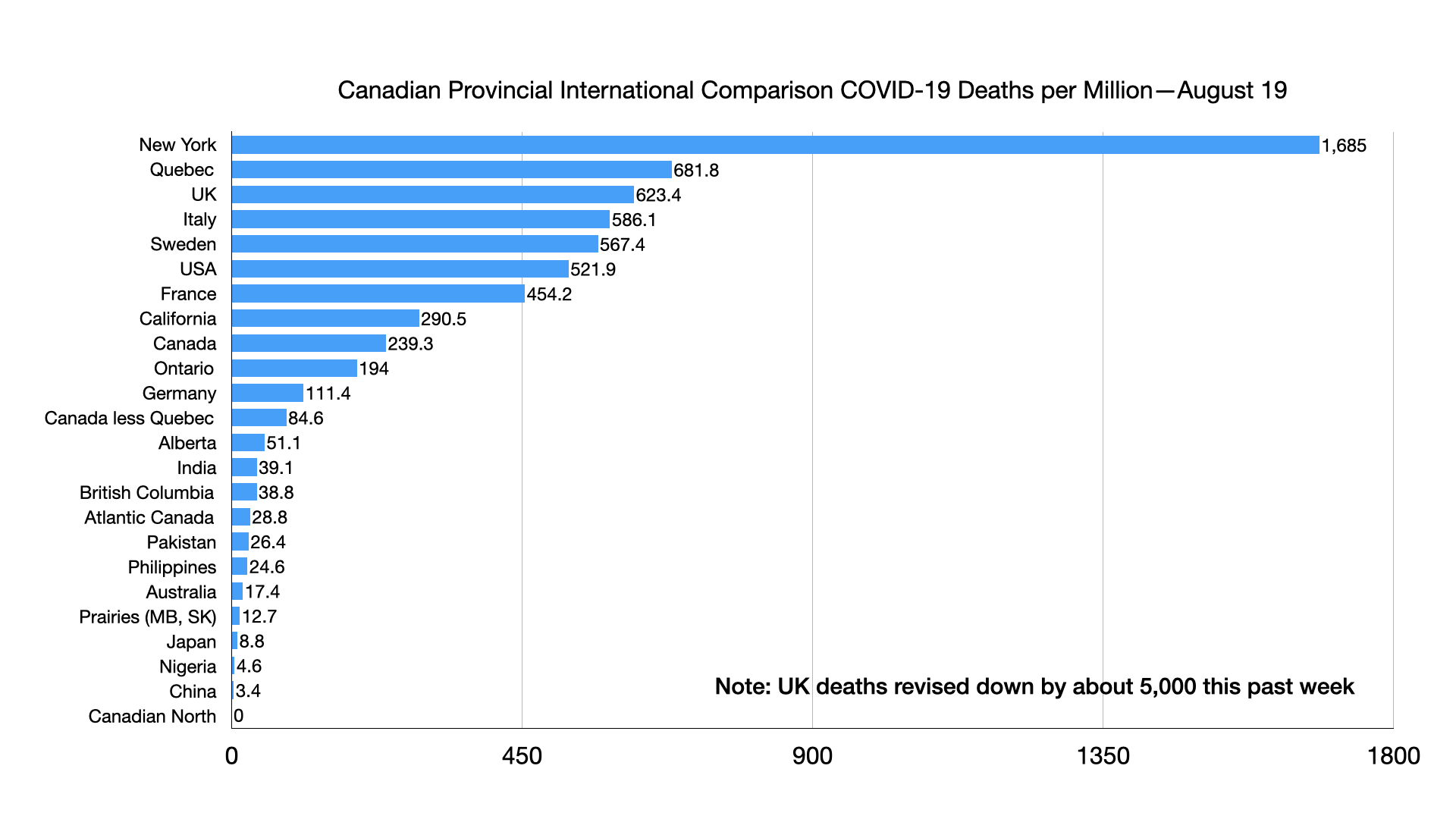 Ironic to cite COVID-19 as a justification for Quebec independence while ignoring that Quebec has the highest number of infections and deaths per million of all Canadian provinces and on par with the most affected European countries.
And of course, both multiculturalism and interculturalism are similar models of civic integration, with more semantic rather than substantive differences:
Du point de vue de notre avenir politique, deux leçons peuvent être tirées de l’actuelle pandémie. Nous avons pu constater que, presque partout, les populations plongées dans l’insécurité se sont tournées vers leur nation pour se protéger. Les instances supranationales, à commencer par l’Union européenne, se sont montrées étonnamment impuissantes à mettre en œuvre des initiatives efficaces pour contrer la pandémie.
Chacun a pu ainsi prendre conscience du recours indispensable que l’État-nation continue de représenter comme rempart dans un contexte de crise. Cette enceinte a montré une grande capacité à susciter une solidarité, montrant ainsi qu’elle est loin d’avoir perdu sa pertinence. Il y a intérêt à la soutenir et à la perpétuer. C’est la première leçon.
La pandémie a aussi révélé la fragilité des réseaux supranationaux. La mondialisation ne s’en trouve pas pour autant condamnée, loin de là, mais elle a accusé d’inquiétantes carences. Il sera prudent de mieux définir nos engagements et nos articulations avec cette sphère qui demeure largement chaotique et imprévisible. On voit l’importance de pouvoir se reposer sur un État doté de tous les pouvoirs essentiels. C’est la deuxième leçon.
Les raisons profondes qui ont toujours motivé le mouvement souverainiste restent d’actualité : le combat pour le français, l’émancipation économique, sociale et culturelle de notre société, le renforcement d’une francophonie nord-américaine et, plus généralement, une plus grande liberté collective pour traiter à notre façon, suivant nos traditions et nos choix, les grands problèmes de l’heure. Ces raisons sont clairement rappelées et mises à jour dans le dernier numéro de la revue Action nationale. La pandémie en fait voir d’autres : renforcer la nation-refuge et procurer à l’État une marge de manœuvre accrue qui lui permet de mieux naviguer à travers les écueils de la sphère planétaire.
Sur l’enjeu identitaire
Tout cela survient au moment où le Parti québécois, occupé à se redéfinir, se donnera bientôt un nouveau chef. J’aimerais, dans ce contexte, soumettre trois réflexions. La première concerne la thématique identitaire, toujours bien vivante au sein de ce parti. Écartons d’abord un malentendu. Il est incontestable qu’une nation a besoin d’une identité comme expression d’une appartenance et source de solidarité. On imagine mal comment, privée de ces ressorts, elle pourrait mobiliser ses citoyens et ses citoyennes autour d’idéaux et de projets communs.
Le danger, c’est lorsque la quête d’une identité glisse vers une auscultation de soi qui l’appauvrit et rétrécit le « nous » de la nation. Un déplacement de ce genre est néfaste pour une société diversifiée. Il tend aussi à diminuer la place d’une dimension essentielle, celle de l’action collective, des grands projets que nous pourrions réaliser tous ensemble comme Québécois. Or, la mémoire de ces réalisations contribue justement à fortifier l’identité.
La population québécoise est de plus en plus diversifiée et le vieux noyau francophone jadis largement majoritaire se contracte progressivement (de 79 % en 1971, sa proportion serait passée à 64 % en 2014). Il est donc nécessaire d’ajuster la définition de la nation et de l’identité à la nouvelle réalité.
Est-ce là succomber au multiculturalisme ? On en est loin. Premièrement, il s’agit simplement de reconnaître les droits de tous les citoyens du Québec, en particulier là où ils sont compromis. Cette règle n’est pas copiée du multiculturalisme, elle fait partie de l’héritage général de toutes les horreurs commises durant la première moitié du XXe siècle en Occident. L’éthique qu’elles ont engendrée invite à respecter la diversité plutôt que de la broyer. Le multiculturalisme canadien en est lui-même une expression parmi bien d’autres, tout comme l’interculturalisme québécois.
Deuxièmement, le modèle canadien en matière de relations interculturelles est très différent de l’approche québécoise. Dans le premier cas, les groupes ethnoculturels se voient accorder une latitude exceptionnelle, si bien que le souci de cimenter ces minorités devient quasiment secondaire.
Au Québec, au contraire, c’est une priorité. Nous sommes une petite nation constamment soucieuse d’intégration, de solidarité, de concertation, de rassemblement — et de survie. Troisièmement, le multiculturalisme canadien reconnaît l’existence de minorités mais nie celle d’une majorité. Comment ce modèle pourrait-il s’appliquer ici ?
Le prochain chef du PQ
Je reviens au Parti québécois. La recherche d’une identité forte, au sens défini plus haut, et la promotion d’une conception vraiment inclusive de la nation ne sont nullement incompatibles. Il suffit de revenir à la tradition instaurée par le parti à ses années glorieuses. La loi 101 en est une parfaite illustration. D’un côté, elle servait les intérêts de la majorité en renforçant le français. De l’autre, elle servait les intérêts des minorités en leur procurant le moyen de mieux s’intégrer à la société et d’y faire leur chemin.
Dans l’intérêt du parti et de celui du Québec, il est éminemment souhaitable qu’il renoue avec cette philosophie qui lui a valu une grande partie de ses succès. Cette tradition est toujours porteuse d’avenir parce qu’elle est étroitement alignée sur le Québec en devenir que les fondateurs avaient remarquablement anticipé.
Concernant la course à la chefferie, ces réflexions invitent à favoriser le candidat qui incarne le mieux à la fois la grande tradition et l’avenir du parti suivant les voies esquissées ici. Parmi les candidatures en lice, celle de Sylvain Gaudreault me semble la plus proche de ce profil.
Source: La souveraineté du Québec, plus nécessaire que jamais

Click image for book purchase
 Multicultural Meanderings
