Trigger for new immigration powers ‘intentionally not defined’ in border bill: Diab

Not reassuring as some guidelines or principles would be useful:

Immigration Minister Lena Diab says the definition of a “public interest” event that would allow her department to pause or revoke immigration applications is “intentionally not defined” in new legislation.

Diab told the House of Commons immigration committee today the definition was left open-ended in the government’s new border security bill, C-12, to allow Ottawa to respond to unforeseen events.

“It is intentionally not defined in the legislation, as I said, to allow for maximum flexibility for the government to respond in a range of unforeseen circumstances that threaten the public interest,” Diab told the committee. 

Diab was asked repeatedly during the committee hearing when the government would be permitted to use the new powers to pause immigration applications or cancel existing documents.

The minister said they could be deployed in a national security emergency or health crisis, adding the government could have made good use of the power to pause immigration applications during the COVID-19 pandemic.

Tara Lang, Immigration, Refugees and Citizenship Canada director general of integrity policy and programs, told the committee the public interest power also could have been used for a mass extension of healthcare worker visas during the pandemic.

Conservative immigration critic Michelle Rempel Garner repeatedly asked Diab to explain what safeguards exist in the legislation to prevent the power change or revoke immigration documents en masse from being abused. 

“You want Parliament to give the government the ability to kick mass groups of people out, undefined, who they don’t like. That’s what it sounds like to me,” Rempel Garner said. 

“How could I go to ethnic groups in my community and say I could vote for this? This is actually bananas and so anti-Canadian. So what are those specific safeguards?”

Diab replied that these powers would “only be used in exceptional circumstances. She said the use of the powers would have to be Charter compliant and the decision would have to be made in consultation with other ministries and cabinet. 

More than 300 civil society organizations, including civil and migrant rights groups, have called on the government to withdraw this legislation due in part to the proposed power to mass cancel immigration documents. 

Justice department officials at the committee said that it’s their opinion the legislation being put forward is Charter compliant. 

The rationale for using these powers would be published in the Canada Gazette and through a cabinet order, with specific reasoning on why the powers are being used and who is affected.

Lang said that while the powers could be used to revoke an immigration document, they would not remove someone’s legal status in Canada as that is a different process. 

Lang added that if people feel they are “improperly named” in one of these orders there is an opportunity for them to request to the immigration department that they be removed from the order revoking or modifying a document. 

Source: Trigger for new immigration powers ‘intentionally not defined’ in border bill: Diab

As concern about immigration grows, Conservative MP calls for an end to birthright citizenship

Getting some political attention, suspect its purpose given unlikely that the government will propose a bill to address birth tourism (both former ministers Fraser and Miller quoted but not Diab) and that the Bloc opposes, at least for the moment, any such initiative. Hope to have my annual update on CIHI numbers for non-resident births, which will be timely given Rempel-Garner’s raising the issue:

A Conservative MP’s unsuccessful push this week to end birthright citizenship is among a suite of stricter measures the party is proposing as concern about immigration grows for Canadians.

Calgary MP Michelle Rempel Garner made the pitch at a parliamentary committee meeting Tuesday night while proposing an amendment to the government’s “lost Canadians” bill, which aims to clarify rules for when Canadian citizens born abroad can pass along citizenship to their children.

Rempel Garner argued that with a rise in the number of non-permanent residents in Canada, including international students, people on work visas or asylum-seekers, citizenship should be granted only to people born in Canada with at least one parent who is a citizen or permanent resident. …

Source: As concern about immigration grows, Conservative MP calls for an end to birthright citizenship

Rempel-Garner: Canada must now place restrictions on birthright #citizenship. Here’s why.

Interesting that the Conservatives are raising birth tourism aspects of citizenship as part of their critique of Bill C-3)

…Today, there are millions of people living in Canada on temporary visas, comprising an astonishing 7%+ of the country’s population – a situation never before seen in Canadian history. Another estimated 500,000 undocumented persons are living in Canada too, as well as 300,000 people in the asylum claim queue (many with bogus claims). Many of the millions of temporary residents are set to have their visas expire, or have already expired.

In this context, it’s not much of a stretch to foresee that Canada’s practice of having no restrictions on jus soli citizenship acquisition is likely to be abused by people seeking to stay in the country after their visa expires or after a bogus asylum claim is found to be invalid. This is because while having a child on Canadian soil theoretically grants no immediate stay rights to parents who are temporary residents, in practice, court rulings, a deeply broken asylum system, protracted appeals, and sluggish deportationsfunctionally often allow them to remain.

Recent videos on social media advertising this loophole suggest this may be the case. The number of people born in Canada to temporary or undocumented residents is not publicly tracked, but recent policies by Canadian hospitals charging temporary residents for giving birth suggest it’s a problem. And birth tourism, the practice of non-residents (i.e. those on visitor visas) travelling to Canada to have their child on Canadian soil so that they can obtain citizenship, is also back on the rise. When former Conservative Prime Minister Stephen Harper left office in 2015, birth tourism levels were 590% lower than today. Birth tourism is now at its highest levels ever, both in terms of absolute levels and percentages. These types of population growth are not typically accounted for in immigration levels planning….

Source: Canada must now place restrictions on birthright citizenship. Here’s why.

Pierre Poilievre’s call to scrap the temporary foreign worker program marks new, tougher stance for Conservatives

Safer area for Conservatives to attack and immigration critic Rempel Garner is having fun tweeting examples of TFWs in low-skilled service jobs. The excesses need to be trimmed and Canadian employers should not rely on TFWs to the same extent as cheaper labour or avoiding more investment in technology. Expect the provinces will also push back given the views of their business communities.

Conservative Leader Pierre Poilievre is calling on Mark Carney’s Liberals to ditch the federal government’s decades-old temporary foreign worker program, taking a harder stance against a program he’s previously said should be reduced, not axed outright.

The reason why, Poilievre said Wednesday, is because of worsening youth unemployment, rather than a Liberal-induced “immigration crisis” he has claimed has weakened both the economy and security of the country.

“The individual temporary foreign workers, the workers themselves, they are not bad people. They are not the problem. They are being taken advantage of by Liberal corporate leaders who want to use them to drive down wages,” Poilievre said at a news conference in Mississauga.

“We continue to support the dream of all immigrants to Canada, the immigrants who come here to be Canadian to get a job, work hard, contribute and live a good life that is part of the Canadian promise, and that is not what we’re addressing here today.”

Experts, however, warn that the Conservative leader’s framing is misleading, and promotes beliefs that foreign workers are a prominent threat to Canadian jobs.

The long-standing temporary foreign worker program allows Canadian companies to hire foreign nationals for temporary positions, as long as employers complete a Labour Market Impact Assessment (LMIA) to demonstrate the need for a temporary worker and that no local Canadians or permanent residents can fill the role. Through its various streams, the program has been lauded as a way to address labour shortages, but has also become a magnet for criticisms that it exposes workers to exploitation and abuse.

During this year’s spring campaign, Poilievre pledged in his platform to “restore order to immigration” in part by “dramatically reducing the number of temporary workers.”

On Wednesday, his party called on Ottawa to permanently end the program, cease issuing visas for new workers, create a separate program for “legitimately difficult-to-fill agricultural labour,” and to wind down the program more slowly in “ultra-low-unemployment regions.”

Tim Powers, chair of public affairs firm Summa Strategies, said Poilievre’s tougher position and shift in tone suggests he is seizing on Canadians’ economic fears while also avoiding turning away more immigrant communities who could join his coalition of Conservatives.

“It isn’t so much about what the program actually does. It’s what he thinks it represents to Canadians, this narrative that their jobs are being taken from them, and young people don’t get the opportunity to do work because temporary foreign workers are replacing them,” Powers said.

“I think if you talk to a lot of employers who use the program, they would tell you that trying to find local workers, particularly in service-based jobs … is hard to do because not everyone views the opportunities to work in a fish plant or a Tim Hortons as a job they want.”

At a cabinet retreat in Toronto, Prime Minister Mark Carney said he believed the program still had a place in his policy book and said he would assess how well the program was working.

“When I talk to businesses around the country … their number 1 issue is tariffs, and their number 2 issue is access to temporary foreign workers,” Carney told reporters.

But the Conservative leader, citing a youth unemployment rate that has climbed to 14.6 per cent, rolled out a series of claims about the program to justify his ask.

“The Liberals promised they would cap the temporary foreign worker program at 82,000, but in the first six months, they’ve already handed out 105,000 permits,” Poilievre said.

….According to federal data, Canada set a target to admit 82,000 new arrivals through the program this year.

But Immigration, Refugees and Citizenship Canada said Poilievre’s 105,000 figure does not “represent new arrivals to the country” and includes permit extensions for people already in Canada.

“Between January and June 2025, 33,722 new workers entered Canada through this program, which is roughly 40 per cent of the total volume expected this year,” a spokesperson for the department said in an email.

Despite Poilievre’s focus on the economic impacts of the program, some economists and immigration experts expressed concern about that the Conservative leader’s comments could still feed into the belief that migrant workers steal jobs. 

“It is wrong to suggest that migrant labour is a major source of the problems Canadian workers are experiencing today — which are the result, first and foremost, of (U.S. President) Donald Trump’s tariff attacks, lingering high interest rates, the decline of high-wage industrial jobs, and government austerity in some provinces,” said Jim Stanford, economist and director of the think tank Centre for Future Work.

Stanford also emphasized that the program Poilievre is targeting only makes up a small share of the workforce and should not be confused with foreign workers under the substantially larger International Mobility Program, which includes international students.

Stanford said Poilievre’s claim that temporary foreign workers now make up two per cent of Canada’s workforce is inaccurate.

According to government data on the program, there were approximately 191,000 work permit holders in total in 2024, “less than one per cent of the workforce,” Stanford said. …

Source: Pierre Poilievre’s call to scrap the temporary foreign worker program marks new, tougher stance for Conservatives

Rempel Garner: Conservatives to end leniency for non-citizen criminals

Likely a winner in terms of public opinion, likely among established immigrants and non-immigrants alike. Less divisive than 2015 “barbaric cultural practices” tipline or citizenship revocation:

…This is why once the House of Commons resumes in the fall, Conservatives will introduce legislation to amend the Criminal Code to rectify this issue. Our bill will add a section after Section 718.202 of the Criminal Code which will expressly outline that any potential impact of a sentence on the immigration status of a convicted non-citizen offender, or that of their family members, should not be taken into consideration by a judge when issuing a sentence.

The rationale for this change is straightforward. Anyone seeking residence or citizenship in Canada has responsibilities as well as rights. The citizenship guide clearly states that citizens must obey Canada’s laws and respect the rights and freedoms of others, and IRPA outlines the potential consequences for non-citizens who fail to do so. Without legislative clarity on considering immigration status in sentencing, judges can apply aspects of the Pham ruling to undermine that principle for non-citizens, effectively end-running the deportation consequences already enacted by Parliament through IRPA

In effect, the Criminal Code amendment that Conservatives plan to propose this fall will prevent judges from using aspects of the Pham ruling to prioritize the process of entering and staying in Canada over the responsibility to respect Canadian law required of those seeking to do so. It will also help quell anger from Canadians who have read about high-profile rulings where the perception has arisen that non-citizens are receiving leniency for a crime committed on Canadian soil simply by virtue of their non-citizen status.

The vast majority of people in Canada who have immigrated here or are on temporary visas  abide by the law. Removal from Canada for non-citizens after being convicted of a serious crime is a no-brainer to both protect Canadians, the value of Canadian citizenship, and every person who resides in Canada and plays by the rules. 

After a decade of Liberal post-nationalism and excessively high immigration levels, accepting this change would allow the Liberals to demonstrate some respect for Canadian citizenship by affirming that, at minimum, the privilege of residing here for non-citizens depends on adherence to the rule of law.

Source: Conservatives to end leniency for non-citizen criminals

LILLEY: Carney’s Liberals hiding immigration data as questions mount

Rather than defaulting to a conspiracy theory, perhaps this delay in releasing the data reflects reorganizational stress given resource constraints. Still no excuse for these delays as generally IRCC is one of the better departments in terms of data availability:

The Carney Liberals have been hiding immigration data from Canadians for months. Now, after being called out on it, the government says it’s all in the name of openness and transparency.

Normally, government numbers on the number of new arrivals, the number of asylum seekers and more are released on the government’s open data portal. As of now, the government hasn’t released any data since May and that information only covers until the end of March.

The news was made public in a statement last week by Conservative Immigration Critic Michelle Rempel-Garner.

“How many illegal border crossings have we had? How many more asylum claims have piled on to an already backlogged waitlist? How many more permits have the Liberals handed out that continue to overwhelm our housing, health-care system and job market?” Rempel Garner asked.

“Whatever they are, Canada has a right to know.”

She’s right: We do have a right to know, especially since the Liberals have made such a disaster of the immigration system….

Source: LILLEY: Carney’s Liberals hiding immigration data as questions mount

Rempel Garner: Without national identity, integration is impossible and collapse is inevitable.

Always worth reading the Conservative take on immigration policy even when overly partisan and exaggerated in places. Some of her critiques have some merit but are weakened by being overstated. And to ignore broader trends on belonging and pinning everything on the Trudeau government is shallow at best:

…For example, on immigration, the Trudeau Liberals narrowed the age range for mandatory language and knowledge requirements in citizenship applications from 14-64 to 18-54, thus diminishing shared language’s role in Canadian identity for newcomers. They eliminated the in-person citizenship oath requirement. They sought to erase references to practices like female genital mutilation as abhorrent in the citizenship study guide, and in so doing, arguably normalized their importation into Canada. They turned a blind eye to judicial rulings allowing immigration status to factor into sentencing violent criminals, valuing the process of entry into the country over the responsibility associated with citizenship. They allowed Canada’s compassionate asylum system to be abused into a mockery.

The Trudeau Liberals also normalized the practice of the importation of conflicts from newcomer’s countries of origin, rather than primarily encouraging the shedding of these quarrels in favour of a pluralistic, unified Canadian identity rooted in Western democratic values. This phenomenon is best exemplified via the Trudeau government’s tolerance of diasporic lobby groups’ influence in elections and Canadian institutions, while simultaneously turning a blind eye to groups who sought to plant international conflicts and even terrorist principles in Canadian soil. And despite clear evidence of rising foreign interference in elections, the Liberals have yet to implement a foreign agent registry.

The Trudeau Liberals also prioritized cultural and ethnic differences over a shared ethos of equality in hiring and storytelling. For example, they embedded divisive, quasi-racist hiring policies into federal funding for educational institutions. They allowed Canada’s publicly funded national broadcaster to consider abandoning objectivity for racialized narratives, and now allocate news funding based on whether or not outlets sufficiently highlight ethnic, religious, and other group differences.

And rather than enlisting newcomers to help strengthen a cohesive Canadian national identity, such as by constructively addressing the nation’s historic injustices while simultaneously celebrating its positive achievements, the Trudeau Liberals actively erased symbols of shared historic Canadian identity from public view. They redesigned the Canadian passport to replace images of Canadian national heroes like Terry Fox with inert objects like a wheelbarrow. They supported activities that established the Canadian flag as a symbol of shame as opposed to a representation of patriotism. They worked to erase Canada’s founders from places of prominence.

Thus, Canada’s political left has profoundly succeeded in transforming Canada into a post-national no-nation, free from the trappings of a cohesive national identity.

For those who might argue that this is a good thing, they are very wrong. 

What Justin Trudeau overlooked in his Liberal government’s zealous pursuit of post-nationalism is that his father’s multicultural vision could only thrive under robust Western democratic institutions. Without a government prioritizing above all else, especially over partisan ideology, the safeguarding of principles like freedom of speech, secularism, and equality of opportunity, multiculturalism will inevitably destroy a peaceful, democratic pluralism.

The proof is in the pudding. Today in Canada, after decades of post-national, national identity-destroying policies, less than half of Canadian youth say they would fight for the country. This marks a startling shift from generations ago, when Canadians fought for what seemed to be immutable freedoms in the Great Wars. Diasporic conflicts now erupt on Canadian streetshate crimes against ethnic and religious groups have surged, and the once-strong Canadian consensus on immigration is solidly broken.

If Canadians want to reverse the pluralism-destroying course post-nationalism has set us on, everyone, regardless of political stripe, must acknowledge that post-nationalism has eroded Canada’s national identity to point of non-existence. That state of affairs is likely the biggest threat to Canada’s sovereignty today.

History proves this conclusion correct. For a civilization to survive the test of history it needs some sort of cohesive shared identity. Without it, collapse occurs. There’s even examples to be found within Canada’s own evolution in the 20th century. In the early 1900s a Canadian national identity had taken root in spite of high levels of immigration. Forged in the crucibles of battlefields like Vimy Ridge, peoples of many backgrounds fought together as Canadians, united by shared values of democracy, rule of law, bilingualism, and loyalty to the Crown. To be Canadian then was to embrace English or French as a primary language, respect parliamentary institutions, and demonstrate civic duty through collective efforts in war and nation-building. 

Fast forward to today. Our domestic efforts fail to build critical national infrastructure and have allowed our military to atrophy to the point of near non-functionalityOur foreign policy rewards the tactics of terrorist organizations and abandons Western allies in times of crisis. Logic dictates that if the Liberal government continues eroding the Western democratic values that once, but arguably no longer, underpin Canada’s rapidly disappearing pluralistic national identity (freedom of speechfreedom of worship, and equality in the rule of law’s application), then collapse is what should be expected of Canada’s once-vaunted pluralism.

Those looking for remedy from new Liberal Prime Minister Mark Carney will likely be sorely disappointed. Long an adherent to the World Economic Forum’s globalist brand of post-nationalism, the best definition of Canada’s national identity he has mustered is that we’re not the United States. His new “Minister of National Identity” Stephen Guilbeault managed an arguably worse response, offering pithiness like “I won’t stand here and pretend that I can tell you what Canadian identity is or should be,” while arguing there is “no one way to be Canadian.” That neither could define Canadian identity as rooted in shared respect for things like the rule of Western-based law, freedom of speech, freedom to worship, and equality of opportunity is telling.

The reality for Mr. Carney is that his government must reverse the many changes Mr. Trudeau made under his aggressive post-national doctrine to order to rebuild Canada’s national identity, prevent pluralism’s collapse, and retain our sovereignty.

If he fails, the effect will be the same as if he were to tip over Cardiff’s speakers in the National Gallery: a shameful and purposeful squandering of an intricate, delicate masterpiece.

Source: Without national identity, integration is impossible and collapse is inevitable.

Rempel Garner: For youth, AI is making immigration cuts even more urgent.

Will be interesting to see if the annual levels plans makes any reference to expected impacts of AI. Valid concerns and need for further thinking about appropriate policy responses, shorter and longer-term:

…So at writing, the only consensus on what skills will make someone employable in a five to ten year period, particularly in white collar jobs, are advanced critical thinking and problem solving ability acquired through decades of senior level managerial and product creation experience. So the question for anyone without those skills – read, youth – is, how can someone acquire those skills if AI is taking away entry level research and writing jobs? And how can they do that while competing with hundreds of thousands of non-permanent foreign workers?

While many parts of that question may remain without clear answers (e.g. whether current public investments in existing modalities of education make sense), there are some that are much more obvious. Where Canadian employers do have a need for entry level labour, those jobs should not be filled by non-Canadians unless under extremely exceptional circumstances, so that Canadian youth can gain skills needed to survive in a labour market where they’re competing against AI for work.

And translating that principle into action means that the Liberal government must (contrary to Coyne’s column) immediately and massively curtail the allowance of temporary foreign labour to continue to suppress Canadian wages and remove opportunity from Canadian youth. It’s clear that they haven’t given the topic much thought. Even their most recent Liberal platform only focused on reskilling mid-career workers, not the fact that AI will likely stymie new entrants to the labour market from ever getting to the mid-career point to begin with. While older Liberals may be assuming that the kids will be alright because they grew up with technology, data suggests AI will disrupt the labour market faster and more profoundly than even offshoring manufacturing did. Given that context, immediately weaning Canadian businesses off their over-reliance on cheap foreign labour seems like a no brainer.

But on that front, Canada’s federal immigration policy, particularly its annual intake targets, fails to account for the anticipated labor market disruptions driven by artificial intelligence. This oversight may have arisen because many of those setting these targets have had the luxury of honing their skills over decades in an economic landscape where life was far more affordable than it is today. Or, because it’s easier to listen to the spin from lobbyists who argue that they have the right to cheap foreign labour than to the concerns of millions of jobless Canadian youth. Nevertheless, the strategy of allowing Canadian youth to languish in this hyper-rapidly evolving and disruptive job market, while admitting hundreds of thousands of temporary low-skilled workers and issuing work permits to an equal number of bogus asylum claimants, demands an urgent and profound rethink.

Indifference to this issue, at best, will likely suppress wages and opportunities as the economy transitions to an AI integrated modality. At worst, it may bring widespread AI precipitated hyper-unemployment to an already unaffordable country, and all the negative social impacts associated with the same: debt, crime, and despair.

So the Liberals can either immediately push their absurdly wide open immigration gates to a much more closed position while they grapple with this labour market disruption out on behalf of Canadians, or pray that Canadians forgive them for failing to do so.

Source: For youth, AI is making immigration cuts even more urgent.

Rempel Garner: 50K+ jobs to foreign workers in Q1. Why?

Interesting list of which companies and organizations, and for which occupations, had approved LMIAs (Rempel Garner neglects to mention Kenney’s earlier mistake and rhetoric regarding expanded access for Temporary Foreign Workers but his correction was both quick and efficient).

The chart below shows the overall shift to lower skilled occupations, particularly a greater shift to the lowest skill levels, with some correction in the latter half of 2024:

The Q1 List of Shame

To illustrate the dysfunction, consider these (few) examples (there are many, many more, and I encourage you to look through the list yourself):

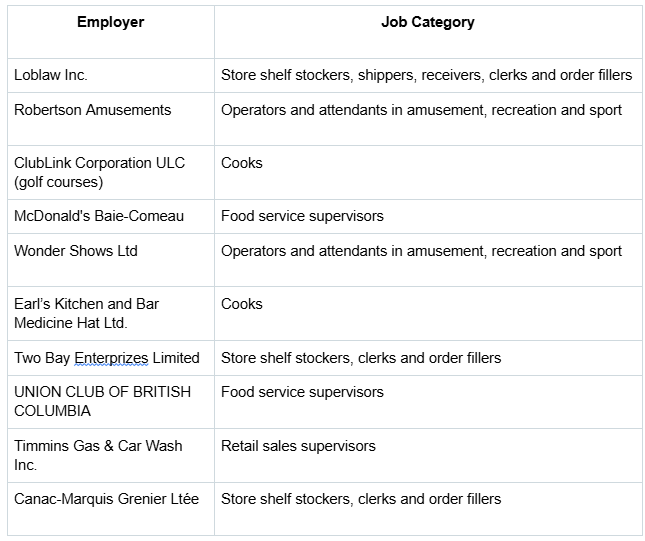
Companies and public sector entities that got approved to hire entry-level and food services labour:

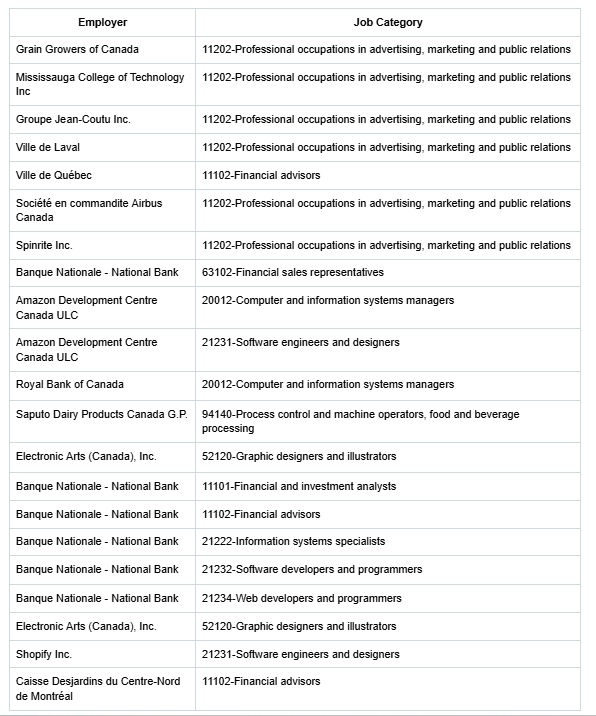
Companies and public sector entities that got approved to hire white collar jobs with TFWs (my personal favourite here is the Grain Growers of Canada(a lobby group) receiving a positive LMIA decision for a communications position….come on guys, for real??):

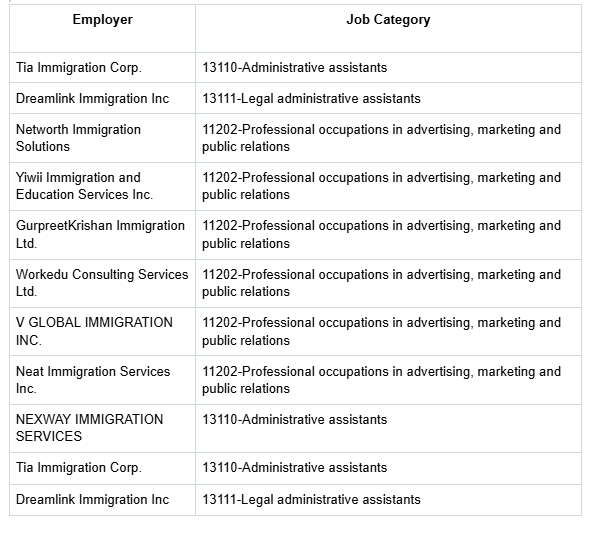
Immigration consulting firms that often help companies get approved for TFWs got approved for TWFs too:

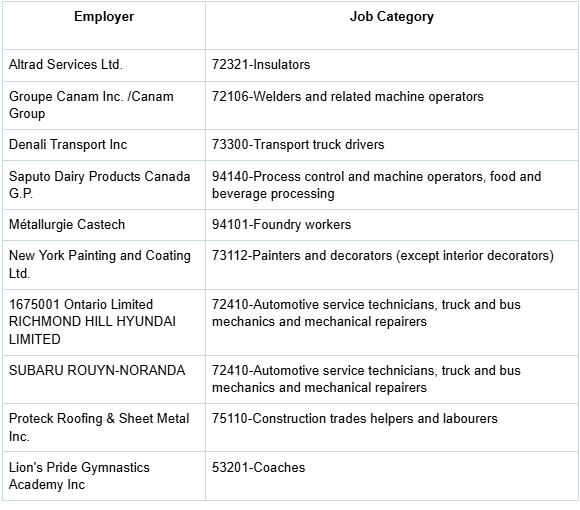
Companies that got approval to fill trades jobs with TFWs:

The arguments that many companies most commonly use to justify their use of the TFW program (particularly the low-skilled stream) are that:

  • Canadians don’t want to do the work
  • That only a foreigner could do the job, or
  • That government benefit programs often prevent people from taking jobs. 

In many cases, these arguments wouldn’t pass the smell test for an ordinary Canadian, so they shouldn’t for the Liberal government either.

In reality, outside of a very few regions where unemployment levels significantly defy the current national rate of 6.9%, and in certain segments of the seasonal agricultural industry, many of these jobs can and should go to available Canadians. And, there won’t be change unless the Liberals stop buying into bunk arguments for temporary foreign labour and find ways to reform the program, or, as the case may be, incent Canadians to work. Wages that aren’t suppressed by an open floodgate of low skilled temporary foreign labour would probably be a good place to start.

Ironically, on that front, all the Liberals had to do upon taking office in 2015 was not bend to the will of powerful corporate lobbyists clamouring for the reversals of program changes made by the former Harper Conservative government. I was in cabinet at the time and remember the gnashing of teeth and wailing from employers that were accused of seriously abusing the program.

Nonetheless and to his credit, Jason Kenney, as Minister of Employment and Social Development, introduced major reforms to the TFW program and LMIA process in 2013 and 2014. In 2013, key changes included requiring employers to pay temporary foreign workers at prevailing wages, introducing processing fees for LMIA applications, extending job advertising periods to recruit Canadians first, and adding scrutiny on outsourcing impacts. The 2014 overhaul was more comprehensive: it imposed a 10% cap on low-wage foreign workers per worksite (phased in from higher limits), barred low-wage hires in regions with unemployment above 6%, limited low-wage worker stays to two years, introduced moratoriums in sectors like food services, boosted inspections and fines for violations, and split the TFW program from the International Mobility Program to reduce overall reliance on foreign labor, leading to an 80% drop in low-skilled approvals.

Source: 50K+ jobs to foreign workers in Q1. Why?

Thousands of foreigners’ criminal convictions forgiven by Ottawa over 11-year span, raising transparency concerns

Rempel Garner and Kurland correct to call for more transparency:

More than 17,500 foreigners have had their criminal convictions forgiven by the Immigration Department over the past 11 years, removing a bar to coming to Canada, federal government figures show. The disclosure has raised transparency concerns about the type of offences they committed.

Foreigners are, in general, inadmissible to Canada if they have been convicted of an act that is considered a criminal offence in this country. But Immigration, Refugees and Citizenship Canada (IRCC) has the power to grant an exception if five years have elapsed since a person was convicted or finished a sentence. 

Government figures show that in the 11 years up to and including 2024, 17,600 people convicted of criminal offences abroad were considered “rehabilitated” by IRCC. This meant they were able to apply to enter Canada, including through work and study visas, as permanent residents or visitors. 

IRCC has not, however, released a breakdown of the kind of criminal offences that were forgiven. It said in a statement to The Globe and Mail that the Immigration Minister would be involved in decisions relating to the most serious offences. …

Source: Thousands of foreigners’ criminal convictions forgiven by Ottawa over 11-year span, raising transparency concerns