Ottawa makes massive data change on temporary foreign worker numbers 

Hopefully the government will be fully transparent on how this happened and what changes are being made. This can further undermine general confidence in government management and administration given how fundamental accurate data to government programs:

The federal government has revised more than two decades of immigration data, saying that “technical difficulties” led to bloated figures for a subset of temporary foreign workers.

Slightly more than one million people held work permits through the International Mobility Program at the end of last year, an increase of 48 per cent from 2021, according to figures that were published by Immigration, Refugees and Citizenship Canada in February.

But recently, IRCC updated those numbers – and they are significantly different. Now, the federal government says that roughly 675,000 people held IMP work permits at the end of 2022, a decline of about 340,000 from the earlier dataset. The figures for all previous years, dating back to 2000, were also reduced.

Globe and Mail journalists recently discovered the revisions. The federal immigration department did not publish the new figures with an explanation for why they had changed so much.

IRCC spokesperson Matthew Krupovich said in a statement that the department experienced “technical difficulties” when producing the figures. The current numbers, he said, are “accurate.”

The Globe and Mail asked IRCC for a deeper explanation of these issues, but has yet to receive a response.

“It’s extremely frustrating,” said Mikal Skuterud, a professor of economics at the University of Waterloo, who uses these numbers in his research. “At a minimum, when you’re working with government data, you want to trust that they’re accurate.”

Canada’s population is growing at the fastest rate in decades, in large part because of temporary migration, including students and workers. The country grew by more than one million people in 2022, and just last week, the population surpassed 40 million.

The International Mobility Program plays a large role in population growth, accounting for the majority of temporary work permit holders. Within IMP, there are several streams of migration, including post-graduate workers and spouses of skilled workers.

The presence of temporary foreign workers has grown dramatically over the past two decades. Based on the updated numbers, the volume of IMP permits has grown by 1,434 per cent since 2000.

Canada’s growing reliance on temporary foreign labour has drawn criticism on several grounds, including that it shields employers from making more competitive wage offers to domestic workers or investing in new technologies.

Canada is increasingly moving to a two-step immigration process that sees people come here first as students or workers, who vie for the opportunity of securing permanent residency.

The federal government is ramping up targets for the admission of permanent residents to 500,000 annually by 2025.

Source: Ottawa makes massive data change on temporary foreign worker numbers

Hardin: Breaking the Immigration Taboo

A bit of a rant and overly rambling and unfocussed but nevertheless a signal among some who consider themselves progressive are increasingly concerned given housing and other impacts:

….And as if that weren’t enough, Justin Trudeau keeps on increasing the number of immigrants, hiking it from 400,000 annually to half a million. When Eby began the frantic drumbeating for new housing, the figure for new immigrants arriving in Greater Vancouver was an estimated 30,000 to 40,000. That had already changed by the end of 2021, when the net inflow of people to B.C. was 100,797. Of those, 33,356 people came from other Canadian provinces and territories and the remaining 67,141 from abroad, with most ending up in Greater Vancouver. Not all of them would have been immigrants; net non–permanent residents like “temporary foreign workers” and net foreign students would be in the total.

In the subsequent year, 2022, the inflow into B.C. from international migration increased to 150,783, of whom 98,763 were non–permanent residents. Canada’s population overall increased by 1,050,110 people; almost all the increase – 96 per cent – came from international migration.

Eby has mentioned what lay behind what he was facing – federal immigration policy. No wielding of the hammer on that one, however. The new housing minister, Ravi Kahlon, has belatedly gone as far as to argue with Ottawa that immigration should be tied to housing availability. But without his tackling the underlying premises impelling Trudeau and company – without even following through on his own argument – he hasn’t, as of this writing, made much headway.

The taboo is great.

Nor is Eby the only one who shies away from speaking directly to the root issue.

With some exceptions, almost everyone publicly tearing their hair out over housing unaffordability or what the attendant pressure is doing to Vancouver avoids mentioning the “i” word as something that needs to be tackled first and foremost, in the same way that everyone, except a little boy, wouldn’t say out loud that the emperor had no clothes.

What’s really behind high immigration numbers

What underlies immigration to Canada and the current numbers is not humanitarianism but economics. Indeed, immigration to Canada, save for refugees, has always largely been economic. The argument is that immigrants boost the Canadian economy and are even needed to keep the Canadian economy going. That this might be a dubious argument doesn’t discourage its promoters.

Immigration Minister Sean Fraser was quite straightforward about this in a statement to Reuters late in 2021. “Canada needs immigration to create jobs and drive our economic recovery,” he said, as if simply saying so made it true.

Fraser has since doubled down on his message box, again without in fact making the case and again without addressing housing affordability and additional pressures on health care.

The need for immigrants to keep the economy going has now become a mantra, repeated casually at large (an “economic imperative,” a National Post columnist called it), to which has recently been added a submantra: the need for immigrants to fill unfilled job positions. It’s economics – unquestioned economics – again.

NDP leader Jagmeet Singh has also, naively, claimed we are dependent economically on immigration. He and the political left in Canada, captive to their routinized thinking on immigration, have failed to understand the dynamic at work. It’s important to realize that open immigration to serve economics isn’t left-wing at all. The free movement of labour is part of classical right-wing neoliberal doctrine, complementing free trade. If community is harmed or destabilized by the application of the doctrine, whether by free trade or inflated immigration levels, “So what?” says the market-doctrine right-winger: “It’s the market at work. You shouldn’t object.”

It’s not surprising, then, that the original recommendation for hiking the level of immigration to Canada to 450,000 annually came from the federal Advisory Council on Economic Growth, circa 2017, replete with neoliberals and with nobody as awkward as even a pale socialist or environmentalist to show any dissent. The Council was chaired by Dominic Barton, a former senior executive of management consulting firm McKinsey and Company.

The Council also recommended that Canada aim for 100 million people by the end of the century. This was without reference to the environment. The connection between another 60-odd million people in a northern, high-consuming country and its impact on global warming and the environment is not part of the neoliberal frame. The doctrine on this score – justifying immigration for economic reasons outside of the environmental context – is no different, schematically and ideologically, from justifying increased oil sands production and otherwise boosting the oil patch overall for economic reasons.

There’s a further irony underlying these other ironies. The economic rationale for immigration – the majestic declaration that newcomers are the key to the future – is faulty taken by itself.

It’s false to claim that increased immigration is essential to the Canadian economy in any ordinary sense; the evidence doesn’t sustain that and it doesn’t meet the standard of common sense.

There is nothing to prevent an economy with a stable or slowly growing population from functioning well. Indeed, it is arguable that the more stable a population, the more focus can be given to employment engagement, training and education, and downstream allocation of the workforce in order to produce the maximum economic, social and environmental payoff per capita and, at the same time, enhance the quality of life.

It also begs the theoretical question of whether Canada, and every country in the world, have to keep compounding their population growth forever and ever until Doomsday if they wish to prevent their economies from falling apart. The world’s population, then, would have to increase to 15 billion people, and then 20 billion, and so on, just to keep economically afloat – a notion that we know is absurd.

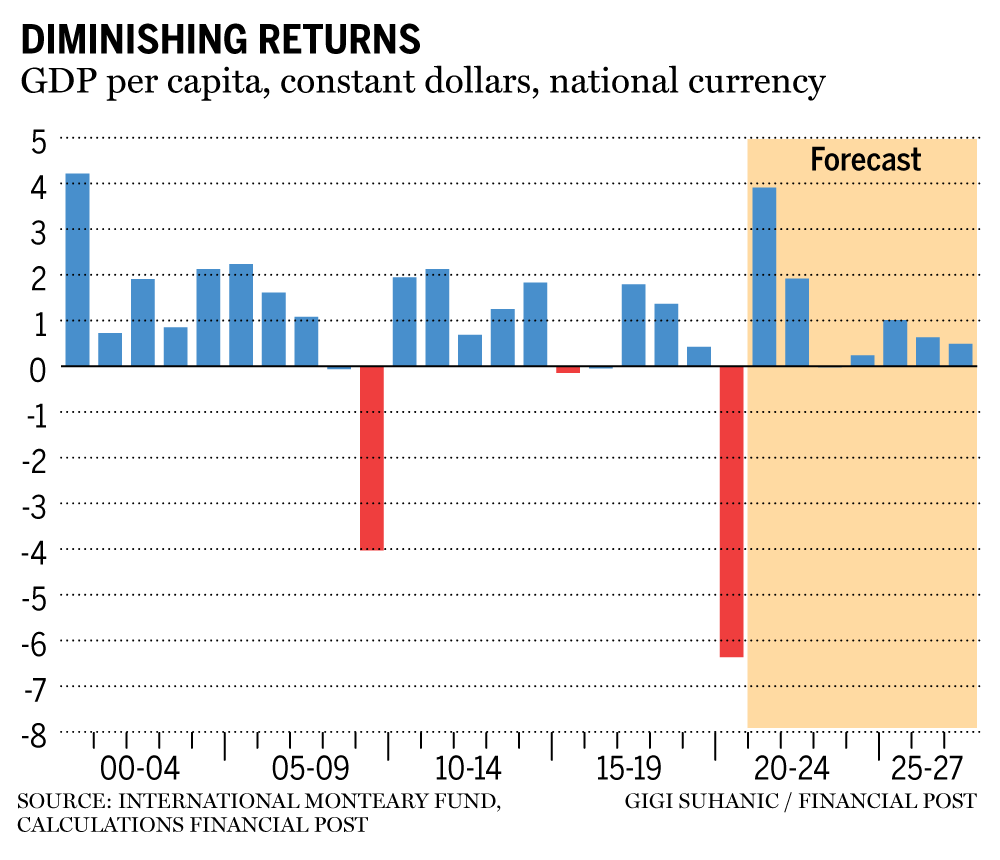
In the here and now, the argument for inflated immigration to Canada is also a counterproductive notion, economically speaking, because it measures by mass rather than by per capita economic performance and quality of life. Canada (using the International Monetary Fund measure) is 26th in the world rankings of GDP per capita, adjusted for purchasing power parity (PPP), as of current estimates. Denmark, which has strictly limited immigration, is 11th. Norway is seventh, Switzerland sixth, the United States eighth and so on. All the Scandinavian countries are higher than Canada; so are Austria and Taiwan. Singapore is second.

In 1986, just prior to immigration to Canada spiking, Canada was 15th; we’ve lost 11 places since. Our GDP per capita in 1986, again adjusted for purchasing power parity, was 89 per cent of the American one; since then it has fallen to 75 per cent.

Perhaps more instructive are the IMF’s projections through to 2027, where Canada is projected to fall to 28th place. It will also have lost, once more, a few percentage points to the United States, which itself is predicted to fall a few places in the IMF rankings. By way of explanation, the OECD has Canada dead last among the 38 OECD members in GDP per capita growth for 2020–30 (and also dead last for 2030–60).

Don Wright, former deputy minister to B.C. Premier John Horgan and a Harvard-trained economist, takes this one step further in a recent paper for the Public Policy Forum. Wright points out that by counting on immigrants and foreign workers for low-wage jobs, average per capita income and what goes with it (from quality of life to per capita tax revenue) are lowered and the professed desire to help the middle class is betrayed. He references stagnant real wages, their direct relationship to housing unaffordability and the coincidental ascendancy of neoliberalism. Raising the per capita standard of living should be the goal, he argues. He goes on to debunk the argument of the open-ended need for more and more labour:

When businesses complain about having difficulty finding enough workers, what this really means is that they cannot easily find the workers they want at a wage they want to pay. But, within reasonable limits, this is a good thing. It forces employers to pay higher wages, provide better working conditions and drives the creative destruction that leads to higher productivity, more valuable products and better business models.

A subsequent study in Policy Options by labour economists Fabian Lange of McGill, Mikal Skuterud of the University of Waterloo and Christopher Worswick of Carleton elaborated on the argument, focusing in particular on the economic case against low-wage temporary foreign workers.⁶

The submantra that we need inflated immigration levels to fill unfilled jobs nevertheless keeps resurfacing, cited as a given both by ostensible experts and by politicians desperate to rationalize consequences like the housing crisis. David Eby himself, just before being sworn in as B.C. Premier, mentioned it by way of explaining why he needed to act aggressively on housing.

It overlooks how the necessary adjustment in the labour market would happen, per Don Wright’s thesis. It’s as if there is no alternative to the neoliberal ideological fix behind the current excessive immigration level.

Well here, schematically, is the alternative, as would happen in a normal economy. Jobs are posted and if they’re more important relative to other jobs, the market or public allocation rises until they’re filled. At the same time, other jobs that cannot compete, because they’re relatively unimportant or not important at all, so that they don’t have sufficient competitive draw on the market or on public revenue, disappear. Over time, one ends up with a far more productive economy and a far more appropriate economy that dynamically follows market demand and public need.

But none of the alternatives to the current immigration level can be properly discussed, nor can a proper public debate take place, until we bury for good the neoliberal legend that we need immigration to keep our economy going. Once we do that, we can then get started on framing public policy accordingly, dramatically cutting back immigration and freely charting another course. We might even conclude that what makes most sense, for a high-energy-use country like Canada, is a stable population. But that’s for another analysis.

Source: Breaking the Immigration Taboo

What’s the right number of immigrants for Canada?

In contrast to Globe editorial, Immigration: Canada needs more newcomers and (much more) housing, this article asks the needed questions, featuring business and academic economists who are increasingly challenging the current general political and economic consensus:

How many immigrants should Canada be admitting?

Economists are asking that question with increasing intensity – and for good reason. Canada’s population jumped by more than a million people last year. The surge was the largest annual increase in the country’s history, and one that was driven nearly entirely by immigration.

The skyrocketing number of new Canadians is putting added pressure on an already drum-tight housing market. People are scrambling “for a place to live in a market with no housing supply,” Bank of Nova Scotia warns. Home prices are climbing, while the rental vacancy rate is at “a generational low,” according to National Bank of Canada.

For now, the Liberal government in Ottawa is sticking to the aggressive pro-immigration policy that it introduced after being elected in 2015. It is targeting nearly half-a-million immigrants a year– roughly double the 261,000 that Canada admitted annually in the 2010 to 2014 period.

However, a growing number of critics are challenging the logic behind Ottawa’s great immigration ambitions.

Prominent business economists say they are baffled by the government’s insistence on sticking to supersized immigration quotas at a time of widespread housing shortages. Stéfane Marion, chief economist at National Bank of Canada, and David Rosenberg, president of Rosenberg Research, have urged Ottawa to consider revising its targets to allow housing supply to catch up to demand.

Meanwhile, a new working paper from a trio of Canadian academic economists digs deeper into the issues around immigration. The paper, currently circulating in draft form under the title, The Economics of Canadian Immigration Levels, offers a scholarly but withering critique of current policy.

The authors – Matthew Doyle and Mikal Skuterud of the University of Waterloo, and Christopher Worswick of Carleton University – argue that policy makers are mistaken to conclude “that if some immigration is good for the economy, then more must be better.”

Granted, how you view this issue depends on how you define “better.” The three economists acknowledge that if Ottawa’s goal is simply to swell Canada’s geopolitical clout then, yes, it does make sense to fling open the doors and welcome a massive influx of newcomers. More workers and more consumers will mean a larger economy.

But size isn’t everything. Imagine a case in which Canada’s economic output doubled while its population did, too. Would this improve life for a typical Canadian? Not really. The average person would wind up seeing no improvement in their standard of living. The increase in the size of the economic pie would be matched by an equivalent increase in the number of people sharing it.

There is also morality to consider. On paper, it’s possible to show that a country can generate an “immigration surplus” by bringing in masses of low-skilled workers to take menial jobs. This underclass of low-paid immigrants can free up the existing population to pursue better-paid occupations.

However, it’s questionable how far this idea can or should be pushed in an egalitarian country such as Canada. The notion of an immigration surplus downplays the stresses faced by low-paid immigrants. It ignores issues of income inequality and focuses only on the benefits reaped by the people already in the country.

The three professors argue for a more equitable, more inclusive approach. They say the fairest and most reasonable test of Canadian immigration policy is whether it helps to grow output per person – or gross domestic product (GDP) per capita, in the jargon.

Research has demonstrated that measures of per capita GDP are closely tied to feelings of well-being and life satisfaction. If immigration offers a surefire way to boost this number, then there is good reason to think it is benefiting the nation as a whole.

Unfortunately, for the pro-immigration camp, there is no evidence that it does much of anything to help accelerate growth in GDP per capita.

The opposite is often true. When immigration is limited and labour is in short supply, businesses can find it profitable to invest in new capital – tools, computers, factories and other gear – to boost the productivity of scarce workers. This capital investment can help to swell per capita GDP.

In contrast, when immigration is surging, the case for capital investment may look less attractive. Businesses can find it cheaper to hire an additional worker to meet new demand instead of investing in new equipment. The result can be a larger work force, but one with lower productivity and lower per capita GDP.

The three professors look back at past decades and see nothing to indicate that immigration has ever been an economic tonic.

“Using evidence for Canada and the U.S., we find either a negative relationship, or no relationship, between periods of high immigration and subsequent growth in GDP per capita,” they wrote in their paper.

Just to be clear here: The lack of any obvious economic payoff from immigration doesn’t mean Canada should slam the door shut on newcomers.

The economists point out that federal legislation lists 12 goals for immigration, ranging from family reunification to supporting minority official languages communities. Many of those goals aren’t economic in nature and can still justify substantial levels of immigration.

But the dubious economic case for immigration raises questions about why Ottawa has been basing so much of its immigration policy on economic rationales. The government’s most recent targets allot roughly 60 per cent of immigrant slots to economic-class applicants – that is, people who are, in theory, being chosen for their ability to contribute to Canada’s prosperity.

This emphasis on economic-class immigrants may reflect misconceptions.

Consider, for instance, the idea that immigration is needed to fill low-skill, essential jobs. This doesn’t make a lot of sense, according to the economists. Admitting people to fill low-wage jobs pulls down, rather than pushes up, GDP per capita.

Just as questionable is the idea that immigration can offset the effects of Canada’s aging population.

Immigrants age and eventually retire just like anyone else. While there may be a short-term demographic dividend from immigration, “leveraging this demographic dividend to produce ongoing growth would require a Ponzi-type strategy of continually increasing the immigration rate to undo the increasing size of the retirement-age population,” the economists wrote.

So what can Canada do to improve its economic-class immigration system?

The three co-authors suggest that Ottawa should focus on admitting immigrants with higher levels of skills and education than it is currently targeting. They argue that the goal should be to select immigrants who can earn at least as much as, if not more, than the average Canadian within 10 years of arrival. Over time, this policy should boost GDP per capita.

The economists don’t offer any estimate of how such a policy would affect the number of immigrants being admitted, although Prof. Skuterud and Prof. Worswick both acknowledged in interviews that the impact, at least at first, would likely be a significant decline in the number of newcomers.

They suggest this might be wise, given the stresses being put on social systems by today’s massive influx of immigrants. Their paper cautions that “the strains currently being placed on the public health care system, the public education system and the highly regulated housing sector suggest even more reason to be cautious about setting high levels of economic immigration.”

Pro-immigration voices can, of course, find plenty here with which to take issue. That is absolutely fine. A vigorous debate over immigration is exactly what Canada now needs.

Source: What’s the right number of immigrants for Canada?

Canada launches new immigration program to fill ‘in-demand’

As expected:

Immigration applicants with experience in any of five sectors could be selected for permanent residence through a new system designed to better align newcomers with Canada’s labour market needs.

On Wednesday, Immigration Minister Sean Fraser launched the highly anticipated “category-based selection” — better known as the “targeted draw” of skilled immigrants — which was first announced last June.

In additional to focusing on picking those with strong French language proficiency, the new tool will target those in the talent pool with a background in five key occupational sectors:

  • Health care;
  • Science, technology, engineering and mathematics (STEM) professions;
  • Trades, such as carpenters, plumbers and contractors;
  • Transport; and
  • Agriculture and agri-food.

“Everywhere I go, I’ve heard loud and clear from employers across the country who are experiencing chronic labour shortages. These changes to the Express Entry system will ensure that they have the skilled workers they need to grow and succeed,” Fraser said in a news release.

“We can also grow our economy and help businesses with labour shortages while also increasing the number of French-proficient candidates to help ensure the vitality of French-speaking communities. Put simply, Canada’s immigration system has never been more responsive to the country’s social or economic needs.”

The job categories have been determined following public consultations, as well as a review of labour market needs. A complete list of eligible jobs for the new categories is available on the immigration department website.

Currently, applicants for skilled immigration programs enter into the Express Entry pool, where they are given points and ranked based on attributes such as age, educational achievements, language proficiency, work experience and availability of a job offer.

Regular draws are conducted to invite those with the highest scores to apply for permanent residence. However, the system doesn’t allow the immigration department to overrule the ranking system and pick a candidate in an “in-demand” profession if the person’s score doesn’t meet the thresholds of those draws.

According to Statistics Canada, the number of job vacancies in the fourth quarter of 2022 decreased by 78,600 or 8.2 per cent to 876,300, marking the second consecutive quarterly decline.

The number of unfilled jobs fell in 16 of 20 broad industrial sectors, particularly in accommodation and food services (-21,400) and administrative and support, waste management and remediation services (-15,800).

Job vacancies also fell in seven of 10 broad occupational groups, including trades, transport and equipment operators and related occupations (-22,200) and sales and service occupations (-20,100).

There were 147,300 job vacancies in health occupations in the fourth quarter, little changed from the record high reached in the third quarter.

Fraser said further details on the timing of invitations for individual categories and how to apply will be announced in the coming weeks.

Source: Canada launches new immigration program to fill ‘in-demand’ jobsCanada launches new immigration program to fill ‘in-demand’ jobs

And criticism from labour economists:

MIKAL SKUTERUD, the director of the Canadian Labour Economics Forum, took issue with a minister meddling in a system for grading talent that is supposed to be apolitical. He wrote that he was concerned the immigration system will fall unduly under the influence of business lobbyists.

“If the objective of the policy is to target skilled candidates with work experience in the sectors listed in the news release, why were these applicants unable to satisfy the selection criteria of the existing Express Entry system?” he wrote to PTM

“The only possible answer I can think of is that this reform seeks to bypass the [Comprehensive Ranking System] which, in effect, means providing eased pathways to PR status for immigrants with lower skill levels and lower expected earnings.”

The Comprehensive Ranking System is the existing method by which the government scores the workforce potential of prospective economic immigrants.

Bringing in immigrants who earn less than would otherwise be the case could inhibit GDP per capita and standard of living growth, wrote Skuterud. 

CHRISTOPHER WORSWICK, who teaches the economics of immigration at Carleton University, wrote: 

“I am generally not in favour of this novel, category-based selection method. It would be better to focus on improving the Comprehensive Ranking System. This seems like a step backward from what had been a human capital-based (or expected earnings-based) selection process. I suspect this is designed to allow the government to choose less-skilled applicants to satisfy the demands of different business lobby groups.”

Worswick wrote that he suspected that some of the newly prioritized industries and occupations in trades contracting, transport, and agriculture could lead to an influx of low-earning immigrants.

“If we bring in workers whenever employer groups say there is a ‘labour shortage,’ we risk keeping wages low and hurting lower-wage workers in Canada who may need wage growth, especially given our challenges with inflation. We should focus on bringing in economic immigrants with the highest human capital (as measured by expected earnings),” he wrote.

Source: https://hilltimes.us10.list-manage.com/track/click?u=a90bfb63c26a30f02131a677b&id=0071de5ea4&e=685e94e554

Theo Argitis: Why economists – not politicians – are raising alarms around immigration

More questioning of increasing levels of immigration and their impact on housing and productivity, along with legitimate worry regarding ongoing support for high levels:
One of the most encouraging national polls in recent weeks was a survey done by Nanos Research for Bloomberg News that showed large flows of international migration into Canada continue to be widely supported by the public.
This is a relief. I’ve been worried, and not because I’m an immigrant.

Source: Theo Argitis: Why economists – not politicians – are raising alarms around immigration

Skuterud: Using immigration to fill vacant, lower-skilled jobs is not sound economic policy

Mikal continues his crusade, rightly, against the flaws of the government’s approach in terms of productivity. Unfortunately, appears governments and business are not listening to these warnings:

Ask a Canadian why the government is increasing immigration and more often than not they will tell you: “to grow our economy.” Ask an economist and you’ll rarely get that answer.

Boosting the economic well-being of a population is indeed a worthwhile objective of immigration, but that requires more than simply making the economy bigger.

India’s economy is 60 per cent bigger than Canada’s and Switzerland’s is 60 per cent smaller. Is India’s economy what we are aiming for? Making the economic pie as big as possible is clearly not the objective. What matters is the size of the average slice when the pie is divided by the population.

The immigration policies that the current Liberal government adopted in 2015 reflected two decades of reforms focused on leveraging immigration to boost GDP per capita, the size of the average slice – a sound economic objective. But this government has shifted the objective to something new.

The government hinted at its objective in March when it rationalized Canada’s surging population – a one million increase last year – as an alleged economic necessity to fill vacant jobs, which if focused on lower skilled jobs is more likely to lower than raise GDP per capita.

Other times, however, the government has been less than transparent. The government’s opacity in what it is trying to achieve leaves us to guess.

Perhaps it is trying to maximize our population to raise our geopolitical influence on the world stage or to keep small towns in the Maritimes from disappearing.

But why then limit our annual immigration target to only 500,000? Why not announce to the world that if you get here, you will be granted permanent residency status on arrival?

That’s because economies have absorptive capacities. When our housing, social infrastructure and business-capital investments do not grow commensurately with our population, there are economic tradeoffs. Usually, the Canadians most adversely affected by these tradeoffs are existing immigrants competing for housing, jobs and social services in the same communities as the newcomers.

Perhaps the objective is humanitarian, that is it’s more about boosting the economic well-being of the newcomers themselves. If that is true, however, then we should target the world’s poorest.

The world’s 20 poorest countries accounted for 8.2 per cent of the world’s population in the 2015-21 period but only 4.8 per cent of Canada’s new immigrants. The share of immigration dedicated to humanitarian objectives in the government’s latest targets is 19.8 per cent in 2023, 18.5 per cent in 2024, and 16.2 per cent in 2025. Humanitarian ideals is clearly not what this government is focused on.

The reality is that the objective of this government’s immigration policies is not the size of the economy, population growth, humanitarianism or GDP per capita.

Leveraging immigration to boost GDP per capita requires attracting the world’s best and brightest to drive innovation, productivity growth and job creation in advanced sectors that are intensive in new technologies, research and development, and STEM skills. That does not seem to be this government’s priority.

The priority of this government appears to be filling existing job slots with workers regardless of the value added of those jobs. The goal is overwhelmingly to support businesses by alleviating the competitive labour market pressures they are facing to increase the wages and productivity of their work forces.

This is evident in the government’s recent decision to reverse regulations introduced by its predecessors in 2014 to curtail business reliance on low-skill temporary foreign workers.

It is also evident in the government’s recent decision to waive all limits on the off-campus work activity of foreign students, whose numbers are exploding and who are heavily engaged in low-wage work.

Most significant, the government is now proposing a reform of its system for selecting candidates for economic-class immigration, known as the “express entry system,” which will target immigrants to fill existing job slots rather than being focused on attracting the world’s top talent.

Debates about immigration policy are contentious precisely because people have different objectives in mind.

The Immigration Department is launching a new initiative that will solicit the views of Canadians on optimal immigration policy. It is hard to believe that this exercise will be any more productive than asking Canadians how they would change the income tax rates they pay.

If we are going to solicit the views of all Canadians, I propose a rule: In making public statements about how Canada should reform its immigration policies, we must all first declare what objective we think the government’s immigration policies should be aiming to achieve and how that objective is best measured.

Mikal Skuterud is a professor of economics at the University of Waterloo and the director of the Canadian Labour Economics Forum.

Source: Using immigration to fill vacant, lower-skilled jobs is not sound economic policy

‘Too much, too quickly’: economists warn of Liberal ‘pro-business’ immigration policy

Great counterpoint to the simplistic and misguided arguments of the government and immigration arguments in favour of the current high levels, with Mikal Stuterud, Chris Worswick and David Green being cited extensively:

The Liberal government’s move to admit record numbers of immigrants to fill a purported “labour shortage” has prompted warnings from economists with years of experience studying immigration to Canada.

The government is selling the policy change as a way to boost economic growth and “help businesses find workers.”

But there’s no evidence, the economists said, that the plan to eventually accept a half million new residents per year will benefit the average Canadian resident—though it might help businesses looking for low-cost labour.

The higher immigration targets—along with a growth in the use of temporary foreign workers and working international students under the Liberal government—have the potential to push down wages for the lowest-paid workers in the country, many of whom are recent immigrants or refugees, they said.

Source: ‘Too much, too quickly’: economists warn of Liberal ‘pro-business’ immigration policy

Skuterud: Canada’s worker ‘shortage’ is an illusion, and bringing in cheap labour doesn’t help

Needed commentary:

If your inclination in hearing about Canada’s labour shortage crisis is to ask, “Where did all the workers go?” you have the wrong economic model in mind.

Despite our aging population, the percentage of Canadian adults participating in the labour force was 65.7 per cent last month, identical to what it was in October, 2018, and July, 2016, after accounting for usual seasonal variations.

In terms of absolute numbers, Canada’s labour force now stands at 20.8 million workers, the largest it has ever been.

Rather than not enough workers, the issue is that the prices of the goods and services that workers produce have increased faster than their wages, motivating businesses to hire more workers and sell more.

Canada’s current tight labour markets overwhelmingly reflect increases in the demand for workers, not a decline in their numbers. And the solution is not to satiate that demand with cheap labour, which undermines labour productivity and average economic living standards in the population.

Why do so many people interpret current labour shortages as “not enough workers”? It is because in their minds the jobs that need to be done in our economy are fixed and the job of policy makers is to make sure there are enough workers to fill all the slots, so the economy does not fall apart.

But employers’ demands for workers are constantly fluctuating and evolving in response to factors within the economy, including relative prices, interest rates, technological advances and consumers’ preferences and incomes.

In 1921, one-third of Canada’s workers were employed in agriculture. After more than 100 years of innovation in farming equipment, less than 2 per cent are.

Very few jobs, if any, are truly essential.

Once we recognize that the jobs employers seek to fill in the economy are fluid, it all becomes clear.

Throughout this pandemic era, I have been tracking Canadian labour-market tightness, measured as the number of job vacancies per available job seeker. After hovering between 0.2 and 0.6 in the 2015-20 period, the ratio surged in January, 2021, and peaked at 1.1 job vacancies for every job seeker in June, 2022.

It is not a coincidence that this increase in labour-market tightness lines up precisely with movements in the relative prices of the goods and services that businesses sell and the wages that workers are paid.

Canada’s headline inflation rate – Statistics Canada’s measure of the annual change in consumer prices – stood at 1 per cent in January, 2021, but increased rapidly, peaking at 7.9 per cent in June, 2022.

After accounting for changes in the mix of jobs, I estimate that workers’ wages were growing at an annual rate of 1.7 per cent in January, 2021, which sluggishly increased to 3.7 per cent by June, 2022, far behind the pace of increases in consumer prices.

In other words, workers’ wages have not kept pace with the prices of the goods and services they produce and consume.

Workers aren’t disappearing; what’s happened is employers’ profit incentives to hire more workers have increased dramatically.

And as the gap between the growth in consumer prices and workers’ wages diminished after June, 2022, so did the hiring appetite of Canadian businesses. With one exception, the number of job vacancies declined in every month between May and November, 2022, resulting in a 21-per-cent reduction in total job vacancies in six months.

In November, 2022, the most recent data we have, there were 0.8 job vacancies for every job seeker, down from the June peak of 1.1.

No doubt, Canadian labour-market tightness remains elevated, making life difficult for some businesses. Competing for scarce workers with other businesses and retaining the ones you have requires improving wages and working conditions, which eats into profit margins. And where competition is especially fierce, it can pose existential risks.

But business failures are a healthy feature of a well-functioning economy. Starting a new business is necessarily risky. It ensures scarce capital is invested where its expected returns are highest and that the businesses that survive are the ones that utilize their workers most efficiently by, for example, investing in new technologies to maximize employee productivity.

These competitive pressures are not a good thing for businesses struggling to turn a profit, and those businesses will plead for government support.

But not coddling the business lobby by, for example, expanding wage-subsidy programs or easing access to low-skilled temporary foreign workers, including foreign students, is good for worker productivity, workers’ wages and average economic living standards.

Mikal Skuterud is a professor of economics at the University of Waterloo and the director of the Canadian Labour Economics Forum.

Source: Canada’s worker ‘shortage’ is an illusion, and bringing in cheap labour doesn’t help

Mahboubi, Skuterud – The Unintended Consequences of Category-Based Immigrant Selection

Valid critique:

From: Parisa Mahboubi and Mikal Skuterud

To: Sean Fraser, Minister of Immigration, Refugees and Citizenship Canada

Date:  February 6, 2023

Re: The Unintended Consequences of Category-Based Immigrant Selection

Immigration, Refugees, and Citizenship Canada (IRCC) recently held consultations on plans aimed at giving the department more flexibility in how it prioritizes economic-class applicants for permanent residency.

The new rules will, in effect, free the immigration minister to bypass the existing system for selecting candidates, known as the Comprehensive Ranking System (CRS), to target applicants with particular “attributes” such as work experience in a particular occupation.

This may alleviate some labour shortages, but we see significant unintended consequences.

Leveraging immigration to boost average living standards in the population requires selecting immigrants whose Canadian earnings exceed average earnings in the pre-existing population, thereby pulling up average incomes and per capita GDP.

The CRS aims to achieve this by ranking and cream-skimming economic class candidates who have the highest expected Canadian earnings. This is estimated using data on the earnings of previous cohorts of immigrants who arrived with similar human capital characteristics. Of particular importance in the CRS calculation are education, age, language abilities, and Canadian work experience.    

Recent analysis using Statistics Canada survey and census data, as well as our own examination of immigrants’ income tax records (see Figure below,) provides encouraging evidence that the CRS has contributed to rising earnings for newcomers since its launch in January 2015.  

By prioritizing applicants’ occupations, IRCC hopes it can be more responsive to employer needs, as well as address Canada’s chronic labour shortages.

But accurately identifying labour market requirements and being sufficiently responsive is difficult, if not impossible. Tight labour markets can quickly become slack. By the time targeted immigrants arrive, their skills may no longer align with employer needs, thereby exacerbating long-standing mismatch issues between immigrant skills and job openings. For this reason, the CRS does not use specific occupational information in its calculation.

The raison d’être of the Temporary Foreign Worker Program, which allows Canadian businesses to employ guest workers on limited-term contracts, is to meet temporary labour-market shortages. The objective of our permanent immigration system, on the other hand, should be to drive new employment growth in high-productivity sectors that are intensive in their use of skills and new technologies.

Unfortunately, we increasingly have a system where our temporary and permanent immigration systems are focused on the same objective – satisfying employers’ current labour needs. The risk is that the overall immigration system fails to do anything well.

An important advantage of the CRS is its transparency. Candidates can determine their own scores using a simple online tool and IRCC reports cutoff scores in their bi-weekly draws allowing unsuccessful candidates to identify what’s needed to be selected. The category-based selection system that IRCC is proposing compromises this transparency by leaving screening criteria to the whims of the minister of the day. This risks increasing applicant confusion and frustration and increases the need for immigration consultants and lawyers to help applicants navigate the system. At worst, it drives applicants with the best outside options to other countries.

Allowing the ministers to determine which candidate attributes are prioritized also risks politicizing the process. Research shows that while temporary worker inflows in Canada are responsive to the intensity of corporate lobbying, the same has not been true for permanent immigration. One explanation is that ‘point systems’ like the CRS remove immigrant selection decision making from the political realm in the same way that the Bank of Canada’s inflation mandate keeps its interest rate decisions from being politicized. Look for that to change.  

In our view, prioritizing candidates’ occupational work experience in immigrant selection makes most sense in sectors where the competitive market mechanism to address labour shortages does not exist, such where wages are set by collective agreements or government regulation.

In these settings, labour shortages are less likely to induce the wage adjustments necessary to encourage job switching and training and education investments within the existing population. Chronic shortages of nurses and other healthcare workers are an important example.

Nonetheless, we question if it makes sense to prioritize applicants for permanent residency whose foreign work experience is in an occupation where credential recognition in Canada is problematic. It doesn’t really matter if credential recognition problems reflect genuine skill and competence issues, or the self-interested behaviour of professional associations. Either way, we are prioritizing applicants who will contribute relatively little to Canadian economic growth, thereby compromising the key objective of our economic immigration system.

In our view, IRCC’s planned reform of how it selects economic-class immigrants is just one step in a series of pandemic-era policies compromising the prioritization of skilled immigrants. The CRS has come to be seen by IRCC as a constraint rather than an effective quality-control mechanism. In prioritizing employers’ short-term labour needs, IRCC is being forced to lower the average CRS score of selected immigrants and, in turn, average expected earnings. The hard reality is that Canada’s newcomers continue to experience labour market challenges that are longstanding and exceptional. The risk is that the last decade’s significant gains will be undone.

Parisa Mahboubi is a senior policy analyst at the C.D. Howe Institute and Mikal Skuterud is professor of economics at the University of Waterloo. 

Source: Mahboubi, Skuterud – The Unintended Consequences of Category-Based Immigrant Selection

Canada wants to welcome 500,000 more immigrants in 2025. Can our country keep up?

The Globe’s Matt Lundy is doing some of the best reporting and analysis of immigration these days, with this article raising one of the elephants in the room, housing availability and affordabilty, healthcare, infrastructure:

Every year, Canada adds a big city – in a sense. The mass of individuals are spread around, mostly to urban centres, but increasingly to suburbs and far-flung communities. They are here to work, to study, to build a better life.

The expansion is historic. From July to September, Canada’s population grew by around 285,000, a 0.7-per-cent gain that was the largest since Newfoundland joined Confederation in 1949. More than 700,000 people have been added over the past year, roughly the same as the population of Mississauga, the seventh-largest municipality in the country.

The trend picked up when the federal Liberal Party came to power. Since 2016, the country has grown at nearly double the rate of its Group of Seven peers. For the most part, that growth is driven by immigration.

The push is deliberate. Policy makers say higher immigration is necessary to fuel Canada’s economic growth, and in particular, to ease labour shortages that have frustrated the corporate sector.

It is, however, a population boom with its share of growing pains

Consider that over the past year, fewer than 200,000 housing units were completed. There were 3.6 new residents for every home added, the highest ratio since at least 1991. Affordability is deteriorating in most places. There is a fundamental mismatch between home supply and demand – and the population boom is contributing to the divide.

At the same time, Canadian governments are struggling to deliver basic services. Surgeries are getting cancelled in crammed hospitals. Canadians can’t find family doctors, let alone newcomers trying to navigate an ailing health care system. Cash-strapped cities can’t refurbish their infrastructure as fast as it’s falling into disrepair.

To cope with the affordability crisis, a growing number of people are fleeing our cities. They include teachers, nurses and construction workers – the very people who keep those cities running.

In this fraught environment, Ottawa has its foot on the accelerator. After admitting about 405,000 permanent residents last year, the federal government is aiming for 500,000 in 2025. And that’s just a portion of the migration wave: At last count, there were 1.4 million residents with temporary work or study permits.

Canada is facing a complicated adjustment. Notably, developers are scrapping or delaying housing projects, owing to rising interest rates and waning profitability. Just when more homes are needed, fewer are being built.

Several economists question why the federal government would create more demand for services, when so many pillars of social infrastructure are in distress. They wonder if Ottawa is singularly focused on hitting its immigration targets, with insufficient planning for how to successfully absorb those newcomers.

For its part, the federal government says the solution to so many of these problems is simple: more immigration. They’re planning to bring in more doctors and nurses from abroad, along with people to build homes.

Many recent immigrants have waited years for admission. Now they’re arriving at a time of decades-high inflation and slowing economic growth. Highly-skilled newcomers will likely manage the transition just fine. But others are discovering the Canadian dream is a pricey proposition – and perhaps not what they bargained for.

Ash Gopalani knew Toronto would be expensive. Just not this expensive.

He and his wife, Sneha, arrived in September, after a stressful three-year process to get their permanent resident cards. Finding an apartment was the next hurdle. Too often, the listings were in cramped basements, with little natural light, or far removed from the city’s core or public transit.

Mr. Gopalani eventually signed a lease for a one-bedroom unit in the city’s west end for $1,800 a month, the top end of his expected range. What he didn’t anticipate was paying six months of rent – $10,800 – up front, because the couple from Mumbai has no credit history here. Now, they have less of a financial buffer as they search for jobs.

Mr. Gopalani was hoping to follow a familiar playbook for newcomers. Establish a career. Save up money. Then buy a house – preferably big enough that their family from India could stay a while.

But the experience of moving here has been a reality check.

“We don’t know if we can afford building a life in Canada,” he said.

The rental market is ground zero for where immigrants get a taste of the cost-of-living crisis, in which fierce competition and bidding wars for relatively few units have led to jacked-up prices.

For Alexiane Sauvaire, it was a rude awakening. She thought finding an apartment in Toronto would be easier than in her native Paris. After eight frustrating days of looking, following her arrival, she moved to Montreal.

“Maybe for rich people, it’s easy. But when you’re not rich, it’s impossible to live right now in Toronto,” she said.

Increasingly, recent immigrants are bypassing the largest metro areas – Toronto, Vancouver and Montreal – to settle elsewhere, although a slim majority still favour those regions, according to the latest census results. However, costs are rising quickly in other cities, too, as they experience fervent demand from migrating people.

Over the past year, the average rent in Calgary has jumped 18 per cent to around $1,720 a month, according to data for new listings on Rentals.ca. London, Ont., is up 26 per cent. Halifax: 21 per cent.

From a labour standpoint, the affordability crisis is making it difficult to recruit – and retain – important workers.

“There are very significant economic risks to large cities if they do not get housing costs under control,” Aled ab Iorwerth, deputy chief economist at the Canada Mortgage and Housing Corp., said on a conference call this summer. “It’s getting increasingly difficult to attract skilled workers and even highly-skilled workers to these cities because they’re just becoming simply unaffordable.”

The task ahead is nothing short of gargantuan. CMHC says that, in order to restore affordability back to levels in 2003 and 2004, Canada would need to build 3.5 million morehomes than projected by 2030.

Earlier this year, the federal government unveiled billions in new spending for housing, with a goal of doubling construction over the next decade. That plan looks dead on arrival amid higher borrowing rates.

There is, of course, another problem: labour. In a recent report, CMHC said there were not enough skilled workers to build the homes so desperately needed.

“Even under more ideal conditions, I don’t think we have the capacity to build at a pace that matches the demand through population growth that we’re seeing,” said Shaun Hildebrand, president at real estate firm Urbanation.

Immigration lawyers have a blunt message: The application system is a mess.

And it’s a mess that was largely created in Ottawa.

Immigration, Refugees and Citizenship Canada (the federal immigration department) had around 2.2 million applications in its inventories as of Oct. 31. About 1.2 million of them were in backlog, meaning they’ve been in the system for longer than service standards for processing. That’s far higher than before the COVID-19 pandemic.

“The system is falling apart. I’ve never seen it like this, in the 20 years that I’ve been practising,” said Kerry Molitor, an immigration consultant in Toronto.

After failing to hit immigration targets in 2020, owing to pandemic challenges, the federal government wanted a rebound. Through various decisions, it invited thousands of people already in Canada to apply for permanent residency. The surge in applications overwhelmed a civil service that struggled to process files efficiently amid office closings and the shift to remote work.

In some cases, applicants are waiting years for a decision. Mr. Gopalani and his wife applied for permanent residency in the fall of 2019. They expected an approval within months, a typical outcome in their stream of immigration. They weren’t approved until July, 2022.

“The immigration system could have been more sensitive, empathetic, towards the kind of transition that people go through, which didn’t happen,” he said.

Because of the backlog, applicants such as Mr. Gopalani have put their lives on hold for years. Others are working in Canada, but their permits are nearing expiry, putting their future plans in doubt. These are individuals who, in Canada’s points-based system for economic immigrants, would often be shoo-ins for approval, but now are caught up in a bureaucratic nightmare.

There are “really good, quality people in the pool, and they’re not getting invitations,” said Mikal Skuterud, an economics professor at the University of Waterloo. “What happens now when these folks leave? They say, ‘The hell with this, I’m going back to my country or the U.S. or wherever.’ Now you’re losing all that talent. That’s completely not what this process is supposed to be.”

Despite the administrative headaches, Canada is on pace to welcome 431,000 permanent residents this year, right on target. The trouble is that talented people are slipping through the cracks – and the immigration system is taking a beating in public opinion.

“There’s this massive psychological toll that the backlogs, the delays and the lack of transparency have on people,” said Lev Abramovich, an immigration lawyer in Toronto. “I don’t think IRCC bureaucrats and politicians understand how much suffering this has caused.”

For all of Ottawa’s talk of targeting the best and brightest, the federal government is also allowing more cheap foreign labour into the country. Earlier this year, it overhauled the Temporary Foreign Worker (TFW) program, largely so employers could access more low-wage labour.

Colleges and universities, meanwhile, are ramping up their intake of foreign students, who mostly don’t need work permits. Increasingly, those students are taking jobs to rack up points for their permanent residency applications.

Around 1.4 million people had temporary work or study permits at the end of 2021, an increase of 85 per cent since 2015. That’s 640,000 people – about equal to the city of Vancouver – who have been added in just six years. Their ranks are set to accelerate this year, after policy changes.

While Ottawa has targets for admissions of permanent residents, there are no such guidelines for other migrants. With students, the federal government has essentially ceded that responsibility to postsecondary institutions, which are inclined to boost their revenues through higher intake of foreign students, who pay lofty tuition fees.

“The number of foreign nationals who receive study permits in any given year is based on demand, not predetermined targets,” Rémi Larivière, a spokesperson for IRCC, said in a statement.

An extreme example: Cape Breton University. Nearly 4,000 of its full-time students this fall had study visas, up a whopping 68 per cent from last year, according to preliminary survey data from the Association of Atlantic Universities. About three-quarters of CBU’s full-time students are from abroad. That’s injecting a surge of new demand for services in sleepy Sydney, N.S. (population: 31,000).

Gurmeet Singh, a second-year student, is trying to help people with their transition. He’s part of a volunteer group that verifies rental listings for incoming students. On average, the group gets three requests daily to check out potential residences. Mr. Singh visits those listings to see if they’re suitable for living – and if they exist.

Fraudulent listings are fairly common, Mr. Singh said; the group finds a scam every couple of days. “We felt it was our moral duty to help our fellow international students,” he said.

That’s not the only source of frustration. In local media this week, CBU students complained that a majority of classes in the two-year postbaccalaureate business program – a popular choice among foreign students – were being held in an unexpected venue: a Cineplex Inc. movie theatre off campus

Higher immigration is a guiding principle for this iteration of the federal Liberal Party.

Time and again, the party frames immigration as the antidote to an aging population, helping to grow the pool of labour market participants – and thus, too, the economy.

“Immigration is not just good for our economy, it’s essential. We can’t get by without it,” Immigration Minister Sean Fraser told reporters at a recent news conference.

The truth is more complicated. A vast body of economic literature shows that immigration has little effect on gross domestic product per capita, a popular measure of living standards. Furthermore, while new immigrants are younger than existing residents, the intake is too meagre to offset a demographic wave of aging citizens.

This doesn’t mean immigration is bad for the economy. But it’s not an accelerant, either.

“Often, the argument is made as if it’s obvious that immigration generates economic growth,” said David Green, an economics professor at the University of British Columbia. “Not if you look at the numbers.”

Of late, Ottawa has said various policy changes – including the expansion of the TFW program and allowing foreign postsecondary students to work longer hours – are aimed at easing labour shortages. This has led several economists to accuse the federal government of kowtowing to corporate pressure, flooding the job market with low-wage foreign labour, rather than forcing companies to hike wages or make investments.

“There’s lots of evidence that holding employers’ feet to the fire in times of tight labour markets is the best way to spur innovation, automation and productivity. Those are the things you want in an economy,” said Jim Stanford, director of the Centre for Future Work, a think tank.

“And if you say to employers, ‘Don’t worry, we’ll let you bring in some low-priced temporary migrants to solve your problem,’ you’re just dissipating the pressure that’s required to achieve a more productive economy.”

Prof. Green questioned the need to admit half a million permanent residents in 2025, given the fragile state of Canada’s social infrastructure and the questionable economic rationale for that target.

“I don’t see the planning here,” he said. “Do you really want to ramp up to 500,000 a year, at a time when we seem to be heading into recession and our housing markets and our health care system are straining at the seams? That’s a discussion that should be had.”

By and large, surveys suggest Canadians welcome immigrants. A recent poll, conducted by the Environics Institute for Survey Research, found nearly seven in 10 respondents support current levels of immigration, about double the share in late 1970s. The vast majority of respondents – 85 per cent – agreed that immigration is positive for the economy, a view that has held strong for decades.

But Prof. Green suggests we shouldn’t take that for granted. If the country struggles to integrate newcomers, then perhaps Canadians will start to eye them suspiciously. “It’s politically dangerous, to my mind,” he said.

For now, that’s a worry. But it’s not the experience of Tanushree Holker and Nishant Kalia, who moved to Toronto from New Delhi in the summer of 2019. Their expectation of Canada as a welcoming country has checked out.

“That perception about Canada being a country which accepts immigrants with open arms, it is true when you come here,” Ms. Holker said.

The couple has shared their journey in Canada on YouTube; their channel, In The North, has nearly 100,000 subscribers, to whom they dispense their acquired wisdom on everything from buying a car to navigating a complex immigration system. Mr. Kalia started the channel after getting laid off early in the pandemic. He’s since built a career in human resources, while his wife works for a Big Six bank.

In recent videos, they’ve documented a major life change: They moved to Calgary. By doing so, they’re saving $350 a month on a similar-sized rental unit, and they expect to buy a home within six to nine months. Despite any number of financial complications, their version of the Canadian dream is going to plan.

“After we made our trip to Alberta, we realized that there is actually a life in Canada beyond Toronto and Vancouver,” Mr. Kalia said in a video. “To our surprise, [Calgary] was much better than we expected.”
Source: Canada wants to welcome 500,000 more immigrants in 2025. Can our country keep up?