Canada looking to stabilize immigration levels at 500,000 per year in 2026

One of the general articles covering the plan with Phil Triadafilopoulos stating the obvious that housing pressures will continue with these high levels give the time it takes for housing to be built:

After increasing its immigration targets several times in recent years, the federal government announced Wednesday it’s aiming to maintain its target of welcoming 500,000 new permanent residents in 2026.

Immigration Minister Marc Miller said the target is meant to support the labour supply while easing pressures on housing and health care.

“What Canadians are telling us, what economists are telling us, is that we have to dive into the micro-economic impacts of immigration,” Miller told a press conference.

The government has steadily increased its immigration targets in recent years to boost the workforce and support an aging population.

Last year, the government released a plan to grant permanent residency to 465,000 people in 2023, a figure that’s set to rise to 500,000 by 2025. The immigration target for 2015 was under 300,000.

Miller said Wednesday the government is now levelling off its planned immigration intake to see what sorts of adjustments can be made to Canada’s immigration programs.

“Those numbers were needed but now we have to take a look at them, where we feel they’re reasonable and plateauing in a space where we think it makes sense,” he said.

“We have a lot of complex calculations that we need to make and measures we need to adjust. I think it’s sometimes politically convenient to come out with a hammer-type approach… It’s more on the level of finer surgery that we need to adjust.”

Canada’s population grew by a record 1 million people in 2022. The population also surpassed the 40 million mark earlier this year.

That population growth is coming at a time when the country is also facing a housing shortage. Almost 5.8 million new units will have to be built by the end of the decade in order to fix the housing supply, said a report from the Canada Mortgage and Housing Corporation released in September.

Miller admitted the housing shortage was a factor in the decision to level off immigration targets. He said it was not the main factor.

“If that were the sole reason, it would totally be misunderstanding the challenges I think we’re facing as a country,” he said.

Many experts have said that the root causes of this housing shortage are not related to immigration. Red tape and anti-development sentiment at the municipal level, for example, can lead to major delays in housing projects.

The federal government is pushing municipalities to adjust their zoning bylaws through its housing accelerator program.

Miller maintained that Canada will need to maintain immigration levels in order to provide the workers who can build houses.

Earlier this year, the government announced changes to the express entry system that would prioritize tradespeople for permanent residency. Miller said those changes have attracted roughly 1,500 tradespeople from abroad.

But Phil Triadafilopoulos, a political science professor who specializes in immigration at the University of Toronto, said high levels of immigration will still put pressure on the housing market.

“I don’t know whether pausing at a historically high level of immigration is really going to do much to ease affordability issues around housing,” he told CBC News. “Those pressures are going to persist, I think.”

The government’s target for economic immigrants is holding steady at 60 per cent of total immigration, according to the new plan

Goldy Hyder, president and CEO of the Business Council of Canada, said the government should boost that portion to 65 per cent.

“Unfilled job openings for highly skilled and educated professionals remain stubbornly high. If not addressed with urgency and ambition, this shortage of leading talent will have a large and lasting impact on Canadian technological innovation, labour productivity and capital investment,” he said in a media statement.

Jenny Kwan, the NDP’s immigration critic, said the Liberals’ plan lacks transparency.

‘While the government’s immigration levels plan document talks about ensuring newcomers can successfully resettle in Canada, there are no plans attached to make that happen. Once again, it’s all talk and not action,” she said in a media statement.

Source: Canada looking to stabilize immigration levels at 500,000 per year in 2026
Miller shares strategy for Canada’s immigration system, ahead of new levels plan

The messaging before the levels plan, along with a glossy communications piece:

The federal government’s priorities for improving Canada’s immigration system include better aligning the number of people welcomed to the country with what the labour market needs, as well as services and infrastructure, says a report released Tuesday.

“With an aging population, people living longer, families having fewer children, Canada imperatively needs immigration to rebalance our demographics and support the growing need for workers,” federal Immigration Minister Marc Miller said Tuesday.

“Today, we’re laying out our plans to build an immigration system that can meet the future demands of our country,” Miller added as he released a report outlining key actions intended to strengthen the immigration system, based on consultations with stakeholders.

The report comes ahead of the federal government’s annual immigration levels plan, which Miller is expected to table in the House of Commons on Wednesday.

Among the changes outlined in the report is the need to develop a “whole-of-government” approach to immigration growth. Such an approach would take housing, health care, infrastructure and other services into account when planning immigration levels.

Canada’s immigration system has faced scrutiny recently as high levels of newcomers drive population growth and put pressure on the housing market. Last year’s immigration plan, released in November, said Canada would welcome 500,000 immigrants per year by 2025.

Miller suggested Tuesday the constraints in the housing market are the result of a failure to take action by both Conservative and Liberal federal governments, as well as the provinces.

However, he pointed recent steps by the federal government to address the housing shortage, including the rollout of the housing accelerator fund, which gives cities additional money to boost housing development.

The report also offers a guidefor other action the federal government has either begun or is in the processing of developing to improve the immigration system.

That includes developing a new francophone immigration policy that will “enhance the vitality of francophone minority communities, while maintaining and increasing the demographic weight of French linguistic minority communities in Canada,” according to a news release.

The report proposes creating a chief international talent officer position to better align immigration programs and pathways with the labour market.

It says the federal government is also looking at creating a “recognized institutions framework” to fast-track study permits for educational institutions with high standards.

Source: Miller shares strategy for Canada’s immigration system, ahead of new levels plan

Government explainer: An Immigration System for Canada’s Future: A plan to get us there

Près de dix ans d’attente pour qu’un réfugié obtienne sa résidence permanente au Québec

Of note:

Les seuils d’immigration proposés par le gouvernement Legault menacent de faire exploser les délais des futurs résidents permanents dans la catégorie humanitaire. Tandis que s’amorceront dans moins de deux semaines les consultations publiques en immigration, Le Devoir a appris que le nombre de dossiers est tel qu’au rythme où vont les admissions au Québec, il faudra près de dix ans à un réfugié reconnu et à ses personnes à charge pour obtenir la résidence permanente.

Selon les données d’Immigration Canada, quelque 30 000 réfugiés reconnus vivant au Québec — soit des demandeurs d’asile à qui le gouvernement fédéral a donné le statut de « personnes à protéger », ce nombre comprenant leurs personnes à charge se trouvant à l’étranger — attendaient ce précieux sésame en date du 8 août. Or, la planification pluriannuelle soumise par la ministre de l’Immigration, Christine Fréchette, propose d’accueillir, pour chacune des quatre prochaines années, environ 3550 personnes dans la catégorie « réfugiés reconnus sur place ». Cette catégorie comprend les demandeurs d’asile arrivés au Québec notamment par voie terrestre, maritime et aérienne.

Une règle de trois montre qu’il faudra huit ans et demi pour écouler ces dossiers, sans compter que des milliers de nouveaux réfugiés reconnus vont venir ajouter le leur sur la pile. Rien qu’en 2022, 60 000 demandes d’asile de personnes vivant au Québec ont été déposées. Ces demandes ne seront toutefois pas toutes acceptées.

« Je suis abasourdie, même si les chiffres ne me surprennent pas tant que ça parce qu’il y a eu une hausse des demandes d’asile », a déclaré Stéphanie Valois, présidente de l’Association québécoise des avocats et avocates en droit de l’immigration. « Mais ce qui me surprend c’est quand on met [ce nombre] en parallèle avec les objectifs d’admission dans la planification du Québec. Il y a un décalage complet avec la réalité. »

« Le Québec se met la tête dans le sable », a déploré pour sa part Stephan Reichhold, directeur de la Table de concertation des organismes au service des personnes réfugiées et immigrantes. « Ces délais sont rattachés à des souffrances majeures pour les familles qui sont séparées et reconnues comme réfugiées. Qu’elles se fassent traiter comme ça, c’est absolument inacceptable. » Selon lui, le message qu’on leur envoie est clair : « Mieux vaut pour ces personnes déménager en Ontario ! »

Sans la résidence permanente, les réfugiés reconnus ne peuvent pas étudier, avoir accès aux garderies et occuper certains emplois, explique Me Valois. « Et pour la réunification familiale, c’est une catastrophe », dit-elle, en rappelant que, si les réfugiés reconnus sur place sont en sécurité au Québec, ce n’est pas toujours le cas de leurs proches. « J’ai beaucoup de clients du Soudan, et c’est la guerre là-bas. Même si le réfugié soudanais qu’on reconnaît comme personne à protéger se trouve ici, les membres de sa famille, eux, peuvent être bloqués à l’étranger dans une situation de danger. Ils ne peuvent pas attendre tout ce temps. »

Les partis d’opposition, choqués

Ces données sur le nombre de dossiers font réagir les partis d’opposition. Le député de Québec solidaire et porte-parole en matière d’immigration, Guillaume Cliche-Rivard, se dit « atterré » et « choqué » de constater que le plan de la ministre Fréchette maintiendra dans la précarité « sans raison apparente et pour des délais excessifs » les personnes parmi les plus vulnérables qui travaillent et sont déjà intégrées.

« Cela confirme l’incompétence du ministère, qui présente, année après année, des plans incomplets et sans crédibilité. La ministre Fréchette vient malheureusement de nous confirmer que son arrivée n’a rien changé à ce niveau. »

Pour le député libéral de Nelligan, Monsef Derraji, l’immigration dite « humanitaire » est aussi économique. « Ce n’est pas de la charité. C’est une catégorie qu’on s’est donnée, car on est très accueillant comme peuple au Québec », soutient-il. « Le nombre de demandes a augmenté depuis l’arrivée de la CAQ au pouvoir et, pour moi, on ne peut pas faire fi de ça. »

Il estime d’ailleurs que la consultation publique qui s’amorce passe à côté de débats importants. « C’est l’occasion en or de parler de la capacité d’accueil, on a l’occasion de parler des travailleurs étrangers et on ne le fait pas. C’est la même chose pour les personnes de la catégorie humanitaire, on n’en parle pas. »

Le co-porte-parole du Parti québécois en immigration, Stéphane Handfield, rejette pour sa part la faute sur Ottawa. « Il faut aborder la question en fonction de notre capacité d’accueil [langue, logement, école, médecin, etc.], ce que le gouvernement fédéral n’a certainement pas fait dans les dernières années. Il s’agit ici de personnes vulnérables, qui, dans bien des cas, sont séparées des membres de leur famille depuis de nombreuses années en raison de la lenteur du système d’immigration fédéral. »

Des cibles souvent dépassées

Rappelons que, dans le plan d’immigration, les cibles proposées par le gouvernement sont souvent dépassées, car ce sont des indicateurs. En 2021 et en 2022, par exemple, il était prévu d’accueillir entre 2500 et 2800 réfugiés reconnus sur place, y compris leurs personnes à charge, mais en réalité, plus de 5600 personnes ont été admises dans cette catégorie en 2021 et quelque 4000 en 2022. Environ deux fois plus.

En plus du nombre croissant de demandes d’asile, cela peut aussi s’expliquer par un rééquilibrage dans la foulée de la pandémie. En 2019, soit tout juste avant la pandémie, le nombre de personnes admises dans la catégorie « réfugiés reconnus sur place » avait été fidèle à la prévision. En 2018, la prévision a été légèrement dépassée.

Mentionnons que, dans la catégorie de l’immigration humanitaire, les « réfugiés sélectionnés à l’étranger », dont font partie les réfugiés parrainés au privé par des petits groupes d’individus ou des organismes, ne sont pas aussi nombreux à attendre. Selon les chiffres d’Immigration, Réfugiés et Citoyenneté Canada, le nombre est d’environ 2000 personnes.

Suscitant un engouement certain, les consultations publiques sur la planification de l’immigration au Québec pour la période 2024-2027 s’amorceront le 12 septembre prochain. Un nombre record de plus de 70 intervenants et organismes seront entendus.

Source: Près de dix ans d’attente pour qu’un réfugié obtienne sa résidence permanente au Québec

Barutciski: Canada’s overly inclusive definition of ‘immigrant’ threatens to upset the apple cart 

Fully agree with need to include temporary residents in the annual levels plan but no need for the government to await an amendment to IRPA: in the interim, the government could decide to do so on its own volition if inclined to do so and be more transparent about actual levels of immigration.

Likely inertia will prevail, nothing will be done by the government and no amendment to IRPA will come before Parliament. Happy to be proven wrong…:

That Canadians have been debating aspects of immigration policy this summer is, on its own, unusual. After years of record-setting admission numbers, systemic problems such as the generalized housing shortage and the surge of homeless asylum seekers have prompted debates about whether the number of admissions is too high – though admirably, Canada’s traditional widespread openness and commitment to immigration remains unquestioned. But what’s also unusual is the way we are talking about immigrants, because official and media sources have presented the yearly number of immigrants to the country in a way that hasn’t been as clear and upfront as possible about recent changes in immigration policy.

In the past, the term “immigrant” was generally used to designate permanent residents who had been admitted to the country. As a consequence, Canadians had grown accustomed over the past few decades to hearing that their country was admitting roughly 200,000 to 400,000 immigrants a year. In March, however, then-immigration minister Sean Fraser announced that Canada had brought in a million new immigrants in the previous year. While the sudden huge increase was largely unexplained, careful observers figured it out: the new statistics included temporary residents, such as international students, along with the usual permanent resident numbers.

This has stemmed from an explosion in the granting of temporary resident permits since the Liberals came to power in 2015. The Liberals were also still able to issue a large number of permanent-resident permits during the COVID-19 pandemic, when the borders were closed, by relying on the selection of temporary residents who were already in Canada. This approach is becoming the new way of selecting many of the country’s permanent residents.

In other words, temporary migrants already have become a significant part of the country’s immigration policy; the data has just caught up with that reality. The problem is that nobody has actually explained this major change to the host population. The implications need to be discussed openly and honestly, and it is impossible to do so if the relevant information is not made public.

According to s. 94 of the Immigration and Refugee Protection Act, the immigration minister is supposed to provide Parliament with a report that explains many details focusing on the permanent residents who are admitted every year. This provision is now incomplete given this shift in reporting basic statistics. Parliamentarians should amend the legislation so that Canadians can be properly informed not only about permanent residents, but also temporary residents.

All opposition parties should push for this amendment. The Liberals have somewhat downplayed their role in the evolving language, maintaining that temporary permits depend on demand from employers and postsecondary institutions. Yet the federal government ultimately controls the authorization and issuance of visas. If employers looking for cheap labour and cash-strapped educational institutions really are able to guide the country’s immigration policy based on their own narrow interests, that would disregard the implications for the rest of the country.

There seems to be an ideological dimension to the shift, and it has been implemented in a way that goes beyond the traditional consensus amongst Canadians. When she was foreign affairs minister, Chrystia Freeland illustrated this vision when she rushed to Toronto’s Pearson Airport in 2019 to greet the newly arrived asylum seeker Rahaf Mohammed. Her characterization of the Saudi teenager that day as a “brave new Canadian” was technically premature if we go by the country’s Citizenship Act. Some have similarly started to refer to asylum seekers as “newcomers,” even though in most cases, their ultimate status and right to remain in Canada is unknown. This generous use of inclusive terminology regarding community membership is not understood by average Canadians, and threatens to upset the informal agreement that positively informs our politics: that immigration enriches Canada.

All these changes to Canada’s immigration policy may represent potentially interesting new ideas, but they need to be clearly presented and debated to keep the public on board. Marc Miller, who took over for Mr. Fraser as Immigration Minister in July, would be wise to proceed cautiously and reassure Canadians that their country is not being transformed too quickly by the improvised and ad hoc application of new concepts. The place of temporary permits in the overall immigration scheme provides one important example where recent developments need to be properly scrutinized. An amendment to Canada’s immigration legislation is needed to make sure this happens.

Michael Barutciski is a faculty member of York University’s Glendon College. He teaches law and policy with a focus on migration issues.

Source: Canada’s overly inclusive definition of ‘immigrant’ threatens to upset the apple cart

Les immigrants temporaires ne feront pas partie des discussions de Québec

Seems similar blind spot to the federal government consultations on the annual plan that doesn’t include temporary residents even if the numbers and arguably impact greater than Permanent Residents:

Reconnaissant que près de 300 000 immigrants non permanents se trouvaient en sol québécois à la fin de 2022, la ministre de l’Immigration, Christine Fréchette, refuse toutefois d’inclure la question des immigrants temporaires dans sa consultation sur les cibles cet automne.

Talonnant Mme Fréchette sur le sujet lors de l’étude des crédits de son ministère, le député solidaire de Saint-Henri–Saint-Anne, Guillaume Cliche-Rivard, a sommé le gouvernement d’aborder le sujet lors de ses consultations sur les cibles d’immigration 2024-2027. « On a aucune consultation sur les temporaires, je vous demande un engagement pour qu’on puisse faire une planification ordonnée réglée ensemble et qu’on sache où on s’en va. De faire uniquement l’exercice sur les permanents, c’est de passer à côté du débat », a-t-il souligné.

Le député libéral de Nelligan, Monsef Derraji, a renchéri en faisant valoir que la majorité des travailleurs temporaires s’installaient dans la région de Montréal. « On ne peut pas dire qu’on peut juste tenir compte des permanents dans la planification pluriannuelle », a-t-il lancé.

Selon des documents rendus publics dans le cadre de l’étude des crédits, il y avait environ 290 000 immigrants temporaires en territoire québécois au 31 décembre 2022, surtout des étudiants étrangers et des travailleurs temporaires.

La ministre Fréchette a pour sa part rétorqué que ce type d’immigration reflète le besoin ponctuel des entreprises et estime important que ces dernières gardent cette « agilité » pour aller « chercher les talents dont elles ont besoin ». « L’immigration temporaire, c’est [aussi] l’effet du succès de nos établissements d’enseignement », a-t-elle ajouté. « Pour nous, d’office, ça fait partie des éléments, car on y fait référence, mais pour ce qui est des orientations comme telles, la planification pluriannuelle porte sur l’immigration permanente. »

Déplorant que des travailleurs étrangers temporaires soient pris en otage en raison de permis « fermés » qui les lient à un donneur d’emploi en particulier, le député Monsef Derraji a tenté d’obtenir de la ministre qu’elle s’engage à éliminer ces documents qui conduisent parfois à des abus de la part des employeurs. Christine Fréchette a répondu qu’il s’agissait d’une question dont elle discute déjà avec son homologue fédéral, Sean Fraser. Elle a par ailleurs rappelé que son gouvernement souhaite rapatrier les pouvoirs des programmes concernant les travailleurs temporaires gérés par Ottawa.

Davantage d’immigrants francisés

Malgré des taux de décrochage parfois élevés dans certaines régions, la ministre de l’Immigration s’est également félicitée du progrès de la persévérance des immigrants en francisation dans l’ensemble du Québec.

Préférant voir les choses du côté positif, Christine Fréchette dit observer des taux de persévérance de 78,8 % pour les étudiants à temps complet et 84,6 % pour les étudiants à temps partiel. « C’est franchement un beau succès. […] On a augmenté considérablement le nombre de personnes qui prennent des cours de francisation ».

Lors de l’étude des crédits, le député Derraji lui a fait valoir que près de la moitié des immigrants en francisation décrochent dans certaines régions administratives, notamment en Abitibi-Témiscamingue, où ce taux atteint 43 %. À Montréal, il est près de 25 %. « Ce n’est pas du tout un échec, on partait de zéro. On a tellement rebâti en 2018 », a répondu la ministre Fréchette. Selon les documents du ministère, le décrochage est moins élevé chez élèves à temps partiel, soit environ 15 % pour l’ensemble du Québec.

Pressée d’expliquer pourquoi certains immigrants décrochent de la francisation, elle a noté que, dans un contexte de plein-emploi, beaucoup peuvent être tentés par le marché du travail. « Quand on prend des cours de francisation, on peut être rapidement sollicité pour intégrer des entreprises ou travailler davantage d’heures si on a déjà un emploi », a-t-elle affirmé.

Quant aux immigrants temporaires, la ministre a précisé que la majorité d’entre eux (60 %) parle français et, qu’au cours de la dernière année, il y a eu une augmentation de plus de 30 % des travailleurs étrangers temporaires qui ont suivi des cours de français. « C’est colossal », a-t-elle déclaré.

Or, bien que les allocations s’étendent désormais aux milliers de travailleurs temporaires agricoles, à peine 431 d’entre eux se sont inscrits à la francisation. La ministre Fréchette a dit vouloir augmenter ce score. « La francisation est un travail constant, il y aura toujours des efforts à faire pour que l’apprentissage du français soit facilité et accessible. » Elle entend miser sur de nouveaux outils, dont Francisation Québec, un guichet unique qui sera lancé dès le 1er juin et qui regroupera toute l’offre de services en francisation.

Pas fermée à la régularisation

Par ailleurs, questionnée à savoir si son ministère allait emboîter le pas au fédéral, qui planche sur un programme de régularisation des personnes sans statut, Christine Fréchette a dit ne pas fermer pas la porte. « Mais il faut voir davantage les intentions pour décider si on s’y engage ou pas », a-t-elle souligné.

La ministre a d’ailleurs affirmé qu’il était « encore trop tôt pour se prononcer » sur cette question. « C’est important pour nous de connaître la nature des orientations [du fédéral]. On souhaite être consultés sur cette politique publique. »

Source: Les immigrants temporaires ne feront pas partie des discussions de Québec

Canadian immigration ministers agree on multi-year PNP levels plan

Good initiative. Now the haggling over multi-year levels can begin :).

Seriously, same planning logic that led feds to multi-year planning to assist settlement agencies and others also applies at the provincial level:

The Forum of Ministers Responsible (FMRI) for Immigration met in Saint John, New Brunswick on July 28 to discuss a host of major immigration policy issues.

Topics on the agenda included Canada’s Immigration Levels Plan, a more agile economic immigration system, regional economic immigration, settlement, and refugees resettlement.

The big takeaway is that Canada’s immigration ministers agreed to develop a multi-year Provincial Nominee Program (PNP) allocation plan. Currently, even though Canada sets its permanent residence targets over a three-year period, PNP allocations are determined on an annual basis. Moving forward, the ministers agreed that PNP allocation targets will also be set on a three-year basis. The ministers agreed to determine the multi-year PNP plan by March 31, 2023.

The FMRI is comprised of Canada’s federal, provincial, and territorial immigration ministers. They meet each year to discuss immigration issues of national importance. The FMRI is a decision-making body with the goal of supporting a flexible, timely, and effective immigration system for Canada.

Canada’s Immigration Minister Sean Fraser added in the post-meeting press conference that there is no certainty at the moment on the precise numbers on the increased PNP allocations for each province and territory. The reason, he said, is the federal government needs to have follow-up conversations with provinces and territories to ensure they have the settlement capacity necessary to welcome more newcomers.

The rationale for a multi-year PNP plan is similar to why Canada re-introduced a multi-year Immigration Levels Plan back in 2017. The rationale for the Immigration Levels Plan 2018-2020, and subsequent plans, has been to allow stakeholders including government, the settlement sector, and employers the ability to plan in advance for higher immigration levels. Canada is now guided by the Immigration Levels Plan 2022-2024 and Minister Fraser is set to table the 2023-2025 plan by November 1st of this year.

At present, Canada’s PNP targets over a three-year period are contained in the levels plan. However, each province and territory’s PNP allocation is set on an annual basis. The federal immigration minister sends a letter to their provincial and territorial counterparts each year with their respective allocation, typically in the first quarter of the calendar year.

However, the country’s immigration ministers have now agreed that by the end of March 2023, the federal minister will inform each province and territory of their PNP allocation over a three-year period. This will allow each province and territory to plan ahead, including identifying how to best use their allocation to achieve their economic development goals, as well as to identify what operational steps they need to take to be able to process PNP applications as efficiently as possible. As a province or territory’s PNP allocation increases, they need to ensure they have enough staff and the requisite technology in place to process higher PNP volumes within their service standards.

The PNP has grown in prominence since it was introduced in 1998 to promote a broader distribution of immigration across Canada. Prior to its introduction, most immigrants settled in Ontario, Quebec, and British Columbia, which made it challenging for the Atlantic and Prairie provinces to support their economic development through immigration. The PNP only contributed to about 400 new immigrant arrivals in 1999, but it is now set to welcome over 80,000 new immigrants in 2022 and over 90,000 by 2024. The PNP, next to the federal Express Entry system, is among the two major pathways for economic class immigrants to land in Canada.

The post-meeting press release noted the immigration ministers also discussed assisting Afghan refugees, supporting Ukrainians, improving application processing times, taking steps to strengthen public support for immigration in Canada, among other topics.

Source: Canadian immigration ministers agree on multi-year PNP levels plan

‘Very difficult’ to meet Canada’s immigration targets after pandemic drop: immigration lawyer

IMO, government needs to recognize reality and revise the targets downwards given current trends ad that previous downturns have resulted in poorer economic outcomes in the short-term for recent immigrants, with some being adversely affected in the longer term:

Canada welcomed 341,000 new immigrants in 2019, and continued to accept high levels of new immigrants at the beginning of last year, but those efforts and the immigration system were completely derailed by the COVID-19 pandemic.

A Statistics Canada report said that Canada’s population “essentially stopped” due to COVID-19, increasing by just 2,767 from July 1, 2020 to Oct. 1 2020 – virtually zero per cent.

In October of 2020, Canada only welcomed approximately 15,000 new immigrants, less than half of the number of people welcomed in October 2019.

In response, Immigration, Refugees and Citizenship Canada (IRCC) announced a 2021-2023 “Immigration Levels Plan” setting out hard targets for the next three years.

The aim is to welcome new immigrants at a rate of around 1 per cent of the population, which would mean 401,000 permanent residents in 2021, 411,000 in 2022, and 421,000 in 2023 – the first time Canada has set an annual immigration target above 400,000.

But setting targets is one thing – meeting them is another.

“I think the government is going to have a very difficult time meeting those targets this coming year,” said Toronto immigration lawyer Chantal Desloges on CTV’s Your Morning Thursday. “Last year the targets were not close to being met, and on the ground we’re not seeing anything speeding up in terms of application processing.”

“It’s one thing to set a target and say we’re welcoming a certain number of newcomers in a year, but officers still have to process those cases, and with a lot of embassies closed all over the world, its going to be really hard to meet that target,” Desloges said.

New automation systems aim to make immigration easier

Desloges noted that the IRCC’s new automated portal for permanent residency application – built largely in response to a pandemic that took face-to-to-face interactions off the table – has sped up the application process, but still will not close the gap.

“A lot of the applications that you used to have to [physically] submit can now be done online, you can set up an account in this portal, link applications in this portal… you also avoid the chance of missing a letter that is mailed or missing an email,” Desloges said.

“Those things are all good but it’s important to understand that immigration is still really limited in its technology… and I think that’s holding it back in terms of what they are able to do,” she said.

For people sponsoring their parents or grandparents, Desloges said, technology can also be limiting for those who are not tech savvy or do not have continual access to computers.

Election derailment

After Prime Minister Justin Trudeau shuffled his cabinet earlier this week, there were whispers of a potential snap election – and a government change could signal sweeping reform in immigration.

But Desloges said, while a new party in power could affect immigration targets, that it won’t be immediate.

“You’d see differences in how the border was treated, you’d see a difference in refugee policy – but those things will not happen overnight,” Desloges said. “Even if a party came into power that favours economic immigration over compared to sponsoring your parents… it’s important for people to not have a knee jerk reaction.”

Source: ‘Very difficult’ to meet Canada’s immigration targets after pandemic drop: immigration lawyer

Trudeau’s Plan to Ramp Up Immigration Falls Flat With Canadians

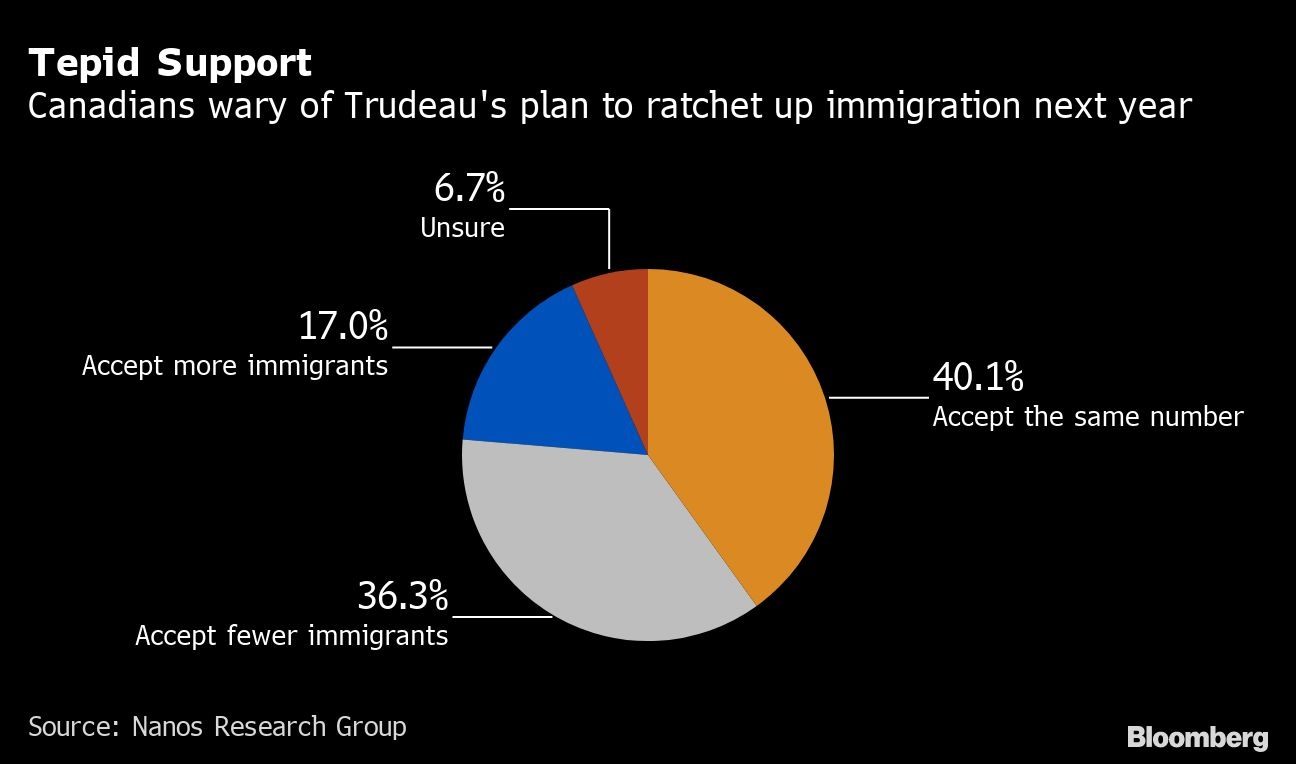
While it would be helpful to have more information on the context and wording of the framing questions, overall seems to make sense. But not that negative: 40 percent maintaining the current level (340,000) and 17 percent supporting an increase, is very positive during an economic downturn:

Prime Minister Justin Trudeau may struggle to sell his ambitious new immigration plan to Canadians, a new survey shows.

Only 17 per cent of respondents say the country should accept more immigrants in 2021 than it did last year, according to a Nanos Research Group poll conducted for Bloomberg News. That suggests most Canadians are less than enthusiastic about aggressive new targets announced last week.

Trudeau hopes to attract 401,000 newcomers next year, 60,000 more than in 2019. The target would rise by 10,000 in each subsequent year, bringing it to 421,000 in 2023. Respondents were asked whether the government should raise levels above last year’s actual inflows.

Embedded Image

Tepid Support

An open-door policy is a central tenet of the Liberal government’s long-term growth agenda. But with the economy recovering from the damage wrought by COVID-19, opposition parties are raising concern.

“We’re facing 9 per cent to 10 per cent unemployment — more than a million Canadians are out of work,” Conservative lawmaker Raquel Dancho said in an interview, adding that affordable housing is also scarce. “Where are these folks going to work? Where are these folks going to live?”

Closed borders and pandemic-related travel restrictions have slowed immigration this year and the country is on pace to meet only 60 per cent of its 2020 target of 341,000 permanent residents.

Labor Gaps

The survey results suggest Trudeau’s new targets don’t enjoy widespread support. Some 40 per cent of respondents say the government should reduce the number of new permanent residents accepted in 2021 below 340,000. And 36 per cent say they would like the country to maintain the same immigration levels as 2019.

Immigration Minister Marco Mendicino argues increasing the number of permanent residents will support the economy’s recovery from COVID-19 and help fill vacancies in essential work like healthcare. He is also hoping to draw on the more than 1 million foreign students, temporary workers and asylum seekers already in the country to achieve the increased targets.

“Canadians have a long, proud history of welcoming immigrants, because we know immigration makes our country stronger,” Mendicino said Friday by email, citing support for the higher targets from business and unions.

The flow of newcomers into Canada has been credited with helping counter aging demographics and supporting everything from the housing market to banking services. Before COVID-19, the government’s policies helped drive the fastest pace of population growth in three decades.

Dancho, the chief Conservative spokeswoman on the issue, said her party is pro-immigration but thinks the Liberal government’s announcement of new targets was “tone deaf” as “it did not acknowledge the feasibility concerns of bringing in this many new workers.”

The Nanos survey of 1,000 Canadians was conducted between Oct. 28 and Nov. 1 via telephone and online. The government announced the new targets Oct. 30.

Source: Trudeau’s Plan to Ramp Up Immigration Falls Flat With Canadians