Farber and Fisman: The overlap between lockdown agitators and hate groups is a threat to us all

Of note:

The pandemic has been a major source of disruption in the lives of Canadians for more than a year, leaving many of us frightened. For some people, that fear means opportunity.

In 2008, epidemiologists developed models of the “coupled” dynamics of epidemics and the fear generated by them, showing that behavioural changes engendered by fear can spread as a parallel epidemic, making the infectious disease worse. When two such epidemics interact, the process is referred to as a “syndemic.”

The pandemic, then, has undoubtedly been a syndemic of infection and fear, preyed upon by well-known internet influencers who sat at the core of hate networks that existed before the first outbreak. Now, we have to reckon with a syndemic of infection and hate in a system too vulnerable to both – or face very real consequences.

According to a recent report in The New York Times, many experts now believe the United States may never reach herd immunity. This is largely due to hesitancy around safe and effective vaccines, which is being driven in part by anti-science and pro-conspiracy beliefs. These movements have only sown confusion as people navigate the informational minefield that is a public-health crisis, and they threaten to keep us all in pandemic limbo for the foreseeable future.

Indeed, since the beginning of the global outbreak, conspiratorial anti-establishment movements have only gained momentum, finding common cause in opposing mask mandates and lockdown measures and sucking up oxygen by undermining valid criticisms of government health orders. Rallies and protests have been organized almost every weekend across the country, and those who have found fame in the process bill themselves as defenders of our freedoms. They march with a list of grievances and conspiracy theories, but all believe they are standing up against their misguided idea of tyranny.

Outdoor rallies may not in and of themselves confer much risk on attendees; COVID-19 is some twentyfold less infectious outdoors than indoors as a result of dominant aerosol transmission. However, these gatherings undermine confidence in public-health guidance and promote messaging that is likely to further damage communities already hard-hit by this pandemic.

Ekos Research has found that 8 per cent to 20 per cent of Canadians have views that could be characterized as being distorted via disinformation, with men, minorities and lower-income individuals more likely to be disinformed. We know that minority and lower-income communities in Canada have already been the hardest-hit by COVID-19, and now we’ve seen the promotion of disinformation deepening the problem. Vaccine hesitancy also tracks closely with being disinformed; the promotion of disinformation will continue to injure communities even if it becomes possible to move beyond the pandemic via vaccination.

The principal actors of the anti-lockdown movement have either been or rubbed elbows with some significant haters on the scene. Vancouver neo-Nazi Brian Ruhe, who at one point organized a mock book burning, was involved in its earliest iteration. Quebec’s far-right conspiracy streamer Alexis Cossette-Trudel, a big name among France’s QAnon following, is an important mouthpiece of the francophone anti-lockdown movement. Neo-Nazi Paul Fromm is a fixture at rallies in both Ontario and in Kelowna, B.C. Antimask activist Chris Saccoccia’s social-media feeds feature Holocaust denial and racist posts.

Perhaps one of Canada’s most persistent agitators is Kevin Johnston, who made national headlines in 2017 when he was charged with the willful promotion of hatred against Muslims. In 2019, he lost a $2.5-million judgmentfor his role in racially motivated defamation against Toronto philanthropist Mohamad Fakih in which he repeatedly accused him of being a terrorist; the judge called his comments about Mr. Fakih “hate speech at its worst.” Now, Mr. Johnston is running for mayor of Calgary and has shifted gears by portraying himself as an anti-lockdown and antimask influencer.

The fact that an anti-public health agenda aimed at undermining the Canadian economy and the health and well-being of Canadians has been taken up by a rogues’ gallery with a long track record in disinformation and promotion of hatred should give us all pause. And with our country now approaching 25,000 dead due to COVID-19, Canadians should ask themselves whether the promotion of disinformation – and the undermining of the tools and measures that will permit a return to normalcy – has crossed the line from mere grotesque opportunism to active, malicious harm.

Source: https://www.theglobeandmail.com/opinion/article-the-overlap-between-lockdown-agitators-and-hate-groups-is-a-threat-to/

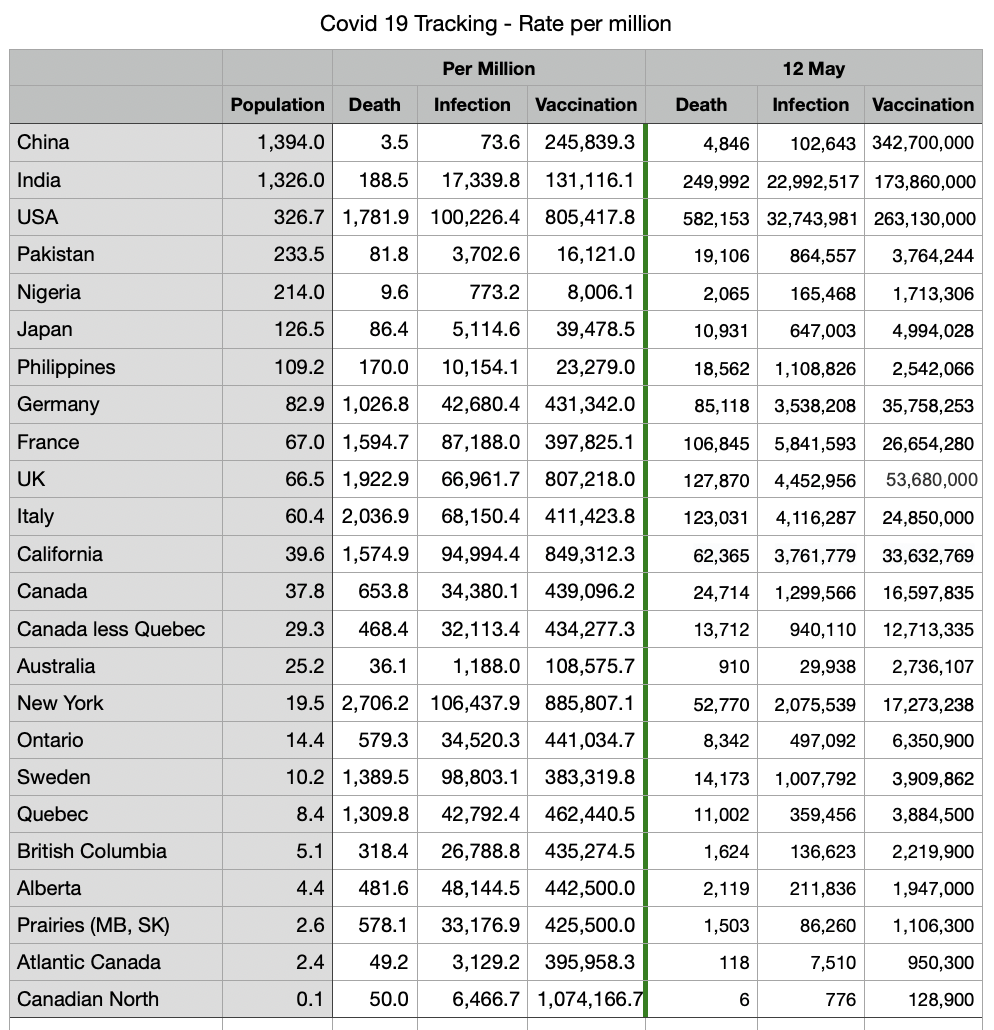
#COVID-19: Comparing provinces with other countries 12 May Update

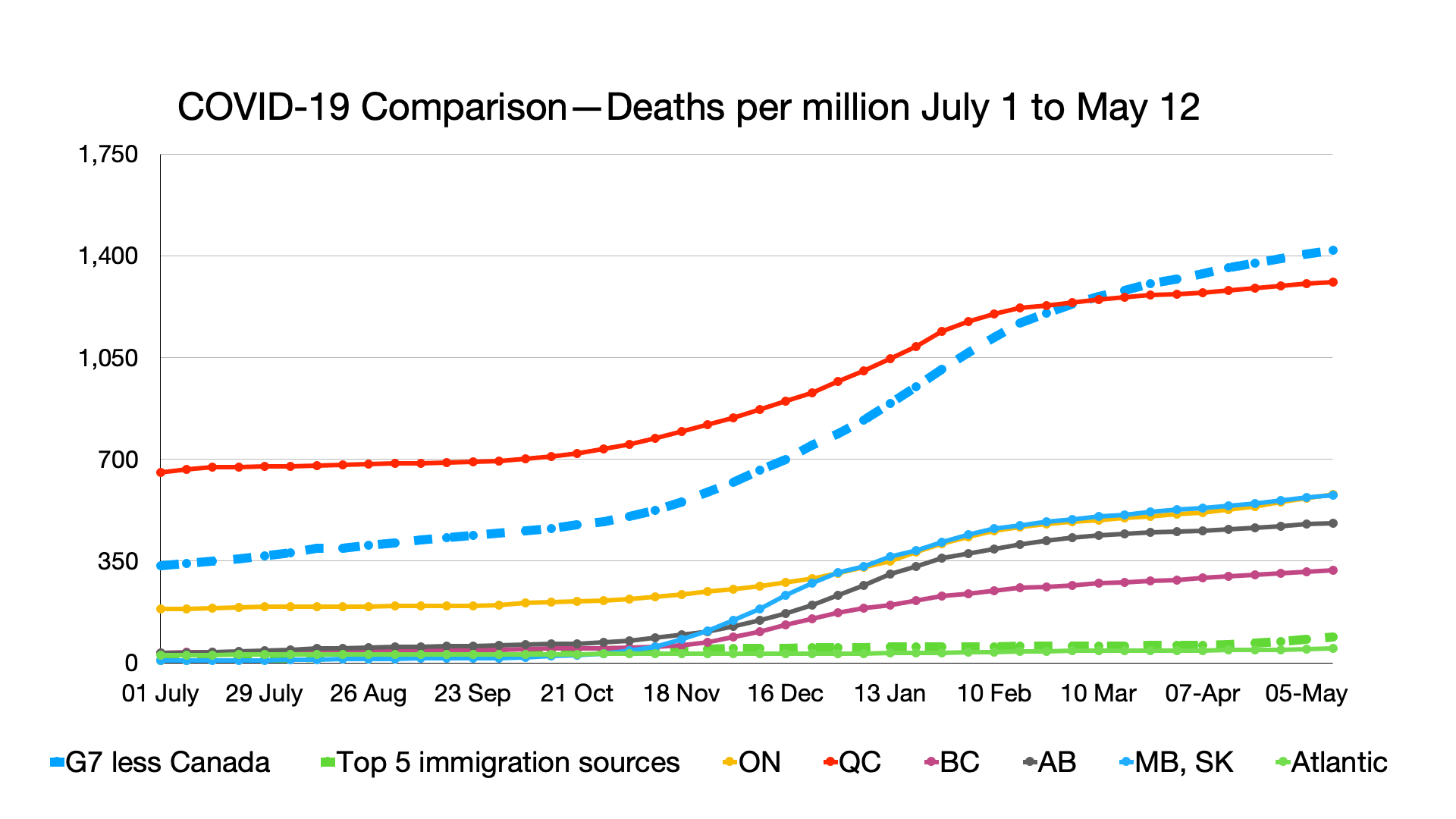
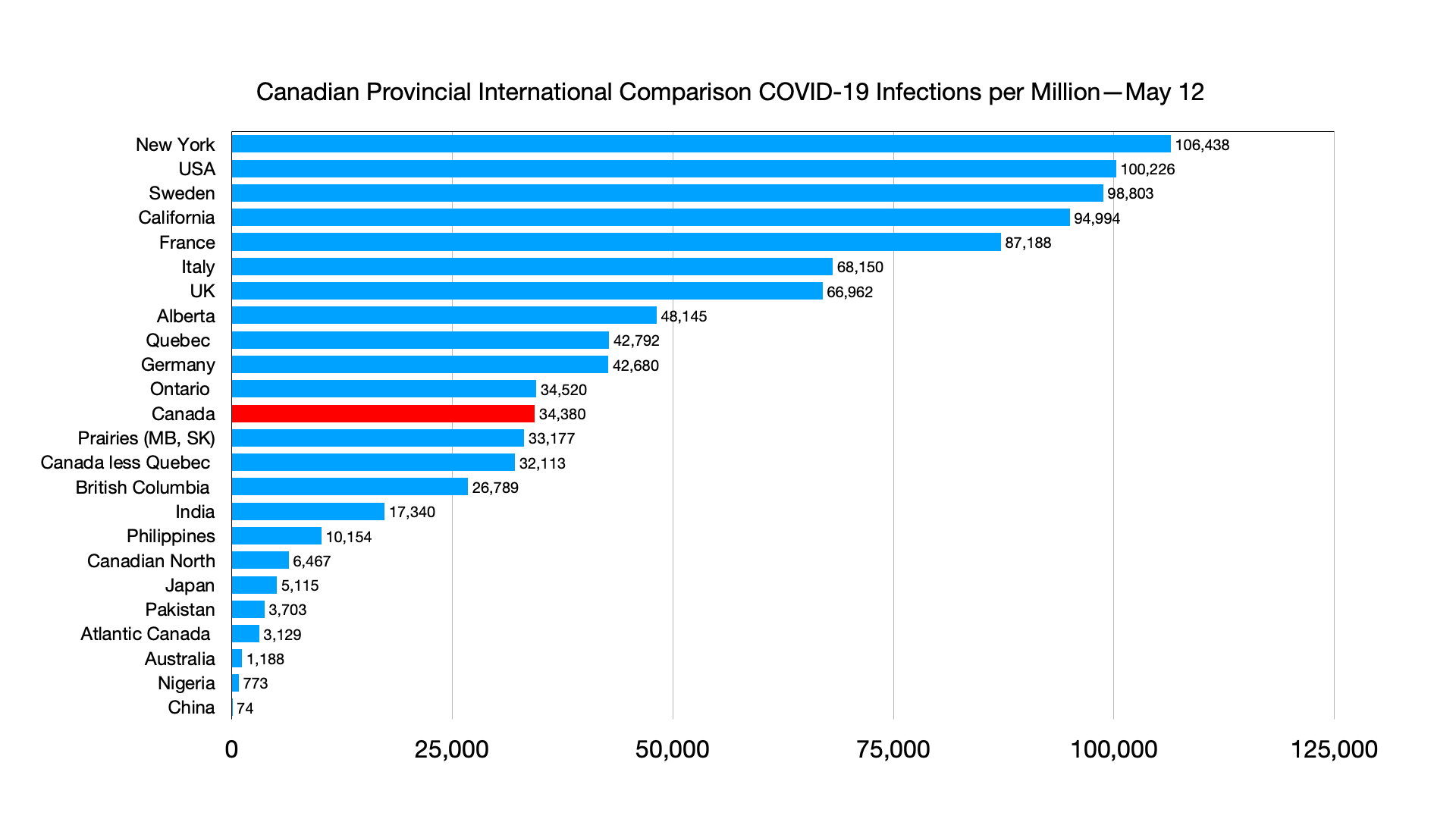
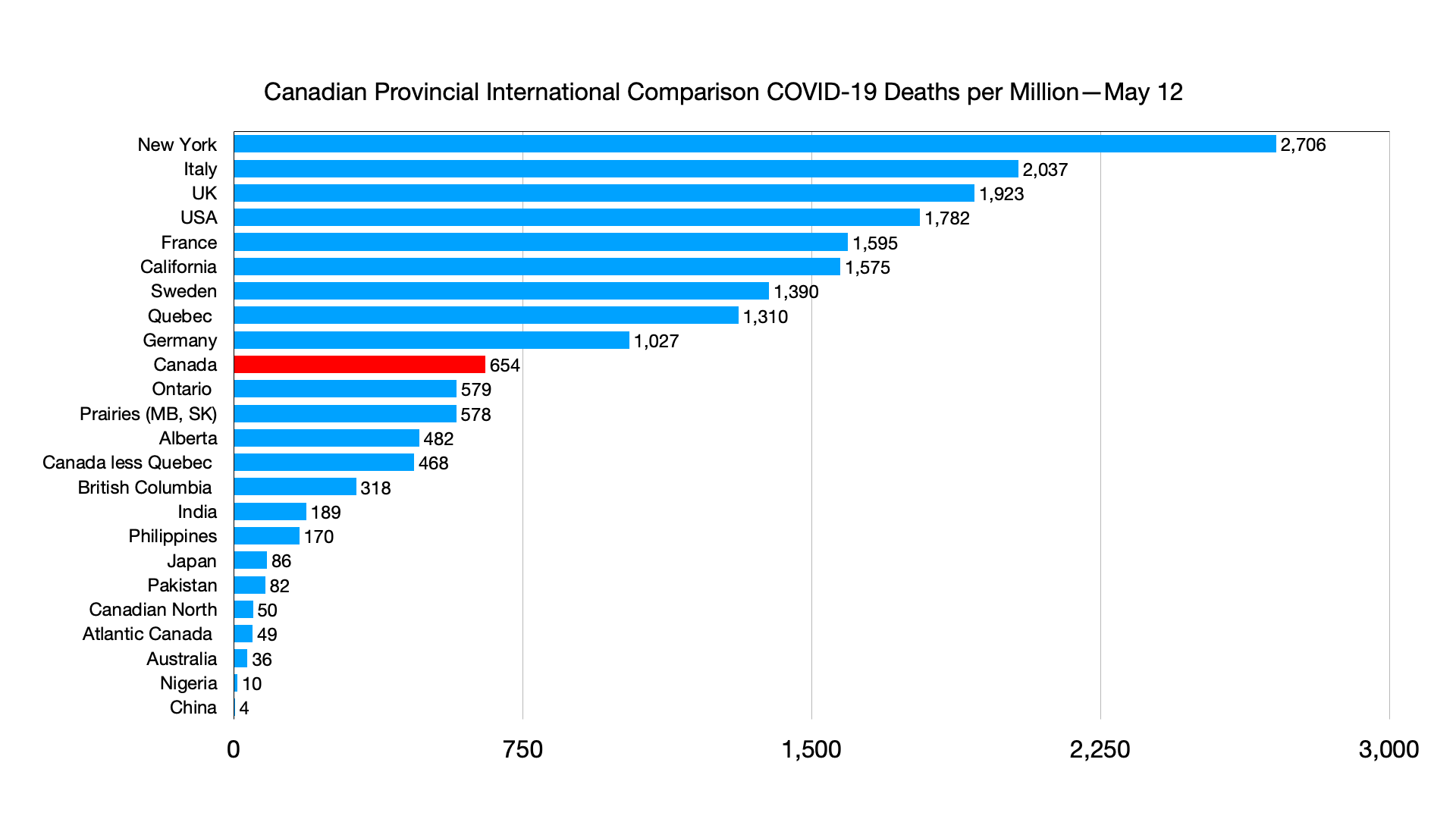
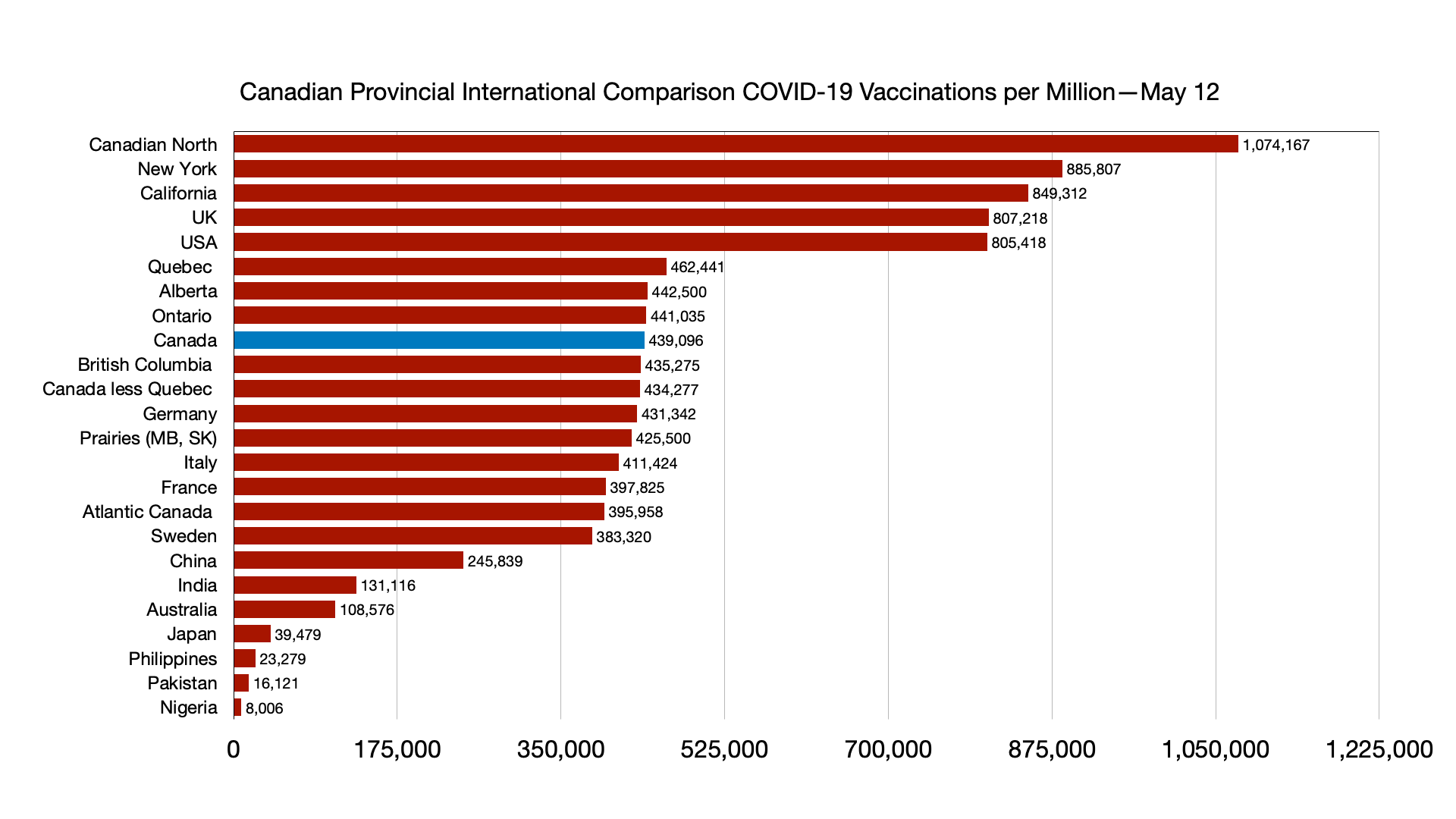
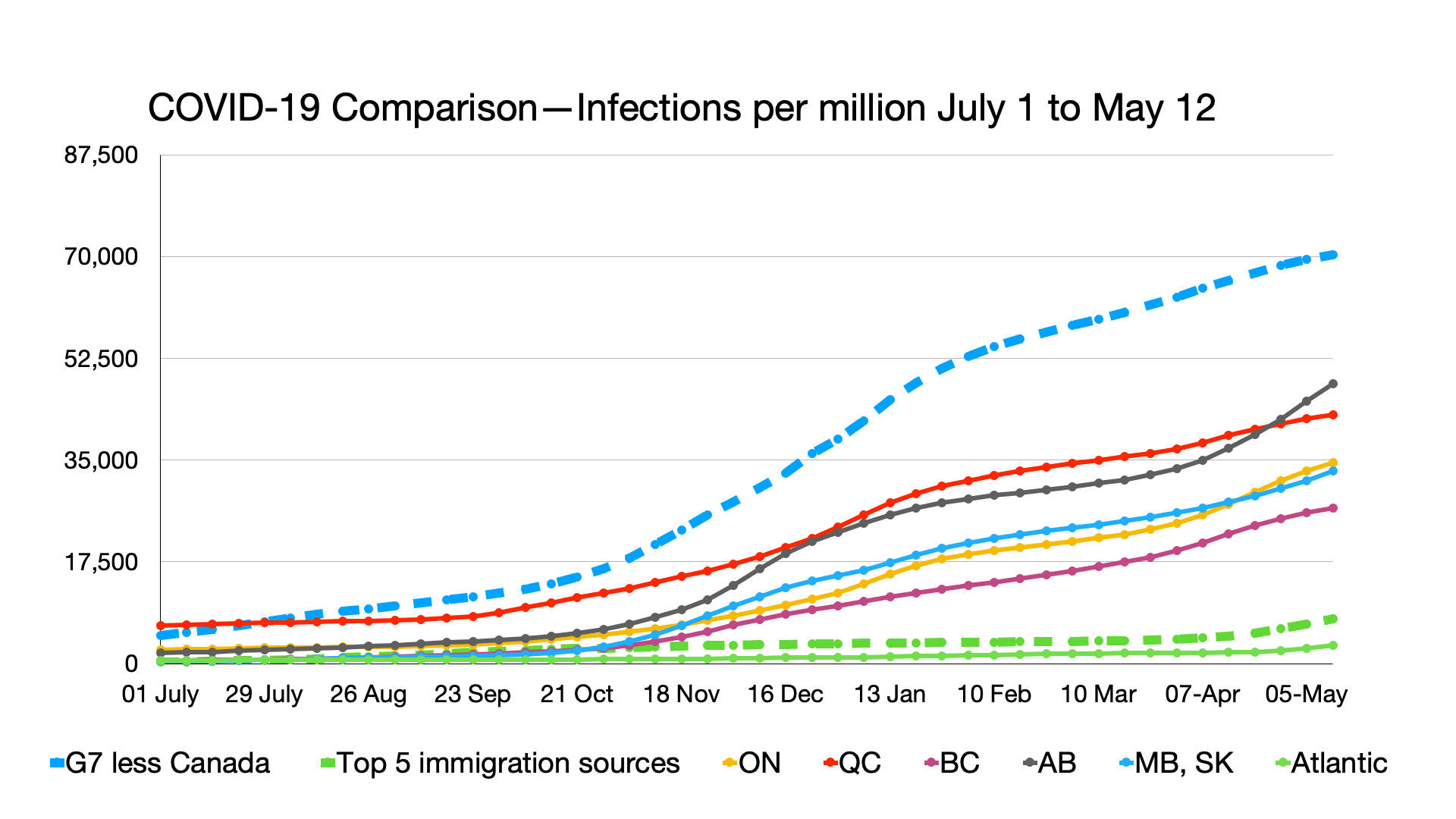
The latest charts, compiled 12 May as the third wave continues. The ongoing spike of infections and deaths in India per million still has not resulted in a change in the relative ranking given the size of India’s population.

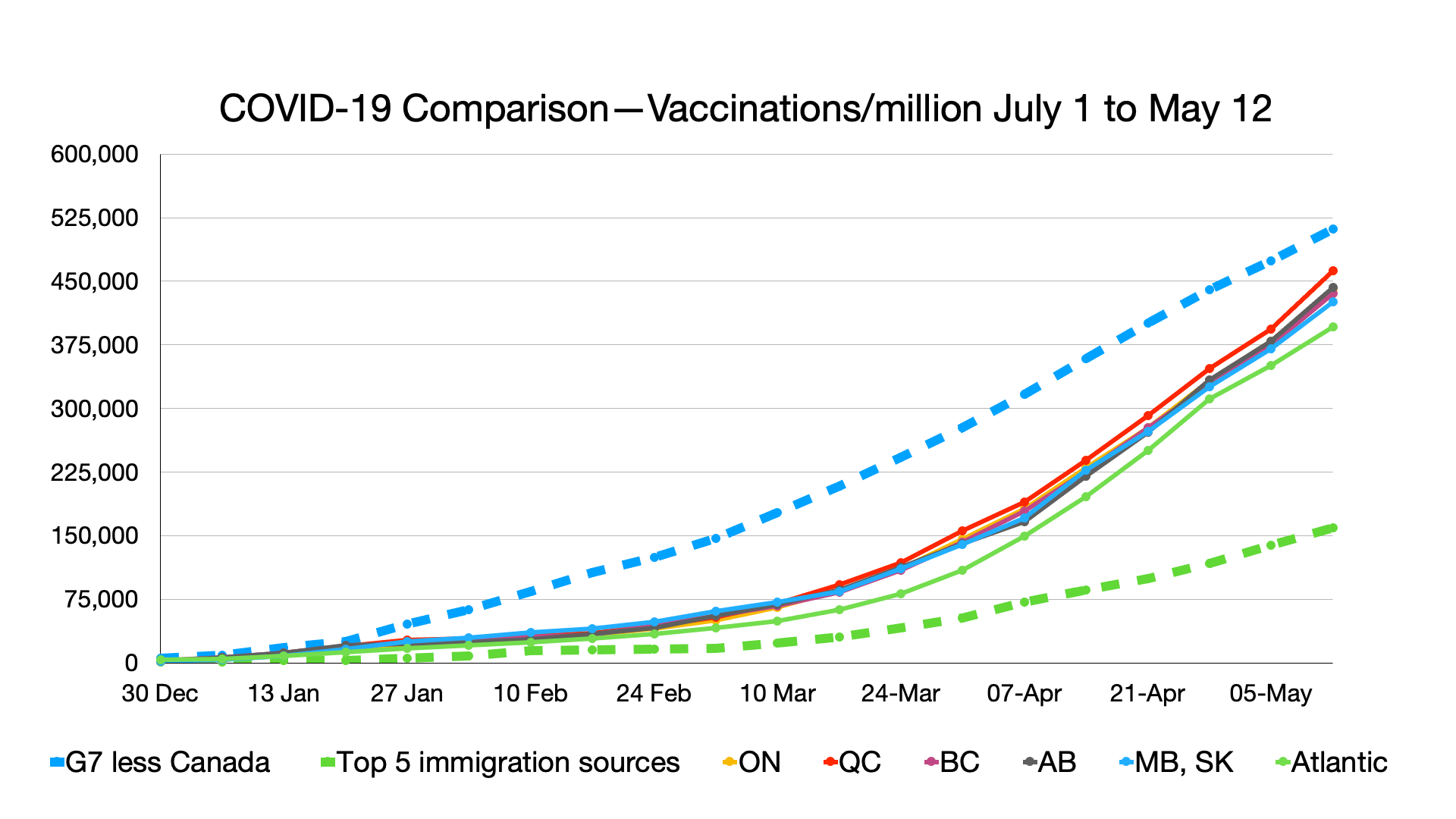
Vaccinations: Overall, vaccination rates in Canada and most provinces continue to be comparable or greater to those of EU countries.

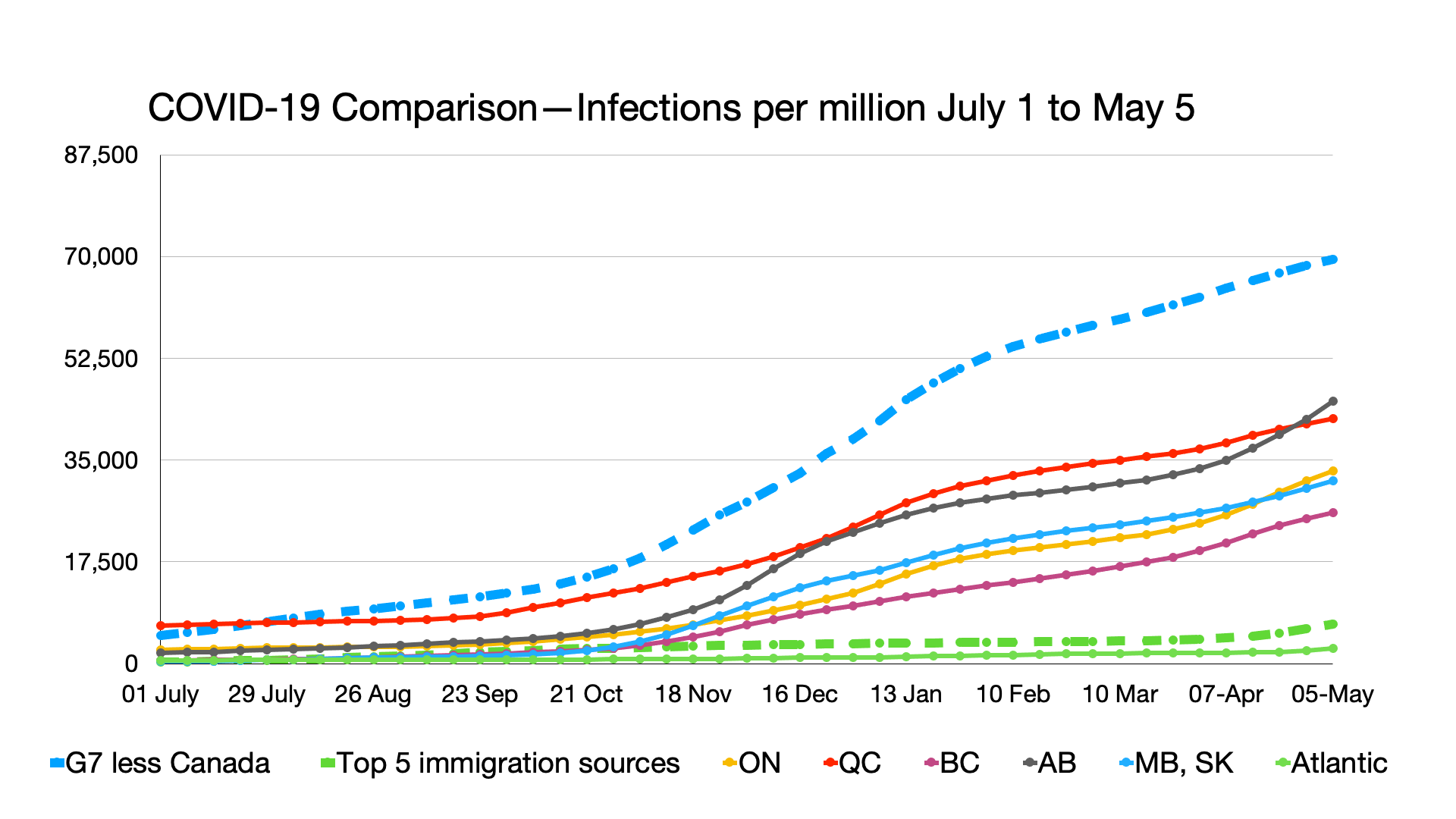
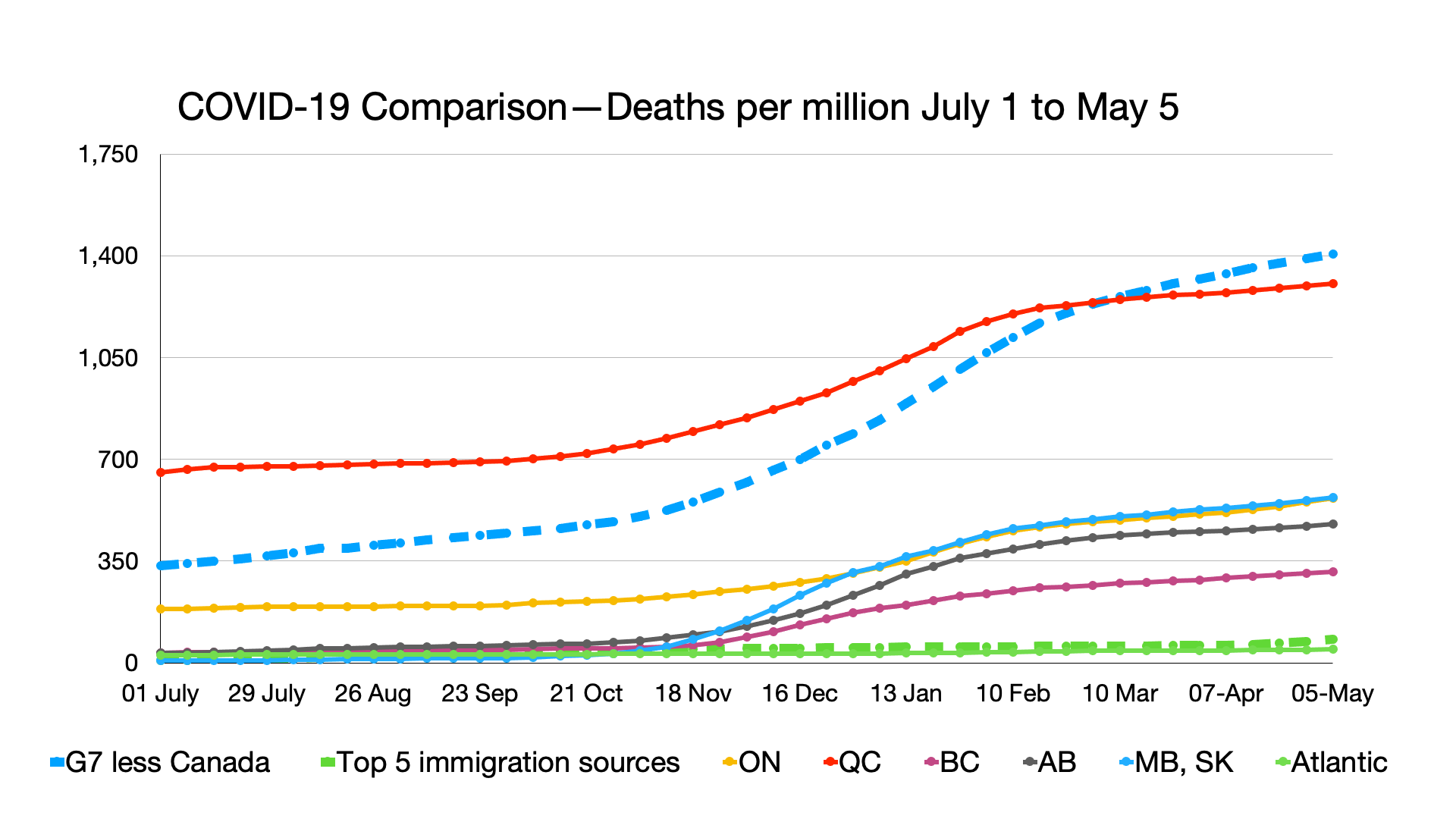
Trendline charts

Infections per million: The ongoing spikes in Alberta and Ontario continue, with Alberta showing the highest growth rate.

Deaths per million: Gap between G7 and Canadian provinces continues to grow.

Vaccinations per million: Vaccination rates in Canadian provinces continue to increase more quickly than overall G7 less Canada countries. USA has moved ahead of the UK. Canada and the largest four provinces all ahead of Germany but Atlantic Canada behind France, while Australia and Japan have moved ahead of the Philippines. The Increases among immigration source country continue to reflect China and India mass vaccination roll-out, but at lower rates of increase compared to Canadian provinces and G7.

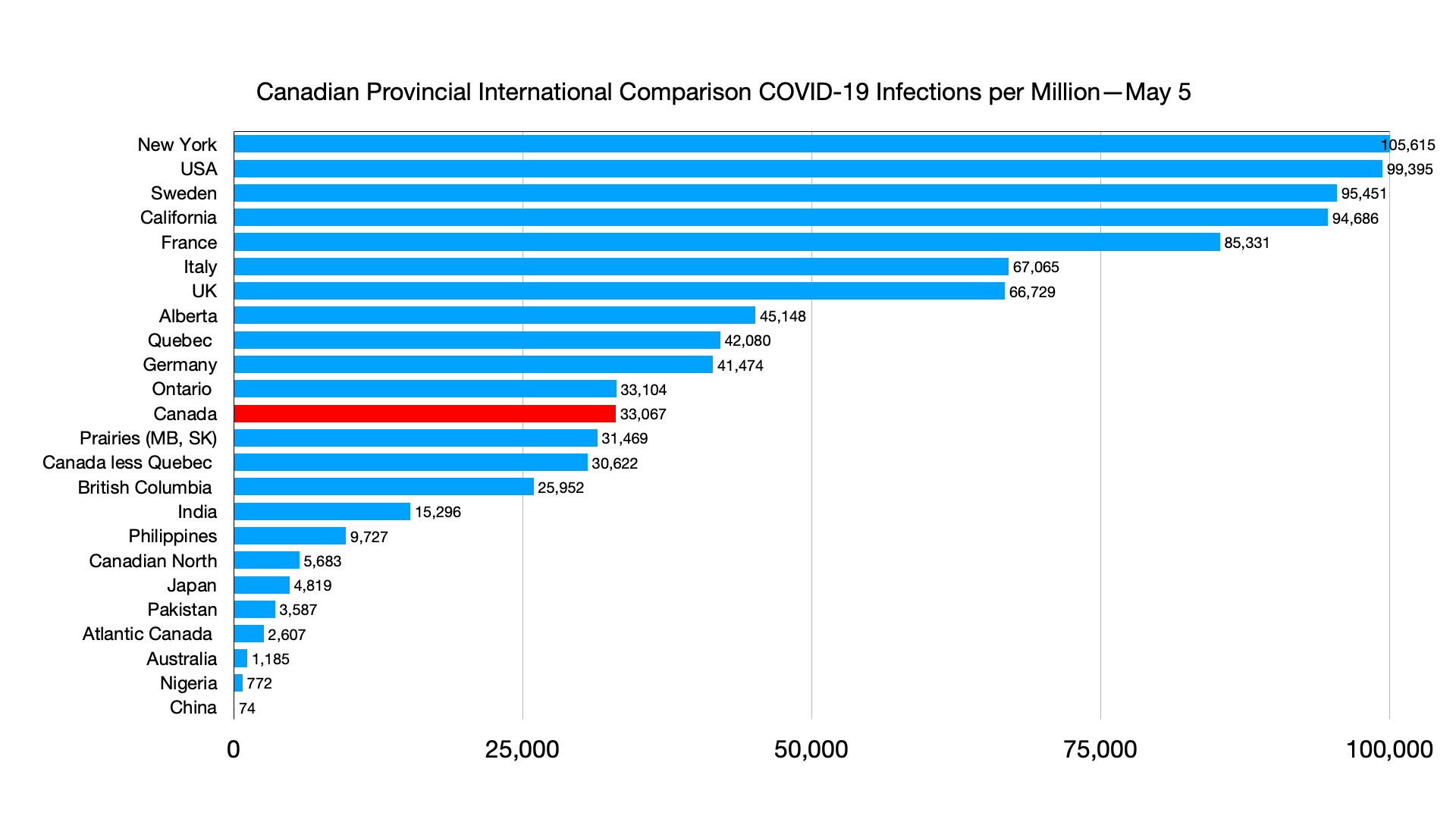
Weekly

Infections per million: Sweden moved ahead of California, Italy ahead of UK, and Ontario ahead of all Canada.

Deaths per million: Ontario ahead of Prairies.

They’ve been called hot spots. It’s actually ‘code’ for social inequity

More analysis confirming COVID-related racial and other disparities:

People who live in Toronto and Peel COVID-19 hot spots are on average nearly twice as likely to be racialized and about four times more likely to be employed in manufacturing and utilities compared to those in the regions’ other neighbourhoods, a new analysis shows. 

New research from the Gattuso Centre for Social Medicine at University Health Network also highlights how residents of these hot-spot areas are, on average, more than twice as likely to work in trades, transportation and equipment operation and also more likely to meet low-income thresholds.

While the public has heard over the past year that racialized people, those with lower-income status and essential workers are bearing a disproportionate burden of the COVID-19 pandemic in Ontario, the analysis from the Gattuso Centre highlights at a granular level who actually lives in the neighbourhoods hardest hit by the virus, how much money they make, and what they do for a living. 

“When we talk about ‘hot spot’ postal codes, what we’re really talking about is the structural determinants of health. Social inequities and the pathologies of poverty have been driving this pandemic,” said Dr. Andrew Boozary, executive director of the Gattuso Centre. “This is further evidence that life-saving measures need to get to neighbourhoods with the highest structural risks –– this at the very least means community leadership driving vaccine rollouts and better safety measures at workplaces.”

Using Census data, the social medicine team looked at demographics in Toronto’s 13 “sprint” strategy communities deemed most at-risk and compared it with the rest of Toronto’s forward sortation areas (the first three characters in postal codes). They also compared hot spots in Toronto and Peel with the remainder of neighbourhoods in those regions, and did a similar comparison of all of Ontario’s 114 hot spots with postal codes in the rest of the province.

In virtually every case, the most at-risk neighbourhoods had, on average, higher proportions of racialized individuals, those who meet low-income measures, people who work in manufacturing and utilities, and those employed in trades, transportation and equipment operation. 

For example, M3N, which includes Jane and Finch and Black Creek, has the most manufacturing and utilities employment, the sixth-highest proportion of people who meet low-income thresholds, the eighth highest employment in trades, transportation and equipment operation, and is the 10th most racialized community out of all postal codes in Toronto and Peel.

Similarly, L6R, in northern Brampton, has the most trades, transportation and equipment-operation employment, the fourth-most manufacturing and utilities employment and is the third-most racialized postal code out of all Toronto and Peel neighbourhoods. 

The only exception the researchers found was in the Ontario-wide hot-spot comparison, in which the percentage of people who work in trades, transportation and equipment operation in hot spots was slightly lower than non-hot-spot neighbourhoods.

“That’s the thing with this data, it also really shows the disparity. It really shows that no, we haven’t all been through the same experience with COVID,” said Sané Dube, Manager, Community and Policy with Social Medicine at UHN, using the example of someone who makes over $100,000 annually, lives in downtown Toronto and can pay for their groceries to be delivered.

“That is very different from the experience from the person who is making $30,000 in a grocery store, has continued to work the whole pandemic and lives in a certain part of the neighbourhood. There’s this idea that we’ve all had the same experience in this pandemic. We haven’t. This really brings that home.”

Laura Rosella, scientific director of the Population Health Analytics Lab at the Dalla Lana School of Public Health and a collaborator on the analysis, notes that hot spots are vulnerable for different reasons, which is why connections between policy-makers and the communities are so important.

“The data kind of gives you that first layer, saying we need to pay attention here. Then it’s the conversations with the community that will tell you what the solutions are,” Rosella said. “The data alone won’t tell you what the solutions are. The community will.”

Michelle Dagnino, executive director of the Jane/Finch Community and Family Centre, says that while she is not surprised by the data, many people, including many who work in social services, did not realize just how many people in vulnerable areas have continued to go to work throughout the pandemic. 

“I think there was a sense that there were going to be more workplace shutdowns than there ever actually ended up being. The definition of ‘essential’ just ended up being so broad in terms of these workplaces,” she said. 

“Effectively, all of our factory workers, whether they’re manufacturing glass panes or producing clothing or whether they’re delivering factory-made goods through Amazon distribution centres, they have been open the whole time. And the consequences of that in this third wave have led us to a situation where we have seen racialized, low-income workers dying because they’ve had to continue to go to work.”

Source: https://www.thestar.com/news/gta/2021/05/11/theyve-been-called-hot-spots-its-actually-code-for-social-inequity.html


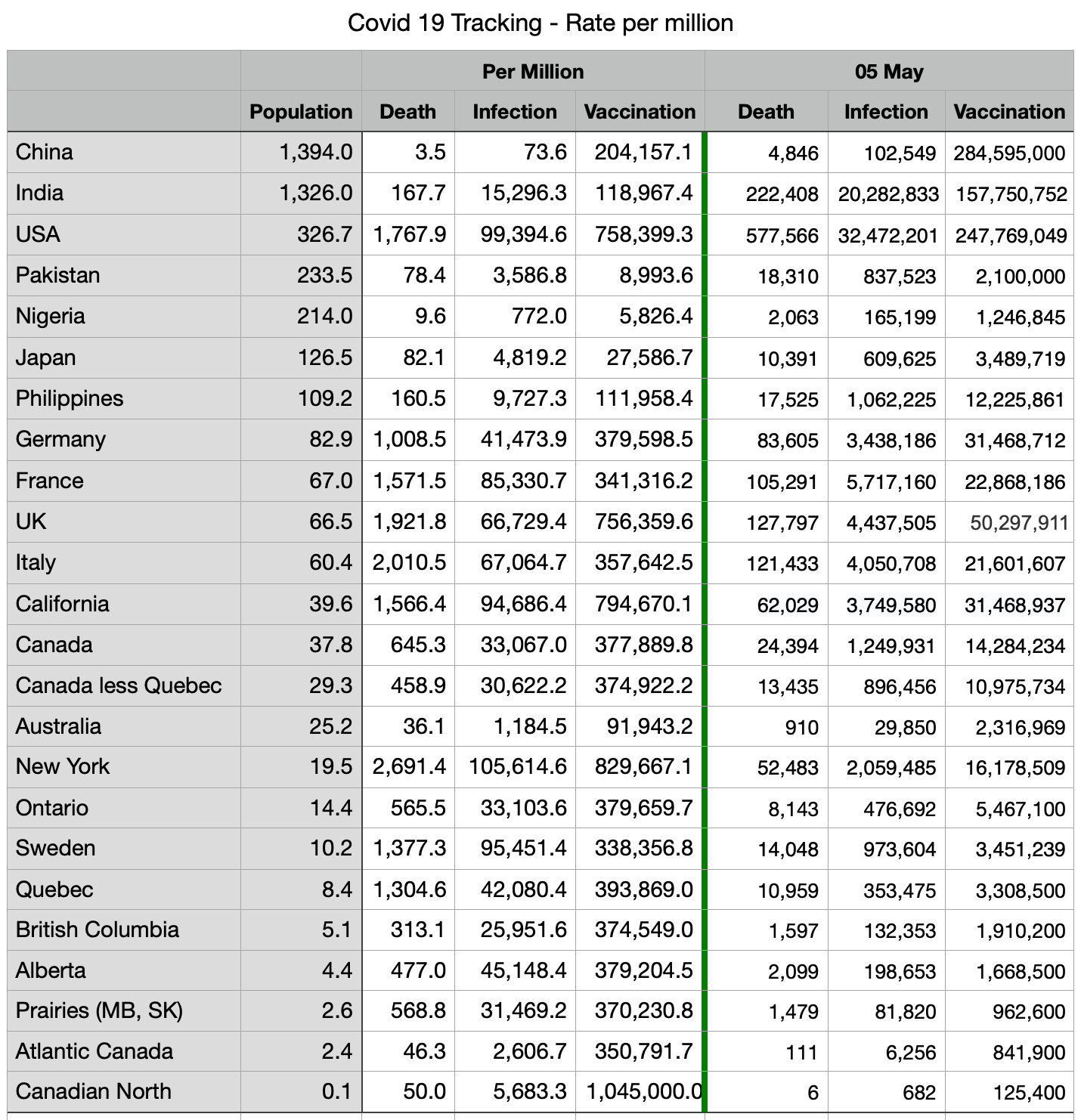
#COVID-19: Comparing provinces with other countries 5 May Update

The latest charts, compiled 5 May as the third wave continues. The ongoing spike of infections and deaths in India per million still has not resulted in a change in the relative ranking given the size of India’s population.

Vaccinations: Overall, Canada and most provinces continue to be comparable or greater to EU countries.

Trendline charts

Infections per million: The ongoing spikes in Alberta and Ontario continue, with Alberta significantly ahead of Quebec, Ontario ahead of the Prairies.

Deaths per million: Gap between G7, Quebec and other provinces continues to grow.

Vaccinations per million: Vaccination rates in Canadian provinces continue to increase more quickly than overall G7 less Canada countries. Increases among immigration source country reflect China and India mass vaccination roll-out, but at lower rates of increase compared to Canadian provinces and G7.

Weekly

Infections per million: Sweden now ahead of California, Italy now ahead of UK, and Ontario ahead of Canada .

Deaths per million: France ahead of California, India ahead of Philippines

Is Australia’s India travel ban legal? A citizenship law expert explains and a critique of the ban

The lack of a charter with mobility rights compared to Canada:

There is a growing public and political outcry over the federal government’s sudden decision to ban Australians from coming home from India.

But as everyone from Indian community leaders to human rights leaders, famous cricketers and Coalition MPs calls on the government to rethink the policy, is it legal? Is a High Court challenge an option?

What is citizenship?

In terms of common law, citizenship is a relationship between an individual and their nation, where each owes fundamental obligations to the other. In broad terms, the citizen’s job is to be loyal to the nation. The nation’s job is to protect its citizens.

Last year, a record number of people pledged allegiance to Australia and became citizens. The largest group of new citizens were Indian migrants, with over 38,000 becoming Australians in 2019-20.

Now, under the Australian government’s tough new travel ban, 9,000 Australians remain stranded in India, which is currently battling a deadly COVID-19 second wave and oxygen and vaccine shortages.

Some were granted permission to travel to India to see dying relatives or attend funerals. Others travelled there pre-pandemicand have since been unable to return to Australia.

Despite having done nothing wrong, these Australians have been left unprotected by a government that has failed to hold up its end of the citizenship bargain.

How does the travel ban work?

The ban makes it unlawful for anyone, including Australian citizens, to enter Australia if they have been in India in the past 14 days. It was made under sweeping powers conferred on federal Health Minister Greg Hunt by the 2015 Biosecurity Act.

Section 477 of the act allows Hunt to issue “determinations” imposing any “requirement” that he deems necessary to control the entry or spread of COVID-19. These determinations cannot be disallowed by parliament. Thanks to a provision aptly known as a “Henry VIII clause”, they also override any other federal, state or territory law.

If a person breaches the travel ban, for instance by transiting through a third country, the Biosecurity Act states they may face criminal penalties of five years imprisonment, a $66,000 fine, or both (even if Prime Minister Scott Morrison says jail time is unlikely).

Hunt says the ban is a “temporary pause”. It will lapse on May 15. However, if he deems it necessary, he could use his broad powers to reintroduce it, or impose similar restrictions.

As political pressure builds to remove the ban early, the government says it is “constantly” reviewing it.

Is the ban legal?

Another basic principle of citizenship is citizens may freely return to their countries. Under common law, this stems from the Magna Carta. It is also an important principle of international law, enshrined in the Universal Declaration of Human Rights, and the International Covenant on Civil and Political Rights.

In March, two Australians stranded in the United States took their case to the United Nations Human Rights Committee. They argued government policies blocking their return contravene international law.

The committee has not reached a decision, but in April it asked Australia to ensure their prompt return, noting they faced “irreparable harm”.

What about our domestic law?

Whether the ban is legal under Australian domestic law is a different question. Although the Department of Home Affairs says Australian citizens can “apply for an Australian passport and re-enter Australia freely”, there is no codified right of return under Australian law. This sets us apart from many countries that have a bill of rights, and include this right.

A High Court challenge is an option, but there is no clear path to success.

The High Court has said little on the subject. A 1908 case suggests citizens may have a common law right to return to Australia, provided this has not been taken away by parliamentary law. The Biosecurity Act of course thoroughly displaces any such right.

Due to the deep links between citizenship and the right of return, it has been suggested citizens may have an implied constitutional right to enter Australia. There is no case law on this yet — just a single, vaguely worded sentence in a 1988 High Court case — and there are good reasons why it might be a difficult case to argue in Australia.

Implied rights must be derived from the text and structure of Australia’s Constitution, which says nothing about Australian citizenship, and little about the relationship between the government and the people, besides providing for democratic elections.

Does it breach the Biosecurity Act?

Another argument might be the travel ban is unlawful on the grounds Hunt failed to comply with the conditions for making a determination under section 477 of the Biosecurity Act.

These conditions require him to be satisfied, before imposing the ban, that it was “likely to be effective” in stopping the spread of COVID-19, “appropriate and adapted” to this purpose, and “no more restrictive or intrusive” than the circumstances required.

Importantly, it is Hunt personally who must be satisfied of these conditions. This means if he reached that conclusion on reasonable grounds, he has not broken the law, even if a different approach might have been available.

Yesterday, Chief Medical Officer Paul Kelly’s advice to Hunt in advance of the travel ban was released. Kelly’s advice emphasises the significant risk quarantine leakage poses to the Australian community and says a travel ban on arrivals from India until 15 May would be effective, proportionate and limited to what is necessary.

In light of this, it seems likely that a court would see the determination as a reasonable exercise of Hunt’s power.

Beyond the law, what about moral arguments?

But, legality aside, let’s return to the idea that Australia has a fundamental responsibility to protect its citizens. In February 2020, Hunt acknowledged this, pointing to two related national priorities: to contain the virus and protect citizens at home, and protect and support Australians abroad.

There may be circumstances in which these priorities conflict with each other. But it is hard to see the conflict in this situation. Quarantine and effective contact tracing have seen those within Australia substantially protected against COVID-19. We have not needed blanket bans on returns from the US, the United Kingdom or other countries that have experienced virus surges.

Kelly’s advice points to potential strain on quarantine, and Morrison has said the ban ensures that “our quarantine system can remain strong”. But the federal government could protect more people in Australia and abroad (not to mention ease pressure on countries experiencing COVID-19 strain), if it worked to bring citizens home while devoting more resources towards strengthening the quarantine system.

Yet the government has resisted this, despite a clear constitutional power over quarantine, the recommendations of public health experts and a national review.

Meanwhile, 9,000 Australians in India are anxiously waiting for a change to the law, which would at least legally permit them to try and return home.
Source: Is Australia’s India travel ban legal? A citizenship law expert explains

Strong commentary by Tim Soutphommasane, former Australian race discrimination commissioner, arguing against the ban:

It has come to this: a government pulling up the drawbridge on its own citizens trying to make it home. Last week’s announcement of a ban on return flights from India marks a drastic escalation of “fortress Australia”.

Yes, it isn’t the first time during the pandemic that Australia’s borders have been closed to people arriving from certain countries deemed high risk. This happened, for example, with China in February 2020.

But this new measure goes beyond a temporary closure of borders. It also involves harsh criminal penalties imposed on people seeking to return from India, including fines and even imprisonment.

There’s something seriously wrong about this. Citizenship is meant to guarantee its bearers certain rights and liberties. The right to vote. The right to expression. The right to live without interference. The right to enter one’s country.

Clearly, we can’t take our basic rights and liberties for granted. It’s no exaggeration to say that this policy undermines the very status of citizenship. The principles of democratic liberalism are under assault.

After all, citizenship means little if you can’t exercise your right to return to Australia in a time of need. Liberal democracy is diminished when your government doesn’t protect you when you’re in present or impending danger.

On every Australian passport, there is a page that bears a request of other governments and people that they “allow the bearer, an Australian Citizen, to pass freely without let or hindrance and to afford him or her every assistance and protection of which he or she may stand in need”. Those words now ring hollow. How can we expect people abroad to do that, if our own government won’t do the same to its citizens?

Equal citizenship

Closer to home, this move inserts some doubts as to whether all citizens can presume they enjoy equal citizenship.

It hasn’t escaped many of us that there have been different standards of treatment given to citizens and residents returning to Australia during this pandemic. Last year, when Covid was rampaging through the United States, the United Kingdom and Europe, the government took no step to close our borders to those places, let alone impose criminal penalties on those arriving from there.

The government says it has introduced this policy based on medical advice. Yet, according to the commonwealth chief medical health officer, Paul Kelly, “no advice was given” in relation to the imposition of fines or jail terms for those seeking to circumvent the India travel ban. Moreover, numerous leading public health experts have questioned why a ban has been introduced.

It wouldn’t be the first time an Australian government has engaged in cynical racial dog whistling. As the Australian Human Rights Commission has stated, the government “must show that these measures are not discriminatory and the only suitable way of dealing with the threat to public health”. Because right now they do look discriminatory. And they are far from the only way to deal with any public health threat.

Here’s how we should be dealing with things. There remain about 35,000 Australians stranded overseas, including about9,000in India. We – and by we I mean the government that acts in our name – must act urgently to bring these Australians home, wherever they are. The way to do that is obvious: charter flights to bring them back, and create dedicated quarantine facilities across the country to make sure it happens safely.

How breathtaking it is that this hasn’t yet happened. We are more than one year into the pandemic. There has been plenty of time to think this through, make plans and deliver.

A choice between two Australias

Then again, you can understand why government hasn’t done this. This pandemic has confronted us with a choice between two Australias: between being an open, confident, internationalist country and being a closed, fearful, parochial nation. Increasingly, it seems as though people are choosing the latter.

There has been a strange acceptance of, maybe even enthusiasm for, a retreat into a hermit nation. Our politicians know all too well that closing borders and imposing lockdowns seem to bring some solid electoral payoffs: just ask Annastacia Palaszczuk and Mark McGowan.

For too many people, including those who may like to consider themselves progressive, border closures have become a fetish. It was weird enough that the pandemic was generating a competition among some premiers to close borders to other states. Now we’ve got to the point where we’re happy to have our national borders closed off to our own people and fellow citizens. At least some of them, anyway.

Covid has confirmed some timeless political truths. Amid threat, fear is a formidable beast to counter. And in tough times, minorities very rarely fare well. Covid has generated a significant rise in anti-Asian racism. Consider too, the disproportionate impact the pandemic has had on migrants and international students.

But now the government is taking things into dangerous territory. Citizenship has been the bedrock of Australia’s multiculturalism: whatever background you’re from, you can be assured formal membership of the community. This latest move signals that, in the eyes of government, some of us are more Australian than others.

Tim Soutphommasane is a political theorist and professor at the University of Sydney. He was Australia’s race discrimination commissioner from 2013 to 2018

Source: Criminalising citizens returning from India signals some are more Australian than others

Scarborough researchers found the link between multi-generational households and COVID-19. What it could change about housing in years to come

Good and relevant study even if not particularly surprising:

A new study by three Scarborough researchers shows that the places that have been hardest hit by COVID-19 are also the places where multiple working adults or families are all sharing a household. 

The study by the Neighbourhood Change Research Partnership and the University of Toronto found that the maps that showed which areas in the GTA have high rates of COVID-19, shared a lot of overlap with areas that had the most households of what they call “mutually dependent adults.” One of those areas being Scarborough, where all three researchers reside. 

The findings confirm some assumptions people have made about why COVID-19 has spread the way it has, disproved some others, and reinforced why information like this is crucial to an effective pandemic response. 

But looking to the future it also shows that as more people live in bigger households like this, it’s time we get ahead of this issue, and build homes that can keep the people living inside healthy.

What does mutually dependent mean?

Using special-ordered Statistics Canada data from 2006 and 2016, the team parsed data on “mutually dependent adults” — combinations of households that could be a group of roommates, a grandparent living with a single mom, a family who rents out a room in their house — pretty much any situation where multiple working-age adults are living together under one roof, rather than independently, or as just a traditional couple. 

Between 2006 and 2016 as housing costs skyrocketed, the amount of working-age residents living together and depending on one another also grew by about 13 per cent across the country.

The most being in the notoriously expensive Toronto and Vancouver, where in 2016 mutually dependent adults were 27 and 25 per cent of the population, respectively. 

Multiple-family households and COVID-19

When broken down by neighbourhoods in Toronto, overall, the 10 with the highest rate of COVID-19 cases had just over twice as many mutually dependent adults at 37 per cent of the population. These were mostly found in Scarborough, northwest Toronto and some areas of York and North York. 

Meanwhile neighbourhoods that had more independent households also had fewer COVID-19 cases. 

The same held true in the GTA, with areas like Brampton. which has 37.2 per cent of adults in these kinds of households, and the highest average household size in the GTA — 3.5 people compared to Canada’s overall average 2.4. At the end of last year, Brampton also had 68 per cent of Peel Region’s COVID-19 cases.

John Stapleton, social policy expert and one of the study’s authors, said pooling resources in this way is both a solution to the high cost of living in Toronto, and to improve quality of living. It’s a way for people to potentially get more space — a house with a yard, for example, rather than living independently in smaller homes. But it created a higher risk for a virus like COVID-19. 

“What it was doing was creating an accelerant for a pandemic of this particular sort,” Stapleton said. 

Through the pandemic, Stapleton noted the assumptions that were made about why racialized people have seen disproportionate rates of COVID-19 — gathering for holidays like Diwali, language barriers. “It has very little to do with it,” he said. 

“Having so many people in a household and a number of adults working … and most likely working right in key sectors that you can’t do the work from home … that means that those households will be more vulnerable to COVID spread,” said David Hulchanski, a housing and community development professor at U of T.

“It’s demonstrating in yet another way what is wrong with having such a huge gap in income and wealth, which then affects all aspects of our life,” Hulchanski said. 

Seeing the overlap in the maps reaffirms that it is wise to focus treatment and resources in these highly-affected areas.

“In other words, it’s telling you, yes, you should have the vaccines (for) Scarborough. You should be doing this stuff by postal code,” Stapleton said.

Still with the vaccine rollout, Ontario only allotted 25 per cent of supply to hot spot areas despite its science table recommending 50 per cent, and only recently announced plans to up it to half as distribution has expanded. 

Epidemiologist Colin Furness said that the province’s reluctance to collect demographic data and have it influence the response from the start of the pandemic, has been a huge downfall. 

“The tail has really had to pull the dog along here and it really should not be that way,” he said.

Building a healthier future

While the high cost of housing is a factor at play here, Stapleton also notes that for some families, it’s more traditional and a choice to live together, rather than just affordability and circumstance.

And with this data in mind, and the cultural choice factor, both Furness and Stapleton see a takeaway being to make these kinds of multi-family households more livable and safe. 

Furness said: “How do we make ourselves resistant to communicable disease in a home? No one talks about that. So, I think we might have some opportunities in terms of how we think about designing safe residences, given what we now understand both what living patterns are, and what the risks are associated with that.”

Furness said building codes, ventilation requirements, the ability for more separation in the household are all things that could be incorporated into creating living spaces that can keep people safe. And also considering sustainability, rather than plowing into farmland in Ontario to create more and bigger houses. 

It’s a complex problem he said and it’s up to leaders to move the dial in this direction. Furness says he is “not optimistic.”

“What we learn from history is that we do not learn from history.”

Source: https://www.thestar.com/news/gta/2021/05/01/scarborough-researchers-found-the-link-between-multi-generational-households-and-covid-19-what-it-could-change-about-housing-in-years-to-come.html

Forgetting Citizenship: Australia Suspends Flights from India

Interesting arguments given that Australia is often cited as the model in Canada. That being said, Australia has been much more serious than Canada in its quarantine requirements and enforcement for all groups, not just South Asians:

As India is being devastated by COVID-19 at a daily rate of 400,000 cases, Australia has taken the decision to suspend all flights coming into the country till mid-month. The decision was reached by the Morrison government with the blessing of the State Premiers and the Labor opposition.

Not happy with banning flights from India, the Morrison government promises to be savage in punishing returnees who find ways to circumvent the ban (for instance, by traveling via a third country). Citizens who breach the travel ban can face up to five years imprisonment and fines up to $51,000. “We have taken drastic action to keep Australians safe,” explained the Treasurer Josh Frydenberg. The situation in India was “serious”; the decision had only been reached after considering the medical advice.

According to a statement from Health Minister Greg Hunt, it was “critical the integrity of the Australian public health and quarantine systems is protected and the number of COVID-19 cases in quarantine is reduced to a manageable level.”

The decision fails to carry any weight. It did not take long for more alert medical practitioners to wonder why the approach to India was being so selectively severe. Health commentator and GP Vyom Sharma thought the decision“incredibly disproportionate to the threat that it posed.” Sharma is certainly correct on this score in terms of international law, which requires the least restrictive or least intrusive way of protecting citizens.

Then there was the issue of the previous policies Canberra had adopted to countries suffering from galloping COVID-19 figures. A baffled Sharma wondered, “Why is it that India has copped this ban and no people who have come from America?” Former race discrimination commissioner Tim Soutphommasane seconds the suspicions. “We didn’t see differential treatment being extended to countries such as the United States, the UK, and any other European country even though the rates of infection were very high and the danger of its arrivals from those countries was very high.”

The Australian Human Rights Commission has also asked the federal government to justify its actions. “The government must show that these measures are not discriminatory and the only suitable way of dealing with the threat to public health.”

In the face of such behaviour, aggrieved citizens are left with few legal measures. Australia, among liberal democratic states, is idiosyncratic in refusing to adopt a charter of rights. Down Under, parliamentarians are supposedly wise and keen to uphold human rights till they think otherwise. (Human rights, the argument goes, would become the fodder of lawyers and judges, interfering with the absolute will of Parliament and the electors.) The Australian Constitution is hopelessly silent on the issue of citizenship. Left at the mercy of legislative regulation, Parliament and the executive can be disdainful towards their citizens without consequences.

One avenue remains the Geneva-based UN Human Rights Committee. On April 15, the UNHRC ruled on the case of two petitioners of FreeAndOpenAustralia.org (formerly StrandedAussies.org) that the Morrison government had to “facilitate and ensure their prompt return to Australia.”

Represented by the notable sage of international law Geoffrey Robertson QC, the petitioners argued that Australia was in breach of Articles 12(4) and 2(3) of the International Covenant on Civil and Political Rights. The first article provides that no one shall be arbitrarily deprived of the right to enter his own country; the second provides for “effective” remedies to be granted to those whose rights and freedoms have been breached under the ICCPR. The petitioners also freely admitted that they had no issue with quarantining for 14 days on returning to Australia.

In the words of Free and Open Australia spokesperson Deb Tellis, the Commonwealth should “use its power to expand quarantine facilities, and end travel caps that are being dictated by the states. There are thousands of our fellow citizens suffering [the] loss of their relatives and loss of their jobs.”

The government has preferred a meaner, penny-pinching approach in coping with quarantine, reducing flights when needed rather than expanding facilities to accommodate a greater number of infected arrivals. The hotel quarantine system continues to receive effusive praise from Australian Prime Minister Scott Morrison as being 99.99 percent effective. But it is impossible for him, and his ministers, to conceal the fact that they do not trust, and are unwilling, to use other facilities and expand existing ones.

Since last November, there have been 16 COVID-19 leaks across the cities of Melbourne, Sydney, Brisbane, Adelaide, and Perth from quarantine hotels. At this writing, another quarantine leak is being reported in Western Australia, involving the now customarily infected hotel security guard and the inevitable seepage into the community. The problem of airborne transmission continues to plague, as does the uneven provision of personal protective equipment. No national standard of quarantine has been formulated throughout the country, with each state adopting its own approach. Audits of the ventilation systems in many such hotels remain sketchy.

Western Australian Premier Mark McGowan, who recently imposed a lockdown of the Perth and Peel areas and may well do the same thing over the next few days, suggested that the Commonwealth be generous with some of its facilities. Why not use the RAAF Curtin Air Base, or the immigration detention centres of Yongah Hill and Christmas Island? “It’s kind of staring us in the face and there are things that could assist, it’s just that the Commonwealth doesn’t want to do it.”

The evidence so far is that facilities such as Howard Springs in the Northern Territory tend to work. It features single-storey cabins, segregated air conditioning systems, outdoor veranda space, and, in the vicinity, a fully functioning hospital. No leaks have been recorded. And location is everything: distant from densely populated areas. This government, however, is miserly on the issue of quarantine, an obligation it has transferred without constitutional justification to State premiers who fear both the virus and its electoral consequences.

Source: Forgetting Citizenship: Australia Suspends Flights from India

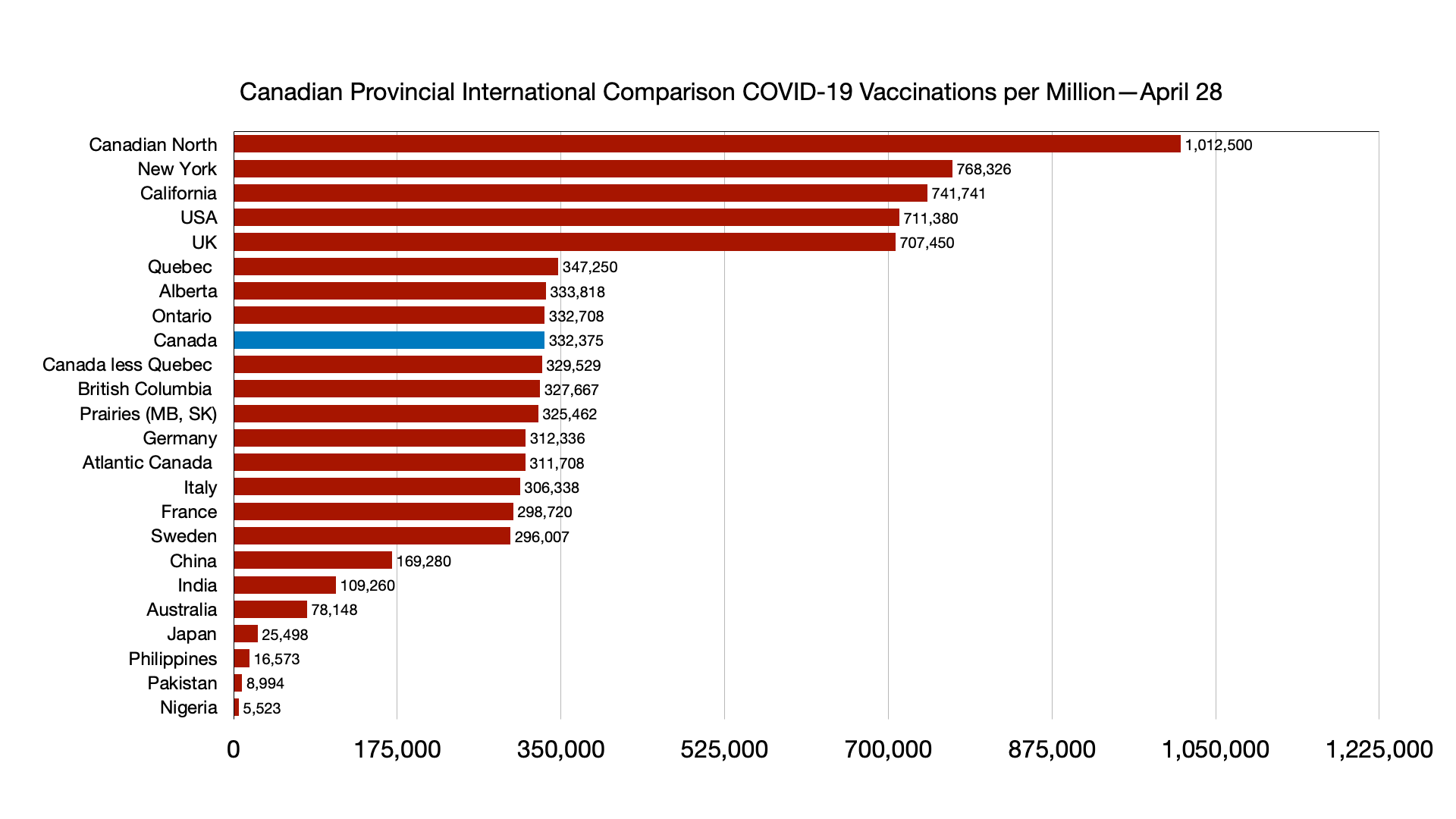
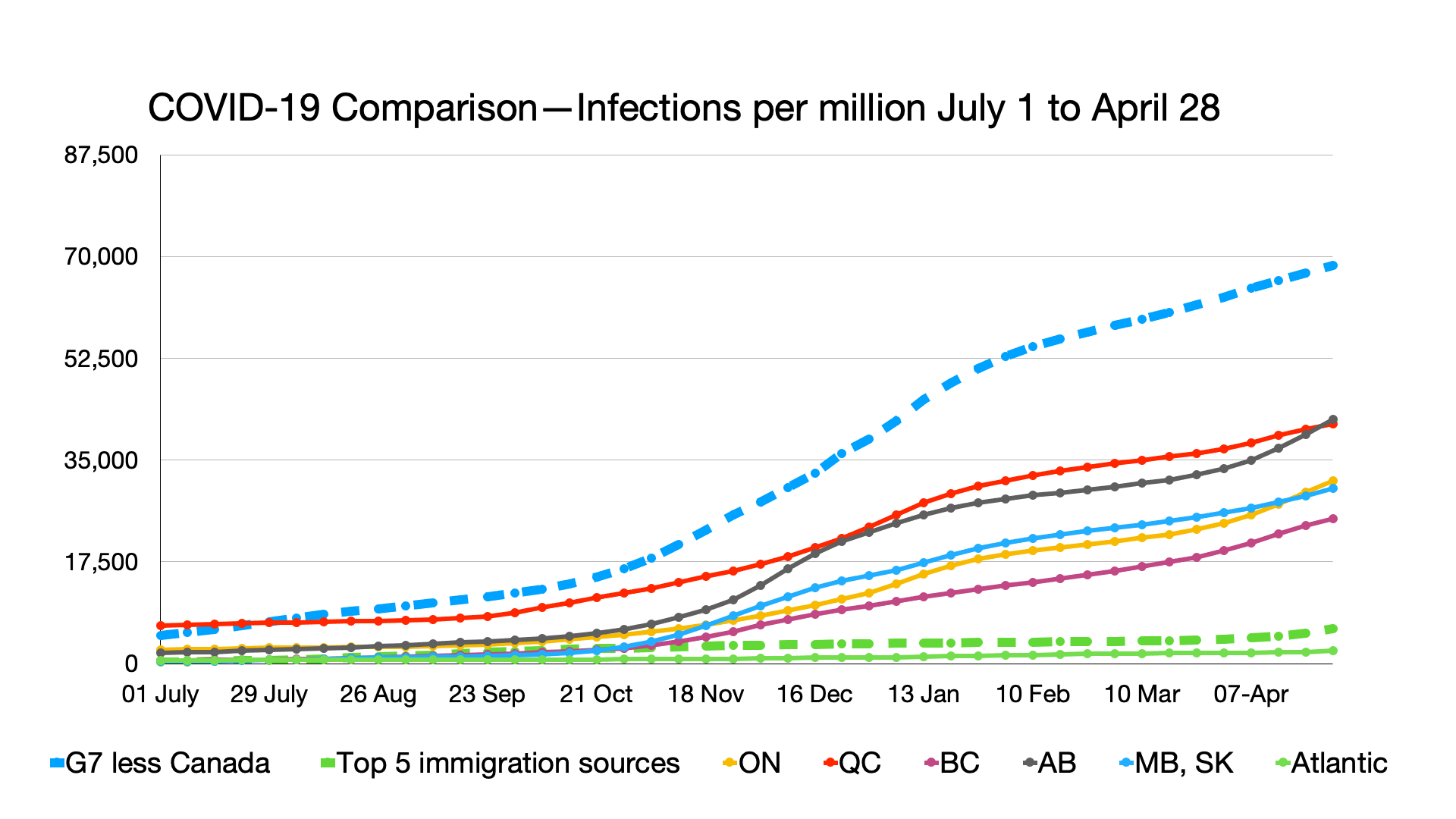
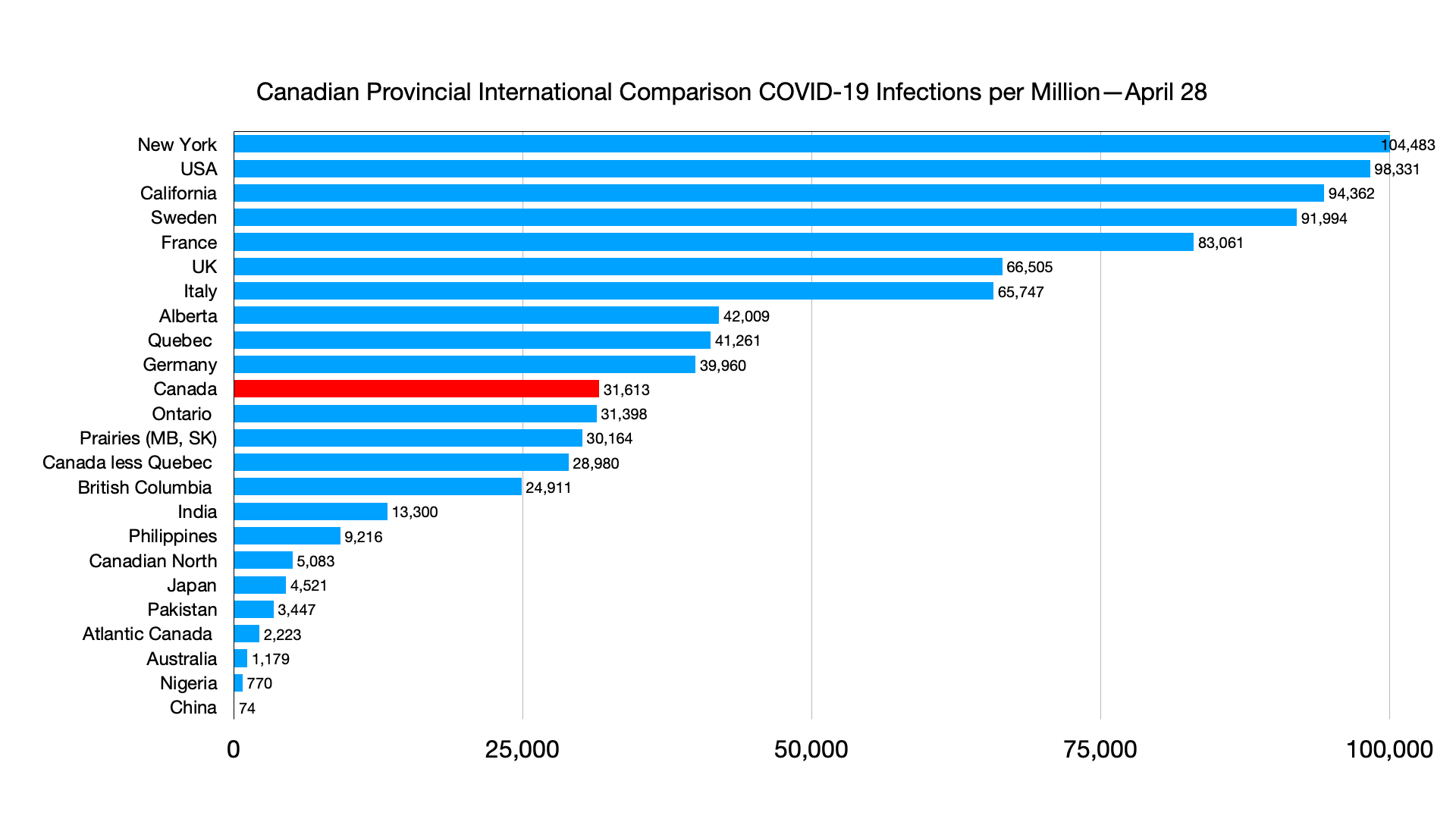
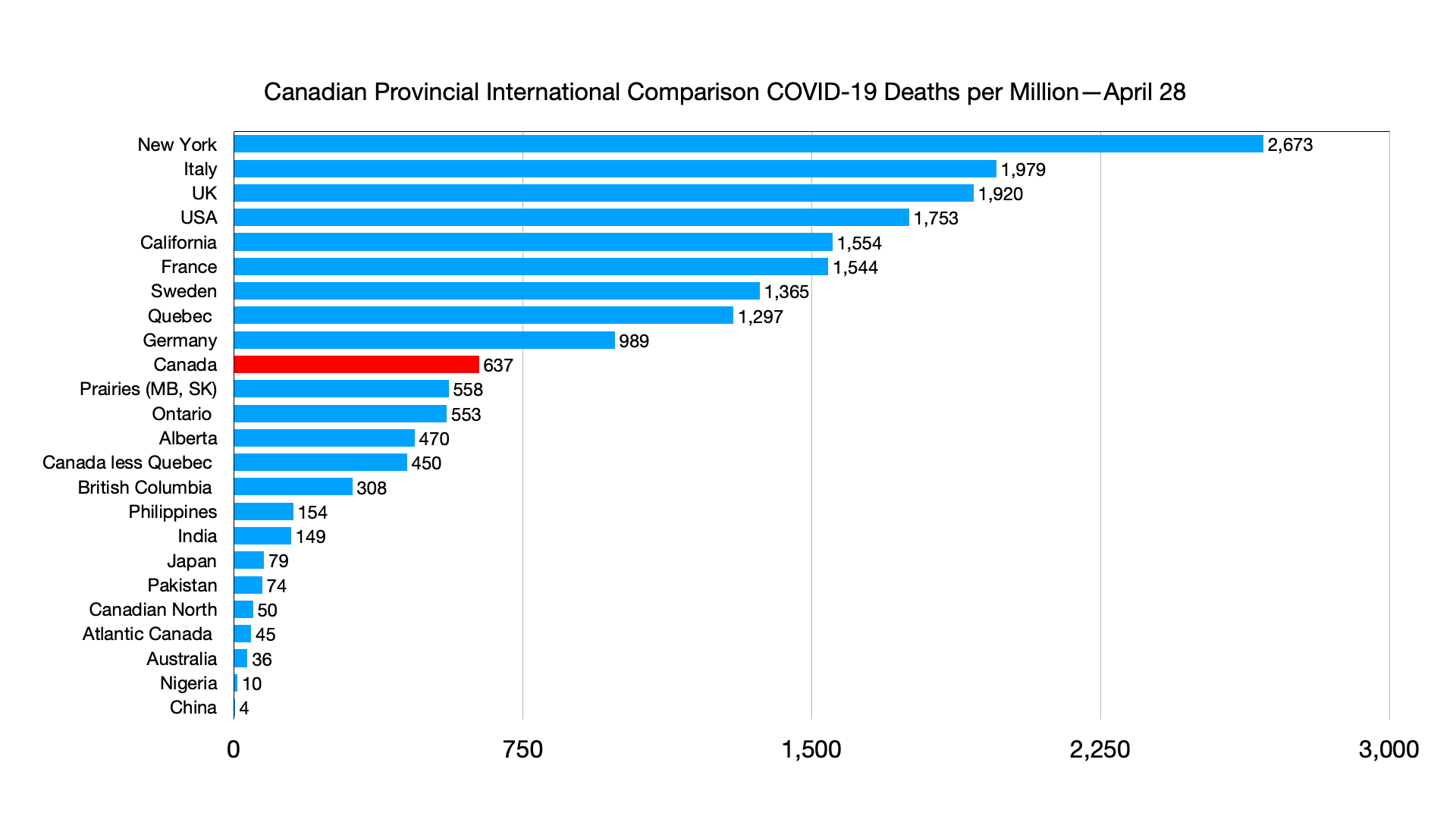
#COVID-19: Comparing provinces with other countries 28 April Update

The latest charts, compiled 28 April as the third wave has started. The spike of infections and deaths in India per million, although dramatic, has not resulted in a change in the relative ranking given the size of India’s population.

Vaccinations: Overall, Canada and most provinces continue to be comparable or greater to EU countries. On a personal note, received my vaccine last week.

Trendline charts

Infections per million: Recent spikes in Ontario and Alberta continue to be more apparent.

Deaths per million: Canadian North ahead of Atlantic Canada.

Vaccinations per million: Vaccination rates in Canadian provinces continue to increase more quickly than overall G7 less Canada countries. Increases among immigration source country reflect China and India mass vaccination roll-out.

Weekly

Infections per million: Surge in Ontario has not changed overall ranking but surge in Alberta has resulted in Alberta surpassing Quebec.

Deaths per million: As noted, Canadian North now ahead of Atlantic Canada.

India is in a COVID-19 crisis. South Asian-Canadians are weeping from afar, but also seeing devastating parallels for our people in Ontario

Captures well some of the dilemmas facing diaspora communities:

11,627 km.

That’s the distance from my house in Peel to Delhi, India, where the majority of my family lives.

This past week has been extremely difficult as a first generation Canadian born in India. I watch the devastation occurring in my hometown, and can’t help but see the parallels happening here in Ontario within the South Asian community. Immigrants like myself are fighting two pandemics – one here and one tens of thousands kilometres away, and it weighs heavily, each and every day.

On March 23, India had 40,000 COVID-19 cases. Fastforward to April 22, that number rose to 330,000. This is what exponential growth looks like. Experts believe these numbers are vastly under-reported by a margin of at least 10 times. Even if 10 per cent of these were hospitalized, with the average COVID-19 related hospital or ICU stay being 15 days, there is simply no healthcare system in the world that has the capacity to sustain such volume.

The situation in India is grave and complex. India saw a sharp decline in cases earlier this year, with around 10,000 cases on average per day in February. This unfortunately led to a sense of complacency, with some experts claiming preemptively that the country had achieved herd immunity. Subsequently, life returned to a form of “normalcy,” with weddings, religious festivals and political rallies being commonplace. Even Kumbh Mela, which is one of the largest gatherings in the world that sees upwards of 110 million people over the duration of the festival and up to 30 million people per day, went ahead as planned.

Complacency, however, wasn’t the only factor that led us to this situation. It’s a culmination of other factors. India has one of the lowest testing capacities per capita, with only 0.4 tests conducted per 10,000 people. India also has a much slower vaccination program. While India has manufactured large quantities of vaccines, it has distributed the majority of these globally. It is one of the largest suppliers into the COVAX program, accounting for 60 per cent of global vaccine supply. Meanwhile, less than 10 per cent of India’s own population has received one dose of the vaccine, with only 1 per cent fully vaccinated with two doses.

In addition, India now has a potentially concerning new variant, B.1.617, that amongst many mutations has two critical ones — L452R and E484Q — within the spike protein, making it more transmissible and possibly able to evade pre-existing immunity. It is still unknown whether vaccines are efficacious against this variant.

The stories, pictures and videos coming out of India are devastating. Scenes of people lying on the ground on the street with oxygen masks connected to empty tanks, dying outside of hospitals that did not have capacity to take them in, health care systems collapsing. There are make-shift outdoor hospitals, mass cremations sites, and reports of families having to keep dead bodies of relatives at home for two days because there was no wood left to build a funeral pyre. Hospital with mere hours left of oxygen supply.

Many in the South Asian diaspora are carrying the burden of knowing our own family members are amongst those affected. My father, who lives with me, spends his entire day calling each and every one of his family and friends. So many infected, many hospitalized, many searching for hospitals. Daily updates, sometimes hourly. Everytime he utters Hari Om Tat Sat (a sanskrit mantra) I wait with baited breath. I feel helpless remembering we are again, 11,627 km, apart — a number I can’t stop thinking about.

What hurts my heart even more is knowing that what is occurring to my people in India is also occurring here on Canadian soil. South Asians have been disproportionately impacted by COVID-19. The pandemic has been deeply inequitable, from support and protections to testing and now access to vaccines. Further, we are seeing additional stigmatization of South Asians due to this new variant now being found in Canada despite the fact that the primary reason for transmission remains to be structural barriers faced by our racialized communities. And like me, they are dealing with two pandemics — the one here and the one back home.

It really feels like because our skin is brown, our lives mean less. But we didn’t get to choose the colour of skin we were born into our socioeconomic status. We didn’t get to choose the country we were born in.

It was heartbreaking to see the world’s response to India’s crisis. Canada shut its borders. Simultaneously, our Premier’s office contacted the Indian high commissioner to request additional AstraZeneca vaccines in spite of the current crisis. The United States of America continues to sit on unused AstraZeneca vaccines and withhold raw materials required for India to manufacture more vaccines. This ‘me first’ strategy is not only inequitable, it is unwise because we know how the pandemic unfolds in one country will eventually happen in another.

And this is why vaccine nationalism is lethal. Your access to vaccines and subsequent right to life is dependent on factors that are out of your control. It is the stark inequities, the perpetuation of discrimination, the haves vs the have nots, the unfairness of it all that weighs heavily on me.

India gasps for air and burns with funeral pyres. But these lives don’t seem to matter. Because they’re brown.

I can’t stop crying. Because my heart can’t take it anymore.

Source: https://www.thestar.com/opinion/contributors/2021/04/24/india-is-in-a-covid-19-crisis-south-asian-canadians-are-weeping-from-afar-but-also-seeing-devastating-parallels-for-our-people-in-ontario.html?li_source=LI&li_medium=thestar_recommended_for_you

#COVID19 #Immigration impact: February update

My latest monthly update.

The trend of increased transitions from temporary to permanent residents continued in February and given recent policy and operational changes (lowering of Express Entry minimum CRS score, recently announced targets for healthcare and other essential workers, international students) this trend will likely continue for the balance of the year.

All of these changes, advisable or not, will help the government achieve (or partially achieve) its 2021 target of 401,000 new immigrants. 

Moreover, these changes should also address the imbalance between the higher skilled, who transition at a higher (and increasing rates) and the lower skilled, with lower transition rates).

Interestingly, IMP data now shows a large percentage of “Other IMP Participants.” Typically, this was less than 50 per month but jumped to over 3,000 in February, perhaps due to delayed coding against the individual programs.

In contrast to the relative return to traditional levels of new immigrants, the number of new citizens remains much lower than pre-COVID, from an average of about 21,000 in 2019 to an average of about 6,000 from June 2020 when the program was restarted.

Web statistics show an increase of interest compared to last year for all programs save citizenship.