Latest publication by ACS focussing on citizenship issues, based upon a conference last year. Good range of perspectives and I encourage you to check it out.
My contribution below where I continue to reinforce themes of concern to me:
Time to take citizenship seriously
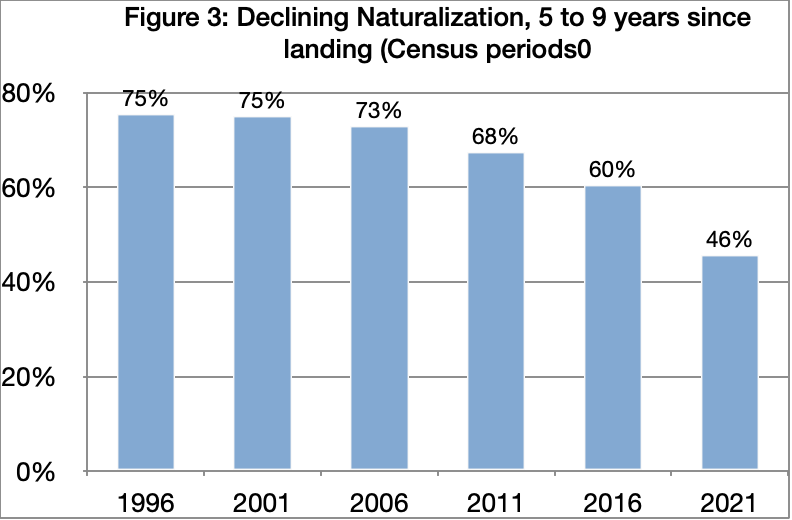
The Census 2021 revelation that the naturalization rate of recent immigrants (five to nine years) in Canada had plummeted to 45.7 percent in the 2011-15 census period compared 60.4 percent for the equivalent period from the 2016 Census provided a needed shock for the government to take citizenship more seriously. An earlier Statistics Canada study noted a longer- term trend of declining naturalization which reinforced that need. The analysis indicated that the main factors influencing naturalization were family income, knowledge of official languages, and educational attainment.
Some factors are outside the Canadian government’s purview. Whether or not an immigrant source country permits or prohibits dual citizenship, and the extent to which it enforces a prohibition, affects naturalization. However, recent analysis by the Institute for Canadian Citizenship indicates the net effect on naturalization is small despite the fact that a larger number of immigrants come from countries that do not permit dual citizenship.
The relative economic and other benefits of Canadian citizenship have changed for some developing countries, resulting in some immigrants returning to their country of origin or keeping their options open. However, there are a number of measures that the government could take to strengthen the efficiency, oversight and meaningfulness of citizenship. Operational efficiency, oversight and accountability
Immigration, Refugees and Citizenship Canada, the federal department responsible for these issues, has made progress in moving to online applications and updates to manage increased numbers and improve applicant service. Investment in AI and automation for routine applications is a logical next step, particularly given that citizenship is straightforward compared to the multitude of immigration pathways, and should result in faster processing. A pilot program integrating citizenship and passport applications is a welcome initiative.
IRCC needs to publish more citizenship statistics on the Open Government Portal, as currently the portal only has monthly statistics on countries of birth with no data on citizenship applications (unlike for permanent and temporary residents along with international students). Backlog (inventory) statistics need to be integrated into the portal. Moreover, regular publishing of citizenship proofs (citizenship certificates), broken down by those submitted from within Canada and those submitted from outside Canada, should resume given these provide a reality check on the number of “lost Canadians” from earlier parliamentary testimony.
While broader than citizenship as it will allow for deeper analysis of health and immigration linkages, IRCC, Statistics Canada and the Canadian Institute for Health Information (CIHI) should provide more precise information on birth tourism (women travelling to Canada on visitor visas to obtain Canadian citizenship for their child) by separating out women international students and temporary foreign workers from the overall numbers of “non-resident” births. Moreover, MPs need to challenge those advocating the easing of citizenship requirements and policies given the disparities between claims of the numbers of people affected and actual numbers and the risks that additional complexity brings to citizen service.
While the number of “Lost Canadians” claimed was around 200,000, the actual number was about 20,000. Restrictions on voting rights for Canadian expatriates were lifted in 2019 but out of the estimated 3.6 million adult expatriates, fewer than 30,000 voted in the 2021 election, a tripling compared to the 2015 election but still a minuscule number. Similarly, while the number of persons subject to the first generation citizenship transmission cut-off will grow, it is likely that the numbers of those who have a meaningful connection to Canada will be relatively small and advocates for change have relied more on anecdotes and country comparisons.
More systemically, all MPs need to recognize that not every situation requires a specific legislative solution, which only further complicates overall service delivery, as some are best handled through a discretionary grant in section 5(4) of the Citizenship Act or the permanent resident application route.
Meaningfulness The government needs to issue a revision to Discover Canada, the citizenship study guide, first announced in 2016 four IRCC ministers ago, and reportedly ready for ministerial sign-off for some time. The current guide, while a significant improvement from its predecessor, is dated in terms of approach, emphasis and examples, and is not aligned with the government’s inclusion emphasis.
The government also needs to decide whether it intends to implement, in whole or in part, its election platform’s commitment in 2019 and 2021 to eliminate citizenship fees, currently around $1,400 for a family of four. The high fees contribute to lower citizenship take-up among disadvantaged immigrants. Given that citizenship provides both private benefits such as security and passports and public benefits such as greater inclusion and political participation, halving the current fees would balance private and public benefits.
The government needs to abandon its proposed self-administration of the citizenship oath and revert to in-person citizenship ceremonies for the majority of ceremonies. Moving to “citizenship on a click” combined with virtual ceremonies largely removes the recognition of the immigration journey and its celebration by family and friends. The government’s justifications for the proposed change focusses on saving three months and unspecified savings given that “participation in ceremonies would be lower than it is currently, and there would likely be fewer ceremonies overall”. However, it is silent on the more substantive impact that being in a room together with other new (and already) Canadians brings in terms of belonging and inclusion.
Efficiency should focus on application processing, not the ceremonial and celebratory moment. Treating citizenship as transactional, much as a driver’s licence, undermines the fundamental objective of reinforcing integration, a fundamental objective of the Citizenship Act since 1947. Public commentary has been highly negative, as have the majority responses to the Gazette notice, and a parliamentary petition was launched to oppose the change. The government should shift the relatively small needed funds from the integration program (about one billion dollars outside Quebec) to maintain the in-person citizenship oath and ceremonies.
Ongoing work by the Institute for Canadian Citizenship is focused on understanding the link between dual citizenship prohibitions and Canadian naturalization, disaggregating average time between permanent residency and becoming a citizen by gender, immigration category and place of birth. To further understand the reasons behind declining naturalization, a detailed comparison between Census 2021 and Census 2016 citizenship data will assess the relative impact of income, labour force participation and education.
The government also needs to set meaningful performance standards. The current standard is an 85-per-cent naturalization rate for all immigrants, whether recent or many years ago, essentially meaning no accountability for the government given that until the 2021 census, it always met this meaningless standard. A more valid approach, consistent with Statistics Canada methodology, would be to set the standard for recent immigrants (five to nine years) rather than all. Recent data suggests a benchmark of 75 per cent of recent immigrants would be appropriate.
Just as the government needs to strike a balance between easing the path to becoming a citizen and operational efficiency, the government needs to ensure that citizenship reinforces the sense of belonging and inclusion that citizenship brings. Efficiency improvements in application processes are needed and welcome but should not be to the detriment to the one moment in immigration journeys that celebrates and honours this achievement by new Canadians.
Prime ministers, immigration ministers and MPs all treasure these celebratory moments, as do the vast majority of new Canadians. It is important that this in-person moment not be limited to the few but provided to all.
We shall see, look forwards to any comments on my analysis of the possible impact:
….The National Council of Canadian Muslims and dozens of Muslim organizations, mosques and groups signed an open letter to MPs ahead of Ramadan, asking them to stay away from events during the holy month if they couldn’t commit to taking several stances, including support for an immediate ceasefire and condemning some of the actions of Israeli forces.
When asked about Polievre’s outreach this year, Conservative spokesman Sebastian Skamski said Poilievre has articulated a clear position that Israel has a right to defend itself and that Palestinians need humanitarian relief “as a result of the war that Hamas has started.”
Andrew Griffith, a former director of multiculturalism policy for the federal government, said while Muslims are not a monolithic group, it’s likely Poilievre’s loud pro-Israel stance will cause some people to turn from the party, including in key ridings around Toronto.
However, he said, given the current polling numbers, it would be unlikely to do much damage to Conservative fortunes when the next election rolls around.
Skamski also pointed to a speech Poilievre delivered Tuesday in Montreal to the Beth Israel Beth Aaron Jewish congregation, where he addressed the matter head-on.
“I want you to know,” Poilievre the crowd, “I say all of these things in mosques. I do go to mosques. I love meeting with the Muslim people, they are wonderful people.”
He went on to say that when the issue of Israel is raised, “I say, ‘I’m going to be honest with you — I’m a friend of the state of Israel and I will be a friend of the state of Israel everywhere I go.'”
That runs counter to the approach taken by Justin Trudeau, continued Poilievre, accusing the prime minister of muddying the government’s position.
“While it might make for good politics to have one individual MP who says the right thing in order to get a seat back and keep Justin Trudeau in power, it does not solve the problem of having Canada take a right and principled position,” he said.
Skamski said Poilievre has met with thousands of Muslim Canadians during his team as leader and has connected on their shared values of “faith, family and freedom.”
“You can’t talk to Muslim Canadians about faith, about family values, all of those things, while at the same time turning a blind eye to 30,000 dead,” Tahir said, referring to the number of people killed in Gaza since Israel began bombarding the territory in October.
Tahir said many were disappointed in Poilievre’s opposition to funding the UN aid agency UNRWA….
More on this sorry episode although unclear how widespread these perceptions shared among IRCC staff (but not unique…):
Une personne employée au sein d’IRCC, n’était pas surprise de ce développement. Elle voit le travail de fonctionnaires ignoré depuis des années quand leurs conclusions ne vont pas dans le sens des plans du gouvernement.
Nous donnerons à cette personne le nom fictif de Marie. Francopresse a accepté de protéger son identité, parce qu’elle craint des répercussions au travail.
Un travail qui dérange
Selon elle, la plupart des fonctionnaires n’oseraient jamais aller contre le courant : «Dès que tu dis un peu la vérité, fearless advice, dis ce que tu penses, c’est fini.»
Elle voit donc peu de gens qui osent présenter des points de vue divergents dans la fonction publique. «Il n’y a rien de pire dans une démocratie.»
Elle doute d’ailleurs que même les avertissements émanant de fonctionnaires se rendent toujours au bureau du ministre de l’Immigration.
«Je pense que plusieurs sous-ministres et sous-ministres adjoints croient que leur mission est de protéger [le ministre]. Ils empêchent que des choses soient écrites ou s’assurent que ça ne monte pas pour pouvoir dire “le ministre n’était pas au courant, donc il a continué sa mauvaise idée, mais il ne le savait pas”.»
La vérité étouffée
Selon Andrew Griffith, directeur général à IRCC de 2009 à 2011, un certain degré de tension est normal, même bénéfique.
«La bureaucratie est censée offrir des conseils sans peur en fonction de son analyse et de son expertise et le niveau politique doit apporter sa perspective», explique-t-il.
Mais la transmission des conseils à travers l’échelle bureaucratique est floue, prévient-il. La parole est habituellement plus franche chez les directeurs, mais «plus haut, les sous-ministres adjoints et les sous-ministres sont moins directs en fonction de leurs efforts à répondre aux besoins politiques».
«C’est probablement là que réside la majeure partie de la frustration liée à l’ignorance de l’expertise», précise M. Griffith.
C’est au sein même de la fonction publique que l’information semble bloquer, corrobore Marie. «Les politiciens préfèreraient éviter de faire des erreurs, mais ils se sont entourés de hauts fonctionnaires opportunistes, ambitieux, peu compétents qui étouffent la vérité.»
«Les hauts fonctionnaires qui pensent seulement à leur carrière sont le pire problème, la pire plaie. Les ministres peuvent influencer leur carrière, alors ils s’autocensurent, censurent les autres et s’entourent de gens peu compétents ou qui leur ressemblent», poursuit-elle.
Manque d’expertise chez les cadres supérieurs
Dans le rapport d’un examen effectué par l’ancien sous-ministre d’IRCC, Neil Yeates, ce dernier parle de tensions à IRCC qui seraient «exacerbées par la forte baisse d’expertise en matière d’immigration parmi les [sous-ministres adjoints] et les [directeurs généraux]».
Selon lui, cette baisse d’expertise est relativement nouvelle et crée un «manque de crédibilité vis-à-vis des employés de première ligne et des gestionnaires» qui connaissent bien la Loi sur l’immigration et la protection des réfugiés.
«Qui voudrait d’une douche froide?»
L’immigration a toujours été très politisée, fait remarquer Andrew Griffith. «Là où les choses se sont gâtées, c’est dans l’encouragement de l’immigration à grande échelle qu’a défendu l’Initiative du siècle, diverses organisations commerciales [et d’autres] sans qu’aucun d’entre eux, jusqu’à trop tard, ne commence à dire : “Attendez une minute, il va y avoir des implications à cela. Avons-nous les capacités d’absorption pour tous ces immigrants?”»
Il ne croit pas que l’argument selon lequel il faut hausser les seuils d’immigration afin de remédier au vieillissement de la population ait été assez remis en question. Surtout lorsque l’on considère le nombre de démographes qui ne partageaient pas cette analyse.
Plusieurs économistes ont aussi critiqué cette approche, dont Mikal Skuterud, professeur d’économie à l’Université de Waterloo, en Ontario. Il a l’impression que parmi tous les experts en immigration, ce sont surtout les économistes qui sont ignorés.
«Qui voudrait d’une douche froide? Pourquoi voudraient-ils nous parler si on ne leur donne pas les réponses qu’ils veulent?», demande-t-il.
Le gouvernement avance que l’augmentation de l’immigration permet la croissance économique, «mais pour l’économiste, ce n’est pas vraiment honnête».
«Pour l’économiste, la croissance économique vient de l’augmentation du PIB par habitant, explique-t-il. Et rien ne prouve que l’augmentation de l’immigration fasse croitre le PIB par habitant.»
En fait, dans les dernières années, celui-ci a chuté. «Les économistes avaient donc raison, mais ils ont été complètement ignorés sur cette question», déplore Mikal Skuterud.
«Je ne pense pas que l’identité de la personne qui transmet le message soit importante, tant que le message est conforme aux objectifs du gouvernement», ajoute-t-il.
Étant lui-même immigrant, le professeur aimerait pouvoir dire qu’une hausse de l’immigration améliorera le sort économique de tous. «C’est une très belle histoire à vendre, mais c’est juste faux, martèle-t-il. Ce n’est pas si simple.»
Les affaires, ce n’est pas l’économie
Christopher Ragan, professeur en économie à l’Université McGill, à Montréal, était membre du Conseil consultatif en matière de croissance économique mis sur pied par le gouvernement libéral en 2016 et présidé par Dominic Barton, ex-directeur de la firme McKinsey et cofondateur de l’Initiative du siècle.
«Je ne voyais aucune raison à l’époque, et je n’en vois aucune aujourd’hui, de penser que l’augmentation de l’immigration puisse être le pivot d’une stratégie de croissance. Du moins, pas le type de croissance qui devrait nous intéresser. J’ai mené ce combat au sein du Conseil et j’ai perdu», a déclaré l’économiste sur X en janvier 2024.
Sa position n’a pas été retenue dans les rapports du Conseil, probablement parce qu’«un consensus entre 12 personnes n’arrivera jamais», déclare-t-il en entrevue avec Francopresse.
«Le gouvernement perçoit mal l’immigration et son rôle dans la croissance générale et je crois que le Conseil y est pour quelque chose», assure-t-il.
Christopher Ragan était l’un des seuls économistes au sein de ce conseil : «La plupart étaient des gens d’affaires, ce qui est problématique pour un conseil sur la croissance. […] Leur point de vue est important, mais ils n’ont généralement pas beaucoup de compétences en termes de politiques.»
«Je pense que le gouvernement a aussi écouté le lobby des affaires qui a demandé plus d’immigration, en particulier d’immigration temporaire, pour remplir des pénuries de main-d’œuvre, parce qu’ils préfèrent embaucher des immigrants que d’augmenter les salaires», se désole-t-il.
Overall normal post December increase across programs with the exception of asylum claimants and students.
The percentage of former temporary residents transitioning to permanent residency was the highest to date, 78 percent of all Permanent Residents.
Asylum claimants continue at about 15,000 per month.
The impact of the cap on international students is not yet apparent in the February website data (possible leading indicator). February operational data on applications and permits issued will likely indicate impact.
Full 2023 settlement services now included, showing 53 percent increase compared to 2022.
Full 2023 citizenship application data now included, showing 20 percent increase compared to 2022, with the January number of new citizens increasing by a comparable on a year-over-year basis.
The one element to flag is the sharp increase in the number of asylum claimants, from a monthly average of about 10,000 January to June 2023 to about 15,000 July to November, largely driven by the easing of visa restrictions, with close to two-thirds of claims being “inland.” Given the large number of Mexican claimants, averaging more than 2,000 per month in 2023, there will continue to be calls to reimpose the visa requirement on Mexicans, as well as more general calls to restore the previous visa restrictions.
Percentage of former temporary residents transitioning to permanent residency partially bouncing back after September (from 32 to 39 percent, 2023 January to August average 65 percent). Year to date: 404,000 of which 212,000 are former temporary residents.
Temporary residents (IMP): Year to date 757,000 compared to 484,000 in comparable 2022 period
Temporary residents (TFWP): Year to date 172,000 compared to 124,000 in comparable 2022 period
Asylum claimants continue to grow significantly, reflecting easing of visa requirements and other factors: Year to date 117,000 compared to 70,000 in comparable 2022 period. Unclear whether visa exemption for Mexico will remain tenable given sharp increase and rumblings in US border states regarding increasing arrivals from Canada: Year to date 22,000 compared to 12,000 in comparable 2022 period.
The number of new citizens remains strong, largely driven by virtual ceremonies being the default option (almost 90 percent of new citizens participated in virtual ceremonies). Year to date: 317,000 largely the same as the comparable 2022 period.
With the Conservatives leading the polls, it is worth speculating what changes a Conservative government might bring to immigration, citizenship, multiculturalism, and employment equity policies, and the degree to which Tories would be constrained in their policy and program ambitions. Despite talking about change and “common sense,” they will still be constrained by provincial responsibilities and interests, the needs and lobbying of the business community, and an overall limitation of not wanting to appear to be anti-immigration.
Constraints
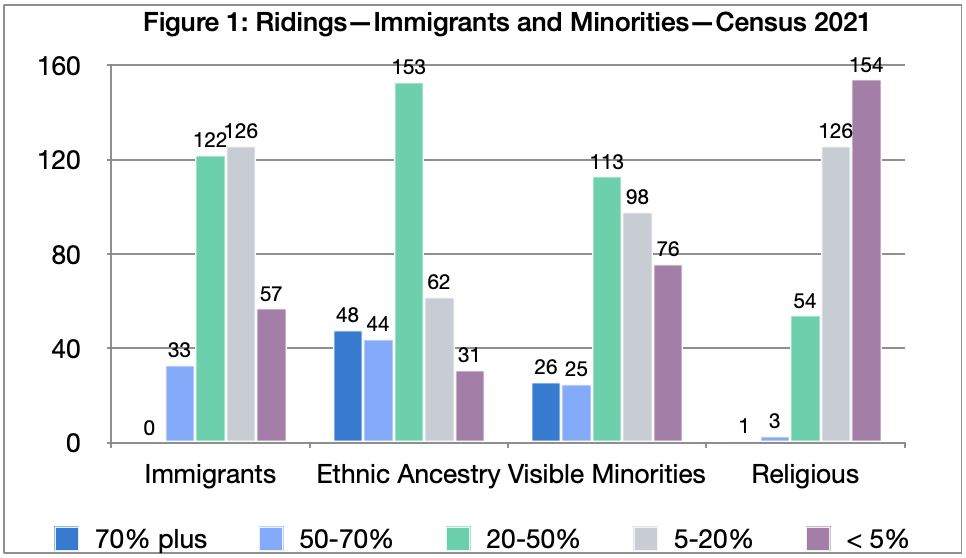
One fundamental political constraint is that elections are won and lost in ridings with large numbers of visible minorities and immigrants, like in the Greater Toronto and Hamilton Area, British Columbia’s Lower Mainland, and other urban areas as shown in Figure 1. Arguably, the Conservatives learned this lesson in the 2015 election, where citizenship revocation provisions and the Barbaric Cultural Practices Act signalled to many new Canadians they were not welcome.
The demographic of immigrants and minorities across Canadian electoral ridings. Graph courtesy of Andrew Griffith
Given that immigration is a shared jurisdiction with the provinces, any move to restrict the numbers of permanent residents, temporary workers, and foreign students will likely be met with provincial opposition. All provinces—save Quebec—largely buy into the “more is merrier” demographic arguments. Provincial governments and education institutions rely on large numbers of international students to fund higher education, and thus have already signalled concerns with the current government’s trial balloon about capping students from abroad.
Stakeholder pressures are a further constraint. Business groups, large and small, want a larger population to address labour market needs, and that includes international students for low-value-added service jobs. A larger population also means more consumers. Immigration lawyers and consultants, both in Canada and abroad, benefit from more clients. Settlement and refugee groups can continue to press for increased resources even if evaluations question their effectiveness with respect to economic immigrants. Most academics focus on barriers to immigrants and visible minorities rather than questioning their assumptions. Lobby groups like the Century Initiative and others continue to push the narrative that a larger population is needed to address an aging population, a narrative that is supported by all these stakeholders, and federal and provincial governments (except for Quebec).
Few of these stakeholders seriously address the impact of immigration on housing availability and affordability, health care, and infrastructure, despite all the recent attention to the links between housing and immigration. Most stakeholders are either in denial, claim that ramping up housing can be done quickly as many recent op-eds indicate, or argue that raising these issues is inherently xenophobic if not racist.
Global trends that also could shape a possible Conservative government include increased refugee and economic migrant flows, greater global competition for the same highly skilled talent pool and, over time, expanded use of AI and automation as a growing component of the labour market.
Immigration
Given these constraints and the fear of being labelled xenophobic, Conservatives have focused more on service delivery failures than questioning immigration levels, whether it’s permanent resident targets or the rapid increase in uncapped temporary workers and international students. Poilievre has stated that the Conservative focus will be on the “needs of private-sector employers, the degree to which charities plan to support refugees, and the desire for family reunification,” suggesting greater priority on economic and family immigration categories, as was largely the case for the Harper government. The Conservatives’ recent policy convention was largely silent on immigration. They are engaging in considerable outreach to visible minority and immigrant communities, adopting the approach of former Conservative minister Jason Kenney, “the minister for curry in a hurry.”
That being said, it is likely that a Conservative government would likely freeze or decrease slightly the number of permanent residents rather than continuing with the planned increases (the Liberal government recently indicated that it is not “ruling out changes to its ambitious immigration targets.)”
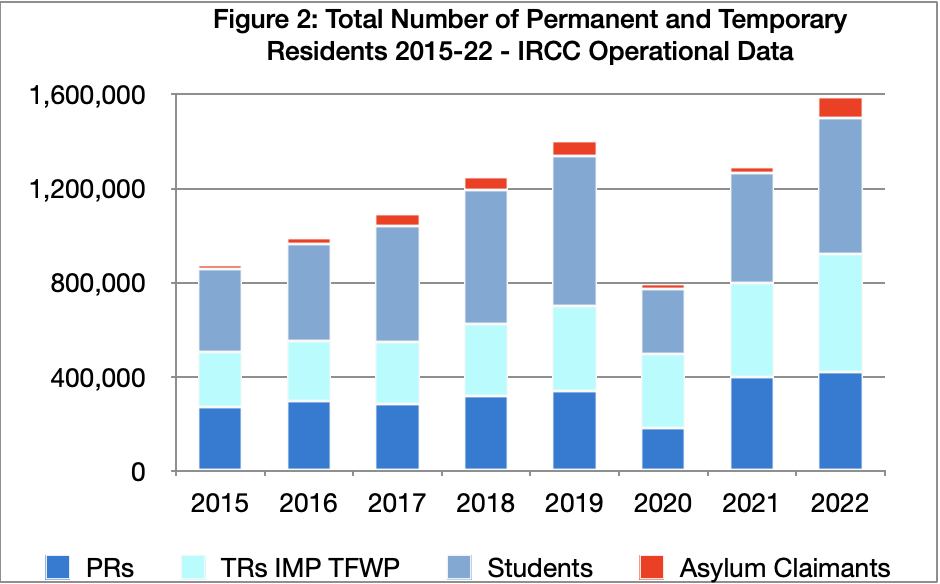
Figure two highlights the growth in permanent and temporary residents since 2015. The extent of public debate on the impact of immigration on housing provides latitude for a freeze at 2023 levels, or a small decrease given that immigrants and non-immigrants alike are affected. Graph courtesy of Andrew Griffith
It is less clear whether a Conservative government would have the courage to impose caps on temporary workers given pressure from employers, including small businesses. However, the previous Conservative government did have the political courage to impose restrictions following considerable abuse of the temporary work program, ironically exposed by the Liberals and NDP. Similarly, imposing caps on international students would run into strong resistance from provincial governments given their dependence on students from abroad to support higher education. Even placing caps on public colleges that subcontract to private colleges—which are more for low-skilled employment than education—would be challenging given employer interest in lower-wage employees. They may, however, reverse the Liberal government’s elimination of working-hour caps for foreign students.
Whether a Conservative government would go beyond the usual federal-provincial-territorial process and provide financial support for foreign credential recognition, or be more ambitious and transfer immigrant selection of public sector regulated professions (e.g., health care) to the provinces is unclear. However, given that regulatory bodies are provincial and, for health care, provinces set the budgets, they may explore this option.
While the simplification and streamlining of over 100 immigration pathways is long overdue, given the complexity for applicants to navigate the system, and for governments to manage and automate it, such longer-term “fixing the plumbing” initiatives are less politically rewarding than addressing various stakeholder pressures.
Given the increased number of asylum claimants, a Conservative government would be likely to restore requirements for claimants to have sufficient funds and an intent to leave, and may consider reimposing a visa requirement on Mexican nationals.
Citizenship is arguably the end point of the immigration journey as it represents full integration into society with all the political rights and responsibilities that entails. This assumption is being challenged by a combination of Canadian economic opportunities being relatively less attractive for source countries such as China and India, along with greater mobility of highly educated and skilled immigrants. As a result, the naturalization rate is declining as shown in figure three.
Figure three depicting naturalization rates between 1996 and 2021. Graph courtesy of Andrew Griffith
The previous Conservative government was more active on citizenship than other recent governments. In 2009, it released a new citizenship study guide, Discover Canada, with a greater focus on history, values and the military. It also required a higher passing score on the citizenship test—up to 75 per cent compared to 60 per cent—and different versions were circulated to reduce cheating. Language requirements were administered more strongly, and adult fees were increased from $100 to $530. A first generation cut-off for transmission of citizenship was implemented as part of addressing “lost Canadians” due to earlier Citizenship Act gaps. C-24 amended the Citizenship Act to increase residency requirements from three to four years, increased testing and language assessment to 18-64 years from 18-54 years, and a revocation provision for citizens convicted of treason or terror.
It is unclear the degree to which the Conservatives will consider citizenship a priority in relation to other immigration-related issues. From an administrative perspective, changing residency requirements again would simply complicate program management, make it harder to reduce processing times, and would not provide any substantive benefit. Re-opening citizenship revocation would simply draw attention to the risks that countries would offload their responsibilities, as the example of former U.K. citizen and Canadian citizen by descent Jack Letts illustrates.
Given that the Liberal government to date has not issued a revised citizenship guide, the Conservatives would likely stick with Discover Canada, issued in 2009. Similar, the existing citizenship test and pass rates, and proof of meeting language requirements would not need to be changed. As the Liberal government never implemented 2019 and 2021 campaign commitments to eliminate citizenship fees, one should not expect any change from the fee increase of 2014.
The Conservatives may wish to revisit the issue of birth tourism. In 2012, they pushed hard, but ultimately the small numbers known at the time and provincial opposition to operational and cost considerations made them drop their proposal. Since then, however, health-care data indicated pre-pandemic numbers of birth tourists to be around 2,000, although these dropped dramatically during the pandemic given visa and travel restrictions.
In contrast to immigration and citizenship, a Conservative government would face fewer constraints with respect to multiculturalism and employment equity. Their public criticism of wokeism, their policy resolutions stressing merit over “personal immutable characteristics“, their criticism of diversity, equity and inclusion training, and their criticism of Liberal government judicial, Governor in Council, and Senate appointments all point to a likely shift in substance and tone.
It is highly likely that resources would be cut sharply under a Conservative government given their overall approach to government expenditures, their general approach to limit government intervention and their scepticism regarding critical race theory, systemic racism, and diversity, equity, and inclusion training. There would likely also be a return to a more general integration focus between and among all groups. They would, of course, be unlikely to curb any of the recognition months or days, given the importance to communities (and their political outreach).
A Conservative government might reduce the amount and quality of data available regarding visible minority, Indigenous Peoples, persons with disabilities represented in public service, and other government appointments.
The Liberal government expanded public service data to include disaggregated data by sub-group, allowing for more detailed understanding and analysis of differences within each of the employment equity groups since 2017, along with data on LGBTQ+ people. Previous government reports only covered the overall categories of women, visible minorities, Indigenous Peoples and persons with disabilities. It is uncertain whether these reports under a future Conservative government would revert back to only reporting on overall group representation, hirings, promotions and separations. Given that this concerns public service management, it may well decide to continue current practice or the more sceptical elements may press for change.
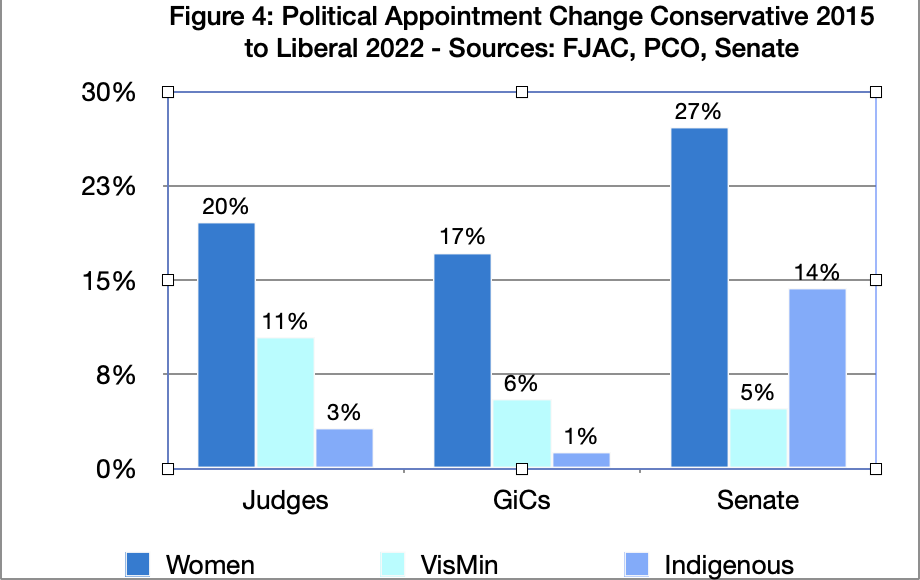
On the other hand, political appointments—judges, Governor-in-Council, Senate—are another matter. Appointment processes are likely to be revised given concerns that the processes introduced by the Liberal government unduly favoured candidates more on the centre-left than centre-right. Figure 4 highlights the increased representation of women, visible minorities and Indigenous Peoples in political appointments.
Figure four highlights the increased representation of women, visible minorities and Indigenous Peoples in political appointments. Graph courtesy of Andrew Griffith
Similarly, at the end of the last Conservative government, Governor-in-Council appointments to commissions, boards, Crown corporations, agencies, and tribunals were 34.2 per cent women, 6.1 per cent visible minorities, and 2.9 per cent Indigenous. Under the Liberal government, the number of women increased to 51.4 per cent, visible minorities to 11.6 per cent, and 4.2 per cent Indigenous by January 2023.
Senate appointments present a more nuanced picture. Conservative appointment of visible minorities was at 15.8 per cent, representing a conscious effort to address under-represented groups, but women, at 31.6 per cent of appointments, and Indigenous Peoples at 1.8 per cent, were significantly under-represented. The Liberal introduction of a formally independent and non-partisan advisory board resulted in a sharp increase in diversity: 58.8 per cent women, 20.6 per cent visible minorities, and 16.2 per cent Indigenous Peoples.
Along with these process changes, the Liberal government expanded annual reporting to include visible minorities, Indigenous Peoples, persons with disabilities, and judicial appointment reporting also included LGBTQ and ethnic/cultural groups. Should a Conservative government decide to stop these annual breakdowns, it will be harder to track any shifts in representation.
The current review of the Employment Equity Act, launched in 2021, has not yet resulted in any public report on consultations and recommendations from the Task Force. Given limited parliamentary time and higher priorities during the current mandate, it is unlikely that any revisions to the Act will be approved. However, should any legislation come to pass, it is likely that a future Conservative government might wish to revisit some of the provisions.
Concluding observations
To date, two overarching themes have driven Conservative discourse: Canada is broken, and the need to “remove the gatekeepers.” The Yeates report confirms that the immigration department is broken, reflecting long neglect of organization weaknesses, a lack of client focus, and, I would argue, an excessive multiplicity of programs that make it harder for clients to navigate, and more difficult for IRCC to manage.
One of the ironies of assessing likely Conservative policies is immigration, citizenship, and related areas all pertain to government being “gatekeepers.” It’s easier to shrink the gate for some policies and programs than others (e.g., government political appointments). Others, such as reducing levels of permanent and temporary residents, are much more challenging given the strength of provincial, business, and other stakeholders opposition. The degree to which a Conservative government is prepared to expend political capital will obviously reflect whether or not it has a majority in Parliament.
The sharp decrease in public support for immigration, given the impact on housing, health care, and infrastructure, likely provides greater flexibility for any future Conservative government. While there is greater flexibility with respect to multiculturalism and employment equity, a Conservative government could also be ambitious with needed immigration reforms for permanent and temporary immigration.
While some have argued that immigration and related issues have become a third rail in Canadian politics, this need not be the case. The concerns being raised are regarding the impact of large and increasing numbers of permanent and temporary migration on housing, health care, and infrastructure, not the racial, religious or ethnic composition of immigrants. These issues affect immigrants and non-immigrants alike and focus on commonalities, not differences.
Of particular note this month is the drastic drop in the number of temporary residents transitioning to permanent residency and a an equally sharp decrease in the number admitted under IMP.
Reviewing the plan and the coverage to date, my initial reflections are as follows:
The approach of stabilizing levels at 500,000 in 2025 resulted in the headlines the government likely wanted, with words like “plafonnent,” “hold back,” “capping,” “level out” and”stabilize.”
However, given that means an increase from 2023 levels of465,000 to 500,000 in 2025, this “stabilizing” is more virtue signalling that they are listening to public concerns than actually taking action. The fact that any further adjustment would happen after the 2025 election makes is likely meaningless for the current government.
Moreover, given timelines to increase housing and healthcare capacity, continued increases in immigration levels will simply exacerbate the gap between levels and absorptive capacity. Hard to see this as a winning strategy…
However, should, as appears likely, the Conservatives form the next government, they would be faced with a high baseline level that may or may not be politically difficult to undo. And of course, the Liberals may have thoughts of this being a potential wedge issue for immigrant origin voters, a dubious strategy given that immigrant voters are more concerned about high immigration levels than Canadian-born (Environics Focus Canada 2023).
The plan, as is common in government documents, fails to acknowledge the negative impacts of some policy changes:
On the positive side, the government belatedly notes the impact of high levels of immigration on housing, healthcare and infrastructure and notes the need for a “whole of government” approach to improve the absorptive capacity:
While immigration contributes to the supply of labour, alleviates demographic pressures, and provides social and cultural benefits, it also creates demand for infrastructure and services. With significant and sustained growth in planned notional immigration levels, success for newcomers and all Canadians means working collaboratively with other federal departments, provinces and territories, communities and municipalities, Indigenous communities, the private sector, and stakeholders.
While there is more discussion on the role and importance of temporary foreign workers but no details on possible actions resulting from his media comment that “Canada has become “addicted” to temporary foreign workers, which has created what he called “perverse incentives” and, in some cases, led to abuse of the workers.” Minister Miller has started to address the abuse of the international student program but still too early to tell how effective these changes will be given implementation issues.