The Politics of the Ostrich: On Pascal Bruckner’s “Un racisme imaginaire: La querelle de l’islamophobie et culpabilité” – Los Angeles Review of Books

Good long review and discussion of Islamophobia by Reza Zia-Ebrahimi, King’s College London, one of the more comprehensive ones I have seen.

Highly recommended for members of the Canadian Heritage committee studying Islamophobia, among others:

OVER THE PAST DECADE, the prominent French intellectual Pascal Bruckner has emerged as one of the figureheads of a sustained assault on any public discussion of Islamophobia and the consequences it may have on its victims. He has published op-eds with titles such as “L’invention de l’islamophobie” (the invention of Islamophobia) and “L’islamophobie n’existe pas!” (Islamophobia does not exist!), where he has outlined many of the ideas that the reader will find in Un racisme imaginaire. Thus, those familiar with the man’s writing will find little novelty in this book. To add perplexity to disappointment, the book also lacks focus: indeed, in addition to declaring Islamophobia imaginary, Bruckner devotes significant sections of his book to shadow-box and disparage all the usual scarecrows of the French neoconservative movement: the 1968 generation, multiculturalism, the left under all its manifestations, “political correctness,” sociologists, anthropologists, occasionally the anglo-saxons, and rather consistently — “Islam.” It would take me far more than the space I have been here granted to address all the issues he raises, and will focus on what is the central theme of Un racisme imaginaire: the existence or inexistence of Islamophobia.

Bruckner opens his book by declaring point-blank that his objective is to “delegitimize the term Islamophobia, instil doubt about it, flank it with permanent inverted commas.” He does not therefore even pretend that he is going to engage with objective data, or carry out empirical research. His first round of attack uses etymology to delegitimize the term Islamophobia, and in doing so Bruckner essentially paraphrases the French journalist Caroline Fourest, who claimed in 2003 that Islamophobia as a term was the brainchild of the Iranian 1979 Revolution. [1]According to this theory, the Iranian “mullahs” coined the term to suppress women who refused to wear the Islamic veil. The argument is put forth without a shred of evidence, and as a historian of modern Iran who is familiar with the 1979 Revolution and the discourse of its founders and ideologues, I can confidently assert here that the claim is simply a fabrication and widely acknowledged as such (even by Fourest herself who, embarrassed, edited the online version of her 2003 article accordingly). Undeterred, Bruckner continues to promote the now discredited theory, and another one, also initially made by Fourest, according to which Islamophobia re-emerged during the controversy surrounding Salman Rushdie’s book The Satanic Verses and the fatwa against his life. As with the previous claim, no evidence is to be found, no quotation is reproduced, no source is referenced. And for good reason: the claim is fallacious. It took me about 10 seconds and a simple Google search to find a 2015 article where Rushdie declares, “Today, I would be accused of Islamophobia.” Which means that back in 1989 he was not.

Although the term Islamophobia occurs in French texts as early as the 1920s (something recognized by Bruckner), its present-day use cannot be traced to the machinations of Islamists as the Islamophobia negationists would have us believe, but is rooted in a conceptual need to name forms of hostility and discrimination experienced by Muslims. The origins of the term’s present-day incarnation is thus to be found in a 1997 report called Islamophobia: A Challenge for Us All, by a UK-based think tank dedicated to the study of racism, the Runnymede Trust. This fact is widely acknowledged by the literature on Islamophobia, that Bruckner sadly ignores throughout his book, thus seriously weakening its core argument. The purpose of Bruckner’s genealogy is simply to suggest that the term Islamophobia is tainted by some original sin, its origins invariably leading to some mad, bearded fanatic. The Iranian mullah story also presents the added advantage of pitting Islamophobia against the struggle of women against the Islamic veil. Two conceptual birds are hit with the same rhetorical stone, but it remains that it is this genealogy, rather than Islamophobia itself, that is imaginary.

The second negationist argument put forth by Bruckner relates to the instrumentalization of Islamophobia, which then becomes — in his words — “a weapon of mass destruction of the intellectual debate.” Islamophobia, he claims, was maliciously coined by “fundamentalists and their Marxist allies” (or “Islamo-gauchisme” as he calls the alliance) to write off as racist anyone attempting to criticize or reform Islam. Of course, it is perfectly conceivable that if you criticize “Islam,” someone might label you an Islamophobe. Bruckner has not reinvented the wheel: Islamophobia, just like any other concept, designation, or idea, can be instrumentalized. Disappointingly, Bruckner does not come up with many examples to illustrate what he believes is a new form of blasphemy law: first, he refers to a few cases in which French Catholic groups sued film directors for blasphemy. That his first example is one from the world of catholic militancy is telling enough. His second example refers to the Organization of the Islamic Conference’s attempt — supported by many non-Muslims states — to ban the defamation of religions in international law. An attempt that — it is worth stressing — has so far miserably foundered, making one wonder why it is a relevant example in the first place. Indeed, no “legitimate criticism of Islam” has ever been “silenced” as a result of that effort. Bruckner mentions a few other cases of clashes in the polemics of Islam in Europe, but none in my view where the accusation of Islamophobia was either central to the controversy, or — indeed — succeeded in forcing anyone into silence. He is right in pointing out that the terrorists who opened fire on the staff of Charlie Hebdo in January 2015 silenced, for good, individuals that they considered to have blasphemed against Islam. Nobody disputes that murdering individuals in cold blood is criminal and shocking. But then again, why should our ability to discuss Islamophobia be undermined by the actions of murderous jihadists? Would we not let them win by doing so? By refusing to discuss Islamophobia, we make it impossible to challenge the jihadist view that Europe is fundamentally Islamophobic and that Muslims have no place there, a view that according to most serious scholarship is one of their top recruitment pitches.

I can think of a perhaps more convincing example, not of the charge of Islamophobia as a tool for censorship, but as a tool for political expediency. When Austrian authorities banned rallies in Austria in favor of President Recep Tayyip Erdoğan’s constitutional referendum in January 2017, the Turkish Foreign Ministry spokesperson called them racist and Islamophobic. No doubt, this is a case of political instrumentalization of the labels racism and Islamophobia, although I should rush to stress that the Turkish declaration had no effect whatsoever on the Austrian government, which seems to indicate that the accusation of Islamophobia is far from carrying the magical effects that Bruckner associates with it.

Provisional conclusion: Despite the paucity of Bruckner’s examples, instrumentalization is possible. That being said, Bruckner’s argument remains illogical. Ask yourself: Does the instrumentalization of a concept mean that the concept itself is inherently bankrupt? Does the phenomenon it refers to henceforth cease its tangible, objective, existence? The claim runs in the face of the most basic form of common sense. Let me illustrate my point. Many on the farther corners of the left liberally use the term “fascist” to discredit ideas or individuals that they find to be too far to the right of the political spectrum. For instance, many hard-left sympathizers in France routinely call the supporters of Marine Le Pen’s Front National party “fascists.” This is an instrumentalization of the concept of fascism designed to discredit one’s political adversaries. However, does this polemical usage mean that the concept of fascism is intrinsically flawed? Does it in itself negate the facts of history? Does it mean that Benito Mussolini was never born, and that the National Fascist Party never took power? Of course not, such flawed reasoning challenges basic rationality.

Another perhaps closer example: Few would deny that some instrumentalize anti-Semitism to silence any criticism of the state of Israel. Benjamin Netanyahu calls the BDS movement anti-Semitic. The Anti-Defamation League (ADL) calls Jimmy Carter (the US president who oversaw the Camp David Accords between Israel and Egypt) an anti-Semite because he criticizes Israeli policies. The ADL joined forces with the American Israel Public Affairs Committee (AIPAC) to push through a bill that would criminalize criticism of Israel in the United States as anti-Semitic (the legislation failed on the Congress’s floor). In all these cases, anti-Semitism is instrumentalized to pursue a political agenda: silence criticism of Israel. Yet, does this instrumentalization automatically invalidate the legitimacy of anti-Semitism as a concept, an analytical category, an objective historical phenomenon, and a lived experience for many Jews around the world? Are we to suddenly believe that Jews were never subjected to slander, hostility, discrimination, segregation, and an attempt at genocide? Of course not. But it is exactly such profoundly flawed arguments that Bruckner and his like-minded negationists put forth to have us believe that Islamophobia is imaginary. A word or a concept cannot be held hostage by those who use or abuse it.

The third argument is perhaps the most mystifying and audacious. Bruckner, again following Fourest and her fallacious Iranian genealogy of Islamophobia, claims repeatedly that Islamophobia is used by repressive Muslim states as “a tool of domestic police against Muslim reformers and liberals.” Here again, Bruckner does not provide a single example. And again for good reason: taking the claim at face value would mean that the religious police in Iran or Saudi Arabia initially had their hands tied in the back. They were incapable of repressing what they perceived as anti-Islamic deviance, because they lacked the wordthat would allow them to do so. And then one day, hallelujah, the term Islamophobia was invented and now they could freely repress religious reformers, secularizing intellectuals, and unveiled women. The reasonably critical reader is left flabbergasted by the daftness of the argument. One keeps reading, hoping that Bruckner will attempt to strengthen his case, or cover his tracks … in vain.

Islamophobia is not defined as criticism of Islamic practices in any dictionary, encyclopedia, or scholarly work on the topic. It is generally defined as hostility toward, and discrimination against, people perceived as Muslims. As such, it stands to reason that Islamophobia is a reality. The European Union and the United Nations have programs in place that attempt to quantify Islamophobia. The hostility aspect of Islamophobia manifests itself in acts of degradation or vandalism against mosques or Islamic centers and cemeteries. Hostility also manifests itself in daily acts of aggression, anything from verbal abuse to physical attack and even murder. The number of such acts is constantly increasing in spite of Bruckner’s claim (based on one single year) that the opposite is true: in my hometown of London alone, the Metropolitan Police registered 1,300 Islamophobic hate crimes in the 12 months leading to March 2017, a whopping 370 percent increase over 2013. We have also recently witnessed an unprecedented number of murderous acts: in January of this year, a gunman known for his anti-Muslim views opened fire in a Québec City mosque, killing six and injuring 19. Individuals carrying such acts are not criticizing Islamic practices, they target individuals that they perceive as Muslims for their “Muslimness” and nothing else. When in July of this year a man drove his car into a crowd leaving the Finsbury Park Mosque in London killing one, he shouted, “I want to kill all Muslims” and “This is for London Bridge,” indicating that he considered all Muslims as collectively responsible for an earlier jihadi attack.

Islamophobia can also kill people on the left, as they are seen as the natural allies of “Islam” (what Bruckner calls islamo-gauchisme). When in 2011 Anders Behring Breivik cold-bloodedly murdered 77 innocent people, mostly young members of the Norwegian Labour Party, he believed that by killing left-wing militants he was curtailing the Islamization of Europe. Like Bruckner, Breivik believes that the left and “Islam” are in bed together in an attempt to Islamize Europe. Interestingly, a flick through Breivik’s tedious manifesto 2083: A European Declaration of Independence shows that this latter’s criticism of the term Islamophobia is similar to Bruckner’s, thus revealing broader ideological affinities.

The second aspect of Islamophobia is the experience of discrimination. Some very serious studies show identifiable and quantifiable forms of discrimination against individuals with Muslim-sounding names in the practices of the state or of private entities. For instance, it has been shown by Patrick Simon that if you have a Muslim-sounding name you are at a disadvantage in the dispensation of public housing in France. [2] A compelling study by Adida, Laitin, and Valfort has shown that you are 2.5 times less likely to be shortlisted for a job if you bear a Muslim-sounding name than someone with identical qualifications but a non-Muslim-sounding name. [3] Again, theology has nothing to do with any of this; this type of discriminatory attitude proceeds from deep-seated prejudices against Muslims as a group, something that can reasonably be called Islamophobia so that the phenomenon has a name.

In light of these examples (that could be multiplied), the question is not whether Islamophobia exists, because it does beyond any doubt. Rather, the question is why are Bruckner and other negationists so keen to convince us that it does not. Why do they recoil in horror when they hear the term? I would like to offer an explanation. If one were to grossly divide the French opposition according to various forms of racism, one would end up with two camps. The first group includes the spiritual disciples of Hannah Arendt, who see totalitarianism as the main impetus behind the Holocaust, and are mainly concerned with anti-Semitism as the supreme form of racism. The second group includes the spiritual disciples of Frantz Fanon, who espouse one form or the other of anti-imperialism, and are more focused on colonial and postcolonial forms of racism, including Islamophobia. The two groups are obviously not as neatly separated as I make it appear: after all Hannah Arendt herself contended in the second volume of The Origins of Totalitarianismthat racism was made necessary by European imperialism, and that the two were part and parcel of the history of the totalitarian state. Be that as it may, one can consider Bruckner as a thinker clearly anchored within the first group, genuinely concerned about anti-Semitism, and consistently in favor of Israeli and American foreign policies, including this latter’s disastrous invasion of Iraq. He abhors third-worldism, which he scathingly (and indiscriminately) attacked in his 1983 book The Tears of the White Man. Bruckner is one of the most vehement critics of anything smacking of anti-racism, which he considers as racism (you have to admire the audacious inversion). Any acknowledgment of wrongdoing in colonial history is nothing more than “self-hatred.” Therefore, one could claim that Bruckner belongs to an exclusivist strand within the group concerned with totalitarianism, emphatically opposed to any discussion linking colonialism and racism, and rejecting out of hand any claim that postcolonial forms of racism matter or even exist. Beyond the sometimes wild exaggerations and hyperbolic language necessitated by such immoderate stances, the recurrent vocabulary of totalitarianism is an indication of Bruckner’s categories of analysis, perfectly valid otherwise, but here radically disconnected from the topic at hand: he repeatedly claims that Islamophobia is comparable to “totalitarian propaganda,” the censorship methods of the Soviet Union, and a world akin to Orwell’s dystopian novel 1984.

In a vision of the world influenced by Samuel Huntington’s The Clash of Civilizations, where a neat, clearly delimited, liberal and democratic “West” is pitted against an equally neat, delimited, but repressive and hostile “Islam,” Muslims can only be represented as oppressors, or as oppressed by other Muslims. He claims that even in Myanmar, Muslims are victimized by their own kind, a lie that is frankly detestable in light of current events. In this rigid mental straitjacket, there is no possibility of envisioning a Muslim being simply a victim, especially of a Westerner’s racism, and God forbids a French person’s racism.

It is this ideological baggage that explains the recurrent attempts to delegitimize any discussion of, or research on, Islamophobia. Not because Islamophobia does not exist — it obviously does — but because it is an inconvenient truth that challenges the rather simplistic us versus them, black versus white, ideational universe described above. Bruckner pours ridicule on Muslims who experience gratuitous antagonism or discrimination, by contending that being subjected to racism is not humiliating or traumatizing, but it is a prize, a status, a cachet, that Muslims cunningly seek. Worse, it is a usurpation of the status of the realand exclusive victims of racism: Jews. He contends that by complaining of Islamophobia, Muslims try to pass for Jews, or rather — as he scornfully puts it — “substitute Jews.” He rightly contends that Jews can be “racialized,” and that as a result anti-Semitism is a form of racism. However, he denies that racialization can be applied to Muslims. In other terms, you are born a Jew but being Muslim is voluntary. This curious contradictory claim runs in the face of a significant literature that highlights that anti-Semitism and Islamophobia are bothcharacterized by discursive dynamics that “racialize” the followers of a faith into a group with inherent psychological characteristics.

How can a thinker so genuinely touched by the plight of the victims of anti-Semitism be so insensitive to the plight of victims of Islamophobia? The answer is inescapable: for Bruckner, there is a hierarchy of racisms. Some are unacceptable, some are acceptable, a binary that reflects a hierarchy of humankind in Bruckner’s mind.

Anyone who opens Bruckner’s book hoping that he might be the long-awaited freethinker who will at long last transcend the above described divide between the opponents of anti-Semitism and colonial racisms, and make the overdue point that racism is always unacceptable, will be disappointed. Un racisme imaginaire is a collection of hackneyed attacks on the field of Islamophobia studies, and not a work concerned with objective facts. It is a cross between a long rant and an ideological pamphlet. Undoubtedly, there will be no shortage of readers happy to absolve its shortcomings and its ideological fanfare as the mostly positive reviews in the French media suggest. Yet, it remains that the book is addressed to a public that has already made up its mind on Islamophobia. For the rest of us, who expect claims to be backed up with a modicum of evidence or rational argumentation, the book is merely a primary source, a document that helps us gauge the state of the intellectual debate in the age of “fake news” and “alternative facts.”

via The Politics of the Ostrich: On Pascal Bruckner’s “Un racisme imaginaire: La querelle de l’islamophobie et culpabilité” – Los Angeles Review of Books

Being on social assistance draws more spite than race, colour, gender . . . but not more than being Muslim: survey | Toronto Star

Some interesting insights, particularly with respect to contacts or not between groups:

While racial profiling and sexual harassment may have grabbed the public spotlight, being poor and living on assistance is more likely to elicit hostility and prejudice than race, skin colour or gender — although being Muslim is marginally worse for this.

According to an Ontario Human Rights Commission survey released Friday, one in five Ontarians have negative feelings against those on social assistance, surpassing their unfavourable views against all other groups, except Muslims, who were disliked by 21 per cent of the respondents.

The statistically validated survey of 1,501 Ontarians was the first attempt by the province’s human rights watchdog to measure public awareness, perception and attitudes towards different groups, and learn about personal experiences of discrimination in order to guide its strategic plan in the next five years.

“It is important for institutions, such as the commission, to try and reach people we may not encounter in our day-to-day work, just to get a sense more broadly what some of the sentiments are,” said its chief commissioner, Renu Mandhane.

“It will provide useful info for the commission, for the government and community, about how we can more effectively advance the public discourse about human rights.”

The questionnaire, conducted earlier this year, found 63 per cent of respondents believed race or colour to be one of the most common reasons for discrimination in Ontario, followed by sexual orientation (34 per cent), disability (25 per cent) and creed or religion (24 per cent).

While almost half of the survey participants said they experienced some form of discrimination in the past five years, seven in 10 of Indigenous respondents said they received prejudicial treatment over the time period.

Only four per cent of respondents say they were victims of discrimination as a result of being on social assistance, but those who are unemployed, from the LGBTQ community, who have disabilities, are on a low income and have less education were way more likely to say so.

“People on social assistance tend to map out against the (human rights) code grounds . . . racialized, Indigenous, people with disabilities, single parent. What this data shows us is that even stripping that away, there is a unique form of discrimination that poor people face,” Mandhane said.

“There is a private member’s bill in Ontario right now to include social conditions in the code. This is a solid foundation for the need to have our code modernized to account for the fact that poor people face unique discrimination.”

Mandhane said the lack of exposure to people from different backgrounds can breed ignorance and prejudice.

When asked about how often they came into contact with specific groups, some people were more insulated from diversity than others:

  • 1 out of 10 respondents said they rarely or never interacted with someone with a different ethnic origin or creed and religion
  • 14 per cent had few contacts with people of colour
  • One quarter had no dealinsg with immigrants
  • Two out of five seldom or never interacted with Indigenous or aboriginal people
  • 61 per cent hardly knew of a refugee
  • 66 per cent had little to do with transgender people.

The commission will “start to look at how we reach young people and teach them about human rights. Every time there is some discussion about curriculum, it is a very polarized environment,” said Mandhane.

“But 89 of respondents would support more human rights education in schools, which suggests that this cuts across demographics, across the regions, across income levels and should be a solid basis to move forward on that commitment.”

In response to people in religious and cultural attire, most respondents said they were comfortable seeing someone wearing a Christian cross, Jewish kippah or traditional Mennonite clothing. One out of five felt discomfort with men wearing turbans or women in hijab (head scarf). However, 46 per cent of people disapproved of a niqab or veil covering a woman’s face.

While seven per cent of respondents said they experienced sexual harassment in the past five years, one in 10 women say this happened to them, compared to just three per cent of men.

Four in 10 people believed it was sometimes justified for police to profile certain groups, namely Muslims, Arabs, homeless people, South Asians, young people, Blacks and people with mental health disabilities and addictions.

via Being on social assistance draws more spite than race, colour, gender . . . but not more than being Muslim: survey | Toronto Star

Webinar: How to write an op-ed

This is a well done and the tips and advice apply both to op-eds and writing more generally:

You’ve poured energy and passion into your research – now you want to make sure your findings and your expertise make an impact outside of your immediate network. But how do you get policy-makers, potential collaborators and the wider public to take notice? One recent estimate is that 82 percent of the peer-reviewed articles published annually are never cited.
Jennifer Ditchburn, editor-in-chief of Policy Options, and Shannon Sampert, editor and director of the Evidence Network, spend their days devoted to mobilizing knowledge from Canadian researchers. They share their strategies on how to write sharp op-eds for broader consumption, one of the most important ways to ensure your analysis and research is shared in the public sphere.

via Webinar: How to write an op-ed

Ban the niqab, keep the cross? | National Post

Good long read by Graeme Hamilton:

Until last summer, the Cyclorama of Jerusalem in Sainte-Anne-de-Beaupré, Que., was largely unloved. Visitors to the massive 360-degree panoramic depiction of Jerusalem at the time of Christ’s crucifixion were growing scarce, and those who paid the $12 admission often left disappointed.

“It was just bizarre and I would not recommend,” one critic wrote on Trip Advisor last year. “This painting is from another era when pilgrims flocked from all over and were believers, which is not the case these days,” another wrote in August. Compared to the soaring Sainte-Anne-de-Beaupré Basilica next door, the Cyclorama was a kitschy eyesore.

But then something strange happened. News broke at the beginning of August that the Cyclorama was up for sale and that the owners were looking for a foreign buyer to pack up the crucifixion panorama and move it elsewhere. Instead of a shrug, the news was met with instant mobilization. A group of academics called on the province to buy the Cyclorama before it was lost, and the minister of culture declared it a “heritage jewel.” Attendance jumped. And two weeks after the first news reports of the sale, the government announced that the attraction built in the late 19th-century would be protected as an official heritage site. The government is now in discussions with the owners about providing financial aid for upgrades to the building.

The swift intervention to save a religiously themed tourist attraction seems odd for a province that prides itself on its secularism — or laïcité in French. Indeed, the drive to limit the place of religion in the public sphere is shaping up to be a central issue in next year’s election. The Liberal government of Philippe Couillard passed its religious neutrality act, Bill 62, in October preventing women who wear the niqab or burka from providing or receiving government services, and the opposition Parti Québécois and Coalition Avenir Québec have promised even stricter legislation if elected.

The Cyclorama of Jerusalem outside Quebec City. (sothebysrealty.ca)

But there are frequent reminders that secularism in Quebec comes with an asterisk. Typically, the religions that need to be restricted are those of minorities – Muslims, Sikhs, Jews. More often than not they are practiced by relative newcomers to Quebec. And despite the conventional wisdom that Quebecers broke free from the yoke of the Catholic Church in the Quiet Revolution, a stubborn attachment to Christian symbols remains, leading critics to label Quebec’s secularism “catho-laïcité.”

In the aftermath of the adoption of Bill 62, Gabriel Nadeau-Dubois of the left-wing Québec Solidaire party, saw an opportunity to correct what he saw as a glaring contradiction. The law targeting niqab-wearing Muslims in the name of religious neutrality was adopted in a legislature where a crucifix hangs prominently behind the Speaker’s chair. (A judge last week suspended the application of the niqab ban until another section of the law comes into force.) Citing the need for a “separation of powers between religion and the state,” Nadeau-Dubois called for legislators to debate moving the crucifix out of the legislative chamber, which is known as the Salon Bleu because of its blue walls. His motion went nowhere when the Liberals and CAQ refused to grant the unanimous consent required to debate it. “It’s part of the history of the Salon Bleu,” Liberal member Serge Simard explained to Radio-Canada. “It’s part of the history of Quebec.”

The Quebec flag backdropped by a church near Sacre-Couer-de-Jesus, Que. (Mike Drew/Postmedia)

Haroun Bouazzi is head of Association of Muslims and Arabs for a Secular Quebec. In principle, he says, secularism should be a positive thing for minority religions, protecting freedom of belief while shielding the state from the influence of any one sect. But what he has witnessed in Quebec in recent years is secularism being invoked by politicians and opinion leaders to oppress rather than protect. Seeing Bill 62 adopted under a crucifix was the height of hypocrisy, Bouazzi says. “How can you be so strict about secularism that you want to put people out of a job because they have chosen to believe something, and then vote that specific (law) under a cross?” he asks. “Sadly, secularism seems to be invoked just to take away rights from religious minorities and not for the right things.”

When Bouazzi arrived in Quebec from his native Tunisia in 2000, he absorbed the standard Quebec history of a 1960s rupture with the once powerful church, which led to a commitment to secularism. He now sees that account as a myth. “It’s not true that all Quebecers got rid of religion,” he says.

Solange Lefebvre, a religious studies professor at the Université de Montréal, agrees. “It’s not true that religion has been abandoned. That infuriates me,” she says. “That is the myth of the Quiet Revolution, spread even by academics sometimes.” As the “simplistic” story goes, Quebecers were in darkness until the Quiet Revolution, then they saw the light, were emancipated from religion and fashioned a skilled bureaucracy to perform functions previously controlled by the church. Lefebvre says the actual story is more nuanced because the influence of religion is felt on multiple levels.

“They were emancipated from certain aspects: from a church that played a lot of roles, that had control over health and education services,” she says. “But religious education continued until 2000. Rites of passage were very much in demand. The Catholic Church in Quebec was very dynamic after the 60s — there were bishops who were stars.”

Census data show that while Quebec pews have emptied, a strong attachment to the church remains. The 2011 National Household Survey found that 75 per cent of Quebecers declared a Catholic religious affiliation, and just 12 per cent declared no religious affiliation – the lowest of any region, according to University of Waterloo professor Sarah Wilkins-Laflamme. It is British Columbians who are the least religious Canadians, with 44 per cent declaring no religious affiliation.

Reginald Bibby, a sociology professor at the University of Lethbridge who has long tracked religious trends in Canada, says the identification of francophone Quebecers with Catholicism remains surprisingly high. For example, nearly 90 per cent of adults aged 35 and under who were raised in Catholic homes continue to identify as Catholic. He says many francophone Quebecers have an “à la carte” approach to religion, praying privately and believing they experience God, but rejecting church authority over issues relating to sex, sexual orientation and abortion.

Bibby says the historical importance of the Catholic Church to Quebec-born Catholics is inescapable. Catholicism “is virtually ‘in their bones’ and is not only part of their culture but also part of their personal identities,” he said in email correspondence. “The result is that they feel natural affinity with Catholic symbols, public and otherwise. Any efforts to obliterate those features of their culture is also an assault on identity and can be expected to be met with opposition, sometime vigorous.”

Demonstrators take part in a protest against Quebecu2019s proposed Values Charter in Montreal on Sept. 14, 2013. (Ryan Remiorz/Canadian Press)

Such a response was seen last February when, in the name of state religious neutrality, a Quebec City hospital took down a crucifix hanging by its elevators. The action drew a threat of violence, a scolding from government ministers and a petition signed by more than 13,000 people, egged on by the former politician behind the PQ’s failed Charter of Values. When the hospital returned the crucifix, it drew praise from Health Minister Gaétan Barrette, who declared the cross “heritage.”

For Lefebvre, religious symbols like the crucifix have taken on a disproportionate importance. “But we have no choice. It’s loaded with symbolic meaning, in connection with identity. So it is very risky now for political parties, for public personalities, to take a stand against these symbols,” she says. Spencer Boudreau, a retired McGill University education professor and a practicing Catholic, has trouble understanding how the crucifix, hung in the National Assembly in 1936, has survived more than 80 years of tumultuous history. But he sees ample evidence that Quebecers’ attachment to Catholicism persists — from the atheist politician and writer Pierre Bourgault requesting a funeral in Montreal’s Notre-Dame Basilica in 2003 to the Journal de Montréal’s publication last week of a calendar of cultural events to mark Advent. “It’s like your family,” Boudreau says. “There might be things you don’t like in the past, maybe you’ve got this crazy uncle, but that doesn’t mean you reject everything.”

Quebec efforts to grapple with secularism in the past decade have included the 2007-’08 Bouchard-Taylor commission, the 2013 Charter of Values seeking to ban conspicuous religious symbols from the public service and Bill 62, which is already the subject of a constitutional challenge. And still confusion reigns. Municipalities use zoning to restrict new places of worship while largely empty Catholic churches occupy prime estate. Residents of a small town outside Quebec City last summer blocked the opening of a Muslim cemetery on the grounds that a graveyard should be open to all, even though Catholic cemeteries can be just as restrictive.

With no sovereignty referendum on the horizon, secularism is likely to be a key “Quebec identity” issue as the province moves toward an election next October. CAQ leader François Legault, who is currently leading in the polls, has promised a “values test” for immigrants and he has identified the full-body burkini swimsuit as something that runs counter to Quebec values. His party also wants to prohibit people in positions of authority, including judges, police officers and schoolteachers, from wearing religious symbols.

The legislature in Quebec City on Nov. 16, 2017. (Jacques Boissinot/Canadian Press)

Félix Mathieu, a PhD student in Political Science at the Université du Québec à Montréal who co-authored a paper on the PQ Charter of Values, says the push to preserve symbols of Quebec’s Catholic past is led by conservative thinkers who argue that secularization went too far and the baby was thrown out with the bathwater. “They have a really flexible tolerance for religious symbols,” he says. “Those of the majority are accepted because they speak to our past; those of minorities — in particular Muslims and Sikhs — are identified as elements that sow division.”

Since the Liberals defeated the PQ in 2014 and the proposed Charter of Values died, the conservatives have been in retreat. But Mathieu says the next election could reverse that.

Quebecers are not alone in resisting minority religious symbols, but polls suggest they are the most opposed. An October poll by the Angus Reid Institute after Jagmeet Singh won the NDP leadership found that 47 per cent of Quebecers would not consider voting for a turban-wearing Sikh, compared with 32 per cent in Alberta, 23 per cent in British Columbia and 24 per cent in Ontario.

A nun outside Mary Queen of the World Cathedral in Montreal. (Graham Hughes/Canadian Press)

Another Angus Reid poll later that month showed 68 per cent of Quebecers thought niqab-wearing women should be prohibited from visiting government offices, well above the national average of 49 per cent. The same poll found 55 per cent of Quebecers consider Islam to be damaging to Canada and 22 per cent said Judaism is damaging (compared with 11 per cent who said it is benefiting.) Catholicism, on the other hand, was seen as damaging to society by 10 per cent of Quebecers and benefiting by 36 per cent.

Angus Reid, founder of the institute, says the results show that Quebecers’ suspicion of minority religions cannot be explained simply by an embrace of secularism. “When you look at Quebec society, you find a level of intolerance for diversity which is significantly higher than the rest of the country,” he says. “It is seen in spades in the current Islamic debate that’s going on. It’s also seen in the fundamental question of the perception of Judaism.”

It is worth nothing that in 2011 just three percent of Quebecers identified as Muslim, one per cent as Jewish and a fraction of a per cent as Sikh. Lefebvre is optimistic that the more contact Quebecers have with adherents of minority religions, the more open they will become. “It’s familiarity that allows people to get over prejudices,” she says. And she questions whether other Canadians really view minority religions all that differently.

“Canada remains a country that is very inspired by Christianity from a certain point of view,” she says. “To me, the big difference between Quebec and the rest of Canada is that we are very vocal. We say what we are thinking loud and clear.”

via Ban the niqab, keep the cross? | National Post

Opinion: Nationalist anti-immigrant parties thrive in Europe. Why not in Canada? | Herbert Grubel

While I disagree with much of Grubel’s argumentation, I do agree with his assessment that the FPTP provides a degree of immunity compared to PR systems. This combined with 41 ridings that are visible majority (mainly in the 905 and Lower Mainland) makes it virtually impossible to win a majority and likely a strong minority for any party:

The German federal elections on Sept. 24 produced an electoral earthquake. The country’s ruling coalition headed for 12 years by Chancellor Angela Merkel lost its majority, mainly because of the success of the nationalist/anti-immigrant party Alternative for Germany (AfD), which won 97 seats, up from zero in the preceding elections. On Nov. 16, Merkel made the unprecedented announcement that she had been unable to form a new governing coalition and refused to head a minority government, preferring a new election instead.

Nationalist/anti-government parties in other countries of Europe also have gained much support from voters. The percentage of the total vote and the number of seats gained in these countries after the most recent elections were: Switzerland 29.4 per cent and 65 seats out of 200; Denmark 21.1 and 37/179; Austria 26 and 51/183; Finland 17.7 and 38/200; Norway 15.2 and 27/169; Netherlands 13.1 and 20/150; Sweden 12.9 and 49/349; Germany 12.6 and 97/631.

In France, the National Front received 13.2 per cent of the vote this year, more than the gains by the AfD, but because of the country’s electoral system won only eight out of 377 seats in parliament. In Poland, the Law and Justice party received 37.6 per cent, and with a majority of 235 out of 460 seats has formed the government. Nationalist/anti-immigrant parties have also been successfully attracting votes in the Czech Republic, Hungary, Bulgaria, Latvia and other former communist countries of Eastern Europe.

Voters dissatisfied with their countries’ immigration policies also played important roles in the victory of the British referendum that led to Brexit, and of President Donald Trump in the United States.

The platforms of the nationalist/anti-immigrant parties in Europe appealed to voters who had personal experiences and learned from media reports that immigrants were responsible for many growing social and economic ills in their lives: the number and scope of terror attacks and criminal acts; threats to cultural and religious institutions and practices; the cost of housing; the crowding of schools, hospitals and public spaces; and the scarcity of jobs.

The establishment politicians in the countries with strong nationalist/anti-immigrant parties obviously have not been able to counter these views by claiming that their supporters are racist, xenophobic and fascists and that they do not understand the large benefits brought by immigrants: the elimination of labour shortages; reductions in the financial problems of social programs; increases in global solidarity with needy people in the rest of the world; and the benefits of greater cultural and religious diversity.

Canadian politicians and intellectual elites have been ignoring the growth of nationalist/anti-immigrant parties in Europe. The current government has instead increased the planned annual number of immigrants from the recent 250,000 to a high of 360,000 by 2020.

It seems that this policy is out of touch with the views of the public. An Angus Reid poll in the middle of 2017 found that 57 per cent of Canadians agreed with the statement that “Canada should accept fewer immigrants and refugees.” The latest annual poll by the federal Department of Immigration reported in November that increasing numbers of Canadians hold negative views about the current level of immigration.

Why the persistence of the difference between government and public views on immigration policies? The answer is that Canada uses the first-past-the-post system to allocate seats in parliament. In Europe, most countries use proportional representation to assign seats, which enabled the creation and success of the nationalist/anti-immigrant parties.

Canada’s establishment parties will not abandon the present electoral system. Their assured protection from anti-immigrant parties brings them too many opportunities to use immigration policies to buy the votes of employers of cheap immigrant labour, the firms and professionals wanting larger domestic markets for their output, the real estate and construction industries, the communities of recent immigrants and the immigration industry of lawyers and consultants — even as they know that the public disapproves of the mass immigration they create.

The majority of Canadians who want to see fewer immigrants will have to wait a long time before they get their way.

via Opinion: Nationalist anti-immigrant parties thrive in Europe. Why not in Canada? | Vancouver Sun

Canada’s problem with polygamy: Islamic family law – The Economist

Would be nice to have some estimates of the numbers rather than just relying on the fact that some of Canada’s top source countries permit polygamy.

Is there not any data on how widespread polygamy is in the Philippines, Iran and Pakistan (three of our large source countries, one mainly Christian, the others Muslim)?

Immigrants go through a rigorous process, it is not simply a matter of a “snap judgement” of a border agent.

Not to say that this polygamy does not occur, and that processes would benefit from further review along with greater enforcement, but a greater analysis of how prevalent it is would help assess what measures are required:

MENTION polygamy in Canada and what might come to mind is Bountiful, a suitably named town in British Columbia. It is home to Canada’s best-known polygamist, Winston Blackmore, who has an estimated 148 children. He and James Oler, a fellow adherent of a fundamentalist splinter sect of the Mormon church, practised “plural marriage” for decades until a court found them guilty in July of the crime of polygamy. (Their appeal will be heard on December 12th.)

It was the first conviction for more than a century under a law from 1892 that aimed to stop American polygamists (many of them Mormons irked by their church’s renunciation of polygamy in 1890) from practising in Canada. Authorities had been wary of laying such charges for fear of a constitutional challenge. That obstacle was removed in 2011 when the Supreme Court in British Columbia found freedom of religion could not be used to justify actions that harmed others.

The debate about the conflicting principles of human rights and religious freedom is shifting to Islamic immigrants. That is partly because of the trial of Mohammad Shafia, an Afghan immigrant who in 2009, with the help of his second wife and son, murdered three of their other children, as well as his first wife; and partly because of the passage in 2015 of the Zero Tolerance for Barbaric Cultural Practices Act by the previous Conservative government. The law, which reiterated that polygamy is a crime, as are “barbaric practices” such as genital mutilation and the forced marriage of children, was criticised for having an Islamophobic tone. Yet it struck a chord with those Canadians who feel Muslims do not share their values.

Polygamy is legal for Muslims in three of the top five source countries for immigrants to Canada in 2015 (the Philippines, Iran and Pakistan) and quite common in another (India). Canada has advised UNHCR, the UN’s agency for refugees, not to refer any refugees in polygamous marriages to Canada for resettlement. But border agents in Canada must often make snap judgments based on little information. Often the only way they can identify a polygamist is if he were to volunteer the information or tried to bring in more than one wife at once. Easier to bring them in separately as domestic servants or relatives (Ms Shafia was brought in as a servant and described as the children’s aunt).

Often the first sign officials have of a polygamous relationship is when it comes to light in a case of domestic abuse, says Shalini Konanur of the South Asian Legal Clinic of Ontario, which helps women in violent relationships who risk deportation. The impact of enforcement falls most heavily on women, who are barred at the border, abandoned in their home country or stuck in abusive relationships in Canada for fear of being found out and deported.

Martha Bailey, a specialist in family law at Queen’s University in Kingston, says polygamy sometimes comes up as an issue when multiple wives seek shares in an inheritance. Susan Drummond, a legal anthropologist, argued in 2009 that the ban on polygamy should be dropped because Canada has other laws and regulations to protect women and minors.

Canada’s prime minister, Justin Trudeau, has promised to ensure Canadian laws are analysed to see if they harm women. That is a nice gesture. But he should look at how laws work in practice, too.

via Canada’s problem with polygamy – Islamic family law

Fiery exchange erupts in Ottawa over reports citizenship guide for immigrants may be changed

Minister is being disingenuous – Canadian Press obtained a draft a few months ago (New citizenship study guide highlights Indigenous Peoples, Canadian …):

Immigration Minister Ahmed Hussen won’t say whether the government will keep a warning against female genital mutilation in a revamped study guide for the Canadian citizenship exam.

During a House of Commons committee meeting Thursday, Conservative immigration critic Michelle Rempel grilled Mr. Hussen on a Canadian Press report earlier this year that said the reference to female genital mutilation (FGM) had been removed from a leaked draft of the new citizenship guide. The document, known as the Discover Canada guide, is currently being rewritten by the government.

The Liberal government has made gender issues a prominent part of its foreign policy, launching what it called “Canada’s first feminist international assistance policy” earlier this year. The Conservatives want the government to make it clear in the citizenship guide that FGM is illegal in Canada, so that female newcomers from countries where it is allowed understand their rights.

Mr. Hussen declined to comment on the draft guide or say whether the government will include references to FGM in the new version.

“There hasn’t been any removal of anything. There is no citizenship guide that has been written, so your assertion that we removed something from something that hasn’t been completed is completely false,” Mr. Hussen said in a fiery exchange with Ms. Rempel.

“I commit to continue to consult Canadians on the citizenship guide.”

In 2011, the then-Conservative government inserted a warning against “barbaric cultural practices,” such as FGM, honour killings, forced marriage and spousal abuse. Former Liberal immigration minister John McCallum – Mr. Hussen’s predecessor – was in favour of removing this section from the document.

A draft version of the guide obtained by The Canadian Press in July showed that the Conservative section on “barbaric cultural practices” had been removed. Ms. Rempel asked Mr. Hussen which stakeholders wanted the government to remove the reference to FGM.

“No one has,”Mr. Hussen said.

The minister’s response left Ms. Rempel baffled.

“In the minister’s own words, nobody is asking for this change. So I don’t understand why they wouldn’t just say ‘okay’ [to the guide’s FGM reference],” Ms. Rempel said after the committee meeting.

When Ms. Rempel tried to ask Mr. Hussen for his opinion on FGM, her question was ruled out of order by committee chair Robert Oliphant who said the minister’s personal views were irrelevant.

Speaking to The Globe and Mail after the committee meeting, Mr. Hussen made his views clear.

“Of course I’m against FGM. It’s a criminal offence. I’m a lawyer. I’m an officer of the court,” Mr. Hussen said. “My personal opinion on this is irrelevant.”

The United Nations Entity for Gender Equality and the Empowerment of Women says FGM has been perpetuated against at least 200 million women and girls worldwide. The UN says 98 per cent of women and girls in Somalia aged 15 to 49 have undergone FGM, followed by Guinea at 97 per cent and Djibouti at 93 per cent.

Ms. Rempel has sponsored a petition in Parliament calling on the government to include the condemnation of FGM in its final version of the citizenship guide. It has garnered more than 17,000 signatures to date.

The Immigration Department did not respond to a query asking when the government will release its updated version of the citizenship guide.

via Fiery exchange erupts in Ottawa over reports citizenship guide for immigrants may be changed – The Globe and Mail

While many fixate on swastikas, insidious hatred is increasingly normalized: Oliver Schmidtke

Good piece by Schmidtke, a professor of history and political science at University of Victoria:

Across North America and Europe, we’re being confronted with a striking increase in hate crimes and symbols of intolerance toward minorities and migrants.

The University of Victoria and the University of British Columbia have both seen racist posters and activities on their campuses in recent weeks. “This brazen outburst of far-right anti-semitism at a Canadian university is a serious concern,” noted B’nai Brith Canada CEO Michael Mostyn to media after white-supremacist posters surfaced at UVic in October.

We are understandably shaken by the growing prominence of a symbol that ought to have been irreversibly discredited by history: the swastika. Penned on walls in our cities, scribbled on desks in libraries and on campus whiteboards, left on public display in parks, exhibited endlessly on the internet – the hakenkreuz (hooked cross) as the symbol of Hitler’s National Socialists and the Holocaust has made an eerie comeback.

How should we react to these intolerable displays of anti-Semitism? Is the public informed by the subsequent media attention, or does it merely provide visibility to acts of hate? Does the reappearance of the swastika in our public spaces indicate a rise in anti-Semitic and racist ideologies?

Clearly in many cases, the use of this symbol simply reflects ignorance. Let’s presume the vast majority of those drawing the swastika in public places would be hard-pressed to explain what they’re trying to invoke, let alone reflect on the symbol’s relation to the myth of Aryan racial superiority and genocide orchestrated by Germany’s fascist regime.

Yet this ignorance does not take away from the viciousness with which the swastika is used as an instrument of hatred.

One of the key challenges for those alarmed by this trend is the anonymity of those spreading an ideology of race-based hatred. The people behind the incidents at UVic and UBC remain invisible.

The internet is an ideal tool for disseminating messages of hate with little fear of repercussion. Legal instruments such as the prohibition of hate propaganda in Canada’s Criminal Code remain difficult to apply to online hate sites.

Germany recently introduced a “social media law” in an effort to provide more robust investigative and legal means to address hate speech on internet platforms. The jury is still out on the effectiveness of such approaches.

STORY CONTINUES BELOW ADVERTISEMENT

What we must keep in mind amid the resurgence of hate crimes and overt displays of racism is that ugly posters celebrating white supremacy and swastikas in our public spaces are only the most obvious examples of a much subtler and troubling shift.

The most organized groups employing fascist messaging are in fact moving toward a more cautious use of direct references to Nazi-era fascism. Across Europe and North America, nationalist groups seek to gain respectability in mainstream politics and media. French politician Marine Le Pen sacked her father and founder of the Front National from the party after he described the Holocaust as a “mere detail” in history.

Similarly, organizers of the Unite the Right march in Charlottesville, Va. – or Germany’s new party, the Alternative for Germany – carefully avoid conspicuous references to Hitler’s regime.

Claims of white supremacists and extreme nationalists are now primarily framed in terms of protecting one’s culture or identity, reflected in slogans such as “They won’t replace us” or “Patriotic Europeans Against the Islamization of the West,” which conceal overt reference to ideas of racial superiority.

With issues of migration and refugees looming large in public discourse, extreme nationalists have sensed the opportunity to spread their message to parts of society that once would have rebuffed the rhetoric of exclusion. We are confronted with a deliberate and insidious attempt to muddy the waters regarding what constitutes intolerable racism, especially when political elites accept this gradual normalization of exclusionary nationalism.

When U.S. President Donald Trump comments on the “fine people” among the white supremacists in Charlottesville, or when Polish Interior Minister Mariusz Blaszczak describes as “a beautiful sight” the Nov. 11 march of 60,000 extreme nationalists advocating for an exclusively Catholic and white Poland, it shakes the foundations of an inclusive and pluralistic society.

Such statements normalize and legitimize beliefs of cultural homogeneity that provide the breeding ground for race-based hate.

Recent history has demonstrated how vulnerable democratic practices and norms are to authoritarianism and extreme nationalism. We are currently at a critical threshold, as those with lived memory of fascist dictatorships and the Holocaust are aging and dying.

The role of our educational institutions, political leadership, media and civil society has never been more essential for educating coming generations of the threat that xenophobia and authoritarianism pose to the viability of a democratic and inclusive society.

Yes, images that call up the Nazi era rightly repel us. But the most insidious forces for racist hatred are among us, with no swastika in sight.

via While many fixate on swastikas, insidious hatred is increasingly normalized – The Globe and Mail

Poll: Asian-American Discrimination Marked By Individuals’ Prejudice : NPR

Latest in NPR polling on discrimination:

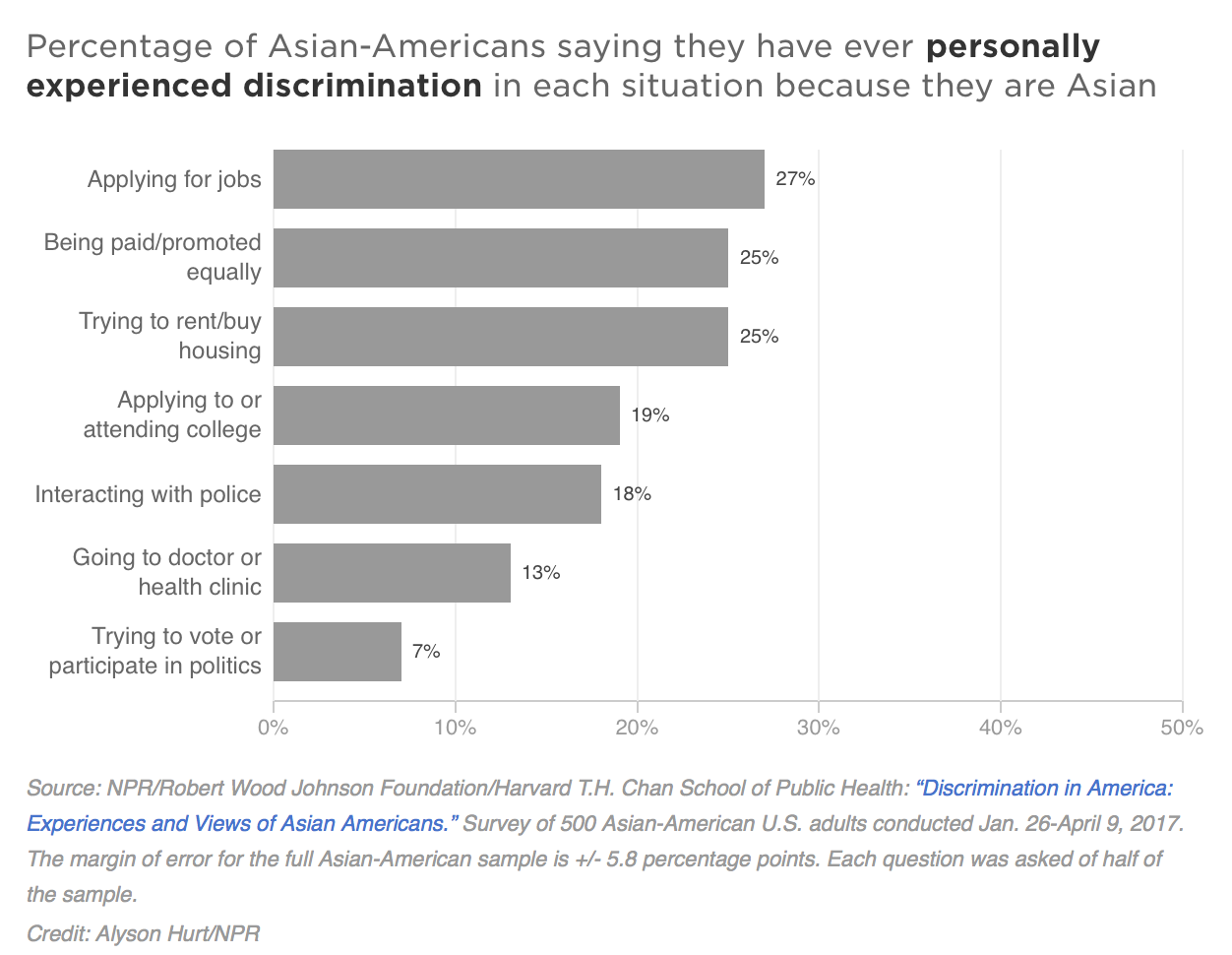
New results from an NPR survey show that large numbers of Asian-Americans experience and perceive discrimination in many areas of their daily lives. This happens despite their having average incomes that outpace other racial, ethnic and identity groups.

The poll, a collaboration among NPR, the Robert Wood Johnson Foundation and the Harvard T.H. Chan School of Public Health, also finds a wide gap between immigrant and non-immigrant Asian-Americans in reporting discrimination experiences, including violence and harassment.

“Our poll shows that Asian-American families have the highest average income among the groups we’ve surveyed, and yet the poll still finds that Asian-Americans experience persistent discrimination in housing, jobs and at college,” says Robert Blendon, professor of health policy and political analysis at the Harvard Chan School who co-directed the survey. “Over the course of our series, we are seeing again and again that income is not a shield from discrimination.”

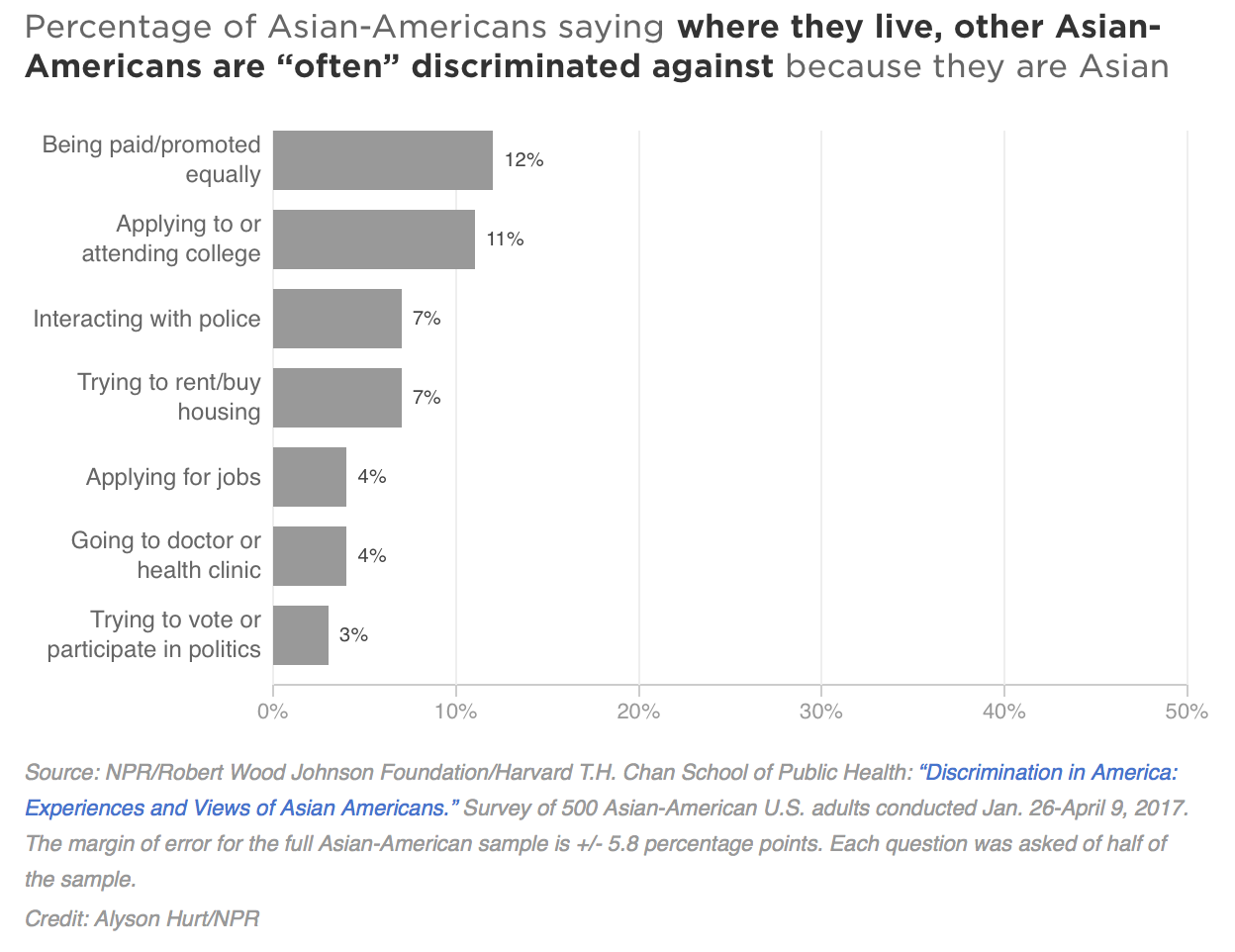
In addition to asking about personal experiences with discrimination, we also wanted to find out what people’s perceptions are of discrimination within their own neighborhoods. The numbers for Asian-Americans were lower on this measure than for personal experiences but still show that a notable level of discrimination exists in everyday life.

The survey was conducted among a nationally representative probability-based telephone (cell and landline) sample of 500 Asian-American adults. The margin of error for the total Asian-American response is 5.8 percentage points at the 95 percent confidence interval. Interviews were conducted in English, Mandarin, Cantonese and Vietnamese. Complete methodological information is in the full poll report.

Looking at the split according to immigration status, we found that nonimmigrant Asian-Americans are more than three times as likely to say they’ve experienced violence because they are Asian and more than twice as likely to say they’ve been threatened or non-sexually harassed because they are Asian.

We also saw a similar gap based on immigration status in terms of experiencing sexual harassment. But it’s important to note that our poll was done earlier this year, before the country’s widespread discussions of sexual assault and harassment in the fall. “These national conversations may have affected how people viewed or responded to their own experiences, or on their willingness to disclose these experiences in a survey,” Blendon says.

via Poll: Asian-American Discrimination Marked By Individuals’ Prejudice : NPR

Ex-StatsCan chiefs make last-ditch appeal to fix ‘egregious flaw’ in stats agency governance bill

Tend to agree with Smith and Fellegi:

A pair of former chief statisticians made a last-ditch plea to Senators last week to fix what one said was an “egregious flaw” that “fundamentally undermines” a government bill’s aim to give Statistics Canada more independence.

In an appearance in front of the Senate’s Social Affairs, Science, and Technology Committee Nov. 30, Wayne Smith and Ivan Fellegi restated the case they made in front of the House of Commons committee that studied Bill C-36: that the changes to the Statistics Act that purport to give the chief statistician more independence, should come with a more-stringent hiring process.

“I’m very conscious of the fact this is the 23rd hour in terms of this legislation,” said Mr. Smith, who served as the chief statistician from 2010 until he resigned in September 2016 in protest over the role Shared Services Canada plays in handling Statistics Canada’s information technology.

Mr. Smith called a lack of specificity in the bill over how the chief statistician is selected the “one egregious flaw in the legislation that fundamentally undermines the achievement of its objective.” The bill would change the chief statistician’s term to a fixed five years served under good behaviour, instead of the current term that lets them stay on as long as the government wants them to.

Both Mr. Smith and Mr. Fellegi—who served as the country’s chief statistician from 1985 to 2008—are calling for the creation of a three-person non-partisan selection committee to create a shortlist of candidates for the governor-in-council appointment (which would ultimately be decided by cabinet), as well as for the bill to clearly define what requirements a chief statistician should have.

“The new proposed bill gives a great deal more authority on professional issues to the chief statistician,” Mr. Fellegi said. “That makes it that much more important that he or she should be properly qualified. And an appropriately composed search committee should have that task.”

But Liberal Senator Jane Cordy (Nova Scotia), a member of the Social Affairs Committee and the bill’s sponsor in the Senate, told The Hill Times she doesn’t think the bill needs changing.

Sen. Cordy, who said she was first approached about sponsoring the bill in the spring by the government’s representative in the Senate Peter Harder (Ottawa, Ont.), pointed to comments made by Independent Senator Tony Dean (Ontario) during the Nov. 30 committee meeting that selection committees don’t eliminate potential bias.

“I’m a fan of search committees,” Sen. Dean told the former chief statisticians, but added he didn’t think the bill necessarily required changing. Instead, the recommendation could be rolled into an observation for the minister to consider.

There is precedent for choosing the chief statistician by committee, according to Mr. Fellegi, who said the appointment of his predecessor, Martin Wilk, was conducted that way. Mr. Wilk’s appointment came after a period in the late 1970s when Statistics Canada didn’t have the stellar reputation it enjoys today, Mr. Fellegi said, and needed a “transformative” leader.

“We found a transformative chief statistician who wouldn’t have applied because he was vice-president of AT&T, being paid probably five times as much, at least, as the offer from the government of Canada,” Mr. Fellegi said, adding that the search committee “basically appealed to his conscience” to have him return to Canada from the United States to take the job from 1980 to 1985.

Conservative Senator Linda Frum (Ontario), the official opposition critic for the bill in the Senate, said during her second-reading speech on Oct. 5 that the chief statistician should also be subject to approval by both houses of Parliament.

“If this government wants to demonstrate its sincere desire for a more arm’s-length relationship between the agency and the government of the day, it should support such an amendment, that parliamentary approval must be required before appointing a new chief statistician,” Sen. Frum said.

On Dec. 1, Sen. Frum’s office told The Hill Times that following the start of the committee’s study of the legislation, she still saw this as a shortcoming, but that there were no proposed amendments yet formalized.

via Ex-StatsCan chiefs make last-ditch appeal to fix ‘egregious flaw’ in stats agency governance bill – The Hill Times – The Hill Times