Forget sovereignty, a new political divide is ready to split Quebecers – Macleans.ca

New political fault lines? Or just another variation of identity politics?

The divisions that once defined Quebec are dissolving before the eyes of its oldest political parties. Less than a year before the next election, fear of another referendum—or desire for one—is no longer top of voters’ minds, challenging the raisons d’être of both the ruling federalist Liberals and their rivals, the separatist Parti Québécois. Freed from the old worries, though, Quebecers might soon be following the worldwide trend of right-left polarization, splitting along populist and progressive lines.

The Liberals were elected with a majority in 2014 after the PQ’s attempt to capitalize on Quebec’s decade-long identity debate with the Charter of Quebec Values. It will go down as one of the worst misplays in the province’s political history, says François Pétry, a Université Laval political scientist, because much as they like debating the value of state secularism, Quebecers are disturbed by the idea of fighting with each other.

Now, after three years of focusing on the province’s economy, and pulling it out of deficit, Premier Philippe Couillard is wading into that same territory. Bill 62, a new law banning face coverings while receiving public services, was championed by the Liberals, and is already subject to two court challenges.

 It is drawing ire from all sides. Civil liberties advocates say it unfairly targets a tiny portion of Muslim women, while the nationalist opposition parties, Coalition Avenir Québec (CAQ) and the PQ, say it doesn’t go far enough. Premiers across the country have denounced it and Prime Minister Justin Trudeau has said the federal government is studying legal ways it could join the chorus. “It’s not a good initiative, purely on the electoral front,” Pétry says, adding the law figured nowhere in the Liberals’ election platform. “If you start to create conflicts between Quebecers, [you’re] probably going to suffer the consequences.”
It’s one of the few mistakes Couillard has made, according to Pétry, who tracks politicians’ promises and says Couillard has kept more of his than any premier in recent Quebec history. That and the government’s strong fiscal performance makes the Liberals’ recent slump in the polls a paradox. The most recent by Leger, published in October, had the Liberals running second to the four-year-old, right-of-centre CAQ on the question of voting intentions, with 29 per cent support compared to 34 per cent for the CAQ.

Couillard may be paying, says Pétry, for ethics blunders made by the party under its former leader, Jean Charest, which have tainted how voters view the party. What’s more, the Liberals have been in power since 2003, save for a two-year stint by the PQ under Pauline Marois, leaving many antsy for change.

“For the first time in 40 years, a party other than the PQ and the PLQ could be in power, and that’s a real feat,” says Dan Pelletier, a 45-year-old Laval security guard who plans to vote CAQ in the next election. Pelletier says he’s for legislation like Bill 62, as long as it’s done “with respect for the [minority] communities that live with us, without becoming authoritarian.”

Still, the CAQ, which has been criticized for sowing us-versus-them political division, has vowed to enact even further-reaching religious attire legislation, which would put Quebec at greater odds with the rest of the country. It’s a prospect that worries Emilie Nicolas, co-founder of Québec Inclusif and a Ph.D. candidate in anthropology at the University of Toronto, who says Quebec has seen “a progressive normalization of distrust of Muslim communities” since the early 2000s.

Discussions surrounding religious accommodations have long been placed in the context of Quebec’s separating of church and state in the 1960s. Some say that watershed moment can no longer be used to explain Quebec’s unease with those different from its French settlers. “In this day and age no society is an island,” says Arjun Tremblay, a postdoctoral fellow at the Université du Québec à Montréal who studies the politics of multiculturalism. He doubts any Quebec leader can steer clear of addressing identity for long—it “strikes an emotional chord in a lot of people,” he says, “and can be used to mobilize segments of the electorate.”

Tremblay, like others, points to the Trump administration’s “thinly veiled anti-Muslim” immigration and refugee bans. A far-right movement is gaining ground in the province, especially in Quebec City, where less than a year ago a mass shooting at a mosque left six dead and 19 seriously injured. The suspect, 27-year-old Alexandre Bissonnette, was said to have an affinity for Trump and the white nationalist groups supporting him.

The attack fuelled calls for the Quebec government to launch a formal commission looking into systemic racism in the province. But a month after it launched, Couillard changed its focus and name, ridding it of terms of reference relating to systemic racism in favour of vaguer language on discrimination and integrating immigrants. Nicolas says the move, compounded by Bill 62, shows how out of touch Quebec politicians are with the appetite among young voters to address social justice issues. “Millennials are not that young anymore,” she says, “and it turns out that they can vote if they feel like it makes a difference.”

Case in point: the Nov. 5 election of Valérie Plante, the first woman voted mayor of Montreal, who ran on a platform of progressive politics and on her independence from the political establishment. Her cheery demeanour helped. Plante’s predecessor, Denis Coderre, a former Liberal MP and cabinet minister, was seen as arrogant. Quebec’s main parties may be driven and divided by 1990s politics, Nicolas says, but that’s changing, “actually as we speak.”

Whether the Liberals find a way to renew themselves or dig deeper into old debates will determine how they do come October 2018, she predicts. Either way, the old guard remains in place and has 11 months to pick up the pieces. And if there’s one thing the experts agree on, it’s that 11 months in politics is a long time.

via Forget sovereignty, a new political divide is ready to split Quebecers – Macleans.ca

Umberto Eco Decodes the Secret Meaning of the Cell Phone

Fun and stimulating to read:

I wrote a fairly irate article in the early ’90s when cell phones were in the hands of just a few people, but a few who were making train journeys hell. I said, in short, that cell phones should only be allowed for organ transplanters, plumbers, and adulterers. For everyone else, especially in cases where otherwise unremarkable people were mouthing away in trains or airports about stocks and shares, metal section beams, or bank loans, it was more than anything a sign of social inferiority: those in real power don’t have cell phones but twenty secretaries who filter their calls and messages, whereas those who need them are middle managers who have to answer to the CEO at any moment, or small businessmen whose banks need to tell them their account is overdrawn.

As for adulterers, the situation has changed twice since that article: initially they had to forego this extremely personal means of communication since its acquisition gave rise to entirely justifiable suspicion in the mind of their spouses; then the situation changed—everyone had one, so it was no longer cast-iron evidence of an adulterous relationship. Lovers can now use them, unless they’re having affairs with persons who are to some degree in the public eye, in which case their conversations will certainly be tapped. No change with regard to social inferiority, there are still no photos of Bush with his ear to a cell phone, but it’s a fact that the cell phone has become an instrument for communication, and excessive communication, between mothers and children, for cheating in exams, and for photomania. Younger generations are abandoning their wrist watches because they can check the time on their cell phones; added to this is the birth of text messages, of up-to-the- minute news information, of the opportunity now to connect with the internet and receive wireless emails, offering, in their more sophisticated forms, even the functions of pocket computers, so that we’re now in the presence of a phenomenon that is socially and technologically essential.

Can we still live without a cell phone? Given that “living-with-a-cell-phone” means a total acceptance of the here-and-now and a frenzy of contact that deprives us of a single moment of solitary thought, anyone who cherishes their own inner and outer freedom can exploit the very many services it offers, apart from its use as a telephone. At most it can be switched on just to call a taxi or tell those at home that the train is three hours late, but not for being called: all you have to do is keep it switched off. When anyone complains about this practice of mine, I reply with a rather somber argument: when my father died over forty years ago, and therefore long before cell phones, I was on a journey and it was many hours before I could be reached. Well, those hours of delay had changed nothing. The situation would have been no different had I been called within ten minutes. This all means that instant communication provided by the cell phone has little to do with the great questions of life and death; it’s of no use to someone who is studying Aristotle, nor to someone struggling over the existence of God.

Does a philosopher therefore have no interest in a cell phone, apart from it allowing him to carry in his pocket a list of 3,000 books on Malebranche? On the contrary. Certain technological innovations have changed human life to such an extent as to become a topic for philosophical discussion—and just think of the invention of writing, from Plato to Derrida, or the advent of mechanical looms, see Marx. Curiously there has been little philosophical reflection on other technological changes that seem so important to us, such as the car or the airplane, though there has been on the changing concept of speed. But we use the car and the airplane only at certain times, unless we’re a taxi or a truck driver, or a pilot, whereas writing and the mechanization of most of our daily activities has had a radical impact on every second of our lives.

Maurizio Ferraris has written about the philosophy of the cell phone in Where are you? Ontology of the Cell Phone. Perhaps the title raises a hint of light amusement, but Ferrari draws a number of serious reflections from his subject, and involves us in a rather intriguing philosophical game. Cell phones are radically changing our way of life and have therefore become “philosophically interesting.” Having also taken on the role of pocket diary and mini-computer with Web connection, the cell phone is less and less an oral instrument and more and more an instrument for reading and writing. As such, it has become an all-inclusive instrument for recording, and we’ll see how words like “writing,” “recording,” and “inscription” might make a confederate of Derrida prick up his ears.

“I like to recall the tragedy of Dr. Zhivago who, after many years, sees Lara on the tram. He cannot alight in time to reach her, and dies. If both had had mobile phones, how would their tragic story have ended?”
The first hundred pages on the “anthropology” of the cell phone are fascinating even for the non-specialist. There’s a substantial difference between talking on a telephone and talking on a cell phone. On the telephone we could ask whether a certain person was at home, whereas on the cell phone, unless it’s stolen, we always know who is answering, and whether he or she is there, which also changes the quality of intimacy. But with a landline we know where we are calling. Now, with the cell phone, there’s the problem of where the person is. There again, if he or she replies, “I’m right behind you,” but has an account with a cell phone company in a different country, the answer is travelling halfway round the world. Nonetheless, we don’t know where the other person is whereas the telephone company knows where we both are, so that while we can avoid letting the other person know our precise whereabouts, our movements are totally transparent when it comes to Orwell’s Big Brother.

via Umberto Eco Decodes the Secret Meaning of the Cell Phone

Morneau advisers urge sweeping changes to cope with looming tech disruption

Following its earlier report urging an increase of immigration levels to 450,000 per year, the Barton Commission suddenly recognizes technological disruption and its impact on the labour force – [Canada] “can no longer rely on the old formula for economic growth, which emphasized investments in machinery and equipment, and population growth.”

Ironic, to say the least.

The earlier recommendation of increased immigration would have benefited from analysis of the possible impact of technological disruption. Perhaps a revised immigration recommendation is needed?:

Canada is ill-prepared for the effects of widespread technological disruption reshaping the global economy, Finance Minister Bill Morneau’s expert panel of economic advisers are warning in a set of reports scheduled for release this week.

To prevent the country’s economic growth from falling behind that of other nations, the group is recommending a modernization of Canada’s tax and regulatory systems to make them more innovation-friendly.

In addition, it is calling for a $15-billion spending surge to retrain workers so their skills are up to speed in a rapidly shifting labour market.

The recommendations are contained in advance drafts of the latest reports from the 14-member group, formally known as the Advisory Council on Economic Growth, obtained by The Globe and Mail.

“The latest wave of recommendations is geared towards preparing our economy … to capture the opportunities and handle the disruption coming over the next decade,” said council chair Dominic Barton, global managing director of consultancy McKinsey & Co. Mr. Barton was one of several council members who spoke with The Globe about their third set of recommendations to government since the council’s formation in March, 2016.

“The world is going through a period of unprecedented change, which offers many opportunities but also brings significant volatility,” the council writes in one of the documents, received by Mr. Morneau earlier this month. “Canada must be prepared to navigate this change and volatility. It can no longer rely on the old formula for economic growth, which emphasized investments in machinery and equipment, and population growth.”

The new reports come as Mr. Morneau crafts his third budget, for release in early 2018. They likely provide a sense of policy themes under consideration given the government’s close co-operation with the council and quick action on several of its past calls. Proposals that have been adopted include the launch of an infrastructure bank, the creation of a federal entity to promote foreign investment into Canada, and changes to boost immigration levels and hasten the process for high-skilled foreigners to move here. A spokesperson for Mr. Morneau said the minister has had good discussions with the council and will carefully review its suggestions as he prepares the budget.

…The new reports focus on preparing Canadians for an economy rapidly shifting away from the production and sale of physical goods to the commercialization of digital services and intellectual property. That is being accompanied by changes in how work is done, and by whom – or by what. According to a recent McKinsey study, 45 per cent of activities performed by humans could be automated using existing technology. “Already, robots can build your car, take your lunch order, review your legal case history, sell you insurance or examine your X-rays,” reads one council report. The council says at least 10 per cent of the Canadian work force – about two million people – face job losses by 2030 and will struggle to find new jobs “unless they acquire new formal qualifications.”

The council acknowledges that federal and provincial governments are aware of the challenges and do fund training programs. Ottawa promised significant changes in the previous budget to existing agreements to transfer job-training funds to provinces and territories plus an additional $2.7-billion in related spending over six years. Federal Employment Minister Patty Hajdu said in an interview that negotiations to revise the transfers are going well and results could be announced in early 2018. The government previously responded to an earlier growth-council recommendation by setting up a new organization to study and report on Canada’s skills needs.

But council member Ilse Treurnicht, former CEO of Toronto’s MaRS Discovery District said, “much more needs to be done given the wave that’s headed our way. It will take an all-hands effort.” She added that other countries are experimenting with retraining efforts, but “it is still early in the process.”

The growth council calls for a “jolt to the system” with the creation of a “third pillar” alongside the education system and regimes for funding retirement and unemployment insurance. “The focus has to be about providing skills upgrading capabilities and opportunities for people who are in the labor market,” said council member Michael Sabia, CEO of the Caisse de dépôt et placement du Québec.

At the heart of the council’s proposed $15 billion-per-year skills funding boost would be a new $2.5-billion-per-year government fund for training employed adults. The $15-billion amount would be jointly funded by government, industry and individuals. Mr. Sabia said it was “premature” to say how costs would be split. The council also calls for the government’s employment centres to be transformed to provide not only help for the unemployed but also career and training guidance for working adults and employers. “What we’re really saying is … the country has to get on with the discussion that’s required about how are we are going to deal with this issue,” he said.

via Morneau advisers urge sweeping changes to cope with looming tech disruption – The Globe and Mail

Poll: Discrimination Against Women Is Common Across Races, Ethnicities, Identities : NPR

Another in the series of NPR polls on discrimination, with the usual richness of data including the “intersectionality” between race and gender:

Discrimination in the form of sexual harassment has been in the headlines for weeks now, but new poll results being released by NPR show that other forms of discrimination against women are also pervasive in American society. The poll is a collaboration with the Robert Wood Johnson Foundation and the Harvard T.H. Chan School of Public Health.

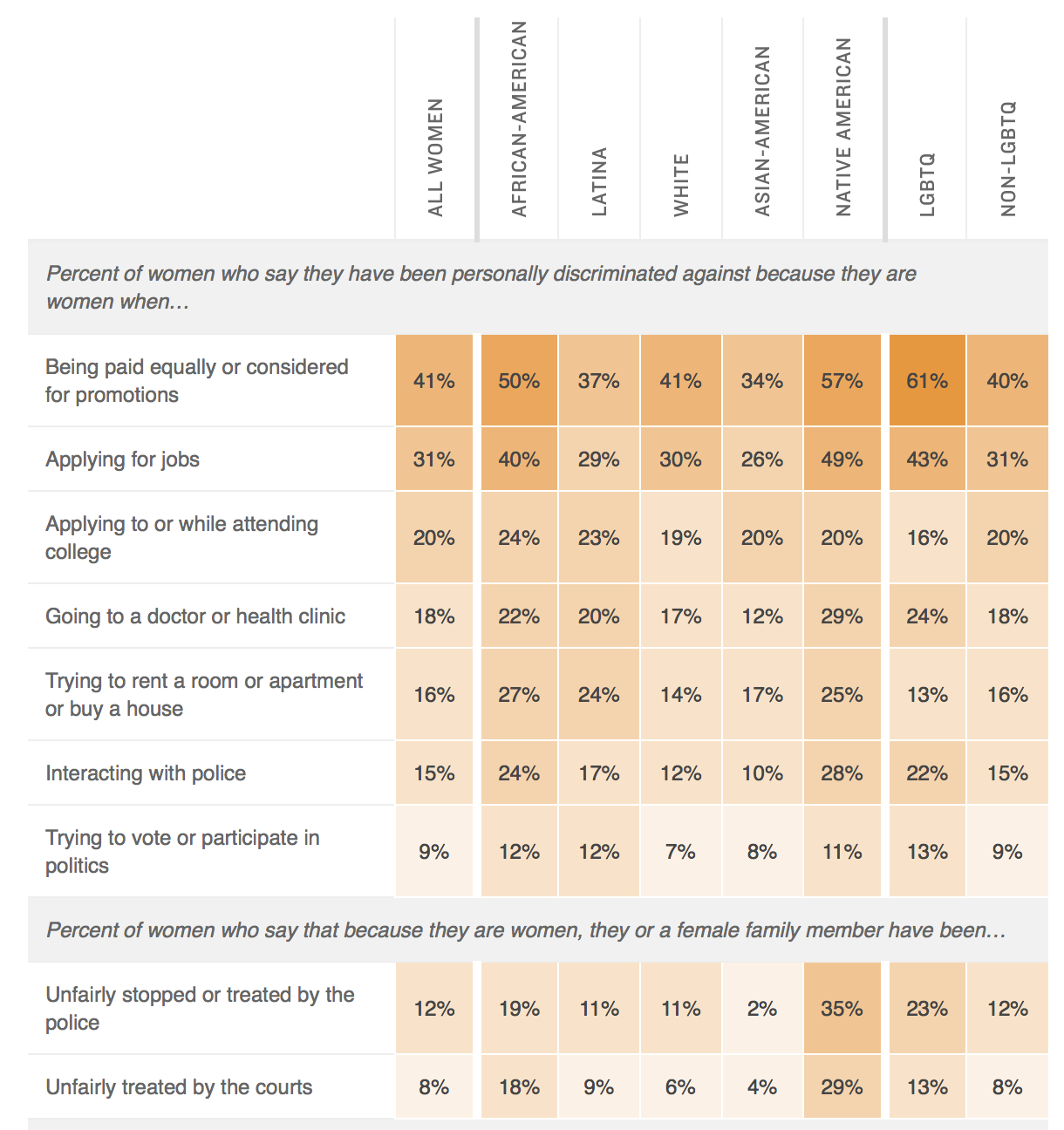
For example, a majority (56 percent) of women believe that where they live, women are paid less than men for equal work. And roughly a third (31 percent) say they’ve been discriminated against when applying for jobs because they are women.

Overall, 68 percent of women believe that there is discrimination against women in America today.

The chart below shows that the experience of gender discrimination is not monolithic — women in each racial, ethnic and identity group have particular problems in employment, education, housing and interactions with law enforcement, the courts and government. Several groups of women also avoid seeking health care out of concern they will face discrimination.

On nearly every measure, Native American women had the highest levels of discrimination based on gender. In our series, “You, Me and Them: Experiencing Discrimination in America,” we have highlighted several of these situations, including unfair treatment by the courts in majority-Native areas.

NPR will livestream an expert panel discussion on Native American issues at noon ET on Tuesday.

One of the patterns that emerged from the poll and our subsequent reporting is a gulf between high- and low-income areas when it comes to experiences of discrimination. This gap is also apparent in the gender data crunched by our Harvard team. The graph below illustrates the stark differences based on income when it comes to several everyday experiences people have in their own neighborhoods.

A snapshot in time

Our poll — which was fielded from late January to early April — before this fall’s intense news coverage of sexual harassment — also captures what women were feeling and experiencing before the recent scandals.

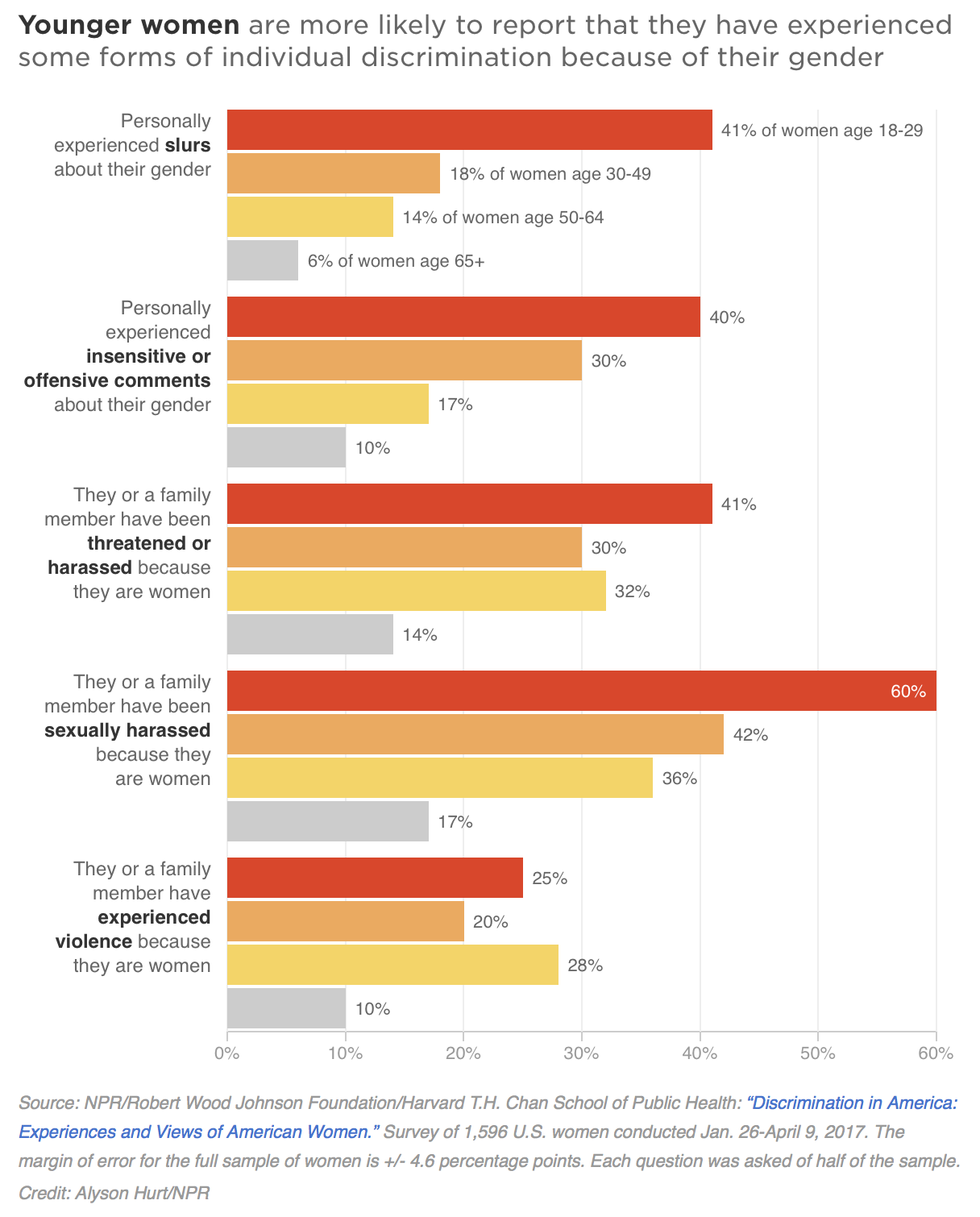
We found that 37 percent women overall reported they or a female family member had been sexually harassed because they are women at some point in their lives. But there was a wide range of responses based on age, with 60 percent of those 18 to 29 years old saying they or a female family member had been sexually harassed because they are women, versus 17 percent of women 65 and over.

“Our survey highlights the extraordinary level of personal experiences of harassment facing women today, as reflected in the news,” says Robert Blendon, co-director of the poll and professor of health policy and political analysis at the Harvard Chan School. “These national conversations may have affected how people viewed or responded to their own experiences in our survey, or their willingness to disclose these experiences.”

Indeed, a poll released last week by Quinnipiac University, asking specifically about sexual assault, suggests women may be more comfortable reporting such experiences now that more women are coming forward and revealing past abuse. (Our poll differs from Quinnipiac in that we asked a broader question: “Do you believe that you or someone in your family who is also a female has experience sexual harassment because you or they are female?”)

The survey from NPR, the Robert Wood Johnson Foundation and the Harvard Chan School was conducted from Jan. 26 to April 9, 2017 among a nationally representative probability-based telephone (cell and landline) sample of 1,596 women. The margin of error for total female respondents is 4.6 percentage points at the 95 percent confidence interval. Complete methodological information is in the full poll report.

via Poll: Discrimination Against Women Is Common Across Races, Ethnicities, Identities : NPR

EU chiefs ‘IGNORE’ ethnic minority staff ‘despite promoting diversity’ | Express.co.uk

The numbers are telling:

Statistics published by the Politico website show minorities make up just one per cent of EU institutions.

Part of the reason for the EU’s deliberate colour blindness stems from countries like France where there is huge opposition to compiling statistics on race.

But critics say that has led the bloc to become a “bubble” for rich white people and no longer reflects the continent it purports to represent.

Is the EU too white?

British Conservative MEP Syed Kamall said there was a clear divide between those high up in Brussels and the staff performing low-level jobs.He told the site: “If you want to see diversity in the European institutions, look at the faces of the cleaners leaving the building early in the morning and contrast that with the white MEPs and officials entering.”

One MEP’s assistant, Rachael Moore, even accused politicians at the European Parliament of ignoring her as one of the few “black faces” andclaimed she was subjected to security checks for no good reason.

She said: “It’s like I am not even there — they just look straight at my boss.

“They don’t look or reply to me when I ask a question. I get looks like ‘you’re not supposed to be here’.”

She went on: “I don’t sound like anything in particular on the surface.

“There is shock, a blank stare when they see me for the first time. It plays on my daily life.”

There is a lack of diversity at EU institutions

British Conservative MEP Syed Kamall said there was a clear divide between those high up in Brussels and the staff performing low-level jobs.

And Sarah Chander from the European Network Against Racism (ENAR) told Politico there was an “audacity” in Brussels where “every single one” of those promoting multiculturalism were white.

She said: “Many working in the Brussels bubble feel that working on progressive issues gives them a sense of immunity for the overwhelming whiteness of their institutions and organisations.”

It is not the first time concerns have been raised about a lack of representation in the EU corridors of power.

The ENAR penned a letter to Jean Claude-Junker earlier this year calling for changes to its diversity strategy.

It came after the Commission published a new policy on boosting the number of women, people with disabilities and LGBT staff working at its buildings, but ignored their race.

The letter said: “The European Commission has been widely criticised for under-representation of racial, ethnic and religious minorities within its workforce.

“Many commentators have argued that the European Commission must better reflect the diversity of the European society.

“Particularly at senior levels, the issue of under-representation is acute.

“This points to a trend of structural discrimination within the European Commission and jeopardises the equal inclusion of racial, ethnic and religious minority staff.”

But last year Alexander Winterstein, deputy chief spokesman for the Commission, defended its policies.

He claimed: “If you walk through our corridors you will see people from all walks of life, from all over Europe.”

via EU chiefs ‘IGNORE’ ethnic minority staff ‘despite promoting diversity’ | World | News | Express.co.uk

House of Commons gearing up for Indigenous languages in chamber

Interesting:

Ottawa is boosting its roster of Indigenous language interpreters in the House of Commons, even as MPs grapple with whether to move beyond the chamber’s two official languages, English and French.

An extra interpretation booth has already been added to the new Commons chamber in the West Block, slated to open next fall as the existing chamber gets a 10-year makeover. From there, specialists will be able to interpret Indigenous languages like Cree and Ojibway, as well as other languages, in real time.

“Given that there are approximately 60 different Indigenous dialects in Canada, grouped in 10 families, the capacity of qualified freelance interpreters in Indigenous languages is extremely limited,” warns an internal briefing note from Public Services and Procurement Canada (PSPC), obtained by CBC News under the Access to Information Act.

An artist’s rendering of the temporary House of Commons chamber, in the West Block, to open next fall. The new chamber has been fitted with a extra booth that can be used for simultaneous interpretation of Indigenous languages used by MPs. (Government of Canada)

“The [Translation] Bureau is working to develop this capacity and has assigned a senior interpreter to work on assessing and building capacity. Other factors to be considered are related to security clearance, travel (distances and costs are significant), and the ability to assess language skills in Indigenous languages, which is limited, as well.”

The July 2017 document indicates the government is gearing up for a potential linguistic watershed: the first simultaneous interpretation of an Indigenous language ever provided in the Commons chamber.

The issue has been forced by Robert-Falcon Ouellette, Liberal MP for Winnipeg Centre, who gave a speech in Nehiyo, or Cree, in the chamber on May 4. One of every five people in his riding is Indigenous.

Ouellette provided 48 hours’ notice of his speech, but there was no simultaneous interpretation into English and French — prompting him to ask the Speaker of the House to rule on a question of privilege.

Ruled against

Geoff Regan ruled against Ouellette, while acknowledging some MPs might find the situation “woefully inadequate.”

Regan then wrote to the Commons committee on procedure and house affairs, on Sept. 25, suggesting MPs study the issue. The committee has agreed, and is expected to hold hearings early in the new year.

“I want the grandmother who’s sitting in a reserve in her community to be able to turn on a channel and to listen to the Cree language, and listen to the great debates going on in our Parliament,” Ouellette said in an interview.

The Commons chamber has echoed with many languages over the years, including Japanese, Cantonese, Punjabi and Italian, and even a 1983 exchange between two members in Latin and Greek.

Indigenous languages heard in debate have included Dene-North Slavey, Inuktitut, Ojibway, Salishan and Cree, including comments from New Democrat MP Romeo Saganash after the 2011 federal election.

But simultaneous interpretation in languages other than English-French has been restricted to those rare occasions when a foreign dignitary has visited, requiring an extra booth be set up in the crowded chamber.

The Translation Bureau did provide simultaneous interpretations for two Indigenous senators in the Upper Chamber for a 2009 pilot project. And two Commons committees received simultaneous interpretation of Indigenous languages for a total of 14 days in 2016, including during visits to Kuujjuaq and Iqaluit, says the briefing note.

via House of Commons gearing up for Indigenous languages in chamber – Politics – CBC News

EUROPP – The question of citizenship in the Brexit divorce: UK and EU citizens’ rights compared

Some interesting polling data. No surprise that “on average British citizens are more supportive of their rights abroad compared to EU-27 citizens’ rights in the UK:”

One of the key priorities for the EU during the Brexit negotiations is safeguarding citizens’ rights. This refers to 3.5 million EU citizens living in the UK and 1.2 million UK nationals living in EU countries. The EU supports equal treatment in the UK of EU27 citizens as compared to UK nationals, and in the EU27 of UK nationals as compared to EU27 citizens, in accordance with Union law. In her Florence speech on 22 September, the UK Prime Minster, Theresa May, offered to incorporate legal protections for EU citizens living in the UK into UK law as part of the exit treaty.

However, since the UK triggered Article 50 on 29 March, there has been little substantive progress in the Brexit negotiations with the question of citizens’ rights being one of the primary sticking points. A European Parliament resolution criticised the lack of sufficient progress on this issue, with the Parliament’s Brexit chief, Guy Verhofstadt, arguing that ‘citizens’ rights are not being well-managed’ suggesting the possibility of a potential European Parliament veto of the Brexit deal.

Against this background of uncertainty, it is important to understand how citizens’ rights feature in the hearts and minds of the British public. To do so, we designed a survey, conducted by YouGov for the University of York on 29 June just a few days after official negotiations for departure began between the UK and the EU on 19 June. The key questions we sought to address were:

  • What is the opinion of British citizens on the rights of EU citizens in the UK as part of the Brexit divorce?
  • How do attitudes towards the rights of UK citizens abroad compare to attitudes towards the rights of EU citizens in the UK?

Our sample consisted of 1,698 individuals and was representative of the general British population in terms of age, gender, education, social grade, region, political attention and EU referendum vote. We broke down the question of citizens’ rights into four subsequent components that relate to freedom of movement in the EU, i.e. the right to freely work, reside and do business in another EU member state, as well as receive welfare.

UK citizens’ attitudes towards EU-27 citizens’ rights in the UK

Overall, British public opinion is dispersed on EU-27 citizens’ rights in the UK, as shown in Figure 1. There is much more support for doing business in the UK as opposed to working and living in the UK. The least support is observed on the question of access to welfare where we may observe comparatively much more disagreement and potentially a level of polarisation among the electorate.

On a scale from 0 to 10, where 0 denotes full disagreement and 10 full agreement, approximately a quarter of the respondents (24.16%) fully disagree that EU citizens should be allowed to claim welfare benefits in the UK. If we were to add those who have responded below 5, i.e. the middle point of the scale, then this proportion reaches 50% of the respondents. This shows that opposition to EU citizens’ accessing welfare benefits in the UK is much higher to opposition to EU citizens’ right to live, work and do business in the UK, which is at 20.84%, 19.57% and 9.25% respectively. Put differently, the majority of British citizens tend to be in favour of EU citizens living, working and doing business in the UK, but they are not as happy for them to claim welfare benefits in their country.

UK citizens’ attitudes toward UK citizens’ rights in the EU-27

How do these findings compare to how British citizens view their own rights abroad? Here the picture is slightly different. Figure 2 shows that on average British citizens are more supportive of their rights abroad compared to EU-27 citizens’ rights in the UK. Overall, fewer people disagree that UK citizens should have the right to live, work, do business and claim welfare benefits in other EU countries (responses below point 5 on the scale). These percentages range from 14.74% disagreeing that UK citizens should have the right to live in an EU country, 14.04% being hostile to UK citizens having the right to work in the EU, only 7.74% disagreeing that UK citizens should be able to do business in other EU countries, and 44.9% arguing that UK citizens should not receive welfare abroad. The latter number on UK citizens’ welfare rights in other EU countries is about 5 percentage points lower than those who oppose EU citizens’ welfare access in the UK. That being said, however, British citizens are similarly polarised on the question of welfare access even if this concerns their own nationals abroad.

Our findings suggest that although the question of EU immigration is very important among the public, and – as we know – contributed to how people voted in the Brexit referendum in 2016, it is much more nuanced and potentially contradictory than we had previously thought.

First, often – at least in the British case – some nationals may have ‘double standards’ not viewing non-nationals having equal rights to themselves. This might undermine the UK government’s popularity following a Brexit divorce deal that guarantees equal rights for both UK nationals in EU member states and EU-27 citizens in the UK.

Second, the British public is much more agreeable to EU citizens’ living, working and doing business in the UK, but they are considerably less comfortable with them sharing welfare. This suggests that it is the social aspect of EU citizenship that is the key issue featuring in the hearts and minds of the majority of the British public. This could be because the anti-EU campaigns, parties and individuals heavily politicised the welfare aspect of EU integration during the Brexit referendum, by for example associating EU membership costs with a deficit in the NHS.

via EUROPP – The question of citizenship in the Brexit divorce: UK and EU citizens’ rights compared

Government hiring outside contractor to create Canada’s new citizenship test

This is encouraging as it means that the government is serious about maintaining some of the integrity measures introduced by the previous government such as multiple versions of the test to reduce potential cheating. It is also encouraging that the tender requires field testing of questions, one step the previous government largely skipped.

That the tender is out suggests that the revised study guide is close to finalization but that roll-out of the guide and test is unlikely before late 2018 or early 2019:

The federal government is turning to the private sector to help draft the latest version of the Canadian citizenship test.

A request for proposal went out on Tuesday morning, with Immigration, Refugees and Citizenship​ Canada (IRCC) explaining that it needs help to “develop a pool of (400) multiple choice official questions, a test blueprint, and 15 versions of the Canadian citizenship knowledge test.”

The value of the contract is, as of right now, undetermined. But bidders have until mid-January to submit their proposals and the contract is slated to last one year, likely ending in early 2019.

A spokesperson for IRCC said a rollout date for the new test has not yet been determined.

The Liberal government is also in the process of overhauling the study guide that is used by citizenship hopefuls to prepare for the test. That work is being done internally, however, and isn’t finished yet. It’s unclear how work on the test could begin before the guide is complete.

The request for proposal documents note that “significant revisions” are being made to the guide, and the citizenship test “will need to be updated to reflect the new version.”

“As we have done in the past, we will partner with testing experts to ensure that the test reflects the content presented in the completed study guide,” wrote department spokesperson Remi Larivière in an email.

“This will support the success of our clients while ensuring they obtain and demonstrate the knowledge required for citizenship.”

…The written test is just one of many steps toward citizenship. People hoping to become Canadian citizens must first prove they know about the country’s history, demographics, geography, politics and much more. Right now the test contains 20 multiple-choice questions, and applicants must get at least 15 correct to pass. That’s not expected to change.

via Government hiring outside contractor to create Canada’s new citizenship test – National | Globalnews.ca

2016 Census Environics Presentation: Release 6 – Education, Labour, Journey to work, Language of work, Mobility, migration

Really good detailed series of slides on the latest Census release. Not just for policy and data nerds:

via 2016 Census: Release 6 Education, Labour, Journey to work, Language of work, Mobility, migration

Douglas Todd: Is it OK to ask, ‘Where are you from?’

I remember my mother always bristled when asked “where are you from,” as for her, as a former refugee, it somehow placed her as an “other” rather than Canadian.

That being said, if the question emerged later in a conversation, and was framed as a matter of interest in the person, it was less objectionable.

I often ask as I am curious about the life stories of people that I meet but leave it to later in a conversation and usual preface it with some words to minimize the risk of it being perceived as a micro-aggression. Asking about origins or ancestry generally works better:

One of the many troubles with the movement to eradicate micro-aggressions is it’s based on an “open concept” characterized by intrinsically fuzzy boundaries, says clinical psychologist Scott Lillienfeld of Emory University.

Microaggressions are distinct from explicit acts of racial discrimination and superiority. They are said to represent implicit prejudice, under-the-radar acts purported to damage their victims.

But, as Lillienfeld writes in the magazine, Aeon, there is no scientific evidence they harm anyone. And, perhaps worse, they put everyone in a double bind. People can be charged with being micro-aggressors, Lillienfeld says, for both showing interest (“Where are you from?) and for not showing interest (“I don’t see colour”).

In other words, a micro-aggression is entirely subjective, requiring what cognitive behavioural therapists term “negative mind-reading,” which they encourage clients to avoid.

I took the “where are you from?” issue to University of B.C. social psychologist Ara Norenzayan, a Lebanon-raised specialist in global diversity studies.

“As you can imagine, I’ve had my fair share of being asked this question! I guess I look and sound ambiguous, so people can’t easily place me,” Norenzayan said.

“It all depends on how it’s done. I’ve had experiences that were a wonderful opportunity to share different cultural experiences and backgrounds: When the question comes from a place of empathy and genuine curiosity.

“And I’ve had experiences that were quite annoying and the conversation hit a brick wall, when it was out of context and I sensed a lack of openness and curiosity. I think in a place like Vancouver, where half the population was born outside Canada, the question could be an excellent invitation to learn about and celebrate Canada’s diversity, if it’s … non-judgmental.”

So, somewhat like Norenzayan, I urge North Americans, and especially Metro Vancouverites, to err on the side of asking about national, ancestral or ethnic origins. It involves a social risk, of course, because whether one is being judgmental is in the eye of the person being asked.

But it’s probably better than succumbing to silence, not to mention mutual suspicion. We have to step up our social game to counter the slow death of community that appears to be occurring across question-phobic Metro Vancouver.

Even though it might be easy for me to say — since I’m a journalist and it’s our job to come up with questions — I’d urge residents to start asking about a whole variety of things.

Would it be so bad if we relaxed a little bit, and biased ourselves to getting to know one another? You never know, we might meet someone we like.

via Douglas Todd: Is it OK to ask, ‘Where are you from?’ | Vancouver Sun