ICYMI: How the federal government is slowly becoming as diverse as Canada

Good overview article by Aaron Wherry of CBC on diversity in government, both public service and political appointments. Some of my analysis quoted and used:

Campaigning in 2015, Justin Trudeau’s Liberals promised to “build a government as diverse as Canada.”

That job might’ve seemed nearly done on Day One. Of the 31 ministers sworn in on Nov. 4, 2015, 15 were, famously, women. Five ministers were visible minorities and two others were Indigenous.

A cabinet ratio of 48.3 per cent women, 16.1 per cent visible minorities and 6.5 per cent Indigenous comes close to matching a Canadian population that was 50.9 per cent women, 22.3 per cent visible minorities and 4.9 per cent Indigenous.

But a prime minister and his government are responsible for far more than a few dozen cabinet positions. The cabinet oversees more than 1,500 appointments, including chairs and members of boards, tribunals and Crown corporations, deputy ministers, heads of foreign missions, judges and senators.

On that much larger scale, progress has been made, but the ideal of a government that looks like Canada is still a ways off.

A new appointment process

When the government was sworn in, just 34 per cent of federal appointees were women, 4.5 per cent were visible minorities and 3.9 per cent were Indigenous.

Two years later, according to data from the Privy Council Office, 42.8 per cent of appointees are women, 5.6 per cent are visible minorities and 5.8 per cent are Indigenous.

In February 2016, the Liberal government announced a new appointment process for boards, agencies, tribunals, officers of Parliament and Crown corporations. It specified diversity as a goal and opened applications to the public.

According to the Privy Council Office, 429 appointments were made via that process through Dec. 5, 2017. Of those, 56.6 per cent were women, 11.2 per cent were visible minorities and 9.6 per cent were Indigenous.

A total of 579 appointments — including deputy ministers, heads of mission and appointments for which requirements are specified in law — were made through existing processes. Of those, 43.7 per cent were women, 3.8 per cent were visible minorities and 5.2 per cent were Indigenous.

“Mr. Trudeau has been more intentional on these issues than his predecessors and has made great progress in opening up the process. He has also clearly made great strides on gender,” says Wendy Cukier, director of Ryerson University’s Diversity Institute.

But, says Cukier, the government’s efforts toward transparency and equal opportunity need to be accompanied by “proactive outreach and recruitment as well as retention strategies” in order to “address some of the barriers historically disadvantaged groups have faced.”

Eleanore Catenaro, press secretary for the prime minister, says, “Our aim is to identify high-quality candidates who will help to achieve gender parity and truly reflect Canada’s diversity.”

She says, “We know there is more work to do to achieve these goals, and we continue to do outreach to potential qualified and diverse candidates to encourage them to apply.”

Rigorous reporting of demographic data across federal appointments could presumably drive change — or at least give the  government something to answer for — but most of these numbers have not been made public.

“It is crucial that the government tracks, measures and reports on diversity in all areas,” says Sen. Ratna Omidvar, the founding director of Ryerson’s Global Diversity Exchange. “By doing so, we are able to see where we are making progress and where we need to improve.”

Beneath those top-line numbers, there are a few other points of reference.

According to Global Affairs Canada, the government made 87 heads-of-mission appointments — ambassadors, consul generals and official representatives — in 2016 and 2017. Forty-eight per cent were women and 13.8 per cent were visible minorities. There were no Indigenous appointees.

Senate and court appointments

Andrew Griffith, a former official at the department of citizenship and immigration who has been tracking diversity in federal appointments, has counted 18 women, six visible minorities and three Indigenous Canadians among Trudeau’s 31 Senate appointments.

As a result of an initiative to track judicial appointees, the Office of the Commissioner for Federal Judicial Affairs has published a tally of court appointments from Oct. 21, 2016 through Oct. 27, 2017. Between those dates, 74 judicial appointments were made, of whom 50 per cent were women, 12.1 per cent were visible minorities and four per cent were Indigenous.

But that data also suggested the pool of candidates was limited: of the 997 applications received, just 97 applicants identified as a visible minority and 36 were Indigenous.​

At some point, it might be charged that diversity is being inappropriately prioritized ahead of merit or competency — as Kevin O’Leary once alleged of Trudeau’s cabinet. But such suggestions assume that achieving diversity must come at the expense of merit.

Ideally, diversity would also amount to more than a numerical value.

3 benefits of diversity

Griffith, for instance, suggests three potential benefits of diversity in appointments: that it allows Canadians to see themselves represented in government institutions, that it brings a range of experience and perspectives to government policies and operations and that it reduces the risk of inappropriate policies (for example, an RCMP interview guide that asked asylum-seekers about their religious practices).

“It has been proven over and over that more diversity in the workplace leads to better outcomes,” says Omidvar, who is also pushing to tighten the standards included in a proposed government bill that would require corporate boards to report on diversity.

But the most profound impact could conceivably relate to Griffith’s first potential benefit. A nation that values diversity and pluralism might want its institutions to reflect those principles — and institutions that reflect those principles might advance the building of a multicultural society.

“It normalizes diversity,” Omidvar said of public appointments. “At this point, diversity is still sort of not the norm, which is why we focus on it.”

via How the federal government is slowly becoming as diverse as Canada – Politics – CBC News

ICYMI – Canadian citizenship applications surge after government relaxes language, residency rules

Always amusing to see how IRCC releases short-term data quickly in response to media requests while regular data releases, apart from the monthly operational data, takes an inordinate amount of time (i.e., the quarterly Citizenship Applications Overview dates from June 2017).

Over the course of 2018, the one-time impact of the change in residency requirements and the ongoing impact of the reduced requirements for knowledge and language assessment will be quantified versus the ongoing impact of the steep level of citizenship fees (two weeks data, while relevant, is not long enough):

There was a spike in applications for Canadian citizenship after the government relaxed the rules around residency requirements and language proficiency this fall.

Figures from Immigration, Refugees and Citizenship provided to CBC News show there was an average of 3,653 applications a week in the six months before changed were brought in Oct. 11.

The number shot up to 17,500 applications the week after the new requirements kicked in. There were 12,530 applications submitted the week after that, but data for subsequent weeks is not yet available.

Citizenship applications

“Reducing the physical presence requirement gives more flexibility to applicants to meet the requirements for citizenship and encourages more immigrants to take the path to citizenship,” said Immigration, Refugees and Citizenship spokeswoman Nancy Caron. “This helps individuals who have already begun building lives in Canada achieve citizenship faster.”

In recent years, there has been an average of 200,000 citizenship applications submitted each year.

Fluctuations in application rates are expected after rule changes, so the department put resources in place to handle “surge capacity” and keep processing times below the 12-month service standard, Caron said.

Andrew Griffith, a former senior immigration official, author and fellow of the Canadian Global Affairs Institute, said it’s too early to tell if the jump in numbers represents a blip or part of a longer-term trend. But he believes an increased rate of citizenship fosters social cohesion and eases community tensions as immigrants have a deeper connection to the country and to Canadian society.

‘Integration journey’

“We want people to become citizens because we believe that’s part of the integration journey,” he said. “That helps them feel part of Canada and ultimately should improve all the economic, social and political outcomes of the country.”

The new rules include:

  • The required length of physical presence in Canada is reduced to three out of five years, from four out of six years.
  • A portion of time spent in Canada before permanent resident status will count toward residency requirements, which will give credit to temporary workers and students.
  • The age range for language and knowledge requirements is reduced to 18 to 54 years old, from the previous requirement of 14 to 64.

But Griffith said high fees remain a barrier for some to apply for citizenship, especially those in the family reunification or refugee categories with stretched finances.

Processing fee hikes

The processing fee jumped to $630 in 2014-2015, which includes a $100 “right of citizenship” fee. That is still much lower than the fees in the U.K., the U.S. and the Netherlands, but is higher than New Zealand, Germany, Australia and France.

Griffith said reducing costs would reflect the fact that promoting citizenship provides not just personal benefit, but a benefit to the greater Canadian society when people can fully participate, including in the political process.

Immigration Minister Ahmed Hussen, who marked the changes taking effect at an event in October, said they will make the path to join the “Canadian family” easier and more flexible.

“As a country that’s committed to the settlement and integration of newcomers successfully so they can restart their lives and make contributions to our society, we have to ensure the path to citizenship for permanent residents,” he said at the time.

People can be deemed ineligible for Canadian citizenship if they have a criminal record or are facing charges in or outside Canada, or if they have had citizenship refused or revoked in past.

via Canadian citizenship applications surge after government relaxes language, residency rules – Politics – CBC News

Europe’s ageing societies require immigration to survive – and that means anti-immigration politics is here to stay

An interesting analysis of the correlation between increased immigration and xenophobia in Europe. Not encouraging:

The era after WWII was mostly devoid of populist party influence. Instead, Europe was on the mend, and integration at the forefront of European if not global policy agendas. Integration ensured peace. The postwar-prosperity was phenomenal, productivity and social welfare programmes expanded rapidly. Given the changes in the past decades, in particular after the latest European expansion and Eurozone crisis, a new era is upon us.

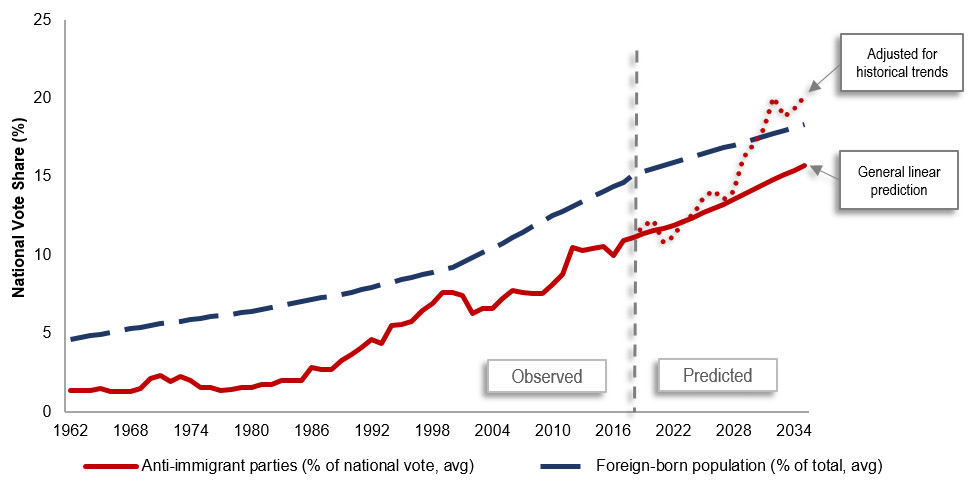
Beginning in the 1970s in Western Europe, populism has risen yet again amidst the waves of immigration that began in the 1960s. The new populist parties are often unidimensional with explicit xenophobic, anti-immigrant positions. Their messages scapegoat non-white, non-native born persons; often with a diametric opposition to Muslims or Islamic culture. In Western European countries, anti-immigrant populist parties – sometimes labelled the ‘populist radical right’ or ‘neo-nationalists’ – expanded from below 5% of the national vote share in 1962 up to 13% by 2017, on average.

Figure 1: Immigrants and observed/predicted future support for anti-immigration parties in Western Europe (1962-2035)

Note: This chart is based on 17 countries: Austria, Belgium, Denmark, Finland, France, Germany, Greece, Ireland, Iceland, Italy, Netherlands, Norway, Portugal, Spain, Sweden, Switzerland and the UK. Data from OECD, Global Bilateral Migration and ParlGov.

The vote share and percentage of foreign-born members of the population observed from 1962-2017 reveals a pattern. They rise in tandem. This is not a paradox of pooling Western European data. In each country on its own, the stock of foreign-born persons explains 50 to 97% of the variance in anti-immigrant party vote share (i.e., the range of correlation coefficients in 17 countries). This does not mean immigration causes anti-immigrant voting; however, social and political research explains why it is part of the causal process.

Immigration appears to be the only stable component of new populist parties and their limited policy victories. Thus far, new populist parties have successfully ushered in policies banning or criticising inter-ethnic marriage, the construction of Mosques, immigration flows and the human right to asylum (to name a few). Meanwhile, the UK voted to leave the EU; the Social Democrats in Sweden, after bleeding votes to the Sweden Democrats, introduced bureaucratic regulations against immigration; and perhaps most dramatically, 12.7% of German voters voted for the AfD, which is now Germany’s third largest party.

This marks a new era. The post-war spring season of growth has turned to autumn, with a fall in votes for mainstream parties, falling GDP growth and a potential decline in human rights. Anti-immigration views and aggressive displays of national pride, which might once have been confined to private dinner table conversations, have now moved into the public sphere, on the streets, in the media, and in political debates. The 2014 launch of PEGIDA and the sudden growth of the AfD are evidence of this public sphere change in Germany, the last place on earth one expects to find populism. At least 5 million Germans lost their lives under populist leadership last time around, not to mention those from other countries. Once out in the open, history suggests that nationalism reproduces itself because individuals see the public sphere as a safe space for them to express, if not grow their dissatisfaction with society and politics.

This is particularly acute when rates of immigration are increasing. Immigration provides a tangible basis to support narratives among the media and social networks that then shape the perceptions and experiences of natives. This leads to an increased salience of group boundaries. The native population may feel threatened by immigrants geographically and economically, challenging both group and national identities. These feelings magnify when native populations face increasing risks to their social and material security, a situation that lower income workers have had to confront since the 1980s due to a combination of economic crises, stagnant wages and welfare state retrenchments. Thus, redrawing or redoubling group boundaries is an active response, a defence mechanism built on the belief that the group will prosper if other groups are marginalised. This belief then fuses with the rhetoric of anti-immigration parties. As Figure 1 shows, this effect is likely a function of the number of immigrants in wider society.

Figure 2: Ageing population figures and observed/predicted GDP growth in Western Europe (1962-2035)

Note: Observed and predicted data from the OECD for Austria, Belgium, Denmark, Finland, France, Germany, Greece, Ireland, Iceland, Italy, Netherlands, Norway, Portugal, Spain, Sweden, Switzerland and the UK.

And immigration must continue to increase. The ageing population in Western Europe demands services and resources that the native working-age population cannot provide. Figure 2 demonstrates conservative estimates of both population ageing and GDP growth stagnation until 2035 from the OECD. Today a country is lucky to have 3% growth on average. Using predictive multilevel modelling and these statistics, we can tentatively predict that anti-immigration populist parties will increase their vote share.

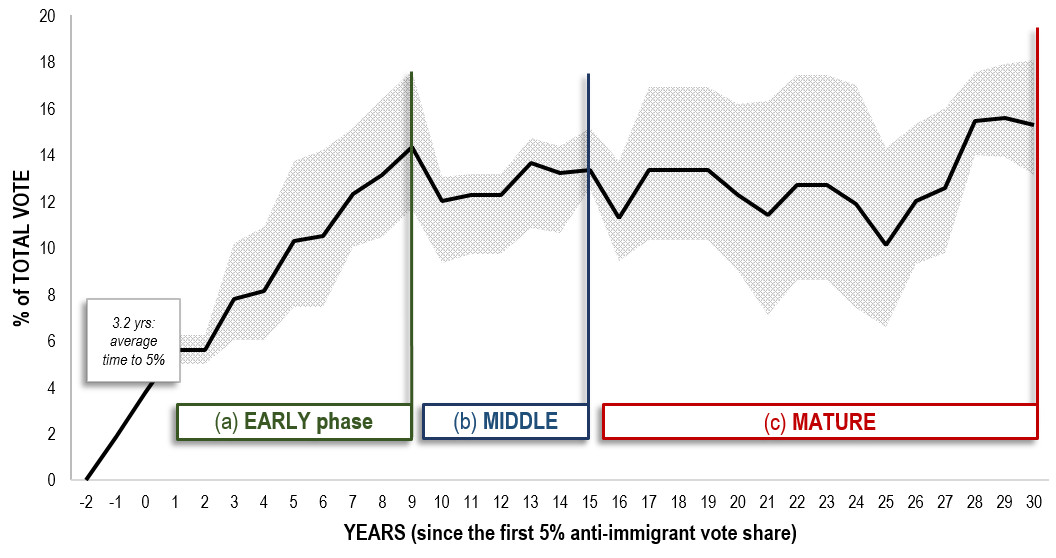
The most conservative prediction suggests that the vote share for such parties will cross 15% by 2035, as shown by the solid red line in Figure 1. However, the development of this support follows distinct phases. After an anti-immigration party enters the political arena and acquires support, the average time before it gains 5% of the national vote is 3.2 years (albeit with a large variance). After this 5% threshold is met, anti-immigration parties follow a trajectory of swift gains in the early phase (within 10 years of crossing the 5% mark), stability if not turbulence in the middle phase (up to 15 years) and then ultimately more gains in the mature phase (up to 30 years) as sown in Figure 3.

Figure 3: Trajectory of national vote share for anti-immigration parties after crossing the 5% threshold

Note: The three country phases include the following countries: Phase (a) includes Austria, Switzerland, France, Belgium, Norway, Denmark, Italy, Sweden, the UK, Greece, Germany and the Netherlands. Phase (b) includes Austria, Switzerland, France, Belgium, Norway, Denmark and Italy. Phase (c) includes Austria, Switzerland, France, Belgium and Norway.

Using these phases as an alternative augmentation to statistical prediction, suddenly 15% turns into a 20% vote share by 2035, shown by the dotted red line in Figure 1 after 2017. In most if not all countries, 20% of the national vote would put an anti-immigration party in second place and make it a serious contender as a coalition partner, as seen in Austria’s recent election.

Even with UKIP gaining much lower levels of support than this, the UK opted for a drastic undermining of European integration with its vote for Brexit. Meanwhile in other countries, support of between 5 and 25% of the vote for anti-immigration parties has coincided with more restrictive asylum rules or bureaucratic practices being put in place in Austria, Sweden, Belgium, Denmark, Finland, the Netherlands and Switzerland in recent years. A 20% vote share for anti-immigration parties would equate to a roughly 5-10% increase in the overall level of support for these parties in Western Europe. Moreover, if nationalist policies undermine international actors such as the EU or international frameworks such as the Geneva Convention, supranational arbitration will become increasingly difficult as states come into competition with one another.

How likely are these estimates? Nothing is certain and exogenous shocks are commonplace. Yet demographic science suggests that increased labour force participation, higher contributions from workers and employers, and lower benefits provided to retirees would be inevitable without an increase in immigration. In hyper-ageing societies such as Germany, the necessary increase would equate to a population where as many as 60% or more of citizens are foreign-born. Using these drastic estimates, the models outlined above also predict a 20% foreign-born population by 2035. Either way, the suggestion that support for anti-immigration parties will reach 15% on average by 2035 is potentially conservative, and 20% support is entirely possible.

Populism rises and falls in its myriad variants, but the explicitly anti-immigration version is likely here to stay. This carries additional baggage, as anti-immigration parties take aim at European integration while sometimes allying themselves with neoliberalism as both are in opposition to ‘the establishment’. These parties are not normally anti-democracy, but their authoritarian tendencies, their lack of coherent economic or educational policy and their willingness to foster division are all symptoms of the new season Europe is now entering: a European fall.

Source: Europe’s ageing societies require immigration to survive – and that means anti-immigration politics is here to stay

«On ne doit jamais tenir pour acquise notre cohésion sociale», dit Joly

True.

And good to see that the Liberal government has maintained and strengthened the program introduced by the Conservatives to provide funding for security equipment for faith centres:

Les appels à manifester lancés la semaine dernière par des groupes d’extrême droite avant qu’ils ne se ravisent sont un rappel qu’on «ne doit jamais tenir pour acquise notre cohésion sociale».

C’est ce qu’a déclaré la ministre du Patrimoine canadien, Mélanie Joly, qui était de passage mercredi au Centre communautaire Laurentien situé dans l’arrondissement montréalais d’Ahuntsic-Cartierville.

Mme Joly y annonçait l’octroi d’une subvention de 29 000 $ visant à améliorer la sécurité de ce centre communautaire musulman, qui abrite également une mosquée.

Ottawa épongera la moitié de la facture de ce projet frôlant les 60 000 $. Des pellicules de protection empêchant de fracasser les fenêtres seront apposées. Le centre se dotera également d’un système d’alarme, d’un système de télévision en circuit fermé et d’un système de contrôle des entrées.

Cet investissement du fédéral provient d’un programme mis en place il y a quelques années pour protéger les communautés à risque contre les crimes haineux.

Lors du dernier budget, Ottawa avait doublé le financement de ce programme, appelé Programme de financement des projets d’infrastructure de sécurité pour les collectivités à risque et chapeauté par le ministère de la Sécurité publique, pour le porter à 10 millions de dollars sur une période de cinq ans.

Interrogée en point de presse sur la présence plus visible de groupes d’extrême droite dans le paysage politique québécois, Mme Joly, qui est responsable des dossiers de l’inclusion et de la diversité au sein du gouvernement fédéral, a souligné qu’il est de notre responsabilité à tous de ne jamais baisser la garde.

«À chaque fois qu’il y a des discours haineux qui sont prononcés, on doit toujours les dénoncer», a-t-elle souligné.

«On a un rôle de leadership moral à jouer», a-t-elle rappelé à la classe politique.

Bien qu’aucun incident majeur ne soit à déplorer au Centre communautaire Laurentien, un sentiment d’insécurité avait fleuri chez ses membres dans la foulée de l’attentat perpétré à la mosquée de Québec le 29 janvier dernier.

Quelques semaines plus tard, Mme Joly participait à une rencontre avec des représentants de la communauté musulmane d’Ahuntsic-Cartierville pour discuter de ce qui pouvait être fait pour «accroître la tranquillité d’esprit» de ses membres.

C’est alors que le Centre communautaire Laurentien a décidé de déposer un projet auprès du gouvernement fédéral pour renforcer la sécurité des lieux.

Quelques incidents isolés étaient venus ternir la quiétude des lieux au cours des dernières années, dont notamment des messages haineux laissés sur la boîte vocale du centre et des vitres brisées, se rappelle le directeur du centre, Samer Elniz.

Il ajoute toutefois que pour ces quelques gestes odieux commis à l’encontre du centre, il répertorie un nombre incommensurablement supérieur de paroles chaleureuses et de mains tendues.

«C’est une minorité qui veut jouer avec le sentiment de la majorité», dénonce-t-il, se disant convaincu que le climat social continuera à s’améliorer au Québec.

Source: «On ne doit jamais tenir pour acquise notre cohésion sociale», dit Joly

Petition calling for more representation of Indigenous people in citizenship guide headed to House of Commons

Pretty clear that there will be from public comments at both the political and official levels (see Pathways to Prosperity 2017: Building Bridges between Indigenous and Immigrant Communities):

….Indigenous people from B.C. say changes critical

For Wet’suwet’en and African-American youth Taleetha Tait, changes to the guide are critical.

“It allows our experiences to be acknowledged and not to be judged,” Tait said.

“I feel better about new people coming to Canada and learning the truth and not hiding the wrongs, so there is less ignorance,” she added.

Information about Indigenous people in the citizenship guide is placed in the “Canada’s History” and the “Who We Are” sections.

The first describes the hunting and gathering practices and traditional diets of Indigenous people. For example, it says “West Coast natives preserved fish by drying and smoking.” It also adds “warfare was common among Aboriginal groups as they competed for land, resources and prestige.”

The Indigenous section under “Who We Are”  starts with “the ancestors of Aboriginal peoples are believed to have migrated from Asia many thousands of years ago.” It uses the word “Indian” and “Aboriginal” to describe Indigenous people and says residential school ended in the 1980s.

Ry Moran, the director of the National Centre for Truth and Reconciliation, says the guide is not giving newcomers the tools needed to participate in important conversations Canadians are currently having.

“It’s a very good example of a document that presents very poor information on Indigenous people and absolutely needs to be rewritten,” Moran said.

“It repeats the general narrative that there were Indigenous Peoples, there was a brief period of relationship and then goes into the predominant settler narrative. It doesn’t talk about the difficult relationship or serve newcomers well,” he added.

Changes a long time coming says new Canadian

There are two Truth and Reconciliation Commission calls to action pushing the federal government to revise the information kit for newcomers, the citizenship test and the oath to reflect an accurate portrayal of Indigenous people.

They call on the Government of Canada to change the Oath of Citizenship to observe treaties with Indigenous Peoples.

The guide currently says Aboriginal and treaty rights are in the Canadian Constitution, but there is nothing about treaties in the oath.

Kue K’nyawmupoe came to Canada as a Burmese refugee and is now a Canadian citizen. She says she is relieved the new citizenship guide and exam will be updated and wished she had learned more about Indigenous people when she first arrived.

“That is a very good change that has needed to happen for a very long time, and it would be very useful for Canadians  to recognize the first people of Canada, to be more inclusive,” K’nyawmupoe said.

The cynical roots of Rempel’s female genital mutilation crusade – iPolitics

Martin Patriquin on Michelle Rempel’s raising the issue of FGM and its inclusion or not in the revision of the Discover Canada citizenship guide:

The procedure by which a woman’s clitoris is surgically removed is usually performed without anesthesia and in unsanitary conditions. Unnecessary, retrograde and associated with a host of physical ailments, the surgery also can saddle a woman with a lifetime of psychological issues.

The very purpose of the surgery — to deprive a woman of sexual pleasure — is religiosity at its worst. Only a monster would support such a thing.

A monster — or the Liberal government, according to the blinkered thinking of Conservative MP Michelle Rempel. She seems to believe that the 23rd prime minister of Canada, along with its 20th immigration minister, are in favour of the practice.

Why? Because the Liberal government (she suggests) plans to remove from the pending new citizenship guide a reference to female genital mutilation, which is listed among other “barbaric cultural practices,” including honour killings and forced marriage.

“Those guilty of these crimes are severely punished under Canada’s criminal laws,” the current guide helpfully points out.

In fact, ‘plans to remove’ is too strong a statement, as the Liberals have yet to release the new citizenship guide, which newcomers use to study for the citizenship test. Nor have the Liberals said that the reference would be excised from the guide, despite the leak of a draft copy this summer that didn’t include it. Whenever he is asked about it, Immigration Minister Ahmed Hussen typically spouts the words “consultation” and “stakeholders” ad absurdum.

Rempel, who serves as the party’s shadow minister for Immigration, Refugees and Citizenship, sees something altogether nefarious in all this bureaucratese. And should the Liberals indeed remove the mention of female genital mutilation, it will be a “tacit message to people that perhaps the Canadian government is OK with it,” Rempel recently said during a radio interview.

open quote 761b1bRempel’s line of questioning strongly suggested Hussen was a cypher, using his position to foist the practice of ritual mutilation on an unsuspecting Canadian public.

So, there you have it. Canada’s current government is in favour of the forced, ritual removal of a part of a woman’s anatomy, according to the Official Opposition. To be clear, Rempel says she doesn’t know why the Liberal government would be gung ho on such a thing. But that hasn’t stopped her from speculating — on the record.

During a recent parliamentary committee hearing, Rempel lobbed loaded questions at Hussen, the apparent goal of which was to suggest the Prime Minister’s Office had asked for the reference to be removed. After Hussen said the PMO hadn’t instructed him to do anything, Rempel aimed for the jugular — or rather, below the belt. “What is your personal view?” Rempel asked Hussen, before the committee chair mercifully cut her off.

Hussen hails from Somalia, where the rate of female genital mutilation is the highest in the world, according to UNICEF. He is a refugee who fled war and strife to become a Canadian citizen and eventually a federal cabinet minister. Rempel’s line of questioning strongly suggested he was a cypher, using his position to foist the practice of ritual mutilation on an unsuspecting Canadian public.

The reference to female genital mutilation in the citizenship guide is similarly loaded. Telling potential citizens that cutting off another person’s body parts is illegal and will be punished is … redundant. Worse still, the inference is clear, and is aimed squarely at a certain subset of would-be Canadian citizens: Muslims.

Not coincidentally, female genital mutilation is carried out in roughly 30 countries, nearly all of them in Africa and nearly all predominantly Muslim. The inclusion of the phrase in the 2011 citizenship guide, much like the Conservative’s “barbaric cultural practices hotline” gambit during the 2015 election, is the stuff of cynical wedge politics meant to leverage revulsion against an identifiable religious group.

It conveniently ignores the fact that immigrants and refugees often flee their countries of origin specifically because of such practices. And it vastly overstates the scope of the problem in Canada.

As in Europe, instances of genital mutilation in this country remain isolated tragedies, and often come to light as a result of arrests. Moreover, the rate of female genital mutilation among those 30 countries has decreased by 30 per cent since 1985, according to UNICEF.

Meanwhile, other types of crimes in Canada are far more common. There were 1,409 police reported hate crimes in 2016 — an increase of 20 per cent since 2013. The homicide rate has also increased by 20 per cent in that time period. There were over 220,000 assaults across the country in 2016, and roughly 159,000 instances of breaking and entering.

One wonders why Rempel isn’t pushing the federal government to remind potential citizens that murder, assault, thievery and race-based aggression are illegal in this country and will be punished. Because it’s obvious, perhaps?

via The cynical roots of Rempel’s female genital mutilation crusade – iPolitics

Worries about Malaysia’s ‘Arabisation’ grow as Saudi ties strengthen

Of note in Malaysia as elsewhere in Southeast Asia:

Malaysia’s growing ties to Saudi Arabia – and its puritan Salafi-Wahhabi Islamic doctrines –  are coming under new scrutiny as concerns grow over an erosion of traditional religious practices and culture in the multi-ethnic nation.

A string of recent events has fueled the concern. Hostility toward atheists, non-believers and the gay community has risen. Two annual beer festivals were canceled after Islamic leaders objected. A hardline preacher, accused of spreading hatred in India, has received official patronage.

The government has backed a parliamentary bill that would allow harsh sharia punishments, such as amputations for theft and stoning for adultery. And after religious officials supported a Muslim-only laundromat, Malaysia’s mostly ceremonial royalty made a rare public intervention, calling for religious harmony.

Marina Mahathir, the daughter of Malaysia’s longest serving prime minister, Mahathir Mohamad, publicly lashed out at the government for allowing the “Arabisation” of Malaysia.

Marina, who heads the civil rights group Sisters in Islam, told Reuters Saudi influence on Islam in Malaysia “has come at the expense of traditional Malay culture”. Her father, 93, now heads the opposition alliance.

Saudi Arabia’s fundamentalist Wahhabi beliefs have strongly influenced Malaysia – and neighboring Indonesia – for decades, but have strengthened considerably since Najib became prime minister in 2009 and began cozying up to the kingdom.

The relationship came under a harsh spotlight when nearly $700 million wound up in Najib’s bank account in 2013. Najib said it was a donation from the Saudi Royal family, rebutting allegations it was money siphoned from the 1MDB state investment fund he had founded and overseen. Malaysia’s attorney-general cleared him of any wrongdoing.

The trend toward a politicized brand of Islam in Malaysia, a middle-income emerging market, has alarmed Malaysia’s non-Muslims, including ethnic Chinese who comprise a quarter of the population and dominate private sector commerce. It is also a concern for foreign investors, who account for nearly half the local bond market and have invested $8.95 billion in project investments in the first nine months of this year.

The government denies actively promoting Wahhabi-style Islamic conservatism.

Najib has been largely silent about the recent religious controversies. Critics have accused the prime minister, whose governing coalition lost the popular vote in the last general election but retained a simple majority in parliament, of playing on fears that Islam and Malay political power will be eroded should the opposition win. An election is due by mid-2018.

ELECTION CALCULATIONS

Militancy has also been on the rise in Malaysia, which from 2013 to 2016 had arrested more than 250 people with alleged ties to Islamic State, many of whom were indoctrinated with hardline interpretations of Islam.

After the visit of the Saudi monarch this year, Malaysia announced plans to build the King Salman Centre for International Peace to bring together Islamic scholars and intelligence agencies in an effort to counter extremist interpretations of Islam.

The center, which is being built on a 16-hectare (40-acre) plot in the administrative capital of Putrajaya, will draw on the resources of the Saudi-financed Islamic Science University of Malaysia, and the Muslim World League, a Wahhabi Saudi religious body.

Saudi Arabia has long been funding mosques and schools in Malaysia, while providing scholarships for Malaysians to study in the kingdom. Many of them find employment in Malaysia’s multitude of Islamic agencies, said Farouk Musa, chairman and director of the moderate think-tank, Islamic Renaissance Front.

One of the most worrisome doctrines they preach in multi-cultural Malaysia is ‘al-w ala’ wa-al-bara’ or ”allegiance and disavowal“, Farouk said. ”This doctrine basically means do not befriend the non-believers (al-kuffar), even if they are among the closest relatives.

”We have never heard of Islamic scholars forbidding Muslims to wish Merry Christmas before, for example. Now, this is a common phenomenon,” he said.

The adoption of Arab culture and interpretations of Islam is a result of greater exposure to Middle Eastern people and universities, said Abdul Aziz Kaprawi, a member of the Supreme Council of Najib’s political party, the United Malay National Organisation.

“The extensive usage of social media also accelerated the external influence on the locals,” he told Reuters.

The government is not promoting Wahhabism but rather the doctrine of “wasatiyyah”, or moderation and balance, to accommodate Malaysia’s multi-cultural society, said Abdul Aziz, who is also a federal deputy minister.

CROWN PRINCE‘S REFORMS?

Karima Bennoune, the United Nations Special Rapporteur for cultural rights, expressed concern in a report after her September visit to Malaysia about the deepening involvement of religious authorities in policy decisions. She said this was influenced by “a hegemonic version of Islam imported from the Arabian Peninsula” that was “at odds with local forms of practice.”

She also expressed concern about “the banning of books, including some about moderate and progressive Islam, in the country when the government extols these very concepts abroad”.

Marina Mahathir said religious departments, staffed with Saudi graduates, “are now consulted on absolutely everything, from movies to health and medicine to insurance, all sorts of things that they do not necessarily have any expertise in”.

The kingdom also exerts leverage over Muslim-majority countries such as Indonesia and Malaysia through the quotas it gives to countries for the number of pilgrims they can send on the Hajj, one of the five pillars of Islam that all capable Muslims must perform at least once in their lives.

This could all start to change if Saudi Arabia’s powerful Crown Prince Mohammed bin Salman succeeds in returning the Saudi kingdom to “a moderate Islam,” which he says was practiced before 1979.

He has already scaled back the role of religious police, permitted public concerts and announced women will be allowed to drive.

The kingdom has also set up an authority to scrutinize uses of the “hadith” – accounts of the sayings, actions or habits of the Prophet – to prevent them being used to justify violence or terrorism.

Source: Worries about Malaysia’s ‘Arabisation’ grow as Saudi ties strengthen

As Trump Tightens Legal Immigration, Canada Woos Tech Firms – The New York Times

Another story on the Canadian immigration advantage:

A Flatiron district artificial intelligence start-up was recently looking to expand, adding new engineers who happened to know a niche computer language.

The people it hired hail from Morocco, Belarus, France, Georgia and Canada. But they are not working in New York. They are in Montreal, where immigration policies make it possible to get work permits within two weeks, and the Canadian tech industry is aggressively trying to woo foreign companies.

“It’s becoming less and less sexy to be going to the United States,” said Tim Delisle, 26, a founder of the start-up Datalogue, which uses artificial intelligence to prepare and synthesize data for other businesses. He added that skilled foreign workers crave the greater stability that he said immigrants have in Canada compared with the United States.

While much attention has been paid to President Trump’s policies cracking down on illegal immigration, the administration has also moved to restrict legal immigration, especially in the tech industry, which draws many workers from abroad. In April, Mr. Trump introduced an executive order, Buy American and Hire American, which included requests to reform a visa program known as H-1B as a way to benefit American workers.

The program awards 85,000 temporary visas annually to highly skilled foreign workers in what are deemed “specialty” occupations through a lottery. Between application and legal fees, the process of applying for one H-1B visa can cost a company up to $6,000, lawyers say, and can take months; it is also as uncertain as roulette, with hundreds of thousands of applicants for the spots.

Last week, the Department of Homeland Security published a set of proposed rule changes that would make the visas even harder to qualify for, to ensure that only “the best and brightest” foreign workers were selected. It also hoped to eliminate a work permit for spouses of some of these visa holders.

In contrast, Canada’s immigration agency in June started the Global Skills Strategy for high-skilled workers from abroad to get a work permit in two weeks.

“That is, excuse my English, goddamn fast,” said Hubert Bolduc, the chief executive of Montreal International, a public-private partnership that recruits foreign companies to move to Canada and offers support once they arrive in Montreal. “We’ve been loving government on this because we know it’s a talent game.”

In 2017, the organization conducted eight international recruiting missions, in London, Paris, San Francisco and Los Angeles. Its directors have made several informal visits to New York, where it came this month to woo a video game company.

With the Trump administration’s immigration policies, “We’re almost saying, ‘Don’t come,’” said Sunil Hirani, the co-founder of trueEx, an electronic global interest rates exchange, also in the Flatiron neighborhood. He came to New York as a child 40 years ago from India. “How can you have a ‘Come to New York City’ program if the people of New York City are going to get kicked out? How do you sell that?”

Last year, trueEx’s chief executive and president, Karen O’Connor, was looking at options to expand the company’s computer engineer group. A consortium related to Montreal International invited her to Canada for a visit that made her feel like a foreign dignitary, she said. There was the elegant lunch, the precisely coordinated meetings with potential business partners and a visit to the Montreal Stock Exchange.

Ms. O’Connor said the 50-person company could save more than $1 million in wages if it hired engineers based in Montreal. In part, that was because the cost of living was far less compared with New York and because the company could qualify for certain tax benefits.

But after Mr. Trump was elected, trueEx hesitated, to gauge the climate; now, it is again considering expanding north of the border in 2018, Ms. O’Connor said, in part because it got a spot site visit from the Department of Homeland Security this summer to verify employment records for its H-1B visa holders. They were in order, but the company’s executives found the process nerve-racking.

Photo

Datalogue’s founders, Tim Delisle, left, and Bryan Russett, in their Montreal office. “It’s becoming less and less sexy to be going to the United States,” Mr. Delisle said. CreditRenaud Philippe for The New York Times

“My advice to other companies would be: Hold on for dear life, but explore other options,” Mr. Hirani said.

But John Miano, a lawyer who represents American workers who say that they have lost jobs unfairly to low-skilled H-1B visa holders, thought it was “posturing” for companies to say they are moving north of the border to find the best talent. “The problem is, you got to go to Canada,” Mr. Miano said. “The reality is, the place to do business is still the United States.”

Datalogue’s expansion to Montreal, Mr. Delisle’s hometown, evolved swiftly. He and a partner founded Datalogue in 2016 at Cornell Tech in Manhattan and were lucky when a tech mogul, Charles E. Phillips Jr., the chief executive of Infor, gave him two desks on the fifth floor of Infor’s elegantly restored Flatiron headquarters.

By spring 2017, Datalogue had grown to five employees and had raised $1.5 million in seed funding. But to bring in more engineers would have cost thousands of dollars in visa fees, Mr. Delisle said, and even then, the process would not be guaranteed. Canada has a burgeoning artificial intelligence sector, and the company opened its Montreal office in April in the trendy Mile End neighborhood; it raised another $1.5 million in seed funding by November.

Still, Mr. Delisle said that his company has better access to customers in New York, and for that reason he has kept seven employees there for sales and marketing.

While tech is still thriving in New York, where it is the fastest-growing industry in the city, losing offices or whole companies to Canada could be a concern, said Kevin Ryan, an entrepreneur who had founded a half-dozen start-ups. The multiplier effect of the start-up world is a powerful one.

“When someone decides not to come here to join a start-up, and they go to Toronto, some of them may break off and start a new company across the street,” he said. “The wider impact will be felt, literally, for decades.”

Mr. Delisle agreed. “I’m not necessarily scared for New York; there’s phenomenal programs there,” he said. “I am more scared for the broader policies being applied right now.”

According to the Partnership for New York City, a business advocacy group, immigration has always been central to the economy of New York. Forty-eight percent of the city’s small-business owners are immigrants, and 45 percent of the work force in the city is foreign-born.

“The No. 1 priority of business today is where they can get the talent they need from the global talent pool,” said Kathryn S. Wylde, the chief executive of the group. “There’s not much a locality can do to incentivize, but we can try to keep the global pipeline open.”

Stimulating the city economy was the impetus for New York City’s Economic Development Corporation to create a program called International Innovators Initiative, or IN2NYC. The idea was to provide H-1B visas that were exempt from the government-imposed cap because entrepreneurs would work in partnership with city universities.

The program was announced in the spring of 2016 and received 144 applications in the first round. The second round, coming on the heels of the Trump administration’s travel ban, attracted half that number. The program received only 41 this fall.

Perhaps even more telling is the small number of foreign entrepreneurs who received visas: six. The IN2NYC program had envisioned at least 25 working at once, but the process, officials say, has been delayed by government challenges to the visas.

One company that was initially rejected has appealed — and set up shop in Canada while it is waiting for a decision.

via As Trump Tightens Legal Immigration, Canada Woos Tech Firms – The New York Times

Stress From Racism May Be Causing African-American Babies To Die More Often : Shots – Health News : NPR

Ongoing impact from micro-agressions or other factors?

“Black babies in the United States die at just over two times the rate of white babies in the first year of their life,” says Arthur James, an OB-GYN at Wexner Medical Center at Ohio State University in Columbus. According to the most recent data from the U.S. Centers for Disease Control and Prevention, for every 1,000 live births, 4.8 white infants die in the first year of life. For black babies, that number is 11.7.

The majority of those black infants that die are born premature, says James, because black mothers like Pierce have a higher risk of going into early labor.

Scientists and doctors have spent decades trying to understand what makes African-American women so vulnerable to losing their babies. Now, there is growing consensus that racial discrimination experienced by black mothers during their lifetime makes them less likely to carry their babies to full term.

James, 65, has seen far too many black babies who didn’t survive.

It just doesn’t seem right, says James, who is also African-American. “You ask yourself the question: What is it about being black that places us at an increased risk for that kind of experience?”

A decades-long quest

Richard David, a neonatologist at the University of Illinois of Chicago, has been studying this for decades. When he first began looking into the problem in the 1980s, he says scientists thought the two main culprits were poverty and lack of education.

“We knew African-American women were more likely to be poor,” says David. “We knew that fewer of them had completed their education by the time they were bearing children.”

But David, who at the time was at the Cook County Hospital in Chicago, and his colleague James Collins at Northwestern University Medical School found that even educated, middle-class African-American women were at a higher risk of having smaller, premature babies with a lower chance of survival.

For example, David says, black and white teenage mothers growing up in poor neighborhoods both have a higher risk of having smaller, premature babies. “They both have something like a 13 percent chance of having a low birth weight baby,” he says.

But in higher-income neighborhoods where women are likely to be slightly older and more educated, “among white women, the risk of low birth weight drops dramatically to about half of that, whereas for African-American women, it only drops a little bit.”

In fact, today, a college-educated black woman like Samantha Pierce is more likely to give birth prematurely than a white woman with a high school degree.

“That’s exactly the kind of case that makes us ask the question: What else is there?” says David. “What are we missing?”

Some people suggested that the root cause may be genetics. But if genes are at play, then women from Africa would also have the same risks. So, David and his colleague, Collins, looked at the babies of immigrant women from West Africa. But as they reported in their 1997 study in The New England Journal of Medicine, those babies were more like white babies — they were bigger and more likely to be full term. So, it clearly isn’t genetics, says David.

Then, many years later, David and Collins noticed something startling. The grandchildren of African immigrant women were born smaller than their mothers had been at birth. In other words, the grandchildren were more likely than African-American babies — more likely to be premature.

This was also true of the grandchildren of black women who had emigrated from the Caribbean.

Meanwhile, the grandchildren of white European immigrant women were bigger than their mothers when they were born. David and Collins published their results in 2002 in the American Journal of Epidemiology.

“So, there was something about growing up black in the United States and then bearing a child that was associated with lower birth weight,” says David.

Growing up black and female in America

What is different about growing up black in America is discrimination, says David. “It’s hard to find any aspect of life that’s not impacted by racial discrimination,” he says. “Whether you’re talking about applying for a job, or purchasing a new car, finding housing, getting education … even given equal education, earning the same amount of money, that doesn’t happen. If you’re black, you tend to get less pay.”

As a recent poll by NPR, the Robert Wood Johnson Foundation and the Harvard T.H. Chan School of Public Health found, 92 percent of African-Americans believe that discrimination against African-Americans exists in America today. Higher education and income did not necessarily mean people experienced less discrimination, the poll found.

In 2004, David and Collins published a study in the American Journal of Public Health in which they reported the connection between a mother’s experience of racism and preterm birth. They asked women about their housing, income, health habits and discrimination. “It turned out that as a predictor of a very low birth weight outcome, these racial discrimination questions were more powerful than asking a woman whether or not she smoked cigarettes,” David says.

Other studies have shown the same results.

via Stress From Racism May Be Causing African-American Babies To Die More Often : Shots – Health News : NPR

i24NEWS – Austria pledges to grant citizenship to Holocaust victim descendants

Will be interesting to see whether there is much take up by descendants:

The newly minted Austrian government will grant citizenship to the descendants of Holocaust victims, Haaretz reported Tuesday.The decision comes in the wake of a diplomatic spat between Israel and Vienna as Austria’s new coalition between the conservatives and the far-right Freedom Party was sworn in on Monday, rekindling an alliance from the early 2000s which prompted unease around Europe.

The Freedom Party, led by Heinz-Christian Strache, has a past stained by frequent anti-Semitic incidents and instances of Nazi propaganda, which is why a harsh Israeli response was widely expected

According to a statement released by the Israeli government, “Israel will continue to work with civil servants of the Ministries headed by members of the Freedom Party”, but will also “continue to struggle against Anti-semitism” and “for the commemoration of the Holocaust.”

Some Israeli media have interpreted the statement as a “boycott” of the Freedom Party Ministers at the political level, since it says that “working relations” will continue with “civil servants”.

Others have emphasized that working relations will go on, reading the statement as a weak reaction. The reaction is certainly milder than in 2000, when the Freedom Party first joined a coalition government and Israeli authorities withdrew the Ambassador from Vienna.

Freedom Party leader Heinz-Christian Strache has traveled to Israel a number of times, and developed ties with representatives of the Israeli right. In one of his last trips, however, late Israeli President Shimon Peres had refused to meet him.

via i24NEWS – Austria pledges to grant citizenship to Holocaust victim descendants