ICYMI: Racist reporting still rife in Australian media

Haven’t seen the equivalent study of Canadian media but may have missed it (readers to advise):

Half of all race-related opinion pieces in the Australian mainstream media are likely to contravene industry codes of conduct on racism.

In research released this week, the Who Watches the Media report found that of 124 race-related opinion pieces published between January and July this year, 62 were potentially in breach of one or more industry codes of conduct, because of racist content.

Despite multiple industry codes of conduct stipulating fair race-related reporting, racist reporting is a weekly phenomenon in Australia’s mainstream media.

We define racism as unjust covert or overt behaviour towards a person or a group on the basis of their racial background. This might be perpetrated by a person, a group, an organisation, or a system.

The research, conducted by not-for-profit group All Together Now and the University of Technology Sydney, focused on opinion-based pieces in the eight Australian newspapers and current affairs programs with the largest audiences, as determined by ratings agencies.

We found that negative race-related reports were most commonly published in News Corp publications. The Daily Telegraph, The Australian and Herald Sun were responsible for the most negative pieces in the press. A Current Affair was the most negative among the broadcast media.

Chart 1: Number of race-related stories by outlet and type of reporting

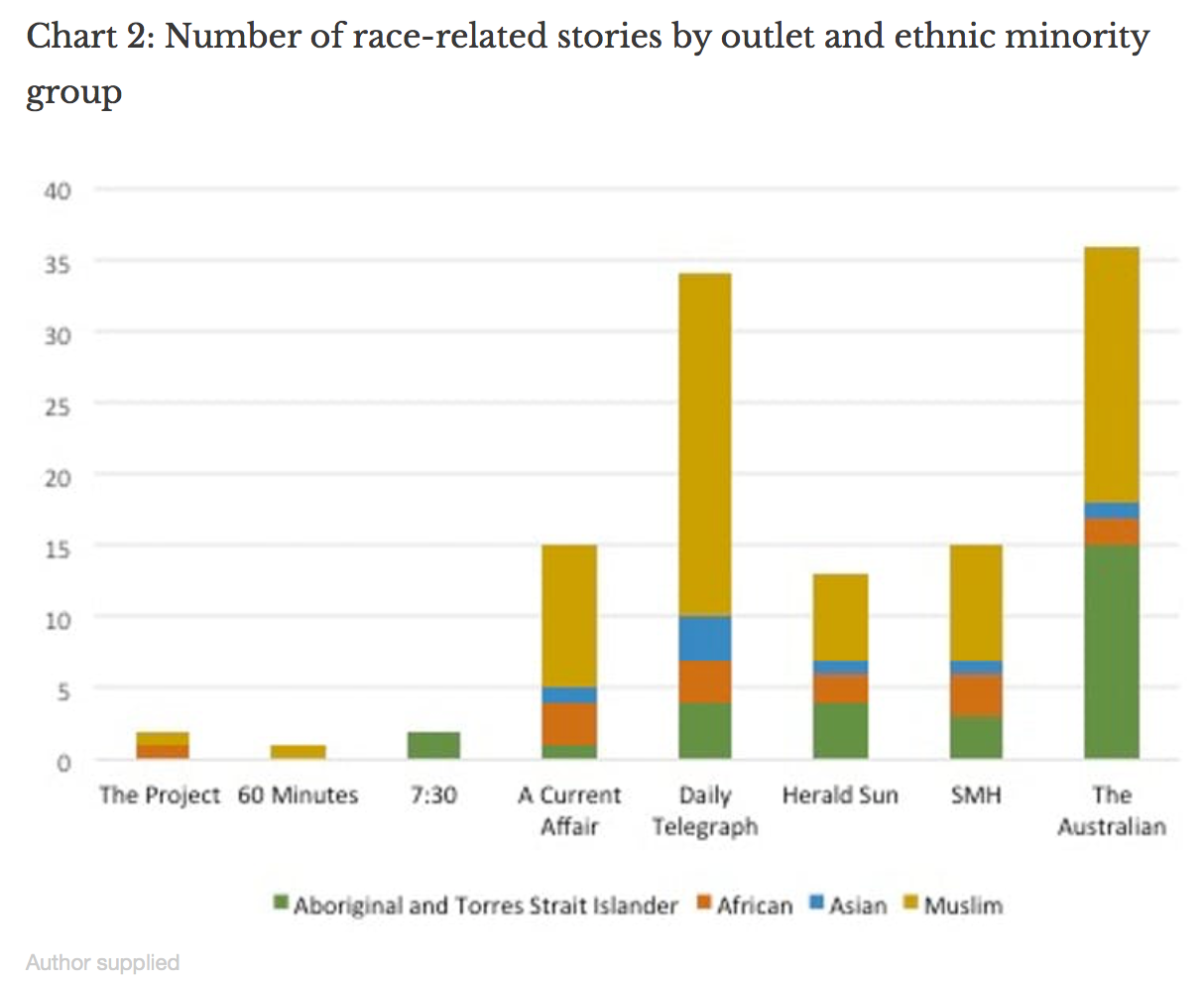
Muslims were mentioned in more than half of the opinion pieces, and more than twice as many times as any other single group mentioned (see chart 2).

Muslims were portrayed more negatively than the other minority groups (see chart 3), with 63% of reports about Muslims framed negatively. These pieces often conflated Muslims with terrorism. For example, reports used terrorist attacks in the UK to question accepting Muslim refugees and immigrants to Australia.

This was a recurring theme in race-based opinion pieces over the study period. In contrast, there were more positive than negative stories about Aboriginal Australians and Torres Strait Islanders.

Negative commentary about minority groups has lasting impacts in the community. An op-ed in the New York Times recently highlighted the impact that racism in the media has on individuals. It explained:

…racism doesn’t have to be experienced in person to affect our health — taking it in the form of news coverage is likely to have similar effects.
The noted effects include elevated blood pressure, long after television scenes are over. Racism is literally making us sick.

Note also that given the lack of cultural diversity among opinion-makers, particularly on television, social commentators are largely talking about groups to which they do not belong. According to the 2016-20 PwC Media Outlook report, the average media employee is 27, Caucasian and male, which does not reflect the current population diversity of Australia.

This creates a strong argument for increasing the cultural diversity of all media agencies to help minimise the number of individuals or groups being negatively depicted in race-related reports.

via Racist reporting still rife in Australian media

Professors owe their graduate students more than what Lindsay Shepherd got: Clifford Orwin

One of my better former professors on the Shepherd case:

With the stunning revelation that there never were student complainants against teaching assistant Lindsay Shepherd – not even one – the reputation of Wilfrid Laurier University should hit rock bottom. Ms. Shepherd’s hectorers were lying to her, like cops trying to extract a confession from a suspect, and they knew they were lying to her.

Rather than complainants, there were merely students overheard discussing Ms. Shepherd’s class. Isn’t that what is supposed to happen at a university, students discussing their courses (hopefully with some animation)? Even taking strong stances pro and con about the teachers and their presentations? My dream of the perfect end to one of my lectures would be a vast crescendo of buzz, indicating that the students will carry the discussion far beyond the lecture hall. If that was Ms. Shepherd’s effect on her students, then some Canadian university should snap her up. One doubts that it will be Laurier.

That there were no student complainants is, as far as it goes, encouraging. Yes, there’s this culture of outrage on our campuses, and the multiplication of groups dedicated to squelching those who offend them. But only a tiny minority of students believes that to disagree with them is an affront (or even a threat) to them. Most are grateful to teachers who introduce them to opinions other than their own. They recognize this as an integral (even the most important) part of a true education. I’ve been disagreeing with students for 43 years now, and they have thanked me for it.

To confront Ms. Shepherd with these phantom complainants was indefensible. You hear a lot about vulnerable groups on campus; you can count graduate students among them. Begin with their material problems: They are faced with a declining job market and the rising costs of education.

This economic reality aggravates the predicament of graduate students in other ways, including their dependence on the opinions of their supervisors. The temptation is to play it safe in the hopes that the jobs will go to those who have done so. (This, too, was an anxiety on which Ms. Shepherd’s supervisors were playing: conform or find yourself professionally toxic.)

In these difficult times, professors are called more than ever to perform their duty of mentorship. Whether in supervising students’ theses or their teaching, we must put their intellectual development first.

In the case of teaching, that means both modelling best practices on the one hand and encouraging our teaching assistants (TAs) to find their own voices on the other. Here Ms. Shepherd’s teachers set bad examples in both regards. They sought to crush her budding intellectual and pedagogical independence; attempted to coerce her into agreement with them concerning both the substance and the methods of their course; banned her from bringing further videos into her classroom and required her to submit all future teaching materials for their prior review. This was an object lesson in how not to treat a graduate student. Did it not occur to them that a TA as engaged and lively as Ms. Shepherd was a blessing to their program?

Every large university course is a collaboration between the lecturer and the teaching assistants. Of course there must be co-ordination, and the TAs must avoid contradicting the lecturer in ways that might confuse the students. But the success of any large course depends on the TAs’ contribution as much as on the lecturer’s. That contribution should not be micromanaged. The lecturer should offer them advice where they solicit it, leave them to spread their wings where they don’t. Should an issue arise between a student and a TA, then of course I must look into it. Otherwise, the lectures are mine, the tutorials are theirs. The course will succeed only if they buy into this arrangement. If I treat them like Lindsay Shepherd was treated, they won’t.

via Professors owe their graduate students more than what Lindsay Shepherd got – The Globe and Mail

Diversity must be the driver of artificial intelligence: Kriti Sharma

Agree. Those creating the algorithms and related technology need to be both more diverse and more mindful of the assumptions baked into their analysis and work:

The question over what to do about biases and inequalities in the technology industry is not a new one. The number of women working in science, technology, engineering and mathematics (STEM) fields has always been disproportionately less than men. What may be more perplexing is, why is it getting worse?

It’s 2017, and yet according to the American Association of University Women (AAUW) in a review of more than 380 studies from academic journals, corporations, and government sources, there is a major employment gap for women in computing and engineering.

North America, as home to leading centres of innovation and technology, is one of the worst offenders. A report from the Equal Employment Opportunity Commission (EEOC) found “the high-tech industry employed far fewer African-Americans, Hispanics, and women, relative to Caucasians, Asian-Americans, and men.”

However, as an executive working on the front line of technology, focusing specifically on artificial intelligence (AI), I’m one of many hoping to turn the tables.

This issue isn’t only confined to new product innovation. It’s also apparent in other aspects of the technology ecosystem – including venture capital. As The Globe highlighted, Ontario-based MaRS Data Catalyst published research on women’s participation in venture capital and found that “only 12.5 per cent of investment roles at VC firms were held by women. It could find just eight women who were partners in those firms, compared with 93 male partners.”

The Canadian government, for its part, is trying to address this issue head on and at all levels. Two years ago, Prime Minister Justin Trudeau campaigned on, and then fulfilled, the promise of having a cabinet with an equal ratio of women to men – a first in Canada’s history. When asked about the outcome from this decision at the recent Fortune Most Powerful Women Summit, he said, “It has led to a better level of decision-making than we could ever have imagined.”

Despite this push, disparities in developed countries like Canada are still apparent where “women earn 11 per cent less than men in comparable positions within a year of completing a PhD in a science, technology, engineering or mathematics, according to an analysis of 1,200 U.S. grads.”

AI is the creation of intelligent machines that think and learn like humans. Every time Google predicts your search, when you use Alexa or Siri, or your iPhone predicts your next word in a text message – that’s AI in action.

Many in the industry, myself included, strongly believe that AI should reflect the diversity of its users, and are working to minimize biases found in AI solutions. This should drive more impartial human interactions with technology (and with each other) to combat things like bias in the workplace.

The democratization of technology we are experiencing with AI is great. It’s helping to reduce time-to-market, it’s deepening the talent pool, and it’s helping businesses of all size cost-effectively gain access to the most modern of technology. The challenge is there are a few large organizations currently developing the AI fundamentals that all businesses can use. Considering this, we must take a step back and ensure the work happening is ethical.

AI is like a great big mirror. It reflects what it sees. And currently, the groups designing AI are not as diverse as we need them to be. While AI has the potential to bring services to everyone that are currently only available to some, we need to make sure we’re moving ahead in a way that reflects our purpose – to achieve diversity and equality. AI can be greatly influenced by human-designed choices, so we must be aware of the humans behind the technology curating it.

At a point when AI is poised to revolutionize our lives, the tech community has a responsibility to develop AI that is accountable and fit for purpose. For this reason, Sage created Five Core Principles to developing AI for business.

At the end of the day, AI’s biggest problem is a social one – not a technology one. But through diversity in its creation, AI will enable better-informed conversations between businesses and their customers.

If we can train humans to treat software better, hopefully, this will drive humans to treat humans better.

via Diversity must be the driver of artificial intelligence – The Globe and Mail

Haitian asylum seekers are about to test Canada’s refugee system in a big way – Macleans.ca

Test for the government in terms of public confidence in the immigration system and the degree to which its outreach and other efforts, particularly in dealing with claims expeditiously, succeed in reducing the flow:

A sixth borough of New York City might just exist; it could be a realm called Limbo. Twenty thousand Haitians live throughout other neighbourhoods but in a state of temporariness, waiting every couple of years to see if the federal government will allow them to renew their temporary protective status—and stay in the United States—for a processing fee of US$495 per person.

In subway stations, a Brooklyn advocate named Herold Dasque distributes flyers asking New Yorkers to lobby government officials to extend the Haitian status America-wide, at least one more time. “You will have 50,000 Haitians who will try to go in hiding,” says Dasque about the consequences of terminating the designation. “They will not go to work, not go to church,” he says. “You don’t go outside.”

Dasque’s campaign didn’t sway the Department of Homeland Security. It announced in late November that it will end the temporary protective status for Haiti, though it will delay deportations until July 2019.

Since the U.S. first warned in May 2017 that it might end the protected status, thousands of asylum seekers, many of them Haitian, have headed for Canada. In 2018, even more are expected to follow, adding pressure to an already backlogged refugee processing system.

Canadian members of Parliament have already begun meeting face-to-face with Haitians and officials in New York, as well as in Florida, attempting to end illegal crossings into Canada—17,000 asylum claimants from around the world were intercepted by the RCMP this year.

Among the recipient cities and towns, Montreal converted its Olympic Stadium into an emergency shelter in August, and about two weeks before that the Canadian Forces set up tents in Cornwall, Ont. As Canada attempts to warn asylum seekers against going with the flow, 2018 may be the year Canada flips its metaphorical welcome mat.

“They have to be aware of the robust immigration law we have in Canada,” says MP Emmanuel Dubourg, a Quebecois Liberal who was born in Saint-Marc, Haiti, and moved to Canada at age 14. He recently travelled to New York where he spoke with city hall officials, held meetings at the Canadian consulate and did an interview with Radio Soleil, the local Haitian radio station. “The goal, it’s to inform them, to tell them what the consequences are if they cross the border illegally.” Canada welcomes immigrants, he tells them, but “it’s not a free ticket to cross the border like this.”

“I don’t even think people would go to that meeting,” says Jeffry House, a human rights lawyer in Toronto, about Ottawa’s outreach efforts. “The number of illegal people who would go to a library to hear some MPs talk about why it’s not a good idea to come—it doesn’t strike me as a crowd-pleaser.” In Montreal, Warren Creates, an immigration and refugee lawyer, also says the delegation won’t reverse the trend. “It’s not going to stop it; it’s not going to stem it; it’s not going to mitigate it,” says Creates. “They’re wise, these communities of people who are fearful. They’ve figured out where they need to go. They’ve figured out the path of least resistance.”

While the number of illegal border migrants is still relatively small, Canada’s refugee system is not equipped to process them. The Immigration and Refugee Board of Canada (IRB) predicts that if its backlog grows as anticipated, claimants arriving in 2021 could wait 11 years for hearings. Between February and October, 6,304 Haitian refugee claims were referred to the IRB and just 298 cases were concluded.

Creates says most migrants won’t start presenting themselves at ports of entry, aware they’d be turned away at those sites due to the Safe Third Country Agreement, which allows Canada to turn back an asylum seeker coming from the U.S. who fails to make a claim first in that country, but only if he or she arrives at an official port of entry. “What worries me most is that in darkness, and storms and winter months, people ill-equipped and not properly clothed . . . they’re being forced into a procedure that they know will allow them entry into Canada and have this fair chance, but at the same time they’re risking their health and their lives.”

The delegation to New York, Creates says, only embellishes the Liberal image of taking action. Haitians will not agree to present themselves at official border crossings, as they are not travelling for business or pleasure, but rather for a home more certain than Limbo.

via Haitian asylum seekers are about to test Canada’s refugee system in a big way – Macleans.ca

Trump may have emboldened hate in Canada, but it was already here: Ryan Scrivens

Good overview by Scrivens:

A key turning point, in fact, was during the latter months of 2015. Two important events created a perfect storm for the movement.

First was Justin Trudeau’s pledge, as part of the Liberal party’s election platform, to welcome 25,000 Syrian refugees to Canada by the end of 2015. The second was the terrorist attack on concert-goers in Paris, inspired by the so-called “Islamic State,” on Nov. 13, 2015.

Each of these events were distinct in nature, yet Canada’s radical right wing treated them as interconnected, arguing that Canada’s newly elected prime minister was not only allowing Muslims into the country who would impose Sharia law on Canadian citizens, but that they too could be “radical Islamic terrorists.”

It all sparked a flurry of anti-Muslim discourse in Canada.

The day after the Paris attack, a mosque in Peterborough, Ont., was deliberately set ablaze, causing significant damage to the interior of the building.

The next day, a Muslim woman picking up her children from a Toronto school was robbed and her hijab torn off. The perpetrators called her a “terrorist” and told her to “go back to your country.”

Days later, an anti-Muslim video was posted on YouTube in which a man from Montreal, wearing a Joker mask and wielding a firearm, threatened to kill one Muslim or Arab each week.

Similar events continued to unfold in 2016 — all, of course, well before Trump’s election victory. A school in Calgary, for example, was spray-painted with hate messages against Syrians and Trudeau: “Syrians go home and die” and “Kill the traitor Trudeau.”

Edmonton residents were also faced with a series of anti-Islamic flyer campaigns, hateful messages were spray-painted on a Muslim elementary school in Ottawa and man in Abbotsford, B.C. went on a racist tirade and was caught on video.

Canadian chapters of Soldiers of Odin first made their presence known in the early part of 2016 by patrolling communities and “protecting” Canadians from the threat of Islam, and the Patriotic Europeans Against the Islamization of the West (PEGIDA), an anti-Islam group who first appeared in Canada in 2015, continued to rally in Montreal and Toronto in 2016.

And so it would be impulsive and short-sighted for us to attribute our spike in hatred solely to Trump and his divisive politics.

Instead, the instances listed above serve as an important reminder that prior to Trump’s election victory Canada was experiencing a rise in hatred.

In responding to hatred in Canada, we must first acknowledge that it exists in Canada, and it becomes ever more present during times of social and economic uncertainty. We must also acknowledge that the foundations of hatred are complex and multi-faceted, grounded in both individual and social conditions.

So too, then, must counter-extremist initiatives be multi-dimensional, building on the strengths and expertise of diverse sectors, including but not limited to community organizations, police officers, policy-makers and the media. Multi-agency efforts are needed to coordinate the acknowledgement and response to right-wing extremism in Canada.

I see signs of us moving in the right direction in building resilience against hatred in Canada. But in the months and years ahead, there’s still much to do.

via Trump may have emboldened hate in Canada, but it was already here

Refugees should be sent home even if they have jobs, says Danish immigration official | The Independent

Another example of xenophobia and “othering,” despite labour shortages:

A Danish MP has called for all refugees, even those with jobs, to be deported from the country once their home nations are deemed “safe”.

Marcus Knuth, an immigration spokesman for the governing Liberal (Venstre) party, said all people who have been granted asylum in Denmark should be made to go back to their country of origin regardless of whether they had already assimilated into Danish life.

The government, which is minority controlled by the Liberals with support from the Danish People’s Party, Liberal Alliance and the Conservative People’s Party, is currently negotiating what is being called a “paradigm change” in the country’s attitude to asylum.

The rule change is being demanded by the nationalist Danish People’s Party in return for supporting tax cuts. The new rules would see refugees granted temporary asylum, meaning they will be ordered to go back to their home country when the danger had past and are denied the right to family reunification.

These refugees will also be barred from accessing integration services such as language lessons and the “basic integration education programme” – an apprenticeship scheme introduced last year, The Local reported.

A similar scheme was introduced in Germany last year following a backlash against Chancellor Angela Merkel’s open door policy to refugees fearing violence in Iraq and Syria.

Over 1 million refugees arrived in Germany in 2016.

But the new rules are likely to create a big hole in the Danish jobs market as the arrival of refugees has made up for a reported decline in the number of people coming to the country from eastern Europe.

A report by the Danish newspaper Berlingske said that workers from outside the EU made up a larger share of foreign workers than EU citizens for the first time.

Meanwhile the Confederation of Danish Industry has repeatedly stressed the difficulty its members have had in filling its jobs – which it said was largely to do with the falling number of people arriving in the country to work.

Figures released by the body in November showed that the number of EU citizens coming to Denmark to work has fallen by 65 percent in the space of 15 months.

According to their analysis EU citizens took just 11 per cent of newly created jobs in Denmark in 2017 – compared with 87 per cent in 2013.

But Mr Knuth is adamant that “overall refugees are an economic burden for Denmark”.

He said: “The number of refugees on the labour market is fortunately increasing. But at the same time, they do not make up a big part of the jobs market”.

“If refugees can make a contribution, that can only be positive. But that does not change the fact that, as soon as there is peace in their home country, that have to go back”.

via Refugees should be sent home even if they have jobs, says Danish immigration official | The Independent

Hungary Citizenship Plan Reaches 1 Million Mark in Orban Boost – Bloomberg

Electoral strategy:

Hungary’s program to extend citizenship to ethnic kin who are nationals of other countries reached the 1 million mark, boosting Prime Minister Viktor Orban’s already strong chances for re-election next year.

The millionth citizenship under the program, one of the first laws approved by parliament after Orban returned to power in 2010, was awarded to a 36-year-old ethnic Hungarian farmer in Serbia, President Janos Ader said at a ceremony in Budapest over the weekend that Orban also attended.

Ethnic Hungarians living abroad, most of them in areas of neighboring countries that were cut off from Hungary after World War I, overwhelmingly backed Orban in the 2014 parliamentary elections, when more than 95 percent of almost 130,000 of those votes were for the premier’s Fidesz party. Fidesz has a wide lead in all opinion polls over a fragmented opposition ahead of elections next year, where Orban is looking to further consolidate the first “illiberal state” in the European Union, modeled on Russia and Turkey. Orban has said he expects elections to take place in April.

Unlike hundreds of thousands of Hungarians who’ve moved West, ethnic kin living abroad who’ve received citizenship can cast ballots by mail, a recurring criticism for opposition parties who say the rule is discriminatory. At the same time, ethnic kin living abroad get only one vote — for party list — versus two votes for others who also get to pick the candidate for their electoral district to represent them in parliament.

In 2014, 8.2 million Hungarians were eligible to vote, including almost 194,000 ethnic Hungarians living abroad, according to the website of the National Election Office.

via Hungary Citizenship Plan Reaches 1 Million Mark in Orban Boost – Bloomberg

German anti-Semitism commissioner idea backed by Interior Minister Thomas de Maiziere | DW

Ongoing concern:

Germany’s interior minister has joined the chorus of politicians expressing concern over the burning of Israeli flags in Berlin. Germany’s Central Council of Jews has been calling for an anti-Semitism commissioner.

Acting Interior Minister Thomas de Maiziere said in an interview with German national newspaper Bild am Sonntag that he supports creating the position of anti-Semitism commissioner in the next German government.

The conservative De Maiziere said his support for the commissioner went beyond the most recent incidents — in which Berlin protesters burned Israeli flags to demonstrate against US President Donald Trump’s decision to recognize Jerusalem as Israel’s capital — and was also based on the recommendation of an independent commission of experts.

Germany’s Central Council of Jews has also called repeatedly for an anti-Semitism commissioner to be part of the chancellor’s office.

In the interview, de Maiziere expressed his concern over the increase in anti-Semitic agitation in Germany.

“Each crime motivated by anti-Semitism is one to many and shameful for our country,” he told the paper. He also said that occurrences of derogatory comments, inappropriate jokes and discrimination towards “our fellow Jewish citizens” were on the rise.

“Hatred towards Jews must never be allowed to take hold again in Germany,” he added, alluding to Germany’s historic responsibility for the Holocaust, in which 6 million Jews were killed.

His words on the subject of anti-Semitism were the latest to emerge from a German politician in the aftermath of protests in front of the US Embassy in central Berlin and in the immigrant-heavy Neukölln neighborhood.

The minister spoke out in favor of cracking down on protesters’ actions that demonstrate a hatred of Israel, including through police action when possible.

“We cannot tolerate it when a country’s flag is burned in public,” he said. “It is the symbolic annihilation of a country’s right to exist.”

Current German law makes it illegal to burn flags and symbols of a foreign state that have been officially installed. Burning homemade or non-official flags is not a crime, though incitement to violence against Jews is.

De Maiziere said that he found the burning of homemade flags comparable to burning official ones. “I consider the burning of imitation flags to also be a disruption of public security and order.”

De Maiziere’s fellow Christian Democratic (CDU) politician and acting Chancellor Angela Merkel also has denounced the burning of Israeli symbols.

via German anti-Semitism commissioner idea backed by Interior Minister Thomas de Maiziere | News | DW | 17.12.2017

The White House Is Seeking a Major Shift of Opinion on Immigration

Moving towards the Canadian and Australian models given priority to the economic class with, of course, falsehoods regarding the percentage of immigrants in jailed (less than non-immigrants) and exaggerations regarding links to terror:

The White House is embarking on a major campaign to turn public opinion against the nation’s largely family-based immigration system ahead of an all-out push next year to move toward a more merit-based structure.

The administration was laying the groundwork for such a drive even before an Islamic State-inspired extremist who was born in Bangladesh tried to blow himself up in Midtown Manhattan on Monday. It is assembling data to bolster the argument that the current legal immigration system is not only ill-conceived, but dangerous and damaging to U.S. workers.

“We believe that data drives policy, and this data will help drive votes for comprehensive immigration reform in Congress,” said White House spokesman Hogan Gidley.

White House officials outlined their strategy this week exclusively to The Associated Press, and said the data demonstrates that changes are needed immediately. But their effort will play out in a difficult political climate, as even Republicans in Congress are leery of engaging in a major immigration debate ahead of the 2018 midterm elections.

The issue is expected to be prominently featured in the president’s Jan. 30 State of the Union address. The White House also plans other statements by the president, appearances by Cabinet officials and a push to stress the issue in conservative media.

The administration was beginning its campaign Thursday with a blog post stressing key numbers: Department of Homeland Security data that shows nearly 9.3 million of the roughly 13 million total immigrants to the U.S. from 2005 to 2016 were following family members already in the United States. And just one in 15 immigrants admitted in the last decade by green card entered the country because of their skills.

Other planned releases: a report highlighting the number of immigrants in U.S. jails, assessments of the immigration court backlog and delays in processing asylum cases, and a paper on what the administration says is a nexus between immigration and terrorism.

Critics have questioned the administration’s selective use of sometimes misleading data in the past.

The proposed move away from family-based immigration would represent the most radical change to the U.S. immigration system in 30 years. It would end what critics and the White House refer to as “chain migration,” in which immigrants are allowed to bring a chain of family members to the country, and replace it with a points-based system that favors education and job potential — “merit” measures that have increasingly been embraced by some other countries, including Britain.

Gidley said that for those looking to make the case that the U.S. is ill-served by the current system, “transparency is their best friend.”

“The more people know the real numbers, the more they’ll begin to understand that this is bad for American workers and this is bad for American security. And quite frankly, when these numbers come out in totality, we believe it’s going to be virtually impossible for Congress to ignore,” he said.

The public is sharply divided on the types of changes President Donald Trump is advocating.

A Quinnipiac University poll in August found that 48% of voters opposed a proposal that Trump has backed to cut the number of future legal immigrants in half and give priority to immigrants with job skills rather than those with family ties in this country. 44% of those polled — including 68% of Republicans — supported the idea.

The White House hopes to see Congress begin to take up the issue early in 2018 — though it has yet to begin discussions with congressional leaders over even the broad strokes of a legislative strategy, officials said.

Trump has laid out general principles for what he would like to see in an immigration bill in exchange for giving legal status to more than 700,000 young people brought to the U.S. illegally as children. These include the construction of a border wall, tougher enforcement measures and moving to a more merit-based legal immigration system. In September, Trump gave Congress six months to come up with a legislative fix to allow the young immigrants known as “Dreamers” to stay in the country, creating an early-2018 crisis point he hopes will force Democrats to swallow some of his hardline demands.

Source: The White House Is Seeking a Major Shift of Opinion on Immigration

India cabinet backs bill to criminalise Islamic instant divorce – BBC

Welcome. However, enforcement will likely be a challenge:

The Indian cabinet has backed a bill that will make the Islamic practice of instant divorce a criminal offence.

The bill proposes jail of up to three years for a Muslim man who indulges in the controversial practice.

The government hopes to get the bill passed by parliament in the winter session, which began on Friday.

In a major victory for women’s rights activists, the Supreme Court outlawed the “triple talaq” practice in August and called it “un-Islamic”.

India is one of a handful of countries where a Muslim man can divorce his wife in minutes by saying the word talaq (divorce) three times.

Muslim women and rights groups have been campaigning for years against the custom.

Campaigners have described it as humiliating and discriminatory.

The bill, called the Muslim Women (Protection of Rights on Marriage) Bill, has been drafted by a group of ministers, led by Home Minister Rajnath Singh.

The Indian government, led by the Hindu nationalist Bharatiya Janata Party (BJP), has supported ending the practice.

Prime Minister Narendra Modi has brought up the issue several times, including in his Independence Day address on 15 August.

What is instant divorce?

There have been cases in which Muslim men in India have divorced their wives by issuing the so-called triple talaq by letter, telephone and, increasingly, by text message, WhatsApp and Skype. A number of these cases made their way to the courts as women contested the custom.

Triple talaq divorce has no mention in Sharia Islamic law or the Koran, even though the practice has existed for decades.

Islamic scholars say the Koran clearly spells out how to issue a divorce – it has to be spread over three months, allowing a couple time for reflection and reconciliation.

Most Islamic countries, including Pakistan and Bangladesh, have banned triple talaq, but the custom has continued in India, which does not have a uniform set of laws on marriage and divorce that apply to every citizen.

Via: http://www.bbc.com/news/world-asia-india-42366461