The Rise of the Resentniks: And the populist war on excellence.

Interesting take by Brooks. Always felt there was an element of resentment in Canadian conservative attacks on elites, and the exaggerated distinctions between the “anywheres” and “somewheres”:

There’s a powerful moment at the start of Anne Applebaum’s recent essay in The Atlantic. She’s recalling a party she threw on Dec. 31, 1999, at her home in Poland. Many of the hundred-odd guests were Polish, but others flew in from around the world for a weekend together, to greet the new millennium.

Most of the guests were conservatives — which in those days meant being anti-Communist and pro-market, but also believing in international alliances like NATO. The party was a great success, lasted all night and continued into brunch the following day. Everybody felt a part of the same team.

“Nearly two decades later,” Applebaum writes, “I would now cross the street to avoid some of the people who were at my New Year’s Eve party.” She estimates that half the people at that party are no longer on speaking terms with the other half.

For example, in recent years Applebaum has not had a single conversation with a woman who was once one of her closest friends and is godmother to one of her children. She tried to reach out to this woman and suggested they get together, but the woman refused. “What would we talk about?” she texted.

Those of us who came of age in conservative circles know exactly what Applebaum is talking about. The same kinds of rifts have opened up among conservatives around the world, in Britain, Italy, Germany and the U.S.

Some conservatives stayed on the political trajectory they were on in 1999. Others embraced populist nativism. They wandered into territory that is xenophobic, anti-Semitic, authoritarian. Still others were driven leftward by the reactionary revival.

What happened? This is the story I would tell.

During the Cold War, being a conservative was a moral cause. You were fighting Communist tyranny — aligned with Aleksandr Solzhenitsyn and Lech Walesa. But you were somewhat marginalized in your own society. Liberals controlled the universities, the news media, the cultural high ground, so the right attracted many people with outsider personalities.

Then with the election of Reagan and Thatcher and in the years afterward, conservatives built their own counter-establishment — think tanks, publications, broadcasting outlets. As conservatism professionalized, it despiritualized. After the Soviet Union collapsed, conservatism no longer had a great moral cause to rally around. It became a technocratic, economics-focused movement concerned with small government and entitlement reform. Compassionate conservatism and the dream of spreading global democracy were efforts to anchor conservatism around a moral ideal, but they did not work out.

Many conservatives simply could not succeed in the new conservative counterestablishment. In any meritocracy, there are going to be a lot of people who lose out and do not get the glittering career they think they are due. Sooner or later those people are going to rise up to challenge the competition itself and to question its idea of excellence. “Resentment, envy, and above all the belief that the ‘system’ is unfair — these are important sentiments among the intellectuals of the Polish right,” Applebaum writes.

At the same time, they resent how spiritually flat conservatism has become. “The principles of competition, even when they encourage talent and create upward mobility, don’t necessarily answer deeper questions about national identity, or satisfy the human desire to belong to a moral community,” Applebaum continues.

In such a situation, you’re almost bound to get a return of blood-and-soil nationalism. The losers in the meritocratic competition, the permanent outsiders, seize on ethnic nationalism to give themselves a sense of belonging, to explain their failures, to rally the masses and to upend the meritocracy.

In office, what the populist nationalists do is this: They replace the idea of excellence with the idea of “patriotism.” Loyalty to the tribe is more important than professional competence. In fact, a person’s very lack of creativity and talent becomes proof of his continued reliability to the cause, as we’ve seen in the continued fealty to King Trump.

While there is a sprinkling of good professionals in the Trump administration, they are there by accident, not by intent. Many of those staffing the White House could not get a job in any normal Republican administration, which selected people according to any traditional criteria of excellence.

And now, as Trump reshuffles his administration yet again, we see the remnants of the B and C teams replaced by members of the D team. Over the past few days, there’s been a lot of gossip over whether Acting Attorney General Matthew Whitaker will keep his job. But it almost doesn’t matter, because from here on out, it’s Whitakers all the way down.

If conservatism is ever to recover it has to achieve two large tasks. First, it has to find a moral purpose large enough to displace the lure of blood-and-soil nationalism. Second, it has to restore standards of professional competence and reassert the importance of experience, integrity and political craftsmanship. When you take away excellence and integrity, loyalty to the great leader is the only currency that remains.

USA: Blacks Are Twice as Likely as Whites to Experience Sudden Cardiac Death

Striking. Both the fact and lack of explanations:

The rate of sudden cardiac death in African-Americans is twice as high as in whites, and no one knows why.

Sudden cardiac death is an unexpected fatality from cardiac causes that happens within an hour of the onset of symptoms, usually with no known cause.

For more than six years, researchers followed 9,416 blacks and 13,091 whites who had no history of cardiovascular disease. Over the period, 67 whites and 107 blacks died suddenly with heart symptoms. The study is in the Journal of the American College of Cardiology.

The researchers controlled for education, physical activity, depression, cholesterol and other factors. Blacks tended to have lower incomes, were less likely to be insured and had higher rates of smoking, diabetes and high blood pressure. But even after accounting for these differences, they found that the risk for sudden cardiac death was still 97 percent higher in blacks than in whites.

The lead author, Dr. Rajat Deo, an associate professor of medicine at the University of Pennsylvania Perelman School of Medicine, said that there could be variables they were unable to rule out, or unknown genetic factors that predispose blacks to heart rhythm disorders.

In any case, he said, “Over the last two decades, we’ve seen a reduction in heart attacks and stroke, but we haven’t seen the same kind of reduction in sudden cardiac death. I think more work needs to be done.”

Ahead of a federal election, what road will Conservatives take on immigration?

The latest by Michael Adams. See my earlier take on Conservative immigration critic Michelle Rempel on her positioning (Conservative immigration critique of the levels plan):

On the surface, the contrast between Canada and the United States on immigration is sharp. U.S. President Donald Trump was recently warning of an “invasion” by a group of migrants crossing Mexico on foot, even going so far as to send troops to the border in a theatrical flourish just ahead of the mid-term elections.

Around the same time, Canada’s Prime Minister was apologizing for this country’s refusal to accept the 907 German Jewish refugees aboard the MS St. Louis who sought safety in Canada in 1939. Justin Trudeau drew parallels to our own time – noting refugees are still on the move around the globe and the resurgent anti-Semitism evidenced by the recent mass shooting in Pittsburgh.

But despite the Prime Minister’s humanitarian gestures – and the fact that the Immigration Minister is touring the country making the case for higher immigration levels and a compassionate asylum policy – there is certainly an appetite in Canada for a thicker border and a more hard-line approach to immigrants and refugees. Responding to that appetite is something politicians who wish to court those voters will need to do carefully.

There was a time when those who question the fundamentals of Canada’s approach to immigration, multiculturalism and refugees were spread across all political parties. Over the past 20 years, research indicates that this constituency has become concentrated in the Conservative Party. These voters are not the majority of the Conservative Party, but they’ve been gravitating in that direction for a number of years.

For most of his time in government, former prime minster Stephen Harper resisted the temptation to court xenophobic feeling on the political right; instead, he built a Conservative majority in part by courting the newcomers and settled immigrant communities in Canadian suburbs. He also cultivated an increasingly diverse caucus and cabinet. In 2015, a pivot to more xenophobic messaging, including the introduction of the “barbaric cultural practices” snitch line promoted by ministers Kellie Leitch and Chris Alexander, proved the wisdom of his earlier approach: The divisive gambit backfired and helped fuel a Liberal majority.

As the Conservatives prepare for the next federal election, they are in a tight spot. They can’t win government – and certainly not a majority – without appealing to new Canadians who are the key to winning ridings in the suburbs of large Canadian cities. At the same time, they need to appear in touch with voters who are having second thoughts about Canada’s current policies and practices on immigration, refugees and multiculturalism. Our data indicate that Canadians who are most likely to question the status quo on migration-related issues are concentrated in Alberta and Saskatchewan, where Conservatives rely on racking up plenty of seats. Attracting these two groups simultaneously will be a tricky task.

Conservative Leader Andrew Scheer will probably remember the lessons of 2015 – but he’ll also feel Maxime Bernier breathing down his neck. The platform of Mr. Bernier’s breakaway People’s Party proposes immigration levels substantially lower than those currently in place and opposes the use of immigration “as a tool to forcibly change the cultural character and social fabric of Canada.” Virtually every vote Mr. Bernier wins with these policy ideas will be a vote that’s siphoned away from Mr. Scheer’s Conservatives – a threat that is especially acute in the Quebec City area and in rural Quebec, where the CAQ did so well in the recent provincial election.

Many commentators have wondered whether the blatant racism and xenophobia advanced by far-right candidates in Europe and now the United States will take hold in Canada, where no major political party in recent decades has adopted strongly anti-immigrant policies or rhetoric. Could it happen here?

With the emergence of Mr. Bernier’s party and the success of the CAQ, some variation is here today. The question is whether Canada’s case of xenophobic populism will be a mild one that inoculates us against a more virulent strain, or whether it will take hold and change the norms of our political culture in a deeper way.

To some extent, this will be up to Mr. Scheer himself: Will he compete with Mr. Bernier for anti-immigration votes and expand the issue’s place in our political discourse? Or will he follow the model of the early Harper years, when the Conservatives used pocketbook issues and selected socially conservative messages to connect with new Canadians?

His answer will affect his party’s fortunes – and likely have a powerful effect on Canadian political culture for years to come.

Source: Ahead of a federal election, what road will Conservatives take on immigration?: Michael Adams

Amazon’s Algorithm Has an Anti-Semitism Problem

As we are also seeing in the ongoing Facebook scandals, tech hasn’t managed to include ethical and moral considerations in its business models and algorithms:

In the wake of the Pittsburgh massacre, I invited my followers on Twitter to send me their inquiries about anti-Semitism. The response was overwhelming, and ran the gamut from questions about specific aspects of the prejudice to requests for advice on how to help fight it. One reader asked for more information about the Rothschild family, the Jewish banking dynasty that is a favorite bogeyman of anti-Semites and is typically used as a stand-in for the Jewish conspiracy that purportedly controls world affairs. He explained that some in his circle of friends regularly make bigoted remarks about the Rothschilds and their vast power and he wanted to set them straight. I’d written a report about the Rothschilds in school years ago, but figured there was probably better, more up-to-date material out there. So like anyone else, I went to Amazon.com and plugged in “history of rothschilds.” To my surprise, this is what I got:

amazonrothschilds
Rather than direct me to serious scholarship on the Rothschilds, like historian Niall Ferguson’s multivolume history on the family, Amazon first recommended blatantly bigoted content.

This isn’t the only instance of Amazon’s algorithm feeding intellectually bankrupt content to intellectually curious readers regarding fraught subjects. A search for “who did 9/11” yields this book as the #1 search result:

amazon911

As the book’s own blurb notes, its author, Nick Kollerstrom, is a “longtime member of Britain’s 9/11 truth group.” Among other conspiracies, the book contains an entire chapter entitled “9/11 and Zion” which blames the attack on the Jews. (Kollerstrom also happens to be a Holocaust denier who infamously declared, “Let us hope the schoolchildren visitors are properly taught about the elegant swimming pool at Auschwitz, built by the inmates, who would sunbathe there on Saturday and Sunday afternoons while watching the water polo matches.”)

Similarly, if one searches for “Jews and the slave trade,” the second, fourth, and fifth results are not scholarship on the subject, but notoriously anti-Semitic publications from Louis Farrakhan’s Nation of Islam. Farrakhan has worked for years to mainstream the baseless anti-Semitic conspiracy theory that Jews were behind the African slave trade.

(All searches above were done logged out from Amazon while incognito on Chrome, to ensure that the search results were the default ones, and not influenced by the specific user or their past search history.)

This isn’t Amazon’s first run-in with anti-Semitism concerns. Back in 2000, the company came under fire for stocking The Protocols of the Elders of Zion, one of the most influential anti-Semitic tracts in history. At the time, while firmly distancing itself from the bigoted content, Amazon insisted that it would not remove it from the catalog, because the company does not censor books. Today, copies of The Protocols on Amazon carry a cautionary message from the Anti-Defamation League and the following disclaimer from the company:

As a bookseller, Amazon strongly believes that providing open access to written speech, no matter how hateful or ugly, is one of the most important things we do. And because we think the best remedy for offensive speech is more speech, we also make available to readers the ability to make their own voices heard and express their views about this and all our titles in reviews and ratings.

It’s a reasonable defense. But it does not cover Amazon’s algorithm prioritizing the bigoted books over the legitimate ones.

The problem here is not that Amazon sells anti-Semitic material. The problem here is not that Amazon is trying to be anti-Semitic. It’s that the company is ignorant of anti-Semitic ideas, and so has not trained its algorithm to discount them. If a human librarian were asked about the Rothschilds, 9/11, or Jews and the slave trade, they would know how to distinguish between conspiratorial rantings and genuine documentation. They would also likely be aware of the anti-Semitic canards swirling around the subjects, and would steer interested readers away from them. Amazon’s vaunted search engine, perfectly tuned to maximize sales and the user’s shopping experience, has no such cultural competency.

Beyond the moral failure, these results also represent a straightforward professional failure. When a person searches for “history of rothschilds,” they are looking for historical information on the family, not a book featuring a shadowy figure squeezing blood out of globe. A bookselling algorithm that feeds readers misinformation is a broken bookselling algorithm.

If big tech companies like Amazon, Facebook, and Google want to get serious about combating online hate and misinformation, they need to start developing cultural competency on bigotry—and fast. They need not just coding experts working on their algorithms, but anti-hate experts who can flag conspiratorial currents. After all, it’s impossible for computers to identify a prejudice if they don’t know what it looks like. It’s about time we started teaching them.

Source: Amazon’s Algorithm Has an Anti-Semitism Problem

Trump Is Reshaping The Judiciary. A Breakdown By Race, Gender And Qualification

Good analysis with significant longer-term impact. Sharp contrast with Canadian judicial appointments under the current government where by my count, 56 percent are women, 9 percent visible minority and 3 percent Indigenous peoples:

The Trump administration has already written the opening chapters of what could be its most enduring legacy: the makeup of the federal courts.

In partnership with Senate Majority Leader Mitch McConnell, the Trump White House has secured lifetime appointments for 29 appeals court judges and 53 district court judges. That’s not to mention two Supreme Court nominees.

“He came into office with a mandate to nominate judges in the mold of Justice [Antonin] Scalia and Justice [Clarence] Thomas,” said Carrie Severino, chief counsel at the Judicial Crisis Network, which advocates for conservative judges. “That was a key reason he won the presidency.”

Supporters will celebrate that record this week at the annual convention of the Federalist Society, whose primary mission is to place conservatives on the courts.

The effort is so important to the Republican legal community and the party’s voting base that lawmakers have been holding hearings for nominees while the Senate was in recess, aiming to confirm those candidates in the lame-duck session scheduled before the end of the year.

Critics call this an abuse of the system and point out that all the Trump picks for the appeals courts and the Supreme Court tend to have something in common: most of them are white men.

“Of his 43 appellate nominations, none are African-American,” said Vanita Gupta of the Leadership Conference on Civil and Human Rights.

“None are Latino. Only nine are women. Our nation’s great diversity should be reflected in its government institutions, especially the federal judiciary, which serves as the guardian of our rights and liberties.”

Also notable, said Democratic Sen. Patrick Leahy of Vermont, is that the Republican-controlled Senate limited President Obama to two circuit court judge confirmations and 22 district court nominations during his final two years in office.

Obama’s choice for the Supreme Court, Merrick Garland, never got a hearing.

NPR aggregated these data from public sources and inquiries to judicial nominees. This presentation reflects the state of nominations formally sent to the Senate as of Nov. 14, 2018. View the full spreadsheet here.

Source: Trump Is Reshaping The Judiciary. A Breakdown By Race, Gender And Qualification

What has Germany really learned – and remembered – from Kristallnacht?

Good commentary with the lingering questions “What have we learned from the Shoah?”:

Last week, Germany memorialized the 80th anniversary of Kristallnacht – “the night of broken glass” – during which 1,400 synagogues and innumerable Jewish businesses throughout the country were vandalized. There were dozens of killings on that day, Nov. 9, 1938. At least 30,000 Jewish men were arrested and sent to concentration camps.

It was the visible unravelling of the old as a violent new social order was born, yet the savagery had not emerged from a void, as many have since argued. For almost a century, anti-Semitic speech had been increasingly normalized in public discourse. The brutality of Kristallnacht was an unsurprising outcome once a leader able to channel hatred arrived on the scene.

As the 2018 memorial date approached, the German government banned a planned protest march by far-right groups. This was a risky move in a liberal democracy, but necessary, according to Thomas Lutz, who heads the Memorial Museums Department of the Topography of Terror Foundation in Berlin. Mr. Lutz told me he encouraged the authorities to take preventative action. He belongs to the postwar generations who have made moral responsibility and Holocaust education their life’s work – a group that is being tested as never before. The radical Alternative for Germany party (AfD) is a serious threat to the German liberal consensus. Having entered the political mainstream in 2017, its leaders are hostile to foreigners and to Holocaust memorialization in the name of resurgent ethnic nationalism.

Two political streams are emerging where, until recently, there was only one. The AfD is increasing its support, but last week the older ethos was also visible when a 94-year-old former SS guard went on trial for crimes committed in Poland. “Germany owes it to the families and victims to prosecute these Nazi war crimes even today,” the prosecutor said. “This is a legal and moral question.”

No country has made greater efforts to atone for Second World War crimes than Germany, the perpetrator state. Since the 1970s, schoolchildren have learned about the Holocaust through history classes and mandatory visits to concentration camps. Museums such as Mr. Lutz’s superb Topography of Terror, which details the Nazi regime in words and pictures, have been erected. Small and large memorials pepper Berlin, including the massive and unsettling Holocaust Memorial near the famous Brandenburg Gate.

On the other hand, the former East Germany did not parallel this education. According to Communist ideology, there were no war criminals east of the Wall: they all lived in the West; a fiction that blocked acknowledgement and reflection. At reunification in 1990, the two cultures were largely strangers, and in the subsequent years, the promise of measurable gain has not materialized in much of the East. One can plot the growth of animosity. Simmering resentments soared in 2015 when Chancellor Angela Merkel allowed a million poorly vetted refugees into the country. Postwar taboos against racist speech loosened, possibly liberated by trash talk from the new U.S. President. Permission to spout hatred almost always radiates from the top.

On the anniversary last week, Ms. Merkel delivered a powerful address in a reconstructed synagogue in Berlin. She decried the “worrying” rise of anti-Semitism in her country. She called for the safeguarding of protective institutions and the liberal values that underpin them. And she asked the seminal question we once thought we had answers to, but has since become ambiguous: “What did we really learn from the Shoah, this rupture of civilization?”

“Democracy is complicated,” she said. “It relies on balance between majority and minority, on the division of powers.” Then she addressed an evident truth: Those who felt left behind were looking for simple, not complicated, answers – and they were finding them among racist nationalists.

Given its 20th-century history, the revival of right-wing German nationalism is a fearful prospect – not least to Germans themselves. Yet as important as it is to march in the streets, simple confrontation is not an effective strategy. New research suggests that cultural memory has a shelf life of 70 to 80 years – exactly the time that has elapsed since the Holocaust. Better solutions to the economic problems and social resentments of those who feel outstripped must be reimagined.

Angela Merkel is Europe’s wisest leader, but she has been fatally weakened by the political rise of the extreme right in both parts of her country. In her forthcoming absence, others must defend the democratic values she embodies and with which she has served her country.

Her question, “What have we learned from the Shoah?” hangs in the air.

Source: What has Germany really learned – and remembered – from Kristallnacht?

Racial profiling concerns raised after ‘DNA sweep’ targeting Middle Eastern men alleged in B.C.

Of note:

Civil liberties watchdogs say they’re troubled by a recent media report that suggested homicide investigators in B.C. targeted numerous Middle Eastern men in a voluntary DNA collection “sweep” as part of their investigation into the killing of a teenager.

The use of a DNA dragnet, they say, raises immediate concerns about racial profiling, coercion and the targeting of vulnerable populations, as well as questions about what’s done with DNA samples after they’ve been collected.

“If you’re trying to build trust in communities to further your investigation, make this something people will find credible,” said Micheal Vonn, policy director of the B.C. Civil Liberties Association.

The body of 13-year-old Marrisa Shen was found in a wooded area of Central Park in Burnaby, B.C., in July 2017, prompting a massive investigation that at its peak eclipsed 300 investigators.

Two months ago, the region’s Integrated Homicide Investigation Team (IHIT) announced that a suspect, Ibrahim Ali, 28, had been arrested and charged with first-degree murder. Ali, a permanent resident of Canada, had arrived in the country in March 2017 as a privately sponsored refugee from Syria.

Police would not say how they homed in on Ali. During their 14-month investigation, they canvassed more than 1,300 residents, conducted 600 interviews and identified and eliminated 2,000 “persons of interest.”  The killing was said to have been a random act.

This week, the Burnaby Now newspaper reported that prior to Ali’s arrest, police had approached numerous Middle Eastern men across the region — including those who escaped “persecution in totalitarian regimes” — asking them if they would voluntarily provide samples of their DNA.

One of those men, Ayub Faek, fled Iraq as a refugee and came to Canada in the early 2000s. He said homicide investigators called him out of the blue and asked if they could come talk to him.

“When they came, I asked them, ‘Why me?’ and they say, ‘Not only you; many people,’” Faek told the newspaper. “I said, ‘Do you have clue like about why, for example, me?’ Maybe they have clue. They didn’t tell me. They didn’t tell me anything.”

Faek said he was asked about his work and visits to the park and was shown Shen’s picture. He agreed to provide a sample of his blood from his finger. “You don’t want to do that … but you have to say yes,” he said.

The Burnaby Now also spoke with Ariyan Fadhil, another Burnaby resident who fled Iraq in the early 2000s. He said he was questioned in a van during his lunch break and agreed to give a DNA sample.

“I knew that, if they want, they’re going to get an order from court or something, I don’t know, to take it from me, so that’s why I gave it,” he said.

Both men told the paper they were skeptical about the assurances they got that their DNA samples would be destroyed after the investigation was complete.

Cpl. Frank Jang, a spokesman for IHIT, said in an email Wednesday that it would be improper to comment while the case is before the courts.

“What I can tell you is that IHIT strictly adheres to Canadian law and RCMP policy with respect to the handling of DNA exhibits.”

The RCMP’s website states that DNA profiles must be removed from a database in a “timely manner” if the donor asks for its removal or if it is no longer useful in the investigation for which it was obtained.

But Vonn said police agencies should take the extra step of providing written verification to people that samples have been destroyed.

“You should be able to take that to the bank,” she said.

As for the act of collecting DNA samples in the first place, Vonn said while it is described as voluntary, there’s still an inevitable “element of coercion” involved because if you don’t agree to give a sample, that could make you a target of suspicion.

“No doubt police are very alive to how delicate a balance this is,” she said. “In other cases, we’ve heard in media reports people say the officer made it clear, ‘You don’t do this. We’ll put you under a microscope.’”

The use of DNA sweeps has come under scrutiny in the past. In 2016, in response to a complaint, Ontario’s Office of the Independent Police Review Director examined the use of the technique by Ontario Provincial Police detectives investigating a sexual assault in Bayham, a rural municipality in southwestern Ontario.

While police succeeded in finding the culprit — a migrant worker from Trinidad — the review found that the DNA canvass carried out by police had been “overly broad.”

DNA was obtained from virtually “every local migrant worker of colour,” regardless of physical characteristics, the review found.

The scope of the DNA sweep “could reasonably be expected to have an impact on the migrant workers’ sense of vulnerability, lack of security and fairness. It could also send the wrong message to others in the local community about how migrant workers, as a group, should be regarded,” the review found.

And while DNA samples of those individuals cleared in the investigation were destroyed, the OPP “took no steps” to notify migrant workers this had taken place.

Dozens of migrant workers from that case have since filed complaints with the Human Rights Council of Ontario.

And one of those workers is the plaintiff in a proposed class-action lawsuit against the province of Ontario alleging that the results of DNA samples collected in this and other cases have been retained unlawfully.

Source: Racial profiling concerns raised after ‘DNA sweep’ targeting Middle Eastern men alleged in B.C.

As India Eases Citizenship Path for Hindus, Rohingya Muslims Fear Expulsion

Legacies of partition?

Nar Singh can vividly recall the day in 2014 when Narendra Modi promised to provide refuge to Hindus suffering around the world. The 39-year-old shop owner sat awestruck inside his two-bedroom house in Pakistan’s eastern Mirpur Khas district, as Modi’s voice boomed from the television during his successful campaign to become India’s prime minister.

“If there are atrocities on Hindus in Fiji, where will they go? Should they not come to India? If Hindus are persecuted in Mauritius, where should they go? Hindustan!” Modi declared to a roaring crowd.

For Singh, whose grandfather had been born in British-ruled India before the bloody partition that led to the creation of Pakistan in 1947, Modi’s words resonated deeply. “He spoke so wholeheartedly, it felt like a warm invitation,” said Singh. “I was so proud and happy.”

Living in Muslim-majority Pakistan, where Hindus say they often face religious discrimination and hate crimes, Singh had always felt drawn toward India. Seven months ago, he and his family stepped off a train in India’s border state of Rajasthan with a 25-day pilgrimage visa and no intention of returning. They now live in a hut on government-owned land on the outskirts of Jodhpur city, alongside about 150 other Hindu families from Pakistan.

He is hopeful he will be granted Indian citizenship – a process that, for immigrants such as Singh, would become much easier under a bill likely to be debated in India’s parliament next month. Drafted by the Modi administration, it would tweak the law to relax rules for Hindus and other non-Muslim minorities from Afghanistan, Pakistan and Bangladesh to become Indian citizens.

Critics say the bill is blatantly anti-Muslim and have called it an attempt by the ruling Hindu nationalist Bharatiya Janata Party (BJP) to increase its Hindu voter base ahead of a national election next year. Protests have erupted in recent weeks in the border state of Assam, where a movement against illegal immigrants from Bangladesh has simmered for decades.

While the BJP denies the bill is discriminatory, it offers no concessions to Muslim asylum-seekers, whatever their predicament. That is evident in the tourist city of Jaipur, some 200 miles east of Singh’s new home in Jodhpur, where about 80 Muslim Rohingya families eking out a living share none of his optimism.

The group, among the estimated 40,000 Rohingya who live in India after fleeing waves of violence in Buddhist-majority Myanmar, have recently been asked to submit personal details that they fear will be used to deport them back to the country where they say they face persecution.

“We have no option but to fill these out,” said 38-year-old Rohingya community leader Noor Amin as he looked at a stack of forms handed to them by police last week.

Amin fled Myanmar in 2008, when he says his madrassa was shut down by the authorities and harsh restrictions on travel for Rohingya made it impossible for him to continue studying.

Bouts of violence in Myanmar’s western Rakhine state have continued for many years, culminating in a sweeping military campaign unleashed in August 2017 in response to militant attacks. That crackdown has forced more than 720,000 Rohingya to flee to Bangladesh, in what the United Nations’ human rights agency has called “a textbook example of ethnic cleansing”. Myanmar has denied almost all the accusations made by refugees against its troops, who is said engaged in legitimate counterinsurgency operations.

The Modi government has said the Rohingya in India are illegal immigrants and a security threat. It deported the first seven Rohingya men back to Myanmar last month, despite warnings by rights groups that conditions in Myanmar were not safe for their return and the move was a violation of international law.

“They were sending a message to the whole world about what they really think about us,” said Sayadi Alam, another Rohingya leader in Jaipur.

Alam fled Myanmar a decade ago, hoping for a better life in India. Like many of the Rohingya in Jaipur, he started off picking up scrap and selling it for recycling, but now he drives an electric rickshaw.

“We are not asking for citizenship. We are not asking for anything more,” he said. “Just let us stay here. At least don’t send us back to Myanmar.”

Such is the fear of deportation among the Rohingya in India that some families have fled for Bangladesh in recent weeks, according to community leaders in the capital New Delhi.

CITIZENSHIP LAW

If the Modi government bill passes, critics say it would for the first time seal into law the ruling party’s disregard for Muslims, and take the BJP a step closer to achieving its often-stated ambition to make India a Hindu nation.

“On the one hand the government says it doesn’t want illegal immigrants. Then why are they taking X refugees and not Y?” said Tridivesh Maini, a foreign policy analyst with the Jindal School of International Affairs.

Arun Chaturvedi, a BJP minister in Rajasthan, defended the bill, saying it was meant for persecuted minorities from specific countries. “This is not a dustbin,” he said. “Everyone cannot come here to claim citizenship. Rohingyas have to be deported because they are staying here illegally.”

Modi set up a task force shortly after coming to power in 2014 to speed up the process of granting Pakistani Hindus citizenship. In 2016 the government gave seven states, including Rajasthan, powers to issue citizenship to Hindus and other religious minorities from neighboring Muslim countries, and allowed them to seek driving licenses and national identity cards.

As a result, the number of Pakistani nationals who received Indian citizenship rose to 855 in 2017 from 508 in 2015, according to home ministry data. The number getting long-term visas increased to 4,712 in 2017 from 890 in 2015.

Immigrants like Singh are a meaningful vote base for the BJP. Of the roughly 500,000 Pakistani Hindus who have arrived in Rajasthan since the India-Pakistan war of 1965, some 200,000 are now registered voters, said Hindu Sodha, who runs the Seemant Lok Sangathan non-profit for Pakistani Hindus out of Jodhpur.

India is home to hundreds of thousands of immigrants and refugees, but does not have a legal framework for dealing with them and has not signed the 1951 UN Convention for Refugees. Successive governments have dealt with immigrants on an ad hoc basis.

While the citizenship bill has been pegged as a humanitarian effort by the Modi government, some experts said the government would draft a refugee policy or sign the convention if it was serious about the issue.

“Hindus from Pakistan will understandably seek refuge in India, and they deserve to get citizenship, but that doesn’t mean you turn a blind eye to the fate of other oppressed communities,” said Maini.

It is unclear how many Hindus move to India, but until 2014 that number was roughly 5,000 a year, said Rakesh Vankwani, patron of the Karachi-based Pakistan Hindu Council and a politician in the ruling Pakistan Tehreek-i-Insaaf.

Many of those living around Singh’s settlement told stories of harassment and discrimination in Pakistan to explain their move.

One recent afternoon, Singh scrolled through photos on his smartphone of his life back home: a shiny white sedan, fully stocked general stores, and several acres of land.

Singh now sews t-shirts at a factory. He recently fulfilled his father’s dying wish by immersing his ashes in the Ganges, a river considered holy in Hinduism.

Water is scarce, and there is no electricity in the area yet. Still, he says he is much happier than he was in Pakistan.

“I had a big house and lived comfortably, but there was no mental peace because there was no freedom of religion,” he said. “We can be accused of blasphemy any time there. We cannot wear what we want, and our women are not safe there.”

Source: As India Eases Citizenship Path for Hindus, Rohingya Muslims Fear Expulsion

Citizenship schemes should be ‘phased out as soon as possible’

Hard not to agree with this recommendation of  the European Parliament:

Schemes which offer citizenship or residency by investment should be phased out as soon as possible, a European Parliament special committee has said.

In a draft report released on Tuesday, the Special Committee on Financial Crimes and Tax Evasion expressed concerns about Malta’s Individual Investor Programme, saying it could “potentially pose” high risks.

Their concerns came following an analysis by the Organisation for Economic Co-operation and Development, which found Malta could potentially offer a back-door to money-launderers and tax evaders.

Read: Malta at ‘high’ risk of being used for money laundering

Following continued revelations over the past year, including the Panama Papers and Paradise Papers, the European Parliament decided to set up a special committee on financial crimes, tax evasion and tax avoidance.

After many months of expert hearings, studies and fact-finding missions, the committee presented its findings on Wednesday.

The report, put forward by Czech MEP Luděk Niedermayer and Danish MEP Jeppe Kofod, calls for an urgent reform of outdated and international tax rules.

“Anti-money laundering provisions in Europe are a loose patchwork blanket of EU and national rules. The blanket clearly doesn’t cover all it needs to, and the patches don’t quite line up, leaving loopholes,” Mr Kofod said.

In a statement, the EPP also came out strongly against schemes offering citizenship or residences for investment.

These schemes were being abused and posed a security threat to the rest of the EU, MEP Dariusz Rosati, EPP group spokesman in the committee said.

In his reaction, PN MEP Francis Zammit Dimech said concerns related to proper lack of due diligence meant countries were facing “totally unnecessary security risks”.

Nationalist MEP Francis Zammit Dimech

“This is why we shall keep on insisting on the full and clear disclosure of the names of all persons acquiring citizenship and not try to hide those names from public attention and scrutiny,” he said.

The draft report will be discussed on November 27.

And in other citizenship-by-investment news, this editorial in the Jordan Times regarding recent Jordanian proposals:
The government decided on Sunday to have another look at the regulations governing granting of the Jordanian nationality to foreigners by raising the financial stakes for their eligibility.

Depositing $1.5 million with the Central Bank of Jordan, purchasing no less than $1.5 million worth of Jordanian treasury bonds or even buying stakes in Jordanian companies worth $1.5 million are all well and good revisions, but making the price of citizenship higher does not go far enough. The Jordanian nationality has no price and cannot be measured in US dollars or Jordanian dinars. There must be something much more important and valuable for obtaining the Jordanian nationality.

One would have thought, therefore, that the government would revisit other factors for citizenship qualification that go beyond money. What about having potential citizen take a test, like all countries do when they grant citizenship to foreigners, with a view to determining the extent of their knowledge of the history of the country and its goals and aspirations.

Potential citizens must be also sensitive to the culture of the country, and its regional and international challenges. Above all, there is a need to gauge the extent of their solemn loyalty to the country.

None of these non-material testing grounds appear to figure highly in the process leading to granting citizenship to foreign applicants. And come to think of it, why not invite Parliament to have a look also at the citizenship process for foreign applicants. The people’s representatives need to have voice in this important policy.

Being a Jordanian is a very serious matter and taking it should not be for serving applicants’ immediate needs. Otherwise, the Jordanian nationality would become a citizenship of convenience.

Jordanians at large would want to make sure that no one is contemplating taking Jordan for a ride, to serve their own immediate and perhaps temporary goals. This whole process of granting citizenship to investors requires another look, a look that is deeper and multidimensional.

Source: Citizenship is not a commodity

Stupid Is as Stupid Writes – Good writing advice

Not as concise as the classic Orwell piece, Politics and the English Language, but some good experiments that show the advantages in writing simply:

Most writing experts agree that “direct, declarative sentences with simple common words are usually best.”1 However, most undergraduates admit to intentionally using complex vocabulary to give the impression of intelligence to their readers. Does using complex vocabulary in writing actually increase the perception of higher author intelligence among readers? According to Carnegie Mellon University professor Daniel M. Oppenheimer, the answer is No.2 Oppenheimer’s 2006 article published in the journal Applied Cognitive Psychology, “Consequences of Erudite Vernacular Utilized Irrespective of Necessity: Problems with Using Long Words Needlessly,” effectively makes the case against needless complexity in writing. The paper includes five experiments: the first three show the negative influence of increased complexity on perceived author intelligence, and the latter two investigate the role of fluency (ease of reading) more generally on judgments about author intelligence.

Oppenheimer’s work provides valuable information on how to avoid the common pitfalls of trying to sound smart when writing. The research also provides an insightful framework to explore how needless complexity may be harming public perception at larger scales, such as the perception of academic journals and disciplines. In what follows, I will briefly outline the experiments and findings in Oppenheimer’s paper and apply them to academia to show how disciplines vary in the degree of unnecessary complexity. This complexity comes at a cost, and fields like gender studies are paying the price.

*     *     *

Experiment 1: Does Increasing the Complexity of Text Make the Author Appear More Intelligent?

In the first experiment, Oppenheimer showed that using longer words causes readers to view the text and its author more negatively. Six personal statements for graduate admission in English Literature were taken from writing improvement websites that varied greatly in quality and content. Excerpts were taken from the six essays and three versions of each were prepared. Highly complex versions were made by replacing every noun, verb, and adjective with their longest respective entry in the Microsoft Office thesaurus. Moderately complex versions were made by only altering every third eligible word, and an original was left unchanged. Each of the 71 participants read one excerpt and decided whether or not to accept the applicant and to rate both the confidence in their decision and how difficult the passage was to understand.

The more complex an essay was, the less likely students were to accept the applicant regardless of the quality of the original. Interestingly, controlling for difficulty of reading nearly eliminated the relationship between complexity and acceptance. The opposite is not true, however, suggesting that differences in fluency are what cause the negative relationship between complexity and acceptance. Complex texts are rated poorly because they are hard to read.

Experiment 2: Is the Perceived Intelligence of the Author Affected by the Complexity of the Translation Used?

Even geniuses sound unintelligent when they use big words. Concerns about the word replacement algorithm in experiment one hurting the quality of the text due to imperfectly matched meanings led the author to a second, more natural test. One of two different translations of the first paragraph of Rene Descartes Meditation IV were given to 39 participants. Two independent raters agreed that one of the translations was considerably more complex despite comparable word counts. Participants read the text and rated both the intelligence of the author and how difficult the passage was to understand. In order to investigate the effects of a prior expectation of intelligence, half were told the author was Descartes and half were told it was an anonymous author.

Readers rated the author intelligence higher in the simple translation, whether or not they knew the author was Descartes. As in experiment 1, loss of fluency appeared to be the cause of poor ratings for the complex translation, but statistical significance was not reached for its mediating influence in this case.

Experiment 3: Does Decreasing the Complexity of Text Make the Author Appear More Intelligent?

Have a big vocabulary? Dumbing it down with this method might improve your writing. A dissertation abstract from the Stanford sociology department with an unusual number of long words (nine or more letters) was selected for the experiment. A simplified version of the text was made by replacing every long word with its second shortest entry in the thesaurus. The 85 participants were instructed to read one of the abstracts and rate both the intelligence of the author and how difficult the passage was to understand.

Readers rated the author intelligence higher and the difficulty of understanding lower in the simplified version. Again, fluency had the predicted effect, but failed to reach statistical significance. This supports experiment 1 by showing that a word replacement algorithm does not necessarily impair the quality of work and make it harder to understand. The message is clear—complex texts are harder to read and get rated more poorly.

Experiment 4: Does Any Manipulation that Reduces Fluency Reduce Intelligence Ratings?

This experiment is a compelling argument against using silly fonts (I’m looking at you, Comic Sans). Presenting text in a hard to read font is an established way of reducing fluency. The unedited version of the highest quality essay from the first experiment was given to 51 participants in one of two fonts: italicized “Juice ITC” or normal “Times New Roman.” See below for a comparison:
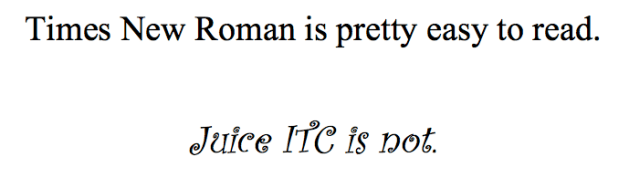
The participants were instructed to read the text and rate the author’s intelligence. All of the instructions and rating scales were written in the corresponding text to prevent readers from assuming the author had chosen the font, which could be taken as a hint about their intelligence.

Readers who received the “Juice ITC” version rated the author as less intelligent than those who read it in “Times New Roman.” This establishes the effect of fluency independent of complexity, and supports the idea that complex texts are rated poorly because they reduce fluency.

Experiment 5: Do Manipulations of Fluency Have the Same Effect if the Source of the Decreased Fluency is Obvious?

People tend to discount the role of fluency when it has an obvious source. For example, Tversky and Kahneman found that although people typically use fluency as a cue for estimating surname frequency, if they are in the presence of obvious causes for fluency (personal relevance, famous name) they stop using fluency and even overcompensate.3 To test this, 27 participants were given an unedited essay from experiment one that was either printed normally, or with low toner in the printer making it light, streaky, and hard to read. Readers were asked to decide if they would accept the applicant as well as rate the confidence of their decision and the author’s intelligence.

Participants who read low toner texts were more likely to recommend acceptance than those who read the normal version. They also rated the intelligence of the author more highly in the low toner condition. When the source of fluency is obvious, people become aware of their bias and overcorrect.

*     *     *

The implications of the first four experiments can be neatly summarized: “Keep it simple, stupid.” As experts have long recommended, you should use short, common words and easy to read fonts. Someone who makes good points, but relies on complex words and jargon to do so, likely pays a price in terms of the perceived quality of their work and mind. Reading Oppenheimer’s paper made me wonder if the same rules hold true on the broader scale of academic disciplines. If a field tends to use needlessly complex language more than other fields, is it viewed as less credible?

To test this hypothesis I set out to compare the complexity of the top journals from various fields to their perceived credibility using average word length as a proxy for complexity and SCImago Journal Rank (SJR) as a proxy for credibility. Specifically, I chose to compare the top journal in astrophysics, biochemistry, sociology, and gender studies. To estimate word length I sampled the first five full articles from the latest issue of each journal and divided the number of characters by the word count. Each journal’s complexity score reflects the average word length of the five selected papers.

There was no relationship between SJR and complexity score (names of the journals and papers used for the analysis, as well as results, can be found here.) This could be for a number of reasons: the top journal of a field is not necessarily reflective of the field as a whole, average word length could be a bad proxy for complexity, SJR could be a bad proxy for credibility, small sample size, etc.

Or, could it be that I was confusing complexity with needless complexity?

The complexity score is similar for Gender and Society (5.5) and Annual Review of Astronomy and Astrophysics (5.3), but is the difficulty of understanding for the underlying content the same? Almost certainly not. Previous research has developed a Hierarchy of the Sciences that uses objective bibliometric criteria to assess the “softness” of an academic field.4 Unsurprisingly, the ranks are as follows, from hardest to softest science: physical (physics, mathematics), biological-hard (molecular biology, biochemistry), biological-soft (plant and animal sciences, ecology), social (psychology, economics), and humanities (archaeology, gender studies). The authors state that as you progress from mathematics to humanities there is “a proportional loss of cognitive structure and coherence in their literature background.” In other words, Gender and Society uses equally complex language to describe “softer” phenomena. Therefore, the degree of needlesscomplexity is higher than in similarly complex texts where the underlying difficulty of the concepts is greater.

The point is clarified by the following examples taken from papers analyzed for this article. Excerpt 1 comes from an abstract in the Annual Review of Astronomy and Astrophysics,5excerpt 2 comes from an abstract in Gender and Society.6

  1. In our modern understanding of galaxy formation, every galaxy forms within a dark matter halo. The formation and growth of galaxies over time is connected to the growth of the halos in which they form. The advent of large galaxy surveys as well as high-resolution cosmological simulations has provided a new window into the statistical relationship between galaxies and halos and its evolution.
  2. In Hegemonic Masculinity: Formulation, Reformulation, and Amplification, James Messerschmidt provides a comprehensive and nuanced explanation of hegemonic masculinity, including the sociohistorical context of its development, and an incisive analysis of research that has utilized the tricky concept.

I applied the methodology of experiment 3 from Oppenheimer’s paper to both (simplified long words). Let’s see how they change.

  1. In our modern understanding of galaxy creation, every galaxy forms within a dark matter halo. The creation and growth of galaxies over time is linked to the growth of the halos in which they form. The advent of large galaxy surveys as well as high-resolution cosmological models has provided a new window into the statistical link between galaxies and halos and its evolution.
  2. In Powerful Maleness: Design, Redesign, and Expansion, James Messerschmidt provides a full and nuanced account of powerful maleness, including the sociohistorical context of its development, and an incisive analysis of research that has utilized the tricky concept.

In the first excerpt there were nine words that had nine or more letters, and four could be replaced with a shorter word without distorting the meaning. In the second excerpt there were more long words, despite the fact that the passage is much shorter (38 vs. 64 words). Of the 12 words that met the criteria in excerpt 2, nine of them could be replaced without altering the meaning. Therefore, the density of both long words and needlessly long words is higher in the second excerpt.

Does this needless complexity harm the public perception of gender studies? Yes. Good luck convincing laymen about the oppression of women using terms like “subalterneity” and “phallogocentrism.” It will be difficult to understand, and therefore judged negatively. Take, for example, a passage from one of the most influential works from arguably the most influential gender theorist, “Performative Acts and Gender Constitution: An Essay in Phenomenology and Feminist Theory” by Judith Butler.7 

“When Beauvoir claims that ‘woman’ is a historical idea and not a natural fact, she clearly underscores the distinction between sex, as biological facticity, and gender, as the cultural interpretation or signification of that facticity. To be female is, according to that distinction, a facticity which has no meaning, but to be a woman is to have become a woman, to compel the body to conform to an historical idea of ‘woman,’ to induce the body to become a cultural sign, to materialize oneself in obedience to an historically delimited possibility, and to do this as a sustained and repeated corporeal project.”

The above is a reasonable argument for separate definitions of sex and gender that is totally obscured by jargon and wordiness. It could be reworded as follows without losing any meaning:

“According to Beauvoir, to be a woman is more than to be biologically female. It also involves behaving in the way women are expected to based on historical precedent.”

*     *     *

In summary, a lack of fluency (often caused by needlessly complex words) causes readers to negatively judge a text and its author. The degree of needless complexity varies across academic fields and this needless complexity likely harms public perceptions of the fields where it is most pronounced. All of this raises one last question: why do disciplines like gender studies insist on needless jargon? Three hypotheses seem most likely: historical coincidence, physics envy, and conscious deception.

The first two hypotheses suggest well-meaning authors. It is possible that the early writers of certain fields like gender studies set a bad precedent by coining long, unintuitive words that are now important to the field, while other disciplines were fortunate to have such tractable terms as black holes and dark matter. Alternatively, given the widespread attitude (at least in some circles) that the humanities and social sciences are softer, less challenging, or less valuable than other fields of inquiry, one could see academics in those fields internalizing a sense of inferiority. This attitude is known as physics envy. In order to prove their intelligence, to themselves and to others, they might be tempted to complicate simple ideas and use complex vocabulary to describe them—just like the Stanford undergraduates interviewed by Oppenheimer.

The third hypothesis, that they are consciously deceiving readers, brings us back to Oppenheimer’s fifth experiment. If you recall, participants in that experiment rated more highly the text quality and author intelligence of text printed with low toner. It was obvious to them that the low toner was biasing their judgements in a negative way, so they overcompensated. The question remains, what sources of poor fluency are obvious enough to hit the inflection point where instead of hurting perception they begin to help it? Does heavy use of complex academic jargon count as an obvious enough source and, if so, are writers incentivized to use it? If laymen are self-aware of the jargon reducing fluency, they may give the text and the author benefit of the doubt when it is undeserved.

Ultimately, this is an empirical question waiting to be answered. In the meantime, if the writers who are producing needlessly complex pieces are doing so to deceive the public, we can take solace in the fact that it isn’t working very well— there is only one sociology journal in the top 100 (Administrative Science Quarterly, #78), and one gender studies journal in the top 1,000 (Gender and Society, #975) of journals ranked by SJR.


Source: Stupid Is as Stupid Writes