Some similar questions regarding Canadian policy and consular obligations with the Canadian tendency to more inclusive approaches as seen in the government’s response to the Ukraine International shoot down and Iranian Canadians and the evacuation of Chinese Canadians, including some permanent residents to keep families together, from Wuhan:
While the initial debate about the Australians in Wuhan has focussed on details such as whether or not evacuees would (or should) pay something towards the cost of the flights, and whether the controversial immigration detention facility at Christmas Island is the appropriate housing area for quarantine, another curious matter sits in the background. What is our country’s responsibility, if any, for evacuating citizens, permanent residents and others from the site of a pandemic, or other crisis overseas? And what does citizenship mean in these circumstances?
Australia has a curious relationship with citizenship. As a migrant country, Australia has long seen citizenship as a key pillar of our economic policy: attracting people from around the world to join the population, offering a better life in return for enhancing the nation’s future prosperity.
But citizenship is not always a simple, one-way story that ends with life in Australia and single Australian citizenship. And the dynamic of multiple citizenships in the modern world means that migrants and refugees might not just stay put in Australia, but may split residence between countries.
The legal term of Australian citizenship is only 70 years old. It was established in 1948, with Australians remaining British subjects – a status that was removed only in 1984. From 1986, dual citizenship was established, with people from other countries allowed to take up Australian citizenship and retain their original nationality. It was only in 2002, that Australian citizens were allowed – under Australian law – to assume citizenship of another country without first renouncing their Australian citizenship.
Some 33.3 per cent of Australians were born overseas, which provides one indication of some of numbers possibly at play with multiple citizenship.
But outside economic policy, changes in citizenship law in Australia and overseas, and changes in an increasingly complex strategic environment, have thrown up some thorny problems. The 2017 federal parliamentarian citizenship crisis and the fate of the children of Australians who travelled to the Middle East to join the self-proclaimed Islamic State are recent examples.
Reporting around the coronavirus outbreak, with headlines such as “Aussie kids trapped in Wuhan”, show a simplistic perception of citizenship. It suggests those affected only hold Australian citizenship and have been inadvertently caught in a crisis overseas and need the help of their government. The reality is often more complex, with many dual or other multiple citizenship holders affected by this and other crises. Some of those Aussie kids are also Chinese. As are their parents. They may be long-term residents of Wuhan or on a first visit to family.
And as longstanding government policy – easily found on DFAT’s Smartraveller website – makes clear, it is an individual’s responsibility, not government’s, to manage their own safety and well being when overseas. In the case of the current outbreak, however, the government has done the right thing in enabling those Australians who wish to leave to do so.
Despite the sometimes-changeable nature of Australia’s bilateral relationship with China in recent years, the movement of Australians, including dual-nationals, out of China has not presented as an issue.
But this latest experience throws in to question what we do in the future. Do we need a more nuanced approach to how we deal with dual nationals located in their other home countries?
Do the challenges of conflict, pandemics, and strategic tension in our region and in the rise of non-traditional threats such as global terrorism, mean that we need to maintain awareness not only of how migration affects economic development and jobs, but also how it affects security. As the coronavirus reminds us, this includes health security.
Perhaps now is the time to talk with countries such as China, India and the Philippines, which many Australians also call home, about a shared approach to how we each look after our shared citizens in health and other crises.
We have arrangements with Canada, New Zealand and other countries on reciprocal assistance evacuating our citizens from conflict areas, natural disasters and other emergencies. The coronavirus could be a useful reference for similar discussions on deciding when it’s appropriate for Australian dual nationals to remain in country, and how all countries involved can work together to ensure the best assistance is provided in place.
The recent establishment of the Home Affairs portfolio to include immigration along with security, emergency management and other roles, and raising it to a central agency of government, means that we have the policy levers to consider how migration and citizenship works with security and other roles.
A future Home Affairs White Paper could provide strategic direction on where and how Australian citizenship and immigration could and should support how Australia engages globally.
Regardless of government policy, we need better awareness within our community of what citizenship currently looks like, and what our policy settings are, in order to better inform the public discussion of what we expect our government to do for our citizens, wherever they chose to be around the world. Here, the media plays a pivotal role in explaining what’s going on, and ensuring we don’t fall into a simplistic representation of Australians.
Australia’s success is due in part to the continual change in what it is to be Australian, and what constitutes Australian interests. But as we deal with complex challenges, like coronavirus, we need to be mindful that what it is to be Australian is not always simple.
Significant short and longer term impact. Haven’t seen data on Canadian visa overstays for international students but likely less given Canadian Experience Class pathway to permanent residence:
The next Trump administration action taken against high-skilled foreign nationals may be to limit the length of stay for international students after they are admitted to the United States. This would be done through a new rule eliminating “duration of status,” which now allows a student, once admitted to America, to continue his or her studies until completion, without requiring additional approvals.
The vehicle for this new restriction would be a new regulation to establish a “maximum period of authorized stay for students.” The targeted date for publishing the proposed rule is February 2020.
Replacing the current “duration of status” for international students with a “maximum period of authorized stay” would increase uncertainty for students. It would require them to gain new approvals at each stage of their studies in the United States, such as a transition from an undergraduate to a graduate-level program. New approvals also would be needed if academic programs take longer than anticipated.
In interviews, educators estimate extra costs incurred by international students could be $1,500 or more per extension. Moreover, students would face the prospect of USCIS adjudicators denying student extension requests, much like many H-1B visa holders experience today when trying to extend their status and are forced to leave the country. The denial rate was 24% for H-1B petitions for new employment and 12% for continuing employment through the first three quarters of FY 2019, according to a National Foundation for American Policy analysis.
Educators and analysts blame higher costs in the United States and restrictive Trump administration immigration policies for recent declines in international student enrollment. The new policy would raise costs higher for students and be much more restrictive than the status quo.
Given the significant delays in U.S. Citizenship and Immigration Services (USCIS) processing under its current workload, the agency is unlikely to approve applications in time for many students. At the Texas Service Center, as of February 4, 2020, the processing time was 9 to 11 and a half months for an “Application to Extend/Change Nonimmigrant Status (I-539).” That means a student would need to file a year in advance for an extension, which likely would not even be permitted by USCIS.
What happens if a student files a timely application but USCIS fails to approve it in time? The student would be in jeopardy unless he or she leaves the country, according to USCIS.
The agency includes the following on a list of Q&As for an extension of stay: “What if I file for an extension of stay on time but USCIS doesn’t make a decision before my I–94 expires? Your lawful nonimmigrant status ends, and you are out of status, when your Form I-94 expires, even if you have timely applied to extend your nonimmigrant status . . . DHS [Department of Homeland Security] may bring a removal proceeding against you, even if you have an application for extension of status pending.”
The administration has provided little justification for this significant change in policy, which was first placed on the regulatory agenda in October 2018. The “Statement of Need” for the rule to end duration of status reads: “The failure to provide certain categories of nonimmigrants with specific dates for their authorized periods of stay can cause confusion over how long they may lawfully remain in the United States and has complicated the efforts to reduce overstay rates for nonimmigrant students. The clarity created by date-certain admissions will help reduce the overstay rate.”
The only evidence presented on international student overstay rates remains a series of flawed Department of Homeland Security (DHS) reports – and even those reports show student overstay rates have dropped significantly.
As discussed previously, Department of Homeland Security reports include as “overstays” people who did not necessarily overstay a visa, but individuals who DHS could not confirm had departed the United States. The distinction is important. “The DHS figures represent actual overstays plus arrivals whose departure could not be verified,” writes Robert Warren, a senior visiting fellow at the Center for Migration Studies in an analysis.
Attorney Paul Virtue, a former top official at the Immigration and Naturalization Service, told me in an interview: “The DHS report on overstays is dependent on the accuracy of information in SEVIS (Student and Exchange Visitor Information System) and the agency’s ability to match entry and exit information, especially for students who, for example, may have departed through a land port of entry or have had a change of status that was not updated in SEVIS . . . there is still too much guesswork built into the DHS assumptions concerning the number of overstays among the student and exchange visitor populations.” (Emphasis added.)
Recent DHS reports show the purported overstay rate for F-1 students declined by 42% between FY 2016 and FY 2018, falling from 6.19% in FY 2016 to 3.59% in FY 2018. Despite this, DHS has not backed away from the potential rule to abolish duration of status and establish a maximum period of authorized stay for F-1 students.
Many in the international education community believe the “overstay” argument is being used to justify the policy rather than the actual impetus for eliminating duration of status. The motivation, many suspect, is to limit or discourage more international students from coming to the United States, as evidenced by a series of policies the administration has put forward to restrict international students and employment-based immigration.
New enrollment of international students at U.S. universities declined by more than 10% between the 2015-16 and 2018-2019 academic years. At the same time, in Australia the enrollment of international students in higher education increased by 47% between 2015 and 2018, according to Australian government data.
At a time when other countries are attracting more students, increasing costs and adding new layers of uncertainty will likely discourage international students from coming to the United States.
More from the epicentre. Good that they are also looking at possible local approaches:
Richmond city council wants the new federal minister of immigration to tackle the problem of birth tourism.
A motion by Coun. Carol Day to write to Marco Mendicino, the Minister of Immigration, Refugees and Citizenship, urging him to end birthright citizenship for non-Canadians was supported by almost all of council at Monday’s committee meeting.
In the meantime, city staff are fining birth tourism operators on any illegal activity they may be running – but because there is no business license for birth tourism, they can’t be shut down for advertising birth tourism services, explained Cecelia Achiam, general manager of community safety.
“We do not regulate something that we could not approve, so birth tourism is not something that we could regulate at this point,” Achiam said.
This was challenged by the mayor, Malcolm Brodie, however, at the meeting, and he asked staff to find out whether it is possible to shut them down based on the fact they are an illegal business.
“If they’re doing something that’s unlicensed and not allowed, you’re telling me you can’t do anything about it – surely it’s operating a business without a license,” Brodie said.
Currently, staff will fine any activity advertised by birth tourism services if they don’t have a license, explained Achiam, for example, if they advertise tutoring services, the city can fine them if they don’t have a business license for tutoring – or if they advertise food services and airport pickup/dropoff services without the correct licenses.
The motion passed by council was to write to the new minister to ask for “immediate permanent changes” to end automatic citizenship for babies born in Canada to non-resident, non-Canadian parents.
Greene pointed out that staffing at Richmond Hospital is based on census data, but this would not take into account the quarter of the total number of births that are to non-residents.
“We’re definitely seeing service impacts – I’ve personally been impacted,” Greene said.
Of the countries that have birthright citizenship, North America is a desirable destination, she said, but this is something the “ultra-rich” only can do.
“It feels really unfair and it doesn’t feel right to shop for your citizenship,” Greene said.
Greene also criticized MLA Jas Johal for praising the U.S. government move to ban pregnant women from getting tourist visas, something Greene called “policing women” by profiling them if they’re pregnant when applying for a tourist visa.
The U.S. State Department put in rules more than a week ago that banned women who were pregnant fromgetting tourist visas to the U.S.
Greene called this a “horrifying violation of human rights.”
She said she wants the letter to reflect that Richmond wants to end a practise where “people essentially buy their citizenship so that we’re never ever in a situation where we’re policing women’s bodies.”
Greene also called for an amendment that talked about changes not affecting vulnerable and stateless people but this didn’t pass.
Coun. Bill McNulty said the accommodation rules need to be revisited, because birth tourist stays don’t fall under short-term rentals, rather the provincially regulated long-term rentals.
“I think there are many loopholes to be closed and I think the city can close some of them within our community,” he said.
This was reiterated by Coun. Harold Steves who suggested long-term rentals for birth tourism are actually turning homes into hotels.
McNulty also suggested sending the letter to all MPs in Canada since it’s a federal issue.
“If you want something to be done at the federal level … I think we have to let everybody know,” he said.
Greene was the only councillor who voted against the motion.
Mendicino did not return repeated requests from the Richmond News for an interview.
And the related statement by Councillor Kelly Greene
We need to stop birth tourism in Canada. Birth tourism is the practice wherein rich people go to another country, with jus soli, to give birth in order to obtain a “better” passport for their child. Some call them “anchor babies” (this is an offensive term) because of the advantage to later sponsor family members for citizenship or residency. Jus soli is the right to automatic citizenship based on birthplace. Of G20 members, the countries which have jus soli are Canada, United States, Mexico, Argentina, Brazil, and China.
To be clear, rich people shopping for the most advantageous place to give birth, for the purposes of obtaining a particular citizenship for their child, is an affront to the principles of fairness and to the value of people navigating the immigration system who are not “skipping the line” by buying their way to the front.
However, the motion considered by Richmond City Council was not to ask the federal government to stop the loophole of birth tourism. It was a motion to end jus soli for everyone.
This fundamentally fails to consider significant humanitarian and human rights issues and in my opinion is fatally flawed. To correct the flaw, I proposed the following amendment to the original motion: “, with protection for vulnerable people such as stateless persons and refugees.”
Without my proposed amendment, there would be significant and disproportionate harm to vulnerable people, specifically women and children of colour, should the originally worded motion be enacted by the federal government. We are a country that should care about not further marginalizing people who are already in jeopardy. We should not accept further harm to vulnerable people as an acceptable outcome for stopping rich people from “shopping for passports”.
Vulnerable people are not expendable. They are people who do not deserve to be collateral damage from policies requested and enacted by government bodies that are primarily white, male, and economically advantaged.
Further, Canada is a signatory of the International Convention on the Reduction of Statelessness (1961), where an otherwise stateless person should be granted citizenship to a person born in its territory. Additionally, in the Universal Declaration of Human Rights and the Convention on the Rights of the Child, of which Canada is also a signatory, the basic right to a nationality is specified. We have obligations, both morally and by international law, to ensure that vulnerable people are thoughtfully and carefully protected from any changes to jus soli.
Previous attempts by Conservative and Liberal federal governments to amend or end jus soli have failed because of the lack of consideration for vulnerable people and international obligations. The motion passed by Richmond Council is asking for the exact same thing that previous governments have rejected. It has no chance of being acted upon in its current form, as it’s already been decided upon previously. This raises the spectre of political theatre and people may wonder why it is being brought forward again. One would hope it was not to appeal to racism and intolerance, as in dog-whistle politics.
It was suggested at the meeting that we shouldn’t specify to the federal government what it is exactly that we want and that the federal government would figure it out. To the contrary, as Council we ask for very specific things all the time from both the provincial and federal governments. There is nothing preventing us from asking specifically what we want – to stop rich people’s birth tourism – unless, perhaps, the goal is exactly as written, to end jus soli for everyone, including vulnerable people.
Without the addition of my amendment, I could not in good conscience vote for a resolution which calls for a blanket termination of jus soli. My hope is that my fellow council members will have a moment to reflect on the implications of the motion passed in General Purposes Committee, and amend the motion before it passes at the Council meeting on Monday.
Of the African countries included in the ban, immigration to Canada has increased for all of them 2015-19 (till November): Nigeria (4,090 to 11,175), Eritrea (2,210 to 6,555), Sudan (335 to 1,200) and Tanzania (150 to 200). So hard to see Kusmu’s case for “measures to directly increase immigration to Canada from those countries” given that it is already happening.
I am not sure about whether this would actually play a positive role in gaining African support for the Canadian Security Council bid, given that this is essentially a brain drain from Africa to Canada:
Understanding the news that came from the White House on Jan. 31 was an exercise in cognitive dissonance.
Earlier that day, President Donald Trump proclaimed February as National African-American History month. “Through bravery, perseverance, faith and resolve – often in the face of incredible prejudice and hardship – African-Americans have enhanced and advanced every aspect of American life,” he said.
But just a few hours later, his administration announced the latest round of travel bans, which will affect four African countries – Nigeria, Eritrea, Sudan and Tanzania – that contain nearly a quarter of the continent’s entire population (a continent he previously referred to as containing “shithole” countries). The various restrictions – the suspension of visas for people sponsored by family members and, for some, green card (i.e. diversity visa program) applications – go into effect on Feb. 22.
The Trump administration cites national-security concerns for those bans, including potential slips of aging identity-management systems and overall “elevated risk and threat environments”; past White House officials and current legislators have called the bans nonsensical and cruel. Indeed, those issues offer the government thin cover to arbitrarily target potential immigrants, most of whom are free to apply for a temporary visitor visa (which would theoretically nullify any security precautions) but are barred from the labour-intensive process of applying for an immigration visa that often requires years of intense vetting.
So if security seems like an unlikely motive for the administration’s latest move, what is? While there is some speculation it may be a play for diplomatic bargaining chips with those countries, the more probable motivator is Mr. Trump’s anti-immigration base as a presidential election looms. Unlike the 2017 Muslim ban, which garnered widespread condemnation and scrutiny, a craftier approach – targeting mostly African nations under the pretense of national security – has been adopted. (Myanmar and Kyrgyzstan were also included in this round of bans.)
What Mr. Trump and his supporters may not realize (or, more likely, care about) are the economic and moral consequences of this decision. Banning immigration from Nigeria, one of Africa’s fastest-growing and most dynamic economies, would essentially close America off to a demographic that has proven to be some of its most educated and, with it, direct access to what Newsweek named a growing global “economic superpower” – ironically, on the same day the bans were announced.
The graver implication is that this policy will bring ruin to the lives of the more than 12,000 potential immigrants expected to apply next year and the thousands more relatives and loved ones. The fact that families who are awaiting to permanently reunite with their aging parents or their distant partners on American soil will know that this is impossible, at least for now, is heart-wrenching. To make matters worse, Eritrea and Myanmar (where the Rohingya population is under threat of genocide) are experiencing outsize refugee crises, demonstrating yet again the cruelty of this measure.
Countries continue to erect walls against migrants, from the United States to Greece, which recently announced a (widely ridiculed) plan to create a floating barrier to block refugees on boats. Leaders continue to employ racist rhetoric; Mr. Trump, for instance, previously cited concerns that Nigerians visiting the U.S. would never “go back to their huts” in Africa. And this represents an opportunity for Canada and Prime Minister Justin Trudeau.
Canada will likely witness a large increase of immigration applications from the countries affected by Mr. Trump’s ban. As a country, we will be all the better for such waves, particularly since the infusion of new Canadians can help us offset the challenges that come with our increasingly aging population. And so Mr. Trudeau can counter Mr. Trump’s rhetoric and policies by announcing measures to directly increase immigration to Canada from those countries. If nothing else, it could serve as a last-minute rallying point to bolster his government’s campaign for a seat on the United Nations Security Council, especially as he embarks on an outreach tour of Africa this month.
But perhaps, more poignantly, this move could serve as a much-needed act of atonement to Canadians of African descent, for whom the memories of Mr. Trudeau’s blackface scandal from the 2019 federal election campaign are still fresh. Just as Mr. Trump’s Black History Month actions were telling about his government’s approach, there might be few better ways for Mr. Trudeau to signal his support of Black History Month in Canada this year.
By way of comparison, there are about 52,000 persons of Nigerian ethnic ancestry in Canada (Census 2016), about 71 percent first generation. In the last 5 years (January 2015 to November 2019, about 37,000 new Nigerian permanent residents have been admitted (IRCC, open data). Average and median incomes are lower than the overall Canadian numbers. While participation levels are stronger, unemployment levels are higher. Like most recent immigrant groups, Nigerians are more highly educated than the Canadian average.
See article for the charts regarding Nigerians in the USA:
This column will not render a verdict on whether the White House decision last week to suspend immigration from Nigeria — the world’s seventh most-populous nation — and five other countries was mainly an expression of bigotry from an administration led by a man who once likened African nations to latrines, or if it was a legitimate reaction to security concerns. It will, however, tell you some things you might not know about Nigerian immigrants in the U.S.
To start, there’s a fair number of them (which is why I’m focusing on Nigeria and not Eritrea, Kyrgyzstan, Myanmar, Sudan or Tanzania, the other five countries hit by the new ban). An estimated 374,311 Nigerian-born people were living in the U.S. in 2018, which put the country in 27th place as a source of foreign-born Americans, behind Pakistan and ahead of Japan. These and a lot of the numbers to follow are based on the American Community Survey that the U.S. Census Bureau sends out to 3.5 million households every year, so they’re subject to margins of error (19,648 for the number cited above), plus the inevitable strengths and limitations of self-reported statistics.
For example, the Census Bureau says there were an estimated 462,708 people of Nigerian ancestry in the U.S. in the 2018, but that’s based on what people put on the survey, not the sort of genealogical investigation that would surely reveal that there are millions of Americans whose forebears were brought across the Atlantic against their will in past centuries from the region of West Africa that is now Nigeria. Still, for our purposes the census survey is probably better, in that it restricts the scope mostly to recent immigrants and their kids. The members of this group have more than doubled in number since 2007, and they are for the most part doing quite well.
The median income for households led by someone of Nigerian ancestry, for example, was $68,658 in 2018, compared with $61,937 for U.S. households overall. Here are a few other informative comparisons:
Nigerian-Americans are more likely to have jobs than the rest of us, and much more likely to have college degrees. They’re also much less likely to own their homes, and slightly more likely to be below the poverty line — although they’re less likely to collect the Supplemental Nutrition Assistance Program benefits commonly known as food stamps. Nigerian-Americans are younger (median age is 31.6, compared with 38.2 for the U.S. overall), more likely to live in big cities (at least, that’s how I interpret the relatively high share of public transportation users), more likely to work in education and health care (there are a lot of Nigerian-American doctors) and slightly more likely to be married.
The percentage of Nigerian-Americans 16 and older with jobs ranked them 10th among ancestries in the U.S. in 2017 (the Census Bureau’s new data portal is still going through some growing pains that prevented me from assembling these rankings for 2018).
Nigerian-Americans also came in 10th place for the percentage with college degrees.
Australia, Bulgaria and Nigeria are the only countries to make it into the top 10 on both rankings, which to me indicates a sort of integration sweet spot. Nigerians who come to the U.S. usually speak English before they get here, they tend to be well educated or in the process of becoming so, and they don’t seem to have much trouble getting jobs or otherwise fitting in. I don’t think these are the only things immigrant success should be judged by, and there’s something more than a little creepy about passing such judgments upon people by their country of origin. But since immigration policy in general and the new immigration bans in particular do just that, it does seem relevant that Nigerian-Americans are clearly among the most successful immigrant groups in the U.S.
Also relevant is that Nigerians feature prominently on the Department of Homeland Security’s rankings of people who stick around longer than their visas allow. Here are the numbers for business and pleasure visas:
Among those with student and exchange-program visas, the numbers are smaller, with 1,664 Nigerian students suspected of overstaying their visas in fiscal year 2018. But that makes for an even higher share (18.6%) of those that U.S. authorities had expected to depart. (Nigeria has been moving up in the ranks of countries sending students to U.S. colleges and universities, to 11th place in 2018-2019, according to the Institute for International Studies.)
One way to look at this data is that Nigerians need to be kept out of the U.S. or they’ll never leave. This has in fact been the reaction of the current administration, which in March of last year suspended a visa-interview waiver program that allowed Nigerian applicants for some visas to apply by mail, and in August jacked up visa fees for Nigerians. Big surprise: The number of Nigerians visiting the U.S. fell by 21% in the first 10 months of last year, the biggest drop of any country, according to Quartz Africa, which has been all over this story.
Another way to think about the visa-overstay phenomenon, though, is that the U.S. isn’t supplying nearly enough immigrant visas to Nigerians. The demand is clearly there, and Nigerian immigrants have a track record of great success here. I would guess that those who stick around after their visas expire are less successful than those who come on immigrant visas, but in theory at least they too are represented in all the above statistics from the American Community Survey, which don’t differentiate by visa status. And yes, if the U.S. allowed a big increase in the number of immigrants from Nigeria, their education levels and success rates might fall. But banning immigration from Nigeria outright, as the administration has now done, seems like a pretty big step in the wrong direction.
This step was taken, Acting Secretary of Homeland Security Chad F. Wolf said Friday, because Nigeria and the other five countries subject to the new ban “lack either the will or the capability” to adhere to new screening and vetting criteria imposed by the U.S. government since March 2017. Now, I am perfectly willing to believe that the Nigerian response to U.S. demands has been somewhat shambolic, especially given how some Nigerian officials reacted to the news. “The travel ban is a wake-up call, a rude one at that, on the need for us to be alive to our responsibility to our people and ensure that we have citizenship integrity,” Ajibola Basiru, chairman of the Nigerian Senate Committee on Diaspora Affairs, told the Punch (a leading Nigerian newspaper) over the weekend. “At the moment, we are a nation of anonymous citizens. We don’t have records of our citizens and anybody can claim to be a Nigerian.”
The Nigerian government will now surely react with more alacrity to the U.S. push for information-sharing, and may well succeed in getting this latest visa ban revoked — as occurred with neighboring Chad in April 2018. But resolving this situation ought to be a policy priority for the U.S. as well. Nigerian immigrants are great. We need more of them, not fewer.
Given the overall lack of diversity in the industry as exemplified in the various awards, worth noting:
In the eight years since Get Lifted Film Co.’s start, the partnership launched by John Legend, Mike Jackson and Ty Stiklorius has grown to become an industry player. Launched in 2012, Get Lifted has delivered one thunderclap after another, from WGN America’s record-setting sensation “Underground,” to the Oscar winning “La La Land,” for which the company served as executive producer. On the stage, Get Lifted produced a 2017 Broadway production of August Wilson’s “Jitney,” for which its founders won the Tony Award for Best Revival of a Play.
The trio has built a successful and influential independent production house without much fanfare, and have largely avoided any vanity press. They have more recently started to discuss the company, and all three founders sat with IndieWire last month for a lengthy and candid conversation about the origins of the company and its vision for the future.
“Hollywood has changed over the years, for women and people of color, because it was hard when we started,” Jackson said. “’12 Years a Slave’ hadn’t won an Oscar. And so we would pitch projects like a black historic biopic for example, and executives would scoff. So it’s been revealing to have been there before, and then to now see so much more openness and interest in the kind of stories we wanted to tell, but couldn’t.”
For many, Get Lifted is principally known as Legend’s company, but the company’s aspirations go far beyond his own musical and acting ambitions. (Its catchphrase: “Smart, Elevated, Commercial.”) The company’s most groundbreaking project to date is “Underground.” A critical success that also broke viewership records for WGN America in its first season in 2016, the series was a bold, refreshing take on the slave narrative, unfolding more like a fast-paced action-drama, than anything TV audiences had seen before it. And it caught on quickly: Slave narratives weren’t quite the same again after that, with last year’s Harriet Tubman biopic, “Harriet,” taking a similar approach.
“That really represented who we are and the types of chance-taking stories we wanted to be at the forefront of,” said Jackson. The project was a real breakthrough for the company. “It was something that came to us already pretty much baked, but we ensured that our DNA was in the show.”
They also tout the critical success of their new sketch series “Sherman’s Showcase,” which premiered on IFC last fall to raves. Created by Bashir Salahuddin and Diallo Riddle, the series is hosted by Sherman McDaniel (Salahuddin) as he takes viewers through time via music and comedy drawn from the 40-year library of a legendary (but fictitious) musical variety show.
“It’s very smart, probably the best-reviewed thing I’ve ever been part of in my life,” said Legend. “There’s been this assumption that there isn’t an audience for intelligent black content, but we’re proving that it’s obviously not true.” The series will return with a one-hour “Black History Month Spectacular,” this summer, not in February.
Get Lifted’s latest offering, the Netflix hip-hop competition series “Rhythm + Flow,” was released in October 2019, also to raves. In the series, which the company developed internally, hip hop artists Cardi B, Chance The Rapper, and Tip “T.I.” Harris critique and judge unsigned rappers, who are competing to win a $250,000 prize.
As usual, Netflix hasn’t released viewership data on the series, but its contestants have become stars virtually overnight, with the winner, a 34-year-old rapper named D Smoke, seeing his Instagram follower count skyrocket from around 7,000 to over 1.3 million in a matter weeks.
“Rhythm + Flow” is the first original music competition program for Netflix, which was the most sensible home for it, Legend said. “It was hard to try to make it at a regular network because of the language,” he said. “And there’s so many things that would sand off the edge of the show if it were sanitized, and hip hop needs edge. And we’re so happy to partner with Netflix because they allowed us to do exactly what we wanted to do.”
It’s a long way from when they first launched Get Lifted, and had to prove themselves. Some didn’t take them seriously: Legend’s celebrity was seen as a handicap, and they were treated like a vanity company. However, the founders that only made them more inclined to take risks.
“We had almost nothing to lose at that point,” Stiklorius said. “And so, looking back on those years when a lot of people were saying things like, ‘You’ll never make it in this town,’ it’s great that we’ve built a strong reputation for having great taste and great work ethic.”
As the company has grown, they haven’t lost that nerve — whether it’s with a wholly original program like an IFC sketch variety show that’s unlike anything before it, or NBC’s “Jesus Christ Superstar Live in Concert,” which Legend starred in.
A lot of people balked at that last one. “The three of us talked and decided, John being the black Jesus? We’ve got to do this,” Stiklorius said. “We exec produced it, and then we won the Emmy for it. But everything about how we live our lives, and what we’ve done to get to this point, is about going against the norm, doing the work and believing in ourselves.”
The three founders have been friends for many years. Stiklorius and Jackson grew up together in Philadelphia. Legend met Stiklorius in college, at the University of Pennsylvania, in the mid-1990s, where they sang in an a capella group. She would eventually introduce Legend to Jackson, who became the singer’s first manager, after graduating from Penn in 1999.
Legend’s music career took off when his debut studio album, “Get Lifted,” was released in 2004 by Columbia Records. Music eventually brought him into the world of film and television, and he never looked back, becoming increasingly more influential as his celebrity grew. Get Lifted Film Co. was born not long after that. They sold over two dozen shows almost immediately, but quickly realized that getting those projects on the air was a whole separate challenge.
“We would pitch and they would buy it in the room, and we were thinking, ‘This is easy’,” Stiklorius said. “The frustrating part was getting all the way to the finish line with any project. But we knew that we had really great ideas, because they were at least buying into them.”
Get Lifted landed its first overall deal from Universal about nine months after it launched, which kept the company afloat as its ambitions grew. It took another three to four years before its first TV show actually made it to series — “Underground,” in 2016 — and it was a big year for the company, which had a hit TV series and two feature film releases: the young Obama romance, “Southside with You,” and “La La Land.” Following its Sundance premiere, “Southside With You” was praised by critics, and was a mild box office hit; and “La La Land” received a record-tying 14 nominations at the 89th Academy Awards, winning in six categories.
More deals would come, including a multi-year overall production pact signed in early 2017 with independent studio Critical Content to create unscripted television and digital media content. A few months later, the company inked a first-look deal with Sony Pictures Television, and in 2019, signed a three-year overall deal with ABC Studios after a multiple-studio bidding war.
Now, Get Lifted is benefited from changes to the industry climate, from the rise of streamers to increased pressure to diversify. The founders said they have more outlets for their projects, but like anyone else, faced more competition than ever before. One advantage: Legend’s starpower and social media reach, which includes over 13 million followers on Twitter, and close to 12 million on Instagram.
The company has a lot in the pipeline, but the project they expressed particular enthusiasm for upcoming Netflix musical “Jingle Jangle,” written and directed by David E. Talbert. Get Lifted’s biggest and most expensive project to date, it stars Forest Whitaker and Madalen Mills in the story of a toymaker and his granddaughter who construct a magical invention which, if they can get it to work in time for the holidays, could change their lives forever. Jackson called it “black ‘Willy Wonka.’”
Talbert had been trying to get off the ground for nearly two decades when Netflix bought the pitch in 2017, and Get Lifted came onboard as producers the following year. “It’s amazing to be part of something that’s really this huge, with this budget, for original content by a black writer and director, with an all black cast, and black producers,” said Legend. (Netflix is targeting a fall release.)
So what does Get Lifted envision for the future? “World domination,” Jackson joked, but noted the company has developed an international footprint with unscripted shows like “Rhythm + Flow.” The team is are also having broader conversations about how to expand the brand, and the potential of owning their own distribution channels so they can operate on multiple platforms.
“We’re pretty ambitious and have smartly taken our time and built our business slowly and systematically,” Legend said. “Now we’re at that point where we can expand it globally, and really make a dent, without ever losing our identity and without compromise.”
We shall see but agree with Falconer that it could go either way:
U.S. President Donald Trump’s decision to slap visa restrictions on six new countries could affect immigration flows to Canada.
Past moves by his administration on immigration policy for Haiti and Iran saw asylum claims and student visa applications in Canada jump.
Trump is now targeting visas granted to citizens of Nigeria, Sudan and Eritrea, among the largest sources of refugee claims lodged by people crossing irregularly into Canada from the U.S.
Immigration policy researcher Robert Falconer says Trump’s move could have both positive and negative impacts on the Canadian immigration system.
He says the number of asylum seekers could rise, as people from those countries already in the U.S. realize they won’t be able to stay permanently and so follow others who’ve already come to seek refugee status here.
But on the other hand, he says Nigeria’s booming middle class could be the source of many new economic or student immigrants to Canada, now that the door to the U.S. is harder to get through.
The Liberal government insisted China let the primary caregivers of Canadian children return to the country with those children after leaving Wuhan, the epicentre of an outbreak of the novel coronavirus, even if they are not citizens themselves.
“We insisted on the concept of family unity,” Foreign Affairs Minister Francois-Philippe Champagne said Monday in Ottawa.
A chartered plane will soon be in Hanoi, Vietnam, where it will wait to pick up Canadian citizens — and some permanent residents accompanying their children — from Wuhan, the city of 11 million people in the central Hubei province that is currently under quarantine in response to the outbreak.
The federal government is awaiting final approval from the Chinese government to fly through the restricted airspace and land at the closed airport in Wuhan, but Champagne said other preparations are already well underway.
“We will be in touch with Canadians in Wuhan later this afternoon to provide them all the necessary details,” Champagne said.
Federal Health Minister Patty Hajdu said 304 Canadians have asked for assistance to return home but only 280 have Canadian passports.
The numbers remain fluid and Canada has secured a second flight, as well as seats on other flights, should they be needed.
China is allowing only foreign nationals from all countries to board repatriation flights, but Champagne said Canada insisted that children be able to fly with their primary caregivers, even if they are permanent residents, and China agreed to let this happen.
That will not apply to families where no minors are involved.
Hajdu says China will not allow anyone who is showing symptoms of coronavirus to board a flight to leave the country, even if they are Canadian citizens, as part of that country’s efforts to control the spread of the coronavirus.
“I don’t anticipate we will be able to get the Chinese to concede on that point,” Hajdu said.
Those who remain will be offered consular services from the rapid deployment team already on the ground in Wuhan.
Passengers will be screened twice — once by Chinese authorities and then again before they board — and will be monitored during the flight for possible symptoms of the virus.
If any fall ill, they will be transported to a health facility in British Columbia while the plane refuels. Otherwise, passengers will not be allowed to leave the plane until they arrive at Canadian Forces Base Trenton, where they will be held in isolation for 14 days.
The Ontario base was chosen because it has the space to allow large numbers of people to be processed quickly, and a facility where people can be housed with dignity, said Hajdu.
“I want to remind people that these are Canadians who have been through a very traumatic experience over the past couple of months and in many cases will have significant stressors,” Hajdu said.
The repatriated Canadians will be housed at the nearby Yukon Lodge until they are cleared to return home.
“Part of the reason we’re offering social support is they will also be isolated from one another,” Hajdu said. “So if one person falls ill, that won’t necessitate the start of an entire other quarantine for all of the passengers.”
Interesting study and analysis. Wasn’t able to find comparable take up data to the Canadian equivalent (Working Income Tax Benefit rebranded as the Canada Workers Benefit) but about 5 percent of tax filers claim the benefit.
Given the number of benefits delivered through the tax system, expect Canada has a higher filing rate than the US:
The Earned Income Tax Credit supplements incomes through the tax code, awarding thousands of dollars each year primarily to low-wage workers with kids. But there’s a problem: a huge population of eligible workers fails to file their taxes and get the money each year.
Several years ago, the state of California established their own state EITC (CalEITC) on top of the federal one. Depending on how many kids they have and how much they earn, a Californian who files for both the state and federal credit can get upwards of $6,000. For the poorest households with kids, those tax credits could almost double their household income. There’s a lot of money on the table to help the most at-risk families in the state, and California policymakers have grown concerned about the large number of eligible workers failing to file taxes and claim their credits.
In 2018, the state of California and the California Policy Lab, an interdisciplinary think tank of scholars from various University of California schools, started trying to solve this problem, and they commissioned one of the most fascinating experiments in “nudging” we’ve seen in a while.
Nudge Experiments
Nudges are simple, low-cost interventions aimed at gently guiding people to make better decisions. For example, making retirement plans the default option when you join a job, which has been shown to significantly increase the likelihood you save more for retirement. The California Policy Lab and its partners decided it would try and nudge workers to claim the EITC by sending them letters and text messages. The solution seemed like a no brainer: inform people how they can get free money, and they’ll get that free money! If only it were that simple.
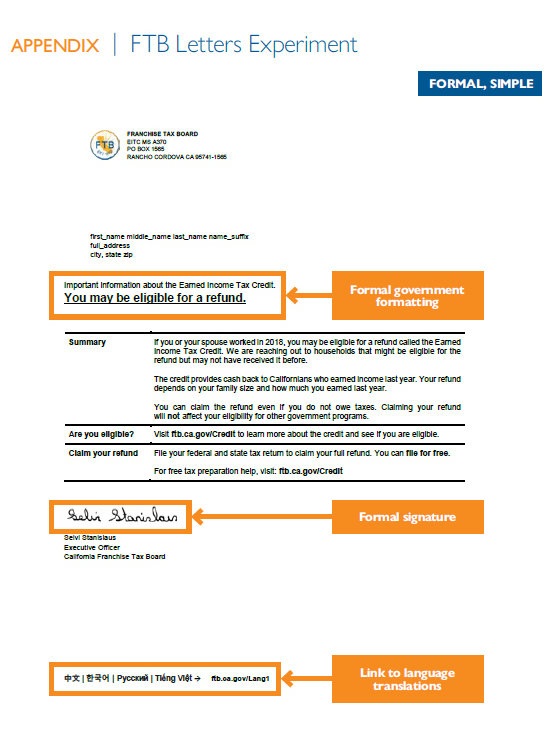
The researchers conducted field experiments for two years on over a million Californians. They randomly divided them into treatment groups, which received various types of messages, and a control group, which received no message. “We were trying lots of different ways of reaching people, lots of different messages you could give people, but to try to test what would be most effective,” says Jesse Rothstein, a labor economist at UC Berkeley who co-directs the California Policy Lab. The researchers tried to make sure these letters and text messages didn’t look like a scam. Below is an example of one letter they sent:
California Policy Lab
“We found a very precise zero effect,” says Elizabeth Linos, a behavioral scientist at UC Berkeley who was also behind the study. Many of those who received the messages, she says, did visit the website advertised in the messages to help them sign up for the EITC. But in the end, they didn’t fill out the forms to receive their credit. They turned down free money. “We weren’t able to increase the rate at which people file for taxes and we weren’t able to increase the number of households that claim the EITC,” Linos says.
This experiment might seem like a gigantic failure for behavioral economics and the theory of nudging. But both researchers believe their findings support the broader idea that people aren’t the perfectly calculating, error-free creatures of traditional economic models. They’re turning down free money — even after they’re informed they can get free money.
The researchers don’t have a solid answer for why the nudges failed. They believe, however, a big part of the problem has to do with tax forms. “Those of us who file taxes know that it’s not so easy to file taxes,” Rothstein says. “And so we’ve gotten people to understand that it’s there and to want it. But we haven’t really given them the tools that it would take to make it easy for them to claim it.”
Linos and Rothstein believe our tax system is too complicated, and that we should make claiming the EITC, and filing for taxes more generally, much simpler. Linos says the good news is that other countries provide examples of systems that don’t require mind-numbing paperwork to file for taxes or receive government benefits. “In a lot of countries, the government uses information they already have on you to pre-populate your tax forms,” she says. In other words, they tell you what you owe. Or are owed. Then you can just look it over and click send.
But we’re not other countries. We’re the USA, where filing for taxes is still stupidly hard. The IRS estimates that about 20 percent of eligible taxpayers fail to file and claim the EITC. Rothstein believes the solution to getting more people signed up for the EITC has to be a mixture of nudging them to sign up and “structural changes that make it easier to file taxes.” This could include an expansion of programs aimed at giving people assistance with taxes, including software designed to make filing easier.
A dark view of the findings might write off this population as doomed to poverty because of bad decision-making and self-destructive behavior. But psychologist Eldar Shafir and economist Sendhil Mullainathan suggest a more charitable lens, which they call the “psychology of scarcity .” Their research suggests the poor bear a unique cognitive burden that hurts their decision-making. They work long hours. They have higher stress. They’re consumed with thinking about paying their rent, getting their kids medical care, and putting food on the table. Shafir and Mullainathan find these stresses lower their “mental bandwidth,” and it might help explain why so many low-income Californians are turning down free money.
The one time that I found the Survey particularly helpful was when I was managing the merger then CIC citizenship and multiculturalism divisions following the 2008 decision to move multiculturalism from Canadian Heritage (reversed in 2015 under the Liberals).
The survey indicated much higher satisfaction from the citizenship side than multiculturalism, a sober reminder of just how hard and how long it takes to integrate different diversions from different departmental cultures.
And of course, like all government surveys and publications, there is a certain amount of sugar coating (we rely on the OAG for more candour!) but the survey nevertheless serves a useful function in providing an opportunity for departments, down to the DG-level in my day, to get an absolute and relative sense of employee views:
• The published results are unduly positive and actually misleading;
• Meaningful results are not published;
• There is no acknowledgement of good or bad results;
• No one seems to be accountable for the results; and
• No apparent effort is being made to improve on the results.
I have been involved in and reporting on the PSES since it was first implemented in 1999. Here’s the clear message coming out from employees in this survey: “We’re mostly not a happy bunch.”
Yes, the official results overall look fairly good. Look closer. Reports state that 62 per cent have confidence in their senior management. What is not stated is that only 29 per cent have a lot of such confidence. Isn’t this misleading? Results for many other questions are similarly skewed.
Here are some other meaningful responses to some specific questions:
• Only 24 per cent feel their agency does a great job supporting career development;
• Only 21 per cent seriously feel that any good idea they presented would be supported;
• Only 25 per cent think their workplace is very healthy;
• Only 15 per cent think that change is handled very well in their agency;
• Only 27 per cent feel the agency does a great job of explaining what it does; and
• 38 per cent gave their implicit opinion: They did not return the survey.
It’s fairly easy to score the results and rank the agencies on a “best agencies to work for” basis. That list effectively acknowledges the top federal agencies while establishing target benchmarks for the rest.
Agency heads do not appear accountable to achieve positive results nor to take any specific action responding to negative results. Based on my own experience and hearing from a few current employees, there’s a little buzz created with the survey but things rapidly return to the status quo. It’s like the French expression, “Plus ça change, plus c’est pareil.”
There is no evident major effort made to act on the PSES results by improving the workplace. Certainly nothing like that shows up on the Treasury Board website. There used to be a very telling question in the survey asking employees if they thought senior management was going to do much with the results. In 2014, the response to that question showed that just 17 per cent of employees were much convinced. That question has since been removed.
Here are a few suggestions to act positively in response to the survey:
• Give the straight goods when reporting the results. No sugar-coating;
• Officially publish a “best” list. Reward agency heads or not, according to their placement on the list. Heck, put their names on the list too:
• Ensure that agency heads demonstrate care and compassion for employees as a mandatory requirement to being hired;
• Celebrate the top-rated agencies on the list, such as Western Economic Diversification Canada, number one on my list. Tell their story. Reveal their secret to success.
• Publicly describe what the other agencies are doing to improve: what’s working, what isn’t.
• In future surveys, offer employees the chance to suggest ways to improve their workplace, their work or the whole public service. Review all suggestions, pick the best ones, implement them, reward the contributors.
• Add a bit to the survey so employees can confidentially answer a few key questions and get a sense of their health risks with pointers to improve their health. Such tools are already used and available in Canada.
These are just a few strategies that can fire up and empower the 300,000-some public service employees to better use their creativity, knowledge and experience to improve their workplace and, consequently, better serve all Canadians.
That’s what I want to see.
Jake Cole spent 34 years in Canada’s public service working in six different agencies. For his “best” list of all 66 major PS agencies, contact: colejster@gmail.com