Immigrant Health-Care Workers in the United States

Another good analysis by MPI. Similar picture in Canada with respect to immigrants and visible minorities:

Immigrants represent disproportionately high shares of U.S. workers in many essential occupations, including in health care—a fact underscored during the coronavirus pandemic as the foreign born have played a significant role in frontline pandemic-response sectors. In 2018, more than 2.6 million immigrants, including 314,000 refugees, were employed as health-care workers, with 1.5 million of them working as doctors, registered nurses, and pharmacists. Immigrants are overrepresented among certain health-care occupations. Even as immigrants represent 17 percent of the overall U.S. civilian workforce, they are 28 percent of physicians and 24 percent of dentists, for example, as well as 38 percent of home health aides.

Overall, immigrants ranging from naturalized citizens, legal permanent residents, and temporary workers to recipients of Temporary Protected Status (TPS) and the Deferred Action for Childhood Arrivals (DACA) program accounted for nearly 18 percent of the 14.7 million people in the United States working in a health-care occupation in 2018. As a group, immigrant health-care workers are more likely than their U.S.-born counterparts to have obtained a university-level education. Immigrant women in the industry were more likely than natives to work in direct health-care support, the occupations known for low wages. In contrast, immigrant men were more likely than the U.S. born to be physicians and surgeons, occupations that are well compensated. Compared to all foreign-born workers, those employed in the health-care field were more likely to speak English fluently and had higher rates of naturalization and health insurance coverage.

Definitions

The term “foreign born” refers to people residing in the United States at the time of the Census survey who were not U.S. citizens at birth. The foreign-born population includes naturalized citizens, lawful permanent residents (LPRs, also known as green-card holders), refugees and asylees, legal nonimmigrants (including those on student, work, or certain other temporary visas), and persons residing in the country without authorization. The terms “immigrant” and “foreign born” are used here interchangeably.

The terms “U.S. born” and “native born” are used interchangeably and refer to persons with U.S. citizenship at birth, including persons born in Puerto Rico or abroad born to a U.S.-citizen parent.

Most analyses in this article divide health-care occupations into the following occupational groups:

Health-Care Practitioners and Technical Occupations

  • Physicians and surgeons
  • Therapists (i.e., occupational therapists, physical therapists, respiratory therapists, and speech-language pathologists)
  • Registered nurses (RNs)
  • Health-care technologists and technicians (i.e., clinical laboratory technologists and technicians, dental hygienists, emergency medical technicians and paramedics, licensed practical and licensed vocational nurses, pharmacy technicians, and radiologic technologists and technicians)
  • Health practitioners and technical occupations, all others (i.e., dentists, nurse practitioners and nurse midwives, optometrists, pharmacists, physician assistants, podiatrists, and veterinarians

Health-Care Support Occupations

  • Home health aides
  • Personal care aides
  • Nursing assistants
  • Health-care support, all others (i.e., dental assistants, massage therapists, medical assistants, phlebotomists, and physical therapist assistants and aides).

As the Migration Policy Institute (MPI) has documented, significant numbers of immigrant college graduates with health-related degrees are facing skill underutilization, in other words are working in low-skilled jobs (for example registered nurses working as health aides) or are out of work. This skill underutilization, often referred to as brain waste, affects 263,000 immigrants in the United States with college degrees—a workforce whose talents could be tapped amid the pandemic.

Even before the COVID-19 pandemic, a number of health-care occupations were among the fastest-growing occupations, as projected by the U.S. Bureau of Labor Statistics (BLS) for the 2018-28 period. The more immediate trends now are less clear. Like other parts of the U.S. economy, the health-care sector has suffered job losses since February 2020, which may continue until the economy rebalances. Nonetheless, the main drivers for a greater demand for health-care services—population aging and longevity—remain valid. As in the past, immigrants can be expected to play a significant role in the future of U.S. health care.

This Spotlight provides a demographic and socioeconomic profile of foreign-born health-care workers residing in the United States. The data come primarily from the U.S. Census Bureau’s 2018 American Community Survey (ACS) and BLS. All data refer to civilian, employed workers ages 16 and older, unless otherwise noted.

Source: Immigrant Health-Care Workers in the United States

UK to change immigration rules for Hong Kong citizens if China passes law

Looks like it may be more expansive than first indicated. And Canada will need to step up as well:

Britain will change its immigration rules and offer millions of people in Hong Kong “a route to citizenship” if China imposes new security laws, Boris Johnson has said.

Writing in the Times, Mr Johnson said the UK would “have no choice” but to uphold its ties with the territory.

China is facing mounting criticism over its planned law.

Many people in Hong Kong fear it could end their unique freedoms, which the rest of China does not have.

The UK is already in talks with allies including the US and Australia about what to do if China imposes the new law – which would make it a crime to undermine Beijing’s authority – and people start fleeing Hong Kong.

In the Times on Wednesday, the prime minister confirmed that if China passes the law, people in Hong Kong who hold British National (Overseas) (BNO) passports will be allowed to come to the UK for 12 months without a visa. Currently they are allowed to come for six months.

Around 350,000 people in Hong Kong currently already have a BNO passport, but 2.6 million others are also eligible.

Passport-holders would also be given further immigration rights, including the right to work.

This “could place them on a route to citizenship,” Mr Johnson said.

‘Britain will not walk away’

The prime minister added that the immigration changes “would amount to one of the biggest changes in our visa system in British history”.

“If it proves necessary, the British government will take this step and take it willingly.

“Many people in Hong Kong fear their way of life, which China pledged to uphold, is under threat.

“If China proceeds to justify their fears, then Britain could not in good conscience shrug our shoulders and walk away; instead we will honour our obligations and provide an alternative.”

Hong Kong is a former British colony. It was handed back to China in 1997.

As part of an agreement signed at the time, it enjoys some freedoms not seen in mainland China – and these are set out in a mini-constitution called the Basic Law.

BNO passports were granted to all Hong Kong citizens born before the Chinese handover in 1997 and while they allow the holder some protection from the UK foreign service they do not currently give the right to live or work in Britain.

There has been widespread international criticism of China’s proposed law and the UK government’s announcement marks a step up in Britain’s opposition to it.

On Tuesday, Foreign Secretary Dominic Raab said the UK was in talks with countries in the Five Eyes alliance about how to handle a potential “exodus” of people from the area.

He urged China to reconsider its plans which, he said, would threaten Hong Kong’s autonomy and prosperity.

Senior MPs from Britain, Canada, Australia and New Zealand have urged the United Nations to appoint a special envoy to Hong Kong to monitor how the new law affects human rights.

Earlier this week, seven former UK foreign secretaries urged Mr Johnson to form a global alliance to co-ordinate a response.

Source: UK to change immigration rules for Hong Kong citizens if China passes law

Nicholas A. R. Fraser: Reassessing Canada’s refugee policy in the COVID-19 era

I think the post-Covid-19 will need a broader rethink of immigration policy than only the question of refugees, as opening up any one category has potential implications on the other categories and levels.

While the government may well decide to maintain planned ongoing immigration growth, likely economic impacts make that assumption risky at best.

Similarly, depending on the results of the US presidential election, Canada as many have noted, will be facing a whole series of challenges and need for policy rethinking, of which immigration will be one aspect:

The decision by the Trump administration on April 22nd to effectively freeze immigration flows into the United States is the latest in a series of moves by that government to restrict immigration. In Canada, the COVID-19 pandemic has led to a partial border closure that has disproportionately impacted refugees and been criticized by several human rights watchdogs including Amnesty International. In recent months, Canada also temporarily halted the flow of refugees travelling here from the US, stranding many asylum seekers.

While Canadians may take some comfort in knowing that Canada’s federal government has attempted to limit the impact of the current border closure, we should nevertheless learn from these experiences and pause to consider how the current pandemic and future ones might impact refugee policy. How can policy-makers balance very real health concerns with their obligations to protect refugees, whose need has not dissipated and whose circumstances may well be increasingly precarious due to COVID-19 outbreaks in their countries of origin?

Intermittent border closures may be a necessary component of the government’s response to pandemics, but we have little experience with such measures in a globalized world. Just as open borders must be carefully managed to balance health and security issues against economic and human rights concerns, so must closed borders. Canada needs a comprehensive border closure strategy for our new and still-changing times.

When it comes to refugee policy, liberal democratic receiving states often face duelling pressures: upholding the rights of refugees while at the same time controlling their borders and processing applications competently and efficiently. The COVID-19 pandemic poses new challenges on both counts that policy-makers must respond to in the coming weeks and months. Yet these new challenges also foreshadow long-term trends that will persist for decades due to future pandemics and climate change: new types of refugees, and peaks and valleys of migration flows in response to intermittent border closures.

More reasons to flee

For years, wealthy democracies have responded to humanitarian crises by hosting refugees from conflict zones as well as sending development aid and peacekeepers to these areas. Devised in the wake of the genocides committed in Europe and Asia during the Second World War, the Refugee Convention was meant to provide protection for people fleeing persecution. However, the spectre of a global pandemic that threatens prosperity or even basic economic stability and requires the suspension of international travel is a serious game-changer for refugee protection.

Like climate change, pandemics pose a global risk that could disproportionately impact developing countries. Since February, COVID-19 has wreaked havoc in many countries with world-class health care systems and high-functioning state infrastructures. One can only imagine how COVID-19 may critically weaken or even devastate public services in countries with high levels of conflict, socio-economic inequality or corruption. The World Health Organization is already projecting that African countries could be severely hit by COVID-19.

To meet this new challenge, the cabinet can do a lot with targeted development aid. However, given the long-term trajectory of forced migration, Canada’s policy-makers must anticipate receiving people who are fleeing displacement not because of persecution but because of pandemics, climate change and natural disasters that will make it difficult, and in some cases impossible, for people to return to their countries of origin.

The federal government should direct Immigration, Refugees and Citizenship Canada (IRCC) and Global Affairs Canada (GAC) to identify a new category of potential refugee-sending countries: those in high-impact zones that have seen their public infrastructure collapse because of a pandemic or other crisis. As with previous refugee-producing crises, IRCC and GAC should consider collaborating with civil society groups to sponsor individuals from such high-risk zones as refugees to Canada or easing requirements for family reunification for Canadians with relatives from such places.

While the Immigration and Refugee Protection Act establishes a legal framework for accepting people escaping persecution, Canada has also extended protection to those fleeing other desperate situations, such as the refugees from a major earthquake that devastated Haiti 10 years ago. Furthermore, the government has already done research on the likelihood of people fleeing the effects of climate change and signed the United Nations Compact for Safe, Orderly and Regular Migration, which requires signatory countries to “identify, develop and strengthen solutions for migrants compelled to leave their countries of origin due to slow-onset natural disasters, the adverse effects of climate change, and environmental degradation.” At present, this agreement has not been codified into Canadian law. The federal government led by IRCC should work with advocacy groups such as the Canadian Council for Refugees and the Canadian Association for Refugee Lawyers to update the existing legal framework to accept climate change refugees as well as those fleeing natural disasters and pandemics.

Managing waves of migration

Periodic border closures complicate flows of forced migration by incentivizing migrants to arrive in larger numbers while host countries’ borders are open. The implications for government agencies that handle immigration are significant. Managing administrative capacity — keeping visas and refugee claims running smoothly through the departmental machinery — is critical not only for carrying out policy goals but also to ward off negative political impacts that could undermine public support for hosting refugees. When governments are perceived to be losing control over immigration because of backlogs or bungling, it is not hard for critics of the government (including but not limited to far-right parties) to trigger public anger and anti-refugee sentiment. Despite Canada’s tradition as an immigrant nation, it is not immune from such public backlashes. The significant number of Canadians expressing frustration with the Trudeau government’s willingness to admit tens of thousands of asylum seekers from the US since 2017 is a case in point.

For this reason, ensuring that Canada’s immigration bureaucracy can keep up with surges in applications is essential — especially during pandemics, when the movement of people can easily provoke public fear and anxiety. Policy-makers could effectively manage increased administrative pressures by developing a strategy for closing and opening the border that involves civil society organizations who have been essential partners in helping develop and implement Canada’s immigration and refugee policies. Specifically, lawyers, NGOs and community organizations have provided channels for gathering information about refugee flows and developments in source countries that is critical for ensuring that policy is applied equitably.

In the past, the cabinet has commissioned independent reviews to assess the impact of procedural changes to immigration and refugee policy. The federal government should appoint a similar commission of policy experts from IRCC and civil society to study two core aspects of refugee policy: first, how immigration procedures can be improved to operate effectively during periods of open and closed borders; and, second, to what extent Canada’s existing settlement services and infrastructure need to be altered in order to comply with social distancing measures and adapt to the changed economy. Finally, IRCC and the Canada Border Services Agency should establish facilities and recruit medical staff at all ports of entry before the border is reopened so that they can screen all international travellers, including refugees.

Many of the administrative capacity and rights issues associated with refugee policy stem from governments and migrants of all sorts reacting to uncertainty. In developing a comprehensive border closure strategy, the government can work with civil society to reduce uncertainty and set clear expectations. An expansion of Canada’s categories of refugees is also needed, to acknowledge new global realities. No government may be able to predict what events will unfold, but Canada can utilize the COVID-19 pandemic as an opportunity to update its immigration and refugee policies in order to meet similar challenges we are likely to face in the coming years.

Source: Reassessing Canada’s refugee policy in the COVID-19 era

Sheema Khan: What Muslim Canadians can teach Asian communities about the discrimination that sadly lies ahead

I suspect the teaching can go both ways, given the historical experience of Asian Canadians with racism (e.g., Chinese head tax and immigration restrictions, Komagatu Maru being sent back to India etc):

On the morning of Sept. 11, 2001, I remember making a frantic call to Dudley Herschbach, a former chemistry professor at Harvard, to make sure no one was on the Boston-based flight that crashed into the World Trade Center. The next day, he called me back to reassure me that everyone was safe. The relief of his words, however, was punctuated by his worry: that hate was about to be unleashed against Muslims, Arabs and people who looked Middle Eastern. I didn’t quite appreciate the gravity of his words – that is, until they were borne out.

The onset of the coronavirus pandemic is unfortunately reminiscent of 9/11 – except that it is now Asian-Canadians (and in particular, Chinese-Canadians) who have become prime targets of xenophobia. There has already been an uptick in the number of hate crimes. Many in the Asian-Canadian community feel the spectre of racism while out in public.

I have spent almost two decades fighting xenophobia directed against Muslim communities in Canada, from hate crimes to discriminatory employment practices to state-sanctioned rendition policies. I was the chair of a grassroots advocacy group that worked with civil institutions – such as the media, human-rights commissions, school boards and the courts – to advocate that Canadian Muslims be treated fairly in accordance with the Charter of Rights and Freedoms. What I’ve learned might be useful for Asian-Canadian advocacy organizations needing to push back on current and future discrimination.

Such organizations should document incidents, no matter how small, because such data is vital for public policy initiatives. As such, there should be ample publicity in community publications about what constitutes an incident, and where individuals can report this information. Currently, the Chinese Canadian National Council has an online reporting form, and there should be open lines of communication with police forces to ensure that any incidents are promptly investigated.

These advocacy organizations should also educate community members about their basic rights as provided by the Charter. For example, no one should face discrimination in housing, education or employment simply due to their cultural heritage or ethnicity. Individuals have the right to be treated fairly at border crossings. Our organization developed a popular pocket “Know Your Rights” guide that is still highly useful today.

With the possibility of a “Cold War” with China, Canadian security agencies might begin interviewing Chinese-Canadians. These interviews can be traumatic, inducing fear. Community members should be educated about their rights prior to such interviews, along with their duty to speak truthfully. Recourse to legal assistance will be necessary. In addition, there should be lines of communication open between advocacy organizations and CSIS.

An important component is the education system. Efforts should be under way to contact school boards to ensure that once students return to the classroom, there will be heightened vigilance of anti-Asian discrimination. In the long-term, Asian Heritage Month in May can be used to educate students about the rich contribution of Asian-Canadians to Canadian society.

All of the above requires human resources and money. As such, members of the business and legal communities need to step up and offer funds and their time. Members of the law profession can provide assistance pro bono, to help community members navigate through the legal system. Many disputes involving discrimination are resolved through human-rights commissions, rather than through the courts. Community members will require assistance to proceed with their complaints.

Chinese-Canadian advocacy organizations should network with anti-discrimination organizations that have a wealth of expertise. Examples of national organizations include the Canadian Race Relations Foundation, the National Council of Canadian Muslims and the Canadian Anti-Hate Network. A common goal should be the declaration of Jan. 29, the day of the Quebec City mosque massacre, as a National Day of Action against Hate.

However, not all of the burden should be placed on the Asian-Canadian community. Every one of us has a role to play to ensure that ours is a safe, inclusive society. Civic leaders have an added responsibility to speak forcefully in favour of inclusion, and any politicians who scapegoat Asian-Canadians for political gain must be denounced unequivocally.

Finally, the coming period will be another crucible for the continuing project of forging our Canadian identity. Post-9/11, Canadian Muslims asked themselves what it meant to be Muslim and Canadian. Without hesitation, we denounced terrorism repeatedly, along with the ghastly practice of “honour killing.” We became more involved in the fabric of Canadian society. We shared our personal stories with the wider public. We developed resilience along the way and gained strength from the loving support of wider society. Our journey is not over, but we extend a hand to our fellow Canadians who are of Asian heritage: we are with you, on yours.

Source: What Muslim Canadians can teach Asian communities about the discrimination that sadly lies ahead: Sheema Khan

The Somali atheist activists who get death threats

Of interest:

Somali atheists in the diaspora are running a Facebook group to challenge their community’s Islamic beliefs, but they often receive death threats, writes journalist Layla Mahmood.

“I am going to kill you. I am going to find you. I am going to cut your head off,” was one of the threats that Ayaanle, a Canada-based Somali atheist, received.

“[But] that’s kind of normal,” the founder of the True Somali Freedom Page (TSFP) says sardonically as he talks about the death threats that clog his inbox.

The popular Facebook group, which has more than 80,000 members, is predominantly led by atheists, or “ex-Muslims”, as they refer to themselves.

It was initially inspired to create a safe space for religious discussion and now promotes all forms of freedom for Somalis who feel marginalised by mainstream Somali culture.

Ayaanle did not want to give his full name. He told me how the movement began.

Ejected from group

Around 2016, he stumbled across a Somali Facebook group that purported to be a space for free speech and debate.

“I got into a discussion about religion and everybody just erupted. They went ballistic. They made me feel like I killed someone.”

He was swiftly removed from the group, a common experience for those who express contrary views in this kind of Somali forum.

‘A space to be free’

Ayaanle then felt the only way forward was to create a new platform, with new rules.

“I wanted [the TSFP] to be a place where… people could be free to say whatever they liked.”

A driving force for Ayaanle stemmed from his belief that contemporary Somali discussions about religion had become increasingly restrictive in the aftermath of Somalia’s decades-long civil war.

“Islam is untouchable. You cannot criticise or say anything about Islam.

“Right now the young people are changing, they are a little more tolerant to debates and criticism.

“[But] many of those who grew up in Somalia and came to the West during and after the civil war accept the idea that if someone criticises Islam they should be killed. They really think it’s something valid.”

Hence the death threats that he has received.

“That’s one of the things I want to put out there and what I have the page for – to show that Islam is not untouchable. It can be criticised, it can be debated and it can be talked about openly.”

In Somalia and the breakaway state of Somaliland, blasphemy is a jailable offence, and the TSFP has set out to challenge this.

It campaigned and raised money for the academic Mahmoud Jama Ahmed-Hamdi. He was a university lecturer who was arrested for writing a Facebook post that questioned the validity of praying to God as a means of relieving the drought in 2019.

He served 10 months in prison before receiving a presidential pardon, but is still at risk from vigilante attacks. One prominent imam called for his execution.

The case demonstrates the complexity of how power operates in Somalia and Somaliland, with the line between religious leaders and government being significantly blurred.

Fear of exposure

Somalis have not only been using the group as a platform to debate, but, in some cases, as a means of survival.

Some of the most at-risk groups in Somalia who have put messages on the TSFP are Christians, atheists and LGBT individuals.

These are people who grapple with the constant fear of being exposed and are subjected to attacks and imprisonment.

One way that the TSFP helps is through raising money and the cash has bought plane tickets and helped with living expenses.

This was the case when a Somali Christian woman in Kenya used her publicly accessible identity to leave a comment on the TSFP.

Her identity was quickly discovered and a video of her being dragged out of a taxi in Kenya was widely shared on Somali internet channels. The attackers threatened to expose her because of her criticisms of the Prophet Muhammad on the page.

The TSFP arranged for her to be moved to a different country, where she has now found safety in a Christian community.

Careful investigation

But it is not just non-Muslims, ex-Muslims or LGBT individuals who reach out to the group.

A Somali man living in Sudan contacted the TSFP after being physically attacked on the street by a group of men who he believed ascribed to Wahhabism – a form of Islam that is often associated with a more rigorous and extreme interpretation of the Koran and teachings of the Prophet Muhammad.

He was discovered, following criticisms on Facebook that he made about some Hadith, statements attributed to the Prophet Muhammad. The TSFP arranged for him to be relocated from Sudan to a safer place.

The volume of requests that the group’s administrators get means that those who want help have to be carefully vetted.

“We research and investigate,” Kahaa Dhinn, a Norway-based women’s advocate who has become a leading figure on the page, says.

“We ask their tribe name and their family names. We then look at their Facebook profile and talk to people in the group to see if anyone knows them. If they don’t tell us who their tribe is, we know they’re lying.”

Kahaa collaborates with the TSFP but has a separate Facebook and YouTube account, which she uses as a platform to talk about issues affecting the Somali community.

‘I know where you live’

Her main focus is to empower Somali women, but like Ayaanle, she is also an outspoken atheist, which has made her a target.

“They threatened to kill me with knives and said ‘the Muslims will kill you and you will die in their hands’.

But the threats appear not to dampen her conviction: “I’m not afraid of them. They want to silence me through fear.”

Norwegian arrest

Her fearlessness is emboldened by the knowledge that she lives in a country where threats have consequences.

In Somalia, killings and attacks rarely get investigated but in Norway she has got the police involved.

“Two of the guys who threatened me were using their real profiles and the police were able to arrest them,” she says.

Ayaanle echoes this sentiment but knows that there are some who are not so lucky.

“A lot of Somalis who are on the page don’t show their faces – the ones who say they are non-believers – because they’re scared for their lives,” he says.

‘I feel relieved’

The fact that Ayaanle and Kahaa have distanced themselves from Islam has not meant that they have distanced themselves from being Somali, despite the two being intertwined.

“I actually feel more Somali, like I have my real identity back,” says Kahaa.

But Ayaanle stresses that the group’s intended aim is not to convert Somali Muslims into atheists, or into any other non-conformist identity, but to create an environment that promotes freedom of expression and speech. Something he believes Somalis need now more than ever.

“So, it’s small steps. But we are winning some hearts. We really believe that people should believe what they want to believe and be who they want to be.”
Source: The Somali atheist activists who get death threats

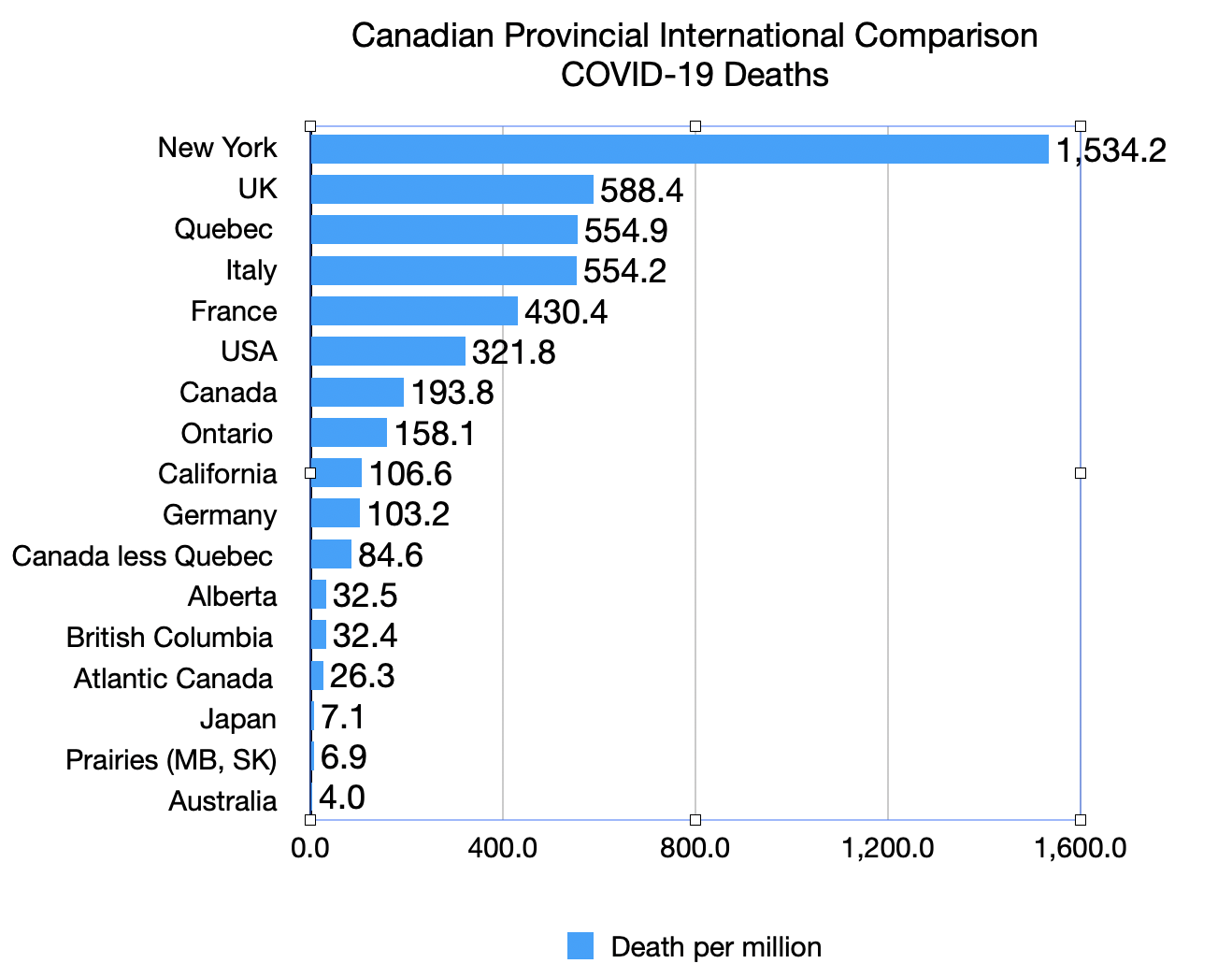
#COVID-19: Comparing provinces with other countries, Quebec similar to worst hit European countries: June 3 Update

Quebec now has the third highest death rate per million:

Per Million

Jun 3

Population

Death

Infection

Death

Infection

New York 19.5 1,534.2 19,062.1

29,917

371,711

UK 66.5 588.4 4,176.5

39,127

277,738

Quebec 8.4 554.9 6,113.6

4,661

51,354

Italy 60.4 554.2 3,860.9

33,475

233,197

France 67.0 430.4 2,826.1

28,836

189,348

USA 326.7 321.8 5,544.2

105,147

1,811,277

Canada 37.8 193.8 2,426.1

7,326

91,705

Ontario 14.4 158.1 1,962.7

2,276

28,263

California 39.6 106.6 2,903.9

4,220

114,993

Germany 82.9 103.2 2,214.6

8,555

183,594

Canada less Quebec 29.3 84.6 1,288.7

2,665

40,351

Alberta 4.4 32.5 1,600.9

143

7,044

British Columbia 5.1 32.4 509.2

165

2,597

Atlantic Canada 2.4 26.3 612.9

63

1,471

Japan 126.5 7.1 133.1

900

16,834

Prairies (MB, SK) 2.6 6.9 361.9

18

941

Australia 25.2 4.0 286.5

102

7,221

‘Non-advertising’ hiring up due to feds’ new appointments policy, data shows

My latest – links below:

The new appointments policy allowing for greater flexibility in the hiring of federal public servants came into effect in April 2016, resulting in a greater number of “non-advertised” hiring compared to formal publicly advertised hiring processes and competitions.

The Public Service Commission has reported on an overall increase in non-advertised appointments to 34 per cent of hires in 2017-18 compared to 25 per cent in the previous fiscal year, reflecting the attractiveness of this easier way to staff. 2018-19 data shows a further increase to 35 per cent. Greater use of non-advertised staffing raises the potential risk of the “who you know” factor playing a greater role in hiring and this analysis aims to assess this potential risk.

Source: ‘Non-advertising’ hiring up due to feds’ new appointments policy, data shows (Hill Times)

pdf: TBS New Appointments Policy Impact, New Appointments Policy: Annex A Departmental Comparisons (clearer table than in the HT piece)

Quebec should reconsider immigration changes

On the non-competitiveness of recent Quebec changes to PEQ:

Recently announced reforms to the Quebec Experience Program should be reconsidered.

Since 2010, the Quebec Experience Program (or “PEQ” in French) has offered a fast-track to permanent residence for temporary foreign workers and international students that lived in Quebec. Such individuals could often get their Quebec Selection Certificate in around 20 business days, and then go ahead and submit their permanent residence application to the federal government.

This was excellent policy by Quebec.

Government research shows that such individuals integrate quickly into Canada’s economy and society since they are young, well-educated, speak English and French and have Canadian work experience.

In addition, it made sense for Quebec to fast-track their applications since unlike immigration candidates outside of Canada, such individuals are already here. It would be very inconvenient to have them leave Quebec when they have already established themselves in the province and are contributing to the economy as workers and consumers.

Problems with Quebec’s new work experience requirements

The province is increasing the work experience requirements that future applicants will need to obtain to become eligible for the PEQ.

Currently, a temporary foreign worker (TFW) needs 12 months of eligible Quebec work experience within the preceding 24 months of submitting their application to meet the PEQ’s criteria. Students do not need Quebec work experience to be eligible.

Quebec will now require 36 months of work experience from TFWs and between 12-24 months of work experience from foreign students (depending on their program of study in Quebec).

A benefit of the stricter PEQ criteria is it will help more Quebec Skilled Worker Program (QSWP) candidates immigrate to the province through its Arrima Portal.

Currently, highly-qualified QSWP candidates are not able to obtain permanent residence under what is a more competitive process than what PEQ applicants need to go through.

However, Quebec is now introducing stricter work experience requirements for the PEQ than what is currently in place nationally. This means it will become more difficult for foreign workers and students to obtain permanent residence in Quebec.

One may argue that this is a good thing, since those that do become immigrants (whether through the QSWP or QEP) are more likely to succeed in the province.

But, many of the foreign workers and students who are poised to succeed will be unlikely to meet the high bar that Quebec has set.

It is quite normal across Canada for federal and provincial programs to have work experience requirements in place for existing TFWs and international students that want to transition to permanent residence. However, typically, the Canadian work experience requirement is set at 12 months. Whether Quebec likes it or not, it is in competition with other provinces to attract and retain global talent.

If I am a province that is offering the same product (in this case, Canadian permanent resident status), what is the incentive for a prospective immigrant to go through more hurdles when neighbouring provinces offer that product at a much lower cost? (i.e., only 12 months of work experience required versus 24-36 months for TFWs and some international students in Quebec).

Quebec’s higher standards will disincentivize TFWs and students from choosing Quebec.

Such individuals will either choose to go to other provinces at the start of their Canadian immigration journey, or will leave Quebec and move to another province when they are ready to apply for permanent residence.

Even if an individual is motivated to remain in Quebec, it may prove difficult for them to obtain the work experience they may need to be eligible for the PEQ.

For instance, some TFWs such as International Exchange Canada participants have work permits that are valid for no more than two years. Employers may not be willing spend the time and money required to petition the government to provide such individuals with one or more work permits (e.g., a work permit that requires a Labour Market Impact Assessment or “LMIA”).

One other point on this front: in the short run, it will become even more challenging for candidates to meet the new work experience requirements due to the economic damage that is being caused by the coronavirus pandemic. 

New processing standard is also problematic

Quebec indicated that it will now seek to process PEQ applications within 6 months, rather than 20 business days, in order to harmonize its processing standard with the Quebec Skilled Worker Program.

Once again, Quebec is hurting its competitiveness since the quicker processing standard was one of the PEQ’s major selling points. Now, prospective immigration candidates may look to options outside of the province given that there will no longer be a significant advantage to applying to the PEQ.

Keep in mind that it was already taking nearly 23 months for PEQ candidates to obtain permanent residence (20 business days to get a Quebec Selection Certificate plus another 22 months for the federal government to process permanent residence applications).

Adding another fives months on top of that is unwise on its own, and even more so when you consider that successful Express Entry candidates are usually able to get permanent residence within six months.

A better solution would have been to identify how to reduce the length of time it takes Quebec to issue CSQs to QSWP candidates.

Changes come at a time when Quebec will need more immigration

No immigration program is perfect, and it is a good practice for Canada’s federal and provincial governments to seek reforms to their programs to help meet the country’s evolving economic and social needs.

However, not all reforms end up being beneficial.

In this case, time will likely prove that Quebec’s reforms are misplaced. By discouraging workers and students from remaining in the province due to uncompetitive work experience requirements and processing times, Quebec may end up with even lower immigration levels at a time when it will need higher immigration in the years to come due to its aging population and low birth rate.

This may be hard to fathom at the moment due to the COVID-19 crisis.

But, the crisis will eventually pass and Quebec will soon need more immigrants to complement its Quebec-born work force.

What better way of doing so, then by providing a fast-track to immigration for the workers and students that have already resided in Quebec and contributed for several years?

Source: Quebec should reconsider immigration changes

Facebook Employees Revolt Over Zuckerberg’s Hands-Off Approach To Trump, Twitter contrast

Needed backlash at what can only be described as business-motivated collusion, one that becomes harder and harder to justify from any perspective:

Facebook is facing an unusually public backlash from its employees over the company’s handling of President Trump’s inflammatory posts about protests in the police killing of George Floyd, an unarmed black man in Minneapolis.

At least a dozen employees, some in senior positions, have openly condemned Facebook’s lack of action on the president’s posts and CEO Mark Zuckerberg’s defense of that decision. Some employees staged a virtual walkout Monday.

“Mark is wrong, and I will endeavor in the loudest possible way to change his mind,” tweeted Ryan Freitas, director of product design for Facebook’s news feed.

“I work at Facebook and I am not proud of how we’re showing up,” tweeted Jason Toff, director of product management. “The majority of coworkers I’ve spoken to feel the same way. We are making our voice heard.”

The social network also is under intense pressure from civil rights groups, Democrats and the public over its decision to leave up posts from the president that critics say violate Facebook’s rules against inciting violence. These included a post last week about the protests in which the president said, “when the looting starts, the shooting starts.

Twitter, in contrast, put a warning label on a tweet in which the president said the same thing, saying it violated rules against glorifying violence.

The move escalated a feud with the president that started when the company put fact-checking labels on two of his tweets earlier in the week. Trump retaliated by signing an executive order that attempts to strip online platforms of long-held legal protections.

Zuckerberg has long said he believes the company should not police what politicians say on its platform, arguing that political speech is already highly scrutinized. In a postFriday, the Facebook CEO said he had “been struggling with how to respond” to Trump’s posts.

“Personally, I have a visceral negative reaction to this kind of divisive and inflammatory rhetoric,” he wrote. “I know many people are upset that we’ve left the President’s posts up, but our position is that we should enable as much expression as possible unless it will cause imminent risk of specific harms or dangers spelled out in clear policies.”

Zuckerberg said Facebook had examined the post and decided to leave it up because “we think people need to know if the government is planning to deploy force.” He added that the company had been in touch with the White House to explain its policies. Zuckerberg spoke with Trump by phone Friday, according to a report published by Axios.

While Facebook’s 48,000 employees often debate policies and actions within the company, it is unusual for staff to take that criticism public. But the decision not to remove Trump’s posts has caused significant distress within the company, which is spilling over into public view.

“Censoring information that might help people see the complete picture *is* wrong. But giving a platform to incite violence and spread disinformation is unacceptable, regardless who you are or if it’s newsworthy,” tweeted Andrew Crow, head of design for the company’s Portal devices. “I disagree with Mark’s position and will work to make change happen.”

Several employees said on Twitter they were joining Monday’s walkout.

“Facebook’s recent decision to not act on posts that incite violence ignores other options to keep our community safe,” tweeted Sara Zhang, a product designer.

In a statement, Facebook spokesman Joe Osborne said: “We recognize the pain many of our people are feeling right now, especially our Black community. We encourage employees to speak openly when they disagree with leadership. As we face additional difficult decisions around content ahead, we’ll continue seeking their honest feedback.”

Less than 4% of Facebook’s U.S.-based staff are African American, according to the company’s most recent diversity report.

Facebook will not make employees participating in the walkout use paid time off, and it will not discipline those who participate.

On Sunday, Zuckerberg said the company would commit $10 million to groups working on racial justice. “I know Facebook needs to do more to support equality and safety for the Black community through our platforms,” he wrote.

Source: Facebook Employees Revolt Over Zuckerberg’s Hands-Off Approach To Trump

And Kara Swisher’s call for Twitter to take Trump off the platform:

C’mon, @Jack. You can do it.

Throw on some Kendrick Lamar and get your head in the right space. Pour yourself a big old glass of salt juice. Draw an ice bath and fire up the cryotherapy pod and the infrared sauna. Then just pull the plug on him. You know you want to.

You could answer the existential question of whether @realDonaldTrump even exists if he doesn’t exist on Twitter. I tweet, therefore I am. Dorsey meets Descartes.

All it would take is one sweet click to force the greatest troll in the history of the internet to meet his maker. Maybe he just disappears in an orange cloud of smoke, screaming, “I’m melllllllting.”

Do Trump — and the world — a favor and send him back into the void whence he came. And then go have some fun: Meditate and fast for days on end!

Our country is going through biological, economic and societal convulsions. We can’t trust the powerful forces in this nation to tell us the truth or do the right thing. In fact, not only can we not trust them. We have every reason to believe they’re gunning for us.

In Washington, the Trump administration’s deception about the virus was lethal. On Wall Street and in Silicon Valley, the fat cats who carved up the country, drained us dry and left us with no safety net profiteered off the virus. In Minneapolis, the barbaric death of George Floyd after a police officer knelt on him for almost nine minutes showed yet again that black Americans have everything to fear from some who are charged with protecting them.

As if that weren’t enough, from the slough of our despond, we have to watch Donald Trump duke it out with the lords of the cloud in a contest to see who can destroy our democracy faster.

I wish I could go along with those who say this dark period of American life will ultimately make us nicer and simpler and more contemplative. How can that happen when the whole culture has been re-engineered to put us at each other’s throats?

Trump constantly torques up the tribal friction and cruelty, even as Twitter and Facebook refine their systems to ratchet up rage. It is amazing that a septuagenarian became the greatest exploiter of social media. Trump and Twitter were a match made in hell.

The Wall Street Journal had a chilling report a few days ago that Facebook’s own research in 2018 revealed that “our algorithms exploit the human brain’s attraction to divisiveness. If left unchecked,” Facebook would feed users “more and more divisive content in an effort to gain user attention & increase time on the platform.”

Mark Zuckerberg shelved the research.

Why not just let all the bots trying to undermine our elections and spreading false information about the coronavirus and right-wing conspiracy theories and smear campaigns run amok? Sure, we’re weakening our society, but the weird, infantile maniacs running Silicon Valley must be allowed to rake in more billions and finish their mission of creating a giant cyberorganism of people, one huge and lucrative ball of rage.

“The shareholders of Facebook decided, ‘If you can increase my stock tenfold, we can put up with a lot of rage and hate,’” says Scott Galloway, professor of marketing at New York University’s Stern School of Business.

“These platforms have very dangerous profit motives. When you monetize rage at such an exponential rate, it’s bad for the world. These guys don’t look left or right; they just look down. They’re willing to promote white nationalism if there’s money in it. The rise of social media will be seen as directly correlating to the decline of Western civilization.”

Dorsey, who has more leeway because his stock isn’t as valuable as Facebook’s, made some mild moves against the president who has been spewing lies and inciting violence on Twitter for years. He added footnotes clarifying false Trump tweets about mail-in ballots and put a warning label on the president’s tweet about the Minneapolis riots that echo the language of a Miami police chief in 1967 and segregationist George Wallace: “When the looting starts, the shooting starts.”

“Jack is really sincerely trying to find something to make it better,” said one friend of the Twitter chief’s. “He’s like somebody trapped in a maze, going down every hallway and turning every corner.”

Zuckerberg, on the other hand, went on Fox to report that he was happy to continue enabling the Emperor of Chaos, noting that he did not think Facebook should be “the arbiter of truth of everything that people say online.”

It was a sickening display that made even some loyal Facebook staffers queasy. As The Verge’s Casey Newton reported, some employees objected to the company’s rationale in internal posts.

“I have to say I am finding the contortions we have to go through incredibly hard to stomach,” one wrote. “All this points to a very high risk of a violent escalation and civil unrest in November and if we fail the test case here, history will not judge us kindly.”

Trump, furious that Dorsey would attempt to rein him in on the very platform that catapulted him into the White House, immediately decided to try to rein in Dorsey.

He signed an executive order that might strip liability protection from social media sites, which would mean they would have to more assiduously police false and defamatory posts. Now that social media sites are behemoths, Galloway thinks that the removal of the Communications Decency Act makes a lot of sense even if the president is trying to do it for the wrong reasons.

Trump does not seem to realize, however, that he’s removing his own protection. He huffs and puffs about freedom of speech when he really wants the freedom to be vile. “It’s the mother of all cutting-off-your-nose-to-spite-your-face moves,” says Galloway.

The president wants to say things on Twitter that he will not be allowed to say if he exerts this control over Twitter. In a sense, it’s Trump versus his own brain. If Twitter can be sued for what people say on it, how can Trump continue to torment? Wouldn’t thousands of his own tweets have to be deleted?

“He’d be the equivalent of a slippery floor at a store that sells equipment for hip replacements,” says Galloway, who also posits that, in our hyper-politicized world, this will turn Twitter into a Democratic site and Facebook into a Republican one.

Nancy Pelosi, whose district encompasses Twitter, said that it did little good for Dorsey to put up a few fact-checks while letting Trump’s rants about murder and other “misrepresentations” stay up.

“Facebook, all of them, they are all about making money,” the speaker said. “Their business model is to make money at the expense of the truth and the facts.” She crisply concluded that “all they want is to not pay taxes; they got their tax break in 2017” and “they don’t want to be regulated, so they pander to the White House.”

C’mon, Jack. Make @realDonaldTrump melt to help end our meltdown.

Source: Think Outside the Box, Jack


China could keep dual citizenship Canadians from leaving Hong Kong amid protests: lawyer

Legitimate worry:

A Canadian legal activist is warning the federal government to grant asylum to democracy activists in Hong Kong and expanded settlement to those with links to Canada before China prevents them from leaving.

The warning came Monday from Avvy Go, the director of the Chinese and Southeast Asian Legal Clinic, which has already helped bring Hong Kong pro-democracy activists to Canada.

There are 300,000 Canadians of Hong Kong descent in China, and Go says if Ottawa doesn’t act now to accommodate those who want to leave, Beijing will prevent them from leaving in the future.

“The time to act is now. As China continues to crack down on the democracy movement in Hong Kong, it may soon find ways to prohibit Hong Kong activists from leaving that city, period,” Go said Monday at a joint video press conference hosted by Amnesty International.

“Even with those who are Canadian citizens, China may refuse to recognize their dual citizenship status and deny their exit from Hong Kong.”

MPs from the four major Canadian political parties and one independent senator stood in solidarity with the proposals Go put forward at a virtual press conference convened by Amnesty International.

Canada, along with the United States, Britain and Australia, have condemned Beijing’s imposition of a new national security law that they say violates Hong Kong’s freedom from Chinese communist interference.

“This is the Beijing government’s most breathtaking, threatening and callous attack yet … discarding any pretence of fulfilling China’s international promises made when Hong Kong was handed over in 1997,” said Alex Neve, the secretary general of Amnesty’s Canadian branch.

Go called on the federal government to implement several immigration and asylum measures, to help people get out of Hong Kong before it is too late. They are:

— Expediting family sponsorship applications by Canadians with spouses and parents in Hong Kong.

— Expanding family-reunification sponsorship programs beyond parents and spouses.

— Issuing more temporary-resident permits, work visas and student visas.

— Granting refugee status to democracy advocates, and offering them stepped-up resettlement options.

Last year, Hong Kong residents took to the streets in mass protests against a proposed extradition law from Beijing that was eventually abandoned.

During that unrest, Go’s clinic received requests from Canadians of Hong Kong descent whose relatives participated in pro-democracy protests, she said.

Since Beijing announced the new security law, the clinic is getting calls from Canadians who are worried about their families even though they may not have been involved with the democracy movement, said Go.

“These are our people. And as parliamentarians dedicated to promoting and protecting democracy, we cannot stand by silently. I endorse all of the actions,” said Independent Sen. Marilou McPhedran.

McPhedran said she has travelled across Africa and seen the effect of China’s massive development spending, an influence-buying effort that many analysts say is a power play by Beijing’s ruling communist party.

“The weaponization of economic support is something that we need to understand better as we look at what is happening in Hong Kong,” said McPhedran.

“The violation of the Hong Kong Basic Law, which is the essence of what China is saying it is going to do, is in fact a precursor to threats to democracies in many other countries as well.”

Conservative MP Kenny Chiu, who was born in Hong Kong, said the people of his homeland respect human rights and the rule of law, and they are prepared to commemorate Thursday’s anniversary of the Tiananmen Square massacre that saw the Chinese army kill scores of pro-democracy student protesters in 1989.

“We’re witnessing in Hong Kong basic dictatorship in disguise, exerting its power out of fear for these values,” said Chiu.

Source: China could keep dual citizenship Canadians from leaving Hong Kong amid protests: lawyer