September immigration impact of #COVID19
2021/11/20 Leave a comment
Latest monthly update:
Working site on citizenship and multiculturalism issues.
2021/11/19 Leave a comment
Striking. One of the disadvantages of IRCC’s shift to monthly stats was the elimination of regular reports on backlogs, and in the case of citizenship, application data. So having this information fills a needed gap in understanding IRCC’s operational challenges.
For citizenship, highest previous backlog was 323,000 in 2012, impact of Discover Canada study guide and related knowledge test, along with cutbacks in citizenship processing capacity in a government-wide program review exercise:
IRCC’s backlog stands at almost 1.8 million immigration applications.
CIC News has received data from Immigration, Refugees and Citizenship Canada (IRCC) showing the following number of applications in IRCC’s inventory as of October 27, 2021 (figures are rounded):
IRCC’s figures indicate their backlog has grown by nearly 350,000 applications since July.
In August, a report by Nicholas Keung of the Toronto Star showed that the backlog as of July 6, 2021 stood at about:
In an email to CIC News, an IRCC spokesperson explained “Ongoing international travel restrictions, border restrictions, limited operational capacity overseas and the inability on the part of clients to obtain documentation due to the effects of COVID-19 have created barriers within the processing continuum. This hinders IRCC’s ability to finalize applications, creating delays that are outside IRCC’s control.”
At the same time, the spokesperson acknowledged the challenges that applicants are facing, noting “Despite our efforts, we know that some applicants have experienced considerable wait times with the processing of their applications, and we continue to work as hard as possible to reduce processing times. We thank them for their patience and understanding at this moment, and we look forward to welcoming them to Canada.”
IRCC also shared data on the number of applications it has processed during the pandemic:
2021/11/19 Leave a comment
Indeed. And good initiative to address equality and equity issues:
Some years ago, I learned that our local mosque refused to allow women to serve on the board. This sexist practice was also entrenched in the bylaws of the British Columbia Muslim Association for nearly four decades. Only Muslim men, it turned out, could be elected to the board, and only by Muslim men. When I asked the mosque and the BCMA if they would change their policies, they unequivocally refused.
But when I began to prepare a column about the issue, a lawyer reached out, asking me to refrain from speaking out. Why? There was concern that then-prime minister Stephen Harper and his Conservative government would use this information to go after mosques. “Not now – give us time,” came the plea.
“So, once the Liberals are elected, mosques will open their boards to women?” I asked. We both knew the answer.
Rather than address the discrimination within, some organizations have found it easier to simply ignore internal criticism, while silencing whistle-blowers with emotional blackmail: You’ll hurt the community by airing dirty laundry. The problem is that the laundry is piling up and the stench is getting unbearable, while those who can access the washing machine continue to refuse to do their chores.
The situation is especially acute for victims of violence and abuse. They are often pressed to keep matters quiet, and not file charges, so that the community won’t look bad in the eyes of the public. Meanwhile, there is little accountability of perpetrators. Those who do speak out are shamed as traitors, enablers of Islamophobia, or worse, as self-hating Muslims. Often, it is the voices of women that are silenced by these heavy-handed tactics. Consequently, justice is thrown under the bus of community self-censorship.
It’s why well-meaning institutions overreach in their attempts to stamp out a quantum of Islamophobia. The Toronto District School Board (TDSB), for instance, has yet to decide whether it will allow teenaged girls to participate in a book club event featuring Nadia Murad, a Yazidi woman who was enslaved, tortured and raped by members of the Islamic State. This courageous young woman refused to remain silent, and has even won the Nobel Peace Prize for her efforts to seek justice for her people. That she was assaulted by sadistic individuals acting under the cover of an inhumane interpretation of Islam is part of her truth, as is the fact that Muslims worldwide repudiate the Islamic State. The TDSB apparently fears that impressionable teens may not be able to distinguish between an extremist group and ordinary Muslims who are their friends and neighbours.
But here’s a thought: The Muslim community can simultaneously fight Islamophobia and address the ills within it. It is not, and should not be, a zero-sum game. Just as Muslims desire from others safety, freedom from discrimination, access to justice and the opportunity to thrive, they should work hard to ensure the same principles apply to those who are themselves Muslims. One cannot make demands and then plead indifference when asked to fulfill those same demands. As the Quran states in the chapter titled “Women”: “Oh you who believe. Stand firmly for justice, as witnesses to God, even though it is against yourselves, your family, the rich or the poor.”
Here’s another thought: Muslim women have the agency to improve their own lives. Their own history is replete with illustrious paradigms, including that of Khawlah bint Tha’labah, who challenged a cruel marital custom in 7th-century Arabia when no one else dared; her courageous stand led to its abolition. She is known as “al-Mujaadilah,” or “the woman who pleaded,” in the 58th chapter of the Quran. For 14 centuries, Khawlah has been a model for unwavering commitment to justice within.
In the coming weeks, the Mujaadilah Centre – founded on the noble example of Khawlah – will be launching. Its goal is to unapologetically address harms faced by Canadian Muslim women within their communities. This will include an in-depth analysis of the gender make-up of mosque boards across the country. And in 2022, the centre will address the controversial practice of polygamy here in Canada, by providing new legal research of the Criminal Code along with documentation of harm suffered by women and children.
There is hope on the horizon. A new generation of Muslims is demanding greater accountability of leadership. They will not turn a blind eye to discrimination and abuse within, since they understand that wrongdoings left unaddressed will only lead to worse outcomes. Too many lives have been destroyed for this to continue. This cohort is taking the lead on addressing taboos head-on. They will make a difference for the better.
In the meantime, let’s all strive for a better society – standing up for what is right, and forbidding what is wrong, across all communities.
2021/11/19 Leave a comment
Good critique of different appearance-based classifications compared to the official visible minority group classifications:
Avez-vous le teint pâle, clair, moyen ou foncé ? On apprend cette semaine que, selon les Services correctionnels du Québec (SCQ), la question est une manière tout à fait utile de classifier les personnes ayant été incarcérées dans la province. L’information a été rendue publique dans une note de l’Institut de recherche et d’informations socioéconomiques (IRIS), grâce à une demande d’accès à l’information.
La ministre de la Sécurité publique, Geneviève Guilbault, a défendu la pratique à la suite de la publication de l’étude. Elle aurait déclaré au Soleil ne déceler aucun signe de racisme dans la pratique et assuré que ce ne sont que des informations collectées et utilisées à l’interne, avec d’autres caractéristiques physiques, « pour des situations très particulières où l’on doit absolument identifier quelqu’un, exemple une évasion ou un risque d’évasion ».
Prenons la ministre au pied de la lettre. Il pourrait aussi être utile, selon cette logique, de classifier aussi la texture des cheveux des prisonniers sur une échelle similaire à quatre niveaux : les cheveux droits, les ondulés, les bouclés et les crépus. On pourrait même créer une échelle pour les nez, d’aquilin à camus. Et si l’État collectait les tailles de soutien-gorge des prisonnières pour mieux les distinguer de profil, en cas d’évasion ou de risque d’évasion ?
La pratique des SCQ est absurde, mais pas seulement ça : on a aussi affaire à de l’obscurantisme. Il est en effet important d’avoir des données démographiques précises sur les personnes judiciarisées au Québec pour savoir sur quelles parties de la population les effets du système pénal sont les plus importants. Lorsque Statistique Canada collecte des données sur différentes « minorités visibles », il ne s’agit pas de mesurer des caractéristiques biologiques comme le teint, mais bien de comprendre des identités et des différences sociales. Les données du recensement nous montrent où se concentrent la pauvreté et la richesse dans le pays, par exemple, et comment la discrimination influence les inégalités.
Il serait pertinent de savoir quelles communautés racisées sont les plus ciblées par la justice criminelle au Québec. Mais parce que les SCQ ont inventé leur propre système plutôt que de suivre le recensement, on ne peut qu’en arriver à des approximations. Il y a 13 % de minorités visibles au Québec et 33 % de « moyens » et de « foncés » parmi les personnes ayant été incarcérées au Québec, selon l’étude de l’IRIS. Si les deux catégories étaient équivalentes, on pourrait calculer que les minorités visibles sont 2,6 fois plus représentées dans nos prisons. Mais puisqu’il y a très certainement des minorités catégorisées comme « claires », on a là affaire à une grossière sous-estimation de la réalité. On sait donc que la justice criminelle cible disproportionnellement les minorités au Québec, mais pas à quel point, ni précisément lesquelles. Hourra pour la pseudoscience sociale !
Quelle différence cette imprécision fait-elle ? On le voit en se penchant sur les chiffres plus justes rendus publics sur les personnes autochtones, lesquelles font l’objet d’un recensement statistique à part. Toujours selon l’étude de l’IRIS, on voit que les personnes autochtones constituent 6,6 % des admissions en services correctionnels alors qu’elles ne forment que 2,3 % de la population. Elles sont donc 2,9 fois plus représentées parmi les personnes judiciarisées, une donnée qui permet de contextualiser tous les témoignages sur les relations difficiles entre les policiers et les communautés autochtones collectés lors de la commission Viens, par exemple.
Avec les données précises par communauté, on peut aussi voir que 40,5 % de tous les Autochtones judiciarisés sont des Inuits. Il semble donc y avoir un problème particulièrement criant dans les rapports entre les communautés inuites et le système de justice criminelle. La surreprésentation vient-elle de pratiques policières particulièrement agressives dans le Nunavik ? La judiciarisation accrue des personnes en situation d’itinérance à Montréal a-t-elle eu un impact majeur sur cette donnée ? Il faudrait fouiller, poser plus de questions. Avec cette statistique effarante, il y a matière à s’inquiéter, voire à enquêter.
De même, l’étude montre que le système pénal punit disproportionnellement les personnes déjà précaires. Ainsi, 85 % des nouveaux admis aux SCQ sont peu scolarisés (niveau primaire ou secondaire seulement). De plus, 50 % des hommes et 68,5 % des femmes nouvellement judiciarisés en 2019-2020 tiraient leurs revenus de l’assistance sociale, alors que seulement 5 % de la population générale en bénéficie. Ces chiffres, qui ne sont pas nouveaux, devraient nous inciter à réfléchir de toute urgence aux conséquences de la concentration de la surveillance policière auprès des pauvres.
Les statistiques nous permettent aussi de comprendre l’effet réel de la discrimination à l’emploi selon le casier judiciaire sur la capacité des anciens détenus à se réinsérer avec succès en société après leur incarcération. Les taux de récidive étant nettement plus élevés chez les personnes judiciarisées qui n’arrivent pas à se retrouver un emploi, on peut se demander si les préjugés des employeurs envers les personnes qui ont un casier ne constituent pas carrément un problème pour la sécurité publique. Surtout que 85 % des condamnations au Québec ne visent pas des « infractions contre la personne » : l’association automatique entre personne criminalisée et personne « violente », qui subsiste dans l’imaginaire, ne passe donc pas l’épreuve des faits.
Ah, les faits ! Lorsqu’on les collecte de manière sensée, comme la réalité sociale nous apparaît plus « claire » ! Vous m’excuserez pour le mauvais jeu de mots.
2021/11/19 Leave a comment
Of note:
In a major shift for a country long closed to immigrants, Japan is looking to allow foreigners in certain blue-collar jobs to stay indefinitely starting as early as the 2022 fiscal year, a justice ministry official said on Thursday.
Under a law that took effect in 2019, a category of “specified skilled workers” in 14 sectors such as farming, construction and sanitation have been allowed to stay for up to five years, but without their family members.
The government had been looking to ease those restrictions, which had been cited by companies as among reasons that they were hesitant to hire such help.
If the revision takes effect, such workers — many from Vietnam and China — would be allowed to renew their visas indefinitely and bring their families with them, as the other category of more skilled foreigners are allowed to do now.
Immigration has long been taboo in Japan as many prize ethnic homogeneity, but pressure has mounted to open up its borders due to an acute labor shortage given its dwindling and ageing population.
“As the shrinking population becomes a more serious problem and if Japan wants to be seen as a good option for overseas workers, it needs to communicate that it has the proper structure in place to welcome them,” Toshihiro Menju, managing director of think tank Japan Center for International Exchange, told Reuters.
The 2019 law was meant to attract some 345,000 “specified skilled workers” over five years, but the intake has hovered at around 3,000 per month before the Covid-19 pandemic sealed the borders, according to government data.
As of late 2020, Japan housed 1.72 million foreign workers, out of a total population of 125.8 million and just 2.5% of its working population.
Source: Japan looking to allow more foreigners to stay indefinitely in a major immigration policy shift
2021/11/19 Leave a comment
Of note:
A group of universities and colleges from across Canada are signing a charter to fight anti-Black racism in post-secondary institutions.
The 22-page document requires those signing it to respect certain principles as they develop their own action plans to foster Black inclusion.
Referred to as the Scarborough Charter, the document was drafted by an advisory committee that emerged from an event hosted by the University of Toronto last year as anti-Black racism was in the international spotlight.
“There was an opportune moment for us to say, ‘well, there are a lot of statements being issued, but this may be the time for us to come together and do this together,” charter committee chair Wisdom Tettey said in an interview.
The committee asked universities and colleges for their feedback to refine the charter and met with several organizations and groups, including Universities Canada and the parliamentary Black caucus, said Tettey, vice-president of the University of Toronto.
Forty-six universities and colleges, including the country’s largest post-secondary institutions, are signing the charter virtually on Thursday.
They include the University of Toronto, McGill University, York University, the University of British Columbia, the University of Calgary and the University of Waterloo.
Tettey said more universities and colleges are expected to sign the charter in the near future. There are 96 publicly-funded universities and 139 publicly-funded colleges in Canada.
“We expect each partner institution to commit to the principles of black flourishing,” Tettey said.
“The idea of black flourishing is to make sure that our institutions are places where Black people, faculty, staff, students and community members can feel a sense of belonging, can see themselves in our mission and can be supported to flourish.”
At the University of Toronto, part of the school’s plan to remove barriers faced by Black students includes providing better mental-health support for them, Tettey said.
“We’re making sure that we have counsellors that understand and come from Black communities,” he said.
The university is also reviewing curriculums to ensure Black knowledge is reflected, and is supporting Black students through scholarships and access programs.
Ananya Mukherjee Reed, the provost of the University of British Columbia, said Black students face the same barriers at post-secondary institutions that exist in society at large.
“They go to a class and they feel alone. They’re either the only black student or one of the very few black students,” she said.
“They don’t always feel that they have a voice and when they sometimes express the voice or they would point out something in relation to the Black experience or Black history, they’re not always heard. They often feel dismissed.”
Curriculums in many universities don’t reflect Black experiences or Black successes, she said.
“Black authors are often absent from curriculum and that creates a sense of alienation when you are alone in a classroom, and then you are studying something that you feel is missing a perspective.”
Malinda Smith, the vice-president of the University of Calgary, said there are also few Black scholars in the faculties of Canadian universities.
Statistics Canada census data from 2016 and data from a 2019 Universities Canada report indicate six per cent of undergraduate students, 6.1 per cent of graduate students, and three pre cent of PhD graduates are Black, while 1.9 per cent of the professoriate at universities and 0.8 per cent of universities’ leaders are Black, Smith said.
“There’s a significant underrepresentation. I’m the only Black senior leader at the University of Calgary,” she said, adding that universities need to deal with barriers and biases that may prevent Black scholars from being hired.
“We have to recognize systemic racism, and we have to recognize racial biases.”
Robert Summerby-Murray, the president of St. Mary’s University in Halifax said engaging local Black communities in research conducted by universities is also an important step to address anti-Black racism.
“Part of what we have done in the charter, I believe, is acknowledge a set of Eurocentric and colonial processes inside the academy,” he said.
“Here in Nova Scotia, we have a very important historical African Nova Scotian community … that has been in this province for hundreds of years. And these communities need to be engaged as partners in research.”
Source: Canadian universities, colleges sign charter to address anti-Black racism
2021/11/18 Leave a comment
Valid criticism of low level fines and other issues related to recruiting agencies:
Ontario’s proposed changes to employment law would not protect vulnerable migrant workers from unscrupulous recruiters and employers, and need more teeth to work for the workers, say advocates.
Professional recruiters play a key role in the transnational recruitment of migrant workers for employment in Ontario’s agricultural sector, fisheries, food supply, transportation, tourism, as well as in-home personal care and support services.
Last month, Labour Minister Monte McNaughton introduced Bill 27. The omnibus legislation includes policy changes meant to remove barriers for immigrants to get licensed in a regulated profession; require temporary help agencies to be licensed; and compel businesses to let delivery drivers use their washrooms, among other things.
Dubbed the Working for Workers Act, the bill, currently under review by a provincial standing committee, would also require recruiters to be licensed in a public registry and be responsible for repaying workers any illegal fees charged here or abroad.
The consequence of non-compliance for the recruiter would be the revocation of their licence and a possible fine under $300 for a first offence, critics point out.
Although employers would be required to use licensed recruiters, they would only face a fine of $250 for using someone who’s not registered.
Advocates for migrants have been calling for the licensing of recruiters and recruitment agencies since 2008, but said the enforcement tools in the proposed legislation are inadequate because the fines for infractions are way too low to be deterrents.
“Recruiters, agencies and consultants use the promise of jobs that don’t exist and work conditions that don’t exist to lure workers to come to Canada,” said Syed Hussan, executive director of the Migrant Workers’ Alliance for Change. “Once they’re here, they’re so indebted they’re unable to protect themselves and defend themselves.
“This has been a well-documented issue. Now, the rest of the country has moved forward. Ontario has frankly not created any effective legislation to protect migrant workers from exploitative recruiters. As the bill stands, this will simply be window dressing, half-baked.”
According to Hussan, six provinces — Alberta, Quebec, British Columbia, Saskatchewan, Manitoba and Nova Scotia — have already adopted mandatory licensing programs, requiring a security deposit between $5,000 and $25,000 from recruiters; most also have a registry for employers who hire migrant workers. Fines for employers for using an unlicensed recruiter can go up to $50,000 in Manitoba. A registry would enable proactive inspections.
Deena Ladd of the Workers’ Action Centre said Ontario must follow the other jurisdictions to hold employers equally responsible to make sure they use recruiters that do not charge illegal fees.
“This would not compel an employer to use a licensed recruiter if all you are required is a $250 fine,” she said. “It’s really the employers who use the recruitment agencies in the first place that drive this whole business model. It is their demand for migrant workers that creates a supply chain.
“We need to make sure employers are jointly and severally liable so they’re responsible when they use these recruitment agencies.”
Advocates are asking for a minimum fine of $15,000 against employers who fail to use a licensed agency, as well as a security bond of no less than $25,000 against licensed recruiters.
Ladd said a mandatory registry of employers who hire migrant workers is crucial.
“In our experience, we see employers who violate employment standards and continue to hire workers, only to repeat the violations, such as unpaid hours of work, overtime and illegal deductions,” said Ladd.
“Mandatory employer registration would enable the Ministry of Labour to conduct effective, targeted, proactive inspections as it will have all the information they need to do so.”
Also under this bill, Hussan said the onus is on the migrant workers to prove they have paid a recruitment fee or have been exploited. But recruiters have become so savvy that they now leave little paper trail.
“We need to reverse the onus so that workers don’t have to prove that they are being charged illegal fees, but employers and recruiters must prove that the charging doesn’t happen,” he said.
Source: ‘Half-baked’ Bill 27 won’t protect migrant workers from exploitative recruiters, say advocates
2021/11/18 Leave a comment
Useful background:
Naturalization is perhaps the most powerful marker of immigrants’ integration, as they take the fullest step towards participation in the civic life of their new country by becoming citizens. In the United States, naturalized citizens have the same privileges and responsibilities as U.S.-born citizens, including the right to vote and similar access to government benefits and public-sector jobs. They also receive the ability to sponsor immediate family members for immigration and cannot be deported.
More than 613,700 immigrants naturalized during fiscal year (FY) 2020, fewer than at any other point in the last decade. This decline may be partly due to impacts of the COVID-19 pandemic, including delayed oath ceremonies; the FY 2020 number represented a 27 percent decline from the 843,600 naturalizations the prior year, which marked the largest number since FY 2008 (see Figure 1). Notably, trends for new naturalized citizens do not necessarily follow those for new lawful permanent residents (LPRs). Overall, there were 23.2 million naturalized U.S. citizens in the United States in 2019, the most recent reporting available, making up 52 percent of the overall immigrant population, which stood at 44.9 million.
Figure 1. New Naturalizations and New Lawful Permanent Residents, FY 1980-2020
Source: MPI tabulation of data from U.S. Department of Homeland Security (DHS), Yearbook of Immigration Statistics (Washington, DC: DHS Office of Immigration Statistics, various years), available online; DHS, “Legal Immigration and Adjustment of Status Report Fiscal Year 2020, Quarter 4,” accessed July 30, 2021.
In recent years, institutional factors such as processing times and case backlogs have affected the number of annual naturalizations, as have financial constraints in meeting the citizenship application fee of $725 and immigrants’ personal decisions about whether to apply. While the number of new naturalized citizens has fluctuated each year, processing wait times have increased. The average processing time for N-400 applications for naturalization increased to 11.5 months in FY 2021, up from 9.1 months in FY 2020 and about 10 months in FY 2019.
In order to become a citizen, applicants must meet a set of requirements outlined in the Immigration and Nationality Act. These include maintaining lawful permanent residence, also known as getting a green card, for several years (generally five, though a green-card holder married to a U.S. citizen can naturalize after three years), proving basic proficiency in English and knowledge of U.S. history and government, and passing a background check to demonstrate good moral character. In addition to legal benefits, naturalized citizens also tend to have better economic outcomes than other immigrants, including higher incomes and rates of homeownership.
Using the most recent available data from the U.S. Department of Homeland Security (DHS) Office of Immigration Statistics, the U.S. Census Bureau (the most recent 2019 American Community Survey [ACS]), and other sources, this Spotlight provides information on new naturalized citizens in the United States, including historical trends, characteristics of naturalized citizens, and the population potentially eligible for naturalization.
Source: http://my.migrationpolicy.org/salsa/track.jsp?v=2&c=RWMKmxNCrz2UlS%2FeRjM5hkPuFzZ27T2g
2021/11/18 Leave a comment
Preliminary analysis. Will be interesting to see what others come up with such as the Canada Election Study. As it is likely that COVID and vaccination will not be a top issue (we hope!) in the next election, likely the PPC will focus on immigration and other related issues, and their advocacy for more restrictive policies:
At first glance, the 2021 federal election appears to have changed very little. Each party was returned to the House of Commons with about as many seats as it had previously held.
Beneath the surface, however, some shifts occurred. Most notably, while the People’s Party of Canada failed to win any seats, its share of the popular vote grew to five per cent — more than double what it earned two years earlier.
The PPC’s support is small yet not easily dismissed. The 841,000 votes it earned makes it the fifth most popular party in the country, well ahead of the Greens (who have appeared on the ballot, addressing the prominent issue of climate change, for decades). The People’s Party won three times more votes than the Reform Party did when it first fielded candidates in 1988, one election prior to its breakthrough in 1993.
Understanding exactly what to make of the PPC’s growing support is especially important for the leadership of the Conservative Party of Canada. If PPC voters are former Conservative supporters disappointed with the party’s attempt to appeal to middle-of-the-road, suburban Canadians, it signals a serious dilemma — each voter the Conservatives gain by moving to the centre could be matched by a right-leaning voter lost to the PPC.
What, then, do we know about PPC voters? At first glance, our fall 2021 survey shows PPC voters have the profile many would expect. They’re dissatisfied with the way things are going in our country today, feel the economy is getting weaker, think there are too many immigrants coming to Canada who don’t adopt the country’s values and hold a favourable opinion of the United States.
Yet these opinions do not really set them apart. Most Conservative Party supporters also hold these views. What does distinguish current PPC voters is their views on the COVID-19 pandemic, and specifically on the issue of vaccination, vaccine mandates and vaccine passports.
Our survey, conducted during the 2021 election campaign, asked Canadians to identify the most important problem facing the country today.
Both Liberal and Conservative Party supporters were most likely to mention the COVID-19 pandemic in general. Climate change was most likely to be mentioned as the most important problem by NDP, Bloc Québécois and Green Party supporters.
But for PPC supporters, the No. 1 issue was the loss of freedom stemming from vaccine mandates — a concern barely mentioned by anyone who supported other parties.
A more rigorous analysis of the survey results, which tests the significance of different factors while holding others constant, confirms the importance of vaccination issues to current PPC voters.
Someone who singled out “loss of freedom” during the pandemic as the most important issue facing the country had a 59 per cent chance of supporting the PPC, compared to only a five per cent chance for someone who mentioned any other issue.
Similarly, someone who singled out “COVID-19 vaccination issues” as the most important issue facing the country had a 44 per cent chance of supporting the PPC, compared to a six per cent chance for someone who mentioned any other issue.
This last example, furthermore, likely underestimates the impact of PPC voters’ irritation with vaccination requirements. It can be assumed that the very few number of Liberals who also singled out “COVID-19 vaccination issues” as the most important issue probably had something very different in mind — perhaps frustration with those who won’t get vaccinated — than their PPC counterparts.
Nonetheless, the main point is clear: voters concerned about the push to be vaccinated and what they perceive as a loss of freedom during the pandemic were much more likely to vote PPC than voters concerned about anything else.
Equally important is the finding that PPC voters stand out much less for their attitudes on immigration. The impact of immigration views on someone’s likelihood of supporting the PPC is barely significant, in stark contrast to their opinions on vaccination.
This does not mean that PPC voters are strong supporters of immigration; rather, it means simply that their views on the subject do not differentiate supporters of the PPC from supporters of some other parties — notably, the Conservatives.
Incidentally, it should be noted these findings apply only to Canadians indicating they intended to vote for the PPC, not to the party’s leadership, organizers or funders who may regard closing our borders to newcomers as more of a priority.
Nonetheless, the fact that the growth in PPC support is tied to the unusual issue of vaccination against COVID-19 is no guarantee that the party’s popularity will fade once the pandemic ends. Other issues may come along to take its place.
But it does send a cautionary note to Conservatives who might be wondering what the party can do to bring PPC voters back into the fold. Rejecting new policies on climate change or social diversity is unlikely to help so long as PPC supporters continue to be motivated largely by a single issue — their opposition to vaccines.
As the election outcome itself showed, showing flexibility on vaccine mandates in order to win back defectors to the PPC risks putting more distance between the Conservative Party and the mainstream of Canadian public opinion.
In short, PPC voters were not simply typical Conservative supporters leaning furthest to the right on a range of issues that include government spending, taxation, climate change and immigration. They were, on average, a unique cluster of voters who have rejected the overwhelming public consensus on the need to be vaccinated to contain the spread of COVID-19.
The growth potential for the Conservative Party lies not in chasing the small number of voters angered by vaccine mandates, but in appealing to the much larger pool of voters whose top priorities include bringing the pandemic to an end and refocusing attention on the fight against climate change.
Source: https://theconversationcanada.cmail19.com/t/r-l-triyyhjl-kyldjlthkt-n/
2021/11/18 Leave a comment
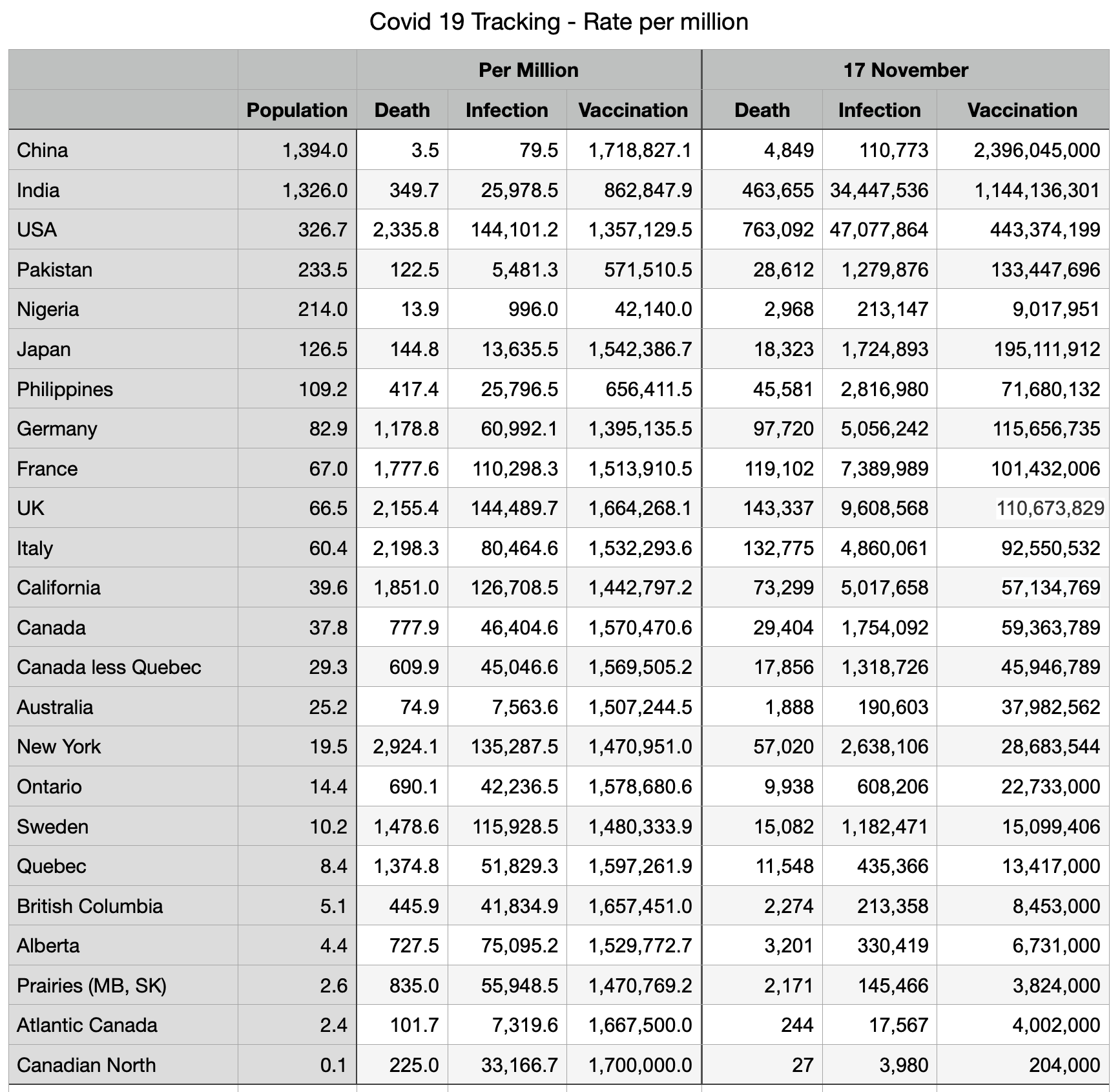
The latest charts, compiled 17 November. Canadians fully vaccinated 76.4 percent, compared to Japan 75.8 percent, UK 68.9 percent and USA 59.4 percent.
Vaccinations: Canadian North ahead of Atlantic Canada, UK and British Columbia, Sweden and New York ahead of Prairies. China fully vaccinated 76.8 percent, India 27.6 percent, Philippines 36.5 percent.

Infections: Recent trends of increased infections in Europe becoming more apparent. Canadian provincial trends showing minimal change from last week.
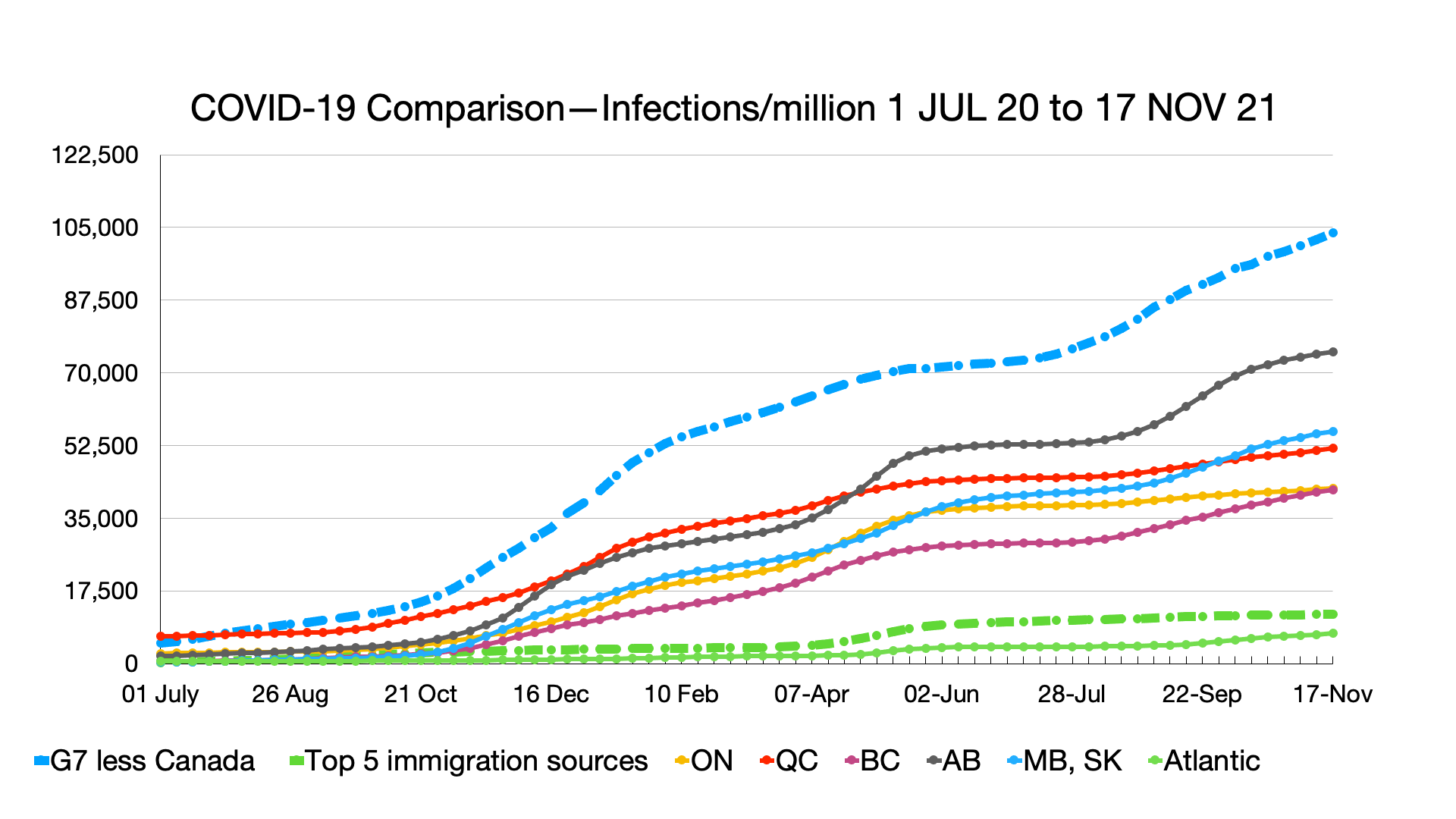
Deaths: Albert, Prairie and British Columbia deaths climb at slower à rate to G7 less Canada (driven mainly by USA).
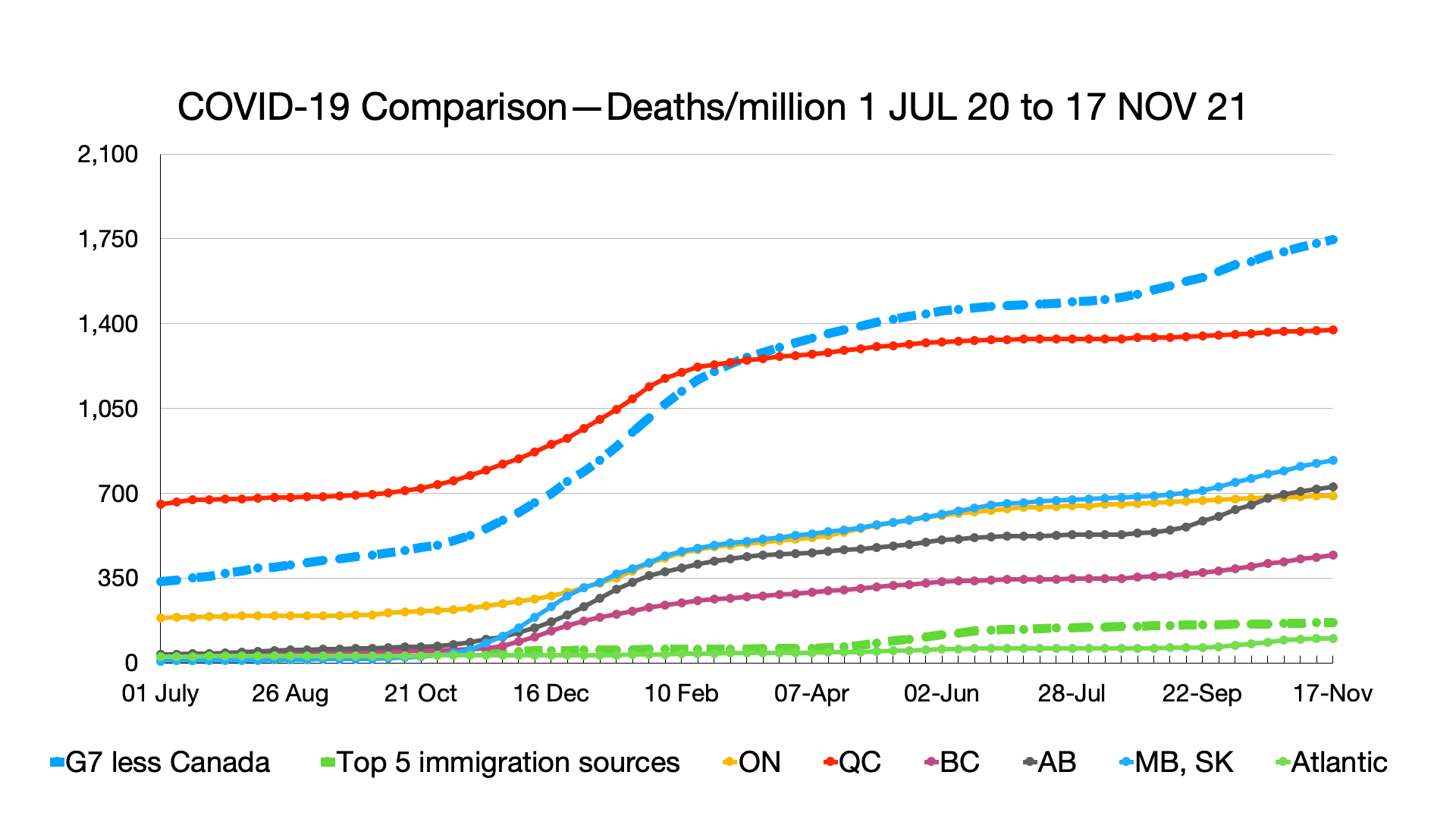
Vaccinations: Ongoing convergence among provinces and G7 less Canada and narrowing gap with immigration source countries.
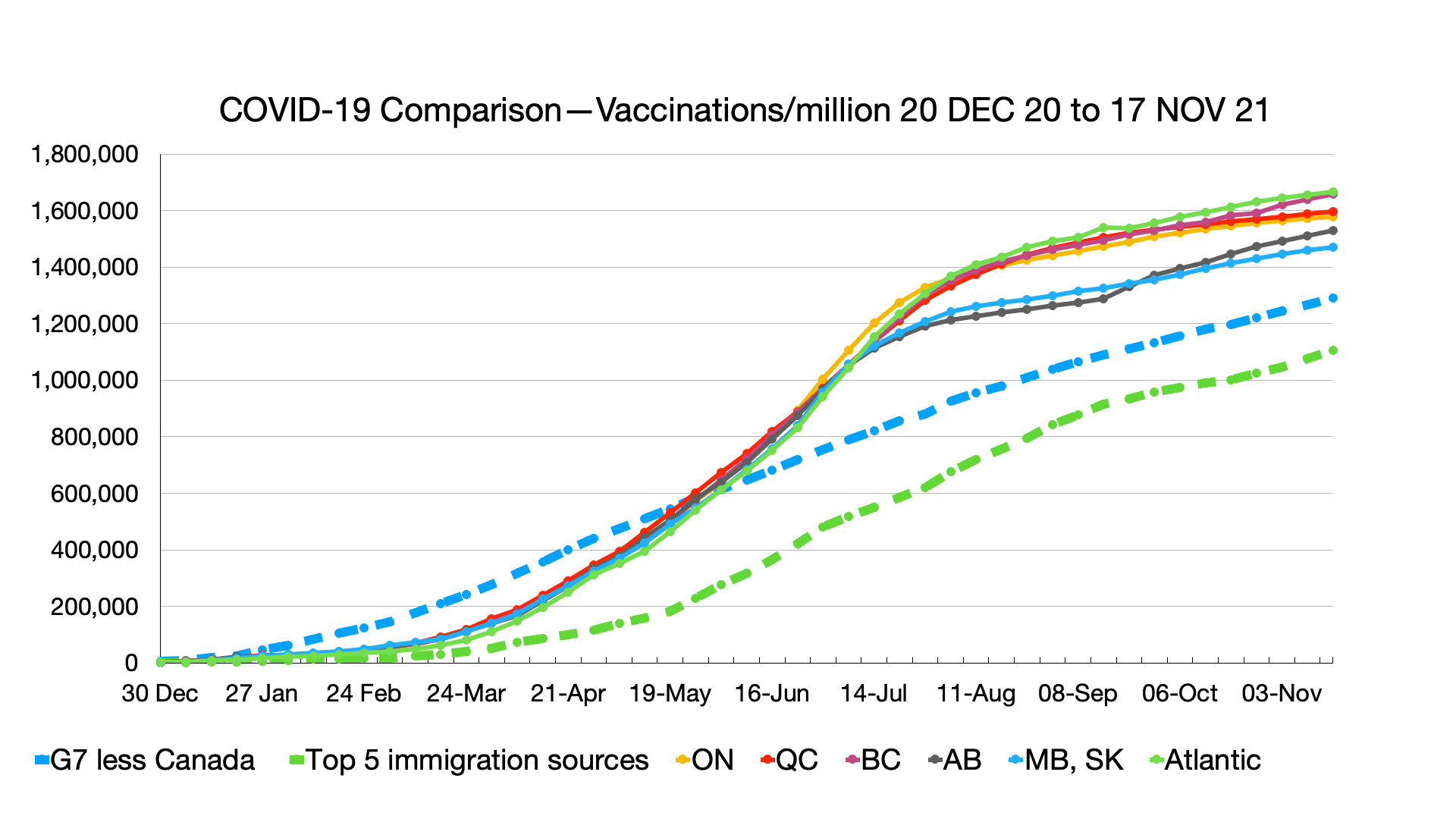
Infections: UK ahead of USA with no other relative change.

Deaths: No relative change

And an interesting article on cognitive bias and vaccine hesitancy:
The World Health Organization recognized vaccine hesitancy as a growing challenge in 2011, and identified it as a new priority topic. This was mostly because of the return of vaccine-preventable diseases like measles in Europe and the United States.
Ten years later, in 2021, we see that vaccine hesitancy has become an even more significant challenge despite all the efforts. The COVID-19 pandemic has brought it to a peak, and all efforts to manage the pandemic depend on the people’s willingness to take the vaccination. However, the numbers are not very promising as some percentage of populations in every country are reluctant to vaccinate.
Vaccine hesitancy means “delay in acceptance or refusal of vaccines despite availability of vaccination services.” Vaccine-hesitant people cite distrust in vaccine safety and concerns over vaccine adverse eventsas the most common reasons for reluctance to get vaccinated.
Vaccines are used in healthy people to prevent a disease that might harm them in the future. However, as they are healthy at the time of vaccination, they may worry about the vaccine’s safety.
Our team of business analytics and artificial intelligence researchers at Concordia University, along with a professor of epidemiology at McGill University, has published a paper in the BMC Public Health journal that investigated this critical concern from two perspectives.
First, we addressed vaccine safety concerns by analyzing data from vaccine adverse events systems. These are vaccine surveillance systems where adverse events following immunization are reported, monitored and stored in a database. Canada’s system is called the Canadian Adverse Events Following Immunization Surveillance System (CAEFISS).
Second, we focused on cognitive science and highlighted the critical role of cognitive biases in people’s vaccination decision-making that might lead to vaccine hesitancy.
A solution to mitigate distrust in vaccines safety is to provide evidence-based meaningful information about vaccine safety and adverse events. We followed this path and analyzed all the adverse events reported to the U.S. Vaccine Adverse Event Reporting System (VAERS).
We analyzed almost 294,000 reports over eight years from 2011 to 2018. It equals roughly 115 reports per million people, covering 87 vaccine types. The most frequently reported vaccines were those for chickenpox, influenza, pneumococcal bacteria and human pappilomavirus (HPV).
Each VAERS report (representing one incident) involved an average of three adverse events, the most common being rashes, fever, swelling, pain and headaches. Only 5.5 per cent of the reports were marked as serious, resulting in hospitalization, disability, threats to life or death. The top adverse events in this group also include fever, pain, vomiting, headaches and shortness of breath.
We also analyzed the vaccine adverse events reported to Canada Vigilance. Our findings were consistent with those from the VAERS.
We have provided our results in an interactive dashboard. Health-care professionals and others involved in vaccine communication can use this dashboard to provide evidence-based information to the public. Research suggests that summarized data is the best format for communicating vaccine safety information, so using this dashboard in vaccination communication can help mitigate vaccine hesitancy and safety concerns, and increase trust in vaccines.
In the second part of our study, after addressing concerns about vaccine adverse events, we examined the role of cognitive biases on vaccine hesitancy. We identified cognitive biases that might affect vaccine communication and decision-making.
As mentioned earlier, vaccines are administrated to healthy people. When people are making decisions about vaccination, they might feel some degrees of risk, ambiguity and uncertainty about the results, which can instigate cognitive biases in the decision-making process. Such cognitive biases might nudge people toward vaccine hesitancy.
For example, contrary to the positive effect of providing people with summarized vaccine safety information that increases vaccine trust, detailed vaccine adverse event reports will decrease trust because of two cognitive biases.
First, when vaccine hesitant people read a detailed report about a vaccine adverse event, it gives them the chance to see what they want to see. It is an example of confirmation bias, which is the tendency to recall and interpret information that confirms our existing beliefs.
Second, a detailed adverse event report will also increase the event’s vividness, making it easier to recall the next time there is a decision to be made about taking a vaccine. That is the effect of availability bias, the tendency to attribute more weight to factors that are easier to recall.
We identified 15 cognitive biases in the vaccine decision-making process and categorized them into three groups:
The full list of cognitive biases affecting vaccination decision-making and their examples is available here. Public health officials and practitioners can use this list and customize their plans, interventions and other forms of vaccine communication to decrease vaccine hesitancy.
You also can check the list and see if these biases have influenced your own vaccination decisions.
Source: https://theconversationcanada.cmail19.com/t/r-l-trtukldd-kyldjlthkt-b/

Click image for book purchase


