Doug Ford government scraps diversity hiring targets for transit projects

UPDATE: Reversed!

The Ontario government will no longer include hiring targets for disadvantaged groups in its agreements for provincial transit projects, a reversal of a groundbreaking policy intended to deliver jobs to marginalized communities where new lines are built.

Advocates warn the decision will undo years of progress toward bringing women, people of colour, and Indigenous and Black residents into the workforce, and raises questions about whether Premier Doug Ford’s subway program is eligible for federal funding.

The hiring targets were first included in a so-called community benefits agreement the previous Ontario Liberal government reached for the Eglinton Crosstown LRT in 2016, which was hailed at the time as setting a precedent that would inject funding, training and employment into neighbourhoods in need.

But the Toronto Community Benefits Network (TCBN), a coalition of labour and community groups, says the targets are being left out of plans already underway for Ontario’s $28.5-billion subway program, which consists of the Ontario Line, Yonge North Subway Extension, Scarborough Subway Extension, and Eglinton West LRT.

Metrolinx, the provincial agency responsible for transit construction in the GTA, will be “on the wrong side of history” if it scraps the hiring thresholds and other key aspects of the benefits framework, said Rosemarie Powell, executive director of TCBN.

The group is expressing “deep concern” about the province’s change of heart, which it says will undermine a program that has helped ensure people who get opportunities through public infrastructure investment “come from and reflect the diversity of local communities.”

Metrolinx is overseen by Ontario Minister of Transportation Caroline Mulroney. Asked why the province is dropping the hiring targets, the minister’s spokesperson Dakota Brasier said the province “will continue to facilitate a pathway for local communities to develop the skills and qualifications needed to find good-paying jobs in the sector.”

She said Ontario’s “historic” transit plans are on course to “generate thousands of jobs, create more connections for people across the province and boost our economy.”

The community benefits agreement signed by the province, Metrolinx, TCBN and the company building the Crosstown LRT six years ago set a target that 10 per cent of work hours for the project go to local groups that have historically faced employment barriers, like racialized residents, women and newcomers.

The target wasn’t a legal obligation under the LRT contract and was described as “aspirational,” but the signatories pitched it as a meaningful way to give hundreds of people from groups traditionally shut out of the construction industry a path to a decent career.

The Ontario government of the day said the agreement would serve as a framework for future projects, and a similar deal was struck for the Finch West LRT.

In addition to not including the 10 per cent hiring target in agreements for the new provincial subways, TCBN says Metrolinx hasn’t committed to other measures around consultation, transparency and local procurement that represent “a minimum standard” for a community benefits agreements.

In a Feb. 11 letter to the group, Metrolinx CEO Phil Verster confirmed the agency is taking a “different approach” to community benefits, but one that it believes will still deliver “the same objectives” and “meaningful change.”

Although it doesn’t include hiring targets, Verster wrote that Metrolinx’s strategy will provide local employment opportunities, require contractors to develop and report on apprenticeship and workforce development plans, and direct contractors to develop “shop local” campaigns and host trade shows to connect employers with job-seekers.

The agency is also committed to making public realm improvements and in some cases could provide amenities like community centres or affordable housing as part of transit projects.

Metrolinx spokesperson Fannie Sunshine said the “broader” approach will give the agency the “flexibility” required “to meaningfully engage” with communities, and allow it to “identify better opportunities.”

Powell acknowledged implementing the original agreement hasn’t been easy. Crosslinx, the private consortium building the Crosstown, hasn’t reached the 10 per cent hiring goal, and is instead hovering around five per cent, according to TCBN. A spokesperson for Crosslinx said she didn’t have up-to-date figures.

But Powell said Metrolinx has been a good partner on the benefits program to date, and she had expected the agency to address problems with the strategy, not weaken it.

“Don’t throw out the baby with the bathwater,” she said.

TCBN also points out that when the federal Liberal government announced more than $10 billion in financial support for Ford’s subway program in May 2021, it said the funding was dependent on the province satisfying a number of conditions, including community benefits agreements and “meeting employment thresholds for under-represented communities including Black, Indigenous, people of colour, and women.”

Sunshine said Metrolinx’s position is that the workforce development plans included in its new approach “will help to enable federal requirements.”

Zoltan Csepregi, a spokesperson for Infrastructure Canada, said community benefits agreements are still a condition of the funding, and the federal government will “work collaboratively with the government of Ontario to ensure that Metrolinx upholds these conditions.”

Source: Doug Ford government scraps diversity hiring targets for transit projects

Mintz: Reckoning With Inequality

Thoughtful analysis and discussion, along with some useful suggestions of how to approach inequality from a variety of lenses:

I was struck in the New York Times obituary of one of the great historians of race, Leon Litwack, by the casual and condescending way his landmark scholarship was dismissed. Sure, the article’s subtitle was positive: “One of Berkeley’s most popular professors, he brought passion and nuance—and a love for blues music—to his award-winning study of the marginalized and the oppressed.”

The obituary also mentioned that his scholarship “illustrated how racism had structured institutions and relations” and “focused on the way Black Americans experienced their freedom and shaped it.”

But toward the obituary’s end, the author observed that “many fellow historians complained that it placed unrelenting emphasis on Black people as victims and failed to tell a more nuanced tale about resistance.” It then quoted the Princeton historian emeritus Nell Irvin Painter:

“Litwack implies that African-American institutions function merely in response to white oppression, as though blacks had no existence beyond their connection with whites—Black Southerners as victims rather than Black Southerners as people … For all its picturesque appeal, ‘Trouble in Mind’ is stale.”

We mustn’t confuse an obituary with a eulogy, and without engaged and rigorous criticism, scholarship isn’t worthy of its name. But I fear that the Litwack obituary feeds into a common misconception: that scholarship in the humanities, like its counterpart in the natural sciences, is progressive, as more recent research supplants and supersedes its predecessors.

I consider this generational condescension utterly wrongheaded. Since the humanities disciplines are interpretive and analytic, humanities scholarship doesn’t necessarily progress and newer works certainly don’t sweep their predecessors into the dustpan of history.

Litwack’s historical scholarship, while focusing on highly specific historical topics—notably, Black lives during Reconstruction and the age of Jim Crow—also represented an attempt to grapple with race and racial inequality multidimensionally. He was as interested in racial socialization, racial etiquette and the intricacies of Black lives in extraordinarily difficult contexts as he was in Black resistance to racist violence.

Reality is multidimensional, but the academy is siloed.

At this historical moment, no issues draw more attention within the academy draw than those involving inequality and stratification. Departments across the humanities and social sciences offer a vast array of courses that speak to issues of anti-Semitism, homophobia, racism, sexism, xenophobia and other forms of bias, prejudice and persistent inequality.

But our students would be hard-pressed to study these topics holistically.

The reasons are obvious. Not only is the subject of inequality too broad to be treated with the nuance and complexity that it deserves, but none of us are knowledgeable enough to speak to the topic with the expertise that we take for granted in more specialized courses.

Also, there’s the danger of conflating inequalities that have different historical roots, trajectories and manifestations.

Classism, racism, sexism, homophobia, ageism and other forms of bias, prejudice and inequality have economic, historical, legal, political, psychological, sociological and even linguistic and theological dimensions. Inequality needs to be understood as ideological and institutional, but also as lived experience. Similarly, resistance to inequalities takes multiple forms: day-to-day resistance, cultural resistance, acts of collective protest and more

Efforts to eradicate inequalities not only involve policy and politics but philosophy, too, as we contemplate the host of ethical issues that the subjects raise involving personal and collective responsibility, atonement, forgiveness, and reparations.

As scholars, our expertise is rooted in particular disciplinary specializations. My discipline, history, focuses on change over time. Historians ask how inequalities are constructed socially and culturally, and their manifestation, meaning and function in specific economic, political and social contexts.

Yet, to take just one facet of the broader issue of inequality, gender inequities, any serious attempt to grapple with the subject would require us to examine, in addition to women’s history:

  • The ideological dimension: How various fields, including medicine and psychology, have pathologized women’s minds and bodies.
  • The legal, economic and political dimensions: How law, the market and policy embed and perpetuate gender inequities.
  • The representational dimension: How gendered depictions in art, advertisements and various media have distorted and misrepresented women’s realities.
  • The psychological dimension: How gender identities are socialized and how sexism has shaped women’s identities, expectations and behavior, pushing women to provide various forms of support to others.

I lead my life according to a series of mantras, one of which is “Anything worth doing is worth doing half-assed.” By that, I simply mean that we need to do the best we can even if we can’t accomplish everything we might wish.

So what if we, as a collective endeavor, tried to structure a multidisciplinary humanities and social sciences cluster around gender and racial inequalities, with a goal of providing students with “the big picture”? How might we address such an expansive and sweeping topic without lapsing into superficiality or punctuating broad themes with excessive narrowness?

Here, I can only begin to sketch what such a cluster might look like.

1. A history class might begin with the oldest, most long-standing form of inequality, patriarchy, and women’s systematic exclusion from “the creation of law, symbolic values, and structures of meaning.” Such a course might begin with the Middle Assyrian Laws of the 15th to the 11th centuries BCE, which required “women to wear head-to-toe veils and forbade them from speaking to non-family males or walking outdoors except in the company of a close male relative,” in the guise of protecting them from male predation.

The notion of separation or segregation as a form of guardianship and a shield against social conflict is a recurrent theme used to naturalize and legitimate restrictions and various forms of segregation.

Such a class might move on to Aristotle’s equation of women with slaves and domesticated animals—which served as the prototype for the “animalization” of other subordinate groups.

This class might also examine how anti-Semitism served as a seedbed for racism, and how, beginning in the 14th century, modern racism emerged, how European expansion and the slave trade reinforced racist thought, and how racism was institutionalized in the late 19th and early 20th centuries. This class would also need to look at the fluidity of definitions of race, which have varied geographically and chronologically, and the complex legacy of religious sectarianism and the Enlightenment, which at once offered new justifications for racial and gender inequalities while also fostering the first collective challenges to slavery and gender and racial inequalities.

2. An economics course might explore occupational and residential segregation; differentials in wages, owned assets and savings; debt levels; discrimination in loans, mortgages and patronage of businesses; and the concentration of women and Blacks in low-wage occupations. But it should also examine, through economic history, women’s unpaid labor, the intersection of labor systems and race, and efforts to contest subordination and labor exploitation.

3. A political science class might examine the role of law, public policy and civic institutions in promoting, reinforcing and perpetuating racial and gender hierarchies, as well as the political uses of racial and gender ideologies to preserve and exercise power, promote group solidarity, and distance subordinate classes from supposedly inferior groups.

4. A psychology class might reckon with the discipline’s racist and sexist past and examine the affective, emotional and psychological functions of gender and racial bias. Topics might include gender and racial socialization, stereotyping, implicit bias, scapegoating, and the role of emotional aversion in maintaining racial and gender boundaries. It might also examine the psychological costs of racism and sexism.

5. A sociology course might explore:

  • Racism and sexism as systems of structural, systemic and institutionalized privilege and advantage.
  • Racism and sexism through the lens of intersectionality: how gender, race, sexuality and other forms of social hierarchy and discrimination reinforce one another and help define status and power.
  • The relevance of caste, with its stress on heredity, group hierarchy and purity and pollution, to an understanding of gender and racial inequalities.
  • The complex relationship between race, gender and socioeconomic class.

6. A philosophy course might explore ideas of race and gender in the history of philosophy. It might also speak to some of today’s hottest topics: how best to address relics of a racist and sexist past; the meaning and value of meritocracy and the validity of the mechanisms used to assess merit; the desirability and practicality of reparations; and issues relating to atonement, forgiveness and closure.

I am convinced that many students crave the context and perspectives that the humanities and the social sciences offer on the issues of our time. But the discipline-based surveys and introductory courses and the narrow upper-division courses that reflect faculty members’ research interests fail, all too often, to capture students’ imagination or ignite their passions.

I understand the reluctance to tackle a topic as expansive and interdisciplinary as gender and racial inequalities. But please consider following my advice and remember my mantra—if it’s worth doing, it’s worth doing half-assed.

Steven Mintz is professor of history at the University of Texas at Austin.

Source: Reckoning With Inequality | Higher Ed Gamma

Feds deny delay as lawyer in multi-billion-dollar Black bureaucrats’ class-action suit calls Crown’s ‘overlap’ arguments ‘insulting’

Watching with interest. In terms of the data, clear that the lawyers have cherry-picked the worst departments, and not the overall picture which indicates that Blacks are not unduly under-represented compared to other visible minority groups (see Will the removal of the Canadian citizenship preference in the public service make a difference?):

The leading lawyer in a multi-billion-dollar class-action lawsuit representing current and former Black federal public servants, filed against the federal government and now involving nearly 1,300 individuals, says the government’s lawyers are attempting to delay proceedings by claiming the Black class action overlaps with other ongoing cases—an argument which he calls “insulting.”

“It’s not a secret, we’ve laid it out, we’ve argued it over and over in court. The government has one goal right now: do not let this matter go to court in September,” said Courtney Betty, a former Crown attorney at the federal Justice Department’s Toronto office in the early 1990s, who is leading the class action filed on Dec. 2, 2020.

In March 2021, The Hill Times reported that more than 520 class members had joined a proposed $900-milllion class-action lawsuit alleging decades-long government discrimination, lack of advancement opportunities, and harassment. As of Sept. 21, the number of class members had increased to 1,031, who are now seeking $2.5-billion in damages following an amendment to the claim made on May 13.

The number of class members has increased to 1,293, as of Feb. 28, according to Nicholas Marcus Thompson, who was among the first of the current and former federal employees who filed the class-action lawsuit as a representative plaintiff.

“The Crown’s argument really is that the government is facing a number of class-action lawsuits that raise the issue of systemic levels of discrimination against visible minority groups and racialized groups in government,” said Kofi Achampong, principal lawyer and government relations adviser with Achampong Law.

“Presumably, some of the pleadings in those class actions would cross over or would have some level of consistency with some of the pleadings in the Black class action lawsuit, and therefore it’s difficult for the government to determine who they are responding to in relation to the causes of action for racialized employees,” said Achampong, who is a lawyer and legal strategist for the class-action lawsuit.

“In essence, they are saying there is too much overlap,” he said.

Betty said the government “came up with a very creative argument,” calling it “insulting.”

“What the government says, is that any case in Canada … an Indigenous case, a woman’s case, could be any case—as long as there is racism and discrimination mentioned, then there’s an automatic overlap with the Black class action.”

“That argument carries no weight at all,” said Betty, who noted that this particular case deals with hiring and advancement within the public service.

“Our case is about the hiring and promotion of Black public service workers—there are no other cases that are out there that deals with the hiring and promotion of Black public service workers.”

“The reality is that the basis, the pith and substance of the Black class action, is really the unique experience that Black public servants have undergone across over 100 government departments,” said Achampong, adding that this is “the only legal action, the only class action in the history of Canada, that has ever explicitly sought to address that particular issue.”

Alain Belle-Isle, spokesperson for the Treasury Board Secretariat, said the Government of Canada “has no intention of delaying the certification hearing.”

“The parties in this case continue to discuss the best means of addressing the issue of overlapping claims with the Court, while also preparing for the certification hearing scheduled for September 2022,” wrote Belle-Isle in an emailed response to the The Hill Times. 

He reaffirmed the government’s commitment to creating a “diverse and inclusive public service free of discrimination, harassment and violence,” which was reflected in the most recent mandate letter to the president of the Treasury Board, Mona Fortier (Ottawa-Vanier, Ont).

The mandate letter for Treasury Board President Mona Fortier, pictured during a press conference on Jan. 25, 2021, cites the government’s commitment to a ‘diverse and inclusive public service free of discrimination, harassment and violence.’ 

Black employees ‘last to be hired, first to be fired’: law firm analysis

According to Betty’s legal firm, which has analyzed numbers regarding promotions and demographics within the federal public service, the number of “Black employees” within Natural Resources and the Department of National Defence (civilian staff), was less than two per cent.

In the Department of Justice, less than 20 individuals were appointed on an intermediate basis from 1970 to 2000 who were identified as “Black.”

In Fisheries and Oceans Canada, as of March 31, 2019,  the number of “Black employees” was less than one percent.

And for the 2005 to 2018 period, 35.4 per cent of “Black employees” within the federal public service received zero job promotions.

“What we’ve done is we’ve looked at 30 years of government data, and we’ve demonstrated that on a percentage basis, Black public service workers are the last to be hired, the first to be fired, last to be promoted,” said Betty, pointing to the above data analysis provided to The Hill Times.

“We’ve demonstrated that statistically, so with the harassment of the individual, none of that comes in,” said Betty. “It’s a data analysis case, there’s none of the other cases that are even similar to that.”

Thompson expressed his dismay that there’s “been no appointment in leadership positions” for Black employees in the public service in recent months.

“We’re still in the same position that we were in last year and the year before and the year before,” said Thompson, who added that the government is trying to create a mental health plan, are trying to create developmental opportunities under the mandate of the Treasury Board, “and have acknowledged all of things that we’ve raised as issues that exists for Black workers.”

“But in the courtroom, they are fighting to avoid having to pay for those damages,” said Thompson.

The leadership of the public service continues to remain “almost exclusively white,” said Thompson, as Black workers “continue to be at the bottom of the public service and racialized workers just above.”

“The work of eradicating bias, barriers, and discrimination demands an ongoing, relentless effort, said Belle-Isle. “We are committed to this effort and to using all available levers to improve the experiences of public servants, to ensure that they are able to realize their full potential, and for Canada’s public service to fully reflect the diversity of Canadians.”

Proceed on a ‘case-by-case basis,’ says Justice Gagné

Associate Chief Justice of the Federal Court Jocelyne Gagné said during a Feb. 16 hearing a motion to stay would need ‘substantial overlapping.’ 

The class action will be moving towards certification following a Federal Court justice’s direction for the government and the class action members to file additional documentation.

During the most recent court proceeding on Feb 16, Associate Chief Justice Jocelyne Gagné directed the plaintiffs to serve and file their additional submissions on the issue of overlapping with any other class action brought before the court no later than March 26.

Justice Gagné also directed the Crown to serve and file its record no later than June 29, with the plaintiff’s reply to be file no later than July 14. Certification hearing dates have been set for Sept. 21-23, 2022.

In the Feb. 16 hearing, Gagné said a meeting had taken place amongst the judges who were seized with other class actions, “however all of them, but the two last ones, which quite frankly have nothing to do with the issue before the court on this file—and I can tell you that at this point, it is the general view that these cases should be dealt with on a case-by-case basis.”

“In my view, and in the view of many, a carriage motion or a motion to stay, I think you need substantial overlapping, which is absent here in these cases,” said Gagné.

“That said, I understand that the case before me is broader, and although encompasses only one group of people, it encompasses many departments of the government,” she said.

Source: Feds deny delay as lawyer in multi-billion-dollar Black bureaucrats’ class-action suit calls Crown’s ‘overlap’ arguments ‘insulting’

Turkey rejected Uyghur citizenship applications over “national security” risks

Sigh….

The Turkish government has rejected the citizenship applications of some Uyghurs who have been outspoken about the detention of their families in China, citing risks they pose to “national security” and “public order,” according to interviews and documents reviewed by Axios.

Why it matters: Turkey has been an important refuge for Uyghurs, who have faced repressive policies in China for years. But Ankara’s growing economic and security ties with Beijing have led to fears among some Uyghurs that they’re no longer safe in Turkey.

  • The denial of citizenship for some Uyghurs in Turkey fits a broader pattern of China’s growing ability to extend repression beyond its own borders, Elise Anderson, a senior program officer at the D.C.-based Uyghur Human Rights Project, told Axios.
  • Chinese government authorities are “surveilling, tracking and hunting down Uyghurs, and in some cases, have succeeded in sending them backto the People’s Republic of China,” Anderson said.

Details: Alimcan Turdi, a Uyghur who moved to Turkey in 2013 for education opportunities for his children, told Axios he has numerous relatives in Xinjiang who were detained in mass internment camps in 2017 and he has not heard from them since.

  • He began organizing protests in Turkey and speaking out against the Chinese government on social media in 2019. In October 2021, Turdi’s application for citizenship in the country he had called home for more than seven years was rejected.
  • Turdi says he received no explanation other than a document that cited “obstacle to national security” and “public order” — allegations that he called “very upsetting,” given the loyalty he said he feels for Turkey. Turdi is now in the Netherlands, though his family remains in Turkey.

Axios spoke to four other Uyghurs who described similar experiences and provided documentation.

  • Amine Vahid, a Uyghur woman who has lived in Turkey since 2015, said both her and her 17-year-old son’s applications were rejected in October 2021 on “national security” and “public order” grounds.
  • Vahid said she has participated in protests in Turkey because she has relatives in the camps, but claims her son has never been involved in activism and is being unfairly punished.
  • One Uyghur woman who wished to stay anonymous told Axios she has never participated in protests or anti-China social media activity, but that applications for her, her husband and three children were all rejected for the same reasons.

Turkey’s Foreign Ministry, Interior Ministry and embassy in D.C. did not respond to repeated requests for comment.

The big picture: Many Uyghurs are worried about their ability to remain safely in Turkey, which is home to one of the largest Uyghur diasporas in the world, with estimates between 30,000 and 50,000 people.

  • The Chinese government has asked Ankara to extradite some Uyghurs back to China; many Uyghurs believe at least one Uyghur family in Turkey has been deported. Egypt, Thailand, Saudi Arabia and the United Arab Emirates have deported numerous Uyghurs at China’s request.
  • The inability to obtain citizenship and the loss of residency status can plunge Uyghurs into statelessness and make it difficult for them to keep jobs and go to school in Turkey.

Background: Turkish President Recep Tayyip Erdoğan was once critical of China’s repression of Uyghurs, including suggesting in 2009, years before the construction of the camps, that ethnic violence in Xinjiang amounted to “genocide.” Uyghurs and Turkish people share linguistic, ethnic and religious ties.

  • But as Erdogan has turned away from the West in recent years and strengthened economic links to China, Ankara’s criticism has grown muted.
  • On a visit to Beijing in 2019, Erdogan warned that to “exploit” the Uyghur issue would damage Turkey-China relations and that he believed it was possible to “find a solution to this issue that takes into consideration the sensitivities on both sides.”

The bottom line: “Turkish people know about Uyghurs and care about Uyghurs,” Anderson said. “But at other times, Turkish authorities make moves that leave Uyghurs in fear.”

Source: Turkey rejected Uyghur citizenship applications over “national security” risks

New report details how autocrats use the internet to harass and suppress activists in Canada

Thousands of miles away from her homeland in Syria, she organized protests and ran social media pages in Canada in support of opposition forces fighting President Bashar al-Assad’s regime.

Then anonymous complaints started rolling in and prompted Facebook to shut down her group page. Trolls left “nasty and dirty” comments on social media and created fake profiles with her photos, she said, while a Gmail administrator alerted her that “a state sponsor” was trying to hack her account.

“The Assad regime was functioning through this network of thugs that they call Shabeeha. Inside of Syria, those thugs would be physically beating up people and terrorizing them,” said the 42-year-old Toronto woman.

“Then they were also very much online, so they terrorized people online as well.”

As diaspora communities are increasingly relying on social media and other online platforms to pursue advocacy work, authoritarian states are trying to exert their will over overseas dissidents through what’s dubbed “digital transnational repression,” said a new study released Tuesday.

“States that engage in transnational repression use a variety of methods to silence, persecute, control, coerce, or otherwise intimidate their nationals abroad into refraining from transnational political or social activities that may undermine or threaten the state and power within its border,” said the report by the Citizen Lab at University of Toronto’s Munk School of Global Affairs.

“Thus, nationals of these states who reside abroad are still limited in how they can exercise ‘their rights, liberties, and voice’ and remain subject to state authoritarianism even after leaving their country of origin.”

Being a country of immigrants — particularly refugees seeking protection from persecution — Canada is vulnerable to this kind of digital attacks, amid the advancement of surveillance technology and rising authoritarianism around the globe, said the report’s authors.

“There is this misassumption that once people arrive in Canada from authoritarian countries, they are safe. We need to redefine what safety is,” said Noura Al-Jizawi, one of the report’s co-authors.

“This is not only affecting the day-to-day life of these people, but it’s also affecting the civic rights, their freedom of speech or their freedom of assembly of an entire community that’s beyond the individuals who are being targeted.”

A team of researchers interviewed 18 individuals, all of whom resided in Canada and had moved or fled to Canada from 11 different places, including Syria, Saudi Arabia, Yemen, Tibet, Hong Kong, China, Rwanda, Iran, Afghanistan, East Turkestan, and Balochistan.

The participants shared their experiences of being intimidated for the advocacy work they conducted in Canada, as well as the impacts of such threats — allegedly from these foreign states and their supporters — on their well-being and the diaspora communities they come from.

“Their main concern besides their privacy and the privacy of their family is the friends and colleagues back home. If the government targets their devices digitally, they would reveal the underground and hidden network of activists,” said Al-Jizawi.

“Many of them mention that they try to avoid the communities from their country of origin because they can’t feel safe connecting with these people.”

Many of the participants in the study said they have reached out for assistance to authorities such as the Canadian Security Intelligence Service but were disappointed.

“The responses were generally like, we can’t help you or this isn’t a crime and there’s nothing actionable here. In one case, they suggested to the person to hire a private detective,” noted Siena Anstis, another co-author of the study.

“Law enforcement is probably not that well equipped or trained to understand the broader context within which this is happening. The way that they handle these cases is quite dismissive.”

The anonymous Syrian-Canadian political activist who participated in the study said victims of transnational repression will stop reporting to Canadian officials if nothing comes out of their complaints.

“Every day we’re becoming more and more digital, which makes us more vulnerable to digital attacks and digital privacy issues. I hope our government will start thinking about how to protect us from this emerging threat that we never had to worry about before,” said the woman, who came here from Aleppo as a 7-year-old and has stopped her political activities to free Syria.

“If someone like me who is extremely outspoken and very difficult to stifle felt a little bit overwhelmed by all of it, you can imagine other people who recently came from Syria and still have a lot of ties there. I know a lot of people that will not open their mouth publicly because they’re scared what will happen.”

The report urges Ottawa to create a dedicated government agency to support victims and conduct research to better understand the scale and impact of these activities on the exercise of Canadian human rights. It also recommends establishing federal policies for the sale of surveillance technologies to authoritarian states and for guiding how social media platforms can better protect victims from digital attacks.

“It might seem at this stage it’s only happening to some communities in Canada and it doesn’t matter,” said Anstis. “But collectively it’s our human rights that are being eroded. It’s our capacity to engage in, affirm and protect against human rights and democracy. That space for dialogue is really reducing.”

Source: New report details how autocrats use the internet to harass and suppress activists in Canada

#COVID-19: Comparing provinces with other countries 2 March Update; Japan impact and policy changes

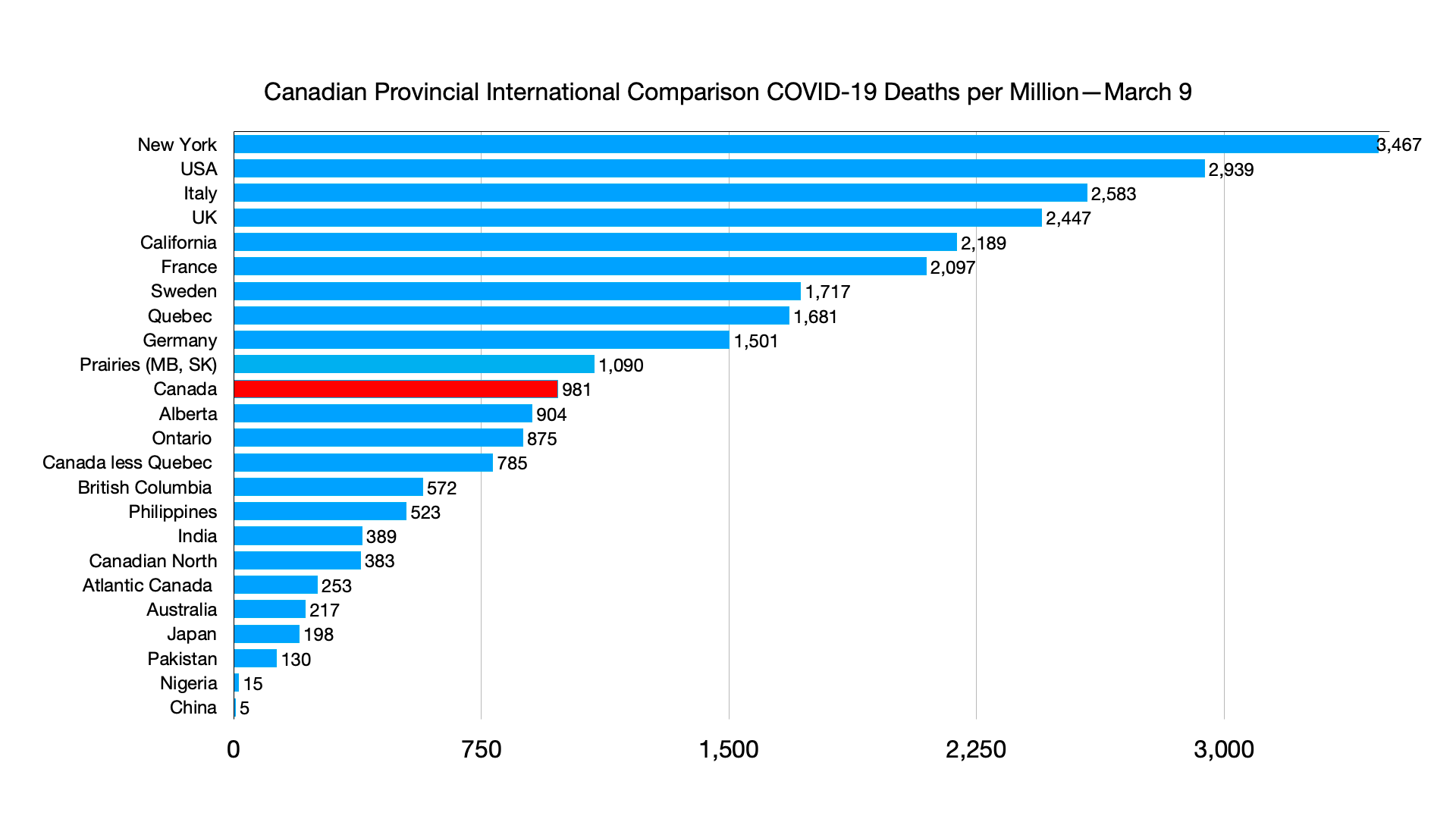
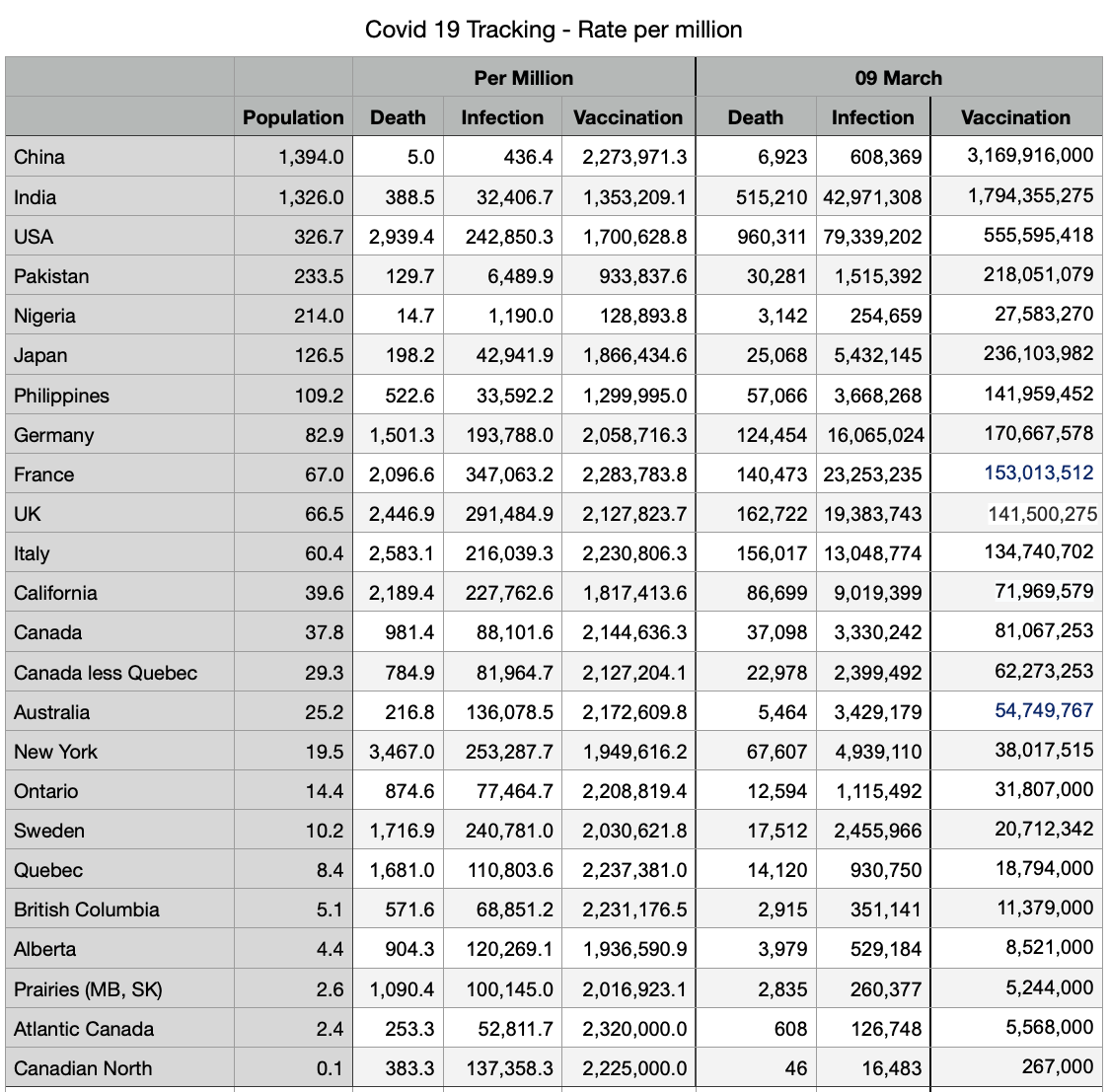
Overall decline in infections and deaths as omicron wave passes. The big news is that numbers from China have shown a significant increase in the past week, from 134,000 to 315,000 infections and from 4,936 to 5,380 deaths, perhaps reflecting suppression of numbers pre-and post-Olympics.

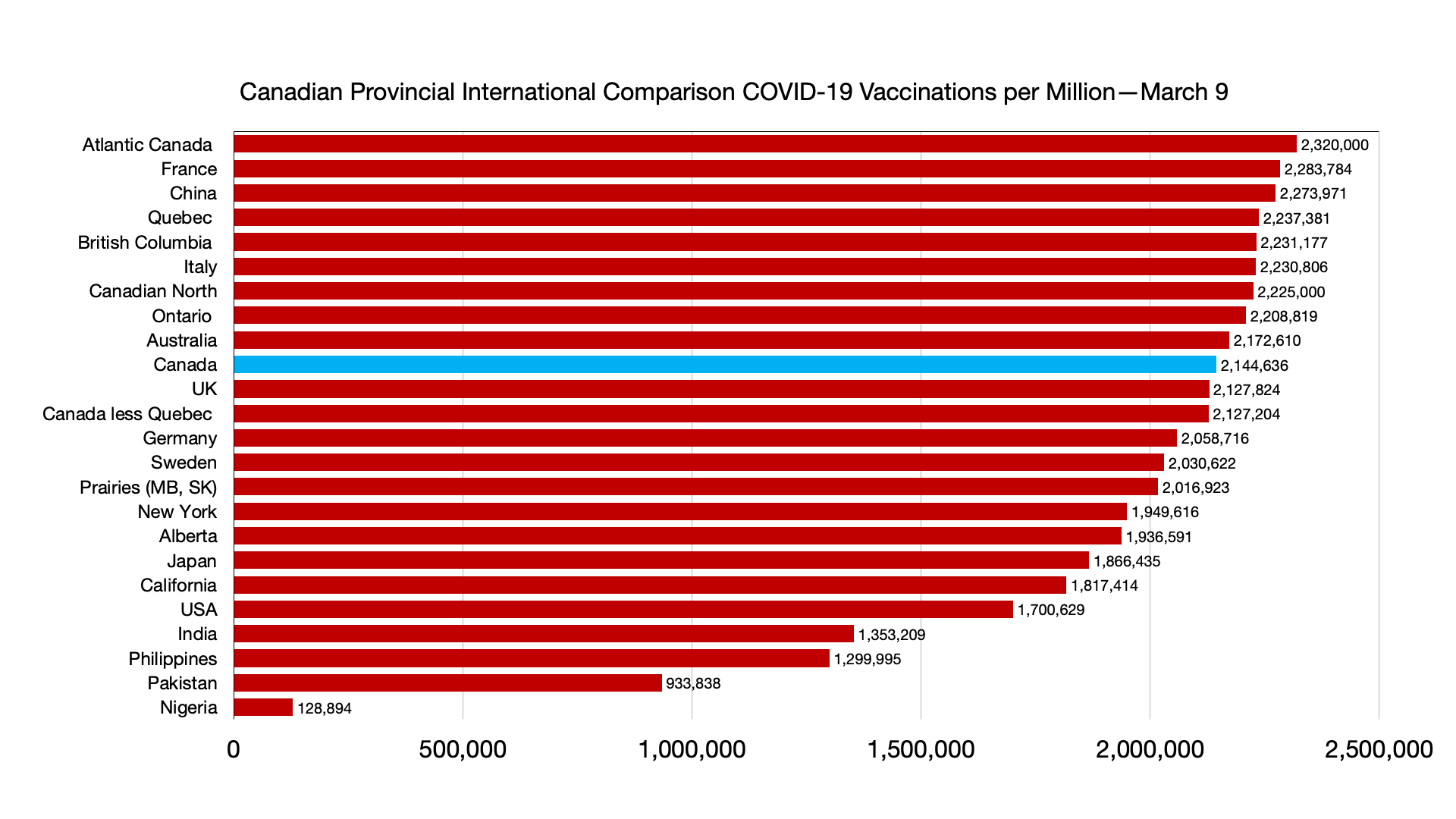
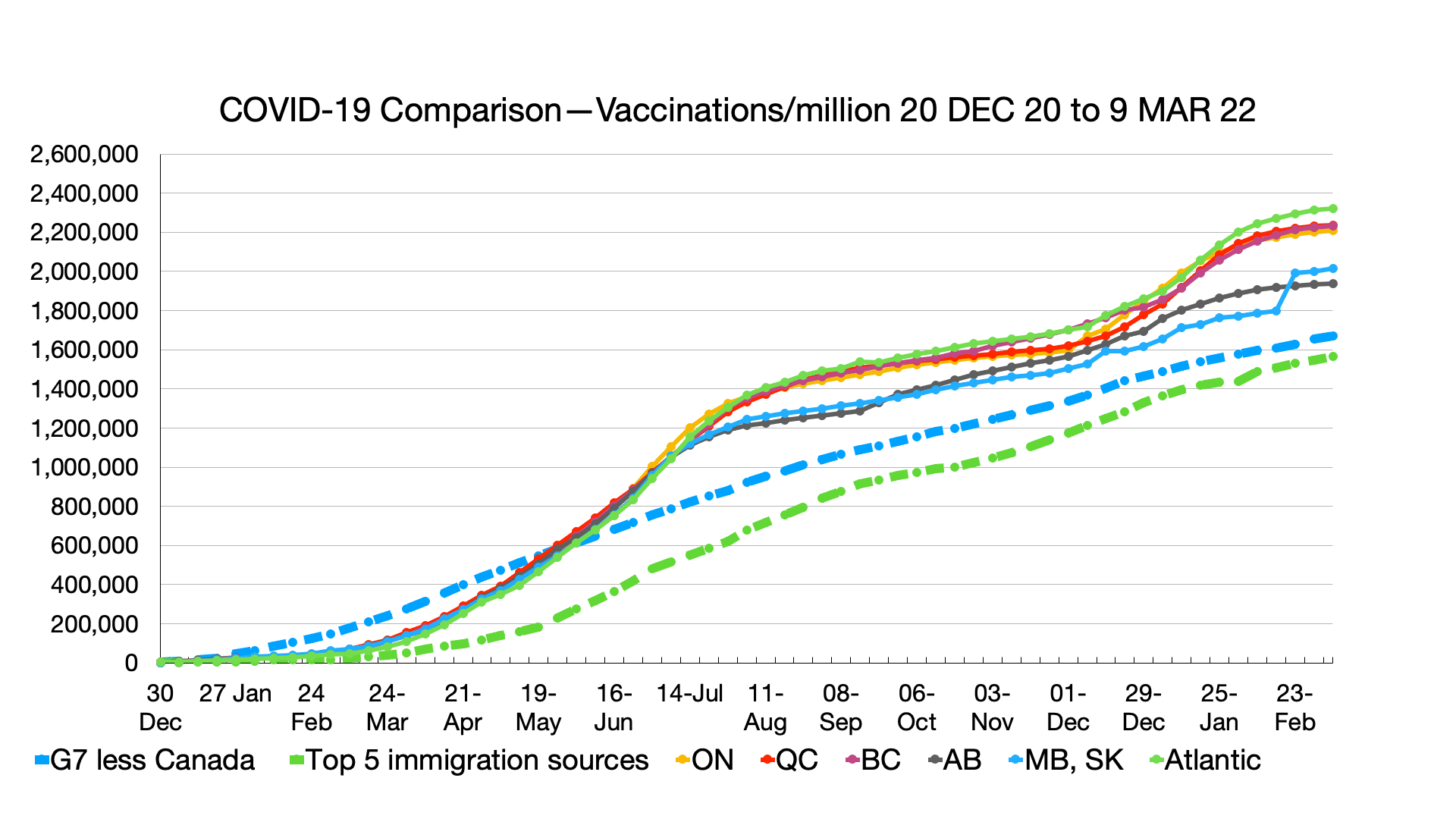
Vaccinations: Some minor shifts but convergence among provinces and countries. Canadians fully vaccinated 82.2 percent, compared to Japan 79.4 percent, UK 73.3 percent and USA 65.7 percent.

Immigration source countries are also converging: China fully vaccinated 88.3 percent (numbers have not budged over past four weeks), India 57.9 percent, Nigeria 4 percent, Pakistan 45.7 percent, Philippines 58.4 percent.

Trendline Charts:

Infections: Ongoing signs of omicron and other variants plateauing.

Deaths: Quebec continues to plateau with moderate increases in other provinces but G7 still not plateauing.

Vaccinations: No major relative changes.

Weekly

Infections: No relative changes. Infections per million in China have increased from 96 to 226 per million after relatively flat for over six months

Deaths: Major change again is with respect to China with deaths per million increasing from 3.5 to 3.9. Sweden is now ahead of Quebec.

COVID-19: New Immigration Rules Crack Open Japan’s Closed Door

In early December 2021, when the highly contagious Omicron variant started spreading globally, Japan slammed its border shut. In fact, except for the first months of the pandemic, it adopted a harsher border policy than during previous infection waves.

The country would essentially remain closed to all non-Japanese citizens other than existing residents.

Among the many stranded travelers were an estimated 150,000 international students who had enrolled in Japanese universities, but never made it into Japan after the borders closed in March 2020. Also affected were business people, foreign specialists and technical interns, the term used for foreign nationals who work on farms, in fishing, food processing, hotels, nursing homes or other industries faced with a serious labor shortage.

Japan’s isolationist approach was in tune with only a few other countries, such as China and Hong Kong. Australia and New Zealand  ーwhich previously had some of the strictest border rules, stopping even their own citizens from returning homeー have recently reversed their two year long isolation.

The Japanese government has been a lot more cautious. In the wake of criticism by industry leaders and academics it has now relaxed some of the entry rules. However, its general policy to ban most new entries has not changed. Tourists still remain shut out.

Nevertheless, there is some welcome positive news going into effect from March 2022.

Raised Cap on Daily Entries

In a first sign of hope, the current limit on arrivals at the Japanese border, capped to 3,500 (roughly the passenger load of 17 airplanes), has been raised to 5,000 from March 1.

Vaccination Status Matters

One of the biggest changes is that starting on March 1, Japan will distinguish between vaccinated and non-vaccinated travelers. This is a significant step for a country that was previously disinterested in vaccination status upon entry and has not adopted any kind of vaccination passport to use domestically.

Fully vaccinated travelers coming from high risk countries can isolate at home for seven days. This period can be shortened to three full days with a negative covid-test on day three.

Fully vaccinated arrivals from low risk countries have no quarantine obligation whatsoever.

Fully Vaccinated Means Three Shots

An arriving person only qualifies as vaccinated with proof of three shots. And the vaccines used need to have been approved by Japan.

Currently, there are only four approved shots: The COVID-19 vaccine from Pfizer, Moderna, Astra-Zeneca and Johnson & Johnson. Plus, the only recognized third shots are for Moderna and Pfizer.

…. New Visa Applications

Last not least among the big changes, schools and businesses can now apply for new visas on behalf of business partners, workers and students, if they pledge to monitor that the incoming person will follow any necessary quarantine rules and other measures imposed.

A new website has been set up by the Ministry of Health to facilitate applications, named ERFS or “Entrants, Returnees Follow-up System”. Once the application is approved foreign entrants will get a Certificate of Eligibility (COE), a necessary step to get a visa stamped into the passport at a Japanese embassy or consulate abroad.

Only organizations, not individuals can apply through this website. If you have a COE that has recently expired or is about to do so, a new policy on the period of validity for a certificate of eligibility may be of help as some COE holders may be eligible for an extension.

It is not clear if people who currently have an unexpired COE have to apply.

It also remains to be seen how quickly new visas will be issued and what kind of priorities will be given to whom. After two years of closed borders there is a significant backlog of old cases.

As a cap of daily arrivals remains in place, even though it has now been lifted to 5,000 persons daily, many people will still be in for a long wait.

Source: COVID-19: New Immigration Rules Crack Open Japan’s Closed Door

2021 Staffing and Non-Partisanship Survey Highlights Report

Overall, positive change from 2018

From the conclusion: 

The Public Service Commission of Canada is responsible for promoting and safeguarding a merit-based, representative and non-partisan public service that serves all Canadians. The 2021 Staffing and Non-Partisanship Survey makes available detailed information on the perceptions of public servants regarding staffing, and their awareness of their obligations related to political impartiality.

The survey results reveal that:

  • employees’ views on merit, fairness and transparency have improved since 2018 
  • differences persist in employment equity groups’ perceptions of merit, fairness and transparency
  • employees’ awareness of obligations related to political impartiality remains high 
  • there is a need to raise hiring managers’ awareness of persons with a priority entitlement as a valuable source of qualified candidates
  • despite staffing during a pandemic, managers and staffing advisors expressed a high degree of confidence in their organizations’ ability to recruit needed staff

Federal public service organizations will need to take a hard look at these results, identify gaps and develop measures to address them. More in-depth analysis will help pinpoint how to address key areas that still need improvement.

Appendix A

Methodology 

Survey results are based on the responses of full-time indeterminate or term public service employees, including members of the regular Canadian Armed Forces and the Royal Canadian Mounted Police who conduct staffing activities under the Public Service Employment Act. Part-time and seasonal employees, casuals, students, contractors, Governor-in-Council appointees and ministers’ exempt staff are excluded from this analysis. Responses of those who did not agree to share their data with the Public Service Commission of Canada are also excluded. The sample consists of 75 440 public service employees, including: 

  • 51 889 non-manager/supervisor employees (69% of respondents)
  • 23 444 managers/supervisors (31% of respondents) 
  • 633 staffing advisors (1% of respondents)

The 2021 survey response rate is 34.2% and the results are considered representative of the 234 757 federal public servants that are included in this broad definition. The data collection took place over a period of 9 weeks, between March 16, 2021, and May 14, 2021. For questions about their past experience, respondents were asked to refer to the previous 12 months, from March 16, 2020, to March 15, 2021 (for example, regarding the COVID-19 pandemic). 

As in the previous cycle of the survey, the 2021 survey frequently uses response categories that ask respondents the extent to which they agree with the question based on a 4-point scale: 

  • “Not at all”
  • “To a minimal extent”
  • “To a moderate extent”
  • “To a great extent”

In the rare exception where a question is posed negatively, the most positive response would be for those who say “not at all” or “to a minimal extent” and this is the result included. For simplicity, this report groups these results into 2 categories to highlight the share of respondents responding most affirmatively to a “moderate” or “great extent.” 

When drawing comparisons, it is important to note that in 2018, a 5-point scale was used for response categories for some questions mostly concentrated in the section on merit, fairness and transparency. For simplicity, the results for the unadjusted positive scores are reported for 2018 since more complex adjustments do not substantially alter the findings.

Source: Share this page

How ‘Multiculturalism’ Became a Bad Word in South Korea

Highlights some of the challenges to previously insular societies:

Inside the dimly lit house, young Muslim men knelt and prayed in silence. Outside, their Korean neighbors gathered with angry signs to protest “a den of terrorists” moving into their neighborhood.

In a densely populated but otherwise quiet district in Daegu, a city in southeastern South Korea, a highly emotional standoff is underway.

Roughly 150 Muslims, mostly students ​at the nearby Kyungpook National University, started building a mosque in a lot next door to their temporary house of worship about a year ago. When their Korean neighbors found out, they were furious.

The mosque would turn the neighborhood of Daehyeon-dong into “​an enclave of Muslims and a ​crime-infested ​slum,” the Korean neighbors wrote on signs and protest banners. It would bring more “noise” and a “food smell​” from an unfamiliar culture, driving out the Korean residents.

The Muslim students and their Korean supporters fought back, arguing that they had the right to live and pray in peace in Daegu, one of the most politically conservative cities in South Korea. “There is a difference between protest and harassment,” said Muaz Razaq, 25, a Ph.D. student in computer science who is from Pakistan. “What they were doing was harassment.”

The fault line between the two communities here has exposed an uncomfortable truth in South Korea. At a time when the country enjoys more global influence than ever — with consumers around the world eager to dance to its music, drive its cars and buy its smartphones — it is also grappling with a fierce wave of anti-immigrant fervor and Islamophobia. While it has successfully exported its culture abroad, it has been slow to welcome other cultures at home.

The mosque dispute has become a flash point, part of a larger phenomenon in which South Koreans have had to confront what it means to live in an increasingly diverse society. Muslims have often borne the brunt of racist misgivings, particularly after the Taliban executed two South Korean missionaries in 2007.

The arrival of 500 Yemeni asylum seekers on the island of Jeju in 2018 triggered South Korea’s first series of organized anti-immigrant protests. The government responded to fears that the asylum seekers were harboring terrorists by banning them from leaving the island.

“Their rules on the hijab alone are enough reason that they should never set foot in our country,” said Lee Hyung-oh, the leader of Refugee Out, a​ nationwide anti-immigration network that opposes the mosque in Daegu.

Many Koreans explain their attitude toward foreigners by citing history: their small nation has survived invasions and occupations for centuries, maintaining its territory, language and ethnic identity. Those who oppose the mosque and immigration more broadly have often warned that an influx of foreigners would threaten South Korea’s “pure blood” and “ethnic homogeneity.”

“We may look exclusionist, but it has made us what we are, consolidating us as a nation to survive war, colonial rule and financial crises and achieve economic development while speaking the same language, thinking the same thoughts,” Mr. Lee said. “I don’t think we could have done this with diversity,” he added. “We are not xenophobic. We just don’t want to mix with others.”

Some say the country does not have much of a choice.

South Korea’s rise as a cultural powerhouse has coincided with a demographic crisis. Years of low birthrates and rising incomes in urban areas have led to shortages of women who want to marry and live in rural towns. Farms and factories have found it difficult to fill low-wage jobs. Universities lack local students.

To help alleviate the challenges, South Korea opened its doors to workers and students from other nations. Some rural men began to marry foreign women, especially from Vietnam. Yet when the government introduced policies to support “multicultural families,” there was a backlash. Suddenly, words like “multiculturalism” and “diversity” became pejorative terms for many South Koreans.

And the antipathy has not been limited to Muslim students in Daegu, a city of more than two million people.

Last year, an anti-China uproar forced a local developer to cancel its plan to build a Chinese cultural center west of Seoul. In Ansan, south of Seoul, all but six of the 450 students in Wongok Elementary School are immigrants’ children because Korean parents have refused to send their children there. In 2020, a Ghanaian entertainer sparked a backlash when he criticized a blackface performance by high school students. He eventually apologized.

“Koreans have deep-rooted xenophobic beliefs that foreigners are inferior,” said Yi Sohoon, a professor of sociology at Kyungpook National University who supports the mosque. “But they value foreigners differently according to their origin. They treat Black people from the United States or Europe differently from Black people from Africa.”

Runaway housing prices, a lack of social mobility and a widening income gap have contributed to the tensions. In a recent Facebook post, Yoon Suk-yeol, a leading conservative candidate in the March 9 presidential election, vowed to stop immigrants from getting “a free ride” with national health care. Lee Jae-myung, his more left-leaning rival, accused Mr. Yoon of fanning “xenophobic right-wing populism.”

The number of foreign residents in South Korea grew to 1.7 million, or 3.3 percent of the total population, in 2020, from 1.4 million in 2017. The government has predicted that the number will grow to 2.3 million by 2040. The overall population fell for the first time on record in 2021, increasing the need for foreign workers and students.

“Human beings are naturally biased, but don’t let the bias lead you to depriving other people of their fundamental human rights,” said Ashraf Akintola, a Ph.D. student in biomedical engineering from Nigeria and one of the Muslim worshipers in Daegu. Mr. Akintola said he felt sad when a Korean protester followed him last year shouting, “Leave our country!” Back in Nigeria, he said, K-pop was so popular that his friends learned to speak Korean.

The Muslim students had prayed at an ordinary house in Daehyeon-dong for seven years. In late 2020, after tearing the house down, they began building a mosque, using a building next door as a temporary house of worship during construction. That’s when Korean residents and activists joined forces to make the neighborhood the center of an anti-immigrant campaign.

In January, the neighbors hung a large black-and-white banner across from the proposed mosque site: “Korean people come first!”

“We are not against their religion,” said Kim Jeong-suk, a 67-year-old Korean resident who opposes the mosque. “We just can’t have a new religious facility in our crowded neighborhood, whether it’s Islamic, Buddhist or Christian.” The neighborhood already has 15 Christian churches, including one roughly 30 yards from where the mosque would be.

Many of the offensive signs were removed after the government’s National Human Rights Commission intervened last October. Construction remains suspended as both sides take their case to court, but human rights lawyers say discrimination against immigrants can also be found in South Korean law.

“It’s one thing that Koreans want to be recognized globally, get rich and successful abroad,” said Hwang Pil-gyu, a human rights attorney who tracks abuses against immigrants. “It’s quite another whether they are willing to embrace foreigners.”

An anti-discrimination bill has stalled in Parliament for years amid opposition from a powerful Christian lobby. Under current policy, undocumented people are not afforded the same rights as those who are in South Korea legally, and foreigners detained under immigration laws are not entitled to habeas corpus.

Last year, disturbing closed-circuit TV footage from a detention center for undocumented immigrants showed a Moroccan man hogtied in solitary confinement. The Justice Ministry admitted to human rights abuses and promised reform.

Still, accepting Muslim refugees has become so unpopular that when the government gave asylum to 390 Afghans last year, it refused to call them refugees. Instead it called them “special contributors,” signaling that the country would only welcome those who contributed to national interests.

“Globalization has a positive connotation among South Koreans,” said Ms. Yi, the professor. “But they need to realize that it involves an exchange of not just money and goods, but culture, religion and people.” Ms. Yi was among the liberal politicians, professors and activists who staged rallies supporting the mosque.

Residents, however, appear to be united in their opposition. More than 175,000 people signed a petition addressed to Moon Jae-in, the president of South Korea, warning that “If we lose Daehyeon-dong, we will lose Daegu.”

“I had never seen people like them before, and I saw no women, only men, swarming in there,” said Park Jeong-suk, a 60-year-old resident who lives next door to the proposed mosque site.

Ms. Park’s neighbor, Namgung Myeon, 59, said he opposed an influx of foreigners as South Korea’s own population declined. “It will unsettle our national foundation,” he said, “enervating our national character and values.”

Source: How ‘Multiculturalism’ Became a Bad Word in South Korea

Europe’s different approach to Ukrainian and Syrian refugees draws accusations of racism

Of note. But important to distinguish whether the intent was more factual, e.g., “refugee wave we have been used to,” unfortunate contrasts “these people are intelligent” implying others are not, and more right wing deliberate anti-immigrant language.

That being said, the situation of many non-Ukrainians fleeing the invasion, is extremely disturbing:

They file into neighbouring countries by the hundreds of thousands — refugees from Ukraine clutching children in one arm, belongings in the other. And they’re being heartily welcomed, by leaders of countries such as Poland, Hungary, Slovakia, Bulgaria, Moldova and Romania.

But while the hospitality has been applauded, it has also highlighted stark differences in treatment given to migrants and refugees from the Middle East and Africa, particularly Syrians who came in 2015. Some among them say the language they are hearing from leaders now welcoming refugees has been disturbing and hurtful.

“These are not the refugees we are used to; these people are Europeans,” Bulgarian Prime Minister Kiril Petkov told journalists earlier this week. “These people are intelligent. They are educated people…. This is not the refugee wave we have been used to, people we were not sure about their identity, people with unclear pasts, who could have been even terrorists.

“In other words, there is not a single European country now which is afraid of the current wave of refugees.”

‘Racism and Islamophobia’

Syrian journalist Okba Mohammad says that statement “mixes racism and Islamophobia.”

Mohammad fled his hometown of Daraa in 2018. He now lives in Spain and with other Syrian refugees founded a bilingual magazine in Arabic and Spanish. He described a sense of déjà vu as he followed events in Ukraine.

He also had sheltered underground to protect himself from Russian bombs. He also struggled to board an overcrowded bus to flee his town. He also was separated from his family at the border.

“A refugee is a refugee, whether European, African or Asian,” Mohammad said.

The change in tone of some of Europe’s leaders who in the past have expressed among the most extreme anti-migration views in the bloc has been striking. They have shifted from “We aren’t going to let anyone in” to “We’re letting everyone in.”

Those comments were made only three months apart by Hungarian Prime Minister Viktor Orban. The first quote is from statements he made in December when he was addressing migrants and refugees from the Middle East and Africa. The second from comments made this week addressing people from Ukraine.

Some journalists, too, are being criticized for descriptions of Ukrainian refugees.

“These are prosperous, middle-class people,” an Al Jazeera English television presenter said. “These are not obviously refugees trying to get away from areas in the Middle East … in North Africa. They look like any European family that you would live next door to.”

The channel issued an apology saying the comments were insensitive and irresponsible.

CBS news apologized after one of its correspondents said the conflict in Kyiv wasn’t “like Iraq or Afghanistan that has seen conflict raging for decades. This is a relatively civilized, relatively European” city.

Reports of Nigerians, Indians and Lebanese stuck at borders

As more and more people scrambled to flee Ukraine, several reports emerged of residents, including Nigerians, Indians and Lebanese, getting stuck at borders. Unlike Ukrainians, many non-Europeans need visas to get into neighbouring countries. Embassies around the world were scrambling to assist their citizens in getting through.

Videos shared on social media under the hashtag #AfricansinUkraine allegedly showed African students being kept from boarding trains out of Ukraine to make space for Ukrainians.

The African Union in Nairobi said Monday that everyone has the right to cross international borders to flee conflict. The continental body said “reports that Africans are singled out for unacceptable dissimilar treatment would be shockingly racist and in breach of international law.”

It urged all countries to “show the same empathy and support to all people fleeing war notwithstanding their racial identity.”

Polish UN Ambassador Krzysztof Szczerski said at the General Assembly on Monday that assertions of race- or religion-based discrimination at Poland’s border are “a complete lie and a terrible insult to us.”

“The nationals of all countries who suffered from Russian aggression or whose life is at risk can seek shelter in my country,” he said.

Szczerski said people of some 125 nationalities had been admitted to Poland on Monday morning from Ukraine, including Ukrainian, Uzbek, Nigerian, Indian, Moroccan, Pakistani, Afghan, Belarusian, Algerian and more. Overall, he said, 300,000 people have arrived during the crisis.

Hostility toward Syrian refugees in Europe

When over a million people crossed into Europe in 2015, support for refugees fleeing wars in Syria, Iraq and Afghanistan was relatively high at first. There were also moments of hostility — such as when a Hungarian camerawoman was filmed kicking and possibly tripping migrants along the country’s border with Serbia.

Still, back then, Germany’s then chancellor, Angela Merkel, famously said “Wir schaffen das” (“We can do it”), and the Swedish prime minister urged citizens to “open your hearts” to refugees.

Volunteers gathered on Greek beaches to rescue exhausted families crossing on boats from Turkey. In Germany, they were greeted with applause at train and bus stations.

But the warm welcome soon ended after EU nations disagreed over how to share responsibility, with the main pushback coming from Central European countries such as Hungary and Poland. One by one, governments across Europe toughened migration and asylum policies, earning the nickname “Fortress Europe.”

Just last week, the UN High Commissioner for Refugees denounced the increasing “violence and serious human rights violations” across European borders, specifically pointing the finger at Greece.

Last year, hundreds of people, mainly from Iraq and Syria but also from Africa, were left stranded in a no man’s land between Poland and Belarus as the EU accused Belarusian President Alexander Lukashenko of luring thousands of foreigners to his country’s borders in retaliation for sanctions. At the time, Poland blocked access to aid groups and journalists. More than 15 people died in the cold.

‘Deeply embedded racism’

Meanwhile, in the Mediterranean, the European Union has been criticized for paying Libya to intercept migrants trying to reach its shores, helping to return them to abusive and often deadly detention centres.

“There is no way to avoid questions around the deeply embedded racism of European migration policies when we see how different the reactions of national governments and EU elites are to the people trying to reach Europe,” Lena Karamanidou, an independent migration and asylum researcher in Greece, wrote on Twitter.

Jeff Crisp, a former head of policy, development and evaluation at UNHCR, agreed that race and religion influenced treatment of refugees.

“Countries that had been really negative on the refugee issue and have made it very difficult for the EU to develop coherent refugee policy over the last decade, suddenly come forward with a much more positive response,” Crisp said.

Much of Orban’s opposition to migration is based on his belief that to “preserve cultural homogeneity and ethnic homogeneity,” Hungary should not accept refugees from different cultures and different religions.

Members of Poland’s conservative nationalist ruling party have echoed Orban’s thinking, saying they want to protect Poland’s identity as a Christian nation and guarantee its security.

These arguments have not been applied to their Ukrainian neighbours, with whom they share historical and cultural ties. Parts of Ukraine today were once also parts of Poland and Hungary. Over one million Ukrainians live and work in Poland and hundreds of thousands more are scattered across Europe. Some 150,000 ethnic Hungarians also live in Western Ukraine, many of whom have Hungarian passports.

“It is not completely unnatural for people to feel more comfortable with people who come from nearby, who speak the [similar] language or have a [similar] culture,” Crisp said.

In Poland, Ruchir Kataria, an Indian volunteer, told The Associated Press on Sunday that his compatriots got stuck on the Ukrainian side of the border crossing into Medyka, Poland. In Ukraine, they were initially told to go to Romania, hundreds of kilometres away, he said, after they had already made long journeys on foot to the border, not eating for three days. Finally, on Monday they got through.

Source: Europe’s different approach to Ukrainian and Syrian refugees draws accusations of racism

Québec loin de sa cible pour les réfugiés afghans

Of note (and not blaming the feds):

Six mois après la crise en Afghanistan, Québec peine à accueillir les 300 réfugiés afghans qu’il s’était engagé à recevoir, a constaté Le Devoir. Selon des chiffres fournis par le ministère de l’Immigration, de la Francisation et de l’Intégration (MIFI), à peine 89 d’entre eux se sont installés au Québec dans le cadre du Programme spécial pour les Afghans qui ont aidé le gouvernement du Canada au mois d’août dernier, alors qu’ils sont plusieurs milliers dans le reste du pays.

En comparant cette opération humanitaire à celle menée pour les Syriens en 2015-2016, où plus de 5000 réfugiés syriens avaient été accueillis par le Québec, force est d’admettre qu’elle n’a pas la même ampleur, admet Stephan Reichhold, directeur de la Table de concertation des organismes au service des personnes réfugiées et immigrantes (TCRI). « C’est quand même assez décevant. En août et septembre dernier, on pensait qu’on recevrait des milliers d’Afghans, la Ville de Montréal était hypermobilisée, et finalement très peu d’Afghans sont arrivés au Québec, dit-il. Au moins, [le gouvernement] aura essayé. »

Pour toute l’année 2021, hormis les 89 venus au Québec grâce au programme spécial du fédéral, 232 Afghans ont été admis comme réfugiés dans la province, à la suite de l’aboutissement de demandes de parrainages privés déposées au cours des années précédentes. La cible du gouvernement Legault pour 2021 est de 7500 réfugiés, toutes origines confondues.

Quant au gouvernement canadien, il disait la semaine dernière qu’il travaillait « d’arrache-pied » pour atteindre sa cible de 40 000 réfugiés afghans. Or, jusqu’ici, 7885 Afghans sont arrivés, soit 4600 dans le cadre du Programme spécial pour les Afghans ayant aidé le gouvernement et 3285 grâce à un autre programme humanitaire canadien destiné aux plus vulnérables (femmes leaders, personnes LGBTI, etc.).

Rétention difficile

Selon le MIFI, les réfugiés afghans venus au Québec dans le cadre du programme de réinstallation fédéral se sont surtout installés à Montréal, Longueuil et Brossard. Malgré le fait que Sherbrooke abrite la deuxième communauté afghane en importance, à peine 11 personnes, venues grâce au programme fédéral, y ont élu domicile, mais 52 réfugiés, entrés par la « voie régulière » que constituent les parrainages, s’y sont aussi installés. Alors que les premières familles arrivaient en septembre dernier, la directrice du Service d’aide aux néo-Canadiens (SANC) de l’époque, Mercedes Orellana, reconnaissait déjà qu’un nombre moins important que prévu allait s’installer en Estrie et au Québec en général.

À l’époque, une intervenante et interprète afghane du SANC s’était rendue à Toronto à la demande du MIFI pour tenter de convaincre les nouveaux arrivants de venir s’installer au Québec. Selon Mme Orellana, il était important de vérifier si la famille avait des attaches ou un intérêt particulier à venir s’installer dans une province comme le Québec qui a ses particularités, notamment la langue française. « C’est bien de vérifier, car ça va être un facteur de rétention pour plus tard », avait-elle indiqué. À l’étranger, le Canada est plus connu que le Québec.

Le MIFI explique aussi le déficit d’attraction du Québec par la popularité de grandes villes canadiennes. « Le Québec était prêt à accueillir plus de familles, cependant, il semble qu’une part importante des personnes réfugiées afghanes arrivées à ce jour ont préféré demeurer dans la grande région de Toronto, où des membres de leurs familles ou des proches étaient déjà installés », a déclaré Émilie Vézina, porte-parole du MIFI.

Un « manque d’ambition »

Le député de Québec solidaire et porte-parole en matière d’immigration, Andrés Fontecilla, estime que la cible d’accueil fixée était trop faible et ne reflétait pas les besoins. « Trois cents personnes nous apparaissaient très peu. À 4personnes par famille, ce n’est même pas 80 familles », a-t-il dit au Devoir. Il rappelle que, l’été dernier, accueillir les Afghans au Canada était une « urgence ». « On disait qu’on allait faire immigrer le plus grand nombre possible [d’Afghans]. Le résultat est vraiment décevant. »

Le député libéral Saul Polo déplore lui aussi le « manque d’ambition » du gouvernement du Québec. « Pour avoir été en contact avec un grand nombre de personnes afghanes, à Laval, mais aussi dans d’autres villes comme Sherbrooke, je peux dire qu’elles sont déçues et frustrées du manque d’ambition du gouvernement face à la situation afghane. Il semble que le gouvernement ne tient pas compte du fait que la communauté est prête à se mobiliser pour les accueillir et les intégrer. »

C’est ce qu’aimeraient justement faire Nancy Green-Grégoire et Clothilde Parent-Chartier, toutes deux membres de Tri-Parish + Friends for Refugees, un groupe de parrainage collectif (parrainage privé). Dans une lettre ouverte publiée en septembre dernier, elles demandaient que le parrainage collectif puisse être mis à contribution pour les Afghans, ce que les plafonds imposés ne permettaient pas. « Il y a des [gens] ici qui étaient prêts à parrainer et qui voulaient réagir rapidement, comme lors de la crise syrienne, mais ce n’était pas possible », rappelle Mme Parent-Chartier, en disant voir le parrainage collectif comme étant complémentaire au parrainage de l’État.

En 2020, le groupe a notamment parrainé une famille d’Afghans, réfugiée au Pakistan, qui n’est pas encore arrivée. Il a aussi déposé, le mois dernier, trois autres dossiers d’Afghans membres d’une même famille ayant fui au Pakistan, qui n’ont pas encore réussi à obtenir un statut officiel de réfugiés. « On ne sait pas s’ils vont répondre aux critères [du MIFI]. Vont-ils pouvoir bénéficier d’un traitement particulier alors que c’est très difficile pour eux d’obtenir une preuve du Haut-commissariat aux réfugiés ? » s’inquiète Mme Parent-Chartier.

Source: Québec loin de sa cible pour les réfugiés afghans