Non-white refugees fleeing Ukraine detained in EU immigration facilities

Of note:

Non-white students who have fled Ukraine have been detained by EU border authorities in what has been condemned as “clearly discriminatory” and “not acceptable”.

An investigation by The Independent, in partnership with Lighthouse Reports and other media partners, reveals that Ukraine residents of African origin who have crossed the border to escape the war have been placed in closed facilities, with some having been there for a number of weeks.

At least four students who have fled Vladimir Putin’s invasion are being held in a long-term holding facility Lesznowola, a village 40km from the Polish capital Warsaw, with little means of communication with the outside world and no legal advice.

One of the students said they were stopped by officials as they crossed the border and were given “no choice” but to sign a document they did not understand before they were then taken to the camp. They do not know how long they will be held there.

A Nigerian man currently detained said he was “scared” about what will happen to him after being held in the facility for more than three weeks.

Polish border police have confirmed that 52 third-country nationals who have fled Ukraine are currently being held in detention facilities in Poland.

The International Organisation for Migration (IOM) said they were aware of three other facilities in Poland where people non-Ukrainians who have fled the war are being detained.

Separately, a Nigerian student who fled the Russian invasion is understood to have been detained in Estonia after travelling to the country to join relatives, and is now being threatened with deportation

This is despite a EU protection directive dated 4 March which states that third country nationals studying or working in Ukraine should be admitted to the EU temporarily on humanitarian grounds.

Maria Arena, chair of the EU parliament’s subcommittee on human rights, said: “International students in Ukraine, as well as Ukrainians, are at risk and risking their lives in the country. Detention, deportation or any other measure that does not grant them protection is not acceptable.”

The findings of the investigation, which was carried out in collaboration with Lighhtouse Reports, Spiegal, Mediapart and Radio France, comes after it emerged that scores of Black and Asian refugees fleeing Ukraine were experiencing racial discrimination while trying to make border crossing last month.

‘They took us here to the camp… I’m scared’

Gabriel*, 29, had been studying trade and economics in Kharkov before war broke out. The Nigerian national left the city and arrived at the border on 27 February, where he says his phone was confiscated by Polish border guards and he was given “no option” but to sign a form he did not understand.

“It was written in Polish. I didn’t know what I was signing. I said I wouldn’t sign, but they insisted I signed it and that if not I would go to jail for five months,” he said in a recorded conversation with a Nigerian activist.

The student said he was then taken to court, where there was no interpreter to translate what was being said so that he could understand, and then taken to a detention centre in the small village of Lesznowola.

“It is a closed camp inside a forest,” said Gabriel, speaking from the facility. “There’s no freedom. Some people have been here more than nine months. Some have gone mad. I’m scared.

“We escaped Ukraine very horrible experience, the biggest risk of my life […] Everything was scary and I thought that was the end of it. And now we are in detention.”

Gabriel said there are at least two other Nigerian students in the camp, along with students from Cameroon, Ghana, the Ivory Coast and French African nations.

Guards at the centre said inmates have their mobile phones confiscated, with only those who have a second sim card given a phone without a camera.

Many can only communicate with the outside world via email – and even this is said to be limited to certain times.

Another individual detained at the centre is Paul, 20, a Cameroonian who had been studying management and language at Agrarian University Bila Tserkva in Kyiv for six months when the war started.

His brother, Victor, who is in Cameroon, said Paul had told him that he had been apprehended while crossing the border and that on 2 March, a Polish judge ordered that he be transferred to Lesznowola detention centre.

“From his explanation, the camp doesn’t seem like one that welcomes people fleeing from the war in Ukraine. It’s a camp that has been existing and has people that came to seek for asylum. No one knows why he is being detained,” he said.

Victor said that Paul was given seven days to appeal the decision to detain him, but that he has been unable to access the internet in order to file the appeal in time.

“Since that day he filed the appeal, police and guards try to restrict them. He used to get five minutes of internet but on that day they stopped letting them use the internet. The phone he used to communicate with me was blocked. Maybe it’s because they realised that the issue was taking on a legal dimension,” he said.

‘He’s not allowed to be in Estonia’

This investigation has also heard reports that a Nigerian student, Reuben, is facing deportation from Estonia after being detained having fled the war in Ukraine.

Prior to his arrival in the eastern European country, 32-year-old Reuben emailed the head of International House, a service centre that helps internationals in Estonia to communicate with the state, explaining that he wanted to join his cousin living in the country.

The head of the organisation Leonardo Ortega responded by letter that he may relocate to Estonia.

Reuben, who attended Bila Tserkva National Agrarian University in Ukraine and is married to a Ukrainian woman, arrived on 9 March through Poland with his cousin Peter.

After being delayed for three hours at the Estonia border, the pair were escorted to a police station, according to Peter, 30, who has an Estonian residency permit.

He said three police officers escorted his cousin away with his luggage and said he would be detained for two days themn deported back to Nigeria.

The officers reportedly advised that the 32-year-old would be banned from entering any Schengen country for the next five years; his phone was confiscated and he’s been in detention since.

“A few officers said ‘he’s not allowed to be in Estonia’. Even after asking for international protection, we were told that my cousin needs to have a lawyer to fight his case, but most of the lawyers I initially contacted refused to take my cousin’s case,” said Peter.

“He received an email in advance saying it was okay to come – and after everything we went through, the next thing they want to deport and ban him for five years. I don’t know why deportation came into the picture.”

Criney, a London-based campaigner who has been supporting the affected students on a voluntary basis, said there was an “emerging pattern of arbitrary detention of students coming out of Ukraine fleeing the war”.

“There are other cases in Austria and Germany with regards to students who have applied for asylum or asked for permits to remain,” the campaigner said.

Detained ‘for the purpose of identity verification’

The EU directive on 4 March aims to help refugees fleeing the invasion to stay for at least one year in one country and also have access to the labour market and education.

It states that it also applies to “nationals of third countries other than Ukraine residing legally in Ukraine who are unable to return in safe and durable conditions to their country or region of origin”.

This can include third-country nationals who were studying or working in Ukraine, it states, adding that this cohort should “in any event be admitted into the union on humanitarian grounds”, without requiring valid travel documents, to ensure “safe passage with a view to returning to their country or region of origin”.

Michał Dworczyk, a top aide to the Polish prime minister, said when war broke out that “everyone escaping the war will be received in Poland, including people without passports”.

But the Polish government has admitted that it is sending some of this cohort to closed facilities once they cross the border.

In a tweet on 2 March, the Polish ministry of internal affairs and administration said: “Ukrainians are fleeing the war, people of other nationalities are also fleeing. All those who do not have documents and cannot prove Ukrainian citizenship are carefully checked. If there is a need, they go to closed detention centres.”

In a letter to a member of the EU Parliament, Poland’s border police admitted that 52 third country nationals who had fled from Ukraine had been taken to closed detention centres in the first three weeks of the war.

The letter stated that this was necessary “to carry out administrative proceedings for granting international protection or issuing a decision on obliging a foreigner to return”.

Ryan Schroeder, press officer at the IOM, said the organisation was aware of three other facilities in Poland where “third-country nationals arriving from Ukraine, who lack proper travel documentation, are brought to for the purpose of identity verification”.

The Polish government, the Polish police and the Estonian authorities declined to comment on the allegations.

A spokesperson for the Polish border force said it “couldn’t give any detail about the procedures on foreigners because of the protection on personal data”, adding that it is “the court which takes the decision each time to place people in guarded centres for foreigners”.

‘Clearly unsatisfactory and discriminatory’

Steve Peers, a professor of EU law in the UK, says that even if member states choose not to apply temporary protection to legal residents of Ukraine, they should give them “simplified entry, humanitarian support and safe passage to their country of origin”.

“In my view this is obviously a case where students could not have applied for a visa and might not meet the other usual criteria to cross the external borders, yet there are overwhelming reasons to let them cross the border anyway on humanitarian grounds. There are no good grounds for immigration detention in the circumstances,” he added.

Jeff Crisp, a former head of policy, development and evaluation at UNHCR, said it was “clearly unsatisfactory and discriminatory” for third country nationals who have fled from Ukraine to be held in detention centres in EU states, “not least because of the trauma they will have experienced in their efforts to leave Ukraine and find safety elsewhere”.

He added: “They should be released immediately and treated on an equal basis with all others who have been forced to leave Ukraine.”

It comes after the UN High Commissioner for Refugees Filippo Grandi warned this week that, although he had been “humbled” by the outpouring of support seen by communities welcoming Ukrainian refugees, many minorities – often foreigners who had been studying or working there – had described a very different experience.

“We also bore witness to the ugly reality, that some Black and Brown people fleeing Ukraine – and other wars and conflicts around the world – have not received the same treatment as Ukrainian refugees,” he said.

“They reported disturbing incidents of discrimination, violence, and racism. These acts of discrimination are unacceptable, and we are using our many channels and resources to make sure that all people are protected equally.”

Mr Grandi appealed to countries, in particular those neighbouring Ukraine, to continue to allow entry to anyone fleeing the conflict “without discrimination on grounds of race, colour, descent, or national or ethnic origin and regardless of their immigration status”.

*Names have been changed

Source: Non-white refugees fleeing Ukraine detained in EU immigration facilities

New Leger Poll says 30% of young new Canadians could leave in the next two years

Interesting data, worth looking at the detailed breakdowns by age, education, income etc and significant concerns particularly among the younger and university cohorts.

Data on the number of immigrants who actually emigrate is imperfect but this 2018 Statistics Canada study, Measuring Emigration in Canada: Review of Available Data Sources and Methods, provides estimates for all Canadians, not just immigrants, ranging from 150,000 (using tax data, likely the best indicator) to 450,000.

The Annual Demographic Estimates: Canada, Provinces and Territories, 2021, however, indicates about 37,000 in 2019-20.

Earlier studies by Statistics Canada indicate that recent immigrants, young adults and more highly educated individuals are more likely to emigrate.

Given that our selection criteria are biased towards the younger and more highly educated, a certain amount of “churn” is to be expected:

A new national survey conducted by Leger on behalf of the Institute for Canadian Citizenship (ICC) — Canada’s leading citizenship organization and the world’s foremost voice on citizenship and inclusion — challenges some cherished Canadian assumptions about immigration and citizenship.

“Canada is a nation of immigrants — and one of the stories we tell ourselves is that we are welcoming to new immigrants, wherever they may be from,” says ICC CEO Daniel Bernhard. “But while this may be generally true, new survey data points to the fact that many new Canadians are having a crisis of confidence in Canada — and that should be ringing alarm bells all over Ottawa.”

Survey findings include:

  • 30% of 18–34-year-old new Canadians and 23% of university-educated new Canadians say they are likely to move to another country in the next two years.
  • While most Canadians and new immigrant Canadians alike believe that Canada provides immigrants with a good quality of life, Canadians have a much more positive outlook on Canada’s immigration policy compared to new Canadian immigrants.
  • New Canadian immigrants are more likely to believe that Canadians don’t understand the challenges that immigrants face and feel the rising cost of living will make immigrants less likely to stay in Canada.
  • Immigrants with university degrees tend to have less favourable opinions on matters related to fair job opportunity and pay than other immigrants.
  • Among those who would not recommend Canada as a place to live, current leadership and the high cost of living were the top two reasons

The full survey data is available here.

“The data suggest that younger, highly skilled immigrants in particular are starting to fall between the cracks,” said Dave Scholz, Executive Vice-President at Leger. “We need to continue working hard to ensure that we are welcoming newcomers with the resources they need to succeed, and that we continue to be a country that provides opportunity.”

Source: New Leger Poll says 30% of young new Canadians could leave in the next two years

St Vincent Prime Minister reiterates opposition to CBI programs

Recent restrictions having an impact along with the realization that these programs attract a lot of vagabonds and criminals and people who want to use their money to escape the extent of scrutiny.”:

Prime Minister of St. Vincent and the Grenadines Ralph Gonsalves has reiterated his government’s position regarding the Citizenship by Investment Program (CBI), saying legislative moves in the United States and European Union recently, show that his administration’s position on the program is correct.

Under the CBI, foreign investors are afforded citizenship of a country in return for making a significant investment in the socio-economic development of the particular country. Several Caribbean countries have instituted CBI programs.

Gonsalves said the United States has moved to decline visas to holders of passports obtained by CBI and the European Union has passed a law giving countries three years to phase out the program or face visa requirements for all its passports holders.

He said there is a bipartisan move in the US Congress, with a Republican and a Democrat introducing a bill “to clamp down on these what they call golden passports, passports, which you get through citizenship by investment, selling the passport, selling the citizenship.”

Prime Minister Gonsalves said the law took “a little bit further” what was being done administratively.

“If you buy your passport, buy your citizenship, the Americans had taken a decision administratively not to give you any visa.”

He said where someone who obtains a passport from Antigua and Barbuda, Dominica, Grenada, St. Kitts-Nevis, or St Lucia through CBI can travel visa-free to the United Kingdom and the EU, “the United States has practically closed the door.”

Gonsalves said Canada has done so to some extent “because Canada even though you have to apply for visas, a few of them who have purchased passports, they got into Canada.”

Gonsalves said some European Union countries including Bulgaria, Malta, and Cyprus also have CBI programs.

“The Russian yacht which had come down here, that Russian came here on a passport from Cyprus. But he was not sanctioned.”

The superyacht “Anna” docked in Kingstown on March 4, with its owner, Russian billionaire Dmitry Rybolovlev, onboard and purchased 40,000 gallons of fuel before setting sail one day later.

Gonsalves said Rybolovlev was not under sanctions as both the US and Europe imposed measures following Russia’s invasion of Ukraine.

He further said a resolution was passed in the European Parliament directing the European Commission to ban “golden passports.

“You can go online on the European Parliament website and find this particular resolution, this text which was adopted and basically what it says that they are given the countries three years, between now and 2025,

“You have one of two choices: you abolish citizenship by investment, you abolish the selling of passports and citizenship by 2025, and they give you three years for you to gradually phase it out. You ain’t supposed to do any new program.”

“All Antiguans, all Grenadians, all Kittians, all St. Lucians, all Dominicans, would lose entry into Europe, and the United Kingdom is planning the same thing. So, if you want to go to France where you can go there now without a visa, you will require a visa,” Gonsalves said.

The EU Parliament has called for an EU “levy of a meaningful percentage on the investments made – until ‘golden passports’ are phased out, and indefinitely for ‘golden visas’” within the block.

“It also asks the Commission to put pressure on third countries that benefit from visa-free travel to the EU to follow suit,” according to the website.

The resolution passed by the parliament with 595 votes to 12 and 74 abstentions says golden passports should be phased out fully.

At least 130,000 people benefitted from CBI/RBI schemes in the EU from 2011 to 2019, generating revenues of over Euro 21.8 billion (One Euro=US$1.29 cents) for the countries concerned.

Gonsalves warned that if Britain, which is not a member of the European Union, “does the same way like the Europeans, it puts everybody into trouble by not having the visa; just like how Canada cut off theirs.

“But additionally, who’s going to buy your passport if you can’t get in any way visa-free?”

Gonsalves recalled that the CBI program had been a major issue in the 2015 and 2020 general elections.

The main opposition New Democratic Party (NDP) supports a CBI program for St. Vincent and the Grenadines.

“And, you know, the position that I take on citizenship by investment… That is the glamorous name for selling citizenship and selling passports. A rose by another name, or, as the case may be, a pit toilet by any other name,” Gonsalves said, adding that he has always maintained that in principle and practice, CBI “is a mistake.”

He said in principle, a country “mustn’t sell our instruments of nationhood.

“Citizenship is the highest office in the land, higher than the prime minister, higher than governor general. It’s not a commodity for sale. And the passport is the outward sign of the inward grace of citizenship and that, too, is not for sale. You have heard me on that mantra, over and over again.”

He said that in practice, CBI is not sustainable.

“And in any case, it is bringing a lot of vagabonds and criminals and people who want to use their money to escape the extent of scrutiny.”

Source: St Vincent Prime Minister reiterates opposition to CBI programs

US Special Immigration Program Refers More Than 5,000 Afghan Refugees to Canada – Voice of America

Of note:

The U.S. State Department has referred more than 5,000 Afghan refugees who were seeking admission to the United States to a parallel program in Canada, where waiting times for permanent residence are shorter.

State Department officials confirmed to VOA those referred to the special immigration program are not simultaneously going through the U.S. Refugee Admissions Program (USRAP).

“We are working with Canada to refer up to 5,000 refugees to Canada, independent of our ongoing efforts for U.S. resettlement,” a State Department spokesperson told VOA.

On the Canadian side, Immigration, Refugees and Citizenship Canada (IRCC) said Afghan refugees referred by the U.S. are coming to Canada from third countries, where they have been located since they fled Afghanistan.

Masuma Haidari, 37 and a software engineer in Afghanistan, is one of the people benefiting from the partnership between the two countries. She was able to leave Afghanistan in August 2021 and lived in North Macedonia for more than six months.

Private organizations helped her leave Afghanistan and find her way through the program that led her to Canada.

Haidari told VOA she was about to get the keys to her first apartment in Calgary, Canada.

“It’s not bad,” Haidari said. “The government helps us with money and we (must) manage to cover all costs.”

But with her background in software engineering and having worked for the Afghan government, she hopes it will be useful in her new Canadian life.

“I think that the technical experiences will be useful in Canada. I will try to [transfer] my degree, my education and also I will be ready to find a job in the IT industry,” she added.

Though Haidari is able to start a new life, thousands of people are still hoping to leave Afghanistan.

Rescue efforts

U.S. military veterans, former intelligence and defense officials and others have dedicated their time to rescue those still in Afghanistan through newly formed groups like Operation North Star, which is all volunteer, or Task Force Pineapple, which is a public-private partnership.

Getting people out of Afghanistan is just part of the problem.

According to the Operation North Star website, they have almost 500 Afghans in third countries and more than 2,000 Afghans in safe homes in Afghanistan. Equally challenging has been guiding the Afghans through the complex process to resettle in the United States, including finding safe homes, leaving Afghanistan, finding a third country, applying to a refugee program and arriving in a new country.

The U.S. immigration system includes a patchwork of complex laws for regulating the flow of refugees seeking to enter the United States. The U.S. manages a strict vetting process to determine who to accept for resettlement and the process can take two to five years.

Slow U.S. processing is prompting some private groups to look elsewhere for a permanent home for the evacuees, with immigrant-friendly Canada emerging as a favored destination.

So far in Fiscal 2022, which began October 1, 2021, 133 Afghans were admitted into the U.S. through USRAP. In Fiscal 2021, that number was 872. Through the Special Immigrant Visa program, which is for those who served as interpreters and translators or were employed by or on behalf of the U.S. government, the U.S. admitted 1,545 refugees in Fiscal 2022.

Jordan Kane, a volunteer at U.S.-based Operation North Star, said it has been difficult to secure U.S. refugee status for Afghans who have been recommended for relocation by the U.S. Embassy in Kabul, the U.N. High Commissioner for Refugees or a designated NGO. After the referral, it still takes at least two years for applicants to arrive in the United States.

“Thousands of Afghan refugees who had secured limited referrals to the U.S. resettlement process were given an option to be switched over to the Canadian process, with women leaders fleeing Taliban threats receiving preference,” Kane told VOA.

The U.S. Refugee Admissions program was dramatically cut under the Trump administration, leaving fewer resources within the government and the resettlement agencies to handle the significant increase of refugee applications and arrivals.

Resettlement in Canada

Once the U.S. identifies Afghan refugees who meet eligibility and admissibility requirements, they are then accepted for resettlement to Canada.

“As government-assisted refugees, Afghan refugees become permanent residents upon arrival and have access to the Resettlement Assistance Program (RAP),” according to Jeffrey MacDonald, communications officer at IRCC.

The Canadian government provides temporary housing and up to 12 months of income support.

“Monthly income support levels for shelter, food and incidentals are guided by provincial or territorial social assistance rates where the refugee resides and vary depending on family size, configuration and city of residence,” MacDonald said in an email to VOA.

One refugee, whose case was transferred to Canada, is identified for security reasons only as “Farishta.” She was a women’s rights activist and prosecutor in the office of the Afghan attorney general.

“The Canadian program under which Farishta is applying is unique,” Kane said. “Like the U.S., Canada has a program for resettling Afghans who worked for them, who are mostly male military interpreters. However, unlike the U.S., Canada also has a program for admitting other groups of Afghans targeted by the Taliban, including female leaders, which is great.”

The Women at Risk Program recognizes the women and girls particularly vulnerable in refugee situations and prioritizes their resettlement to Canada.

“But Canada shouldn’t be the only country looking out for women like Farishta,” Kane said, adding, “the U.S. and other NATO allies need to copy this program to make sure we are not leaving Afghan women behind.”

The Canadian government has committed to accept 40,000 Afghan refugees. Included in that number are the 5,000 people being referred through the partnership with the United States. From August 2021 to March 2022, the country has admitted 8,815 under all available refugee categories.

Canada has a biometric verification process that refugees must complete before they enter Canada, according to Oliver Thorne, who is the executive director at the Vancouver-based Veterans Transition Network.

“Although these are Afghans that risked their lives to support and in many cases, save the lives of Canadian soldiers, our government policy will not allow them into Canada without biometric verification,” Thorne told VOA.

Thorne said the Canadian government policy needs to align with the urgency of these evacuation efforts and allow for biometrics to be done after arrival in Canada.

“Without this, evacuations will proceed at a trickle pace, leaving brave and deserving Afghans at risk of reprisals from the Taliban,” he added.

MacDonald, of the IRCC, responded that the biggest hurdle “is not the processing capacity of the government of Canada, it’s situational and environmental factors on the ground in Afghanistan. These are challenges that we are working on every day, there’s no lack of effort on the part of the government of Canada.”

Nevertheless, the private groups credit Canada for taking in a number of Afghans who might not be eligible for resettlement elsewhere. Most countries are offering visas to a limited number of Afghans who worked directly for them, refugee advocates said.

As for Farishta, she had hoped to resettle in the United States, Kane said.

“The United States was Farishta’s first choice, because she has more friends there, but she considers Canada to be a great option. … Two reasons for this: she, like many educated Afghans, speaks fluent English already. Second, Canada has more generous resettlement benefits than the U.S.,” Kane said

Source: US Special Immigration Program Refers More Than 5,000 Afghan Refugees to Canada – Voice of America

Daphne Bramham: Canada’s broken system punishes high-skilled immigrants [credential recognition of dentists]

Dentist case study and related recognition data:
Early last Friday, Mariam Tariq, a couple of friends in Toronto and her mother in Pakistan were ready at their computers waiting for the moment that registration opened to get her seat to write the first of three National Dental Examining Board of Canada exams in August.
Tariq managed to get a place on the waiting list. So, she’ll have to keep studying hard … just in case.By August, the 32-year-old will have been in Vancouver for more than two years and has moved only a tiny step closer to becoming a licensed dentist.

It took 14 months before her academic credentials were accepted, although the NDEB says the average processing time once all the documents are received is 20 weeks.

Then, Tariq joined the throng of close to 1,700 who each year sign up for the “equivalency process,” which entails a total of three exams, including a clinical one. Currently, there are over 10,000 people at various stages of the process.

It’s anathema to how Canada’s immigration system should work.

Canada promises high-skilled professionals and tradespeople from around the world a fast-track to a bright future here. But on arrival, they’re ensnared in a web of national and regional accreditation and licensing bodies.

It can take up to five years or more to qualify and some simply give up and move on to something or somewhere else.Tariq had been a lecturer in pediatric dentistry at the government-run Ayub College in Abbottabad and presented papers at international dental conventions including in the U.S.

She came here on the fast-track-to-permanent-residency under Canada’s Express Entry program that favours people whose skills are badly needed.

In January 2020, she sent credentials from Pakistan to the NDEB for verification and signed up for online coaching for the first exam — the assessment of fundamental knowledge or AFK.

“I thought it would take a year or a year-and-a-half (to get licensed),” Tariq told me. “But I’ve found out that it usually takes more like three-to-five years.”

She arrived here in July 2020. It wasn’t until March 2021 that her credentials were accepted. But the AFK exam is given only twice a year in August and February. And Tariq had missed the window to register for the August sitting.In November 2021, she wasn’t fast enough to grab a precious seat for February 2022.

COVID-19 restrictions are partly to blame for the bottleneck. The NDEB expects to be able to increase testing capacity later this year.

Aside from the scarcity of seats, the full-day exams are gruelling as they must be to protect patient safety. Over the past five years, the pass rate for the multiple-choice AFK has ranged from 32 to 49 per cent. For the other two exams, the pass rate runs from the mid-30s to the mid-60s.

And if that’s not pressure enough, NDEB has a three-strikes’ rule. Fail three times and you’re banned from ever trying again.With such high stakes, many foreign-trained dentists pay fees of up to $5,000 to what Tariq described as “coaching academies” in addition to the NDEB fees that start at $1,000 for the AFK and go up from there.

There are thousands currently in this unenviable cycle of what Tariq described as “work, earn money to study, study and pay for the next exam.”

Having run through the money she had saved to come to Canada, she has at least found work at dental clinics, albeit as an accounts receivable clerk, a receptionist and now as a chair-side assistant — “I have a lot of friends who are working at Tim Hortons, Walmart.”

Tariq is pragmatically taking courses to qualify as a dental assistant. The pay will be better than what she’s earning now, which means Tariq will be less reliant on her dentist/mother for help paying for the NDEB examsShe’s also fortunate to be in the first cohort of a free coaching program offered by the immigrant settlement society, SUCCESS.

Its CEO, Queenie Choo, has first-hand experience with the credentialing hoops. Trained as a nurse in Britain and having worked on a transplant team and in acute care, she said it was humiliating to have to prove her ability to do injections by sticking a needle in an orange.

“We want to attract talent through immigration, but we have not created an environment where they are able to practise,” she said. “We definitely need a system that is seamless with less barriers including financial help for the required exams.”

Among the many criticisms of Canada’s accreditation system is that only credentials from institutions in the white, English-speaking world are deemed good enough.

“I don’t know if it’s a subtle form of racism,” Choo said. “But we need to look at systemic racism that it may be creating.”

What might that look like? A lot like what’s happening now

By neglect or design, the expensive and fragmented credentialing system is creating an underclass. Instead of working dentists, doctors and nurses, foreign-trained professionals end up as assistants, associates and aides.

In the past 20 years, Statistics Canada found that the number of immigrants who become Canadian citizens has dropped by more than 20 percentage points.

There are multiple reasons why. But this is surely one of them.

Source: Daphne Bramham: Canada’s broken system punishes high-skilled immigrants

Bell: Kenney’s plan to woo ethnic voters to help him save his job

Back to his days of Minister for Curry in a Hurry:
This is getting to be serious business.
I hear Rishi Nagar on West of Centre, a CBC podcast.When he talks about Premier Jason Kenney courting voters from cultural communities in northeast Calgary in a bid to keep his job it gets me curious.

I decide to give the political deep thinker a call. Nagar also happens to be a heck of a nice guy who knows his stuff.

Nagar is the news director at RED FM, a multicultural radio station in Calgary.

The questions come easily

How many people in northeast Calgary filled out membership forms for Kenney’s United Conservative Party?

Folks who snagged a membership by this past Saturday can register to vote Yes or No next month on the premier’s fate. As many as 20,000 across the province may register. It is an astounding number.

So what is the educated guess, the ballpark number?

Who better to ask than a man who attended a half-dozen Kenney events in the city’s northeast?

He says around 2,000-plus signed up for the premier

The premier. The citizenship, immigration and multiculturalism minister in his previous life in Ottawa.

His job back then was to win new Canadians to the federal Conservative side. Kenney was tagged with a nickname by an MP. The Minister for Curry in a Hurry.

As the premier scrounges for votes in the upcoming vote on his leadership, Nagar mentions organizers from different communities reaching out to their people “to fill the membership form for Mr. Kenney.”

He mentions Hindus and Sikhs and Muslims. He mentions Muslims from Pakistan and Muslims from Lebanon and Muslims from South Africa.

In every event there are forms filled out and collected in groups of 50. The memberships add up, the promises to vote for Kenney.Kenney is a very frequent visitor to the city’s northeast. The premier even goes to very small gatherings, as small as 15 people.

“He’s very happy,” says Nagar, of the premier.

Local members of the legislature, serving under the banner of Kenney’s United Conservatives, are at the back of the room.

It could be Rajan Sawhney or Mickey Amery or Peter Singh.

Nagar cannot say, and nobody knows, how many with UCP memberships will actually vote in Red Deer.

Of course if the UCP decides to have voting in Calgary as well as Red Deer it will be much more convenient.

Ditto if they decide to allow in-person voting in the capital city.

“Mr. Kenney is targeting minority communities here in Calgary. He must be doing the same thing in Edmonton,” adds NagarThe Kenney pitch is first and foremost the fear of the NDP.

Then the fear of breaking up the United Conservatives, an uneasy marriage of convenience with former Wildrosers and former PC types intent on seeing the NDP defeated last election.

Then there’s Kenney on the economy coming out of COVID, pledging to make communities “happy and flourishing.”

Kenney talks a lot about the economy.

The man from RED FM says there is not one single question on the premier’s past comments on the spread of COVID in northeast Calgary or on the issue of hail insurance after the huge storm.

Nagar says just before the Alberta government budget Kenney was “absolutely unpopular.”

After the budget things started changing. He started showing up.

There is “one interesting feature” mentioned. The desire to get a picture with Kenney.

“Whenever there is a photo-op with the premier they forget everything. A picture is important. If I have a picture with Jason Kenney I will hang it in my family room.”

Such is the sentiment.

“There is a lineup for the pictures.”

Nagar says the members Kenney is signing up may not be the deciding factor in his survival but it is big support for him to win.

The premier’s people know they’re in a fight.

They know his approval is nothing to write home about and they don’t talk about it.

They know polls show most Albertans aren’t happy with him.

They emphasize how the UCP could squeak out a win against the NDP, not pointing to the fact some of that UCP vote may come from those who expect Kenney could be gone after his party’s leadership vote

But when the premier is in Calgary’s northeast he is one happy camper

“You can see his tone and language when he departs. He’s super-happy. He’s very confident. His gait is changed. His way of talking changes after seeing all these people.”

Source: Bell: Kenney’s plan to woo ethnic voters to help him save his job

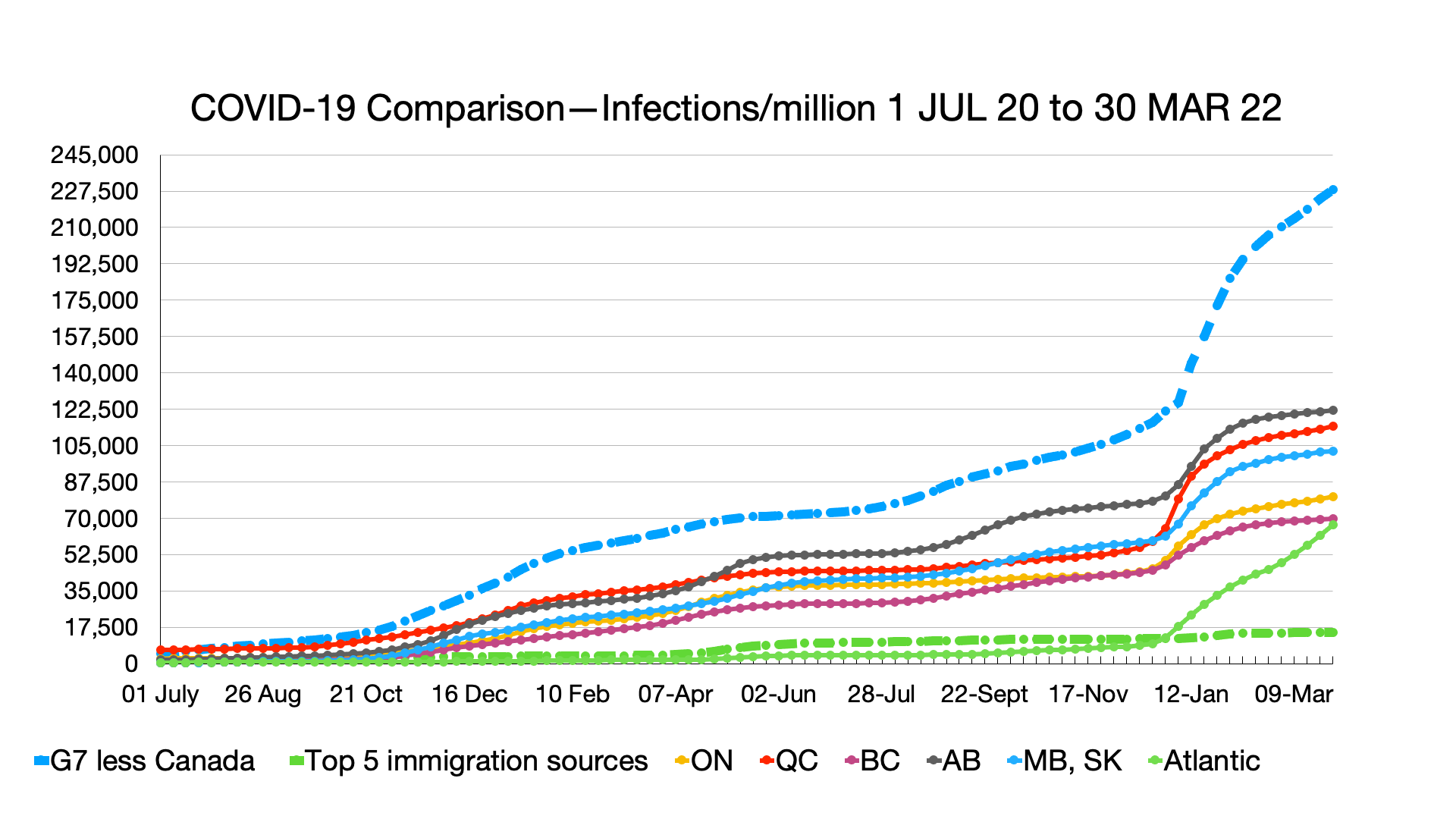
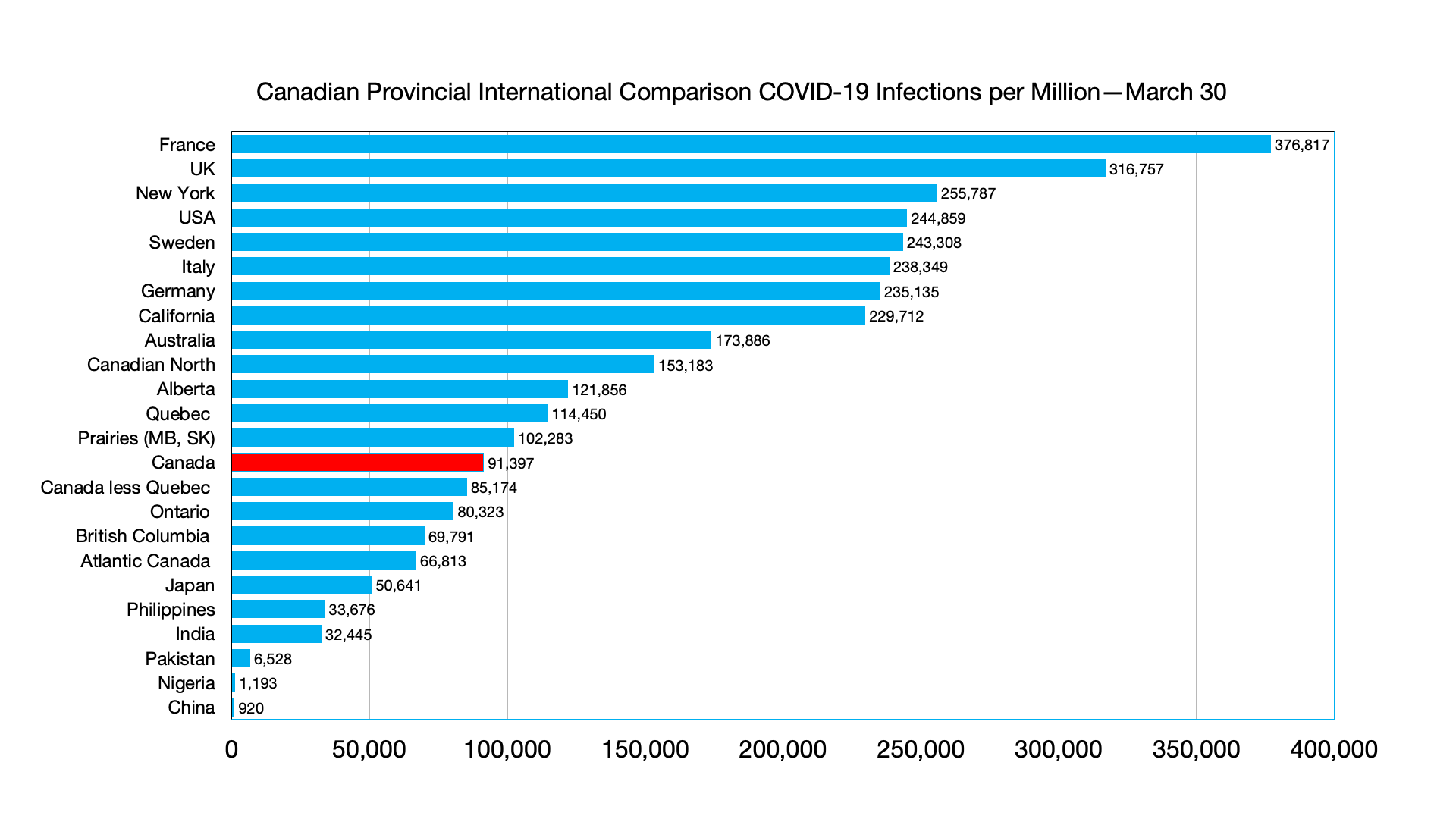
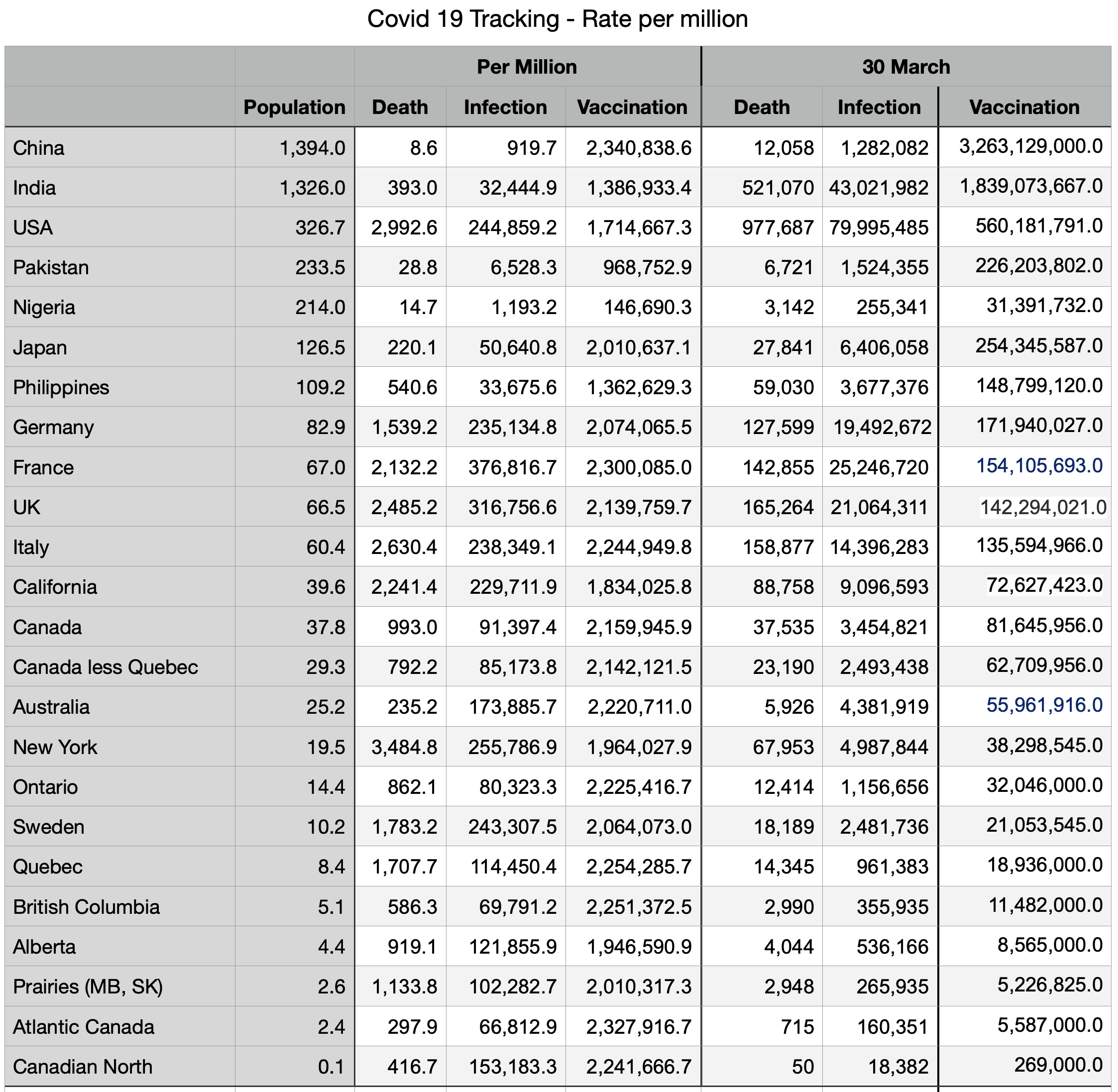
#COVID-19: Comparing provinces with other countries 23 March Update, Vaccinations in African countries

Numbers from China continue to climb with infections up 59 percent and deaths up 21 percent. New omicron variant showing up in increased infections in some countries.

Vaccinations: Some minor shifts but convergence among provinces and countries. Canadians fully vaccinated 82.7 percent, compared to Japan 79.6 percent, UK 73.8 percent and USA 66.1 percent.

Immigration source countries: China fully vaccinated 88.7 percent, India 60.1 percent, Nigeria 4.5 percent, Pakistan 47 percent, Philippines 60.3 percent.

Trendline Charts:

Infections: Limited signs of new omicron variant yet in Canada, with Atlantic Canada infection rates not yet slowing town.

Deaths: No major changes.

Vaccinations: No major relative changes, with Japan ahead of New York and Alberta.

Weekly

Infections: Italy ahead of California.

Deaths: No relative change.

Informative analysis in The Economist:

It is little over a year since the first doses of life-saving vaccines were delivered to Africa under the Covid-19 vaccines Global Access Facility (covax), a scheme aimed at helping poorer countries get inoculated. Yet what should have been a celebration of the region’s fastest-ever vaccine rollout—with 400m doses jabbed into waiting arms—was instead marred by disappointment at how much more could have been achieved.

Listen to this story.

Instead of complaining about not getting vaccines, some countries are now protesting that they are being drowned in a deluge of the stuff and are unable to use it all. Last month Africa cdc appealed to donors to stagger the supply of their shots. “We have not asked them to pause the donations, but to co-ordinate with us so that the new donations arrive in a way so that countries can use them,” said John Nkengasong, the director of Africa cdc.

Increased deliveries are exposing logistical defects in distribution within countries, while weak health-care systems have been unable to jab doses into arms as fast as they get them. Across Africa as a whole just 62% of delivered vaccines have been administered and 29 countries have used less than half of their supplies, says the who. Among the worst laggards are the Democratic Republic of Congo, which has used 15% of its consignments and jabbed less than 2% of its eligible population, and Burundi, which has used less than 2%.

Also hidden in the averages are big gaps in vaccination rates between cities and the countryside. Although continent-wide data are not available, Githinji Gitahi, the chief executive officer of Amref Health Africa, an ngo, says this trend is clear across many countries, including Ghana, Kenya, Rwanda and Tanzania. In Kenya 51% of adults in Nairobi, the capital, had been fully vaccinated by March 16th. But in Mandera county, a poor semi-arid region next to the border with Somalia, only 10% had been fully jabbed.

Part of the reason is logistical. Freezers for storing vaccines are in short supply. But this should be surmountable. Take Uganda. By November just 14% of its eligible population had received their first dose. But in a push supported by donors including the American government, it bumped that rate up to 47% in just six weeks. In Ivory Coast, where many people were nervous about the jab, the government bumped up the vaccination rate from 22% to 36% in the month of December by running radio campaigns to allay people’s fears. These speedy successes suggest that in many places the biggest shortage is not of freezers or nurses, but of zeal on the part of the authorities to go out and get injecting. 

Source: Africa has plenty of covid doses, but it lags in jabs

Helping A.I. to Learn About Indigenous Cultures

Interesting:

In September 2021, Native American technology students in high school and college gathered at a conference in Phoenix and were asked to create photo tags — word associations, essentially — for a series of images.

One image showed ceremonial sage in a seashell; another, a black-and-white photograph circa 1884, showed hundreds of Native American children lined up in uniform outside the Carlisle Indian Industrial School, one of the most prominent boarding schools run by the American government during the 19th and 20th centuries.

For the ceremonial sage, the students chose the words “sweetgrass,” “sage,” “sacred,” “medicine,” “protection” and “prayers.” They gave the photo of the boarding school tags with a different tone: “genocide,” “tragedy,” “cultural elimination,” “resiliency” and “Native children.”

The exercise was for the workshop Teaching Heritage to Artificial Intelligence Through Storytelling at the annual conference for the American Indian Science and Engineering Society. The students were creating metadata that could train a photo recognition algorithm to understand the cultural meaning of an image.

The workshop presenters — Chamisa Edmo, a technologist and citizen of the Navajo Nation, who is also Blackfeet and Shoshone-Bannock; Tracy Monteith, a senior Microsoft engineer and member of the Eastern Band of Cherokee Indians; and the journalist Davar Ardalan — then compared these answers with those produced by a major image recognition app.

For the ceremonial sage, the app’s top tag was “plant,” but other tags included “ice cream” and “dessert.” The app tagged the school image with “human,” “crowd,” “audience” and “smile” — the last a particularly odd descriptor, given that few of the children are smiling.

The image recognition app botched its task, Mr. Monteith said, because it didn’t have proper training data. Ms. Edmo explained that tagging results are often “outlandish” and “offensive,” recalling how one app identified a Native American person wearing regalia as a bird. And yet similar image recognition apps have identified with ease a St. Patrick’s Day celebration, Ms. Ardalan noted as an example, because of the abundance of data on the topic.

As Mr. Monteith put it, A.I. is only as good as the data it is fed. And data on cultures that have long been marginalized, like Native ones, are simply not at the levels they need to be. “Clearly, there’s a bias represented,” he said.

The workshop was the initiative of Intelligent Voices of Wisdom, or IVOW, a tech start-up that Ms. Ardalan, an executive producer of audio at National Geographic, founded to preserve culture through A.I. and to counter those biases.

“The internet is not representative of the entire population, and when people are represented, it may not be accurate because of stereotypes and hate speech,” said Percy Liang, an associate professor of computer science at Stanford University and director of the school’s Center for Research on Foundation Models.

To counter this tendency, Ms. Ardalan, who is an Iranian American of Bakhtiari and Kurdish descent, wants IVOW to develop tools to create “cultural engines” for underrepresented groups so they can generate, and take ownership of, their data. “The cultural engine cannot be a data scientist in Philadelphia trying to create data sets for a tribe in Arizona,” she said.

More representative, accurate data is beneficial not only to the groups it represents, but also to A.I. systems at large, said W. Victor H. Yarlott, an A.I. researcher at Florida International University, a member of the Crow Tribe of Montana and an IVOW collaborator.

“Lacking this knowledge just makes your system worse,” he said. “You’re not really representing human intelligence or human knowledge unless your system can handle it from a broad range of cultures.”

The participation of Indigenous people in the project was critical. Mr. Monteith, who led the effort to enter the Cherokee writing system into Microsoft Office, said he’s been working on building trust for technology, and more recently A.I., in his Native communities for decades. “I knew without me doing this that we would be in a worse spot in terms of literacy, and our culture,” he said.

The team at IVOW, along with a group of volunteer collaborators and advisers, has been developing proofs of concept for these cultural engines — smart data sets that can feed more inclusive A.I. tools, including chatbots and image recognition apps.

One such tool is IVOW’s Indigenous Knowledge Graph, or IKG, a cultural engine in early development that is focused on storytelling about Indigenous recipes and culinary practices. After meeting the IVOW team in 2018, Mr. Yarlott pitched the IKG, a sort of visualization of a data set, to capture Indigenous knowledge.

“You know in dramas, you see the person trying to unravel a mystery and they have the corkboard and the little notes and the string between them?” Mr. Yarlott said. “That’s basically what the IKG is, but for cultural knowledge.”

The first step was to gather the data. The team chose a culinary focus because it is a part of life that all people share. They collected recipes and related stories from both the public domain and team members.

Mr. Monteith chose to enter the story of the Three Sisters stew, a recipe created from symbiotic crops (corn, beans and squash) that he said is known among Indigenous peoples wherever those ingredients grow. The story of the Three Sisters, he said, is not only a recipe but a way to teach sustainability practices, such as the preservation of water. “It’s just a great metaphor for what we need to do as a society and as a people across the world,” Mr. Monteith said.

Using Neo4J, a graph database management system, the recipes were broken down into components (title, ingredients, instructions and related stories) and tagged with information, like the tribe of origin or whether the recipe was contemporary or historical, or had roots in folklore. This data set was then entered into Dialogflow, a natural language processing platform, so it could be fed into a chatbot — in this case, Sina Storyteller, the Siri-like conversational agent designed by IVOW. Currently, anyone can interact with the early version through Google Assistant.

The tools and techniques to create the IKG were designed to be basic enough that anyone, not just those with a background in computer science, could use them. And IKG uses only information that is widely available or that the team had permission to use from their own tribes, bands and nations.

There are challenges, though. The process is labor intensive and expensive; IVOW is a self-funded enterprise, and the work of the collaborators is voluntary.

“It’s a little bit of a chicken and an egg problem because you need the data to really build a big system that demonstrates value,” Mr. Yarlott said. “But to get all the data, you need money, which only really starts to come when people realize that there’s substantial value here.”

Mr. Liang said that while this kind of “artisanal” data is important, it is difficult to scale, and that more emphasis should be placed on improving foundation knowledge — models that are trained on large-scale data sets.

For years, computer scientists have warned Ms. Ardalan that cultivating this sort of data is a tedious process. She doesn’t disagree, which is why she says the time to start is now.

“The future is going to be these cultural engines that communities create that are relevant to their heritage,” she said, adding that the notion that A.I. will be all-encompassing is wrong. “Machines cannot replace humans. They can only be there with us around the campfire and inform us.”

Source: Helping A.I. to Learn About Indigenous Cultures

Hundreds march downtown calling for end to racial discrimination in Canada’s immigration system

More from the Migrant Rights Network:

Hundreds of people marched through downtown Toronto Sunday calling for an end to racial discrimination in Canada’s immigration system.

The demonstration organized by The Migrant Rights Network gathered near Toronto’s City Hall before taking their message to the streets, briefly blocking some downtown intersections.

The group called on the federal government to grant citizenship to an estimated 1.6 million migrant and undocumented workers in Canada.

Syed Hussan, executive director of the of Migrant Workers Alliance for Change, said migrant and undocumented workers are afraid to assert their rights and speak out about the exploitation they may face on the job.

“You can be made homeless because you live in employer-provided housing, you can be kicked out of the country, you’re not allowed to get another job,” Hussan said.

“To have a fair society, everyone must have equal rights. The only way to have equal rights, is if every resident in the country has the same citizenship rights and immigration status.”

Tina Kusbiantoro came to Canada from Indonesia more than three years ago and says not being able to secure permanent residency has been challenging.

“We have no equal rights and then we’re separated from our families a long time … we cannot access the health care and we don’t vote,” Kusbiantoro said.

A woman who identified herself only as Jane tells CTV News Toronto she feels ignored and disappointed in the immigration system.

Jane has been working as a personal support worker since arriving from Uganda.

“We have been working hard through the pandemic to ensure that we give services to vulnerable people who cannot help themselves,” Jane said.

“Being denied…it’s a kind of racism. I feel so bad, I feel so betrayed.”

Migrant rights activists were joined by a group from Community Solidarity Toronto, who rallied Sunday to take a stand against racism and what they see as the growth of Canada’s far right.

Source: Hundreds march downtown calling for end to racial discrimination in Canada’s immigration system

ICYMI: Craintes de voir l’anglais «éradiqué» du Québec

Of note:

Le ministre responsable de la Langue française, Simon Jolin-Barrette, a trouvé la « formule parfaite » pour « éradiquer » la minorité anglophone du Québec, avertit la présidente du Quebec Community Groups Network (QCGN), Marlene Jennings. Elle ne sait plus en quelle langue le dire pour être prise au sérieux.

« Réveillez-vous ! » lance l’ex-députée fédérale de 1997 à 2011, cherchant à secouer l’apathie des Québécois face aux offensives linguistiques menées à Québec — et à Ottawa — sur la foi, selon elle, de la « fabulation » selon laquelle la langue française est « en danger » dans les milieux de travail.

Le gouvernement est pourtant catégorique : la proportion de travailleurs qui accordent une place prédominante au français au travail s’est effritée au Québec au fil des 15 dernières années, passant de 82 % en 2006 à 79,7 % en 2016.

L’abandon du projet d’agrandissement du cégep Dawson ainsi que le gel des programmes conduisant au diplôme d’études collégiales (DEC) ou encore à l’attestation d’études collégiales (AEC) en anglais prévu dans la version amendée du projet de loi 96 entraîneront des conséquences « pernicieuses » pour les communautés anglophones du Québec, précise Marlene Jennings dans un entretien avec Le Devoir. Il y aura de moins en moins de professionnels « bilingues » dans le réseau de la santé, illustre-t-elle au bout d’une table de conférence dans les quartiers de QCGN dans le centre-ville de Montréal.

« On n’est pas stupides [les caquistes] sont en train d’étrangler le système », ajoute la directrice générale de QCGN, Sylvia Martin-Laforge.

Simon Jolin-Barrette promettait d’assurer le « respect le plus complet des institutions de la communauté anglo-québécoise » lors du dévoilement du projet de loi sur la langue officielle et commune du Québec, le français (projet de loi 96) en mai 2021.

Le groupe de pression soupçonne le gouvernement caquiste de réduire la « communauté anglo-québécoise » — qui est en droit de recevoir des services en anglais, selon lui — à la « communauté historique d’expression anglaise », ce qui exclut près de 500 000 Québécois anglophones, dont les immigrants provenant d’un État anglophone comme la Grande-Bretagne ou la Jamaïque, par exemple.

D’ailleurs, Marlene Jennings se dit lasse d’entendre que la minorité anglophone du Québec est « la mieux traitée », alors que les Québécois d’expression anglaise sont « sous-employés » et « sous-payés ». « La seule minorité linguistique qui se rapproche, qui a les mêmes statistiques dévastatrices, ce sont les Acadiens et les francophones du Nouveau-Brunswick, les seuls. Mais, on ne parle jamais de ça », dit la première personne noire à avoir représenté une circonscription québécoise à la Chambre des communes.

Les projets de loi signés par Simon Jolin-Barrette (96) et par Ginette Petitpas Taylor (C-13) exacerberont à coup sûr non seulement les inégalités économiques entre anglos et franco, mais aussi les tensions sociales, est persuadée Marlene Jennings.

Coût pour le Québec

« Ce n’est pas que l’affaire des anglos, des minorités, c’est l’affaire des francophones », soutient Sylvia Martin-Laforge, selon qui le renforcement de la loi 101 par « 96 » et « C-13 » ne se fera pas sans coût économique et moral pour le Québec.

Les patronnes du QCGN n’arrivent pas à croire que le gouvernement Trudeau puisse donner la possibilité aux entreprises privées de compétence fédérale présentes au Québec de mener « leurs communications avec les consommateurs » dans le respect de la Charte de la langue française du Québec — que Simon Jolin-Barrette s’emploie à blinder notamment au moyen des dispositions de dérogation aux chartes des droits et libertés.

« Quand je vois nos chartes [des droits et libertés] suspendues, et on n’est pas en situation de guerre, on n’est pas en Ukraine […], je suis découragée », indique Marlene Jennings au Devoir, ce qui n’est pas sans rappeler son gazouillis du 24 février, aujourd’hui disparu. La Montréalaise exprimait son étonnement de voir François Legault appuyer la démocratie ukrainienne face à l’assaut de la Russie alors qu’il a la « volonté de suspendre tous les droits et libertés de tous les Québécois avec son projet de loi 96 ».

« J’ai une grande gueule et j’en suis fière. I’m a Jennings et une Garand ! » s’exclame la « femme noire d’origine ethnique diverse » dans des locaux presque vides. Marlene Jennings est le fruit de l’union d’un homme noir émigré de l’Alabama et d’une femme blanche francophone, dont les ancêtres, français et belges, avaient défriché le Manitoba, dont un aux côtés du grand défenseur des Autochtones et de la langue française Louis Riel. « J’ai toujours été en faveur de Louis Riel », précise-t-elle.

Marlene Jennings, qui s’enorgueillit aussi d’avoir voté, en 1976, pour le chef du Parti québécois René Lévesque dans la circonscription de Taillon, et ce, même si sa mère « voulait [la] tuer », mène aujourd’hui la résistance au nom de la minorité linguistique anglophone du Québec. Et elle fait flèche de tout bois.

Le premier ministre du Canada, Justin Trudeau, n’est pas épargné. L’ex-élue du Parti libéral du Canada l’accuse de « rompre avec les valeurs fondamentales de notre société canadienne », dont celle de la dualité linguistique, en conférant aux travailleurs des entreprises privées de compétence fédérale du Québec notamment « le droit d’effectuer leur travail et d’être supervisés en français » et « le droit de recevoir toute communication et toute documentation […] en français ». « On a des employés anglophones qui travaillent [dans une banque] en français, mais pour une raison ou une autre, ils voudraient avoir leurs communications en anglais. Ils n’auront pas ce droit-là avec C-13 dans son format actuel. Alors quel genre d’atmosphère, de climat de travail ça va créer ? » demande Marlene Jennings, qui se défend d’être une « angryphone », comme la dépeignent ses détracteurs.

Mauvais « timing »

Marlene Jennings attribue la faible mobilisation contre les projets de loi 96 et C-13, à commencer au sein des communautés anglophones du Québec, aux occasions de socialisation — les discussions sur l’actualité autour de la machine à café du bureau, par exemple — qui se sont faites rares durant la pandémie de COVID-19, mais aussi, plus largement, à la montée de l’individualisme et de la désinformation dans la société canadienne.

Cela dit, la présidente de QCGN a pris bonne note de la décision du Parti libéral du Québec de s’opposer à l’adoption du projet de loi 96, qui a été officialisée par sa cheffe, Dominique Anglade, lors d’une visite du cégep Dawson il y a près d’un mois. « Je suis contente qu’elle se soit finalement ralliée, avec ses députés. Elle ne peut plus reculer là-dessus maintenant », fait remarquer Marlene Jennings. Le PLQ n’a pas mis son cahier de « 27 propositions pour l’avenir de la langue française » au rebut pour autant, lui signale Le Devoir. « Ça, c’est toute une autre question. »

Source: https://www.ledevoir.com/politique/quebec/688341/projet-de-loi-96-craintes-de-voir-l-anglais-eradique-du-quebec?utm_source=infolettre-2022-03-19&utm_medium=email&utm_campaign=infolettre-quotidienne