No real increase in Ukraine anti-Semitism, OSCE Rep

Of note:

Rabbi Andrew Baker, who is the Personal Representative of the Chairperson-in-Office on Combating Anti-Semitism at the Organization for Security and Co-operation in Europe, or OSCE, made the statement Tuesday after visiting Ukraine this week.

“There have been several incidents in the last few months including violent attacks which are rare in Ukraine,” Baker told JTA in an email. “By all accounts hate crime incidents in Ukraine are under reported. But apart from these recent events, which many believe were not ‘home grown,’ there does not appear to be any real increase over recent years.”

No real increase in Ukraine anti-Semitism, researcher says | The Times of Israel.

Les fameux avis juridiques sur la Charte restent introuvables

I am not sure what is more objectionable and irresponsible: making apparently false statements about legal opinions or not asking for legal opinions. In either case, another mark against the Marois government:

Dès la première conférence de presse à ce sujet, en septembre 2013, La Presse lui avait demandé si ce projet était soutenu par de tels avis pour expliquer quelles étaient les chances de succès en cour, si la Charte de la laïcité pouvait traverser le test des chartes canadienne et québécoise des droits. M. Drainville avait alors répliqué: «Nous avons la conviction que ce projet-là est constitutionnel. On a des avis qui vont dans ce sens. Mais comme vous le savez, ces avis constitutionnels sont toujours confidentiels, l’ont toujours été et vont le rester.»

L’ex-ministre de la Justice, Bertrand St-Arnaud, avait toujours refusé de confirmer l’existence d’avis juridiques de son ministère sur le projet de loi 60. Mais en campagne électorale, clairement embarrassée, Mme Marois avait laissé entendre qu’elle en avait plusieurs et qu’ils étaient même contradictoires. «Nous avons eu des avis juridiques. Certains nous disent que cette charte pourrait tenir la route. Mais cependant, je tiens à ce point à cette charte que s’il faut aller vers une dérogation, nous le ferons», avait-elle dit, soutenant même que des avis «disent qu’il y a des risques». Peu après, le ministre St-Arnaud avait encore refusé de confirmer que son ministère disposait de tels avis.

Les fameux avis juridiques sur la Charte restent introuvables | DENIS LESSARD | Politique québécoise.

Le PQ n’avait pas d’avis juridique

C-24 Citizenship Act Committee Hearings – 30 April

Good overview by CBC and iPolitics on yesterday’s C-24 hearings. Apart from Martin Collacott of the Centre for Immigration Policy Reform, all other testimony expressed serious concern over the proposed revocation provisions, both on process (how the decision is taken) and substance (should we treat single and dual nationals different, is banishment appropriate?).

Naturally enough, the likelihood or not of the proposed approach being in compliance with the Constitution and Charter was raised again. Minister Alexander on Monday stated that the Bill is in “complete conformity with the requirements of our constitution” (the Government does not release internal legal opinions which are exempt under ATIP). Given the Government’s track record on recent SCC high-profile cases, and any number of other cases, not sure whether Minister Alexander’s certainty is well-placed.

Collacott’s rationale on supporting revocation provisions:

“A survey in 2012 found that eight out of 10 people…agreed that Canadians found guilty of treason or terrorism should lose their citizenship, he said, then mentioned an Ipsos Reid poll from several years earlier that reached a similar conclusion.

“Of course if we started taking away citizenship from every Canadian who was charged with a terrorism act — say, in Russia for activities in Ukraine or a lot of other places — we would have a problem. But I don’t think that’s what the bill’s aimed at. And I don’t think the bill will be misused for that purpose.”

While Collacott is correct on public opinion, having faith in the bill not being misused does not excuse the risks of overly broad drafting, even if one accepts the principle. David Matas of B’nai Brith made the point in noting that “terrorism offence” the term used in the Bill, should be narrowed to “act of terrorism”.

Citizenship has its privileges: committee debates terms of revocation (iPolitics)

Citizenship changes ‘likely unconstitutional,’ lawyers warn (CBC)

David Berger, former Liberal MP and Ambassador to Israel, focuses more on the increased residency and related requirements, arguing:

These measures are counter-productive in the 21st century when people arguably are our most important asset and we should help all of our residents to develop to their fullest potential. Immigrants are particularly critical for Canada, because they account for 67 per cent of our annual population growth.

The removal of flexibility is also out of step with an increasingly globalized economy in which immigrants can contribute to our economy and society through their activities abroad. It also contradicts the goal of the government’s highly touted startup visa which according to Employment Minister Jason Kenney aims to attract the next Steve Jobs or Bill Gates. Immigrants admitted under this program can fully be expected to spend considerable time outside Canada if they are building the next Apple Computer or Microsoft.

Citizen should encourage citizenship

Links to briefs:

Canadian Bar Association

Canadian Association of Refugee Lawyers

B’nai Brith

Centre for Immigration Policy Reform (not yet posted)

Video of 28 April First Session
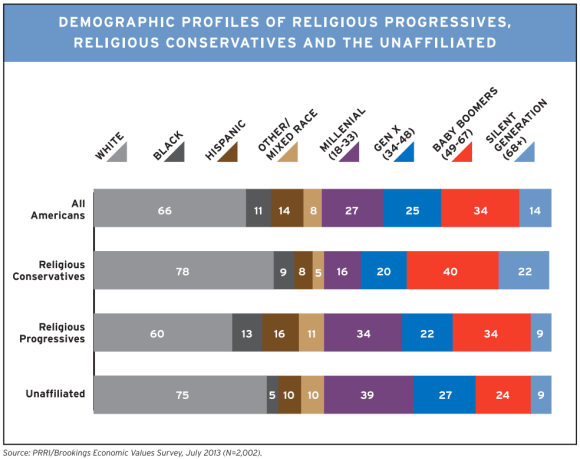
Ethnic Origin, Age and Religious Views (US)

Interesting analysis by Emma Green cross-referencing ethnic origin, age, and religious views in the US:

Blacks, hispanics, and people of mixed race are all more likely to be religious progressives than conservatives; these groups are also among the fastest-growing demographics in the United States. Similarly, Millennials are more than twice as likely to be religious progressives than religious conservatives; in fact, people older than 50 make up more than 60 percent of those who are considered to be religious conservatives. Although it’s impossible to talk to an 18-year-old about her views on culture and predict what she’ll think in two decades, these demographic trends suggest that the religious right is about to start shrinking.

But the question of influence is a little fuzzier. Although more than a third of Millennials are considered religious progressives, roughly 40 percent don’t have any faith at all: A growing number of young people don’t identify with a particular religion. That, along with the fact that an overwhelming majority of religious progressives don’t see religion as “the most important thing in their life,” suggests that faith is losing its overall influence over how people think about social and cultural issues.

Chart Of The Day « The Dish.

Canada hires rookie groups to lead Ukraine election observers

While not clear why the Government chose inexperienced organizations to lead Canada’s team of observers to Ukrainian elections compared to Canadem (public service advice was clear), the size of the delegation reflects diaspora politics. Understandable that governments want more visibility than contributions to international organizations, but still questionable:

Canada’s assignment of such large numbers of bilateral observers — the Liberals did it first in 2004, and the Conservatives have followed suit — has continued despite internal warnings.

One such warning came from Bob Johnston, a regional director general with the former Canadian International Development Agency, in a January 2012 memo.

Johnston recommended Canada channel its election observation efforts through the internationally recognized leader in the field, the Organization for Security and Co-operation in Europe, or OSCE.

However, Johnston noted the government may want to send in short-term bilateral observers “to demonstrate Canada’s commitment to Ukraine’s democratic development” — a message that Prime Minister Stephen Harper and his cabinet have repeatedly emphasized.

“If this option is selected, Canadem would again be the only possible partner,” Johnston wrote.

Johnston’s boss, then CIDA president, Margaret Biggs, agreed.

“Canadem, a Canadian NGO with a long track record of recruiting, training, and deploying election observers, is the proposed implementing organization,” Biggs wrote in a July 2012 memo. CIDA has since been merged into Foreign Affairs….

Veteran Canadian election observers, who have served on numerous international missions, criticized the government for sending such large numbers of bilateral observers when no other country does so. They agreed to speak on the condition they not be identified because all are independent contractors who rely on international work for their livelihoods.

They say the government is sending large numbers of observers to win votes at home because there are an estimated 1.2 million people of Ukrainian descent in Canada.

“You’ve got the gold standard with the OSCE, and we’re sending the maximum contribution we can send anyway. On top of that, for domestic political reasons we’re sending another however-many-Canadians for no reason at all,” said one observer.

Canada hires rookie groups to lead Ukraine election observers.

Middle Easterners Make Up Majority of Second-Citizenship Applicants, Report Says – Middle East Real Time – WSJ

Not surprising:

But statistics in a new report commissioned by Arton Capital, one of those firms, suggest people from the Middle East have come to dominate the citizenship-for-investment landscape.

Just shy of 60% of the world’s super-wealthy who apply for second citizenships come from the region, by the reckoning of Wealth-X, an information company that crunched numbers for the report. Despite containing just 5% of people classified as “ultra high net worth individuals” – multi-millionaires and billionaires – the Middle East now accounts for a majority of the world’s uber-wealthy citizenship-seekers.

Political instability probably has a lot to do with it. Since the Arab Spring erupted in 2011, scores of wealthy people from countries like Lebanon, Egypt and Syria have jumped on the second-citizenship bandwagon as a way to ensure they can still travel, do business and even relocate their families permanently if need be in the fact of instability. People from Lebanon, beset by spillover from Syria’s civil war, made up 15% of second-citizenship applicants, according to the report, while Syrians and Egyptians each made up 7%.

Middle Easterners Make Up Majority of Second-Citizenship Applicants, Report Says – Middle East Real Time – WSJ.

A Tool That Maps Out Cultural Differences – Harvard Business Review


Comparing_Management_Cultures_-_Harvard_Business_Review

Interesting approach to understanding cross-cultural differences from a management perspective. Canada does not figure but the graphs are interesting. Risk of stereotyping, of course, but it may help people reflect on their styles and the impact on others:

Erin Meyer, an American (from Minnesota) in Paris who coaches executives in managing cross-cultural career moves and teaches at INSEAD in Fontainebleau, has a theory about these malentendus. The problem, she argues, is that most people tend to emphasize just one or two, at most three, dimensions of cultural difference when it comes to parsing and predicting foreigners’ behavior.

But cultures differ along many more than three dimensions, so the more dimensions you consider, the less likely you are to trip up on a cultural paradox — you’ll be able to tell that incoming French manager to tone down critiques of his American subordinates before he upsets them.

The trouble, of course, is that it’s cognitively difficult for us to keep more than three dimensions of comparison in our head at once. What’s more, we tend to lose sight of the fact that relative, not absolute differences, are what matters. Most cultures would find the Brazilians to be very relaxed about punctuality, for instance, but Brazilians themselves tend to struggle to adapt to Indians’ even more casual notions of time.

A Tool That Maps Out Cultural Differences – David Champion – Harvard Business Review.

Companies see diversity pay off

An example of diversity leadership in legal practice, Denton’s Canada (highlighting their Calgary office):

“From a cultural perspective, we’ve had zero pushback from senior leadership on embracing (diversity and inclusion) programs,” says Ghitters. “Diversity isn’t a fad. We’re in it for the long term.”

Having been recognized recently as one of Canada’s Best Diversity Employers by Mediacorp Canada Inc., Ghitters said diversity has to be built into the culture of a company with buy-in from the top down.

In the past six to eight months, the company has done everything from host several events supporting the LGBT community, had inspirational speakers, and ongoing support from the firm’s regional diversity committees for its array of programs.

It’s all part of an effort to instil a sense of support for diversity in every aspect of the company’s operations.

It appears to be working. “Any good workplace culture has some fun to it and this is a good way to celebrate diversity,” said Jordan Deering, partner and co-lead of the diversity committee in Calgary with Ghitters.

They use the simple method of reflecting the naturally diverse nature of the clients they serve and the cities they operate in across Canada.

“It also assists us in approaching legal issues from different perspectives and ways of thinking,” says Deering. “It helps us look at things from all angles.”

Companies see diversity pay off.

Why Race Has Been the Real Story of Obama’s Presidency All Along

Lengthy but interesting article by Jonathan Chait on the enduring legacy of slavery, and how it plays into the political and ideological divides in the US. Worth reading:

And the truth is almost too brutal to be acknowledged. A few months ago, three University of Rochester political scientists—Avidit Acharya, Matthew Blackwell, and Maya Sen—published an astonishing study. They discovered that a strong link exists between the proportion of slaves residing in a southern county in 1860 and the racial conservatism (and voting habits) of its white residents today. The more slave-intensive a southern county was 150 years ago, the more conservative and Republican its contemporary white residents. The authors tested their findings against every plausible control factor—for instance, whether the results could be explained simply by population density—but the correlation held. Higher levels of slave ownership in 1860 made white Southerners more opposed to affirmative action, score higher on the anti-black-affect scale, and more hostile to Democrats.

The authors suggest that the economic shock of emancipation, which suddenly raised wages among the black labor pool, caused whites in the most slave-intensive counties to “promote local anti-black sentiment by encouraging violence towards blacks, racist norms and cultural beliefs,” which “produced racially hostile attitudes that have been passed down from parents to children.” The scale of the effect they found is staggering. Whites from southern areas with very low rates of slave ownership exhibit attitudes similar to whites in the North—an enormous difference, given that Obama won only 27 percent of the white vote in the South in 2012, as opposed to 46 percent of the white vote outside the South.

The Rochester study should, among other things, settle a very old and deep argument about the roots of America’s unique hostility to the welfare state. Few industrialized economies provide as stingy aid to the poor as the United States; in none of them is the principle of universal health insurance even contested by a major conservative party. Conservatives have long celebrated America’s unique strand of anti-statism as the product of our religiosity, or the tradition of English liberty, or the searing experience of the tea tax. But the factor that stands above all the rest is slavery….

And yet—as vital as this revelation may be for understanding conservatism, it still should not be used to dismiss the beliefs of individual conservatives. Individual arguments need and deserve to be assessed on their own terms, not as the visible tip of a submerged agenda; ideas can’t be defined solely by their past associations and uses.

Liberals experience the limits of historically determined analysis in other realms, like when the conversation changes to anti-Semitism. Here is an equally charged argument in which conservatives dwell on the deep, pernicious power of anti-Semitism hiding its ugly face beneath the veneer of legitimate criticism of Israel. When, during his confirmation hearings last year for Defense secretary, Chuck Hagel came under attack for having once said “the Jewish lobby intimidates a lot of people up here,” conservatives were outraged. (The Wall Street Journal columnist Bret Stephens: “The word ‘intimidates’ ascribes to the so-called Jewish lobby powers that are at once vast, invisible and malevolent.”) Liberals were outraged by the outrage: The blog Think Progress assembled a list of writers denouncing the accusations as a “neocon smear.” The liberal understanding of anti-­Semitism is an inversion of conservative thinking about race. Liberals recognize the existence of the malady and genuinely abhor it; they also understand it as mostly a distant, theoretical problem, and one defined primarily as a personal animosity rather than something that bleeds into politics. Their interest in the topic consists almost entirely of indignation against its use as slander to circumscribe the policy debate.

Why Race Has Been the Real Story of Obama’s Presidency All Along — New York Magazine.

C-24 – Citizenship Act Revisions – Committee Hearings Started

Will be interesting to see how these play out. First day was essentially introduction plus some initial positions from the opposition parties:

… NDP opposition critic Lysane Blanchette-Lamothe started off by asking Alexander to address the bill’s constitutionality. Given the Harper government’s record on tests of constitutionality before the Supreme Court recently, the question’s a touchy one.

In particular, she asked whether the new requirement for those applying for Canadian citizenship to declare their intention to reside in Canada post-citizenship — violated sections six and 15 of the Charter — those that protect the right to free mobility and equal protection under the law.

“With regard to our bill and the constitution — of course we reviewed this bill in that context. I carried this out with my colleague the minister of justice and we believe this bill is in complete conformity with the requirements of our constitution,” Alexander answered in French.

“It is reasonable, in our view, to require that a permanent resident wishing to become a Canadian citizen express his or her intention to reside in Canada.”

Liberal critic John McCullum focussed on the impact of no longer providing credit to foreign students for time spent in Canada prior to becoming permanent residents as part of residency qualifications. Minister Alexander restated the government’s position.

This change also affects refugees, arguably not a priority for the Government, and live-in caregivers. The latter, largely Filipinos, may, should the Filipino Canadian community become active on this issue, may be more problematic given that this community is one of the Government’s political target communities.

To be continued, and thanks to iPolitics for covering the hearings.

Citizenship reform bill is constitutional, Alexander assures committee