Federal government turning to Dragons’ Den to shake up policymaking

Interesting. Is this part of transition planning for a future government that may be more willing to loosen the reins?

Or is it more “make work” given that we have a government that, for understandable – if not necessarily justifiable – reasons, prefers to limit discussion and debate, and reduce the independence of watchdogs.

How much latitude does the government want bureaucrats to have, given their perception, not completely unfounded, of our biases?

Will future governments bring us “back to the good old days” (which were not so good anyway) or not?:

According to the briefing documents, some of the innovative policy ideas the government is looking to test as pilot projects could include using social media or other tools to engage or consult the public, end users and others to help inform policy development; or creating a “tiger team” to address specific, time-limited objectives.

Other examples of possible pilot projects include using open data, such as launching a challenge to design apps, or innovative “social finance instruments” to help address social problems.

The deputy ministers’ committee was created in November 2012 and originally called the DMs’ “committee on social media and policy development.” It was initially mandated to consider links between social media and policymaking, including new models for policy development and public engagement.

As of December 2013, the committee was asked to move beyond social media to examine trends and new technologies to help improve and transform policy development.

Yet, the rise of social media and its impact on how government communicates its messages and develops policy remains a concern to the government, according to the documents.

“Many governments around the world are seeing their authority decrease as autonomous networks of citizens and stakeholder groups emerge, decreasing the impact of governments on public policy. Concurrently, the public is becoming less deferential to authority,” the documents note.

The changes in ease of access to information and data are “effectively undoing governments’ monopoly on policy analysis,” says the briefing material.

“Social media is fundamentally changing the nature of citizen-state relations. Citizens increasingly expect democratic governments to be transparent, participative, responsive, and to provide customizable and digital services,” the documents say.

“The speed of social media interactions puts pressure on government to develop quick and coordinated responses, which can conflict with longer-term policy and communications planning and priority setting.”

Federal government turning to Dragons’ Den to shake up policymaking | Ottawa Citizen.

Mothers the latest weapon in U.K.’s fight against terrorism

Another UK initiative to reduce radicalization and extremism:

Now British police are hoping to tap into that mother’s instinct to protect her children. In April, they launched an unprecedented program to encourage Muslim women to contact authorities if they suspect their loved ones are planning to travel to Syria or have already gone.

Women are often best placed to intervene, says deputy assistant commissioner Helen Ball of the Metropolitan Police, one of three senior female police officers running Britain’s counterterrorism operations.

“This is very much about prevention and protection,” says Ball, who devised the program. “It is women who . . . notice a change in behaviour very quickly. We want women to feel confident to come forward, whether it is to police, or a community member they trust or a school teacher.”

Such initiatives — from the benign to the extraordinary — are being taken by governments as they struggle to reduce the number of western Muslims joining the war in Syria for fear they return to cause carnage on the streets of their homelands.

On Tuesday, U.S. Attorney General Eric Holder called the issue a “global crisis in need of a global solution.”

“The Syrian conflict has turned that region into a cradle of violent extremism. But the world cannot simply sit back and let it become a training ground from which our nationals can return and launch attacks,’” Holder said in a speech to Norwegian diplomats and national security officials in Oslo.

… But as Einas Deghayes [mother of an extremist killed in Syria] insists, it is often the mothers who are the last to know what their children are up to.

Mothers the latest weapon in U.K.’s fight against terrorism | Toronto Star.

Robyn Urback: If you want to learn abstinence, go to church. Get Christian sex-ed out of secular public schools

A reminder of other forms of fundamentalism.

It is not just the anecdotes cited by Urback regarding the effectiveness of abstinence approaches; the contrast between California and Texas is striking (Texas Isn’t Keeping Up With National Drop in Teenage Births):

The Pregnancy Care Centre taught courses in about 60 Edmonton-area schools last year, according to executive director Norah Kennedy. She says that their presentations do not explicitly mention Christianity, though the Centre was founded on religious principles. “We are brought in to speak from an abstinence-based perspective; which differs from abstinence-only presentation,” she told the Edmonton Journal. “We present abstinence as the best and safest choice while also giving them a comprehensive overview of all of their options.”

That may be true (though the Dawsons’ complaints, which have yet to be proven, say otherwise). Even still, an abstinence-focused sexual education program will not offer the same wide-ranging, balanced approach to education that a class without an “agenda” can deliver. Indeed, there’s a difference between a lecturer telling students to use a condom if they must, and a lecturer showing students how to properly put on a condom, why they shouldn’t layer condoms (it happens, amazingly enough), why they should use a condom for both vaginal and anal sex (that happens in high school, too) and what to do if the condom breaks.

Students wanting to know about same-sex relationships, the morning after pill and other religious no-nos should also feel free to do so without judgment; that’s hard to do when someone from a faith-based organization is standing at the front of the class. This might be a human rights issue for Emily and her mom, but it’s arguably more an access to education issue for everyone else. Christian sex education should stay out of secular public schools.

The Edmonton School Board dropped the program offered by Pregnancy Care Centre following the complaint and publicity.

Robyn Urback: If you want to learn abstinence, go to church. Get Christian sex-ed out of secular public schools

Chart of the Day: Hate crimes – Five-Year Trends

Source: StatsCan Police-reported hate crimes in Canada (2008-12)

Source: StatsCan Police-reported hate crimes in Canada (2008-12)

Thanks to New Canadian Media, the Statscan 2012 hate crimes report is getting some attention (reporting Share News):

There were 82 more hate crime incidents in Canada in 2012 than in 2011. Some of the increase is partly due to improvements in reporting by some police services.

The study lists Hamilton, Thunder Bay and Peterborough as having the highest incidents of hate crime in Canada.

And the majority, or 82 per cent of hate crimes, occurred in major cities with Toronto, Montreal, and Vancouver leading the way.

Of the hate crimes reported and examined, 75 per cent had been confirmed by police as hate-motivated; and the remaining 25 per cent were recorded as suspected, Statistics Canada said.

Looking at the report, and comparing with the previous four years, some observations:

  • the overall level of hate crimes is remarkably stable (about 1,400 per year);
  • mischief continues to be the most common hate crime;
  • race and ethnicity continue to account for around 50 %;
  • black victims consistently account for about 40 %;
  • Jewish victims range from 53 to 71%, with no trend line ;
  • Muslim victims range between 9 and 15%, similarly with no trend line; and,
  • while victims of hate crimes, save for sexual orientation, are relatively distributed in terms of age, those accused of hate crimes are overwhelmingly young. In both cases, males are predominant.

Some of the disparities in reporting rates (these are police reported hate crimes) reflects the comfort different communities have in reporting to the police.

Muslim hate crimes are likely relatively under-reported given the newness of the community to Canada and likely trust issues with the police.

In contrast,  Canadian Jews are more well established and comfortable reporting to the police, in part given the work of B’nai Brith.

Hate crimes increasing against Blacks and Jews – StatsCan | Share News.

Direct link to the StatsCan report (worth reading):

Police-reported hate crime in Canada, 2012

ICYMI: The Immigrant Advantage – NYTimes.com

The_Immigrant_Advantage_-_NYTimes_comInteresting piece on the relative success of immigrants in the US compared to native-born Americans, particularly in the poorer states with weaker public and other supports:

American scholars have long warned of declining “social capital”: simply put, people lacking the support of others. In Texas, I encountered the wasteland described by writers from Robert D. Putnam on the left to Charles Murray on the right. In mostly white, exurban communities that often see themselves as above the woes of inner cities, I found household after household where country music songs about family and church play but country-music values have fled: places where a rising generation is often being reared by grandparents because parents are addicted, imprisoned, broke or all three.

In places bedeviled by anomie, immigrants from more family-centered and collectivist societies — Mexico, India, Colombia, Vietnam, Haiti, China — often arrive with an advantageous blend of individualist and communitarian traits.

I say a blend, because while they come from communal societies, they were deserters. They may have been raised with family-first values, but often they were the ones to leave aging parents. It can be a powerful cocktail: a self-willed drive for success and, leavening it somewhat, a sacrificial devotion to family and tribe. Many, even as their lives grow more independent, serve their family oceans away by sending remittances.

The Immigrant Advantage – NYTimes.com.

Douglas Todd: We must stand on guard for Canada

Douglas Todd captures the ongoing debate on new Canadians and Canadian values.

I tend to favour Tung Chan’s more pragmatic approach but with a bit more teeth with respect to public and private institutions in terms of setting accommodation limits when they conflict with fundamental equality rights:

Rohani, a businessman who has sat on RCMP diversity committees, and Dosanjh, a lawyer whose biography will be released on Aug. 5, want prospective immigrants to Canada to be taught the essentials of liberal democracy and equality.

“Speaking as an immigrant, if we choose Canada as the best place to come and live, then why aren’t we following its values?” Dosanjh says. “If we want to recreate the society we left behind, why don’t we just stay there? It’s incumbent upon us newcomers to embrace the whole of society, not just its dollars.”

Tung Chan, former head of the government-financed immigrant services society, SUCCESS, is a friend of Rohani’s. But he’s more sanguine about the religion-rooted hazards facing liberal democracy.

Chan would prefer not to highlight the difficulties associated with what he claims in Canada is only the “one per cent who are mal-adapted” and don’t embrace free choice and equality.

Although Chan agrees with Rohani and Dosanjh that new immigrants and all Canadians should be taught about the country’s laws, Constitution, and Charter of Rights and Freedoms, Chan takes a hands-off approach beyond that.

“After the teaching is done,” Chan says, “whether they choose to accept or reject our value system is entirely up to them as long as they do not break the law.”

Dosanjh strongly disagrees, maintaining Canadians shouldn’t be so shy about upholding democratic principles. “Society is not just governed by laws. We have our values, our ethics, our integrity. It’s not a written law, for example, that we should allow people to marry whoever they want to marry.”

Douglas Todd: We must stand on guard for Canada.

Misbahuddin Ahmed found guilty of 2 terrorism charges and ISIS Recruitment Video with Canadian

Yet another terrorism conviction. Born in Pakistan, raised in Montreal, radicalized in Canada, a likely candidate for citizenship revocation under the new Citizenship Act:

Conspiring to knowingly facilitate a terrorist activity carries a maximum sentence of 14 years in prison, while participation in the activities of a terrorist group has a 10-year maximum term.

Ahmed will be sentenced on Sept. 15.

Mark Ertel, Misbahuddin Ahmeds lawyer, said after the verdict that his client was misguided for a short period of his life but is a good man. “I’m devastated by the verdict, it’s never easy to lose a case and it’s especially hard to see someone like this be convicted of these types of offences,” said Ahmeds lawyer, Mark Ertel.

“He’s a good man, a family man, the jury obviously found that for a short period of time in his life he was misguided but the acquittal on the third count proves they realized if there was any danger to Canadians or anyone he put an end to it.”

Crown lawyers said during the trial that Ahmed was a “committed jihadist” with an eye on potential Canadian targets, pointing to a bag in his basement they alleged held bomb-making materials.

Misbahuddin Ahmed found guilty of 2 terrorism charges – Ottawa – CBC News.

And another example of a terrorist or extremist, born, raised and radicalized in Canada, and would not be subject to revocation (if he were still alive):

An Ontario janitor who died while fighting with an extremist group in Syria said in a posthumous video released Friday that he had left Canada because he could no longer live among non-Muslims.

“Life in Canada was good,” André Poulin, a Muslim convert who fled to Syria following a string of arrests in Timmins, Ont., said in an Islamic State of Iraq and Al-Sham recruitment video that encouraged others to follow his path.

“I had money, I had good family. But at the end of the day, it’s still dar al-kufr [a land of disbelief] and at the end of the day you cannot obey Allah fully as you can by living in a Muslim country, in an Islamic state,” he said.

…. But Poulin was hardly a regular Canadian. He was a troubled youth who had repeated brushes with the law for crimes such as uttering threats until he left to remake himself as a jihadist fighter. He was killed last summer in northern Syria.

“He accepted Islam in a land at war with Islam,” a narrator said in the video, referring to Canada, “in a land with few Muslims, in a land where evil, kufr [disbelief] and sin called him from every direction and corner to succumb to Satan and to his desires.”

It said he had married after arriving in Syria and that his wife was pregnant when he was killed while trying to capture the Mennegh airport. In his address from the grave, Poulin implored recruits to leave the West and join him.

“My brothers, how can you answer to Allah when you live on the same street, when you’re using their light and you’re paying taxes to them and they use these taxes to assist their war on Islam. You can’t live as a Muslim,” he said, adding those who can’t fight should “give money.”

The flow of radicalized youths to Syria has become a top priority for Canadian security and intelligence officials, who fear recruits could one day return home, bringing their paramilitary training and violent anti-Western ideology with them.

Parents of those lured to Syria have also becoming increasingly vocal, calling for government action to deal with radicalization and recruitment. Several dozen Canadians are fighting in Syria, and some have joined ISIS, which has seized parts of northern Syria and Iraq through a campaign of guerrilla warfare, suicide bombings and mass executions.

Concerned about the number of Canadians leaving to join armed factions in Syria, imams from across the country issued a statement last month warning Muslim youths against traveling abroad to fight in foreign conflicts.

The Canadian Council of Imams denounced the “narrow, bigoted, dogmatic distortions of the purveyors of violence and terror,” and called for “meaningful discussions, to engage in preventative strategies and to find meaningful solutions to this growing threat in our country.”

‘Regular Canadian’ killed in Syria conflict featured in slick, new ISIS propaganda video

Kenney to consider exemptions to temporary foreign worker plan – Macleans.ca

Kenney’s consistent messaging while suggesting some flexibility on the margins:

While Kenney attempted to strike a conciliatory note toward the provinces, he took a hard-line toward employers, whom he has criticized in the past as relying on relatively cheaper foreign workers as business model for success.

“We would encourage employers — I’m not talking about any region or industry in particular — we would encourage employers to redouble their efforts to hire and where necessary accommodate local unemployed workers,” Kenney said.

That could mean raising pay, allowing more flexible hours, investing in training or providing transport to work from hard-to-reach areas, he said.

“We think those options are all preferable than picking up the phone and calling a labour recruiter on the other side of the world and having someone fly you in from a developing country, into a region of double-digit unemployment.”

Kenney to consider exemptions to temporary foreign worker plan – Macleans.ca.

Jonathan Kay: Stop calling people ‘racialized minorities.’ It’s silly and cynical

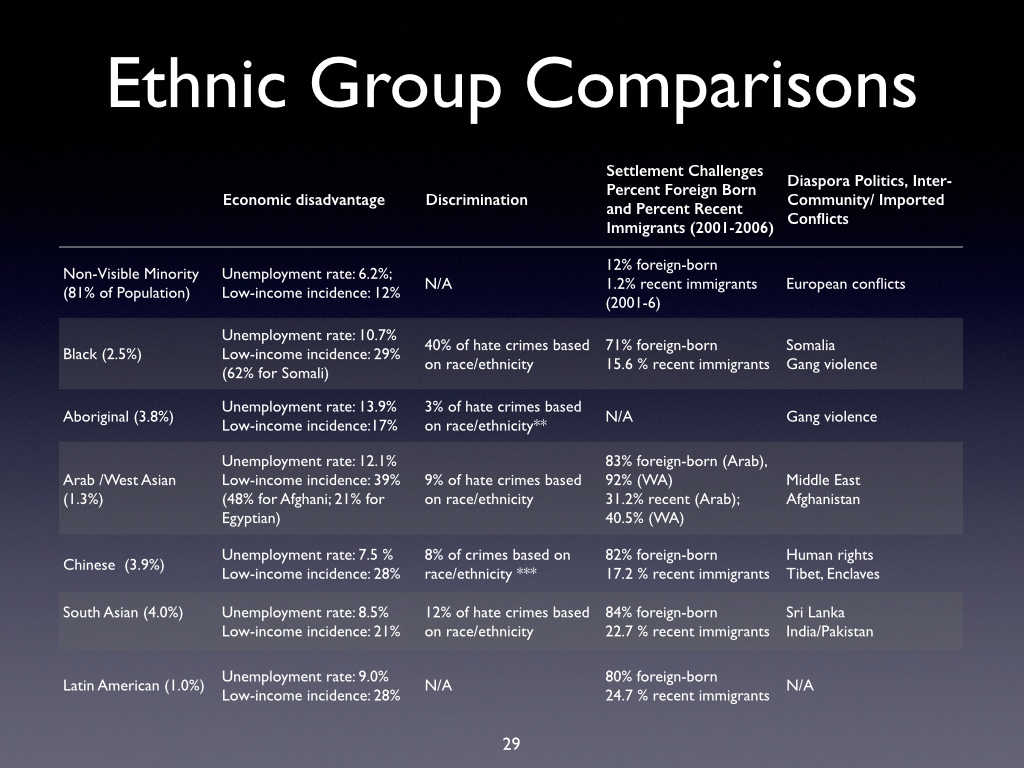
Ethnic Community Comparisons

From Policy Arrogance or Innocent Bias: Resetting Citizenship and Multiculturalism

Jon Kay takes the easy route out on faulting Carol Goar on her terminology, “racialized,” but ignores the broader, and more uncomfortable question she raised regarding inclusiveness and participation (Toronto is diverse but not as inclusive as it could be):

“Racialized Torontonians” as they call themselves?

Here’s a question for readers who live in Toronto: Do you know a single ordinary person — someone who is not either an activist, or enrolled in feminist film studies at Ryerson, or a “diversity consultant” hired by governments and big companies — who routinely refers to herself or anyone as a “racialized” person?

To be more specific, have these words ever escaped anyone’s lips within the 7,124 square kilometers of the Greater Toronto Area: “As a racialized Torontonian, I’m supporting Argentina over Germany in the World Cup final.” “As a racialized Torontonian, that shade of eye shadow really doesn’t go with my skin tone.” “As a racialized Torontonian, I’m having trouble finding a restaurant that serves authentic soul food.”

I suspect that most ordinary Torontonians would be utterly confused if Ms. Goar insisted on addressing them as a “racialized” person in a restaurant or store. They might assume she was taking some kind of ethnic census. If pressed to describe themselves through the lens of race-obsession, they might more simply respond: “If you really want to know, I’m half-black.” Or, “I’m Sephardic Jewish with a quarter Latino.” Or “I was both in The Philippines.” Or perhaps many might just avoid eye contact and say, “I’m a Canadian who lives in Toronto.”

Jason Kenney questioned the use of the term “racialized” along with “white power” and “oppression.” Grant and contribution proposals that included these terms, or websites of applicants with these terms, were routinely rejected.

While the underlying policy rationale was overdue – given Canada’s increased diversity, integration challenges within and among communities were equally significant – this change downplayed equity aspects of multiculturalism.

Jonathan Kay: Stop calling people ‘racialized minorities.’ It’s silly and cynical | National Post.

Refugee health cuts: Not cruel but unusual – Colby Cosh

Colby Cosh takes a self-critical look at journalists and commentators on how they influenced the refugee claimant healthcare decision:

This is pleasing to the ego, yet I am not as confident as Justice Mactavish that the Conservative cuts to the old refugee health arrangements are shocking to Canadians. One obvious problem with using pundits as an index of conscience is that people who are angry about something will write about it, and people who aren’t, won’t.

The old IFHP provided not only the health care ordinarily given free to citizens by the provinces, but also extra entitlements working Canadians typically devote part of their paycheques to, including drug coverage, vision care, dentistry and contraception. Refugee claimants typically became eligible for IFHP immediately upon setting foot in the country—and remained eligible until they were removed from Canada, even if their refugee claims failed. ….

These [diabetic Afghan, Colombian eye surgery] are hard cases that could have been rectified by means of modest tweaks. Justice Mactavish instead threw out the whole 2012 IFHP revision, citing a further panoply of ill-documented or downright hypothetical cases in which the effects of the revised IFHP might also be “cruel and unusual.”

This procedure has met with near-universal approval from journalists. We, after all, sort of helped write the ruling. But what if the Conservatives run against it in 2015, challenging the media’s reading of the nation’s “general conscience”. . . and they win? Should we really be so sure we speak for you?

Valid points, but part of the role of journalists is to draw issues to our attention, and the decision likely relied more on the testimony of doctors and healthcare experts than journalists. And the Government, as in so many cases, by aiming for simple and simplistic solutions, along with its apparent lack of evidence (not to mention rhetoric), did not help itself. Refugee health cuts: Not cruel but unusual.