Why far-right nativist political parties stand no chance in Canada

Bit of a flawed and limited analysis by James Yan.

Canada is more welcoming, accepting, tolerant than other immigration-based countries like the US and Australia. Europe is not a comparator region.

Our history influences who we are, and as Kymlicka and Ibbitson’s popularization (Why is Canada the most tolerant country in the world? Luck), there are unique factors to our history, particularly the (imperfect) accommodation to aboriginal Canadians and more significantly French-English accommodation that provide the backdrop and culture for a more accommodating political culture.

And we recognized, belatedly, many of the unfortunate incidents of our past.

So while demographics now make it impossible, how we got here, and the contrast with other immigrant-based societies, are equally important factors:

In the case of Canada, however, the proportion of Canadian citizens who are foreign-born and the proportion who are members of a visible minority, at 20.6 per cent and 19.1 per cent respectively as of 2011, is simply too high for a nativist party to even be politically viable. Political parties in Canada win elections only by winning the support of a broad coalition of voters, especially immigrants and second-generation immigrants who belong to visible minorities, since they form such a sizable chunk of the electorate. In Canada, any far-right nativist political party will inevitably self-destruct since it alienates the very voting bloc from whom it inescapably needs votes.

In Europe, on the other hand, nativist parties are doing well because the proportion of foreign-born people in most countries is nowhere near as high as that in Canada. According to the United Nations Population Division’s 2013 International Migration Report, the percentage of the population that is foreign-born in most European countries mentioned at the beginning of this article is between five and eight per cent. European countries are also more ethnically homogeneous. This is why nativist political parties in Europe can afford to lose the immigrant and visible minority vote yet still perform so well in elections.

So it seems that hostility towards “outsiders” resembles a bell-shaped curve. These perceived outsiders can be scapegoated up to a certain point, but once they have attained a critical mass in any given country, nativist political parties cease to be politically viable. Luckily, Canada today is positioned on the right side of this bell curve.

Those who ignore history are condemned to repeat it.
Why far-right nativist political parties stand no chance in Canada | Embassy – Canadas Foreign Policy Newspaper.

Canadian charities in limbo as tax audits widen to new groups – Politics – CBC News

Not quite sure whether the list below passes the “smell” test of being neutral and completely free of political direction:

“CRA audits occur at arm’s length from the government and are conducted free of any political interference. Our government is committed to ensuring that our tax system is fair for all Canadians.”

The tax agency acknowledges it has been auditing the political activities of a variety of charities whose work focuses on animal welfare, poverty, education, religion, health, human rights and others.

Canadian charities in limbo as tax audits widen to new groups – Politics – CBC News.

Canada’s immigration enforcement system suffers from ‘orchestrated mismanagement,’ whistleblower claims

Interesting read. Despite the Government’s efforts and messaging, deportations and removals have declined.

And yet, in the Toronto region, about 3,000 fewer deportations took place in the last fiscal year over the previous year, a drop of about 34%, he says. Nationally, there were about 5,000 fewer deportations, down about 26%. That follows year-after-year increases in deportations since the 2008-09 fiscal year, he says.

CBSA had projected removing 17,075 people nationally in the last fiscal year but only managed to remove 13,900 and is the first time in perhaps a decade CBSA’s target was missed, the letter says.

As to his allegations of “organizational mismanagement,” hard to comment without having a full picture. And performance pay reflects the range of responsibilities of senior executives, not just one file (unless it is one of those files that contaminates all those it touches!).

Canada’s immigration enforcement system suffers from ‘orchestrated mismanagement,’ whistleblower claims | National Post.

Homegrown jihadis: Canadians have always fought in other people’s wars – Granatstein

Jack Granatstein’s fine reminder that Canadians have often fought in other wars and conflicts:

The government of Mackenzie King tried to stop Canadians from going to Spain, and it passed the Foreign Enlistment Act in April, 1937, to prevent men from signing up for foreign wars. The volunteers went to Spain anyway, while countless others donated money to the cause. Most of the Canadians who went to fight – 76 per cent, according to Michael Petrou’s fine study of the Mac-Paps – were Communist Party members, most recent immigrants to the Dominion. The Mac-Paps earned a reputation for political unreliability and combat effectiveness, and at least 400 never returned home. These “premature anti-fascists” suffered for their political sins in the Second World War and Cold War years.

The Foreign Enlistment Act remained on the books, but it didn’t stop Canadian Jews from fighting for Israel or raising millions of dollars for its support. Ben Dunkelman, who had served with distinction with the Queen’s Own Rifles in Europe, went to Israel in 1948 and led a brigade with great success in Israel’s independence war. Many others did so, including George Buzz Beurling, a Royal Canadian Air Force fighter ace and a gentile, who joined the Israeli Air Force as a well-paid mercenary. Beurling died in an air crash in Rome on his way to the Middle East. Many other Canadian Jews served in the major Arab-Israeli wars of the following decades. Others serve in the Israeli military to this day, all presumably in violation of Canadian law.

Then there was the Vietnam War. While hard numbers are unavailable, estimates are that as many as 50,000 Canadians served in the U.S. military during that long, bloody struggle. Some enlisted out of the conviction that North Vietnam was an aggressor state, others presumably because of an adventurous spirit that could not be satisfied in the Canadian Forces because of Ottawa’s preference for United Nations peacekeeping. Once again, the law was not applied against Canadians who fought abroad.

None of those war veterans brought jihad home to Canada, a legitimate concern we live with today, although some communists who fought in Spain might have had attitudes inimical to the Canadian capitalist state. Most of the Islamist volunteers, if they survive to return to Canada, will likely settle down to a “normal” life. But so long as ideology, religion, adventurism and a soldier’s pay still matter, Canadians will likely continue going off to fight in other people’s wars.

Not sure where he stands on citizenship revocation in such cases, but clearly his expectation is that most will “grow out of it” and return to Canada, which may be a bit naive given the intensity of their beliefs and the nature of the organizations they are fighting with.

Homegrown jihadis: Canadians have always fought in other people’s wars – The Globe and Mail.

When the “Multicultural” Penny Dropped – NCM

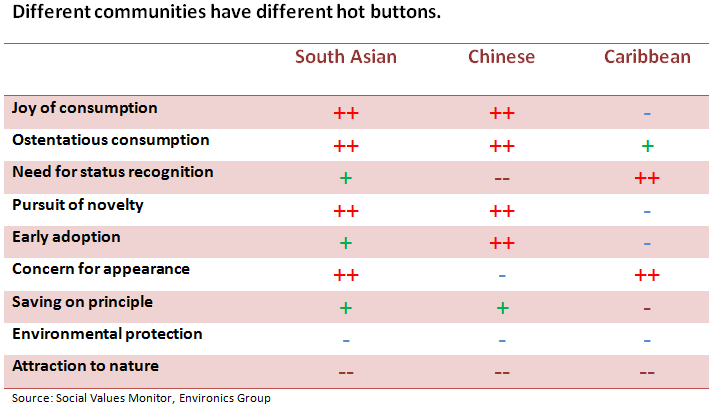
Diff comms have diff hot buttonsGautam Nath of Balmoral Multicultural Marketing on marketing to an increasingly diverse Canada:

Research was the backbone to facilitate professionalism in this market. There were but one or two long-established multicultural communication firms in Canada 20 years ago. Soon talent got together and a string of new agencies cut their teeth in the new space.

Today, there may be over 20 agencies, and in this digital era, each one looks very professional and established online.

The proof is in the pudding, however. Several agencies are literally one-man-shows operating from the confines of their basements looking to bag new business. A few have dedicated physical office space but operate with less than a handful of staff. And, literally, less than five agencies have dedicated in-house resources to support the full suite of client needs. However, this thin selection is supported by a contingent of planning, production, and other freelancers that give outside support to wherever the business goes.

Notwithstanding, over the years, the market has seen a wide range of companies wooing the multicultural consumer. In fact, it is estimated that the dollar spend of this community is about $40 billion annually and growing. But the challenge is that few marketers are constant spenders year on year.

With clients being erratic in their spending, each year is anybody’s guess.

Fortunes are made in a day and fortunes are lost with equal haste in the multicultural support services business. The long-standing, endurance-oriented and action-driven agencies will survive, others will truly shake in the wind.

Product groups that addressed these segments were the Big 5 banks initially and then the telecommunication providers. This was soon followed by large retailers, food products, real estate, automotive and entertainment. Education and settlement agencies are also growing in their spend in communicating to these audiences. But other than a handful with long-term vision and deep pockets, many are still in a pilot and a learning phase.

When the “Multicultural” Penny Dropped – New Canadian Media – NCM.

Canada’s new vision of citizenship: a privilege in two classes | The Migrationist

Louisa Taylor on the new Citizenship Act, starting off with a reminder just how moving citizenship ceremonies are to all who attend, criticizing the fundamental change in philosophy in differential treatment for single and dual nationals, and lamenting the lack of public debate.

Once we have a number of court cases and decisions, expect debate will pick up as the recent refugee claimant healthcare ruling illustrates:

There was no shortage of informed critique of the legislation, but the issue failed to catch fire with the general public. One migration advocate said privately last week she and her allies were shocked that the issue failed to move Canadians. It affected each one of us, after all, and a national survey in 2012 found that most of us – naturalized and citizens by birth alike – felt existing citizenship provisions were good enough. But to become bigger, the issue would have had to resonate not just with the quarter of Canadians who were born outside the country, but with the so-called “Canadian mainstream” of citizens by birth – exactly the people most likely to rarely think about citizenship at all.

The law will be in force soon, but the bitter aftertaste remains. Thousands more new Canadians will swear loyalty to the Queen this year, knowing – for better or for worse – their new home has put clear boundaries on their citizenship. Is that how we build a stronger sense of belonging?

Canada’s new vision of citizenship: a privilege in two classes | The Migrationist.

Europe takes rehab approach to Islamic extremists

German initiative to combat radicalization and extremism:

Bozay runs a project called Wegweiser, which means signpost in German. It seeks to prevent radicalization among Muslim teenagers in the city, which has a large Islamic community, with the help of schools, families, religious leaders and job centers. Besides Bochum, there are two Wegweiser centers in Bonn and Duesseldorf — all three aimed at engaging troubled youths before they fall into radical Islam.

The centers send out social workers who intervene when they see recruiters approaching teenagers on playgrounds, football fields and school yards, or when they carry out Islamic conversions on market squares. The workers engage the youths in conversation and try to offer solutions that steer them away from fundamentalism.

The centers, which were launched in April, have the backing of the security service in Germany’s most populous state, North-Rhine Westphalia. The state has seen a jump in the number of Salafists, adherents of an extreme fundamentalist version of Islam that has authorities worried. Their numbers have grown to 6,000 in Germany, according to official figures, with 1,800 in North-Rhine Westphalia alone.

“Salafism is a lifestyle package for young people because it offers them social warmth, a simple black-and-white view of the world, recognition by their peer group — basically everything they lack in real life,” said Burkhard Freier, who heads the states domestic intelligence service.

Europe takes rehab approach to Islamic extremists – Yahoo News.

Common lime name has racist history

Following the Redskins piece by Neil MacDonald (From Washington Redskins to queer culture, the uneasy evolution of the slur), another example of a term in need of changing:

There is a growing campaign to change the name of a variety of lime because it is viewed as offensive by some.

“Kaffir” lime is gaining popularity as North American cooks expand their culinary horizons into Southeast Asian food. The lime’s leaves are also used in parts of South Asia and Africa. It goes by many names around the world, but Veronica Vinje, a masters student in Intercultural and International Communications in Victoria, B.C., says the most common one is deeply racist.

Vinje says calling someone by this name in South Africa is akin to using the N-word to describe black people, while in the Middle East and South Asia, the name is a derisive term for non-Muslims.

​”Since there are so many other names for this lime already, I thought whats the big deal if we call it something else?” Vinje said. “Because it is becoming popular and trendy … and it’s not a very nice message to send to our citizens from Southern Africa … that know this term from a very bad history. Why not change it to something else?”

Common lime name has racist history – Canada – CBC News.

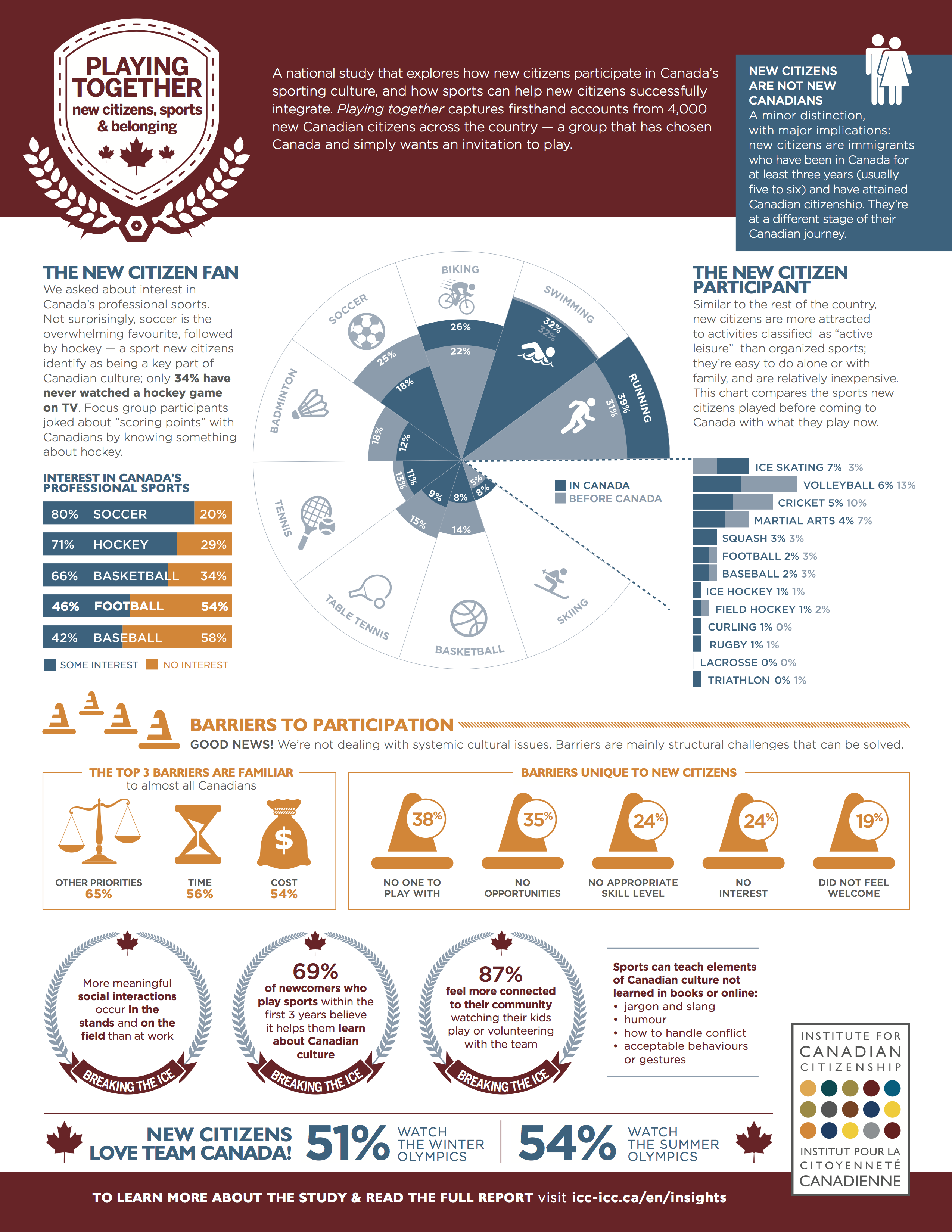
Chart of the Day: Sports and New Citizens

Great initiative by the Institute for Canadian Citizenship to raise the profile and encourage more new Canadian citizens to participate in sports, with a really good info graphic (which can be saved in a high-resolution pdf) and report (New citizens, sports & belonging):

Sports Infographic-FINAL


Court loss on refugee health cuts may still be Conservative win

I am not sure that it is as much of a win as Patriquin suggests, given that most commentary on both the left and right, has been against the Government (online comments and Sun Media excepted).

It’s like anything, the bumper sticker slogan works (in either direction) until human examples come out, making the issue more complex than the slogan or stereotype, sometimes changing public opinion:

It’s a stretch to say the Conservatives built laws specifically to fail in court, but their failure doesn’t hurt the brand nearly as much as some might think. Rather, the Conservative operative would say that the party has instead garnered crucial talking points for the coming election. By thwarting Conservative laws, the various courts—whose judges are as unelected as your local senator, remember—have essentially shown themselves to be the liberal and Liberal friend to every pot-smoking, drug-injecting, prostitute-loving, refugee-coddling softie out there. Each judicial decision against the Conservatives reaffirms a collective belief, and reinforces a handy stereotype.

In the most recent Federal Court case regarding refugees, the government isn’t quite clear on what constitutes a “bogus” claim. I asked, and the ministry sent a list of rejected, abandoned and withdrawn claims so far in 2014. The inference, I guess, is that every denied or dropped claim is inherently bogus. The number of refugee claimants doesn’t suggest a surge in abuse: as this chart shows, there were roughly 34,000 accepted refugee claimants in 2011, down from 2003’s 25-year high of 42,400.

In the end, though, it doesn’t much matter, because Prime Minister Stephen Harper and the Conservatives scored a double whammy. Having spent years making the case that Canada’s refugee system is replete with “bogus” claims, they can now claim the courts are in favour of immigrant hoards leeching off the Canadian dream. Even in loss they win.

Court loss on refugee health cuts may still be Conservative win.